Connect with us

NewsBeat

Livingston MP raises Uphall Post Office closure with UK Government Minister

Published

on

Daily Record

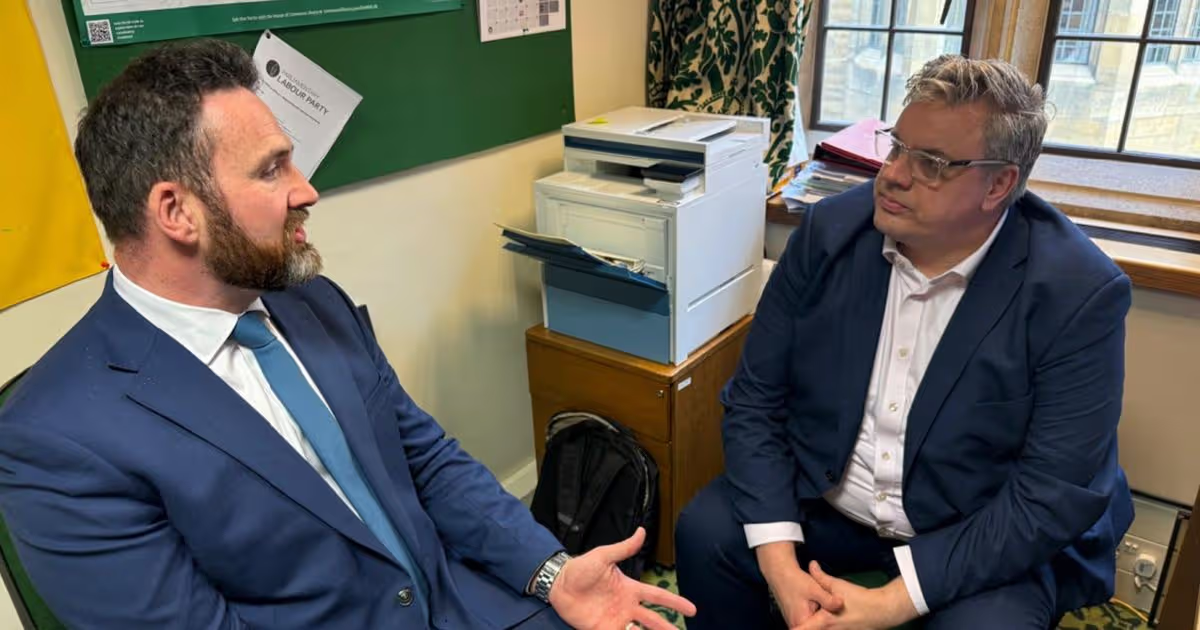
Gregor Poynton has met with Blair McDougall, Parliamentary Under-Secretary of State (Minister for Small Business and Economic Transformation), to press for urgent action to secure the future of Uphall Post Office.

Livingston’s MP has raised the Uphall Post Office closure directly with the UK Government’s Post Office Minister.

Advertisement

Gregor Poynton has met with Blair McDougall, Parliamentary Under-Secretary of State (Minister for Small Business and Economic Transformation), to press for urgent action to secure the future of Uphall Post Office.

Mr McDougall holds ministerial responsibility for the Post Office. During their meeting in Westminster, Mr Poynton outlined the impact the closure of Uphall Post Office is having on local residents, older people, and small businesses who rely on services in the village.

The Uphall branch on West Main Street closed following the resignation of the previous postmaster.

READ MORE: Baz Luhrmann takes centre stage on the big screen at Vue Livingston this March

Advertisement

Mr Poynton raised concerns about the disruption this has caused and sought assurances about what support the Government can provide to help Post Office Ltd secure a new postmaster and restore services as quickly as possible.

He said: “The closure of Uphall Post Office has had a real and immediate impact on local constituents. For many residents and small businesses, the services provided by the Post Office is essential.

“I met directly with the Minister responsible for the Post Office to make clear the strength of feeling locally and to ask what support can be offered to help secure a new postmaster for Uphall.

“It is vital that Post Office Ltd moves at pace to appoint a new operator and restore full services. I will continue working at every level, locally and nationally, to secure the long-term future of post office provision in Uphall.”

Advertisement

READ MORE: West Lothian apprentice enjoying combining work and college experience

Mr Poynton has pledged to remain in close contact with the Minister and with Post Office Ltd while a new operator is sought.

It is not yet known how long the West Lothian village will be left waiting for the restoration of the service.

The Post Office area change manager wrote to residents and local representatives in February to inform them of the decision.

Advertisement

He said: “We are writing to inform you that, regrettably, following the resignation of the postmaster.

“The provision of a Post Office service to our customers in the local community is important to us, and we will continue to work hard to restore services in the area as soon as possible.

READ MORE: West Lothian man spotted with ‘bladed weapon’ in street as police rush to scene

“We would welcome any applications from potential retail partners interested in running a branch locally on our behalf.

Advertisement

“We apologise for the inconvenience the closure may cause. We hope that our customers will continue to use Post Office services and details of possible alternative Post Office branches in the area.”

A statement released by West Lothian Council earlier in the week said: “Uphall Post Office on West Main Street, is set to close from 6pm on Wednesday, February 18, following the resignation of the postmaster at the branch.

“The Post Office is welcoming applications from interested parties to ensure a post office service can be continued in the area.”

READ MORE: Nurseries challenge West Lothian Council’s budget decision

Advertisement

Don’t miss the latest news from the West Lothian Courier. Sign up to our free newsletter here.

Source link

Continue Reading
Click to comment

Leave a Reply

Your email address will not be published. Required fields are marked *

NewsBeat

British fighter jet shoots down drone in first operational kill during Iran war | News World

Published

on

British fighter jet shoots down drone in first operational kill during Iran war | News World

To view this video please enable JavaScript, and consider upgrading to a web
browser that
supports HTML5
video

A British F-35B fighter jet shot down an Iranian drone over Jordan’s airspace – the first time the jet has destroyed a target on operations.

Advertisement

British jets are protecting UK personnel and allied nations across the Middle East, shooting down drones fired from Iran into various Gulf Countries.

The Ministry of Defence said the jets were supported by RAF Typhoons and a Voyager air-to-air refuelling aircraft.

This followed earlier strikes on drones by a British counter-drone unit in Iraqi airspace, as well as by an RAF Typhoon, which shot down an Iranian drone directed at Qatar on Monday.

Sir Keir Starmer confirmed the UK would be sending HMS Dragon, one of the Royal Navy’s six Type 45 air defence destroyers, after RAF Akrotiri on Cyprus was hit by a drone.

Advertisement

Defence Secretary John Healey said: ‘We are moving quickly to further reinforce our defensive presence in the Eastern Mediterranean.’

‘I am deeply proud of the professionalism and bravery of our Armed Forces personnel who have in recent days successfully taken action across the region to protect our allies and defend British interests.’

The jet shot an Iranian drone out of Jordanian air space (Picture: MOD)
Image of an RAF F-35B aircraft, seen here taking off for operations across the Middle East. British jets are protecting UK personnel and allied nations across the Middle East, shooting down hostile drones. RAF F-35B Lightnings, operating over Jordanian airspace, shot down uncrewed aerial systems in defence of Jordan ? marking the first time a British F-35 has destroyed a target on operations. The jets were supported by RAF Typhoons and a Voyager air-to-air refuelling aircraft. A British counter-drone team also intercepted uncrewed aerial vehicles in Iraqi airspace that were heading towards Coalition forces, protecting UK personnel operating in the area. Separately, an RAF Typhoon shot down an Iranian one-way attack drone directed at Qatar, operating as part of 12 Squadron ? the joint UK-Qatar squadron. These operations form part of the UK's broader commitment to regional security and an active commitment to protect our personnel and allies.
TheF-35B fighters are deployed to the region right now (Picture: MOD)

On Sunday, Starmer granted permission for the US to use British bases for ‘defensive’ strikes on Iran’s missile sites, a day after the launch of joint American-Israeli military action against Tehran over the weekend.

Hours afterwards, a drone hit RAF Akrotiri, a British sovereign air base on the island, though the Prime Minister said it was launched before his announcement and was not in retaliation.

Advertisement

Earlier today, a British counter-drone team also intercepted uncrewed aerial vehicles in Iraqi airspace that were heading towards Coalition forces, protecting UK personnel operating in the area.

The escalation in the conflict in the region continues on its third day after joint USIsrael airstrikes over the weekend, and Iran’s retaliation targeting its neighbours and American interests.

US allies are struggling to avoid being drawn into the conflict, which has put global security, trade and travel at risk.

The Prime Minister said yesterday that the UK would not join US-Israeli strikes against Iran, citing the ‘mistakes of Iraq.’

Advertisement

He said: ‘We all remember the mistakes of Iraq, and we have learned those lessons. Any UK actions must always have a lawful basis, and a viable thought-through plan.

‘That is the principle that I applied to the decisions that I made over the weekend.’

Get in touch with our news team by emailing us at webnews@metro.co.uk.

For more stories like this, check our news page.

Advertisement

Source link

Advertisement
Continue Reading

NewsBeat

AI could be giving US lethal edge in Iran war – but there are dangers | Science, Climate & Tech News

Published

on

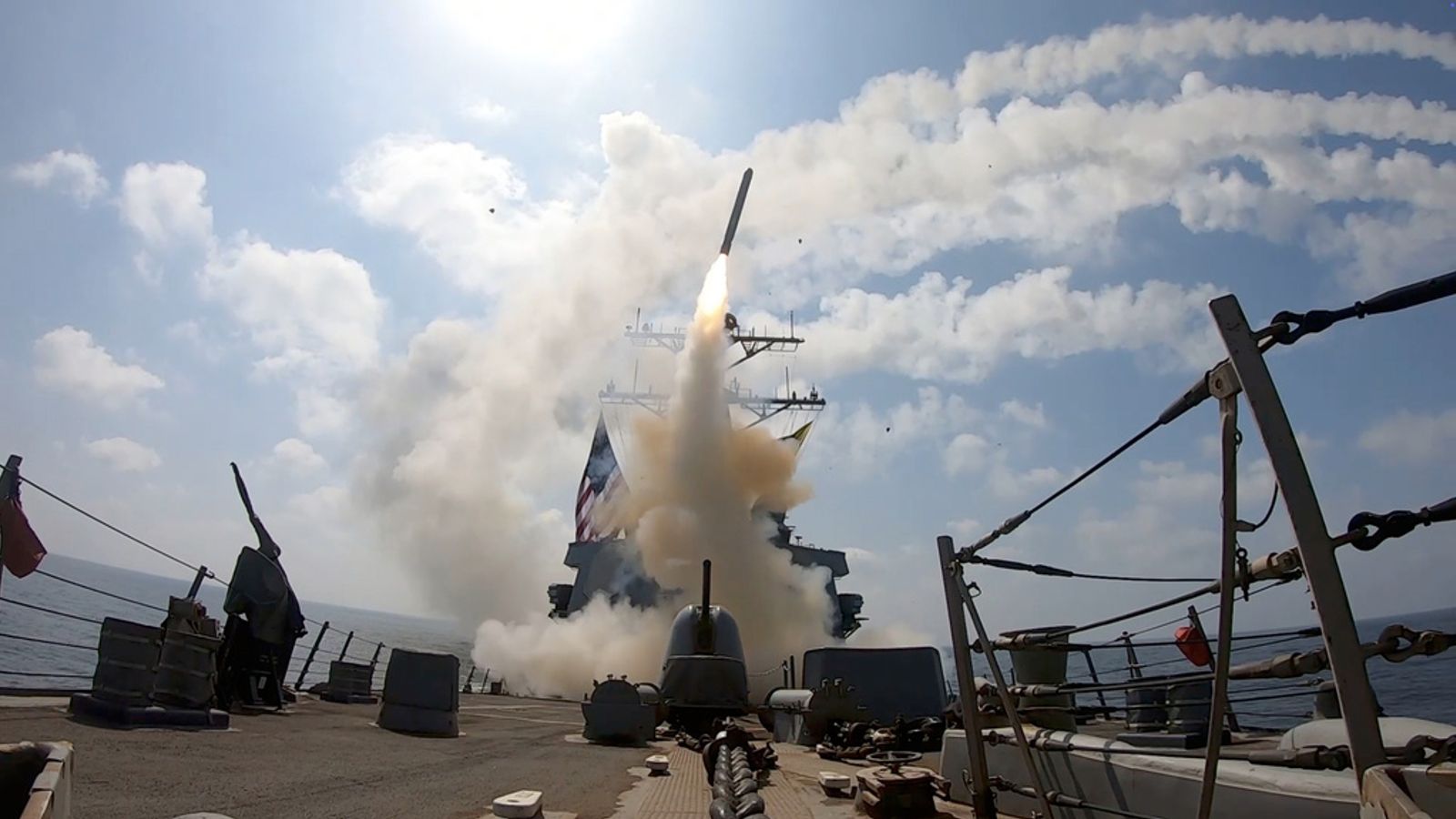
It's possible the US may already be using AI to inform its missile strikes. Pic: AP/CentCom

Forget science fiction. The age of AI in war is here.

Israel has used AI systems in Gaza to flag potential targets and help prioritise operations.

The United States military reportedly used Anthropic’s model, Claude, during its operation to abduct Nicolas Maduro from Venezuela.

And even after Anthropic got into difficulties with the US administration over exactly how AI should be used in war, the US military still apparently used Claude in its attack on Iran.

Advertisement

Iran latest: Trump criticises Starmer over UK stance

It is highly possible, experts say, that the missiles flying over Tehran today are being targeted by systems powered by AI.

“AI is changing the nature of modern warfare in the 21st century. It is difficult to overstate the impact that it has and will have,” says Craig Jones, a senior lecturer in political geography from Newcastle University.

“It is a potentially terrifying scenario.”

Advertisement

Terrifying or not, it seems there’s no going back. If you want a sense of the importance the US military places on AI, a good place to start is a memo sent by defence secretary Pete Hegseth, who styles himself Secretary of War, to all senior military leaders early this year.

“I direct the Department of War to accelerate America’s Military AI Dominance by becoming an ‘AI-first’ warfighting force across all components, from front to back,” Mr Hegseth wrote.

This is not an experiment, this is a command – to adopt AI quickly, and at scale.

Or as Hegseth puts it: “Speed Wins”.

Advertisement
Image:
It’s possible the US may already be using AI to inform its missile strikes. Pic: AP/CentCom

Yet the scenario in question is not the one that might first spring to mind.

Yes, autonomy is increasing in some areas. In Ukraine, for example, there are drones capable of continuing a mission even after losing contact with a human operator.

But we are not at the stage of autonomous killer robots stalking the battlefield.

“We’re not in the Terminator era just yet,” says David Leslie, professor of ethics, technology and society at Queen Mary University of London.

Advertisement

The systems in which AI is being embedded – known as “decision support systems” in military jargon – are advisers which flag targets, rank threats and suggest priorities.

AI systems can pull together satellite imagery, intercepted communications, logistics data and social media streams – thousands, even hundreds of thousands of inputs – and surface patterns far faster than any human team.

The idea is that they help cut through the fog of war, allowing commanders to focus resources where they matter most, while potentially being more accurate than tired, overwhelmed, stressed human soldiers.

This means they’re not just a tool, says Dr Jones, but a new way of making decisions.

Advertisement

“AI, as we see in our own lives, is more like an infrastructure,” he says. “It’s built into the system.”

“We have this ability to collect that surveillance that we’ve been doing for some years.

“But now AI gives a stability to act on that and to kill the leader of Iran and to take out serious adversaries and serious enemies and find them in improbable ways in which they may have not been found before.”

‘A very persuasive tool’

Advertisement

Professor Leslie agrees that the new systems are extremely capable from a military perspective.

“The race for speed is what’s driving this uptake,” he says. “Making decision-making cycles faster is what brings military advantage of lethality.”

An important feature of decision support systems is that the AI doesn’t press the button. A human does. That has been the central reassurance in debates about military AI. There is always “a human in the loop”.

As OpenAI, the company which makes ChatGPT, put it after announcing a partnership to supply the Pentagon with AI: “We will have cleared forward-deployed OpenAI engineers helping the government, with cleared safety and alignment researchers in the loop.”

Advertisement

OpenAI has also emphasised that it had secured agreement with the Pentagon that its technology would not be used in ways that cross three “red lines”: mass domestic surveillance, direct autonomous weapons systems and high-stakes automated decisions.

But even with a human in the loop, a question remains.

Read more:
AI willing to ‘go nuclear’ in wargames, study finds
Claude Opus 4.6: This AI just passed ‘vending machine test’


US-Israel airstrike destroys parts of Iranian city

Advertisement

When you’re fighting a war, can a human really check each decision from an AI? When time is compressed and information is incomplete, what does “human oversight” really mean?

“Humans are technically in the loop,” says Dr Jones.

“That doesn’t mean, in my opinion, that they are in the loop enough to have effective decision-making power and oversight of exactly what’s happened. The AI… is a very persuasive tool to people that make decisions.”

Or as Professor Leslie puts it: “We are really facing a potential scaled hazard of… rubber stamping, where because of the speed involved, you don’t have active human, critical human engagement to assess the recommendations that are being put out by these systems.”

Advertisement

And then there’s the question of AI’s own fallibility.

Read more:
UK will deploy HMS Dragon in Cyprus, PM confirms
Iran Q&A: Why Trump could try to declare quick victory

Testing by Sky News found that neither Claude nor ChatGPT could tell how many legs a chicken had, if the chicken didn’t look as it expected.

What’s more, the AI insisted it was right, even when it was clearly wrong.

Advertisement

The example came from a paper which illustrated dozens of examples of similar failures. “It’s not a one-off example of animal legs,” said lead author Anh Vo.

Advertisement

Artificial intelligence is accelerating – but how fast is too fast? Rowland Manthorpe looks at the latest research.

“The problem is general across types of data and tasks,” Vo added.

The reason is that AI doesn’t really see the world in the human sense – they guess what’s most probable based on past data.

Advertisement

Most of the time, that kind of statistical reasoning is astonishingly effective. The world is predictable enough that probabilities work.

But some environments are by their very nature unpredictable and high stakes.

We are testing the boundaries of this technology in the most unforgiving circumstances imaginable.

Advertisement

Source link

Continue Reading

NewsBeat

US consulate building in Dubai ‘on fire’ after Iran drone strikes

Published

on

Daily Record

Iran continues to strike Gulf nations

Explosions continue to ring out in the popular holiday destination of Dubai, with reports that the U.S. consulate building is ablaze after being targeted by Iranian drone strikes.

Advertisement

Iran has carried out strikes against several neighbouring Gulf nations, including the UAE, Oman and Saudi Arabia, as well as retaliatory strikes against Israel. Joint Israeli and U.S. bombardments killed Iran’s Supreme Leader Ali Khamenei on Saturday (February 28).

On Tuesday evening, pictures appear to show the U.S. consulate building on fire. Earlier that day, the U.S. Embassy in Riyadh, Saudi Arabia, was also struck by Iranian fire as it hit back at industrial and diplomatic targets across the Middle East.

During a press conference alongside German Chancellor Friedrich Merz, President Donald Trump claimed ‘everything’s been knocked out in Iran’ and criticised the UK for its delay in allowing the U.S. to use their bases in the region to conduct bombing campaigns.

Advertisement

Referring to the UK’s Chagos Islands deal, which he has publicly backed and rejected multiple times, Trump said: “That island that you read about, the lease, for whatever reason, he made a lease of the island, somebody came and took it away from him.

“And it’s taken three, four days for us to work out where we can land, it would have been much more convenient landing there as opposed to flying many extra hours.

“So we are very surprised. This is not Winston Churchill that we’re dealing with,” he said of UK Prime Minister Keir Starmer.

Source link

Advertisement
Continue Reading

NewsBeat

Scottish Government ask if Scots airports used for US military ops to Iran

Published

on

Daily Record

“We are therefore seeking clarity, not least from the UK Government, that no aircraft passing through Scottish Government-owned airports are part of offensive operations against Iran.”

The Scottish Government has asked the UK Government if any military aircraft used in operations in Iran had stopovers in the country. Speaking in the chamber on Tuesday External Affairs Secretary Angus Robertson confirmed the Government is seeking clarity that no aircrafts passing through Scotland have been involved in US-Israeli offensive operations in the Middle East.

Advertisement

He said that some Scottish airports are regularly used as an “important stopover point” for air forces. He said: “Glasgow Prestwick Airport and some Highlands and Islands airport limited airports are an important stopover point for many air forces including the UK’s Royal Air Force and other Nato partners such as the United States, and have been for many years.

“This is in line with UK law, international aviation standards and long-standing agreements between allied nations. Prestwick is a civilian facility, and there are, of course, a plethora of military bases available to the United States and the Middle East.

“We have no information on whether any aircraft that passed recently through Scotland or whatever nation were involved in operations against Iran. That said, we believe it is essential that all nations abide by the international rules-based system. The events in Iran over the last few days, do not suggest to us that the United States and Israel have done this.

Advertisement

“It is also the case that the UK Prime Minister has said that UK military bases must not be used in US or Israeli offensive operations against Iran. The same must apply to non-military bases. We are therefore seeking clarity, not least from the UK Government, that no aircraft passing through Scottish Government-owned airports are part of offensive operations against Iran.”

On Monday Prime Minister Sir Keir Starmer defended his decision not to allow the US access to UK bases for its initial strikes – a position which has since been reversed following pressure from Washington and states in the Gulf. US President Donald Trump said he was “very disappointed” with the initial decision, but Sir Keir told the Commons on Monday he had a “duty to judge what is in Britain’s national interest”.

Speaking to the Press Association on Monday, John Swinney voiced his concern over the intervention, but stopped short of saying he considered it illegal.

“I’m deeply concerned by the events in the Middle East over the weekend and I bear no warmth towards the Iranian regime,” he said. “I think it is an oppressive and a repugnant regime, but when I look at the events of the last few days, it becomes ever more clear to me that the United States and Israeli action, the original action, is not compatible with the international rules-based system.

“As a consequence of that, the United Kingdom now finds itself getting dragged into this conflict – an illustration of how quickly these events can escalate from their original foundations – and that’s deeply concerning.”

Advertisement

Scottish Conservative leader Russell Findlay said the Conservative Party supports the US decision to launch attacks in Iran. Speaking to the Press Association on Tuesday, he said: “The Conservative Party backs the United States. They are our strongest and most reliable ally. We will support them, and that’s something that we should see happening.

“I think what we need to see happening in the Middle East is a favourable outcome for the people of Iran and long-term security and stability in the region.”

The UK Government has declined to comment.

Get more Daily Record exclusives by signing up for free to Google’s preferred sources. Click HERE.

Advertisement

Source link

Continue Reading

NewsBeat

Harry Styles admits fame left him feeling ‘isolated’ and questioning his purpose

Published

on

Harry Styles admits fame left him feeling ‘isolated’ and questioning his purpose

“Something I’ve often struggled with, in the middle of a tour, is feeling like I’m not sure what I’m giving, not sure what I’m adding to the world,” he said. “People are giving me so much, which I deeply appreciate. But what am I contributing? At times I felt quite existential about that.”

Source link

Continue Reading

NewsBeat

Chaos on EasyJet flight as NI grammar school teacher launches into a drunken rage mid air

Published

on

Daily Record

He was behaving in a threatening manner and using abusive language

A PE teacher at a top grammar school has been sentenced after he flew into a drunken rage during a flight.

A court has heard how Peter Shepherd was behaving threating manner and using abusive behaviour on board an EasyJet flight.

Advertisement

Antrim Magistrates Court, sitting in Ballymena, heard that once the case against Peter Shepherd has concluded, his position will be referred to the Board of Governors at Royal Belfast Academical Institution.

“What is the position with his job, is that in jeopardy?” District Judge Nigel Broderick enquired, BelfastLive reports.

Defence counsel Peter Sands confirmed that while the 49-year-old “continues to work while being supported, they have told him that they will assess the situation once the case has concluded.”

At an earlier hearing, Shepherd, from Whinfield in Larne, had entered guilty pleas to four charges arising from an incident on an EasyJet flight from Hurghada in Egypt on April 20 last year.

Advertisement

The 49-year-old admitted assaulting the female cabin crew manager, using disorderly behaviour, being drunk on an aircraft and behaving in a threatening and abusive manner.

Opening the facts of the case today, a prosecuting lawyer told the court how police were called to Belfast International Airport in the early hours of April 20 following reports of an assault on board the flight.

Officers spoke to the victim who reported that Shepherd had been “acting in a disruptive manner” towards crew members. His behaviour was such that at one point during the flight, a passenger approached her and asked if they “would like for him to be restrained.”

Advertisement

Describing how Shepherd was behaving in a threatening manner and using abusive language, the prosecutor said the assault had been a physical assault, rather than an apprehension.

The court heard that when the cabin manager was speaking to Shepherd about his behaviour, he initially walked away but when he came back at her, he “pressed his forehead into the right side of her face.”

Throughout the assault, Shepherd had been “shouting abuse at her.”

During police interviews, Shepherd “denied the allegations” but admitted he had consumed “a couple of drinks before boarding” and that whilst mid air, he had been drinking from his hip flask.

Advertisement

Lodging a plea in mitigation, Mr Sands, instructed by Reid Black Solicitors, emphasised the PE teacher had admitted his guilt and has “expressed shame, regret and remorse.”

“Clearly, it was very poor behaviour,” the barrister conceded, adding that as “someone who isn’t keen on flying, to put it mildly” Shepherd had consumed more alcohol than he usually would.

Having heard that the defendant’s children were on the flight too, Judge Broderick commented that his behaviour “isn’t a very good example” for them, “not to mention the other passengers.”

“It is a source of embarrassment and shame,” Mr Sands told him.

Advertisement

The judge said he had made the point before that he treated such behaviour on a plane in a serious manner because, “it is a confined space.”

“It’s not like a boat or a train where other passengers can get up and walk away,” he told the court.

As regards the appropriate disposal, Mr Sands confirmed there was “no reason” why Shepherd could not engage in community service.

Judge Broderick told Shepherd it was clear that having admitted his guilt, he had “expressed appropriate remorse, regret and shame.”

Advertisement

He said while he was aware the case “may have an impact on your employment, that is a matter for the school.”

Emphasising that the cabin crew, and particularly the manager, “in no way deserved” to be subjected to such verbal and physical abuse, he imposed a 120-hour community service order “as an alternative to imprisonment.”

In addition to the CSO, Shepherd was also fined a total of £500 and ordered to pay £500 compensation to the lady he assaulted.

Get more Daily Record exclusives by signing up for free to Google’s preferred sources. Click HERE

Advertisement

Source link

Continue Reading

NewsBeat

‘Facing the unimaginable’: Community rallies to support family after sudden death of young mum

Published

on

Belfast Live

The 24-year-old was sadly found deceased following several search operations after her disappearance

Friends and the local community are rallying around the family of a young mum-of-two who was found dead last month, a week after she went missing.

Advertisement

Caitlin Green from Gilford was sadly found deceased on February 7, following several search operations in Co Armagh after her disappearance in late January.

The 24-year-old was last seen in the Derry Road/Lord Lurgan Park area after leaving a friend’s home nearby at around 12.30pm on Saturday, January 31. Following Caitlin’s disappearance, extensive police searches took place with detectives also reviewing all available CCTV.

READ MORE: ‘I carry you with me always’: Heartbroken mum pays tribute to son who died in London balcony fallREAD MORE: Tributes paid to ‘skilful footballer’ and chef who died in A5 road crash

She left behind a heartbroken family including her two young children, two-year-old Cadáin and 13-month-old Clíodhna; parents Stephanie and Barry; siblings Jason, Lela, Patrick and Lily-Rose and granny Siobhan.

Advertisement

Caitlin was laid to rest following Requiem Mass in St Patrick & St Colman’s Church, Laurencetown, where mourners heard that the young mum had once been commended for her bravery in saving the life of another.

Now a local fundraising page has been set up by family friend Nicola Cully to support Caitlin’s loved ones following her tragic passing.

Nicola told Belfast Live: “Our community has been left devastated by the tragic loss of Caitlin, known lovingly as Caity, a much-loved daughter and mother. She has left behind two beautiful young children who will now grow up without their mummy, and a heartbroken mother, who is not only grieving the unimaginable loss of her daughter but now also carrying the responsibility of supporting her grandchildren.

Advertisement

“As they try to come to terms with their devastating loss, they are also facing the financial pressures that come with laying a loved one to rest and supporting her children in the weeks and months ahead. There are still so many unanswered questions surrounding Caitlin’s passing, and the pain of that uncertainty makes this loss even harder for her family and friends.”

Nicola added: “We are raising funds to help ease some of the financial burden during this incredibly difficult time — to support funeral costs and ensure Caitlin is given the peaceful resting place she deserves, without her family having the added worry of financial strain.

“The GoFundMe page has been created by friends and members of the community who simply want to help ease some of that burden. This is about coming together to support a grieving family and ensuring Caitlin’s children are surrounded by care and security.

Advertisement

“The local community has already shown great compassion, and we hope anyone who is in a position to help will consider supporting the fundraiser or sharing it. Every donation, no matter how small, will go directly towards funeral costs and providing stability for Caitlin’s children during this incredibly difficult time.

“Let’s come together as a community to show love and support to a family facing the unimaginable.”

You can donate to the fundraiser here.

To ensure you don’t miss out on all the latest from Belfast Live, be sure to make us your preferred source on Google.

Advertisement

Source link

Continue Reading

NewsBeat

Owners of falling-down Cambs building told to take action

Published

on

Cambridgeshire Live

The owners of the building have pleaded guility in court for failing to make repairs to the historic building

Court action has been taken out against the owner of a building that is falling apart. The former Franks Butchers in Market Place, Wisbech has been left to fall into disrepair.

Advertisement

The Whitfield Group, the building’s owners, has been prosecuted by Fenland District Council for failing to make improvements to the building within two months. At Peterborough Magistrates’ Court on February 17, the Whitfield Group pleaded guilty to failing to comply with the order, which was issued in March last year.

The owners had done some work on the site. Councillor Dee Laws, portfolio holder for planning, said: “We hope this action sends a message to all owners of heritage buildings in Fenland that we won’t stand by and watch them degrade.

“And that now the owners of this building will do the right thing and take the action we’ve ordered to preserve this important building’s future.” The owners now must comply with the order.

The council will work with the owners to agree a reasonable, as soon as possible, deadline for the works to be achieved. While in court, the owners were ordered to pay £810 for not complying with the order. If they fail to meet the next deadline, they could face further prosecution and a daily fine of up to £500.

Advertisement

Do you want more of the latest Cambridgeshire news as it comes in from across the county? Sign up to our dedicated newsletter to make sure you never miss a big story from Cambridge or anywhere else in the county. You can also sign up to our dedicated Peterborough, Traffic and Crime newsletters for the latest updates on the topics you are most interested in.

Source link

Continue Reading

NewsBeat

Starmer-Trump relationship tested amid Iran strike disagreement

Published

on

Starmer-Trump relationship tested amid Iran strike disagreement

LONDON (AP) — Keir Starmer has never had a bad word to say in public about Donald Trump.

That is not being reciprocated now as the American president lambasts the British prime minister over his reluctance to join the U.S.-Israeli strikes on Iran.

“This is not Winston Churchill that we’re dealing with,” Trump said Tuesday at the White House, blasting Britain’s reluctance to let U.S. warplanes use its bases.

The dispute is roiling a relationship that Starmer worked hard to forge, and further straining trans-Atlantic ties frayed by Trump’s “America first” foreign policy and transactional approach to international relations.

Advertisement

Britain is in Trump’s bad books

“This was the most solid relationship of all. And now we have very strong relationships with other countries in Europe,” Trump told British tabloid The Sun in an interview published Tuesday.

“I mean, France has been great. They’ve all been great,” Trump said. “The U.K. has been much different from others.”

“It’s very sad to see that the relationship is obviously not what it was,” he said.

Starmer initially blocked American planes from using British bases for the attacks on Iran that started on Saturday. He later agreed to let the United States use bases in England and on Diego Garcia in the Indian Ocean to strike Iran’s ballistic missiles and their storage sites, but not to hit other targets.

Advertisement

Even after the British base at Akrotiri in Cyprus was hit by an Iran-made drone over the weekend, Starmer said that the United Kingdom “will not join offensive action.” He said Tuesday that a Royal Navy destroyer, HMS Dragon, and Wildcat helicopters with counter-drone capabilities were being sent to the region as part of “defensive operations.” British forces have also shot down drones in Jordanian and Iraqi airspace, the government said.

Starmer has offered a rare, though implicit, rebuke of the U.S. president, saying Monday that the U.K. government doesn’t believe in “regime change from the skies.”

“Any U.K. actions must always have a lawful basis and a viable, thought-through plan,” Starmer told lawmakers in the House of Commons on Monday.

“President Trump has expressed his disagreement with our decision not to get involved in the initial strikes, but it is my duty to judge what is in Britain’s national interest,” Starmer added.

Advertisement

The Financial Times called it Starmer’s “Love Actually moment” — a reference to the 2003 movie scene in which a British prime minister played by Hugh Grant stands up to a bullying U.S. president played by Billy Bob Thornton.

Friction has grown over Greenland and Diego Garcia

Friction between the two leaders has been building for months. Trump’s threat to take over Greenland was denounced by Starmer and other European leaders earlier this year. Recently, Trump has condemned Britain’s agreement to hand over the Chagos Islands, home to the Diego Garcia base, to Mauritius, despite his administration earlier backing the deal.

Peter Ricketts, a former head of the U.K. Foreign Office, told The Observer newspaper that under Trump, “the Americans have effectively given up on any effort to be consistent with international law.”

That is a red line for the law-abiding Starmer, a barrister and former chief prosecutor for England and Wales.

The spat is a setback for Starmer’s efforts to woo Trump since the president’s return to office in 2025. The British government rolled out the red carpet to the president for a state visit as the guest of King Charles III, and Starmer consistently has praised Trump’s efforts — so far unsuccessful — to broker an end to the Russia-Ukraine war.

Advertisement

The Iran war has also divided European leaders, who fall along a spectrum from condemnation to support.

NATO Secretary-General Mark Rutte said that he unreservedly approves of Trump’s decision to attack Iran and kill its supreme leader, and called the war crucial for Europe’s security.

The U.K., France and Germany jointly said that they weren’t involved in the strikes, but were prepared to enable “necessary and proportionate defensive action to destroy Iran’s capability to fire missiles and drones at their source.”

Spanish Prime Minister Pedro Sánchez condemned the strikes as “unjustifiable” and “dangerous.”

Advertisement

Polling suggests many Britons are skeptical of the U.S. justification for war. But politicians to the right of Starmer’s Labour Party slammed the prime minister for not joining the offensive. Conservative leader Kemi Badenoch said that her party “stands behind America taking this necessary action against state-sponsored terror.”

Foreign Office Minister Stephen Doughty denied the U.S.-U.K. “special relationship” was on the ropes.

“Our relationship with the United States is strong,” he said Tuesday in the House of Commons. “It has endured, it continues to endure, and it will endure into the future on both the economic and the security fronts.”

Advertisement

Source link

Continue Reading

NewsBeat

Horror as Yorkshire gran dies from rabies after being scratched by a puppy on holiday

Published

on

Wales Online

Yvonne Ford was scratched by a dog while on holiday

It was too late to save a grandmother’s life as she was diagnosed with rabies months after being grazed by a dog in Morocco, an inquest has heard.

Sheffield Coroner’s Court heard today (March 3) how Yvonne Ford, from Yorkshire, suffered several seemingly unexplainable symptoms for months.

Advertisement

The 59-year-old grandmother had gone to hospitals in Barnsley and Wakefield several times, reporting an insect bite above her ankle.

Her family say the Barnsley woman had been bitten by a stray dog in Morocco when she got up from a sunbed and startled it. They thought little of the scratch it left behind, simply wiping it with a wet wipe.

It wasn’t until she was referred to a mental health team at Barnsley Hospital last June that she was diagnosed with rabies, reports Yorkshire Live.

Yvonne, who leaves behind two children and four grandchildren, died at Royal Hallamshire Hospital in Sheffield on Wednesday, June 11, 2025, assistant coroner Marilyn Whittle explained to the jury of nine women and three men.

A rabies expert said doctors at Barnsley Hospital “were on the right track” as they struggled to find a diagnosis for Yvonne’s rare symptoms.

The inquest heard how Yvonne was admitted to Barnsley Hospital on June 2 after several medical appointments in March and April. She was suffering from “severe headaches” and a range of other symptoms, including poor mobility, struggling to drink, hallucinations, anxiety, disorientation and severe agitation.

Doctors at Barnsley Hospital were unable to provide a diagnosis, the jury was told. Junior doctor Dr Awan said: “In view of her current symptoms, we were still trying to find the organic cause. At the moment when we asked about travel history, it was made known that there were some insect bites above the ankle. We were investigating some kind of tick bite encephalitis.

Advertisement

“We were still trying to find if it was neurological or if there was any other cause. There was unexplained anxiety. For the nausea, we weren’t too sure. For the dehydration, there was no working diagnosis. Essentially, there was no working diagnosis at this point.”

On June 6, she was referred to the mental health liaison unit at Barnsley Hospital. Psychiatrist Dr Alex Burns reviewed Yvonne and admitted he had concerns about an infectious disease causing her hallucinations, agitation and anxiety.

Dr Burns said: “I had asked about travel, and I had asked about insect bites. It was very unclear what the diagnosis was. I wanted to think a bit more outside the box and think about rare conditions, including travel-related ones.” Yvonne’s husband informed Dr Burns they had travelled to Morocco in February. He told Dr Burns Yvonne was bitten by a dog on a beach after she startled it by getting up from a sunbed.

Advertisement

Dr Burns added: “I didn’t know all of the symptoms of rabies at that point, but after I spoke to Yvonne’s husband, I did speak to the medical team in the office, and that was to discuss what I had found out so far. At that point, because my knowledge of rabies was limited, I did look into it more regarding the symptoms, and it became clear that all of Yvonne’s symptoms could be explained by that diagnosis at that point.”

Yvonne’s daughter, Robyn Thomson, told Dr Burns: “We see you as a turning point into mum’s care, and we thank you for that.”

Rabies expert Dr Katharine Cartwright, consultant physician at Sheffield Teaching Hospitals, defended the medical treatment Yvonne received. “This was a rare presentation of something rare. This was incredibly rare,” she said.


“A rabies diagnosis is so unusual, so out of everyone’s experience, I think it’s not unreasonable for it not to have been considered within a few days. Half of the American rabies diagnoses were made post-mortem. The fact we got a diagnosis of rabies before Yvonne died is good.”

Advertisement

Dr Cartwright explained that there had only been 26 recorded rabies cases in the UK since 1946. Once bitten or scratched, rabies has a near-100 per cent fatality rate, she said, adding: “Once the symptoms start, death within a couple of weeks is the norm. That means the virus has started to replicate in the brain, and it’s not salvageable from that point.”

Dr Cartwright said there was “no way to say when the virus reached her spinal cord”, after which there was no medical treatment. She said the cause of death was 1a rabies encephalitis.

Source link

Advertisement
Continue Reading

Trending

Copyright © 2025