Pizza chain Papa John’s said it plans to close hundreds of underperforming restaurants in North America by the end of next year.
“We have identified approximately 300 underperforming restaurants across North America that are not meeting brand expectations or lack a clear path to sustainable financial improvement, as well as locations where we can effectively transfer sales to a nearby restaurant,” Papa John’s Chief Financial Officer Ravi Thanawala said last week during the company’s fourth-quarter earnings call.
Advertisement
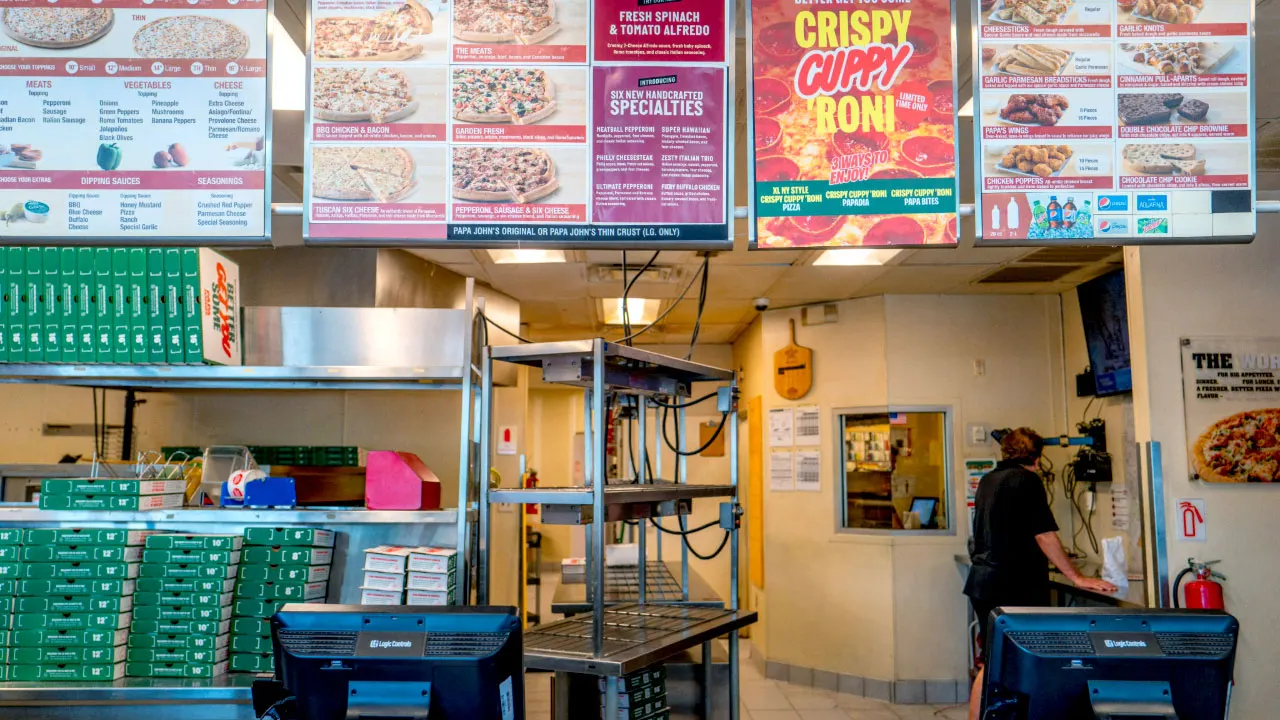
Thanawala described the locations as being primarily franchise-owned, more than a decade old and generating less than $600,000 in annual sales (AUVs). He said the majority of the restaurants will shutter by the end of 2027, with about 200 closures happening this year.
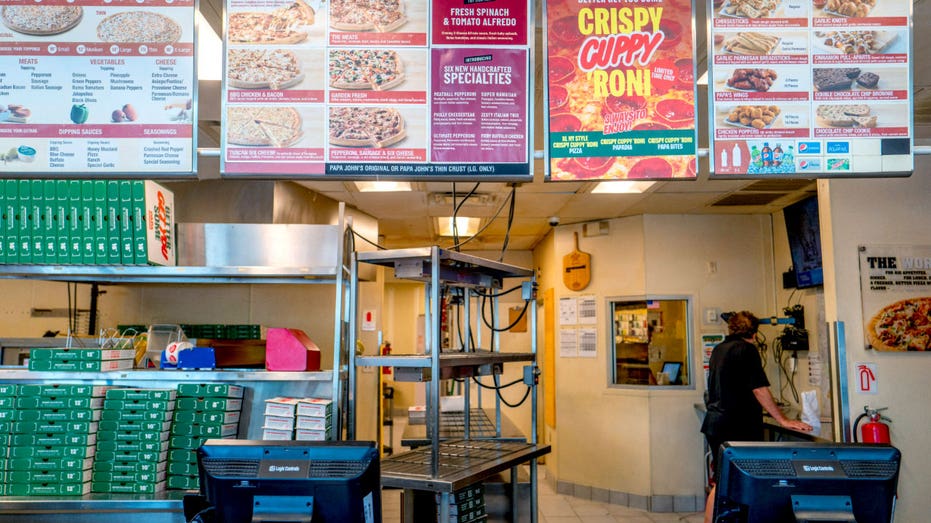
The locations expected to close are mostly franchise-owned and more than a decade old. (Luke Sharrett/Bloomberg via Getty Images)
“We believe these closures will further strengthen the system, increasing AUVs by at least 3% and improve franchisee health by allowing franchisees to reallocate resources towards operational excellence in their remaining restaurants and open units in priority markets,” Thanawala said.
He also said that the majority of the company’s restaurants worldwide have “performed well over the years and delivered strong returns for both corporate and franchise owners,” and that the strategic closure of underperforming restaurants are “among the most impactful actions we can take to improve restaurant profitability and fleet health.”
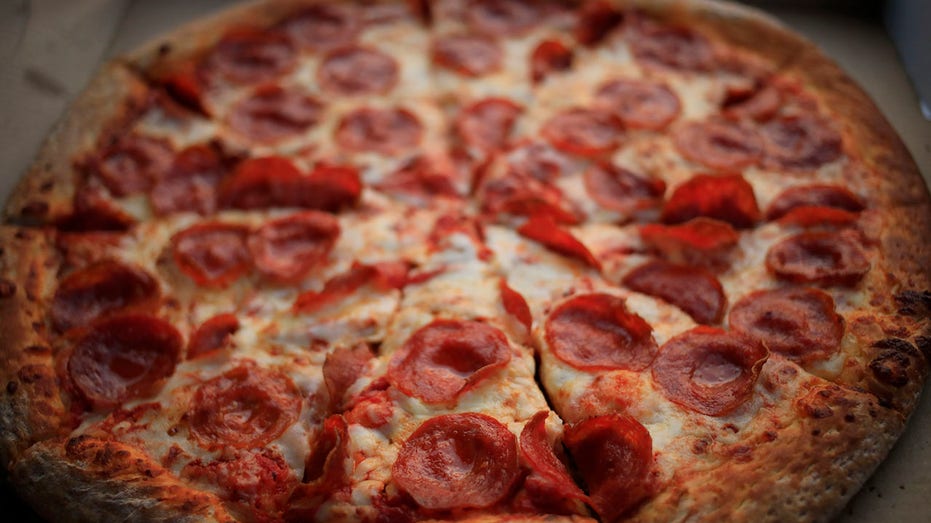
Papa John’s operated more than 3,500 restaurants in North America as of the fourth quarter of 2025. (Brandon Bell/Getty Images)
The company reported a 5.4% decline in same-store sales in the fourth quarter, which CEO Todd Penegor said “reflected a weak consumer backdrop and elevated promotional environment.”
Ranjith Roy, the chief financial officer of Pizza Hut’s corporate parent Yum! Brands, said during an earnings call that the closures will primarily target weaker-performing Pizza Hut restaurants as part of a broader effort to modernize the chain.
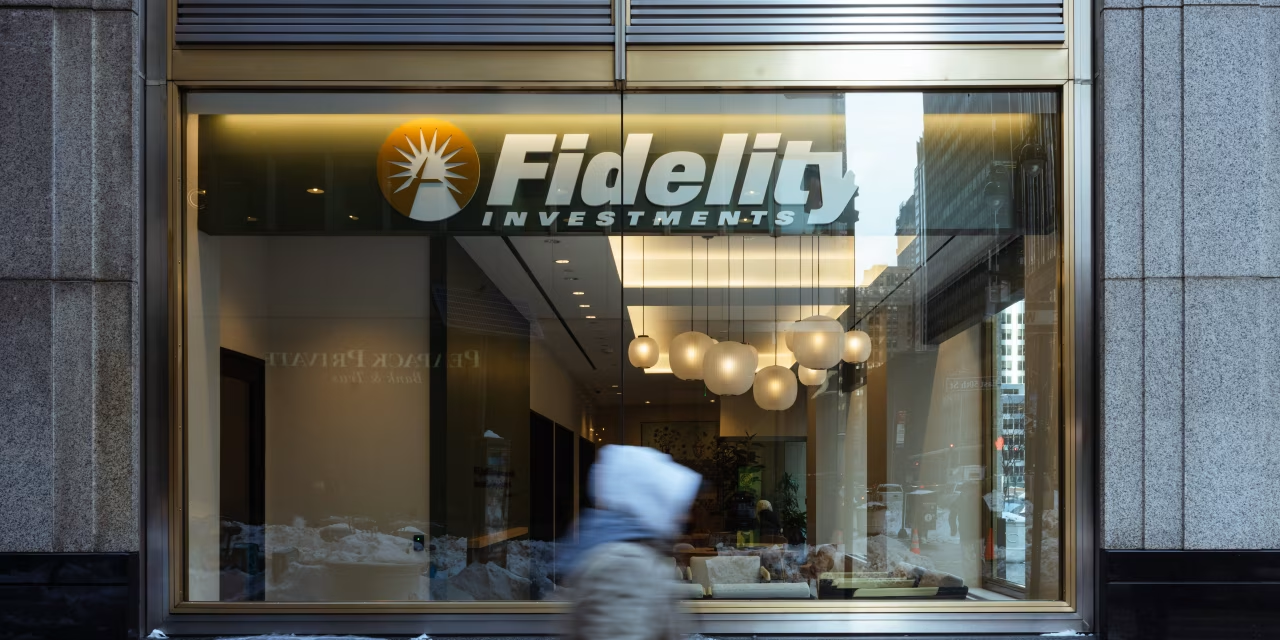
Fidelity Investments said that profits rose to a record after an extended market rally drew billions in new customer money into its investment accounts and funds.
FMR LLC, Fidelity Investments’ parent company, said its annual operating income jumped 24% to $12.7 billion, lifted by rising stock prices and interest rates. Revenue climbed 15% to $37.7 billion, also a record high.
The vast majority of Iran’s roughly 1.6 million barrels a day of crude exports is bound for China, but the world’s second-largest economy has spent months shoring up its supply, cushioning itself from any potential shocks from this weekend’s conflict.
Iranian crude is mostly bought up by small, independent “teapot” refineries in China, which are well supplied in the near term and are unlikely to turn to the mainstream market to compete with other buyers for crude, analysts said.
Even before the conflict started on Saturday, Iran had accelerated crude-oil loading onto vessels in preparation for days of zero or low loadings, according to commodities data provider Kpler.
Amylyx Pharmaceuticals, Inc. (AMLX) Q4 2025 Earnings Call March 3, 2026 8:00 AM EST
Company Participants
Lindsey Allen – Head of Investor Relations & Communications Justin Klee – Co-Founder, Co-CEO & Director Camille Bedrosian – Chief Medical Officer James Frates – Chief Financial Officer Joshua Cohen – Co-Founder, Co-CEO & Director
Advertisement
Conference Call Participants
Seamus Fernandez – Guggenheim Securities, LLC, Research Division Kevin Strang – Goldman Sachs Group, Inc., Research Division Marc Goodman – Leerink Partners LLC, Research Division Michael DiFiore – Evercore ISI Institutional Equities, Research Division James Condulis – Stifel, Nicolaus & Company, Incorporated, Research Division Rami Katkhuda – LifeSci Capital, LLC, Research Division Geoffrey Meacham – Citigroup Inc. Exchange Research Graig Suvannavejh – Mizuho Securities USA LLC, Research Division Christopher Chen – Robert W. Baird & Co. Incorporated, Research Division Ananda Ghosh – H.C. Wainwright & Co, LLC, Research Division
Advertisement
Presentation
Operator
Good morning, everyone. My name is Jim, and I will be your conference operator today. At this time, I would like to welcome everyone to the Amylyx Pharmaceuticals Fourth Quarter and Full Year 2025 Earnings Conference Call. [Operator Instructions] Please be advised that this call is being recorded at the company’s request, and it is now my pleasure to turn the floor over to Lindsey Allen, Vice President, Investor Relations and Communications. Welcome, Lindsey.
Advertisement
Lindsey Allen Head of Investor Relations & Communications
Good morning, and thank you all for joining us today to discuss our fourth quarter and full year 2025 financial results and business update. With me on the call today are Josh Cohen and Justin Klee, our Co-CEOs; Dr. Camille Bedrosian, our Chief Medical Officer; and Jim Frates, our Chief Financial Officer. Before we begin, I would like to remind everyone that any statements we make or information presented on this call that are not historical facts are forward-looking statements that are based on our current beliefs, plans and expectations and are made pursuant to
Jade Tucker is the CEO of Tucker Family Supports, a Pittsburgh-based organisation focused on strengthening families through clear communication and emotional awareness.
Her career is shaped by a steady belief that progress begins when people feel understood. Rather than building large systems, she has built a leadership style grounded in listening, structure, and calm decision-making.
Raised in Pittsburgh, Tucker’s early life exposed her to the realities of family pressure and responsibility. These experiences shaped how she views leadership today. She later attended Chatham College, where her interest in psychology became central to how she approaches work. She did not pursue theory for theory’s sake. She studied behaviour to better understand how people think, react, and recover under stress.
As CEO, Tucker leads with consistency. Her work focuses on reducing friction in family systems before problems escalate. She is known for slowing conversations down, asking precise questions, and creating space for people to speak clearly. This approach has made her a respected voice in family support and community-based services.
Her leadership is practical. She avoids noise and conflict and stays focused on outcomes that improve stability. In an industry often driven by process, Tucker stands out for keeping people at the centre of every decision. She believes trust is built through presence, not pressure.
Advertisement
Today, she continues to guide Tucker Family Supports with a steady hand. Her career reflects a simple idea carried out with discipline: when communication improves, everything else becomes easier to manage.
Jade Tucker on Building Stability Through Listening
What first drew you to working with families rather than another field?
I grew up seeing how small tensions inside families can quietly grow into bigger problems. Most of the time, no one notices until things feel unmanageable. I did not want to work in crisis response alone. I wanted to focus on what happens before that point. Families do better when communication stays clear, and I saw a real gap there.
How did your education influence the way you lead today?
My time at Chatham College shaped how I think. Studying psychology taught me how stress affects behaviour and decision-making. It also taught me how often people act from pressure rather than intention. As a leader, that helps me stay calm when others feel overwhelmed. It also helps me design support that fits real life instead of ideal scenarios.
What was the turning point that led you to become CEO of Tucker Family Supports?
The turning point came when I realised families were not failing. They were overloaded. I kept seeing the same pattern. People wanted guidance, not judgement. They wanted someone to slow the process down. Taking on the CEO role allowed me to build an organisation that works at that pace rather than rushing people through solutions.
Advertisement
How would you describe your leadership style?
I lead quietly. I pay attention to tone, timing, and context. I do not believe pressure produces good outcomes. I believe clarity does. Most of my work involves listening before acting. That approach helps teams function better and helps families feel safe enough to be honest.
Can you share an example of how listening changes outcomes in your work?
I once worked with a parent who felt ignored by every system they dealt with. They came in defensive and frustrated. I let them speak without interruption for several minutes. By the end, their body language changed completely. Once they felt heard, they became open to problem-solving. That shift happens often, and it always starts with attention.
What challenges come with leading in the family support industry?
The biggest challenge is pace. Families want quick relief, but lasting stability takes time. Another challenge is emotional weight. Leaders in this space must manage their own reactions while supporting others. That requires discipline and boundaries.
Why do you place so much emphasis on communication rather than formal intervention?
Because communication shapes behaviour. When people understand each other, they make better decisions. Many issues labelled as complex are actually communication breakdowns. Fixing those early prevents escalation.
Advertisement
How do you stay focused when work becomes demanding?
I stay grounded by keeping my role clear. I am there to guide, not control. I also rely on structure. Clear routines reduce mental load. That allows me to stay present with people rather than distracted by noise.
What does success look like for you in this role?
Success looks quiet. It looks like families handling challenges with less tension. It looks like conversations that end with clarity instead of frustration. Those outcomes do not make headlines, but they matter.
Where do you see your work heading next?
I see a growing need for practical education around communication. Families and organisations want tools they can use daily. That is where my focus remains. Steady improvement over time.
National Pancake Day flipped into high gear on March 3, 2026, as IHOP declared the first Tuesday of March its official celebration, offering diners a free short stack of buttermilk pancakes at participating locations nationwide from 7 a.m. to 8 p.m. local time.
Pancake
The promotion, marking the 21st anniversary of IHOP’s annual event, drew crowds to restaurants across the U.S., with no minimum purchase required for the dine-in deal — though hours may vary by location. Customers were encouraged to donate to Feeding America, where every $1 helps provide at least 10 meals to those facing food insecurity.
IHOP’s move to claim the first Tuesday in March as “National Pancake Day” sparked some debate, as other sources recognize Sept. 26 as the date or tie the holiday to Shrove Tuesday, which fell on Feb. 17 in 2026. Still, the chain’s promotion has become a beloved tradition since launching in 2006 to raise funds for charity.
Here are 10 essential things to know about National Pancake Day in 2026 and beyond:
1. **IHOP Owns the March Date** — IHOP officially crowned the first Tuesday of March as its National Pancake Day in a February 2026 announcement, positioning it as a brand-defining moment separate from traditional observances. This year’s date landed on March 3, drawing lines at locations from coast to coast.
Advertisement
2. **Free Short Stack Deal** — Guests received one free short stack — three buttermilk pancakes — per person, dine-in only. The offer required no purchase, though many added toppings, sides or beverages. IHOP emphasized checking local stores, as participation and hours varied.
3. **Charity Focus** — The event supported Feeding America, with in-restaurant donations on March 3 directly aiding food banks. IHOP guaranteed additional support through supplier contributions: from March 30 to Dec. 31, 2026, one cent per pound of coffee sold systemwide went to the cause, with a minimum $150,000 commitment.
4. **21 Years of Flipping for Good** — IHOP launched National Pancake Day in 2006 as a charitable initiative. Over two decades, it has raised millions for hunger relief, turning a simple breakfast staple into a nationwide philanthropic tradition.
5. **Hollywood Fan Event** — To amp up excitement, IHOP hosted a special “Mr. Fantasy” meet-up at its Sunset Boulevard location in Hollywood from 2 p.m. to 5 p.m. PST on March 3. Fans gathered for photos, giveaways and pancake-fueled fun, blending celebrity culture with the holiday.
Advertisement
6. **Pancake Day’s Religious Roots** — Traditionally known as Shrove Tuesday or Pancake Tuesday, the day precedes Ash Wednesday and the start of Lent in the Christian calendar. It originated as a way to use up rich ingredients like eggs, milk and fat before fasting — hence pancakes as the perfect vehicle.
7. **Global Traditions** — In the U.K., Ireland, Australia and Canada, Shrove Tuesday features pancake races where participants flip pancakes while running. The custom traces to 1445 in Olney, England, where a woman allegedly raced to church mid-cooking, pan in hand.
8. **Pancake Consumption Stats** — Americans devour billions of pancakes yearly, with Southern states leading at about 32.5% of national intake. The U.S. consumes roughly 2.5 tons annually, or 75 billion individual pancakes — a testament to the food’s enduring appeal.
9. **Historical Pancake Fun** — Pancakes date back over 30,000 years, with early versions appearing in ancient cultures. The first commercial pancake mix, Aunt Jemima, debuted in 1889. Record feats include a 31-foot pancake toss in 2010 and millions of eggs used in U.K. Pancake Day celebrations.
Advertisement
10. **Competing Dates** — While IHOP champions March’s first Tuesday, National Day Calendar lists Sept. 26 as National Pancake Day, creating a “twice-a-year” phenomenon for enthusiasts. Some brands and regions stick to Shrove Tuesday’s movable date, tied to Easter.
As crowds enjoyed their free stacks on March 3, social media buzzed with photos of golden pancakes topped with syrup, whipped cream and fruit. IHOP’s promotion not only satisfied cravings but reinforced community support through charity.
For those who missed the March event, Sept. 26 offers another chance to celebrate, though without IHOP’s signature freebie. In the meantime, the breakfast chain’s bold date claim ensures National Pancake Day remains a fixture on early March calendars.
Whether for the free food, the cause or the tradition, National Pancake Day continues to stack up as one of America’s sweetest holidays.
In honor of Women’s History Month, StubHub is jumping on the train of women’s sports and its continued growth.
The ticketing platform announced Tuesday that they will be launching “HerSportsHub,” the first dedicated women’s sports ticket destination in the resale industry.
Advertisement
HerSportsHub centralizes access to WNBA, NWSL, PWHL, NCAA Women’s Basketball, and more in one place, giving women’s sports fans a one-stop shop to search for a variety of women’s sports experiences.
Team United States celebrates the winning goal during the Women’s Ice Hockey Gold Medal Game between USA and Canada on day 23 of the Milano Cortina 2026 Winter Olympic Games at Milano Santagiulia Ice Hockey Arena on Feb. 19, 2026 in Milan, Italy. (EyesWideOpen/Getty Images)
“HerSportsHub builds on the momentum we’re seeing, creating a centralized space for fans to discover and secure tickets across leagues,” said Jill Gonzalez, Head of Consumer Communications at StubHub. “Although the hub launches this week, it’s here to stay to provide access beyond Women’s History Month.”
StubHub saw an increase in women’s sports ticketing demand following the Olympics, especially in hockey after Megan Keller’s golden goal against Canada. Professional Women’s Hockey League (PWHL) demand jumped nearly 60% immediately following Team USA’s gold medal win at the 2026 Winter Olympics.
Advertisement
This was no fluke, either, as ticket demand for women’s sports also grew after the 2024 Paris Olympics.
Gold medalists Megan Keller (5), Aerin Frankel (31) and Hayley Scamurra (16) of Team United States celebrate the victory after the Women’s Ice Hockey gold medal game between USA and Canada at the Milano Santagiulia Ice Hockey Arena. Milan, Italy. (Erick W. Rasco/Sports Illustrated via Getty Images)
WNBA demand surged over 360% year-over-year during the Olympic year (largely in part due to Caitlin Clark’s presence), and National Women’s Soccer League (NWSL) demand jumped over 150% during the Olympics. In total, eight WNBA and NWSL teams saw at least a 215% in search spikes post-Paris Olympics. In the 30 days post-Paris Olympics, demand accelerated again — up 170% in the WNBA and 330% in the NWSL.
In the 30 days after the Paris Games, buyers jumped nearly 200% — and 88% were first-time women’s sports purchasers, and multi-game buyers nearly tripled.
Advertisement
To celebrate its launch, StubHub will be hosting a watch party for the NWSL’s Gotham FC on April 4 at Blazers in Brooklyn, a woman-owned sports bar, to watch a game against the KC Current.
At the party, StubHub will announce the first recipient of StubHub Access: New York, a $100,000 youth ticket fund to give young sports fans the chance to experience live sports.
A general view of the inside of the stadium as players of Gotham FC walk over for their team photograph prior to the FIFA Women’s Champions Cup 2026 Third Place Play Off match between ASFAR and Gotham FC at Arsenal Stadium on Feb. 1, 2026 in London, (Harriet Lander – FIFA/FIFA via Getty Images)