

Crypto World
Trump Attacks Banks Over Stablecoin Yield, Clarity Act Standoff



President Donald Trump accused US banks of threatening the GENIUS Act and holding the CLARITY Act hostage, escalating a months-long standoff between the banking and crypto industries over stablecoin yield.
The clash threatens to derail the CLARITY Act before the 2026 midterms, leaving the US crypto regulatory framework incomplete at a critical moment.
Trump Takes Aim at Banks Over Stablecoin Yield Fight
In a Truth Social post on Tuesday, Trump said the GENIUS Act — the landmark stablecoin law he signed last July — “is being threatened and undermined by the Banks,” and called on Congress to pass market structure legislation immediately.
“Americans should earn more money on their money. The Banks are hitting record profits, and we are not going to allow them to undermine our powerful Crypto Agenda that will end up going to China, and other Countries if we don’t get The Clarity Act taken care of,” Trump wrote.
The statement marks the sharpest presidential intervention yet in the legislative battle over stablecoin rewards — a dispute that has stalled the broader crypto regulatory agenda in Washington.
Stablecoin Yield: The Core Dispute
At the center of the conflict is a provision in the GENIUS Act that prohibits stablecoin issuers from paying interest directly to holders. However, the law does not explicitly prevent third-party platforms such as Coinbase and Kraken from passing yield on to users — a gap that banks have labeled a “loophole.”
This arrangement allows crypto exchanges to capture yield on reserve assets such as US Treasury bills and distribute it to customers, creating a competitive edge over traditional savings accounts that often pay as little as 0.01%.
Banking trade groups, led by the Bank Policy Institute, have warned that this structure could trigger deposit outflows of up to $6.6 trillion — a figure drawn from a US Treasury Department analysis. Bank of America CEO Brian Moynihan echoed the concern in January, stating that interest-bearing stablecoins could divert roughly 30–35% of all commercial bank deposits.
The banking lobby has pushed to close this gap through the CLARITY Act, the crypto market structure bill currently under Senate consideration. The bill would assign specific oversight roles to the SEC and CFTC, but has become a vehicle for the stablecoin yield debate.
Dimon Draws a Line
Trump’s post came on the same day that JPMorgan Chase CEO Jamie Dimon delivered pointed remarks on stablecoin regulation. Speaking on CNBC, Dimon argued that firms offering yield on stablecoin balances are functionally operating as banks and should be regulated accordingly.
Dimon suggested a compromise in which platforms could offer rewards tied to transactions rather than idle balances, but drew a firm line at interest-like payments on holdings. He cited capital requirements, FDIC insurance, anti-money-laundering obligations, and community lending mandates as standards that banks must meet — but that crypto firms currently do not.
However, Coinbase CEO Brian Armstrong has publicly rejected such framing. Armstrong predicted that banks would eventually reverse course and lobby for the ability to pay interest on stablecoins, once competitive pressure from digital assets becomes unavoidable.
A coalition of more than 125 crypto companies, including Coinbase, Gemini, and Kraken, launched a coordinated campaign against the banking lobby last year, arguing that reopening the GENIUS Act’s yield provisions would undermine the certainty that markets and innovators depend on.
Legislative Clock Is Ticking
The White House had set a tentative March 1 deadline for a deal between the two sides. That deadline passed without resolution. The CLARITY Act remains stuck in the Senate Banking Committee, with no markup date announced.
According to Elliptic’s regulatory analysis, the Senate Banking Committee had planned to vote on the bill in mid-January, but indefinitely postponed the session after Coinbase withdrew support over a proposed amendment restricting stablecoin rewards. Two White House meetings in early February failed to produce a compromise.
The OCC further complicated matters last week by publishing a 376-page proposed rulemaking under the GENIUS Act, with provisions that crypto insiders say could restrict how stablecoin issuers’ partners pay out rewards.
Senator Cynthia Lummis reposted Trump’s message, adding: “America can’t afford to wait. Congress must move quickly to pass the Clarity Act.”
With the 2026 midterm election cycle accelerating and a summer recess ahead, the legislative window is narrowing. If no deal emerges in the coming weeks, the US risks losing momentum on the crypto regulatory framework that both the White House and the industry view as critical to maintaining global competitiveness.



Core Scientific (CORZ), a bitcoin mining and digital infrastructure company, sold just over 1,900 bitcoin in January for approximately $175 million, according to CORZ Q4 earnings call.
The sale implies an average price of about $92,100 per BTC, about 35% higher than today’s $67,000 current price, as it accelerates its shift toward AI focused data center operations.
Chief Financial Officer Jim Nygaard said on the Q4 call the company “we also opportunistically sold just over 1,900 bitcoin for approximately $175 million,” adding, “at this time, we hold under 1,000 bitcoin and expect to remain opportunistic going forward.”
On Dec. 31, 2025, the company held 2,537 BTC with the latest sale bringing its tally to around 630 BTC.
Management has made clear that bitcoin mining is no longer the long term focus. CEO Adam Sullivan described the mining segment as “essentially in runoff,” with operations maintained primarily to meet minimum power draw requirements while legacy sites are converted into colocation facilities supporting AI and high performance computing workloads.
Core Scientific ended the year with approximately $530 million in liquidity and highlighted up to $4 billion in potential financing tied to its 590 megawatt CoreWeave contract at stabilization, underscoring that BTC sales are being used to fund AI infrastructure expansion rather than rebuild mining capacity.
Core Scientific missed fourth quarter expectations, reporting $79.8 million in revenue versus $122.08 million consensus and a loss of $0.42 per share compared with estimates for a $0.08 loss.
The shift reflects a broader industry pivot away from pure bitcoin mining toward AI and data center infrastructure, with MARA Holdings (MARA) striking a deal with investment firm Starwood, Riot Platforms (RIOT) selling roughly $200 million of bitcoin in the final two months of 2025, and both Cipher Digital (CIFR) and Bitfarms (BITF) rebranding to emphasize AI and HPC exposure.


OKX on Tuesday rolled out an AI-focused upgrade to OnchainOS, its developer platform, pitching it as infrastructure for autonomous crypto trading agents.
The AI layer builds on familiar components such as wallet infrastructure, liquidity routing, and on-chain data feeds, combining them into a unified execution framework aimed at AI agents operating across chains.
Rather than wiring price feeds, token approvals, gas estimation, and swap routing manually, developers can connect an agent and issue a high-level instruction, such as swapping ETH for USDC below a certain price. OnchainOS handles the workflow behind the scenes, from monitoring markets to sourcing liquidity and confirming settlement.
The intersection between crypto and AI has grown exponentially in the past 12 months with the blockchain AI market projected to rise from $6 billion in 2024 to $50 billion by 2030.
And traders are using the technology to their advantage. One recent example was where a group of retail traders used AI to find “glitches” on platforms like Polymarket before instructing AI to trade on its behalf.
More than 60 blockchain networks are supported, along with smart routing across 500+ decentralized exchanges, according to a release from the company. OKX says the broader OnchainOS stack already processes 1.2 billion daily API calls and about $300 million in daily trading volume, underscoring that the AI layer sits on existing production infrastructure.
Access comes through natural language “AI Skills,” Model Context Protocol integration for coding agents like Claude Code and Cursor, and direct REST APIs for developers seeking more control.
OnchainOS is available globally to developers starting Tuesday March 3, the company said in a release.
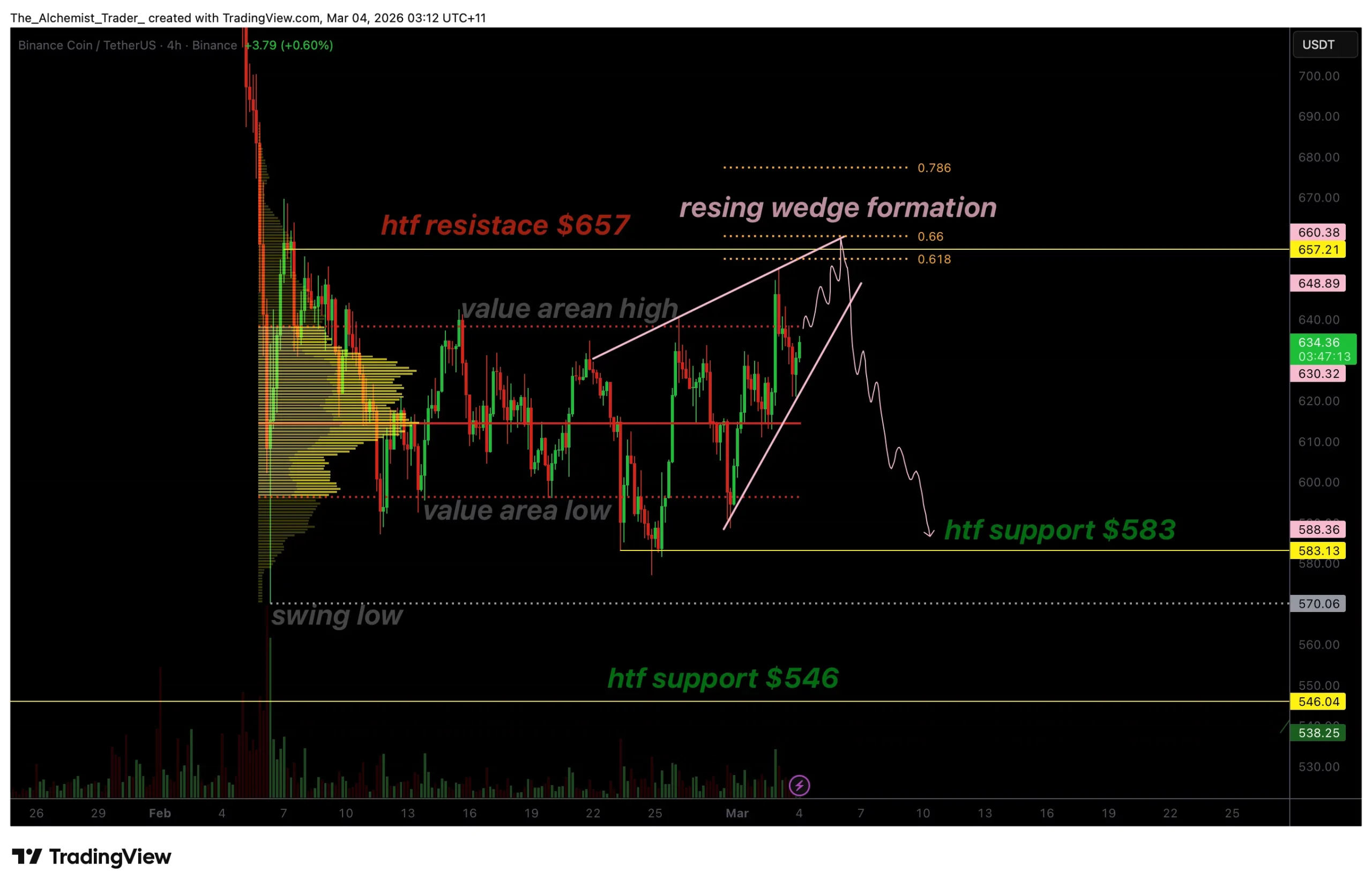
BNB price is trading within a rising wedge formation, a structure that often precedes bearish breakdowns. With price nearing major resistance near $657, a move toward $580 becomes increasingly likely if support fails.
Summary
- Rising wedge pattern signals potential bearish breakdown
- $657 resistance aligns with 0.618 Fibonacci confluence
- Breakdown targets $583–$580 high timeframe support
BNB’s (BNB) recent price action reflects a corrective phase rather than a confirmed bullish expansion. While the asset has been gradually pushing higher, the structure of the advance suggests weakening momentum.
The development of a rising wedge pattern, combined with heavy overhead resistance, places the market at a critical inflection point where downside risk is building.
BNB price key technical points
- Bearish Pattern: Rising wedge formation nearing apex.
- Major Resistance: $657 aligns with 0.618 Fibonacci and wedge resistance.
- Downside Target: Breakdown projects toward $583–$580 support.
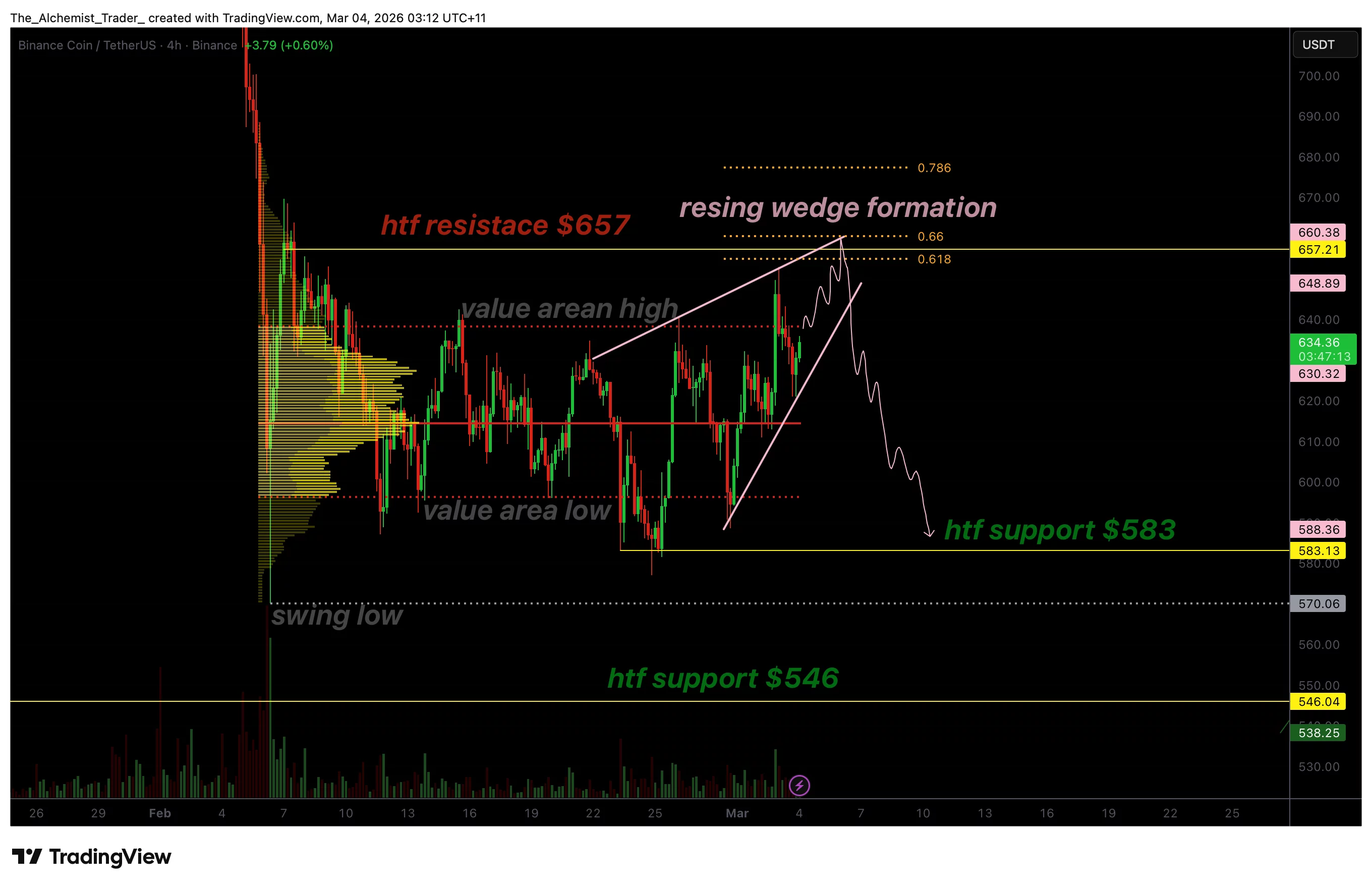
BNB is currently compressing within a rising wedge, a pattern characterized by higher highs and higher lows that converge over time. Although price appears to be trending upward, rising wedges are typically considered bearish formations, particularly when they develop after corrective rallies rather than strong impulsive moves.
At present, price is trading near the Value Area High, approaching a major resistance cluster near $657. This level aligns with the 0.618 Fibonacci retracement and overlaps with the upper boundary of the rising wedge. The convergence of these resistance factors creates a technically significant supply zone where sellers may reassert control.
The market is now positioned near the apex of the wedge formation, meaning volatility compression is reaching its limit. In such setups, price often breaks decisively in one direction once liquidity builds sufficiently. Given the bearish characteristics of the structure, the probability slightly favors a downside resolution.
For the pattern to activate, BNB would need to break below the lower boundary of the wedge. This confirmation would require a decisive close beneath the Value Area Low, signaling acceptance at lower prices.
A breakdown accompanied by expanding volume would validate the bearish thesis and increase confidence in a corrective move, even as Binance introduces seven AI-powered agent tools aimed at automating trading, data analysis, and risk management workflows.
Should this scenario unfold, the next high timeframe support sits near $583–$580, which represents the broader range support and prior structural demand. This level becomes the primary downside target in the event of a wedge breakdown.
From a market structure perspective, BNB remains within a corrective environment. Despite recent upward movement, the asset has not yet reclaimed significant high timeframe resistance on a sustained basis. Until the $657 zone is decisively broken and converted into support, upside continuation remains uncertain.
Volume dynamics also warrant attention. Breakouts from wedge patterns typically require increased participation to confirm direction. A surge in selling volume during a breakdown would reinforce the bearish case, while strong bullish volume pushing above $657 would invalidate it.
The technical setup currently leans bearish, with downside risk emerging should lower support fail, even as Senator Richard Blumenthal has opened a Senate inquiry into Binance over reports it processed $1.7 billion in transactions tied to sanctioned entities, adding regulatory uncertainty to the broader landscape.
What to expect in the coming price action
BNB remains vulnerable while trading within the rising wedge and below $657 resistance. A confirmed breakdown below the Value Area Low would activate the pattern and project a move toward $580 support.
Conversely, a strong breakout above resistance with volume expansion would negate the bearish setup and shift momentum back to the upside.


Japan’s economic security minister Sanae Takaichi said she has “absolutely no knowledge” of a Solana-based meme token bearing her name, after the cryptocurrency briefly surged to a market capitalization of around $30 million million.
“I have heard that a cryptocurrency called SANAE TOKEN has been issued and is being traded to some extent,” Takaichi wrote on X. “Due to the name, it seems there are various misunderstandings, but regarding this token, I have absolutely no knowledge of it, nor has my office been informed about what this token entails. We have not given any approval whatsoever in this matter.”
Her statement came after the token reached a market capitalization of $27.72 million before falling back to around $6 million. Onchain data cited by Wu Blockchain showed that the top three addresses held roughly 60% of the token’s supply, with several leading wallets recording notable inflows.
This is not the first time a memecoin inspired by a political figure has caused a stir, with the LIBRA token initially framed as being backed by Argentina president Javier Milei, leading to political turmoil.
Takaichi said she issued her statement “to ensure that the public does not labor under any misapprehensions,” distancing herself and her office from the project.
Disclosure: This article does not represent investment advice. The content and materials featured on this page are for educational purposes only.
Spot XRP ETF inflows top $1.2b as rising exchange outflows signal tightening supply dynamics.
Summary
- BFXMining positions its cloud mining model as a passive income option amid shifting crypto cycles.
- The platform highlights audited infrastructure and insurance mechanisms to strengthen platform transparency.
- As volatility rises, BFXMining markets structured cash-flow strategies for risk-conscious crypto investors.
As spot XRP ETF inflows accelerate, the market is showing a highly significant and signal-rich shift: capital is entering, while tokens are leaving exchanges.
Multiple data sources indicate that cumulative XRP ETF inflows have exceeded $1.2 billion, at one point approaching $1.4 billion. At the same time, more XRP holders are transferring tokens from exchanges to self-custody wallets, with on-chain outflows clearly increasing.
When “ETF capital inflows” and “declining exchange supply” occur simultaneously, markets are often pricing in stronger mid-term expectations — a structure that typically brings heightened volatility alongside trend potential.
Amid rising self-custody demand, some investors are shifting focus from purely price speculation to capital efficiency, including building more stable passive income structures through cloud mining models such as BFXMining, which are gaining increased attention.
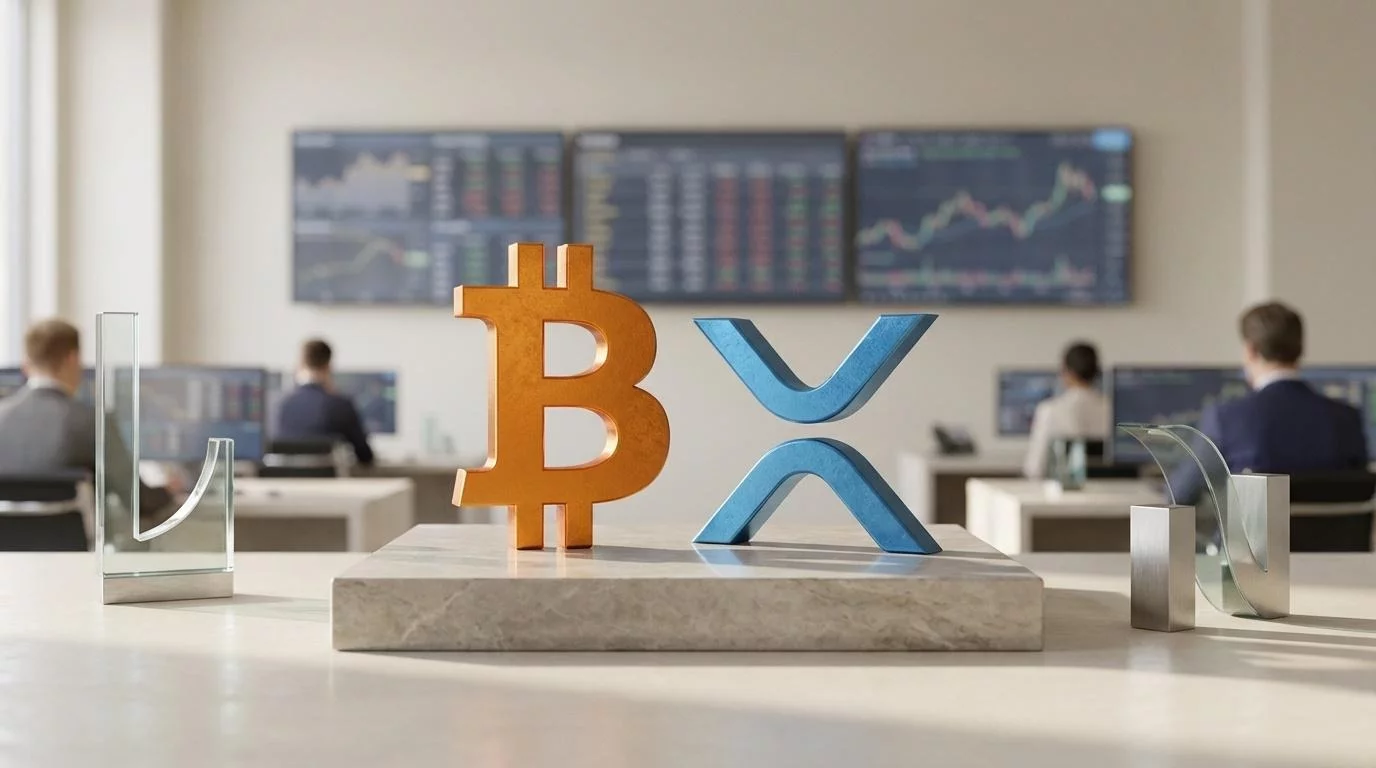
ETF inflows + exchange outflows: Is XRP’s supply structure tightening?
ETF inflows signal one clear message: traditional capital is entering the XRP market through regulated, transparent channels. Meanwhile, holders withdrawing tokens from exchanges often suggest two dynamics:
- Reduced short-term sell pressure: fewer tokens available on exchanges
- Stronger holding conviction: self-custody typically reflects longer-term positioning
When these forces converge, XRP may experience a structural shift of “rising demand + tightening supply.”
However, for investors, this also implies one thing: price moves may become faster, and volatility may intensify.
The self-custody wave: A market entering a high-sensitivity phase
Self-custody is not just a technical decision; it reflects market psychology.
During ETF-driven capital inflow phases, exchange withdrawals often indicate stronger bullish expectations and longer holding horizons. At the same time, reduced exchange liquidity can amplify price elasticity — rallies may accelerate, but pullbacks may also become sharper.
This is why, as ETF momentum builds, more investors are adopting a “directional exposure + cash-flow structure” strategy: participating in trend opportunities while ensuring capital continues generating income during volatility.
BFXMining: Building daily passive income during XRP’s structural shift
Before a full breakout materializes, BFXMining has drawn increasing interest for a simple reason: it offers a yield path that does not rely solely on short-term price swings through its cloud mining contract model.
Users do not need to purchase mining hardware or manage electricity and maintenance costs. By selecting contracts tied to major assets such as BTC, ETH, and XRP, participants can access:
- Automated operations
- Daily yield settlements
- Flexible allocation adjustments
- Withdrawals according to contract terms
As XRP potentially enters a higher-volatility phase driven by ETF inflows and tightening supply, mining-based income continues operating under predefined rules, providing a stabilizing cash-flow layer within diversified portfolios.
3-second self-check: Need a cash-flow supplement?
A cash-flow structure may be prioritized if:
- XRP is held, but exposure does not need to be reduced during volatility
- There are concerns about ETF-driven price swings
- Reliance on directional predictions needs be reduced
- Capital is preferred to continue generating returns during consolidation phases
If the answer is “yes,” there may not be a need for a more aggressive position, but a more resilient structure.
Compliance and operational transparency
According to publicly available information, BFXMining is headquartered in the United Kingdom and aligns its operational framework with the EU’s MiCA regulatory standards and MiFID II financial guidelines.
From a security standpoint, the platform employs multi-layered technical infrastructure, external audits, and insurance mechanisms to enhance operational transparency and stability. Investors should independently evaluate platform terms, risk disclosures, and applicable regulatory conditions before participating.
Getting started takes just three steps
1. Create an account and claim a welcome bonus
Visit bfxmining.net and register with an email address. New users receive a $22 bonus to explore the cloud mining structure.
2. Choose a cloud mining plan
Select from multiple contract options tailored to a particular risk preference. No technical expertise required.
3. Receive daily rewards
Once activated, contracts operate automatically and distribute yields daily according to predefined rules, helping establish a steady passive income rhythm.
Mobile access and app download options are available via the official website.
Conclusion
XRP ETF inflows surpassing $1.2 billion and approaching $1.4 billion — combined with large-scale exchange withdrawals — suggest the market may be entering a “rising demand + tightening supply” structural phase. Historically, such dynamics often bring both trend opportunities and amplified volatility.
As potential acceleration unfolds, more investors are adopting a “directional exposure + cash-flow structure” approach to manage risk and capital efficiency. BFXMining’s cloud mining model is increasingly being considered as one way to build a stable passive income during this transitional phase.
For more information, visit the official website and download the mobile app.
Disclosure: This content is provided by a third party. Neither crypto.news nor the author of this article endorses any product mentioned on this page. Users should conduct their own research before taking any action related to the company.


The Bank of Japan (BOJ) announced expansion of its blockchain experimentation for settling central bank reserves, while highlighting that efforts for a retail central bank digital currency (CBDC) are ongoing.
The BOJ rolled out a “sandbox project” to experiment settlements and bank deposits using central bank money, Governor Kazuo Ueda said on Tuesday in a speech titled “The New Financial Ecosystem and the Role of Central Banks.”
“In this experimental project, the Bank will conduct technical experimentation on settlement using central bank money in the form of current account deposits on a system that uses blockchains,” Ueda said.
The bank intends to explore “methods of connection with the existing system as well as examining use cases such as domestic interbank settlement and securities settlement,” he added. Analysts say introducing blockchain for reserves settlement would allow for instant round-the-clock settlement and reduce gridlock risk in stress events.
Ueda emphasized that the retail CBDC project is ongoing. “First, the ongoing pilot program for retail central bank digital currency (CBDC) involves the bank’s continued conduct of technical experiments, which will make it possible to provide … a digital form of cash when in demand by the wider public.”
Japan began CBDC experiments in 2021 and launched a pilot program in 2023. But the central bank has not committed to issuing a digital yen. According to a prior report, the BOJ this year will decide whether to issue a retail CBDC.
Ueda also spoke of Project Agorá,” an international experiment involving multiple central banks and major private financial institutions. He said its participants are considering “building a mechanism that would enable central banks, including the Bank of Japan, to issue central bank money as tokenized deposits on the blockchain.” If successful, he said, the effort “may bring innovation in terms of streamlining cross-border payments.”
Unlike a retail CBDC, which would function as a digital form of yen for the general public, tokenized central bank deposits would represent wholesale central bank money used by financial institutions on blockchain-based infrastructure, according to Ueda’s speech.
The move to use blockchain technology to settle reserves follows decisions in the U.K. and Hong Kong to issue sovereign debt on the blockchain.

Japanese Prime Minister Sanae Takaichi publicly disavowed a cryptocurrency bearing her name and likeness. The token crashed 58% within hours, and regulators moved to investigate the issuer.
The episode is the latest in a string of political memecoins that have burned retail investors worldwide.
PM’s Denial Triggers Crash
Takaichi is Japan’s first female prime minister and one of its most popular in decades. Her LDP won 316 seats in the Feb. 8 general election, a supermajority, and her cabinet approval rating sits near 70%.
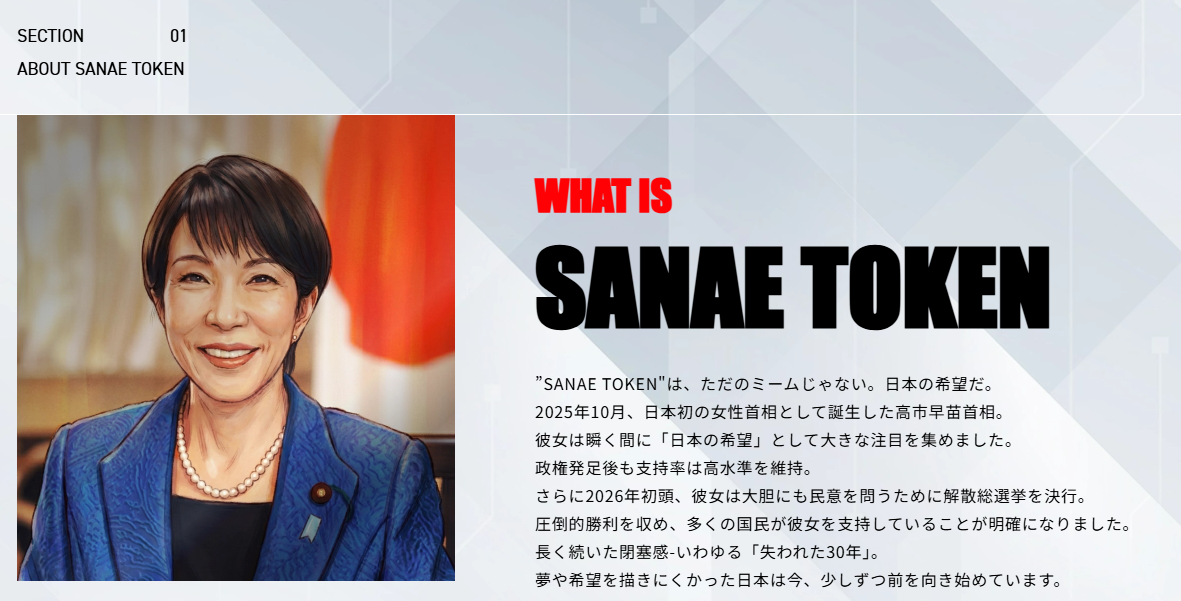
SANAE TOKEN launched on the Solana blockchain on Feb. 25 without the prime minister’s knowledge. Serial entrepreneur Yuji Mizoguchi’s NoBorder DAO community issued it as part of a “Japan is Back” initiative. The project’s website displayed Takaichi’s name and an illustrated portrait of her.
Mizoguchi had earlier stated on the YouTube show “REAL VALUE” that he was in contact with Takaichi’s side. That claim amplified speculation that the token carried some form of official backing.

On March 2, Takaichi posted on X to shut down the narrative. The post amassed over 63 million views. She said neither she nor her office knew anything about the token. She added that no approval had ever been granted.
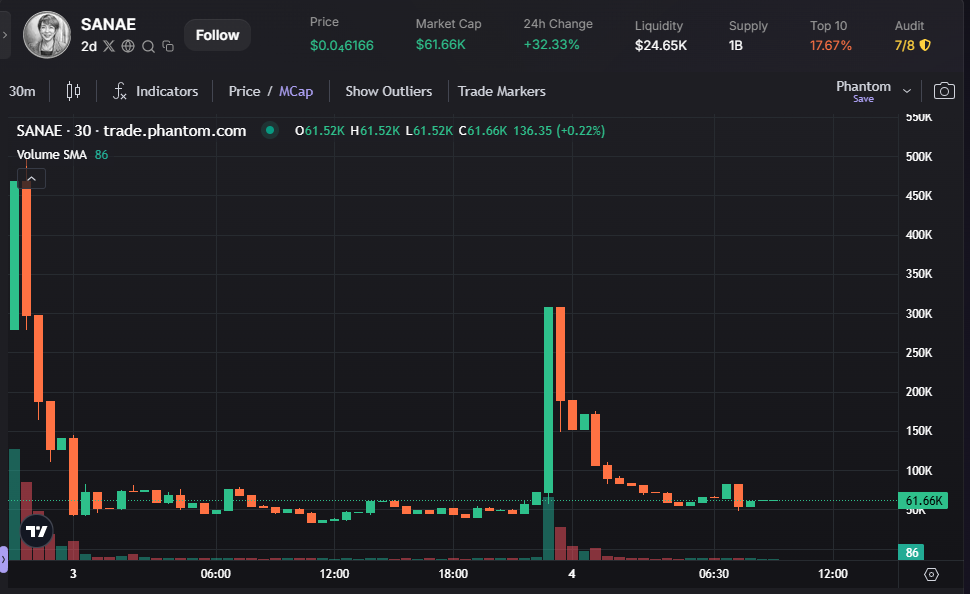
The token’s price plunged from $0.0137 to $0.0058 almost immediately after her statement. By March 4, the market cap had cratered to roughly $62,000 with just $25,000 in liquidity.
FSA Launches Probe
Japan’s Financial Services Agency (FSA) is now investigating the token’s operators. The agency found that the issuing company lacks the required crypto exchange license.
Under Japan’s Payment Services Act, selling or exchanging crypto assets requires registration with the FSA. Violators face up to five years in prison or fines of ¥5 million.
A company called neu, led by CEO Ken Matsui, claimed responsibility for the token’s design. Matsui posted a public apology on X on March 3, saying they handled all operations.
Mizoguchi reposted Matsui’s statement and pledged cooperation with a media investigation. He wrote on X that he would not run from accountability or shift blame onto others. He said he intended to face the matter based on facts, not emotions.
Still, the gap between his earlier YouTube remarks and the prime minister’s flat denial remains unresolved.
The FSA confirmed that neu was not on its registered exchange list as of January. No subsequent application had been filed either.
The token’s structure has drawn additional scrutiny. Sixty-five percent of the total supply was reserved for operators.
Political Memecoins Under Global Spotlight
Japan’s scandal mirrors a pattern now emerging across multiple countries.
In the US, President Donald Trump launched $TRUMP on Solana in January 2025. His family and partners retained 80% of the supply and earned over $350 million in fees.
Senator Chris Murphy introduced the MEME Act to ban officials from issuing financial assets. Trump’s crypto czar, David Sacks, countered that memecoins are collectibles, not securities.
In February 2025, Argentina’s President Javier Milei promoted the $LIBRA token. It surged to a $4.5 billion market cap before crashing 89% within three hours.
Insiders allegedly extracted roughly $100 million before the collapse. Milei now faces fraud investigations and impeachment calls.
Regulatory Gap Persists
Each case exploits a similar loophole. Memecoins typically fall outside the definitions of securities in most jurisdictions.
Japan’s framework may offer a stricter path. The Payment Services Act covers crypto exchange activity regardless of token type. The FSA can act against unlicensed operators without classifying tokens as securities.
In the US, the SEC under the Trump administration has narrowed its scope of crypto enforcement. Memecoins remain largely unregulated at the federal level.
No international framework currently addresses political memecoins specifically. The gap leaves retail investors exposed to hype-driven schemes tied to public figures.
Industry observers say the SANAE TOKEN case could set a precedent. Japan’s response may shape how other regulators approach the growing trend.
The partnership with the CFTC-regulated prediction market will let users bet on luxury watch prices.
Kalshi, the largest prediction market platform by monthly spot volumes, has unveiled a strategic partnership with Bezel, a specialist in authenticated luxury watches, to let Kalshi users bet on the prices of luxury watches. Kalshi announced the move in an X post today, March 3.
The partnership with Bezel is part of Kalshi’s broader strategy to enhance its offerings in the collectibles market, Bloomberg reported today, citing executives from both firms.
Bezel’s CEO and co-founder, Quaid Walker, told Bloomberg that watches have “been viewed as a financial market for a really long period of time, but it’s also passion-driven.”
Kalshi’s previous moves into collectibles markets include a recent partnership with StockX, a platform for trading physical collectibles, from trading cards to sneakers and other apparel and accessories.
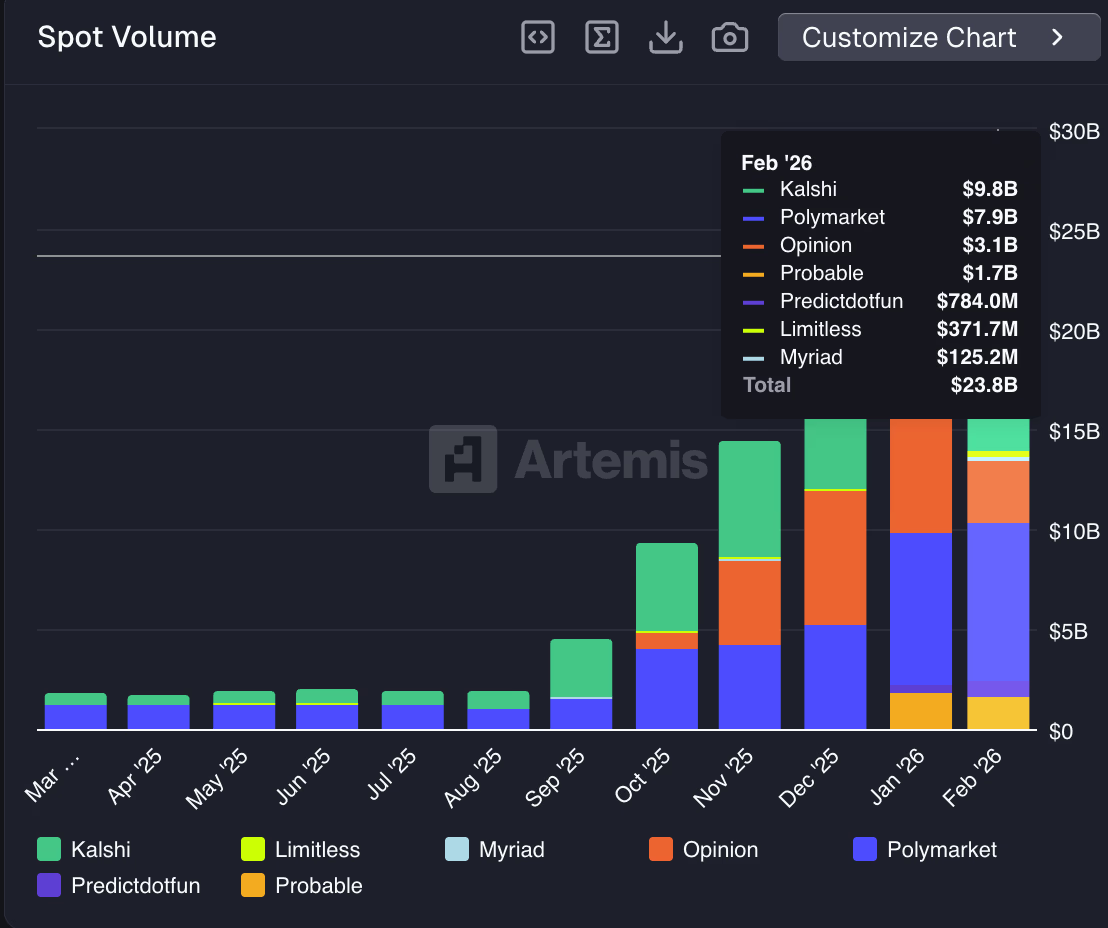
Today’s announcement comes as the hybrid on-off-chain prediction platform had its best month yet, per data from Artemis. Kalshi also surpassed on-chain prediction marketplace Polymarket in monthly trading volumes for the sixth consecutive month, with $9.8 billion in trades in February.
Polymarket saw just under $8 million last month, while total sector volume was down month over month for the first time since last August, as BNB Chain-based rival Opinion recorded a massive drop.
Kalshi and Polymarket have been neck and neck in recent months, both in terms of trading volumes and valuations, after their most recent funding rounds.

The prediction market industry is navigating complex legal landscapes, with platforms like Kalshi and Polymarket under scrutiny — including in the United States, where both platforms now operate as regulated entities under the Commodity Futures Trading Commission (CFTC).
As The Defiant reported, last month, the CFTC took a strong public stance on the issue, arguing that that the agency, not individual states, should regulate prediction market platforms.
This article was generated with the assistance of AI workflows.


The CEX said its IRAs are the first crypto-native retirement accounts in the U.S. to offer crypto and traditional equities in one account.
Centralized exchange (CEX) Crypto.com has unveiled retirement account in the U.S. the let users invest in both cryptocurrency and traditional equities in a single account.
The CEX says that the IRAs are a first of its kind for a crypto native firm, according to a press release published today, March 3.
“The launch of Crypto.com IRAs is our latest significant step in providing consumers the ability to act on and invest in financial opportunity,” Kris Marszalek, co-founder and CEO of the platform said in a statement.
Per the announcement, the Crypto.com IRAs offer features such as tax-deferred or tax-free growth, contribution matches of up to 5%, and zero account fees.
The move comes just a week after the CEX announced it has received conditional approval from the Office of the Comptroller of the Currency (OCC) to establish Foris Dax National Trust Bank, positioning itself as a federally regulated qualified custodian, as The Defiant previously reported.
Founded in 2016, Crypto.com is currently ranked 10th among CEXs on CoinGecko by 24-hour trading volume and trust score, with about $2.8 billion in trades today.
In April, Fidelity launched dedicated cryptocurrency retirement accounts with exposure to several major crypto assets, as The Defiant reported. The tax-advantaged accounts from the TradFi giant, however, only offer crypto investment, while clients need to keep a separate IRA account for their traditional investments.
This article was generated with the assistance of AI workflows.
War news may be dominating headlines, but Alibaba AI believes crypto’s mid-to-long-term prospects look better than ever.
Market behavior suggests that investors may have already absorbed the impact of war-related risks earlier in the year, following selloffs triggered by former President Trump’s rhetoric around possible U.S. military escalation involving Greenland and Iran.
As such, Alibaba AI predicts sweltering new highs this year for XRP, BTC, and ETH.
XRP ($XRP): Alibaba AI Forecasts a 9x Move Over the Next 10 Months
In a recent update, Ripple reaffirmed that XRP ($XRP) is the key to positioning XRP Ledger (XRPL) as a global, enterprise-ready payments infrastructure.
With fast settlement speeds, and ultra-low transaction costs, XRPL could capture an early advantage in two of crypto’s fastest growing segments: stablecoins and tokenized real world assets.
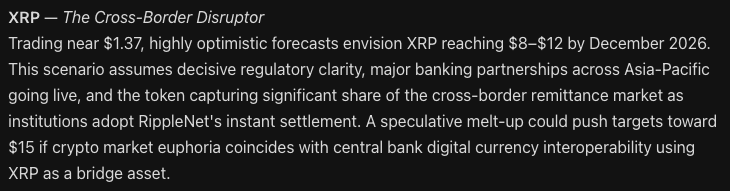
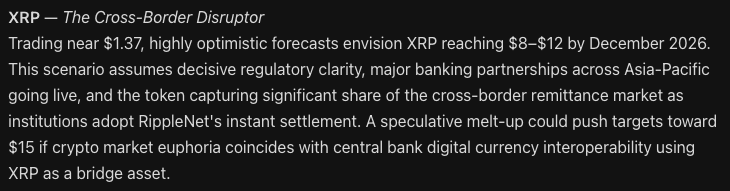
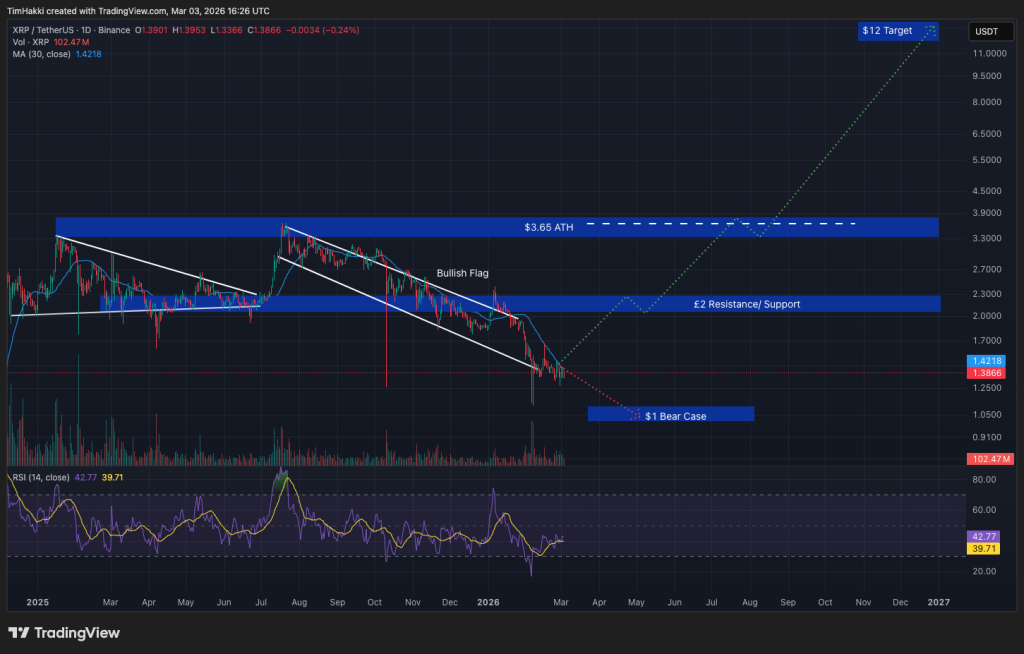
XRP is currently trading near $1.38, and Alibaba AI predicts a potential climb toward $12 this year, a ninefold return for current holders.
Technical data adds weight to the bullish call. XRP’s relative strength index (RSI) is hovering around 43, while price action has found support near the 30-day moving average, signalling that the extended consolidation phase could be over.
Further upside catalysts include rising institutional involvement following the launch of U.S.-listed XRP ETFs, Ripple’s expanding international partnerships, and potential regulatory clarity should the CLARITY bill pass in the U.S. later this year.
Bitcoin (BTC): Alibaba AI Eyes a $155,000 New Year Target
The first and biggest crypto, Bitcoin ($BTC), reached an all-time high of $126,080 on October 6 before shedding nearly 50% of its price in the months following.
Despite recent volatility, Alibaba suggests Bitcoin remains on a long-term growth trajectory, with 2026 possibly peaking at $150,000.
Often referred to as digital gold, Bitcoin attracts risk-averse institutional and retail investors seeking diversification and protection against inflation and macroeconomic uncertainty.
Bitcoin currently represents about $1.3 trillion of the $2.4 trillion total crypto market. Much of its recent losses followed sharp pullbacks after the U.S. threatened military involvement in Iran and Greenland.
Accelerating institutional adoption and reduced supply following the latest halving event could be key drivers pushing Bitcoin to new highs this year.
If Trump delivers on his promice for a U.S. Strategic Bitcoin Reserve then BTC could even peak far higher than Alibaba suspects.
Ethereum (ETH): Alibaba AI Says ETH to Hit $6,000
Ethereum ($ETH) is the leading smart contract platform and the backbone of decentralized finance.
With a market capitalization of approximately $239 billion and $53 billion locked on chain, Ethereum is the primary settlement layer for on-chain economic activity.
Its proven security, leadership in stablecoins, and early momentum in real-world asset tokenization position Ethereum as a strong candidate for deeper institutional adoption.
That hinges on regulatory progress. Approval of the CLARITY bill by U.S. lawmakers could provide the certainty institutions need to deploy capital on Ethereum.
ETH currently trades under $2,000, with major resistance expected around $5,000 as seen by last August’s ATH of $4,946.05.
A decisive break above $5,000 has Alibaba hypothesizing $6,000 ETH by Christmas.
Maxi Doge: Early-Stage Meme Coin Targets Outsized Returns
Alibaba thinks XRP, Bitcoin, and Ethereum may offer substantial growth this year, which will ultimately be great for meme coins.
And one high upside potential new meme coin investors are piling into is Maxi Doge ($MAXI). It has raised $4.6 million in its ongoing presale as investors bet on Maxi dethroning Dogecoin.
Maxi Doge claims to be Dogecoin’s louder, degenerate, long-lost gym-bro cousin, evoking the viral energy of meme coins during the 2021 bull run.
Built as an ERC-20 token on Ethereum’s proof-of-stake network, MAXI leaves a significantly smaller environmental footprint compared to Dogecoin’s proof-of-work model.
Early presale participants can currently stake MAXI for yields of up to 67% APY, with returns gradually decreasing as more tokens enter the staking pool.
The token is $0.0002806 in the current presale phase, with automatic price increases scheduled at each funding milestone.
Investors looking to secure $HYPER can visit the official website and connect a supported wallet such as Best Wallet.
Purchases can also be made with a bank card.
Visit the Official Website Here
The post China’s Alibaba AI Predicts the Price of XRP, Bitcoin and Ethereum by the End of 2026 appeared first on Cryptonews.

Social Media Reacts To His Jeffrey Epstein Testimony

How Much Money Financial Advisors Make

Royal College of Surgeons called in to Leslie Irwin NHS investigation


-

 Politics5 days ago
ITV enters Gaza with IDF amid ongoing genocide
-

 Fashion4 days ago
Weekend Open Thread: Iris Top
-

 Politics19 hours ago
Alan Cumming Brands Baftas Ceremony A ‘Triggering S**tshow’
-

 Tech3 days ago
Unihertz’s Titan 2 Elite Arrives Just as Physical Keyboards Refuse to Fade Away
-

 NewsBeat6 days ago
Cuba says its forces have killed four on US-registered speedboat | World News
-
Sports4 days ago
The Vikings Need a Duck
-
 NewsBeat3 days ago
Dubai flights cancelled as Brit told airspace closed ’10 minutes after boarding’
-

 NewsBeat3 days ago
‘Significant’ damage to boarded-up Horden house after fire
-
 NewsBeat6 days ago
Manchester Central Mosque issues statement as it imposes new measures ‘with immediate effect’ after armed men enter
-
 NewsBeat4 days ago
The empty pub on busy Cambridge road that has been boarded up for years
-

 NewsBeat3 days ago
Abusive parents will now be treated like sex offenders and placed on a ‘child cruelty register’ | News UK
-

 Entertainment2 days ago
Baby Gear Guide: Strollers, Car Seats
-

 Business6 days ago
Discord Pushes Implementation of Global Age Checks to Second Half of 2026
-

 Business5 days ago
Only 4% of women globally reside in countries that offer almost complete legal equality
-
 Tech5 days ago
NASA Reveals Identity of Astronaut Who Suffered Medical Incident Aboard ISS
-
 NewsBeat3 days ago
Emirates confirms when flights will resume amid Dubai airport chaos
-
Politics3 days ago
FIFA hypocrisy after Israel murder over 400 Palestinian footballers
-

 Crypto World5 days ago
From Crypto Treasury to RWA: ETHZilla Retreats and Relaunches as Forum Markets on Nasdaq
-

 NewsBeat2 days ago
Is it acceptable to comment on the appearance of strangers in public? Readers discuss
-

 Tech3 days ago
Viral ad shows aged Musk, Altman, and Bezos using jobless humans to power AI