
Crypto World
$1.4b ETF inflows as investors build stable passive income via BFXMining

Disclosure: This article does not represent investment advice. The content and materials featured on this page are for educational purposes only.
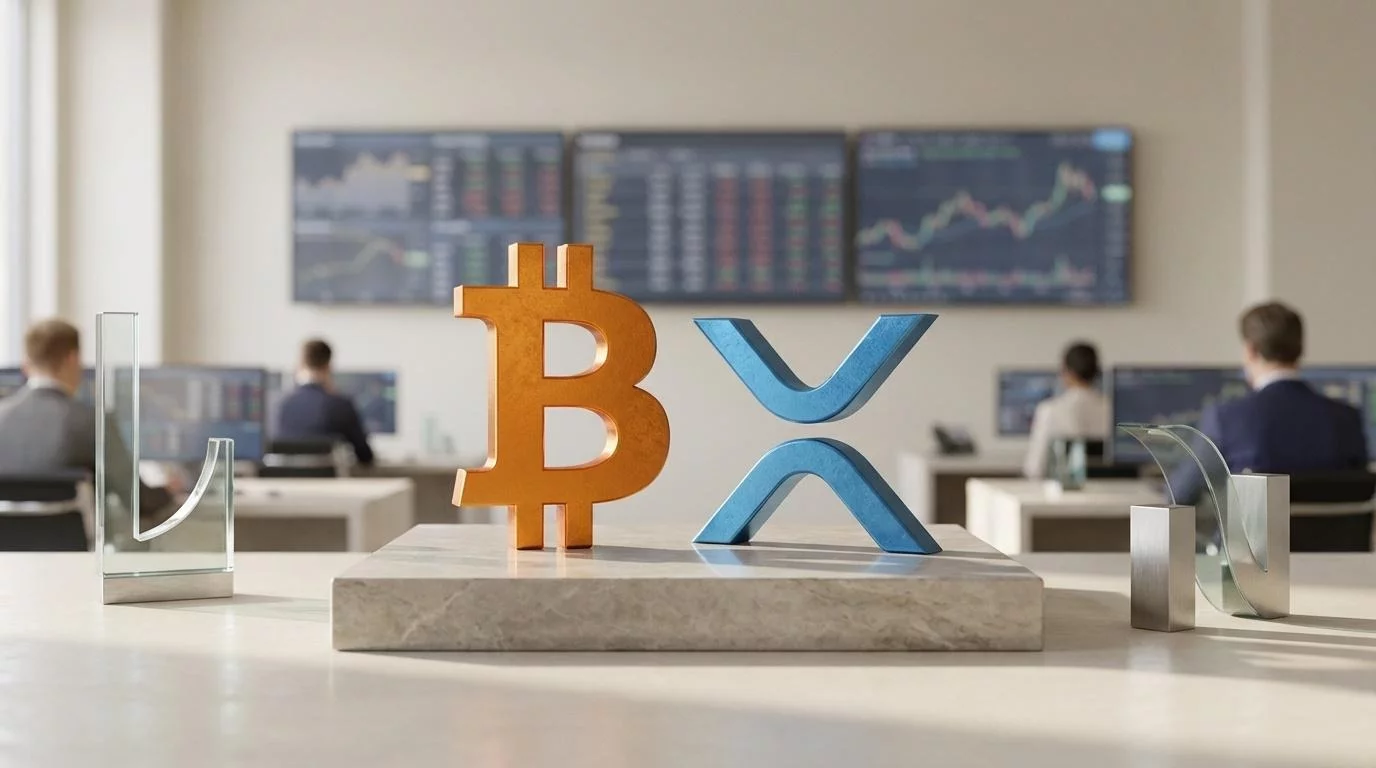
Spot XRP ETF inflows top $1.2b as rising exchange outflows signal tightening supply dynamics.
Summary
- BFXMining positions its cloud mining model as a passive income option amid shifting crypto cycles.
- The platform highlights audited infrastructure and insurance mechanisms to strengthen platform transparency.
- As volatility rises, BFXMining markets structured cash-flow strategies for risk-conscious crypto investors.
As spot XRP ETF inflows accelerate, the market is showing a highly significant and signal-rich shift: capital is entering, while tokens are leaving exchanges.
Multiple data sources indicate that cumulative XRP ETF inflows have exceeded $1.2 billion, at one point approaching $1.4 billion. At the same time, more XRP holders are transferring tokens from exchanges to self-custody wallets, with on-chain outflows clearly increasing.
When “ETF capital inflows” and “declining exchange supply” occur simultaneously, markets are often pricing in stronger mid-term expectations — a structure that typically brings heightened volatility alongside trend potential.
Amid rising self-custody demand, some investors are shifting focus from purely price speculation to capital efficiency, including building more stable passive income structures through cloud mining models such as BFXMining, which are gaining increased attention.
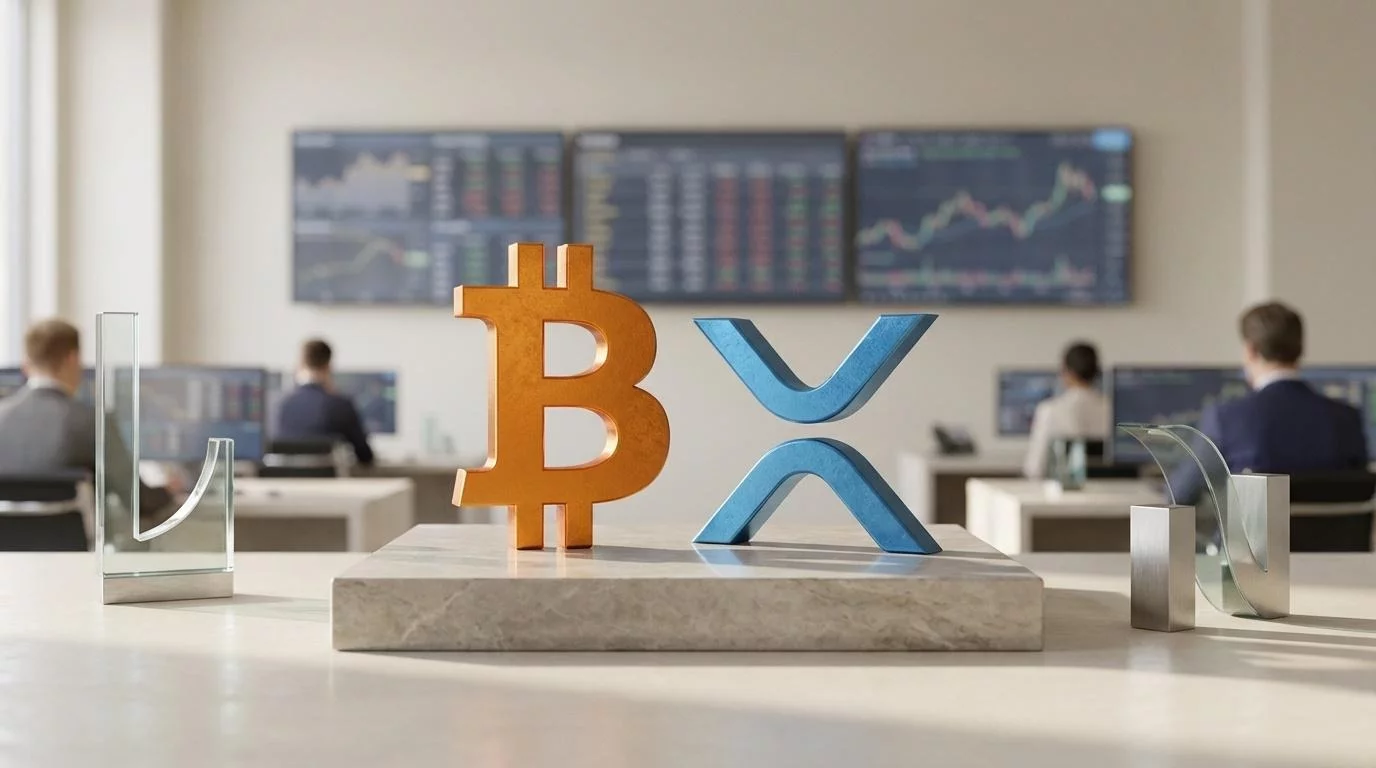
ETF inflows + exchange outflows: Is XRP’s supply structure tightening?
ETF inflows signal one clear message: traditional capital is entering the XRP market through regulated, transparent channels. Meanwhile, holders withdrawing tokens from exchanges often suggest two dynamics:
- Reduced short-term sell pressure: fewer tokens available on exchanges
- Stronger holding conviction: self-custody typically reflects longer-term positioning
When these forces converge, XRP may experience a structural shift of “rising demand + tightening supply.”
However, for investors, this also implies one thing: price moves may become faster, and volatility may intensify.
The self-custody wave: A market entering a high-sensitivity phase
Self-custody is not just a technical decision; it reflects market psychology.
During ETF-driven capital inflow phases, exchange withdrawals often indicate stronger bullish expectations and longer holding horizons. At the same time, reduced exchange liquidity can amplify price elasticity — rallies may accelerate, but pullbacks may also become sharper.
This is why, as ETF momentum builds, more investors are adopting a “directional exposure + cash-flow structure” strategy: participating in trend opportunities while ensuring capital continues generating income during volatility.
BFXMining: Building daily passive income during XRP’s structural shift
Before a full breakout materializes, BFXMining has drawn increasing interest for a simple reason: it offers a yield path that does not rely solely on short-term price swings through its cloud mining contract model.
Users do not need to purchase mining hardware or manage electricity and maintenance costs. By selecting contracts tied to major assets such as BTC, ETH, and XRP, participants can access:
- Automated operations
- Daily yield settlements
- Flexible allocation adjustments
- Withdrawals according to contract terms
As XRP potentially enters a higher-volatility phase driven by ETF inflows and tightening supply, mining-based income continues operating under predefined rules, providing a stabilizing cash-flow layer within diversified portfolios.
3-second self-check: Need a cash-flow supplement?
A cash-flow structure may be prioritized if:
- XRP is held, but exposure does not need to be reduced during volatility
- There are concerns about ETF-driven price swings
- Reliance on directional predictions needs be reduced
- Capital is preferred to continue generating returns during consolidation phases
If the answer is “yes,” there may not be a need for a more aggressive position, but a more resilient structure.
Compliance and operational transparency
According to publicly available information, BFXMining is headquartered in the United Kingdom and aligns its operational framework with the EU’s MiCA regulatory standards and MiFID II financial guidelines.
From a security standpoint, the platform employs multi-layered technical infrastructure, external audits, and insurance mechanisms to enhance operational transparency and stability. Investors should independently evaluate platform terms, risk disclosures, and applicable regulatory conditions before participating.
Getting started takes just three steps
1. Create an account and claim a welcome bonus
Visit bfxmining.net and register with an email address. New users receive a $22 bonus to explore the cloud mining structure.
2. Choose a cloud mining plan
Select from multiple contract options tailored to a particular risk preference. No technical expertise required.
3. Receive daily rewards
Once activated, contracts operate automatically and distribute yields daily according to predefined rules, helping establish a steady passive income rhythm.
Mobile access and app download options are available via the official website.
Conclusion
XRP ETF inflows surpassing $1.2 billion and approaching $1.4 billion — combined with large-scale exchange withdrawals — suggest the market may be entering a “rising demand + tightening supply” structural phase. Historically, such dynamics often bring both trend opportunities and amplified volatility.
As potential acceleration unfolds, more investors are adopting a “directional exposure + cash-flow structure” approach to manage risk and capital efficiency. BFXMining’s cloud mining model is increasingly being considered as one way to build a stable passive income during this transitional phase.
For more information, visit the official website and download the mobile app.
Disclosure: This content is provided by a third party. Neither crypto.news nor the author of this article endorses any product mentioned on this page. Users should conduct their own research before taking any action related to the company.

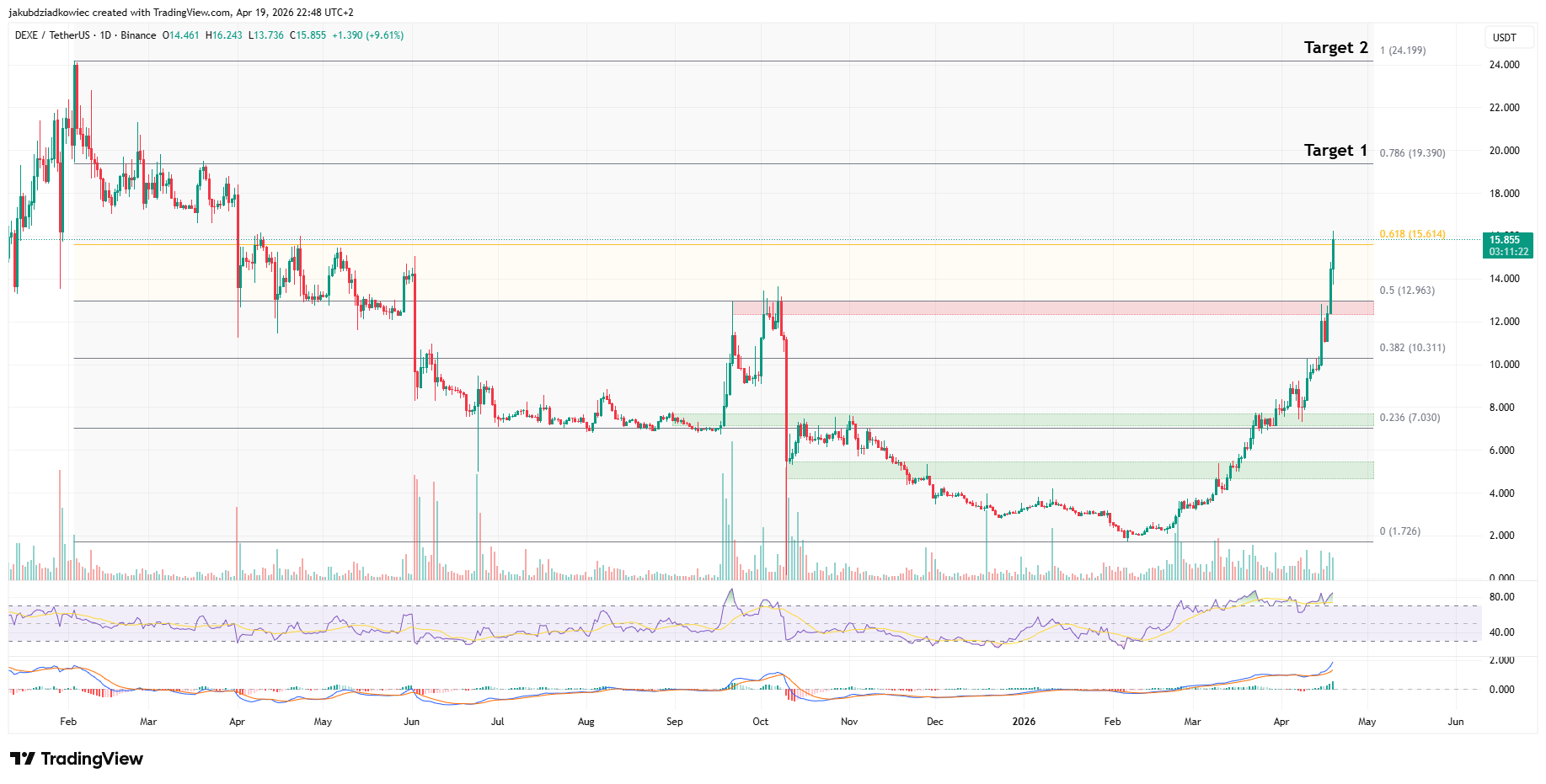
Three altcoins are entering next week with fresh bullish setups on their daily charts. DeXe (DEXE) leads with a 63.8% weekly gain, while Ethena (ENA) and MemeCore (M) show technical breakouts that suggest follow-through upside.
Each chart shows a distinct setup. DEXE has cleared a key Fibonacci retracement with strong momentum, ENA has broken a multi-month downtrend line, and M is riding an exponential support curve above a confirmed breakout zone.
Altcoin to Watch: DeXe Leads the Week With a 64% Rally
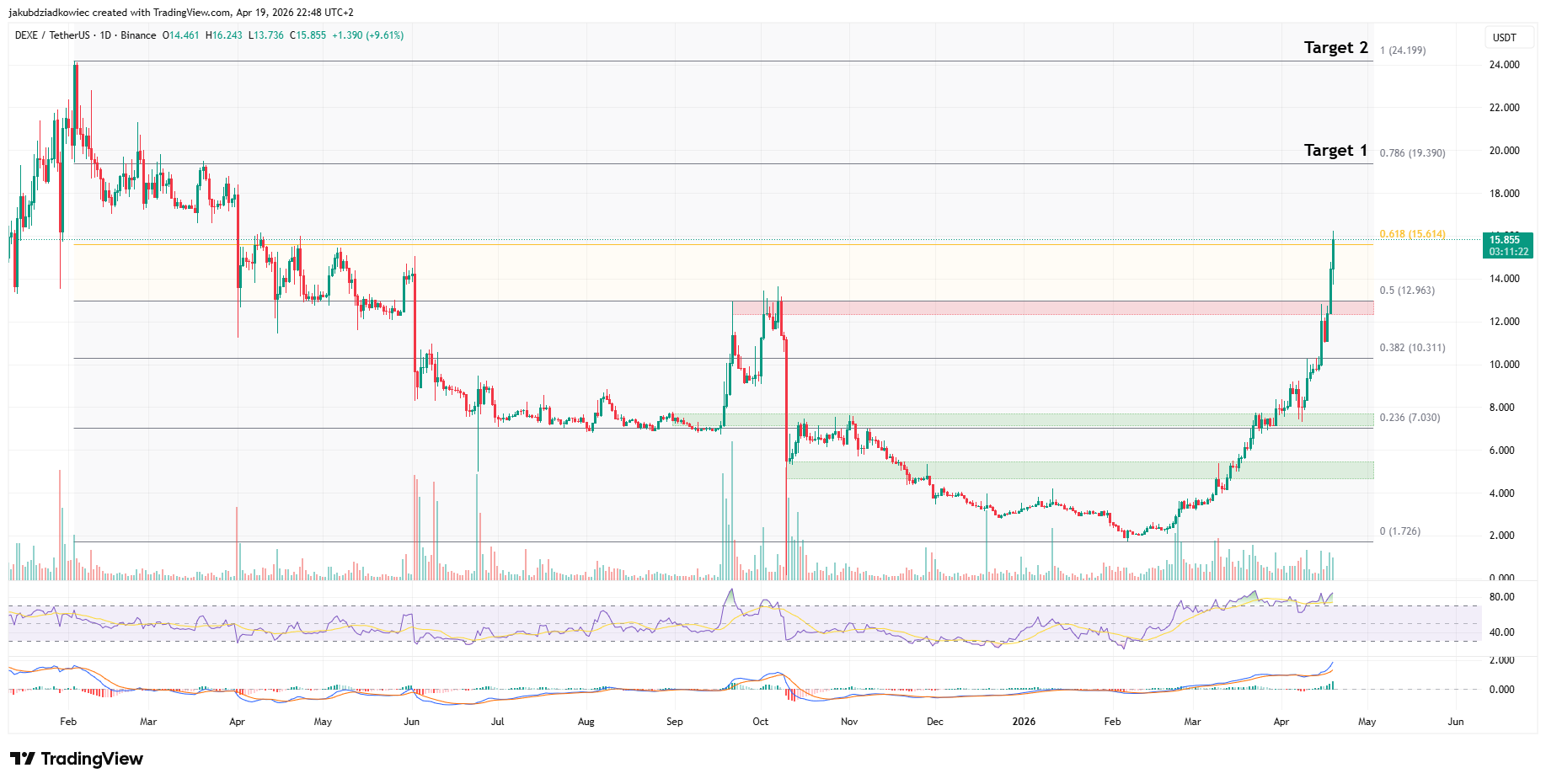
DeXe (DEXE) is the strongest performer on this watchlist, up 63.8% over the last seven days. Nearly 10% of that gain came in the last two sessions, with price trading at $15.85 and sitting directly on the 0.618 Fibonacci retracement at $15.61.
The coin has already cleared the $12.50 to $13 resistance zone, a level flagged in prior DeXe coverage. That area now acts as the first support if buyers step back.
The next major target on the upside is the 0.786 retracement at $19.39. Above that level, the chart shows a final target at the 1.0 retracement near $24.20, which would mark a full recovery to the February 2025 high.
Moving Average Convergence Divergence (MACD) remains elevated and positively sloped, which continues to support momentum. However, the Relative Strength Index (RSI) has reached the upper band and is showing the first hints of bearish divergence, a shift that could signal cooling ahead.
Volume has been declining across the advance, a typical sign that the move lacks fresh participation. The uptrend could stall if new buyers do not step in at higher prices.
If momentum reverses, the first downside target is $13. The second support sits at $10.31, which is the 0.382 Fibonacci retracement and the line that would define a deeper correction.
Ethena Breaks a Multi-Month Downtrend Line
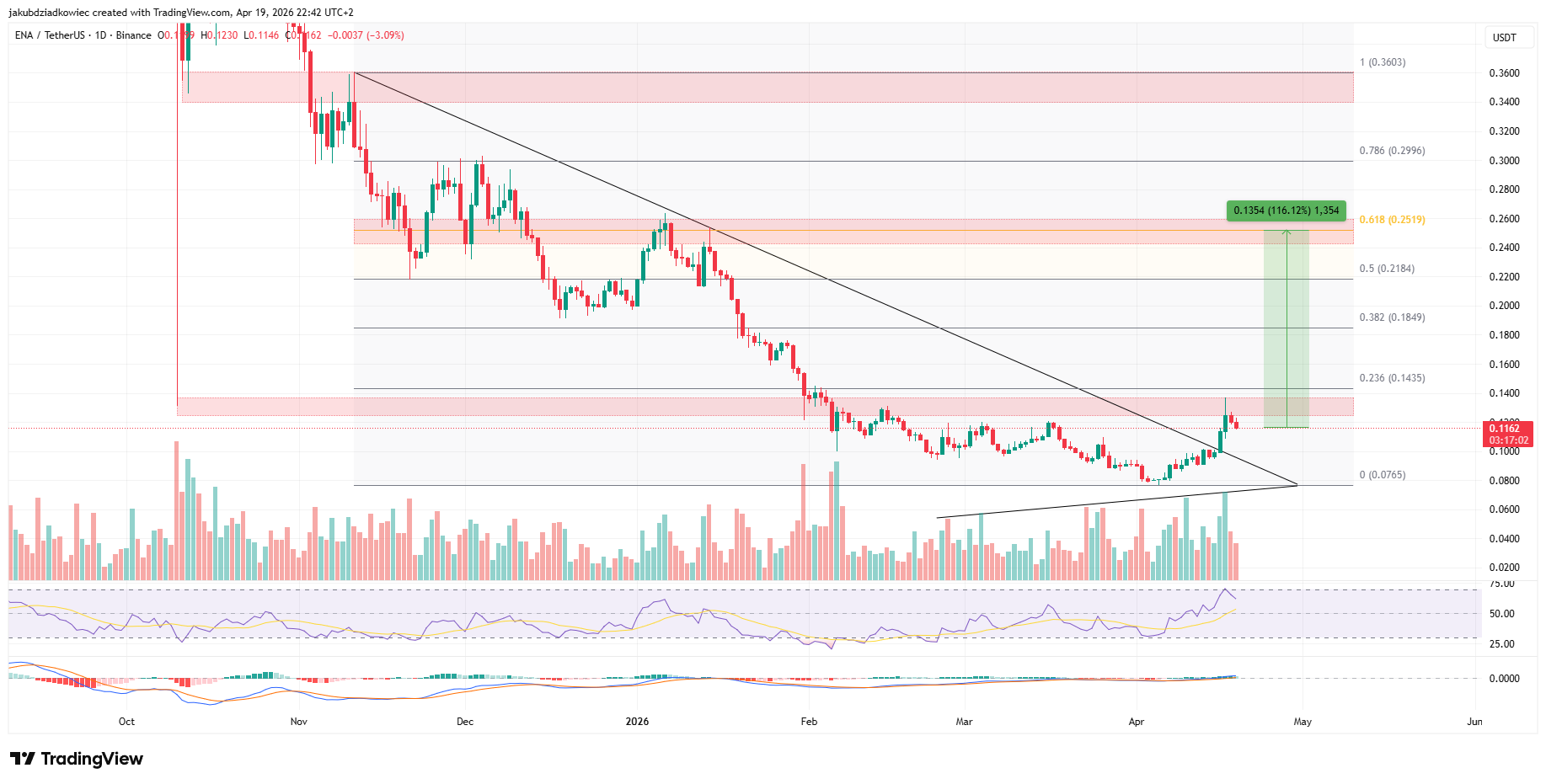
Ethena (ENA) has gained 27.1% over the past week, the second-strongest performer on this list. Price trades near $0.1162 after a short-term pullback on the day, yet the weekly structure remains constructive.
Three days ago, the price pushed above a descending trend line. That line had guided the full move from the November 11 high at $0.3603 into the April 5 low at $0.0765.
The Fibonacci retracement anchored from those two points places the first resistance at $0.1435, which is the 0.236 level. Price is consolidating just below that zone, which is marked in red on the chart.
A confirmed close above $0.1435 would open the 0.382 retracement at $0.1849 and the 0.5 retracement at $0.2184. The 0.618 retracement at $0.2519 remains the primary target for a larger breakout. That level would represent a 116% gain from current prices (green).
Volume has been rising on bullish candles, signaling stronger buyer participation. RSI has climbed out of oversold without reaching overbought, which leaves room for further upside. Other altcoins have shown similar recovery setups heading into April.
The final bullish target sits at $0.3603, the breakdown zone from November. That path is ambitious, yet the chart no longer prints fresh lower lows, and the break of the trend line is the first structural shift in months.
MemeCore Holds Breakout Support After a 24% Weekly Gain
MemeCore (M) posted a 24.2% gain over the last seven days, rounding out this week’s three altcoins. The token broke out of a multi-month resistance zone on April 16 and has since converted that zone into support.
That resistance had capped gains since September 17, 2025. It now sits between $2.80 and $3.00 on the daily chart, and a retest on April 19 confirmed the area as support.
An exponential curve drawn on the chart (black) continues to track the price from below. A break of that curve would be the first clear sign that the trend structure has shifted.
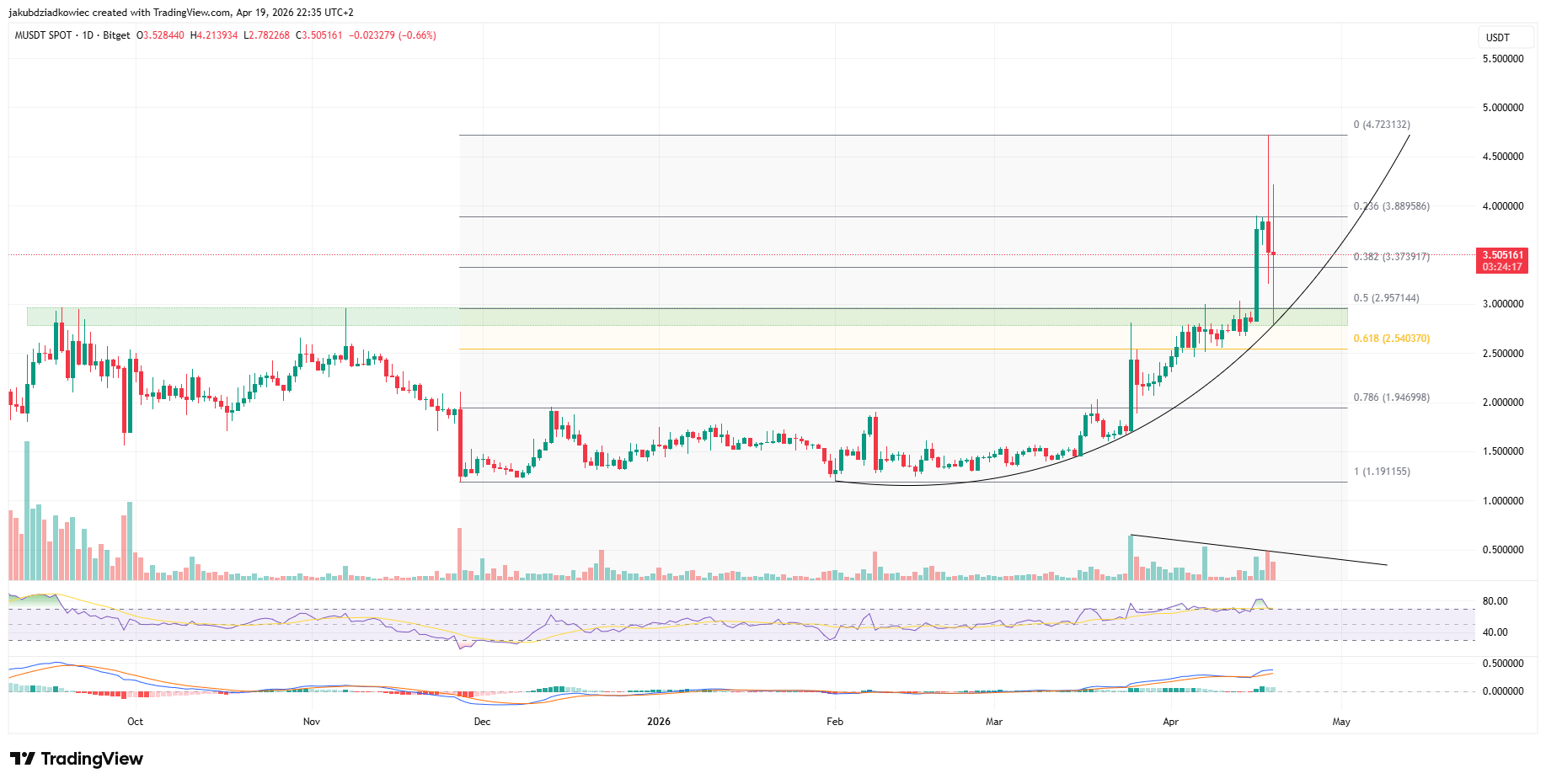
The most recent pullback tagged the 0.5 Fibonacci retracement, which sits inside the same support band. A deeper correction would shift attention to the 0.618 retracement near $2.54, the last defense for the bullish thesis. Prior MemeCore coverage tracked a similar breakout attempt earlier this cycle.
RSI shows no bearish divergence, and MACD remains constructive. Volume has been trending lower even as price extends, a divergence that suggests the rally needs fresh buyers to sustain the current pace.
The post 3 Altcoins to Watch in the 4th Week of April 2026 appeared first on BeInCrypto.

Key Takeaways
- A security breach affecting KelpDAO’s rsETH product on April 20 created cascading effects throughout Solana’s DeFi infrastructure
- Stablecoin lending platforms across the network have experienced dramatic spikes in utilization metrics
- Jupiter Lend currently shows 99% utilization with only $81 million remaining from its $421 million USDC reserves
- Both Kamino and Marginfi face severe liquidity constraints as borrowing rates exceed 8%
- The available capital for lending across Solana’s ecosystem has reached critically low levels
A security incident targeting KelpDAO’s rsETH infrastructure on April 20, 2026, has triggered widespread disruption across the Solana blockchain’s decentralized finance landscape.
The repercussions materialized quickly. Capital started evacuating from DeFi applications, creating a squeeze on stablecoin availability throughout Solana’s lending infrastructure. Multiple prominent platforms now operate with minimal reserves remaining.
Jupiter Lend faces particularly acute pressure. The protocol manages $421 million in total USDC deposits, of which $340 million has been distributed to borrowers. When factoring in mandatory reserve requirements, the platform operates at approximately 99% capacity. Current annual percentage yields for lenders stand at 4.36%.
Kamino Prime Market experiences similar stress conditions. Data indicates total USDC deposits of roughly $186.8 million against outstanding loans of $178.8 million. This configuration produces utilization approaching 96%, while lending yields have climbed to 8.92%.
Kamino’s Main Market exhibits comparable dynamics. The platform holds approximately $172 million in USDC deposits supporting $164 million in active loans. Utilization metrics hover around 95.75%, with lending returns reaching 10.2%.
Secondary Platforms Experience Significant Pressure
Marginfi data reveals USDC lending utilization at 88.32%, accompanied by lending yields of 7.65%. Save Finance, the rebranded iteration of Solend, has witnessed utilization climb beyond 70%, with corresponding lending rates at 3.9%.
These metrics demonstrate that liquidity stress extends well beyond flagship platforms. The pressure has permeated Solana’s entire lending infrastructure.
Elevated utilization percentages indicate extremely limited USDC availability for new borrowers. Users requiring access to capital face restricted options alongside escalating costs.
The constricted market conditions have additionally impacted derivative markets tracking Solana’s token valuation. Prediction markets estimating Solana above $150 during the April 13–19 window show only 0.4% probability on the affirmative side. These markets lack actual USDC trading volume, undermining their credibility as price signals.
Market Data Reveals Investor Sentiment
For April 16, certain prediction markets price Solana exceeding $100 at 100% certainty. However, with zero verifiable transaction volume supporting this figure, the indicator provides minimal analytical value.
Affirmative position shares betting on Solana reaching $150 by mid-April trade at merely 0.4 cents while offering $1 payouts upon correct resolution. This potential 250x multiplier underscores profound market doubt regarding imminent price appreciation.
The liquidity impact stemming from the KelpDAO security incident remains unresolved. Borrowing costs continue their upward trajectory as utilization persists at heightened levels throughout Solana’s primary lending protocols.
As of April 20, Kamino’s Main Market lending yield of 10.2% represents the peak rate documented among impacted platforms.

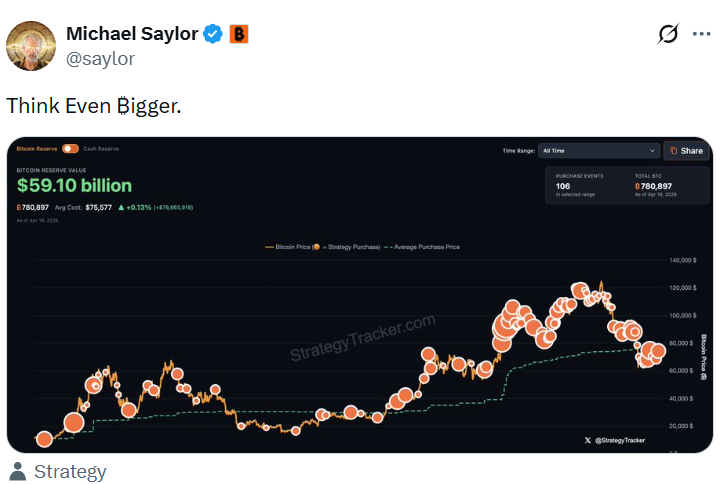
Strategy co-founder Michael Saylor has hinted at another large Bitcoin purchase, just a week after the company disclosed that it bought around $1 billion of Bitcoin in the second week of April.
Strategy disclosed last Monday that it acquired 13,927 Bitcoin for $1 billion between April 6 and 12, at an average price of $71,902 per coin, posting “Think ₿igger” the day before the filing.
However, Saylor posted “Think Even ₿igger” on X on Sunday along with a chart of Strategy’s purchase history, something he has historically done to hint at another purchase announcement.
It comes just days after the Bitcoin treasury company proposed to increase the frequency of dividend payments to stockholders in the hopes of stabilizing the price and growing demand.

In a video presentation to shareholders shared by Saylor on Friday, Strategy CEO Phong Le said the company hopes to pay dividends twice a month — on the 15th and again at the end of each month — for a total of 24 a year at the current rate of 11.5%.
“What do we think this will do, it should stabilize the price, dampen cyclicality, drive further liquidity and grow demand,” Le said.
A preliminary proxy filing was sent to the US Securities and Exchange Commission on Friday. The definitive proxy filing is expected on April 28, when voting opens to approve or reject the measure. Voting closes on June 8 at the annual shareholder meeting, with the new schedule expected to start mid-July if approved.
Strategy is proposing to pay semi-monthly dividends on $STRC, instead of monthly. No change to the annual dividend obligations or dividend rate. These proposed changes are intended to stabilize price, dampen cyclicality, drive liquidity, and grow demand. pic.twitter.com/jHFRaDz6oP
— Michael Saylor (@saylor) April 17, 2026
Demand plunging after dividend dates, said Le
Le said one of the main reasons for the proposed change was to address a drop in demand after investors were no longer eligible for the upcoming dividend, which cooled buying activity and slowed the pace of new share sales.
“If we were to move forward with paying STRC to semi-monthly, we would be in category 1, the only preferred in the world that pays semi-monthly dividends. We think this is unique and this is attractive,” he added.
The company went through dozens of iterations before settling on the semi-monthly schedule and had considered weekly and even daily dividend record dates. The NASDAQ stock exchange, which lists Strategy’s stock, follows industry rules requiring a minimum gap of ten days between the record date and the payment date, according to Le.
Related: Strategy’s Michael Saylor signals impending Bitcoin purchase
Strategy has the largest Bitcoin (BTC) stash among publicly traded companies with 780,897 coins, worth $58.2 billion, according to Bitbo. It’s also one of the most frequent buyers with regular weekly purchases.
The company’s stock (MSTR) jumped 11.8% on Friday to $166.52. It’s still down more than 47% over the past year, according to Google Finance.
Strategy’s Bitcoin buying comes despite the company sitting on significant unrealized losses on its holdings. Earlier this month, Strategy reported in its first-quarter financial results that its unrealized losses on digital assets amounted to $14.46 billion.
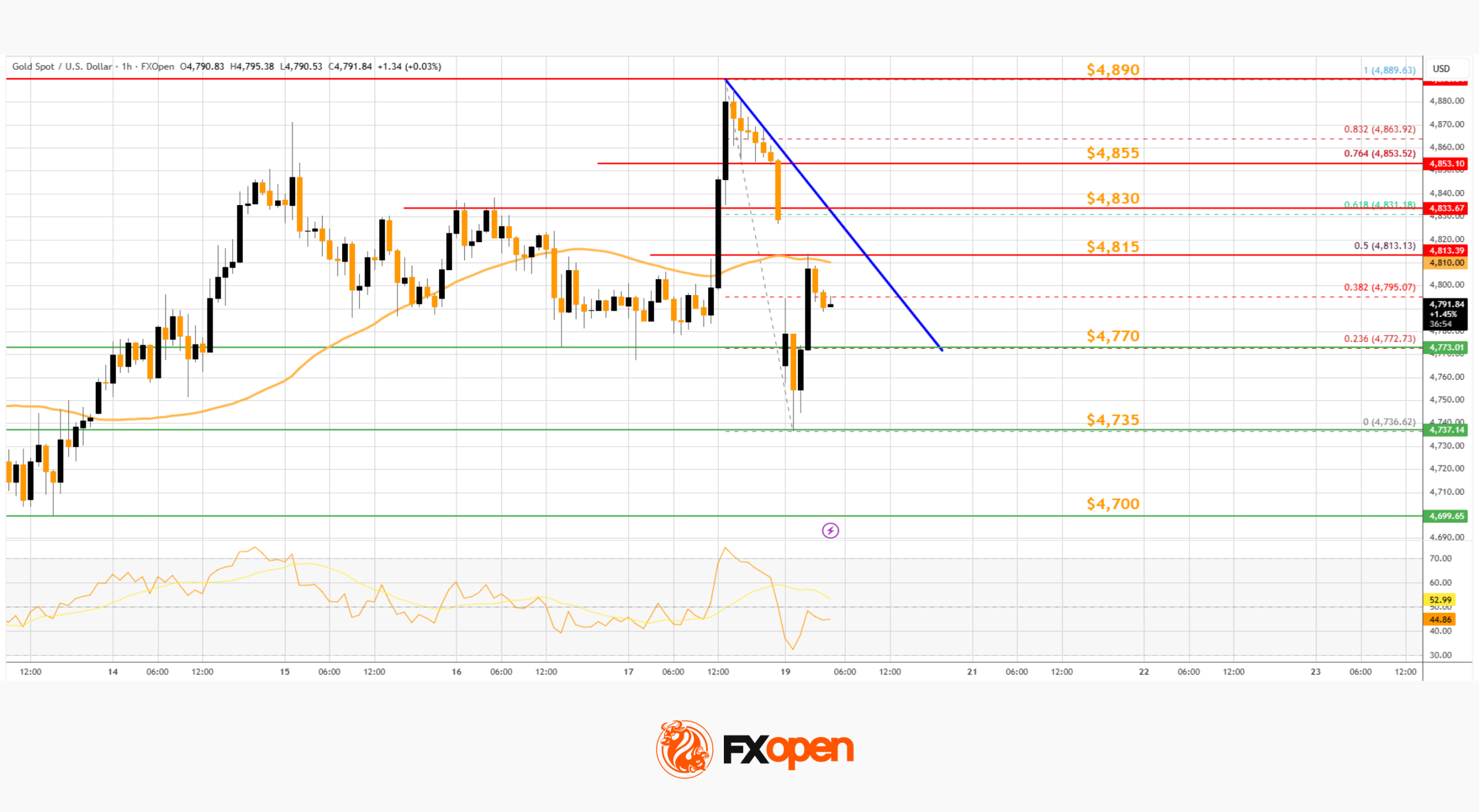
Gold price extended losses below $4,800 before the bulls appeared. WTI Crude oil prices are rising and could climb further higher toward $92.00.
Important Takeaways for Gold and WTI Crude Oil Prices Analysis Today
· Gold price failed to clear $4,900 and declined steadily against the US Dollar.
· There is a key bearish trend line forming with resistance at $4,815 on the hourly chart of gold at FXOpen.
· WTI Crude oil prices are moving higher above the $85.00 pivot zone.
· There is a connecting bearish trend line forming with resistance at $89.10 on the hourly chart of XTI/USD at FXOpen.
Gold Price Technical Analysis
On the hourly chart of Gold at FXOpen, the price failed to settle above $4,900 and reacted to the downside, as discussed in the previous analysis. The price traded below $4,850 and $4,800 to enter a short-term bearish zone.
There was a sharp drop below $4,750. The price settled below the 50-hour simple moving average, and RSI dipped below 40. Finally, it tested the $4,700 zone. A low was formed at $4,699, and the price is now correcting some losses.
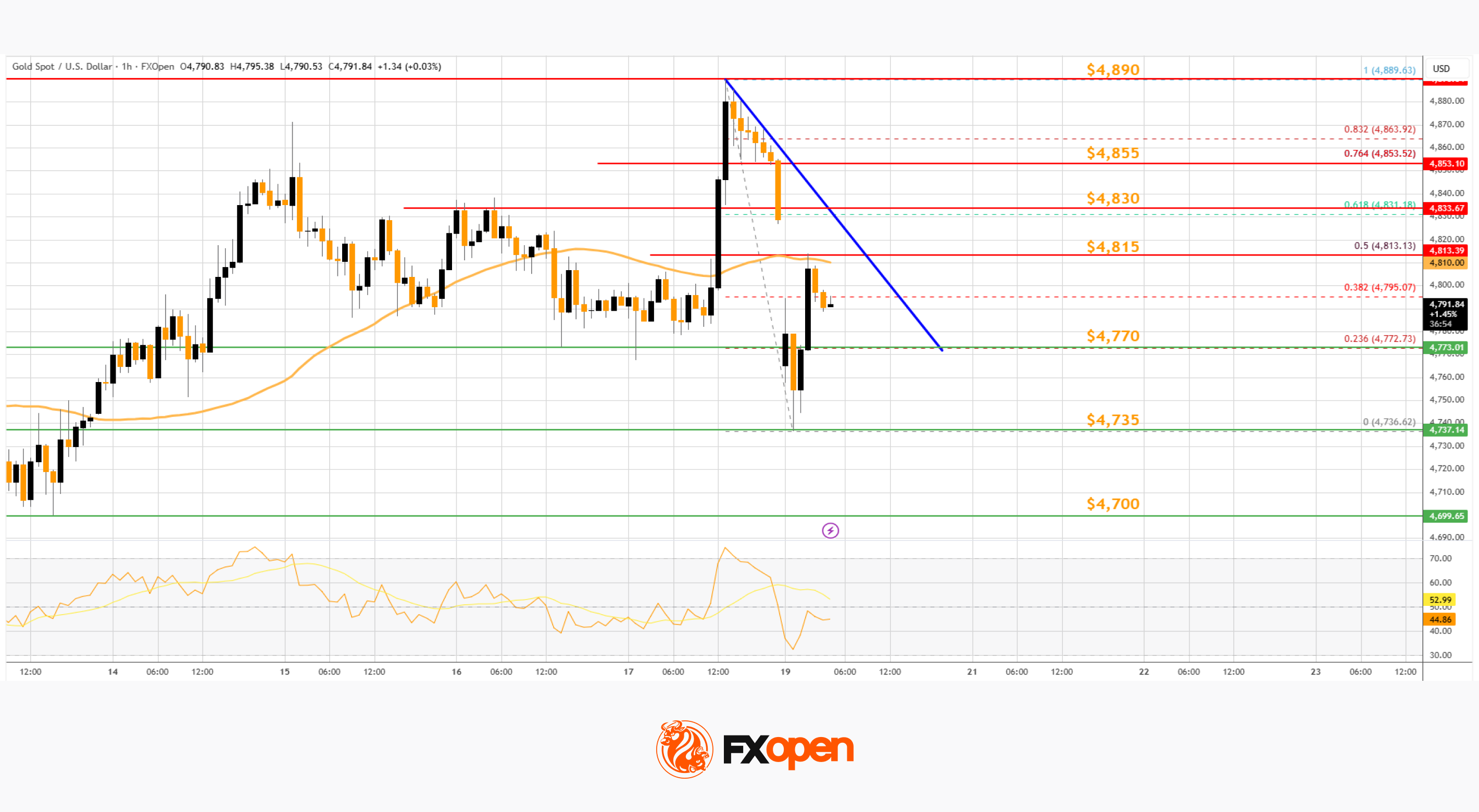
Immediate hurdle on the upside is $4,815 or the 50% Fib retracement level of the downward move from the $4,889 swing high to the $4,699 low. There is also a key bearish trend line forming with resistance at $4,815.
The first major barrier for the bulls could be $4,830 and the 61.8% Fib retracement. A close above $4,830 could initiate a recovery wave to $4,855. An upside break above $4,855 could send Gold price toward $4,890. Any more gains may perhaps set the pace for an increase toward $5,000.
If there is no fresh increase, the price could continue to move down. Initial support on the downside is near the $4,770 level. The first key area of interest might be $4,700. If there is a downside break below $4,700, the price might decline further. In the stated case, the price might drop to $4,500.
WTI Crude Oil Price Technical Analysis
On the hourly chart of WTI Crude Oil at FXOpen, the price started a fresh increase from $79.00 against the US Dollar. The price gained bullish momentum after it broke $84.00.
There was a sustained upward movement above $84.50 and $85.00. The bulls pushed the price above the 50-hour simple moving average, and the RSI climbed toward 60. A high was formed near $89.08 before there was a minor pullback. The price declined below the 23.6% Fib retracement level of the upward move from the $78.96 swing low to the $89.08 high.
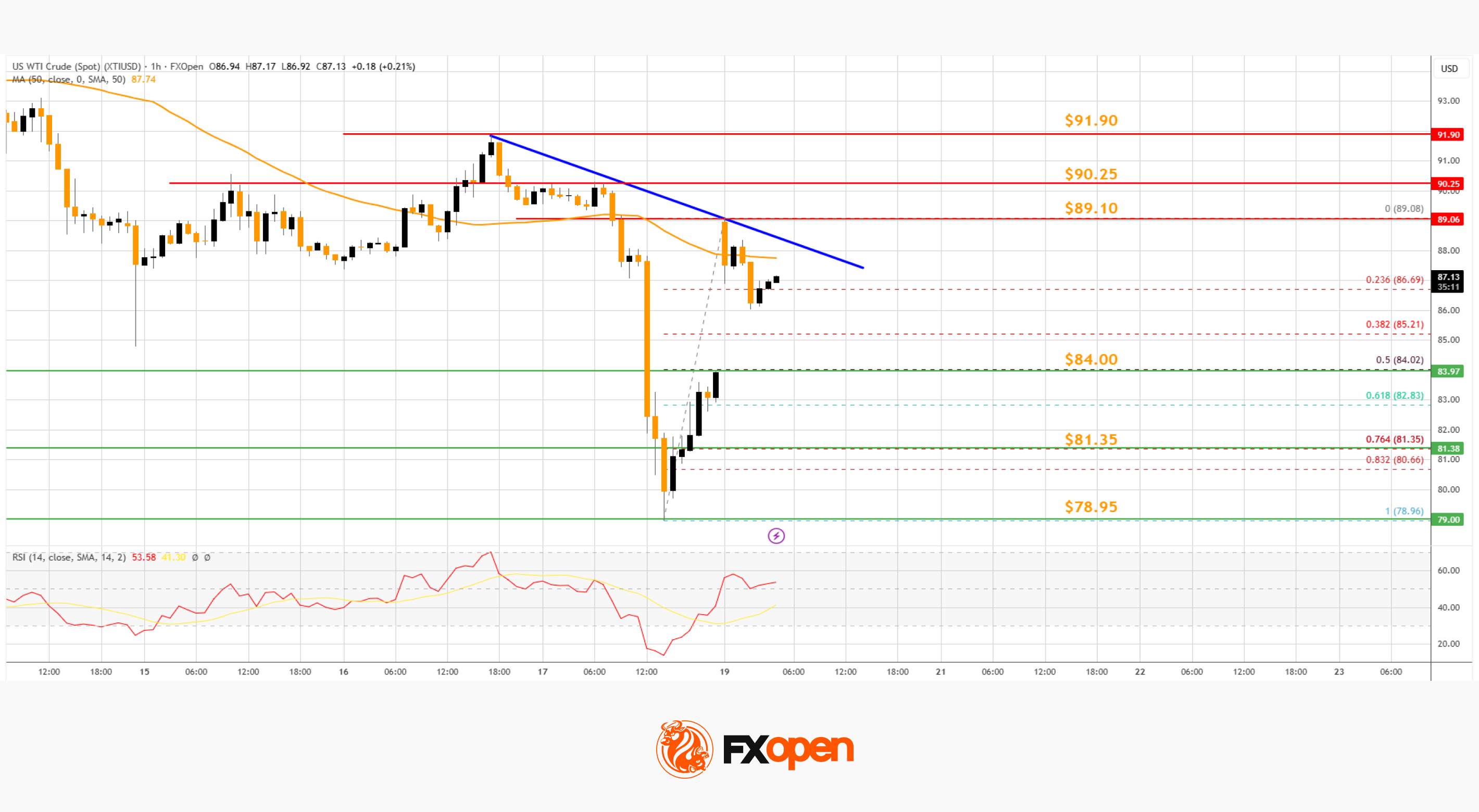
However, the bulls are active above $85.00. Immediate resistance is near a connecting bearish trend line at $89.10. If the price climbs further, it could face hurdles near $90.25.
The next major stop for the bulls might be $91.90. Any more gain might send the price toward $95.00. Conversely, the price might correct gains and test the 50% Fib retracement at $84.00. The next area of interest on the WTI crude oil chart could be $81.35.
If there is a downside break, the price might decline to $80.00. Any more losses may perhaps open the doors for a move toward $75.00.
Start trading commodity CFDs with tight spreads (additional fees may apply). Open your trading account now or learn more about trading commodity CFDs with FXOpen.
This article represents the opinion of the Companies operating under the FXOpen brand only. It is not to be construed as an offer, solicitation, or recommendation with respect to products and services provided by the Companies operating under the FXOpen brand, nor is it to be considered financial advice.


Strategy co-founder Michael Saylor is signaling another massive Bitcoin acquisition, coming on the heels of a $1 billion purchase finalized earlier this month.
Summary
- Strategy is currently sitting on the world’s largest corporate Bitcoin treasury with 780,897 coins valued at over $58 billion.
- Michael Saylor hinted at a new multi-billion-dollar Bitcoin acquisition via social media just days after the company confirmed a $1 billion purchase.
According to a Sunday post on X, Saylor shared a chart of the company’s historical buying patterns alongside the caption “Think Even ₿igger.”
The latest post follows a regulatory filing last Monday, where Strategy disclosed it had picked up 13,927 Bitcoin between April 6 and 12, which cost the company $1 billion at an average price of $71,902 per token.
Strategy currently holds the largest Bitcoin treasury of any publicly traded firm, with a total stash of 780,897 coins valued at roughly $58.2 billion.
Dividend overhaul to boost liquidity
Strategy CEO Phong Le detailed a new proposal on Friday to move the company toward a semi-monthly dividend schedule. The plan, shared in a shareholder video presentation, suggests paying out dividends on the 15th and at the end of every month.
By increasing the frequency to 24 payments a year at the current 11.5% rate, the company hopes to attract more consistent buying interest.
“What do we think this will do, it should stabilize the price, dampen cyclicality, drive further liquidity and grow demand,” Le said.
The CEO noted that the current structure often causes a drop-off in activity once investors are no longer eligible for the next scheduled payout. By switching to a semi-monthly model, the company would become the only preferred stock in the world with such a frequent distribution.
“If we were to move forward with paying STRC to semi-monthly, we would be in category 1, the only preferred in the world that pays semi-monthly dividends. We think this is unique and this is attractive,” Le added.
The proposal comes while the company manages significant paper losses. First-quarter financial results showed unrealized losses on digital assets totaling $14.46 billion. Despite these figures, investors reacted positively to the dividend news and the prospect of more Bitcoin buys, sending MSTR stock up 11.8% to $166.52 on Friday.
A preliminary proxy filing is already with the SEC, and a definitive version is expected by April 28. If shareholders approve the measure at the annual meeting on June 8, the new payment cycle will begin in mid-July. Currently, Nasdaq rules require Strategy to maintain a 10-day window between the record date and the actual payment.
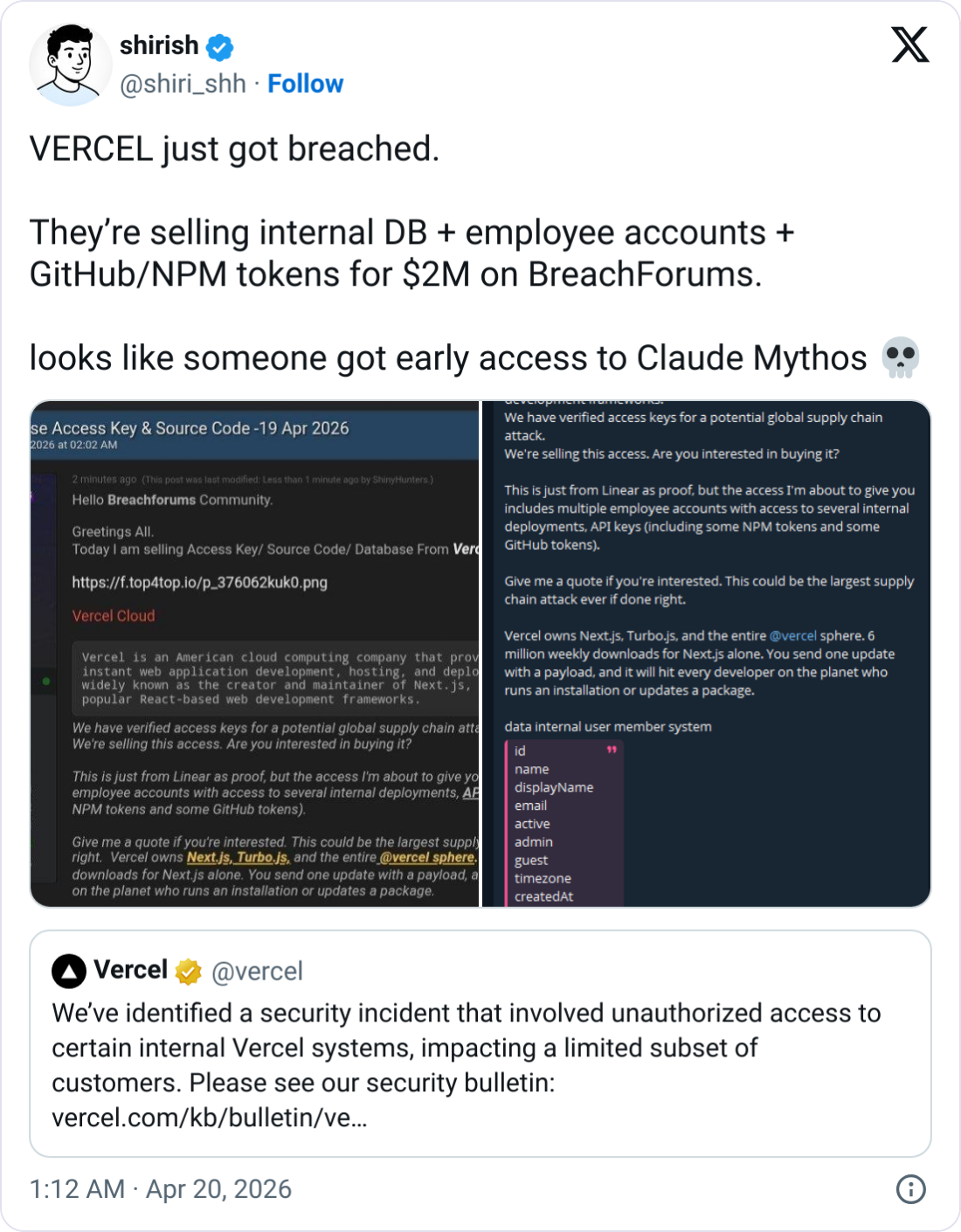
Vercel, a cloud hosting provider popular among crypto projects, has confirmed that it suffered a security breach that allowed hackers to make off with a “limited” subset of customer credentials.
Vercel said in a blog post on Sunday that it “identified a security incident that involved unauthorized access to certain internal Vercel systems” and was investigating the breach.
“Initially we identified a limited subset of customers whose Vercel credentials were compromised,” it added. “We reached out to that subset and recommended an immediate rotation of credentials.”
Vercel’s confirmation came after multiple X users reported that a post on the hacking forum BreachForums by a user called “ShinyHunters” claimed to be offering Vercel’s data in exchange for $2 million.
The poster claimed to have access keys, source code, database information and employee accounts with access to internal deployments, which they said could be used for a “global supply chain attack.”

Vercel did not address the post’s claims, but said the attacker was “highly sophisticated based on their operational velocity and detailed understanding of Vercel’s systems.”
Third-party AI tool compromised to carry out hack
Vercel CEO Guillermo Rauch said on Sunday that the attack originated after a Vercel employee was compromised via a breach of an artificial intelligence tool they used called Context.ai.
The attacker was then able to compromise the Vercel employee’s Google Workspace account, allowing them access to some of Vercel’s internal systems.
Rauch said the company stores customer environments with full encryption, but it has the capability to designate variables as “non-sensitive,” and the attacker “got further access through their enumeration.”
Related: Aave’s TVL tanks $8B a day after $293M Kelp DAO hack
“We believe the attacking group to be highly sophisticated and, I strongly suspect, significantly accelerated by AI,” he added. “They moved with surprising velocity and in-depth understanding of Vercel.”
Rauch said that Vercel had “deployed extensive protection measures and monitoring” and it had analyzed its supply chain to ensure “Next.js, Turbopack, and our many open source projects remain safe for our community.”
“My advice to everyone is to follow the best practices of security response: secret rotation, monitoring access to your Vercel environments and linked services, and ensuring the proper use of the sensitive env variables feature,” he added.
Magazine: Meet the onchain crypto detectives fighting crime better than the cops


EasyDNS has confirmed that a security failure within its own systems allowed a social engineering attacker to briefly seize control of eth.limo, a primary gateway for the Ethereum Name Service.
Summary
- An attacker impersonated an eth.limo team member to bypass account recovery protocols at easyDNS and gain control of domain settings.
- DNSSEC safeguards prevented the redirection of users to malicious sites by rejecting forged responses that lacked valid cryptographic signatures.
- EasyDNS is migrating the service to Domainsure to eliminate account recovery vulnerabilities and prevent future social engineering breaches.
The incident occurred on Friday when an attacker successfully impersonated an eth.limo team member to initiate an account recovery process, gaining the authority to modify name server records and redirect the domain to Cloudflare.
The eth.limo team, in a post-mortem published Saturday, stated that they immediately notified the community and prominent figures like Ethereum co-founder Vitalik Buterin once the DNS hijack was identified.
Serving as a bridge for roughly 2 million decentralized websites, eth.limo is a high-stakes target because a successful compromise could allow hackers to divert users to malicious pages. Buterin himself issued an urgent warning on Friday, advising his readers to avoid his blog until the team could restore secure operations.
Security extensions prevent widespread impact
EasyDNS CEO Mark Jeftovic noted that the presence of Domain Name System Security Extension (DNSSEC) played a critical role in stopping the attacker from causing further damage.
Because the hacker lacked the necessary cryptographic signing keys, modern DNS-aware resolvers rejected the forged responses, resulting in users seeing error messages rather than being funneled to phishing sites.
“We screwed up and we own it,” Jeftovic stated on Saturday, acknowledging that this was the first successful social engineering breach in the provider’s 28-year history.
The eth.limo developers highlighted in their own report that these safeguards likely reduced the “blast radius” of the hijack. While the service was disrupted, the team is currently unaware of any confirmed user impact or fund losses.
Jeftovic added that eth.limo is now being migrated to Domainsure, an enterprise-grade platform that does not offer a manual account recovery mechanism, effectively closing the loophole exploited in this attack.
The latest incident is one of the many recent infrastructure attacks hitting the crypto sector. Only days earlier, on April 14, the decentralized exchange aggregator CoW Swap lost control of its domain for several hours following a similar social engineering attack against the .fi registry, leading to an estimated loss of $1.2 million from affected users.
LayerZero says preliminary indicators point to North Korea’s Lazarus Group, specifically the TraderTraitor subgroup, as the likely actor behind the KelpDAO exploit on April 18, 2026.
The theft now ranks as the largest decentralized finance (DeFi) loss of 2026. It overtakes the $285 million Drift Protocol breach from April 1, which investigators also tied to state-backed North Korean actors.
North Korea Suspected in The Biggest Crypto Loss of 2026
In a post on X (formerly Twitter), LayerZero outlined the mechanics of the incident, describing it as a “highly sophisticated attack.”
“On April 18, 2026, LayerZero Labs’ DVN became the target of a highly sophisticated attack, likely attributable to the Lazarus Group, more specifically TraderTraitor.” the post read. “The attack was specifically engineered to manipulate or poison downstream RPC infrastructure by compromising a quorum of the RPCs the LayerZero Labs DVN relied upon to verify transactions. It was not done through an exploit to the protocol, DVN, key management, or other means.”
The attribution aligns with a broader trend of increasingly complex cyber operations tied to North Korean actors. Earlier this month, Drift Protocol (DRIFT) revealed that its $285 million exploit on April 1 followed a six-month campaign also linked to state-backed entities.
US authorities have previously connected the same group to major incidents, including the $1.5 billion Bybit hack in February 2025. Data from Chainalysis further highlights the scale of the threat.
The firm revealed that North Korea-linked hackers stole a record $2.02 billion from crypto platforms in 2025, a 51% increase year-over-year, largely driven by the Bybit breach.
Follow us on X to get the latest news as it happens
Market Fallout Spreads Across DeFi
Trust across the DeFi sector has taken a visible hit since the breach. Lookonchain reported that Aave’s total value locked (TVL) fell to $17.947 billion, shedding $8.45 billion over the prior two days.
However, DeFi-wide exposure proved larger. Combined TVL across all chains slid from $99.497 billion to $86.286 billion, a $13.21 billion decline.
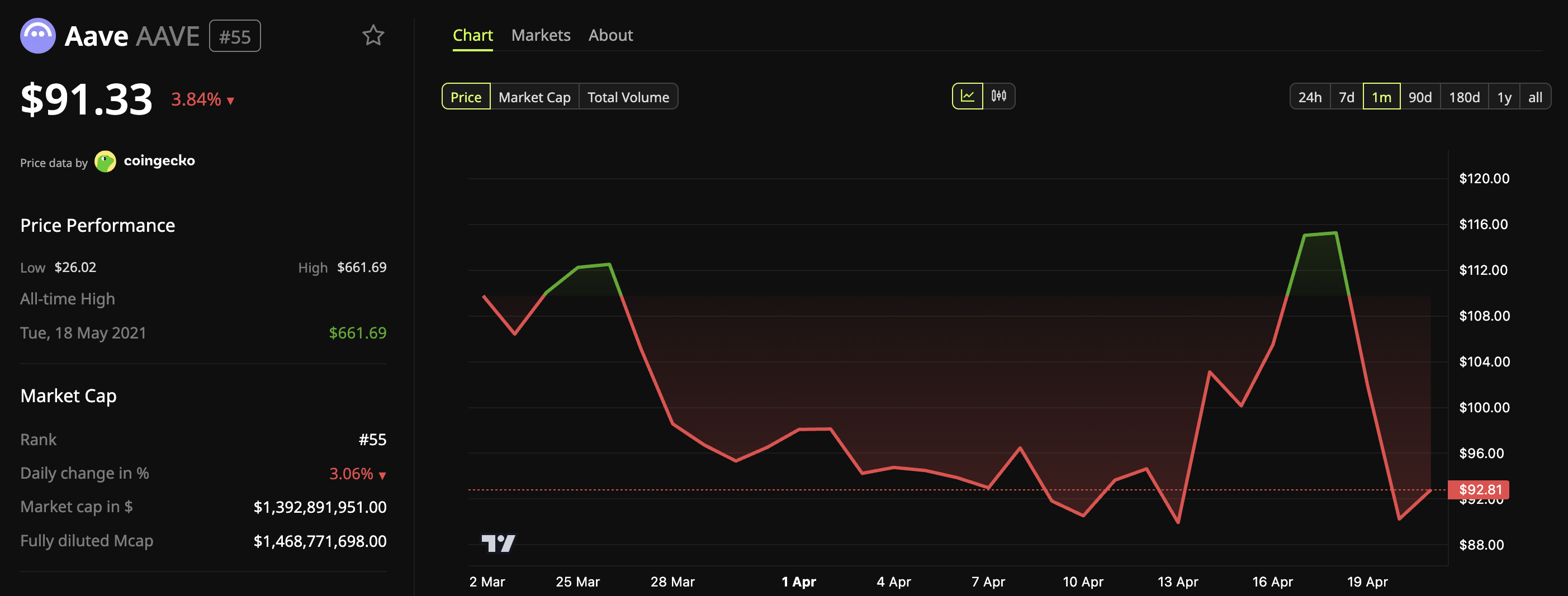
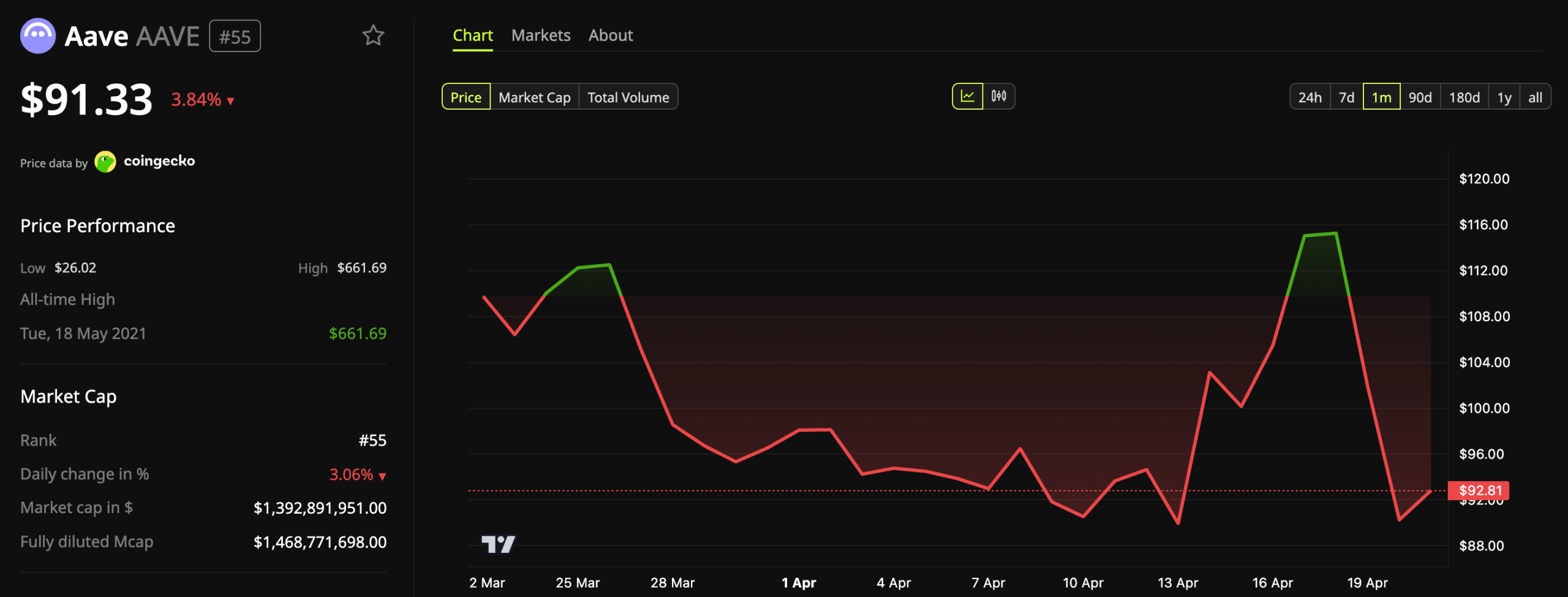
Aave’s native token AAVE dropped 3.84% in the past 24 hours after losing roughly 20% on Sunday. BeInCrypto highlighted that whales offloaded more than $6 million in tokens after the KelpDAO exploit.
The post LayerZero Ties KelpDAO Exploit to Lazarus Subgroup TraderTraitor appeared first on BeInCrypto.

Coinbase CEO Brian Armstrong said the company has started testing AI agents on Slack and email to assist employees with work tasks, continuing the company’s efforts to embed AI into its workflows.
In a post to X on Saturday, Armstrong said the company has already deployed two AI agents, modeled after two former executives, speculating that AI agents could eventually outnumber human employees at the crypto exchange.
“Soon, it will be easy for any employee to spin up a new agent for themselves or their team. I suspect we will have more agents than human employees at some point soon.”
Major tech companies have laid off thousands of employees this year as they increased their reliance on AI. Armstrong has been pushing for AI to automate more workflows at Coinbase, stating in September that he wants more than 50% of the company’s code to be written by AI.
A month before, Coinbase said one of its biggest focuses is to transform its more than 4,000-member workforce into “AI-Natives.”
Coinbase introduces AI agents Fred and Balaji
One of the AI agents is Fred, named after Coinbase co-founder Fred Ehrsam. Fred will serve as the company’s “strategic executive agent,” assisting Coinbase workers with strategic clarity and priority alignment while offering executive-level feedback.
The other is Balaji, the agent of chaos and creativity who was modeled after Coinbase’s former chief technology officer, Balaji Srinivasan.
Balaji has been brought in to challenge assumptions and assist Coinbase employees with thinking outside the box in an effort to “spark innovation.”

Coinbase has also contributed to the agentic AI wave, having launched the x402 protocol for agentic AI payments on crypto and fiat rails in May 2025.
AI agents tipped to play a big role in crypto
The move comes amid a broad industry belief that AI agents could become the dominant users of blockchain payments in the coming years.
Related: How AI agents can reshape arbitrage in prediction markets
Earlier this month, Armstrong predicted there will be “more AI agents transacting online than humans very soon,” echoing comments from Circle CEO Jeremy Allaire in January that “literally billions of AI agents” will be transacting onchain in three to five years.
Former Binance CEO Changpeng Zhao also said in January that crypto is the “native currency for AI agents,” which will handle everything from buying tickets to paying bills without credit cards.
Magazine: AI agents will kill the web as we know it: Animoca’s Yat Siu
Key Highlights
- BTC plummeted to approximately $73,753 following Iran’s refusal to participate in additional U.S. peace negotiations
- The cryptocurrency had climbed to $78,300 on Friday before geopolitical developments reversed momentum
- Iranian officials declined talks scheduled in Islamabad, pointing to American naval operations near its coastline
- The bilateral ceasefire arrangement between Washington and Tehran concludes Wednesday, April 22
- Market sentiment indicator Crypto Fear & Greed Index registers 29 — remaining in “fear” zone
Bitcoin experienced a promising start to the weekend before rapidly surrendering those advances as diplomatic friction between Washington and Tehran intensified throughout the weekend period.
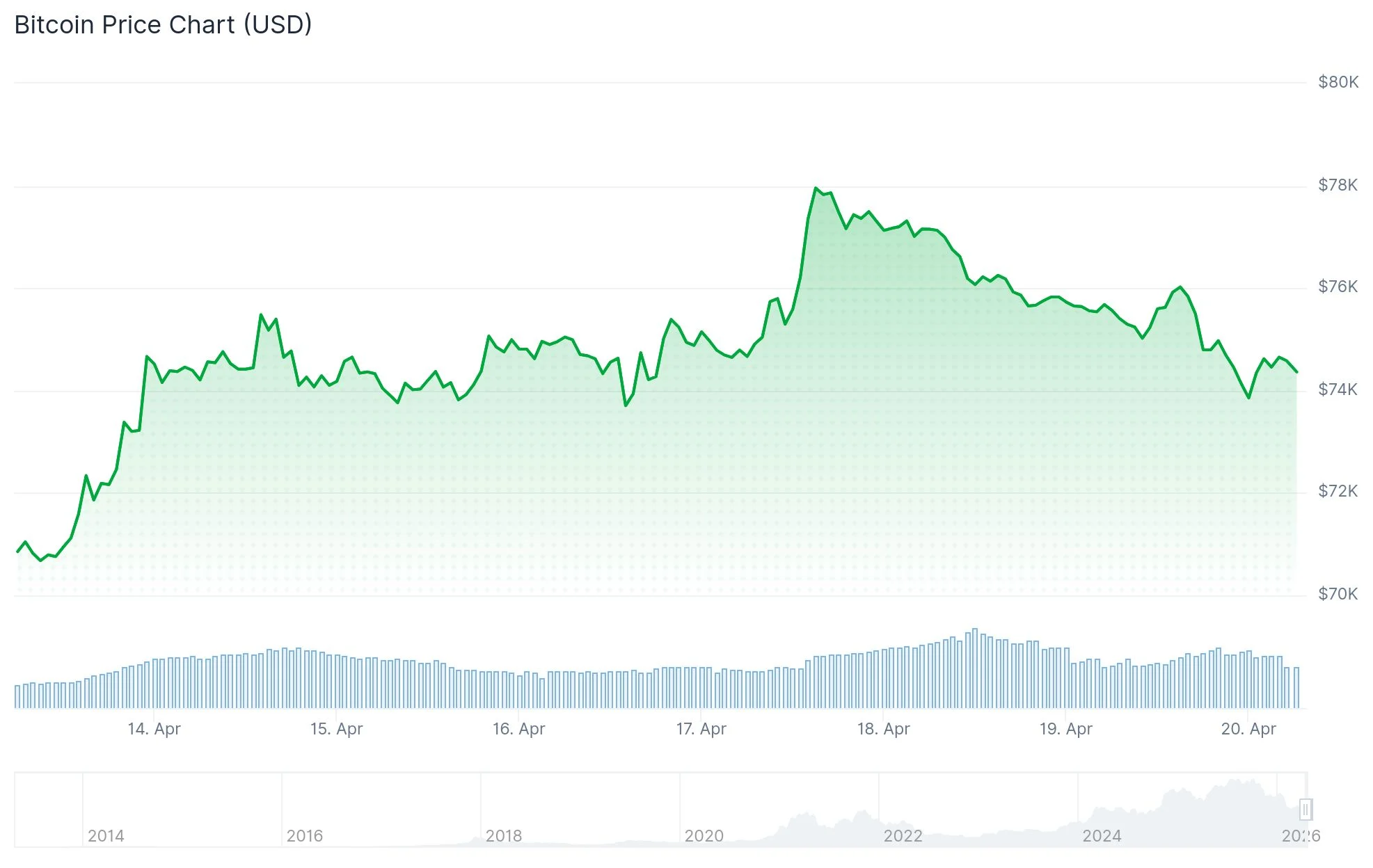
The leading cryptocurrency reached $78,300 on Coinbase during late Friday trading — representing its strongest valuation since early February. However, this upward momentum proved short-lived. By the conclusion of Sunday trading, Bitcoin had slipped beneath the $74,000 threshold.
The catalyst for this decline was Tehran’s decision to withdraw from scheduled diplomatic discussions in Islamabad, Pakistan. Representatives from Iran attributed their decision to Washington’s maritime enforcement activities near Iranian harbors and what they characterized as inconsistent policy positions from American negotiators.
Esmail Baghaei, spokesperson for Iran’s Foreign Affairs ministry, published statements on X platform, characterizing American naval operations as breaches of ceasefire terms and violations of international legal frameworks, specifically citing the UN Charter.
President Donald Trump responded sharply, characterizing Iran’s actions as a “serious violation” of ceasefire terms following Iranian military engagement in the Strait of Hormuz. While Trump expressed continued optimism regarding potential diplomatic resolution, he emphasized an agreement would materialize “one way or another.”
Initial diplomatic sessions occurred April 11–12 in Islamabad, extending beyond 21 hours without producing consensus. Vice President JD Vance acknowledged that Iranian negotiators declined to accept conditions proposed by the United States.
BTC Declines to $73,753 Level
On April 19, the cryptocurrency descended to roughly $73,753 on Bitstamp exchange, representing approximately 2% depreciation within a 24-hour timeframe. This movement pushed BTC outside its previously established $74,000–$77,000 trading corridor.
The wider digital asset marketplace declined in tandem with Bitcoin, with total market capitalization contracting by an estimated $83 billion. The Crypto Fear & Greed Index currently stands at 29 out of 100, maintaining position firmly within “fear” parameters.
American equity futures also retreated Sunday evening. S&P 500 futures decreased 0.8%, Nasdaq-100 declined 0.6%, and Dow Jones futures dropped approximately 450 points. Petroleum futures surged over 4.5% to exceed $95 per barrel amid concerns regarding potential Strait of Hormuz disruptions.
Market analyst Wu Blockchain reported via X that Bitcoin spot exchange-traded funds registered $996 million in net capital inflows during the week spanning April 13–17, representing the third consecutive week of positive movement. Ethereum ETFs attracted $276 million in inflows, XRP spot ETFs recorded $55 million, and SOL spot ETFs accumulated $35 million.
Critical Price Thresholds Under Observation
Technical analysis indicates support zones around $70,500–$71,000 with resistance positioned near $75,000. BTC has attempted to breach $76,000 on multiple occasions in recent trading sessions without sustaining elevation above that mark.
The temporary ceasefire arrangement between Washington and Tehran reaches its conclusion Wednesday, April 22. Iranian authorities have declined further negotiations and accused American officials of violating agreement terms. As of 8:30 p.m. ET Sunday, Bitcoin maintained position marginally above $74,000.

(VIDEO) Elon Musk Predicts AI Robotics Will Make Work Optional Ushering in New Era of Abundance by 2040s

3 Altcoins to Watch in the 4th Week of April 2026

Eddie Murphy Receives AFI’s Highest Honor


-

 Crypto World7 days ago
The SEC Conditionalises DeFi Platforms to Be Avoided for Broker Registration
-

 NewsBeat6 days ago
Trump and Pope Leo: Behind their disagreement over Iran war
-

 Fashion3 days ago
Weekend Open Thread: Theodora Dress
-

 Crypto World6 days ago
SEC Signals Exemption for Crypto Interfaces From Broker Registration
-

 News Videos5 days ago
Secure crypto trading starts with an FIU-registered
-

 Sports3 days ago
NWFL Suspends Two Players Over Post-Match Clash in Ado-Ekiti
-

 Crypto World6 days ago
SEC Proposes Certain Crypto Interfaces Don’t Need to Register as Brokers
-

 Business17 hours ago
Powerball Result April 18, 2026: No Jackpot Winner in Powerball Draw: $75 Million Rolls Over
-

 Crypto World2 days ago
Russia Pushes Bill to Criminalize Unregistered Crypto Services
-

 Politics2 days ago
Palestine barred from entering Canada for FIFA Congress
-

 Sports7 days ago
NWFL opens Pathway for new Clubs ahead of 2026 Season
-
 Business3 days ago
Creo Medical agree sale of its manufacturing operation
-
 Entertainment6 days ago
Brand New Day’ Footage Reveals the Devastating Impact of ‘Now Way Home’
-

 Politics22 hours ago
Zack Polanski demands ‘council homes not luxury flats for foreign investors’
-

 Tech5 days ago
Microsoft adds Windows protections for malicious Remote Desktop files
-
 Entertainment6 days ago
Karol G’s ‘Ultra Raunchy’ Coachella Set Gave ‘Satanic Vibes’
-

 Sports7 days ago
Aaron Judge says Yankees need to ‘simplify’ approach amid offensive slump
-
 Entertainment7 days ago
Pete Davidson Reveals ‘Brutal’ Mom Moment That Got Him Sober
-

 Entertainment6 days ago
How Babylon 5 Turned Brief Side Story Into Emotional Masterpiece
-

 Tech6 days ago
What was the first ransomware attack to demand payment in Bitcoin?
You must be logged in to post a comment Login