Connect with us

Tech

IEEE’s 2026 Annual Election Begins on 17 August

Published

on

This year’s annual election, which begins on 17 August, will include candidates for IEEE president-elect and other officer positions up for election.

To see who is running for 2027 IEEE president-elect and the petition candidates, visit the election website.

The ballot also includes nominees for delegate-elect/director-elect offices submitted by division and region nominating committees, as well as IEEE Technical Activities vice president-elect; IEEE-USA president-elect; and IEEE Standards Association board of governors members-at-large.

Those elected take office on 1 January 2027.

Advertisement

IEEE members who want to run for an office, except for IEEE president-elect, who have not been nominated, must submit their petition intention to the IEEE Board of Directors by 1 April. Petitions should be sent to the IEEE Corporate Governance staff at elections@ieee.org. The petition intention deadline for IEEE president-elect was 31 December.

Election Updates

Regional elections will also take place. Eligible voting members in IEEE Region 1 (Northeastern U.S.) and Region 2 (Eastern U.S.) will elect the future IEEE Region 2 delegate-elect/director-elect (Eastern and Northeastern U.S.) for the 2027—2028 term. Members in the future IEEE Region 10 (North Asia) will elect the IEEE Region 10 delegate-elect/director-elect for the same term. These changes reflect IEEE’s upcoming region realignment, as outlined in The Institute’s September 2024 article, “How Region Realignment Will Impact IEEE Elections.”

Beginning this year, only professional members will be eligible to vote in IEEE’s annual election or sign related petitions. Ballots will be created for eligible voting members on record as of 31 March. To ensure voting eligibility, all members should review and update their contact information and communication preferences by that date.

To support sustainability initiatives, the “Candidate Biographies and Statements” booklet will no longer be available in print. Members can access the candidate biographies and statements within their electronic ballot, view them on the annual election website, or download the digital booklet. Members are also encouraged to vote electronically.

Advertisement

For more information about the offices up for election, the process for getting on the annual ballot, and deadlines, visit the website or email elections@ieee.org.

From Your Site Articles

Related Articles Around the Web

Source link

Advertisement
Continue Reading
Click to comment

Leave a Reply

Your email address will not be published. Required fields are marked *

Tech

Jolla Sailfish pitches a "European phone" for users wary of Google and Apple

Published

on


Jolla’s return to the smartphone market follows a turbulent decade during which the company nearly collapsed, pivoted to licensing its Sailfish OS platform, severed business ties with Russia after the invasion of Ukraine, and later reorganized under the new corporate structure Jollyboys. The reset produced a device assembled in Salo,…
Read Entire Article
Source link

Continue Reading

Tech

GPT-5.3 Instant cuts hallucinations by 26.8% as OpenAI shifts focus from speed to accuracy

Published

on

OpenAI’s GPT-5.3 Instant — the company’s most widely used model — reduces hallucinations by up to 26.8% compared to its predecessor, prioritizing accuracy and conversational reliability over raw performance gains, OpenAI says.

GPT-5.3 Instant, which is essentially the default and is the most used model for ChatGPT users, also improves on tone, relevance and conversation with fewer refusals. It is available on both ChatGPT and on the API. 

Right now, only the Instant model will be upgraded to 5.3, but the company said it is working on updating the other models under ChatGPT, Thinking, and Pro to 5.3 “soon.” 

GPT-5.3 Instant cuts hallucinations by up to 26.8%

OpenAI ran two internal evaluations: one across higher-stakes domains including medicine, finance, and law; the other drawing on user feedback.

Advertisement

Based on higher-stakes evaluations conducted by the company, GPT-5.3 Instant reduces hallucinations by 26.8% when using the web. It improves reliability by 19.7% when relying on its internal knowledge. User feedback showed a 22.5% decrease in hallucinations when answering queries using web search. 

The company said GPT-5.3 Instant is more reliable because it improved how it balances information from the internet with its own internal training and reasoning. 

“More broadly, GPT-5.3 Instant is less likely to overindex on web results, which previously could lead to long lists of links or loosely connected information. It does a stronger job of recognizing the subtext of questions and surfacing the most important information, especially upfront, resulting in answers that are more relevant and immediately usable, without sacrificing speed or tone,” the company said. 

An example OpenAI gave is when a user asks about the biggest signing in Major League Baseball and its impact. The previous model, GPT-5.2, often defaulted to summarizing search results.

Advertisement

Accuracy overtakes performance as OpenAI’s selling point

With this new release, first on its most used model, OpenAI wants enterprise customers and other ChatGPT users to understand that the battlefront is not just about how performant a model is, but also about how well it can adhere to actual information. Instead of focusing on performance metrics such as speed and token savings, the company is leaning more into GPT-5.3 Instant’s reliability. 

Competitors such as Google and Anthropic also tout greater accuracy in their new models. Anthropic said its new Claude Sonnet 4.6 has fewer hallucinations, while Google was forced to pull its Gemma 3 model after it hallucinated false information about a lawmaker. 

GPT-5.3 Instant dials back refusals and “cringe” tone

“This update focuses on the parts of the ChatGPT experience people feel every day: tone, relevance, and conversational flow. These are nuanced problems that don’t always show up in benchmarks, but shape whether ChatGPT feels helpful or frustrating. GPT-5.3 Instant directly reflects user feedback in these areas,” OpenAI said in a blog post.

GPT-5.3 Instant has a more natural conversation style, moving away from what OpenAI claimed was a “cringe” tone that came across as overbearing and made assumptions about user intent. The company noted that it will ensure the chat platform’s personality is more consistent across updates so users will not experience a tonal shift when conversing with the model.

Advertisement

The new model significantly reduces refusals. OpenAI said the previous model would often refuse to answer questions, even when they did not violate any guardrails. Sometimes, the prior model answers “in ways that feel overly cautious or preachy, particularly around sensitive topics.”

The company promises that GPT-5.3 will not do the same and will tone down “overly defensive or moralizing preambles.” This means the model will answer directly, without caveats, so users do not end conversations without a response to their query. 

Despite this, GPT-5.3 Instant still faces some limitations, especially in some languages like Korean and Japanese, where the answers still sound stilted. 

Safety card shows regressions in sexual content and self-harm categories

The new model does not have support for adult content, according to an OpenAI spokesperson in an email to VentureBeat, as the company is still figuring out “how to maximize user freedom while maintaining our high safety bar.” OpenAI does not have a timeline for when it will release that functionality.

Advertisement

OpenAI conducted safety benchmarking on the new model, noting on its safety card that, while it performed well against disallowed content, it still did not match the level of GPT-5.2 Instant. However, OpenAI noted these results could change after launch.

“GPT-5.3 Instant shows regressions relative to GPT-5.2 Instant and GPT-5.1 Instant for disallowed sexual content, and relative to GPT-5.2 Instant for self-harm on both standard and dynamic evaluations,” the company said.

In other categories, OpenAI said the model performs on par with or better than previous releases, and noted the regressions for graphic violence and violent illicit behavior have low statistical significance.

Expect a new model soon?

After announcing GPT-5.3 Instant and noting that updates for Thinking and Pro will be coming soon, OpenAI teased that even this new model could be retiring.

Advertisement

In a post on X, OpenAI said GPT-5.4 is coming “sooner than you think.”

OpenAI did not elaborate on what changes, if any, we can expect with GPT-5.4 and which modes will get it first. 

GPT-5.2 Instant, the predecessor model, will remain available on the ChatGPT model picker until June 3, when it will be retired.

Source link

Advertisement
Continue Reading

Tech

Facebook accounts unavailable in worldwide outage

Published

on

Facebook

Story update after outage was resolved.

Social media giant Facebook suffered a worldwide outage that prevented users from accessing their accounts.

When visiting the site, users were greeted with a message stating there account is temporarily unavailable.

“Your account is currently unavailable due to a site issue. We expect this to be resolved shortly. Please try again in a few minutes,” reads the outage message.

Advertisement
Facebook outage message stating your account is unavailable
Source: BleepingComputer

According to DownDetector, the outage began around 4:15 PM ET and is impacting accounts worldwide.

However, the Meta status page only claims there are “High Disruptions” to the Facebook ad manager, Instagram Boost, and the WhatsApp Business API.

BleepingComputer contacted Facebook with questions about the outage and will update the story if we hear back.

Update 6:21 PM ET: The Facebook outage has now been resolved, with users once again able to access their accounts.

However, Facebook has yet to provide any information as to what caused the outage.

Advertisement

Malware is getting smarter. The Red Report 2026 reveals how new threats use math to detect sandboxes and hide in plain sight.

Download our analysis of 1.1 million malicious samples to uncover the top 10 techniques and see if your security stack is blinded.

Source link

Continue Reading

Tech

Endor Labs launches free tool AURI after study finds only 10% of AI-generated code is secure

Published

on

Endor Labs, the application security startup backed by more than $208 million in venture funding, today launched AURI, a platform that embeds real-time security intelligence directly into the AI coding tools that are reshaping how software gets built. The product is available free to individual developers and integrates natively with popular AI coding assistants including Cursor, Claude, and Augment through the Model Context Protocol (MCP).

The announcement arrives against a sobering backdrop. While 90% of development teams now use AI coding assistants, research published in December by Carnegie Mellon University, Columbia University, and Johns Hopkins University found that leading models produce functionally correct code only about 61% of the time — and just 10% of that output is both functional and secure.

“Even though AI can now produce functionally correct code 61% of the time, only 10% of that output is both functional and secure,” Endor Labs CEO Varun Badhwar told VentureBeat in an exclusive interview. “These coding agents were trained on open source code from across the internet, so they’ve learned best practices — but they’ve also learned to replicate a lot of the same security problems of the past.”

That gap between code that works and code that is safe defines the market AURI is designed to capture — and the urgency behind its launch.

Advertisement

The security crisis hiding inside the AI coding revolution

To understand why Endor Labs built AURI, it helps to understand the structural problem at the heart of AI-assisted software development. AI coding models are trained on vast repositories of open-source code scraped from across the internet — code that includes not only best practices but also well-documented vulnerabilities, insecure patterns, and flaws that may not be discovered for years after the code was originally written.

Badhwar, a repeat cybersecurity entrepreneur who previously built RedLock (acquired by Palo Alto Networks), founded Endor Labs four years ago with Dimitri Stiliadis. The original thesis was straightforward: developers were becoming “software assemblers,” writing less original code and importing most components from open source repositories. Then came the explosion of AI-powered coding tools, which Badhwar described as “the once in a generation opportunity of how to rewrite software development life cycle powered by AI.”

The productivity gains are real — more efficiency, faster time to market, and the democratization of software creation beyond trained engineers. But the security consequences are potentially devastating. New vulnerabilities are discovered every day in code that may have been written a decade ago, and that constantly evolving threat intelligence is not easily available to the AI models generating new code.

“Every day, every hour, new vulnerabilities are found in software that might have been written 5, 10, 12 years ago — and that information isn’t easily available to the models,” Badhwar explained. “If you started filtering out anything that ever had a vulnerability, you’d have no code left to train on.”

Advertisement

The result is a feedback loop: AI tools generate code at unprecedented speed, much of it modeled on insecure patterns, and security teams scramble to keep up. Traditional scanning tools, designed for a world where humans wrote and reviewed code at human speed, are increasingly overmatched.

How AURI traces vulnerabilities through every layer of an application

AURI’s core technical differentiator is what Endor Labs calls its “code context graph” — a deep, function-level map of how an application’s first-party code, open source dependencies, container layers, and AI models interconnect. Where competitors like Snyk and GitHub’s Dependabot examine what libraries an application imports and cross-reference them against known vulnerability databases, Endor Labs traces exactly how and where those components are actually used, down to the individual line of code.

“We have this code intelligence graph that understands not just what libraries and dependencies you use, but pinpoints exactly how, where, and in what context they’re used — down to the specific line of code where you’re calling a piece of functionality that has a vulnerability,” Badhwar said.

He illustrated the difference with a concrete example. A developer might import a large library like an AWS SDK but only call two services comprising 10 lines of code. The remaining 99,000 lines in that open source library are unreachable by the application. Traditional tools flag every known vulnerability across the entire library. AURI’s full-stack reachability analysis trims those irrelevant findings away.

Advertisement

Building that capability required significant investment. Endor Labs hired 13 PhDs specializing in program analysis, many of whom previously built similar technology internally at companies like Meta, GitHub, and Microsoft. The company has indexed billions of functions across millions of open source packages and created over half a billion embeddings to identify the provenance of copied code, even when function names or structures have been changed.

The platform combines this deterministic analysis with agentic AI reasoning. Specialized agents work together to detect, triage, and remediate vulnerabilities automatically, while multi-file call graphs and dataflow analysis detect complex business logic flaws that span multiple components. The result, according to Endor Labs, is an average 80% to 95% reduction in security findings for enterprise customers — trimming away what Badhwar called “tens of millions of dollars a year in developer productivity” lost to investigating false positives.

A free tier for developers, a paid platform for the enterprise

In a strategic move aimed at rapid adoption, Endor Labs is offering AURI’s core functionality free to individual developers through an MCP server that integrates directly with popular IDEs including VS Code, Cursor, and Windsurf. The free tier requires no credit card, no sign-up process, and no complex registration.

“The idea is that there’s no policy, no administration, no customization. It just helps your code generation tools stop creating more vulnerabilities,” Badhwar said.

Advertisement

Privacy-conscious developers will note a key architectural choice: the free product runs entirely on the developer’s machine. Only non-proprietary vulnerability intelligence is pulled from Endor Labs’ servers. “All of your code stays local and is scanned locally. It never gets copied into AURI or Endor Labs or anything else,” Badhwar explained.

The enterprise version adds the features large organizations need: full customization, policy configuration, role-based access control for teams of thousands of developers, and integration across CI/CD pipelines. Enterprise pricing is based on the number of developers and the volume of scans. Deployment options include local scanning, ephemeral cloud containers, and on-premises Kubernetes clusters with full tenant isolation — flexibility Badhwar said is “the most any vendor offers in this space.”

The freemium approach mirrors the playbook that worked for developer tools companies like GitHub and Atlassian: win individual developers first, then expand into their organizations. But it also reflects a practical reality. In a world where AI coding agents are proliferating across every team, Endor Labs needs to be wherever code is being written — not waiting behind a procurement process.

“Over 97% of vulnerabilities flagged by our previous tool weren’t reachable in our application,” said Travis McPeak, Security at Cursor, in a statement sent to VentureBeat. “AURI by Endor Labs shows the few vulnerabilities that are impactful, so we patch quickly, focusing on what matters.”

Advertisement

Why Endor Labs says independence from AI coding tools is essential

The application security market is increasingly crowded. Snyk, GitHub Advanced Security, and a growing number of startups all compete for developer attention. Even the AI model providers themselves are entering the fray: Anthropic recently announced a code security product built into Claude, a move that sent ripples through the market.

Badhwar, however, framed Anthropic’s announcement as validation rather than threat. “That’s one of the biggest validations of what we do, because it says code security is one of the hottest problems in the market,” he told VentureBeat. The deeper question, he argued, is whether enterprises want to trust the same tool generating code to also review it.

“Claude is not going to be the only tool you use for agentic coding. Are you going to use a separate security product for Cursor, a separate one for Claude, a separate one for Augment, and another for Gemini Code Assist?” Badhwar said. “Do you want to trust the same tool that’s creating the software to also review it? There’s a reason we’ve always had reviewers who are different from the developers.”

He outlined three principles he believes will define effective security in the agentic era: independence (security review must be separate from the tool that generated the code), reproducibility (findings must be consistent, not probabilistic), and verifiability (every finding must be backed by evidence). It is a direct challenge to purely LLM-based approaches, which Badhwar characterized as “completely non-deterministic tools that you have no control over in terms of having verifiability of findings, consistency.”

Advertisement

AURI’s approach combines LLMs for what they do best — reasoning, explanation, and contextualization — with deterministic tools that provide the consistency enterprises require. Beyond detection, the platform simulates upgrade paths and tells developers which remediation route will work without introducing breaking changes, a step beyond what most competitors offer. Developers can then execute those fixes themselves or route them to AI coding agents with confidence that the changes have been deterministically validated.

Real-world results show AURI can already find zero-day vulnerabilities

Endor Labs has already demonstrated AURI’s capabilities in high-profile scenarios. In February 2026, the company announced that AURI had identified and validated seven security vulnerabilities in OpenClaw, the popular agentic AI assistant, which were later acknowledged by the OpenClaw development team. As reported by Infosecurity Magazine, OpenClaw subsequently patched six of the vulnerabilities, which ranged from high-severity server-side request forgery bugs to path traversal and authentication bypass flaws.

“These are zero days. They’ve never been found, but AURI did an incredible job of finding those,” Badhwar said. The company has also been detecting active malware campaigns in ecosystems like NPM, including tracking campaigns like Shai-Hulud for several months.

The company is well-capitalized to sustain its push. Endor Labs closed an oversubscribed $93 million Series B round in April 2025 led by DFJ Growth, with participation from Salesforce Ventures, Lightspeed Venture Partners, Coatue, Dell Technologies Capital, Section 32, and Citi Ventures. The company reported 30x annual recurring revenue growth and 166% net revenue retention since its Series A just 18 months earlier. Its platform now protects more than 5 million applications and runs over 1 million scans each week for customers including OpenAI, Cursor, Dropbox, Atlassian, Snowflake, and Robinhood.

Advertisement

Several dozen enterprise customers already use Endor Labs to accelerate compliance with frameworks including FedRAMP, NIST standards, and the European Cyber Resilience Act — a growing priority as regulators increasingly treat software supply chain security as a matter of national security.

The bet that security can keep pace with autonomous software agents

The broader question hanging over AURI’s launch — and over the application security industry as a whole — is whether security tooling can evolve fast enough to match the pace of AI-driven development. Critics of agentic security warn that the industry is moving too quickly, granting AI agents permissions across critical systems without fully understanding the risks. Badhwar acknowledged the concern but argued that resistance is futile.

“I’ve seen this play out when I was building cloud security products, and people were fearful of moving to AWS,” he said. “There was a perception of control when it was in your data center. Yet, guess what? That was the biggest movement of its time, and we as an industry built the right technology and security tooling and visibility around it to make ourselves comfortable.”

For Badhwar, the most exciting implication of agentic development is not the new risks it creates but the old problems it can finally solve. Security teams have spent decades struggling to get developers to prioritize fixing vulnerabilities over building features. AI agents, he argued, do not have that problem — if you give them the right instructions and the right intelligence, they simply execute.

Advertisement

“Security has always struggled for lack of a developer’s attention,” Badhwar said. “But we think you can get an AI agent that’s writing software’s attention by giving them the right context, integrating into the right workflows, and just having them do the right thing for you, so you don’t take an automation opportunity and make it a human’s problem.”

It is a characteristically optimistic framing from a founder who has built his career at the intersection of tectonic technology shifts and the security gaps they leave behind. Whether AURI can deliver on that vision at the scale the AI coding revolution demands remains to be seen. But in a world where machines are writing code faster than humans can review it, the alternative — hoping the models get security right on their own — is a bet few enterprises can afford to make.

Source link

Advertisement
Continue Reading

Tech

Daily Deal: The 2026 Ultimate GenAI Masterclass Bundle

Published

on

from the good-deals-on-cool-stuff dept

Unlock the power of AI with lifetime access to 50 groundbreaking courses designed to help you master the most advanced AI tools of 2025 and beyond. Explore conversational AI, generative models, and cutting-edge technologies like ChatGPT, GPT APIs, and AI-driven applications with the 2026 Ultimate GenAI Masterclass Bundle. With hands-on projects and real-world applications, this masterclass empowers you to leverage AI for content creation, automation, and industry innovations. Whether you’re a beginner or an expert, this comprehensive program provides the skills you need to excel in any AI-driven field. It’s on sale for $30.

Note: The Techdirt Deals Store is powered and curated by StackCommerce. A portion of all sales from Techdirt Deals helps support Techdirt. The products featured do not reflect endorsements by our editorial team.

Filed Under: daily deal

Source link

Advertisement
Continue Reading

Tech

South Korea's tax office lost millions in crypto after accidentally posting the wallet's master key

Published

on


South Korean authorities made a serious blunder as they sought to showcase their crackdown on online fraud and cybercrime. According to local reports, Seoul’s National Tax Service (NTS) released a press statement detailing an on-site investigation targeting 124 high-profile tax fraud suspects. In the process, it also published a photo…
Read Entire Article
Source link

Continue Reading

Tech

Today’s NYT Connections: Sports Edition Hints, Answers for March 4 #527

Published

on

Looking for the most recent regular Connections answers? Click here for today’s Connections hints, as well as our daily answers and hints for The New York Times Mini Crossword, Wordle and Strands puzzles.


Today’s Connections: Sports Edition is a tough one unless you’re really familiar with a certain sports romance show and book series. If you are, you should have no problems with the blue category. If you’re struggling with today’s puzzle but still want to solve it, read on for hints and the answers.

Connections: Sports Edition is published by The Athletic, the subscription-based sports journalism site owned by The Times. It doesn’t appear in the NYT Games app, but it does in The Athletic’s own app. Or you can play it for free online.

Advertisement

Read more: NYT Connections: Sports Edition Puzzle Comes Out of Beta

Hints for today’s Connections: Sports Edition groups

Here are four hints for the groupings in today’s Connections: Sports Edition puzzle, ranked from the easiest yellow group to the tough (and sometimes bizarre) purple group.

Yellow group hint: Lone Star State.

Advertisement

Green group hint: Support the team.

Blue group hint: Hockey love story.

Purple group hint: Not short.

Answers for today’s Connections: Sports Edition groups

Yellow group: Texas teams.

Advertisement

Green group: Sportswear brands.

Blue group: Associated with “Heated Rivalry.”

Purple group: Long ____.

Read more: Wordle Cheat Sheet: Here Are the Most Popular Letters Used in English Words

Advertisement

What are today’s Connections: Sports Edition answers?

completed NYT Connections: Sports Edition for March 4, 2026

The completed NYT Connections: Sports Edition for March 4, 2026.

NYT/Screenshot by CNET

The yellow words in today’s Connections

The theme is Texas teams. The four answers are Astros, Mavericks, Stars and Texans.

The green words in today’s Connections

The theme is sportswear brands. The four answers are Adidas, Champion, Fila and Starter.

Advertisement

The blue words in today’s Connections

The theme is associated with “Heated Rivalry.” The four answers are Hollander, Metros, Raiders and Rozanov.

The purple words in today’s Connections

The theme is long ____. The four answers are Beach State, jump, relief and snapper.

Source link

Advertisement
Continue Reading

Tech

Quantum Chemistry: AI and Quantum Transform Research

Published

on

Sometimes a visually compelling metaphor is all you need to get an otherwise complicated idea across. In the summer of 2001, a Tulane physics professor named John P. Perdew came up with a banger. He wanted to convey the hierarchy of computational complexity inherent in the behavior of electrons in materials. He called it “Jacob’s Ladder.” He was appropriating an idea from the Book of Genesis, in which Jacob dreamed of a ladder “set up on the earth, and the top of it reached to heaven. And behold the angels of God ascending and descending on it.”

Jacob’s Ladder represented a gradient and so too did Perdew’s ladder, not of spirit but of computation. At the lowest rung, the math was the simplest and least computationally draining, with materials represented as a smoothed-over, cartoon version of the atomic realm. As you climbed the ladder, using increasingly more intensive mathematics and compute power, descriptions of atomic reality became more precise. And at the very top, nature was perfectly described via impossibly intensive computation—something like what God might see.

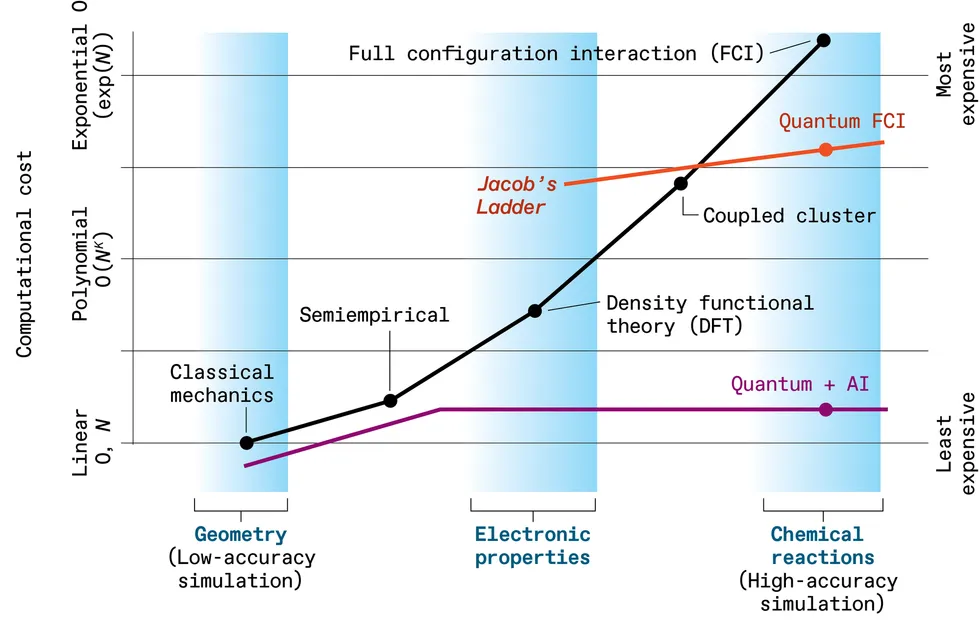
With this metaphor in mind, we propose to extend Jacob’s Ladder beyond Perdew’s version, to encompass all computational approaches to simulating the behavior of electrons. And instead of climbing rung by rung toward an unreachable summit, we have an idea to bend the ladder so that even the very top lies within our grasp. Specifically, we at Microsoft envision a hybrid approach. It starts with using quantum computers to generate exquisitely accurate data about the behavior of electrons—data that would be prohibitively expensive to compute classically. This quantum-generated data will then train AI models running on classical machines, which can predict the properties of materials with remarkable speed. By combining quantum accuracy with AI-driven speed, we can ascend Jacob’s Ladder faster, designing new materials with novel properties and at a fraction of the cost.

Graph comparing the computational cost of simulation methods, from classical mechanics to quantum FCI. At the base of Jacob’s Ladder are classical models that treat atoms as simple balls connected by springs—fast enough to handle millions of atoms over long times but with the lowest precision. Moving up along the black line, semiempirical methods add some quantum mechanical calculations. Next are approximations based on Hartree-Fock (HF) and density functional theory (DFT), which include full quantum behavior of individual electrons but model their interactions in an averaged way. The greater accuracy requires significant computing power, which limits them to simulating molecules with no more than a few hundred atoms. At the top are coupled-cluster and full configuration interaction (FCI) methods—exquisitely accurate but, at the moment, restricted to tiny molecules or subsets of electrons due to the large computational costs involved. Quantum computing can bend the accuracy-versus-cost curve at the top of Jacob’s Ladder [orange line], making highly accurate calculations feasible for large systems. AI, trained on this quantum-accurate data, can flatten this curve [purple line], enabling rapid predictions for similar systems at a fraction of the cost of classical computing.Source: Microsoft Quantum

In our approach, the base of Jacob’s Ladder still starts with classical models that treat atoms as simple balls connected by springs—models that are fast enough to handle millions of atoms over long times, but with the lowest precision. As we ascend the ladder, some quantum mechanical calculations are added to semiempirical methods. Eventually, we’ll get to the full quantum behavior of individual electrons but with their interactions modeled in an averaged way; this greater accuracy requires significant compute power, which means you can only simulate molecules of no more than a few hundred atoms. At the top will be the most computationally intensive methods—prohibitively expensive on classical computers but tractable on quantum computers.

Advertisement

In the coming years, quantum computing and AI will become critical tools in the pursuit of new materials science and chemistry. When combined, their forces will multiply. We believe that by using quantum computers to train AI on quantum data, the result will be hyperaccurate AI models that can reach ever higher rungs of computational complexity without the prohibitive computational costs.

This powerful combination of quantum computing and AI could unlock unprecedented advances in chemical discovery, materials design, and our understanding of complex reaction mechanisms. Chemical and materials innovations already play a vital—if often invisible—role in our daily lives. These discoveries shape the modern world: new drugs to help treat disease more effectively, improving health and extending life expectancy; everyday products like toothpaste, sunscreen, and cleaning supplies that are safe and effective; cleaner fuels and longer-lasting batteries; improved fertilizers and pesticides to boost global food production; and biodegradable plastics and recyclable materials to shrink our environmental footprint. In short, chemical discovery is a behind-the-scenes force that greatly enhances our everyday lives.

The potential is vast. Anywhere AI is already in use, this new quantum-enhanced AI could drastically improve results. These models could, for instance, scan for previously unknown catalysts that could fix atmospheric carbon and so mitigate climate change. They could discover novel chemical reactions to turn waste plastics into useful raw materials and remove toxic “forever chemicals” from the environment. They could uncover new battery chemistries for safer, more compact energy storage. They could supercharge drug discovery for personalized medicine.

And that would just be the beginning. We believe quantum-enhanced AI will open up new frontiers in materials science and reshape our ability to understand and manipulate matter at its most fundamental level. Here’s how.

Advertisement

How Quantum Computing Will Revolutionize Chemistry

To understand how quantum computing and AI could help bend Jacob’s Ladder, it’s useful to look at the classical approximation techniques that are currently used in chemistry. In atoms and molecules, electrons interact with one another in complex ways called electron correlations. These correlations are crucial for accurately describing chemical systems. Many computational methods, such as density functional theory (DFT) or the Hartree-Fock method, simplify these interactions by replacing the intricate correlations with averaged ones, assuming that each electron moves within an average field created by all other electrons. Such approximations work in many cases, but they can’t provide a full description of the system.

a woman stirs a white powder inside a glove box.

The second shows white powder in test tubes.

shows a gloved hand holding a silvery disc close to an electronic apparatus. A joint project between Microsoft and Pacific Northwest National Laboratory used AI and high-performance computing to identify potential materials for battery electrolytes. The most promising were synthesized [top and middle] and tested [bottom] at PNNL. Dan DeLong/Microsoft

Electron correlation is particularly important in systems where the electrons are strongly interacting—as in materials with unusual electronic properties, like high-temperature superconductors—or when there are many possible arrangements of electrons with similar energies—such as compounds containing certain metal atoms that are crucial for catalytic processes.

In these cases, the simplified approach of DFT or Hartree-Fock breaks down, and more sophisticated methods are needed. As the number of possible electron configurations increases, we quickly reach an “exponential wall” in computational complexity, beyond which classical methods become infeasible.

Enter the quantum computer. Unlike classical bits, which are either on or off, qubits can exist in superpositions—effectively coexisting in multiple states simultaneously. This should allow them to represent many electron configurations at once, mirroring the complex quantum behavior of correlated electrons. Because quantum computers operate on the same principles as the electron systems they will simulate, they will be able to accurately simulate even strongly correlated systems—where electrons are so interdependent that their behavior must be calculated collectively.

Advertisement

AI’s Role in Advancing Computational Chemistry

At present, even the computationally cheap methods at the bottom of Jacob’s Ladder are slow, and the ones higher up the ladder are slower still. AI models have emerged as powerful accelerators to such calculations because they can serve as emulators that predict simulation outcomes without running the full calculations. The models can speed up the time it takes to solve problems up and down the ladder by orders of magnitude.

This acceleration opens up entirely new scales of scientific exploration. In 2023 and 2024, we collaborated with researchers at Pacific Northwest National Laboratory (PNNL) on using advanced AI models to evaluate over 32 million potential battery materials, looking for safer, cheaper, and more environmentally friendly options. This enormous pool of candidates would have taken about 20 years to explore using traditional methods. And yet, within less than a week, that list was narrowed to 500,000 stable materials and then to 800 highly promising candidates. Throughout the evaluation, the AI models replaced expensive and time-consuming quantum chemistry calculations, in some cases delivering insights half a million times as fast as would otherwise have been the case.

We then used high-performance computing (HPC) to validate the most promising materials with DFT and AI-accelerated molecular dynamics simulations. The PNNL team then spent about nine months synthesizing and testing one of the candidates—a solid-state electrolyte that uses sodium, which is cheap and abundant, and some other materials, with 70 percent less lithium than conventional lithium-ion designs. The team then built a prototype solid-state battery that they tested over a range of temperatures.

This potential battery breakthrough isn’t unique. AI models have also dramatically accelerated research in climate science, fluid dynamics, astrophysics, protein design, and chemical and biological discovery. By replacing traditional simulations that can take days or weeks to run, AI is reshaping the pace and scope of scientific research across disciplines.

Advertisement

However, these AI models are only as good as the quality and diversity of their training data. Whether sourced from high-fidelity simulations or carefully curated experimental results, these data must accurately represent the underlying physical phenomena to ensure reliable predictions. Poor or biased data can lead to misleading outcomes. By contrast, high-quality, diverse datasets—such as those full-accuracy quantum simulations—enable models to generalize across systems and uncover new scientific insights. This is the promise of using quantum computing for training AI models.

How to Accelerate Chemical Discovery

The real breakthrough will come from strategically combining quantum computing’s and AI’s unique strengths. AI already excels at learning patterns and making rapid predictions. Quantum computers, which are still being scaled up to be practically useful, will excel at capturing electron correlations that classical computers can only approximate. So if you train classical models on quantum-generated data, you’ll get the best of both worlds: the accuracy of quantum delivered at the speed of AI.

As we learned from the Microsoft-PNNL collaboration on electrolytes, AI models alone can greatly speed up chemical discovery. In the future, quantum-accurate AI models will tackle even bigger challenges. Consider the basic discovery process, which we can think of as a funnel. Scientists begin with a vast pool of candidate molecules or materials at the wide-mouthed top, narrowing them down using filters based on desired properties—such as boiling point, conductivity, viscosity, or reactivity. Crucially, the effectiveness of this screening process depends heavily on the accuracy of the models used to predict these properties. Inaccurate predictions can create a “leaky” funnel, where promising candidates are mistakenly discarded or poor ones are mistakenly advanced.

Quantum-accurate AI models will dramatically improve the precision of chemical-property predictions. They’ll be able to help identify “first-time right” candidates, sending only the most promising molecules to the lab for synthesis and testing—which will save both time and cost.

Advertisement

Another key aspect of the discovery process is understanding the chemical reactions that govern how new substances are formed and behave. Think of these reactions as a network of roads winding through a mountainous landscape, where each road represents a possible reaction step, from starting materials to final products. The outcome of a reaction depends on how quickly it travels down each path, which in turn is determined by the energy barriers along the way—like mountain passes that must be crossed. To find the most efficient route, we need accurate calculations of these barrier heights, so that we can identify the lowest passes and chart the fastest path through the reaction landscape.

Even small errors in estimating these barriers can lead to incorrect predictions about which products will form. Case in point: A slight miscalculation in the energy barrier of an environmental reaction could mean the difference between labeling a compound a “forever chemical” or one that safely degrades over time.

Accurate modeling of reaction rates is also essential for designing catalysts—substances that speed up and steer reactions in desired directions. Catalysts are crucial in industrial chemical production, carbon capture, and biological processes, among many other things. Here, too, quantum-accurate AI models can play a transformative role by providing the high-fidelity data needed to predict reaction outcomes and design better catalysts.

Advertisement

Once trained, these AI models, powered by quantum-accurate data, will revolutionize computational chemistry by delivering quantum-level precision. And once the AI models, which run on classical computers, are trained with quantum computing data, researchers will be able to run high-accuracy simulations on laptops or desktop computers, rather than relying on massive supercomputers or future quantum hardware. By making advanced chemical modeling more accessible, these tools will democratize discovery and empower a broader community of scientists to tackle some of the most pressing challenges in health, energy, and sustainability.

Remaining Challenges for AI and Quantum Computing

By now, you’re probably wondering: When will this transformative future arrive? It’s true that quantum computers still struggle with error rates and limited lifetimes of usable qubits. And they still need to scale to the size required for meaningful chemistry simulations. Meaningful chemistry simulations beyond the reach of classical computation will require hundreds to thousands of high-quality qubits with error rates of around 10-15, or one error in a quadrillion operations. Achieving this level of reliability will require fault tolerance through redundant encoding of quantum information in logical qubits, each consisting of hundreds of physical qubits, thus requiring a total of about a million physical qubits. Current AI models for chemical-property predictions may not have to be fully redesigned. We expect that it will be sufficient to start with models pretrained on classical data and then fine-tune them with a few results from quantum computers.

Despite some open questions, the potential rewards in terms of scientific understanding and technological breakthroughs make our proposal a compelling direction for the field. The quantum computing industry has begun to move beyond the early noisy prototypes, and high-fidelity quantum computers with low error rates could be possible within a decade.

Realizing the full potential of quantum-enhanced AI for chemical discovery will require focused collaboration between chemists and materials scientists who understand the target problems, experts in quantum computing who are building the hardware, and AI researchers who are developing the algorithms. Done right, quantum-enhanced AI could start to tackle the world’s toughest challenges—from climate change to disease—years ahead of anyone’s expectations.

Advertisement

From Your Site Articles

Related Articles Around the Web

Source link

Advertisement
Continue Reading

Tech

Minnesota Judge Shuts Down DHS’s Attempt To Expel Thousands Of Refugees

Published

on

from the american-horror-story-season-6 dept

The Trump administration is purposefully cruel. That much cannot be argued, not when it has deliberately sent deportees to foreign torture prisons, dumped them in war-torn countries with histories of human rights abuses, and stranded people its has been ordered to release far from home without their IDs, phones, or money.

This regime loves to inflict pain. Its desire to erase as many minorities from this country as possible has led it to do things no competent government would ever do, especially not one that serves a nation long known as a land of hope and opportunity. The people who first landed here were escaping religious persecution. (They then went on to eradicate the people who actually lived here, but stick with me for a moment.) People seeking the same refuge from persecution are now being ejected from this country as quickly as possible.

The good news is that a federal court has at least pumped the brakes on one such DHS effort. In Minnesota — where Trump has used benefits fraud allegations as justification for a “surge” that has resulted in two murders committed by federal officers (so far!) — a federal judge has just told the administration it can’t just suddenly declare an end to refugee status.

Here’s Law Dork with the summary of yet another anti-minority putsch by the Trump administration:

Advertisement

The longtime government policy has been that refugees — vetted and legally admitted individuals — who are yet to adjust to lawful permanent resident status cannot be detained on that basis alone.

With Operation PARRIS (Post-Admission Refugee Reverification and Integrity Strengthening), the Trump administration wants to change that.

In a pair of memos issued in December 2025 and February 2026 — which Law Dork has covered extensively — the Department of Homeland Security has purported to change that policy by rescinding and re-rescinding the 2010 U.S. Immigration and Customs Enforcement policy that most recently enunciated that policy for applying the relevant provision — 8 U.S.C. 1159 — of the Refugee Act of 1980.

What used to be a normal part of the “give me your tired, huddled masses” ideal that once represented this Land of Opportunity is no longer. The Trump administration is now claiming it can simply pretend existing law no longer matters. And while it is true that Congress could decide to rewrite or overturn the 1980 law, it cannot simply be ignored just because the DHS sent out a couple of memos telling federal officers they’re free to ignore existing law.

Fortunately, this Minnesota court isn’t going to sit by while the administration pretends the only interpretation of the law is the one it recently wrote for itself. From the opinion [PDF]:

Advertisement

When the clock strikes 12:00 a.m. on the 366th day after a refugee was lawfully admitted to the United States, according to the Government, 8 U.S.C. § 1159(a) gives Department of Homeland Security officials the power to arrest and detain that refugee with no limits on the length of detention. Because § 1159(a) provides no such power, the Court will issue a preliminary injunction enjoining Defendants from arresting or detaining refugees in Minnesota on the basis that have not yet been adjusted to lawful permanent resident status—which, by law, cannot occur until one year has passed. The Court will not allow federal authorities to use a new and erroneous statutory interpretation to terrorize refugees who immigrated to this country under the promise that they would be welcomed and allowed to live in peace, far from the persecution they fled.

You see the obvious evil here, right? A refugee — at earliest — cannot secure lawful permanent status until after one year has passed. Trump’s DHS says refugees applying for permanent residence can be arrested and detained indefinitely 24 hours after they’ve been here for a year. The court is right: this not only flips the law on its head, it completely destroys an American ideal that made this nation of a beacon of hope for oppressed people around the world.

Decades ago, as a nation, we made a solemn promise to refugees fleeing persecution: that after rigorous vetting, they would be welcomed to the United States and given the opportunity to rebuild their lives. We assured them that they could care for their families, earn a living, contribute to their communities, and live in peace here in the United States. We promised them the hope that one day they could achieve the American Dream.

The Government’s new policy breaks that promise—without congressional authorization—and raises serious constitutional concerns. The new policy turns the refugees’ American Dream into a dystopian nightmare.

A government that retains any notion of serving the public good would never have attempted to enact this policy. Only a government filled with unjustified hatred of “others” would dare to destroy the American Dream. And only a regime so laden with craven bigots would dare to drape themselves in the flag while shitting on what actually makes this country great.

And, it must be noted, this is only a temporary block. The court is going to allow the government to defend its actions. I don’t think the government will win, but it will certainly kick this up the ladder to the appellate level. That’s fine, so long as the restraining order stays in place while the government cooks up a defense for its blatant racism. With any luck, this will stick all the way to the Supreme Court… and then hopefully after that review as well. No one who truly loves America would back this effort. And no one who only claims to love America while strip-mining it of its greatness should be allowed to turn this great nation into a “dystopian nightmare.”

Advertisement

Filed Under: bigotry, border patrol, cbp, cruelty, dhs, ice, kristi noem, mass deportation, pam bondi, todd lyons, trump administration

Source link

Advertisement
Continue Reading

Tech

Inside SKALA: How Chernobyl’s Reactor Was Actually Controlled

Published

on

Entering SKALA codes during RBMK operation. (Credit: Pripyat-Film studio)

Running a nuclear power plant isn’t an easy task, even with the level of automation available to a 1980s Soviet RBMK reactor. In their continuing efforts to build a full-sized, functional replica of an RBMK control room as at the Chornobyl Nuclear Power Plant – retired in the early 2000s – the [Chornobyl Family] channel has now moved on to the SKALA system.

Previously we saw how they replicated the visually very striking control panel for the reactor core, with its many buttons and status lights. SKALA is essentially the industrial control system, with multiple V-3M processor racks (‘frames’), each with 20k 24-bit words of RAM. Although less powerful than a PDP-11, its task was to gather all the sensor information and process them in real-time, which was done in dedicated racks.

Output from SKALA’s DREG program were also the last messages from the doomed #4 reactor. Unfortunately an industrial control system can only do so much if its operators have opted to disable every single safety feature. By the time the accident unfolded, the hardware was unable to even keep up with the rapid changes, and not all sensor information could even be recorded on the high-speed drum printer or RTA-80 teletypes, leaving gaps in our knowledge of the accident.

(Credit: Chornobyl Family, YouTube)

Setting up a genuine RTA-80 teletype is still one of the goals, but these old systems are not easy to use. Same with the original software that ran on these V-3M computer frames, which was loaded from paper tape (the ‘library’), including the aforementioned DREG program. This process creates executable code that is put on magnetic tapes, with magnetic tape also used for storage.

(Credit: Chornobyl Family, YouTube)

The workings of the SKALA system and its individual programs including KRV, DREG and PRIZMA are explained in the video, each having its own focus on a part of the RBMK reactor’s status and overall health. Interacting with SKALA occurs via a special keyboard, on which the operator enters command codes to change e.g. set points, with parameters encoded in this code.

Using this method, RBMK operators can set and request values, with parameters and any error codes displayed on a dedicated display. There is also the Mnemonic Display for the SKALA system which provides feedback to the operator on the status of the SKALA system, including any faults.

Although to many people the control system of a power plant is just the control room, with its many confusing buttons, switches, lights and displays, there is actually a lot more to it, with systems SKALA and its associated hardware an often overlooked aspect. It’s great to see this kind of knowledge being preserved, and even poured into a physical model that simulates the experience of using the system.

Advertisement

The long-lived nature of nuclear power reactors means that even today 1960s and 1970s-era industrial automation system are still in active use, but once the final reactor goes offline – or is modernized during refurbishing – a lot of the institutional knowledge of these systems tends to vanish and with it a big part of history.

Source link

Advertisement
Continue Reading

Trending

Copyright © 2025