It may affect parking for football fans and shoppers on the weekends
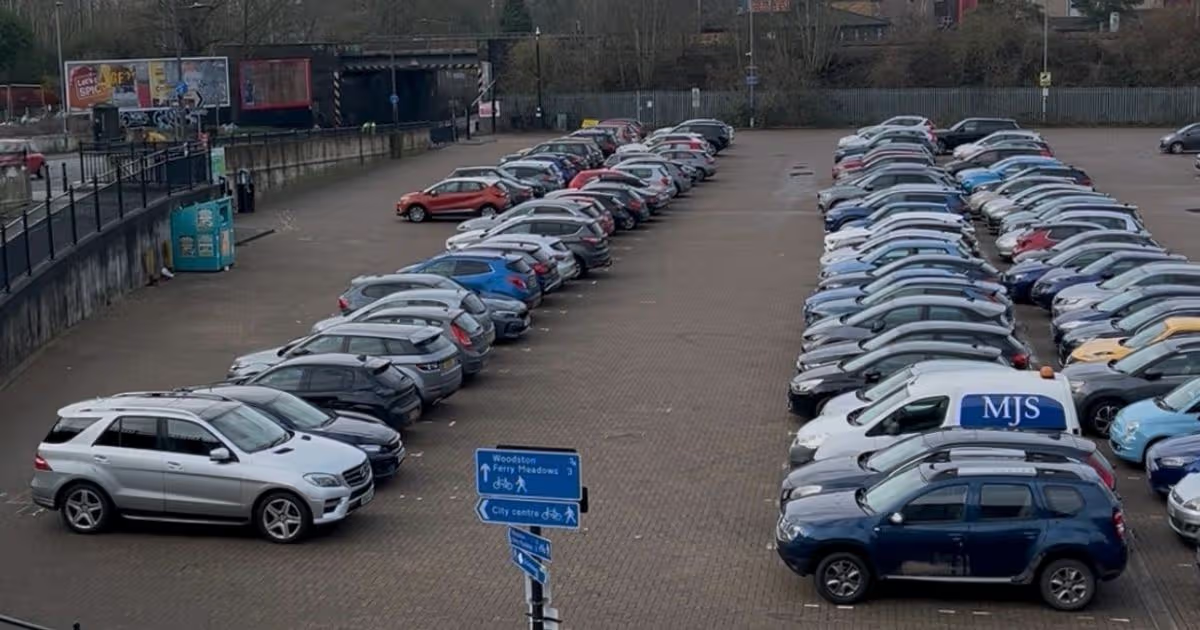
A city centre car park will close for over two weeks for a fair. John Thurston and Son’s Mart Fair returns to Peterborough city centre on Thursday, March 19, and runs until Sunday, March 29.
Advertisement
The fair will be held at the Pleasure Fair Meadow car park. There will be over 100 rides on offer at the fair, providing lots of fun for all ages.
The fair will be open from 6pm until 10pm on weekdays, and 2pm until 10pm on Saturdays and Sundays. The car park will be closed from March 14 until March 30.
This could affect city centre parking for people attending Peterborough United games and also shopping. A Peterborough City Council spokesperson said: “Pleasure Fair Car Park will be closed from 6pm on Saturday 14 March until 6pm on Monday, March 30, due to the return of Mart Fair. Please use alternative car parks during this period.
“For any Posh fixtures taking place during the closure period, please use alternative parking. Thank you for your cooperation.”
Advertisement
The alternative council car parks motorists can use are:
Connor Casey, 22, of The Brambles, Birtley, appeared at Durham Crown Court via video link from Holme House Prison, where he is remanded in custody.
He is accused of stalking a woman between January 28 and March 16, causing her to fear violence would be committed against her.
The allegation states that he kept track of her movements, damaged and threatened to damage her property, followed her when socialising with friends in Newcastle and when she travelled abroad, to Ibiza.
Advertisement
Casey is also accused of assaulting her, causing actual bodily harm, in Thailand, between January 31 and March 3, this year, and intentional strangulation, at Chester-le-Street, between December 31 and February 1.
All three counts were put to Casey at the hearing and he denied them all.
A timetable prior to trial was agreed, with the prosecution to serve its file of evidence by May 8 and the signed defence statement to be submitted by June 5.
All parties agreed on a trial start date of Tuesday September 1.
Advertisement
Judge Nathan Adams told Casey, of The Brambles, Birtley, near Chester-le-Street: “You have pleaded not guilty and the case is now timetabled to trial.
“By June 5 you need to help in the preparation of your signed defence statement, setting out why you say you are not guilty.
“The trial will start on September 1, and you will remain in custody in the meantime.”
Passengers were forced to miss connecting flights and faced hours of disruption – reports suggest there was overcrowded waiting areas and huge queues at major airports
Passengers have been left stranded after a huge number of flights were reportedly cancelled as four major airlines experienced delays.
Advertisement
According to Travel and Tour World, nearly 500 flights were delayed as Capital Airlines, Garuda Indonesia, China Eastern Airlines and Pakistan International Airlines.
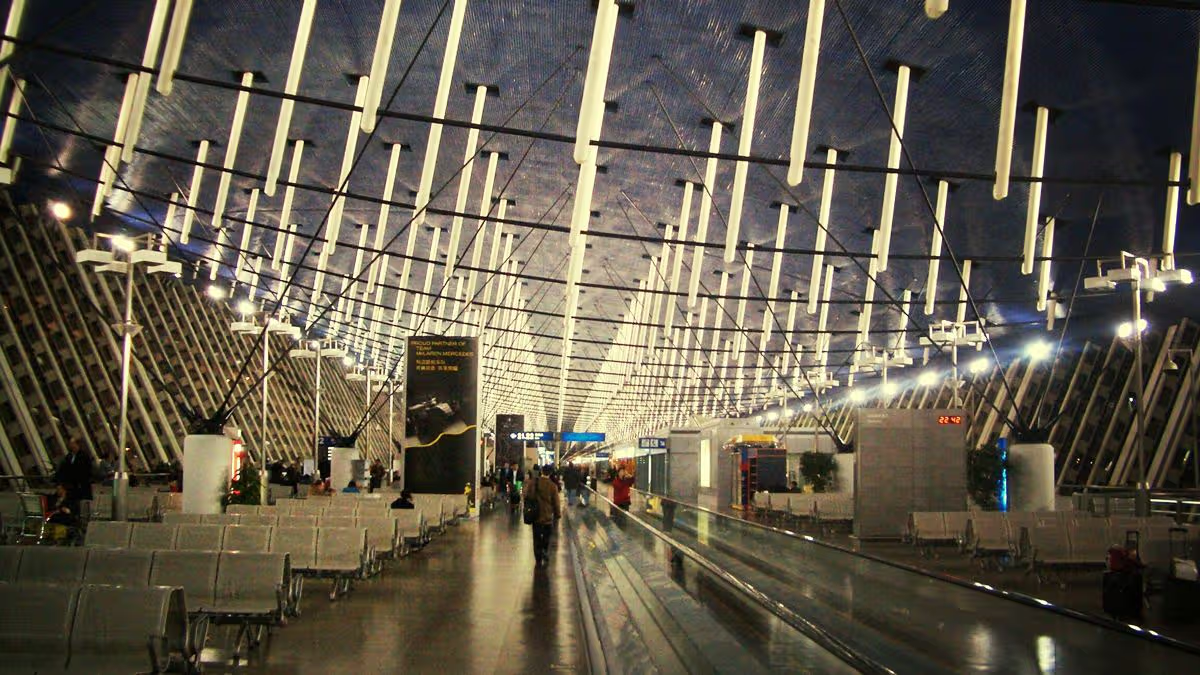
Reports suggest that these delays created a whole host of problems – with passengers missing connecting flights and facing hours of disruption. Travel and Tour World reports that there were overcrowded waiting areas and huge queues at Shanghai and Beijing.
An Aer Lingus spokesperson told RSVP Live: “Aer Lingus has commenced operating its planned summer schedule. A number of recent cancellations have been required due to mandatory maintenance on aircraft, along with a limited number of schedule adjustments.
“Where schedule adjustments are being made, the vast majority of customers are being reaccommodated on same day services.”
Earlier this month, Ryanair chief Michael O’Leary cautioned that flights could be cancelled this summer owing to the soaring cost of jet fuel.
Advertisement
He told ITV News: “We’re all facing an unknown scenario. And we are certainly looking at maybe having to cancel 5 per cent, 10 per cent of flights through May, June and July.”
Should passengers find their flight cancelled, O’Leary suggested they should ‘blame Trump’ rather than the airline.
Air Canada is also set to suspend services to New York’s JFK International Airport over the summer as the war in Iran creates jet fuel shortages that have sent prices soaring.
Canada’s flag carrier said on Friday that flights from Toronto and Montreal to JFK will cease on June 1 and resume on October 25.
Advertisement
Services to the New York metropolitan area’s two other airports — LaGuardia and Newark — will continue.
Air Canada said it will reach out to customers who are affected by the suspension with alternative travel options.
“As jet fuel prices have doubled since the start of the Iran conflict and some lower profitability routes and flights are no longer economic, we are making schedule adjustments accordingly,” a spokesman for the Montreal-based carrier said.
Swedish Chief of Defence warns Moscow could carry out Baltic Sea ‘land grab’ at any time to test NATO’s resolve as military intelligence says Russia capable of war expansion
Sweden is bracing itself for a potential Russian operation to seize the island of Gotland, according to the country’s military chief.
Advertisement
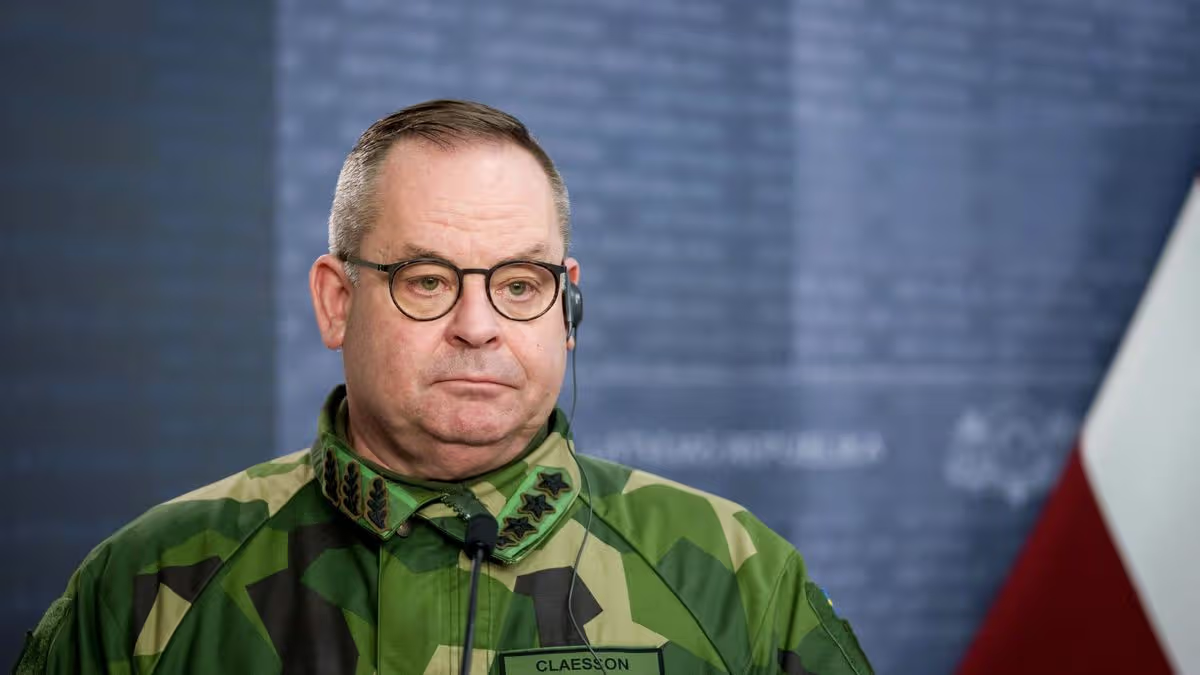
Swedish Chief of Defence Michael Claesson warned that Moscow could execute a land grab “at any time” in order to put NATO’s determination to the test.
“It doesn’t have to be particularly extensive at all, but more to make a point and wait to see what might happen politically,” Claesson said.
NATO military exercises have traditionally centred on a potential Russian land assault along the alliance’s eastern flank, however focus is now turning towards the Baltic Sea.
War games have simulated possible Russian landings on strategically vital islands such as Gotland in Sweden, Bornholm in Denmark, and Hiiumaa and Saaremaa in Estonia.
Advertisement
Swedish military intelligence has cautioned that Russia is capable of broadening its conflict in the years ahead.
They further warn that any resolution to the Russian war could enable Putin to redeploy troops closer to NATO territory.
It follows US President Donald Trump repeatedly rounding on NATO allies over what he regards as insufficient backing for the Iran war. Most recently, at a Turning Point event in Arizona on Friday, 17 April, Trump delivered a keynote speech in which he declared that his country must depend on itself.
Trump said: “If NATO teaches us any one thing, and I hope you all watched because they weren’t there for us, if it teaches us any one thing: we have to rely on ourselves.
Advertisement
“We can’t rely on outside countries and outside sources.”
Meanwhile, Ukraine’s President Volodymyr Zelensky has condemned a US decision to extend the period during which Russia is allowed to sell oil despite Western sanctions.
The move means countries can purchase Russian oil and petroleum products already loaded on vessels at sea until 16 May.
The US argues that the waiver is meant to ease the energy supply crunch sparked by the US-Israel war with Iran.
Advertisement
But in his remarks on Sunday, Zelensky said “every dollar paid for Russian oil is money for the war” in Ukraine. Widespread sanctions have been in place against Russia since President Vladimir Putin launched his full-scale invasion of its neighbour in February 2022.
“Edward”, a nine-year old Kenyan boy, has always been aware his father worked for the British military. The boy’s skin colour, lighter than his peers, has provoked years of bullying. His father disappeared before Edward [not his real name] was born, leaving his mum living in extreme poverty, ostracised by some of her family.
‘It’s the most difficult thing to trust your killer, your occupier, who stole your land, your house, who killed your daughter’
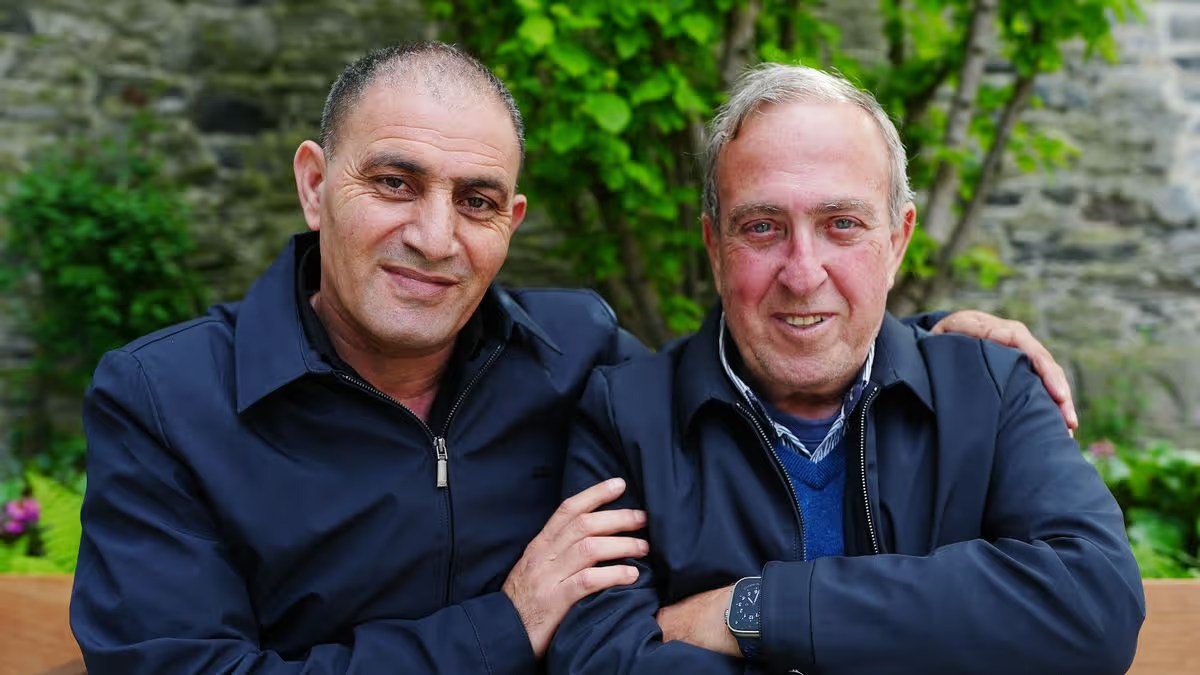
Two bereaved fathers, one Israeli and one Palestinian, are using their friendship to campaign for peace between their two nations.
Advertisement
Despite having fought for opposing sides as young men, Rami Elhanan and Bassam Aramin say they are now “family” and have dedicated their lives to building respect and understanding between their communities.
The two men were in Dublin to speak at an event hosted by the charity Trocaire. They have visited the country before, touring the island and sharing their stories last summer.
“I’m proud that he considers me a brother,” Mr Elhanan says of Mr Aramin.
The 76-year-old veteran of the Yom Kippur War described a man who, aged 17, was jailed for throwing hand grenades at Israeli jeeps.
Advertisement
Mr Elhanan’s life changed “dramatically” following the death of his 14-year-old daughter in 1997.
Smadar Elhanan was killed by Palestinian suicide bombers while shopping for school books with friends in Jerusalem.
The following year he was invited to a meeting of bereaved Palestinian and Israeli parents, set up by The Parents Circle – Families Forum (PCFF), a joint Israeli-Palestinian organisation for bereaved families.
“I was very suspicious… I was very reluctant and cynical,” he said, but added that the meeting “changed my life, changed my mind, changed my attitude”.
“I was 47-years-old, and until today, I’m ashamed to admit it was the first time ever in my life I’d met Palestinians as human beings, not as workers in the streets, and not as terrorists, but as human beings who carry the same burden that I carry, who suffer like I suffer.”
He became involved in grassroots peace movements and met Mr Aramin through the group Combatants for Peace in 2005.
“He always said that I immediately fell in love with him the minute I met him, which is completely true,” Mr Elhan said of Mr Aramin.
Advertisement
That love was needed when, two years later, Mr Aramin’s 10-year-old daughter, Abir, was shot by the Israeli military in East Jerusalem.
“We ran to the hospital,” Mr Elhanan said: “We spent two days by her bed until she passed away and for me, it was like losing my daughter for the second time, I knew this girl.”
Since then the men have campaigned together, sharing their personal tragedies as a warning, and their friendship as a symbol of hope.
“We proved that we can build a real partnership, we can live together all side by side,” Mr Elhanan said.
They say mutual respect and understanding between their two peoples is what is needed to bring the brutal conflict to an end.
“One word is essential, without it nothing will happen, the word is respect,” said Mr Elhanan.
“You have to be able to respect the guy next to you exactly as you want to be respected, no more and no less and once you achieve this, all the rest are technicalities.”
Advertisement
This, he says, can be achieved by “being brave, by telling the truth, by looking straight into your eyes, not being polite, not being not controversial, telling them from the river to the sea, everyone should be free, everyone should be safe, everyone should be equal”.
“It’s the most difficult thing to trust your killer, your occupier, who stole your land, your house, who killed your daughter,” Mr Aramin added.
But he said learning about the “humanity” of those he considered the “enemy” has changed his perspective.
The 57-year-old said it was not until he met Mr Elhanan’s father, an Auschwitz survivor, that he understood the horror of the Holocaust.
Advertisement
He said when he first heard about the Second World War genocide he thought: “I don’t care, it’s not me, I don’t know about anyone.”
“When you meet Rami’s Father, it’s hard, and he starts to talk to you about before he go to the oven.
“Then you understand what’s the name of the Holocaust.”
Mr Elhanan said some in his community claim grief caused him to lose his mind.
Advertisement
“I lost many friends, I lost many family members,” he said, but added: “I get new family members, new friends, and I’m not afraid anymore the worst has already happened.”
“I see the goal very clearly, very sharply, I know exactly where I’m going, what needs to be done in order that children will not keep on dying in this Holy Land of ours, no Muslim children, no Christian children, no Jewish children, no children at all.”
A 2020 novel Aperiogon, based on the pair’s friendship and written by Irish author Colum McCann, was longlisted for the Booker prize.
They compare coming to Ireland to a football team playing a home match, with Mr Aramin saying people in the country “understand us, they’re very supportive”.
Advertisement
They say they use the peace that has been achieved in Northern Ireland as a story of hope.
“It’s not written anywhere that we’re going to continue killing each other forever,” Mr Aramin said.
“It must end at one point, and I believe very soon.”
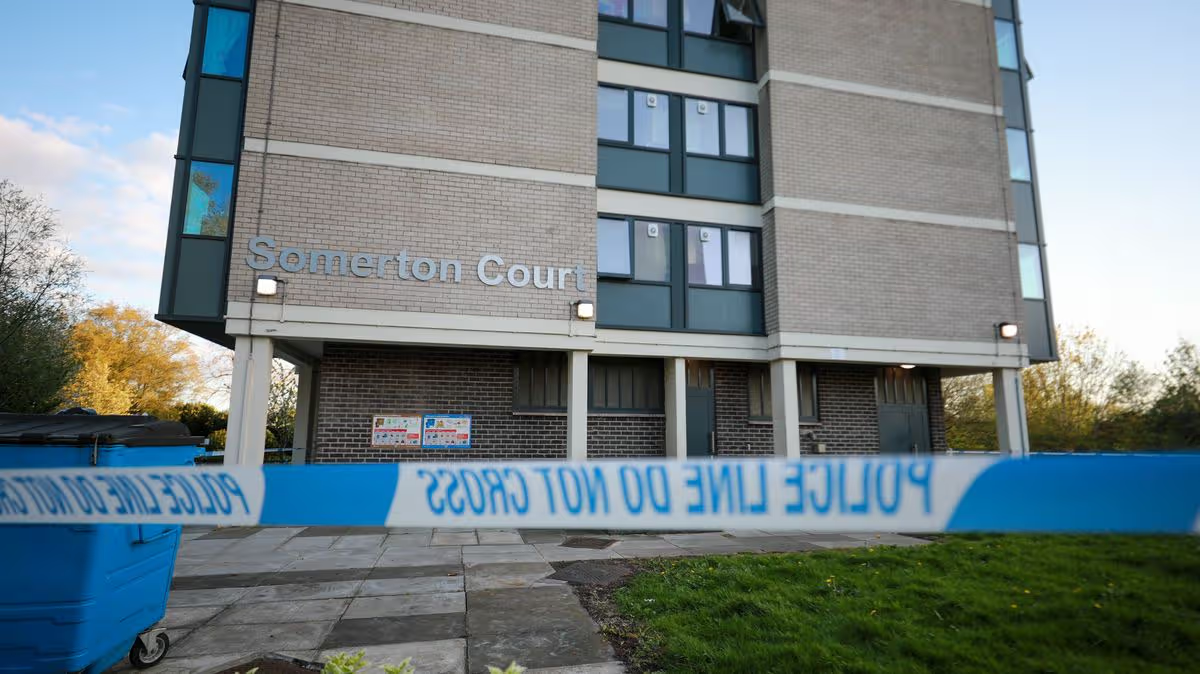
Armed police were called to a block of flats after a woman was found dead. Emergency services flooded Broadmoss Drive, Blackley, on Sunday evening (April 19).
Advertisement
A man has been arrested on suspicion of murder and Greater Manchester Police has said there is no wider risk to the public.
Multiple officers, detectives, forensics, and ambulance staff were spotted in the area today where a cordon was placed at the entrance of Somerton Court.
Police cars were stationed around the flats, with officers standing outside keeping watch.
One resident who lives in Somerton Court described to the M.E.N the moment they heard armed police enter the tower block.
“Earlier today at 18:26 I heard a big bang and a door had been kicked in,” they said. “When we heard the noise, we went to look and then went back up.
“I saw about four ambulances go in as well as armed police and thought, what’s going on?’”
The 22-year-old had been seen as a potential option for Wales going forward
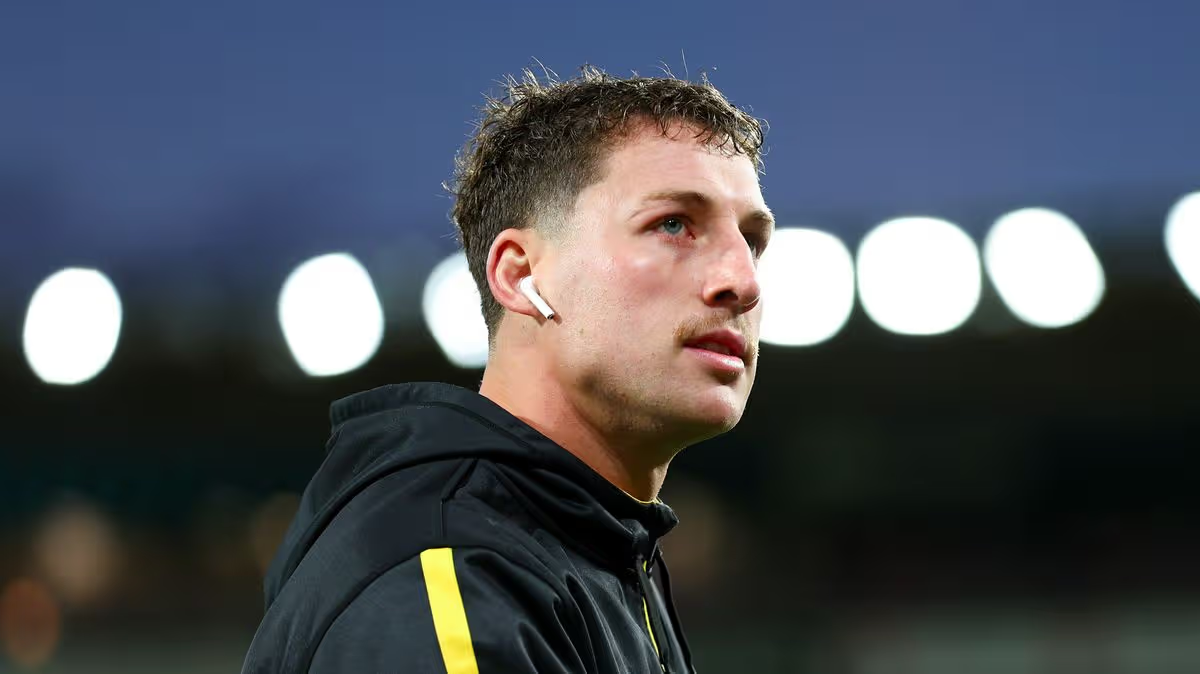
Welsh-qualified centre Riley Higgins has signed for Edinburgh in a blow to Steve Tandy’s hopes of strengthening his playing options.
Advertisement
Despite the Welsh Rugby Union scrapping its Exiles programme last year, the need to expand Wales’ player pool is more pressing than ever, with high-ranking figures within the union casting the net across the globe to find new names. Higgins, who currently plays for Super Rugby Pacific outfit the Hurricanes, was one player seen as a potential option for Tandy, with the 22-year-old qualifying for Wales through a grandmother.
However, the New Zealander is also eligible for Scotland through his Ayrshire-born grandmother, and he has seemingly signalled his international intentions by signing for Edinburgh on a three-year deal from next season.
Higgins – who can play at 12, 13 or on the wing – is highly thought of in New Zealand rugby circles, making his Super Rugby debut before playing any NPC rugby.
Advertisement
He has also represented New Zealand U20s and an All Blacks XV and has unsurprisingly attracted a lot of interest from around the globe in recent times, with English, Japanese and other Super Rugby clubs also thought to be keen on securing his signature.
But while he was previously seen as a player who could potentially add some x-factor to the Wales midfield, Higgins has decided the next step of his career will come in Scotland, and he will more than likely come into contention for international selection by Gregor Towsend from next season.
“I can’t wait to get stuck in with Edinburgh,” he said as his signing was confirmed on Sunday. “It’s a big move but the challenge of testing myself in a new competition, with such a great team and such passionate fans is very exciting.
“The club has a great feel to it, and I can’t wait to grow my game with Edinburgh Rugby over the next few years. I’m still young and learning but I’m hungry to improve as a player and person on and off the field, and help the team wherever I can in the hope of winning some titles.
Advertisement
“Fans can expect a hard-working player who will never give up, and someone who brings an exciting style of play,” Higgins added. “I can’t wait to see you all soon!”
Edinburgh head coach Sean Everitt added: “Riley is an outstanding talent and this is a significant signing for Edinburgh Rugby.
“He has already proven himself at the highest level in the southern hemisphere – a player who was keeping All Blacks out of the Hurricanes’ starting lineup before his 24th birthday – and we believe the best is still very much to come from him.
“The fact that he has chosen to turn down a potential All Blacks future, and has rejected higher offers elsewhere, to come to Edinburgh tells you everything about his ambition to succeed in Scotland. We worked enormously hard over many months to get this deal over the line, and I’m delighted we’ve got it done.
Advertisement
“At 23, Riley still has room to grow, and I genuinely believe the best is still to come from him. Alongside guys like Matt Currie and Mosese Tuipulotu, we are building something really exciting in our midfield, and I know our supporters will enjoy watching this group develop together. I can’t wait to have him with us this summer.”
Local councillors objected to the proposal, calling it ‘unneighbourly’
19:02, 19 Apr 2026Updated 19:04, 19 Apr 2026
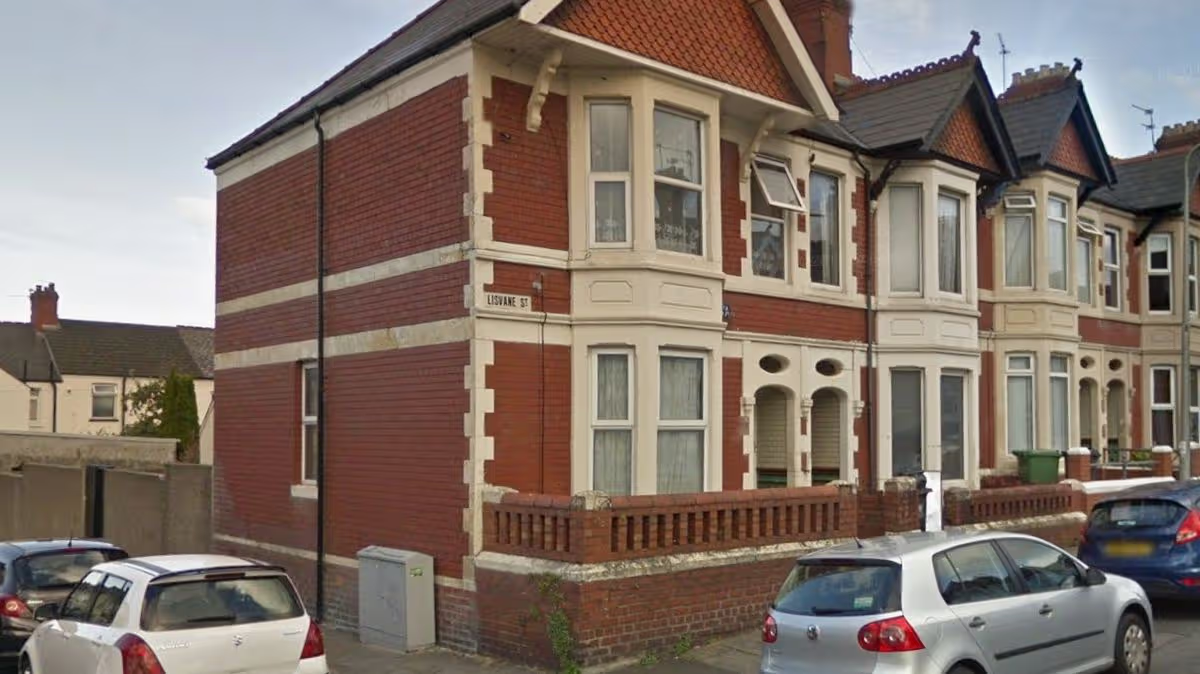
Local councillors are outraged over plans for a flat conversion in Cardiff which they have described as an “unneighbourly development”. The plans propose the conversion of the existing two flats at 15 Lisvane Street in Cathays into three self-contained flats, along with extensions to the building.
Cardiff councillors Sarah Merry, Christopher Weaver and Norma Mackie sent a letter to the council’s planning office objecting to the application on the grounds of it being an “unneighbourly overdevelopment” that will “impact negatively on neighbouring properties”.
Part of the letter reads: “The extension covers the full width of the plot leaving only a small remaining amenity area after the inclusion of cycle parking within 5 metres of the rear boundary wall. Never miss a Cardiff story by signing up to our daily newsletter here
Advertisement
It continues: “Visually as it is the corner property it will be very visible and impact negatively on the character of the area.”
The application reads: “The design aims to achieve an optimal balance between maximizing the use of available space and preserving the character and structural integrity of the original building plus retaining the ground floor shop use.”
It also states that parking, landscaping and waste management will be “addressed” to minimise the impact on the local community.
The applicant, JNR Properties, wrote that the development would be a “harmonious blend of old and new, where the character of the existing building is respected while adapting it to meet contemporary housing needs.”
Advertisement
The planning officer’s report reads: “The scale of the proposal and its relationship with neighbouring properties is considered acceptable.
“It is considered that the proposal would not be overbearing or generally un-neighbourly which would justify concern.”
The councillors’ objections were noted by the report.
All extensions planned for the property were also called “acceptable”.
Advertisement
According to the application, the front of the property will be preserved or “sensitively altered” to “blend seamlessly with the surrounding neighbourhood”.
Planning documents also read: “The design will create high-quality, sustainable, and functional living spaces that enhance the value of the property and positively contribute to the local community.”
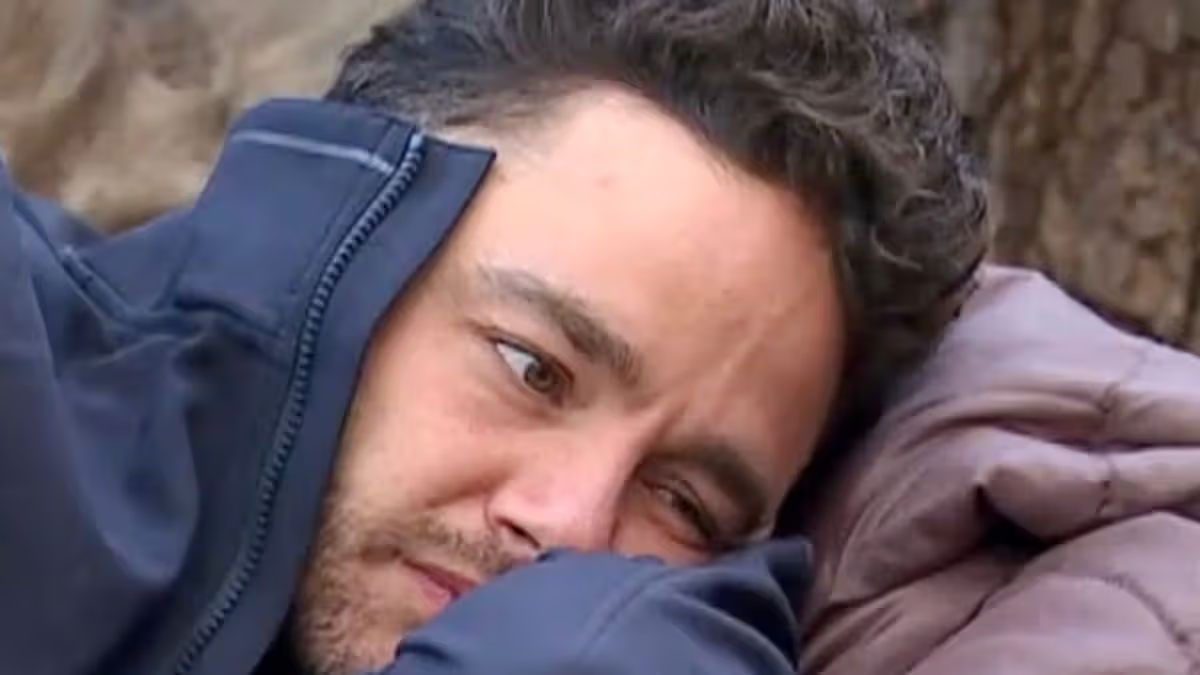
Adam Thomas can currently be seen competing on I’m A Celebrity…South Africa but months after it was all filmed, he has broken his silence after scenes involving his controversial campmate aired.
The actor, 37, who is best known for his roles in Emmerdale and Waterloo Road, can currently be seen competing on the all-stars edition of Ant and Dec’s reality survival show, almost a decade after he appeared on the regular edition of the series.
Earlier this week, boxer David, who was already at the centre of at the centre of controversy thanks to comments he made that were branded sexist, tried to bully Adam to take part in Termite Terror, unable to accept that the former Strictly Come Dancing contestant just wasn’t feeling up to it, reports the Mirror.
Adam has arthritis, which he has been open about. Explaining how it affects him, he said previously: “It is an autoimmune disease. Basically means my immune system is attacking my own body. It causes a s**t-load of pain,” and he has now admitted that it has all been a struggle to watch his time on I’m A Celebrity play out on TV.
Alongside an image from the show, which was filmed towards the end of last year, Adam wrote on Instagram on Sunday evening: “Not going to lie, this picture breaks my heart, as I know on the inside what I was dealing with and truth be told I thought it was all my fault. I now know that’s not the reality… My time in I’m a Celebrity South Africa was one of the toughest things I’ve ever been through, physically, mentally, and emotionally.
“Watching it back hasn’t been easy at all. There were moments I felt pushed to my absolute limit, and if I’m honest, times I didn’t even recognise myself. Living with arthritis is something I don’t really talk about, as much as I should do…but in there it really took its toll. My biggest fight was pretending to put on a brave face and trying to hide the pain! that can be exhausting within itself. There were days my body just didn’t want to keep going, but I did.
“I won’t sit here and say I handled everything perfectly, because I didn’t. I wish I spoke up for myself sooner. I wish I stood my ground instead of trying to keep the peace, but I’ve learned that being kind doesn’t mean being weak, and sometimes it takes going through tough moments to find your voice.
“Since coming out, I’ve taken time to process everything, and I’m in a much better place now. I let go of the anger, had the conversations I needed to have, and chose peace.
Advertisement
“What I’m most proud of, is at times like this I wanted to walk, I wanted to quit but I didn’t . Even when I wanted to walk away, even when it felt like too much, I never give up! and that means everything to me.
Advertisement
“He broke me in there, he pushed me to my limits, and I’ve told David this and he’s apologised and that’s that! I’ve moved on now, am not one to hold a grudge. But thank you for all your lovely messages and all the kind words We all face people and situations that try to break us, but sometimes those moments are what rebuild you stronger than ever. Be kind.”
Adam was inundated with comments of support from fans, with one writing: “You came over in there as such a beautiful human @adamthomas21 You know your own truth You were Always my Winner.”
Another said: “Your genuine & kind. You rose above it & kept going. That is strength. You’ve put it behind you & that stands for everything you are. Thats why you have everyone’s support,” whilst a third wrote: “Those living with these awful autoimmune diseases are the real strong ones. Try living in pain daily and still putting a smile on your face and looking as if you’re not in pain. The fatigue is often worse than the pain. And symptoms can creep up on you at any moment. No warnings.”
It all came to blows as Adam tried to sleep and admitted it would be hard for him to undertake a Bushtucker Trial because he was feeling dehydrated. David raged: “Dehydrated?! We’ve all got the same amount of water! Adam is doing it and that’s it!”
Advertisement
“When is your top form gonna come? Why aren’t we forcing this dude to go and do it? Coincidentally, every time there’s something to do, he’s not feeling well.” It was at that point that Gogglebox legend Scarlett Moffatt, who won I’m A Celebrity…Get Me Out Of Here! in 2016, weighed in as she begged David to “stop it.”
Early on in the series, he made comments about his girlfriend Sian. When talking about his partner cooking for them all, he then added: “She’s like tall, blue eyes. She’s lovely. She’s got the personality of a proper ugly bird.”
Despite Scarlett’s suggestion he should stop there, he continued his tirade as he added: “She has. Most ugly girls realise they don’t they’re not pretty enough to… they gotta have a personality to banter and to tell jokes and s**t, so people overlook the fact that they’re not aesthetically amazing, straight away.
Advertisement
“Which is what’s called Ugly Duckling syndrome, where girls are ugly, when they start off, and then they and then they kind of they, they get pretty as they get older. But they still got the personality of when they’re ugly. Does that make sense?”
In the rant, which left angry viewers fuming, he added: “You get a girl who’s pretty from day one, you get a girl who’s different day one. Everyone goes ‘You’re so beautiful. You’re amazing’. She grows up thinking, I’m amazing. Everyone loves me. I can open any door. I can go anywhere I want.
“They don’t have to have a personality, because most super pretty girls are just idiots. But then their ugly friend, they’ve got work a bit harder, be more personable. They got to be nicer to everyone. Gonna get you a drink.”
Get more Daily Record exclusives by signing up for free to Google’s preferred sources. Click HERE
The Irish TV presenter is expecting hers and Spencer Matthews’ fourth child
22:06, 19 Apr 2026Updated 22:33, 19 Apr 2026
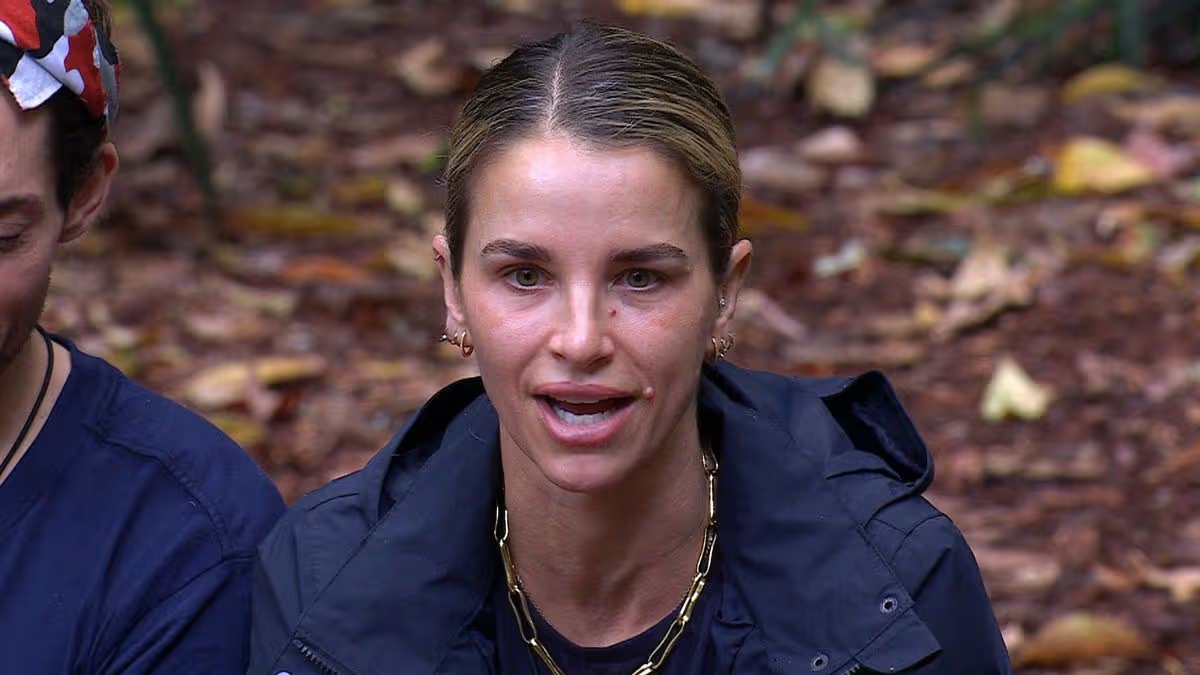
Vogue Williams has revealed that she suffered ‘pregnancy loss’ twice, just days after announcing that she’s pregnant.
The 40-year-old Irish TV presenter, who competed on I’m A Celebrity last year, announced she was pregnant with her and her husband’s, former Made In Chelsea star Spencer Matthews, fourth child on Thursday (April 16).
The couple share three children together; son Theodore, seven, daughter Gigi, five, and a son Otto, three. On top of their parenting duties, they are often presenting the Vogue and Spencer podcast together, where they delve into the ins and outs of their lives.
Advertisement
Click here to get the biggest stories straight to your inbox in our Daily Newsletter
First meeting in 2017 on Channel 4’s The Jump, Vogue and Spencer tied the knot in an intimate ceremony at his family’s Glen Affric estate in Scotland the following year. The couple held a second wedding celebration in 2019.
Vogue confirmed her pregnancy on Instagram, gushing: “BABY NUMBER 4 INCOMING…” as she shared a carousel of pictures from their family holiday in a sunny St Barts. She showed off her bump, with her children in the next picture posing alongside the happy mum and dad to be.
Now, Vogue has taken to her What Does She Even Do? YouTube channel to open up about ‘pregnancy loss’. Vogue said the first happened before the birth of daughter Gigi in 2020, and the second took place last year.
Advertisement
She said: “Trigger warning, pregnancy loss, if anyone doesn’t want to watch, don’t. So it happened to me before I had Gigi, not just me, it happened to Spencer as well obviously, and it was so early on, like so, so early on, we hadn’t had any scans, we hadn’t anything like that, and I must have been maybe a month, if even and it was just one of those things.
“And it was awful but everything happened quite quickly after it as well, so I never really kind of thought about it much. It was really upsetting at the time but then I was pregnant quite quickly after.
“But it actually happened to me last year as well, and it was just, I was literally about to tell the kids… you could kind of start telling I was three months, I just didn’t go for an early scan. I just never even thought about it because I kind of didn’t want to make a fuss.”
Advertisement
Vogue went on to say that she felt ‘quite sick’ but ‘not as sick as I would usually feel during pregnancy’, before discovering that ‘basically the embryo hadn’t grown’.
She added: “Usually you just naturally get a miscarriage, but I didn’t, it just kept like it would have eventually happened, but it just didn’t at the time, and I was three months along, and (the doctor) was just like, I’m really sorry… it’s not really a pregnancy.”
The incidents have left Vogue feeling ‘nervous’ about her current pregnancy,but she is ‘grateful that I feel so sick all the time because then I know it’s there’.
“I wasn’t sure if we wanted to try again because I just felt like I really don’t want to have to go through that again. I’m glad we did, obviously, but now I just have this constant nervousness around hoping that everything is going to be all right,” she stated.







































You must be logged in to post a comment Login