

Tech
Charred Ryobi Air Compressor Is A Warning To Anyone Who Stores Power Tools In Their Car



We may receive a commission on purchases made from links.
Ryobi’s tool offerings extended beyond one’s workshop or garage. There are plenty of Ryobi tools you should keep in your car in case of an emergency, though you should be mindful of where and how you store tools in your car. All it takes is one ending up in a position it shouldn’t be for things to turn catastrophic in a hurry. Case in point, Redditor u/BrianP84 found that their Ryobi handheld air compressor suddenly caught fire in their car — seemingly through no fault of Ryobi’s.
The Reddit user explained that the compressor caught fire, melting itself, the car’s seats, and parts of the floorboard. They also noted that the battery wasn’t the culprit, as there wasn’t any sign that it caught fire, so the Reddit community tried to fill in the blanks. The best guess was that the compressor may have moved around and had its power trigger pressed down and held in that position, likely because it wasn’t stored securely. This would have caused heat buildup over time as the tool ran, leading to overheating and eventual flames. Ryobi isn’t to blame here, as there’s no indication of a faulty tool. Instead, this was seemingly just a matter of circumstance.
All in all, this is a cautionary tale of what can happen when tools aren’t properly stored in a vehicle. That raises the question: What is the right way to keep Ryobi power tools in a car? Well, there are a few steps one can take to ensure the safety of tools and the vehicle they’re stored in.
Best practice for in-vehicle Ryobi tool storage
If you absolutely need to keep Ryobi power tools in your vehicle, there are a few steps to keep yourself, your ride, and your collection safe. First, don’t leave batteries connected to your tools. Keeping a power source connected opens the door for accidental activation. Besides, a vehicle is one of the many bad places to store a Ryobi battery anyway: Ryobi recommends against long-term storage over 30 days in temperatures over 80 degrees Fahrenheit, which a vehicle interior can certainly reach. If not stored properly, lithium-ion batteries can overheat, leak, or even explode, which can spell disaster for you or your tools.
As for the tools themselves, it’s worth investing in a container to hold them while you drive. For example, Ryobi has its own line of storage containers, featuring latched lids, built-in organization, and more. These also support foam inserts, preventing your tools from rattling or moving around inside and potentially being damaged. Alternatively, a tool bag could be a good choice, as they’re designed for durability with pockets for organization and restricting tool movement. In especially hot conditions, though, moving tools to a climate-controlled area is best. Even without a battery, heat can cause damage to internal elements and thus reduce a tool’s life.
Ryobi tools generally aren’t prone to breaking or overheating suddenly, but they, and any other brand’s tools, could become dangerous in the right conditions. If you tend to leave tools in your vehicle for any amount of time, it’s in your best interest to do so as safely and responsibly as possible.



There are quite a few differences between the tow hitches used in the U.S. and Canada, and those used in Europe. Understanding these differences can be very beneficial if you should ever find yourself in Europe with the need to tow something behind your vehicle. The differences in rules and regulations also reflect different approaches to towing in North America compared to Europe.
Tow hitches used in the U.S. and Canada usually fall into two different categories. There are fixed-tongue hitches, and there are receiver hitches. Whereas the fixed-tongue hitch is made in one solid piece, with the ball then being attached to the tongue, the receiver hitches can be used for more purposes than just towing. A receiver hitch can also carry a hammock, a lighting unit, a bike rack, a step, a cargo box, or even a safe for your valuables. The size of the ball on the tow hitch is usually either 2 inches — the standard size tow ball hitch – or 2 5/16 inches, which is the largest size designed for the heaviest loads.
The tow hitches that are commonly used in Europe feature a detachable tow bar or a swan-neck design with a 50 mm ball attached. These hitches are normally smaller than those used in North America, due to the fact that the trailers used in Europe are also smaller in overall size. The detachable style can be removed from your vehicle when it is not being used for towing.
What else should you know about the differences in towing between America and Europe?

In North America, the Society of Automotive Engineers has trailer hitch rating standards running from Class 1 through Class 4. Class 1 is the lowest, with a Gross Trailer Weight of up to 2,000 pounds and maximum tongue weight of 200 pounds. This is for towing items like a motorcycle or a jet ski. Class 4 is the highest rating, with Gross Trailer Weight of up to 10,000 pounds and a maximum tongue weight of 1,000 pounds, typically used by motorhomes and commercial-grade vehicles. There is also Class 5, for GTW over 10,000 pounds, but this class is not SAE-recognized. Check with the hitch manufacturer for information on how much weight you can tow in a safe manner. It’s good to know that nearly any car can have a trailer hitch installed.
In Europe, there are regulations governing the combined weight and size of the trailer and the towing vehicle. EU regulations permit a combined length of 12 meters (39 feet, 4 inches), a maximum width of 2.55 meters (8 feet, 4 inches), and a maximum height of 4 meters (13 feet, 1 inch). Trailer-towing speed limits vary by country. For example, Germany allows a maximum of 80 km/h as standard and up to 100 km/h with a permit. In Italy, the maximum is 80 km/h on its highways, and France permits 130 km/h if the trailer is less than 3,500 kg, with a maximum of 110 km/h during rain.


The federal directive ordering all U.S. government agencies to cease using Anthropic technology comes with a six-month phaseout window. That timeline assumes agencies already know where Anthropic’s models sit inside their workflows. Most don’t today.
Most enterprises wouldn’t, either. The gap between what enterprises think they’ve approved and what’s actually running in production is wider than most security leaders realize.
AI vendor dependencies don’t stop at the contract you signed; they cascade through your vendors, your vendors’ vendors, and the SaaS platforms your teams adopted without a procurement review. Most enterprises have never mapped that chain.
The inventory nobody has run
A January 2026 Panorays survey of 200 U.S. CISOs put a number on the problem: Only 15% said they have full visibility into their software supply chains, up from just 3% a year ago. And 49% had adopted AI tools without employer approval, according to a BlackFog survey of 2,000 workers at companies with more than 500 employees; 69% of C-suite members said they were fine with it.
That’s where undocumented AI vendor dependencies accumulate, invisible to the security team until a forced migration makes them everyone’s problem.
“If you asked a typical enterprise to produce a dependency graph that includes second- and third-order AI calls, they’d be building it from scratch under pressure,” said Merritt Baer, CSO at Enkrypt AI and former Deputy CISO at AWS, in an exclusive interview with VentureBeat. “Most security programs were built for static assets. AI is dynamic, compositional, and increasingly indirect.”
When a vendor relationship ends overnight
The directive creates a forced migration unlike anything the federal government has attempted with an AI provider. Any enterprise running critical workflows on a single AI vendor faces the same math if that vendor disappears.
Shadow AI incidents now account for 20% of all breaches, adding as much as $670,000 to average breach costs, IBM’s 2025 Cost of Data Breach Report found. You can’t execute a transition plan for infrastructure you haven’t inventoried.
Your contract with Anthropic may not exist, but your vendors’ contracts might. A CRM platform could have Claude embedded in its analytics engine. A customer service tool might call it on every ticket you process. You didn’t sign for that exposure, but you inherited it, and when a vendor cutoff hits upstream, it cascades downstream fast. The enterprise at the end of that chain doesn’t know the dependency exists until something breaks or the compliance letter shows up.
Anthropic has said eight of the 10 largest U.S. companies use Claude. Any organization in those companies’ supply chains has indirect Anthropic exposure, whether they contracted for it or not. AWS and Palantir, which hold billions in military contracts, may need to reassess their commercial relationships with Anthropic to maintain Pentagon business.
The supply chain risk designation means any company doing business with the Pentagon now has to prove its workflows don’t touch Anthropic.
“Models are not interchangeable,” Baer told VentureBeat. “Switching vendors changes output formats, latency characteristics, safety filters, and hallucination profiles. That means revalidating controls, not just functionality.”
She outlined a sequence that starts with triage and blast radius assessment, moves to behavioral drift analysis, and ends with credential and integration churn. “Rotating keys is the easy part,” Baer said. “Untangling hardcoded dependencies, vendor SDK assumptions, and agent workflows is where things break.”
The dependencies your logs don’t show
A senior defense official described disentangling from Claude as an “enormous pain in the ass,” according to Axios. If that’s the assessment inside the most well-resourced security apparatus on the planet, the question for enterprise CISOs is straightforward. How long would yours take?
The shadow IT wave that followed SaaS adoption taught security teams about unsanctioned technology risk. Most caught up. They deployed CASBs, tightened SSO, and ran spend analysis. The tools worked because the threat was visible. A new application meant a new login, a new data store, a new entry in the logs.
AI vendor dependencies don’t leave those traces.
“Shadow IT with SaaS was visible at the edges,” Baer said. “AI dependencies are embedded inside other vendors’ features, invoked dynamically rather than persistently installed, non-deterministic in behavior, and opaque. You often don’t know which model or provider is actually being used.”
Four moves for Monday morning
The federal directive didn’t create the AI supply chain visibility problem. It exposed it.
“Not ‘inventory your AI,’ because that’s too abstract and too slow,” Baer told VentureBeat. She recommended four concrete moves that a security leader can execute in 30 days.
-
Map execution paths, not vendors. Instrument at the gateway, proxy, or application layer to log which services are making model calls, to which endpoints, with what data classifications. You’re building a live map of usage, not a static vendor list.
-
Identify control points you actually own. If your only control is at the vendor boundary, you’ve already lost. You want enforcement at ingress (what data goes into models), egress (what outputs are allowed downstream), and orchestration layers where agents and pipelines operate.
-
Run a kill test on your top AI dependency. Pick your most critical AI vendor and simulate its removal in a staging environment. Kill the API key, monitor for 48 hours, and document what breaks, what silently degrades, and what throws errors your incident response playbook doesn’t cover. This exercise will surface dependencies you didn’t know existed.
-
Force vendor disclosure on sub-processors and models. Your AI vendors should be able to answer which models they rely on, where those models are hosted, and what fallback paths exist. If they can’t, that’s your fourth-party blind spot. Ask the questions now, while the relationship is stable. Once a cutoff hits, the leverage shifts, and the answers come too late.
The control illusion
“Enterprises believe they’ve ‘approved’ AI vendors, but what they’ve actually approved is an interface, not the underlying system,” Baer told VentureBeat. “The real dependencies are one or two layers deeper, and those are the ones that fail under stress.”
The federal directive against Anthropic is one organization’s weather event. Every enterprise will eventually face its own version, whether the trigger is regulatory, contractual, operational, or geopolitical. The organizations that mapped their AI supply chain before the storm will recover. The ones that didn’t will scramble.
Map your AI vendor dependencies to the sub-tier level. Run the kill test. Force the disclosure. Give yourself 30 days. The next forced migration won’t come with a six-month warning.


American data analytics company LexisNexis Legal & Professional has confirmed to BleepingComputer that hackers breached its servers and accessed some customer and business information.
The company’s data breach confirmation comes as a threat actor named FulcrumSec leaked 2GB of files on various underground forums and sites.
LexisNexis L&P is a global provider of legal, regulatory, and business information, research tools, and analytics used by lawyers, corporations, governments, and academic institutions in more than 150 countries worldwide.
Cloud breach via unpatched React app
The threat actor says that on February 24 they gained access to the company’s AWS infrastructure by exploiting the React2Shell vulnerability in an unpatched React frontend app.
LexisNexis L&P admitted that hackers breached its network, noting that the stolen information was old and consisted mostly of non-critical details.
“Our investigation has confirmed that an unauthorized party accessed a limited number of servers,” the company told BleepingComputer.
“These servers contained mostly legacy, deprecated data from prior to 2020, including information such as customer names, user IDs, business contact information, products used, customer surveys with respondent IP addresses, and support tickets,” a spokesperson said.
“The impacted information did not contain Social Security numbers, driver’s license numbers, or any other sensitive personally identifiable information; credit card, bank accounts, or any other financial information; active passwords; or customer search queries, customer client or matter information, or customer contracts.”
Based on its investigation, LexisNexis believes that the intrusion has been contained and found no evidence that products or services were impacted by the intrusion.
In a public post detailing the hack, FulcrumSec claims that they stole information related to more than 100 users with .gov email addresses, which included U.S. government employees, federal judges and law clerks, U.S. Department of Justice attorneys, and U.S. SEC staff.
The threat actor detailed the intrusion, saying that they “exfiltrated 2.04 GB of structured data from LexisNexis AWS infrastructure” via a vulnerable React container with access to:
- 536 Redshift tables
- 430+ VPC database tables
- 53 AWS Secrets Manager secrets in plaintext
- 3.9M database records
- 21,042 customer accounts
- 5,582 attorney survey respondents
- 45 employee password hashes
- Complete VPC infrastructure mapping
FulcrumSec said that they also had access to around 400,000 cloud user profiles that included real names, emails, phone numbers, and job functions. According to the hackers, 118 users had .gov addresses belonging to U.S. government employees, federal judges and law clerks, U.S. Department of Justice attorneys, and U.S. SEC staff.
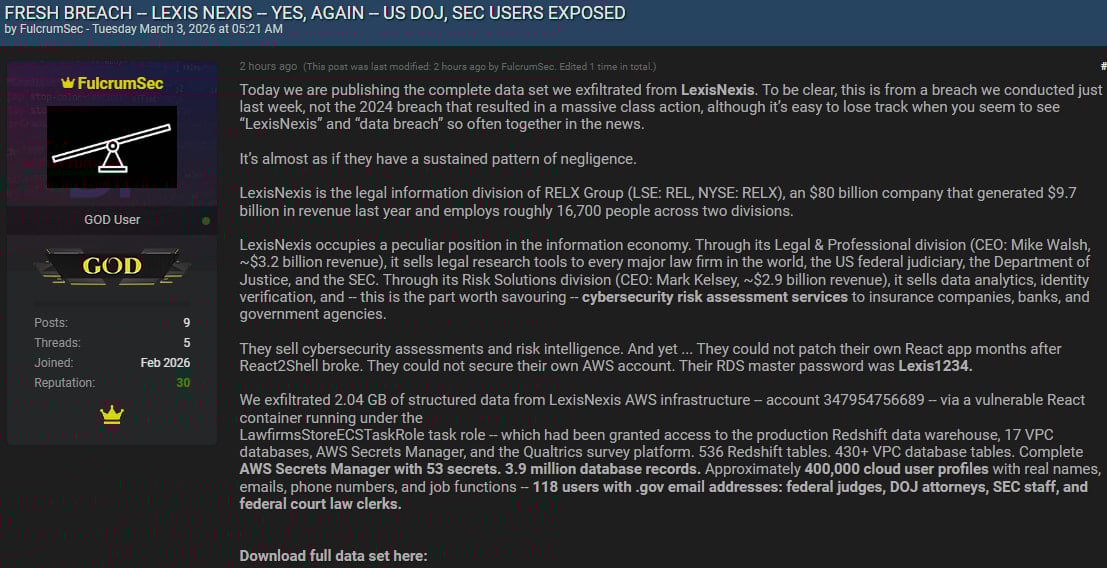
Source: BleepingComputer
FulcrumSec said that they contacted LexisNexis, but the company “decided not to work with us on this.” They also criticized the company’s security practices that permitted a single ECS task role “read access to every secret in the account, including the production Redshift master credential.”
LexisNexis has notified law enforcement and contracted an external cybersecurity expert to assist with the investigation and implementation of containment measures.
The company has taken responsibility for the breach and informed current and previous customers of the intrusion.
Last year, the company disclosed another breach after hackers compromised a corporate account and accessed sensitive information belonging to 364,000 customers.

Malware is getting smarter. The Red Report 2026 reveals how new threats use math to detect sandboxes and hide in plain sight.
Download our analysis of 1.1 million malicious samples to uncover the top 10 techniques and see if your security stack is blinded.
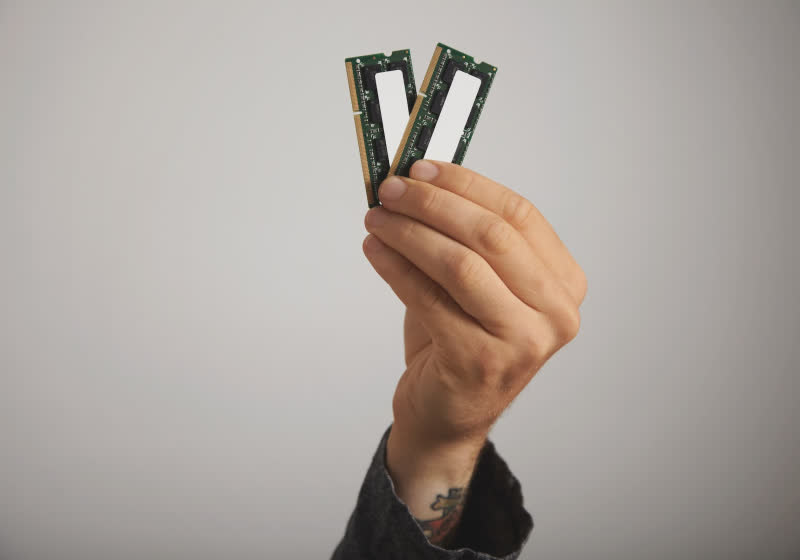
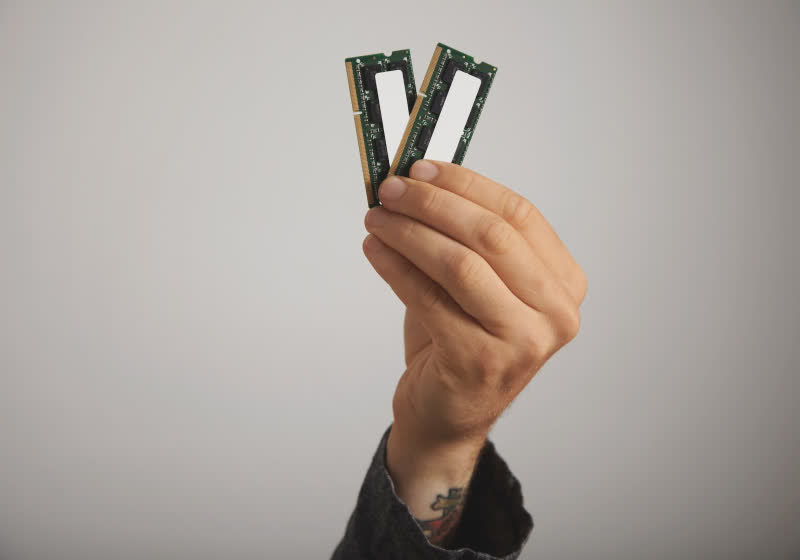
DataDome reports that a single scalping operation has been hammering memory listings with requests every 6.5 seconds, averaging more than 550 automated hits per page and exceeding 50,000 requests per hour across targeted sites. In total, the company says it has blocked more than 10 million requests from this one…
Read Entire Article
Source link
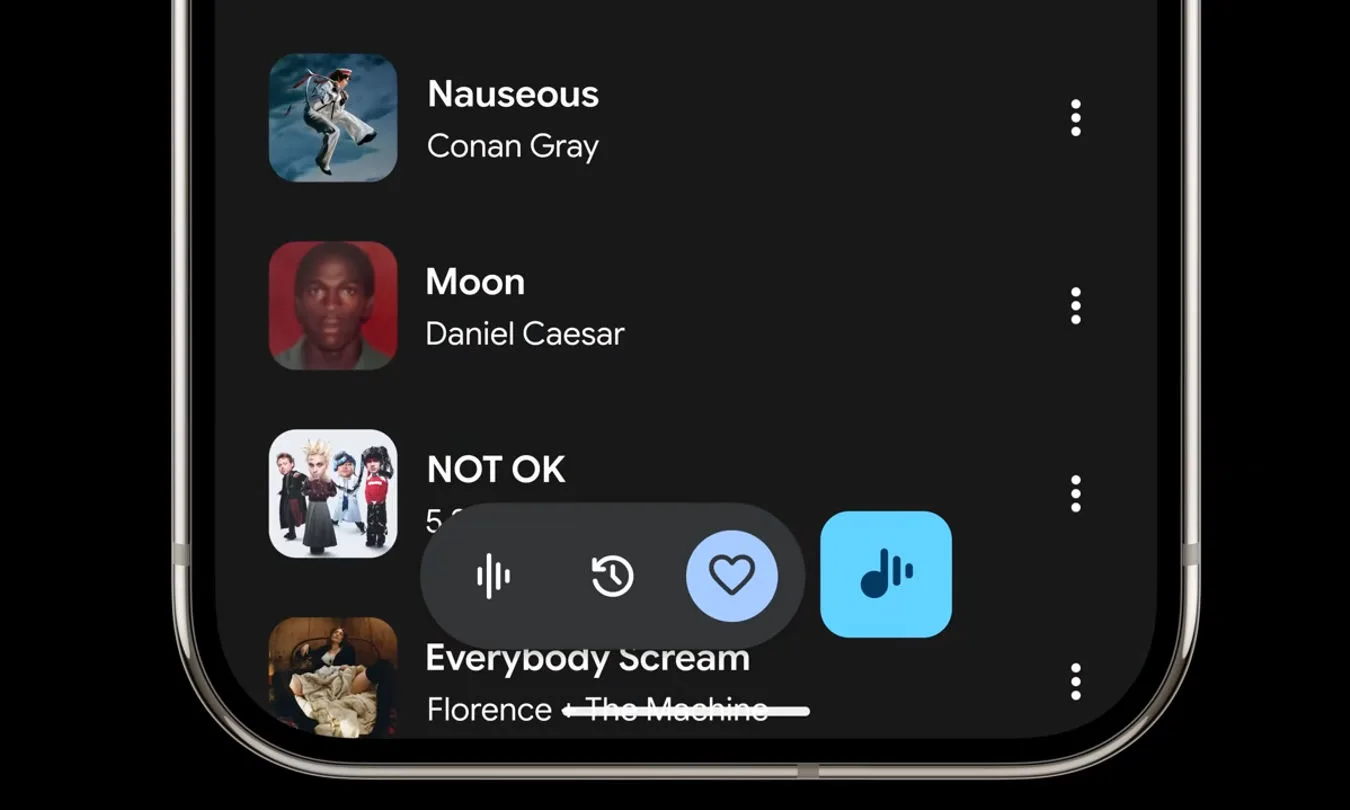
Google‘s March Pixel Drop is rolling out now, and it’s giving one of the Pixel‘s best quiet features its own home. The Now Playing tool, which automatically figures out songs playing around you, is now a standalone app. That means your history of discovered tracks finally has a place to live. You can actually revisit that song you heard at the coffee shop last week.
The update turns a background trick into something useful. Now Playing has long been a Pixel thing, silently catching music without needing to Shazam it. The new app adds a history tab that logs everything your phone has picked up. From there, you can play full tracks in Spotify, Apple Music, or whatever you use. The app is on the Google Play Store now as part of the March Pixel Drop. The rollout started March 3 and will continue over the next few weeks.
A history tab that actually does something
The standalone app changes how you deal with songs your phone has ID’d. Before, Now Playing worked almost invisibly. A track name would flash on your lock screen and then vanish. Now the history tab collects every recognized song in one scrollable list. You can see what played at the gym, in that Uber, or during your walk yesterday.

Better yet, tap any track and your phone offers to open it in your streaming service. You go from “what was that song?” to adding it to a playlist in seconds. The app builds a personal soundtrack of your life, then hands it off so you can actually listen. It’s a small shift. But it turns passive recognition into active discovery.
Why a standalone app changes the game
This isn’t just Google painting an old feature. Making Now Playing its own app solves something Pixel owners actually deal with. You’ve had that moment. You hear a great song, see it on your lock screen, and then forget about it by lunch. The new history tab catches those missed moments. It turns ephemeral discoveries into something you keep.

The move also shows how Google thinks about Pixel perks. Now Playing has always been a low-key differentiator. iPhones and Samsung phones don’t really do this. By spinning it into its own app with music service hooks, Google gives you a reason to stick with Pixel. Small moments turn into a lasting library.
How to get the new Now Playing app
If you’ve got a compatible Pixel, the new app is ready now. Hit the Google Play Store and look for the standalone app. It started appearing after the March 3 announcement. The rollout happens in waves, so it might take a week or two to hit your phone. When it lands, your old song history should show up automatically.
This is one of those updates that makes you wonder why it took so long. The old Now Playing was great at identification but terrible at preservation. Now you’ve got a searchable, playable archive of every track your phone ever caught. That’s a subtle upgrade that adds up. Check the Play Store this week. If it’s not there, give it a few days. The March Pixel Drop is rolling out gradual, and this one’s worth waiting for.
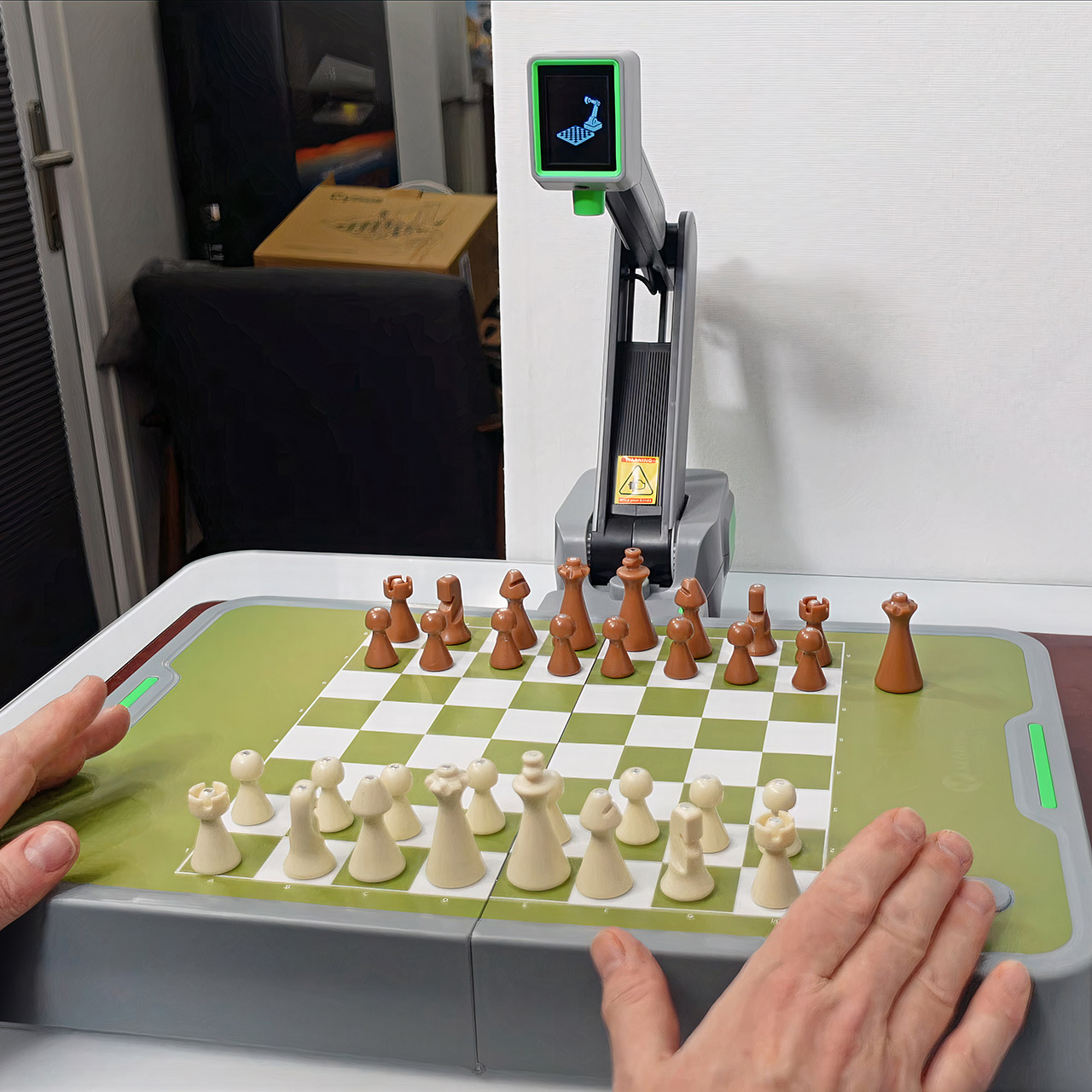
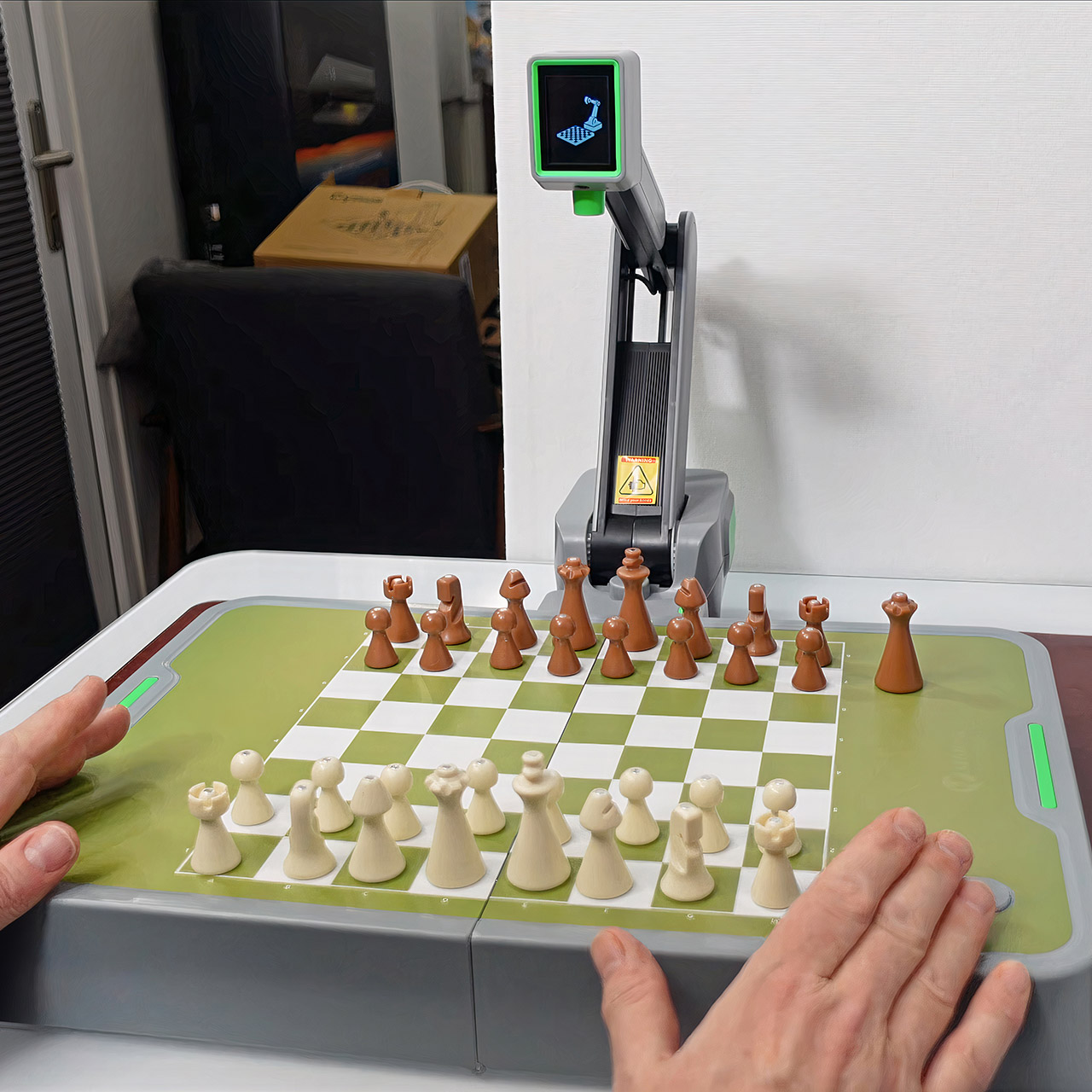
The Manya Cynus chess robot comes in a small box that opens to reveal a complete chessboard and a single robotic arm that is eager to start a game. This device, which was created by Manya Space and distributed to backers who had committed to the 2025 Kickstarter, is basically a physical chess battle against a machine that makes all of its own moves. With eight difficulty settings ranging from extremely basic to expert-level strong, it runs completely off the grid and doesn’t require you to use your phone, computer, or internet connection.
The setup procedure is easy and quick. To get started, simply push a button to unfold the board, use a magnet to secure the arm, and insert the plastic chess pieces—which have metal cores for a firm grip. When you’re ready to begin, you make a motion, push a green-lit confirmation button, and the robot takes over. A small screen on the arm displays the difficulty levels and a few status lights. Its 3-megapixel camera, which is positioned beneath the “head,” continuously scans the entire board to monitor everything and ensure that its movements comply with the regulations. When it’s time to set down one of its own pieces, the arm reaches out, lifts over any of your captured pieces if needed, and sets down its own with a purposeful motion that precisely follows the direction it’s supposed to take—you know, like the huge sweeping motion of a queen or the L-shape of a knight.
Sale

P6 Electronic Chess Board Chess Computer Talking Smart Chess Board Magnetic Electronic Chess Set with LED…
- Product Dimensions: 12.6×12.13×0.9 inches (32×30.8×2.3 cm); Game area: 8.8×8.8 inches(22.5×22.5 cm); Each square: 1.1 inches (28x28mm). King height…
- Electronic Chess Board: Built-in AI intelligent algorithms, with 1-18 levels for beginners to intermediate players. Play against the computer or a…
- Smart Chess Board: Offers three modes: Training for beginners and kids, Match for improving skills with the device, and Human for two-player games…
With each move, a few tiny animated eyes on the screen give the robot a some personality; a winning move gives it a joyful expression, while a checkmate loss gives it a disappointed face and a soft crying sound. It also uses its arm to make a few gestures, giving it a little more personality than you would expect from a computer. With its excellent battery life of over 10 hours on a single charge thanks to its USB-C connector, the entire device is portable because, after you’re done using it, you can simply throw it in a bag or whatever. When folded up, it is about the same size as two tablets stacked on top of one another.
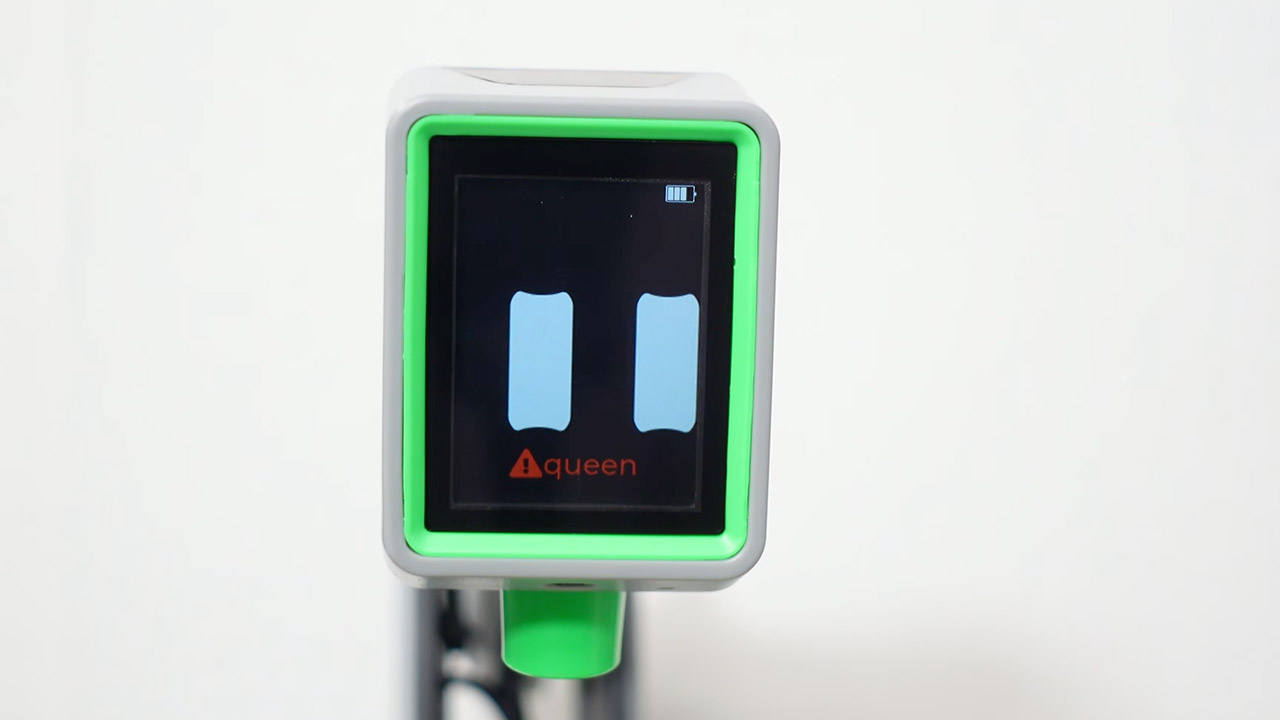
The software is still a bit rough, though, and if you make a mistake, you’re simply rewarded with a brief, easily overlooked notice on the screen; otherwise, play proceeds without even pausing. Despite being heavily highlighted in all of the early promotional materials, the promised companion app is still missing, and there is no timed game mode.The Python-based environment and the open-source protocol that enables it to communicate with Bluetooth 5.1 simply urge users to enter and begin experimenting.

When it’s in operation, it’s a lot of fun to watch the arm calculate, reach, and commit to a move in real time, giving you a comprehensive understanding of your opponent. The only way to win is to be at the top of your game, and even if you lose, it’s quite obvious what went wrong and what you need to improve. Stockfish ensures that it plays solidly across all the different levels. The Manya Cynus is a strange and amazing combination that somehow manages to combine traditional strategic thinking with contemporary robotics for anyone who has a soft spot for chess but also wants to see some cool hardware.
[Source]

Here’s a list of its ports: 1 × USB 4.0 Type-C, 1 × USB 3.2 Gen 2 Type-C, 3 × USB 3.2 Gen 1 Type-A, micro SD Card Reader, HDMI 2.0, 2 x Type-C w/ DisplayPort 1.4, and a headphone/Microphone Combo. The webcam is a 2MP 1080p, which gets the job done, but is looking a little long in the tooth at this point. Otherwise, though, this is a great option for AMD fans.
Best for Performance
-
Photograph: Scott Gilbertson
-
Photograph: Scott Gilbertson
-
Photograph: Scott Gilbertson
-
Photograph: Scott Gilbertson


Kubuntu Focus
Zr Gen 1 Linux Laptop
The Kubuntu Focus Zr 1 (8/10, WIRED Recommends) is a powerhouse, but at 15 inches by 12 inches, over an inch thick, and weighing in at 8 pounds, it’s not a laptop you casually cart around. But if your work requires serious computing power though, be it machine learning (running TensorFlow), local LLMs, big data crunching workflows, or high end video editing, the Zr Gen 1 delivers power in spades.
Inside, the Zr Gen 1 features an Intel Core Ultra 9 275HX with 24 cores, an RTX 5090 graphics card, 24 GB GDDR7 RAM (expandable up to 192 GB), two SSDs, one 1TB, one 2TB (you can have up to 4 drives, one of them being a PCIe GEN 5×4 NVMe). Along with the discrete GPU there’s an integrated one as well, which means you can turn off the discrete card to maximize battery life. I spent about 90 percent of the time with the discrete card off and just turned it on when editing photos and video.
The screen is a gloriously large 18-inch LCD display (2560 x 1600 pixels, 168 DPI density) with a max brightness of over 500 nits and matte finish that makes it easy to use even in bright light. It’s one of the better LCD panels I’ve used lately, and gamers will be happy to see the 240 Hz refresh rate. You can also plug in up to 4 external displays. Thanks to the size of the Zr, there’s plenty of room for a full size keyboard with a numeric pad. The keyboard is user-configurable and features a 65,536-color LED backlight system that you can tweak to your liking with the Focus tool.


Smartphones have evolved into a rather predictable shape over time, with flat slabs, fixed cameras, and batteries well sealed up tight inside. TECNO decided to defy those standards at MWC 2026 by showcasing a design that brings back some pretty old-school modularity in a way that no one expected: a base phone so thin that it barely counts as a complete device until you start adding components to it.
The novelty here is that the main device is only 4.9 millimeters thick, making it narrower than a regular pencil and far thinner than those super-slim flagships that everyone has been gushing about recently. Without any accessories, the phone is rather stripped-down, with a rudimentary camera on the back, a small battery, and a few low-profile pogo pin ports. The back glass panel features a matte surface to reduce glare, and all of the edges are polished for added visual contrast and robustness. It’s all quite basic, and the markings on the rear are just subtle enough to indicate where the various modules should snap into position.
Sale

Google Pixel 10a – Berry – 128 GB with $100 Amazon Gift Card
- Order the new Google Pixel 10a today and get an Amazon Gift Card; valid 2/18/2026 until 3/11/2026 at 11:59pm PT, while supplies last and subject to…
- Return of Pixel 10a without gift card results in charge; offer cannot be combined, is non-transferable and not valid for cash or cash equivalent
- If a qualifying item in your order is returned, you’ll be reimbursed for what you return, minus the value of the gift card
The attachment system is based on a rectangular array of magnets that function in tandem with the pogo pins. The magnets hold everything in place firmly, while the pogo pins give power with minimal trouble and heat. Data is transmitted wirelessly and can switch between Bluetooth, Wi-Fi, and even millimeter-wave communications depending on the module used and the situation. Pairing is simple: find the portion you want, bring it close, and it snaps into place.
Modules are what really make this device sparkle, without making it overly big. Right now, you have about ten possibilities in the present ecology. A power bank module adds capacity at only 4.5 millimeters thick, which is incredibly small, and it effectively doubles your useable battery life, not just for the phone itself, but also for any peripherals you connect to it. As for cameras, one module can transform the device into an action camera, allowing for fresh perspectives and innovative approaches. Another module has a telephoto lens, allowing you to use the phone display as a live viewfinder, resulting in low-latency previews and rapid pictures. Then there’s a larger zoom module with a genuine image sensor behind a true lens mount, along with some excellent physical controls on the side, essentially turning your phone into a compact camera body. Other alternatives include a gaming controller, a wireless mic that clips to your clothing, a wallet, and a speaker.
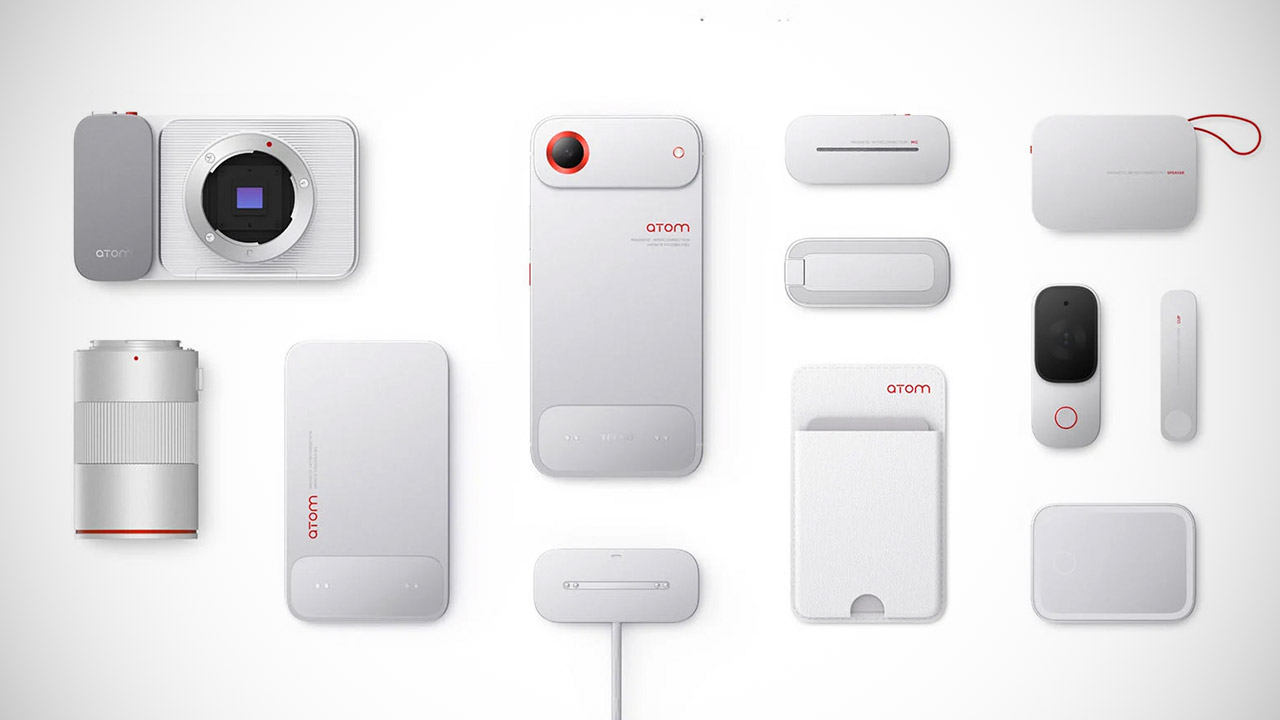
Two design possibilities demonstrate how this concept might look in real life. The ATOM version features a straightforward, sleek silver-aluminum design with some lovely red accents. The MODA edition, on the other hand, opts for a darker, more eye-catching appearance, with a strong emphasis on uniqueness. TECNO describes this as a platform rather than a single set product since it is supposed to be scalable, allowing future modules to offer all sorts of fascinating things such as AI, extra storage, off-grid communications, or accessories tailored to various lifestyles. The piece that holds it all together remains the same, so you can simply keep adding new stuff and using it all without any problems.
Tech
Samsung Health app for Galaxy phones gets a Medications tool that also works as a discount hunter
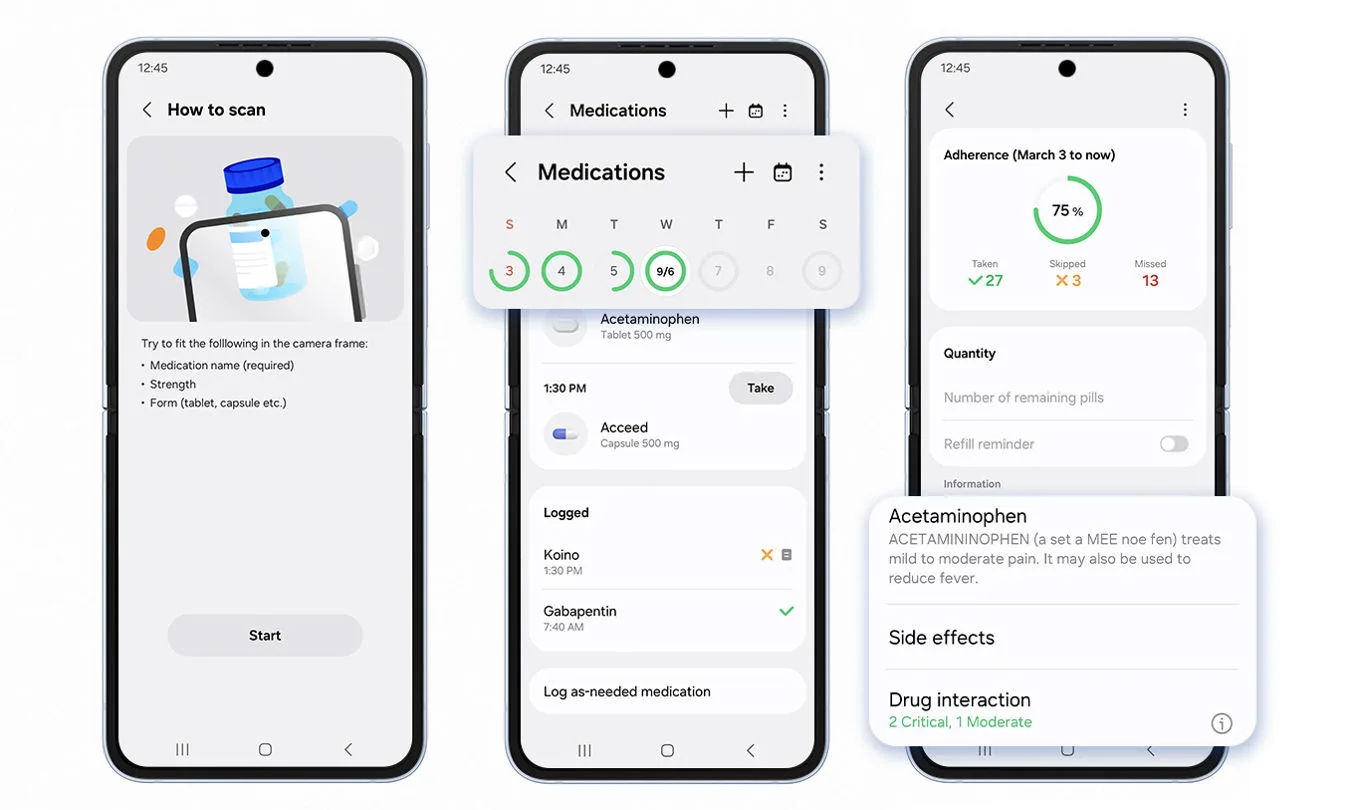
Samsung Health‘s Medications tracker just got a serious upgrade. It now hunts for prescription discounts across more than 70,000 pharmacies. Find a better price and you can save the coupon to Samsung Wallet with one tap. At the counter, just open Wallet and you’re done.
No more printing paper coupons or juggling separate apps. The whole thing lives inside two apps you probably already have on your Galaxy phone. Samsung says the goal is simple, make filling prescriptions less of a headache by combining medication tracking with instant savings.

How the prescription discount tool works
Open the Medications tracker inside Samsung Health. Log your prescriptions, set up your schedule, and now there’s a new option to search for discounts. The tool checks prices at local and national chains. Samsung claims access to deals at thousands of locations.
Found a lower price? One tap saves the coupon directly to Samsung Wallet. At the pharmacy, you tap your phone or show the barcode like you would with any other saved card. The discount applies right there.
The fine print says it’s limited to participating pharmacies. So not every drugstore may be included. But for the ones that are, you just saved yourself a few bucks and a bunch of hassle.
A broader push into health management
This isn’t happening in a vacuum. Samsung Health already lets you pull in health records from your doctors, so lab results and visit summaries live in one spot. It also offers access to board certified physicians through a partnership with HealthTap. You can discuss prescriptions without leaving the house.

Now add discounts to that mix. You track your meds, consult a doctor about them, and find a better price before you ever walk into the pharmacy. The app stops being just a step counter and starts helping you manage what you actually spend on your health.
Samsung hasn’t said whether the discounts work with insurance copays or just manufacturer deals. But for millions of users, it’s one more reason to open the app.
What’s next for Samsung Health users
The feature is live now. You’ll need the latest version of Samsung Health and Samsung Wallet installed. No word yet on international availability, US users are the likely focus given how pharmacy discounts work.
If you take regular medication, spend five minutes poking around inside the Medications tracker. You can even schedule a consultation with a doctor. Run a search on your prescriptions and see what turns up. Worst case, you stick with your current pharmacy. Best case, you save some money with a few taps and forget about it until your next refill. That’s the kind of update worth checking for.
A fridge that’s too cold or too warm will struggle to keep your food fresh. Produce is particularly susceptible to errant temps, but nearly everything you stick inside benefits from keeping your icebox set to a magic number,
Not one to waste, I set out to find out how cool my fridge was since there’s no built-in thermometer. The ultimate goal was to ensure it’s set to that Goldilocks zone: the recommended temperature to keep most items as fresh as possible without freezing.
Here’s how it went down and what I learned after testing nearly every temp setting on my fridge.
What temperature should your fridge be?
Before I can determine the best temperature setting for my fridge, we need to know what constitutes a safe temperature for storing food.
The scientific consensus puts the ideal fridge temperature at 40 degrees Fahrenheit (4 degrees Celsius) or below — cold enough to keep bacteria in check, but not so cold that it freezes delicate foods.
Your freezer should be set to 0 degrees Fahrenheit (minus 18 degrees Celsius) or lower. It might seem like anything below 32 degrees Fahrenheit (0 degrees Celsius) would do the job, but the colder target exists for good reason: it keeps food solidly frozen even when you open the door, add fresh items, or ride out a brief power outage. As a bonus, lower temperatures also speed up freezing, which means smaller ice crystals and better preservation.
I ran tests using real-world conditions
When storing food in your refrigerator, ensure it falls within the safe temperature range for food storage.
When testing the fridge temp settings, I didn’t unload all of my food, though I did move more sensitive items — fresh produce, eggs, and some glass jars — into temporary coolers for colder tests. Likewise, I couldn’t keep items outside the fridge or at warmer temperatures for longer than two hours.
This all required me to keep my tests short. Every time I opened the door, checked the temperature or changed a setting, I affected the test. These inconsistencies, while distressing to my scientific mind, yielded findings that align more closely with real-world conditions in which you might open a packed fridge multiple times an hour.
Fridge thermometers make these tests possible
An abundance of fridge thermometers and smart sensors helped with my test.
As with any test, I needed a way to measure and track temperatures over time. For this test, I used three different kinds of temperature sensors: ThermoPro Refrigerator Thermometers, Hatusoku Digital Thermometer with External Sensor and the recently announced Ikea Timmerflotte smart temperature and humidity sensor.
ThermoPro is the most suitable option for most people because it can be hung from shelves or flipped back into a helpful stand. The built-in light also helps you see the LCD in low lighting — like my freezer, which has no interior light.
Hatusoku’s long temperature probe makes it a great option for a thermometer that you can stick on the outside of the fridge for at-a-glance checks. Still, the probe is extremely sensitive and almost always reacts when I open the door.
ThermoPro and Hatusoku can track minimum and maximum temperatures, allowing you to see if the temperature leaves the safe zone or how much it fluctuates when the fridge compressor is running.
Because it’s so sensitive, the min/max setting isn’t as useful. Consider waiting a few minutes after a cooling cycle before checking the temperature. You also need to contend with an additional wire when placing the probe.
Timmerflotte made my testing arsenal after I floated the idea to a company representative. They were just as curious to see how the sensor performed in the fridge as I was. Still, a developer with the company said the sensors could handle the internal temperature of my fridge, but that the metal might interfere with its connection to the Dirigera smart hub. (Fortunately, I had no connection issues during my test.)
I liked that I could press the front of the Ikea sensor to show its current temperature and humidity without my phone.
Because it’s a smart temperature sensor, Timmerflotte provided me with real-time temperature measurements without requiring me to open the fridge. Ikea sent enough sensors so that I could track the temperature in both the front and back of the fridge, which was incredibly helpful for finding the perfect setting. The Ikea Home Smart app didn’t have a way to track temperature over time — I couldn’t spot trends beyond my manual checks.
However, I should note that the minimum temperature for Timmerflotte was around 14 degrees F (minus 10 degrees C), so it was unable to track the temperature of my freezer. It also turned off after about 12 hours because freezing temperatures and Alkaline batteries don’t get along.
How I tested my fridge temps: Limitations and caveats
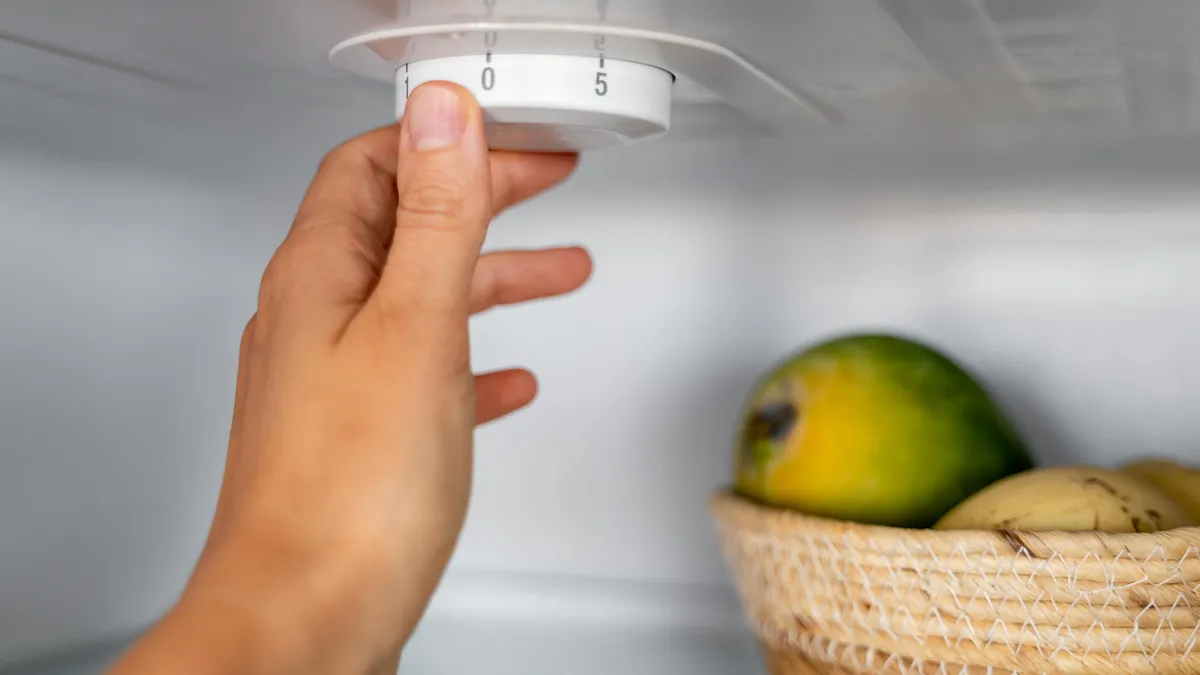
My refrigerator uses a simple dial thermostat to control both the fridge and freezer. The dial lists numbers 1 through 9, with 9 being the coldest setting. Starting with 1, I measured the temperature for at least 20 minutes (often longer with colder settings) to allow it to stabilize after each compressor cycle.
My refrigerator uses a simple dial thermostat to control both the fridge and freezer. The dial lists numbers 1 through 9, with 9 being the coldest setting.
Here’s the rub: My results are unique to my home and fridge.
- Although GE still makes my fridge (Model GTR15BBMRWW), it’s an old model with a likely manufacture date of April 2001. The owner’s manual even recommends setting the temperature control dial to 5 and adjusting from there.
- I have a lot of food in my fridge due to Thanksgiving preparations. With such a large thermal load, it takes considerable time for the temperature to stabilize after adjustments are made. A high food load also blocks airflow during cooling, resulting in cold and hot spots.
- The average temperature of my kitchen during these November tests was about 64 degrees Fahrenheit, which affects how long the fridge runs.
- Frequently opening the door during testing certainly affected the results.
- I usually use a slightly colder setting in the summer to keep foods in the safe zone, and GE’s advice reflects this. Even then, I only put items that are safe to freeze in the back of the fridge, just in case.
Finally, my measurements were more consistent and reliable in the fridge than in the freezer, which fortunately stayed below 14 degrees Fahrenheit (minus 10 degrees Celsius) throughout the test. (I mostly chalk this up to forgetting to photograph refrigerator thermometer readings for Levels 2, 3 and 4.) However, the freezer thermometer wasn’t consistently at 0 degrees Fahrenheit (minus 18 degrees Celsius) or below until I reached Level 4.
My test results and takeaways
I kept both thermometers in the back of the refrigerator to get consistent readings from both.
Ultimately, Level 5 (actually slightly below this) was the only one that kept all of my food within the target range. The front, back and freezer all met the aforementioned food safety guidelines. The other settings either froze items in the back or kept front items too warm.
Fridge temperature test results
Setting Level
Fridge Front
Fridge Rear
Freezer
1
44º F (Fail)
41º F (Pass)
12º F
2
44º F (Fail)
39º F (Pass)
No data
3
45º F (Fail)
38º F (Pass)
No data
4
42º F (Fail)
37º F (Pass)
No data
5
40º F (Pass)
33º F (Pass)
0º F
6
40º F (Pass)
29º F (Fail)
-3º F
7
40º F (Pass)
26º F (Fail)
-7º F
8
32º F (Fail)
19º F (Fail)
-12º F
9
Canceled
Canceled
Canceled
You can see why I canceled the test after Level 8, which put the entire fridge at or below freezing. This level also caused the compressor to run continuously for almost an hour before shutting off.
So, I couldn’t risk spending at least as much time trying to hit Level 9, which I suspect could turn my entire fridge into a freezer — even if the fridge compartment doesn’t quite hit 0 degrees Fahrenheit. (I don’t have enough cooler space to hold a fridge’s worth of food.)
For my fridge, Level 5 is right in the middle, which is likely what the manufacturer intended when curating the various settings. From a user standpoint, I found that impressive. My biggest takeaway from the results is that setting the fridge to a colder temperature isn’t necessarily better, which is sometimes my instinct when I perceive that food is spoiling too quickly.
A simple set of fridge thermometers can help you hit your target temp.
Should you test the temperature of your own fridge?
If your food is consistently spoiling or freezing without explanation, it could be because your settings aren’t calibrated properly. You may not even know which setting is intended to hit the target fridge temp of 40 degrees Fahrenheit (4 degrees Celsius) or below. If that’s the case, running a similar test on your own fridge would be wise.
I recommend getting a set of fridge thermometers as I did. I consider them essential for simple fridges like mine, which use a dial thermostat that doesn’t display the actual temperature.
While many fridges have a digital thermostat with your target temperature, an independent fridge thermometer’s flexibility can help you learn more about your fridge. For example, you’ll be able to move the thermometer around to find cold spots or track temperatures during a power outage.
The Top 6 Landing Spots for Jonathan Greenard if Traded

American And European Tow Hitches Are Different In More Ways Than You Think

Ethereum sendet JETZT ein Signal, das wir nicht verpassen sollten!


-

 Politics6 days ago
ITV enters Gaza with IDF amid ongoing genocide
-

 Politics1 day ago
Alan Cumming Brands Baftas Ceremony A ‘Triggering S**tshow’
-

 Fashion5 days ago
Weekend Open Thread: Iris Top
-

 Tech3 days ago
Unihertz’s Titan 2 Elite Arrives Just as Physical Keyboards Refuse to Fade Away
-

 NewsBeat7 days ago
Cuba says its forces have killed four on US-registered speedboat | World News
-
Sports4 days ago
The Vikings Need a Duck
-
 NewsBeat4 days ago
Dubai flights cancelled as Brit told airspace closed ’10 minutes after boarding’
-
 NewsBeat7 days ago
Manchester Central Mosque issues statement as it imposes new measures ‘with immediate effect’ after armed men enter
-

 NewsBeat3 days ago
‘Significant’ damage to boarded-up Horden house after fire
-
 NewsBeat4 days ago
The empty pub on busy Cambridge road that has been boarded up for years
-

 NewsBeat4 days ago
Abusive parents will now be treated like sex offenders and placed on a ‘child cruelty register’ | News UK
-

 Business6 days ago
Discord Pushes Implementation of Global Age Checks to Second Half of 2026
-

 Entertainment2 days ago
Baby Gear Guide: Strollers, Car Seats
-

 Business6 days ago
Only 4% of women globally reside in countries that offer almost complete legal equality
-
 Tech5 days ago
NASA Reveals Identity of Astronaut Who Suffered Medical Incident Aboard ISS
-
Politics4 days ago
FIFA hypocrisy after Israel murder over 400 Palestinian footballers
-
 NewsBeat3 days ago
Emirates confirms when flights will resume amid Dubai airport chaos
-

 Crypto World6 days ago
From Crypto Treasury to RWA: ETHZilla Retreats and Relaunches as Forum Markets on Nasdaq
-

 NewsBeat2 days ago
Is it acceptable to comment on the appearance of strangers in public? Readers discuss
-

 Tech3 days ago
Viral ad shows aged Musk, Altman, and Bezos using jobless humans to power AI