France’s first social housing project designed for LGBTQIA+ seniors has opened in Lyon. For many residents, it’s not just a roof over their heads – it’s the start of a new chapter of safety, solidarity and love
Much of the building may still be devoid of furniture, and the garden little more than wood chippings, but there’s colour everywhere – on rainbow doormats, the rainbow tape cordoning off the veg patch-to-be, and kaleidoscopic posters emblazoned with wordplays like pépé, pédé et pro du potager (grandpa, faggot and gardening pro).
The residents at La Maison de la Diversité have heard such insults time and again, but now they’re reclaiming them. It’s moving-in day at France’s first senior living residence for the LGBTQIA+ community and allies, and it’s a hive of activity.
Advertisement
“I cried when they told me I had a place,” says Alice*, 58. After living most of her adult life as gay, she came out as trans five years ago. Having been attacked three times in just five years in Mâcon – a city in Bourgogne, north of Lyon, which she describes as having a “small-town mentality” – moving into La Maison de la Diversité means safety and security.
Solutions every Saturday Uplift your inbox with our weekly newsletter. Positive News editors select the week’s top stories of progress, bringing you the essential briefing about what’s going right. Sign up
This is the first co-living project from Les Audacieuses & Les Audacieux, an organisation fighting isolation and promoting social inclusion within the LGBTQIA+ community and its allies.
The team behind La Maison de la Diversité– Stéphane Sauvé, Christophe Dercamp and Marie Gaffet – took inspiration from a similar multigenerational living project, Lebensort Vielfalt, which opened in Berlin in 2012. But as it was a completely new concept in France, it took years to get off the ground. Originally planned for Paris, they finally opened a 16-apartment residence in Lyon in October 2025, with 14 flats for over-55s, one for a young person aged 18-30, and another for guests.
Advertisement
Loneliness and depression are chronic problems among the elderly in much of the western world, but they’re even more pronounced in the LGBTQIA+ community. Of the 17.8m over-60s in France, 28% of 65 to 79-year-olds and 49% of those over 80 live alone. Among LGBTQIA+ seniors – estimated at more than a million people – that figure rises to 65%, and suicide rates are between two and seven times higher than among their heterosexual and cisgender peers.
Gisèle*, 63, experienced profound isolation and suicidal thoughts before moving to La Maison de la Diversité. Having grown up in a rural area of the Loire department, she first fell in love with a woman as a teenager but never acted on her feelings. “Having a relationship or a life with a woman wasn’t something I could imagine,” she says. “I was in love with girls when I was just 15 – Florence, Christine – I can still remember their faces. But my world was traditional and conventional.”
Instead, she married a man, moved to Beaujolais’s Villefranche-sur-Saône, and had children. Her husband was reclusive, and they lived isolated lives. In 2016, Gisèle divorced her husband and came out as gay. But after 30 years without being part of a community, she was profoundly lonely.
Advertisement
“I felt either I’d end up turning to drink or throwing myself in front of a train,” she says. “I’ve arrived here in a vulnerable state – I’m terrified of rejection – but a voice inside me tells me that this is the right decision for me, at the right time.”
Similar projects exist elsewhere in the world. There are retirement communities in San Francisco, Palm Springs and other US towns that cater specifically to LGBTQIA+ residents and allies. The first in the UK, Tonic@Bankhouse, opened in 2024 in London’s Lambeth. What makes La Maison de la Diversité different is its fusion of LGBTQIA+ housing with multigenerational living.
I’ve always hidden who I was to protect myself from others. There’s a certain freedom that comes with being here
“Being part of the queer community unites us and makes our age differences seem much less significant,” says E*, 25, who has moved into the youth flat. “We all signed a solidarity contract when we moved in, essentially pledging that we’d help out.”
The youngest resident by more than 30 years, E pays a reduced rent. While there’s no obligation to help with additional chores, they see the residence as operating like a flatshare – only better. “My mum and I used to tour festivals in our van, so I know what it’s like to live in a community,” says E. “I couldn’t live in a flatshare, but I’m delighted to be in co-housing.”
Advertisement
Each apartment has modest cooking facilities and ensuite bathrooms, and ranges in size from 24 to 42 square metres. There’s also a large shared kitchen and living area, a bike shed and a communal garden. Most residents lived alone before moving here, including Thierry*, 73, who relocated from just three miles away.
“I’ve always hidden who I was to protect myself from others,” says Thierry. “I’ve been arrested just for being gay, just because I was going to a club. We were stigmatised. There’s definitely a certain freedom that comes with being here, but outside these walls it’s still complicated.”
Security and a sense of community are the main reasons most residents have chosen La Maison de la Diversité. But the chance to live as their most authentic selves opens up another possibility – a fresh chance at love. As I chat to them, there’s a resounding sense of optimism that the best is yet to come.
“Being over-50 and trans is like having a double expiry date,” says Alice, “but there’ll be so much more scope for dating here than there was in Mâcon. Now I can be myself all the time, and no one is going to judge, laugh or comment.”
“The cherry on the cake would be finding what I’ve never experienced – a loving, intimate relationship,” says Gisèle.
Advertisement
*Guests have asked that only their first names be published.
Photography by Juliette Treillet
Be part of the solution
At Positive News, we’re not chasing clicks or profits for media moguls – we’re here to serve you and have a positive social impact. We can’t do this unless enough people like you choose to support our journalism.
Advertisement
Give once from just £1, or join 1,800+ others who contribute an average of £3 or more per month. Together, we can build a healthier form of media – one that focuses on solutions, progress and possibilities, and empowers people to create positive change.
WEST DES MOINES, Iowa (AP) — Sgt. Declan Coady had been sending his family updates from Kuwait every hour or two after the U.S. and Israel launched their military campaign against Iran, letting them know he was OK, even as Iran launched retaliatory strikes against Israel and Gulf Arab states that host U.S. armed forces.
When he hadn’t responded to messages Sunday, “most of us started to wonder,” Coady’s father, Andrew, told The Associated Press. “Your gut starts to get a feeling.”
A drone strike at a command center in Kuwait killed 20-year-old Coady of West Des Moines, Iowa, and five other members of the U.S. Army Reserve who worked in logistics and kept troops supplied with food and equipment.
The four soldiers identified Tuesday by the Pentagon also included Sgt. 1st Class Nicole Amor, 39, of White Bear Lake, Minnesota; Capt. Cody Khork, 35, of Winter Haven, Florida; and Sgt. 1st Class Noah Tietjens, 42, of Bellevue, Nebraska. Two soldiers haven’t yet been publicly identified.
Advertisement
“Sadly, there will likely be more, before it ends. That’s the way it is,” President Donald Trump said of the deaths.
Defense Secretary Pete Hegseth claimed that the military “ensured that the maximum possible defense and maximum possible force protection was set up before we went on offense,” he said Wednesday. “The terms of this war will be set by us at every step.”
A mother of two who loved gardening
Amor was just days away from returning home to her husband and two children.
“She was almost home,” her husband, Joey Amor, said from their home Tuesday. “You don’t go to Kuwait thinking something’s going to happen, and for her to be one of the first – it hurts.”
Advertisement
Amor was an avid gardener who enjoyed making salsa from the peppers and tomatoes in her garden with her son, a senior in high school. She also enjoyed rollerblading and bicycling with her fourth-grade daughter.
A week before the drone attack, Amor was moved off-base to a shipping container-style building that had no defenses, her husband said.
“They were dispersing because they were in fear that the base they were on was going to get attacked and they felt it was safer in smaller groups in separate places,” he said.
He said she was working long shifts and that he last spoke to her about two hours before she was killed. He said she told him she had tripped and fallen and that they had been joking with each other about that. The fun messages stopped abruptly.
Advertisement
“She just never responded in the morning,” he said.
One of the youngest in his class
Coady had recently told his father he had been recommended for a promotion from specialist to sergeant, a rank he received posthumously.
He was one of the youngest people in his class, trained to troubleshoot military computer systems, but he seemed to impress his instructors, Andrew Coady said Tuesday.
“He trained hard, he worked hard, his physical fitness was important to him. He loved being a soldier,” Coady said. “He was also one of the most kindest people you would ever meet, and he would do anything and everything for anyone.”
Advertisement
Coady came from a close-knit family and was always calling, even if it was only for a few minutes. Coady was studying cybersecurity at Drake University in Des Moines, and he was taking online classes while in Kuwait. He wanted to become an officer.
“I still don’t fully think it’s real,” his sister Keira Coady said. “I just remember all of our conversations about what he was going to do when he came back.
A calling to serve his country
Khork was very patriotic and drawn from a young age to serving the U.S., his family said in a statement Tuesday.
He enlisted in the Army Reserve and joined Florida Southern College’s ROTC program.
Advertisement
“That commitment helped shape the course of his life and reflected the deep sense of duty that was always at the core of who he was,” his mother, Donna Burhans; father, James Khork; and stepmother, Stacey Khork; said in a statement.
Khork also loved history and had a degree in political science.
His family described him as “the life of the party, known for his infectious spirit, generous heart, and deep care for those who served alongside him and for everyone blessed to know him.”
One of Khork’s friends, Abbas Jaffer, posted on Facebook on Monday that he had lost the best person he had ever known.
Advertisement
“My best friend, best man, and brother gave his life defending our country overseas,” Jaffer said. Khork and Jaffer had been friends for more than 16 years.
A loving father and husband
Tietjens lived with his family in the Washington Terrace mobile home park in the Omaha suburb of Bellevue, Nebraska. He was married with a son, according to a Facebook page.
Tietjens earned a black belt in Philippine Combatives and Taekwondo and was “an instructor who gave his time, discipline, and leadership to others,” the Philippine Martial Arts Alliance said in a Facebook post.
On the mat and as a soldier, “he carried the same values: honor, discipline, service, and commitment to others,” the organization said.
Advertisement
Nebraska Gov. Gov. Pillen paid tribute to the family Tuesday.
“Noah stepped up to serve and defend the American people from foreign enemies around the world — a sacrifice we must never forget,” he wrote.
“We are holding the Tietjens family close in our hearts during this unbelievably difficult time and will keep them in our prayers,” he said.
___
Advertisement
Boone contributed from Boise, Idaho, and Toropin from Washington. Associated Press reporters Sarah Raza in Sioux Falls, South Dakota; Ed White in Detroit; Josh Funk in Omaha, Nebraska; David Fischer in Miami and Hallie Golden in Seattle contributed to this report.
Whitby Coastguard Rescue Team say that they were called to Sandsend to assist Yorkshire Ambulance Service after a 64-year-old had slipped on sea defences.
Teams suspected that she had broken her ankle, due to the high tide and the uneven sea defences with paramedics at the scene having managed to stabilise the injury by the time that the Coastguard arrived.
RECOMMENDED READING:
However, with limited access along the beach due to the tide coming in, the coastguard officers were tasked with helping to move the woman ro safety.
Advertisement
Together, they organised a plan to move the woman along the beach using a cliff rescue stretcher to reach a nearby path.
Once there, she was transferred into the ambulance carry chair, providing a safer means to reach the waiting ambulance.
The coastguard worked with Yorkshire Ambulance Service to rescue the woman (Image: Whitby Coastguard)
A spokesperson for Whitby Coastguard Rescue Team said: “Thanks to great teamwork between the ambulance crew and Coastguard Rescue Officers, the casualty was safely transferred and taken to Scarborough Hospital for further care.
“We wish the casualty a smooth and speedy recovery and hopefully a restful stay for the remainder of the holiday!
Advertisement
“As always, here to help our community 24 hours a day, 365 days a year. Remember, If you see anyone in difficulty along the coast, cliffs or shoreline, call 999 and ask for the Coastguard.”
“I have never asked a question on China-related matters. As far as I am aware I have never met any Chinese businesses whilst I have been an MP, any Chinese diplomats or government employees, nor raised any concern with ministers or anyone else on behalf of, even coincidentally, Chinese interests.
BOA: BOA is a dial-and-cable closure system that replaces traditional ski boot buckles. Introduced from snowboarding, it allows precise, even tension by wrapping the boot shell or cuff around the foot and leg for a customised fit without pressure points. The Alpine H+i1 version uses a Z-shaped cable path to evenly tighten the shell, while newer designs also secure the cuff. BOA systems provide micro-adjustability, smoother closure and a more uniform hold, often making boots feel slightly softer in flex compared with traditional four-buckle designs.
Cabrio: A shell design in three pieces with an external tongue, favoured by freestylers for its smooth flex.
Canting: Canting adjusts the base angle of a ski boot to improve skier alignment. A trained boot fitter assesses stance, adds angled pads and reworks the sole to match the bindings – an advanced adjustment best left to experienced professionals.
Advertisement
Cuff: The upper part of the shell that wraps around the lower leg.
Cuff alignment: Adjustable cuff alignment allows boot fitters to alter boots to more appropriately match the angle of your legs. It can be done via a device on one (single) or both sides (double) of the cuffs.
Flex: Flex is a rating of how much support a boot offers. It is not standardised, but does help to give an indication of how stiff a boot is, when flexing forward. A lower figure is easier to flex forward, while a higher number will give more support and power. Adult boots range from around 60 up to 130, or even higher for some boots.
Flex adjuster: Some boots have a system for altering the flex to suit conditions. For example, stiffer on-piste, softer off-piste.
Advertisement
Footbed: A removable foam insert that sits inside the liner, under your foot. Most people benefit from removing this and using a footbed that has more support and structure. These can be pre-shaped, such as most Superfeet footbeds, or they can be custom moulded.
Last width: Last width is measured across the forefoot and indicates fit. Up to 105mm is generous, less than 99mm is narrow. This ‘last’ figure a brand quotes is typically for a size 26/26.5MP boot.
Liner: Also called inner boots, liners are the padded sections that surround the foot, ankle and leg, providing comfort, warmth and a personalised fit. Options include aftermarket models like Foam Injected, Intuition and ZipFit liners, which use materials such as foam, closed-cell foam or cork mixtures to deliver varying levels of precision, customisation and durability.
Mondopoint (MP): Mondopoint (MP) is the ski boot sizing system based on foot length in centimetres rather than shoe size, so accurate measurement is essential. Most brands pair half sizes (for example, 26.0 and 26.5 MP) as the same shell length, though exceptions like Scarpa use a reversed system.
Advertisement
ROM: This stands for Range Of Motion and is how much movement you get in the cuff of a boot when in tour mode.
Shell: The plastic outer part of boots, which is often heat-mouldable to improve fit. The term shell more specifically relates to the plastic outer around the foot and ankle, as opposed to the cuff which fits around the leg and ankle.
Sole: This is the bottom section of the boot; the part that rests on the floor and interfaces with the binding.
Thermo-moulding: Heat customisation of liners or shells. The whole thing may not be mouldable. All ski boot outers can be heat moulded to some degree. When we’ve rated them as heat mouldable, in the bullet points for the boots, it’s because they’ve been designed to be put in an oven and the whole shell heated. Nordica does it a different way and uses their own Infrared heating system.
Advertisement
Tour/walk mode: A connector, usually on the rear of the boot, that can be released to allow greater fore and aft movement in the cuff when hiking or skinning. This can then be switched to securely connect to the cuff and lower shell for skiing.
Tongue: The part of the boot that sits in front of the shin. Both the liner and shell can have a tongue.
Amid the escalating Middle East conflict, Wizz Air has issued an update and confirmed that it has extended its cancellation period for four of its destinations
Wizz Air has issued a major update for four destinations and has extended its flight cancellations.
Advertisement
The conflict in the Middle East has caused significant travel disruptions for airlines, with thousands of flights cancelled as the Foreign, Commonwealth & Development Office (FCDO) warns against travel to parts of the region. Tensions remain high following the US-Israeli strikes on Iran that began over the weekend, with further attacks being carried out.
As the conflict escalates, Wizz Air has confirmed that it is suspending all flights to and from Israel, Dubai, Abu Dhabi, and Amman up to and including Sunday, 15 March. They had originally planned to cancel these flights until 7 March, but as the conflict shows no signs of slowing, they have extended the cancellation period.
A Wizz Air spokesperson confirmed: “Wizz Air confirms that, following the recent escalation of the security situation in Iran, the airline is suspending all flights to and from Israel, Dubai, Abu Dhabi, Amman up to and including 15 March, pending structural schedule changes reflecting reduced demand. Flights to and from Saudi Arabia will resume as planned from 8 March inclusive.
“The airline is closely monitoring developments and remains in ongoing contact with local and international authorities, aviation safety agencies, security authorities, and relevant governmental bodies. Operational decisions will continue to be reviewed, and the flight schedule may be adjusted as the situation evolves.
“The safety and security of our passengers, crew and aircraft remain Wizz Air’s highest priority. We acknowledge the disruption this may cause and appreciate the understanding of our customers. Passengers with affected bookings will be contacted directly with information regarding their options.”
The extension comes just a few days after Wizz Air first announced that it had suspended all flights to Israel, Dubai, Abu Dhabi, and Amman. Wizz Air joins other major airlines that have cancelled or amended hundreds of flights to parts of the Middle East amid the chaos.
Advertisement
Wizz Air, which has been working hard to ensure passenger safety, confirmed that flights to and from Saudi Arabia will recommence as planned from 8 March. In a bid to support passengers who need to travel to or from Israel, Wizz Air is planning to add flights to Sharm El Sheikh (SSH) from various European airports.
If approved, the extra flights, which will provide a connection between Israel and Europe, will begin on Friday, 6 March. They will be as follows:
Budapest (BUD): from 3 to 10 weekly flights
Rome Fiumicino (FCO): from 11 to 18 weekly flights
London Luton (LTN): from 4 to 8 weekly flights
Milan Malpensa (MXP): from 6 to 11 weekly flights
Sofia (SOF): from 0 to 3 weekly flights
Ensure our latest lifestyle and travel stories always appear at the top of your Google Search by making us a Preferred Source. Click here to activate or add us as your Preferred Source in your Google search settings.
Do you have a travel story to share? Email webtravel@reachplc.com
Secretary of State Marco Rubio on Tuesday awkwardly tried to walk back his comments rationalizing the deadly US attack on Iran to the very reporter he addressed a day before.
Rubio — when asked by CBS News’ Caitlin Huey-Burns on Monday if there was an “imminent threat” from Iran — claimed the US was “proactively” attacking Iran, suggesting that officials believed Israel would attack the country first in a move that would prompt Iran to “come after” US assets in the Middle East.
After President Donald Trump contradicted the messaging on Tuesday by claiming that “if anything, I might have forced Israel’s hand” to attack Iran, Huey-Burns confronted Rubio.
“Yesterday, you told us that Israel was going to strike Iran and that’s why we needed to get involved. Today, the president said that Iran was going to get —,” Huey-Burns began.
Advertisement
“No. Yeah, your statement’s false,” Rubio interjected. “So that’s not what he — I was asked very specifically. Were you there yesterday?”
“OK. No did you — were you the one that — ’cause somebody asked me a question yesterday, ‘Did we go in because of Israel?’ And I said —.”
He proceeded to point to another reporter he addressed just after Huey-Burns on Monday, “I said, ‘No.’ I told you, this had to happen anyway. The president made a decision, and the decision he made was that Iran was not going to be allowed to hide behind its ballistic missile program.”
Advertisement
REPORTER: Yesterday you told us Israel was going to strike Iran and that’s why we needed to get involved. But today the president said Iran–RUBIO: No. Were you there yesterday?REPORTER: Yes. I asked the question
Moments later, when confronted with his quote to Huey-Burns, Rubio added, “The bottom line is this: We — the president determined we were not going to get hit first. It’s that simple, guys.”
RAJU: Your quote is, ‘We knew there was going to be an Israeli action. We know that would precipitate an attack–‘MARCO RUBIO: The– you asked– I was asked a very specific question, so you guys can misrepresent but I was asked a very specific question yesterday. The bottom line is this …
Critics on social media clowned Rubio’s awkward attempt to walk back his comments, including one Bluesky user who simply replied, “Good lord, the bullshit is deep here. 🙄.”
Advertisement
He wants to pretend he didn’t tell us this thing because his boss contradicted it, but we can all watch the video. Their confidence that they can just invent and change reality doesn’t work when we all heard him say the thing Trump now denies
The US and Israel have carried out strikes on Iran for a fourth day after launching an operation which killed its supreme leader.
With no clear end in sight to hostilities, Sky News has mapped the assaults on both sides – and the military assets at play in the region.
A regional conflict
The US began Operation Epic Fury with a series of strikes on Saturday morning, killing Ayatollah Ali Khamenei in his Tehran compound.
Advertisement
Zoom in to explore strike locations in satellite maps
Israel joined the assault, killing dozens of top Iranian military officials in more than 100 aerial strikes in three days.
“Preliminary analysis shows that the United States and Israel used a variety of precision guided munitions to strike Iran,” Nic Jenzen Jones, director at Armament Research Services (ARES) said.
Advertisement
“These included air-delivered weapons such as the AGM-154 Joint Standoff Weapon (JSOW), Blue Sparrow-series air-launched ballistic missiles, and various 500-, 1,000- and 2,000-pound-class bombs.”
He added: “In addition, surface-to-surface missiles were also fired, including sea-based Tomahawk-series missiles and the land-based Precision Strike Missile (PrSm).”
Iran is continuing to retaliate, launching drones and missiles targeting Israel, the United Arab Emirates (UAE), Bahrain, Jordan, Oman and Qatar.
Iran’s drone attack on RAF Akrotiri in Cyprus was a demonstration of its capabilities.
Its longest-range missile, the Sajjil, has a similar maximum range of up to 2,000km (1,240 miles), according to the International Institute for Strategic Studies, a defence thinktank.
Datawrapper
This content is provided by Datawrapper, which may be using cookies and other technologies.
To show you this content, we need your permission to use cookies.
You can use the buttons below to amend your preferences to enable Datawrapper cookies or to allow those cookies just once.
You can change your settings at any time via the Privacy Options.
Unfortunately we have been unable to verify if you have consented to Datawrapper cookies.
To view this content you can use the button below to allow Datawrapper cookies for this session only.
That’s far enough to hit Moscow or Athens, though still well short of giving Iran the ability to strike the UK.
The UK’s base in Cyprus is well within range of not only the Sajjil, but also Iran’s Ghadr and Emad-1 missiles.
Fighter jets and airbases
Advertisement
Sky News’ Data and Forensics team has plotted US and UK air bases in the Middle East and Europe that can be used to launch attacks on Iran.
Datawrapper
This content is provided by Datawrapper, which may be using cookies and other technologies.
To show you this content, we need your permission to use cookies.
You can use the buttons below to amend your preferences to enable Datawrapper cookies or to allow those cookies just once.
You can change your settings at any time via the Privacy Options.
Unfortunately we have been unable to verify if you have consented to Datawrapper cookies.
To view this content you can use the button below to allow Datawrapper cookies for this session only.
Flight tracking data shows the paths taken by 47 US military cargo and refuelling planes over recent days as they made their way to and from the Middle East.
Advertisement
At least 15 of the planes passed through British bases, including four through Diego Garcia in the Indian Ocean.
The site has been in the headlines over recent months, with Donald Trump criticising the UK’s plans to cede control of the Chagos Islands to Mauritius.
The Iran conflict has highlighted the strategic importance of the joint US-UK military base, with Sir Keir Starmer initially refusing permission for it to be used by the US to launch strikes on Tehran.
Satellite imagery captured over the base on Sunday morning shows at least 14 planes stationed next to the runway, including six F-16 fighter jets and two P-8 Poseidon maritime spy planes.
Advertisement
The rest are transport aircraft, including a C-5 Galaxy and three KC-135 Stratotankers, analysts at Jane’s Defence Weekly told Sky News.
The C-5 is the largest transport aircraft in the US arsenal, capable of transporting military vehicles and even fighter jets.
Analysts at Jane’s Defence Weekly said the UK does not operate any of the aircraft models visible in the satellite imagery, except for the P-8 Poseidon.
As planes head to the Middle East, America’s air bases in Germany have been significantly emptied.
While 161 planes have landed at Spangdahlem and Ramstein air bases since 23 February, at least 246 have departed – an overall decrease of 52.
Advertisement
Datawrapper
This content is provided by Datawrapper, which may be using cookies and other technologies.
To show you this content, we need your permission to use cookies.
You can use the buttons below to amend your preferences to enable Datawrapper cookies or to allow those cookies just once.
You can change your settings at any time via the Privacy Options.
Unfortunately we have been unable to verify if you have consented to Datawrapper cookies.
To view this content you can use the button below to allow Datawrapper cookies for this session only.
Al Udeid Air Base in Qatar has also significantly emptied, 20 more planes leaving than arriving. The base was an anticipated target of Iranian counterattacks.
Planes have been accumulating, meanwhile, at bases in Kuwait, Israel and Jordan.
Advertisement
Iranian sea power targeted
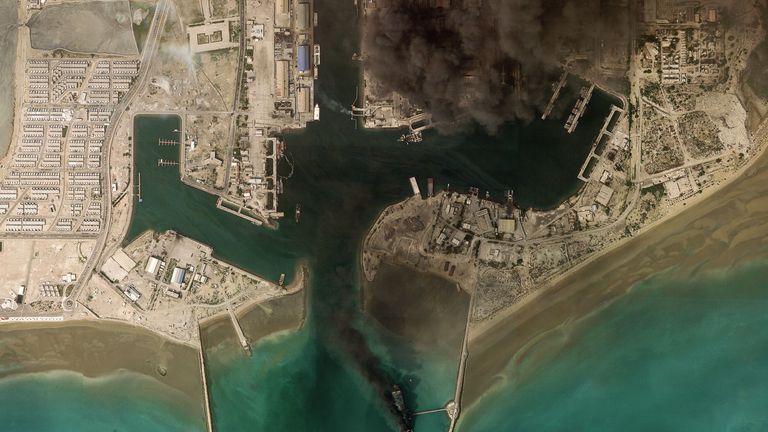
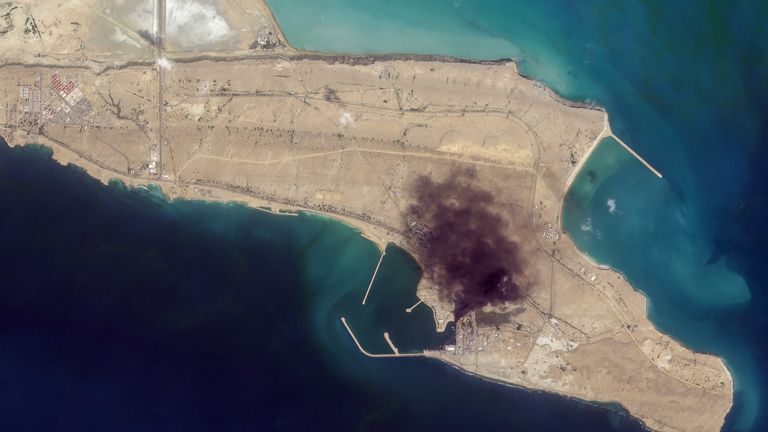
The aftermath of strikes is visible on satellite imagery at two Iranian naval bases.
Image: Bandar Abbas military harbour on 2 March. Source: Planet Labs PBC
Fires can be seen at the military harbour at Bandar Abbas, which is the main headquarters of the Iranian Navy, and oversees the strategically important Strait of Hormuz.
A burning ship, the Makran, is also visible in the image.
It is unclear from the imagery how much damage the vessel has sustained, but as the ship is Iran’s largest naval vessel and serves as a floating base, if it is inoperable this will be a blow to the naval capabilities of the regime.
Advertisement
The Makran is one of six Iranian ships Sky News has tracked using data from TankerTrackers, situated by Qeshm island in the strait of Hormuz.
The ships have been seen on satellite imagery on three recent dates, most recently 2 March.
Datawrapper
This content is provided by Datawrapper, which may be using cookies and other technologies.
To show you this content, we need your permission to use cookies.
You can use the buttons below to amend your preferences to enable Datawrapper cookies or to allow those cookies just once.
You can change your settings at any time via the Privacy Options.
Unfortunately we have been unable to verify if you have consented to Datawrapper cookies.
To view this content you can use the button below to allow Datawrapper cookies for this session only.
Smoke can also be seen at dock of the Konarak Naval Base, which is also on the southern coast of Iran.
Image: Damage visible at Konarak Naval Base, Iran, on 1 March. Pic: Planet Labs PBC
Strikes have also been reported at two other navy installations.
Sky News has mapped the facilities of the Iranian Navy, which are concentrated near the key Strait of Hormuz.
Datawrapper
This content is provided by Datawrapper, which may be using cookies and other technologies.
To show you this content, we need your permission to use cookies.
You can use the buttons below to amend your preferences to enable Datawrapper cookies or to allow those cookies just once.
You can change your settings at any time via the Privacy Options.
Unfortunately we have been unable to verify if you have consented to Datawrapper cookies.
To view this content you can use the button below to allow Datawrapper cookies for this session only.
The Strait of Hormuz, between Iran and Oman, is a strategically vital waterway for Iran and other oil producers in the Middle East.
US naval assets
At least three US military ships are thought to be in the Persian Gulf, and 12 around the Middle East and Mediterranean.
Datawrapper
This content is provided by Datawrapper, which may be using cookies and other technologies.
To show you this content, we need your permission to use cookies.
You can use the buttons below to amend your preferences to enable Datawrapper cookies or to allow those cookies just once.
You can change your settings at any time via the Privacy Options.
Unfortunately we have been unable to verify if you have consented to Datawrapper cookies.
To view this content you can use the button below to allow Datawrapper cookies for this session only.
The aircraft carrier USS Abraham Lincoln was seen under 200km (124 miles) from the coast of Oman on 25 February.
Image: Pic: EU Sentinel, Copernicus
It was accompanied by an unknown ship measuring over 200 metres and was potentially used for replenishing or drills.
The largest aircraft carrier in the US naval fleet, the USS Gerald R Ford, was last seen on satellite imagery on 27 February in the Mediterranean Sea, just under 400km (248 miles) from the coast of Cyprus.
It was reportedly travelling with three US destroyers, capable of carrying more than 6,000 personnel in total.
Maps created by data journalist Alicja Hagopian, digital investigations journalists Ben van der Merwe and Sophia Massam, and OSINT producers Freya Gibson and Lydia Morrish. Copy editing and production by Adam Parris-Long, assistant editor and Natasha Muktarsingh, forensic journalism editor.
Advertisement
The Data x Forensics team is a multi-skilled unit dedicated to providing transparent journalism from Sky News. We gather, analyse and visualise data to tell data-driven stories. We combine traditional reporting skills with advanced analysis of satellite images, social media and other open source information. Through multimedia storytelling we aim to better explain the world while also showing how our journalism is done.
“Fluting continues to evolve as a sophisticated design detail in interiors and is appreciated for the way it introduces texture and movement into a space,” explains Bo Hellberg, CMO at Scandinavian brand String Furniture. “In 2026, its appeal lies in subtlety with soft vertical lines that catch the light, add depth and gently break up flat surfaces.” He adds: “Rooted in Greek architecture and Mid-Century design, fluting now feels quite contemporary, bringing warmth and tactility to clean and minimal interiors.”
Separately, in a letter to the force, shared exclusively with the BBC, lawyers Leigh Day said: “We appreciate the Modern Slavery Act came into force in July 2015 and that the Act itself is not retrospective in relation to historic allegations. However, it does, crucially, provide investigators a prism or lens to look at patterns of behaviour that might otherwise be investigated as ‘historic sexual abuse’ or ‘sexual misconduct’.”