

Crypto World
Four months on, MEV Capital falls victim to $4B DeFi daisy chain implosion



Almost four months have passed since the devastating disassembly of a DeFi daisy chain, which saw the value of the so-called “yield vault” sector drop by over $4 billion.
Since then, many of the “risk curators” involved have kept a low profile, while others are keen to rebuild confidence.
Last week, it became clear that one such curator hadn’t managed to weather the storm.
MEV Capital dissolves
Last week, The Big Whale reported that MEV Capital would be taken over by one of its partners, Belem Capital. Citing DeFiLlama figures, the article highlights an 80% drop in MEV Capital’s assets under management, dropping from $1.5 billion to $300 million.
The drop-off was sparked by the firm’s exposure to looped-leverage yield strategies involving deUSD, which depegged in early November in response to the collapse of Stream Finance (not, as the article claims, in the infamous October 10 market crash).
Elixir announced it would discontinue deUSD shortly thereafter.
MEV Capital’s CEO Laurent Bourquin, “seems to have abruptly stepped back,” according to the article.
Additionally, asset tokenization platform Midas Capital disclosed that it had “concluded all business” with MEV Capital, handing management of mMEV and mevBTC to RockawayX.
DeFi’s ‘risk curator reckoning’
In late October, worries began to circulate over the integrity of a number of high-yield vault tokens across the DeFi sector.
Days later, one of these risk curators, Stream Finance, collapsed spectacularly after admitting it had lost $93 million. With the quality of its backing exposed, Stream’s vault token, xUSD, lost 75% of its value.
Other assets in the “daisy chain” of recursive lending followed suit, notably Elexir’s deUSD.
The resulting domino effect saw a scramble to unwind leverage across a handful of projects. In all, almost half of the sector’s $10 billion in total value locked was wiped out over the following month.
It’s since recovered slightly, sitting at around $6 billion.
Some handled it better than others, with users often waiting weeks with no news. Risk curator Re7 Labs even made legal threats to a self-styled “whistleblower” who had publicly complained on behalf of depositors.
‘Any curators reading these reports?’
November’s yield vault apocalypse hinged on recursive lending and borrowing of vault tokens between interconnected projects.
More sustainable projects, however, went unscathed. They’ve increasingly leaned into “institutional-grade” offerings of on-chain, but somewhat more tangible, real world assets (RWA).
The aforementioned Midas Capital tokenizes off-chain funds such as Fasanara’s F-ONE (as mF-ONE), for example. These come with regular reporting on the state of off-chain assets.
However, some remain unconvinced, asking “any curators reading these reports?” in response to Midas’ recent disclosure of an inaccuracy in their mF-ONE reporting. Another X user called the reporting “trash,” pointing to delays and missing information.
It should be noted that both accounts are contributors at Yearn, a fully on-chain yield aggregator platform.
Read more: Yearn hacker loses $2.4M of $9M loot as tokens burned from wallet
Off-chain risk, now on-chain
DeFi is often seen as plenty risky enough, but it’s certainly not immune from outside risks.
A detailed December report from curator Steakhouse Financial drew attention to a 2% drop in Midas-tokenized fund mF-ONE, in line with the real-world version.
The dip wasn’t enough to cause any mF-ONE collateralized positions to be liquidated, but still raised eyebrows as a novel asset class in DeFi.
Last week, risk management firm Chaos Labs revisited the episode, pointing to “a bankrupt auto-parts supplier” as the source of the shortfall.
It makes the case that “yield is risk,” and that “off-chain doesn’t mean safe by default.”
Steakhouse, whose high-yield vault is exposed to mF-ONE, said the post contained “inaccuracies and selective presentations” and accused Chaos Labs of “plagiarismgooning and fudmaxxing.”
Founder of Steakhouse, Sébastien Derivaux, insisted that mF-ONE is “fit for high yield vaults as collateral.”
Worth it?
The mechanics of bringing RWAs into DeFi are complex. They also make adhering to the maxim “don’t trust, verify,” reliant on issuers’ reporting on off-chain assets.
Even stranger, their use as collateral may even see lenders receiving lower yield than the collateral itself. Whilst assuming both counterparty and underlying asset risk.
Got a tip? Send us an email securely via Protos Leaks. For more informed news and investigations, follow us on X, Bluesky, and Google News, or subscribe to our YouTube channel.

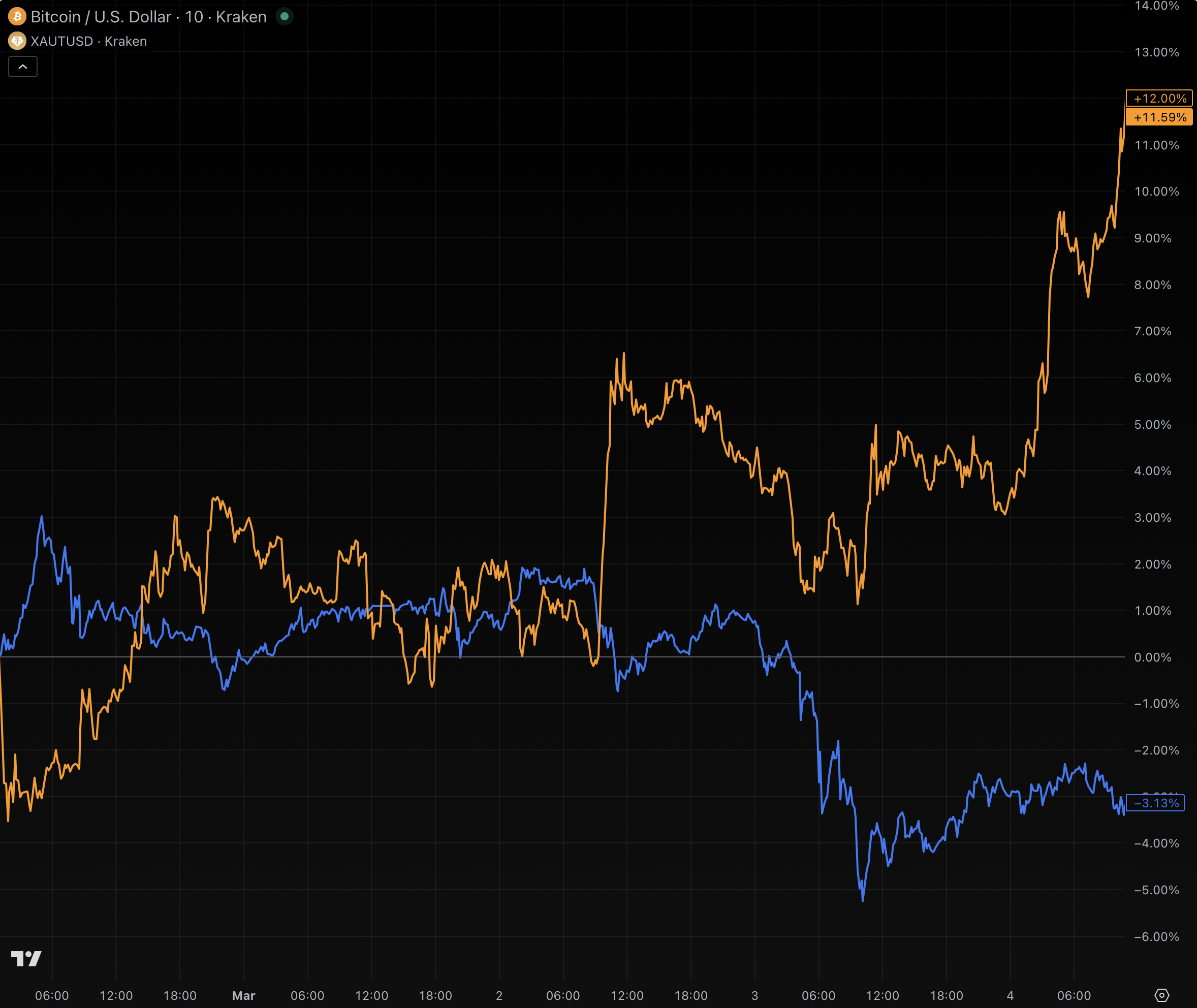
Four days into the onset of the US-Israeli war with Iran, bitcoin (BTC) has outperformed many major asset classes, including commodities that were supposed to shine in exactly this scenario.
Since Donald Trump authorized Operation Epic Fury’s opening airstrikes at 1:15am New York time on February 28, BTC has surged 12.1% from $65,492 to $73,419 at time of writing.
Crude oil, the one asset with an obviously bullish wartime supply reduction, gained a less impressive 10.4% from $67.29 to $74.31 per barrel.
Gold has actually dropped 3% since the onset of war despite an initial safe-haven spike.
Silver entirely retraced a brief spike on war fears and is now down 10.2% after a rollercoaster ride alongside gold and other precious metals.
Easy to beat, the S&P 500 Index flatlined at -0.1%.
A weekend of relative strength amid a bad year
Nvidia, the artificial intelligence (AI) darling that once moved markets by itself and gained signed assurance from the Pentagon that OpenAI would continue to generate plenty of demand for its chips, managed to rally a modest 2.8%.
Even adjusting that 2.8% by 3.1x to account for Nvidia’s larger-than-BTC market cap, it still underperformed the world’s largest crypto by 340 basis points.
The disappointment from precious metals holders is evident. As the US military made obvious movements across the Atlantic into the Gulf states last week, gold and silver steadily ticked higher in textbook fashion — then spent the next three days bleeding out as the dollar strengthened and inflation fears displaced geopolitical hedging.
While BTC investors gained, owners of non-digital hard monies over the last week watched an initial pop turn into a net loss.
Of course, the numbers above are since the proper onset of war. Year-to-date figures are distinct.
Over this longer time frame, BTC has lost 16% while gold has rallied 18%. As usual, there are two sides to every story.
An even better weekend performer than oil
Although the outperformance of BTC raises eyebrows, crude oil’s gain makes intuitive sense. Iran’s Islamic Revolutionary Guard Corps threatened the Strait of Hormuz, the chokepoint near Iran through which roughly one-fifth of the world’s oil transits daily.
Tanker vessel traffic through the strait dropped roughly 81% since the war began, as insurers pulled war risk coverage and shippers avoided the strait for legitimate fears of human life.
Tanker rates in the area hit all-time highs. Brent initially spiked 13% to $82 before settling a bit lower. Barclays analysts warned of $100 per barrel if the blockade holds, though the Organization of the Petroleum Exporting Countries Plus announced 206,000 barrels per day in additional output to soften the supply crunch.
Still, BTC outperformed oil during the year’s biggest war.
Read more: CHART: Bitcoin has lost all of its gains since Trump’s election
AI agrees: BTC is the trade
Interestingly, a recent study has highlighted a new macro tailwind for BTC that could drive demand in 2026.
Researchers published results from 9,072 experiments across 36 frontier AI models and found that AI agents chose BTC 48% of the time when selecting an optimal monetary asset.
For store-of-value use cases specifically, 79% picked BTC. Anthropic’s Claude Opus 4.5, one of the world’s most-used models, chose BTC 91% of the time.
Conventional wisdom was that war favors gold, oil, and the dollar. Four days of live data say otherwise. BTC absorbed the initial shock, recovered faster than many traditional safe havens, and now tops leaderboards of trillion-dollar assets since the early morning hours of Saturday.
Whether the Strait of Hormuz reopens next week or next year, this was the week BTC became an interesting crisis asset performer.
Got a tip? Send us an email securely via Protos Leaks. For more informed news, follow us on X, Bluesky, and Google News, or subscribe to our YouTube channel.
Crypto World
Hong Kong Issues First Stablecoin Licenses as Global Digital Money Architecture Takes Shape in 2026

TLDR:
-
- Hong Kong issues its first stablecoin licences in March 2026 under a strict reserve-backed regulatory framework.
- EnsembleX connects major banks through tokenised deposits, with HSBC settling HK$3.8M for Ant International in real time.
- Europe, the US, and Asia-Pacific are all building identical three-layer digital money stacks on incompatible platforms
- Interoperability protocols are now considered foundational as fragmented infrastructure threatens cross-border settlement at scale.
Stablecoins are moving from concept to regulated reality in Hong Kong. Financial Secretary Paul Chan confirmed the city will issue its first stablecoin licences in March 2026.
The announcement came on February 26, drawing wide attention to the city’s broader digital money framework. Beneath the headline, however, lies a three-layer architecture that mirrors patterns emerging across major financial centres worldwide.
That convergence raises pressing questions about interoperability and the future of cross-border digital finance.
Hong Kong Builds a Three-Layer Digital Money Stack
Hong Kong’s approach to digital money operates across three distinct layers. Each layer runs on different infrastructure, yet all three are intended to work in coordination. This structure reflects the city’s commitment to developing programmable and interoperable finance.
The first layer covers licensed stablecoins governed by Hong Kong’s Stablecoins Ordinance. Under this framework, issuers must hold 100% reserve backing and maintain a minimum HK$25 million in capital.
Redemption is guaranteed within one business day. As a result, these stablecoins are well-suited for retail payments and cross-border transfers.
The second layer involves tokenised deposits through EnsembleX, launched in November 2025 with real money. Participants include HSBC, Standard Chartered, Bank of China (Hong Kong), and other regional institutions.
BlackRock and Franklin Templeton are also taking part. HSBC completed the first cross-bank transaction on November 13, transferring HK$3.8 million for Ant International in real time.
The third layer is EnsembleTX, Hong Kong’s wholesale CBDC platform. It settles tokenised deposit transfers between banks. Financial Secretary Paul Chan has emphasised that it will strengthen cross-border interoperability standards.
A Global Three-Layer Pattern Takes Shape in 2026
Hong Kong is not alone in building this structure. Throughout February 2026, a similar three-layer model emerged across Europe, the United States, and Asia-Pacific.
Quant Network observed on X that the move signals global convergence. Infrastructure fragmentation, the network noted, is becoming a global problem whilst everyone builds the same thing.
In Europe, Deutsche Bundesbank President Joachim Nagel endorsed wholesale CBDC for programmable payments on February 16.
BNP Paribas then tokenised a money market fund on public Ethereum, departing from its earlier private blockchain approach.
Nine European banks plan euro stablecoin launches in H2 2026. The ECB’s Pontes wholesale CBDC project targets Q3 2026.
In the United States, five regional banks announced a tokenised deposit network for Q4 2026 via Cari Network. The banks described the move as a defense against stablecoin displacement.
The GENIUS Act creates a federal licensing framework for stablecoins, with implementation set to begin in July 2026.
Fragmented Platforms Create a Growing Interoperability Problem
With multiple layers running on incompatible platforms, interoperability has become a clear operational challenge.
A Hong Kong corporate treasurer, for example, could face settlement across six different platforms in a single cross-border transaction. Each platform carries its own governance structure, compliance requirements, and settlement logic.
Point-to-point integrations between systems do not scale well over time. Building bilateral links between EnsembleTX, Pontes, Ethereum, and Kinexys creates growing complexity with each new connection.
This mirrors the challenge correspondent banking faced before SWIFT introduced a universal messaging standard.
A Research and Markets report published on February 25 confirmed this challenge directly. It identified interoperability protocols and regulatory messaging standards as foundational to scalable tokenised markets.
With stablecoin licences now live in Hong Kong and major deployments scheduled through 2026, cross-platform coordination has become an operational requirement.


RedStone has launched a price oracle on Stellar after a recent oracle exploit.
Summary
- Oracle provider RedStone has deployed a new price oracle on the Stellar network.
- The move follows a $10m oracle vulnerability attack, highlighting the need for more robust data feeds.
- Stellar DeFi activity and tokenized asset plans are expected to rely increasingly on on-chain price data as lending and trading volumes grow.
Oracle provider RedStone has rolled out a dedicated price oracle on the Stellar network, aiming to support the chain’s expanding decentralized finance and tokenization ecosystem with more secure and reliable market data. The deployment comes in the wake of a $10m exploit tied to oracle vulnerabilities, an incident that reinforced how critical accurate pricing is for lending, collateralized positions, and automated liquidations. As Stellar pushes deeper into areas such as on-chain lending, tokenized real-world assets, and payment-focused DeFi applications, developers need resilient price feeds for assets referenced across smart contracts. RedStone’s integration is designed to give builders a modular source of off-chain and cross-chain prices while adding redundancy to the network’s existing tooling.
By embedding its oracle framework into Stellar’s infrastructure, RedStone intends to offer developers flexible options for how and when price data is delivered to contracts, including support for custom feeds and aggregation methods. That flexibility matters for protocols that may want different update frequencies or asset baskets, such as money markets, synthetic asset platforms, and tokenized securities issuers. The provider’s entry also signals growing third-party interest in Stellar as it evolves from a cross-border payments chain into a broader environment for tokenized assets and programmable finance. For the network, attracting a specialized oracle partner helps close a key tooling gap that has historically limited the complexity of DeFi applications that could safely launch on Stellar.
Strengthening Stellar’s DeFi stack
The RedStone deployment fits a broader industry trend in which chains and protocols are rethinking their reliance on single-source or lightly secured price feeds after a series of exploits. In recent years, attackers have repeatedly targeted thin liquidity and delayed oracle updates to manipulate prices, drain lending pools, or trigger bad debt across DeFi systems. By adding more robust oracle options, Stellar-based projects can diversify data sources and design more conservative liquidation and collateral mechanisms. This, in turn, can make it easier for institutional users and payment firms to consider launching products on the network, as they evaluate technical and risk controls alongside regulatory frameworks such as MiCA.
For developers, the presence of a new oracle provider may unlock designs that were previously too risky, including more sophisticated lending markets, structured products, and multi-asset vaults. Combined with growing interest in tokenized assets and payment rails from platforms comparable to Coinbase and from traditional players that operate similarly to Visa in the fiat world, the move suggests Stellar is positioning itself for a more competitive role in the multi-chain DeFi landscape. If RedStone’s integration delivers the promised reliability and resilience, it could become a core piece of the network’s DeFi stack, helping to prevent a repeat of past oracle issues while enabling a new wave of applications built on more trustworthy pricing infrastructure.
Hyperliquid (HYPE) price has risen almost 31% since Feb. 24, then gave up some of its gains. At press time, the token traded near $32, up roughly 4.5% on the day and approximately 20% over the past seven days. Over the past 30 days, the HYPE price has remained in positive territory, up around 5%, while most top cryptocurrencies, including Bitcoin, Ethereum, BNB, XRP, and Solana, have posted losses over the same period.
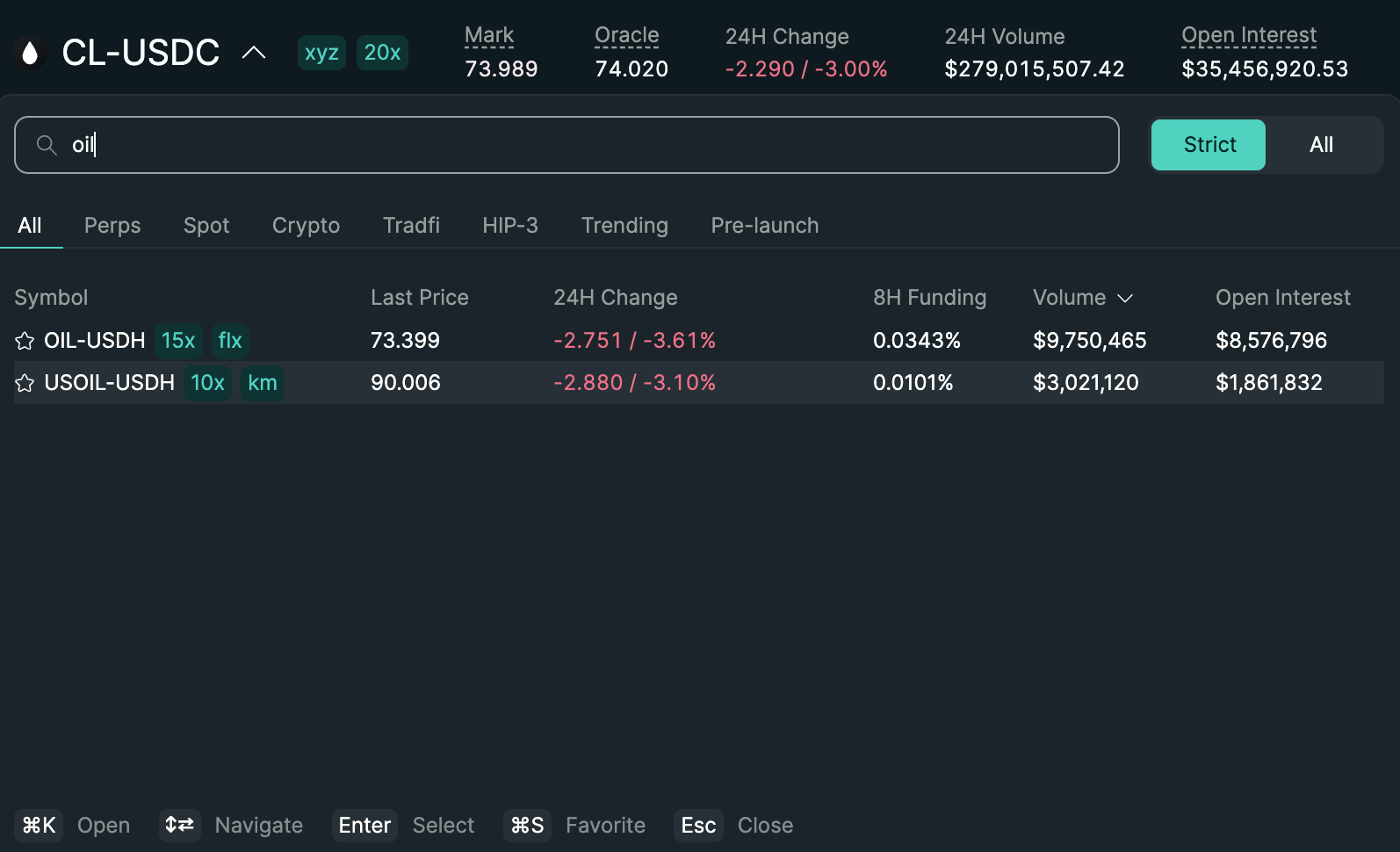
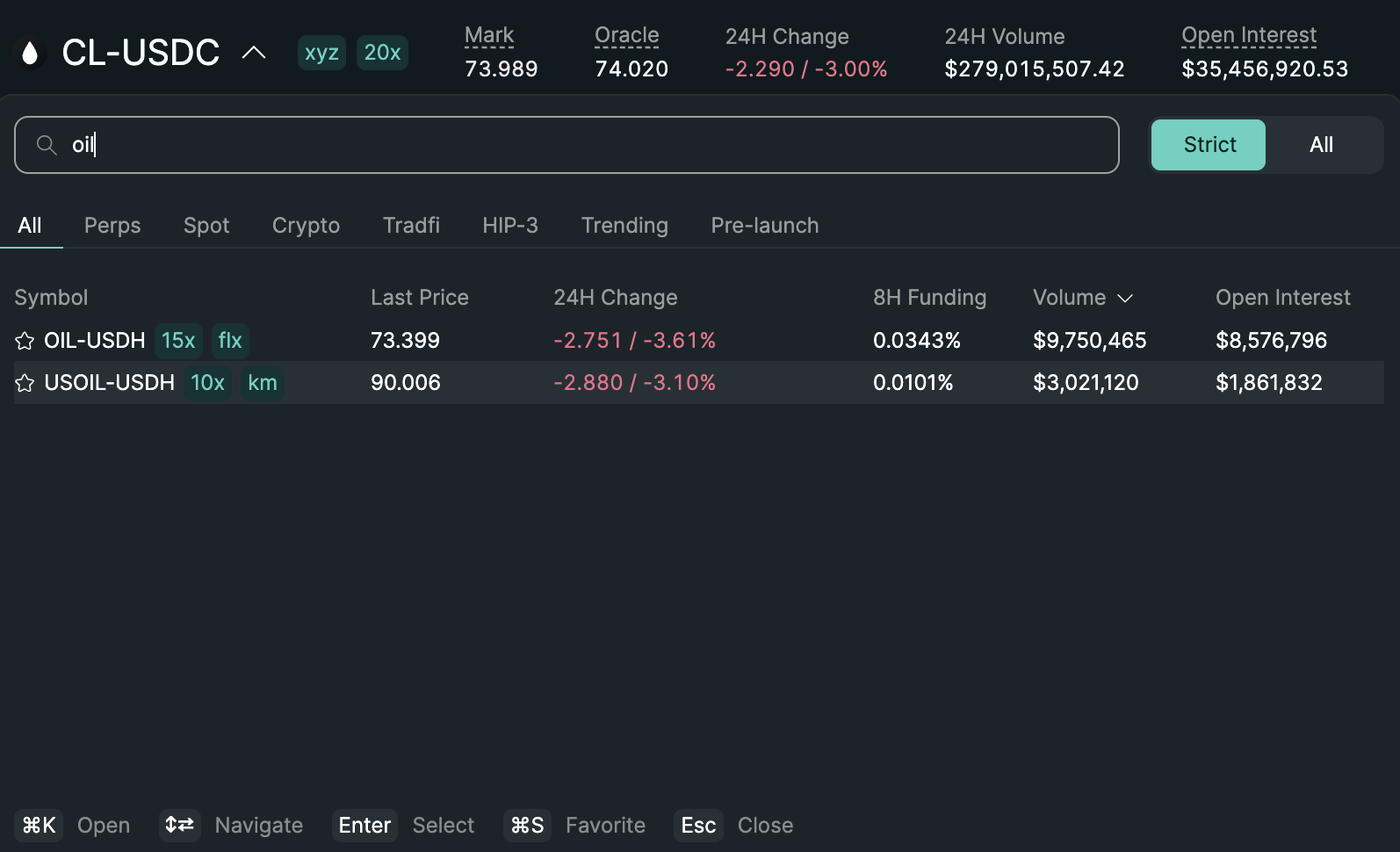
The rally ties into a structural shift: Hyperliquid is becoming the go-to venue for trading traditional financial assets like oil, gold, and stocks around the clock, and every one of those trades feeds directly into the token’s deflationary burn engine. Meanwhile, smart money wallets are overwhelmingly long on HYPE itself, even as retail positions lean short.
Hyperliquid Removes TradFi’s Biggest Bottleneck
Traditional financial markets close on weekends and after hours. Hyperliquid does not. Traders can trade oil, gold, silver, and even stocks like NVIDIA on Hyperliquid using perpetual futures: 24 hours a day, 7 days a week, with sizeable leverage. That edge became impossible to ignore during the March 1–2 weekend.
Platform volume jumped to over $6.4 billion on Sunday alone.
Oil perpetuals on Hyperliquid reportedly surged nearly 20%. Open interest for commodities-focused derivatives allegedly reached an all-time high above $1.1 billion.
This was not a one-off spike.
According to Delphi Digital, tokenized TradFi assets hit 31.6% of all Hyperliquid trading volume in late January — up from under 5% just a month earlier. Metals, equity indices, and individual stocks possibly drove the rotation.
On-chain data from Lookonchain showed one whale depositing $7.35 million in USDC into Hyperliquid to long NVDA and SNDK stocks; holding over $11.94 million in NVDA and $2 million in SNDK with additional limit orders worth $4.53 million pending. This happened right before NVIDIA announced the Q4 results.
Integrations have further accelerated this adoption.
Ripple Prime, launched in early February, gives institutions access to Hyperliquid on-chain perpetuals through a traditional prime brokerage wrapper.
Trojan (formerly Unibot) integrated non-custodial bot trading of real TradFi assets, including TSLA, AMZN, GOOGL, gold, and silver, directly on Hyperliquid’s orderbook.
And on Feb. 24, CoinShares launched a physically backed HYPE staking ETP (ticker: LIQD) on the Xetra exchange — the first regulated product giving traditional finance investors direct exposure to HYPE with staking yield. So the TradFi to crypto link now seems to be working both ways.
The volume surge, mentioned earlier, matters for HYPE price because of a direct mechanical link — and that is where the burn flywheel comes in.
Every Oil, Gold, and Stock Trade on Burns Tokens Permanently
Approximately 97% of all core trading fees on Hyperliquid flow into the Assistance Fund: a system address that automatically buys HYPE on the open market and permanently burns the purchased tokens.
HyperEVM gas fees are also burned. This is not a governance vote or a manual marketing event. It is code-enforced, on-chain, and happens with every single trade; whether that trade is a Bitcoin perpetual, an oil future during a geopolitical crisis, or a leveraged NVIDIA position from a whale wallet.
Want more token insights like this? Sign up for Editor Harsh Notariya’s Daily Crypto Newsletter here.
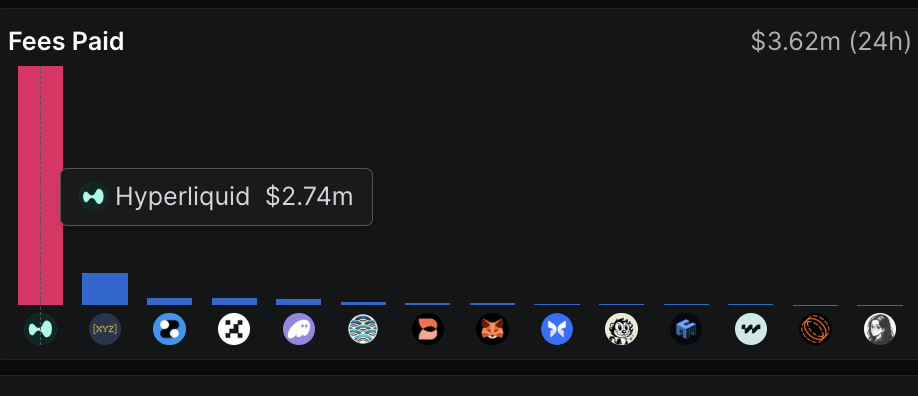
Recent on-chain data showed the platform generated $2.74 million in 24-hour fees, $16.96 million over seven days, and approximately $9.22 million worth of HYPE burned last week — up over 20% week-over-week.
On the supply side, only about 26,790 HYPE are minted daily as staking rewards. Recent daily burn figures have exceeded 48,000 HYPE, resulting in a net removal of over 17,000 tokens per day. Burns are currently running 1.8 to 2.3 times faster than emissions.
That makes HYPE structurally net deflationary at current volume levels, even after accounting for the scheduled March 6 unlock of roughly 9.92 million HYPE for core contributors.
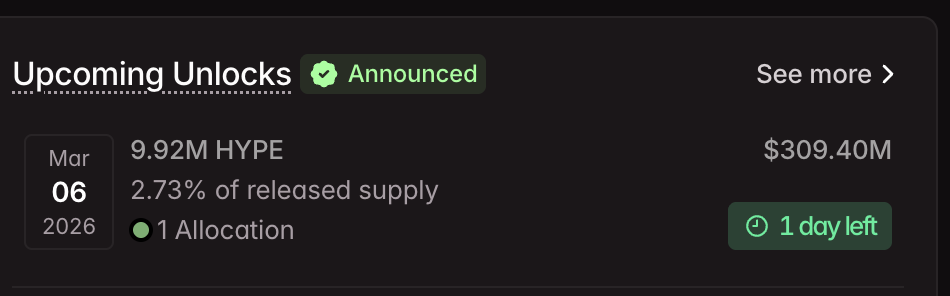
The flywheel is straightforward. More traders using Hyperliquid to trade oil, gold, stocks, and commodities around the clock generate higher fees. Higher fees mean more HYPE bought from the market and burned. More burning means a shrinking supply. And shrinking supply, combined with rising demand, creates price support, which is exactly what smart money appears to be positioning for.
Smart Money Goes All In While Retail Bets Against
On-chain positioning data on HYPE itself reveals a sharp divide between smart money and retail.
According to Nansen AI, overall sentiment on HYPE among tracked smart money wallets reads “strongly bullish.”
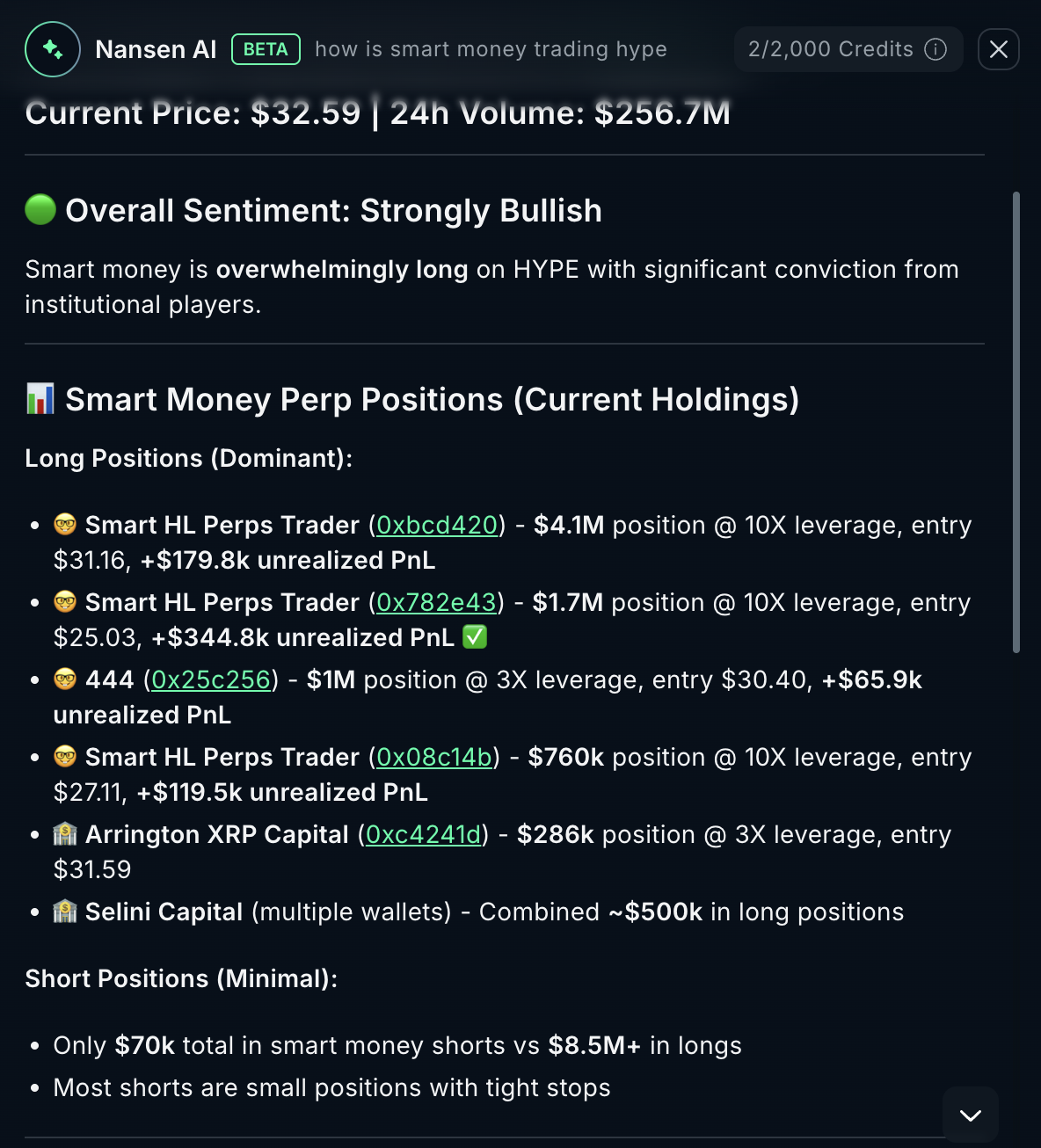
Named participants include Arrington XRP Capital with a $286,000 long entered near $31. Another one is Selini Capital with roughly $500,000 in combined longs across multiple wallets. Plus, there are several tracked smart Hyperliquid perps traders with entries ranging from $25 to $31 — all sitting on unrealized profits at press time.
Retail, however, is positioned in the opposite direction, especially in the broader timeframe. The Bybit HYPE/USDT 30-day liquidation map shows cumulative short liquidation leverage at approximately $33 million compared to roughly $23 million on the long side.
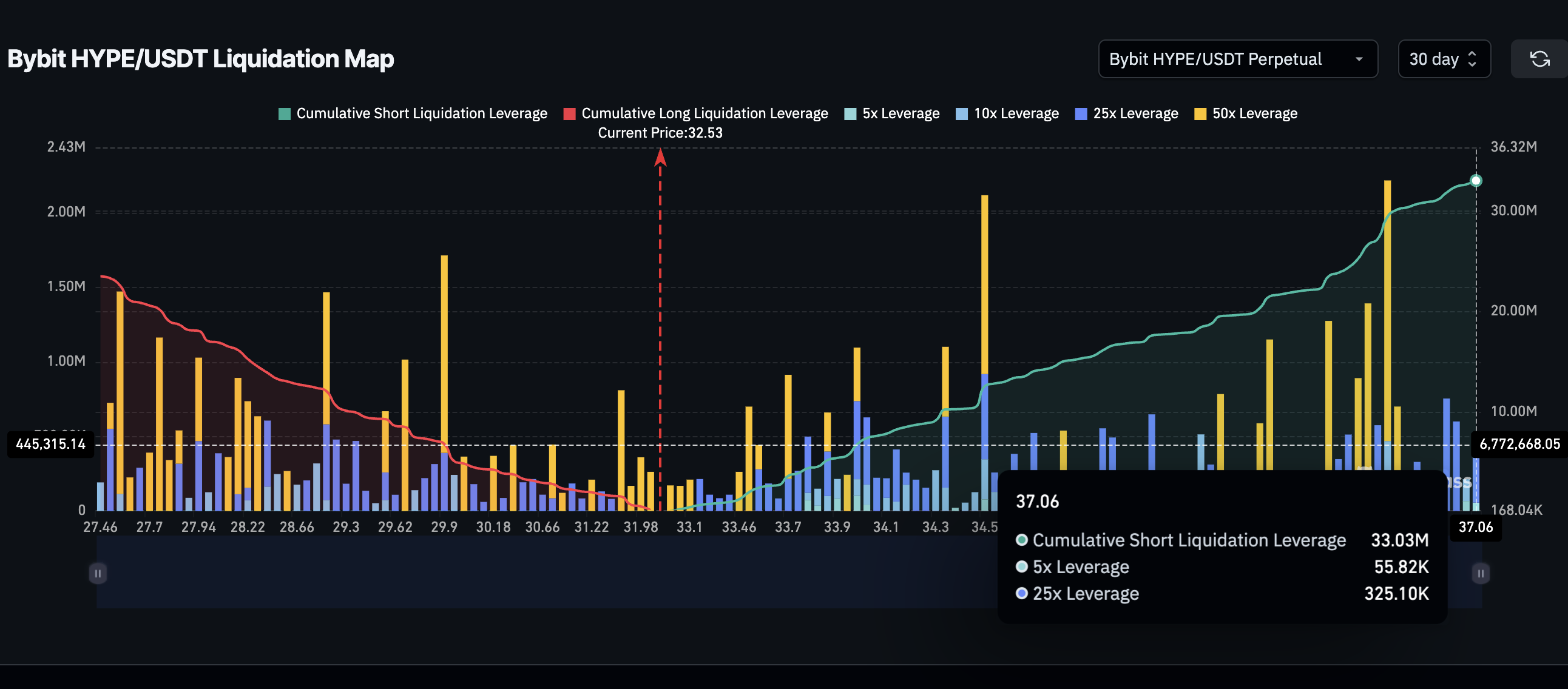
Short leverage clusters build significantly above the $34 range, creating potential fuel for a short squeeze if the Hyperliquid price pushes through that zone.
The Smart Money Index, which tracks the positioning of informed traders, on the technical chart, adds further confirmation for what the Nansen AI highlighted. It crossed above the signal line around Feb. 28, coinciding with the price acceleration. During the late January rally, this same indicator turned down right as sellers rejected HYPE at $43. This time, the indicator is pointing up again, though it still needs to clear the nearest horizontal resistance to confirm stronger momentum.
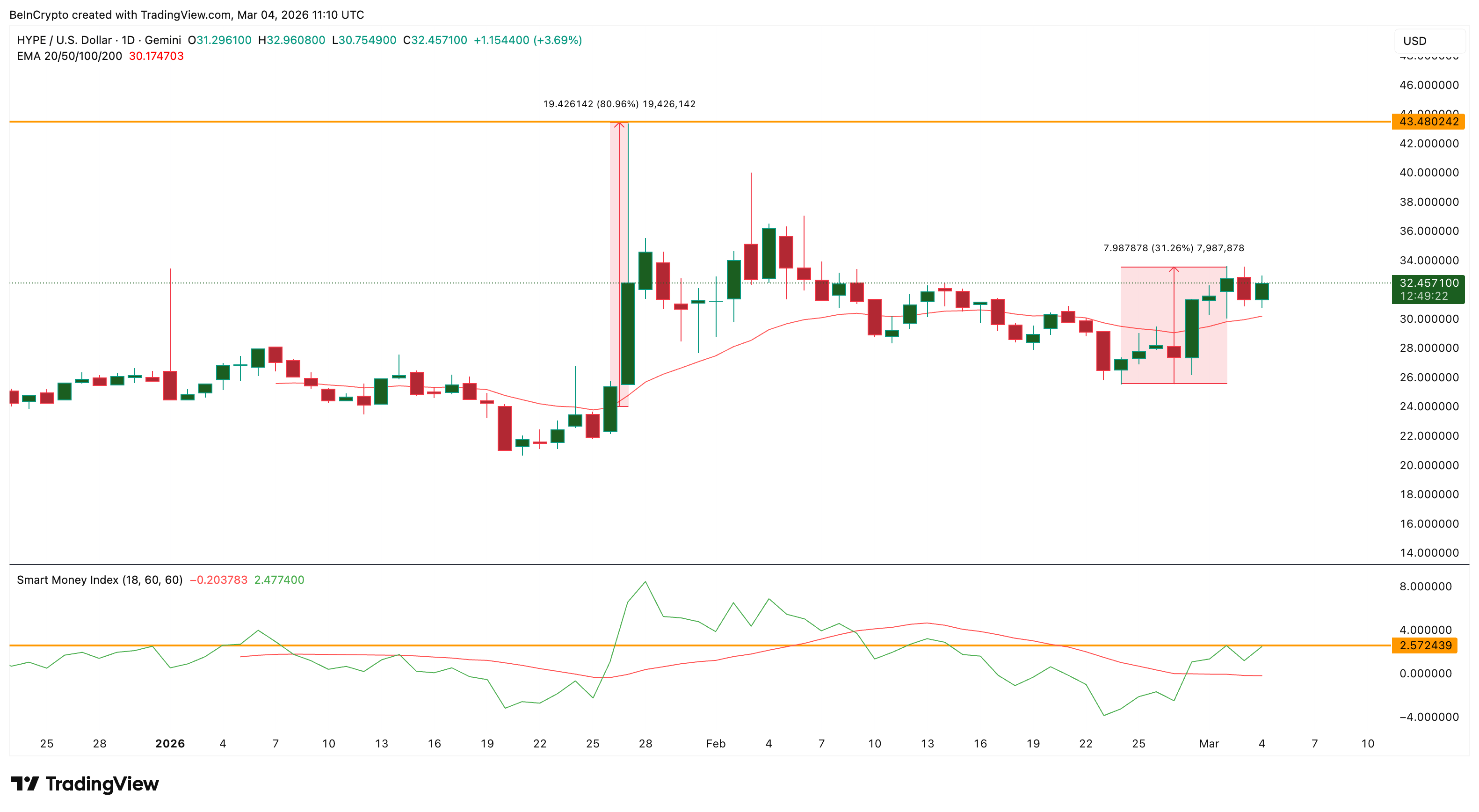
The divide is clear: smart money is accumulating HYPE while retail leans short. That setup, combined with the liquidation clusters above the price, has historically preceded sharp upward moves in crypto markets. And the technical levels above map out exactly where the next legs could go.
HYPE Price Targets $62 for a New All-Time High
The Hyperliquid price rally gained further technical significance when HYPE crossed and reclaimed the 20-day exponential moving average (EMA), a trend-following indicator. The last time this reclaim happened was in late January. HYPE subsequently rallied approximately 81% to $43 before sellers forced a correction.
Despite the current move measuring 31% from the swing low, HYPE is only about 15% above the 20-day EMA level itself. In the January instance, the token had moved much further above its EMA at the equivalent stage before accelerating into the full 81% rally. This suggests the current move may still be in its early stages if the pattern repeats.
Technical extension levels show that the immediate resistance sits near $34. It is also the zone where short liquidation leverage begins stacking heavily, making it the first real test. A break above $34 could trigger cascading short liquidations that accelerate the move.
The $39 represents one of the higher levels, followed by $43. Beyond $43, the technical extension reaches $48 and $62, which would represent a new all-time high, surpassing the September 2025 peak of over $59. From the current price near $32, that represents roughly 90% upside.
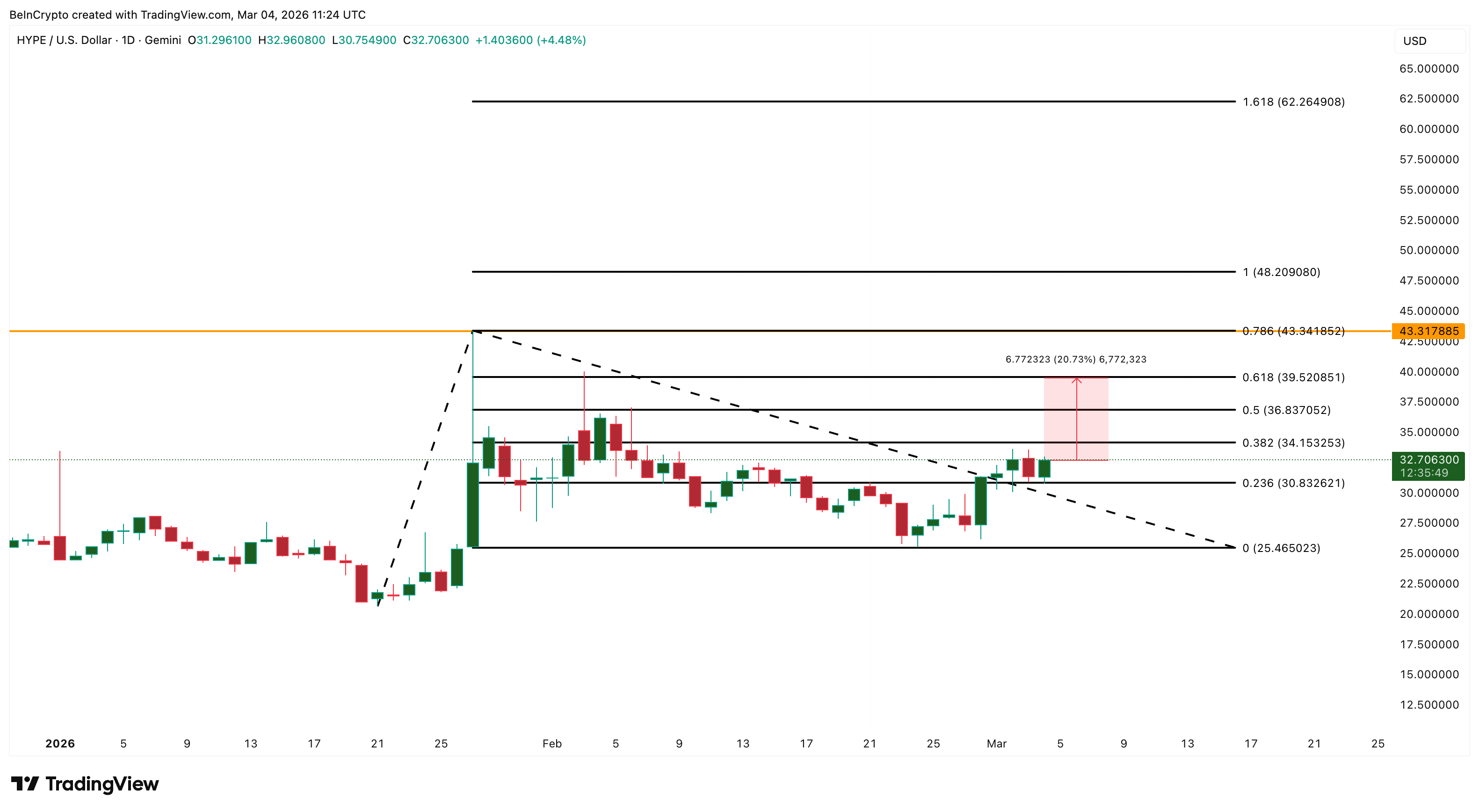
On the downside, losing $30 would weaken the bullish structure. A drop below $25 would invalidate the setup entirely, regardless of how strong the TradFi burn flywheel remains.
TLDR
- The Ethereum Foundation plans to position Ethereum as a trust layer for AI systems.
- The organization will focus on coordination and verification instead of building AI models.
- Davide Crapis said Ethereum can serve as a public verification layer for autonomous agents.
- The foundation supports ERC-8004 to standardize agent identity and trust.
- The strategy promotes privacy, local AI processing, and stronger cryptographic security.
The Ethereum Foundation has outlined a strategy to position Ethereum as a trust layer for AI systems. The organization said it will not compete in building large AI models. Instead, it plans to anchor identity, payments, and verification for autonomous agents.
Ethereum Foundation Outlines Coordination Role for AI Agents
The Ethereum Foundation said it will focus on coordination rather than raw AI computation. Davide Crapis, the AI lead at the EF, presented the plan at NEARCON 2026. He said Ethereum can serve as a “public, governance-less verification layer for AI.”
He explained that AI systems now handle trades, applications, and software tasks. However, centralized control could weaken decentralization and privacy. “If AI doesn’t have the properties we care about, and then we use AI for everything, basically no one has those properties anymore,” Crapis said.
He stated that Ethereum can help agents identify themselves and build trust. The network can also route payments and anchor cryptographic proofs. Heavy computing will remain off-chain on traditional servers.
The EF has supported standards such as ERC-8004 for agent identity and trust. Crapis said developers outside Ethereum have shown interest in these standards. He compared the system to a decentralized review network combined with payment rails.
He said Ethereum can maintain transparent histories for agents. Those records can help assess reputation and past actions. As a result, agents can transact without relying on centralized platforms.
Ethereum Extends Core Principles to AI Security and Privacy
The Ethereum Foundation also aims to bring privacy and censorship resistance into AI systems. Crapis referred to this effort as “Props AI” inside the organization. The program promotes privacy, openness, and security in AI design.
He warned that centralized AI services can build detailed user profiles over time. Queries and usage patterns can reveal personal data. Therefore, the EF supports more local AI processing on user devices.
“We want to create a world where users retain as much data and power as possible,” Crapis said. He added, “We just don’t give it to operators.” The approach seeks to limit unnecessary data transfer to large platforms.
Security forms another part of the initiative. Crapis predicted that AI systems will automate cyberattacks and impersonation. “We will probably see hacks orchestrated by AI,” he said.
He argued that traditional authentication models may fail under AI-driven impersonation. In response, he emphasized the importance of cryptographic keys. Control of a private key provides mathematical proof of ownership.
“In a world where AI is in the wild, we want Ethereum to be the place with the big lock,” Crapis said. He added, “If I have the keys, I still have power.” The EF described the AI program as one of several ongoing priorities.


Network News
NEW SCALING PLANS FOR ETHEREUM: Ethereum co-founder Vitalik Buterin published a blog post on X outlining his latest vision for scaling the blockchain, arguing the network can boost capacity in the near term while laying the groundwork for a longer-term shift to advanced cryptography and data-heavy “blobs” that would change how Ethereum is validated. The post reflects Buterin’s renewed focus on scaling Ethereum’s base layer after several years in which much of the ecosystem’s scaling strategy centered on layer-2 rollups. The plan comes on the heels of the Ethereum Foundation publishing a ‘strawmap’ aimed at making the network more efficient in the long term. In the short term, Buterin says Ethereum can safely increase throughput by making blocks easier and faster to check. Upcoming upgrades will allow the computers that run Ethereum to review different parts of a block simultaneously, rather than processing everything step by step. At the same time, changes to how blocks are built will let the network use more of each 12-second processing window, rather than finishing early out of caution (known as ePBS, and will be implemented in the Glamsterdam upgrade). The result: Ethereum should be able to fit more transactions into each block without increasing the risk of errors or instability. Another major piece of the plan involves rethinking how transaction fees — known as “gas” — are calculated. Buterin argues that not all activity on Ethereum puts the same strain on the network. There’s a big difference between using computing power temporarily and permanently adding new data that every Ethereum computer, or node, must store forever. — Margaux Nijkerk Read more.
OKX DABBLES WITH AI AGENTS: OKX rolled out an AI-focused upgrade to OnchainOS, its developer platform, pitching it as infrastructure for autonomous crypto trading agents. The AI layer builds on familiar components such as wallet infrastructure, liquidity routing and onchain data feeds, combining them into a unified execution framework aimed at AI agents operating across chains. Rather than wiring price feeds, token approvals, gas estimation and swap routing manually, developers can connect an agent and issue a high-level instruction, such as swapping ETH for USDC below a certain price. OnchainOS handles the workflow behind the scenes, from monitoring markets to sourcing liquidity and confirming settlement. The intersection between crypto and AI has grown exponentially in the past 12 months — the blockchain AI market projected to rise from $6 billion in 2024 to $50 billion by 2030 — and traders are using the technology to their advantage. One recent example occurred when a group of retail traders used AI to find “glitches” on platforms like Polymarket before instructing AI to trade on its behalf. — Sam Reynolds Read more.
NEAR FOUNDER ON THE FUTURE USERS OF BLOCKCHAIN: For years, the crypto industry has searched for its next breakout moment — something on the scale of DeFi summer or the NFT boom. Meanwhile, artificial intelligence (AI) has quietly become embedded in daily life. Developers use ChatGPT as a co-pilot. Consumers rely on AI assistants to draft emails, plan travel and, increasingly, manage workflows. Crypto, by comparison, still feels infrastructural. Illia Polosukhin, a co-founder of NEAR, believes the divide is about to collapse, but not in the way many expect. “The users of blockchain will be AI agents,” Polosukhin said in an interview. “AI is going to be on the front end, and blockchain is going to be the back end.” His framing cuts against much of crypto’s recent experimentation with AI, which has centered on speculative tokens, memecoins and agent-themed trading bots. Instead, Polosukhin argues that AI will become the primary interface layer for everything online, including crypto, abstracting away wallets, explorers and transaction hashes. “The goal is to make your AI hide all the blockchain,” he said. “The fact that we have [blockchain] explorers is effectively a failure, because we don’t abstract the technology.” In this view, blockchain doesn’t disappear, it recedes. AI agents interact with protocols directly, executing payments, managing assets, coordinating services and even voting in governance systems. Humans, meanwhile, interact with the AI. — Margaux Nijkerk Read more.
BITCOIN LATEST GOVERNANCE CLASH: Bitcoin’s latest governance clash escalated as the first block signaling support for a temporary soft fork designed to restrict arbitrary, non-monetary data in the blockchain’s transactions was produced by mining pool Ocean. The proposal, formally assigned BIP-110 after evolving from earlier drafts, aims to reinstate strict limits on transaction output sizes and arbitrary data fields for about a year. The idea is to curb what proponents see as “spam” uses of block space for non-financial data. They argue that unchecked data, including large inscriptions and so-called OP_RETURN payloads, threaten the original blockchain’s role as sound monetary infrastructure and burden node operators. The community remains deeply divided. Prominent critics, including Blockstream CEO Adam Back, have warned that consensus-level intervention could harm Bitcoin’s credibility and lead to preferential treatment of some transactions in violation of the principle of neutral transaction capacity. He also questioned the level of support for the proposal, which, he said, increased the risk of the blockchain being split. — Jamie Crawley Read more.
In Other News
- Kraken secured a Federal Reserve “master account,” giving its banking arm direct access to the Fed’s core payment systems and making it the first crypto firm to operate on the same rails as traditional financial institutions. The company said its Kraken Financial unit received approval for a Federal Reserve “master account.” The account allows direct access to Fedwire, a major interbank payment network that processes trillions in transfers every day. Until now, Kraken had to rely on partner banks to send or receive U.S. dollars. Direct access changes that flow as the firm can now settle payments itself, which may speed up deposits and withdrawals for large traders and institutional clients. Kraken Financial operates under a Wyoming charter designed for crypto-focused banks. The Federal Reserve Bank of Kansas City oversaw the application. The approval is limited, however. Kraken will not receive the full set of services available to traditional banks as it won’t earn interest on reserves or be able to tap into the Fed’s emergency lending. — Francisco Rodrigues Read more.
- Tether, the firm behind the most popular stablecoin, USDT, invested $50 million in sleep technology startup Eight Sleep at a $1.5 billion valuation, according to a Wednesday press release and data from Crunchbase. With the funding, Eight Sleep plans to develop new AI health features using Tether’s QVAC architecture, a computing framework designed to process data at the device level rather than relying fully on cloud systems. Eight Sleep builds sensor-equipped sleep systems that track biometrics such as heart rate and temperature during the night. Its flagship “Pod” product adjusts mattress temperature and generates sleep insights based on real-time physiological data. “We believe advanced personalized AI is the perfect pathway to understand and expand human potential,” Paolo Ardoino, CEO of Tether, said in a statement. The investment is the latest example of Tether pushing beyond stablecoins and crypto infrastructure. The firm is best known for its $183 billion USDT stablecoin, which is popular as a savings and payments tool across emerging markets with limited access to U.S. dollars. Tether reported more than $10 billion in net income in 2025 and has increasingly channeled those earnings into venture investments across energy, payments, artificial intelligence and health technology. — Kristzian Sandor Read more.
Regulatory and Policy
- U.S. President Donald Trump said bankers are trying to undermine the Genius Act — the signature stablecoin legislation he signed into law last year — in a Truth Social post Tuesday, and he urged passage of Congress’ crypto market structure legislation without interference. “The U.S. needs to get Market Structure done, ASAP. Americans should earn more money on their money,” he said in the post. “The Banks are hitting record profits, and we are not going to allow them to undermine our powerful Crypto Agenda that will end up going to China, and other Countries if we don’t get The Clarity Act taken care of.” He warned banks against holding the Clarity Act “hostage,” saying the bill was necessary to keep the crypto industry in the U.S. “They need to make a good deal with the Crypto Industry because that’s what’s in best interest of the American People,” he said. The market structure bill has been in limbo since the Senate Banking Committee indefinitely postponed a markup hearing, in which lawmakers were set to debate and vote on amendments to the bill, in January. There are a number of issues still holding up passage of the bill, but the most public fight has been between the banking and crypto sectors over whether third parties can offer yield on stablecoin deposits to customers.— Nikhilesh De Read more.
- A federal judge has dismissed a proposed class action lawsuit against Uniswap Labs, CEO Hayden Adams and several venture capital backers, ruling they cannot be held liable for alleged “rug pull” tokens traded on the decentralized exchange’s protocol. In a ruling issued by the U.S. District Court for the Southern District of New York, Judge Katherine Polk Failla threw out the remaining state law claims in Risley v. Universal Navigation Inc., the Brooklyn-based firm that operates Uniswap. after previously dismissing the plaintiffs’ federal securities claims. The decision effectively ends the case at the district court level. The ruling is one of the first to specifically address whether developers and investors behind a decentralized protocol can be held liable under existing securities and state laws for tokens created and traded by third parties. “Due to the Protocol’s decentralized nature, the identities of the Scam Token issuers are basically unknown and unknowable, leaving Plaintiffs with an identifiable injury but no identifiable defendant,” Failla wrote. “Undaunted, they now sue the Uniswap Defendants and the VC Defendants, hoping that this Court might overlook the fact that the current state of cryptocurrency regulation leaves them without recourse, at least as to the specific claims alleged in this suit,” she added. — Olivier Acuna Read more.
Calendar
- Mar. 24-26, 2026: Digital Asset Summit, New York City
- Mar. 30-Apr. 2, 2026: EthCC, Cannes
- Apr.15-16, 2026: Paris Blockchain Week, Paris
- Apr. 29-30, 2026: Token2049, Dubai
- May 5-7, 2026: Consensus, Miami
- Sept. 29-Oct.1, 2026: Korea Blockchain Week, Seoul
- Oct. 7-8, 2026: Token2049, Singapore
- Nov. 3-6, 2026: Devcon, Mumbai
- Nov. 15-17, 2026: Solana Breakpoint, London


The White House will review new prediction market measures proposed by the CFTC.
Summary
- The CFTC has sent a new set of prediction market measures for review.
- The White House will examine the proposal before any implementation decisions are made.
- Crypto and traditional prediction markets may see changes in oversight, licensing, and product design depending on the outcome.
The White House is set to review a new package of prediction market measures submitted by the U.S. Commodity Futures Trading Commission, underscoring how on-chain and traditional prediction platforms are moving deeper into the regulatory spotlight.
The proposal, described in market reports as a fresh attempt to clarify the status of event-linked derivatives, would shape how platforms structure contracts tied to elections, economic indicators, and other real-world outcomes. While specific details of the measures have not yet been published, the fact that they require White House review signals that the framework could have implications beyond niche crypto products, touching broader derivatives policy and cross-border coordination. For prediction markets built on public blockchains, any shift in U.S. rules could influence which products are considered permissible and how they must be supervised.
The review process comes at a time when prediction markets on both centralized and decentralized platforms are gaining traction with traders looking for high-conviction, event-driven opportunities. On-chain protocols have experimented with a range of designs, from fully decentralized order books to more curated models that resemble traditional venues but settle in digital assets such as Bitcoin (BTC).
At the same time, regulators have grown more vocal about the need to ensure that certain contracts do not function as unregistered gambling or securities products. The CFTC’s latest measures appear designed to bring more consistency to how event-based contracts are treated, whether they are listed on regulated futures exchanges, offered by specialized platforms, or deployed via smart contracts accessible to global users.
Implications for on-chain prediction markets
For crypto-native prediction protocols, a White House-level review of CFTC measures raises both risks and opportunities. Clearer rules could make it easier for compliant platforms to operate in the U.S. and potentially integrate with more traditional financial infrastructure, including brokerages and exchanges that already list bitcoin-linked products through venues like Coinbase. At the same time, stricter definitions of what constitutes a permissible event contract might force some existing markets to shut down or relocate activity offshore, particularly in politically sensitive areas such as elections. Projects inspired by the growth of on-chain prediction markets will be watching to see whether the final framework leaves room for innovative product design or leans toward a narrow, highly restricted set of contracts.
The outcome will likely feed into a broader global conversation about how to regulate event-based markets alongside spot crypto, DeFi, and tokenized assets. As jurisdictions implementing frameworks similar to MiCA refine their own views on derivatives and prediction products, U.S. decisions could influence how other regulators calibrate their approaches. For now, market participants are left to trade under existing rules while anticipating that the White House’s review of the CFTC’s measures will set the tone for the next phase of growth—or retrenchment—in both centralized and on-chain prediction markets.

Monthly inflows into digital asset treasury (DAT) companies have slowed to roughly $555 million, the weakest pace since October 2024, according to DeFiLlama data. The latest figure underscores a quieter phase in crypto treasury activity even as the market shifts in response to political developments and regulatory signals. The data show a notable drop from the late-2024 surge that followed the US elections, when inflows climbed as investors anticipated a more crypto-friendly regulatory environment. The DeFiLlama dataset also tracks a dramatic rebound after the 2024 election results, but the momentum proved fragile in the following year, highlighting how treasury players pivot between accumulation and productive deployment of crypto reserves. The current trend appears to reflect a broader calibration in capital deployment as market participants reassess risk and yield opportunities across digital-asset strategies. Inflows to digital asset treasuries had previously spiked to more than $12.3 billion after the election-related shifts, according to DeFiLlama’s data, before retreating as price cycles and macro uncertainty reasserted themselves. For context, the election period acted as a catalyst for capital inflows into crypto treasury strategies, with observers tracking how regulatory expectations could influence corporate exposure to digital assets.
Digital asset treasury companies have faced a challenging environment over the past year, a headwind that intensified after the October crypto market crash, which kicked off a protracted bear phase and pressured asset prices back toward pre-election levels. The sector has since weathered heightened scrutiny and a cautious liquidity backdrop, compelling firms to rethink their business models beyond mere crypto custody. The conversation around how treasuries should operate has evolved from simple hodling to strategies that generate cash flow and add strategic value to corporate balance sheets.
Related: Crypto treasury companies likely to consolidate in 2026: Crypto exec
Treasury reinvention in a market reset
Tioneering executives argue that the era of “buy and hold” is giving way to more active treasury management. In an interview, Patrick Ngan, chief investment officer of Zeta Network Group, a technology company, emphasized the need for treasuries to demonstrate practical utility for the asset rather than merely warehousing it. “Corporate Bitcoin treasuries now need to show they can actually use the asset, not just warehouse it,” he said, underscoring a broader push toward deploying crypto holdings in revenue-generating activities.
The emphasis on utilization aligns with a broader industry view: crypto treasuries with operating cash flow can outperform those that simply accumulate crypto without an active business plan. The consensus is that the most durable treasury strategies tie digital assets to ongoing operations, whether through staking or validation services on proof-of-stake networks, mining on proof-of-work networks, or DeFi lending and other ancillary ventures. A competitive edge may belong to entities that blend crypto with traditional revenue streams, rather than treating digital assets as a standalone store of value.
The landscape includes a range of models, from dedicated crypto-focused ventures to hybrid strategies that diversify income sources. A notable theme is the exploration of real-world asset (RWA) synergies to support crypto reserves. Case studies and industry commentary point to hybrid structures that blend real estate or other cash-flow-producing assets with BTC exposure, aiming to capture appreciation while generating rental or operating income. Grant Cardone’s approach—integrating real estate with Bitcoin exposure into hybrid treasury vehicles—has been cited as a practical example of how a treasury can leverage tangible assets to support digital-asset growth. Cardone described the strategy as a way to balance property-backed income streams with crypto upside, suggesting that real estate can provide a sturdier foundation for treasury-driven investments than a pure crypto-only vehicle.
The 10 biggest crypto treasury companies, ranked by their crypto holdings. DeFiLlama’s data visually maps the scale of digital asset reserves across leading treasury players, illustrating how the sector concentrates assets among a handful of large holders while many others operate with smaller balance sheets.
Beyond real estate partnerships, treasuries are pursuing revenue streams through staking, validator services, and DeFi lending to sustain cash flow and fund ongoing operations. The broader objective remains clear: convert crypto holdings into sustainable income that can support ongoing operations, fund growth initiatives, and offset crypto-market volatility.
Grant Cardone’s real estate–Bitcoin hybrid approach has drawn attention for illustrating how a treasury strategy can combine tangible asset advantages with digital-asset exposure. In interviews and related reporting, Cardone argued that housing can provide non-discretionary demand dynamics, creating a counterweight to the discretionary nature of many digital-asset purchases. This perspective aligns with a growing willingness among treasury operators to diversify income sources and reduce reliance on pure price appreciation.
The momentum around reinvention is not just theoretical. Comparisons with other sectors suggest that diversified revenue models—whether through staking, lending, or rental income—may lead to more resilient treasury performance over time. Yet, the market remains mindful of macro and policy risks. The crypto sector’s trajectory has been closely linked to regulatory developments in the United States and abroad, as well as to shifts in investor sentiment shaped by macroeconomic trends and cross-asset correlations.
The evolution of crypto treasuries is a matter of both strategic and operational refinement. As firms experiment with combining real assets and digital holdings, the industry watches how these hybrid approaches perform in terms of yield, liquidity, and governance. The experience of 2025—when inflows stayed in the sub-$10 billion range for several months before another downturn—serves as a reminder that a successful treasury requires more than capital; it requires a clear plan for deploying assets into productive activities that align with corporate objectives. The ongoing conversation centers on how to balance risk, return, and liquidity in a landscape characterized by ongoing regulatory scrutiny and a dynamic market regime.
Note: The overarching trend remains that data providers, researchers, and industry stakeholders will continue to monitor whether treasury players can convert crypto holdings into stable, repeatable cash flows while maintaining exposure to upside from crypto markets.
What to watch next
- Regulatory developments in major markets that could influence corporate crypto exposure and treasury management strategies.
- Possible consolidation waves among crypto treasury firms, as suggested by industry debates about 2026 dynamics.
- New treasury vehicle structures that blend real assets with digital holdings, including hybrid real estate–BTC funds and similar models.
- Announced or anticipated ETF and product flow changes that could affect liquidity and investor demand for crypto-tied assets.
- Next-year milestones for major treasury players, including funding rounds, partnerships, or launches of revenue-generating services.
Sources & verification
- DeFiLlama data on digital asset treasuries and inflows (defillama.com/digital-asset-treasuries)
- DefiLlama status post referenced in coverage (https://x.com/DefiLlama/status/2028572552675938399)
- Crypto treasury consolidation discussion (https://cointelegraph.com/news/crypto-treasury-companies-consolidate-2026)
- Cardone Capital on hybrid real estate and Bitcoin strategy (https://cointelegraph.com/news/cardone-capital-dats-real-estate-bitcoin-fund)
- Bitcoin price discussions and related coverage (https://cointelegraph.com/bitcoin-price)
Crypto treasury inflows signal a market reset
In the broader market context, the trajectory of digital asset treasuries appears to reflect a recalibration after a period of outsized inflows tied to political catalysts and policy expectations. The rebound observed after the election results demonstrated the market’s sensitivity to regulatory signals, yet the subsequent slowdown suggests investors are reassessing the risk-reward equation for long-duration crypto exposure. The path forward may hinge on whether treasuries can operationalize their holdings into durable cash flows and whether new vehicle structures can attract capital without compromising risk control and governance.
Market context: The latest data sit within a cautious liquidity environment where macro forces and regulatory developments continue to shape risk sentiment and capital allocation across crypto strategies.
Why it matters
For investors, the evolving picture of digital asset treasuries matters because it highlights how corporate treasury management is shifting from passive asset accumulation to active deployment. The ability to translate crypto holdings into revenue—whether through staking, validation, lending, or real-world asset integration—can influence balance-sheet resilience and funding for strategic initiatives. For builders and operators, the trend signals a demand for more sophisticated treasury products and governance frameworks that can manage risk while enabling exposure to the upside of digital assets. And for the market at large, the shift toward productive use cases may influence liquidity cycles and pricing dynamics, potentially supporting more durable demand cycles beyond mere speculation.
As firms experiment with real-world links and diversified income streams, stakeholders will be watching whether these models deliver consistent returns aligned with risk tolerances. The ongoing dialogue around how to structure, regulate, and monitor crypto treasuries will likely shape industry standards and collaboration across traditional finance, real estate, and digital-asset ecosystems.
What to watch next
- Track regulatory updates and any policy changes that directly affect corporate crypto holdings and treasury strategies.
- Monitor proposed or enacted ETF and institutional product approvals that could impact liquidity and flows into crypto-related assets.
- Observe consolidation activity among treasury operators and the emergence of new revenue-generating platforms.


In a social media post, President Trump openly criticized banks for obstructing his crypto agenda, aligning himself with crypto firms in a dispute over stablecoin yields.
In a social media post, President Trump criticized the banking industry, accusing it of undermining his crypto agenda, and called for progress on the Clarity Act.
“The Genius Act is being threatened and undermined by the Banks, and that is unacceptable — We are not going to allow it. The U.S. needs to get Market Structure done, ASAP. Americans should earn more money on their money,” Trump wrote on Truth Social.
“The Banks should not be trying to undercut The Genius Act, or hold The Clarity Act hostage,” he added.
The GENIUS Act prohibits stablecoin issuers from paying interest directly to holders but permits third-party platforms to distribute yield to users, a measure designed to enhance transparency and regulatory compliance.
Despite hosting White House meetings between crypto firms and banks to negotiate stablecoin yields, banks have shown resistance. Trump’s efforts to mediate a compromise have yet to yield results, as reported by CNBC.
Stablecoin yields have become a focal point of regulatory scrutiny, with significant implications for traditional banking and financial stability.
The ongoing conflict between banks and crypto firms represents a broader debate over the future of financial regulation in the U.S. and could redefine America’s role in global crypto leadership.
This article was generated with the assistance of AI workflows.
TLDR
- Coinbase has launched U.S. stock trading directly within its existing platform.
- Users can access U.S. equities through the same interface used for cryptocurrency trading.
- Coinbase Capital Markets supports the stock trading service as a registered broker-dealer.
- The platform integrates Nasdaq last-sale data to provide real-time stock pricing.
- Nasdaq displayed a congratulatory message for Coinbase on its Times Square tower.
Coinbase has launched U.S. stock trading on its platform, expanding beyond digital assets. The company confirmed the rollout on social media and outlined key features. Users can now access U.S. equities directly within the Coinbase interface.
Coinbase Integrates Equities With Real-Time Nasdaq Data
Coinbase enabled stock trading through Coinbase Capital Markets, which supports the service infrastructure. The company also integrated Nasdaq’s last-sale data into the platform. This integration provides real-time stock pricing within the existing crypto interface.
The company stated that users can manage cryptocurrencies and equities from a single account. Coinbase said the rollout reflects ongoing product expansion efforts. It was written on social media, “Users can now trade U.S. equities directly in the Coinbase app.”
Nasdaq displayed a congratulatory message on its Times Square tower to mark the launch. The display recognized Coinbase for introducing U.S. stock trading. This public message highlighted cooperation between Coinbase and Nasdaq.
Coinbase confirmed that the platform delivers last-sale data sourced from Nasdaq. This feature mirrors real-time data services offered by brokerage firms. As a result, users receive live stock prices alongside crypto market data.
The company designed the feature to operate within its current trading system. Users do not need separate accounts for equities trading. Instead, they can switch between asset classes within one interface.
Hybrid Platform Expands Retail Trading Access
Coinbase historically focused on cryptocurrency trading and custody services. However, the company gradually expanded into services that resemble brokerage offerings. The stock trading launch marks its latest product addition.
The exchange aims to serve retail investors seeking multiple asset classes. By offering equities, Coinbase broadens its accessible markets. The company continues to operate under regulatory requirements for securities trading.
Coinbase Capital Markets supports order execution for stock transactions. This entity operates as a registered broker-dealer. Therefore, it handles the compliance framework for equities trading.
The platform now presents stocks and cryptocurrencies side by side. Users can monitor price charts and execute trades in one place. This structure streamlines account management across asset categories.
Coinbase stated that real-time Nasdaq data strengthens its market information tools. The integration ensures that displayed prices reflect official last-sale reports. As a result, users receive consistent pricing updates during market hours.

5 Forgotten 2000s Thrillers That Have Aged Like Fine Wine

Labour Chairs Warns Party It Must Tackle Immigration “In A Way That Stays True To Our Values”

Imaturidade e dificuldade financeiras


-

 Politics6 days ago
ITV enters Gaza with IDF amid ongoing genocide
-

 Politics2 days ago
Alan Cumming Brands Baftas Ceremony A ‘Triggering S**tshow’
-

 Fashion5 days ago
Weekend Open Thread: Iris Top
-

 NewsBeat7 days ago
Cuba says its forces have killed four on US-registered speedboat | World News
-

 Tech4 days ago
Unihertz’s Titan 2 Elite Arrives Just as Physical Keyboards Refuse to Fade Away
-
Sports5 days ago
The Vikings Need a Duck
-
 NewsBeat4 days ago
Dubai flights cancelled as Brit told airspace closed ’10 minutes after boarding’
-
 NewsBeat7 days ago
Manchester Central Mosque issues statement as it imposes new measures ‘with immediate effect’ after armed men enter
-

 NewsBeat3 days ago
‘Significant’ damage to boarded-up Horden house after fire
-
 NewsBeat4 days ago
The empty pub on busy Cambridge road that has been boarded up for years
-

 NewsBeat4 days ago
Abusive parents will now be treated like sex offenders and placed on a ‘child cruelty register’ | News UK
-

 Entertainment3 days ago
Baby Gear Guide: Strollers, Car Seats
-

 Business7 days ago
Discord Pushes Implementation of Global Age Checks to Second Half of 2026
-
 Tech5 days ago
NASA Reveals Identity of Astronaut Who Suffered Medical Incident Aboard ISS
-

 Business6 days ago
Only 4% of women globally reside in countries that offer almost complete legal equality
-
 NewsBeat4 days ago
Emirates confirms when flights will resume amid Dubai airport chaos
-
Politics4 days ago
FIFA hypocrisy after Israel murder over 400 Palestinian footballers
-

 Crypto World6 days ago
From Crypto Treasury to RWA: ETHZilla Retreats and Relaunches as Forum Markets on Nasdaq
-

 NewsBeat2 days ago
Is it acceptable to comment on the appearance of strangers in public? Readers discuss
-

 Tech4 days ago
Viral ad shows aged Musk, Altman, and Bezos using jobless humans to power AI