

Crypto World
Goldman Sachs and Coinbase CEOs Converge on Tokenized Equities as the Next Frontier


TLDR:
- Stablecoin volume hit $30T last year, forming the blueprint Armstrong cites for tokenized equity growth.
- Over $200B in tokenized assets now live on-chain, with Ethereum holding more than 60% of that total.
- Tokenized equities could unlock 24/7 trading, fractional shares, and smart contract-based governance rules.
- Goldman Sachs CEO David Solomon confirmed tokenized equities are a major area of active strategic focus.
Wall Street attention toward tokenized equities is gaining momentum as major financial and crypto leaders discuss the concept publicly.
Goldman Sachs CEO David Solomon recently raised the topic during a discussion with Coinbase CEO Brian Armstrong.
The conversation focused on how blockchain technology could reshape global access to stock markets. The exchange also highlighted how stablecoins previously followed a similar adoption path.
Tokenized Equities Gain Attention From Goldman Sachs and Coinbase
Solomon asked Armstrong how tokenized equities could evolve within crypto markets. The discussion appeared in a video shared by Etherealize on the social platform X.
Armstrong compared the idea to early skepticism surrounding stablecoins. Many questioned the need for digital dollars when traditional digital payments already existed.
He noted that stablecoins eventually filled a gap for people without access to dollar bank accounts. Residents in high inflation economies often seek dollar exposure.
Countries such as Turkey, Argentina, and Nigeria illustrate that demand. Dollar-pegged crypto assets allow users to transact globally without traditional banking barriers.
Armstrong also referenced data showing strong stablecoin activity. Roughly $30 trillion in stablecoin payment volume occurred during the past year.
He said the same demand drivers could appear in tokenized equities. Crypto infrastructure could reduce friction in global securities trading.
Crypto Markets Push Tokenized Stocks and Global Asset Access
Armstrong outlined a simple model for tokenized equities. A traditional custodian would hold company shares while issuing equivalent tokens on-chain.
That structure could allow global investors to trade stocks without brokerage restrictions. Many people worldwide cannot easily access U.S. equity markets.
The model also introduces continuous trading. Blockchain markets operate around the clock, unlike traditional stock exchanges.
Fractional ownership could expand access further. Investors could buy small portions of companies such as Tesla or Nvidia.
Crypto markets already use perpetual futures and other derivatives. Armstrong said similar instruments could eventually extend to tokenized securities.
Smart contracts also allow programmable governance. Companies could restrict voting rights for short term shareholders through on-chain rules.
The conversation also referenced a broader tokenization trend across financial markets. Institutions now tokenize assets including Treasuries, private credit, and real estate.
Ethereum currently dominates that infrastructure. More than 60 percent of tokenized assets reside on the Ethereum network, according to Etherealize.
Those holdings exceed $200 billion in value. Institutional participants often use Ethereum because of its established compliance infrastructure.

The PI token is the only double-digit price gainer from the top 100 alts today.
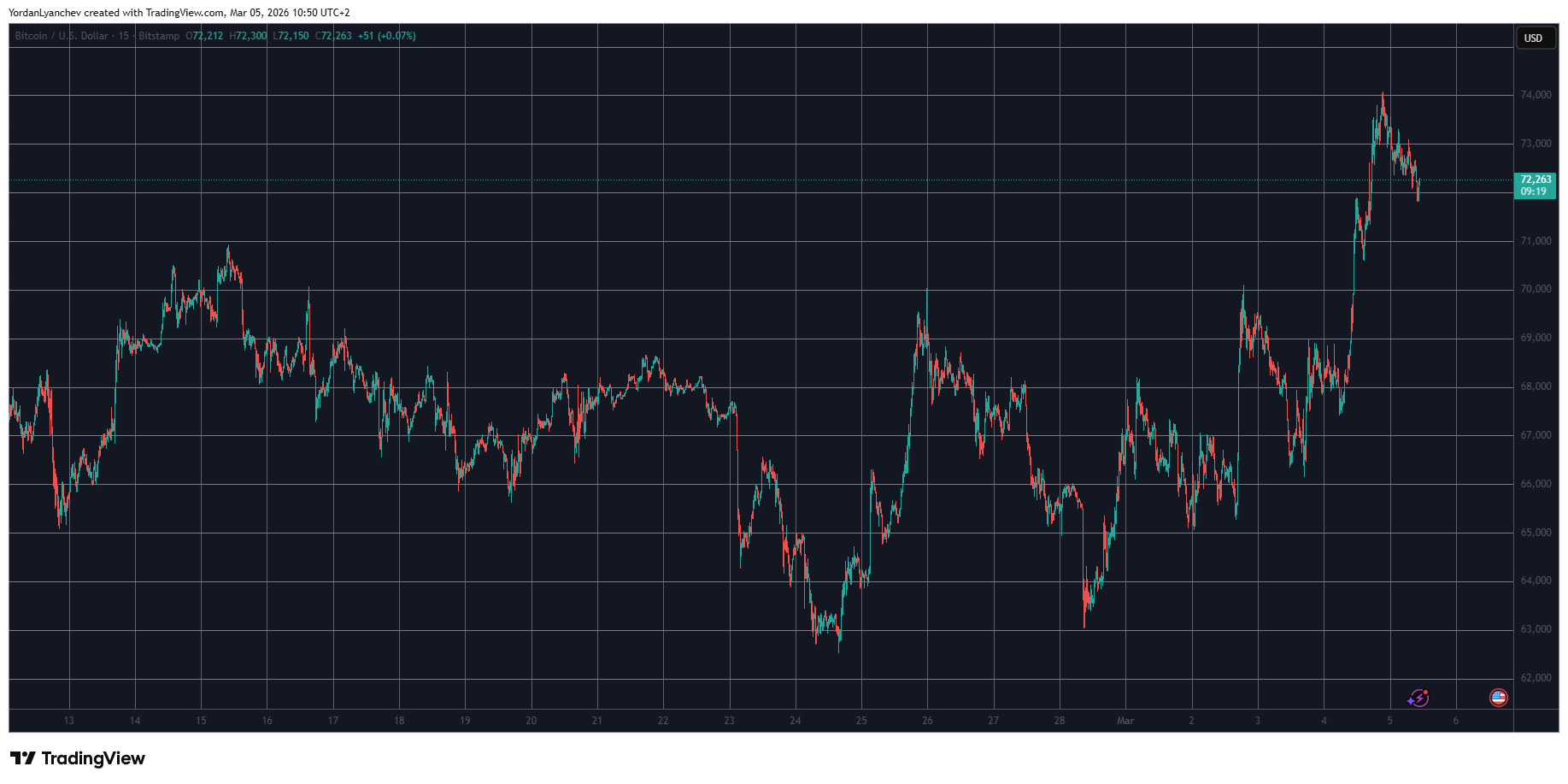
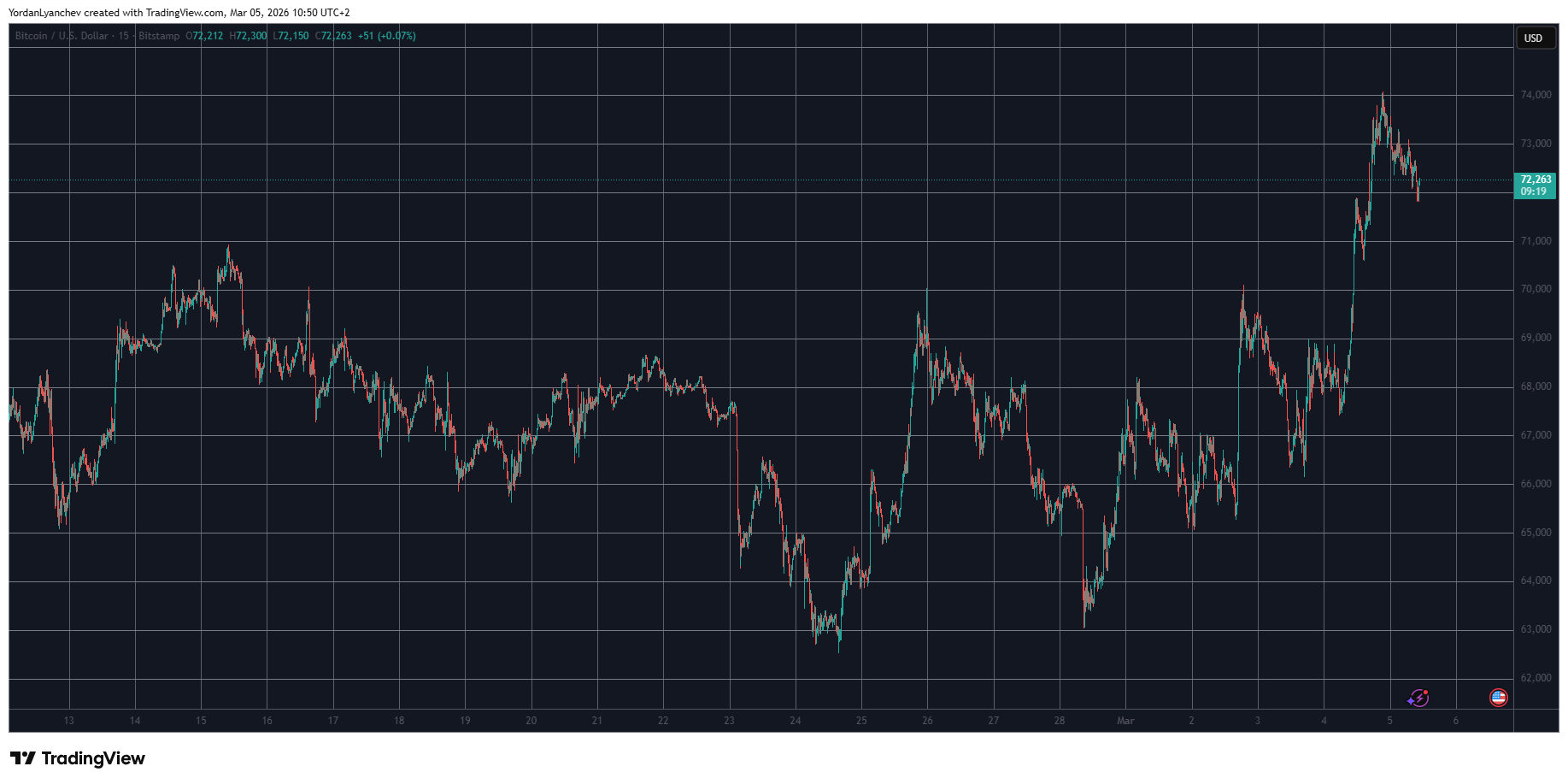
Bitcoin’s price resurgence over the past 24 hours has been quite impressive, as the asset surged to its highest levels in a month at $74,000, where it faced some resistance.
Most altcoins are well in the green today as well, with ETH reclaiming the $2,000 and $2,100 lines, while SOL is up to $90.
BTC Tapped $74K
It was just several days ago, on Saturday, when the primary cryptocurrency plummeted to $63,000 from $66,000 after the US and Israel joined forces to attack Iran. Although the Middle Eastern country responded immediately against numerous targets in the region and its Supreme Leader was killed, BTC didn’t continue to free fall – just the opposite, it rebounded to $68,000 on that same day.
More volatility ensued in the following couple of days, with BTC slipping to $65,200 when it surged by 5% in an hour to $70,000. It was rejected there at first, as it happened during the previous week’s attempt, but the bulls were not to be denied this time.
After they regrouped on Monday and Tuesday, they initiated a substantial leg up yesterday, driving bitcoin to its highest level since early February at $74,000. This meant that the cryptocurrency had added $11,000 since its Saturday low after the attacks began.
Although it was stopped there and now trades around $72,000, it’s still 3% up on the day. Its market cap has surged to almost $1.450 trillion on CG, while its dominance over the alts stands tall at 57.4%.
ETH Above $2.1K, PI on a Roll
Ethereum surged from under $2,000 to $2,200, where it was stopped, but still trades above $2,100 now after a 4% daily increase. SOL is back to $90, while DOGE has risen by 5% to $0.095. XRP, BNB, TRX, ADA, and LINK are also slightly in the green, while XMR is up by almost 5% to $362.
Pi Network’s native token has stolen the show once again. Perhaps driven by the overall market revival and some crucial updates to the network behind it, the PI token has surged by 13% daily and now sits above $0.195. SKY, JUP, and DCR follow suit in terms of daily gains.
The total crypto market cap has added another $60 billion in a day and now sits above $2.5 trillion on CG.

Binance Free $600 (CryptoPotato Exclusive): Use this link to register a new account and receive $600 exclusive welcome offer on Binance (full details).
LIMITED OFFER for CryptoPotato readers at Bybit: Use this link to register and open a $500 FREE position on any coin!
Disclaimer: Information found on CryptoPotato is those of writers quoted. It does not represent the opinions of CryptoPotato on whether to buy, sell, or hold any investments. You are advised to conduct your own research before making any investment decisions. Use provided information at your own risk. See Disclaimer for more information.
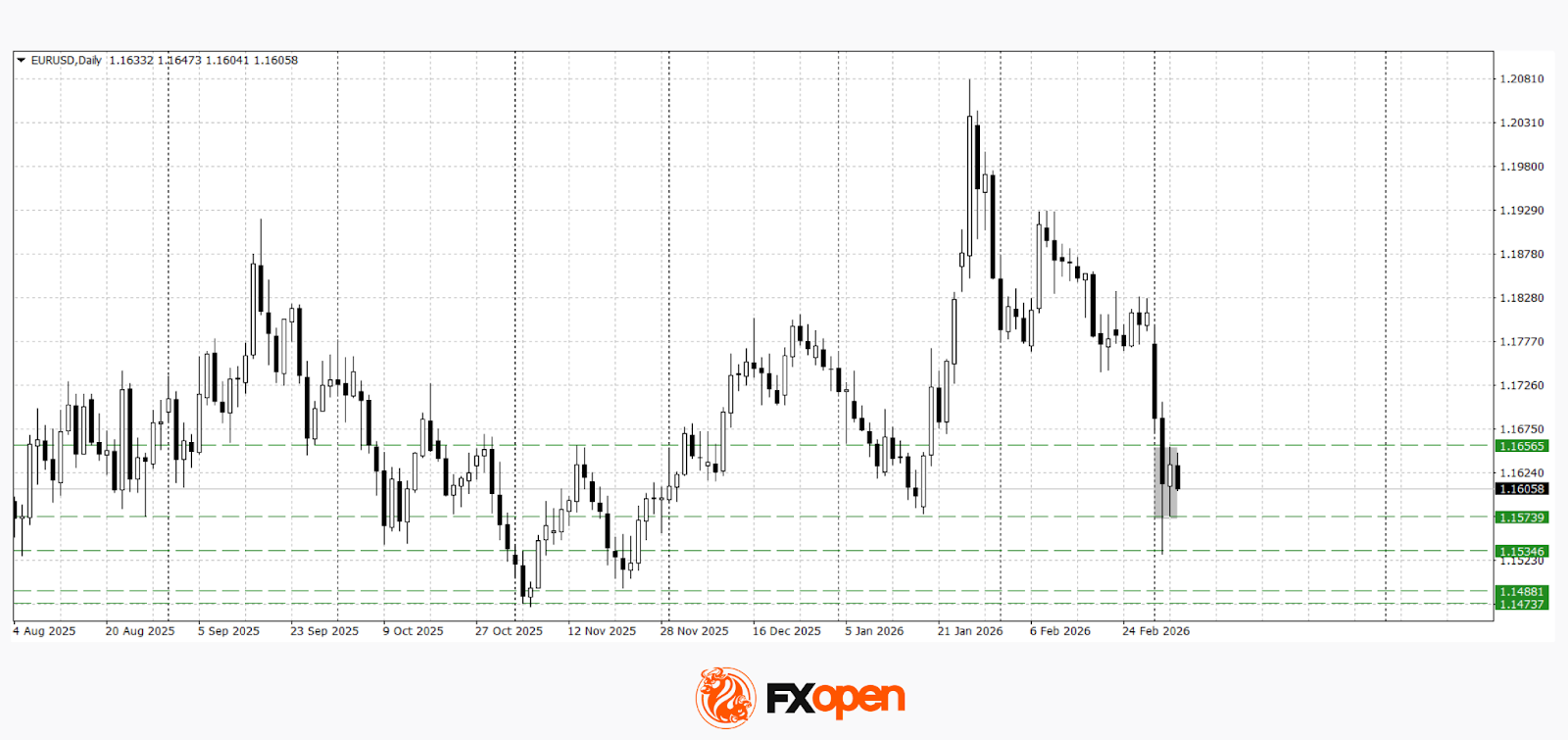
European currencies, particularly the pound and the euro, posted a sharp decline at the start of the week before shifting into a corrective rebound. However, the current move appears largely technical in nature, with the market maintaining a cautious stance ahead of the key US labour market report — Nonfarm Payrolls — due for release tomorrow.
Additional pressure on European currencies stems from the strengthening US dollar amid rising geopolitical tensions in the Middle East. The escalation of the conflict between the United States, Israel and Iran has triggered a sharp increase in energy prices. Natural gas prices in Europe have surged on concerns over potential supply disruptions, as the widening conflict has affected the Strait of Hormuz — one of the key arteries for global liquefied natural gas supplies.
Rising energy costs are increasing inflationary risks for the European economy, which has only just begun recovering from the previous energy crisis. According to analysts’ estimates, if current energy price levels persist, inflation in the euro area could rise by around 0.5 percentage points. This reinforces expectations that European central banks may keep interest rates elevated for longer, while simultaneously heightening the risk of a slowdown in economic activity.
EUR/USD
Following its decline at the beginning of the week, EUR/USD found support at 1.1530 and managed to recover above 1.1600. On the daily timeframe, a bullish harami pattern has formed, though it remains unconfirmed. If the pair fails to consolidate above 1.1650 in the coming sessions, a renewed test of recent lows in the 1.1530–1.1570 range cannot be ruled out.
Key events for EUR/USD:
- Today at 12:00 (GMT+2): Speech by Bundesbank President Joachim Nagel;
- Today at 15:30 (GMT+2): US initial jobless claims;
- Today at 15:30 (GMT+2): US non-farm productivity data.
GBP/USD
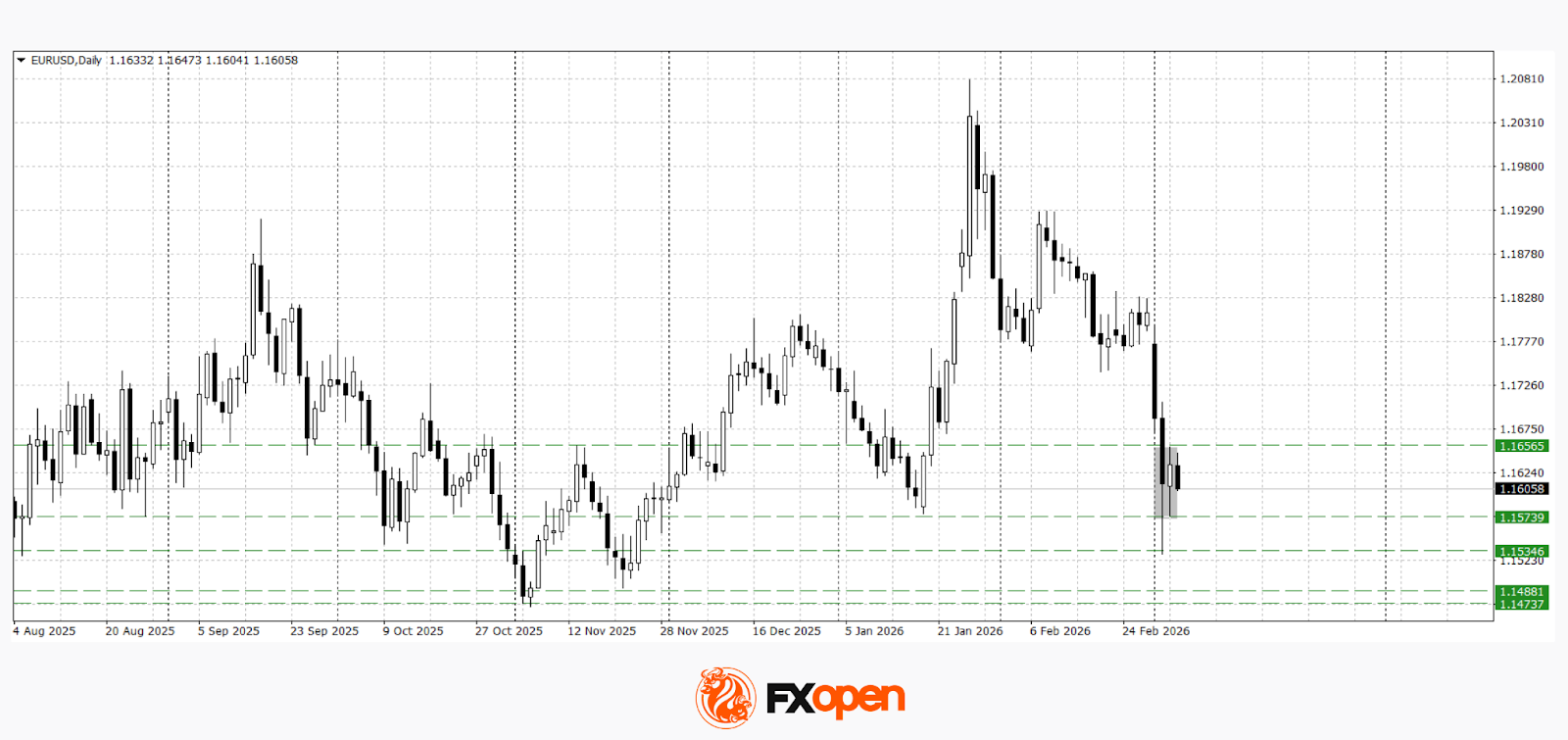
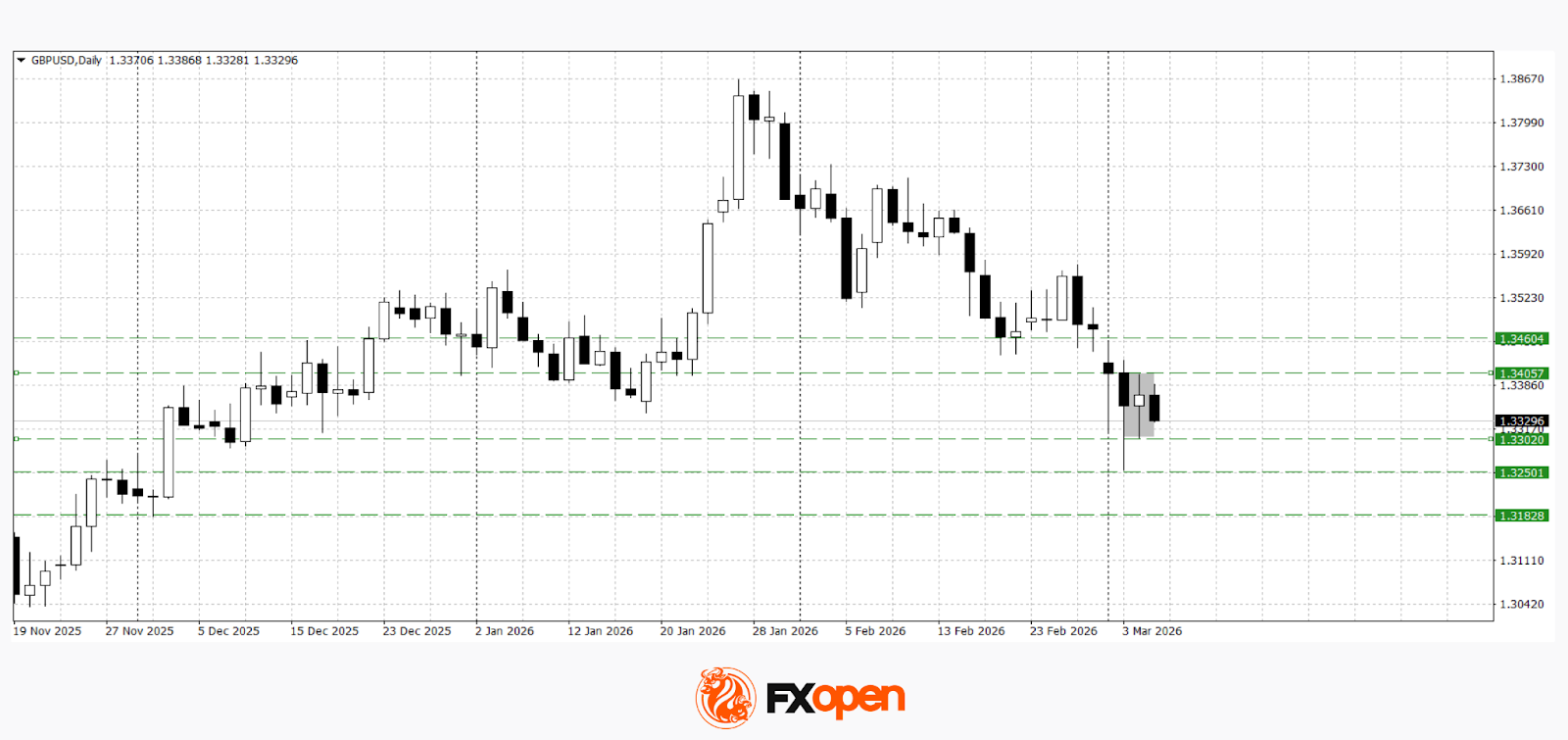
At the start of the current trading week, GBP/USD fell below 1.3300. A sharp rebound from 1.3250 led to the formation of a bullish reversal candlestick pattern; however, without a firm break above 1.3400, it is premature to expect a sustained upward correction. Should buyers fail to hold support at 1.3300, the pair may revisit the recent low at 1.3250.
Key events for GBP/USD:
- Today at 11:30 (GMT+2): UK Construction PMI;
- Tomorrow at 09:00 (GMT+2): UK Halifax House Price Index;
- Tomorrow at 15:30 (GMT+2): US Nonfarm Payrolls.
Trade over 50 forex markets 24 hours a day with FXOpen. Take advantage of low commissions, deep liquidity, and spreads from 0.0 pips (additional fees may apply). Open your FXOpen account now or learn more about trading forex with FXOpen.
This article represents the opinion of the Companies operating under the FXOpen brand only. It is not to be construed as an offer, solicitation, or recommendation with respect to products and services provided by the Companies operating under the FXOpen brand, nor is it to be considered financial advice.
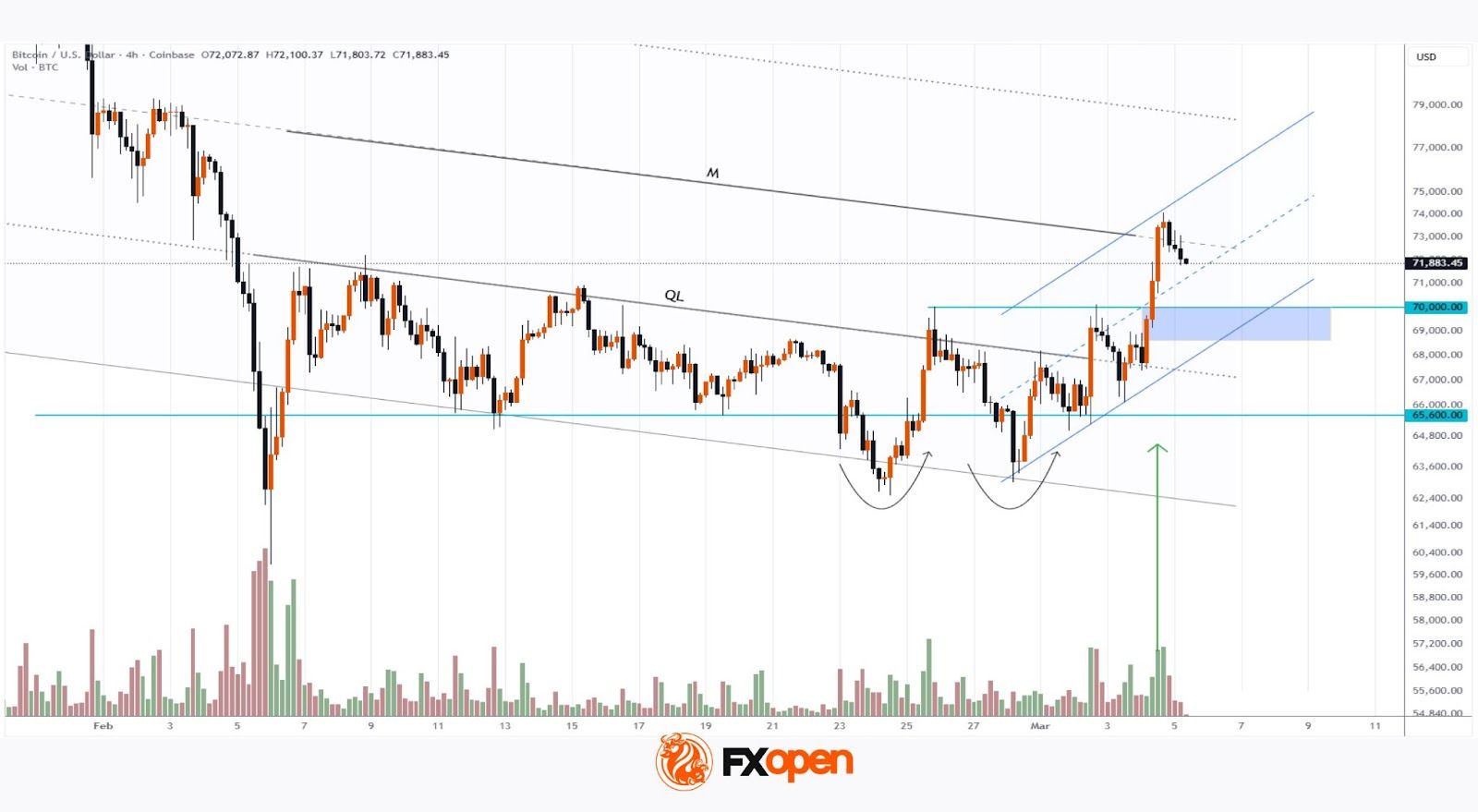
On 20 February, in the note “BTC/USD Analysis: Are the Bulls Stirring?”, we outlined a broad descending channel and highlighted early signs of increasing demand near the $65,600 level.
Subsequent price action provided further grounds to suggest that, following the dramatic decline in Bitcoin’s price from its all-time high in October 2025 to the February low around $60,000, market sentiment has begun to shift. This was reflected in the fact that two attempts by the bears to resume the downward movement (as indicated by the arrows) were unsuccessful.
It is possible that the easing of bearish pressure gave bulls greater confidence at the beginning of March, resulting in notable progress. Yesterday, Bitcoin reached its highest level in a month.
Technical Analysis of the BTC/USD Chart
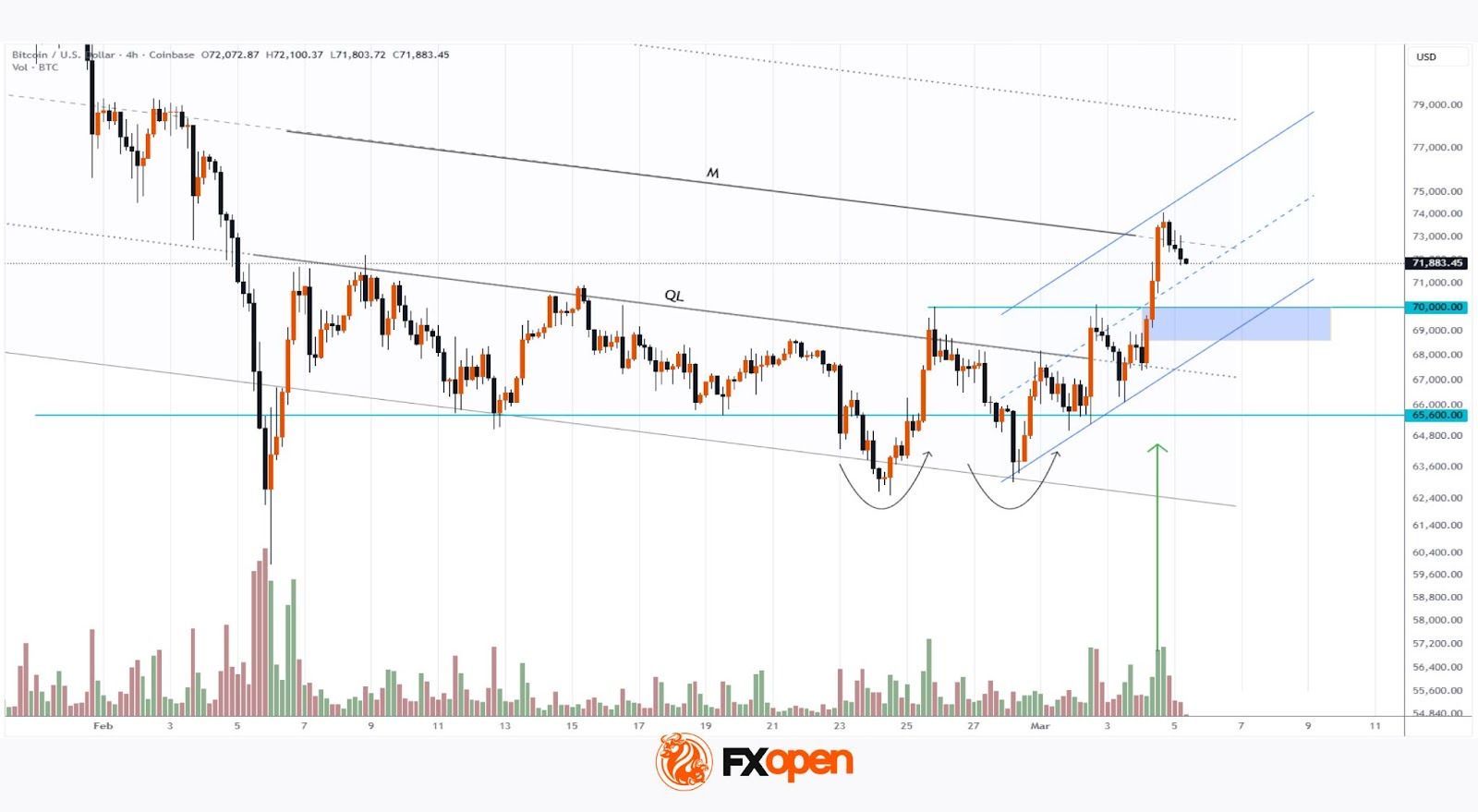
As shown on the chart, the bullish impulse at the start of March led to a breakout above the QL resistance line, as well as the psychological $70,000 level.
From a bearish perspective:
→ classic indicators added to the chart are showing signs of overbought conditions;
→ the median line (M) of the previously constructed channel may act as significant resistance.
From a bullish perspective:
→ rising trading volumes (highlighted by the arrow) represent a positive signal;
→ a sequence of higher highs and higher lows allows for the construction of a local ascending channel (shown in blue);
→ Bitcoin’s price behaviour following the early February panic resembles an Accumulation phase in Wyckoff methodology. If so, the early March rally may represent a Jump Over The Creek (JOC) pattern, signalling a potential transition into the Mark-Up phase.
Considering the above, it is reasonable to expect the formation of a pullback on the Bitcoin chart — for example, a move towards testing the support zone around the psychological $70,000 level.
FXOpen offers the world’s most popular cryptocurrency CFDs*, including Bitcoin and Ethereum. Floating spreads, 1:2 leverage — at your service (additional fees may apply). Open your trading account now or learn more about crypto CFD trading with FXOpen.
*Important: At FXOpen UK, Cryptocurrency trading via CFDs is only available to our Professional clients. They are not available for trading by Retail clients. To find out more information about how this may affect you, please get in touch with our team.
This article represents the opinion of the Companies operating under the FXOpen brand only. It is not to be construed as an offer, solicitation, or recommendation with respect to products and services provided by the Companies operating under the FXOpen brand, nor is it to be considered financial advice.
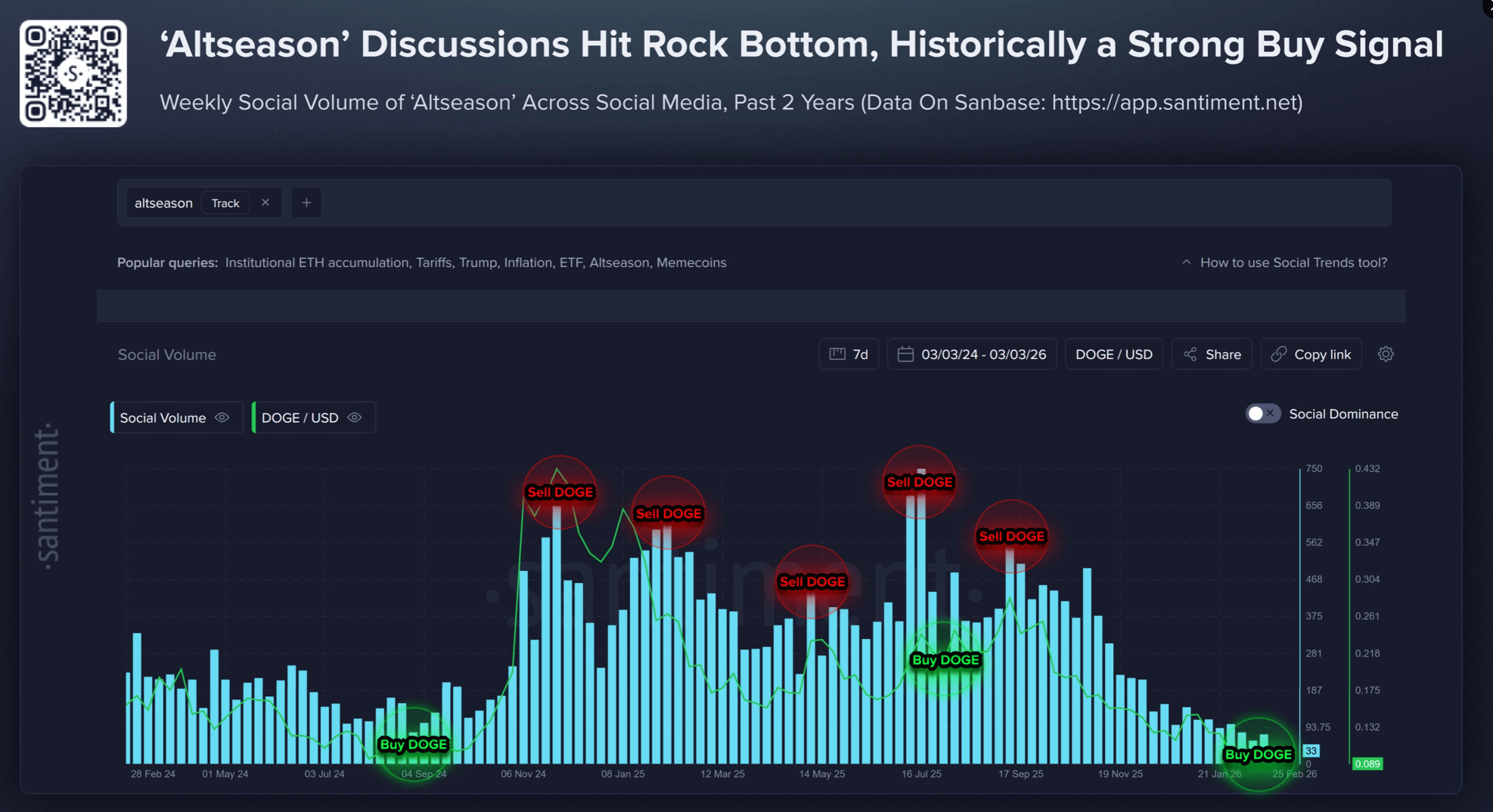
Mentions of altcoins on social media have reached their lowest level in two years, according to crypto sentiment platform Santiment, while indicators suggest that investors are focusing on Bitcoin.
Data from Santiment shows that for the week ended Feb. 27, altcoin social dominance scored 33, a sharp drop from its score of 750 in July 2025, around the time Dogecoin (DOGE) rallied 59% over 30 days.
Google worldwide search data shows a similar pattern. The term “altcoins” scored 4 out of 100 near the end of February, compared with a score of 100 during mid-August, according to Google Trends.
Santiment sees the lack of interest as a bullish signal
Santiment said the lack of interest in altcoins is a bullish signal. “Historically, however, moments like these, when social volume toward altcoin interest is at extreme lows, are around the time that rallies begin,” Santiment said in an X post on Thursday.

Other indicators also suggest that the market’s focus has been shifting from altcoins. CoinMarketCap’s Altcoin Season Index reads a “Bitcoin Season” score of 34 out of 100.
The index flips between “Altcoin Season” and “Bitcoin Season” scores based on the performance of the top 100 altcoins relative to Bitcoin over the past 90 days.
The total crypto market capitalization has fallen almost 43% since October, now sitting at $2.45 trillion.
Bitcoin jumps more than 7% in the past 24 hours
However, the crypto market has rallied over the past day, after US President Donald Trump said “the US needs to get the Market Structure done, ASAP.”
Related: Bitwise has now donated over $380K to open-source Bitcoin devs
The price of Bitcoin (BTC) surged 7.51% over the past 24 hours, with compressed volatility, strengthening ETF flows and a diminished Coinbase discount cited as catalysts for the price rise.
MN Trading Capital founder Michaël van de Poppe said that altcoins could start to take the lead once Bitcoin’s rally begins to slow.
“Great rotation, and I would assume that we’ll see altcoins take more momentum the moment Bitcoin stalls,” van de Poppe said in an X post on Thursday.
Magazine: Bitcoin may face hard fork over any attempt to freeze Satoshi’s coins


Kraken’s latest regulatory milestone has fueled speculation across the crypto community about whether Ripple could be next in line.
While there is no official confirmation, the prospect of gaining access to the Federal Reserve’s core payment infrastructure would carry significant implications for Ripple.
Kraken’s Fed Access Draws Attention to Ripple
Yesterday, BeInCrypto reported that Kraken’s Wyoming-chartered banking arm secured access to the Federal Reserve’s core payment systems. Notably, Kraken is the first crypto firm to gain a Federal Reserve master account.
The latest milestone comes after the firm secured a Special Purpose Depository Institution (SPDI) charter from the state of Wyoming in September 2020. The following month, Kraken applied for a master account with the Federal Reserve Bank of Kansas City, which was approved yesterday.
Following the news, attention has begun to shift toward Ripple. In a recent post on X, journalist and social media personality Paul Barron argued that Ripple may be next in line for similar access. Other analysts have echoed this view.
In July 2025, the company applied for a national trust bank charter and a Federal Reserve master account. In December, BeInCrypto reported that Ripple had received conditional approval from the Office of the Comptroller of the Currency (OCC) for the charter.
Barron noted the bank charter was “the setup.” He added that direct Fed access would be the “final piece” for RLUSD to settle at full banking scale.
“The ‘CLARITY Act’ momentum is forcing the Fed’s hand. See what’s happening from DC Insiders right now – the tide is shifting. The ‘Crypto vs. Banks’ battle is over. But the war is just beginning,” he said.
Follow us on X to get the latest news as it happens
Another analyst from X Finance Bull also remarked that while the timelines may differ, the destination remains the same.
“Kraken already integrated Ripple’s RLUSD stablecoin for their payment platform. That’s not a coincidence. That’s infrastructure connecting. But why did Kraken get it first and not Ripple? Simple. Kraken applied years ago. Wyoming bank charter in 2020. Routing number in 2022. Been in line at the Fed since then. Ripple filed for the same Fed access in July 2025 through Standard Custody. National trust bank got OCC approval in December,” X Finance Bull added.
If Ripple Gains a Fed Master Account, What Could It Mean for XRP?
It is important to note that Ripple has not yet received full approval from the OCC. Additionally, Kraken’s success does not necessarily indicate that the Federal Reserve will make a similar decision regarding Ripple.
Even if the application is approved, the process could extend over several years, similar to Kraken’s lengthy timeline. Still, if Ripple were granted approval, this would place it within the core US banking settlement system.
For XRP, the development could incrementally strengthen its role as a bridge asset within Ripple’s payments network, though the extent of any real-world impact remains uncertain.
Ripple’s infrastructure uses the XRP Ledger to facilitate cross-border transactions, where XRP serves as a short-term intermediary between two fiat currencies.
Subscribe to our YouTube channel to watch leaders and journalists provide expert insights
A Fed master account would improve the fiat settlement side of that equation, allowing Ripple to move dollars faster, which could make the overall payment corridor more attractive to institutional clients.
However, it’s worth noting that the Fed’s payment rails and the XRP Ledger operate as separate systems. XRP itself would not flow through FedWire or FedNow. Thus, any efficiency gains would be indirect, improving the fiat on-ramps and off-ramps around XRP rather than upgrading the asset itself. Whether this translates into meaningfully greater XRP utility depends on factors beyond the master account alone.
The master account, if approved, would be a notable achievement for Ripple as a company. Its effect on XRP specifically could be real but secondary.
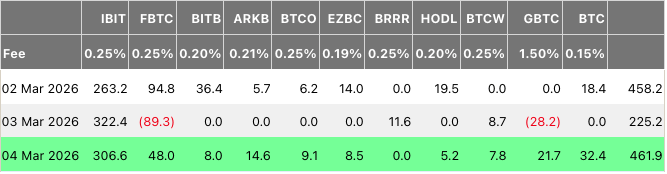
US spot Bitcoin exchange-traded funds increased inflows on Wednesday, with gains distributed across most issuers, as BTC briefly surged past $73,000.
Spot Bitcoin (BTC) ETFs posted $462 million in net inflows, marking the third consecutive day of inflows and bringing the weekly total to $1.1 billion, according to Farside data.
The new gains bring year-to-date flows to about $700 million, a modest amount after the ETFs shed $3.8 billion during a five-week outflow streak.
Ether (ETH) funds shared the sentiment, drawing $169 million in inflows after seeing minor outflows of $11 million on Tuesday.
The flows highlight a potential market reversal, with analysts observing that most Bitcoin ETFs have now turned to net positive flows YTD.
All but one spot Bitcoin fund see gains
Wednesday marked a rare occasion when nearly all US spot Bitcoin funds attracted inflows, with only the CoinShares Bitcoin ETF (BRRR) recording zero inflows on the day.
BlackRock’s iShares Bitcoin Trust ETF (IBIT) again led inflows with $307 million, followed by the Fidelity Wise Origin Bitcoin Fund (FBTC) and the Grayscale Bitcoin Mini Trust ETF (BTC) with $48 million and $32 million, respectively.

According to Bloomberg ETF analyst Eric Balchunas, almost all Bitcoin ETFs had turned net positive in year-to-date flows as of Tuesday, with only three funds still showing losses.
Those include FBTC with $1.1 billion in outflows, as well as the Grayscale Bitcoin Trust ETF (GBTC) and the ARK 21Shares Bitcoin ETF (ARKB), which have seen $648 million and $162 million in outflows, respectively.

The latest wave of gains in Bitcoin ETFs came amid a sentiment recovery attempt, with the Crypto Fear & Greed Index jumping 12 points over the past 24 hours, according to Alternative.me data.
Related: Altcoin chatter sinks to 2-year low as Bitcoin holds attention
Despite Bitcoin recovering about 20% from February’s low of $60,000, the index still stands at “extreme fear” with a score of 20.
At the time of writing, Bitcoin traded at $72,214, down about 8% over the past 30 days, according to CoinGecko.
Magazine: Would Bitcoin really be at $200K if not for Jane Street? Trade Secrets
AI Summary
- The blog post emphasizes the importance of hiring experienced NFT game developers for building successful NFT-powered ecosystems.
- It discusses common failure points in NFT game development, the core capabilities to look for in developers, and the benefits of partnering with a specialized NFT game development company.
- The post highlights the need for expertise in blockchain engineering, game design, backend infrastructure, and security management to create sustainable NFT games.
- It also provides insights on cost considerations, long-term partnership value, and a decision framework for selecting the right development partner.
- Antier is recommended as a suitable development partner due to its expertise in gaming and understanding of technical complexity and economic sustainability in NFT game development.
The NFT gaming market is no longer experimental. Enterprises, gaming studios, & Web3 startups are building NFT-powered ecosystems that combine ownership, interoperability, and tokenized economies. However, while the opportunity is significant, failure rates remain high. The difference rarely lies in the idea. It lies in execution.
Planning to hire experienced NFT game developers is not about adding blockchain functionality to a game. It is about building secure, scalable, economy-driven digital ecosystems that can sustain users, transactions, and growth.
Before choosing a partner, enterprises must understand what truly defines experience in NFT game development and what separates a capable vendor from the best NFT game development company.
Why NFT Games Fail Without the Right Development Team
Many NFT games fail not because of market conditions, but because of technical and architectural weaknesses. Common failure points include:
- Poorly designed tokenomics
- Smart contract vulnerabilities
- Scalability bottlenecks
- Weak backend architecture
- Lack of analytics integration
- Inadequate live-ops planning
NFT games operate at the intersection of blockchain, game design, and economic modeling. A team lacking expertise in even one of these areas creates long-term instability. Enterprises that hire inexperienced NFT game developers often face post-launch issues that require expensive fixes.
What “Experienced” Really Means in NFT Game Development
Experience in NFT game development goes beyond coding smart contracts. True experience includes:
- Designing sustainable in-game economies
- Building secure NFT minting mechanisms
- Implementing gas-efficient smart contracts
- Integrating wallet systems seamlessly
- Managing multi-chain compatibility
- Planning for high transaction throughput
Experienced NFT game developers have in-depth understanding of how blockchain constraints affect gameplay. They design mechanics that account for transaction costs, confirmation delays, and network performance. This level of foresight is critical for long-term success.
Core Capabilities Enterprises Should Look For
When evaluating NFT game developers, enterprises should assess technical depth across multiple domains.
1. Blockchain Engineering Expertise
Developers should demonstrate:
- Smart contract architecture knowledge
- Multi-chain deployment experience
- Security audit readiness
- Token standard implementation expertise
- NFT marketplace integration skills
Weak blockchain engineering creates permanent vulnerabilities.
2. Game Design and Mechanics Understanding
NFT games are still games first and hence developers must understand:
- Player psychology
- Reward loops
- Progression systems
- Competitive balancing
- Retention mechanics
Without strong game design, NFT ownership alone does not drive engagement.
3. Backend Infrastructure and Scalability
A scalable NFT game requires:
- High-performance backend servers
- Real-time gameplay synchronization
- Load balancing systems
- Database optimization
- Analytics pipelines
Scalability issues damage user trust quickly.
4. Security and Risk Management
NFT games involve real asset ownership. Security cannot be optional. Teams should have:
- Smart contract security practices
- Penetration testing workflows
- Fraud prevention systems
- Anti-bot mechanisms
- Wallet security protocols
Security failures often result in irreversible damage.
Planning an NFT Game? Let’s Discuss Your Strategy
Things to Keep in Mind When Hiring NFT Game Developers
Enterprises should be cautious of:
- Teams that focus only on smart contracts
- Lack of scalable backend planning
- No documented delivery process
- Unrealistic timelines
- No post-launch support strategy
A vendor that promises rapid NFT integration without discussing infrastructure and tokenomics likely lacks experience.
In-House vs Hiring a Specialized NFT Game Development Company
Some enterprises consider building internal NFT game teams. While this provides control, it introduces significant hiring and operational challenges. Building an in-house team requires:
- Blockchain engineers
- Backend developers
- Game designers
- UI/UX designers
- DevOps specialists
- Security experts
However, recruiting and coordinating such a team is expensive and time-consuming.
On the other hand, hiring a specialized NFT game development company provides:
- Cross-functional expertise
- Proven frameworks
- Faster time-to-market
- Reduced hiring risk
- Structured delivery models
For most enterprises, partnering with experienced NFT game developers reduces execution risk.
What the Best NFT Game Development Company Offers
The best NFT game development company provides more than technical services. It offers strategic guidance. This typically includes:
- Concept validation
- Tokenomics design consultation
- Architecture planning
- Blockchain selection strategy
- UX optimization
- Monetization alignment
- Compliance considerations
A true development partner aligns technical execution with business objectives.
Cost Considerations When Hiring NFT Game Developers
The cost of hiring NFT game developers tends to vary on the overall scope and complexity. Enterprise NFT games typically range from mid-five to six-figure budgets, depending on:
- Blockchain selection
- Feature depth
- Smart contract complexity
- Backend infrastructure scale
- Integration requirements
Choosing based solely on cost often results in higher long-term expenses due to rework and scalability issues. Investment should be evaluated against long-term platform sustainability.
Long-Term Partnership Value
NFT games evolve continuously. Economy tuning, feature updates, and network upgrades require ongoing technical involvement. Enterprises benefit from partners that provide:
- Continuous optimization
- Performance monitoring
- Economy balancing
- Feature expansion
- Infrastructure scaling
NFT game development is not a one-time project; it is an evolving ecosystem.
Final Decision Framework
Prior to hiring NFT game developers, enterprises should ask:
- Does the team understand both blockchain and game mechanics?
- Can they demonstrate scalable architecture experience?
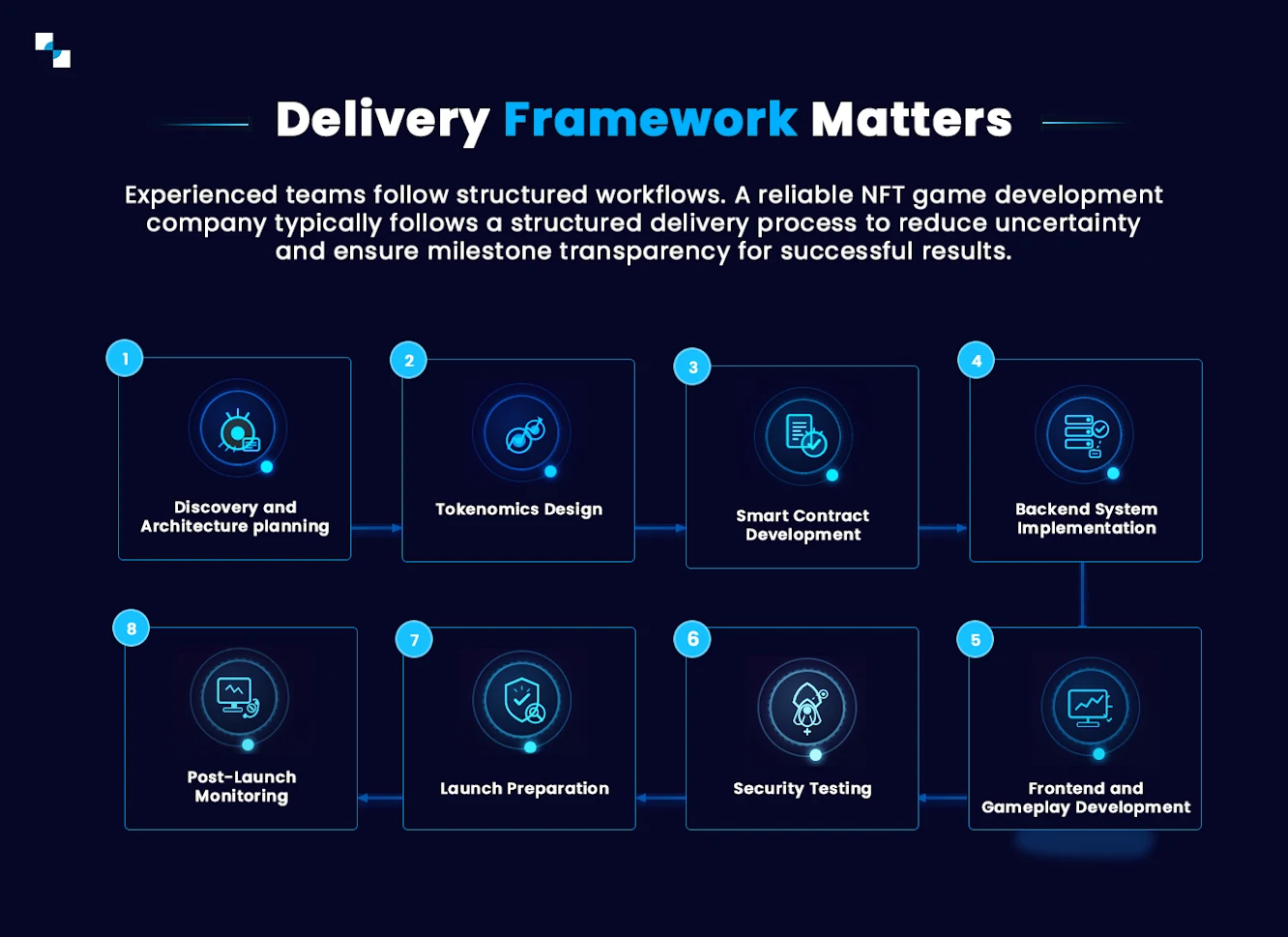
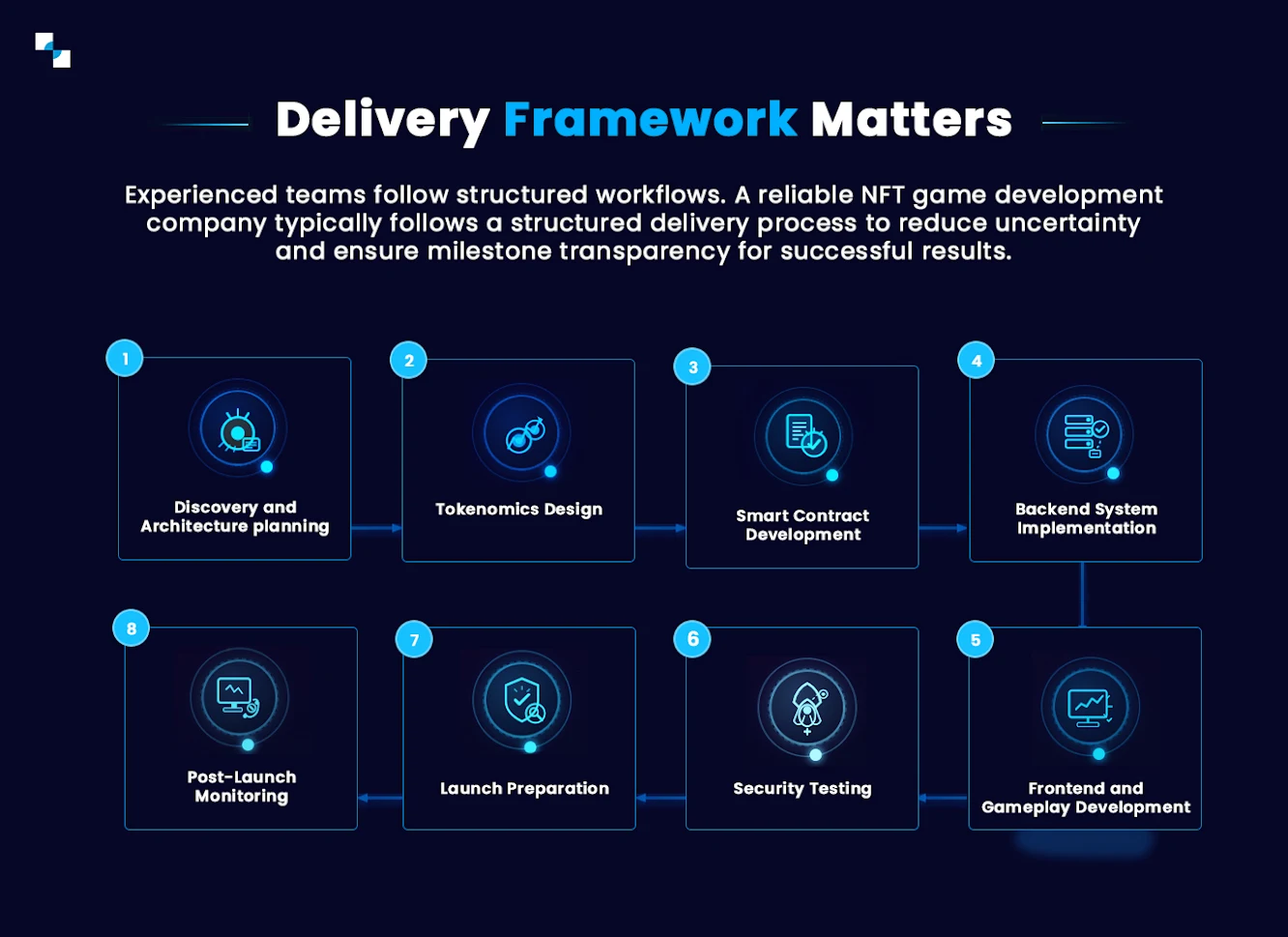
- Do they provide structured delivery processes?
- Can they support long-term growth?
- Do they align technical execution with business goals?
Antier, with its high level expertise & expertise in gaming, happens to be the most suitable development partner to make sure that the NFT game becomes a sustainable ecosystem and not a short-lived experiment.
Enterprises looking forward to building secure, scalable NFT games should work with the best NFT game development company that understands both technical complexity and economic sustainability. The difference between a functioning NFT game and a thriving NFT ecosystem lies in execution, and execution begins with hiring Antier as the right development partner.
Frequently Asked Questions
01. Why do many NFT games fail despite having a good idea?
Many NFT games fail due to technical and architectural weaknesses, such as poorly designed tokenomics, smart contract vulnerabilities, and scalability bottlenecks, rather than market conditions.
02. What should enterprises look for when hiring NFT game developers?
Enterprises should seek developers with experience in designing sustainable in-game economies, building secure NFT minting mechanisms, and managing multi-chain compatibility, among other technical capabilities.
03. How does experience in NFT game development impact long-term success?
Experienced NFT game developers understand blockchain constraints and design mechanics that account for transaction costs and network performance, which is critical for creating stable and successful digital ecosystems.
Bitcoin is currently fightining with a crucial resistance level that could lead to new substantial gains if reclaimed.
Bitcoin’s price moves took a massive turn for the better in the past 24 hours, as the asset finally broke above the coveted $70,000 resistance and tapped a new monthly peak at $74,000.
In this article, we will review some potential reasons behind this rally and outline the next price targets for the cryptocurrency, according to prominent analysts.
The Why?
In a recent post on X, Ali Martinez first laid out the most probable reasons behind the asset’s impressive surge that drove it higher by well over six grand yesterday. Moreover, reaching $74,000 meant that BTC had gained $11,000 since the Saturday low when the strikes between the US, Israel, and Iran began.
The analyst named the ETF flows as the first reason, given the substantial change in investor behavior. Data from SoSoValue paints a clear picture, as the spot Bitcoin ETFs were deep in the red for five consecutive weeks from the one that ended on January 23 to the one that ended on February 20. Within this timeframe, they withdrew nearly $4 billion worth of BTC.
However, they began to pour money in last week (ending on February 27), with $787 million in net inflows, and $683 million has entered the funds in just three trading days during the current one.
However, there’s some discrepancy when it came down to the numbers for this week. While SoSoValue shows $683 million in net inflows, Martinez’s data suggests the value was higher ($789 million), while FarSide claims the actual flows were a whopping $1.145 billion. Nevertheless, even if we take the most modest amount, it still represents a clear shift in investor dynamics.
The two other possible reasons could be related to the ending of the extended Chinese holidays, as well as increased levels of spot buying shown by the BTC CVD indicator – mostly from whales, and not retail.
You may also like:
Next Targets?
Martinez also indicated that BTC had reclaimed an important resistance at $70,685, which was a major cluster. He now believes there’s a very light supply between $72,000 and $81,000, calling it “open air in that range.”
“The next major supply clusters appear around $83,307 and $84,569, which could act as the significant resistance zones.”
The Wolf Of All Streets outlined the significance of the $74,000 level, calling it a “mega technical resistance.”
CryptoWZRD also weighed in on BTC’s recent performance, indicating that it closed bullish. The analysts noted that another move higher is “likely” unless “we face a major geopolitical shift.”
BTC Daily Technical Outlook:$BTC closed bullish. A further upside move is likely from here unless we face a major geopolitical shift. I’ll track the intraday chart tomorrow to get the next quick scalp opportunity ⚡️ pic.twitter.com/naFDHnHKLD
— CRYPTOWZRD (@cryptoWZRD_) March 5, 2026
Binance Free $600 (CryptoPotato Exclusive): Use this link to register a new account and receive $600 exclusive welcome offer on Binance (full details).
LIMITED OFFER for CryptoPotato readers at Bybit: Use this link to register and open a $500 FREE position on any coin!
TLDR
- Eric Trump labeled JPMorgan, Bank of America, and Wells Fargo as “anti-American” over their opposition to stablecoin interest payments
- Traditional banks offer savings rates of 0.01–0.05% APY while receiving approximately 3.65% from Federal Reserve holdings
- Digital currency platforms aim to provide 4–5%+ returns on stablecoins via bills like the Clarity Act
- Jamie Dimon, JPMorgan’s CEO, argued that stablecoin issuers paying interest must face banking regulations
- Presidential crypto advisor Patrick Witt countered Dimon’s stance, asserting yield payments alone don’t justify bank-level oversight
Eric Trump launched a scathing criticism of America’s largest financial institutions this week, claiming they’re actively preventing citizens from accessing superior returns via cryptocurrency stablecoins.
During a Wednesday statement on X, Trump specifically named JPMorgan Chase, Bank of America, and Wells Fargo. His allegations centered on these institutions prioritizing profits over customer welfare.
Trump highlighted the substantial disparity between deposit interest rates paid to customers versus what banks receive from the Federal Reserve. Traditional savings accounts yield merely 0.01% to 0.05% annually for consumers, while banks themselves earn roughly 3.65% on Fed reserves.
He contended that cryptocurrency platforms pose a direct challenge to this arrangement by proposing stablecoin interest rates exceeding 4% to 5%. According to Trump, banking institutions are attempting legislative intervention to prevent this competition.
The American Banking Association along with affiliated lobbying organizations are investing substantial resources to limit these yields through the Clarity Act, Trump alleged. He characterized this campaign as “anti-retail, anti-consumer, and straight-up anti-American.”
Eric Trump serves as co-founder of World Liberty Financial, the organization behind the USD1 stablecoin. This entity is simultaneously pursuing a banking charter via the Office of the Comptroller of the Currency.
The Trump family’s participation in World Liberty Financial has sparked controversy. Questions regarding potential conflicts of interest have emerged, particularly considering President Donald Trump’s influence over cryptocurrency policy.
Banks Push Back on Stablecoin Yields
Traditional financial institutions contend that permitting stablecoin platforms to distribute interest could precipitate a substantial exodus of deposits from conventional banking. They warn this scenario might destabilize the financial system.
JPMorgan CEO Jamie Dimon addressed the controversy earlier this week. His position stated that any stablecoin provider offering interest on holdings must comply with identical regulatory frameworks governing banks.
“If you’re going to be holding balances and paying interest, that’s a bank. You should be regulated like a bank,” Dimon said.
White House Crypto Advisor Responds
Patrick Witt, who directs the President’s Council of Advisors for Digital Assets, challenged Dimon’s characterization. He maintained that connecting stablecoin yields with banking regulations represents a misleading comparison.
Witt clarified the critical distinction: the determining factor isn’t yield distribution itself, but whether platforms engage in lending or rehypothecation of underlying assets. According to Witt, these practices necessitate banking oversight—not simple interest payments.
President Donald Trump addressed the Clarity Act via social media on Tuesday, urging congressional action. His message contained comparable criticisms regarding banking sector resistance to stablecoin provisions.
Donald Trump’s statement followed closely after his meeting with Coinbase CEO Brian Armstrong. Armstrong had publicly retracted his endorsement of the legislation in January, expressing reservations about stablecoin language and additional bill components.
The White House has facilitated ongoing negotiations between traditional finance representatives and crypto industry leaders seeking resolution. Currently, the parties haven’t achieved consensus on stablecoin yield regulations.

A closer look at some of the most important stories you might have missed in the past 24 hours.
A lot happened in the world of cryptocurrencies over the last 24 hours. We have handpicked a few of the more important titles you may have missed, so let’s have a quick look.
Google Warns of New iPhone Exploit Targeting Crypto Users
Google researchers have flagged a relatively powerful exploit kit that they call “Coruna.” It is capable of infecting iPhone devices and potentially jeopardizing sensitive information, including seed phrases of cryptocurrency wallets. The toolkit contains a total of 23 vulnerabilities across five exploit chains that target devices running older versions of iOS, ranging from iOS 13 to 17.2.1.
Multiple security analysts say that attackers have managed to deploy the exploit through compromised websites and fake crypto-oriented platforms. Once a vulnerable device visits the website, malware can scan messages and apps like MetaMask to locate wallet credentials or financial information.
The exploit has originally been linked to espionage campaigns before spreading to cybercriminal groups with financial motives. This highlights how advanced surveillance tools can leak into the broader criminal ecosystem, as well as the critical importance of maintaining technological hygiene, updating your phone’s software, and following mandatory security tips when interacting with crypto platforms.
Morgan Stanley Taps Coinbase and BNY Mellon for Bitcoin Infrastructure
Morgan Stanley is preparing to deepen its involvement in crypto infrastructure. The banking behemoth is supposedly considering launching a Bitcoin investment product. The bank intends to rely on Coinbase for cryptocurrency custody services, as well as on BNY Mellon for additional asset custody related to the proposed Morgan Stanley Bitcoin Trust.
The ETF itself will hold Bitcoin directly, and the custody structure will primarily rely on offline cold storage to reduce hacking risks, according to the filing.
The move signals growing institutional demand for regulated access to crypto products. Major financial institutions have undoubtedly increased their involvement and partnered with well-known crypto firms rather than building their own infrastructure in a bid to accelerate Wall Street’s venture into the digital asset industry.
You may also like:
Zerohash Applies for U.S. National Trust Bank Charter
Popular crypto infrastructure firm Zerohash has formally applied for a National Trust Bank Charter with the U.S. Office of the Comptroller of the Currency (OCC). This step could enable the company to operate as a federally regulated trust bank.
If the application is approved and the charter granted, this would allow Zerohash to further expand its services to niches such as digital asset custody, stablecoin management, and tokenized asset infrastructure under a unified federal regulatory framework.
The company is already powering crypto integrations for institutions, which include Morgan Stanley, Stripe, and Interactive Brokers. The move comes a day after Kraken became the first crypto company to obtain a Fed Master Account.
Venture Giant a16z Targets $2 Billion for a New Crypto Fund
Silicon Valley venture capital powerhouse Andreessen Horowitz (a16z) is raising around $2 billion for a fund focused on investing in the cryptocurrency industry. According to the reports, the round can close as early as the first half of this year.
Historically, a16z has been one of the most prominent VCs in the Web3 ecosystem, backing major projects and startups across blockchain infrastructure, crypto apps, DeFi, and related areas.
Despite the ongoing crypto winter, a new fund of this size suggests that venture investors still see long-term opportunity, highlighting that periods of pressure can also be times of opportunity. Recall that Dragonfly – another crypto-oriented VC – recently launched their fourth fund worth $650 million.
Tether Makes $1.5 Billion Bet on AI Sleep Tracking
Last but not least, we have the stablecoin giant Tether making a strategic investment in the AI-powered mattress and sleep-oriented technology company Eight Sleep at a $1.5 billion valuation.
The investment seems to be part of the firm’s broader strategy to diversify and expand well beyond crypto and stablecoins into emerging sectors such as health technology and artificial intelligence.
Binance Free $600 (CryptoPotato Exclusive): Use this link to register a new account and receive $600 exclusive welcome offer on Binance (full details).
LIMITED OFFER for CryptoPotato readers at Bybit: Use this link to register and open a $500 FREE position on any coin!

Pi Network’s PI Steals the Show With Big Rally, Bitcoin Stopped at $74K: Market Watch

Anthropic CEO Dario Amodei calls OpenAI’s messaging around military deal ‘straight up lies,’ report says

“It’s just another day in Israel" Former News reporter describes his journey to the Middle East as missiles flew overhead


-

 Politics6 days ago
ITV enters Gaza with IDF amid ongoing genocide
-

 Politics2 days ago
Alan Cumming Brands Baftas Ceremony A ‘Triggering S**tshow’
-

 Fashion6 days ago
Weekend Open Thread: Iris Top
-

 Tech4 days ago
Unihertz’s Titan 2 Elite Arrives Just as Physical Keyboards Refuse to Fade Away
-
Sports5 days ago
The Vikings Need a Duck
-
 NewsBeat5 days ago
Dubai flights cancelled as Brit told airspace closed ’10 minutes after boarding’
-

 NewsBeat4 days ago
‘Significant’ damage to boarded-up Horden house after fire
-
 NewsBeat5 days ago
The empty pub on busy Cambridge road that has been boarded up for years
-

 NewsBeat5 days ago
Abusive parents will now be treated like sex offenders and placed on a ‘child cruelty register’ | News UK
-

 Tech3 hours ago
Bitwarden adds support for passkey login on Windows 11
-

 Entertainment3 days ago
Baby Gear Guide: Strollers, Car Seats
-
 Tech6 days ago
NASA Reveals Identity of Astronaut Who Suffered Medical Incident Aboard ISS
-

 Business7 days ago
Only 4% of women globally reside in countries that offer almost complete legal equality
-
Politics4 days ago
FIFA hypocrisy after Israel murder over 400 Palestinian footballers
-
 NewsBeat4 days ago
Emirates confirms when flights will resume amid Dubai airport chaos
-

 NewsBeat3 days ago
Is it acceptable to comment on the appearance of strangers in public? Readers discuss
-

 Crypto World6 days ago
From Crypto Treasury to RWA: ETHZilla Retreats and Relaunches as Forum Markets on Nasdaq
-

 Tech4 days ago
Viral ad shows aged Musk, Altman, and Bezos using jobless humans to power AI
-

 Business7 days ago
World Economic Forum boss Borge Brende quits after review of Jeffrey Epstein links
-

 Video3 days ago
How to Build Finance Dashboards With AI in Minutes