

Crypto World
Crypto Stocks Rally as Trump and Regulators Push Pro-Crypto Agenda


Crypto-related equities surged on Wednesday as pro-crypto commentary from Washington and expectations of a clearer regulatory path bolstered risk appetite. Bitcoin (CRYPTO: BTC) led the upward move, rising more than seven percent in the past 24 hours to the mid-72,000s, while Ether (CRYPTO: ETH) joined the rally with an about eight percent gain. Publicly traded names tied to crypto wealth and infrastructure posted standout moves: MicroStrategy (EXCHANGE: MSTR) shares jumped north of 10%, Coinbase (EXCHANGE: COIN) climbed over 14%, Hut 8 Mining (EXCHANGE: HUT) advanced about 13.89%, and American Bitcoin Corp (EXCHANGE: ABTC) rose roughly 11.65%.
Dominick John, an analyst at Zeus Research, told Cointelegraph that the rally appears linked to the prospect of clearer rules on the horizon. “Crypto equities are rallying as regulatory risk is being fundamentally redefined. With the executive branch championing a clear digital asset framework, coupled with robust spot ETF inflows and the potential passage of the Clarity Act,” he said. “The trend will persist as regulatory clarity strengthens and institutional flows accelerate. With policy risk receding and product demand expanding, crypto equities have room to reprice higher in the medium term.”
“Crypto equities are rallying as regulatory risk is being fundamentally redefined. With the executive branch championing a clear digital asset framework, coupled with robust spot ETF inflows and the potential passage of the Clarity Act,” he said.
Key takeaways
- Regulatory clarity expectations are lifting crypto equities as policymakers signal a more defined digital asset framework and as spot ETF activity strengthens.
- Major crypto-adjacent stocks posted material gains: MicroStrategy (EXCHANGE: MSTR) rose more than 10%, Coinbase (EXCHANGE: COIN) gained over 14%, Hut 8 Mining (EXCHANGE: HUT) advanced 13.89%, and American Bitcoin Corp (EXCHANGE: ABTC) climbed 11.65%.
- Regulatory moves advanced on multiple fronts: the CFTC filed for a regulatory review of prediction markets, while the SEC filed a pending application centered on Federal Securities Laws as they relate to crypto transactions.
- Political signals from the White House and supporters of crypto policy, including calls for market-structure legislation, contributed to the swing in sentiment.
- There is a caveat: the rally could cool if regulatory progress stalls or if Bitcoin retreats, underscoring the sensitivity of crypto equities to policy momentum and macro moves.
Tickers mentioned: $BTC, $ETH, $COIN, $MSTR, $HUT, $ABTC
Sentiment: Bullish
Price impact: Positive. A broad uptick in both the crypto market and related equities points to constructive liquidity and policy optimism gripping the sector.
Trading idea (Not Financial Advice): Hold. If regulatory momentum sustains and BTC maintains elevated levels, the bounce could extend; but a delay or reversal in policy progress would raise the risk of a pullback.
Market context: The move aligns with a broader risk-on tilt in crypto markets as investors price in regulatory clarity, potential ETF inflows, and evolving political support for crypto-friendly legislation, all of which can influence both spot prices and equity exposures tied to digital assets.
Why it matters
The current trajectory matters because it underscores how policy clarity can translate into tangible capital flows for both tokens and crypto-linked equities. As Washington signals a more explicit approach to digital assets, institutional interest tends to rise, creating demand not only for spot exposure but also for products and services that leverage the crypto ecosystem. The rally in MicroStrategy’s shares reflects the market’s perception that corporate treasury strategies that hoard Bitcoin may continue to benefit from price strength and demand for governance-friendly structures around holdings.
Similarly, Coinbase and other listed companies demonstrate how crypto maturity is intersecting with traditional markets. A sustained uptick in prices for BTC and ETH can lift trading activity, mining economics, and service demand for custody, lending, and staking products. The broader takeaway is that policy momentum—if it persists—could act as a catalyst for both price appreciation and the expansion of crypto-focused financial products. The prospect of a clear framework reduces policy risk, enabling more reliable forecasting for investors and incumbents alike.
Yet the landscape remains nuanced. The same catalysts driving optimism—clearer regulation, ETF flows, and favorable political rhetoric—can invert if regulatory conversations stall or if macro momentum shifts. Traders highlighted by Swyftx’s Pav Hundal warned that even a temporary setback in policy or a pullback in Bitcoin could reprice equities quickly, given the leverage that many crypto-related businesses carry and the sensitivity of their earnings to asset prices. The market’s reaction in the near term will likely hinge on the speed and specificity of policy milestones, not merely on aspirational statements from leadership.
What to watch next
- Regulatory milestones: Monitor any progress on the Clarity Act or related crypto policy bills, and timing around potential votes or committee actions.
- ETF inflows: Track fresh data on spot ETF demand and related products that could channel more fiat liquidity into the crypto ecosystem.
- Federal Securities Laws: Observe developments in the SEC’s pending application and the GRCs around crypto transactions, as described in the agency’s filings.
- Bitcoin price dynamics: Watch whether BTC can sustain levels in the low-to-mid 70,000s and how this influences risk appetite in related equities.
- Political signals: Keep an eye on White House communications and legislative activity around crypto-market structures, as these can amplify or dampen sentiment shifts.
Sources & verification
- U.S. Commodity Futures Trading Commission: regulatory review filing for prediction markets (https://www.reginfo.gov/public/do/eoDetails?rrid=1294517).
- U.S. Securities and Exchange Commission: pending filing on Federal Securities Laws and crypto governance (https://www.reginfo.gov/public/do/eoDetails?rrid=1217012).
- Bitcoin price data and market movement cited by CoinGecko (https://www.coingecko.com/en/coins/bitcoin) and Ethereum price data (https://www.coingecko.com/en/coins/ethereum).
- Company price references and tickers via Google Finance pages for MSTR, COIN, HUT, and ABTC.
- Related coverage and quotes, including comments from Dominick John of Zeus Research and Swyftx analyst Pav Hundal, as reported in Cointelegraph.
Market reaction and key details
What the announcement changes
Bitcoin (CRYPTO: BTC) breached notable intraday gains as traders chased the prospect of regulatory clarity and new product avenues. The day’s rotation into equities tied to crypto assets reflects a broader rehearsal for institutional participation, with investors looking for policy breadcrumbs and potential structural protections that could sustain longer-term demand. The initial impulse from Washington, coupled with ongoing regulatory reviews, appears to be shaping a cautious, but increasingly confident, risk environment for digital assets and the companies that hold or facilitate them. The tone of policy discourse matters as much as the price action, because credibility around a defined framework can unlock capital that has previously stayed on the sidelines for fear of regulatory ambiguity.
Why it matters (conclusion)
In sum, the current episode illustrates a market sensitive to the narrative of clarity. If regulators deliver a robust, well-communicated framework, crypto equities could reprice higher over the medium term as institutional players expand their exposure. Conversely, any disappointment or a stall in policy momentum could extinguish the current enthusiasm, given the leverage and sensitivity of crypto-related earnings to asset prices. For traders and investors, the immediate imperative is to watch policy milestones and price stability in the underlying assets, as those variables are the most direct catalysts for sustained momentum or a renewed pullback.
Sources & verification
- Official regulatory filings from the CFTC and SEC cited in the article (see links above).
- Crypto price data and market movements from CoinGecko (BTC and ETH) and Google Finance (MSTR, COIN, HUT, ABTC).
- Analysts and industry commentary referenced, including Dominick John of Zeus Research and Pav Hundal of Swyftx, as cited in the piece.

Crypto World
Rigetti Computing (RGTI) Stock: Revenue Miss Doesn’t Shake Analyst’s 142% Upside Forecast

Key Highlights
- Fourth quarter 2025 revenue dropped 17.6% annually to $1.87 million, falling short of the $2.33 million analyst consensus
- Mizuho’s Vijay Rakesh lowered his price target to $43 from $50 while keeping a Buy rating, seeing 142% potential upside
- The company reached 99.9% two-qubit gate fidelity at 28 nanoseconds, potentially outpacing rivals by 3–5x
- Cash reserves stand at approximately $590 million, with an $8.4 million contract from India’s Centre for Development of Advanced Computing
- The roadmap includes exceeding 150 physical qubits by December 2026 and surpassing 1,000 by late 2027
Rigetti Computing’s fourth quarter financial performance disappointed investors, yet the company’s technological achievements paint a more optimistic picture. Let’s break down the situation.
The company reported Q4 2025 revenue of $1.87 million, representing a 17.6% decline compared to the prior year period and missing analyst expectations of $2.33 million. The previous quarter saw revenue of $2.3 million, highlighting a notable sequential decline.
Gross profit margins also contracted, sliding to 35% from the 44% recorded in Q4 2024. Management pointed to contract mix as the primary factor behind this margin compression.
Operating losses expanded to $22.6 million during the quarter versus $18.5 million in the year-ago period. Operating expenses climbed to $23.2 million from $19.5 million, primarily reflecting increased investment in research and development.
The company recorded a per-share loss of $0.03, matching Wall Street’s consensus forecast.
In response, Mizuho’s Vijay Rakesh reduced his price objective from $50 to $43 — representing a 14% reduction. However, he maintained his Buy recommendation.
The $43 target price suggests approximately 142% potential upside from present trading levels. Rakesh’s valuation methodology applies roughly 9x to his projected revenue 30 months forward, based on Rigetti capturing a 10% share of the quantum computing sector.
First Quarter Guidance and Contract Pipeline
Rakesh projects Q1 2026 revenue reaching $3 million — representing a 62% sequential increase and 106% growth year-over-year. This anticipated expansion is primarily driven by Rigetti’s $5.7 million Novera quantum processor agreement.
Additionally, the company plans to ship its inaugural Cepheus-1 108-qubit system to India’s Centre for Development of Advanced Computing during the latter half of 2026, representing an $8.4 million engagement.
Rigetti’s balance sheet shows approximately $590 million in cash, providing sufficient capital to pursue its development timeline without near-term funding concerns.
Quantum Hardware Advancements
On the technology front, Rigetti demonstrated 99.9% two-qubit gate fidelity utilizing an innovative adiabatic CZ technique at 28 nanoseconds. According to the company, this performance potentially exceeds competing methodologies by a factor of 3 to 5.
The company has successfully deployed both an 84-qubit monolithic chip architecture and a 36-qubit chiplet-based configuration to cloud platforms.
Rigetti manages Fab One, characterized as the quantum computing industry’s first purpose-built integrated device fabrication center.
Strategic collaborations include working with Riverlane on error correction technologies and Nvidia to connect quantum processors with GPUs and CPUs through NVLink, leveraging CUDA-Q software for hybrid computing environments.
The company’s technical roadmap calls for exceeding 150 physical qubits by December 2026 and surpassing 1,000 qubits by year-end 2027. Management estimates quantum advantage is approximately three years from realization.
According to TipRanks, RGTI stock carries a Moderate Buy consensus rating derived from five Buy recommendations and two Hold recommendations. The analyst average price target stands at $37.60, suggesting approximately 111.7% upside potential from current trading prices.
Over the trailing twelve months, RGTI stock has appreciated more than 117%.

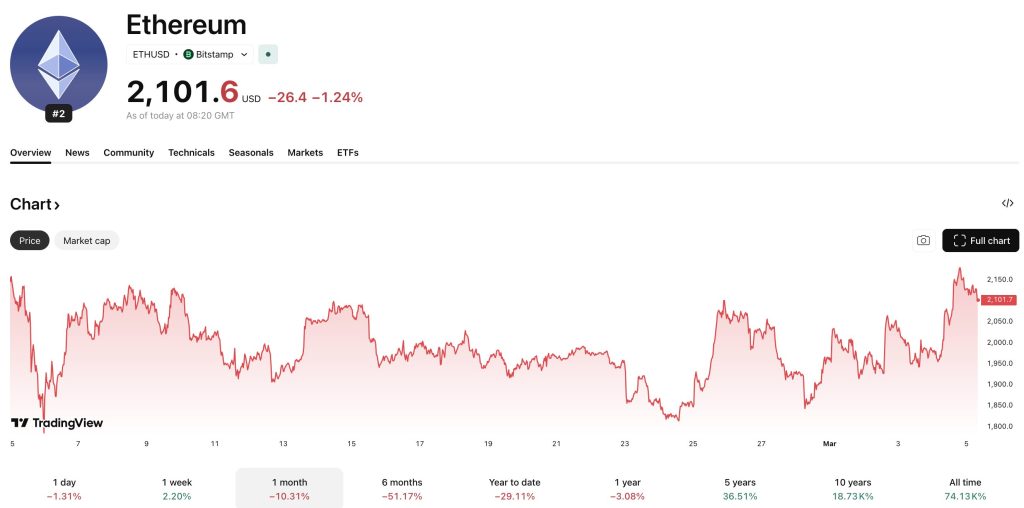
Vitalik Buterin just dropped a bombshell on Ethereum and its ultimate endgame with a “Sanctuary Tech” manifesto. The manifesto, which dropped on March 3, has gone under the radar due to ongoing macroeconomic tensions and an overall lack of retail interest in ETH USD and across the broader crypto market.
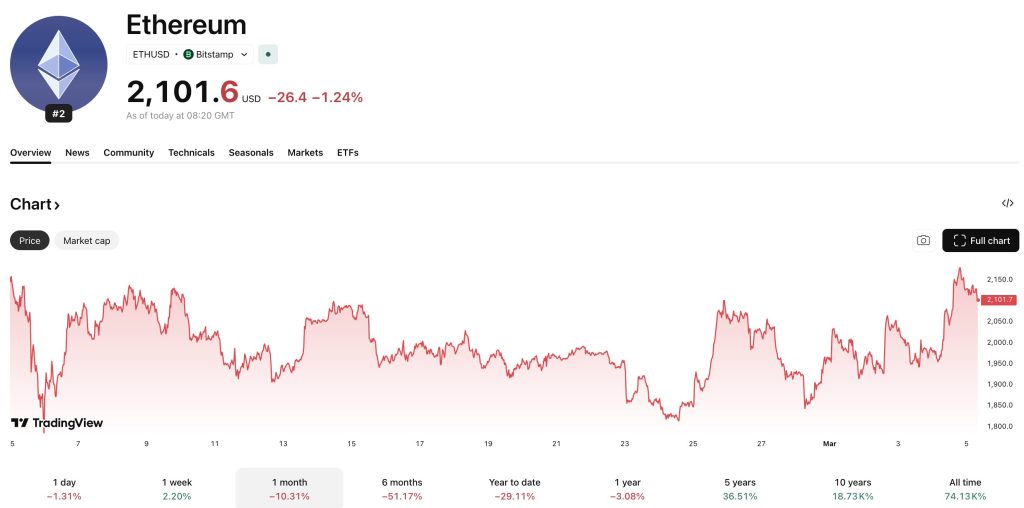
While the Ethereum co-founder outlines a future of resilient “digital islands” and anti-censorship upgrades, immediate price action remains hostage to a brutal institutional rotation. Currently up +6% overnight, the Ethereum price is enjoying a rare period of green candles and bullish sentiment.
What is Vitalik’s Sanctuary Tech: Big Moves Coming for Ethereum?
Ethereum co-founder Vitalik Buterin outlined a vision on March 3, when he took to X to state his desire to create “digital islands of stability” to counter growing government control, corporate power, and surveillance.
He acknowledged concerns that Ethereum hasn’t significantly improved lives in areas like freedom and privacy. To address this, he proposed “sanctuary technologies” that enable individuals and institutions to operate independently of outside pressures.
Buterin envisions Ethereum as a shared, ownerless digital space for building resilient social and economic structures, rejecting the idea of total dominance by any single corporation.
He believes infrastructure that withstands challenges will hold greater value for traders, and it could signal a huge shift for the future of the Ethereum network.
DISCOVER: Next Crypto to Explode in 2026
The Ethereum ETF Picture: BlackRock Hits $100M Positive Flows in the Last Three Days
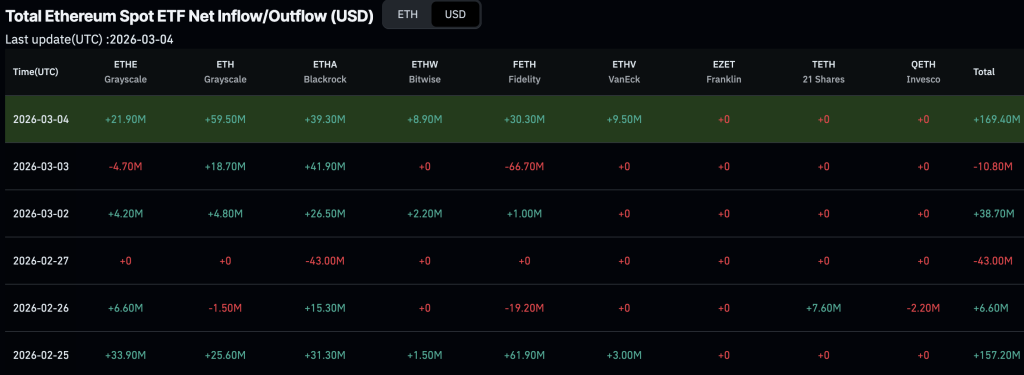
The Ethereum ETF landscape is currently a positive beacon amid a crumbling market. While crypto has enjoyed a rare period of green candles this week, overall price action has been horrendous since the October 2025 cycle highs.
ETFs have remained a solid foundation for ETH USD, with BlackRock (ETHA) leading the way with over +$110M in positive flows in the past week alone.
Grayscale is next up and across its two products (ETH and ETHE), the asset manager has seen more than +$170M in flows since February 25.
These recent moves signal that institutional capital wants greater exposure, even amid growing global economic tensions.
Asset managers aren’t the only firms choosing ETH/USD as an investment. Harvard recently announced it had cut its Bitcoin ETF exposure in favour of Ethereum.
Ethereum Price Analysis: Can $2,000 ETH USD Hold the Line?
The conflict between vision and flows converges at $2,000 on the chart. ETH USD is currently trading at around $2,100, and this level is the current line in the sand. If bulls can hold $2,000, the immediate target returns to the $2,300 resistance band, which also marks the February high.
A daily close above $2,350 would confirm that the BlackRock and Grayscale ETF flows are finally overpowering the sell-side pressure.
However, the downside scenario remains active. If $2,000 fails the hold once more, the door opens to $1,700, a capitulation wick zone.
Analysts tracking current volatility suggest that while AI models predict a recovery in the medium term, the immediate trend requires the $2,000 level to hold.
Watch the daily net flow data for the various ETF products. If we see three consecutive days of net positive inflows exceeding $50M, along with a reclaim of $2,300, Vitalik’s “Sanctuary Tech” narrative will likely begin to catch some attention. On the other hand, if the flows flip negative, the roadmap won’t save the price from testing lower support.
EXPLORE: Best Crypto Presales to Buy in 2026
The post Vitalik Drops Ethereum Endgame Bombshell: ETH USD to $3,000? appeared first on Cryptonews.

TLDR
- Baird maintained its Outperform rating on Nvidia while increasing the price target from $275 to $300
- Wedbush similarly elevated its target to $300 from $230, keeping its Outperform stance
- Analysts highlight Q1 guidance as exceeding buy-side expectations by a significant margin
- The chipmaker has ceased production of China-specific processors, redirecting TSMC capacity toward upcoming Vera Rubin architecture
- Shares of NVDA are currently trading around $183, reflecting gains exceeding 1,100% over three years
The semiconductor powerhouse reported an impressive quarterly revenue of $68 billion, marking a 73% year-over-year surge, prompting analysts to adjust their outlooks upward.
On February 26, Baird confirmed its Outperform stance on Nvidia while bumping its price objective from $275 to $300. The investment firm highlighted data center revenue acceleration reaching nearly double its prior growth pace, while noting that virtual reality metrics are outperforming competitor benchmarks.
Wedbush echoed this sentiment on the same date, upgrading its price objective from $230 to $300 and maintaining its Outperform designation.
Both analyst firms see potential gains exceeding 69% from the stock’s current trading range.
Wedbush emphasized that the Q1 guidance represented the most impressive aspect of Nvidia’s quarterly disclosure. According to the firm, the forward-looking projections substantially exceeded previous buy-side estimates.
Baird revised its financial models to incorporate the robust performance across business segments, with particular strength in data center operations and virtual reality divisions.
NVDA shares currently hover near $183, positioning the company’s market capitalization at roughly $4.4 trillion. The 52-week trading band extends from $86.62 to $212.19.
The equity trades at approximately 22x forward earnings projections, which several market observers consider attractive relative to its expansion profile.
Manufacturing Pivot from China to Vera Rubin Platform
According to a Financial Times article from March 5, Nvidia has discontinued production of semiconductors designated for Chinese customers.
The company has reallocated its manufacturing resources at TSMC, shifting from H200 chip production to focus on its upcoming Vera Rubin generation.
Sources familiar with the situation informed the Financial Times that Nvidia anticipates persistent regulatory obstacles from both U.S. and Chinese authorities will constrain China sales for the foreseeable future.
The Vera Rubin architecture is slated for introduction in late 2026, aligning with Nvidia’s strategy of implementing yearly GPU architecture updates.
Understanding the Analyst Price Projections
Achieving the $300 target from the current $183 level would necessitate approximately 64% appreciation.
One market analyst following the semiconductor giant projects Nvidia could approach $250 within the calendar year, implying a 37% advance from its March 2 closing price.
The same analyst suggested that while $300 remains achievable under favorable market circumstances and reduced investor anxiety, the $250 scenario appears more probable in the immediate term.
Customer appetite for preceding GPU generations—including Blackwell and Blackwell Ultra architectures—remains robust, while cloud service providers continue substantial capital allocation toward AI infrastructure buildouts.
Nvidia’s commitment to annual GPU architecture refreshes maintains a consistent product roadmap for enterprises seeking cutting-edge AI computing capabilities.
As of March 5, NVDA closed at $183.08, posting a 1.68% intraday gain.
Crypto World
IREN deepens AI push with 50,000 Nvidia GPU order; shares fall on at-the-market offering


IREN (IREN), a data center operator focused on AI cloud infrastructure, said it agreed to buy more than 50,000 specialized processing chips from Nvidia (NVDA), expanding its capacity by about 50%.
The B300 GPUs, or graphic processing units, will take the Sydney-based company’s total AI compute fleet to about 150,000 GPUs. A GPU is a specialized chip for performing large numbers of parallel computations, enabling the training and operation of artificial intelligence models at high speed.
The company also filed for a potential at-the-market share sale of up to $6 billion as part of its broader capital management strategy. The shares dropped 5% in pre-market trading on Thursday due to potential dilution.
The additional hardware is expected to be deployed in phases through the second half of 2026 across the company’s air-cooled data centers in Mackenzie, British Columbia, and Childress, Texas. Once fully deployed, the expanded fleet is projected to support more than $3.7 billion in annualized AI cloud revenue, positioning IREN among the larger AI cloud infrastructure providers globally.
IREN said it has secured about $9.3 billion in funding over the past eight months through customer prepayments, convertible notes, GPU leasing and financing arrangements, with roughly $3.5 billion in additional capital expenditures expected for the new GPU deployments in the second half of 2026.

War news may have investors on edge, but when fed a careful prompt, Claude AI reveals the medium-to-long-term outlook for crypto markets is only strengthening.
Investors appear to have largely priced in geopolitical risk earlier this year, following sharp selloffs sparked by former President Trump’s comments on potential U.S. military escalation tied to Greenland and Iran.
Against that backdrop, Claude is forecasting fresh all-time highs (ATHs) in 2026 for XRP, Solana and Cardano.
XRP ($XRP): Claude AI Sees a 6x Surge in 10 Months
In a recent statement, Ripple reiterated that XRP ($XRP) sits at the center of its strategy to position the XRP Ledger (XRPL) as a global, enterprise-grade payments network.

With near-instant settlement and extremely low transaction fees, XRPL is likely to gain an early lead in two of crypto’s fastest-expanding sectors: stablecoins and tokenized real-world assets.
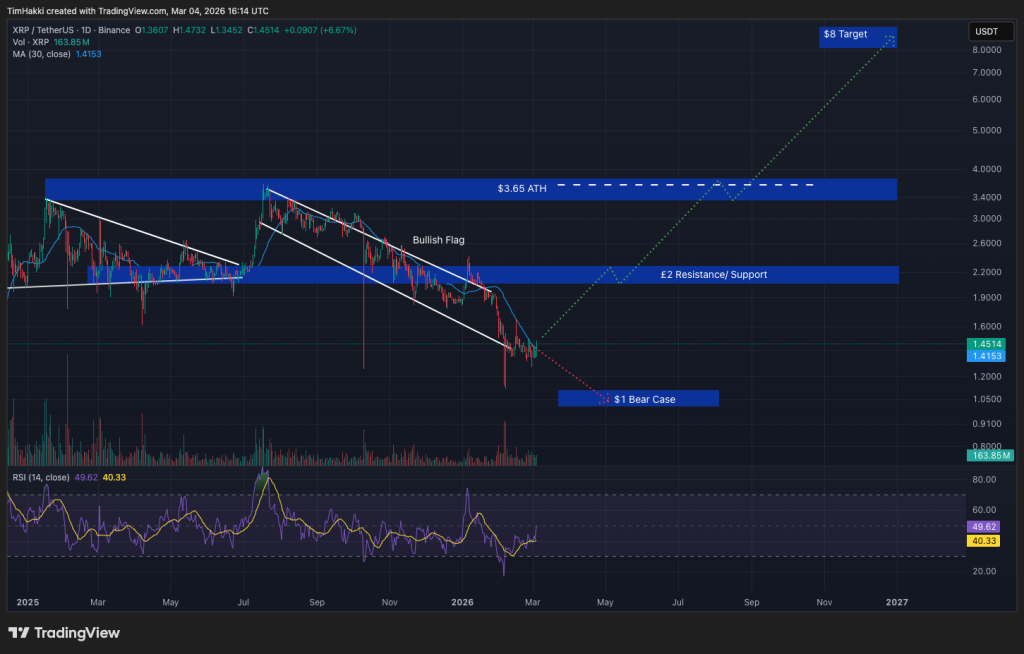
XRP is currently trading around $1.40, and Claude’s projections point to a possible surge toward $8 before year-end, implying a sixfold increase from current levels.
Technical indicators support the optimistic outlook. XRP’s relative strength index (RSI) is sitting at a neautral 50, while prices have stabilized around the 30-day moving average, suggesting the prolonged consolidation phase may be over.
Additional upside drivers include growing institutional exposure following the launch of U.S.-listed XRP ETFs, Ripple’s expanding global partnerships, and the prospect of clearer regulation if the CLARITY bill advances through Congress later this year.
Solana (SOL): Could Solana Really Break Past Its Previous High This Year?
Solana ($SOL) currently secures $6.8 billion in total value locked and has a market capitalization of $52 billion.
Institutional interest accelerated after the recent rollout of Solana-based exchange-traded funds from major asset managers, including Bitwise and Grayscale.
Despite this, SOL pulled sharply back toward the end of 2025 and spent much of February trading below $100.
Under Claude’s most bullish scenario, Solana could rally from its current price near $91 to $500 by Christmas. That would represent a 5.5x gain and place Solana high above its current ATH of $293, reached in January 2025.
Strengthening the long-term case, asset managers like Franklin Templeton and BlackRock are deploying tokenized products on Solana, highlighting the network’s early lead as a scalable, institution ready blockchain.
Cardano (ADA): Claude AI Envisions Up to 1,000% Upside
Created by Charles Hoskinson, Cardano ($ADA) focuses on academic research, rigorous security standards, scalability, and long-term sustainability.
With a market value over $10 billion and more than $140 million in TVL, Cardano’s ecosystem continues to expanding in step with the industry leaders.
Claude’s outlook suggests ADA could rise by more than 1,-00%, climbing from roughly $0.28 today to nearly $3.25 by Christmas. That would surpass its previous peak of $3.09 set in 2021.
The biggest driver for Cardano’s growth would be comprehensive crypto legislation in the US. With regulatory certainty comes capital, which will allow the best altcoins to decouple from Bitcoin’s price movements.
Given the global uncertainty, further downside cannot be ruled out, including a potential drop toward $0.15 if bearish conditions intensify.
Maxi Doge: Early-Stage Meme Coin Targets Explosive Gains
Strength in XRP, Solana and Cardano will spill over into the meme coin sector, as historically seen during major bull cycles.
One emerging project attracting significant attention is Maxi Doge ($MAXI), which has already raised $4.7 million in its ongoing presale as meme coin traders speculate it could dethrone Dogecoin.
Maxi Doge brands itself as Dogecoin’s brash, gym-obsessed degen cousin, tapping into the viral, loud meme culture that defined the 2021 bull market.
Launched as an ERC-20 token on Ethereum’s proof-of-stake network, MAXI also has a smaller environmental footprint compared to Dogecoin’s proof-of-work design.
Early presale buyers can currently stake MAXI for yields of up to 67% APY, with rewards tapering as additional tokens enter the staking pool.
The token is $0.0002807 in the current presale round, with automatic price increases scheduled at each funding milestone.
Investors looking to secure tokens can visit the official website and connect a supported wallet such as Best Wallet.
Purchases can also be completed using a bank card.
Visit the Official Website Here
The post Leading AI Claude Predicts the Price of XRP, Solana and Cardano by the end of 2026 appeared first on Cryptonews.
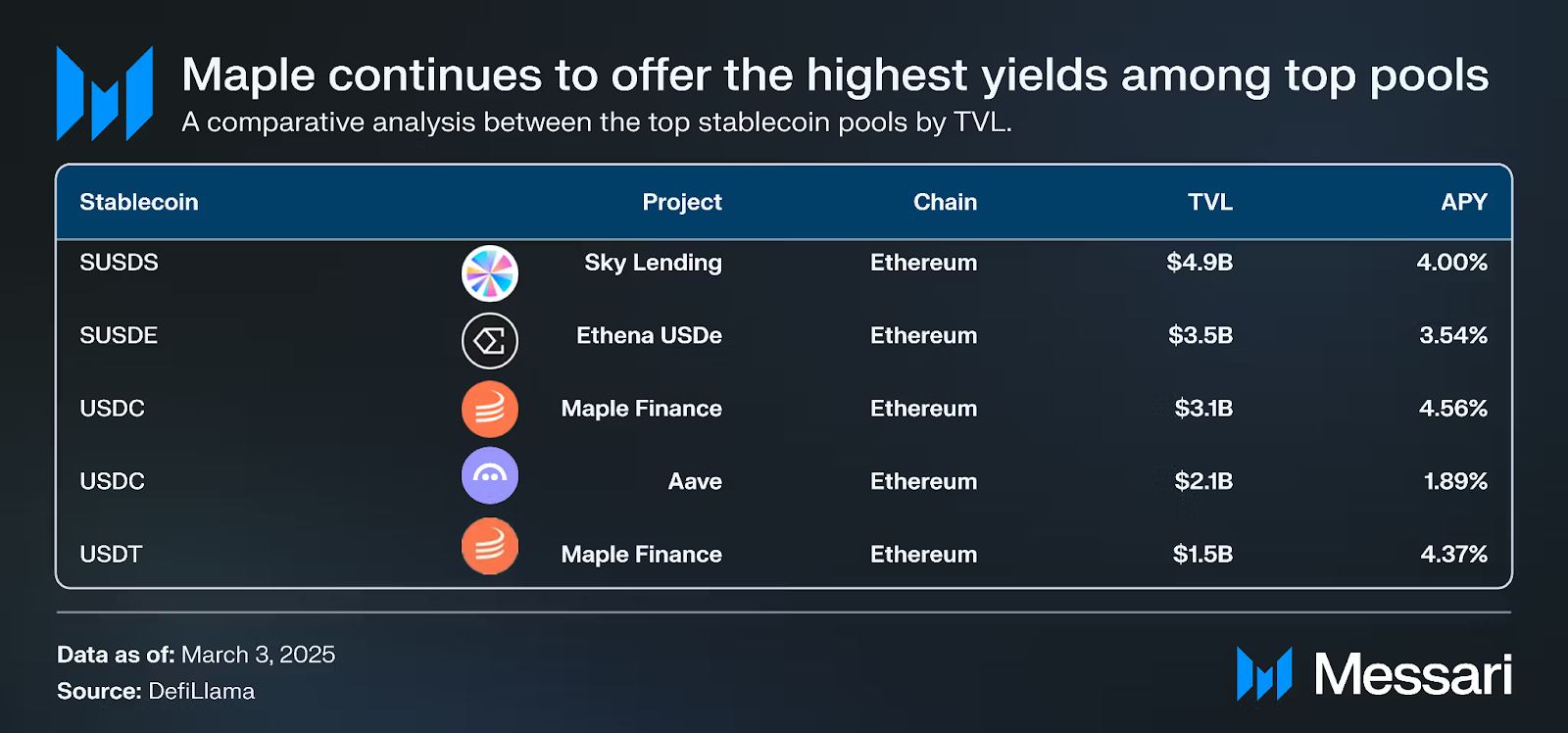
Weekly net stablecoin inflows rebounded last week as onchain activity picked up even while US lawmakers and banking groups sparred over whether stablecoin issuers should be allowed to pay yield, according to a new report from Messari.
Weekly net stablecoin inflows accelerated to $1.7 billion, a 414.5% increase week-on-week, according to the report published on Wednesday.
The recovery also flipped the 30-day average to a positive $162.5 million in daily inflows. Transaction volumes also rose 6.3%, while average transaction size continued to decline, reflecting renewed stablecoin issuance demand and “strengthened” onchain activity amid retail investors, the report said.
Stablecoin inflows track net new stablecoins entering circulation after accounting for redemptions.
The surge follows a weaker period earlier in the year. Messari data showed $249 million in weekly inflows two weeks earlier and $4.4 billion in net outflows over the 30 days leading up to Feb. 18.

Stablecoin yield debate stalls US market structure bill
The renewed demand comes as debate in Washington has sharpened over “yield-bearing” stablecoins. Banking groups have argued that allowing stablecoin issuers to pay yield would create a loophole that could pull deposits away from banks, and have urged lawmakers to restrict the practice as they negotiate a broader crypto market structure bill.
Related: Indiana lawmakers pass crypto rights bill banning discriminatory taxes
Initially scheduled for mid-January, the Senate Banking Committee’s markup of the bill was postponed indefinitely amid disputes over stablecoin yield.
On Tuesday, US President Donald Trump criticized banks for stalling the Senate’s bill.
“The Genius Act is being threatened and undermined by the Banks, and that is unacceptable — We are not going to allow it,” said Trump in a Tuesday post on the Truth Social platform.

Related: Tether invests in AI sleep tracking firm at a $1.5B valuation
The GENIUS Act, a federal framework for regulating stablecoin issuers, prohibits issuers from paying interest or yield solely for holding a payment stablecoin. Third-party platforms, however, can still offer rewards programs tied to stablecoin balances.
Separately, the Digital Asset Market Structure Clarity Act, known as the CLARITY Act, is designed to provide a broader regulatory framework for digital assets. The House passed the measure on July 17, 2025, and it has been under debate in the Senate.
Magazine: How crypto laws changed in 2025 — and how they’ll change in 2026
The PI token is the only double-digit price gainer from the top 100 alts today.
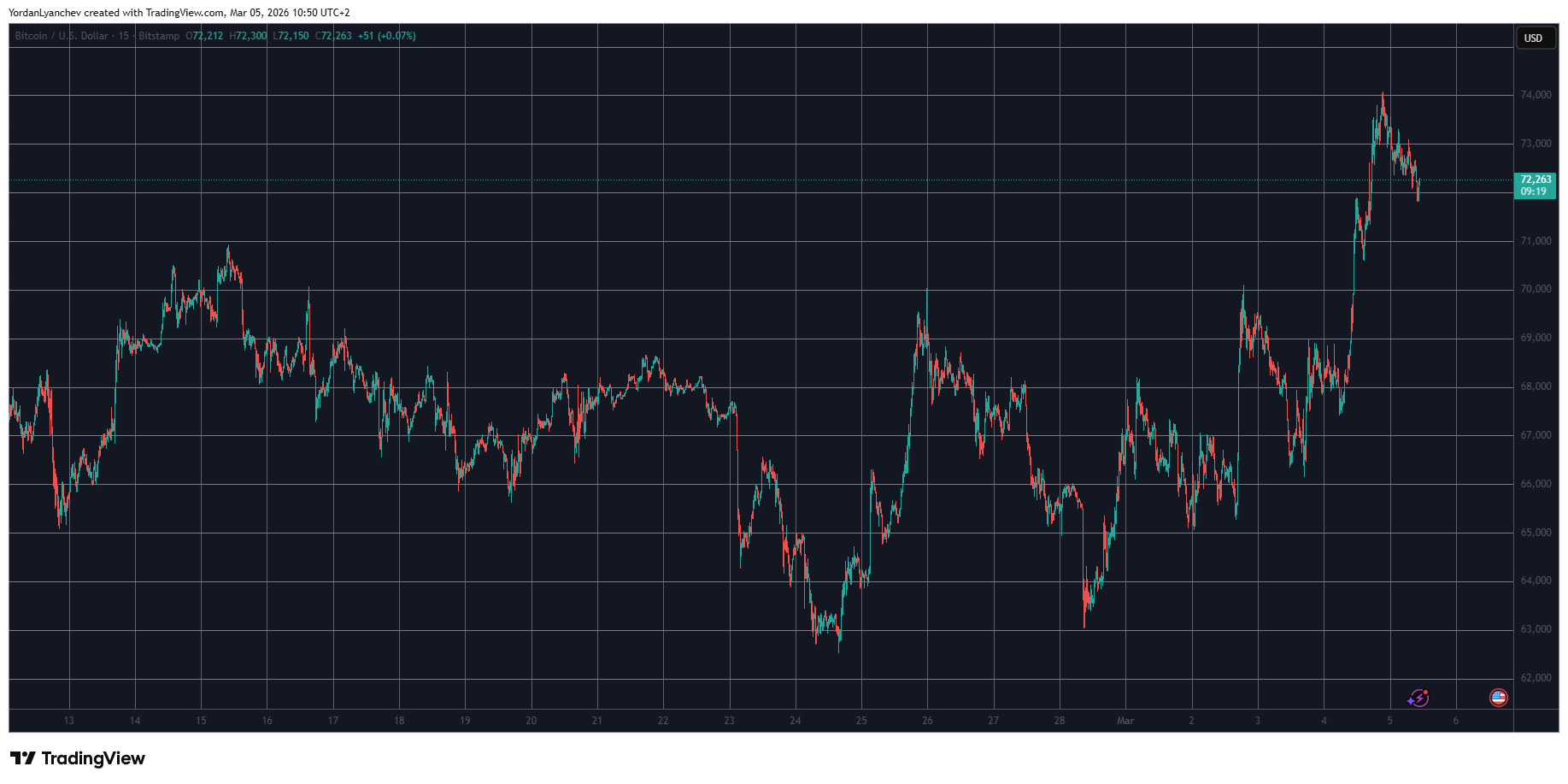
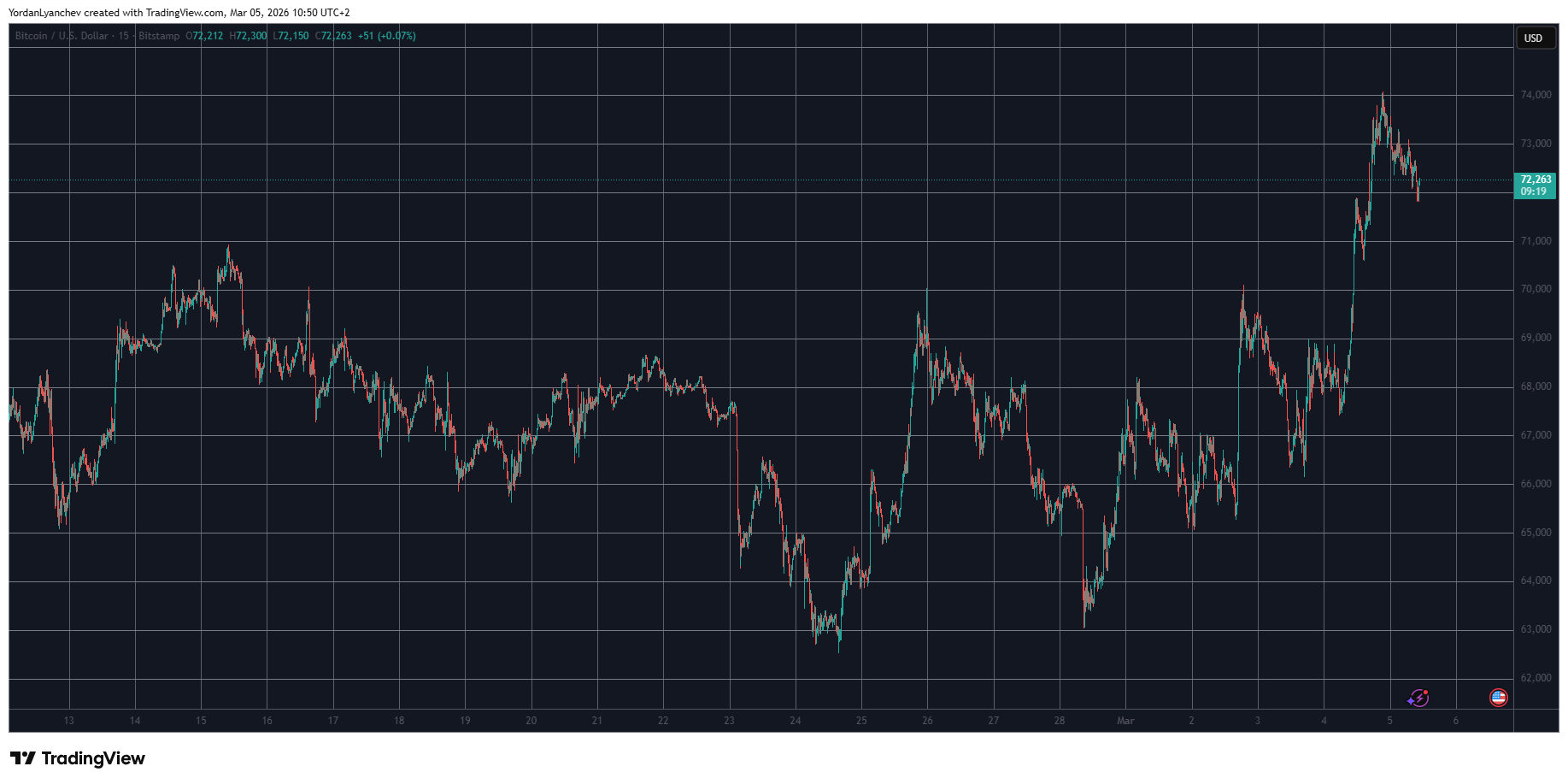
Bitcoin’s price resurgence over the past 24 hours has been quite impressive, as the asset surged to its highest levels in a month at $74,000, where it faced some resistance.
Most altcoins are well in the green today as well, with ETH reclaiming the $2,000 and $2,100 lines, while SOL is up to $90.
BTC Tapped $74K
It was just several days ago, on Saturday, when the primary cryptocurrency plummeted to $63,000 from $66,000 after the US and Israel joined forces to attack Iran. Although the Middle Eastern country responded immediately against numerous targets in the region and its Supreme Leader was killed, BTC didn’t continue to free fall – just the opposite, it rebounded to $68,000 on that same day.
More volatility ensued in the following couple of days, with BTC slipping to $65,200 when it surged by 5% in an hour to $70,000. It was rejected there at first, as it happened during the previous week’s attempt, but the bulls were not to be denied this time.
After they regrouped on Monday and Tuesday, they initiated a substantial leg up yesterday, driving bitcoin to its highest level since early February at $74,000. This meant that the cryptocurrency had added $11,000 since its Saturday low after the attacks began.
Although it was stopped there and now trades around $72,000, it’s still 3% up on the day. Its market cap has surged to almost $1.450 trillion on CG, while its dominance over the alts stands tall at 57.4%.
ETH Above $2.1K, PI on a Roll
Ethereum surged from under $2,000 to $2,200, where it was stopped, but still trades above $2,100 now after a 4% daily increase. SOL is back to $90, while DOGE has risen by 5% to $0.095. XRP, BNB, TRX, ADA, and LINK are also slightly in the green, while XMR is up by almost 5% to $362.
Pi Network’s native token has stolen the show once again. Perhaps driven by the overall market revival and some crucial updates to the network behind it, the PI token has surged by 13% daily and now sits above $0.195. SKY, JUP, and DCR follow suit in terms of daily gains.
The total crypto market cap has added another $60 billion in a day and now sits above $2.5 trillion on CG.

Binance Free $600 (CryptoPotato Exclusive): Use this link to register a new account and receive $600 exclusive welcome offer on Binance (full details).
LIMITED OFFER for CryptoPotato readers at Bybit: Use this link to register and open a $500 FREE position on any coin!
Disclaimer: Information found on CryptoPotato is those of writers quoted. It does not represent the opinions of CryptoPotato on whether to buy, sell, or hold any investments. You are advised to conduct your own research before making any investment decisions. Use provided information at your own risk. See Disclaimer for more information.
European currencies, particularly the pound and the euro, posted a sharp decline at the start of the week before shifting into a corrective rebound. However, the current move appears largely technical in nature, with the market maintaining a cautious stance ahead of the key US labour market report — Nonfarm Payrolls — due for release tomorrow.
Additional pressure on European currencies stems from the strengthening US dollar amid rising geopolitical tensions in the Middle East. The escalation of the conflict between the United States, Israel and Iran has triggered a sharp increase in energy prices. Natural gas prices in Europe have surged on concerns over potential supply disruptions, as the widening conflict has affected the Strait of Hormuz — one of the key arteries for global liquefied natural gas supplies.
Rising energy costs are increasing inflationary risks for the European economy, which has only just begun recovering from the previous energy crisis. According to analysts’ estimates, if current energy price levels persist, inflation in the euro area could rise by around 0.5 percentage points. This reinforces expectations that European central banks may keep interest rates elevated for longer, while simultaneously heightening the risk of a slowdown in economic activity.
EUR/USD
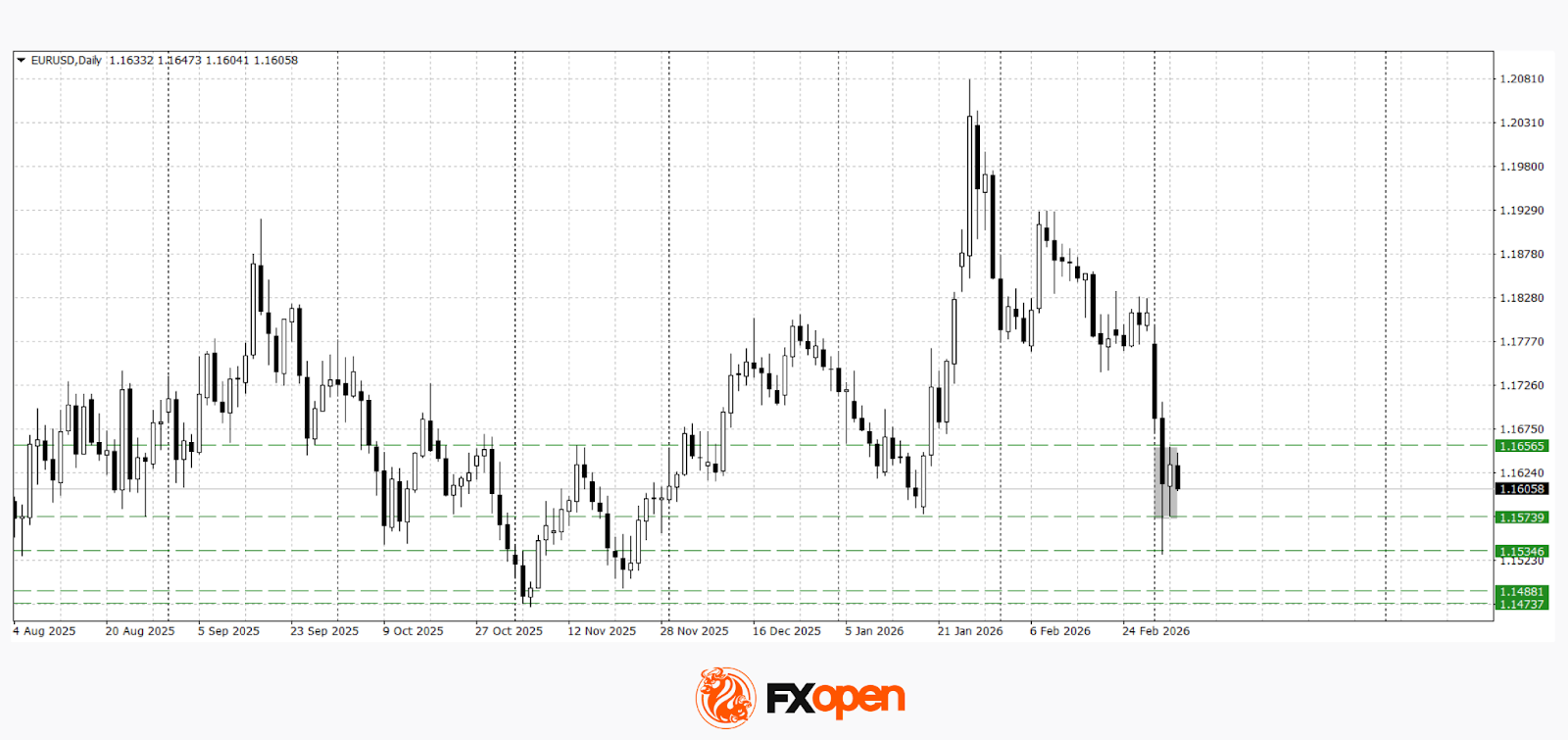
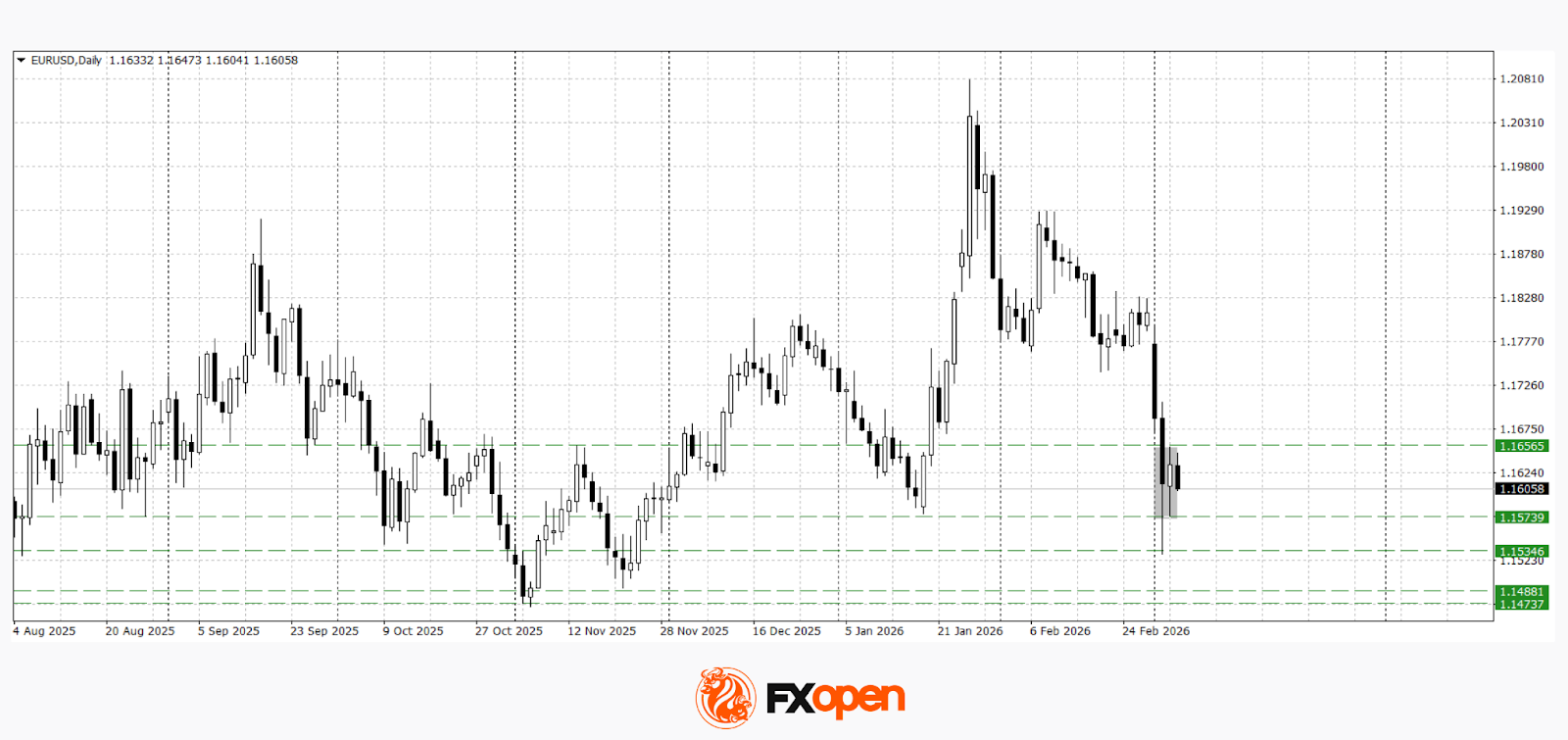
Following its decline at the beginning of the week, EUR/USD found support at 1.1530 and managed to recover above 1.1600. On the daily timeframe, a bullish harami pattern has formed, though it remains unconfirmed. If the pair fails to consolidate above 1.1650 in the coming sessions, a renewed test of recent lows in the 1.1530–1.1570 range cannot be ruled out.
Key events for EUR/USD:
- Today at 12:00 (GMT+2): Speech by Bundesbank President Joachim Nagel;
- Today at 15:30 (GMT+2): US initial jobless claims;
- Today at 15:30 (GMT+2): US non-farm productivity data.
GBP/USD
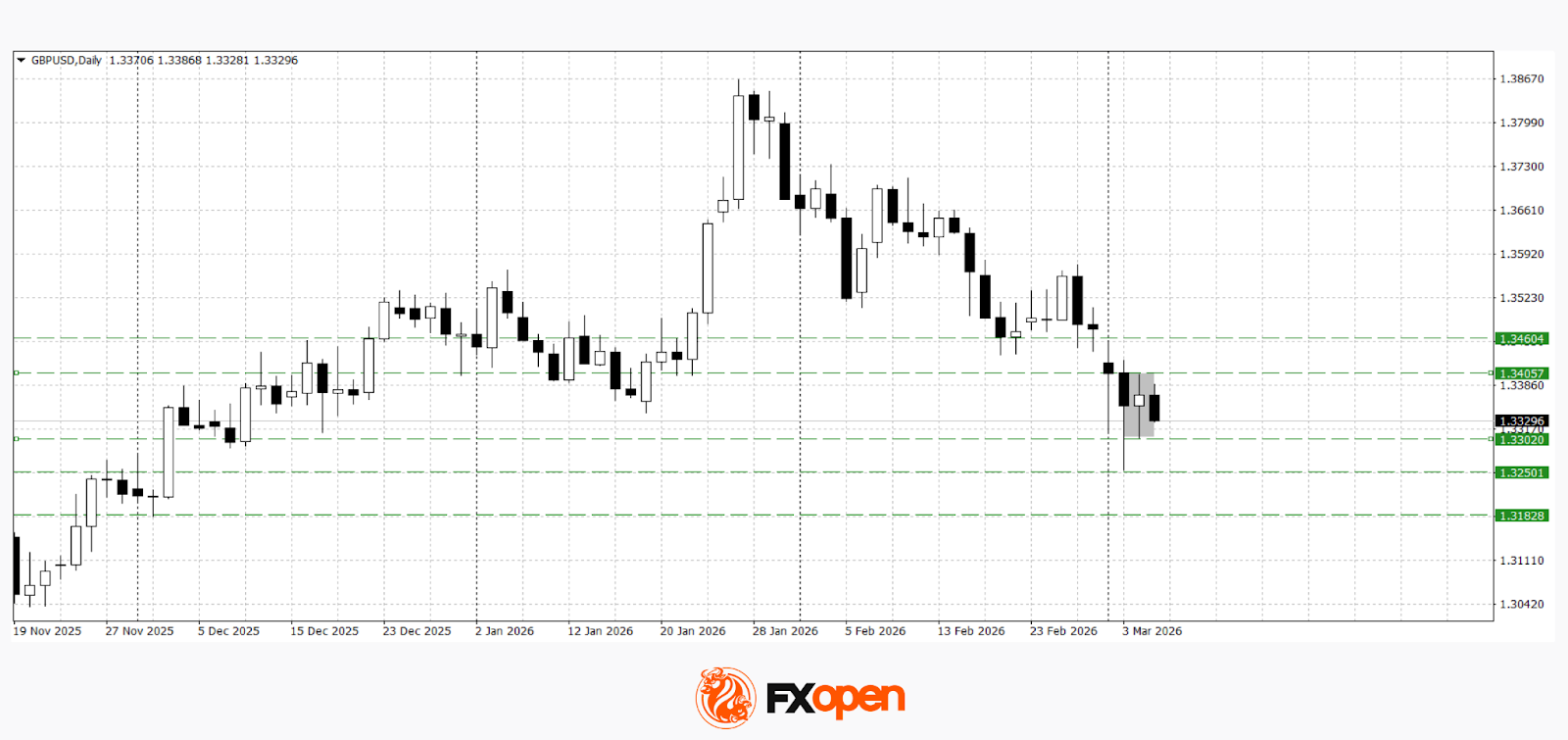
At the start of the current trading week, GBP/USD fell below 1.3300. A sharp rebound from 1.3250 led to the formation of a bullish reversal candlestick pattern; however, without a firm break above 1.3400, it is premature to expect a sustained upward correction. Should buyers fail to hold support at 1.3300, the pair may revisit the recent low at 1.3250.
Key events for GBP/USD:
- Today at 11:30 (GMT+2): UK Construction PMI;
- Tomorrow at 09:00 (GMT+2): UK Halifax House Price Index;
- Tomorrow at 15:30 (GMT+2): US Nonfarm Payrolls.
Trade over 50 forex markets 24 hours a day with FXOpen. Take advantage of low commissions, deep liquidity, and spreads from 0.0 pips (additional fees may apply). Open your FXOpen account now or learn more about trading forex with FXOpen.
This article represents the opinion of the Companies operating under the FXOpen brand only. It is not to be construed as an offer, solicitation, or recommendation with respect to products and services provided by the Companies operating under the FXOpen brand, nor is it to be considered financial advice.
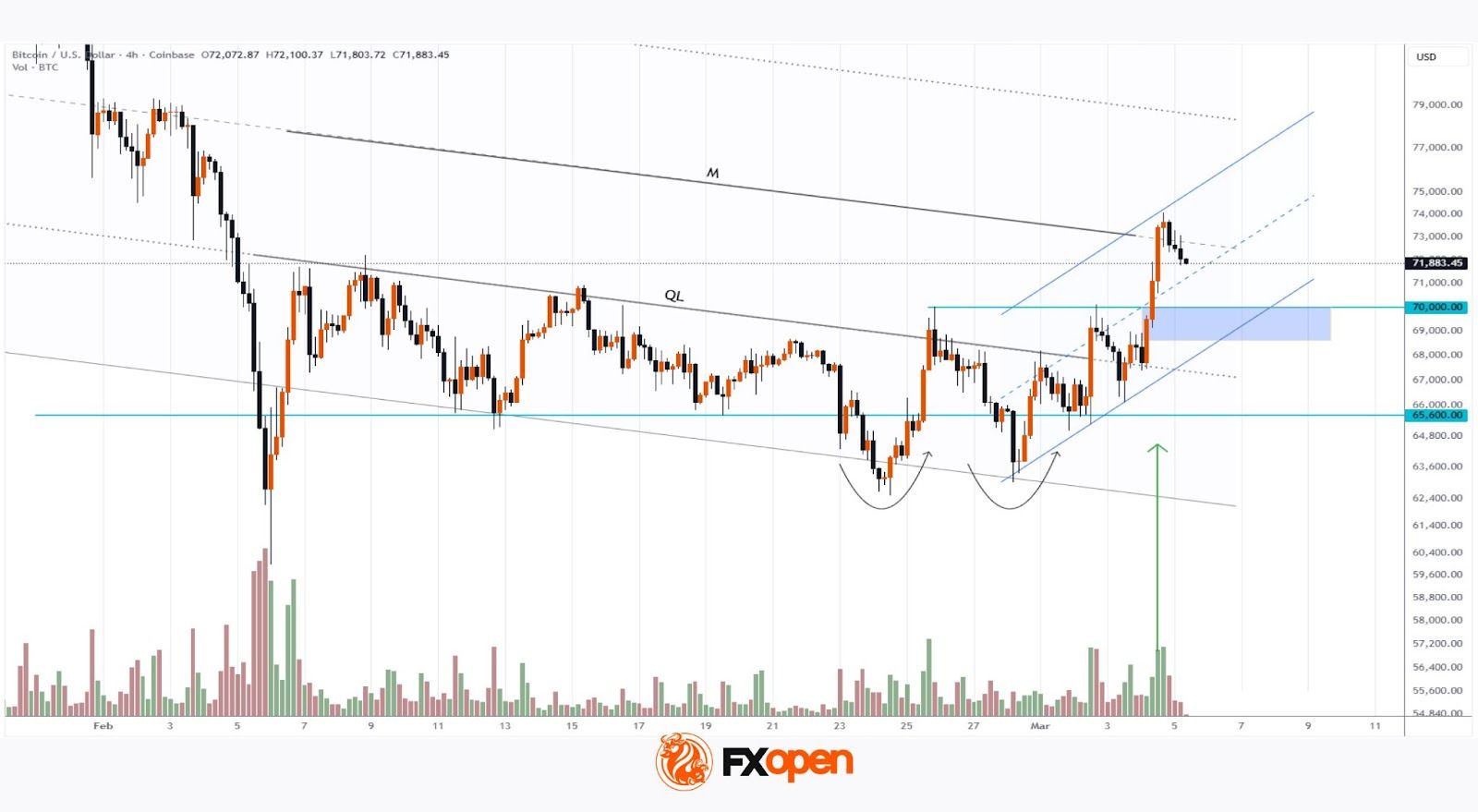
On 20 February, in the note “BTC/USD Analysis: Are the Bulls Stirring?”, we outlined a broad descending channel and highlighted early signs of increasing demand near the $65,600 level.
Subsequent price action provided further grounds to suggest that, following the dramatic decline in Bitcoin’s price from its all-time high in October 2025 to the February low around $60,000, market sentiment has begun to shift. This was reflected in the fact that two attempts by the bears to resume the downward movement (as indicated by the arrows) were unsuccessful.
It is possible that the easing of bearish pressure gave bulls greater confidence at the beginning of March, resulting in notable progress. Yesterday, Bitcoin reached its highest level in a month.
Technical Analysis of the BTC/USD Chart
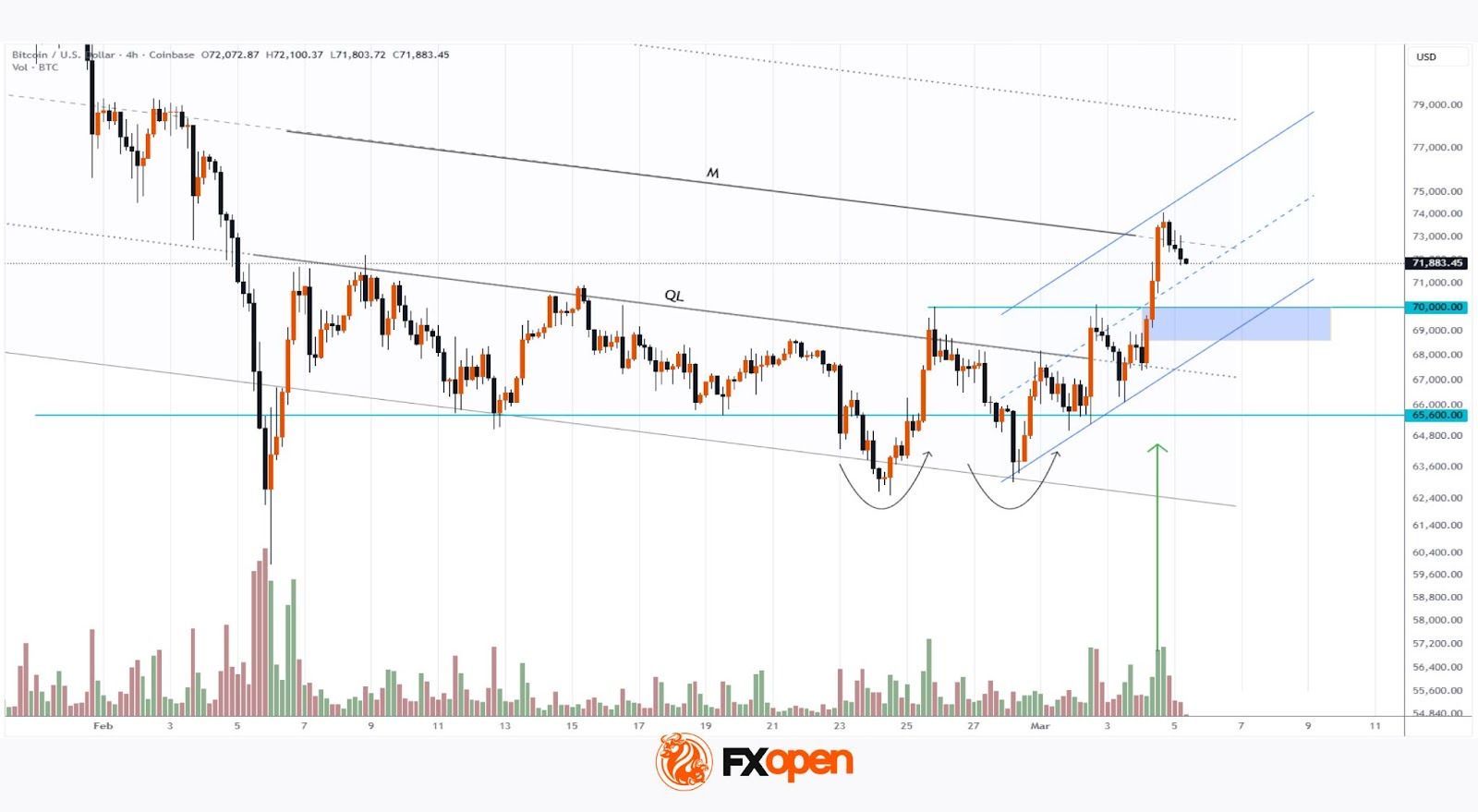
As shown on the chart, the bullish impulse at the start of March led to a breakout above the QL resistance line, as well as the psychological $70,000 level.
From a bearish perspective:
→ classic indicators added to the chart are showing signs of overbought conditions;
→ the median line (M) of the previously constructed channel may act as significant resistance.
From a bullish perspective:
→ rising trading volumes (highlighted by the arrow) represent a positive signal;
→ a sequence of higher highs and higher lows allows for the construction of a local ascending channel (shown in blue);
→ Bitcoin’s price behaviour following the early February panic resembles an Accumulation phase in Wyckoff methodology. If so, the early March rally may represent a Jump Over The Creek (JOC) pattern, signalling a potential transition into the Mark-Up phase.
Considering the above, it is reasonable to expect the formation of a pullback on the Bitcoin chart — for example, a move towards testing the support zone around the psychological $70,000 level.
FXOpen offers the world’s most popular cryptocurrency CFDs*, including Bitcoin and Ethereum. Floating spreads, 1:2 leverage — at your service (additional fees may apply). Open your trading account now or learn more about crypto CFD trading with FXOpen.
*Important: At FXOpen UK, Cryptocurrency trading via CFDs is only available to our Professional clients. They are not available for trading by Retail clients. To find out more information about how this may affect you, please get in touch with our team.
This article represents the opinion of the Companies operating under the FXOpen brand only. It is not to be construed as an offer, solicitation, or recommendation with respect to products and services provided by the Companies operating under the FXOpen brand, nor is it to be considered financial advice.
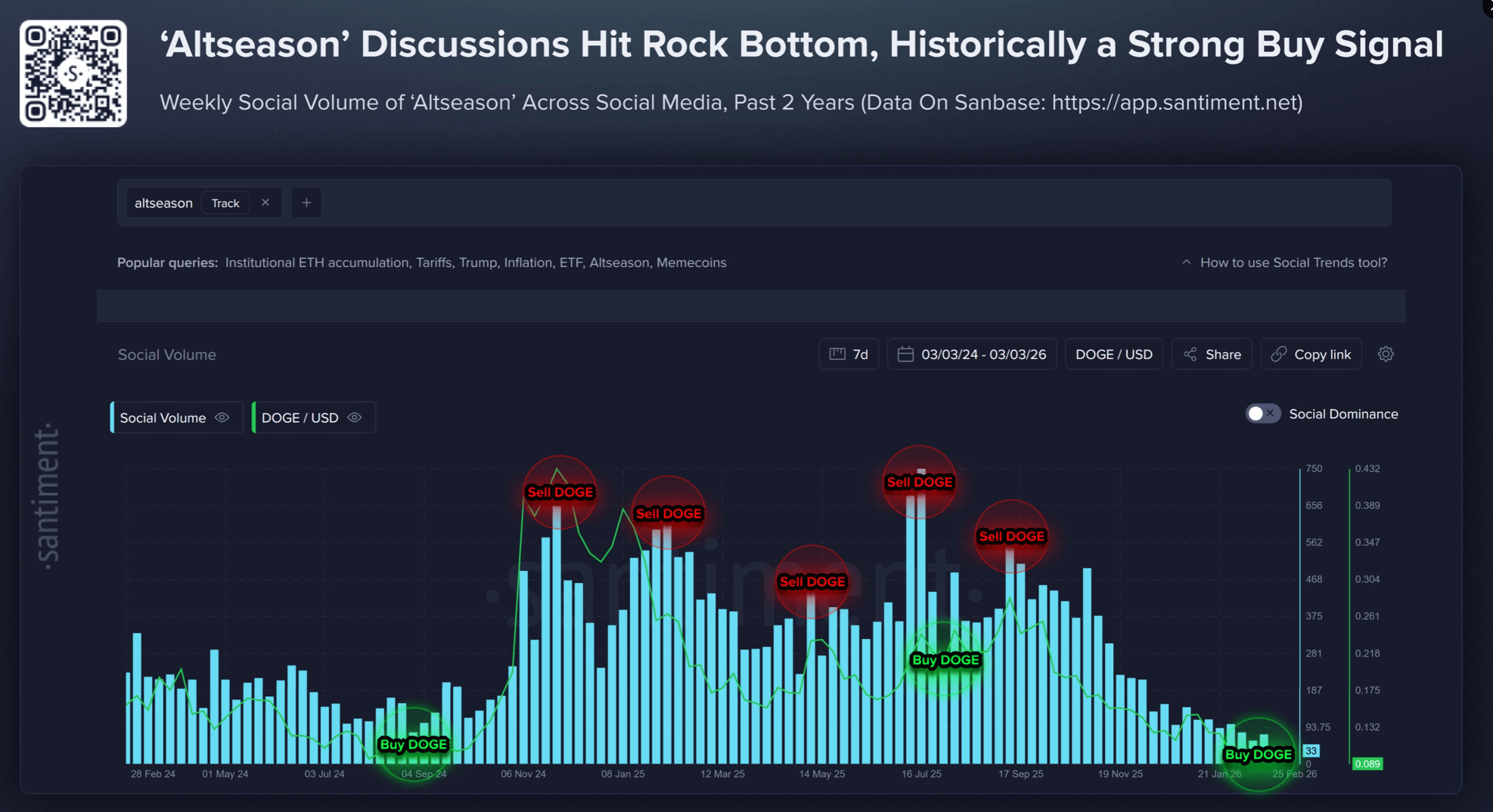
Mentions of altcoins on social media have reached their lowest level in two years, according to crypto sentiment platform Santiment, while indicators suggest that investors are focusing on Bitcoin.
Data from Santiment shows that for the week ended Feb. 27, altcoin social dominance scored 33, a sharp drop from its score of 750 in July 2025, around the time Dogecoin (DOGE) rallied 59% over 30 days.
Google worldwide search data shows a similar pattern. The term “altcoins” scored 4 out of 100 near the end of February, compared with a score of 100 during mid-August, according to Google Trends.
Santiment sees the lack of interest as a bullish signal
Santiment said the lack of interest in altcoins is a bullish signal. “Historically, however, moments like these, when social volume toward altcoin interest is at extreme lows, are around the time that rallies begin,” Santiment said in an X post on Thursday.

Other indicators also suggest that the market’s focus has been shifting from altcoins. CoinMarketCap’s Altcoin Season Index reads a “Bitcoin Season” score of 34 out of 100.
The index flips between “Altcoin Season” and “Bitcoin Season” scores based on the performance of the top 100 altcoins relative to Bitcoin over the past 90 days.
The total crypto market capitalization has fallen almost 43% since October, now sitting at $2.45 trillion.
Bitcoin jumps more than 7% in the past 24 hours
However, the crypto market has rallied over the past day, after US President Donald Trump said “the US needs to get the Market Structure done, ASAP.”
Related: Bitwise has now donated over $380K to open-source Bitcoin devs
The price of Bitcoin (BTC) surged 7.51% over the past 24 hours, with compressed volatility, strengthening ETF flows and a diminished Coinbase discount cited as catalysts for the price rise.
MN Trading Capital founder Michaël van de Poppe said that altcoins could start to take the lead once Bitcoin’s rally begins to slow.
“Great rotation, and I would assume that we’ll see altcoins take more momentum the moment Bitcoin stalls,” van de Poppe said in an X post on Thursday.
Magazine: Bitcoin may face hard fork over any attempt to freeze Satoshi’s coins
Rigetti Computing (RGTI) Stock: Revenue Miss Doesn’t Shake Analyst’s 142% Upside Forecast

MI6 Veteran Condemns Trumps Unnecessary Iran War

Tony Bellew sums up Conor Benn fighting Regis Prograis on his Zuffa debut

Smart energy pays enters the US market, targeting scalable financial infrastructure

Why Israel is blocking foreign journalists from entering

Bitcoin: We’re Entering The Most Dangerous Phase

Bitcoin pumpt auf 72.000$. Warum ich trotzdem NICHT einsteige

5 Financial Mistakes Keeping You Poor #finance #moneytips #wealthmindset #success #Budgeting

ASX down in global sell-off as South Korea’s Kospi crashes | Finance Report | ABC NEWS
-

 Politics6 days ago
ITV enters Gaza with IDF amid ongoing genocide
-

 Politics2 days ago
Alan Cumming Brands Baftas Ceremony A ‘Triggering S**tshow’
-

 Fashion6 days ago
Weekend Open Thread: Iris Top
-

 Tech4 days ago
Unihertz’s Titan 2 Elite Arrives Just as Physical Keyboards Refuse to Fade Away
-
Sports5 days ago
The Vikings Need a Duck
-
 NewsBeat5 days ago
Dubai flights cancelled as Brit told airspace closed ’10 minutes after boarding’
-

 NewsBeat4 days ago
‘Significant’ damage to boarded-up Horden house after fire
-
 NewsBeat5 days ago
The empty pub on busy Cambridge road that has been boarded up for years
-

 NewsBeat5 days ago
Abusive parents will now be treated like sex offenders and placed on a ‘child cruelty register’ | News UK
-

 Tech4 hours ago
Bitwarden adds support for passkey login on Windows 11
-

 Entertainment3 days ago
Baby Gear Guide: Strollers, Car Seats
-
 Tech6 days ago
NASA Reveals Identity of Astronaut Who Suffered Medical Incident Aboard ISS
-

 Business7 days ago
Only 4% of women globally reside in countries that offer almost complete legal equality
-
Politics4 days ago
FIFA hypocrisy after Israel murder over 400 Palestinian footballers
-
 NewsBeat4 days ago
Emirates confirms when flights will resume amid Dubai airport chaos
-

 NewsBeat3 days ago
Is it acceptable to comment on the appearance of strangers in public? Readers discuss
-

 Crypto World6 days ago
From Crypto Treasury to RWA: ETHZilla Retreats and Relaunches as Forum Markets on Nasdaq
-

 Tech4 days ago
Viral ad shows aged Musk, Altman, and Bezos using jobless humans to power AI
-

 Business7 days ago
World Economic Forum boss Borge Brende quits after review of Jeffrey Epstein links
-

 Video3 days ago
How to Build Finance Dashboards With AI in Minutes