

Crypto World
Bitcoin Relief Rally Fades as Bear Market Signals Hold

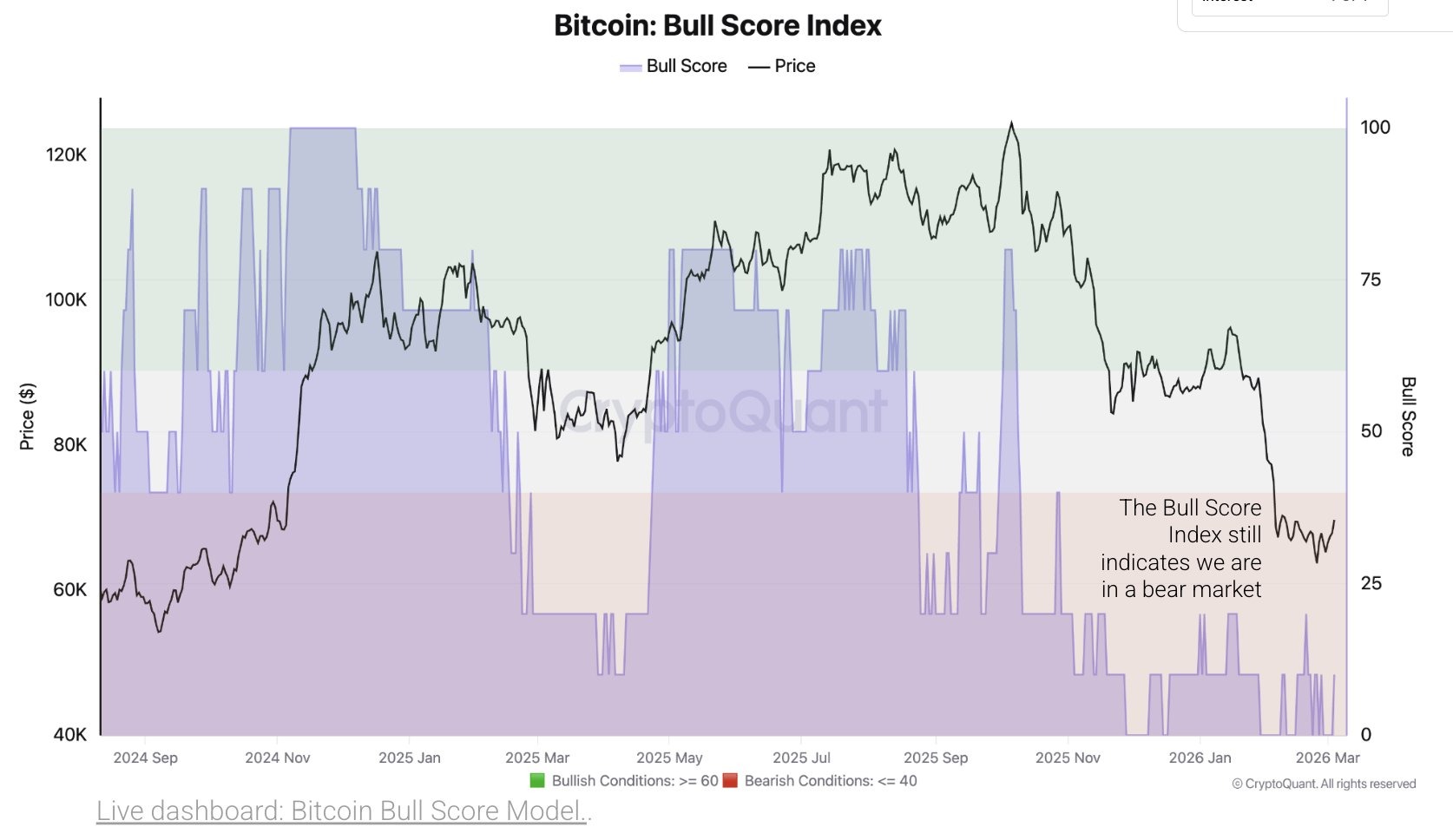
Bitcoin staged a brief relief rally above $74,000 on Thursday, but it has already petered out as analysts predict a persistent bear market will keep momentum subdued.
“Bitcoin is still in a bear market despite the recent rally,” on-chain analytics company CryptoQuant said on Thursday.
The platform’s Bull Score Index, a composite indicator that measures the overall health of Bitcoin (BTC) using a combination of fundamental and technical metrics, remains at 10 out of 100, “deep in bearish territory,” it said.
“Even after the recent price rally, fundamental and technical indicators still point to a bear market environment,” it stated.
“The current move is likely just a relief rally, not the start of a new bull phase.”
Bitcoin briefly tapped a one-month high of $74,000 on Coinbase on Thursday, touching the 50-day exponential moving average, according to TradingView. However, it has already lost more than $3,000, falling back below $71,000 during Friday morning trading.

Bitcoin still vulnerable to renewed downside pressure
Nick Ruck, the director of LVRG Research, told Cointelegraph that the crypto market’s recent relief rally came on “renewed risk appetite and ETF inflows,” but cautioned that the advance has “quickly faced headwinds with prices pulling back toward $71,000 amid persistent macro uncertainties and fading momentum.”
While the brief push provided a welcome relief rally amid supportive liquidity conditions, “ongoing bear market dynamics reinforce caution as softer macro signals, like the anticipated slowdown in February nonfarm payrolls, keep cryptocurrencies vulnerable to renewed downside pressure,” he said.

Bitcoin could see renewed buying interest
CryptoQuant said that a positive Coinbase Premium has signaled renewed US buying interest, driving the recent rally.
Related: Bitcoin slide slowing, but bear market still in play: Analysts
Bitcoin spot demand from US-based investors also switched from contraction to growth, as seen by the Coinbase Bitcoin Premium “switching from deeply negative territory in early February to the most positive since October,” they said.
Selling pressure from traders and long-term holders has also eased after unrealized losses reached levels not seen since July 2022.
Meanwhile, analysts at SwissBlock observed on Friday that “momentum is flashing a critical shift,” adding “We’re exiting peak negative momentum, the kind of transition that often precedes a regime change.”
Magazine: Would Bitcoin really be at $200K if not for Jane Street? Trade Secrets

Crypto analyst EGRAG Crypto urged XRP traders to ignore geopolitical headlines and focus on long-term price structure instead.
Crypto analyst EGRAG Crypto has said that XRP traders should stop focusing on geopolitical headlines and instead pay attention to the token’s long-term price structure.
Their latest chart outlines a defined roadmap with a potential macro bottom, a nearby breakout level, and long-range targets that extend several years into the future.
Key XRP Price Levels for the Next Market Cycle
In a post on X, EGRAG shared a minimalist monthly XRP chart that focuses almost entirely on price structure. The chart spans from 2014 through a projected timeline toward 2028 and highlights three critical phases: the previous cycle bottom, the current consolidation zone, and a potential breakout stage.
The analyst argued that the most important signals are already visible in the long-term structure. According to their chart, XRP appears to be stabilizing near a major support trendline that has been rising since the 2018–2019 bear market bottom.
That trendline intersects with the most recent consolidation zone, which EGRAG highlighted as the area where the next macro bottom could be forming. The chart suggests that the final shakeout may have occurred around the $0.50 region in late 2025 before the market returned to the $1 range.
The next step in their framework centers on confirmation. EGRAG pointed to a horizontal resistance band around the $1.00 to $1.40 region that must be cleared to confirm a broader bullish expansion.
Once that level flips into support, their chart shows XRP entering a multi-year upward channel. The long-term projection lines on the chart stretch toward the 2028 timeframe and point to potential price targets above $27 during the next cycle’s expansion phase.
You may also like:
EGRAG framed the chart as a simple visual argument that long-term structure matters more than short-term news events.
The self-proclaimed XRP perma-bull had already discussed near-term technical thresholds earlier in the week, saying a weekly close above $1.55 would weaken the downward trend that has kept XRP inside a descending channel for months. Furthermore, a break above $2.20 would invalidate the bearish structure entirely.
Other market participants shared similar technical observations, with analyst Arthur writing that his custom indicator had crossed a trigger line that historically precedes fast price moves, pointing to a previous rally of about 27% within four days after a similar signal.
His counterpart, CW, noted that XRP’s decline has once again touched the lower line of its long-term ascending channel, a level that historically marks the starting point of uptrends.
XRP Price Stalls Near Key Technical Levels
Despite those signals, XRP is still stuck inside a broader corrective structure.
At the time of writing, the token was trading around the $1.40 level, down about 0.8% over the past 24 hours. Weekly performance shows an even smaller decline of 0.3%, while the monthly chart reflects a larger pullback of about 12%. On a yearly basis, XRP is still down more than 44%, highlighting the scale of the correction that followed its 2025 peak.
Binance Free $600 (CryptoPotato Exclusive): Use this link to register a new account and receive $600 exclusive welcome offer on Binance (full details).
LIMITED OFFER for CryptoPotato readers at Bybit: Use this link to register and open a $500 FREE position on any coin!


Implied volatility cools, skew normalizes, and options flows turn more balanced even as majors trade lower across the board.
Summary
- Implied volatility has dropped sharply from early February highs, signaling reduced tail-risk pricing in BTC options.
- Skew has compressed from 20% to around 10%, reflecting fading demand for panic hedges and more two-sided positioning.
- Roughly 54.4% of flows are now bullish versus just 21.3% shorting the move, suggesting a shift from fear to calculated risk-taking.
After Bitcoin’s (BTC) brief push to around $74,000, the market has given back ground, with BTC retreating toward the high-$60,000s and broader majors following it lower on the day. Spot screens on ChainCatcher show BTC near $68,555, down about 4.36%, with ETH off roughly 5% around $1,982, and large caps like BNB, SOL, and DOGE all printing mid-single-digit red. On the surface, that tape looks like a classic risk-off flush, but under the hood, options data paints a more disciplined market than the price action implies.
According to Glassnode, implied volatility has fallen well below its early February spike, meaning traders are no longer paying up for crash protection or explosive upside in the same way they did during the last bout of euphoria. That decline in IV is crucial: it signals that the market has recalibrated expectations for extreme moves, effectively re-pricing “fat tail” scenarios down as BTC consolidates below its recent high. In parallel, options skew has tightened from roughly 20% to about 10%, a clear indication that the premium once paid for downside hedges relative to upside calls has normalized. Panic hedging is not gone, but the urgency has bled out of the order book.
Flows confirm this transition from fear to rational positioning. Around 54.4% of BTC options trades are currently expressing a bullish view, while only 21.3% are effectively betting against further upside. That distribution fits a market shifting from emotional capitulation to calculated exposure: spot is under pressure, but derivatives traders are no longer paying crisis prices for protection and are instead selectively re-adding risk. With BTC and the wider crypto complex trading lower on the day, the message from options is that this is not March 2020-level panic, but a volatility compression phase inside an ongoing structural bull move—where each spike down in spot is met with slightly more patience, slightly less fear, and a growing willingness to buy time rather than disaster.

Solana price is nearing the key $90 resistance level as the MACD histogram turns positive, hinting that short-term momentum may be shifting in favor of buyers.
Summary
- Solana trades around $84.53 while approaching a key resistance level near $90
- The MACD histogram has turned positive, signaling improving short-term momentum.
- A breakout could push the price toward $95–$100, while rejection may send it back to support near $85 or $78.
Solana (SOL) was trading around $84.53 at the time of writing, down about 6.5% in the past 24 hours. The crypto market has cooled after a brief rebound, but Solana is still holding near the upper end of its weekly range of $77.47 to $93.40.
Over the past month, the token has lost roughly 10% of its value and remains about 70% below its January 2025 high of $293.
Trading activity has slowed. According to CoinGlass data, derivatives volume dropped 17% to $13 billion, and open interest fell 5.5% to $5 billion. This suggests that some traders are stepping back from leveraged positions as volatility persists.
Solana analyst views
Still, there are signs of short-term optimism. Analysts say that if buying pressure picks up, Solana could test the $95–$105 range in the coming weeks. Breaking above $100 is possible, though the market is still cautious, and price swings continue to be sharp.
Traders’ expectations are mixed. Some traders expect Solana to push past $110, while others think it might struggle to stay above $100 in the near term.
Network activity has been strong. More institutions are investing in Solana products, and activity in DeFi, stablecoins, and memecoins continues. Payment options using USDC are also growing on Solana, showing the network is being used for real-world transactions, not just trading.
The stablecoin market, now worth over $300 billion, could help Solana’s growth. Stablecoins are increasingly used for cross-border payments, derivatives, and everyday transactions.
Analysts also see long-term potential in tokenized assets, which could grow a lot in the coming years.
Solana price technical analysis
Solana is approaching $90, a key resistance level that has caused selling in recent weeks. The MACD histogram has turned positive, which points to short-term momentum building.
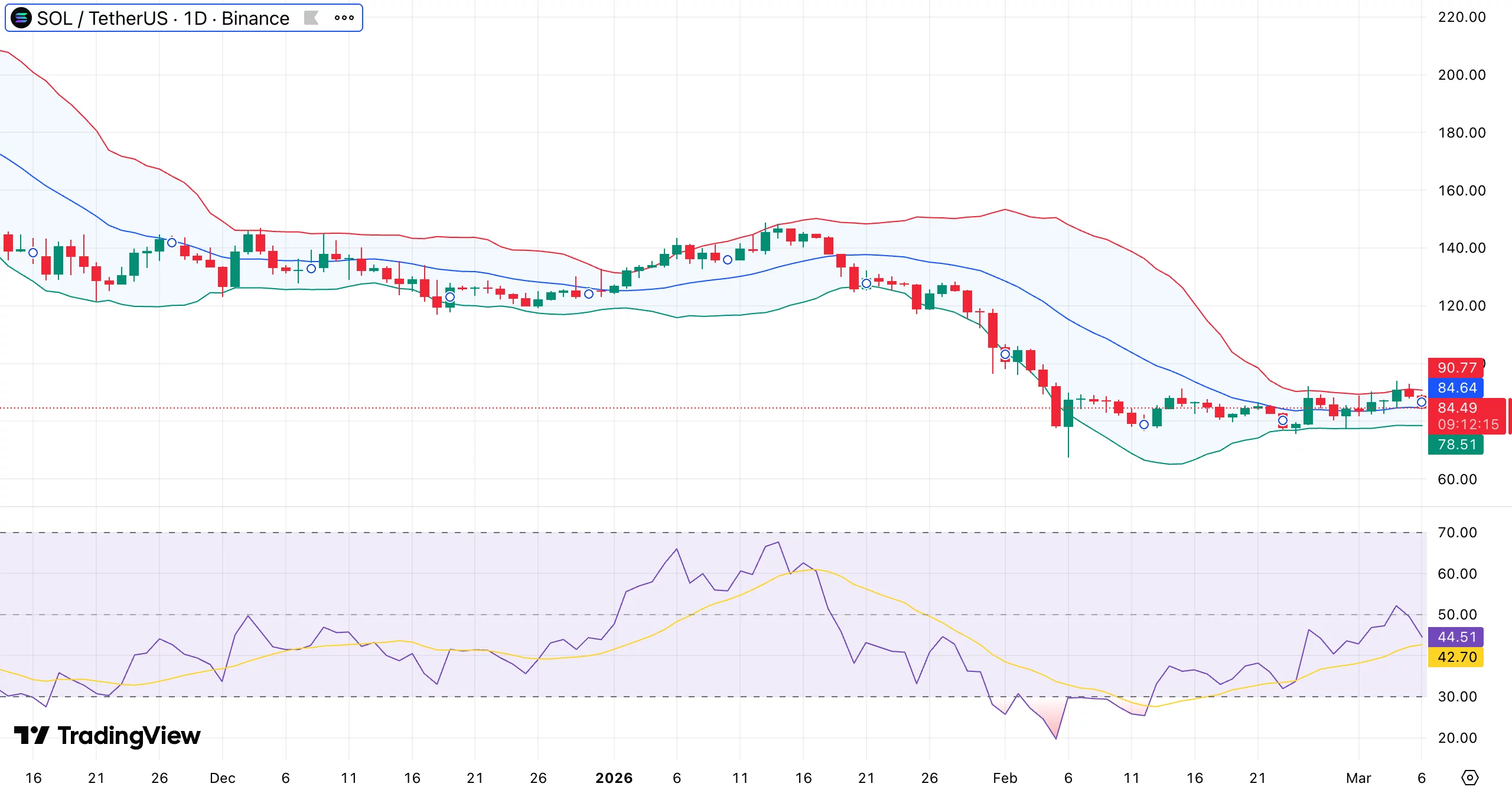
The price is near the 20-day moving average, showing some recovery, but it is still below the 50-day moving average, so the medium-term trend isn’t bullish yet.
Volatility may increase. Bollinger Bands are starting to widen after a quiet period, often a sign that bigger price moves could come. If Solana breaks and closes above $90 with strong volume, the next target could be $95 to $100.
On the other hand, a rejection here could see it fall back toward $85, with stronger support around $78. Right now, $90 is a critical level. How Solana reacts could determine whether it sees a breakout or settles into another period of sideways trading.


The U.S. federal banking agencies have issued new guidance clarifying that tokenized securities should receive the same capital treatment as traditional securities.
The federal banking agencies of the United States have issued clarifications on the capital treatment of tokenization securities. The guidance states that eligible tokenized securities should receive the same capital treatment as traditional securities under existing capital rules.
On Thursday, March 5, the U.S. Office of the Comptroller of the Currency (OCC), the Board of Governors of the Federal Reserve System, and the Federal Deposit Insurance Corporation (FDIC) published joint guidance on securities tokenization.
The guidance is in the form of answers to frequently asked questions about the tokenization of real-world assets (RWAs) that are classified as securities in The U.S. — such as stocks, U.S. treasuries, or exchange-traded funds (ETFs).
The OCC’s guidance aims to provide clarity treatment for banks engaging in tokenization services, potentially encouraging wider adoption of tokenized assets.
“The capital rule is technology neutral. An eligible tokenized security should generally receive the same capital treatment as the non-tokenized form of security under the capital rule,” the OCC summarized in an X post yesterday evening.
One of the FAQs focused on whether the tokenized assets in question were issued on a public, permissionless blockchain network, or on a private, permissioned one. The banking agencies clarified that the distinction didn’t affect capital treatment, stating in its guidance:
“No, the capital rule does not provide a different treatment based on the use of
permissioned or permissionless blockchains.”
The integration of tokenized assets into existing financial frameworks represents a broader trend of financial innovation where blockchain and digital assets are increasingly seen as integral to the future of traditional finance. This regulatory clarity could serve as a catalyst for financial institutions to explore and expand tokenization services, thereby fostering innovation in capital markets.
The OCC, which regulates and supervises national banks and federal savings associations, has received a flood of applications in the past year from crypto-linked firms looking to obtain banking licenses, with zerohash and Revolut among the most recent examples.
As The Defiant reported earlier this week, a new report from three major, global financial infrastructure providers argued that interoperability is essential for digital asset securities to reach their full potential.
This article was generated with the assistance of AI workflows.
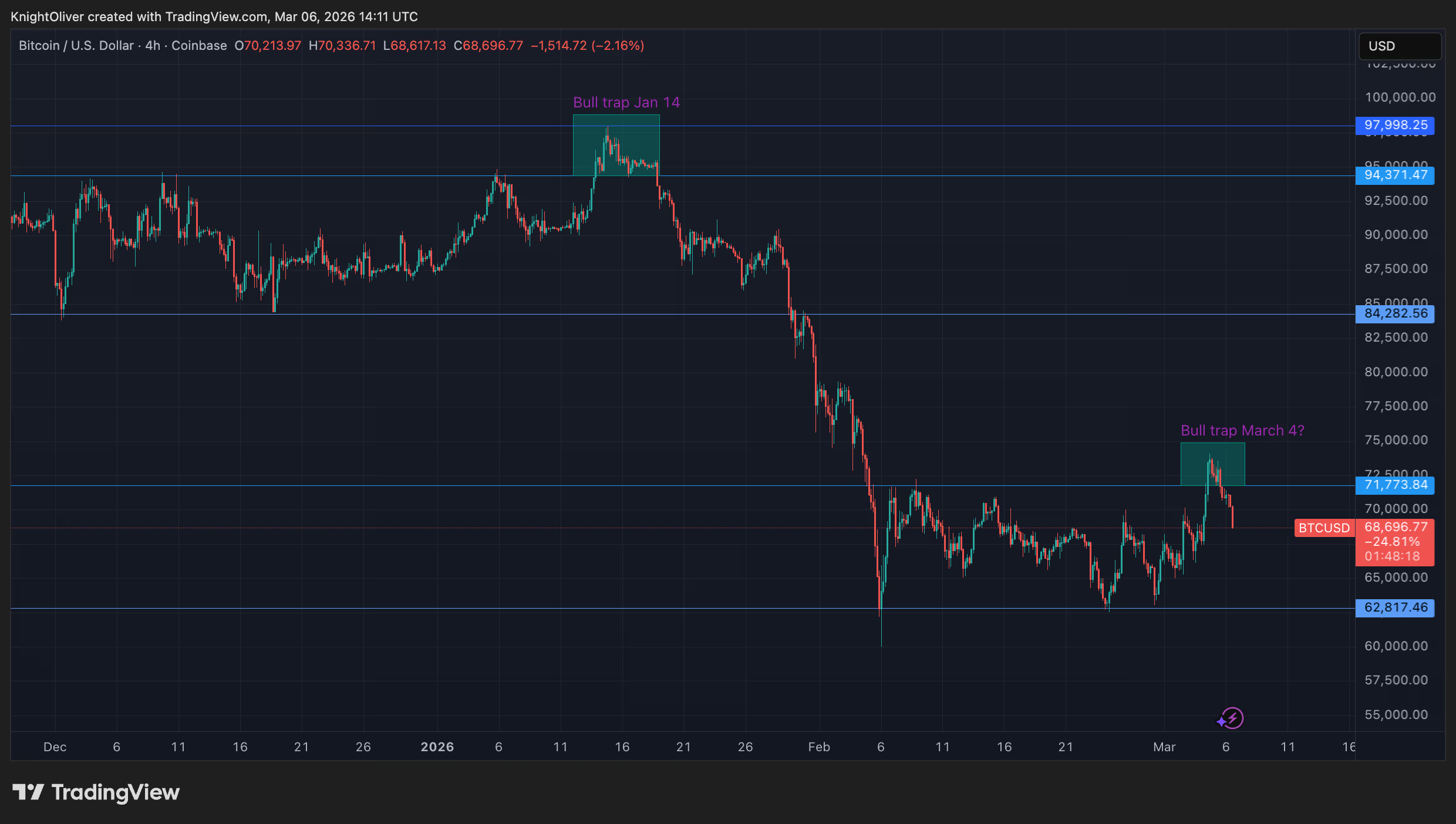
Bitcoin’s move to a one-month high of $74,000 this week triggered a wave of profit-taking from short-term traders, according to data from CryptoQuant.
The largest cryptocurrency is trading around $69,000 after losing momentum from Wednesday’s break above $70,000.
CryptoQuant analyst Darkfost explains that short-term holders transferred more than 27,000 BTC ($1.8 billion) to exchanges in profit over the past 24 hours — one of the largest spikes in recent months.
The only short-term investors currently in profit are those who accumulated bitcoin between one week and one month ago, with a realized price of roughly $68,000, suggesting some recent buyers are choosing to lock in gains rather than extend their positions.
Short-term holders are typically the most reactive group in the market, and their selling reflects lingering caution in light of the ongoing war in Iran.
CoinDesk analysis on Wednesday identified a potential bull trap as price action mirrored that in January when price broke out to $98,000 before taking a leg lower.
And that leg lower occurred on Friday, accelerated by comments from U.S. president Donald Trump who demanded that Iran unconditionally surrenders – a move that also sent the price of oil soaring.

Despite the profit-taking, broader factors are helping support bitcoin’s rally according to Adrian Fritz, chief investment strategist at 21Shares.
Fritz said traders are increasingly betting that the Clarity Act, a U.S. digital asset market structure bill, could pass by year-end. Prediction markets currently price the probability at around 70%, though Fritz noted these markets are relatively illiquid.
He also pointed to rising geopolitical tensions and strong institutional demand as key drivers.
Some investors are increasingly viewing bitcoin as a “gold beta” trade, rotating into the asset after gold’s recent rally. Meanwhile, spot bitcoin ETFs have shown resilience, with holdings down only about 5% during the recent pullback and over $700 million in net inflows this week.
While political developments may have helped spark the move, Fritz said the rally is being sustained by geopolitical hedging and growing institutional conviction in the asset.

Key Takeaways
- The HPS Corporate Lending Fund, worth $26 billion, saw withdrawal demands totaling $1.2 billion during Q1, representing 9.3% of its net asset value
- The firm enforced its 5% redemption cap, distributing $620 million while blocking additional withdrawals
- Shares of BLK declined approximately 5% on Friday after the announcement
- Competing private credit firms experienced similar losses: Blue Owl, KKR, Carlyle, Apollo, Ares, and TPG all dropped 5–6%
- Days before, Blackstone increased its withdrawal ceiling from 5% to 7% and contributed $400 million to satisfy all redemption demands
BlackRock (BLK) faced significant turbulence on Friday when its massive $26 billion HPS Corporate Lending Fund received an overwhelming wave of investor redemption requests that exceeded its capacity to fulfill.
During the first quarter, investors submitted requests to withdraw approximately $1.2 billion — equivalent to 9.3% of the fund’s total net asset value. The firm distributed $620 million before reaching its 5% quarterly limit, which authorized it to halt any additional redemptions for that period.
Shares of BLK tumbled roughly 5% during early Friday trading sessions. The stock had been experiencing downward momentum along with the wider private credit industry.
The selloff quickly infected the entire sector. Shares of Blue Owl Capital, KKR, Carlyle Group, Apollo Global Management, Ares Management, and TPG all experienced declines ranging from 5% to 6% on Friday.
BlackRock characterized the redemption restriction as a deliberate protective mechanism rather than an emergency response. The firm explained that these limitations prevent a fundamental disconnect between investor liquidity needs and the inherently long-term structure of private credit investments.
“Preserving the fund’s available capital to lean into this perceived opportunity set… is in the best interest of the fund as a whole,” HPS said in a statement.
Industry-Wide Redemption Concerns Mount
Blackstone isn’t exempt from similar challenges. Earlier in the week, the firm elevated its typical 5% redemption threshold to 7% and injected $400 million of proprietary capital — combined with employee funds — to honor all pending withdrawal requests.
Blue Owl has similarly attracted scrutiny after substituting immediate cash redemptions with commitments for future distributions.
This surge in exit requests signals mounting investor anxiety about private credit as an investment category. Capital allocated to these vehicles typically remains tied up in illiquid lending arrangements that cannot be liquidated rapidly — creating a fundamental tension that becomes acute when multiple investors simultaneously seek withdrawals.
The HPS Corporate Lending Fund, identified as HLEND, operates as a non-traded business development company (BDC). During the previous quarter, withdrawal requests amounted to approximately 4.1% — substantially lower than the current quarter’s 9.3% figure.
Context Behind the HPS Acquisition
Last year, BlackRock completed its $12 billion acquisition of HPS Investment Partners, marking one of the company’s most significant strategic moves into the private credit sector.
The fund had previously announced plans to repurchase up to 5% of its outstanding units in the preceding month, which represents standard operating procedure for non-traded BDCs.
Investor confidence in private credit had already sustained damage last year when several funds disclosed exposure to bankruptcies involving a U.S. automotive parts manufacturer and a subprime auto lending company.
Financial markets have experienced heightened volatility throughout 2025, with capital flowing toward lower-risk investments. This rotation has intensified withdrawal pressure on private credit products that previously attracted investors seeking higher yields during more stable market environments.
At the time of announcing the withdrawal restrictions, BlackRock’s HLEND managed approximately $26 billion in total assets.


Recent movements by the US Federal Reserve signal an emerging willingness to integrate digital assets into the country’s monetary infrastructure at the highest level. Kraken, a long-standing player in crypto markets, became the first crypto exchange to secure a Federal Reserve master account through its Wyoming-chartered bank, Kraken Financial. The move underscores a broader trend toward institutionalized crypto activity, while political developments suggest a potential tilt toward more crypto-friendly leadership at the central bank. Yet critics argue that expanding direct access to Fed rails carries novel risk for the financial system. The evolving policy landscape, including a pending nomination for a pro-crypto chair, adds layers of complexity for exchanges racing to align with a rapidly changing regulatory environment.
Key takeaways
- Kraken Financial was awarded a Federal Reserve master account, marking a breakthrough for a digital-asset institution to access the Fed’s payments infrastructure directly.
- The master account regime sits within a tiered framework for depository institutions, with access historically prioritized for federally chartered banks with deposit insurance and subject to scrutiny for others.
- New policy concepts, such as a “skinny” master account designed to balance access with risk controls, have emerged as the Fed weighs how widely to extend settlement capabilities.
- There is growing political momentum around crypto-friendly governance, including President Trump’s nomination of Kevin Warsh to chair the Fed, a choice that could influence regulatory posture and policy direction.
- Industry voices, particularly independent bankers and regulatory think tanks, have warned about risks of widening Fed access to nonbank and crypto entities without a clear framework.
- Across markets, the shift signals a trend toward deeper integration of digital assets with traditional financial rails, potentially affecting liquidity, settlement times, and compliance requirements.
Tickers mentioned: $BTC
Sentiment: Neutral
Price impact: Positive. The Fed-access signal may bolster reliability and efficiency for fiat movements in crypto markets.
Trading idea (Not Financial Advice): Hold. The trajectory depends on policy clarity, governance, and broader regulatory alignment.
Market context: The episode ties into a broader move by major financial institutions to normalize crypto rails, even as policymakers debate the scope and safeguards needed to manage systemic risk and consumer protections in a maturing digital-asset sector.
Why it matters
The announcement that Kraken Financial secured a Fed master account reframes the way crypto-native firms interact with the US payments system. A master account provides direct access to dollars held within the Federal Reserve system, a status long reserved for traditional banks and a few limited intermediaries. For Kraken, the benefit is twofold: heightened reliability in moving fiat deposits into and out of digital-asset marketplaces and reduced dependence on third-party banking rails that can introduce cost and settlement delays. As Kraken co-CEO Arjun Sethi put it, the arrangement moves the company from being a peripheral participant to becoming a directly connected financial institution within the US banking framework.
The move also shines a spotlight on the Fed’s evolving approach to crypto access. The Monetary Control Act of 1980 opened the door to Fed accounts for all depository institutions in theory, but in practice, access has been managed through a tiered system. Tier 1 encompasses federally chartered banks with deposit insurance, which typically enjoy the fewest impediments to master-account eligibility. Tier 3 covers state-chartered banks and others, often accompanied by heightened scrutiny. This layered approach explains why the industry has long sought a clearer, more universal pathway to Fed rails for crypto firms—an ambition that a skinny-account concept now hints the Fed is willing to test, albeit with guardrails.
The regulatory dialogue isn’t happening in a vacuum. Critics from the independent banking sector have warned that extending direct Fed access to nonbank entities and crypto firms could introduce new safety concerns for the system. The Independent Community Bankers of America argued that “granting nonbank entities and crypto institutions access to master accounts poses risks to the banking system.” The Banking Policy Institute echoed concerns about the policy framework for such accounts being finalized, arguing that even limited-purpose tests should operate with a transparent governance process and robust risk mitigants. These views reflect a broader tension between innovation in digital finance and the traditional safeguards that have underpinned the US payments system for decades.
On the policy front, the Fed has been balancing the imperative to reduce settlement risk with the need to preserve financial stability. In response to ongoing debates, a notable development came via Fed Governor Christopher J. Waller, who proposed a skinny master account in October 2025 as a pathway to broader access with risk controls. Kraken’s successful pilot suggests an appetite within parts of the regulatory and policy establishment to reward institutionalized crypto activity, even as critics urge caution. The broader question remains: how rapidly will the Fed expand access, and what governance and oversight mechanisms will accompany such expansions?
In parallel with regulatory movements, the White House signaled a potentially transformative shift in leadership for the Fed by nominating Kevin Warsh, a former Fed governor with a history of relatively favorable commentary toward digital assets. Warsh has argued for a nuanced view of crypto, acknowledging its transformative potential while signaling a willingness to deploy policy tools to manage risks. Warsh’s past remarks include praise for Bitcoin as a transformative technology, noting that the asset could inform policymakers when they’re doing things right and wrong. The nomination, however, faces scrutiny from lawmakers concerned about political influence over central-bank independence. If confirmed, Warsh could influence the Fed’s stance on crypto access, governance, and the speed with which new rails are opened to nontraditional financial players.
Bitcoin (CRYPTO: BTC) does not make me nervous,” Warsh said in a May 2025 interview, reflecting a broader willingness to engage with digital assets as a legitimate market force rather than a fringe phenomenon.
As the policy and political landscape evolves, the Fed’s trajectory toward greater crypto openness looks less like a one-off experiment and more like a foundational shift in how digital assets coexist with traditional money flow and settlement infrastructure. Yet the path remains contested. The same voices that welcome a more integrated system caution that the design of future master-account frameworks must address operational risk, cybersecurity, liquidity management, and the potential for stress scenarios that could ripple through the broader financial system.
What to watch next
- Clarity on the Fed’s policy framework for skinny and other experimental master accounts, including risk controls and eligibility criteria.
- Senate consideration and confirmation proceedings for Kevin Warsh as Fed chair, with indicators of how a pro-crypto leadership could influence policy direction.
- Signals from other banks or crypto firms pursuing master-account access and whether regulatory approvals will follow Kraken’s precedent.
- Subsequent reviews or updates from the Fed on payment-system access and the integration of digital-asset markets with traditional rails.
- Ongoing industry feedback from banking groups and crypto incumbents on the balance between innovation and systemic risk in master accounts.
Sources & verification
- Kraken Financial earns Fed master account and Kraken’s formal announcement via a bank charter link: https://cointelegraph.com/news/kraken-crypto-exchange-fed-master-account
- Kraken’s official blog detailing the master-account milestone: https://blog.kraken.com/news/federal-reserve-master-account
- Market reporting on the master account and its implications from The Wall Street Journal: https://www.wsj.com/finance/regulation/kraken-becomes-first-crypto-firm-to-win-access-to-feds-core-payments-system-b5d17031
- American Action Forum analysis on access to Fed settlement accounts: https://www.americanactionforum.org/insight/kraken-and-the-problem-of-who-should-have-access-to-a-fed-master-account/#:~:text=Balances%20held%20at%20the%20Federal
- News coverage of Kevin Warsh nomination for the Fed chair role: https://cointelegraph.com/news/donald-trump-fed-nomination-kevin-warsh-senate
Fed master accounts reshape crypto banking in the US
Kraken’s achievement underscores a broader rethinking of how digital assets fit into mainstream financial infrastructure. The Fed’s master accounts are a coveted entry point—dollars held directly within the central bank’s settlement system, which can reduce settlement times and improve the reliability of fiat transfers associated with crypto markets. The move signals a maturation of the crypto space, where a dedicated digital-asset bank can operate with greater visibility and integration with the nation’s payments rails. As regulators weigh the scope of access and the risk controls that accompany it, the industry is watching closely for guidance on how these rails might accommodate a wider set of participants while preserving financial stability.
At the heart of the conversation is a simple, practical question: what does direct access to Fed rails mean for ordinary users and institutional participants alike? For exchanges and custodians, it can lower settlement risk and reduce the friction involved in moving funds between fiat and digital-assets. For policymakers and regulators, the challenge is to ensure that expanded access does not introduce new systemic vulnerabilities. The Fed’s evolving stance, coupled with high-level political signals, suggests a future where crypto firms operate within a more formalized, centrally cleared settlement framework—one that could, over time, become a cornerstone of crypto market infrastructure in the United States.
As the regulatory architecture unfolds, market participants should expect a steady stream of policy papers, congressional inquiries, and industry comments. The tension between innovation and prudence will define the pace and scope of further access. The Kraken milestone demonstrates that the industry’s push for direct Fed integration has tangible momentum, even as stakeholders debate the precise governance, risk management, and compliance requirements required to sustain such access over the long term.

George Cottrell, a key political aide to Nigel Farage, has lost approximately $550,000 on Polymarket after incorrectly betting against imminent US military action in Iran.
Known in British political circles as “Posh George,” Cottrell’s high-conviction play on the decentralized prediction platform marks a stunning reversal of fortune following his reported multimillion-dollar windfall wagering on the 2024 US election.
The loss underscores the extreme volatility inherent in geopolitical betting, where inside information and political conviction often clash with the chaotic reality of kinetic warfare.
While prediction markets have been lauded for their accuracy in elections, this six-figure liquidation serves as a stark reminder that liquidity does not always equal foresight.
Discover: The best crypto to buy now
Who Is ‘Posh George’ Cottrell and Why Does This Bet Matter?
George Cottrell is far from a typical retail trader. A former banker with an aristocratic lineage and a colorful legal history involving a stint in US federal prison for wire fraud, Cottrell has reinvented himself as a fixture in right-wing politics.
Serving as a top aide to Reform UK leader Nigel Farage, he operates at the intersection of high finance and populist politics, a demographic that has increasingly embraced on-chain prediction protocols.
Cottrell’s reputation in the crypto betting scene was cemented during the 2024 US election cycle. Reports indicate he won as much as $4.4 million betting on Donald Trump’s victory, leveraging his political insights into massive on-chain profits.
However, his pivot to war markets proves that predicting voter behavior and military strikes requires vastly different risk models. The incident highlights how political figures are becoming active participants in prediction markets, moving the size that can skew odds and mislead retail followers.
The $550,000 Wager: How the Polymarket Iran Invasion Bet Failed
The losses centered on a specific Iran invasion bet market hosted on Polymarket, titled to track US military strikes within a set timeframe. Trading under the username GCottrell93, Cottrell took a heavy contrarian position, wagering that the US would not conduct strikes on specific dates in late February.
According to Polymarket data, Cottrell initially saw success, netting $107,000 by correctly betting “No” on a February 27 strike.
Emboldened by the win, he rolled his capital into a much larger position for the following day.
He placed approximately $550,000 on “No” for February 28, effectively betting the geopolitical status quo would hold for another 24 hours.
The market resolved against him when the US military confirmed strikes on Iranian-aligned targets on February 28. The prediction market contracts for “No” instantly collapsed to zero.
Combined with smaller losses of $165,000 across other inaccurate date-specific wagers, Cottrell’s total drawdown for the week topped $655,000.
Unlike traditional finance, where positions might be hedged or stopped out, binary prediction markets offer no exit once the event occurs; capital is either doubled or incinerated instantly.
Geopolitical Betting Markets: High Stakes and Insider Risks
The sheer size of Cottrell’s Iran wager on Polymarket reflects a broader explosion in prediction market volume.
Platforms like Polymarket and Kalshi are no longer niche novelties; they are processing hundreds of millions in volume on outcomes ranging from interest rates to sovereign conflicts.
For traders, these markets offer a way to hedge against macro instability, similar to how Bitcoin and stocks stabilize or react to global bond market risks.
Nigel Farage's bestie George Cottrell, a colourful ex-con and gambler, has plowed $120k today into UK PM Keir Starmer resigning by Feb 28th. — Domer
He spiked the price to 40c on Polymarket.
I was on yes this month (at 16c), but dumped it today, and switched to No at 60c. We'll see! pic.twitter.com/cY0qlQL6xs
 (@Domahhhh) February 9, 2026
However, the sector is drawing intense scrutiny. Lawmakers are increasingly concerned about the gamification of war, where users speculate on casualty counts and invasion dates.
The Telegraph reported that the “Ouster of Iranian Leaders” market alone saw over $529 million in volume, signaling that institutional capital is now treating regime change as a tradable asset class.
For the crypto market, these betting flows are often leading indicators of volatility. When war market probabilities spike, crypto assets often react violently.
Although with Bitcoin briefly $73k despite war chaos, there is a growing argument that the market had already priced in the possibility of war over the course of the extended downturn that began with last October’s market crash.
Discover: The top crypto to diversify your portfolio with
The post Farage Aide ‘Posh George’ Loses $550,000 in Failed Polymarket Iran Invasion Bet appeared first on Cryptonews.


Strike’s parent firm has received a BitLicense from the New York Department of Financial Services (NYDFS), enabling it to offer crypto services in New York.
The parent firm of Strike, the Bitcoin-focused fintech founded by Jack Mallers, has been granted a BitLicense by the New York Department of Financial Services (NYDFS), according a list of approved entities from the regulator.
Strike’s parents company, Zap Solutions, Inc., received a Virtual Currency and Money Transmitter Licenses in February, per the NYDFS website.
This approval allows Strike to expand its operations into New York state, a key market for financial services. Strike is known for leveraging the Lightning Network for Bitcoin transactions.
New York’s BitLicense
New York’s digital asset licensing, generally referred to as the BitLicense, is well known in U.S. crypto regulatory history for having some of the most stringent requirements for approval. At the same time, New York is a highly sought after state for digital asset licensing, as it’s seen as a crucial step for companies aiming to establish a foothold in the U.S. financial landscape.
The regulatory framework was introduced by the NYDFS in 2015, and the first BitLicense was awarded to USDC issuer Circle in September of that year, followed by crypto exchange Gemini a month later.
Strike announced its Bitcoin-backed lending product last May, as The Defiant reported.
Mallers is also the co-founder of Twenty One, a Bitcoin digital asset treasury (DAT) company that launched last April with an initial stockpile of 42,000 BTC, worth about $3 billion at the time. As of today, it holds over 43,500 BTC, worht about $2.9 billion, making it the third-largest Bitcoin DAT company.
This article was generated with the assistance of AI workflows.

TLDR
- Western Alliance (WAL) dropped approximately 12% in premarket hours following disclosure of a $126.4M loan charge-off
- Jefferies Financial (JEF) has been hit with a lawsuit alleging fraud and breach of contract for walking away from payment commitments
- The troubled loans involved First Brands Group, an automotive parts distributor that entered bankruptcy proceedings in September
- Shares of Jefferies (JEF) declined 5-6.6% as the firm dismissed the legal claims as baseless
- Bank management indicates security sales and cost reductions could mitigate approximately $100M of the total $126.4M impact
Western Alliance Bancorporation disclosed a significant $126.4 million charge-off on Friday following notification from Jefferies Financial Group that it would cease making payments required under an existing forbearance arrangement. The announcement triggered a steep premarket decline of approximately 12% in WAL shares.
Western Alliance Bancorporation, WAL
The substantial write-down stems from a commercial financing facility backed by receivables from First Brands Group, an automotive components distributor that sought bankruptcy protection in September 2025 after accumulating $11.6 billion in outstanding obligations.
On Friday, Western Alliance initiated legal proceedings in New York Supreme Court naming Jefferies, its Leucadia Asset Management (LAM) division, and related corporate entities as defendants. The complaint centers on allegations of contractual violations and fraudulent conduct.
The origins of this dispute date to October 2025, when Western Alliance negotiated a forbearance arrangement after uncovering that LAM’s servicing agent had permitted UCC financing statements protecting the receivables collateral to expire — a critical oversight that constituted a default event.
The forbearance terms required Jefferies to execute complete loan repayment no later than March 31, 2026. Western Alliance’s most recent payment receipt was $42.125 million delivered on January 15, 2026.
Then the relationship collapsed. Jefferies recently notified Western Alliance that the final two principal installments scheduled for Q1 2026, representing $126.4 million, would not be forthcoming.
Jefferies issued a forceful rebuttal. “We believe that the lawsuit is without merit and it will be defended vigorously,” the company declared in a Friday statement. JEF shares retreated between 5% and 6.6% during trading.
The First Brands situation continues to deteriorate. Brian Finneran, a managing director at Truist Securities, characterized the evolving story as “just getting so much worse” while questioning “whether everyone will have another round of losses.”
Western Alliance’s Strategy to Absorb the Loss
Chief Executive Kenneth Vecchione of Western Alliance detailed a mitigation strategy for the financial impact. The institution intends to generate $50 million through strategic securities portfolio sales — approximately $45 million of which has been captured within the current quarter — while implementing $50 million in operational expense reductions.
These combined measures address $100 million of the shortfall. The outstanding $26 million deficit remains unresolved, though Vecchione indicated the bank is “evaluating other pathways” to close the gap.
J.P. Morgan analyst Anthony Elian emphasized the importance of ensuring Western Alliance’s earnings performance after Q1 experiences “very minimal impact” from this charge-off event.
Financial Strength Metrics
Notwithstanding the charge-off, Western Alliance maintains its CET1 ratio would fall merely 7 basis points from the year-end 2025 measurement of 11.0%. Management continues to forecast Q1 profitability with stable capital levels.
As of March 5, 2026, the institution reported that 75% of aggregate deposits carry insurance or collateralization, $21.5 billion in unencumbered premium liquid assets, and $20 billion in available off-balance sheet funding capacity.
Western Alliance emphasized it remains on track to deliver profitable quarterly results notwithstanding the financial setback.

How Wearables and AI Are Rewriting Practice

Analyst Tells XRP Holders to Tune Out War Talk and Watch Key Price Levels

Caption Contest (On The Fence Edition)


-

 Politics3 days ago
Alan Cumming Brands Baftas Ceremony A ‘Triggering S**tshow’
-

 Fashion7 days ago
Weekend Open Thread: Iris Top
-

 Tech6 days ago
Unihertz’s Titan 2 Elite Arrives Just as Physical Keyboards Refuse to Fade Away
-

 NewsBeat6 days ago
Abusive parents will now be treated like sex offenders and placed on a ‘child cruelty register’ | News UK
-
 NewsBeat6 days ago
Dubai flights cancelled as Brit told airspace closed ’10 minutes after boarding’
-
Sports6 days ago
The Vikings Need a Duck
-
Business1 hour ago
Form 8K Entergy Mississippi LLC For: 6 March
-
 NewsBeat6 days ago
The empty pub on busy Cambridge road that has been boarded up for years
-

 NewsBeat5 days ago
‘Significant’ damage to boarded-up Horden house after fire
-

 Tech1 day ago
Bitwarden adds support for passkey login on Windows 11
-

 Entertainment4 days ago
Baby Gear Guide: Strollers, Car Seats
-
 Sports22 hours ago
499 runs and 34 sixes later, India beat England to enter T20 World Cup final | Cricket News
-
Politics6 days ago
FIFA hypocrisy after Israel murder over 400 Palestinian footballers
-
 NewsBeat5 days ago
Emirates confirms when flights will resume amid Dubai airport chaos
-

 NewsBeat4 days ago
Is it acceptable to comment on the appearance of strangers in public? Readers discuss
-

 Tech5 days ago
Viral ad shows aged Musk, Altman, and Bezos using jobless humans to power AI
-

 Video4 days ago
How to Build Finance Dashboards With AI in Minutes
-

 Business3 days ago
Guthrie Disappearance Enters Fifth Week as Family Visits Memorial
-
 Crypto World5 days ago
US Judge Lets Binance Unregistered Token Class Action Proceed
-
 NewsBeat4 days ago
Ukraine-Russia war latest: Belgium releases video showing forces boarding Russian shadow fleet oil tanker