

Crypto World
Cardano price prediction as ADA accepted at 137 Spar stores in Switzerland

Cardano’s native token ADA is drawing renewed attention after the Cardano Foundation announced that the cryptocurrency can now be used for payments at Spar supermarkets across Switzerland, marking a real-world adoption milestone for the blockchain network.
Summary
- Cardano Foundation announced that Cardano can now be used at 137 stores of SPAR in Switzerland, expanding real-world crypto payment adoption.
- ADA is trading near $0.27 after weeks of consolidation following a broader downtrend from the $0.40 region earlier this year.
- Technical indicators show weak accumulation and slightly bearish momentum, with key support around $0.26 and resistance near $0.30.
According to the foundation, customers can now pay with the Cardano token (ADA) using a crypto payment integration powered by the OpenCryptoPay gateway, allowing seamless checkout transactions in participating stores.
The rollout makes the Swiss branch of the global retail chain one of the largest supermarket networks in Europe to accept ADA payments.
The initiative reflects Cardano’s broader push toward everyday payment use cases and could help strengthen the network’s reputation as a practical blockchain ecosystem beyond decentralized finance and token speculation.
Retail adoption has historically been a positive sentiment driver for cryptocurrencies, as it signals growing real-world utility. However, the impact on price tends to depend on broader market conditions and investor demand rather than adoption announcements alone.
At press time, ADA is trading near $0.27, showing modest stabilization after a prolonged downtrend that began in early January.
Cardano price prediction after ADA payment rollout across Spar stores
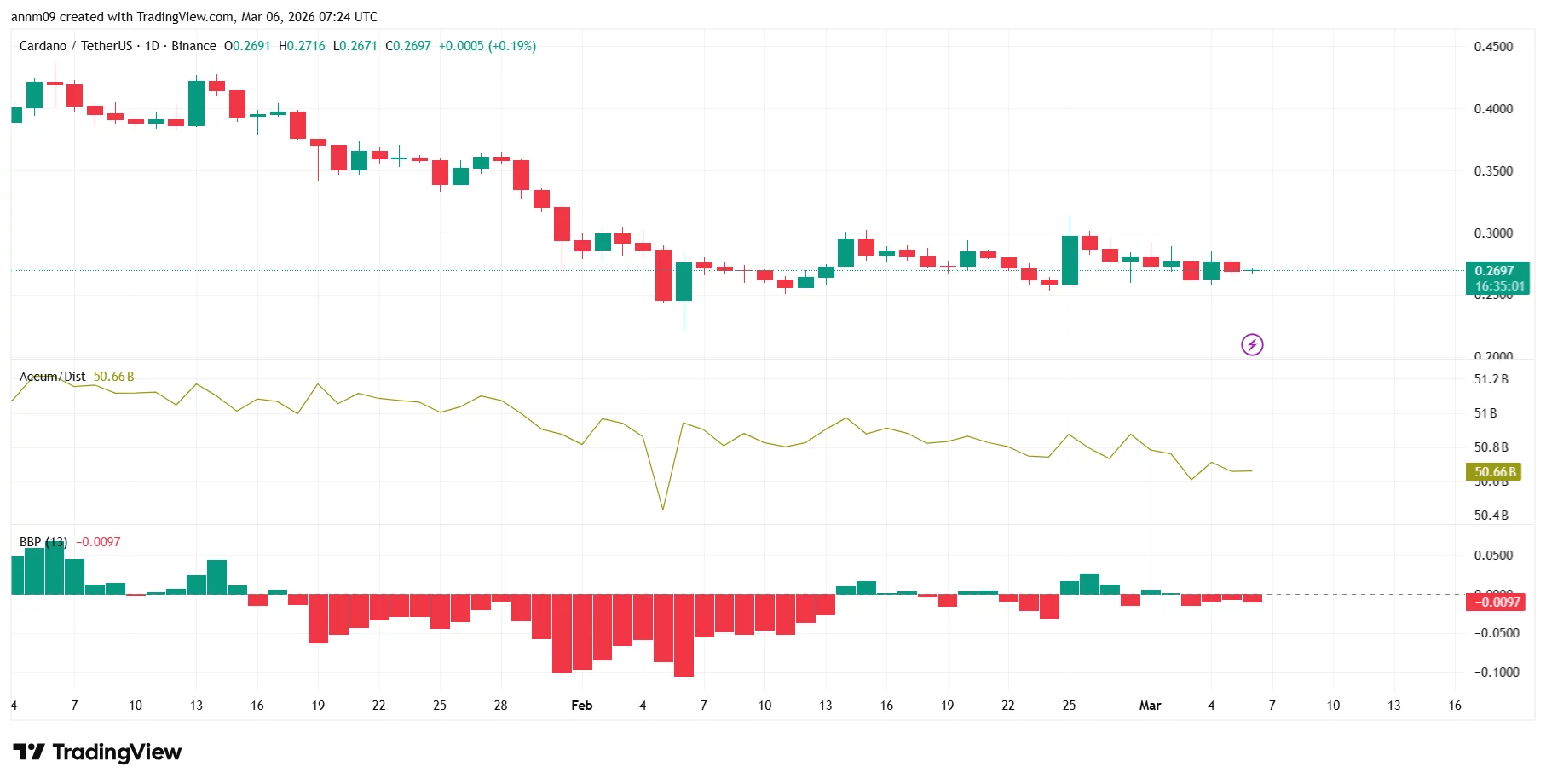
The daily chart shows that Cardano has been trading in a tight consolidation range between $0.26 and $0.30 over the past few weeks following a steep decline from the $0.40 region earlier in the year.
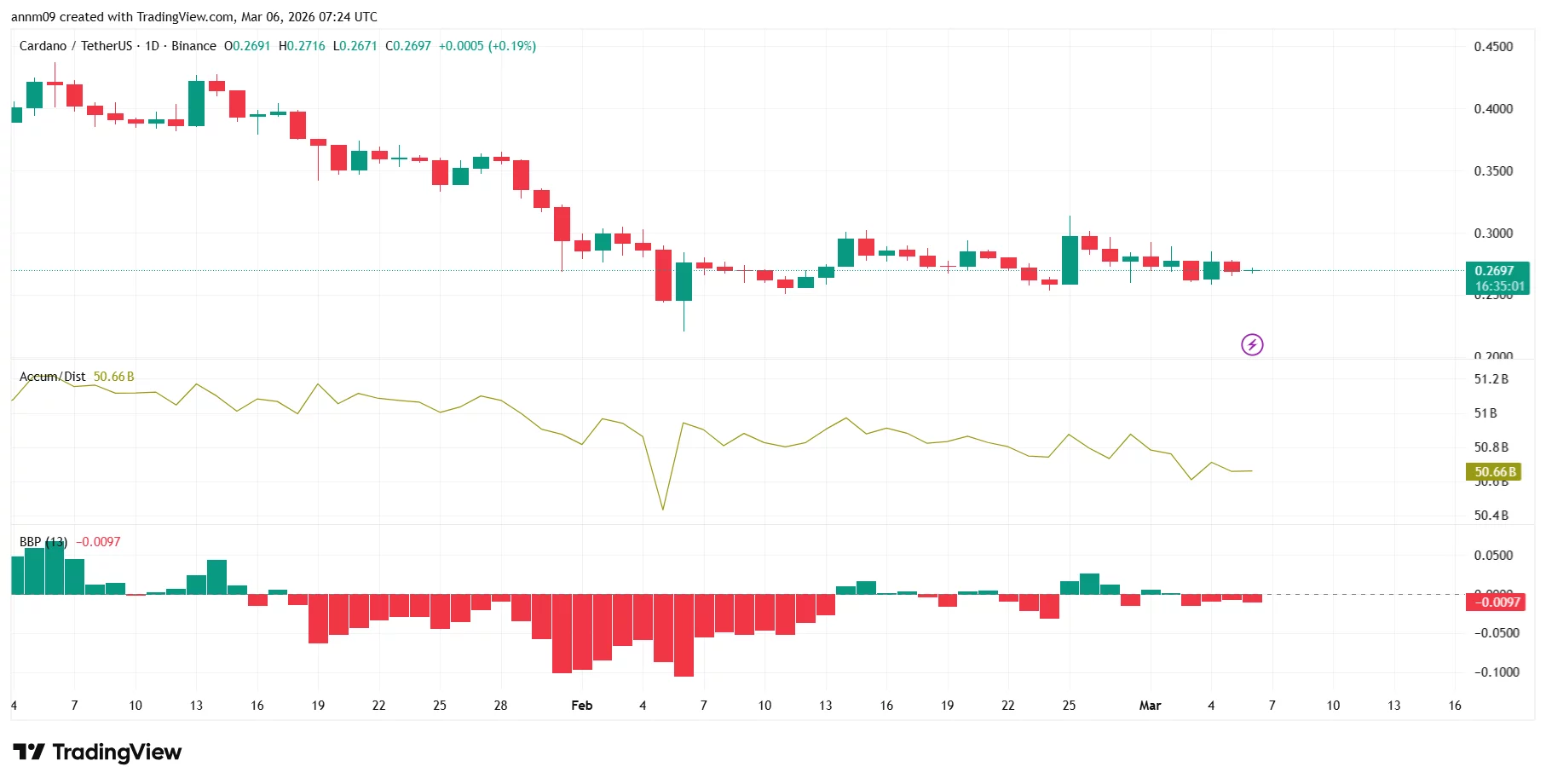
Price is currently hovering around $0.269, with the market forming smaller candles and reduced volatility — a pattern that often precedes a breakout move.
The Accumulation/Distribution indicator, sitting near 50.66B, has been trending slightly downward, suggesting that buying pressure remains limited and that large investors have not yet begun aggressive accumulation.
Meanwhile, the Balance of Power (BOP) indicator remains marginally negative at -0.0097, indicating that sellers still hold a slight advantage in the short term.
Key levels to watch include support near $0.26, which has held multiple times since mid-February. A breakdown below this level could expose ADA to further downside toward $0.24.
On the upside, resistance sits around $0.30, with a stronger barrier near $0.32. A sustained break above these levels could signal the start of a recovery rally if bullish momentum returns to the broader crypto market.
For now, ADA appears to be in a consolidation phase, with traders watching for a catalyst — such as increased adoption or broader market strength — to determine the token’s next major move.



As geopolitical tensions escalate and global markets face a new wave of uncertainty, one asset has been behaving in an unexpected way: Bitcoin.
While the Middle East slides deeper into conflict and energy markets react to potential supply disruptions, the world’s largest cryptocurrency has held up relatively well compared to many traditional assets.
For some observers, that resilience raises an important question: Could Bitcoin be signaling something about the macro environment that markets haven’t fully priced in?
In our latest interview, Arthur Hayes, co-founder of Maelstrom, shares his perspective on the forces shaping the global economy, and why the coming months could prove pivotal for financial markets.
On the geopolitical front, Hayes argues that investors may be underestimating the risks if the current conflict expands or drags on.
“I don’t think global markets are fully priced in [on] a longer war between the US and Iran,” he said. If energy flows are disrupted, the ripple effects could spread through the global economy via higher oil prices, inflationary pressure and increased volatility across markets.
At the same time, Hayes says another powerful disruption is unfolding beneath the surface: artificial intelligence.
According to him, AI could rapidly reshape the labor market by replacing a significant share of knowledge workers, from lawyers and bankers to accountants and analysts. If that transition happens quickly, the result could be widespread credit stress as households struggle to service existing debt.
Ultimately, Hayes believes the global financial system tends to respond to crises the same way: with liquidity. “Bitcoin is essentially just a liquidity smoke alarm,” he says.
To hear Hayes break down his macro thesis, watch the full interview on our YouTube channel and don’t forget to subscribe!
This interview has been edited and condensed for clarity.
Crypto World
Bitcoin Adoption and Offline Storage on the Rise Despite Weak Market Conditions (Santiment)


Despite the shaky price movements, there’s some good news on the BTC adoption front.
The crypto research firm Santiment has identified network data indicating that Bitcoin adoption is rising despite the market’s weakened state.
Santiment’s findings revealed that not only is Bitcoin adoption rising, but cold storage is increasing as well. Investors are increasingly sending their bitcoins (BTC) to offline storage platforms, a pattern usually seen among users who intend to hold for the long term.
Bitcoin Adoption is Rising
According to Santiment’s tweet, the number of separate non-empty wallets on the Bitcoin network has climbed to an all-time high of 58.45 million. This metric witnessed a 1.69 million rise in six months, reflecting a 3% uptick. Such growth indicates that more investors have been buying and holding BTC over the last few months, regardless of the decline in prices and the widely-believed onset of the bear market.
In addition, the amount of BTC on known exchange wallets has plummeted to its lowest level since December 2017. Currently, such wallets hold only 1.17 million BTC.
The rising adoption and the move to offline storage reflect a “buy the dip” trend among investors. Both retail and institutional investors have been accumulating the digital asset; however, at an insignificant pace. It also appears institutional investors have been accumulating more than their retail counterparts.
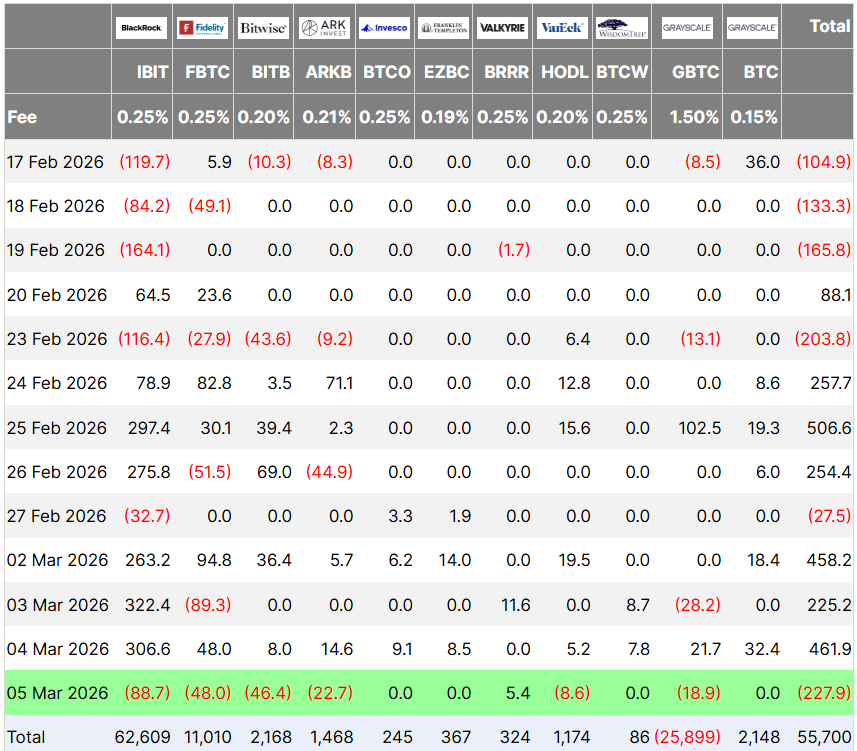
Earlier this month, CryptoPotato reported that last week, U.S. spot Bitcoin exchange-traded funds (ETFs) recorded their first major accumulation wave since mid-October 2025, while retail flows declined. As ETF inflows totalled $1.45 billion on February 25, data shared by analysts showed a $5 billion contraction in retail inflows over the 30-day period from February 6 to March 2.
Genuine Accumulation Drives Spot Demand
Meanwhile, spot demand is also climbing amid war tensions. Despite geopolitical uncertainty shaking markets, unleveraged investors and institutions are still buying. A part of the demand can also be traced to U.S. investors, as seen in the Coinbase Premium, which flipped positive after a long negative streak.
You may also like:
Data from the derivatives market also shows that the demand is not driven by speculative activity stemming from leveraged trades, but by genuine accumulation. This spot demand has pushed BTC back above $70,000 for the first time in three weeks. At the time of writing, the leading crypto asset was trading around $70,560, down slightly over the past 24 hours.
Binance Free $600 (CryptoPotato Exclusive): Use this link to register a new account and receive $600 exclusive welcome offer on Binance (full details).
LIMITED OFFER for CryptoPotato readers at Bybit: Use this link to register and open a $500 FREE position on any coin!
Bitcoin and the leading cryptocurrencies staged a recovery this week following initial shockwaves from the outbreak of the US-Israel conflict with Iran.
Bitcoin (BTC) initially fell to $63,245 on Sunday, before briefly recovering to $73,000 on Thursday, assisted by renewed demand from US-listed spot Bitcoin exchange-traded funds (ETFs), which logged $1.1 billion in net weekly inflows leading up to Thursday.
In the broader DeFi space, Aave’s governance dispute continued, with the Aave Chan Initiative (ACI) saying it will not renew its engagement with the Aave DAO and plans to wind down operations in the next four months.

Aave Chan Initiative to exit Aave DAO after governance clash over funding
The ACI, a major governance delegate and service provider within the Aave ecosystem, said it will not renew its engagement with the Aave DAO and plans to wind down over the next four months.
In a statement on Tuesday, ACI founder Marc Zeller said the organization would continue governance activity and complete outstanding commitments before transferring its infrastructure and responsibilities to the DAO or successor providers.
“The Aave Chan Initiative was built for Aave. Without a future in the Aave ecosystem, the name no longer applies. ACI will wrap up as our obligations conclude,” Zeller wrote.
ACI said its decision to exit was driven by concerns over governance standards and voting dynamics during the proposal process, marking a significant shift in Aave’s governance landscape as its funding plan advances to the next stage.
Strive strategist says AI deflation could push Bitcoin to $11 million by 2036
Technological deflation driven by artificial intelligence could help push Bitcoin above $10 million within a decade by pressuring central banks to keep expanding the money supply, according to a report from Strive strategist Joe Burnett.
Burnett, Strive’s vice president of Bitcoin strategy, said in a report published Monday that faster productivity gains from AI will push down prices across goods and services, squeezing margins and prompting policymakers to respond with sustained monetary expansion. His “base case” calls for Bitcoin (BTC) to reach $11 million in the first quarter of 2036, he wrote.
”My base case for Q1 2036 is $11 million per Bitcoin.”
The forecast rests on a set of aggressive assumptions, including that Bitcoin would grow to about 12% of the value of global financial assets and that global wealth would compound at 7% annually through 2036. With Bitcoin currently accounting for about 0.2% of all financial assets, this would involve an over 176-fold increase in Bitcoin’s market capitalization during the next decade to hit $230 trillion.

The forecast would imply that Bitcoin will become the dominant global reserve asset along with structurally loose monetary policy over the next decade, Nic Puckrin, co-founder and lead market analyst of educational platform Coin Bureau, told Cointelegraph.
”The forecast implies Bitcoin would become around 10 times as large as the current US M2 money supply, nearly four times as large as the US equity market today, and nearly double current global GDP.”
The prediction would also imply a compound annual growth rate (CAGR) of around 53% per annum, which is not unprecedented considering Bitcoin’s average 60% CAGR between 2015 and 2024, but a slowdown may be expected due to its larger market capitalization, added Puckrin.
Shawn Young, chief analyst at MEXC Research, agreed, warning that the prediction would imply a “huge” 16,318% increase for Bitcoin during the next decade, which looks unlikely due to Bitcoin’s declining volatility.
“The more liquidity flows into the asset from both institutional and retail investors, the less likely sharp price spikes will be recorded,” the analyst told Cointelegraph, adding that the “realistic price range is at most $1 million.”
Stablecoin inflows rebound to $1.7 billion as Washington battles over yield rules
Weekly net stablecoin inflows rebounded last week as onchain activity picked up even while US lawmakers and banking groups sparred over whether third parties should be allowed to pay stablecoin yield, according to a new report from Messari.
Weekly net stablecoin inflows accelerated to $1.7 billion, a 414.5% increase week-on-week, according to the report published on Wednesday.
The recovery flipped the 30-day average to a positive $162.5 million in daily inflows. Transaction volumes rose 6.3%, while average transaction size continued to decline, reflecting renewed stablecoin issuance demand and “strengthened” onchain activity amid retail investors, the report said.
Stablecoin inflows track net new stablecoins entering circulation after accounting for redemptions.
The surge follows a weaker period earlier in the year. Messari data showed $249 million in weekly inflows two weeks earlier and $4.4 billion in net outflows over the 30 days leading up to Feb. 18.

Solv Protocol offers 10% bounty after $2.7 million vault exploit
Bitcoin-based decentralized finance platform Solv Protocol says one of its token vaults was exploited for $2.7 million and has offered the attacker a 10% bounty in exchange for returning the stolen funds.
Solv said in an X post on Thursday that fewer than 10 of its users were impacted, but it would cover the loss of 38.05 Solv Protocol BTC (SolvBTC), a token pegged to Bitcoin (BTC).
The project added that it had implemented measures to prevent the attack from recurring and was investigating the exploit with crypto security firms Hypernative, SlowMist and CertiK.

Solv allows users to deposit Bitcoin for Solv Protocol BTC, which they can then use to lend, borrow or stake on other blockchains. The project has 24,226 Bitcoin worth over $1.7 billion and claims it is the largest onchain Bitcoin reserve.
Solv hasn’t confirmed how the exploit occurred, but two crypto security researchers said it stemmed from a vulnerability in one of Solv’s smart contracts that allowed the attacker to mint excessive amounts of a token used on the protocol.
The attacker exploited the vulnerability 22 times before swapping hundreds of millions of tokens for just over 38 SolvBTC, according to CD Security co-founder Chris Dior.
Bybit claims new fraud system stopped $300 million of risky withdrawals in Q4 2025
Bybit said it blocked or disrupted more than $300 million worth of suspected scam-related withdrawals in the fourth quarter of 2025 after rolling out an AI-assisted risk monitoring system designed to flag malicious transactions before funds leave the exchange.
In a company blog post, Bybit said its system flagged about $500 million in withdrawal requests during the quarter and that more than 4,000 users were “protected” after the platform issued real-time risk alerts or blocked transactions outright.
Bybit’s head of group risk control, David Zong, told Cointelegraph that much of the $300 million total reflects withdrawals users voluntarily cancelled after seeing warnings, meaning the funds remained in their accounts rather than requiring clawbacks or reimbursement.
“Because the withdrawals were stopped prior to completion, the funds did not require recovery or reimbursement. They remained in users’ accounts at all times.”
Bybit said the system also identified 350 high-risk investment fraud addresses that shielded 8,000 users from potential withdrawal losses during the previous quarter. It also thwarted over 3 million credential stuffing attacks attempted by hackers throughout 2025.

Cryptocurrency hacks resulted in $3.4 billion in losses during 2025, as hackers turned their focus to large crypto entities.
DeFi market overview
According to data from Cointelegraph Markets Pro and TradingView, most of the 100 largest cryptocurrencies by market capitalization ended the week in the green.
The River (RIVER) token rose 94% as the biggest gainer of the week, followed by the Humanity Protocol (H) token, up 39% during the past week.

Thanks for reading our summary of this week’s most impactful DeFi developments. Join us next Friday for more stories, insights and education regarding this dynamically advancing space.


Surprise February US jobs losses and a higher unemployment rate revive rate‑cut hopes but leave BTC stuck near $70K amid broader risk‑off mood.
Summary
- The US jobs shed 92,000 in February versus forecasts for a 59,000 gain, a sharp reversal from January’s 126,000 increase.
- Unemployment rose to 4.4%, above the expected 4.3%, underscoring a more fragile labor backdrop.
- BTC is pinned around $70,000 as traders weigh softer data against spiking oil, falling equities and shifting Fed‑cut odds.
February’s US jobs report landed as a clean downside surprise: instead of a modest payroll gain, the U.S. economy outright lost 92,000 positions, a swing of more than 180,000 versus consensus and a clear deterioration from January’s 126,000 increase.
The unemployment rate ticked up to 4.4%, overshooting economist expectations and marking a subtle but important break from the “resilient labor market” narrative that has underpinned the Federal Reserve’s higher‑for‑longer stance. On paper, that kind of softness should be a gift to duration assets and high‑beta plays like crypto, because it nudges the Fed closer to rate cuts in the first half of 2026.
The initial market reaction, however, is more conflicted than the textbook macro trade. Bitcoin (BTC), which had already slid overnight as crude spiked and equity futures rolled over, hovered near $70,000 in the minutes after the release, showing no appetite for an aggressive relief rally. Nasdaq futures are down about 1% and S&P 500 contracts off roughly 0.8%, while the 10‑year Treasury yield has eased to around 4.11%, signaling a modest bid for safety rather than a full‑blown “pivot” euphoria. Classic hedges are perking up instead: gold is up roughly 1%, silver 2%, and WTI crude is surging more than 6% to about $86 per barrel, reflecting persistent geopolitical and inflation risk tied to the Iran conflict.
For crypto, that mix is toxic: yes, weaker jobs data theoretically increases the probability of cuts later this year, but an oil‑driven inflation squeeze and rising recession odds complicate the narrative. If growth slows while energy and food keep headline inflation sticky, the Fed’s room to ease aggressively shrinks, leaving bitcoin trapped between “digital gold” narratives and simple de‑risking alongside tech and high‑beta assets. With BTC stuck near $70K and the CoinDesk 20 under pressure, traders are treating this jobs miss less as a green light to lever up and more as another stress signal in a macro regime defined by war‑driven oil shocks, fragile credit and a Fed that cannot yet declare victory.
Crypto World
Fed Governor Miran says job losses in February add to the case for more interest rate cuts
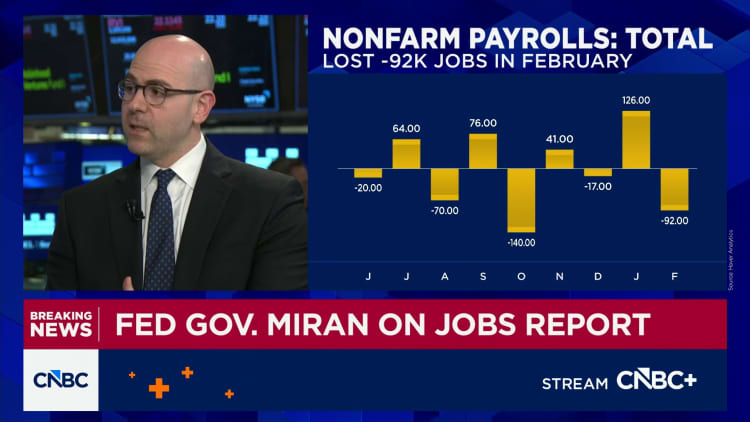

Federal Reserve Governor Stephen Miran said Friday that the weak February jobs report bolsters the rationale for the central bank to lower interest rates further.
Responding to the drop of 92,000 in nonfarm payrolls that the Bureau of Labor Statistics reported Friday, Miran said in a CNBC interview that the Fed should be focusing more on supporting the labor market than worrying about inflation.
“I think that we don’t have an inflation problem,” he said on the “Money Movers” show. “I think that the labor market can use more accommodation from monetary policy. And I don’t see having a modestly restrictive stance of monetary policy as opposed to a neutral stance as being appropriate. I think being close to neutral is appropriate.”
Currently, the Fed’s key interest rate is targeted in a range between 3.5% to 3.75%, following three consecutive quarter percentage point cuts in the latter part of 2025.
If Miran had his way, the rate would be around neutral, which he deems to be about a full percentage point lower. The consensus of Fed officials at the December meeting was that neutral — a level neither holds back nor boosts the economy — is around 3.1%, implying two more cuts.
Miran has been arguing that stubbornly high inflation numbers are more a function of how it is measured by the Commerce and Labor departments rather than true underlying pressures.
One factor he cited was portfolio management fees, which have risen amid a generally higher stock market. Portfolio management fees are often charged as a percentage of assets, so when markets rise the dollar value of those fees increases even though the underlying rate for those services does not.
The recent surge in oil prices and corresponding boost for costs at the pump related to the Iran war are less of a concern, Miran added.
“Typically, the Federal Reserve doesn’t respond to higher oil prices like that. It [boosts] headline inflation, but it tends to be a one-off shock,” he said. “When you think about core inflation [which does not include energy prices], it tends to be more predictive of where inflation is going over the medium term than headline inflation.”
Miran has dissented at each of the Federal Open Market Committee meetings he has attended since September, after President Donald Trump nominated him as a governor. For the three rate cuts, he preferred more aggressive half percentage point reductions to the quarter-point moves the committee approved. In January, when the FOMC voted not to cut, Miran said he wanted a quarter-point reduction.
Asked if he would dissent again, he said, “I hope not, but that would be up to my colleagues. I hope that we vote to cut.”
Miran was appointed to full the unexpired term of Adriana Kugler, who resigned in August 2025. That term expired in January, but Miran has continued to serve until a successor is approved. Trump nominated Kevin Warsh to a position that ultimately will be a replacement for current Fed Chair Jerome Powell, whose term expires in May.
“I will be at the meeting in a couple weeks, and after that I will take it a day at a time,” Miran said.
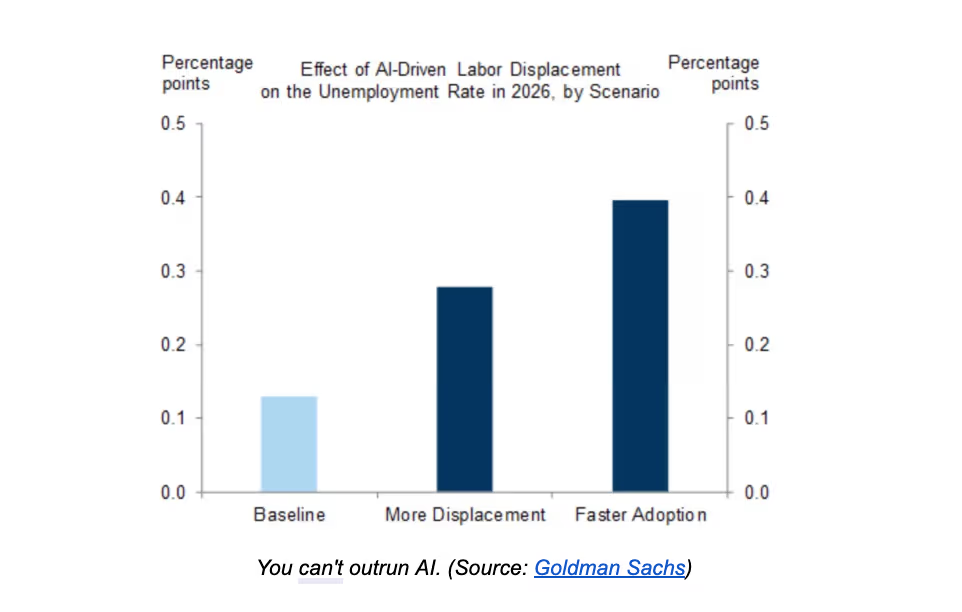
AI is infiltrating every layer of society, finance included. What began as asking ChatGPT about your deepest money worries has rapidly evolved into agents capable of reasoning, executing and coordinating across markets with minimal human intervention.
The pace of change at the intersection of AI and finance is daily, not weekly. Goldman Sachs has warned of AI-fueled layoffs, while Citrini Research’s brief job-displacement scare sparked an AI trade, signaling the scale of disruption ahead. As Matt Shumer wrote in ‘Something Big is Happening,’ adaptability may be the only durable advantage, and now is the time to get your financial house in order.

There’s a simpler way to think about surviving and thriving in the AI era. Instead of trying to outlearn every new AI tool, focus on mastering the AI skills that will build a financial buffer or even a nest egg. Creating insulation against AI-driven disruption that’s coming.
Those who learn to deploy finance AI agents to build capital on their behalf won’t need to obsess over whether their current role survives the next restructuring or scramble to master every new AI release. They’ll be building the means to survive and thrive through the next wave of AI layoffs, using AI.
The greater financial risk may be doing nothing without considering the latest AI alternatives. The opportunity cost of ignoring agents isn’t just missed returns; it’s remaining reactive, paralyzed or paying fund manager fees while the window of gains narrows. Instead of panicked ChatGPT searches, this is a chance to take deliberate control of your financial house, learning just one new skill.
That new skill is agent selection. With the right team of agents doing the heavy lifting with your investments, operating within clear constraints and aligned to defined goals, anyone could be future-proofing their finances.
It’s time to put AI in the financial field
AI is the great equalizer, unlocking the ability for everyone to build generational wealth beyond the elites. AI has the potential to be a major multiplier for anyone’s investments by trading markets better, faster, cheaper, and on repeat, with minimal human intervention. What remains to be seen is whether the rest of us will seize this window of opportunity while institutions hold the headstart.
Today, AI agents for traders remain largely underutilized by the AI-curious. Either confined to institutions or misunderstood by individuals, where perceptions of risk are shaped more by OpenClaw headlines than by how agent risk is actually managed with human oversight, strict controls and proper security, designed by dedicated teams.
Many self-described financial use cases still resemble people treating AI chat interfaces like magic eight balls for money decisions, rather than harnessing the full strategic power of this breakout technology. Nearly one in five (19%) globally now use AI tools to build or adjust their portfolio (eToro), and almost two in five (39%) Brits use AI tools for future financial planning (Lloyds Group). Seeking incremental advice on DIY finance won’t deliver the exponential gains– disciplined execution will.
It’s time to rethink where human judgment adds most value. It makes financial sense to play to our strengths, let humans do what AI can’t and leave AI to do the heavy lifting. Humans are best at defining their investment goals, allocating capital thoughtfully, setting risk constraints and deciding when to intervene. AI is best at executing trades with discipline and precision.
AI is already better at trading than humans
AI is starting to deliver material returns for quant funds and high-frequency traders. AI quant hedge fund Ningbo’s High-Flyer disclosed an average 52.55% return in 2025, placing it top of the industry’s leaders.

By comparison, 84% of retail traders lost money in their first year of trading crypto. The uncomfortable truth is that most traders don’t lose money because they lack information; they lose because they lack discipline. AI doesn’t sleep, hesitate, panic, get bored, impulsively or revenge-trade like humans.
Agents watch every market 24/7, spotting risks, debating strategies and executing the strategy they’re trained on without hesitation. AI executes trades with an edge humans can’t match, where profits are won and lost in milliseconds and margins are razor-thin.
Agent selection and management will be core skills of the future
Agent selection will be one of the defining skills of the next decade. Not prompt engineering or chasing the latest model release. Followed by managing agents.
Think of trading AI agents less like fantasy football and more like owning a real club. When real money is on the line, you don’t draft on hype. You build a squad designed to win across conditions. A striker for momentum, a disciplined defender for mean reversion or a quiet midfielder exploiting arbitrage. You train for tough matches and evaluate performance against expectations.
The same discipline applies to capital. You set the objective, impose constraints and install kill switches, position caps and verify stop-loss controls. You measure more than the last scoreline, tracking consistency, drawdowns and adaptability across regimes. Soon, agents won’t just claim results; they’ll be ranked against transparent and standardized benchmarks. Like any league table, the numbers will speak for themselves.
Take your place in the coach’s box instead of shouting from the stands
Markets will increasingly trade themselves, and crypto is already the proving ground. In a 24/7, onchain environment where speed and discipline compound, agentic systems are beginning to shape liquidity and volatility in real time. The real risk isn’t letting agents compete. It’s waiting until the window closes and the margins compress.
In football, fans watch the game. Coaches shape it. Those who thrive in the AI arena will build and manage squads of trading agents, refining strategy as conditions change and using the technology to keep pace with the industry. In the next league of markets, financial freedom won’t come from watching; it’ll come from building the team from the coach’s box. If job disruption from AI is inevitable, can you afford to stay in the stands?


At a certain point, Strategy investors might start asking themselves what the difference is between STRC and just buying bitcoin (BTC) on a credit card.
Michael Saylor has called STRC his company’s “greatest feat of financial engineering to date,” but its costs keep getting worse. Indeed, its dividend obligations have increased 27% since July, worsening every month since issuance.
Saylor is sticking to the belief that BTC will somehow rally 30% a year for at least a decade to pay for everything, even though the last year it appreciated that much was 2021. Fixated on that number as an imaginary cushion, Saylor has casually hiked STRC’s monthly interest rates toward something that looks more like paying off a credit card than responsibly raising capital for long-term investing.
STRC is a perpetual dividend-paying preferred stock and the company’s self-proclaimed “iPhone moment.”
When the company sells STRC to investors, it funds BTC purchases for Strategy in exchange for monthly dividend payments at an interest rate about 60% the rate of the average US credit card.
On average, US consumers pay about 18.7% to 19.6% APR to service their credit card balance, depending on the poll. Strategy now pays STRC holders 11.5%, or about 60% of that rate, just to keep STRC near its quasi-peg or “par” value of $100 per share.
When STRC launched last July, it offered generous 9% annual dividends, and Saylor’s dubious promise of bank account-like stability.
After STRC fell to $90.52 in November, and again to $93.10 in February, Saylor paid up to guarantee his “iPhone moment” wouldn’t flop.
Incredibly, Strategy has hiked STRC’s dividend seven times since launch.
Read more: Strategy manager wrong about BTC backing STRC
‘Low volatility’ needed a bailout from volatility
Strategy’s cumulative 250 basis point increase since launch has worked, at least temporarily. The rapid and dramatic dividend hikes have bailed out STRC from its downside volatility.
This week, Saylor boasted about STRC trading in a tight intraday range near $100. He then retweeted a Strategy employee calling STRC “the most creative financial instrument in today’s capital markets.”
On the back end, that creativity carries a price tag. Strategy’s total annual dividend obligations now exceed $900 million.
Moreover, the company is under considerable pressure. It’s reported a $12.4 billion net loss for Q4 2025 and its common stock, MSTR, has declined 8% year-to-date, 54% over the past 12 months, and 74% from its November 2024 high.
Worse, the company’s entire BTC-buying operation has lost money since inception. BTC is worth less than Strategy’s average purchase cost of $75,985 per coin, and the company would have fewer losses if it had never bought BTC in the first place.
Moreover, the company’s premium to its BTC holdings has collapsed entirely.
At 11.5% and rising, the question is probably not whether STRC can trade at its $100 par, but how much Strategy can afford to pay to keep it trading there.
Got a tip? Send us an email securely via Protos Leaks. For more informed news, follow us on X, Bluesky, and Google News, or subscribe to our YouTube channel.


Controversial Tron founder Justin Sun has been asked to pay a $10 million fine as part of a lawsuit settlement with the US Securities and Exchange Commission (SEC).
The SEC’s legal counsel informed Judge Edgardo Ramos yesterday of the arrangement made between the government body and Sun’s Rainberry (formerly BitTorrent).
The settlement, which still requires court approval, would see the SEC drop all claims brought against Sun, his firms, and his token, Tron (TRX). The regulator had made allegations of wash trading, price manipulation, and the sale of unregistered securities.
“The remaining claims against Rainberry would be dismissed with prejudice. The final judgment would also dismiss all claims against Justin Sun, Tron Foundation, and BitTorrent Foundation,” the letter reads.
Read more: Justin Sun’s TRON stock is dying
Rainberry also agreed to be “permanently enjoined” from violating Section 17(a)(3) of the Securities Act 1933, which forbids engaging “in any transaction, practice, or course of business which operates or would operate as a fraud or deceit upon the purchaser.”
The SEC’s legal counsel argues that the court should approve the settlement “because it is fair and reasonable and does not disserve the public interest.” It also dropped its claims against rapper DeAndre Cortez Way, otherwise known as Soulja Boy.
He was accused of illegally promoting the TRX tokens along with a host of other celebrities.
Justin Sun ‘pleased’ with SEC settlement
Sun noted that he was “very pleased” with the result, and that it brings him “closure.”
He said, “I will continue to focus on accelerating innovation in the United States and around the world and look forward to working with the SEC to develop guidance and regulations for crypto going forward.”
In contrast, former SEC Chief of Staff Amanda Fischer called the result “an embarrassment to the agency and to this industry.”
Read more: ‘Chinese Instagram’ Rednote bans Justin Sun’s accounts
The SEC launched its lawsuit against Sun back in 2023. Then, on January 16, 2025, the defendants requested to “stay” the case and pause the proceedings.
This was due to the recent SEC dismissal of another lawsuit against Coinbase, and a desire from the defendants to wait out the outcome of “interlocutory appeal proceedings” in the Coinbase case.
Repeated requests paused the lawsuit for over a year as both the SEC and Sun’s counsel held discussions. This was at a time when the Donald Trump administration began to reshape the crypto regulatory landscape, leading to accusations of corruption.
The SEC’s now seemingly dead case is one less headache for Sun, who currently has a litany of legal cases on the go.
Indeed, he’s currently in a legal battle with Bloomberg over his inclusion in the publisher’s Billionaire Index, and is suing music mogul David Geffen over a sculpture.
Got a tip? Send us an email securely via Protos Leaks. For more informed news and investigations, follow us on X, Bluesky, and Google News, or subscribe to our YouTube channel.
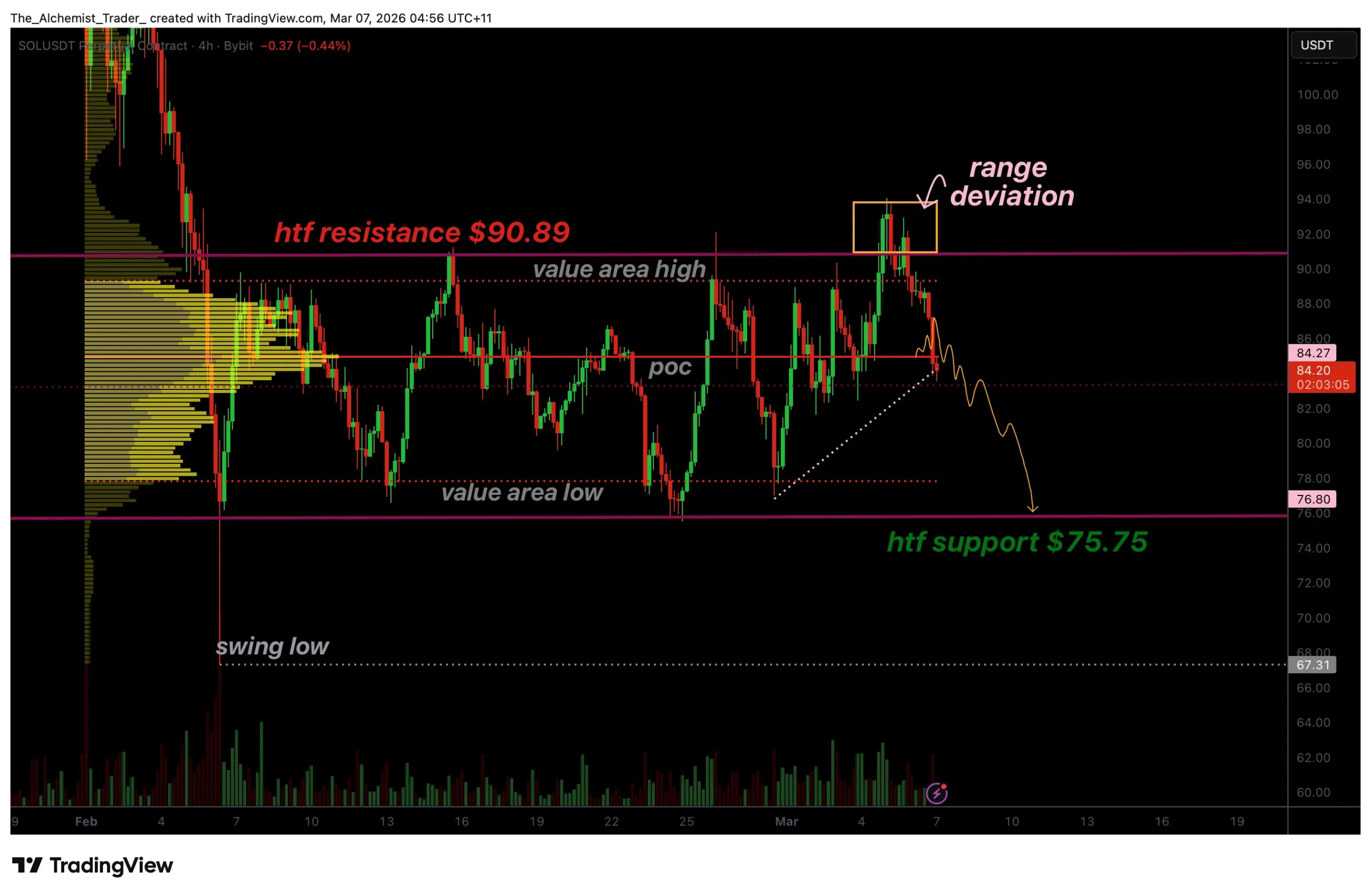
Solana price has confirmed a range-high deviation near the $90.89 resistance level, signaling weakening bullish momentum.
Summary
- Range-high deviation: Solana failed to sustain a breakout above $90.89 resistance.
- Point of Control at risk: Loss of this level signals increasing bearish pressure.
- $75.75 support in focus: Range-low and value area low become the next downside target.
Solana’s (SOL) recent price action is showing signs of structural weakness after failing to sustain a breakout above a key resistance zone. The rejection at the range high near $90.89 has created a deviation pattern, where price briefly traded above resistance before quickly returning back into the trading range.
Such deviations often signal exhaustion in bullish momentum and increase the probability of a corrective move toward lower support levels.
Solana price key technical points
- Range-high deviation: Solana failed to sustain a breakout above the $90.89 resistance.
- Point of Control under pressure: Current price acceptance around this level signals weakening momentum.
- Downside target: $75.75 range-low support aligns with the value area low.
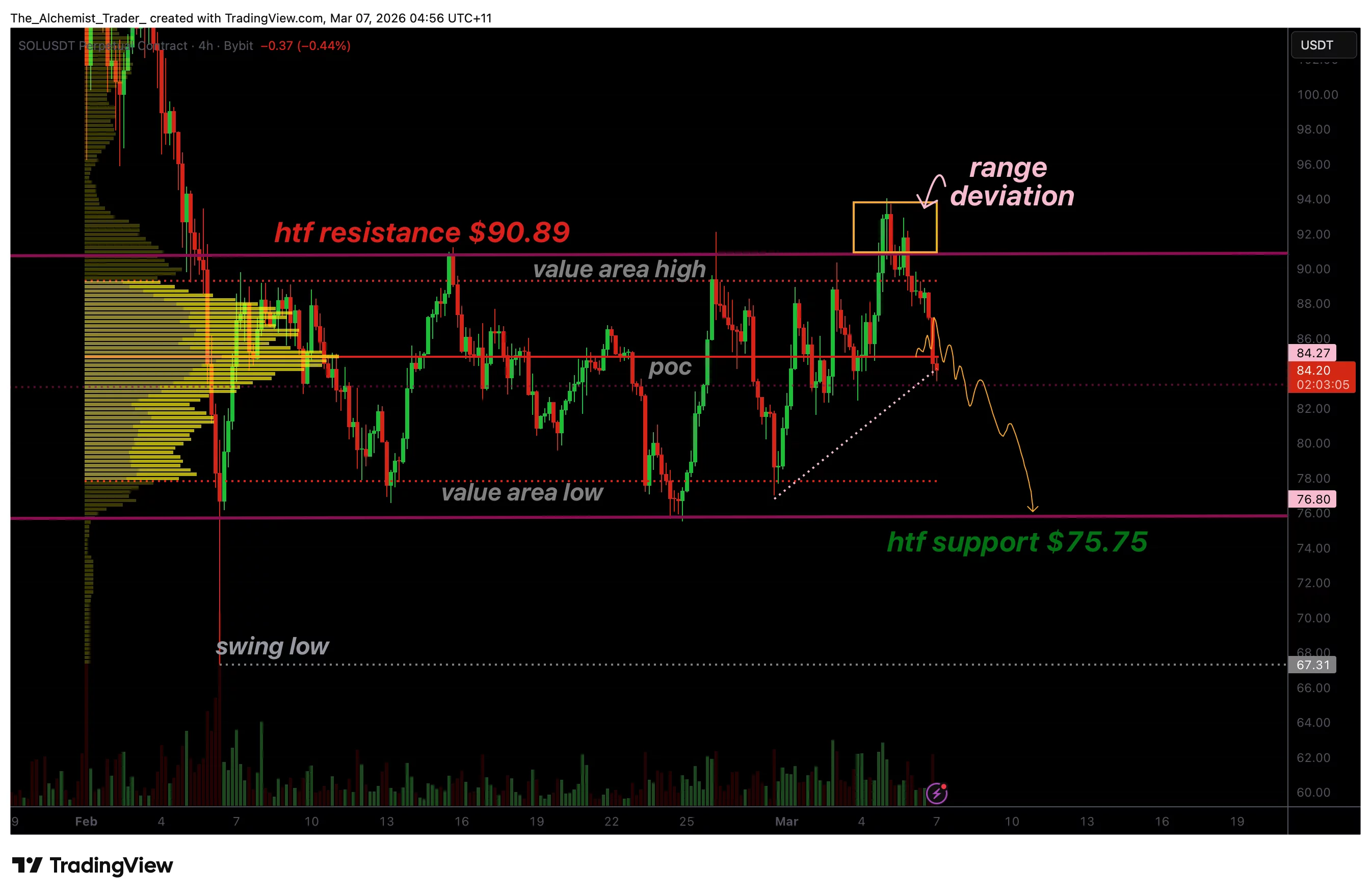
Solana recently attempted to push above the $90.89 range-high resistance, which represents a major high-timeframe level. Initially, the market showed signs of strength, with several four-hour candles closing above this level. However, the breakout lacked follow-through momentum, and price quickly reversed back below the resistance. This type of move is commonly referred to as a deviation, where price temporarily breaks above resistance but fails to establish acceptance.
Deviation patterns are important signals in market structure analysis because they often indicate that liquidity above the highs has been taken before a move in the opposite direction. In Solana’s case, the inability to sustain price above $90.89 suggests that buyers lacked the strength needed to continue the rally. As a result, the market has now returned to trading within the established range.
Currently, Solana is trading around the point of control, which represents the price level with the highest traded volume within the current range. This level often acts as a temporary equilibrium where buyers and sellers find balance. However, the longer price remains below the range high and struggles to reclaim higher levels, the more pressure begins to build on this support.
The loss of the point of control would be a significant technical development. If this level fails to hold, it would signal that sellers have taken control of the short-term market structure. In such a scenario, the market would likely rotate toward the next major support area located near the range low.
The key level to watch below sits around $75.75, which aligns with both the range low and a high-timeframe support zone. This area also coincides with the value area low, making it an important region where buyers may attempt to defend price. Historically, value area lows often attract liquidity as the market searches for balance within the broader trading range.
If Solana continues to show weakness and breaks below the point of control, price could move quickly toward this support region. Markets often accelerate toward lower liquidity zones once key support levels fail, especially after a confirmed deviation at resistance.
The broader trading environment also supports the possibility of continued rotation within the range. Range-bound markets frequently move between the value area high and value area low as liquidity is redistributed. With the range-high deviation now confirmed and price trading below resistance, the probability favors a move toward the lower boundary of the range.
On the fundamental side, Western Union is also expanding its blockchain payment initiatives with a new stablecoin project tied to the Solana network, further highlighting growing institutional interest in the ecosystem.
What to expect in the coming price action
From a technical perspective, Solana remains vulnerable to further downside after confirming the range-high deviation at $90.89. As long as price remains within the range and fails to reclaim the lost resistance, the probability favors a rotation toward the $75.75 range-low support.
A breakdown below this level would significantly increase capitulation risk, potentially opening the door for a deeper corrective move.


Kazakhstan’s central bank plans to begin investing as much as $350 million from its gold and foreign exchange reserves into a crypto-linked portfolio, with the first purchases expected in April or May, senior officials reportedly said during a Friday news briefing.
According to Reuters, National Bank Governor Timur Suleimenov said the bank is compiling a list of instruments for the portfolio. He said the basket would include crypto-linked assets and did not rule out direct cryptocurrency exposure, though officials indicated the initial emphasis would be on listed instruments tied to the sector.
Deputy Governor Aliya Moldabekova reportedly said the bank expects the first investments to begin in April or May. Until then, funds allocated for the initiative are being held in money market instruments. She said the investments may also include shares in companies tied to digital asset infrastructure and exchange-traded funds (ETFs) tracking them.
The remarks were made during a briefing following the bank’s interest rate decision on Friday.
🇰🇿 JUST IN: Kazakhstan’s central bank plans a $350M portfolio tied to crypto markets, expected to begin in April–May. pic.twitter.com/Sm0gu3qTGz
— Cointelegraph (@Cointelegraph) March 6, 2026
The move is one of Kazakhstan’s clearest steps yet toward gaining market exposure to digital assets through reserve management.
Related: Kazakhstan to launch crypto pilot zone for payments and adoption
Citing the central bank, National Business reported that about $350 million from Kazakhstan’s National Fund would be allocated to build the portfolio.
The outlet added that an additional $350 million from the central bank’s gold and foreign exchange reserves may be used to create a separate sub-portfolio tied to similar assets.
Kazakhstan expands digital asset strategy
The development comes as Kazakhstan expands efforts to integrate digital assets into its financial ecosystem.
On Nov. 7, 2025, officials were considering creating a state crypto reserve of between $500 million and $1 billion, funded partly by sovereign wealth assets and confiscated digital assets. The new portfolio implementation appears to advance those earlier discussions.
Kazakhstan has also explored other initiatives tied to digital assets. On Sept. 30, 2025, the government launched the state-backed Alem Crypto Fund to invest in digital assets through the Astana International Financial Centre.
Cointelegraph reached out to the National Bank of Kazakhstan, but had not received a response by publication.
Magazine: What’s a ‘Network State’ and are there real-life examples? Big Questions

Bitcoin Will Feel Ripple Effect of Prolonged Mideast War
Josh Frey’s 2026 NFL Draft Guide: Florida DT Caleb Banks

Cardiologist shares coffee’s ‘long-term effects’ on the heart may not be what you think


-

 Politics3 days ago
Alan Cumming Brands Baftas Ceremony A ‘Triggering S**tshow’
-

 Tech6 days ago
Unihertz’s Titan 2 Elite Arrives Just as Physical Keyboards Refuse to Fade Away
-

 NewsBeat6 days ago
Abusive parents will now be treated like sex offenders and placed on a ‘child cruelty register’ | News UK
-
Business5 hours ago
Form 8K Entergy Mississippi LLC For: 6 March
-
 NewsBeat6 days ago
Dubai flights cancelled as Brit told airspace closed ’10 minutes after boarding’
-
Sports7 days ago
The Vikings Need a Duck
-
 NewsBeat6 days ago
The empty pub on busy Cambridge road that has been boarded up for years
-

 NewsBeat5 days ago
‘Significant’ damage to boarded-up Horden house after fire
-

 Tech2 days ago
Bitwarden adds support for passkey login on Windows 11
-

 Entertainment4 days ago
Baby Gear Guide: Strollers, Car Seats
-
 Sports1 day ago
499 runs and 34 sixes later, India beat England to enter T20 World Cup final | Cricket News
-
Politics6 days ago
FIFA hypocrisy after Israel murder over 400 Palestinian footballers
-
 NewsBeat5 days ago
Emirates confirms when flights will resume amid Dubai airport chaos
-

 NewsBeat4 days ago
Is it acceptable to comment on the appearance of strangers in public? Readers discuss
-

 Tech6 days ago
Viral ad shows aged Musk, Altman, and Bezos using jobless humans to power AI
-

 Video4 days ago
How to Build Finance Dashboards With AI in Minutes
-

 Fashion5 days ago
On the Scene at the 57th Annual NAACP Image Awards: Teyana Taylor in Black Ashi Studio, Colman Domingo in Yellow Sergio Hudson, Chloe Bailey in Christian Siriano, and More!
-

 Business3 days ago
Guthrie Disappearance Enters Fifth Week as Family Visits Memorial
-
 Crypto World6 days ago
US Judge Lets Binance Unregistered Token Class Action Proceed
-
 NewsBeat5 days ago
Ukraine-Russia war latest: Belgium releases video showing forces boarding Russian shadow fleet oil tanker