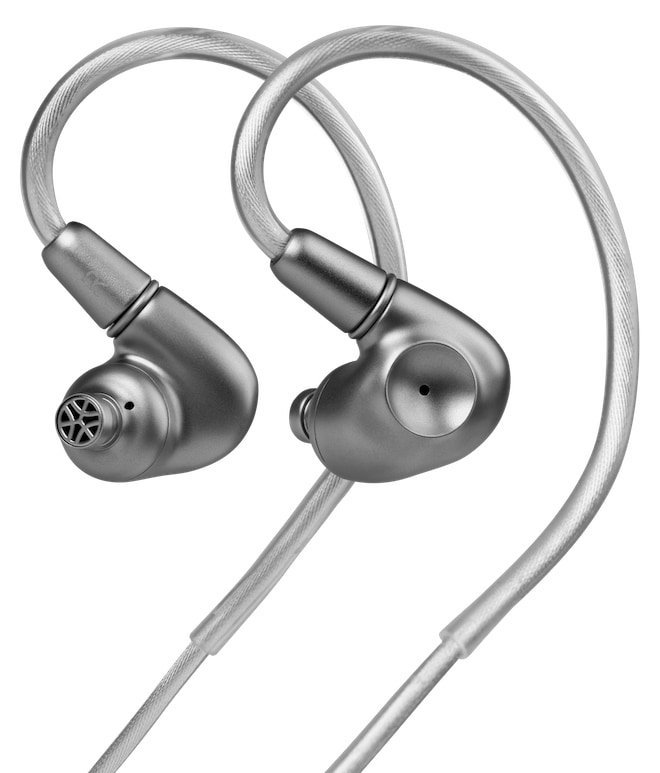
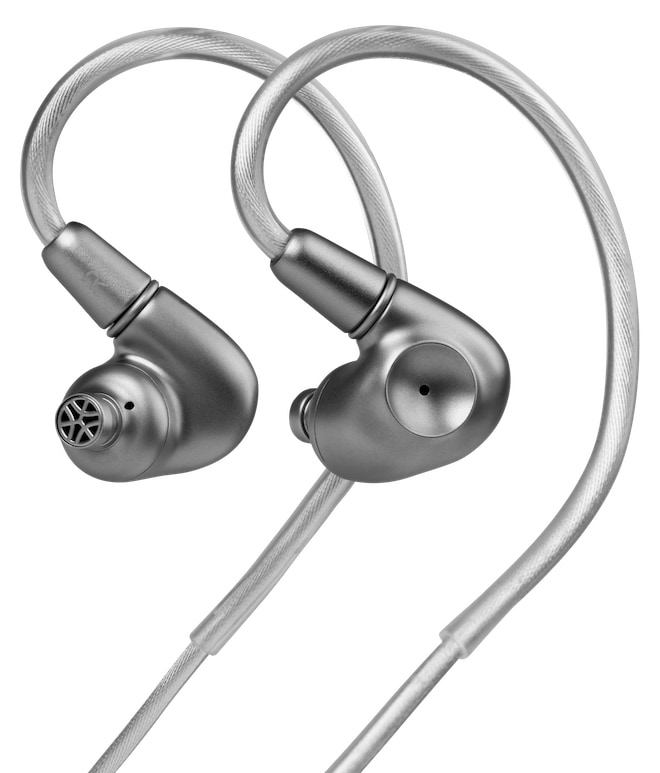
Meze Audio has introduced the ASTRU ($899), a new top of the line single dynamic driver in-ear monitor (IEM) created for listeners who want true high end performance without venturing into the stratospheric pricing that now defines many flagship IEMs. Built around a focused design philosophy, ASTRU relies on a single dynamic driver to deliver a visceral, full bodied presentation that Meze says can rival the layering, imaging, and resolution typically associated with complex multi driver designs.
The new model will make its first public appearance at CanJam NYC 2026 this weekend. Meze says ASTRU will be available starting March 20 through mezeaudio.com, mezeaudio.eu, and selected retailers worldwide.
While Meze Audio is widely known for its award winning headphones such as the Empyrean II, 99 Classics 2nd Generation, 109 Pro, and the recently introduced STRADA, the Romanian brand has also shown it can build compelling in ear monitors as well. Its ADVAR IEM, which we reviewed favorably, stood out for its musical balance, solid build quality, and distinctive industrial design. With ASTRU, Meze appears ready to push further into the high end IEM space while sticking with a simpler single driver approach rather than joining the industry’s escalating multi driver arms race.
Meze Audio ASTRU
Advanced Multilayer Dynamic Driver Architecture
At the center of the ASTRU is a custom multilayer composite 10 mm dynamic driver designed to balance speed, control, and tonal weight. The diaphragm dome is constructed using more than 80 ultra thin layers of gold, applied through a 48 hour physical vacuum DC magnetron sputtering process. This technique allows extremely thin metallic layers to be deposited with high precision, helping maintain diaphragm rigidity while keeping mass low.
The gold layered dome is bonded to a titanium layer and mounted on a PEEK base, materials chosen for their strength, stability, and resistance to unwanted resonance. The result is a driver structure intended to deliver fast transient response, extended treble, and the fuller low frequency presence that dynamic drivers are known for, while maintaining clarity and control across the frequency range.
Advertisement
Titanium Construction, Accessories, and Specifications
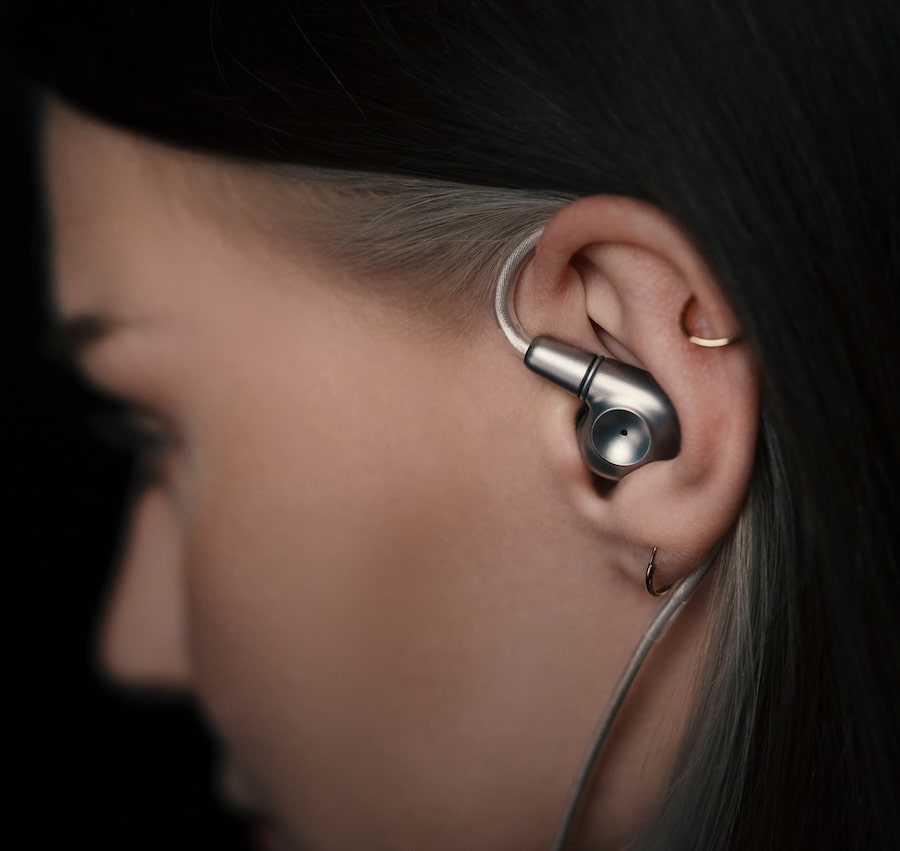
ASTRU’s housing reflects Meze Audio’s focus on durability, precision manufacturing, and long term comfort. The shell geometry has been carefully shaped to provide a secure and stable fit during extended listening sessions. Each earpiece is CNC machined from a single block of pure titanium and finished through a multi stage electroplating process that results in a smooth satin surface. According to Meze, producing each matched pair of shells requires up to seven days of precision machining and finishing, highlighting the level of manufacturing detail behind the design.
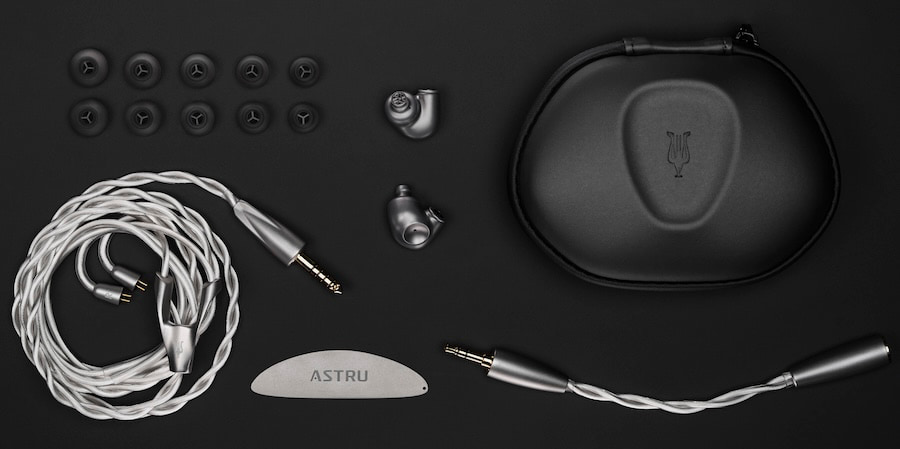
ASTRU is delivered as a complete listening package designed for portable high end audio use. The IEM includes a premium balanced cable equipped with CNC anodized aluminum hardware and a gold plated 4.4 mm balanced termination. This type of connection is commonly used with modern digital audio players and portable amplifiers because it offers improved channel separation and lower noise compared to standard single ended outputs. A 4.4 mm to 3.5 mm adapter is also included for compatibility with more traditional headphone outputs on Dongle DACs that may not offer a balanced output.
Additional accessories include five sizes of ear tips ranging from XS to XL to help users achieve a secure seal and proper acoustic performance. Meze also includes two carrying solutions: a protective pouch for everyday transport and a soft PU leather envelope designed for additional protection during travel or storage.
In terms of specifications, ASTRU offers a frequency range of 5 Hz to 35 kHz with a nominal impedance of 32 ohms and a sensitivity rating of 111dB SPL per milliwatt at 1 kHz. Total harmonic distortion is specified at less than 0.1 percent at 1 kHz. The IEM uses a standard 2-pin connector for cable attachment and weighs 13.4 grams (0.47 oz). These specifications indicate that ASTRU should be easy to drive with most modern digital audio players, portable DACs, and headphone amplifiers while still benefiting from higher quality source components.
Advertisement
The Bottom Line
The Meze Audio ASTRU arrives at an interesting moment for the high end IEM market. With Empire Ears recently shutting down operations, one of the category’s most recognizable boutique brands has exited the stage, leaving more room for companies like Campfire Audio, Noble Audio, 64 Audio, and Astell&Kern to battle it out in the upper tier of the segment. Most of those competitors lean heavily into complex driver arrays, packing multiple balanced armatures, electrostatics, or hybrid configurations into increasingly elaborate designs.
Meze is taking a different path. Rather than joining the escalating multi driver arms race, ASTRU sticks with a single dynamic driver architecture and focuses on materials, diaphragm engineering, and acoustic tuning. The titanium housing, multilayer gold coated diaphragm, and balanced cable package suggest a product built with the same attention to industrial design and materials that has defined Meze’s headphone lineup.
Advertisement. Scroll to continue reading.
What ASTRU offers is a simpler approach to high end IEM performance aimed at listeners who prefer the coherence, bass weight, and natural timbre that dynamic drivers are known for. What it does not offer is the kind of driver count marketing that dominates much of the $800 to $1500 IEM category. At $899, that places it in direct competition with multi driver models from several established brands. Whether buyers prioritize driver complexity or the sonic character of a well executed dynamic design will ultimately determine where ASTRU lands in this crowded field.
Advertisement
Price & Availability
ASTRU will be available for purchase starting March 20, 2026, on mezeaudio.com, mezeaudio.eu and in selected retailers worldwide, with a suggested retail price of $899.
A new NYT Strands puzzle appears at midnight each day for your time zone – which means that some people are always playing ‘today’s game’ while others are playing ‘yesterday’s’. If you’re looking for Sunday’s puzzle instead then click here: NYT Strands hints and answers for Sunday, April 19 (game #777).
Strands is the NYT’s latest word game after the likes of Wordle, Spelling Bee and Connections – and it’s great fun. It can be difficult, though, so read on for my Strands hints.
Want more word-based fun? Then check out my NYT Connections today and Quordle today pages for hints and answers for those games, and Marc’s Wordle today page for the original viral word game.
Advertisement
SPOILER WARNING: Information about NYT Strands today is below, so don’t read on if you don’t want to know the answers.
Article continues below
NYT Strands today (game #778) – hint #1 – today’s theme
What is the theme of today’s NYT Strands?
• Today’s NYT Strands theme is… Gloriously glaring!
NYT Strands today (game #778) – hint #2 – clue words
Play any of these words to unlock the in-game hints system.
Advertisement
SHEATH
CRAG
CHEAT
TOTAL
LINT
MILE
NYT Strands today (game #778) – hint #3 – spangram letters
How many letters are in today’s spangram?
• Spangram has 13 letters
NYT Strands today (game #778) – hint #4 – spangram position
What are two sides of the board that today’s spangram touches?
First side: bottom, 3rd column
Last side: top, 4th column
Advertisement
Right, the answers are below, so DO NOT SCROLL ANY FURTHER IF YOU DON’T WANT TO SEE THEM.
Advertisement
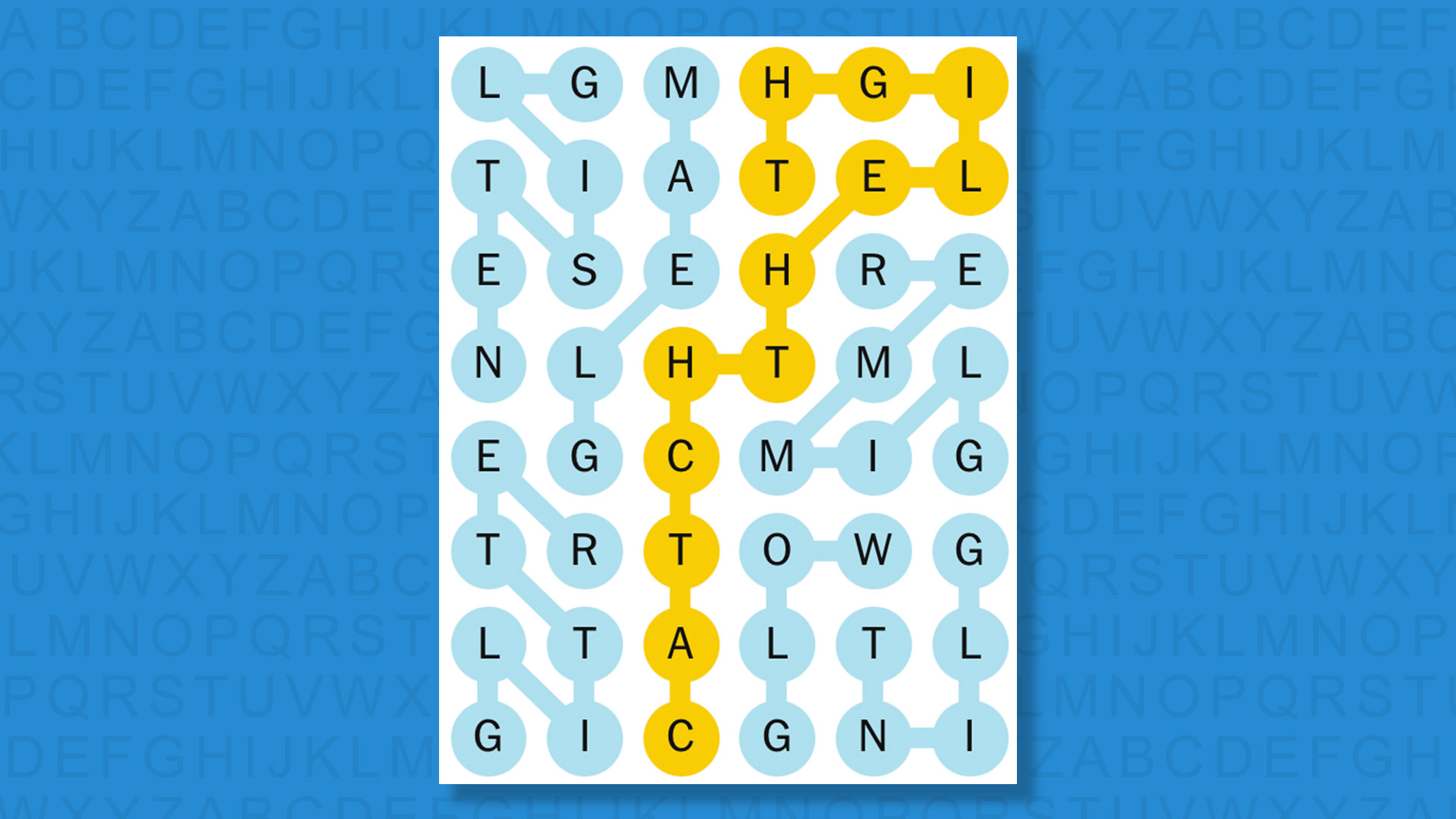
NYT Strands today (game #778) – the answers
(Image credit: New York Times)
The answers to today’s Strands, game #778, are…
GLINT
GLITTER
GLISTEN
GLEAM
GLOW
GLIMMER
SPANGRAM: CATCHTHELIGHT
My rating: Easy
My score: Perfect
The theme was a little bit confusing initially, but after spotting GLINT and GLITTER I understood that every light-associated word we were searching for began with the letter G.
Sign up for breaking news, reviews, opinion, top tech deals, and more.
There was no place then for shimmer or sparkle in this gaggle of G words.
The spangram was harder to spot, but with “light” not featured among the game words I worked backwards to find “catch” and then CATCHTHELIGHT.
Advertisement
Yesterday’s NYT Strands answers (Sunday, April 19, game #777)
ADJUST
MODIFY
TWEAK
REFINE
IMPROVE
ALTER
SPANGRAM: THEREIFIXEDIT
What is NYT Strands?
Strands is the NYT’s not-so-new-any-more word game, following Wordle and Connections. It’s now a fully fledged member of the NYT’s games stable that has been running for a year and which can be played on the NYT Games site on desktop or mobile.
I’ve got a full guide to how to play NYT Strands, complete with tips for solving it, so check that out if you’re struggling to beat it each day.
European Commission President Ursula von der Leyen says the app is technically ready and will be available to citizens soon.
The European Commission yesterday (15 April) unveiled a digital age verification app aimed at shielding children from harmful content online, with European Commission president Ursula von der Leyen declaring there are “no more excuses” for platforms that fail to act.
Announcing the tool in Brussels on Wednesday (15 April), von der Leyen painted a stark picture of the risks children face in the digital world. “One child in six is bullied online. One child in eight is bullying another child online,” she said, warning that social media platforms use “highly addictive designs” that damage young minds and leave children vulnerable to predators.
Users set up the app using a passport or ID card, after which they can confirm their age anonymously. The free app, which the Commission says is technically ready and will soon be available to citizens, allows users to verify their age when accessing online platforms “without revealing any other personal data”, according to von der Leyen. “Users cannot be tracked,” von der Leyen stressed, adding that the app is fully open source and compatible with any device.
Advertisement
Drawing a comparison with the EU’s Covid certificate – adopted in record time and used across 78 countries – von der Leyen said the age verification tool follows “the same principles, the same model.” Seven member states, including France, Italy, Spain and Ireland, are already planning to integrate the app into their national digital wallets.
The announcement comes ahead of the second meeting of the Commission’s Special Panel on Children’s Safety Online, which is due to deliver its recommendations by summer. Von der Leyen was unambiguous about the Commission’s direction of travel on enforcement. “Children’s rights in the European Union come before commercial interest. And we will make sure they do.”
Platforms were put on notice that voluntary compliance alone will not suffice. “We will have zero tolerance for companies that do not respect our children’s rights,” she said, adding that the Commission is “moving ahead with full speed and determination on the enforcement of our European rules”.
Don’t miss out on the knowledge you need to succeed. Sign up for the Daily Brief, Silicon Republic’s digest of need-to-know sci-tech news.
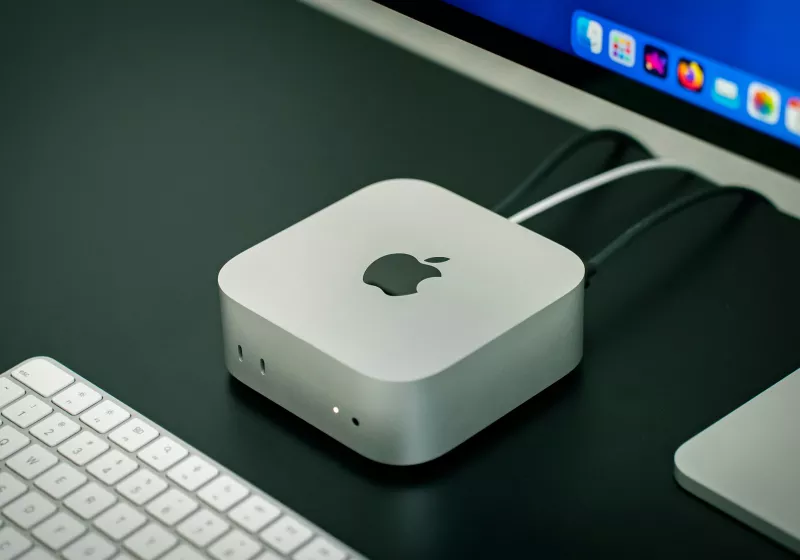
Consumer Intelligence Research Partners estimates the Mac Mini accounted for roughly 3% of Apple’s US Mac unit sales last year. That position has shifted quickly. Read Entire Article Source link
Jeff Bezos’ space company Blue Origin successfully re-used one of its New Glenn rockets for the first time ever on Sunday, but the company failed at its primary mission: delivering a communications satellite to orbit for customer AST SpaceMobile.
AST SpaceMobile issued a statement Sunday afternoon that the upper stage of the New Glenn rocket placed BlueBird 7 satellite into an orbit that was “lower than planned.” The satellite successfully separated from the rocket and powered on, the company said, but the altitude is too low “to sustain operations” and will now have to be de-orbited — left to burn up in the atmosphere of Earth.
The cost of the loss of the satellite is covered by AST SpaceMobile’s insurance policy, according the company, and there are successive BlueBird satellites that will be completed in around a month. AST SpaceMobile has contracts with more than just Blue Origin, and the company said it expects to be able to launch 45 more to space by the end of 2026.
But this represents the first major failure for Blue Origin’s New Glenn program, which only made its first flight in January 2025 after more than a decade in development. This was the second mission where New Glenn carried a customer payload to space, after launching twin spacecraft bound for Mars on behalf of NASA last November. The company did not immediately respond to a request for comment.
Advertisement
The apparent failure of New Glenn’s second stage could have wider implications beyond Blue Origin’s near-term commercial ambitions. The company is pushing hard to become one of the main launch providers for NASA’s Artemis missions to the moon and beyond. The space agency — and the Trump administration — has put pressure on Blue Origin and SpaceX to be able to put landers on the moon by the end of President Donald Trump’s second term, before advancing to returning humans to the lunar surface.
Blue Origin CEO Dave Limp has even said his company “will move heaven and Earth” to help NASA get back to the moon faster.
Blue Origin recently completed testing its first version of its own lunar lander, which the company is expected to try and launch at some point this year (without any crew). Blue Origin had suggested last year that it was considering launching this lander on New Glenn’s third mission, but ultimately decided to launch the AST SpaceMobile satellite instead.
Techcrunch event
Advertisement
San Francisco, CA | October 13-15, 2026
The third New Glenn launch seemed to start just fine on Sunday, with the the mega-rocket lifting off at 7:35 a.m. local time from Cape Canaveral, Florida. It was the first time Blue Origin re-used a previously-flown New Glenn booster — the same one that flew during New Glenn’s second mission. Roughly 10 minutes after liftoff, the booster came back down and landed on a drone ship in the ocean, just like it had last November. Jeff Bezos even shared drone footage of the booster’s landing on X, the social media site owned by his rival Elon Musk. (Musk offered congratulations.)
Advertisement
Roughly two hours after the launch, though, Blue Origin announced in its own post that the New Glenn upper stage placed AST SpaceMobile satellite in an “off-nominal orbit.” The company has not released any more information since that post.
Blue Origin spent a long time developing New Glenn, and it has been taken as a sign of confidence in that process that the company decided to start launching commercial payloads during these early missions. By comparison, SpaceX has spent the last few years flying test versions of its massive Starship, but has stuck with using dummy payloads as it works out the rocket’s kinks.
SpaceX did lose payloads deeper into its Falcon 9 program. In 2015, on the 19th Falcon 9 mission, the rocket blew up mid-flight and lost an entire International Space Station cargo spacecraft. In 2016, a Falcon 9 exploded on the launch pad during testing, causing the loss of an internet satellite for Meta.
A new NYT Connections puzzle appears at midnight each day for your time zone – which means that some people are always playing ‘today’s game’ while others are playing ‘yesterday’s’. If you’re looking for Sunday’s puzzle instead then click here: NYT Connections hints and answers for Sunday, April 19 (game #1043).
Good morning! Let’s play Connections, the NYT’s clever word game that challenges you to group answers in various categories. It can be tough, so read on if you need Connections hints.
What should you do once you’ve finished? Why, play some more word games of course. I’ve also got daily Strands hints and answers and Quordle hints and answers articles if you need help for those too, while Marc’s Wordle today page covers the original viral word game.
Advertisement
SPOILER WARNING: Information about NYT Connections today is below, so don’t read on if you don’t want to know the answers.
Article continues below
NYT Connections today (game #1044) – today’s words
(Image credit: New York Times)
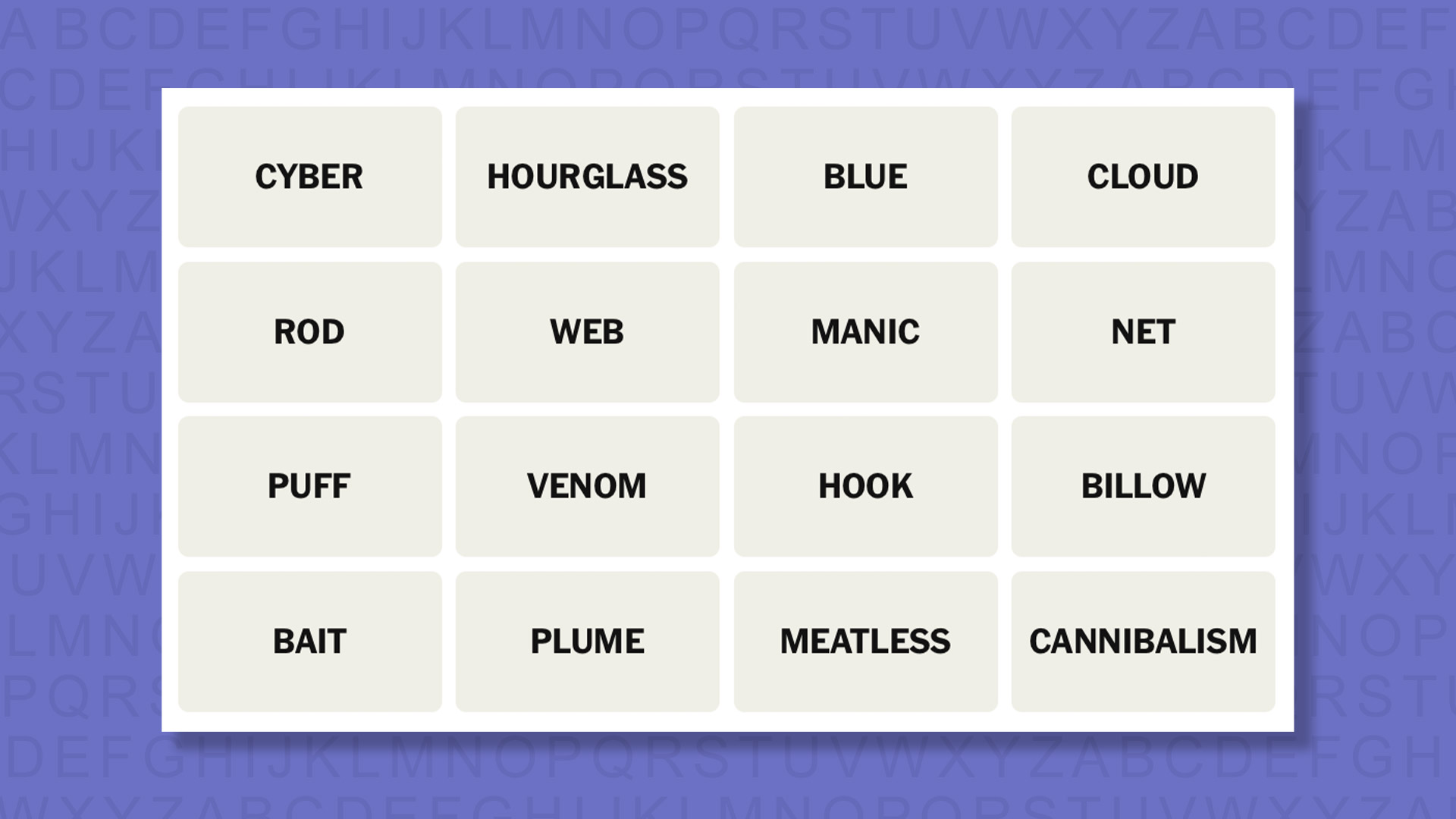
Today’s NYT Connections words are…
CYBER
HOURGLASS
BLUE
CLOUD
ROD
WEB
MANIC
NET
PUFF
VENOM
HOOK
BILLOW
BAIT
PLUME
MEATLESS
CANNIBALISM
NYT Connections today (game #1044) – hint #1 – group hints
What are some clues for today’s NYT Connections groups?
YELLOW: A bunch of fumes
GREEN: Used for angling
BLUE: Linked to an infamous arachnid
PURPLE: Start the week
Need more clues?
We’re firmly in spoiler territory now, but read on if you want to know what the four theme answers are for today’s NYT Connections puzzles…
Advertisement
Sign up for breaking news, reviews, opinion, top tech deals, and more.
NYT Connections today (game #1044) – hint #2 – group answers
What are the answers for today’s NYT Connections groups?
YELLOW: MASS OF SMOKE
GREEN: FISHING GEAR
BLUE: ASSOCIATED WITH BLACK WIDOW SPIDERS
PURPLE: _____ MONDAY
Right, the answers are below, so DO NOT SCROLL ANY FURTHER IF YOU DON’T WANT TO SEE THEM.
Advertisement
NYT Connections today (game #1044) – the answers
(Image credit: New York Times)
The answers to today’s Connections, game #1044, are…
YELLOW: MASS OF SMOKE BILLOW, CLOUD, PLUME, PUFF
GREEN: FISHING GEAR BAIT, HOOK, NET, ROD
BLUE: ASSOCIATED WITH BLACK WIDOW SPIDERS CANNIBALISM, HOURGLASS, VENOM, WEB
PURPLE: _____ MONDAY BLUE, CYBER, MANIC, MEATLESS
My rating: Easy
My score: Perfect
A bit of music knowledge got me to my 33rd “Purple First” thanks to Blue Monday by New Order and Prince’s Manic Monday,made famous by The Bangles. CYBER I was confident about, but MEATLESS I went with purely because of the alliteration.
This actually seemed the easiest group, not that I’m complaining.
Advertisement
Elsewhere, nature knowledge may have helped me get ASSOCIATED WITH BLACK WIDOW SPIDERS, but I spotted the more obvious yellow and green groups first.
Yesterday’s NYT Connections answers (Sunday, April 19, game #1043)
BLUE: CARDS IN TEXAS HOLD ‘EM FLOP, HOLE, RIVER, TURN
PURPLE: LAST WORDS OF CANDY BRANDS IN THE SINGULAR CAP, DUD, KID, MINT
What is NYT Connections?
NYT Connections is one of several increasingly popular word games made by the New York Times. It challenges you to find groups of four items that share something in common, and each group has a different difficulty level: green is easy, yellow a little harder, blue often quite tough and purple usually very difficult.
On the plus side, you don’t technically need to solve the final one, as you’ll be able to answer that one by a process of elimination. What’s more, you can make up to four mistakes, which gives you a little bit of breathing room.
Advertisement
It’s a little more involved than something like Wordle, however, and there are plenty of opportunities for the game to trip you up with tricks. For instance, watch out for homophones and other word games that could disguise the answers.
It’s playable for free via the NYT Games site on desktop or mobile.
There are many drivers who often bemoan the very existence of traffic lights. Despite incurring the daily ire of commuters who are running late for work, even those haters have to acknowledge the traffic signal’s invaluable function in helping to keep our roadways safe.
Traffic signals have, of course, evolved considerably since they were first pressed into use in the late-1860s, with the first electric lights coming into play sometime around 1912. It wasn’t long until those signals started using colored lights, and have since evolved into the red, yellow, and green modes we are all too familiar with today. Even as safety remains the primary purpose of the hundreds of thousands of traffic lights currently employed throughout the United States, some theorize that the life-saving devices may one day cease to exist.
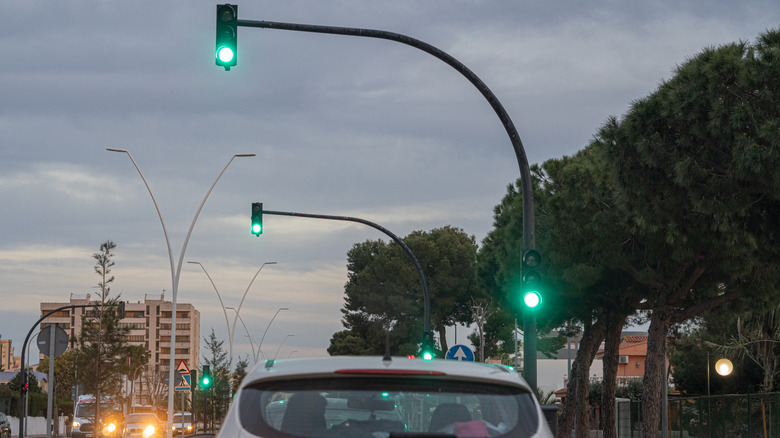
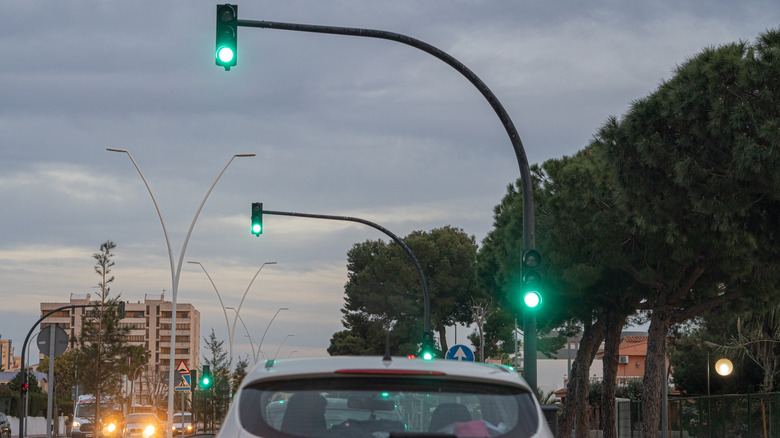
Until that fateful day, getting stuck at red lights when you’re in a rush will remain a constant source of commuter frustration. On some occasions, however, a stream of greens opens up on the road ahead like the parting of the Red Sea. That stream of green has a name, with researchers dubbing it the “Green Wave.” While they may seem rare, the “Green Wave” is a common occurrence in certain parts of the world, and it serves a very important purpose.
Advertisement
What is the purpose of a traffic light Green Wave?
Brasil2/Getty Images
While it might seem like a weird sort of karmic intervention, that “Green Wave” of traffic lights was actually programmed for a specific purpose by whatever government organization is in charge of maintaining the traffic signals in your city, state or township. They are, however, far more commonly utilized on high-volume roads in urban areas. The purpose of a “Green Wave” is to improve the flow of traffic in those areas, particularly during times with increased traffic volume.
At its core, the concept is very simple. The idea is to keep traffic flowing during peak volume times by simply reducing the number of stops at concurrent traffic signals. To enact a “Green Wave,” planners and engineers simply synchronize the traffic lights in congested areas to all turn green at the same time and stay that way for a specified period that ensures a steady flow of traffic in one direction. The method is, naturally, easier to manage on one-way streets with no turning lanes, though some cities have attempted to aid traffic flow further by simply outlawing left turns in metropolitan areas. Some have even taken to banning right turns too.
Advertisement
In any case, on top of aiding the flow of traffic in congested areas, “Green Wave” traffic patterns are also believed to have a positive effect on the environment. After all, the reduction in stop-and-go traffic also reduces a vehicle’s idling time, which, in turn, leads to reduced greenhouse gas emissions.
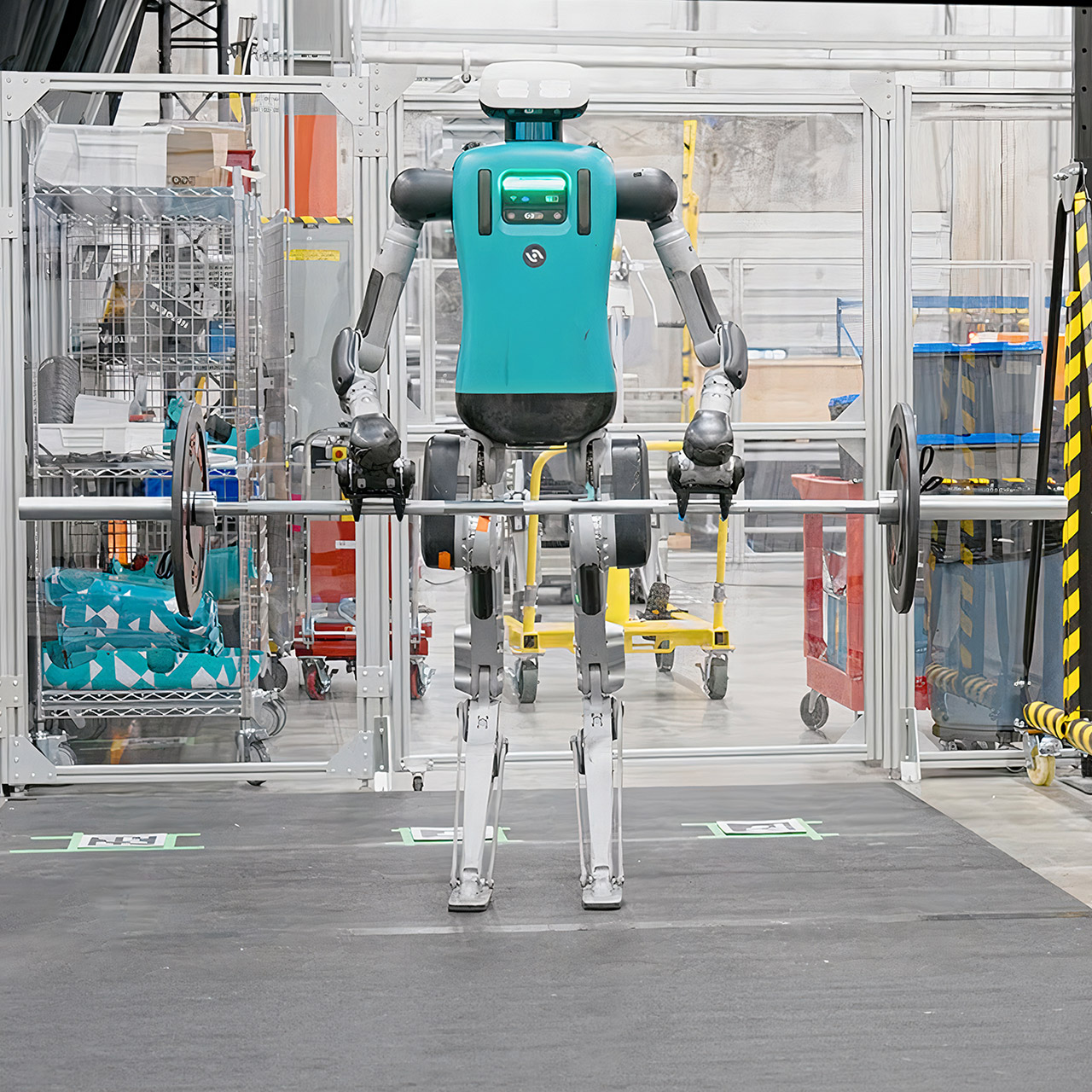
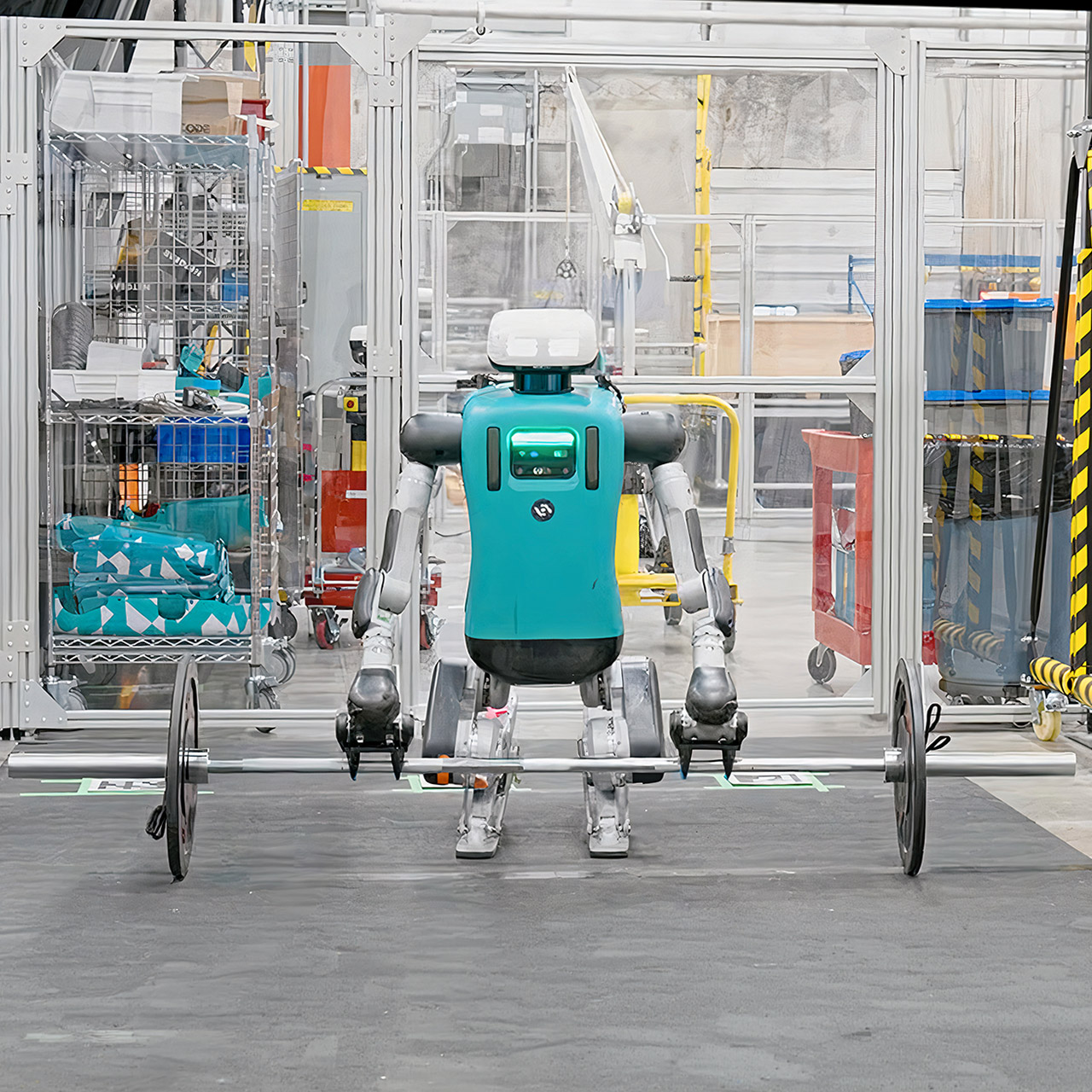
Digit is seen performing deadlifts with a 65-pound weight in the center of a lab. Agility Robotics shared the video a few days ago, and to be honest, the robot maintains a fairly steady balance and completes the task from beginning to end. Someone mentions that the new version can lift significantly more weight than the previous one, while another laughs about how it can run all day without stopping.
The engineers designed the test so that Digit had to work harder than usual. Every additional pound it must lift causes the robot to modify its entire body at simultaneously, including its arms, legs, torso, and everything else. The system must keep the weight centered and avoid tipping over, therefore the legs, arms, and rest of the robot must all function together. These actuators and joints can withstand repeated load without breaking down. Digit’s video simply shows the robot grasping the weight, rising up, then effortlessly placing it down repeatedly in a standard indoor location built for people.
Sleek & Durable Design: Standing at 132cm tall and weighing only approx. 35kg, the G1 is constructed with aerospace-grade aluminum alloy and carbon…
High Flexibility & Safe Movement: Boasting 23 joint degrees of freedom (6 per leg, 5 per arm), it offers an extensive range of motion. For safety, it…
Smart Interaction & Connectivity: Powered by an 8-core high-performance CPU and equipped with a depth camera and 3D LiDAR. It supports Wi-Fi 6 and…
Simulation is where all of the training takes place, because before it touches a real weight, an engineer creates a digital copy of the same thing in a virtual world. Then they anticipate what will happen when the weight shifts. The grip pressure remains constant, with no slipping or lowering. Any changes to the robot’s equilibrium are registered extremely instantly. The policy learns the perfect lift in the simulated environment with no complications before being transmitted directly to the real robot. When you see the real robot perform it, it looks fairly natural because it has already handled every potential variable thousands of times in the simulation.
Engineers chose deadlifts for the test because the movement requires complete body control. A simple arm raise would not put the hardware under the same level of stress. By incorporating weight into the simulation loop, the team is able to handle balancing changes that a pre-programmed script cannot handle alone. As a result, Digit lifts consistently, with no wobbling or resets. This method is easily adaptable to other objects or larger loads in future tests.
Digit was built by Agility to manage long, repetitive jobs that wear people out, such as working in factories or warehouses where you must squeeze into tight spaces, pick up oddly shaped goods, and continue without taking a break. This deadlift test demonstrates Digit’s ability to lift weight on ordinary floors while remaining steady, which is ideal for picking up boxes, carrying tools, and stacking things in human-designed places.
Advertisement
It also illustrates how far they’ve come in teaching robots to perform physical tasks. Whole-body synchronization was originally a nightmare, with hand-tuned code for each joint angle. But now they can simply train a policy in simulation that adapts on the go. Digit detects weight using its sensors, corrects itself in real time, and completes the lift without assistance, while the hardware can keep up because the training has already taught the actuators and joints to be more durable. [Source]
In October and through November, America’s EV sales reached their lowest point since 2022 after government subsidies expired, remembers Time. “But first-quarter data for 2026 shows that used EV sales were 12% higher than the same time last year and 17% higher than the previous quarter.
“One factor likely helping push buyers toward these cars is high gas prices, which recently topped $4.00 a gallon for the first time in four years,” they write — but it’s not just in the U.S. Instead, they argue the conflict “is driving a global surge of interest in electric vehicles…”
In the U.K., electric car sales reached a record high, with 86,120 vehicles sold in March… The French online used-car retailer Aramisauto reported its share of EV sales nearly doubled from February 16 to March 9, rising to 12.7% from 6.5%, while sales of fueled models dropped to 28% of sales from 34%, and sales of diesel models dropped to 10% from 14%. Germany’s largest online car market, mobile.de, told Reuters that the share of EV searches on its website has tripled since the start of March — from 12% to 36%, with car dealers receiving 66% more enquiries for used EVs than in February.
South Korea reported that registrations for electric vehicles more than doubled in March compared to the prior year, due in part to rising fuel prices and government subsidies… In New Zealand, more than 1,000 EVs were registered in the week that ended on March 22, close to double the week before, making it the country’s biggest week for electric vehicle registrations since the end of 2023, according to the country’s Transport Minister, Chris Bishop.
In America, Bloomberg also reports 605 high-speed EV charging stations switched on in just the first three months of 2025, “a 34% increase over the year-earlier period,” according to their analysis of federal data. A data platform focused on EV infrastructure tells Bloomberg that speedier and more reliable chargers are convincing more drivers to go electric and use public plugs.
Most loudspeaker designers don’t spend much time debating open versus closed the way headphone enthusiasts do. Cabinets are part of the equation for a reason, offering control, efficiency, and predictable performance. That’s the accepted playbook. But like any good rule in audio, someone is always trying to break it.
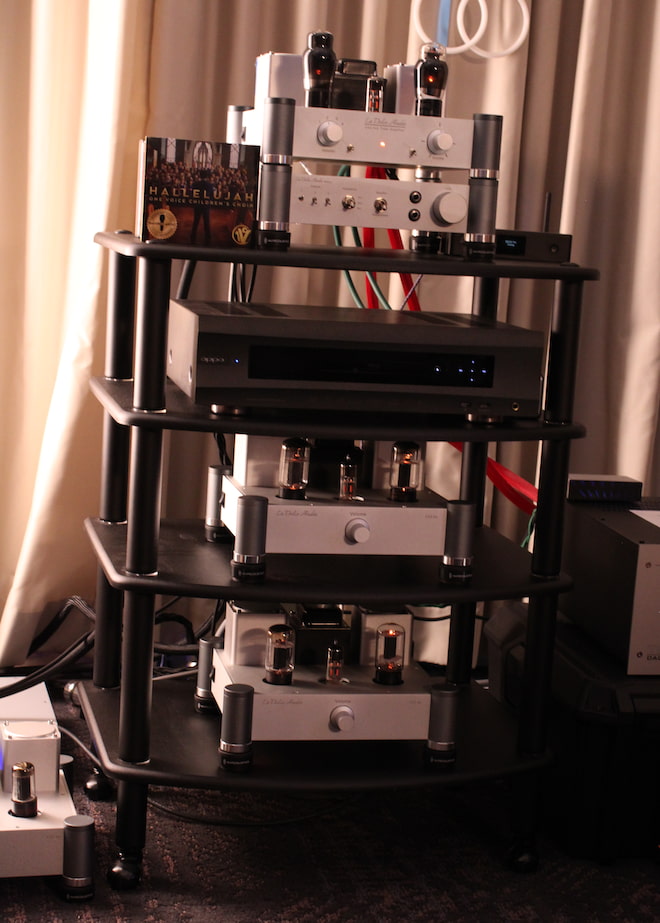
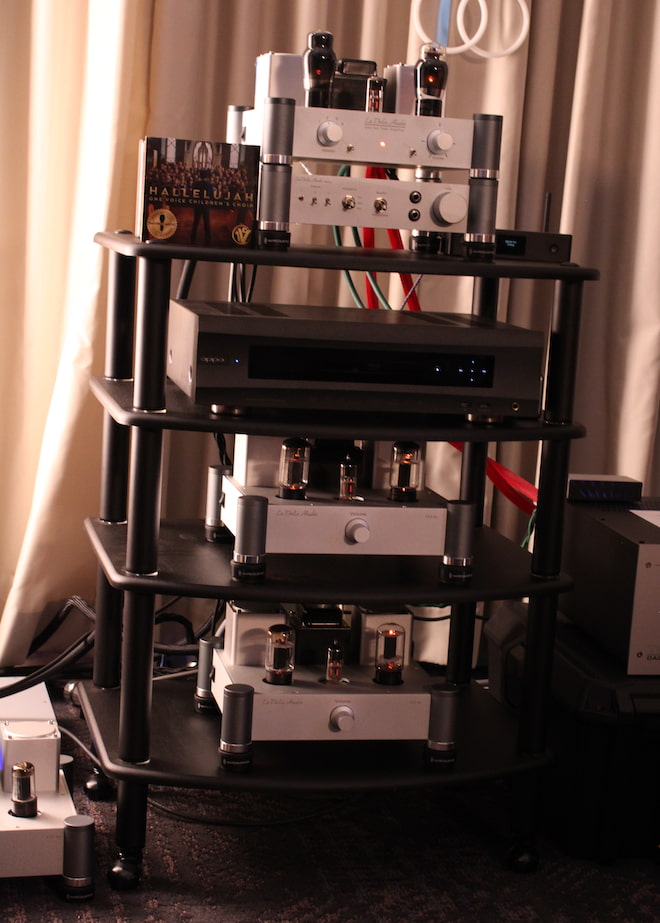
At AXPONA 2026, La Dolce Audio showed what happens when you ignore that playbook and lean into experimentation. Founder Terry Gesualdo isn’t approaching amplification or speaker design from a traditional standpoint, he’s part of a growing group of builders exploring open designs and current drive amplification as an alternative to the usual voltage driven norm.
I met Gesualdo on the shuttle ride over to the show, which feels about right. This isn’t a polished, corporate origin story, it’s the familiar path of someone who started by modifying gear, then building his own tube amps for himself, then for friends and family. The difference here is that he didn’t stop at tweaking circuits. He kept pushing until the results looked and sounded like something entirely his own.
Current Drive Tube Amplification: Why La Dolce Audio Isn’t Following the Script
Having built a few tube amps, I’m always curious to see what others are doing, and Terry Gesualdo is not following the usual path. Most of his designs are single ended pentode circuits, not triodes, and not push pull designs chasing more voltage swing. That choice alone puts him in a different lane than a lot of tube builders.
Advertisement
Where things really diverge is the move to current drive. Most amplifiers are voltage driven. That’s the standard approach across both solid state and tube designs. Current drive shows up more often inside DACs where signal levels are extremely small, and occasionally in headphone amplifiers, but rarely in loudspeaker systems where current demands are far higher.
The idea behind current drive is fairly straightforward. By controlling current instead of voltage, the amplifier reduces the impact of back EMF from the driver. That back EMF is the voice coil behaving like a generator as it moves through the magnetic field, feeding energy back into the amplifier. Reduce that interaction and, in theory, you reduce distortion and improve control over the driver.
It’s not a new concept, but it’s one that almost nobody is applying to loudspeakers in this way, especially with tube amplification. That’s what makes what La Dolce Audio is doing worth paying attention to.
Control Over Harmonics Instead of Chasing Purity
Circling back to that idea of ignoring the usual playbook, another aspect that reinforces how La Dolce Audio is taking a different path is the near exclusive use of pentode tubes instead of the more common triodes. Triodes are the simplest form of amplification with three active elements, anode, cathode, and grid. Fewer parts in the signal path is why many listeners and designers gravitate toward them. The assumption is less complexity means lower distortion and fewer unwanted artifacts.
But that’s only part of the story. Harmonic distortion doesn’t disappear just because the circuit is simpler. It just changes character. And not all harmonics are a problem. A lot of what people describe as tube warmth comes from second and third order harmonics, which many listeners actually prefer.
Advertisement
Terry Gesualdo leans into that reality rather than trying to avoid it. By using pentodes, which add additional control elements beyond what a triode offers, he can shape those harmonic structures instead of accepting whatever the circuit gives him. That includes adjusting the balance between second and third order harmonics and even their phase relationships.
It’s a different mindset. Instead of chasing the lowest possible distortion number, the goal is control over how that distortion presents itself, and giving the listener a way to fine tune the result.
Advertisement. Scroll to continue reading.
Some will find that approach a bit sacrilegious. There’s a large part of the hobby focused on removing as much of this behavior as possible, chasing lower distortion numbers and cleaner measurements. That’s not the goal here.
Advertisement
La Dolce Audio leans into a different philosophy. “If it sounds good, do it” is more than a slogan. It reflects the idea that listening is subjective and that not every system needs to be locked into a single interpretation of neutrality. By giving users control over harmonic structure, the design puts some of that decision making back in the listener’s hands.
UA2.5 and UA2.5M: Modular Power and User Tunability
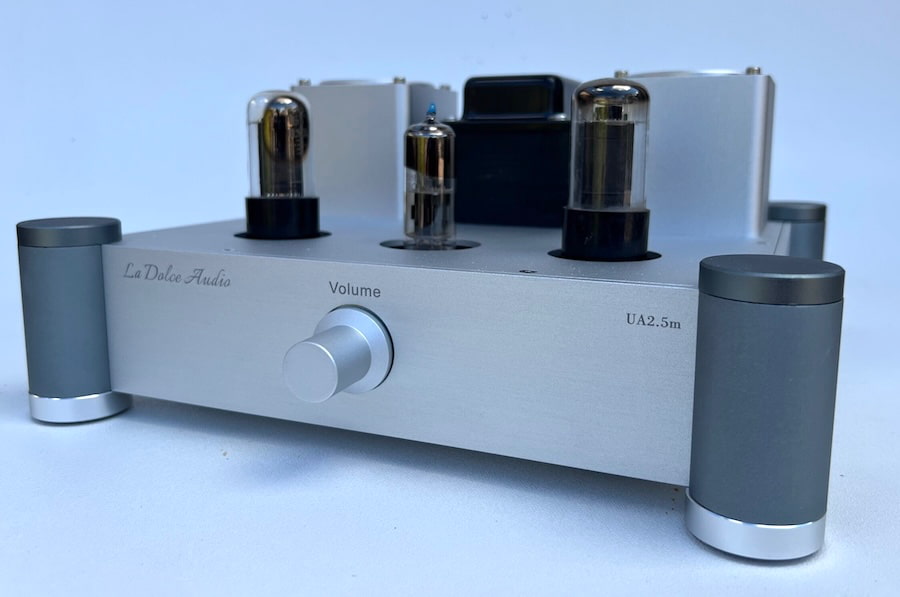
La Dolce Audio UA2.5M monoblock
La Dolce Audio offers two amplifier paths built around the same core ideas but with different roles. The UA2.5 is a dual channel amplifier rated at roughly 3 to 5 watts depending on tube selection, and it’s where most of the flexibility lives. With 24 possible sound signatures, it gives the user direct control over how the amplifier presents harmonic content and overall character.
The UA2.5M monoblocks step things up in output, delivering around 9 watts per channel, but they take a more focused approach. They are designed to be paired with the UA2.5, which handles preamp duties and sound shaping. As a result, the monoblocks do not include the same tuning controls, focusing instead on providing additional power while maintaining the same underlying design philosophy.
HPA2.3 Headphone Adapter
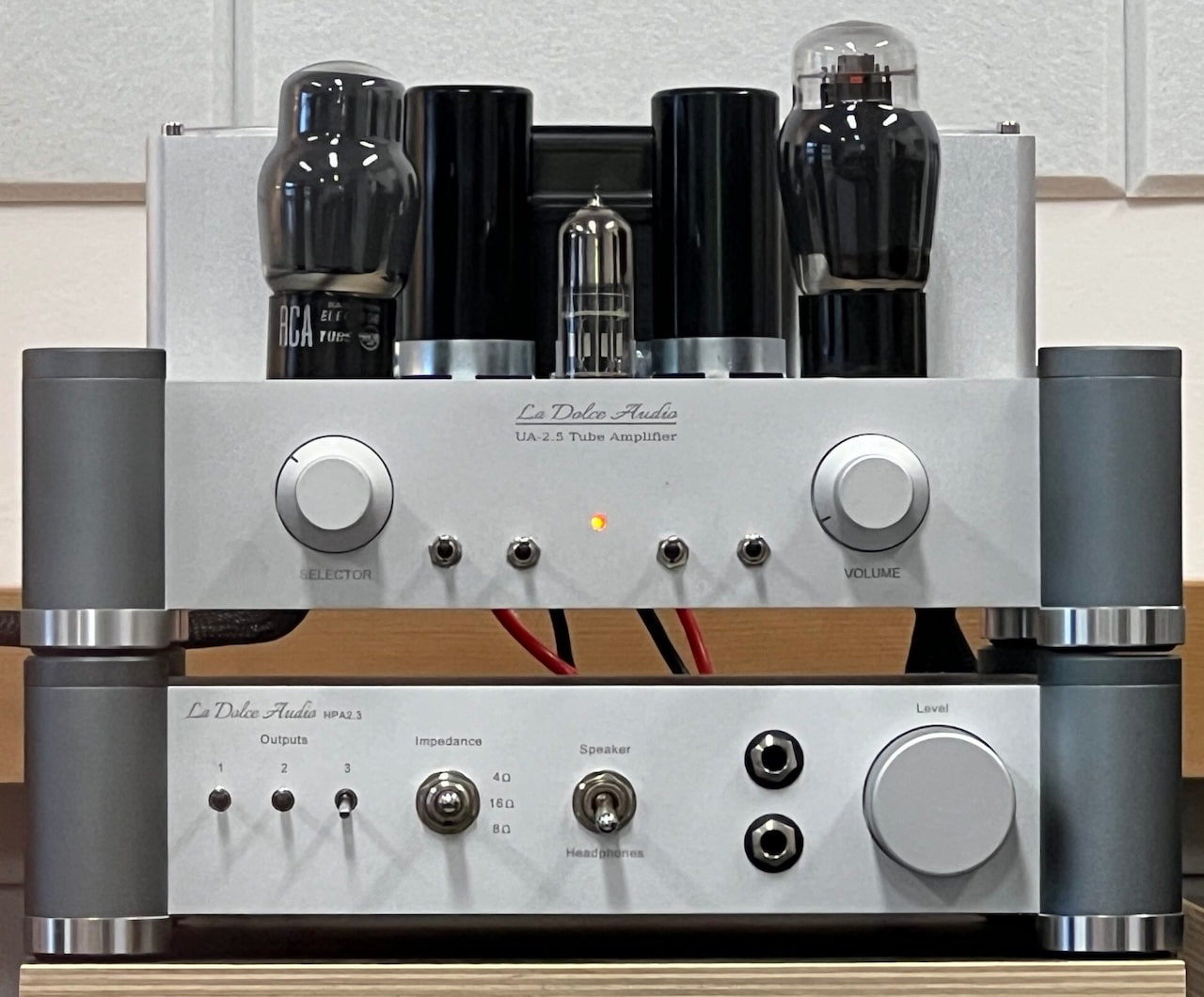
La Dolce Audio UA2.5 Tube Amplifier (top) with HPA2.3 Headphone Adapter (bottom)
Alongside its amplifiers, La Dolce Audio offers the HPA2.3 headphone “amplifier,” although that label needs a bit of clarification. It’s not an amplifier in the traditional sense. The HPA2.3 is a passive device designed to work with the UA2.5, relying on it for signal processing and gain. In practice, it converts the UA2.5 into a headphone amplifier rather than operating as one on its own.
That means the HPA2.3 can drive a wide range of headphones depending on how the UA2.5 is configured, but it cannot function independently. No preamp, no sound.
Pricing reflects that modular approach. The UA2.5, which serves as the foundation of the system, runs between $1,799 and $2,499 depending on configuration and tube selection. The UA2.5M monoblocks are $1,999 each, and the HPA2.3 adds another $599. A full system lands in the $3,500 range, depending on how far you go down the rabbit hole.
Advertisement
The Bottom Line
La Dolce Audio isn’t trying to fit into the usual mold, and that’s the point. In a category where a lot of designs feel like small variations on the same theme, this is a reminder that there are still different ways to approach amplification and system building.
Beyond the amplifiers, the partnership with ABX Audiophiles on Discord to offer open baffle speaker kits adds another layer. It invites listeners to get involved, not just as buyers but as participants, with a community that shares ideas, solves problems, and pushes designs forward together. We’ll have more on that ABX side of things in a forthcoming article.
It won’t be for everyone. If you want plug and play simplicity, this isn’t it. But if you’re the type who likes to understand what your system is doing and shape it to your preferences, La Dolce offers something most companies don’t. A system you can actually interact with, not just listen to.
Unlike previous years in what TV nerds like me call the “brightness wars,” the U7SG doesn’t outblast its predecessor, but it’s not a problem. It gets around three times as bright as anything you can stream (which is naturally capped due to compression), and has enough firepower for all but the flashiest 4K HDR Blu-rays. Its color processing shows a little more restraint than in previous models. It’s not quite what I’d call “accurate to the director’s intent,” like the best TVs I test, but it does keep itself from blasting your eyeballs most of the time.
The high brightness is matched by deep black levels, without much of the “blooming” or “haloing” around bright objects that can dilute the contrast of many budget-friendly TVs. It’s not as striking as OLED TVs, which can control each of their millions of pixels on demand, but it’ll wow you in deep space scenes just the same. I was pleased that the TV’s odd local dimming issue didn’t crop up in real-world content, but the picture does tend to flatten shadows in dark scenes more than expected, even as the matte-like screen does a good job keeping reflections at bay.
Photograph: Ryan Waniata
There are some other notable flaws. Moving off to the TV’s side in my easy chair led to dimmer colors, washed-out contrast between the brightest and darkest images, and uneven backlighting, aka the “dirty-screen effect.” That stood out most in the green backdrop of the Masters on Sunday as Rory McIlroy held on for the win. It wasn’t an issue when viewing head-on, but even then, I noticed some dingy yellow lines along the screen’s left and right sides with light backgrounds. (I may not have noticed them much if I hadn’t been bombarding this TV with test content first.)
The U7SG still doesn’t feel quite like a premium model. But it’s a very clear, bright TV, and will feel more like it’s worth the money once RGB shows up on other Hisense models and the price on this one drops. If you want something brighter than a similarly priced OLED like the LG B5, the U7 is a great buy and has a few good upgrades over last year’s U75QG.
Advertisement
We’ll know more about the 2026 TV landscape once the new RGB TVs have landed, but if you need a powerful, classy-looking TV before then, the U7SG should be on your list.






















































You must be logged in to post a comment Login