

Crypto World
Will Bitcoin price drop below $70K as $2.2B BTC options expiry looms?

Bitcoin price fell to near $70,000 on Friday following a sharp rebound the previous day. A looming BTC options expiry event is now keeping investors on edge as the market anticipates potential volatility.
Summary
- Bitcoin price has given up a portion of its gains from this week.
- Over $2.22 billion worth of options set to expire today have spurred concerns around volatility.
- Bitcoin technicals remain bullish despite the current drawdown.
According to data from crypto.news, Bitcoin (BTC) price fell 4.5% to an intraday low of $70,177 on Friday morning Asian time before stabilizing around $70,400 at press time. The bellwether pulled back after facing rejection around $74,000, a key resistance level it had failed to break for over a month.
Bitcoin price fell as investors began booking profits after climbing over 15% in the past 5 days.
This came amid a broader risk-off environment triggered by the ongoing war between the U.S. and Iran, which has led energy prices to soar to multi-month highs. The military escalation has also triggered capital rotation into traditional safe-haven assets, which have seen relatively better performance amid the geopolitical uncertainty.
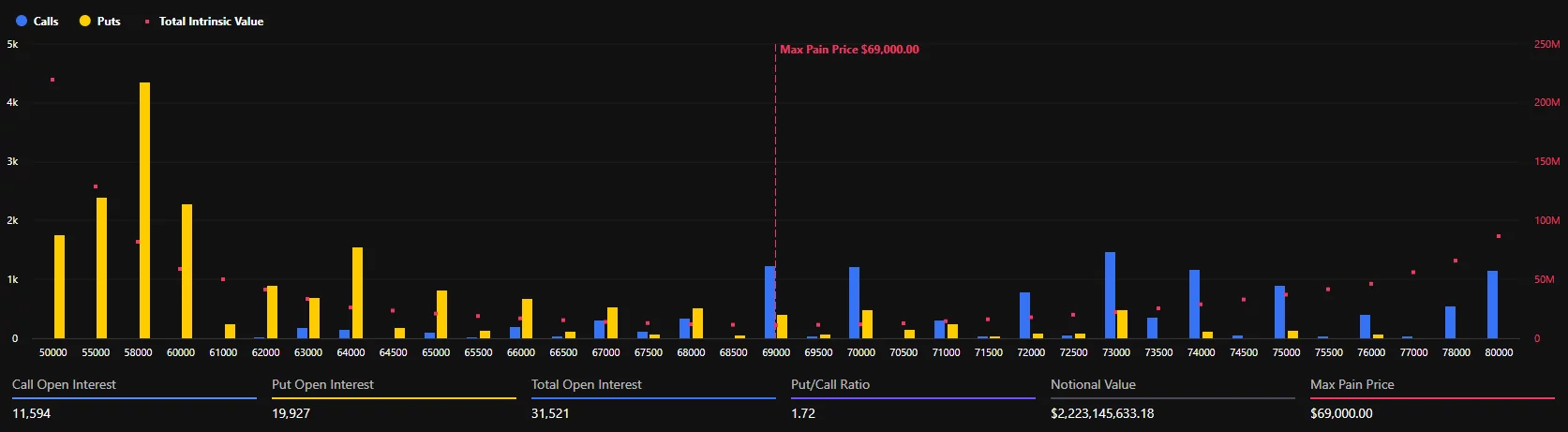
Today, investor sentiment is being kept in check as $2.22 billion worth of Bitcoin option expiry is set to be settled on the Deribit exchange at 8:00 a.m. UTC. Over 31,500 Bitcoin open contracts are set to expire.
At press time, the put-to-call ratio was at 1.72, meaning put options or traders betting on Bitcoin to go lower far surpass the calls that are betting on a rise. The maximum pain level for BTC or the price at which most option contracts expire worthless stood at $69,000, just $1,400 short of the current spot price.
The maximum pain level, also known as the strike price, tends to pull spot prices towards the center around expiry. Therefore, there remains a high risk that Bitcoin price could pull back towards the $69,000 mark as options reach expiry.
Bitcoin has failed to hold above $70,000 six times since the start of February, and losing this key psychological support once again could spook short-term traders who were betting on the current recovery rally.
Despite the concerns surrounding the massive options expiry today, BTC price charts have not yet shown signs of a breakdown.
On the Bitcoin/USDT 24-hour chart, momentum indicators still portrayed a positive outlook at least in the short term.
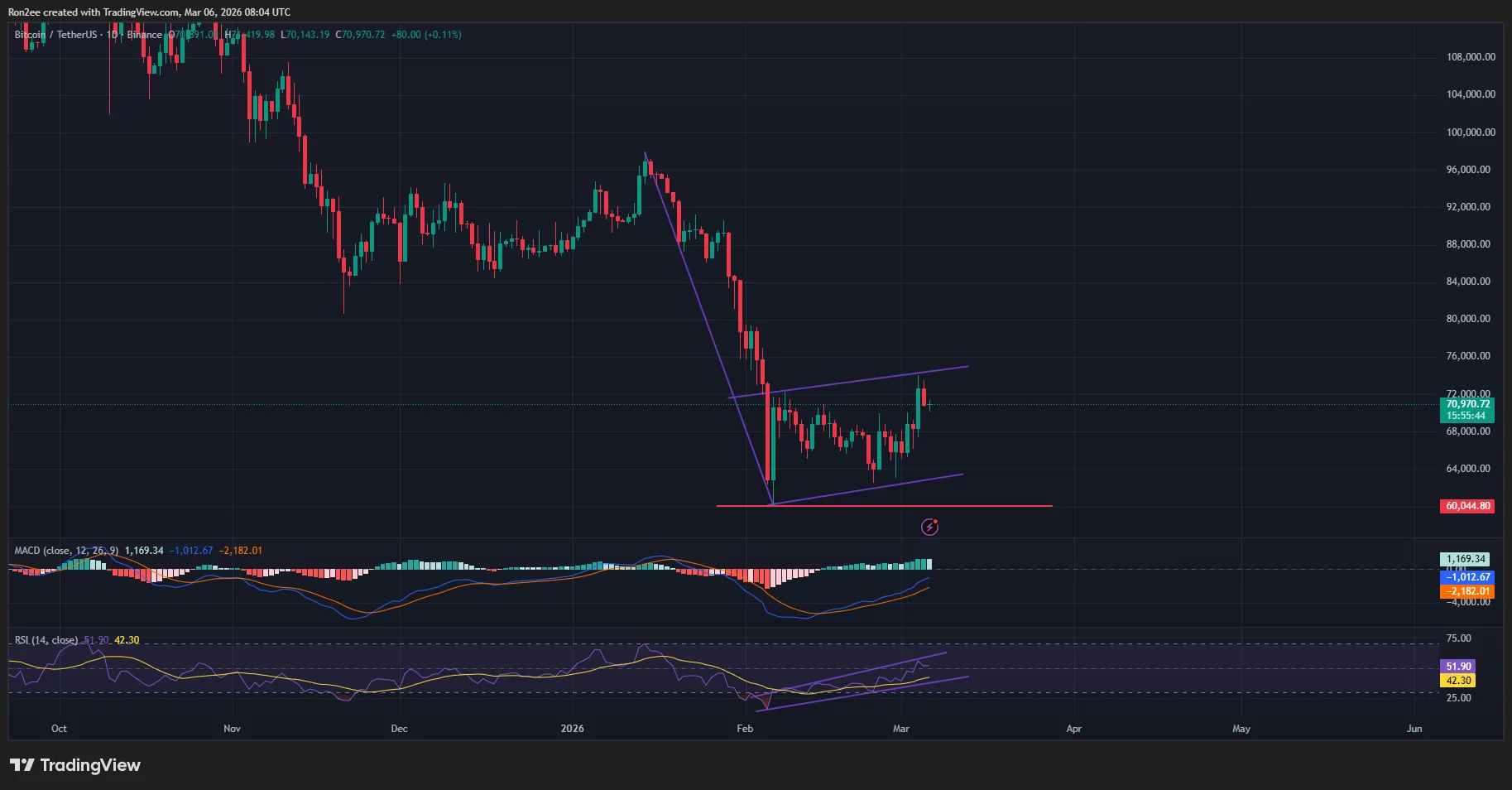
Notably, the MACD line was pointing upwards, suggesting growing buying pressure for the bulls in comparison to the selling pressure exerted by bears. At the same time, the Relative Strength Index has also formed a bullish divergence with the price action.
For now, bulls will be eyeing $72,000 as the next major resistance level to claim, a break above which could likely end its downtrend today.
On the contrary, a move below the $70,000 support could pull BTC price to $69,000 and successively as low as $60,000 as the broader structure remains confined within a bearish flag pattern, which is considered one of the most negative formations in technical analysis.
Disclosure: This article does not represent investment advice. The content and materials featured on this page are for educational purposes only.



Ethereum co-founder Vitalik Buterin backs a controversial shift from Casper FFG to Minimmit, betting that making censorship harder matters more than preserving textbook fault‑tolerance as ETH trades near $2,000.
Summary
- Vitalik proposes replacing Ethereum’s two‑round Casper FFG finality gadget with Minimmit, which finalizes blocks in a single round.
- The trade‑off: fault tolerance drops from 33% to 17%, but censorship resistance and recovery from bugs or attacks arguably improve.
- The debate lands as ETH hovers around $2,000, with markets weighing whether faster, more resilient finality can justify a premium in a choppy macro tape.
Vitalik Buterin has put his weight behind one of the most sensitive changes to Ethereum’s (ETH) core: ripping out the Casper FFG finality gadget and replacing it with Minimmit, a one‑round Byzantine fault‑tolerant scheme that deliberately relaxes some purity‑theory guarantees in exchange for what he frames as more “real world” safety.
Casper today requires validators to attest twice — once to justify a block, again to finalize it — and can tolerate up to 33% of stake behaving maliciously before the system’s guarantees break. Minimmit cuts that to a single round: faster and simpler, but with formal fault tolerance falling to 17% in the current proposed parameters.
On paper, that looks like a downgrade. But Buterin’s thread makes a blunt argument: the worst real‑world attack is not finality reversion, it is censorship. Finality reversion creates undeniable cryptographic evidence and leads to massive slashing — millions of ETH, or billions of $, vaporized on‑chain — which makes such attacks economically absurd for any rational actor with that kind of capital. Censorship, by contrast, is messy: it forces users and developers into social coordination, soft forks, and political fights. In both the “ideal” three‑slot‑finality (3SF) model and Minimmit, an attacker needs 50% of stake to censor, but Minimmit shifts the thresholds at which an attacker can unilaterally finalize bad history, raising that bar from 67% to 83%. That, Buterin argues, maximizes scenarios where the network defaults to “two chains dueling” instead of “the wrong thing finalized” — an outcome that is chaotic but fixable.
The backdrop is a market that is no longer paying for narratives alone. ETH trades around $2,000, down from prior cycle highs near $4,900, with volatility elevated and macro headwinds still in play. Traders have already seen the outline of Ethereum’s “fast L1” strawmap, which aims to cut slot times from 12 seconds to as low as 2 seconds and drive finality down to single‑digit seconds using Minimmit. If this redesign sticks, Ethereum stops competing only on rollup ecosystem and DeFi liquidity and starts competing on something brutally simple: how quickly and credibly your transaction becomes irreversible. In a market where ETH is still repricing its role versus L2s and rival L1s, Minimmit is not just a consensus tweak; it is an attempt to re‑anchor the asset’s value in raw, observable user experience: click, confirm, done.
Crypto World
Robinhood’s venture fund, which gives investors access to private companies, tanks 11% on first day

Robinhood signage during a media event at John F. Kennedy International Airport (JFK) in New York, US, on Wednesday, March 4, 2026.
Adam Gray | Bloomberg | Getty Images
Robinhood’s Venture Fund I plunged 11% in its public market debut on the New York Stock Exchange on Friday, casting doubt on investors’ appetite for riskier investment amid swirling geopolitical tensions.
The fund, which is trades under the ticker RVI, offers exposure to notable private companies such as financial services firm Revolut and software company Databricks. It aims to democratize access to an area of capital markets that has often been off limits to retail investors, Robinhood CEO Vlad Tenev told CNBC’s “Squawk on the Street” on Friday.
“You have companies that are out there at valuations in the hundreds of billions, even getting into the trillions in private markets before retail investors get a chance to come in at all and this is happening more and more,” Tenev said. “We’re trying to solve this by not just opening the door to private markets but completely blowing them off the hinges so that they can never be closed.”
Retail investors can buy and sell shares of the closed-end fund, which is structured like an investment firm, much like they would shares of a traditional company.
However, the launch comes during a tough time for public markets. The major U.S. stock averages are on pace for weekly declines as traders sell equities on fears the U.S.-Iran conflict could continue longer than anticipated.
Robinhood Ventures Fund priced its initial public offering at $25 per share. It opened at $22 and hit a low of $21 before trading around back around $22.12.
RVI were last trading at $22.17 per share.


Massachusetts Senator Elizabeth Warren, one of the more outspoken voices in Congress often connecting cryptocurrencies to illicit activities, slammed the US Securities and Exchange Commission’s settlement with Tron founder Justin Sun.
In a Thursday notice, Warren accused the SEC of “giving a free pass” to Sun after he “poured $90 million” in crypto investments tied to US President Donald Trump and his family.
Sun has invested millions of dollars through token purchases in the Trump family’s crypto platform, World Liberty Financial, and the SEC settled an unrelated case against the Tron founder and his companies for $10 million.
“Justin Sun poured $90 million into Trump’s crypto ventures, and today the SEC agreed to drop its case against him,” said Warren. “The SEC should not be a lap dog for Trump’s billionaire buddies, and any crypto legislation moving through Congress must stop the President’s crypto corruption.”
Warren did not specifically refer to the digital asset market structure bill moving through the Senate, but the legislation has been a focus of the White House and many pro-crypto lawmakers for months after it passed the House of Representatives as the CLARITY Act. The bill, which advanced from the Senate Agriculture Committee in January, is being considered by the Senate Banking Committee, where Warren is the ranking Democrat.
Related: Binance slams US Senate probe over Iran as based on defamatory reports
Crypto observers await markup for market structure bill
Among the issues at stake in the market structure bill include provisions on tokenized equities, ethics and stablecoin rewards. The White House has hosted three meetings between officials and representatives of the crypto and banking industries, but it was unclear as of Friday whether the discussions had made any impact on the legislation.
Both Trump and his son, Eric, posted to social media this week to criticize banks over their position on the market structure bill. Some banking organizations have argued that including provisions on stablecoin rewards in the legislation could undermine credit and lead to deposit flight risk.
In January, the Senate Banking Committee indefinitely postponed a markup on the market structure bill after Coinbase CEO Brian Armstrong said the exchange could not support the legislation “as written.” As of Friday, the body had not rescheduled the event, which would be necessary to address securities law concerns before a potential vote in the full Senate.
Magazine: Clarity Act risks repeat of Europe’s mistakes, crypto lawyer warns
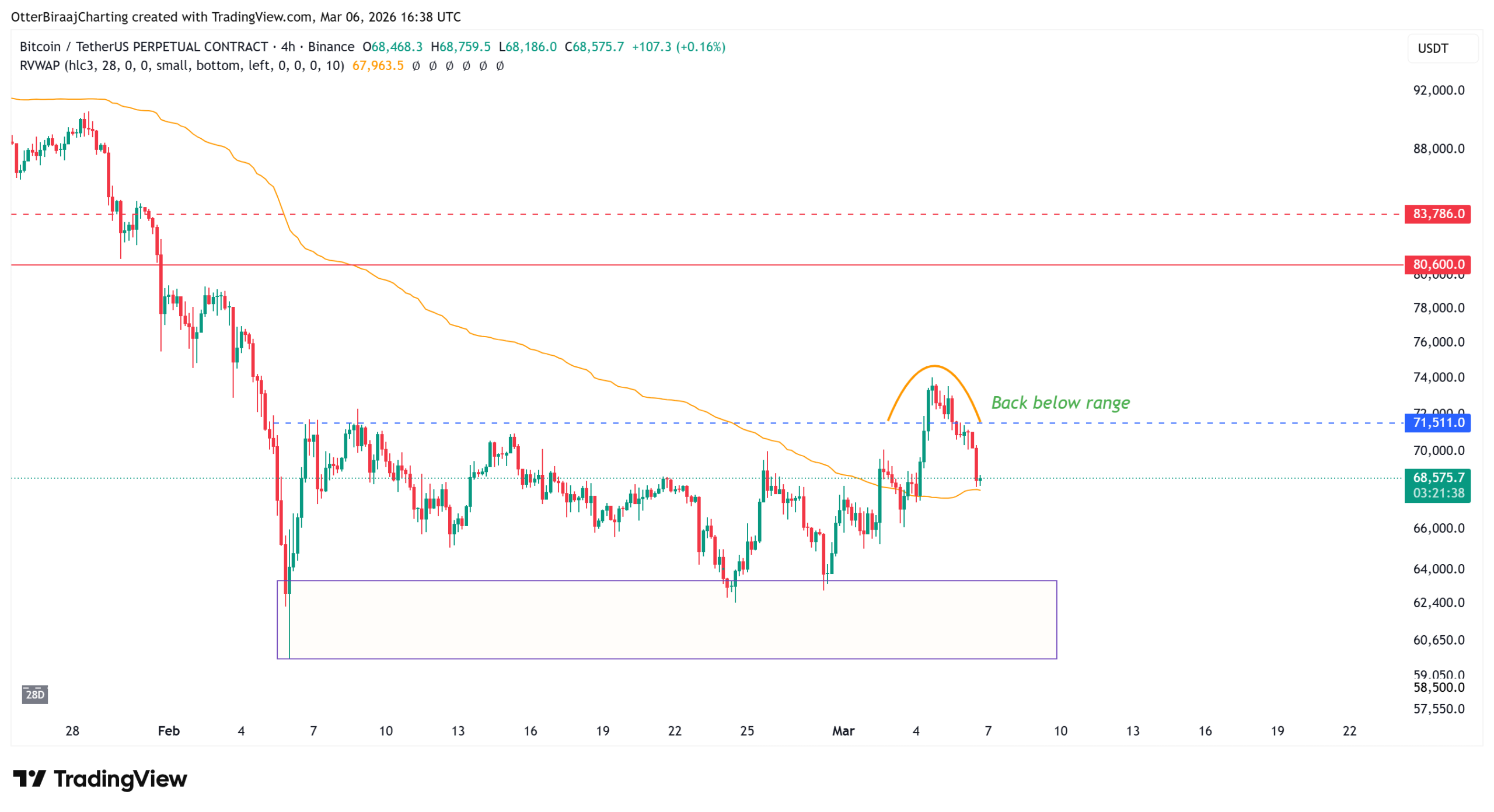
Bitcoin (BTC) slipped back into its monthly trading range under $70,000 after dropping 5% over the past two days.
Market data points to resistance near the $70,000 level, with onchain flows, futures data, and weakening spot volumes signaling renewed selling pressure that limits BTC’s ability to hold this week’s range highs.

BTC short-term holders locked in profit
Profit-taking from the short-term holders (STHs) accelerated during Bitcoin’s rally above $74,000. Crypto analyst Darkfost said that more than 27,000 BTC in profit moved to exchanges from STH wallets over the past 24 hours.

The spike ranks among the largest realized-profit transfers from this cohort since November 2025.
Darkfost noted that the sellers were able to lock in gains mainly accumulated between one week and one month ago, as their realized price sat near $68,000.
Bitcoin futures data showed a similar pattern of aggressive selling activity. Market analyst IT Tech noted that both spot and perpetual futures markets recently flipped negative on the cumulative volume delta (CVD) indicator. The CVD measures buy volume minus sell volume. A negative reading signals dominant selling pressure.
According to the analyst, the spot CVD reached –$202.49 million while perpetual futures CVD dropped to –$185.60 million. Bitcoin slipped below $70,000 during the same period, as bid liquidity pulled back in the market.
Related: Bitcoin price drops to near $68K as US jobs weakness fails to rescue bulls
Coinbase premium index signals fading demand
The spot demand from US-based traders also weakened near key price inflection points.
The Coinbase Premium Index, which measures the Bitcoin price difference between Coinbase and offshore exchanges, has repeatedly faded as BTC approached $74,000. The positive readings usually signal a stronger US spot demand.

During Bitcoin’s rally toward the $73,000–$74,000 range on March 4, the premium briefly spiked above 0.08, indicating strong buying activity from Coinbase-using entities.
The move quickly faded as the price reverted from $74,000, and the premium later turned negative.
MN Capital founder Michaël van de Poppe said that the Friday US sessions have recently produced broad market selling across the risk assets, including the Nasdaq.
Van de Poppe added that Bitcoin holding the $67,000–$68,000 range may stabilize the short-term trend before a continued move higher.
Additionally, crypto trader Titan of Crypto pointed to a nearby fair value gap (FVG) that could support the price consolidation. An FVG forms when the price moves quickly and leaves a low-liquidity area where minimal trading occurred during a breakout. Technically, the price may revisit these zones to rebalance the liquidity.
The lower boundary of that gap sits near $66,500, which the trader is monitoring as a deeper liquidity zone.

Related: Was $74K a bull trap? Bitcoin traders diverge on 2022 crash repeating
This article does not contain investment advice or recommendations. Every investment and trading move involves risk, and readers should conduct their own research when making a decision. While we strive to provide accurate and timely information, Cointelegraph does not guarantee the accuracy, completeness, or reliability of any information in this article. This article may contain forward-looking statements that are subject to risks and uncertainties. Cointelegraph will not be liable for any loss or damage arising from your reliance on this information.
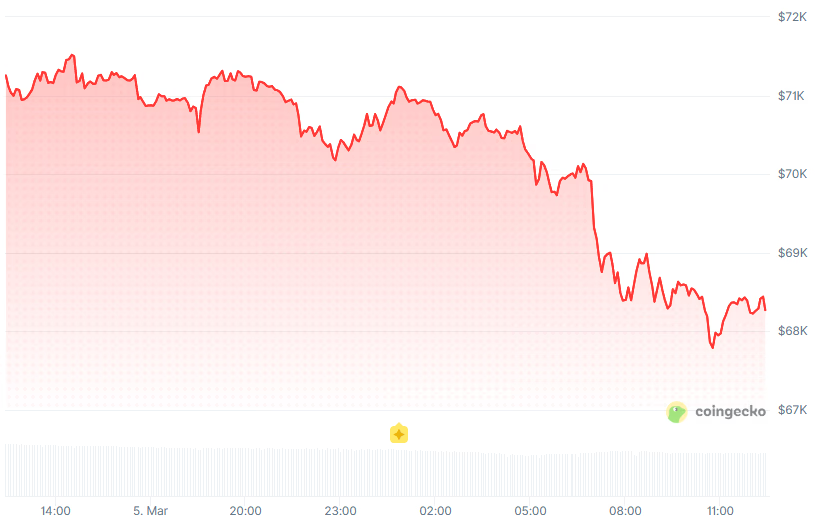
Total crypto capitalization is down 3% to $2.4 trillion amid a global market retreat.
Crypto markets declined for a second day, with investors remaining cautious heading into the weekend amid the ongoing conflict in the Middle East. Global markets face pressure after oil spiked another 14% today, with prices now exceeding $90 per barrel for the first time since 2023.
Bitcoin (BTC) is trading at around $68,000, down 4% over the past 24 hours. Meanwhile, ETH and SOL fell 4.5% to about $1,970 and $84, respectively, and BNB is down 3% on the day.

The overall crypto market capitalization declined by another 3% to $2.4 trillion, according to Coingecko.
U.S. stocks fell after the Bureau of Labor Statistics reported that nonfarm payrolls fell by 92,000 in February, well below estimates. Meanwhile, the unemployment rate climbed to 4.4% from 4.3%.
Crude oil (WTI) surged above $90 per barrel after President Trump said the war would not end without an unconditional surrender by Iran. The S&P 500 and the Nasdaq slipped by around 1%, while gold and silver posted modest gains.
Almost all of the Top 100 digital assets posted losses over the last 24 hours. Today’s top gainer is Pi Network (PI), which ralled 5.5%.
Ethena (ENA) and Zcash (ZEC) are the biggest losers, plunging 8%.
Around 96,000 leveraged traders were liquidated for $324 million in the past 24 hours, according to CoinGlass. Bitcoin accounted for $158 million, while ETH positions made up $67 million.
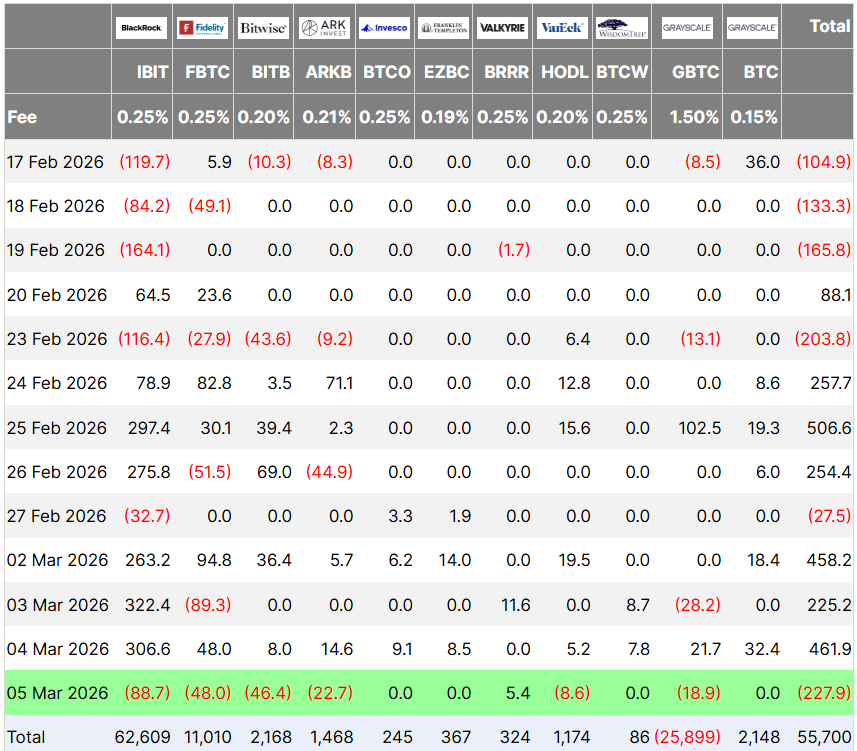
Bitcoin exchange-traded funds (ETFs) recorded outflows of $228 million on Tuesday, ending their multi-day winning streak.


As geopolitical tensions escalate and global markets face a new wave of uncertainty, one asset has been behaving in an unexpected way: Bitcoin.
While the Middle East slides deeper into conflict and energy markets react to potential supply disruptions, the world’s largest cryptocurrency has held up relatively well compared to many traditional assets.
For some observers, that resilience raises an important question: Could Bitcoin be signaling something about the macro environment that markets haven’t fully priced in?
In our latest interview, Arthur Hayes, co-founder of Maelstrom, shares his perspective on the forces shaping the global economy, and why the coming months could prove pivotal for financial markets.
On the geopolitical front, Hayes argues that investors may be underestimating the risks if the current conflict expands or drags on.
“I don’t think global markets are fully priced in [on] a longer war between the US and Iran,” he said. If energy flows are disrupted, the ripple effects could spread through the global economy via higher oil prices, inflationary pressure and increased volatility across markets.
At the same time, Hayes says another powerful disruption is unfolding beneath the surface: artificial intelligence.
According to him, AI could rapidly reshape the labor market by replacing a significant share of knowledge workers, from lawyers and bankers to accountants and analysts. If that transition happens quickly, the result could be widespread credit stress as households struggle to service existing debt.
Ultimately, Hayes believes the global financial system tends to respond to crises the same way: with liquidity. “Bitcoin is essentially just a liquidity smoke alarm,” he says.
To hear Hayes break down his macro thesis, watch the full interview on our YouTube channel and don’t forget to subscribe!
This interview has been edited and condensed for clarity.
Crypto World
Bitcoin Adoption and Offline Storage on the Rise Despite Weak Market Conditions (Santiment)


Despite the shaky price movements, there’s some good news on the BTC adoption front.
The crypto research firm Santiment has identified network data indicating that Bitcoin adoption is rising despite the market’s weakened state.
Santiment’s findings revealed that not only is Bitcoin adoption rising, but cold storage is increasing as well. Investors are increasingly sending their bitcoins (BTC) to offline storage platforms, a pattern usually seen among users who intend to hold for the long term.
Bitcoin Adoption is Rising
According to Santiment’s tweet, the number of separate non-empty wallets on the Bitcoin network has climbed to an all-time high of 58.45 million. This metric witnessed a 1.69 million rise in six months, reflecting a 3% uptick. Such growth indicates that more investors have been buying and holding BTC over the last few months, regardless of the decline in prices and the widely-believed onset of the bear market.
In addition, the amount of BTC on known exchange wallets has plummeted to its lowest level since December 2017. Currently, such wallets hold only 1.17 million BTC.
The rising adoption and the move to offline storage reflect a “buy the dip” trend among investors. Both retail and institutional investors have been accumulating the digital asset; however, at an insignificant pace. It also appears institutional investors have been accumulating more than their retail counterparts.
Earlier this month, CryptoPotato reported that last week, U.S. spot Bitcoin exchange-traded funds (ETFs) recorded their first major accumulation wave since mid-October 2025, while retail flows declined. As ETF inflows totalled $1.45 billion on February 25, data shared by analysts showed a $5 billion contraction in retail inflows over the 30-day period from February 6 to March 2.
Genuine Accumulation Drives Spot Demand
Meanwhile, spot demand is also climbing amid war tensions. Despite geopolitical uncertainty shaking markets, unleveraged investors and institutions are still buying. A part of the demand can also be traced to U.S. investors, as seen in the Coinbase Premium, which flipped positive after a long negative streak.
You may also like:
Data from the derivatives market also shows that the demand is not driven by speculative activity stemming from leveraged trades, but by genuine accumulation. This spot demand has pushed BTC back above $70,000 for the first time in three weeks. At the time of writing, the leading crypto asset was trading around $70,560, down slightly over the past 24 hours.
Binance Free $600 (CryptoPotato Exclusive): Use this link to register a new account and receive $600 exclusive welcome offer on Binance (full details).
LIMITED OFFER for CryptoPotato readers at Bybit: Use this link to register and open a $500 FREE position on any coin!
Bitcoin and the leading cryptocurrencies staged a recovery this week following initial shockwaves from the outbreak of the US-Israel conflict with Iran.
Bitcoin (BTC) initially fell to $63,245 on Sunday, before briefly recovering to $73,000 on Thursday, assisted by renewed demand from US-listed spot Bitcoin exchange-traded funds (ETFs), which logged $1.1 billion in net weekly inflows leading up to Thursday.
In the broader DeFi space, Aave’s governance dispute continued, with the Aave Chan Initiative (ACI) saying it will not renew its engagement with the Aave DAO and plans to wind down operations in the next four months.

Aave Chan Initiative to exit Aave DAO after governance clash over funding
The ACI, a major governance delegate and service provider within the Aave ecosystem, said it will not renew its engagement with the Aave DAO and plans to wind down over the next four months.
In a statement on Tuesday, ACI founder Marc Zeller said the organization would continue governance activity and complete outstanding commitments before transferring its infrastructure and responsibilities to the DAO or successor providers.
“The Aave Chan Initiative was built for Aave. Without a future in the Aave ecosystem, the name no longer applies. ACI will wrap up as our obligations conclude,” Zeller wrote.
ACI said its decision to exit was driven by concerns over governance standards and voting dynamics during the proposal process, marking a significant shift in Aave’s governance landscape as its funding plan advances to the next stage.
Strive strategist says AI deflation could push Bitcoin to $11 million by 2036
Technological deflation driven by artificial intelligence could help push Bitcoin above $10 million within a decade by pressuring central banks to keep expanding the money supply, according to a report from Strive strategist Joe Burnett.
Burnett, Strive’s vice president of Bitcoin strategy, said in a report published Monday that faster productivity gains from AI will push down prices across goods and services, squeezing margins and prompting policymakers to respond with sustained monetary expansion. His “base case” calls for Bitcoin (BTC) to reach $11 million in the first quarter of 2036, he wrote.
”My base case for Q1 2036 is $11 million per Bitcoin.”
The forecast rests on a set of aggressive assumptions, including that Bitcoin would grow to about 12% of the value of global financial assets and that global wealth would compound at 7% annually through 2036. With Bitcoin currently accounting for about 0.2% of all financial assets, this would involve an over 176-fold increase in Bitcoin’s market capitalization during the next decade to hit $230 trillion.

The forecast would imply that Bitcoin will become the dominant global reserve asset along with structurally loose monetary policy over the next decade, Nic Puckrin, co-founder and lead market analyst of educational platform Coin Bureau, told Cointelegraph.
”The forecast implies Bitcoin would become around 10 times as large as the current US M2 money supply, nearly four times as large as the US equity market today, and nearly double current global GDP.”
The prediction would also imply a compound annual growth rate (CAGR) of around 53% per annum, which is not unprecedented considering Bitcoin’s average 60% CAGR between 2015 and 2024, but a slowdown may be expected due to its larger market capitalization, added Puckrin.
Shawn Young, chief analyst at MEXC Research, agreed, warning that the prediction would imply a “huge” 16,318% increase for Bitcoin during the next decade, which looks unlikely due to Bitcoin’s declining volatility.
“The more liquidity flows into the asset from both institutional and retail investors, the less likely sharp price spikes will be recorded,” the analyst told Cointelegraph, adding that the “realistic price range is at most $1 million.”
Stablecoin inflows rebound to $1.7 billion as Washington battles over yield rules
Weekly net stablecoin inflows rebounded last week as onchain activity picked up even while US lawmakers and banking groups sparred over whether third parties should be allowed to pay stablecoin yield, according to a new report from Messari.
Weekly net stablecoin inflows accelerated to $1.7 billion, a 414.5% increase week-on-week, according to the report published on Wednesday.
The recovery flipped the 30-day average to a positive $162.5 million in daily inflows. Transaction volumes rose 6.3%, while average transaction size continued to decline, reflecting renewed stablecoin issuance demand and “strengthened” onchain activity amid retail investors, the report said.
Stablecoin inflows track net new stablecoins entering circulation after accounting for redemptions.
The surge follows a weaker period earlier in the year. Messari data showed $249 million in weekly inflows two weeks earlier and $4.4 billion in net outflows over the 30 days leading up to Feb. 18.

Solv Protocol offers 10% bounty after $2.7 million vault exploit
Bitcoin-based decentralized finance platform Solv Protocol says one of its token vaults was exploited for $2.7 million and has offered the attacker a 10% bounty in exchange for returning the stolen funds.
Solv said in an X post on Thursday that fewer than 10 of its users were impacted, but it would cover the loss of 38.05 Solv Protocol BTC (SolvBTC), a token pegged to Bitcoin (BTC).
The project added that it had implemented measures to prevent the attack from recurring and was investigating the exploit with crypto security firms Hypernative, SlowMist and CertiK.

Solv allows users to deposit Bitcoin for Solv Protocol BTC, which they can then use to lend, borrow or stake on other blockchains. The project has 24,226 Bitcoin worth over $1.7 billion and claims it is the largest onchain Bitcoin reserve.
Solv hasn’t confirmed how the exploit occurred, but two crypto security researchers said it stemmed from a vulnerability in one of Solv’s smart contracts that allowed the attacker to mint excessive amounts of a token used on the protocol.
The attacker exploited the vulnerability 22 times before swapping hundreds of millions of tokens for just over 38 SolvBTC, according to CD Security co-founder Chris Dior.
Bybit claims new fraud system stopped $300 million of risky withdrawals in Q4 2025
Bybit said it blocked or disrupted more than $300 million worth of suspected scam-related withdrawals in the fourth quarter of 2025 after rolling out an AI-assisted risk monitoring system designed to flag malicious transactions before funds leave the exchange.
In a company blog post, Bybit said its system flagged about $500 million in withdrawal requests during the quarter and that more than 4,000 users were “protected” after the platform issued real-time risk alerts or blocked transactions outright.
Bybit’s head of group risk control, David Zong, told Cointelegraph that much of the $300 million total reflects withdrawals users voluntarily cancelled after seeing warnings, meaning the funds remained in their accounts rather than requiring clawbacks or reimbursement.
“Because the withdrawals were stopped prior to completion, the funds did not require recovery or reimbursement. They remained in users’ accounts at all times.”
Bybit said the system also identified 350 high-risk investment fraud addresses that shielded 8,000 users from potential withdrawal losses during the previous quarter. It also thwarted over 3 million credential stuffing attacks attempted by hackers throughout 2025.

Cryptocurrency hacks resulted in $3.4 billion in losses during 2025, as hackers turned their focus to large crypto entities.
DeFi market overview
According to data from Cointelegraph Markets Pro and TradingView, most of the 100 largest cryptocurrencies by market capitalization ended the week in the green.
The River (RIVER) token rose 94% as the biggest gainer of the week, followed by the Humanity Protocol (H) token, up 39% during the past week.

Thanks for reading our summary of this week’s most impactful DeFi developments. Join us next Friday for more stories, insights and education regarding this dynamically advancing space.


Surprise February US jobs losses and a higher unemployment rate revive rate‑cut hopes but leave BTC stuck near $70K amid broader risk‑off mood.
Summary
- The US jobs shed 92,000 in February versus forecasts for a 59,000 gain, a sharp reversal from January’s 126,000 increase.
- Unemployment rose to 4.4%, above the expected 4.3%, underscoring a more fragile labor backdrop.
- BTC is pinned around $70,000 as traders weigh softer data against spiking oil, falling equities and shifting Fed‑cut odds.
February’s US jobs report landed as a clean downside surprise: instead of a modest payroll gain, the U.S. economy outright lost 92,000 positions, a swing of more than 180,000 versus consensus and a clear deterioration from January’s 126,000 increase.
The unemployment rate ticked up to 4.4%, overshooting economist expectations and marking a subtle but important break from the “resilient labor market” narrative that has underpinned the Federal Reserve’s higher‑for‑longer stance. On paper, that kind of softness should be a gift to duration assets and high‑beta plays like crypto, because it nudges the Fed closer to rate cuts in the first half of 2026.
The initial market reaction, however, is more conflicted than the textbook macro trade. Bitcoin (BTC), which had already slid overnight as crude spiked and equity futures rolled over, hovered near $70,000 in the minutes after the release, showing no appetite for an aggressive relief rally. Nasdaq futures are down about 1% and S&P 500 contracts off roughly 0.8%, while the 10‑year Treasury yield has eased to around 4.11%, signaling a modest bid for safety rather than a full‑blown “pivot” euphoria. Classic hedges are perking up instead: gold is up roughly 1%, silver 2%, and WTI crude is surging more than 6% to about $86 per barrel, reflecting persistent geopolitical and inflation risk tied to the Iran conflict.
For crypto, that mix is toxic: yes, weaker jobs data theoretically increases the probability of cuts later this year, but an oil‑driven inflation squeeze and rising recession odds complicate the narrative. If growth slows while energy and food keep headline inflation sticky, the Fed’s room to ease aggressively shrinks, leaving bitcoin trapped between “digital gold” narratives and simple de‑risking alongside tech and high‑beta assets. With BTC stuck near $70K and the CoinDesk 20 under pressure, traders are treating this jobs miss less as a green light to lever up and more as another stress signal in a macro regime defined by war‑driven oil shocks, fragile credit and a Fed that cannot yet declare victory.
Crypto World
Fed Governor Miran says job losses in February add to the case for more interest rate cuts
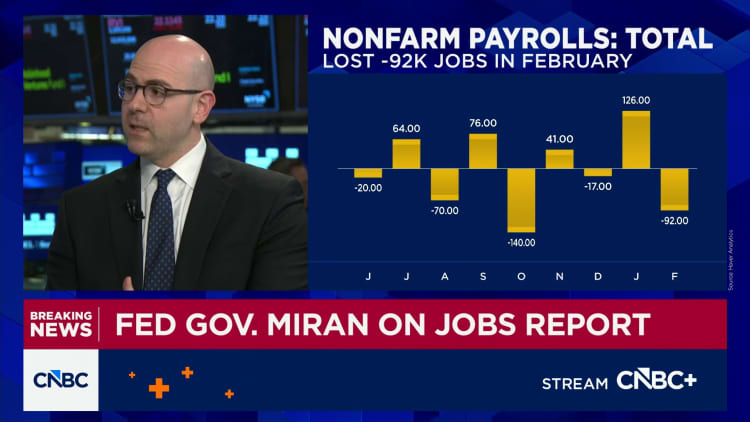

Federal Reserve Governor Stephen Miran said Friday that the weak February jobs report bolsters the rationale for the central bank to lower interest rates further.
Responding to the drop of 92,000 in nonfarm payrolls that the Bureau of Labor Statistics reported Friday, Miran said in a CNBC interview that the Fed should be focusing more on supporting the labor market than worrying about inflation.
“I think that we don’t have an inflation problem,” he said on the “Money Movers” show. “I think that the labor market can use more accommodation from monetary policy. And I don’t see having a modestly restrictive stance of monetary policy as opposed to a neutral stance as being appropriate. I think being close to neutral is appropriate.”
Currently, the Fed’s key interest rate is targeted in a range between 3.5% to 3.75%, following three consecutive quarter percentage point cuts in the latter part of 2025.
If Miran had his way, the rate would be around neutral, which he deems to be about a full percentage point lower. The consensus of Fed officials at the December meeting was that neutral — a level neither holds back nor boosts the economy — is around 3.1%, implying two more cuts.
Miran has been arguing that stubbornly high inflation numbers are more a function of how it is measured by the Commerce and Labor departments rather than true underlying pressures.
One factor he cited was portfolio management fees, which have risen amid a generally higher stock market. Portfolio management fees are often charged as a percentage of assets, so when markets rise the dollar value of those fees increases even though the underlying rate for those services does not.
The recent surge in oil prices and corresponding boost for costs at the pump related to the Iran war are less of a concern, Miran added.
“Typically, the Federal Reserve doesn’t respond to higher oil prices like that. It [boosts] headline inflation, but it tends to be a one-off shock,” he said. “When you think about core inflation [which does not include energy prices], it tends to be more predictive of where inflation is going over the medium term than headline inflation.”
Miran has dissented at each of the Federal Open Market Committee meetings he has attended since September, after President Donald Trump nominated him as a governor. For the three rate cuts, he preferred more aggressive half percentage point reductions to the quarter-point moves the committee approved. In January, when the FOMC voted not to cut, Miran said he wanted a quarter-point reduction.
Asked if he would dissent again, he said, “I hope not, but that would be up to my colleagues. I hope that we vote to cut.”
Miran was appointed to full the unexpired term of Adriana Kugler, who resigned in August 2025. That term expired in January, but Miran has continued to serve until a successor is approved. Trump nominated Kevin Warsh to a position that ultimately will be a replacement for current Fed Chair Jerome Powell, whose term expires in May.
“I will be at the meeting in a couple weeks, and after that I will take it a day at a time,” Miran said.

A Literary Voice Shaping Culture

Ethereum eyes faster, tougher finality with Minimmit
Lana Condor to reunite with “To All the Boys I've Loved Before” costar on “XO, Kitty” season 3


-

 Politics3 days ago
Alan Cumming Brands Baftas Ceremony A ‘Triggering S**tshow’
-

 Tech6 days ago
Unihertz’s Titan 2 Elite Arrives Just as Physical Keyboards Refuse to Fade Away
-

 NewsBeat6 days ago
Abusive parents will now be treated like sex offenders and placed on a ‘child cruelty register’ | News UK
-
Business6 hours ago
Form 8K Entergy Mississippi LLC For: 6 March
-
 NewsBeat6 days ago
Dubai flights cancelled as Brit told airspace closed ’10 minutes after boarding’
-
Sports7 days ago
The Vikings Need a Duck
-
 NewsBeat6 days ago
The empty pub on busy Cambridge road that has been boarded up for years
-

 NewsBeat5 days ago
‘Significant’ damage to boarded-up Horden house after fire
-

 Tech2 days ago
Bitwarden adds support for passkey login on Windows 11
-

 Entertainment5 days ago
Baby Gear Guide: Strollers, Car Seats
-
 Sports1 day ago
499 runs and 34 sixes later, India beat England to enter T20 World Cup final | Cricket News
-
Politics6 days ago
FIFA hypocrisy after Israel murder over 400 Palestinian footballers
-
 NewsBeat5 days ago
Emirates confirms when flights will resume amid Dubai airport chaos
-

 NewsBeat4 days ago
Is it acceptable to comment on the appearance of strangers in public? Readers discuss
-

 Tech6 days ago
Viral ad shows aged Musk, Altman, and Bezos using jobless humans to power AI
-

 Video4 days ago
How to Build Finance Dashboards With AI in Minutes
-

 Fashion5 days ago
On the Scene at the 57th Annual NAACP Image Awards: Teyana Taylor in Black Ashi Studio, Colman Domingo in Yellow Sergio Hudson, Chloe Bailey in Christian Siriano, and More!
-

 Business3 days ago
Guthrie Disappearance Enters Fifth Week as Family Visits Memorial
-
 Crypto World6 days ago
US Judge Lets Binance Unregistered Token Class Action Proceed
-
 NewsBeat5 days ago
Ukraine-Russia war latest: Belgium releases video showing forces boarding Russian shadow fleet oil tanker