

Crypto World
Arthur Hayes Predicts Fed Money Printing From US-Iran Tensions Could Propel Bitcoin (BTC) Higher


Key Takeaways
- Arthur Hayes, BitMEX co-founder, believes extended US-Iran military engagement may compel the Federal Reserve to reduce interest rates and expand monetary supply.
- Historical precedent shows the Fed has injected liquidity during previous US military operations, according to Hayes.
- Escalating oil prices resulting from regional tensions could drive 10-year Treasury yields upward, potentially prompting Fed intervention.
- Bitcoin dropped from approximately $66,000 to $63,000 when tensions intensified but has since rebounded to the $73,000 level.
- Market observers identify $70,685 as crucial Bitcoin support, with near-term price objectives ranging from $75,000 to $80,000.
Arthur Hayes, who co-founded BitMEX and currently serves as chief investment officer at Maelstrom, believes the escalating US-Iran tensions may initiate a sequence of events culminating in Federal Reserve monetary expansion — potentially benefiting Bitcoin prices.
In analysis published Monday on his blog, Hayes explained how prolonged US military operations in Middle Eastern regions have historically compelled the Federal Reserve to implement rate reductions and inject market liquidity. He cited the 1990 Gulf War, post-9/11 global counterterrorism efforts, and the 2009 Afghanistan troop surge as illustrative examples.
“The cure, as always, is cheaper and more plentiful money,” Hayes noted in his analysis.
In a March 6 post on X, Hayes cautioned that sustained increases in Brent crude prices stemming from US-Iran hostilities could cause 10-year Treasury yields to surge dramatically. Such market turbulence would elevate the MOVE Index — which tracks US bond market volatility — creating what Hayes considers a “prerequisite” for Federal Reserve monetary intervention.
Brent crude has climbed approximately 20% since conflict intensification began, fueled by concerns about Middle Eastern supply constraints. Nevertheless, oil prices declined over 1% Thursday to approximately $80 per barrel following Trump administration announcements of price stabilization measures, including a 30-day exemption permitting India to maintain Russian oil purchases.
Implications for Bitcoin Markets
Hayes contends that Federal Reserve rate reductions or balance sheet growth would increase market liquidity, historically providing positive momentum for Bitcoin and comparable risk assets.
Bitcoin’s response to the military tensions has shown volatility. Prices declined from roughly $66,000 to $63,000 immediately following hostilities escalation. Subsequently, the cryptocurrency has recovered and recently reached a one-month peak of $73,000.
Hayes recommends awaiting definitive indications of Fed policy adjustments — either interest rate cuts or balance sheet expansion — before initiating Bitcoin or altcoin purchases. He has not advocated for immediate market entry.
Probability of a rate reduction at the Federal Reserve’s March 17–18 policy meeting remains minimal. CME Group’s FedWatch tool indicates merely 2.7% odds of a cut at that gathering. Most market observers anticipate the Fed will maintain rates within the 3.50% to 3.75% range.
Expert Technical Analysis
Cryptocurrency analyst Ali Martinez has pinpointed $70,685 as a critical Bitcoin support threshold. Maintaining that price level could facilitate a near-term advance toward $75,000–$80,000, according to market technicians.
Inflation pressures represent an additional consideration. Should inflation remain persistent, the Federal Reserve may possess limited flexibility for rate cuts, potentially constraining any immediate rally in risk assets like Bitcoin.
Hayes has offered comparable forecasts repeatedly in recent months. In January, he suggested potential US military operations in Venezuela as a probable catalyst for Fed monetary easing. Last month, he indicated an AI-driven financial crisis as the subsequent trigger.
In December, Hayes forecasted Bitcoin would reach $200,000 this month, referencing reserve management acquisitions announced by the Fed during that period.
Currently, Bitcoin maintains trading activity within the $70,000–$73,000 corridor, with markets monitoring both Federal Reserve communications and Middle Eastern geopolitical developments.
Remember: Preserve all tokens like [[EMBED_0]], [[IMG_0]], [[LINK_START_0]], [[LINK_END_0]], [[SCRIPT_0]], [[FIGURE_0]] etc. exactly as they appear. These are placeholders for embeds, images, and links that must not be changed.

Crypto World
Why Bitcoin suffered a $110 billion wipeout despite its best week of Wall Street news in months
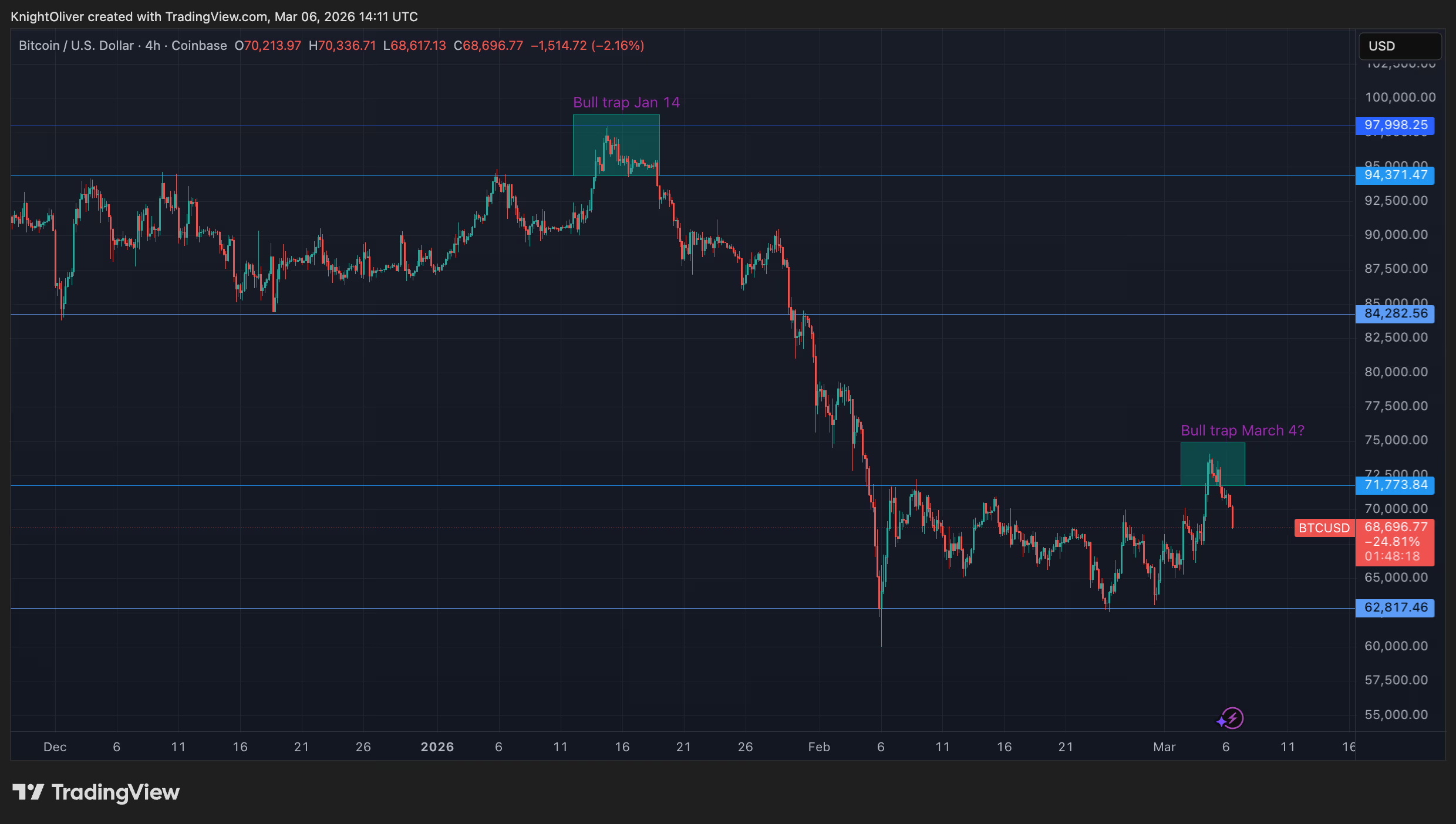
Bitcoin briefly pushed toward $74,000 this week, buoyed by a string of bullish developments that have tied the crypto industry ever closer to traditional finance.
Some market observers began calling this a bullish rally, with one analyst even saying that the new run ‘has legs.’
Yet the rally didn’t last. By the end of the week, the largest cryptocurrency had slipped back below $69,000, losing $110 billion in market cap.
The pullback came despite what might otherwise have been considered one of the most positive stretches of institutional news for the sector in months.
Morgan Stanley named Bank of New York Mellon as a custodian for its spot bitcoin ETF exposure, adding another layer of Wall Street infrastructure around the asset class. Crypto exchange Kraken gained access to the Federal Reserve’s payment system, a milestone in integrating crypto firms with the U.S. banking network. Intercontinental Exchange (ICE), the owner of the New York Stock Exchange, invested in crypto exchange OKX, valuing it at $25 billion, while U.S. President Donald Trump publicly suggested traditional banks should strike a workable relationship with the crypto industry.
Individually, any one of these developments might have sparked a market rally in earlier crypto cycles, when institutional adoption was seen as the catalyst that would send crypto into a massive bull run. Instead, now that adoption is here, the market is ignoring it as macro forces have taken over.

Why the selloff
The selloff was mainly triggered by U.S. dollar strengthening as the conflict in Iran intensified, after U.S. President Donald Trump seemingly quashed any chance of some sort of negotiated settlement with Iran, saying, “There will be no deal with Iran.”
This spurred a spike in oil prices, new inflation concerns and shifting expectations around interest rates (despite jobs data showing a weakening market), which put pressure on risk assets globally. Equities moved to the downside as the dollar index rose, and crypto — which has increasingly traded alongside technology stocks (read: risk assets) — followed.
If that’s not enough, Cracks in the global private credit market expanded to Wall Street giant BlackRock, which reportedly began limiting withdrawals from its $26 billion private credit fund amid rising redemption requests. Following similar stress at Blue Owl, which sold $1.4 billion in loans last month to meet withdrawals, the events started to rattle investors.
Reality check
So what does this week’s episode mean? A growing reality in crypto markets: macro matters more than crypto-native news.
Over the past several years, bitcoin has become more tightly correlated with the Nasdaq and other risk assets as institutional investors entered the market. Hedge funds, asset managers and ETF flows increasingly treat bitcoin as part of a broader portfolio of macro-sensitive assets, reacting to liquidity conditions, interest rates and dollar strength.
Ironically, the same institutional adoption that many in the industry have long sought may be contributing to this dynamic.
As bitcoin becomes embedded in traditional financial portfolios, its price is increasingly influenced by the same forces that move equities, commodities and currencies. When the dollar rallies or interest-rate expectations rise, liquidity tightens across markets — and crypto is rarely immune.
That doesn’t mean the steady drumbeat of institutional developments is irrelevant. The expansion of custody services, banking access, and exchange investment points to a deeper, more mature crypto market structure forming beneath the surface.
Who is selling?
One question investors ask when such conflicting price action batters the markets is: Who is selling?
The macro risk seemed to have spooked mostly the short-term bitcoin holders, who cashed out as bitcoin hit $74,000.
These short-term holders transferred more than 27,000 BTC ($1.8 billion) to exchanges in profit over the past 24 hours — one of the largest spikes in recent months, according to CryptoQuant analyst Darkfost.
Short-term holders are typically the most reactive group in the market, and their selling reflects lingering caution amid the ongoing war in Iran and other macro uncertainties. These holders act more like traders, going in and out of an asset to make quick profits, rather than investors who want to buy and hold for the long term. And with bitcoin’s thin liquidity, these moves make a dent in the price action
And the data shows that.
The only short-term investors currently in profit are those who accumulated bitcoin between one week and one month ago, at a realized price of roughly $68,000, suggesting some recent buyers above that price are choosing to lock in gains rather than extend their positions.
In the short term, with crypto in the midst of a bear market dating back to early October and macro uncertainty, price is the only thing that matters to investors.
Silver lining
But it’s not all doom and gloom.
A recent Binance Research report noted that U.S. spot bitcoin ETFs recorded roughly $787 million in net inflows last week — their first positive weekly flows since mid-January — suggesting that some institutional investors may be beginning to re-engage with the market after several weeks of persistent outflows.
In fact, in a recent conference, giant university endowment funds, which tend to focus on long-term return, said that they have begun looking into other alternative investment ideas, including digital assets-related ETFs, given the sky-high valuations of traditional equities.
The report also pointed to signs that speculative excess may already have been flushed out.
Bitcoin funding rates have fallen to their lowest levels since 2023, indicating that leveraged long positions have largely been unwound — conditions that historically create a cleaner foundation for more durable rallies driven by spot demand rather than short-term speculation.
In the end, it all comes down to conviction and market moves.
Some traders called the sharp rally earlier this week a “bull trap” — a brief breakout that lures in late buyers before reversing lower. While institutional conviction is on the rise, with thin liquidity, a skittish market, macro headwinds and a lack of clear catalysts, bitcoin’s price action, at least this week, seems to have proven them right so far.
Read more: Bitcoin is stuck in a rut but JPMorgan says new legislation could be the ultimate spark

Bitcoin and the broader crypto complex staged a cautious recovery this week as investors recalibrated risk in the wake of a US-Israel conflict with Iran. The flagship asset briefly dipped to $63,245 on Sunday, before a late-week rally pushed prices toward the $73,000 region on Thursday, aided by renewed demand from U.S.-listed spot Bitcoin exchange-traded funds that logged about $1.1 billion in net weekly inflows. In the wider DeFi space, governance tensions at Aave resurfaced as the Aave Chan Initiative said it would not seek renewal of its engagement with the Aave DAO and plans to wind down operations over roughly four months, signaling a broader recalibration of governance dynamics within the ecosystem. The week’s moves underscore a blend of price catalysts, security incidents, and governance shifts that continue to shape Bitcoin and decentralized finance in 2026.
Key takeaways
- Bitcoin traded below $64,000 early in the week and rebounded to around $73,000 as ETF demand returned, with spot-BTC ETFs logging about $1.1 billion in net inflows.
- The Aave Chan Initiative (ACI) announced it would not renew its engagement with the Aave DAO and will wind down over the next four months, transferring infrastructure and responsibilities to the DAO or successor providers.
- A Strive forecast argues that AI-driven deflation could push Bitcoin toward an $11 million price by early 2036, a scenario that hinges on aggressive assumptions about monetary policy and global wealth growth.
- Stablecoins saw a rebound in inflows, with weekly net inflows reaching $1.7 billion as on-chain activity picked up amid renewed retail participation.
- Solv Protocol disclosed a $2.7 million vault exploit, offering attackers a 10% bounty to return funds, as 38.05 Solv Protocol BTC (SolvBTC) were involved in the incident and security firms probe the vulnerability.
- Bybit reported that its AI-assisted risk-monitoring system intercepts blocked or disrupted more than $300 million of risky withdrawals in Q4 2025, with thousands of users protected by real-time risk alerts.
- In DeFi, the market remained broadly green for the largest currencies, with River (RIVER) surging and the Humanity Protocol (H) token also among notable weekly gainers.
Tickers mentioned: $BTC
Sentiment: Neutral
Price impact: Positive. Bitcoin rebounded toward the $73k mark aided by renewed ETF inflows and improving risk appetite.
Market context: The week’s activity sits at the intersection of macro-driven liquidity shifts, evolving DeFi governance, and ongoing security reviews in a landscape where institutions are reassessing exposure to Bitcoin and related networks. ETF flows remain a meaningful barometer of institutional interest, while on-chain activity and governance dynamics continue to influence price trajectories and user engagement.
Why it matters
The week’s developments illuminate how price catalysts, governance mechanics, and security events interact in a maturing crypto market. The resurgence in Bitcoin prices, supported by spot-BTC ETF inflows, signals that institutional channels remain a primary conduit for capital, even as volatility persists amid geopolitical and regulatory headlines. The Aave governance shift, driven by the ACI’s departure, highlights how governance standards and voting dynamics can affect the trajectory of major DeFi protocols. For builders and users, governance transitions can reframe risk, funding, and the allocation of developer resources across ecosystems.
On the technology and policy front, the AI-deflation thesis around Bitcoin underscores how long-term macro dynamics—productivity gains, monetary expansivity, and the role of Bitcoin as a potential reserve asset—continue to fuel debate among analysts. While views vary, the conversation about Bitcoin’s strategic role in the global financial system is sharpening, particularly as asset flows and macro expectations evolve.
Security remains a critical concern. The Solv Protocol incident underscores the fragility of cross-chain and vault-based models, even as networks attempt to harden defenses with audits and third-party oversight. The Bybit risk framework demonstrates the industry’s ongoing move to deploy AI-assisted tools that can curb fraud and protect users, a trend that could become a baseline requirement for exchanges seeking to manage burgeoning threat surfaces.
Meanwhile, the DeFi landscape continues to show resilience in the face of headwinds. The top-100 assets’ overall green turnover, along with notable gains for River and Humanity Protocol, suggests that liquidity and activity remain robust enough to absorb security events and governance shifts without derailing longer-term momentum.
What to watch next
- The Aave governance timeline: monitor developments over the next four months as ACI winds down and responsibilities transition to the DAO or other providers.
- Bitcoin price action in relation to ETF inflows: watch next week’s inflows data and price response near key resistance levels around $73k.
- The Strive AI-deflation scenario: assess updates to Joe Burnett’s analysis and any rebuttals or alternate forecasts from the research community as 2036 approaches.
- Solv Protocol security post-mortem: await findings from Hypernative, SlowMist, CertiK, and any disclosed patch deployments or contract fixes.
- Bybit risk-monitoring rollout: track adoption by other exchanges and any regulatory responses to AI-driven security tooling.
Sources & verification
- Aave Chan Initiative’s departure announcement and related governance thread documenting the wind-down plan.
- Spot Bitcoin ETF inflows data and coverage detailing $1.1 billion in weekly net inflows.
- Strive’s Joe Burnett AI-deflation forecast and the accompanying Mustard Seed Substack piece outlining the 11 million per BTC scenario.
- Messari’s report on stablecoin inflows, including the $1.7 billion weekly inflow figure and on-chain activity indicators.
- Solv Protocol’s exploit disclosure, the SolvBTC minting incident, and security firm investigations.
- Bybit’s security post detailing the AI-assisted risk framework and the quarter’s intercepted threats.
Market reaction and governance shifts reshape DeFi and BTC outlook
Bitcoin (CRYPTO: BTC) moved in a volatile arc as markets absorbed a mix of geopolitical risk, regulatory signals, and liquidity dynamics. Early-week weakness gave way to an earnest recovery, aided by renewed appetite for spot-BTC ETFs that registered about $1.1 billion in net weekly inflows. The resilience of BTC prices in the face of macro pressures underscores how institutional inflows continue to shape the market’s tempo, even as retail activity and on-chain usage remain a trusted barometer of ongoing interest in the asset class.
In governance news, the Aave Chan Initiative announced it would not renew its engagement with the Aave DAO and would wind down its operations over roughly four months. Marc Zeller, the ACI founder, indicated that the organization would continue governance activity and complete outstanding commitments before transferring its infrastructure and responsibilities to the DAO or successor providers. This development marks a notable shift in Aave’s governance landscape as the protocol’s funding and operational model evolves, potentially affecting proposals, resource allocation, and community-driven decisions in the near term.
Separately, a bold AI-influenced forecast from Strive’s Joe Burnett posits that productivity-driven deflation could accelerate BTC’s ascent to a multi-million-dollar price by 2036, with a base case of $11 million per BTC. Burnett’s scenario hinges on aggressive assumptions, including Bitcoin reaching roughly 12% of global financial asset value and wealth compounding at 7% annually. Critics and supporters alike caution that such a trajectory would require unprecedented capital formation and continued regulatory permissiveness, but the debate highlights investors’ ongoing interest in Bitcoin’s potential to serve as a store of value amid macro policy shifts.
Stablecoins also captured attention as inflows rebounded to about $1.7 billion, signaling renewed issuance demand and stronger on-chain activity despite a broader regulatory headwind around yield strategies. The uptick, which lifted the 30-day average into positive territory, suggests a healthy cycle of liquidity entering the market and a willingness among participants to allocate funds to on-chain uses, even as policy debates around stablecoin yields unfold in Washington.
Security and resilience were front and center as well. Solv Protocol disclosed a $2.7 million vault exploit, offering a 10% bounty to the attacker to return the stolen funds. The incident involved Solv Protocol BTC (SolvBTC) and affected fewer than 10 users, but it illuminated the vulnerabilities associated with minting and collateralized tokens in vault-based systems. The project is coordinating with security firms and has implemented measures to prevent recurrence as investigators scrutinize the chain of events and the root cause, including a vulnerability reportedly tied to a minting issue in one of Solv’s contracts. The episode serves as a reminder that even established cross-chain platforms must maintain rigorous security protocols to protect a sizeable on-chain Bitcoin reserve reported to sit at around 24,226 BTC (>$1.7 billion).
On the exchange front, Bybit reported a notable milestone in its risk-control efforts. The firm’s AI-assisted monitoring system purportedly flagged and disrupted more than $300 million in suspected scam-related withdrawals during Q4 2025, with thousands of users receiving real-time risk alerts that helped prevent losses. Bybit’s leadership stressed that most of the “blocked” withdrawals represented user-cancelled actions after warnings, meaning assets stayed in users’ accounts. The exchange also highlighted the protection of about 8,000 users through high-risk address monitoring and defense against credential-stuffing attempts—an indication that AI-driven security tools are becoming a standard feature in the fight against crypto fraud.
Market observers note that the DeFi sector ended the week broadly in the green among the 100 largest assets, with notable winners such as River (RIVER), which surged about 94%, and Humanity Protocol’s token (H), up around 39% over the period. The broader context remains one of cautious optimism: while governance shifts and security incidents pose challenges, liquidity and participant activity persist, supported by a mix of retail interest, institutional traffic, and risk-control technologies that collectively define the sector’s current trajectory.
https://example.com/placeholder.js


BTC dipped below $68,000 minutes ago, thus erasing most of this week’s gains.
Bitcoin’s impressive price surge to $74,000 earlier this week came to a somewhat expected halt, and the asset has lost $6,000 since then, dropping to and under $68,000 today.
The latest price slip came after the US jobs report that came out on Friday and Trump’s new set of threats against Iran and Cuba.
The report, published earlier today, indicated that the country lost 92,000 jobs in February and the unemployment rate rose to 4.4%. This meant that the nation’s labor market had lost steam last month, which contrasted with experts’ expectations. Most anticipated before the report went out that the US had gained around 60,000 jobs last month.
The second reason behind the price correction today could be linked to the new remarks from the POTUS. At first, he threatened Cuba, indicating that the country’s regime is “going to fall pretty soon.”
He added that the US is currently focused on the war against Iran, but they want to make “a deal badly” and suggested that Marco Rubio could handle the negotiations with Cuba.
Additionally, while weighing in on the situation with Iran, Trump said there will be no deal with the Middle Eastern country. Instead, he wanted “unconditional surrender.”
The analysts from the Kobeissi Letter, though, outlined a similar development last year when the US attacked Iran again. At the time, the POTUS made the same strong statement on his social media platform, but the two sides made a deal just six days later.
You may also like:
Today, President Trump called for Iran’s “unconditional surrender.”
The last time we saw this happen was on June 17th, 2025.
6 days later, on June 23rd, a ceasefire was announced.
Will history repeat itself on March 12th? pic.twitter.com/2NxZ6rxBKY
— The Kobeissi Letter (@KobeissiLetter) March 6, 2026
Unlike BTC, which is down by 4% in the past 24 hours, US oil prices have skyrocketed in the past several hours after Trump’s statements, going past $92 per barrel. USOIL now trades at its highest levels since September 2023.
Binance Free $600 (CryptoPotato Exclusive): Use this link to register a new account and receive $600 exclusive welcome offer on Binance (full details).
LIMITED OFFER for CryptoPotato readers at Bybit: Use this link to register and open a $500 FREE position on any coin!


Ethereum co-founder Vitalik Buterin backs a controversial shift from Casper FFG to Minimmit, betting that making censorship harder matters more than preserving textbook fault‑tolerance as ETH trades near $2,000.
Summary
- Vitalik proposes replacing Ethereum’s two‑round Casper FFG finality gadget with Minimmit, which finalizes blocks in a single round.
- The trade‑off: fault tolerance drops from 33% to 17%, but censorship resistance and recovery from bugs or attacks arguably improve.
- The debate lands as ETH hovers around $2,000, with markets weighing whether faster, more resilient finality can justify a premium in a choppy macro tape.
Vitalik Buterin has put his weight behind one of the most sensitive changes to Ethereum’s (ETH) core: ripping out the Casper FFG finality gadget and replacing it with Minimmit, a one‑round Byzantine fault‑tolerant scheme that deliberately relaxes some purity‑theory guarantees in exchange for what he frames as more “real world” safety.
Casper today requires validators to attest twice — once to justify a block, again to finalize it — and can tolerate up to 33% of stake behaving maliciously before the system’s guarantees break. Minimmit cuts that to a single round: faster and simpler, but with formal fault tolerance falling to 17% in the current proposed parameters.
On paper, that looks like a downgrade. But Buterin’s thread makes a blunt argument: the worst real‑world attack is not finality reversion, it is censorship. Finality reversion creates undeniable cryptographic evidence and leads to massive slashing — millions of ETH, or billions of $, vaporized on‑chain — which makes such attacks economically absurd for any rational actor with that kind of capital. Censorship, by contrast, is messy: it forces users and developers into social coordination, soft forks, and political fights. In both the “ideal” three‑slot‑finality (3SF) model and Minimmit, an attacker needs 50% of stake to censor, but Minimmit shifts the thresholds at which an attacker can unilaterally finalize bad history, raising that bar from 67% to 83%. That, Buterin argues, maximizes scenarios where the network defaults to “two chains dueling” instead of “the wrong thing finalized” — an outcome that is chaotic but fixable.
The backdrop is a market that is no longer paying for narratives alone. ETH trades around $2,000, down from prior cycle highs near $4,900, with volatility elevated and macro headwinds still in play. Traders have already seen the outline of Ethereum’s “fast L1” strawmap, which aims to cut slot times from 12 seconds to as low as 2 seconds and drive finality down to single‑digit seconds using Minimmit. If this redesign sticks, Ethereum stops competing only on rollup ecosystem and DeFi liquidity and starts competing on something brutally simple: how quickly and credibly your transaction becomes irreversible. In a market where ETH is still repricing its role versus L2s and rival L1s, Minimmit is not just a consensus tweak; it is an attempt to re‑anchor the asset’s value in raw, observable user experience: click, confirm, done.
Crypto World
Robinhood’s venture fund, which gives investors access to private companies, tanks 11% on first day

Robinhood signage during a media event at John F. Kennedy International Airport (JFK) in New York, US, on Wednesday, March 4, 2026.
Adam Gray | Bloomberg | Getty Images
Robinhood’s Venture Fund I plunged 11% in its public market debut on the New York Stock Exchange on Friday, casting doubt on investors’ appetite for riskier investment amid swirling geopolitical tensions.
The fund, which is trades under the ticker RVI, offers exposure to notable private companies such as financial services firm Revolut and software company Databricks. It aims to democratize access to an area of capital markets that has often been off limits to retail investors, Robinhood CEO Vlad Tenev told CNBC’s “Squawk on the Street” on Friday.
“You have companies that are out there at valuations in the hundreds of billions, even getting into the trillions in private markets before retail investors get a chance to come in at all and this is happening more and more,” Tenev said. “We’re trying to solve this by not just opening the door to private markets but completely blowing them off the hinges so that they can never be closed.”
Retail investors can buy and sell shares of the closed-end fund, which is structured like an investment firm, much like they would shares of a traditional company.
However, the launch comes during a tough time for public markets. The major U.S. stock averages are on pace for weekly declines as traders sell equities on fears the U.S.-Iran conflict could continue longer than anticipated.
Robinhood Ventures Fund priced its initial public offering at $25 per share. It opened at $22 and hit a low of $21 before trading around back around $22.12.
RVI were last trading at $22.17 per share.


Massachusetts Senator Elizabeth Warren, one of the more outspoken voices in Congress often connecting cryptocurrencies to illicit activities, slammed the US Securities and Exchange Commission’s settlement with Tron founder Justin Sun.
In a Thursday notice, Warren accused the SEC of “giving a free pass” to Sun after he “poured $90 million” in crypto investments tied to US President Donald Trump and his family.
Sun has invested millions of dollars through token purchases in the Trump family’s crypto platform, World Liberty Financial, and the SEC settled an unrelated case against the Tron founder and his companies for $10 million.
“Justin Sun poured $90 million into Trump’s crypto ventures, and today the SEC agreed to drop its case against him,” said Warren. “The SEC should not be a lap dog for Trump’s billionaire buddies, and any crypto legislation moving through Congress must stop the President’s crypto corruption.”
Warren did not specifically refer to the digital asset market structure bill moving through the Senate, but the legislation has been a focus of the White House and many pro-crypto lawmakers for months after it passed the House of Representatives as the CLARITY Act. The bill, which advanced from the Senate Agriculture Committee in January, is being considered by the Senate Banking Committee, where Warren is the ranking Democrat.
Related: Binance slams US Senate probe over Iran as based on defamatory reports
Crypto observers await markup for market structure bill
Among the issues at stake in the market structure bill include provisions on tokenized equities, ethics and stablecoin rewards. The White House has hosted three meetings between officials and representatives of the crypto and banking industries, but it was unclear as of Friday whether the discussions had made any impact on the legislation.
Both Trump and his son, Eric, posted to social media this week to criticize banks over their position on the market structure bill. Some banking organizations have argued that including provisions on stablecoin rewards in the legislation could undermine credit and lead to deposit flight risk.
In January, the Senate Banking Committee indefinitely postponed a markup on the market structure bill after Coinbase CEO Brian Armstrong said the exchange could not support the legislation “as written.” As of Friday, the body had not rescheduled the event, which would be necessary to address securities law concerns before a potential vote in the full Senate.
Magazine: Clarity Act risks repeat of Europe’s mistakes, crypto lawyer warns
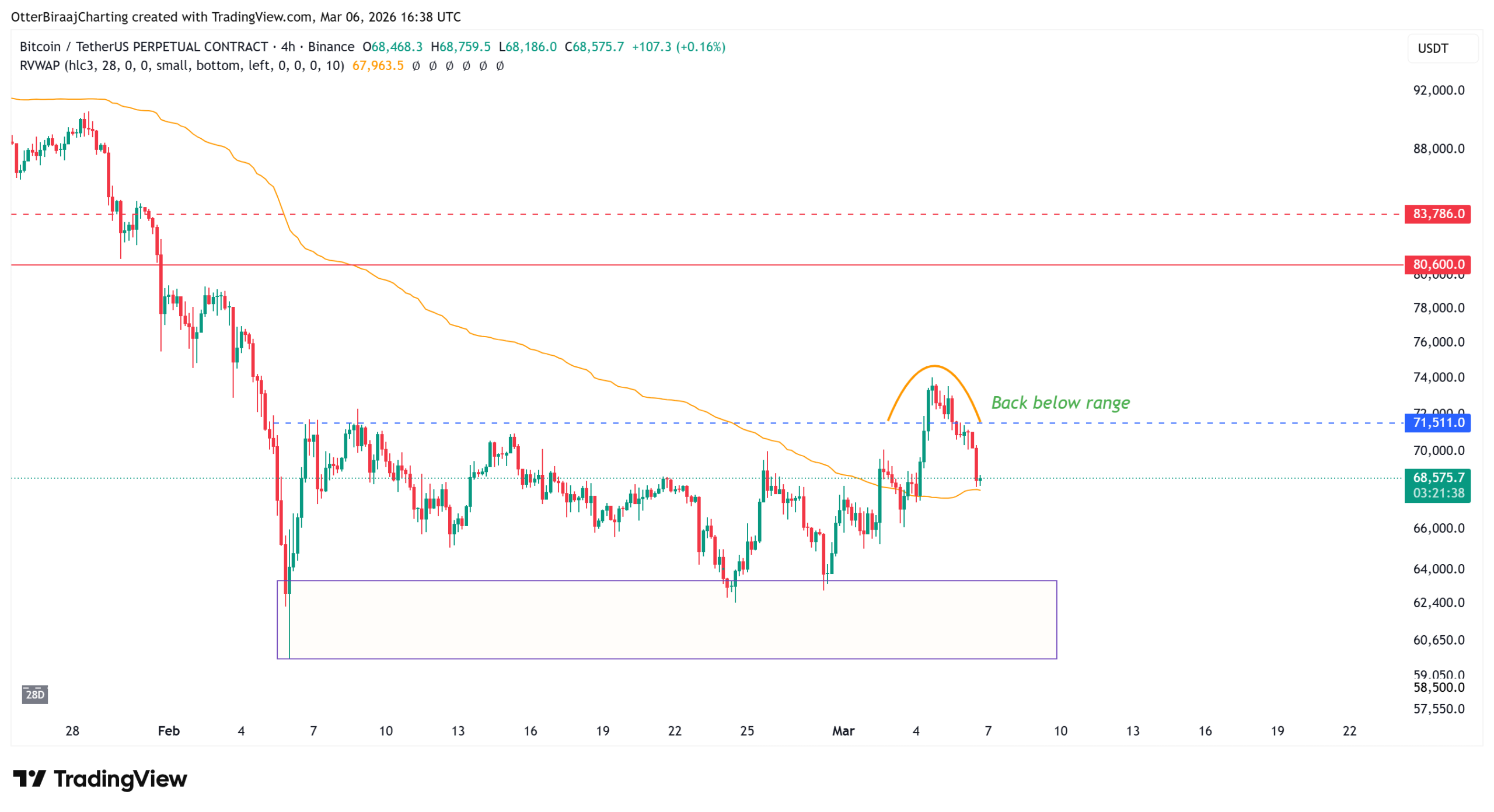
Bitcoin (BTC) slipped back into its monthly trading range under $70,000 after dropping 5% over the past two days.
Market data points to resistance near the $70,000 level, with onchain flows, futures data, and weakening spot volumes signaling renewed selling pressure that limits BTC’s ability to hold this week’s range highs.

BTC short-term holders locked in profit
Profit-taking from the short-term holders (STHs) accelerated during Bitcoin’s rally above $74,000. Crypto analyst Darkfost said that more than 27,000 BTC in profit moved to exchanges from STH wallets over the past 24 hours.

The spike ranks among the largest realized-profit transfers from this cohort since November 2025.
Darkfost noted that the sellers were able to lock in gains mainly accumulated between one week and one month ago, as their realized price sat near $68,000.
Bitcoin futures data showed a similar pattern of aggressive selling activity. Market analyst IT Tech noted that both spot and perpetual futures markets recently flipped negative on the cumulative volume delta (CVD) indicator. The CVD measures buy volume minus sell volume. A negative reading signals dominant selling pressure.
According to the analyst, the spot CVD reached –$202.49 million while perpetual futures CVD dropped to –$185.60 million. Bitcoin slipped below $70,000 during the same period, as bid liquidity pulled back in the market.
Related: Bitcoin price drops to near $68K as US jobs weakness fails to rescue bulls
Coinbase premium index signals fading demand
The spot demand from US-based traders also weakened near key price inflection points.
The Coinbase Premium Index, which measures the Bitcoin price difference between Coinbase and offshore exchanges, has repeatedly faded as BTC approached $74,000. The positive readings usually signal a stronger US spot demand.

During Bitcoin’s rally toward the $73,000–$74,000 range on March 4, the premium briefly spiked above 0.08, indicating strong buying activity from Coinbase-using entities.
The move quickly faded as the price reverted from $74,000, and the premium later turned negative.
MN Capital founder Michaël van de Poppe said that the Friday US sessions have recently produced broad market selling across the risk assets, including the Nasdaq.
Van de Poppe added that Bitcoin holding the $67,000–$68,000 range may stabilize the short-term trend before a continued move higher.
Additionally, crypto trader Titan of Crypto pointed to a nearby fair value gap (FVG) that could support the price consolidation. An FVG forms when the price moves quickly and leaves a low-liquidity area where minimal trading occurred during a breakout. Technically, the price may revisit these zones to rebalance the liquidity.
The lower boundary of that gap sits near $66,500, which the trader is monitoring as a deeper liquidity zone.

Related: Was $74K a bull trap? Bitcoin traders diverge on 2022 crash repeating
This article does not contain investment advice or recommendations. Every investment and trading move involves risk, and readers should conduct their own research when making a decision. While we strive to provide accurate and timely information, Cointelegraph does not guarantee the accuracy, completeness, or reliability of any information in this article. This article may contain forward-looking statements that are subject to risks and uncertainties. Cointelegraph will not be liable for any loss or damage arising from your reliance on this information.
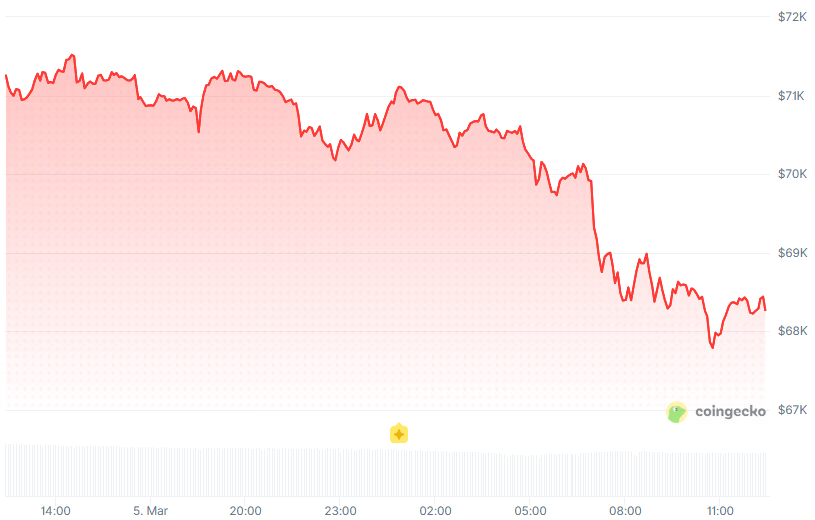
Total crypto capitalization is down 3% to $2.4 trillion amid a global market retreat.
Crypto markets declined for a second day, with investors remaining cautious heading into the weekend amid the ongoing conflict in the Middle East. Global markets face pressure after oil spiked another 14% today, with prices now exceeding $90 per barrel for the first time since 2023.
Bitcoin (BTC) is trading at around $68,000, down 4% over the past 24 hours. Meanwhile, ETH and SOL fell 4.5% to about $1,970 and $84, respectively, and BNB is down 3% on the day.

The overall crypto market capitalization declined by another 3% to $2.4 trillion, according to Coingecko.
U.S. stocks fell after the Bureau of Labor Statistics reported that nonfarm payrolls fell by 92,000 in February, well below estimates. Meanwhile, the unemployment rate climbed to 4.4% from 4.3%.
Crude oil (WTI) surged above $90 per barrel after President Trump said the war would not end without an unconditional surrender by Iran. The S&P 500 and the Nasdaq slipped by around 1%, while gold and silver posted modest gains.
Almost all of the Top 100 digital assets posted losses over the last 24 hours. Today’s top gainer is Pi Network (PI), which ralled 5.5%.
Ethena (ENA) and Zcash (ZEC) are the biggest losers, plunging 8%.
Around 96,000 leveraged traders were liquidated for $324 million in the past 24 hours, according to CoinGlass. Bitcoin accounted for $158 million, while ETH positions made up $67 million.
Bitcoin exchange-traded funds (ETFs) recorded outflows of $228 million on Tuesday, ending their multi-day winning streak.


As geopolitical tensions escalate and global markets face a new wave of uncertainty, one asset has been behaving in an unexpected way: Bitcoin.
While the Middle East slides deeper into conflict and energy markets react to potential supply disruptions, the world’s largest cryptocurrency has held up relatively well compared to many traditional assets.
For some observers, that resilience raises an important question: Could Bitcoin be signaling something about the macro environment that markets haven’t fully priced in?
In our latest interview, Arthur Hayes, co-founder of Maelstrom, shares his perspective on the forces shaping the global economy, and why the coming months could prove pivotal for financial markets.
On the geopolitical front, Hayes argues that investors may be underestimating the risks if the current conflict expands or drags on.
“I don’t think global markets are fully priced in [on] a longer war between the US and Iran,” he said. If energy flows are disrupted, the ripple effects could spread through the global economy via higher oil prices, inflationary pressure and increased volatility across markets.
At the same time, Hayes says another powerful disruption is unfolding beneath the surface: artificial intelligence.
According to him, AI could rapidly reshape the labor market by replacing a significant share of knowledge workers, from lawyers and bankers to accountants and analysts. If that transition happens quickly, the result could be widespread credit stress as households struggle to service existing debt.
Ultimately, Hayes believes the global financial system tends to respond to crises the same way: with liquidity. “Bitcoin is essentially just a liquidity smoke alarm,” he says.
To hear Hayes break down his macro thesis, watch the full interview on our YouTube channel and don’t forget to subscribe!
This interview has been edited and condensed for clarity.
Crypto World
Bitcoin Adoption and Offline Storage on the Rise Despite Weak Market Conditions (Santiment)


Despite the shaky price movements, there’s some good news on the BTC adoption front.
The crypto research firm Santiment has identified network data indicating that Bitcoin adoption is rising despite the market’s weakened state.
Santiment’s findings revealed that not only is Bitcoin adoption rising, but cold storage is increasing as well. Investors are increasingly sending their bitcoins (BTC) to offline storage platforms, a pattern usually seen among users who intend to hold for the long term.
Bitcoin Adoption is Rising
According to Santiment’s tweet, the number of separate non-empty wallets on the Bitcoin network has climbed to an all-time high of 58.45 million. This metric witnessed a 1.69 million rise in six months, reflecting a 3% uptick. Such growth indicates that more investors have been buying and holding BTC over the last few months, regardless of the decline in prices and the widely-believed onset of the bear market.
In addition, the amount of BTC on known exchange wallets has plummeted to its lowest level since December 2017. Currently, such wallets hold only 1.17 million BTC.
The rising adoption and the move to offline storage reflect a “buy the dip” trend among investors. Both retail and institutional investors have been accumulating the digital asset; however, at an insignificant pace. It also appears institutional investors have been accumulating more than their retail counterparts.
Earlier this month, CryptoPotato reported that last week, U.S. spot Bitcoin exchange-traded funds (ETFs) recorded their first major accumulation wave since mid-October 2025, while retail flows declined. As ETF inflows totalled $1.45 billion on February 25, data shared by analysts showed a $5 billion contraction in retail inflows over the 30-day period from February 6 to March 2.
Genuine Accumulation Drives Spot Demand
Meanwhile, spot demand is also climbing amid war tensions. Despite geopolitical uncertainty shaking markets, unleveraged investors and institutions are still buying. A part of the demand can also be traced to U.S. investors, as seen in the Coinbase Premium, which flipped positive after a long negative streak.
You may also like:
Data from the derivatives market also shows that the demand is not driven by speculative activity stemming from leveraged trades, but by genuine accumulation. This spot demand has pushed BTC back above $70,000 for the first time in three weeks. At the time of writing, the leading crypto asset was trading around $70,560, down slightly over the past 24 hours.
Binance Free $600 (CryptoPotato Exclusive): Use this link to register a new account and receive $600 exclusive welcome offer on Binance (full details).
LIMITED OFFER for CryptoPotato readers at Bybit: Use this link to register and open a $500 FREE position on any coin!
Why Bitcoin suffered a $110 billion wipeout despite its best week of Wall Street news in months

Former President Barack Obama speaks during final public tribute to the late Rev. Jesse Jackson

‘Look in the mirror’: Former England pacer questions Jos Buttler’s future after T20 World Cup flop | Cricket News


-

 Politics4 days ago
Alan Cumming Brands Baftas Ceremony A ‘Triggering S**tshow’
-

 Tech6 days ago
Unihertz’s Titan 2 Elite Arrives Just as Physical Keyboards Refuse to Fade Away
-

 NewsBeat6 days ago
Abusive parents will now be treated like sex offenders and placed on a ‘child cruelty register’ | News UK
-
Business6 hours ago
Form 8K Entergy Mississippi LLC For: 6 March
-
 NewsBeat6 days ago
Dubai flights cancelled as Brit told airspace closed ’10 minutes after boarding’
-
Sports7 days ago
The Vikings Need a Duck
-
 NewsBeat6 days ago
The empty pub on busy Cambridge road that has been boarded up for years
-

 NewsBeat5 days ago
‘Significant’ damage to boarded-up Horden house after fire
-

 Tech2 days ago
Bitwarden adds support for passkey login on Windows 11
-

 Entertainment5 days ago
Baby Gear Guide: Strollers, Car Seats
-
 Sports1 day ago
499 runs and 34 sixes later, India beat England to enter T20 World Cup final | Cricket News
-
Politics6 days ago
FIFA hypocrisy after Israel murder over 400 Palestinian footballers
-
 NewsBeat5 days ago
Emirates confirms when flights will resume amid Dubai airport chaos
-

 NewsBeat4 days ago
Is it acceptable to comment on the appearance of strangers in public? Readers discuss
-

 Tech6 days ago
Viral ad shows aged Musk, Altman, and Bezos using jobless humans to power AI
-

 Video4 days ago
How to Build Finance Dashboards With AI in Minutes
-

 Fashion5 days ago
On the Scene at the 57th Annual NAACP Image Awards: Teyana Taylor in Black Ashi Studio, Colman Domingo in Yellow Sergio Hudson, Chloe Bailey in Christian Siriano, and More!
-

 Business3 days ago
Guthrie Disappearance Enters Fifth Week as Family Visits Memorial
-
 Crypto World6 days ago
US Judge Lets Binance Unregistered Token Class Action Proceed
-
 NewsBeat5 days ago
Ukraine-Russia war latest: Belgium releases video showing forces boarding Russian shadow fleet oil tanker