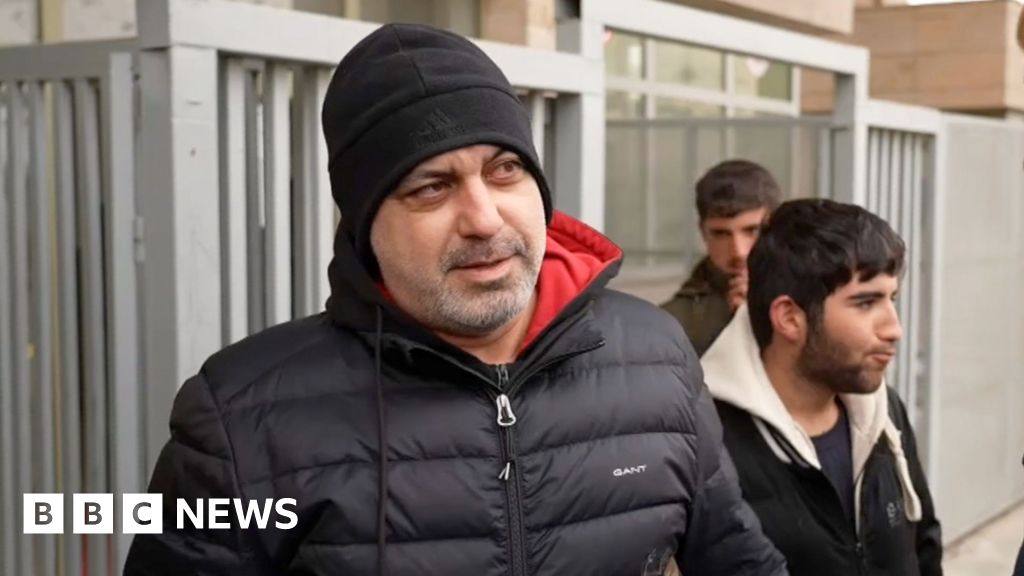
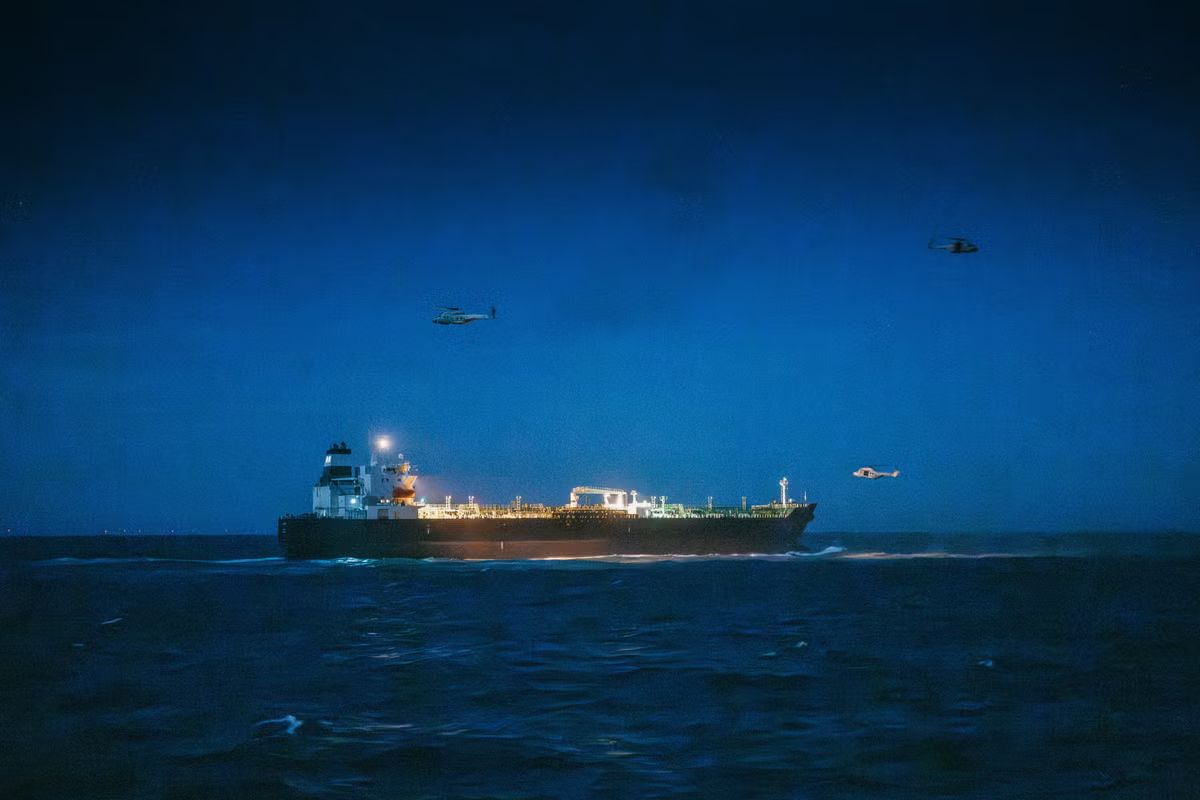
The border separating Iran and Turkey is one of the few ways journalists have been able to speak to people coming out of Iran, with those leaving telling the BBC they feel unsafe and scared.
Hundreds escaping the war are passing through that border, but a few are going back into the country.
The Sign of the Times singer is performing in Manchester tonight for ‘one night only’
Global superstar Harry Styles is performing in Manchester this evening on the day of his latest album launch – and he has issued a heartfelt message to his fans.
Advertisement
The former One Direction star broke his performing hiatus last week at the Brit Awards, which took place at the Co-op Live, where he played Aperture – a track from his new album Kiss All The Time, Disco Occasionally.
Kiss All The Time, Disco Occasionally was released in full today (March 6), and his special Manchester gig is expected to include every song from the new album. Fans were treated to affordable £20 tickets as well as a ticket request system rather than a standard first come first serve ticket sale.
Get MEN Premium now for just £1 HERE – or get involved in our WhatsApp group by clicking HERE. And don’t miss out on our brilliant selection of newsletters HERE.
For Harry’s ‘one night only’ Co-op Live gig, organisers have issued a rare no phones policy, meaning that nobody inside the venue is allowed to take pictures or videos for the duration of the night.
Advertisement
In a message shared on the Co-op Live website, it warns: “Phones will be secured in a recyclable bag, kept on your person upon entry to the event, and will still be able to be used in a normal way including all communication functions but without the camera.”
It continues: “All other recording devices will not be permitted in the building. At the end of the night your phone will be removed from the bag and the bag will be recycled. Please note that anyone using a digital recording device during the performance will be asked to stop and if they do not, they may be asked to leave.
“We hope you will take this opportunity to enjoy the show fully and allow yourself to be fully immersed in the experience.
Advertisement
“Each pair of tickets sold will receive a disposable camera on the night so you can still capture your own special moments and share them after the show.”
One fan has shared an image on X, formerly Twitter, of their disposable camera alongside a note which reads: “It’s really great to be home. Thank you for really being here with me. Dance with all your friends.”
The Queen delivered a moving message about children’s literacy as the BBC 500 Words writing competition winners were announced at Windsor Castle
20:49, 06 Mar 2026Updated 20:50, 06 Mar 2026
The One Show viewers were touched as Queen Camilla delivered a heartfelt message.
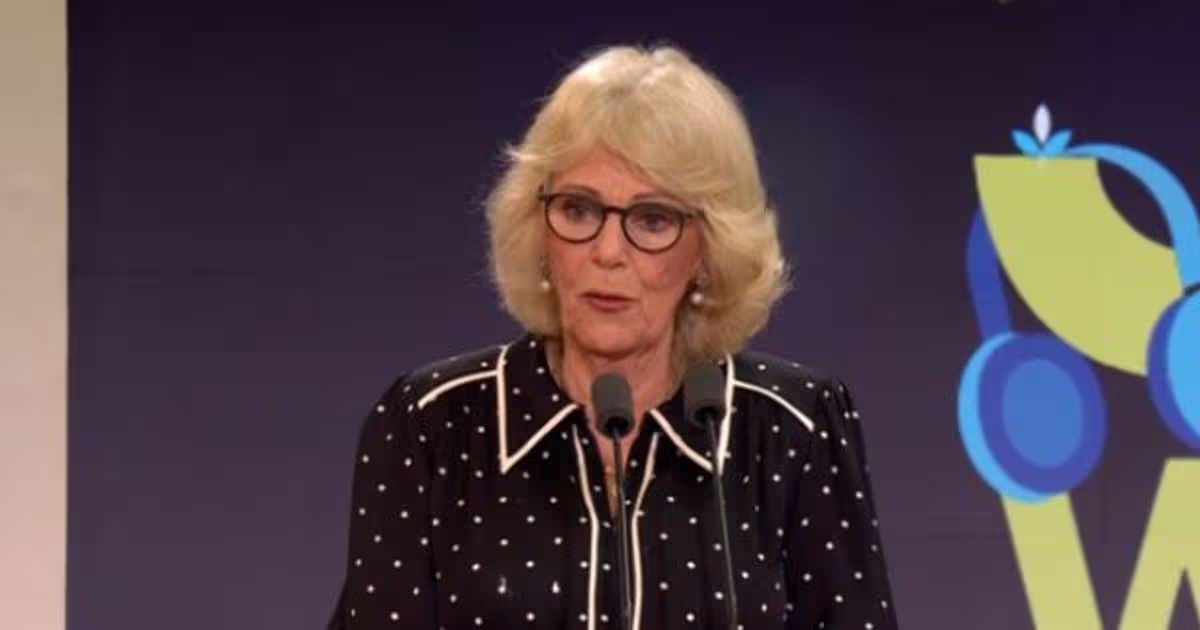
The Royal was present to announce the winners of the children’s writing competition, 500 Words, on the BBC show on Friday evening (March 6). The special episode was hosted by Alex Jones and Roman Kemp at Windsor Castle, reports Wales Online.
Camilla attended the ceremony, where she shared with the audience: “I hope you have enjoyed taking part in the 500 Words, but in doing so you have discovered a secret. A secret that reading and writing are the best fun ever. And don’t just take my word for it.”
Advertisement
She continued: “Many years ago, a famous author said this, ‘In the main, writing is just the thrill. The thrill of exploring.’ Now the man who found writing so thrilling was AA Milne, who exactly a hundred years ago published the first book that introduced us to his beloved bear, Winnie the Pooh. Pooh like all of us here, had firm views about storytelling. He didn’t much like long, difficult words. But rather short or easy words. Like, ‘What about lunch?’”
When it was time to reveal the winners, the Queen stated: “Let me leave you with one more quote from our author of the day AA Milne. ‘Always remember, you are braver than you believe, stronger than you seem and and smarter than you think.’ Which makes you all winners.”
She then told Alex and Roman: “I think to get children reading and writing stories, especially nowadays, is so important. And also, it gives them time to get away from some of their phones!”
Advertisement
The speech resonated deeply with audiences, prompting one viewer to post on X, formerly Twitter: “I’m not crying.”
Another gushed on Instagram: “What a nice clever and inspiring speech!!” A fellow viewer described it as “marvellous”. One fan remarked: “How thoroughly lovely,” whilst numerous others flooded the platform with heart emojis.
One audience member declared the initiative “brilliant” whilst another commented: “Her Majesty is just an extraordinary woman. Truly inspiring.”
Advertisement
The BBC Bitesize-supported competition attracted over 46,500 submissions from throughout the UK. Six young writers were honoured as champions during the finale.
Famous faces including Jodie Whittaker, Joanna Page, Sara Cox, Bradley and Barney Walsh, Big Zuu and Paterson Joseph participated in the ceremony, whilst Paddington made a special appearance to perform The Explorer and The Bear from Paddington The Musical and West End sensation Marisha Wallace delivered a rendition of A Million Dreams from The Greatest Showman.
For the latest showbiz, TV, movie and streaming news, go to the new **Everything Gossip** website
The UK’s asylum system is being overhauled. The home secretary, Shabana Mahmood, has laid out a series of reforms that will affect refugees seeking safety in Britain. Mahmood argues that these changes – which include removing financial and housing support for asylum seekers who break the law, and offering incentive payments for asylum seekers whose claims have been rejected to return home – will remove “incentives” drawing people to Britain. She says they are necessary as part of a “firm but fair approach” to asylum.
One of the headline announcements is to make refugee status temporary, subject to review every 30 months. “Those whose country has now become safe, and therefore no longer require protection, will be expected to return home,” according to the home secretary.
Under the current rules, asylum seekers who have been granted refugee status are permitted to stay for five years, after which they can apply for indefinite leave to remain in the UK. Mahmood claims that “this means refugee status is, in effect, permanent from day one”.
But this is not true. Refugee status was always intended to be temporary. Most refugees have never wanted to be refugees forever, and states have never been expected to host them indefinitely.
Advertisement
Since the creation of the UN refugee convention, states have had the right to end refugee status. The convention itself, as the home secretary even noted, says that its protections no longer apply if “the circumstances in [connection] with which [someone] has been recognised as a refugee have ceased to exist”.
If someone is no longer in need of international protection, they must either return to their country of origin or find another legal way to stay where they are. The UN refugee agency has always been clear though that the onus of proving this falls on states. Refugees should neither be required to continuously justify their right to international protection nor “be subject to constant review in the light of temporary changes” in the country that they came from. This puts the UK government’s position at odds with a key principle designed to protect refugees, by requiring them to apply for further permission to stay.
Technically, the UK government already had the right to remove refugee status and, if individuals had no other legal claim to stay in the UK, send people back to countries it deemed “safe”. For several reasons, however, this has been difficult to implement in practice.
Advertisement
To end a person’s refugee status, states must prove that a refugee is no longer at risk of persecution, and that if they must return to their country of origin, they will not face a threat to their life and fundamental liberties. States must hence demonstrate that there has been a “fundamental, stable and durable” change in the country of origin. This should be related to the specific reason for the refugee’s asylum claim.
Looking at major recent refugee-producing countries, such as Syria, Ukraine and Afghanistan, conflict and violence still rage. It seems implausible that any government would be able to prove that significant numbers of citizens from these countries no longer have valid claims to protection.
Denmark – the country whose asylum system has inspired Mahmood – has been attempting to reject Syrians’ applications to renew their refugee status, on the grounds that parts of Syria are safe for them to return to. These efforts have been criticised by international groups including the UN refugee agency, and are so far only applicable to a small number of people.
The home secretary says changes to the asylum system will remove the ‘incentives’ that draw people to seek safety in the UK. Sean Aidan Calderbank/Shutterstock
Determining safety
Refugees can become pawns in domestic and international politics, regardless of their ongoing need for protection.
Advertisement
Who, for example, gets to decide what is an acceptable standard of human rights? Or whether a change is actually “fundamental, stable and durable”? Countries of asylum have pushed to end refugees’ statuses to reduce their responsibilities to host them. This appears to be Mahmood’s plan.
Countries of origin can also manipulate this process. They have pushed for refugees to be returned to them, in order to silence legitimate political opposition in exile, and in the hope of restoring their images as peaceful countries. This happened during the protracted application of the cessation clause to Rwandan refugees, leaving many in a vulnerable position.
Practically too, in stating that the status of refugees will be reviewed every 30 months, Mahmood is introducing another costly and time-intensive bureaucratic process when the asylum system is already chronically backlogged. The government has already trialled using artificial intelligence in asylum decision making, so it’s possible that this is on the horizon here. But this comes with its own risks to due process, fairness and privacy.
I would argue that the government is dressing up a legal option that they have always had as a “new policy”, while downplaying the safeguards that have prevented them from turning this option into reality.
Advertisement
It is unlikely that this reform will make the asylum process either more efficient or humane, or that it was ever intended to do so. Mahmood insists that it will make the system “fair … to those seeking a new and better future in this country” – but requiring refugees to relive and defend their trauma every two and a half years will only heighten the suspicious, hostile and punitive nature of the asylum system.
A Rockwell B-1 Lancer, a supersonic variable-sweep wing, heavy bomber used by the United States Air Force arrives at RAF Fairford in Gloucestershire (Picture: PA)
One of the US’s most fearsome bombers has landed in the UK ahead of possible deployment to Iran, after the war secretary warned that strikes are ‘about to surge dramatically’.
The 146ft B-1 Lancer has a wingspan of 137ft, weighs 86 tonnes and is the fastest bomber in the US Air Force, according to Boeing, hitting speeds of more than 900mph with 24 cruise missiles on board.
Piloted by a crew of four, ‘the Bone’ has advanced radar and GPS systems to help hit targets, and electronic jammers, radar warnings and a decoy system to protect it from enemies.
The B‑1, which has been used in Syria, Libya, Afghanistan and Iraq, can carry up to 34 tonnes of weapons and equipment.
Advertisement
The US Air Force says on its website: ‘Carrying the largest conventional payload of both guided and unguided weapons in the Air Force inventory, the multi-mission B-1 is the backbone of America’s long-range bomber force.
Sign up for all of the latest stories
Start your day informed with Metro’s News Updates newsletter or get Breaking Newsalerts the moment it happens.
Advertisement
‘It can rapidly deliver massive quantities of precision and non-precision weapons against any adversary, anywhere in the world, at any time.’
A bomber was pictured arriving at RAF Fairford in Gloucestershire on Friday after Sir Keir Starmer granted the US permission to strike defensively against Iran’s missile facilities from British bases.
Advertisement
Western officials confirmed on Wednesday that US aircraft were expected at the base in the coming days and Britain was ready to accept them.
US defence secretary Pete Hegseth said on Thursday that strikes on Iran are ‘about to surge dramatically’.
He said: ‘It’s more fighter squadrons, it’s more capabilities, it’s more defensive capabilities. And it’s more bomber pulses more frequently.’
Advertisement
Protests are expected at RAF Fairford on Saturday afternoon to oppose any use of the base by US bombers.
Smoke and flames rise following an Israeli airstrike on Dahieh, a predominantly Shia Muslim suburb in the south of Beirut, Lebanon (Picture: EPA)
A man walks past heavily damaged buildings at the site of overnight Israeli airstrikes in the southern suburbs of Beirut (Picture: AFP via Getty)
In an update on Friday, White House press secretary Karoline Leavitt revealed the US military campaign against Iran may take as long as four to six weeks.
President Donald Trump has previously suggested the conflict could take around five weeks before warning it could go ‘far longer’.
Hegseth has similarly insisted the US would ‘take all the time we need to make sure that we succeed’.
The president appeared to rule out negotiations with Iran to end the conflict in the Middle East, saying in a social media post Friday that there will be no deal absent ‘unconditional surrender’.
Advertisement
‘After that, and the selection of a GREAT & ACCEPTABLE Leader(s), we, and many of our wonderful and very brave allies and partners, will work tirelessly to bring Iran back from the brink of destruction, making it economically bigger, better, and stronger than ever before,’ Trump said.
He has said multiple times that whoever takes over leadership of Iran must be to the US’s liking.
Trump signed off the social media post with ‘MAKE IRAN GREAT AGAIN (MIGA!)’, a riff on his longtime campaign slogan, ‘Make America Great Again’.
The deal was struck on the same day that a judge planned to hear a challenge to Moore’s arrest in December on three charges, including felony home invasion. Those charges were dropped in exchange for Moore pleading no contest to misdemeanor trespassing and misdemeanor malicious use of a telecom device.
“Things have changed,” Judge J. Cedric Simpson said.
Moore had confronted the woman with whom he had been having an affair and blamed her for his dismissal, even threatening to kill himself with butter knives in her apartment, authorities said.
Advertisement
___ EDITOR’S NOTE — This story includes discussion of suicide. If you or someone you know needs help, the national suicide and crisis lifeline in the U.S. is available by calling or texting 988. There is also an online chat at 988lifeline.org
___
“All the charges against Mr. Moore were not supported by facts and law,” said attorney Ellen Michaels, standing alongside Moore and his wife, outside the courtroom. “The dismissal of those charges validates the concerns we raised about the investigation from the very beginning. Mr. Moore is pleased to put this behind him and move forward.”
Moore did not respond to a reporter asking him for comment. Assistant prosecutor Katie Rezmierski, on her way out of the courthouse, declined an interview request..
Advertisement
Sentencing is scheduled for April 14 on charges that have a potential maximum of six months and 30 days in prison.
He was fired on Dec. 10 after two seasons as the successor to Jim Harbaugh, who won a national championship before leaving to lead the NFL’s Los Angeles Chargers.
Moore arrived at the courthouse with his wife, Kelli, and they walked toward the courtroom holding hands, interlacing fingers.
In dismissing Moore, the university cited an inappropriate relationship with a staff member. Rezmierski has said the woman ended the affair a few days before Moore’s firing and cooperated with the school’s investigation.
Advertisement
The AP isn’t identifying the woman, who has accused Moore of domestic violence and stalking. She did not answer a dozen calls or respond to some text messages from him before his dismissal, police said.
“It’s not stalking if the communication has a legitimate purpose,” Michaels has said.
A message seeking comment was left with attorney Heidi Sharp, who is representing Moore’s former executive assistant.
Michaels has accused the woman’s personal lawyer of giving information to police to “villainize Mr. Moore and maximize the chances of obtaining a large settlement from the deep pockets of the University of Michigan.”
Advertisement
___
Associated Press writer Ed White in Detroit contributed to this report.
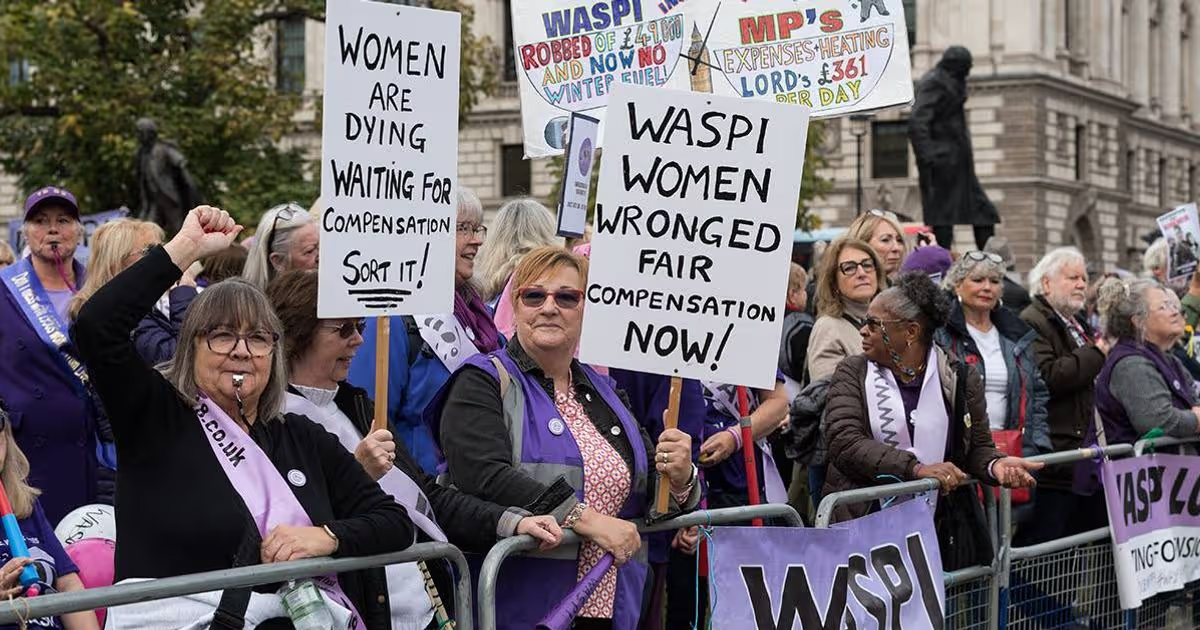
The WASPI campaign has provided an update on next steps after the DWP rejected compensation for the second time, with legal teams reviewing whether to launch another judicial review challenge
The WASPI campaign (Women Against State Pension Inequality) has provided a fresh update on their fight for DWP compensation. The group suffered a significant blow recently when the DWP confirmed it would not be offering compensation.
Advertisement
This marked the second time the Labour Government has issued a statement on the matter. Ministers initially announced in December 2024 that no compensation would be forthcoming, but the WASPI campaign successfully secured a judicial review of that decision.
The campaigners were due to appear in court in December 2025, but ministers withdrew the decision at the last minute, stating they would reconsider it based on new evidence. Legal representatives for the DWP then agreed to an out-of-court settlement, paying out £120,000 to cover WASPI’s legal costs.
This raises questions about whether WASPI will mount another judicial review challenge against the latest decision. In an update, WASPI said: “Since our last update, WASPI’s legal team have undertaken a careful line by line scrutiny of the Government’s new decision and the barrister team has been fully briefed; we will meet with them in the coming days. We will update you on our next steps once we have received their advice.”
The WASPI campaign is amongst several organisations representing women born in the 1950s who were affected when the state pension age for women increased from 60 to 65 and later to 66, reports the Mirror.
Advertisement
Campaigners maintain the women weren’t properly informed about the changes, and the DWP should have communicated the alterations sooner.
An earlier investigation by the Parliamentary and Health Service Ombudsman found there was ‘maladministration’ by the DWP, as they ought to have sent letters to the affected women far earlier. The watchdog recommended compensation payments to the women ranging between £1,000 and £2,950.
Labour has accepted this finding of maladministration, but opted against providing financial compensation. In delivering the second decision, Work and Pensions Secretary Pat McFadden told MPs: “The evidence shows that the vast majority of 1950s-born women already knew the state pension age was increasing thanks to a wide range of public information, including through leaflets, education campaigns, information in GP surgeries, on TV, radio, cinema and online.
“To specifically compensate only those women who suffered injustice would require a scheme that could reliably verify the individual circumstances of millions of women.”
Advertisement
Grace Hardy, tax accountant at Hardy Accounting, highlighted several crucial takeaways from the WASPI situation. She said: “The overarching lesson is that the UK tax and benefits system is genuinely complex, changes frequently, and does not reliably notify those affected by changes.
“Treating your own financial position as something to actively and periodically review rather than something that will look after itself is probably the most valuable single habit anyone can develop.”
She urged individuals not to assume that current regulations will stay the same going forward. She said: “Pension ages, tax thresholds, allowances and benefit rules are all subject to change. Any plan that depends entirely on current rules holding indefinitely is fragile.”
This advice is particularly timely, as the state pension age will soon be rising again. The qualifying age currently sits at 66 for both men and women and will rise progressively from April 2026, reaching 67 by April 2028.
Advertisement
Ms Hardy pointed out some other financial matters worth keeping an eye on. She said: “Know what applies to you specifically. General media coverage tells you the average or headline rules.
“But your state pension age, your National Insurance record, your specific tax position, your pension entitlements these are individual. Use the Government Gateway to check your state pension forecast and National Insurance record.”
She also advised seeking independent financial guidance on significant decisions, including consolidating pensions, drawing down from defined benefit schemes, and inheritance planning. Ms Hardy stated: “These are areas where mistakes are costly and often irreversible.”
He was giving evidence in the trial of Stephen McCullagh who is denies murdering his pregnant girlfriend
19:42, 06 Mar 2026Updated 19:42, 06 Mar 2026
A taxi driver in the Natalie McNally murder trial has told how he picked up a fare outside a Lurgan pub and dropped of in Lisburn the night she was killed.
He was giving evidence in the trial of Stephen McCullagh, 36, of Woodland Gardens, Lisburn, who is accused of murdering his pregnant girlfriend in December 2022.
She was 15 weeks pregnant when she was beaten, stabbed and strangled in her Silverwood Green home in Lurgan on the evening of Sunday, December 18, 2022. Stephen McCullagh denies murder.
Advertisement
During today’s trial at Belfast Crown Court the witness, a Fonacab driver, asked what he remembered about the evening of Sunday, December 18, 2022.
He recalled driving his grey Skoda Octavia along Carnegie Street and then parking up a fare outside Fa Joe’s public bar in Lurgan. Asked by Crown barrister Charles MacCreanor KC where his customer was, he replied: “I believe he came from standing by the entrance to the pub. He was alone. He got into the passenger seat. I didn’t recognise him as a regular customer.”
The fare was picked up at 10.46pm and the drop off time was at 11.13pm. The taxi driver said the only thing he recalled was that he was worried the fare would fall off the seat as he was a “big person.”
He remembered the customer had a bag with him and he put it down by his feet in the footwell. The witness said the customer asked him to take him to Lisburn and to use the Moira/Lisburn Road as the best route.
Advertisement
“He had said that his mother was unwell and the conversation was that everything had been left for him to sort out. He was sort of annoyed that he had to go to Lisburn to sort this out.”
He confirmed to the court that he didn’t know where the ‘end stop’ was for the fare and just followed the directions from his customer. The witness recalled making a couple of wrong turns on the journey.
He said the journey came to an end when the customer said to him that this was the address and he pulled up on the left side of the street beside a hedge and behind it was a small bungalow.
Asked to describe the hedge, the cabbie said: “I think I recall it being very high and I was unable to see the bungalow. The customer said he hoped the family had money to pay for this (fare). He left the car, went into the entrance and came back with the money.”
Advertisement
The driver said the passenger left his bag in the footwell and some customers do that as a sign that they were coming back with the money and then retrieve the bag.
“He came back after a couple of minutes. I would say no more than five minutes, probably.”
He recalled he was paid in cash, adding that normally a trip from Lurgan to Lisburn at that time would have been around £20. The witness said the customer retrieved his bag and went into the bungalow where he had pulled up and stopped his taxi.
Asked to describe his customer’s manner during the trip, he replied: “He was very polite but there were a couple of points when I made a wrong turn and the customer got a little anxious and irate and said: ‘You went the wrong way. It’s OK. A lot of people that make that mistake’.”
Advertisement
Under cross examination from defence counsel John Kearney KC, the witness confirmed he could not be accurate that the drop off time was 11.13pm.
Asked did he tell police that his customer spoke with a local Lurgan accent, the witness said what he was trying to say was that his fare did not speak with a foreign accent.
In a statement from a Foncab IT manager, he said the fare that was picked up outside Fa Joe’s had been dropped off at Woodland Gardens in Lisburn, according to the Skoda Octavia’s GPRS system.
Asteroids are some of the oldest objects in the Solar System: leftovers from the chaotic time when planets were assembling from dust and rock. They’re time capsules, preserving clues about what the early Solar System was like, and, ultimately, what the building blocks of planets are.
Knowing what an asteroid is made of also matters for very practical reasons. If an asteroid were ever on a collision course with Earth, its composition would affect how dangerous it is, how it breaks up in the atmosphere, and how we might successfully nudge it away. This area of research is called planetary defence.
Understanding the make-up of asteroids also matters for the future of exploration: some asteroids may contain metals, minerals, and even water – potentially useful resources. But how can we tell what asteroids are made of when most of them are millions of kilometres away?
Asteroid ‘fingerprints’
One of the most powerful techniques is spectroscopy, the science of splitting light into components and measuring what wavelengths are absorbed or reflected. Minerals interact with light in characteristic ways, leaving subtle dips and slopes in a spectrum. In effect, an asteroid’s surface leaves behind a chemical fingerprint in sunlight.
Advertisement
These fingerprints let us place asteroids into broad families. One of the most common groups near Earth is the S-complex, a class of relatively reflective asteroids often associated with silicate minerals such as olivine and pyroxene. For decades, researchers suspected that S-complex asteroids were linked to a particular category of meteorites that frequently fall to Earth: the ordinary chondrites.
A phenomenal example of how well this can work came from Japan’s sample-return mission Hayabusa, which visited the near-Earth asteroid (25143) Itokawa. Hayabusa reached the asteroid in September 2005. From its reflected light, Itokawa was inferred to be an S-complex asteroid, and spectroscopic comparisons suggested it should resemble ordinary chondrites, particularly the LL subgroup.
Hayabusa returned tiny grains of asteroid regolith to Earth, and laboratory analyses showed the mineralogy and mineral chemistry were identical to LL chondrites. In other words, the remote spectral prediction matched the physical reality of the samples.
Artist’s concept: The Dart mission collided with, and moved, the asteroid Dimorphos. Nasa
Then Dart arrived — and raised the stakes. In September 2022, Nasa deliberately slammed a spacecraft into the small moonlet Dimorphos, which orbits the larger asteroid Didymos, in the Dart (Double Asteroid Redirection Test) mission.
Advertisement
The goal wasn’t to destroy the asteroid; it was to test whether a kinetic impact could measurably change its orbit. Didymos has been observed extensively with spectroscopy and is classified as an S-complex and inferred to have a LL chondrite composition.
But is there a possibility we could we be misreading the make up of some space rocks? A 2026 paper argues that another meteorite group, brachinites, can show spectral properties that overlap with S-complex asteroids. One sample (NWA 14635) even shows spectroscopic band parameters similar to Didymos.
This is a big deal, because it means there may not be a neat one-to-one mapping between asteroid types and meteorite types. Asteroids are the left over building blocks of planets in our Solar System, often termed “space rocks”. Meteorites are space rocks that have survived the journey through a planet’s atmosphere, reaching the surface.
For planetary defence, this distinction matters. A chondritic “rubble pile”, composed of loosely bound rocks, and a more strongly processed, coherent igneous body (which would cover the brachinites) might respond differently when hit.
Advertisement
An ordinary chondrite-like surface might absorb energy like a “cosmic beanbag”, while a more magmatic surface might behave more like brittle rock. If we want to predict what happens when we try to deflect an asteroid, we need to know what its surface resembles.
This is exactly why the European Space Agency’s Hera mission is so exciting. Hera isn’t repeating Dart; it’s doing the follow-up crime scene investigation. Hera launched in October 2024 and is now on its way to the Didymos system, with arrival planned for late 2026. Once there, it will map both asteroids in detail.
Hera also comes with two small satellites known as cubesats: Juventas and Milani. Milani will help study the surface composition. This will give insights into not just what Dimorphos looks like from a distance, but what it’s made of, how it’s structured, and how it responded to Dart’s impact.
In the context of the new brachinite result, Hera’s role becomes even more important. If Didymos and Dimorphos turn out to be less “ordinary chondrite-like” than we assumed, or if their surfaces disguise a more complex origin, Hera is the mission that can test that assumption directly. It’s a reminder that asteroids still have the power to surprise us.
It can be worth looking around to find the cheapest garages
Matt Lee and Paul Gallagher and Cullen Willis
19:00, 06 Mar 2026
The cheapest place in Cambridgeshire to fill up your car with petrol is at a Tesco garage in Huntingdonshire. According to the latest data supplied by retailers, a driver in an average family car could save up to £8 by filling up at this forecourt, compared to the most expensive petrol station.The Tesco garage at Neil Way, Huntingdonshire is charging motorists 128.9p per litre, which means it would cost £71 to fill up an average 55 litre tank. This is based on a feed of live petrol prices which was set up by the government’s Competition and Markets Authority last September. The average price for a litre of petrol across the Cambridgeshire region this week is 134.7p.
The most expensive filling station in Cambridgeshire is an ASDA station on Ness Road in Burwell. The cost of standard petrol at this station is 142.9p, meaning it would cost a total of £79 to fill up an average family car at this forecourt.
Advertisement
For the owners of diesel cars, the cheapest place to fill up is the Tesco garage on Hostmoor Avenue in March. The cost of a litre of standard diesel at this forecourt was 139.9p, according to prices supplied by retailers.
It comes as new figures suggest diesel prices have surged to a 16-month high since the start of the Middle East conflict. The RAC said the average price of a litre of the fuel at UK forecourts has gone up by 5p since Saturday to 147p. It has not been this expensive since mid-August 2024. Average petrol prices have risen by 3p per litre since Saturday to 136p.
Disruption to tanker traffic in the Middle East has sparked a rise in oil prices, which have a significant effect on wholesale fuel prices. The price of Brent crude oil has risen by about 21 percent over the past week, exceeding 88 US dollars (£66) a barrel on Friday.
RAC head of policy Simon Williams said: “While wholesale costs for any retailer buying in new stock will have gone up, it normally takes two weeks for price changes to work their way through to the forecourt. Brent crude jumped to 85 US dollars (£64) on Thursday, something we haven’t seen since July 2024.
Advertisement
“If the price of a barrel stays at this level, or increases, then further forecourt rises will be inevitable. While the rate of increase has been fast, we’re fortunately a long way from the record prices of 2022 when the average price of petrol hit 191.5p and diesel 199p.”