

Crypto World
Dubai regulator issues alert over KuCoin-linked entities advertising crypto services



Dubai’s virtual assets regulator has issued a public warning about several companies linked to the crypto exchange KuCoin, alleging they may have been promoting or providing services to residents without the required authorization.
Summary
- Dubai’s VARA issued an alert naming Phoenixfin Pte Ltd, MEK Global Limited, Peken Global Limited, and KuCoin Exchange EU GmbH for allegedly advertising crypto services under the KuCoin brand without proper authorization.
- VARA said the entities must stop all unlicensed virtual asset activities in or from Dubai, noting they do not hold a license to offer regulated crypto services in the jurisdiction.
- The regulator cautioned that engaging with unlicensed platforms could expose users to financial and legal risks, urging investors to verify whether firms are listed on VARA’s official registry before using their services.
Dubai watchdog flags KuCoin-linked companies for unlicensed crypto activity
In a regulatory notice dated March 5, the Virtual Assets Regulatory Authority (VARA) named Phoenixfin Pte Ltd, MEK Global Limited, Peken Global Limited, and KuCoin Exchange EU GmbH, which it said are commercially advertising services under the KuCoin brand.
According to the regulator, the entities may have been offering virtual asset services to users in Dubai “without the necessary regulatory approvals” and may have misrepresented their licensing status in the jurisdiction.
As a result, VARA has instructed the companies to “cease and desist all unlicensed VA activities” in or from Dubai.
The authority emphasized that the exchange does not hold a license to provide virtual asset services in or from Dubai, meaning any such activities would be in breach of local regulations governing crypto service providers.
Under Dubai Law No. (4) of 2022 and Cabinet Resolution No. 111/2022, all virtual asset service providers must obtain regulatory approval from VARA before offering services in the emirate.
VARA also warned that interacting with unlicensed platforms could expose investors to “significant financial risks and potential legal consequences”, urging residents to verify whether companies are listed on the regulator’s public register before engaging with them.
The regulator further noted that any promotion, advertising, or solicitation related to KuCoin has not been approved, meaning the platform is not permitted to market or promote virtual asset products or services in Dubai.
Founded in 2017, KuCoin is a Seychelles-based cryptocurrency exchange that offers spot, derivatives and margin trading to users worldwide.
The alert is part of VARA’s broader effort to enforce its crypto regulatory framework and prevent unlicensed operators from targeting investors in the emirate.


The team behind the Curve Finance decentralized finance (DeFi) platform accused the PancakeSwap decentralized exchange (DEX) of using its code without the proper licensing.
The code is tied to the “StableSwap” feature used for swapping stablecoins and “tightly-pegged” assets on PancakeSwap Infinity, the latest version of the PancakeSwap DEX.
“If you want to enjoy using stableswap without legal problems and to borrow some of our expertise to keep users SAFU, you still can contact us for licensing and collaboration,” the Curve team said on X.

In a separate post, Curve said “deep stableswap expertise” is needed to safely integrate swap features, and cited the 2022 hack of the Saddle Finance DEX and the $116 million hack of DeFi protocol Balancer in 2025 as examples of swap-based code exploits.
The PancakeSwap team said it would reach out to Curve Finance to discuss the issue. “Indeed, better to be friends and build together,” the Curve team responded.
Cointelegraph reached out to both teams but did not receive a response by the time of publication.
The incident highlights the potential cybersecurity and legal issues that arise in decentralized finance as projects and protocols continue to iterate on products and expand features.
Related: Curve founder says DeFi must ditch token emissions for real revenue
PancakeSwap Infinity launches and goes cross-chain
PancakeSwap Infinity launched on the Arbitrum network and BNB Chain in April 2025, following the integration of one-click, cross-chain swaps that allow users to move digital assets between blockchain protocols.
The updated DEX introduced “hooks,” smart contract plug-ins that customize parameters for liquidity pools, including dynamic fee structuring, tailored rebates and onchain limit orders that execute when preset conditions are met.

The upgrade also lowered pool creation fees by up to 99% and was built to accommodate different liquidity strategies, according to PancakeSwap.
In July 2025, PancakeSwap Infinity launched on Base, an Ethereum layer-2 (L2) scaling network, and touted up to 50% cheaper trading fees when Ether (ETH), the native token of the Ethereum layer-1 blockchain network, was traded against ERC-20 tokens.
ERC-20 is the token standard for most assets minted on Ethereum, including the gas and governance tokens of Ethereum L2s, memecoins, and other projects issuing tokens on Ethereum.
Magazine: MakerDAO’s plan to bring back ‘DeFi summer’ — Rune Christensen


Kazakhstan’s central bank has announced a strategic move to invest up to $350 million in cryptocurrency assets, marking a significant shift in its reserve management strategy.
Kazakhstan’s central bank has unveiled plans to invest up to $350 million in cryptocurrency assets. This decision represents a substantial policy shift aimed at diversifying the country’s reserves.
Kazakhstan has emerged as a significant player in the global crypto mining sector, contributing approximately 6-8% of Bitcoin’s global mining due to its low electricity costs. The government is also working on a regulatory framework to legalize and tax crypto mining and trading, further solidifying its position as a crypto-friendly nation, according to Reuters.
The central bank, which oversees Kazakhstan’s monetary policy and manages its currency reserves, is implementing this investment strategy as part of a broader approach to reserve management.
This move is likely to influence neighboring Central Asian countries, encouraging them to consider similar investments or regulatory measures. The shift could potentially transform the regional crypto landscape, making Central Asia a hub for cryptocurrency development and innovation.
The investment decision aligns with global trends where central banks are increasingly exploring crypto assets as part of their reserve diversification strategies.
This article was generated with the assistance of AI workflows.


Bitcoin outflows from exchanges continued during the Hormuz crisis, signaling holders are moving coins into cold storage rather than selling.
Bitcoin (BTC) held near $70,000 on March 6 after a geopolitical shock tied to tensions around the Strait of Hormuz pushed energy prices higher and triggered risk-off behavior across global markets.
Despite the turbulence, blockchain data shows BTC continuing to leave exchanges, suggesting many holders are not preparing to sell.
Energy Shock Rattles Markets
Analyst GugaOnChain linked the latest volatility to disruptions around the Strait of Hormuz, a major energy shipping route, which remains effectively closed amid the U.S.-Israeli war on Iran.
The market watcher noted that Brent crude traded near $85 and West Texas Intermediate around $81 as the situation pushed up fuel costs, including a $0.27 increase in U.S. gasoline prices during the week.
According to the same analysis, the shock drained liquidity across global markets and led to outflows of just under $228 million from Bitcoin exchange-traded funds on March 5. However, exchange flow data showed an unusual divergence. Using a seven-day moving average, Bitcoin’s net exchange flows remained negative, meaning more coins were leaving exchanges than entering them. Daily data showed withdrawals of 500 BTC, while the weekly total reached about 6,500 BTC, leaving trading venues.
According to GugaOnChain, such movements often signal that investors are transferring holdings into cold storage, which reduces the supply immediately available for sale.
“Given the notable on-chain resilience, the directive is to adopt a tactical defensive stance, maximizing cash now and awaiting confirmation of a reversal in institutional flows before raising exposure again,” the analyst advised.
Trading Activity Intensifies on Major Exchanges
While coins are leaving exchanges overall, trading activity inside platforms has accelerated. Data shared by Arab Chain on March 6 showed Bitcoin turnover on Binance reaching about 425,000 BTC over the past 30 days, one of the highest readings since December.
You may also like:
Binance’s Bitcoin reserves currently stand near 660,000 BTC, and compared with the 30-day turnover figure, the liquidity ratio sits around 0.64, meaning about 64% of those reserves have been traded or transferred during the period.
That pattern suggests the same coins are changing hands repeatedly within a short time frame, which reflects increased speculative activity and stronger liquidity circulation within the market.
Bitcoin has fallen from a monthly peak attained earlier in the week, with price data from CoinGecko showing the asset trading just under $71,000 at the time of writing, down about 2% in the last 24 hours but still up close to 5% over seven days.
At the moment, the flagship cryptocurrency is sitting between renewed institutional demand and global macro pressure. Exchange withdrawals imply that many holders are waiting rather than rushing to exit positions, even as traders remain active inside the market.
Binance Free $600 (CryptoPotato Exclusive): Use this link to register a new account and receive $600 exclusive welcome offer on Binance (full details).
LIMITED OFFER for CryptoPotato readers at Bybit: Use this link to register and open a $500 FREE position on any coin!


As part of Outset PR’s Web3 communications talks, the agency founder Mike Ermolaev recently spoke with Jamie Elkaleh, CMO of Bitget Wallet, about how marketing changes when a crypto wallet evolves from a trading tool into a broader financial interface.
Summary
- Crypto marketing is moving towards utility-driven adoption, where product experience and real-world usability play a central role.
- Regional differences increasingly shape communication strategies, as adoption patterns, regulations, and user expectations vary between markets such as Asia and the West.
- As the industry matures, both media narratives and market movements are becoming more influenced by verifiable data, institutional capital, and macroeconomic forces.
While the full conversation explores everything from user acquisition to media strategy and the shifting dynamics of crypto markets, here are several key insights that are worth broader market attention.
Smooth onboarding drives sustainable user acquisition
One of Jamie’s key points is that sustainable wallet growth is no longer driven by incentives. Airdrops and points programs are often used to generate rapid attention. But according to him, these tactics rarely translate into long-term users. Instead, the focus should be on reducing product friction and simplifying onboarding.
“When users can transact without managing seed phrases or holding native gas tokens, adoption becomes more sustainable.”
In a utility-driven market, Jamie says, product design effectively becomes marketing.
Marketing in Asia vs. the West reflects different user expectations
Another point Jamie raised is that crypto marketing strategies vary significantly by region.
In Asia, adoption is closely tied to everyday financial use cases such as remittances, cross-border transfers, and stablecoin payments. As a result, communication tends to focus on speed, accessibility, and practical value.
“In 2025, the region recorded a 69% year-over-year increase in on-chain value. That reflects strong grassroots usage.”
In Western markets, the situation is different. Regulatory clarity and institutional trust shape user expectations much more strongly.
“With frameworks such as MiCA in Europe and new U.S. stablecoin legislation, users prioritize compliance, proof of reserves, and risk transparency.”
Despite these differences, Jamie notes that the core requirement remains the same across regions: products must work reliably in real-world financial contexts.
Data now underlies media credibility
At Bitget Wallet’s scale, Jamie insists that media coverage can’t rely on generic commentary. Journalists increasingly expect verifiable data that helps explain what is actually happening in the market.
“We publish research reports based on on-chain analytics and user behavior trends, which allows reporters to reference measurable insights.”
Per him, stories supported by real usage patterns – whether in transaction volume, adoption, or user growth – travel much further across the media ecosystem. This approach also changes how the team evaluates PR performance.
“We prioritize tier-one mentions, analyst citations, and share of voice within strategic narratives. Secondary indicators include organic brand mentions, backlink authority, inbound media inquiries, and invitations to podcasts or research collaborations.”
The real signal, Jamie adds, appears when external analysts start referencing the company’s data independently.
Crypto markets now move with macro capital
Jamie also confirms that crypto’s relationship with news has fundamentally changed. In earlier cycles, a single headline could move markets within hours. Today, price actions are increasingly shaped by macro capital flows, because
“Crypto has matured into a macro-sensitive asset class.”
As sector valuations reached multi-trillion-dollar levels, individual headlines naturally stopped carrying such influence.
With nearly $44 billion flowing into Bitcoin ETFs in 2025, institutional capital now plays a structural role in the market. In this environment, narratives matter less than fundamentals.
Utility is becoming crypto’s growth model
Reflecting on the conversation, one pattern becomes clear: the crypto industry is gradually shifting away from narrative-driven growth toward functional adoption.
Wallets are used not just for trading but for payments, transfers, and yield farming. Users expect reliability rather than explanations. And as institutional capital becomes a structural force, macro conditions are more important than short-term hype.
In that environment, the logic of marketing changes as well.
“If users don’t need to understand the infrastructure behind the product, the marketing has done its job.”


Buterin proposed AI-assisted wallets where algorithms suggest transaction plans but users must manually confirm large transfers.
Vitalik Buterin has outlined his perspective on how artificial intelligence (AI) could redefine the next generation of Web3 wallets.
He also proposed a model where humans remain directly involved in approving high-value transactions.
AI Will Shape Newer Crypto Wallets
The Ethereum co-founder shared his views on the decentralized social media platform Farcaster, noting that it is “pretty obvious” that the next iteration of wallets will heavily involve AI.
Despite this, Buterin added that he would not trust LLMs with multi-million-dollar transactions or control over large amounts of money. Instead, he gave an approach in which AI systems assist users while leaving the final decision in human hands.
He described an optimal workflow in high-value situations that would involve an AI system proposing a plan, after which a local light client simulates the transaction. The person would then review the intended action and the required outcome before manually confirming it.
However, Buterin warned that this approach must be implemented conservatively with a strong emphasis on security. He suggested that one way to achieve this is by removing decentralized application interfaces from the transaction process. By eliminating dApp user interfaces from the flow entirely, the system could reduce several attack vectors associated with theft and privacy risks.
The 32-year-old has previously discussed how cryptocurrency and AI could evolve together. He envisions blockchains and the technology working hand-in-hand, with crypto providing the trust, privacy, and economic infrastructure that it needs to operate safely and fairly.
You may also like:
Proposed AI-Assisted Wallet Workflows
Other developers and community members responded to Buterin’s comments by describing potential implementations of the idea.
Ethereum developer Andrey Petrov suggested two additional scenarios. In the first, a user initiates a transaction as usual while AI analyzes the payload about to be signed. The technology would then attempt to guess their intended action and explain it in plain language, allowing them to confirm whether the transaction accurately reflects what they meant to do.
In the second case, the user either states their intended action directly or relies on the explanation generated in the first step. The AI then tries to reconstruct the transaction independently, without referencing the original amount, to determine whether it arrives at the same outcome. He explained that any differences between the two would show areas that require further review before the process is finalized.
Another Farcaster user, identified as fkaany, described a framework in which AI plans complex crypto strategies such as multi-hop swaps, yield optimization, and gas minimization.
This would involve a local light client simulating the outcome, which would allow individuals to review a clear summary and manually confirm the transaction, helping reduce risks from blind signing, phishing interfaces, and malicious dApp payloads.
Binance Free $600 (CryptoPotato Exclusive): Use this link to register a new account and receive $600 exclusive welcome offer on Binance (full details).
LIMITED OFFER for CryptoPotato readers at Bybit: Use this link to register and open a $500 FREE position on any coin!

TLDR:
- Minimmit achieves finality in one signing round, replacing Casper FFG’s two-round justification and finalization process. (truncate to fit — 105 chars)
- The new gadget lowers fault tolerance from 33% to 17%, but raises the unilateral censorship threshold from 67% to 83%.
- Buterin argues censorship poses a greater threat than finality reversion, as it lacks immediate, verifiable on-chain evidence.
- Minimmit requires 83% of clients to share a bug before incorrect finalization occurs, giving developers a wider safety margin.
Minimmit has been put forward as a direct replacement for Casper FFG within Ethereum’s consensus layer. Ethereum co-founder Vitalik Buterin recently shared a detailed technical post comparing both finality gadgets.
Casper FFG has long served as a two-round finality mechanism on the network. The proposed system, by contrast, achieves finality in a single round of validator signatures.
The proposal is drawing attention as the Ethereum community continues to evaluate changes to its consensus architecture.
Why the New System Operates in a Single Round
Casper FFG asks each attester to sign a block on two separate occasions. The first signature “justifies” the block, and the second “finalizes” it.
Minimmit cuts this down to a single signing round. This makes the process more efficient for validators across the network.
The change comes with a direct cost to fault tolerance, though. The new system’s threshold sits at 17%, compared to 33% under Casper FFG.
A smaller portion of malicious stake can therefore disrupt finality under the new model. Still, Buterin’s post makes the case that other properties of the system more than offset this drop.
In the post shared on X, Buterin described himself as a long-standing “security assumptions hawk” in Ethereum’s consensus research. He cited his past push for 49% fault tolerance under synchrony.
He also referenced his work on DAS for dishonest-majority-resistant data availability checks. Despite this record, he stated he is “even enthusiastic” about the proposed design.
The asynchronous network case also differs between the two systems. Under ideal 3SF, finality holds as long as an attacker controls less than 33% of stake.
The proposed gadget lowers that same protection to 17%. In both cases, any reversion of finality triggers massive slashing penalties against offending validators.
Censorship Resistance and the Broader Security Picture
Buterin’s argument centers on identifying censorship as the more dangerous threat. Unlike finality reversion, censorship produces no immediate, publicly verifiable evidence against the attacker.
A reversion event, on the other hand, results in automatic, large-scale slashing. This asymmetry is a core reason behind his support for Minimmit’s design.
Both systems require an attacker to control over 50% of staked ETH to carry out censorship. The key distinction lies in what happens at higher thresholds.
In 3SF, an attacker above 67% can finalize the chain unilaterally, removing any coordination point for honest validators. The new system raises that threshold to 83%.
Software bugs present another area where the proposed gadget holds an advantage. Under 3SF, a flaw shared by 67% of client software can accidentally finalize an incorrect chain state.
Minimmit raises that bar to 83%. This wider margin gives developers more time to identify and respond before errors become permanent.
Buterin also addressed the economic argument against finality reversion attacks. With 15 million ETH staked, reverting finality under 3SF would require slashing 5 million ETH, or roughly $10 billion.
He noted that the 17% baseline still represents an enormous deterrent on its own. From there, he argues the proposed system’s other properties make it the stronger overall consensus design for Ethereum.


Nevin Shetty was convicted of wire fraud related to secretly moving $35 million in funds from a Seattle startup to his own crypto platform in 2022 to use for DeFi investments.
A Seattle judge has sentenced the former chief financial officer of a local startup to two years in prison following his conviction for wire fraud related to a cryptocurrency business.
In a Thursday notice, the US Justice Department said Nevin Shetty would serve two years in prison after he “secretly moved approximately $35 million in company funds to a cryptocurrency platform he controlled as a side business.” He moved the funds to the HighTower Treasury platform in 2022 before a crypto market downturn, resulting in the disclosure of the transfer.
According to the DOJ, Shetty was able to transfer the funds without any executives or board members at the Seattle startup knowing about it, then using the money to invest in “high-yield DeFi lending protocols that promised to generate returns of 20% or more.” He initially earned $133,000 in the first month before the collapse of the Terra ecosystem contributed to a significant market downturn.
“[T]he cryptocurrency investments that Shetty made with the stolen funds soon began declining and by May 13, 2022, the value of the investments was nearly zero,” said the DOJ. “After the $35 million was essentially gone, Shetty told two of his fellow executives what he had done. He was immediately fired.”
Shetty was indicted on charges of wire fraud in May 2023 and found guilty on four counts in November 2025 after a nine-day jury trial. He has been ordered to pay back the stolen funds and be on supervised release for three years after serving his two-year sentence.
Related: Analysts reject Jane Street ‘10 a.m. dump’ claims, say Bitcoin isn’t easily manipulated
Former FTX CEO is still waiting on an appeal
Shetty’s 2022 case happened months before the collapse of cryptocurrency exchange FTX, which later resulted in the arrest and conviction of its former CEO, Sam “SBF” Bankman-Fried. SBF was sentenced to 25 years in prison in 2024 but has filed to appeal the ruling. As of Friday, the US Court of Appeals for the Second Circuit had not announced any decision since it heard arguments in November.
Magazine: The debate over Bitcoin’s four-year cycle is over: Benjamin Cowen


Astana’s $350M pivot from gold and FX to digital assets lands just as Bitcoin grinds against the $70K ceiling, adding fresh “real money” bid to an already tight market.
Summary
- Kazakhstan will reallocate up to $350M from its gold and FX reserves into crypto-linked assets starting April–May.
- The move trims exposure to sanction‑prone reserve assets and adds indirect Bitcoin and Ethereum exposure via funds and infrastructure stocks.
- It lands as Bitcoin trades in the high‑$60Ks to low‑$70Ks with resistance near $73K–$76K, tightening the macro link between sovereign flows and crypto pricing.
According to Reuters, Kazakhstan’s central bank has confirmed plans to carve out up to $350M from its roughly $69B stockpile of gold and foreign exchange reserves to build a crypto‑focused portfolio, a structural shift few emerging market monetary authorities have dared to make.
Rather than loading Bitcoin directly onto the balance sheet, the National Bank will channel capital into funds, index products, and equities tied to digital asset infrastructure, including Bitcoin (BTC) and Ethereum (ETH) exposure via intermediated vehicles. The allocation, slated to begin around April–May, will be funded by rotating out of existing gold and FX holdings, effectively swapping a slice of traditional reserves for higher‑beta digital risk.
Commentators have been blunt that diverting reserves into crypto‑linked assets is a hedge against the kind of reserve freezes Russia faced in 2022, when “safe” FX and gold suddenly proved politicized. By allocating to liquid, globally traded crypto instruments and the companies that support them, Kazakhstan is testing whether digital rails can complement the legacy reserve system without openly confronting it. With only a small fraction of total reserves at stake, the central bank preserves plausible deniability while signaling to miners, exchanges, and infrastructure providers that Astana wants to be a regional hub.
The timing intersects directly with a taut crypto market. Bitcoin is trading in a consolidation band roughly between the high‑$60Ks and mid‑$70Ks, repeatedly probing resistance around $73K–$76K amid rising volumes and a market cap north of $1.4T. Short‑term forecasts cluster around a $72K–$76K range, with technicians watching for a breakout that could extend toward $78K–$80K if fresh capital keeps arriving. Against that backdrop, Kazakhstan’s $350M is not huge in nominal terms, but it is “sticky,” multi‑year reserve capital—precisely the kind of flow that strengthens the narrative of Bitcoin as an emerging reserve adjunct rather than just a speculative trade. If more mid‑tier sovereigns follow, price action at $70K stops being just a chart level and starts to look like a policy decision made in central bank boardrooms.
TLDR:
- Tokenized real-world assets on Ethereum mainnet surpassed $15 billion in total market capitalization this month.
- Aave crossed $1 trillion in all-time cumulative loans, marking a major milestone for decentralized lending on Ethereum.
- BNP Paribas and BlackRock deepened their presence on Ethereum through new tokenized fund launches and integrations.
- Ethereum’s Layer 2 networks advanced significantly, with Linea peaking at 218 mGas/s and Optimism shipping Upgrade 18.
Ethereum builders delivered a remarkable month of progress across the ecosystem, with milestones that captured attention across both crypto and traditional finance.
Tokenized real-world assets on Ethereum mainnet crossed $15 billion in market cap. Aave surpassed $1 trillion in all-time loans, marking a major threshold for decentralized lending.
These achievements arrived alongside 25 distinct ecosystem deliverables spanning privacy, scaling, institutional adoption, and developer tooling.
Tokenized Real-World Assets and Institutional Products Hit Record Levels
Ethereum builders pushed tokenized real-world assets past $15 billion in total market cap on mainnet. The figure reflects sustained growth in onchain financial products built on Ethereum infrastructure. Several institutions contributed directly to that growth through new product launches this month.
BNPParibas launched a euro-denominated money market fund directly on Ethereum’s public blockchain. The move brought one of Europe’s largest banks into Ethereum’s financial infrastructure in a meaningful way. It also added to the growing list of regulated financial products now operating onchain.
OndoFinance brought tokenized stocks, SPYon and QQQon, live as DeFi collateral on @Morpho. @eulerfinance also accepted tokenized equities as collateral through a collaboration with Ondo Finance, Sentora, and Chainlink. Traditional financial exposure is now usable inside Ethereum-native lending markets without leaving the chain.
Uniswap integrated with Securitize to make BlackRock’s BUIDL fund tradeable through UniswapX. @StartaleGroup introduced JPYSC, the first trust bank-backed Japanese yen stablecoin on Ethereum. Together, these launches show institutions treating Ethereum as core financial infrastructure rather than experimental technology.
Aave Crosses $1 Trillion as DeFi Activity Compounds Across the Ecosystem
Aave crossing $1 trillion in cumulative all-time loans stands as one of the month’s most watched milestones. The figure represents years of consistent lending activity built on Ethereum’s open financial layer. It also reflects growing trust in decentralized protocols to handle serious financial volume over time.
MetaLeX_Labs added to DeFi’s expanding use cases by launching cyberSign this month. The product allows users to sign legally binding agreements using Ethereum or Base as the signing infrastructure. It bridges legal execution with blockchain-native identity in a practical and accessible way.
RobinhoodApp launched the public testnet for Robinhood Chain, an Ethereum L2 powered by Arbitrum. The platform targets institutional settlement and aims to bridge traditional brokerage activity with public rollup infrastructure. It joins a growing set of financial platforms building directly on Ethereum’s Layer 2 ecosystem.
@base also announced that Y Combinator startups can now receive funding in USDC on Base. The development connects early-stage startup capital with Ethereum’s stablecoin and payment rails. It opens a practical path for new companies to operate natively within the Ethereum ecosystem from day one.
Builders Advance Privacy Tools, Scaling Capacity, and Staking Infrastructure
Ethereum builders made parallel progress in privacy, performance, and staking throughout the month. @payy_link announced Payy Network, a privacy-first EVM Layer 2 with default private token transfers.
@hinkal_protocol enabled private ETH and stablecoin payments on Arbitrum, extending privacy further across L2s.
Starknet integrated Nightfall for confidential institutional DeFi and released Starkzap, an open-source SDK for consumer apps. @blockscout launched a Tor-native onion service, giving users a private way to view Ethereum state.
The @ethereumfndn also released the One Trillion Dollar Security Dashboard, offering a full view of ecosystem security.
LineaBuild sustained over 100 mGas per second throughout the month, peaking at 218 mGas per second. @Optimism shipped Upgrade 18, targeting a more performant and customizable OP Stack for builders. These results confirm that Ethereum’s rollup layer is actively delivering on its throughput promises.
Rocket_Pool activated Saturn One, introducing 4 ETH megapool validators to strengthen decentralized staking. @ether_fi released its Android app, lowering the barrier for mobile users entering staking and DeFi.
The @ethereumfndn also published its 2026 priorities — Scale, Improve UX, and Harden the L1 — keeping long-term development coordinated and public.
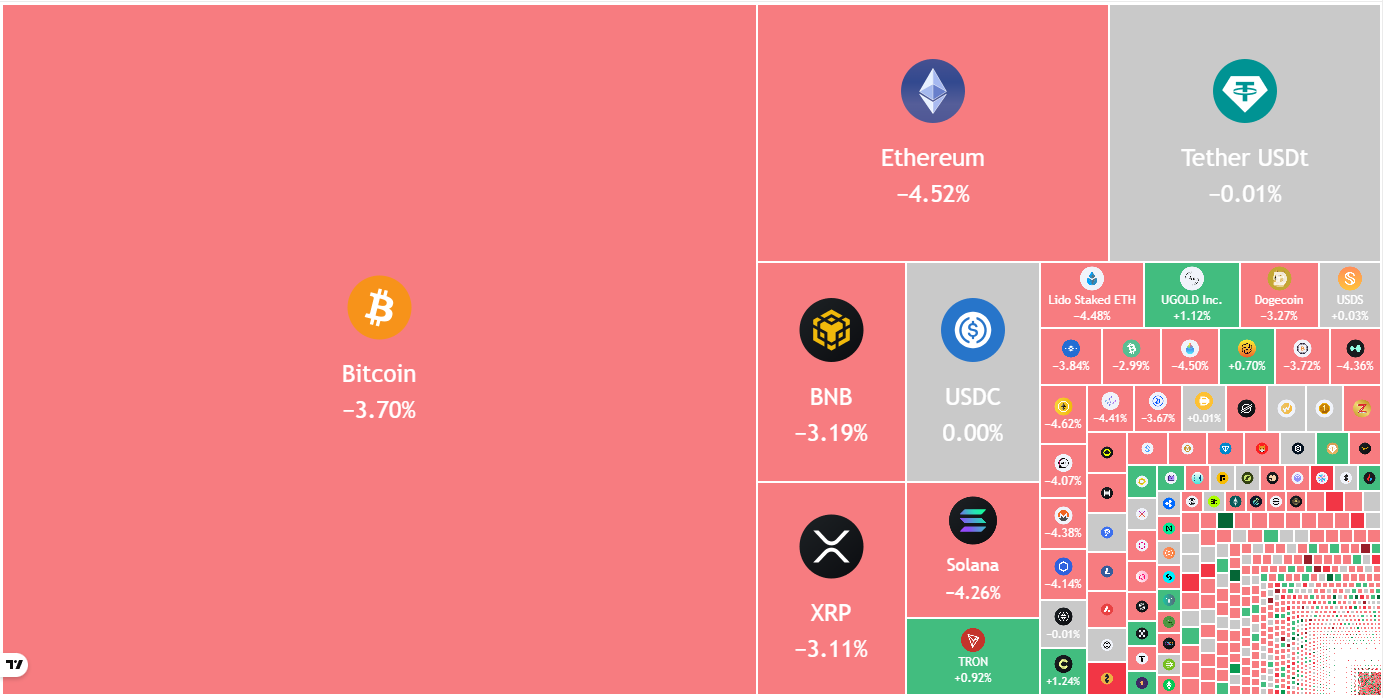
Key points:
-
Analysts believe that Bitcoin will have to stay above the $68,000 level to continue its recovery.
-
Several major altcoins have turned down from their overhead resistance levels, indicating that bears remain in control.
Bitcoin’s (BTC) relief rally was rejected at the $74,000 level, and the bears have pulled the price below $68,500. Select analysts believe that BTC will have to hold the $68,000 to $70,000 zone to continue its short-lived bull trend.
The big question on traders’ minds is whether BTC has bottomed out or if it could fall further. Coinbureau CEO Nic said in a post on X that BTC’s price relative to gold has historically “taken about 14 months to go from peak to bottom.” The bottom of the ratio has been followed by a sharp rally of more than 300% in BTC on every occasion. The current 13-month decline from the previous ratio peak suggests that BTC may be close to bottoming out.

Not everyone believes that BTC’s bear market may be ending. On-chain analytics company CryptoQuant said in a post on X that BTC is in a bear market as per their Bull Score Index, which remains deep in bearish territory. The platform said data shows the current rally is “likely just a relief rally, not the start of a new bull phase.”
Could BTC and select major altcoins hold on to their support levels? Let’s analyze the charts of the top 10 cryptocurrencies to find out.
Bitcoin price prediction
BTC turned down from the breakdown level of $74,508 on Thursday, indicating that the bears are defending the level with all their might.

The 20-day exponential moving average ($69,003) is the critical support to watch out for on the downside. If the Bitcoin price turns up from the 20-day EMA, the bulls will again attempt to clear the obstacle at $74,508. If they can pull it off, the BTC/USDT pair may soar to $84,000. Such a move suggests that the pair may have bottomed out at $60,000.
On the contrary, a close below the 20-day EMA may pull the price to the support line. This is a vital level to keep an eye on as a break below the support line tilts the advantage in favor of the bears. The pair may then collapse to $60,000.
Ether price prediction
Ether (ETH) cleared the $2,111 resistance on Wednesday, but the bears pulled the price back below the level on Thursday.

The Ether price continued lower and broke below the 20-day EMA ($2,032), suggesting that the market rejected the break above the $2,111 level. The ETH/USDT pair is likely to oscillate between $1,750 and $2,200 for some time.
Conversely, if the price turns up from the current level and breaks above the 50-day SMA ($2,328), it suggests that the selling pressure has weakened. The pair may then start an up move to $2,600.
BNB price prediction
BNB (BNB) turned down from the $670 level on Thursday, indicating that the bears are vigorously defending the level.

The bears have pulled the price below the 20-day EMA ($637), indicating that the bulls have given up. That suggests the BNB/USDT pair may remain inside the $570 to $670 range for a while longer.
The bulls will be back in the driver’s seat on a close above the $670 level. That opens the doors for a rally to the 50-day SMA ($718) and later to $790. Sellers will have to yank the BNB price below the $570 level to start the next leg of the down move to $500.
XRP price prediction
XRP (XRP) closed above the 20-day EMA ($1.41) on Wednesday, but the bulls could not sustain the higher levels.

The bears are attempting to pull the XRP/USDT pair below the $1.27 support. If they manage to do that, the XRP price may slump to the support line of the descending channel pattern.
On the contrary, if the pair turns up and breaks above the 20-day EMA, it suggests that the bulls are attempting a comeback. The pair may then rally to $1.61, which could again act as stiff resistance.
Solana price prediction
Solana (SOL) turned down from the $95 level on Thursday and has slipped below the 20-day EMA ($86).

The flattish 20-day EMA and the RSI just below the midpoint indicate a balance between supply and demand. The Solana price may oscillate between $76 and $95 for a few more days.
Buyers will have to secure a close above the $95 level to suggest that the bears are losing their grip. The SOL/USDT pair may then surge to the $117 level. Sellers will be back in the game on a close below $76.
Dogecoin price prediction
Dogecoin (DOGE) rose above the 20-day EMA ($0.10) on Wednesday, but the bulls could not pierce the 50-day SMA ($0.11).

The Dogecoin price turned down and reached the critical $0.09 support. If the bears pull the price below the $0.09 level, the DOGE/USDT pair may retest the Feb. 6 low of $0.08. Buyers are expected to fiercely defend the $0.08 level, as a close below it may sink the pair to $0.06.
The bulls will have to thrust the price above the 50-day SMA to signal strength. The pair may then rally to the breakdown level of $0.12, where the bears are expected to step in.
Cardano price prediction
Buyers attempted to push Cardano (ADA) above the 20-day EMA ($0.27) on Thursday, but the bears held their ground.

However, a minor advantage in favor of the bulls is that they have not allowed the Cardano price to dip below the $0.25 level. If the price turns up from the current level or the $0.25 support, the bulls will again attempt to push the ADA/USDT pair to the downtrend line of the descending channel pattern.
On the other hand, a close below the $0.25 level opens the doors for a retest of the support line. A close below the support line may sink the pair to the $0.15 level.
Related: Was $74K a bull trap? Bitcoin traders diverge on 2022 crash repeating
Bitcoin Cash price prediction
The bounce off the $443 level in Bitcoin Cash (BCH) fizzled out at $476 on Wednesday, indicating a negative sentiment.

The bears will attempt to strengthen their position by pulling the Bitcoin Cash price below the $443 support. If they manage to do that, the BCH/USDT pair will complete a bearish head-and-shoulders pattern. The pair may then plummet to $375.
Buyers will have to propel the price above the 20-day EMA ($488) to signal strength. The pair may then reach the 50-day SMA ($533), which is likely to attract sellers. A close above the 50-day SMA indicates the start of a sustained recovery toward $600.
Hyperliquid price prediction
Hyperliquid (HYPE) has pulled back to the moving averages, which are a crucial support to watch out for.

If the Hyperliquid price rebounds off the moving averages with force, the bulls will again attempt to drive the HYPE/USDT pair to the $36.77 overhead resistance. A close above the $36.77 level signals the start of a new up move.
Contrary to this assumption, if the price continues lower and breaks below the moving averages, it suggests that the pair may remain inside the $20.82 to $36.77 range for a few more days.
Monero price prediction
Buyers are attempting to push Monero (XMR) above the $360 level, but are facing stiff resistance from the bears.

The 20-day EMA ($347) is the crucial support to watch out for on the downside. If the Monero price bounces off the 20-day EMA, the possibility of a break above the 50-day SMA ($396) increases. The XMR/USDT pair may then rally to the 61.8% Fibonacci retracement level of $414.
Instead, if the price turns down and breaks below the 20-day EMA, it signals that the bears are active at higher levels. That may keep the pair range-bound between $384 and $302 for some time.
This article does not contain investment advice or recommendations. Every investment and trading move involves risk, and readers should conduct their own research when making a decision. While we strive to provide accurate and timely information, Cointelegraph does not guarantee the accuracy, completeness, or reliability of any information in this article. This article may contain forward-looking statements that are subject to risks and uncertainties. Cointelegraph will not be liable for any loss or damage arising from your reliance on this information.

Curve Finance Warns PancakeSwap About Licensing Violation

This will RUIN your financial aspirations

Bolton MP Phil Brickell appointed to Ministry of Justice


-

 Politics4 days ago
Alan Cumming Brands Baftas Ceremony A ‘Triggering S**tshow’
-

 Tech6 days ago
Unihertz’s Titan 2 Elite Arrives Just as Physical Keyboards Refuse to Fade Away
-

 NewsBeat6 days ago
Abusive parents will now be treated like sex offenders and placed on a ‘child cruelty register’ | News UK
-
Business7 hours ago
Form 8K Entergy Mississippi LLC For: 6 March
-
 NewsBeat6 days ago
Dubai flights cancelled as Brit told airspace closed ’10 minutes after boarding’
-
Sports7 days ago
The Vikings Need a Duck
-
 NewsBeat6 days ago
The empty pub on busy Cambridge road that has been boarded up for years
-

 NewsBeat5 days ago
‘Significant’ damage to boarded-up Horden house after fire
-

 Tech2 days ago
Bitwarden adds support for passkey login on Windows 11
-

 Entertainment5 days ago
Baby Gear Guide: Strollers, Car Seats
-
 Sports1 day ago
499 runs and 34 sixes later, India beat England to enter T20 World Cup final | Cricket News
-
Politics6 days ago
FIFA hypocrisy after Israel murder over 400 Palestinian footballers
-
 NewsBeat6 days ago
Emirates confirms when flights will resume amid Dubai airport chaos
-

 NewsBeat4 days ago
Is it acceptable to comment on the appearance of strangers in public? Readers discuss
-

 Tech6 days ago
Viral ad shows aged Musk, Altman, and Bezos using jobless humans to power AI
-

 Video5 days ago
How to Build Finance Dashboards With AI in Minutes
-

 Fashion5 days ago
On the Scene at the 57th Annual NAACP Image Awards: Teyana Taylor in Black Ashi Studio, Colman Domingo in Yellow Sergio Hudson, Chloe Bailey in Christian Siriano, and More!
-

 Business3 days ago
Guthrie Disappearance Enters Fifth Week as Family Visits Memorial
-
 Crypto World6 days ago
US Judge Lets Binance Unregistered Token Class Action Proceed
-
 NewsBeat5 days ago
Ukraine-Russia war latest: Belgium releases video showing forces boarding Russian shadow fleet oil tanker