

Crypto World
SEC Moves to Settle Justin Sun of Tron Case With $10M Penalty


The U.S. Securities and Exchange Commission (SEC) moved Wednesday to settle its high-profile enforcement case against Justin Sun and his affiliated companies, proposing a $10 million civil penalty.
If approved by a federal judge, the judgment would dismiss all remaining claims against the TRON founder with prejudice, marking a decisive end to the years-long legal battle.
- Settlement Terms: Rainberry Inc. agrees to a $10 million penalty and an injunction against deceptive practices without admitting wrongdoing.
- Case Dismissal: All claims against Justin Sun, the Tron Foundation, and the BitTorrent Foundation will be dismissed with prejudice.
- Regulatory Signal: The deal represents a significant de-escalation by the SEC following recent leadership changes and industry pushback.
Discover: The best meme coins on Solana
SEC Deal: A $10 Million Resolution to Years of Litigation
According to a proposed final judgment filed yesterday in the U.S. District Court for the Southern District of New York, Rainberry Inc., the company behind the BitTorrent protocol, will pay the $10 million civil penalty.
The company also agreed to a permanent injunction barring it from violating anti-fraud provisions in future securities offerings. Crucially, Rainberry accepted the settlement without admitting or denying the SEC’s allegations.
In exchange for this penalty, the SEC agreed to dismiss all outstanding claims against Sun personally, as well as the Tron Foundation and BitTorrent Foundation. The dismissal is “with prejudice,” meaning the regulator cannot refile these specific charges against Sun or his foundations in the future. The agreement effectively clears Sun’s personal liability in the matter.
Sun confirmed the development on social media on today. In a statement on X, he noted that the resolution “brings closure” and declared his intention to focus on “accelerating innovation in the U.S. and around the world.”
I am very pleased to confirm that the SEC has moved to dismiss all claims against me, Tron Foundation, and BitTorrent Foundation.
Today’s resolution brings closure, but I never stopped building. I will continue to focus on accelerating innovation in the United States and around…— H.E. Justin Sun

(@justinsuntron) March 5, 2026
Context: From Celebrity Charges to Political Pivots
The SEC originally sued Sun in March 2023, alleging the unregistered sale of TRX and BTT tokens.
The regulator’s complaint was extensive, accusing Sun of directing wash trading to artificially inflate TRX volumes and orchestrating undisclosed payments to celebrities like Lindsay Lohan and Jake Paul for promotion.
Six of those celebrities settled in 2024 for roughly $400,000 combined.
This settlement arrives amid a broader shift in SEC enforcement strategy following the presidential inauguration.
Democratic lawmakers, including Rep. Maxine Waters, criticized the move in a recent letter, suggesting the agency is retreating from crypto enforcement cases involving figures with political connections.
Sun reportedly invested heavily in World Liberty Financial tokens and attended events associated with the new administration prior to this resolution.
What the Justin Sun Case Says About the SEC Now
The $10 million figure is relatively modest compared to the billions sought in other recent crypto cases. It signals that the current SEC is prioritizing case clearance over maximum punitive damages, a sharp departure from the “regulation by enforcement” era of 2023.
This shift aligns accordingly with a maturing market structure. As recently discussed on Cryptonews, the biggest winners of the next cycle may be the most regulated entities that successfully navigate the government’s requirements.
If this pragmatic approach continues, expect other stalled enforcement actions to resolve quickly in the coming months, likely with similar “no admission of guilt” structures.
Discover: The next crypto to explode!
The post SEC Moves to Settle Justin Sun of Tron Case With $10M Penalty appeared first on Cryptonews.

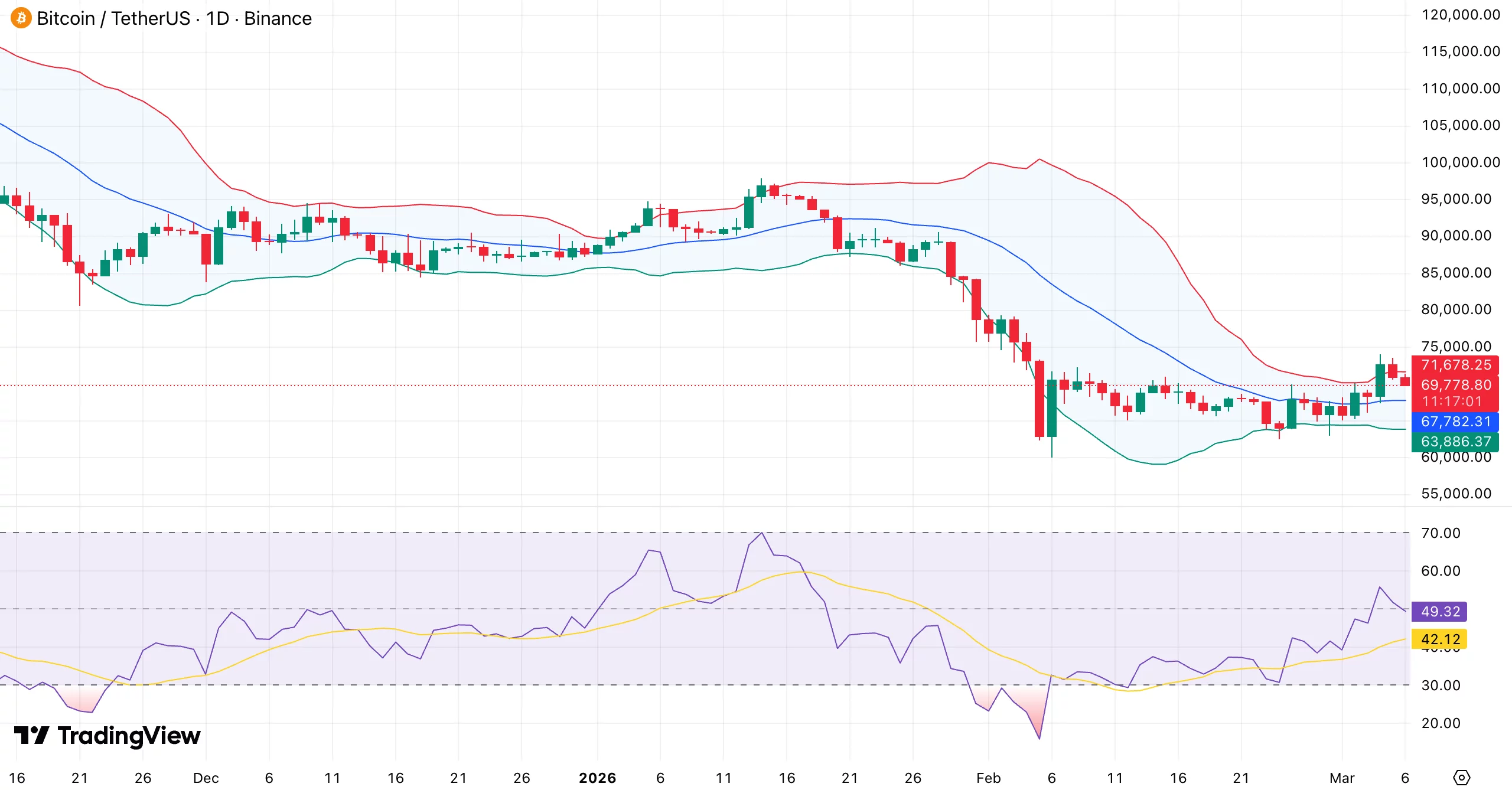
Bitcoin price is showing early signs of a possible trend shift after a key on-chain indicator flashed a rare bullish signal, even as the market continues to consolidate.
Summary
- Bitcoin’s Inter-exchange Flow Pulse crossed above its 90-day moving average for the first time since early 2025.
- BTC is consolidating between $67K and $72K after a sharp drop from the $95K region.
- A breakout above $72K could open the path toward the $75K–$78K resistance zone.
Bitcoin (BTC) was changing hands at around $70,080 at the time of writing. That represents a 3.7% decline over the past 24 hours. Even so, the price remains close to the top of its weekly trading band, which currently spans from $63,176 to $73,669.
Short-term weakness hasn’t erased the gains seen over the past week. BTC is still up about 5.8% during that period. Over the last month, however, the trend is slightly negative, with the asset down around 8%. Compared with its October 2025 peak of $126,080, Bitcoin is still trading roughly 44% below its all-time high.
Market participation has also slowed. During the last 24 hours, trading volume dropped to $47.99 billion, a decline of more than 32%. Such pullbacks in activity are common during consolidation phases, when traders step back and wait for clearer direction.
The derivatives market tells a similar story. Data from CoinGlass shows trading volume in derivatives contracts falling by 23% to $72 billion. Open interest also slipped, declining 8% to $45 billion as some leveraged positions were closed.
IFP indicator signals renewed risk appetite
Amid this quieter market environment, fresh on-chain data is drawing attention. Analysts at CryptoQuant report that Bitcoin’s Inter-exchange Flow Pulse has moved above its 90-day moving average.
The shift marks the first time the metric has crossed that level in roughly a year, according to a March 6 report by CryptoQuant contributor RugaResearch.
To understand why this matters, it helps to look at what the indicator measures. The IFP tracks Bitcoin transfers between spot exchanges and derivatives platforms.
A rise in flows toward derivatives venues often signals that traders are preparing leveraged positions in anticipation of potential upside. When the movement heads toward spot exchanges instead, speculation in the market usually declines.
Looking back at historical data adds more context. Since 2016, similar IFP crossovers have frequently appeared near the early stages of bullish cycles. That said, the signal does not always translate into immediate price rallies. In some cases, the market took time to react.
The indicator had spent nearly a full year below its long-term average before this latest development. It turned bearish in early 2025 and remained there throughout much of the year, making it one of the longest negative stretches recorded for the metric.
Bitcoin price technical analysis
On the price chart, Bitcoin appears to be stabilizing after a steep fall earlier in the year. The drop began in the $95,000–$100,000 range and eventually pushed the price down to around $63,000, where buyers finally stepped in.
Since reaching that level, price movement has been largely sideways. This type of behavior often signals that selling pressure is easing while demand slowly returns.
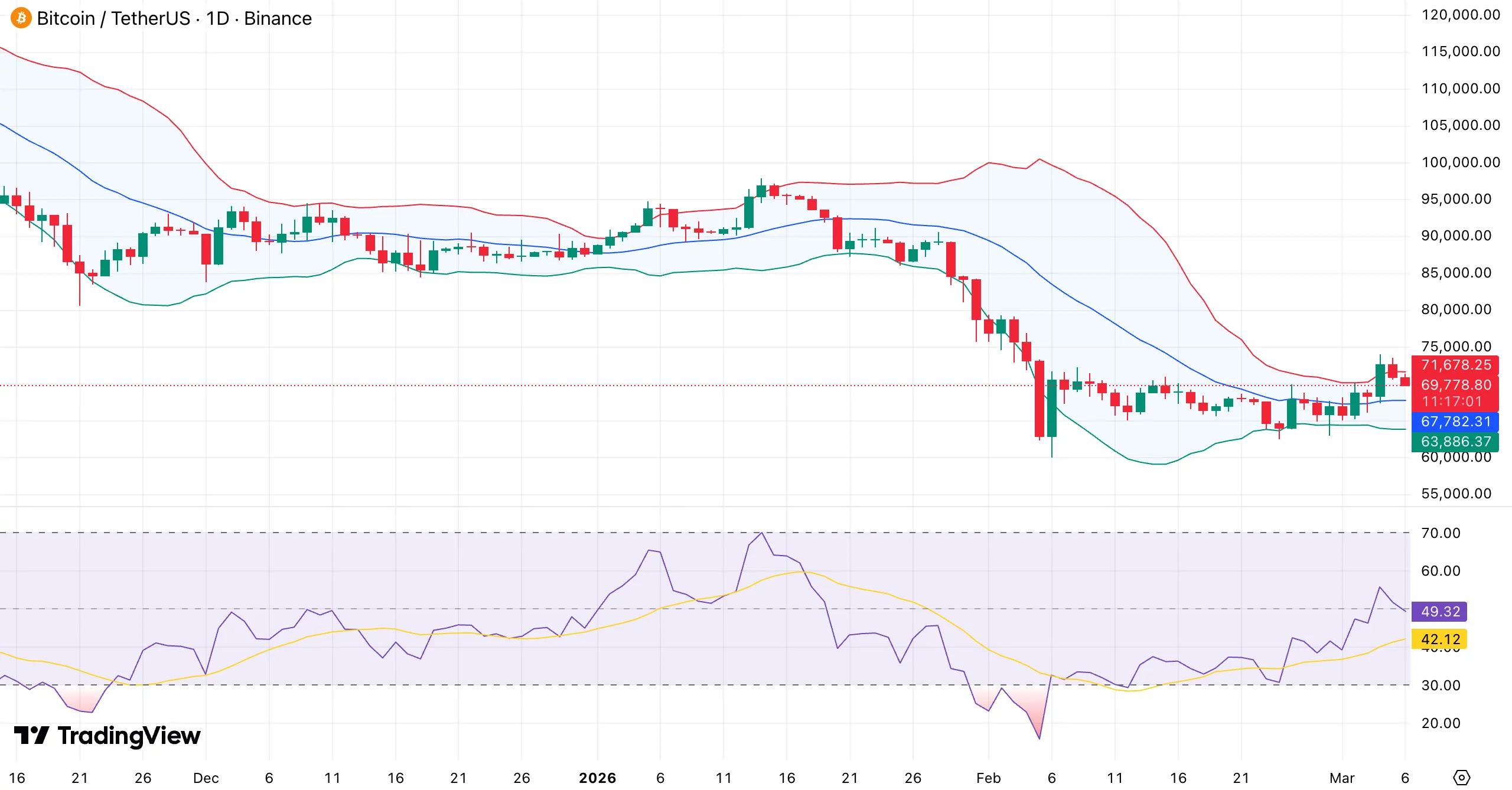
For several weeks now, BTC has traded within a relatively tight corridor between $67,000 and $72,000. Markets often behave this way during accumulation phases, when participants quietly re-position before the next significant move.
The immediate hurdle sits at $72,000. If buyers manage to push the price above that level and secure a strong daily close, a breakout from the range could follow. In that case, attention would likely shift toward the $75,000–$78,000 region, where another supply zone is expected.
Below the current price, support continues to hold around $67,000. A deeper demand area can be found near $63,000, the same region that previously stopped the earlier sell-off.
That dip toward $63,000 may not have been accidental. In many markets, prices briefly fall below a key support level to trigger stop-loss orders before reversing direction.
This type of move is often referred to as a liquidity sweep. Bitcoin quickly rebounded after touching that area, reclaiming $67,000 soon afterward as buying pressure absorbed the sell-off.
Volatility has also been shrinking as the range tightens. Historically, quieter phases like this tend to precede stronger directional moves.
A breakout above $72,000 would likely strengthen bullish momentum and open the path toward higher resistance levels. On the other hand, losing support at $67,000 could weaken the recovery structure and bring the $63,000 demand zone back into focus.
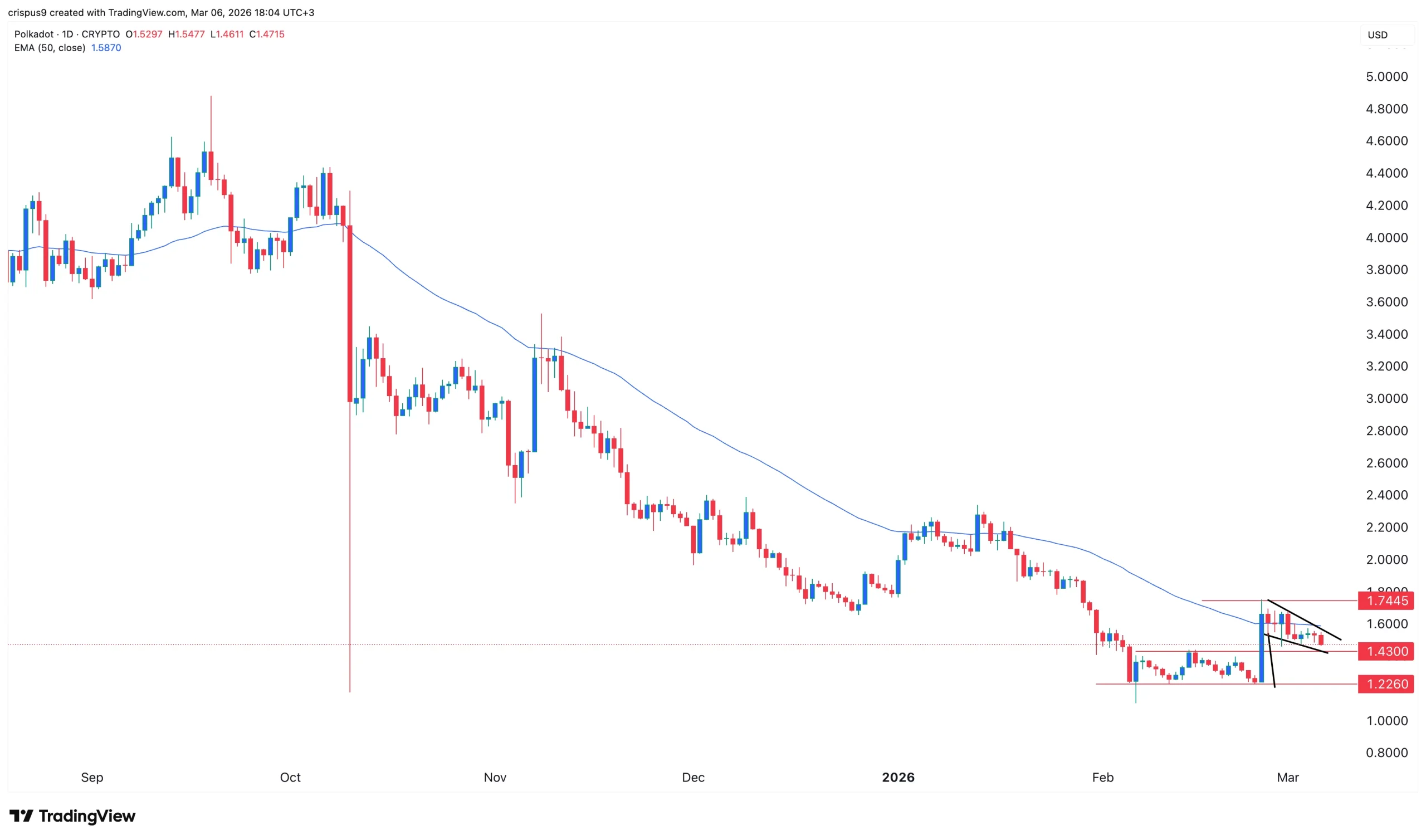
Polkadot price retreated by 3% today, March 6, even as market participants waited for the first DOT ETF and tokenomics overhaul.
Summary
- 21Shares will launch the first spot DOT ETF today.
- The fund will be seeded with $11 million.
- History suggests that the fund may struggle to attract inflows.
Polkadot (DOT) token dropped to $1.4753, down substantially from this month’s high of $1.745. This retreat happened ahead of the launch of the 21Shares DOT ETF today.
Bloomberg’s Eric Balchunas noted that the fund has been seeded with $11 million in assets. This is a substantial amount considering that the three Dogecoin ETFs have accumulated $7.45 million in inflows and have $9.27 million in net assets.
In theory, the launch of the DOT ETF should boost its price as it will make it available to American retail and institutional investors. However, data shows that demand for altcoin ETFs is limited.
Spot Avalanche ETF has added just $8.98 million in inflows. It has had no inflow since February 24. Similarly, spot Hedera and Chainlink ETFs have had less than $100 million in inflows since their launch.
Polkadot’s situation is worse because of its smaller ecosystem than the other chains. For example, while Ethereum holds over $165 billion in stablecoins, Polkadot’s parachains hold less than $100 million.
DOT price will also react to the upcoming tokenomics overhaul on March 12. This overhaul will cap the supply to 2.1 billion and cut emissions by 53.6%. Staking unbonding days will drop from 28 days to between 24 and 48 hours.
Polkadot price prediction: technical analysis
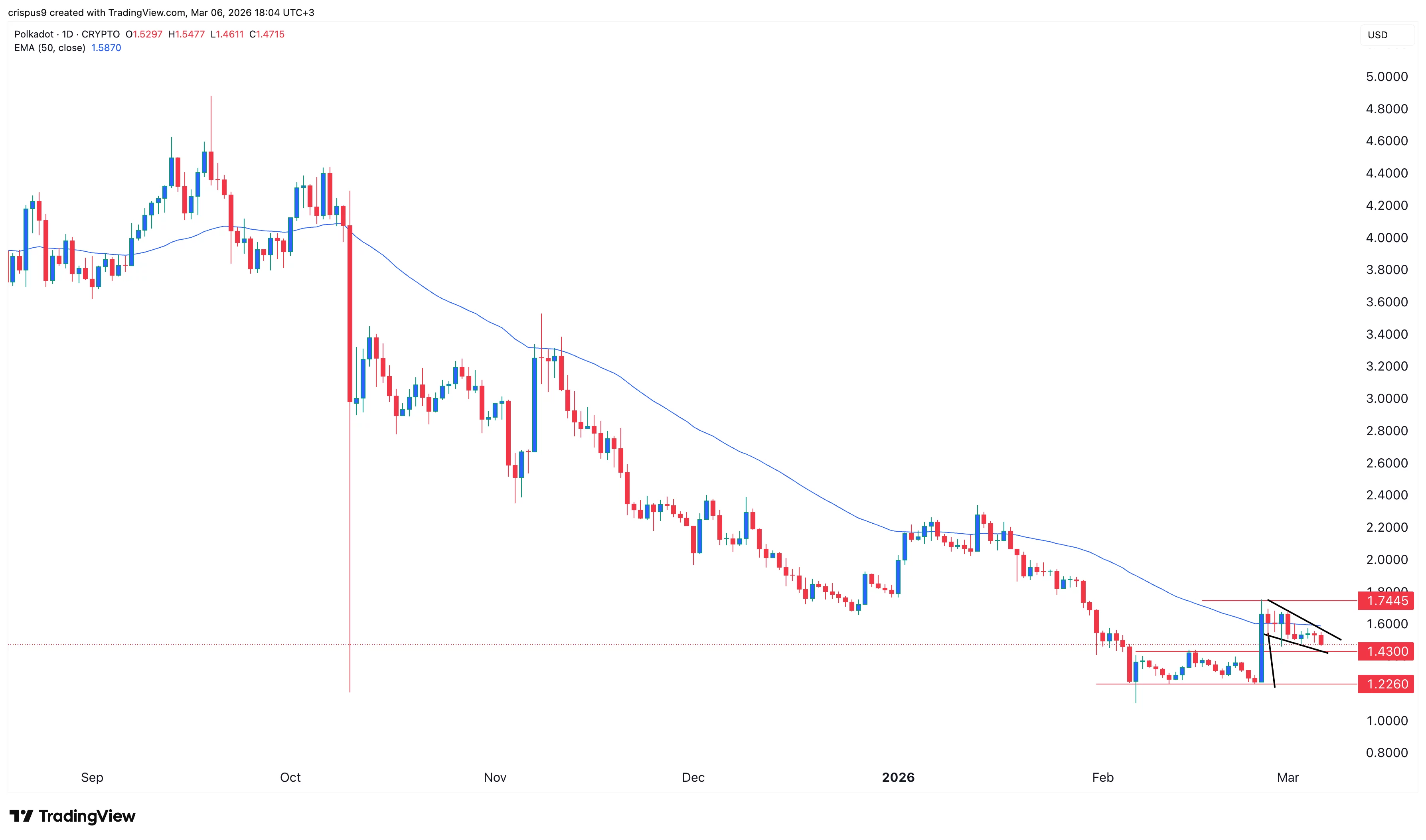
DOT token has pulled back in the past few days, moving from this month’s low of $1.7445 to the current $1.4673. A closer look shows that it has retested the neckline of the double-bottom pattern that happened at $1.2260. A break and retest pattern is a common continuation sign.
The coin has also formed a bullish flag pattern. This pattern has a flagpole and a descending channel, resembling a hoisted flag. Therefore, the coin may attract bids in the next few days. If this happens, the next key target to watch will be at $1.7445. A break above that price will point to more gains, potentially to $2.


Disclosure: This article does not represent investment advice. The content and materials featured on this page are for educational purposes only.
Institutional accumulation of Ethereum signals rising confidence and renewed momentum for DeFi expansion.
Summary
- Institutional Ethereum inflows are boosting new DeFi protocols like Mutuum Finance, which has raised over $20.7m from 19k holders.
- Mutuum Finance builds non-custodial crypto lending on Ethereum, using mtTokens and debt tokens to manage liquidity and loans.
- Mutuum Finance expands DeFi lending with over-collateralized loans, letting users borrow against assets without selling them.
The top crypto market is currently witnessing a concentration of capital as institutional players increase their holdings of Ethereum (ETH). This trend of accumulation is providing a foundation of liquidity that often precedes a broader expansion in the decentralized finance (DeFi) sector.
As large-scale purchases signal growing confidence in the Ethereum network, the focus of the market is shifting toward utility-driven protocols that utilize this infrastructure to provide automated financial services.
Ethereum
Recent market data highlights a substantial increase in Ethereum accumulation. On March 2, the firm BitMine executed a significant acquisition of 50,928 ETH. This purchase brings the company’s total holdings to approximately 3.71% of the total Ethereum supply, moving them closer to their stated target of 5%.
Several analysts have noted that such large-scale movements often indicate potential growth for the asset regardless of short-term price fluctuations. Technical indicators like the Chaikin Money Flow (CMF) and Money Flow Index (MFI) currently suggest a high level of investor confidence and sustained buying pressure.
At present, Ethereum is trading within a range that has established a market capitalization of several hundred billion dollars. Following this recent accumulation, market observers are watching key resistance zones near the $3,800 and $4,000 levels. If the asset can maintain its support above $3,400, it may provide the necessary stability for the rest of the ecosystem to grow.
How massive Ethereum buys power utility protocols
Large Ethereum purchases do more than just influence the price of ETH; they act as a catalyst for the next wave of utility protocols. When institutional capital enters the Ethereum ecosystem, it validates the network’s security and longevity.
This confidence encourages developers and investors to explore new complex protocols like Mutuum Finance (MUTM), which is building a non-custodial framework for automated lending and borrowing. According to its official whitepaper, Mutuum Finance aims to create a decentralized environment where digital assets can be managed through code rather than human intermediaries.
The project has already achieved significant milestones, raising over $20.7 million in funding and establishing an investor base of 19,000 participants. The MUTM token is currently priced at $0.04. By building on the Ethereum network, protocols like Mutuum Finance benefit from the deep liquidity and security provided by the massive ETH accumulation currently taking place.
The Protocol’s mechanics
The economic model of Mutuum Finance relies on a transparent system of receipts and obligations. When a user deposits an asset like ETH into a liquidity pool, the protocol issues mtTokens (such as mtETH) as a yield-bearing digital receipt. These tokens represent the user’s share of the pool. As borrowers pay interest, the value of the mtToken increases. For example, if a pool has a 5% Annual Percentage Yield (APY), a user who deposits 20 ETH will find that their 20 mtETH is redeemable for 21 ETH after one year.
To manage the other side of the transaction, the protocol uses Debt Tokens. When a user borrows against their collateral, the system mints these tokens to track the principal and the accrued interest in real-time. The safety of these loans is managed by the Loan-to-Value (LTV) ratio. If the LTV for a specific asset is set at 75%, a user providing $4,000 in ETH as collateral can borrow a maximum of $3,000 in another asset, like a stablecoin. This ensures that every loan remains over-collateralized, protecting the protocol from potential bad debt.
Furthermore, this mechanism benefits the borrower by allowing them to access liquidity without having to sell their original assets. By borrowing against their ETH instead of selling it, the user can obtain liquidity for immediate use while still maintaining their investment position. If the value of the ETH increases during the loan period, the borrower still gains from that price growth.
The V1 protocol and risk-free testing
The Mutuum Finance V1 protocol is currently the primary environment for testing these features. It focuses on high-liquidity assets including USDT, ETH, WBTC, and LINK. By using the V1 testnet, users can interact with the system’s automated smart contracts. This provides a risk-free environment to understand how mtTokens grow in value, how Debt Tokens track interest, and how LTV ratios function under different market conditions.
In this V1 setup, the protocol uses decentralized oracles to provide live price feeds. These feeds are essential for calculating the “Stability Factor” of each user’s position. If the value of a user’s collateral drops and their Stability Factor falls below a safe threshold, automated liquidation bots sell a portion of the collateral to repay the loan. This mechanical approach ensures that the system remains solvent at all times, regardless of market volatility.
The synergy between Ethereum and protocol roadmaps
The future of both Ethereum and Mutuum Finance is defined by their respective roadmaps. Ethereum is continuing its transition toward greater scalability and lower transaction costs through its “Dencun” and subsequent upgrades. These improvements are vital for DeFi protocols, as they allow for more frequent and cheaper interactions with smart contracts. As Ethereum becomes more efficient, the cost of lending, borrowing, and staking decreases for the end-user.
The Mutuum Finance roadmap is also entering a critical phase. The protocol moves toward the launch of the Safety Module and its staking system. These two components work together to ensure the protocol remains healthy while rewarding users who help protect it.
In decentralized finance, sudden market shifts or technical issues can sometimes create a gap between what the protocol owes and what it holds. The Safety Module acts as a backstop by holding a pool of assets that the protocol can use to cover these unexpected losses. By having this reserve, the system ensures that lenders can always withdraw their funds, even during periods of high market stress.
Staking is the process by which users contribute to this security. When a user stakes MUTM tokens or mtTokens, they are essentially locking them into the Safety Module. By doing this, the user is acting as a guarantor for the protocol’s stability. Because the user is providing a vital service by backing the system’s safety, the protocol compensates for commitment.
This is where the Buy-and-Redistribute mechanism comes in to provide rewards. The protocol collects fees from every loan and trade made on the platform. A portion of these fees is used to buy MUTM tokens directly from the open market. Those tokens are then distributed to the people who have staked mtTokens in the Safety Module. This creates a sustainable cycle: as more people use the protocol, more fees are generated, which leads to more rewards for the stakers who keep the system secure.
Disclosure: This content is provided by a third party. Neither crypto.news nor the author of this article endorses any product mentioned on this page. Users should conduct their own research before taking any action related to the company.

TLDR
- The SEC will hold a public roundtable on April 16, 2026, at its Washington headquarters.
- The agency will examine the structure of the U.S. listed options market during the event.
- Officials will discuss competition among trading venues in the quote-driven market.
- The roundtable will address the overall customer experience for investors.
- Commissioner Hester M. Peirce said the market has seen growth among retail investors.
The U.S. Securities and Exchange Commission will hold a public roundtable on April 16, 2026, in Washington. The agency will examine the structure of the U.S.-listed options market during the event. It will host the session at its headquarters and stream it live on its official website.
Focus on Market Structure and Competition
The SEC will center the roundtable on Market Structure and competition within the listed options market. The agency will review how trading venues compete in a quote-driven environment. It will also assess how this structure affects order handling and price formation. Officials plan to gather input from market participants and industry representatives.
Hester M. Peirce, commissioner at the SEC, addressed the market’s recent expansion. She said, “The U.S.-listed options market has seen remarkable growth, particularly among retail investors.” She added that the roundtable will allow regulators and participants to reflect on the market’s development. She stated that discussions will identify areas where improvements could support continued expansion.
Public Access and Submissions
The SEC will hold the roundtable at 100 F Street, N.E., in Washington, D.C. The agency will open attendance to the public, although seating may remain limited. Visitors will undergo security checks before entering the building. The SEC will provide a live webcast through its website for remote viewers.
The agency will allow members of the public to submit comments electronically or by mail. It will include all submissions in the official public record without modification. The SEC will post these comments on its website for public access. It said it will release the agenda and list of speakers closer to the event date.


Binance has rejected allegations that its platform allowed transactions linked to entities in Iran.
Summary
- Binance issued a formal response to a U.S. Senate inquiry denying claims that it allowed transactions linked to Iran.
- The exchange said media reports cited in the inquiry contain false and unsupported allegations about its compliance program.
- Binance pointed to investigations that led to the removal of certain entities and its expanded compliance measures.
The exchange issued a response on March 6 to a letter sent by Richard Blumenthal regarding sanctions compliance and anti-money laundering controls. The inquiry referenced several recent media reports. Binance said those reports contain false and unsupported claims about its compliance program.
Binance said it runs a large compliance operation to prevent sanctioned users from accessing the platform. Identity verification is required for every user, and individuals located in Iran are not allowed to use the exchange.
Compliance program and monitoring systems
According to the company, millions of dollars have been invested in compliance infrastructure in recent years. The compliance team now includes more than 1,500 professionals around the world. Many focus on sanctions monitoring, financial crime investigations, and counter-terrorism financing checks.
More than 25 monitoring tools are used to screen users and review transactions. Customer onboarding checks, sanctions screening, and behavioral analysis are also applied to detect suspicious activity. When concerns appear, cases are reviewed and information can be shared with law enforcement.
The company also pointed to its cooperation with investigators. In 2025 alone, Binance handled more than 71,000 law-enforcement requests. Over the past three years, authorities seized more than $752 million with assistance from the exchange.
Blockchain analytics data cited by Binance shows a decline in exposure to wallets linked to illicit activity. Between January 2024 and July 2025, the share of exchange volume connected to such wallets dropped from 0.284% to 0.009%.
Investigations involving flagged entities
The inquiry also mentioned two trading entities, Hexa Whale and Blessed Trust, which were reported to have indirect exposure to wallet addresses with possible links to Iran.
Binance said it became aware of those concerns after receiving requests from law enforcement in 2025. Investigations were then carried out by the exchange’s internal team. Transaction records were reviewed and user information was provided to authorities.
After the reviews were completed, both entities were removed from the platform. Hexa Whale was offboarded in August 2025, while Blessed Trust was removed in January 2026. Binance said it is not aware of any account on the exchange that directly transacted with an Iran-based entity.
The company also rejected claims that it had identified thousands of Iranian-linked accounts. Binance said it never made such a determination and noted that any attempt to bypass location restrictions using a VPN violates its terms of service.
Binance said it investigates credible risks, removes accounts when necessary, and works with authorities to address potential misuse of its platform.

TLDR
- MiniMed (MMED) started trading at $19.05 on Friday, March 6, falling 4.8% below the $20 IPO offering price in its Nasdaq launch.
- The diabetes technology firm generated $560 million through the sale of 28 million shares — significantly lower than the anticipated $25–$28 pricing range.
- The opening price established MiniMed’s market capitalization at $5.35 billion.
- Medtronic (MDT) continues to control approximately 90% ownership following the initial public offering.
- Market conditions were challenging on debut day, with the VIX surging to its highest level in four months after disappointing employment data.
The highly anticipated public market entrance of MiniMed fell short of expectations on Friday. Shares of the diabetes device manufacturer began trading at $19.05 on Nasdaq — representing a 4.8% decline from the $20 offering price — establishing a company valuation of $5.35 billion.
MiniMed Group, Inc. Common Stock, MMED
Market sentiment proved challenging across the board. The CBOE Volatility Index climbed to its highest point in four months, fueled by disappointing employment figures that rattled investor confidence. These conditions created far from ideal circumstances for a debut listing.
The transaction generated $560 million in proceeds through the placement of 28 million shares. This represented a significant reduction from initial expectations — the marketed pricing range stood at $25 to $28 per share, forcing MiniMed to accept a substantial discount to complete the transaction.
Market observers had expressed skepticism about whether the original valuation made sense, and the final pricing appears to validate those concerns.
A Tough Market for New Listings
The IPO environment has faced significant headwinds in recent weeks. Anxieties surrounding artificial intelligence disruption and global political instability have reduced enthusiasm for new public offerings, constraining activity throughout the market.
MiniMed’s challenging debut reflects this broader trend. Even established brands are struggling to achieve premium pricing in the current environment.
Medtronic (MDT) executed the separation to generate funds and create an independent diabetes-focused entity. Following completion of the IPO, Medtronic maintains approximately 90.03% ownership of MiniMed — a figure that would drop to 88.70% should underwriters fully exercise their 30-day option to acquire an additional 4.2 million shares.
The transaction is expected to finalize on March 9, 2026.
MiniMed intends to deploy the capital raised for general operational needs, settling intercompany obligations owed to Medtronic, and covering expenses related to asset transfers completed during the separation.
Back to Growth After Regulatory Headwinds
The organization previously encountered regulatory challenges regarding quality control systems and cybersecurity vulnerabilities associated with certain products. Those issues have been resolved, and the company has demonstrated renewed growth momentum in recent reporting periods.
MiniMed operates in a competitive landscape alongside Beta Bionics, Dexcom (DXCM), Insulet (PODD), and Tandem Diabetes Care (TNDM) within the diabetes technology sector.
The company’s portfolio encompasses insulin delivery pumps, continuous glucose monitoring platforms, and sensor technology designed for individuals managing both type 1 and type 2 diabetes.
Medtronic (MDT) finished Thursday’s session lower at $93.01 before the spinoff company’s market debut.
TLDR
- Kalshi faces a proposed class action over a $54 million market on Iran’s Supreme Leader Ali Khamenei leaving office.
- Traders allege the platform failed to honor payouts on “yes” positions after halting the market.
- The lawsuit claims Kalshi did not clearly disclose a death-related carveout before reports of airstrikes surfaced.
- Plaintiffs argue the contract language promised full payouts if Khamenei exited the role by set dates.
- Kalshi CEO Tarek Mansour said the company does not offer markets directly tied to a person’s death.
Kalshi faces a proposed class action over a halted market tied to Iran’s Supreme Leader Ali Khamenei. Traders claim the platform failed to honor payouts on “yes” positions after trading surged. The dispute centers on contract language and disclosures tied to a reported death exception.
Kalshi Market Rules at Center of Payout Dispute
The complaint states that Kalshi structured the market as a binary contract tied to Khamenei leaving office by set dates. Traders argue the language promised full payouts to “yes” holders if he exited the role. However, the filing says the platform did not clearly disclose a death-related carveout before reports of airstrikes surfaced.
Plaintiffs claim Kalshi allowed trading to continue on Feb. 28 as reports of US and Israeli strikes spread. They allege the platform encouraged more “yes” bets despite knowing those contracts would not pay. According to Bloomberg Law, the suit argues the rules were “clear, unambiguous, and binary,” yet traders say the death carveout appeared only after trading intensified.
The disputed market drew about $54 million in trading volume before Kalshi halted it. Traders contend they expected payouts if Khamenei left office for any reason. The lawsuit states that the platform’s disclosures failed to highlight any exclusion tied to death until after the reports emerged.
Plaintiffs Adam Risch and Yonatan Gliksman filed the case in the US District Court for the Central District of California. Novian & Novian LLP represents the proposed class of US traders. The complaint alleges breach of contract and violations of California law.
Kalshi Response and Legal Claims
Kalshi CEO Tarek Mansour addressed the dispute in public posts after criticism increased. He stated that the company does not offer markets directly tied to a person’s death. He wrote, “While the rules were clear and we tried our best to highlight them, traders vocalized they were not prominent enough.”
Mansour later said the company would reimburse traders for fees and net losses linked to the halted market. He added that Kalshi would update how similar contracts disclose death-related exceptions. He wrote that the firm would reimburse losses out of pocket.
The plaintiffs seek damages and restitution from the platform. They also request court orders requiring improved disclosure practices for future contracts. The filing argues that Kalshi’s conduct misled traders about payout conditions.
The market asked participants to predict whether Khamenei would leave office by specific deadlines. Trading accelerated after reports of airstrikes circulated. Kalshi halted the market shortly after the reports, and the dispute now proceeds in federal court.

Online gambling in 2026 presents stark philosophical choices. Established resort brands compete against blockchain-native newcomers.
Borgata carries Atlantic City prestige into digital space. ZunaBet launched this year assuming cryptocurrency changes everything.
Different eras of thinking produced different platforms. Here’s how they compare.
Borgata Explained
Borgata transformed Atlantic City gambling when it opened in 2003. The resort raised standards for the entire market.
Digital operations followed that success. Borgata Online Casino serves New Jersey and Pennsylvania players.
MGM Resorts ownership provides substantial backing. Corporate resources support ongoing operations.
Game selection emphasizes proven quality. Established providers deliver reliable experiences.
Banking processes all money movement. Cards, transfers, e-wallets work through financial institutions.
Withdrawals take banking time. One to five business days covers typical scenarios.
Welcome bonuses stay competitive regionally. Deposit matches and credits attract signups.
MGM Rewards connects everything together. Online points redeem at properties everywhere.
ZunaBet Explained
ZunaBet emerged in 2026 with fresh thinking. Strathvale Group Ltd built cryptocurrency infrastructure from the start.
Leadership experience exceeds 20 years combined. Anjouan licensing governs the platform.
Launch day included 11,000+ games. Sixty-three providers created immediate depth.
Quality names fill the roster. Pragmatic Play, Evolution, Hacksaw Gaming, Yggdrasil, BGaming included.
Cryptocurrency handles everything. BTC, ETH, USDT, SOL, DOGE, ADA, XRP function seamlessly.
Transaction fees stay zero. Speed beats banking consistently.
Full sportsbook operates too. Sports, esports, virtuals all covered.
Dissecting Bonuses
Borgata offers regulated market packages. Deposit matching with typical conditions applies.
State location affects specifics. Current promotions need checking.
ZunaBet reaches $5,000 plus 75 free spins total. Distribution spans three deposits.
First deposit brings 100% to $2,000 plus 25 spins. Second brings 50% to $1,500 plus 25 spins.
Third brings 100% to $1,500 plus 25 spins. Full participation unlocks full value.
Staged distribution sustains engagement. Single offers often end quickly.
Terms apply universally. Understanding them matters.
Dissecting Loyalty
Borgata integrates with MGM Rewards fully. Online play earns resort-wide points.
Points become hotel nights, meals, shows. Property visitors benefit enormously.
Non-visitors accumulate without easy redemption. Location determines value realization.
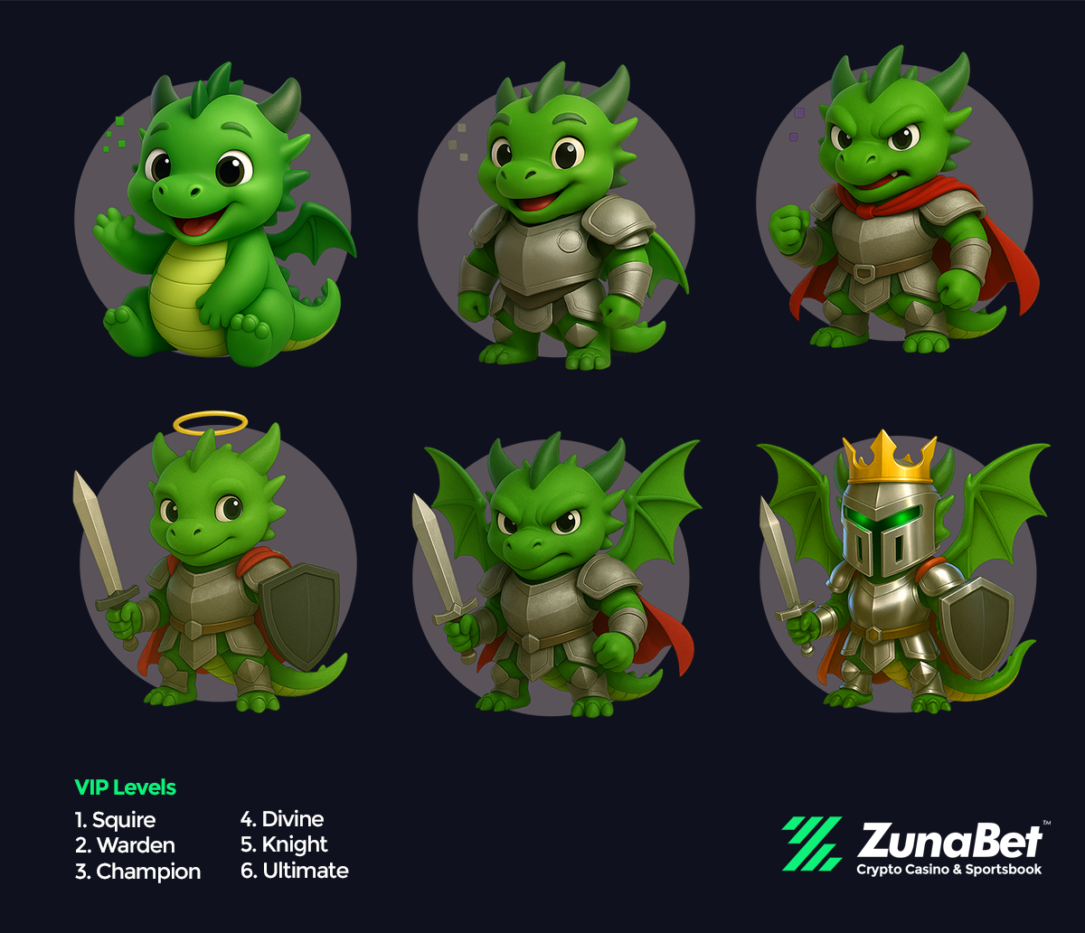
ZunaBet designed dragon progression instead. Six tiers deliver growing rakeback.
Squire returns 1%. Warden returns 2%, Champion returns 4%.
Divine returns 5%. Knight returns 10%.
Ultimate returns 20% rakeback. Volume generates substantial returns.
Free spins reach 1,000 through advancement. VIP extras supplement core rewards.
Zuno dragon visualizes progress. Advancement feels tangible.
Rakeback means direct cash. Resort points mean travel requirements.
Dissecting Payments
Borgata depends on banking infrastructure. Institutions process every transaction.
Cards deposit fast. Withdrawals enter queues.
Business hours matter. Weekends pause things.
Statements show gambling clearly. Privacy limited.
ZunaBet bypasses banking entirely. Wallets transact directly.
No banks means no delays. Crypto timing governs.
Twenty-plus coins accepted. Chain variety included.
Platform charges nothing. Network fees only.
Statements stay clean. Privacy automatic.
Dissecting Games
Borgata curates carefully. Quality over quantity guides selection.
State regulations add variation. Geography affects access.
Core categories covered well. Essentials present.
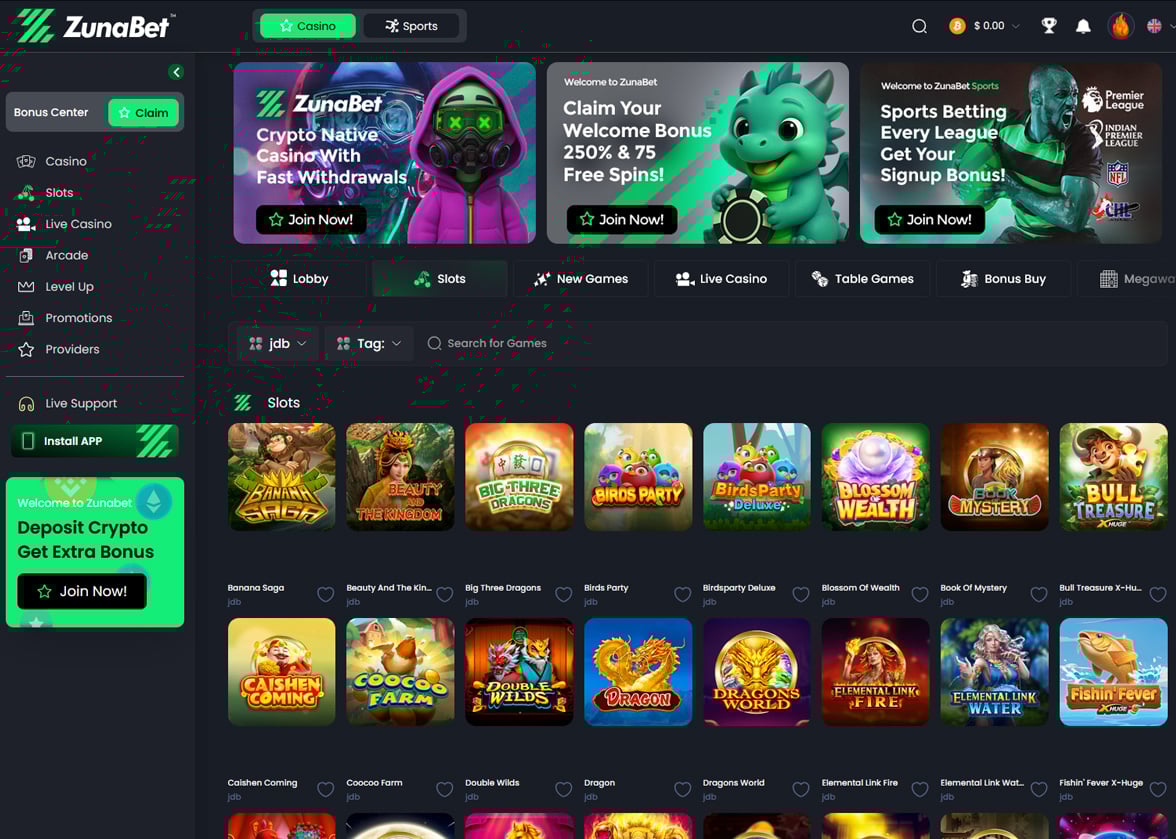
ZunaBet launched with 63 providers. Eleven thousand games available.
Small studios join major names. Unique content exists.
Slots dominate numerically. Tables and live complete things.
Evolution runs live games. Pragmatic supplies slots.
Exploration demands time. Scale requires dedication.
Dissecting Sports
Borgata Sportsbook serves American focus. Major leagues receive attention.
NFL, NBA, MLB, NHL covered. College supplements.
Standard markets and odds present. Competent service.
ZunaBet thinks globally. International balances domestic.
World football shares priority. Tennis, basketball, combat active.
Esports deeper than typical. CS2, Dota 2, League of Legends, Valorant maintained.
Virtuals run always. No gaps.
Unified accounts serve both. Transfers seamless.
Dissecting Experience
Borgata apps cover iOS and Android. Browsers handle desktop.
Corporate design guides everything. Reliability consistent.
ZunaBet covers iOS, Android, Windows, MacOS. Apps exceed browsers.
Dark themes look current. HTML5 loads fast.
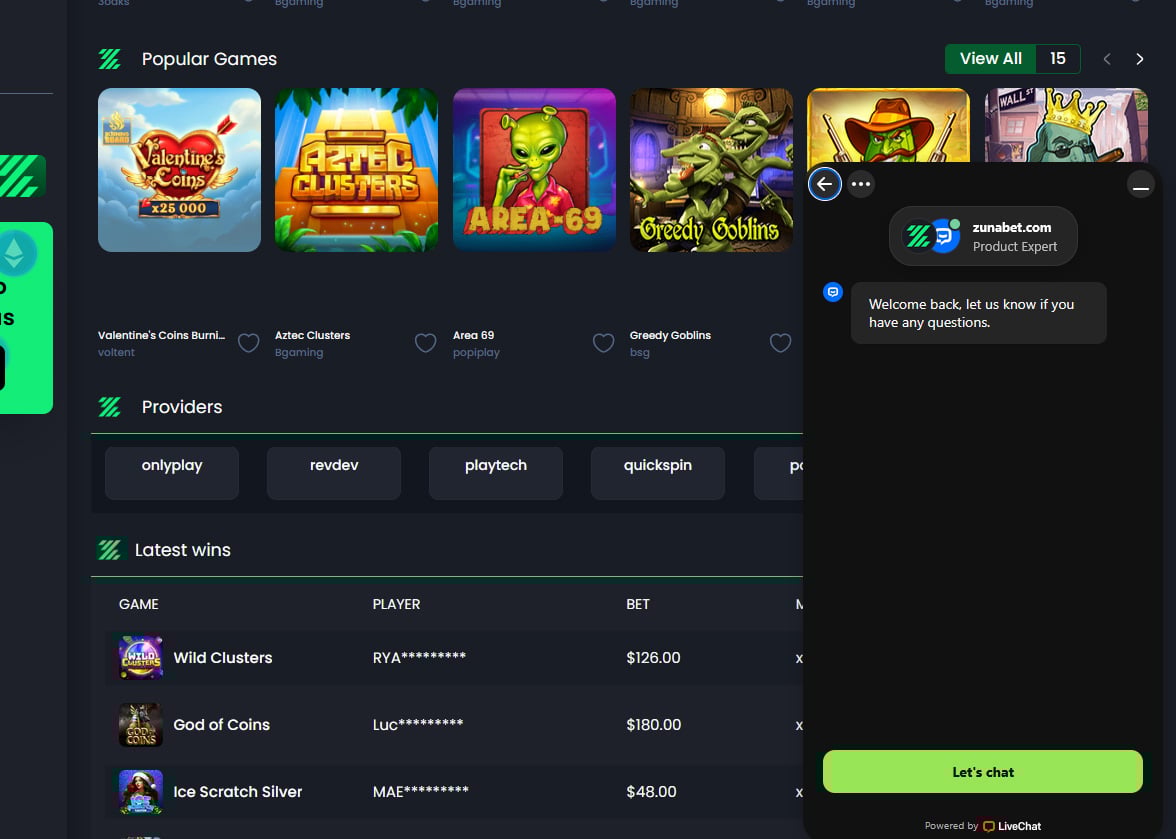
Support runs 24/7. Help always available.
Mobile works smoothly. Switching easy.
Matching Players
Borgata fits resort-connected players. MGM Rewards members gain most.
Banking users face familiarity. Normal processes continue.
Atlantic City and Vegas visitors profit. Travel compounds value.
ZunaBet fits crypto holders. Assets connect directly.
Bonus seekers find larger numbers. The $5,000 dominates.
Rakeback strategists should calculate. Twenty percent compounds.
Privacy seekers benefit structurally. Banks excluded.
Variety seekers find abundance. Eleven thousand games wait.
Reading the Market
Borgata represents gambling heritage online. Resort success provides foundation.
Compliance shapes development. Progress stays incremental.
ZunaBet represents gambling reimagined. Crypto assumptions define features.
The 2026 launch caught momentum. Young players hold crypto.
Dragon loyalty challenges points systems. Direct cash beats resort credits.
Massive libraries attract explorers. Limited ones constrain.
Innovation flows toward crypto. Traditional maintains position.
Projecting Ahead
Borgata continues serving regulated markets. Resources ensure continuation.
Resort integration stays unique. Property benefits exclusive.
ZunaBet accelerates differently. Crypto design matches trends.
Eleven thousand games ready now. Twenty percent rakeback active now.
Universal answers don’t exist. Situations determine fit.
Resort visitors choose Borgata. Crypto users choose ZunaBet.
Property perks versus cash returns. Curation versus selection. Banking versus blockchain.
Both function as designed. Neither fails fundamentally.
Momentum indicates direction though. Crypto draws energy.
ZunaBet captures that energy. The platform points forward.
Players wanting cryptocurrency flexibility, enormous selection, aggressive bonuses, and transparent rakeback find ZunaBet delivers.
Emerging player generations match that profile. ZunaBet built specifically for them.
2026 presents real choice. Heritage competes with innovation.
Tomorrow resembles ZunaBet more. The future appears present already.
Disclaimer: This is a Press Release provided by a third party who is responsible for the content. Please conduct your own research before taking any action based on the content.
TLDR:
- Binance recorded two XRP whale outflows on February 6 and February 27, totaling roughly 74 million tokens withdrawn.
- The February 27 withdrawal of 44 million XRP stands as one of the largest single-day outflow events in the tracked data.
- Negative netflow across 15 exchanges signals that large XRP holders moved assets away from active trading platforms.
- Reduced XRP supply on Binance eases available selling pressure, a pattern analysts monitor for potential market shifts.
XRP whale activity on Binance has drawn attention after two notable outflow events within a single month. On February 27, approximately 44 million XRP left whale wallets on the exchange.
Earlier, on February 6, around 30 million XRP were withdrawn from the same platform. Both movements were monitored across 15 major crypto exchanges.
These back-to-back outflows have led analysts to examine how large investors are currently repositioning their holdings.
Two Consecutive Binance Withdrawals Mark a Notable February Trend
A chart tracking daily XRP whale wallet net flows across 15 exchanges documented both withdrawal events. The data showed a rise in negative netflow, meaning the digital asset was moving out of exchanges. Market analysts typically read outward flows from exchanges as a bullish signal for an asset.
The February 27 outflow of 44 million XRP ranks among the largest single-day events in the charted data. It followed the February 6 withdrawal of roughly 30 million XRP from the same exchange.
Together, both outflows account for a combined removal of approximately 74 million XRP from Binance. Both events originated from the same platform within the same calendar month.
Analyst Amr Taha noted the rise in negative XRP whale flows from Binance in a market update post. The data suggests large holders moved assets off the exchange rather than positioning for near-term selling. These movements reduced the supply of the token available for active trading on the platform.
In contrast, positive netflow reflects the asset moving into exchanges, which raises available supply on a platform. A higher on-exchange supply generally creates more conditions for selling pressure to build.
February’s trend moved in the opposite direction as whale withdrawals drove Binance supply lower. Analysts use this contrast in flow direction to assess broader market conditions.
Falling XRP Exchange Supply and What the Outflow Data Reveals
When XRP exits a major exchange like Binance, the coins available for active trading decline. Fewer tradable coins on the platform can ease the selling pressure that typically pushes prices lower. If buying demand holds steady as supply falls, the market may adjust upward to reflect this change.
Binance ranks among the most actively traded crypto exchanges globally by volume. Whale movements from this platform tend to carry more market weight than those from smaller exchanges.
Two large outflows from the same exchange within one month is a pattern analysts take note of. This suggests multiple large holders acted in the same direction within a short window.
The February data shows a consistent outflow pattern across both recorded events. The February 6 and February 27 withdrawals both moved in the same direction, reinforcing the overall trend. Repeated outflows in the same direction over a short period carry more analytical weight than a single event.
Following both withdrawals, XRP available for trading on Binance has measurably dropped. Whether this leads to any market response will depend on whether demand holds or grows over time.
The outflow data reflects where large holders are placing their assets rather than forecasting price direction. It remains a relevant on-chain signal for those tracking whale behavior across crypto exchanges.

Bitcoin (CRYPTO: BTC) has long carried a reputation for punishing late entrants, with double-digit drawdowns that test even patient investors. Yet a closer look at cycle-era history suggests that time, not timing, often determines whether red ink becomes green in the long run. Across multiple 2017, 2021, 2019, and 2022 cycles, buying near tops produced short-term pain, while patient holders who rode the cycles into longer horizons frequently emerged with meaningful gains. Notably, two-year snapshots can miss the tilt of the market, whereas three-year horizons tend to shift outcomes toward positive territory, particularly when purchases land near bear-market lows. This pattern has kept many analysts watching two key metrics: realized price bands and on-chain valuation, which historically have signaled stronger accumulation zones.
Key takeaways
- Two-year windows expose buyers to sizable drawdowns when entries occur near cycle highs; extending the holding period to three years often moves most positions into positive territory.
- Buyers who entered near bear-market lows historically captured outsized gains: the 2019 bottom yielded about 871% after two years and 1,028% after three years.
- In the 2021 cycle, entrants near the high faced a 43.5% loss after two years, but the same entry produced a positive 14.5% by year three.
- The 2022 cycle low followed a similar pattern, delivering roughly 465% returns after two years and about 429% after three years.
- On-chain valuation metrics, notably realized price bands, identify where long-term accumulation tends to occur, with current levels suggesting meaningful value zones for patient buyers.
- Institutional research reinforces the long-hold thesis: adding Bitcoin to a traditional 60/40 portfolio improved cumulative and risk-adjusted returns in every three-year window studied, with a roughly 5% BTC allocation yielding the strongest balance and a 93% win rate across two-year periods.
Tickers mentioned: $BTC
Market context: In a market driven by cyclical dynamics and on-chain signals, the evidence points to a bias in favor of longer horizons. As institutional interest grows and macro risk sentiment shifts, investors increasingly seek value-driven entries aligned with realized-price support rather than chasing short-term swings.
Why it matters
The historical pattern around Bitcoin’s cycles underscores a core investing lesson: duration matters. While two-year horizons can trap buyers in drawdowns when entry points occur near cycle highs, extending the clock to three years has a higher likelihood of delivering positive outcomes for most entry points. The strongest gains consistently trace back to bottom-entry zones, where price action meets value signals from on-chain data. For people looking to balance risk and reward, this pattern offers a framework for evaluating when to accumulate rather than when to speculate on immediate price swings.
On-chain metrics add another layer to the narrative. The concept of realized price—an average acquisition cost based on the last on-chain movement—helps identify the points at which market participants may have the most favorable long-term cost basis. The idea is to look for cycles where the price dips toward, or below, the realized price bands, signaling a potential trough and a readiness for multi-year rallies. Recent observations place Bitcoin’s realized price around $55,000, with the shifted realized price nearer to $42,000, hinting at plausible accumulation zones for patient buyers. These bands have repeatedly aligned with cycle lows since 2015, a pattern traders and researchers have used to frame longer-horizon strategies.
Research into portfolio construction reinforces the argument for longer horizons. Matt Hougan, chief information officer at Bitwise, highlighted a study showing that incorporating Bitcoin into a traditional 60/40 allocation improved both cumulative and risk-adjusted returns over all three-year windows examined. The takeaways point to a 93% win rate across two-year periods when BTC is allocated at roughly 5% of the portfolio, suggesting that even a modest exposure can meaningfully improve outcomes for investors willing to endure the cycle’s ups and downs. A separate Bitwise analysis covering July 2010 through February 2026 showed declining loss probabilities as holding periods lengthened: 0.7% chance of loss after three years, 0.2% after five, and zero over ten years. By contrast, shorter horizons, particularly day trading, bore higher risk, with a 47.1% chance of losses for two-year-like timeframes and a 24.3% probability of being underwater after one year.
The takeaway is not a guarantee but a pattern that aligns with a broader investment principle—time diversification tends to smooth out volatility and improves the odds of favorable outcomes when you tilt toward longer horizons and value-oriented entry points. For those who prefer chart-driven cues, a related analysis notes BTC price formation at bottoming levels, underscoring the practical value of combining on-chain signals with price action. See These 4 Bitcoin charts say BTC price is forming a bottom for context on bottom-case signals, and consult TradingView’s data as a reference point for price trajectories across cycles: TradingView.
These observations are not predictions but a framework that helps separate the noise of day-to-day price moves from longer-run fundamentals. They illuminate why some investors accumulate during downturns and wait for the market to revert to mean-like levels rather than chasing speculative rallies that may fade as quickly as they rise.
What to watch next
- Bitcoin price approaching realized price bands around $55,000 or testing the shifted band near $42,000 could signal potential accumulation zones worth monitoring over the next several quarters.
- Monitor whether new entries near bear-market lows translate into multi-year rallies, using three-year windows as a benchmark for evaluating performance.
- Follow updates to institutional research on long-hold strategies, especially any additional studies on 60/40-type portfolios that include BTC.
- Track on-chain metrics that refine bottom-entry signals, including shifts in realized price and related valuation bands across different market cycles.
- Pay attention to broader liquidity and risk sentiment changes that could influence the pace and duration of future cycles.
Sources & verification
- Bitcoin realized price bands and their role in identifying accumulation zones (current levels around $55k realized price; $42k shifted realized price).
- Historical performance: 2017 peak entry scenarios with a 48.6% two-year loss and a 108.7% three-year gain; 2021 peak with 43.5% two-year loss and 14.5% three-year gain; 2019 bear bottom delivering 871% and 1,028% over two and three years, respectively; 2022 cycle low with 465% and 429% returns over two and three years.
- Bitwise CIO Matt Hougan’s assessment of BTC in a traditional 60/40 portfolio and the cited 93% win rate for two-year horizons with ~5% BTC allocation.
- Bitwise review (2010–2026) showing loss probabilities drop to 0.7% at three years, 0.2% at five years, and zero at ten years.
- Shorter-horizon risk indicators: day traders’ near-50% loss probability; ~24% underwater for one-year horizons.
Bitcoin cycle dynamics: timing, realized price, and the long horizon
Bitcoin (CRYPTO: BTC) has long been cast as a volatile asset that punishes those who rush in near the highs. Yet a closer reading of market cycles demonstrates that the longer you stay exposed, the more often outcomes swing in favor of the patient. The historical record identifies a clear dichotomy: two-year horizons frequently register sizable drawdowns when purchases occur near cyclical peaks, but three-year horizons tend to flip those same entries into profitability. The most dramatic gains occur when accumulation happens near bear-market basins, reinforcing the case for disciplined, long-horizon participation in the market.
The data are not merely anecdotal. In 2017, investors who bought near the peak endured a near-50% drawdown within two years, yet those same investors who held for three years saw a substantial reversal, ending with gains exceeding 100%. The subsequent cycle showed a similar pattern: a roughly 43.5% loss over two years for buys near the 2021 top, followed by a positive return of about 14.5% in year three. By contrast, buying near bear-market lows produced outsized returns: 871% after two years and 1,028% after three years from the 2019 bottom. The 2022 cycle bottom followed suit, delivering roughly 465% over two years and about 429% over three years. Taken together, two-year windows expose investors to large drawdowns when entry points align with cycle highs, while three-year windows carry a higher probability of being in the green for most entries, with the bottom entries consistently offering the strongest price expansions in both timeframes.
The framework gains further credibility from on-chain valuation signals. Realized price bands, which reflect the average cost basis of coins based on the last on-chain movement, have guided accumulation for years. When prices dip toward these bands, the forward path often becomes more favorable for multi-year rallies, a pattern the data repeatedly validates since 2015. Today’s readings place Bitcoin’s realized price around a level that has historically coincided with the start of longer-term rallies, underscoring why patient accumulation near these zones has historically produced meaningful upside.
Market researchers also underscore the role of time in risk management. Bitwise’s analysis of long-hold periods shows that the long horizon not only improves returns but reduces downside risk. The combination of a measured allocation and a willingness to extend the investment horizon appears to deliver superior risk-adjusted outcomes relative to shorter-term approaches. This is not a guarantee, of course, but it is a framework that aligns with the observed data across multiple cycles, from 2017 through 2022 and into subsequent periods.
For readers seeking additional corroboration, a related analysis on BTC price dynamics highlights bottom-forming signals, and the charts cited there resonate with the idea of accumulation near defined valuation bands. As always, investors are advised to verify figures through the charting platforms and on-chain metrics that populate these narratives, including the TradingView data referenced above.
He Predicted EVERY Bitcoin Move (Now He Says $58K Is NEXT)

‘My father was an expat in the UAE. An Iranian missile landed on him’ | World News

Raia Drogasil S.A. (RADLY) Q4 2025 Earnings Call Transcript


-

 Politics4 days ago
Alan Cumming Brands Baftas Ceremony A ‘Triggering S**tshow’
-

 Tech6 days ago
Unihertz’s Titan 2 Elite Arrives Just as Physical Keyboards Refuse to Fade Away
-

 NewsBeat6 days ago
Abusive parents will now be treated like sex offenders and placed on a ‘child cruelty register’ | News UK
-
Business11 hours ago
Form 8K Entergy Mississippi LLC For: 6 March
-
 NewsBeat6 days ago
Dubai flights cancelled as Brit told airspace closed ’10 minutes after boarding’
-
Sports7 days ago
The Vikings Need a Duck
-

 Fashion7 hours ago
Weekend Open Thread: Ann Taylor
-
 NewsBeat7 days ago
The empty pub on busy Cambridge road that has been boarded up for years
-

 NewsBeat5 days ago
‘Significant’ damage to boarded-up Horden house after fire
-

 Tech2 days ago
Bitwarden adds support for passkey login on Windows 11
-

 Entertainment5 days ago
Baby Gear Guide: Strollers, Car Seats
-
 Sports1 day ago
499 runs and 34 sixes later, India beat England to enter T20 World Cup final | Cricket News
-
 NewsBeat6 days ago
Emirates confirms when flights will resume amid Dubai airport chaos
-
Politics6 days ago
FIFA hypocrisy after Israel murder over 400 Palestinian footballers
-

 NewsBeat5 days ago
Is it acceptable to comment on the appearance of strangers in public? Readers discuss
-

 Tech6 days ago
Viral ad shows aged Musk, Altman, and Bezos using jobless humans to power AI
-

 Video5 days ago
How to Build Finance Dashboards With AI in Minutes
-

 Fashion5 days ago
On the Scene at the 57th Annual NAACP Image Awards: Teyana Taylor in Black Ashi Studio, Colman Domingo in Yellow Sergio Hudson, Chloe Bailey in Christian Siriano, and More!
-

 Business3 days ago
Guthrie Disappearance Enters Fifth Week as Family Visits Memorial
-
 NewsBeat5 days ago
Ukraine-Russia war latest: Belgium releases video showing forces boarding Russian shadow fleet oil tanker