— Amperity, a Seattle-based startup that helps companies collect and manage customer data, named Bridget Perryas chief marketing officer.
Earlier in her career, Perry was a marketing director for Microsoft for nearly nine years and worked for more than eight years at Adobe, leaving the role of CMO of Europe, Middle East and Africa. She was most recently interim CMO for Later, an influencer marketing company, and has held strategic advisor roles.
“Bridget has led marketing teams through real platform shifts, not incremental change. She knows what it takes to build credibility in a market and scale it globally,” said Tony Owens, CEO of Amperity, in a statement. The company is ranked No. 39 on GeekWire 200, our list of top Pacific Northwest startups.
Simon Frey. (LinkedIn Photo)
— Seattle-based Simon Frey was promoted to chief customer officer of Gong. He was previously senior vice president of customer outcomes for the San Francisco startup that builds agentic AI technology to optimize revenue performance and automate workflows.
“Simon has spent years partnering closely with our customers, helping them unlock meaningful growth across their revenue organizations,” said Shane Evans, Gong’s chief revenue architect, in a statement.
Frey joined Gong in 2024 after leaving TaxBit, where he was VP of revenue. Other past employers include Qualtrics and McKinsey. He also served as an advisor to Jargon, which was acquired by Remitly.
Advertisement
Elizabeth Scallon, Find Ventures co-founder and board chair. (LinkedIn Photo)
— Elizabeth Scallonis now director of healthcare AI startups at Nvidia where she will oversee its global Healthcare and Life Sciences Inception program. Scallon, a longtime leader in Seattle’s startup ecosystem, joins Nvidia from HP where she worked for nearly four years as director of technical and business incubation and strategy.
Scallon is also an affiliate instructor at the University of Washington and has held leadership roles at Amazon and WeWork. She was director of the UW’s CoMotion Labs for five years and co-founded Find Ventures.
“With this role, I’m returning to my roots in biotech and genetics and bringing the skills, experience, and connections I’ve built along the way to do my life’s work,” Scallon said on LinkedIn.
Jenny Brinkley. (LinkedIn Photo)
— After nearly a decade at Amazon Web Services, Jenny Brinkley is resigning as director of security readiness.
“I start a new role next week in a rapidly growing space, and I am excited to be part of something transformative once again. To my AWS colleagues, thank you for the kind words and support,” Brinkley said on LinkedIn.
Brinkley, who is based in Portland, Ore., earlier co-founded an AI startup and ran a consultancy.
Advertisement
— Siteimprove announced Jen Jones as its chief marketing officer. The company, which helps businesses improve their website functionality, is based in Denmark and has an office in Bellevue, Wash., where much of its executive leadership team is based. Jones was previously at commercetools.
— Padmashree Koneti had departed her role as chief product officer of Yoodli after roughly five months. The Seattle startup has not yet named a replacement. Yoodli, which is using generative AI to analyze speech and offer tips for improving communication skills, also just hired Alexandra Breymeier as customer success lead. She previously worked at employee referral company ERIN.
Vandana Shah. (LinkedIn Photo)
— Vandana Shah is now vice president of product for Scowtt, a Kirkland, Wash.-based startup that wants to reshape how advertisers optimize paid campaigns. The company in December announced a $12 million Series A funding round.
Shah joins Scowtt from Ladder. She was previously Google’s director of product management for the advertising platform, working at the Bay Area company for more than 16 years.
“Having spent years leading complex platform initiatives at Google Ads, I have seen the power of building resilient, customer-first foundations at scale. I am thrilled to bring that experience to Scowtt,” she said on LinkedIn.
Advertisement
Dinesh Govindasamy. (LinkedIn Photo)
—- Dinesh Govindasamy was promoted to director of engineering at Meta, supporting teams across Tupperware, Public Cloud and Meta Kubernetes Service. Govindasamy joined Meta in October 2023.
“This milestone is thanks to the mentors, collaborators, and teams who believed in me and pushed me to grow. You know who you are — thank you,” he said on LinkedIn.
Govindasamy, based in the Seattle area, was previously at Microsoft for more than 15 years, leaving the role of group engineering manager in which he led teams working on Azure Kubernetes Service Hybrid and other initiatives.
Beto Yarce. (City of Seattle Photo)
— Beto Yarce has started his tenure as director of the City of Seattle’s Office of Economic Development. Yarce joins the city from the U.S. Small Business Administration where he was regional administrator for the Pacific Northwest.
“I am incredibly honored by Mayor Wilson’s trust in me to lead OED and to help shape the economic ecosystems that make Seattle not only a great place to live, work, and play, but also the best place in the country to open, run, and grow a business,” Yarce said in a statement.
He earlier served as executive director of the Seattle nonprofit Ventures for more than eight years. The organization supports underserved entrepreneurs including women, people of color, immigrants and low-income individuals.
Advertisement
— Rob Lloyd, Seattle’s chief technology officer, will become executive director of the Center for Digital Government at the end of this month. The organization describes itself as “a national research and advisory institute on information technology policies and best practices in state and local government.”
“Looking forward to working with peers and leaders across the nation on solving the biggest challenges facing our communities, in smarter ways,” he said on LinkedIn.
Lloyd served as CTO for less than two years. Read more about his departure in earlier GeekWire coverage.
— Dan Rodgers is now chief financial officer for CTL, a Beaverton, Ore., company that manufactures Chromebooks, desktop PCs, servers and Google Meet video conferencing tools. Rodgers’ past roles include leadership at companies including PwC, McCormick and Schmick’s, Nike and New Seasons Market.
Advertisement
“CTL’s commitment to innovation and its dedication to sustainability present a unique opportunity to pair financial discipline with a mission-driven strategy,” Rodgers said in a statement.
— Scott Roberts, a longtime executive at LinkedIn where he is currently an AI product initiative advisor, has joined the board of directors for the San Francisco company Voices.
Seagate introduced the Mozaic 3+ platform in 2024, turning the heat-assisted magnetic recording (HAMR) dream into a real product for customers in need of massive storage capacities. The HDD maker is now introducing the next-generation Mozaic 4+ drives, which offer capacities up to 44TB. Read Entire Article Source link
Apple has made it pretty clear that it wants to siphon off Android and Windows users, and it’s doing it by adopting an aggressive, “budget-friendlier” model across nearly its entire ecosystem.
Apple is using $599 devices to grow its ecosystem
When I first entered the Apple ecosystem, it was when I bought an iPhone 4 in 2011 — I got it right after the 4s made its debut. I don’t remember exactly what I paid, but I know it was less than the initial $199 price tag. And back then, I thought that was a completely asinine amount of money to pay for a phone. Fortunately, or maybe unfortunately, I had more money in my pocket than brains in my head, so I bought it just the same. Continue Reading on AppleInsider | Discuss on our Forums
Anthropic confirmed it has been designated a ‘supply chain risk’ by the US administration, and said it has no choice but to challenge in the courts.
Despite ongoing talks between Anthropic and the US Department of Defense, Anthropic confirmed last night it had received a letter from defense secretary Pete Hegseth confirming the ‘supply chain risk’ designation that had been threatened.
“Yesterday (March 4) Anthropic received a letter from the Department of [Defense] confirming that we have been designated as a supply chain risk to America’s national security,” wrote co-founder and CEO Dario Amodei last night in an official statement. “We do not believe this action is legally sound, and we see no choice but to challenge it in court.”
Amodei was quick to point out that “even supposing it was legally sound”, the limited application of the designation means the “vast majority” of its customers will be unaffected by the move. He said the restriction clearly only applied to the use of Claude by customers as a direct part of contracts with the US defense department, “not all use of Claude by customers who have such contracts”.
Advertisement
“The Department’s letter has a narrow scope, and this is because the relevant statute is narrow, too,” wrote Amodei. “It exists to protect the government rather than to punish a supplier.”
As with previous statements, Amodei strikes a conciliatory tone, saying Anthropic is committed to US national security and will offer continuing support from its engineers to ensure a smooth transition from Claude “for as long as we are permitted to do so”.
Anthropic drew the ire of the US administration after a standoff with the Pentagon, where Anthropic refused to change its safeguards related to using its AI for fully autonomous weapons, or for mass surveillance of US citizens.
With many in Silicon Valley supporting its relatively principled stand, and general users sending it to the top of the US Apple charts in recent days for free downloads – beating OpenAI’s ChatGPT for the first time – its flagship Claude.ai and Claude Code apps went down for around three hours on 2 March due to “unprecedented demand”.
Advertisement
Claude Cowork in particular was already becoming the darling of AI enthusiasts in the professional world, and Bloomberg reported on Tuesday that Anthropic was on track to generate annual revenue of almost $20bn, more than double its run rate from late 2025, signalling the rapid growth at the AI company which is today valued at around $380bn.
Don’t miss out on the knowledge you need to succeed. Sign up for the Daily Brief, Silicon Republic’s digest of need-to-know sci-tech news.
According to the plaintiff, Tinder charged users aged 29 and older more for premium subscriptions such as Tinder Plus and Tinder Gold, while offering cheaper rates for the same services to users in their teens and 20s. The lawsuit claimed the tiered pricing model violated multiple California laws, including the… Read Entire Article Source link
TriZetto Provider Solutions, a healthcare IT company that develops software and services used by health insurers and healthcare providers, has suffered a data breach that exposed the sensitive information of over 3.4 million people.
The firm, which has been operating under the Cognizant umbrella since 2014, disclosed that it detected suspicious activity on a web portal on October 2, 2025, and launched an investigation with the help of external cybersecurity experts.
The investigation revealed that unauthorized access began nearly a year before, on November 19, 2024.
During the exposure period, the threat actors accessed records relating to insurance eligibility verification transactions, which are part of the process providers use to confirm a patient’s insurance coverage before treatment.
Advertisement
The types of data that have been exposed vary per individual, and may include one or more of the following:
Full names
Physical address
Date of birth
Social Security number
Health insurance member number
Medicare beneficiary identifier
Provider name
Health insurer name
Demographic, health, and insurance information
Affected providers were alerted on December 9, 2025, but customer notification started in early February 2026. According to a filing Maine’s Attorney General submitted today, the number of exposed individuals is 3,433,965.
TriZetto says that payment card, bank account, or other financial information was not exposed in this incident.
Also, the company is not aware of any cases where cybercriminals have attempted to misuse this information.
TriZetto says it has taken steps to strengthen cybersecurity on its systems and informed law enforcement authorities of the incident.
Advertisement
Notification recipients are offered free 12-month coverage of credit monitoring and identity protection services from Kroll to help mitigate risks arising from compromised data.
BleepingComputer has contacted TriZetto to learn more about the nature of the security breach and why the firm delayed notifications to consumers for several months, but we have not received a response by publication time.
No ransomware groups have taken responsibility for the attack yet, and no data leaks linked to TriZetto have appeared on underground forums.
Cognizant itself was rumored to have suffered a Maze ransomware breach in 2020. In June 2025, Clorox sued the IT firm for gross negligence after it allegedly let Scattered Spider operatives into its network following a social engineering attack in September 2023.
Advertisement
Malware is getting smarter. The Red Report 2026 reveals how new threats use math to detect sandboxes and hide in plain sight.
Download our analysis of 1.1 million malicious samples to uncover the top 10 techniques and see if your security stack is blinded.
Ubisoft has finally confirmed what Assassin’s Creed fans have suspected for years: a remake of Assassin’s Creed IV: Black Flag is officially in the works.
The company revealed the project, titled Assassin’s Creed: Black Flag Resynced, in a new blog post outlining the future of the long-running series.
We don’t know much about the game yet, but initial reports suggest that Resynced will be a full remake rather than a simple remaster, with upgraded visuals and gameplay improvements, bringing one of the best AC games into the modern age.
It’s also suggested that new story content will be added to flesh out the world around Edward Kenway’s life – at the expense of the modern day gameplay, which has apparently been removed from the remake altogether. It’ll be interesting to see how this all works, given how the original game weaved parts of both storylines into the ending.
Advertisement
We’ve known for quite some time that Ubisoft has been thinking about breathing life into the 2013 game, but this was more or less confirmed when the name surfaced on a European ratings board listing late last year.
Advertisement
We don’t yet have a release date for the game, but we know that an unannounced game was due to arrive before the end of the current financial year. Of course, Ubisoft delayed seven games earlier this year – and Black Flag is expected to be one of them.
Whether or not we see the game before the end of 2026 remains to be seen, but for now we’ll keep our “spyglass on the horizon”.
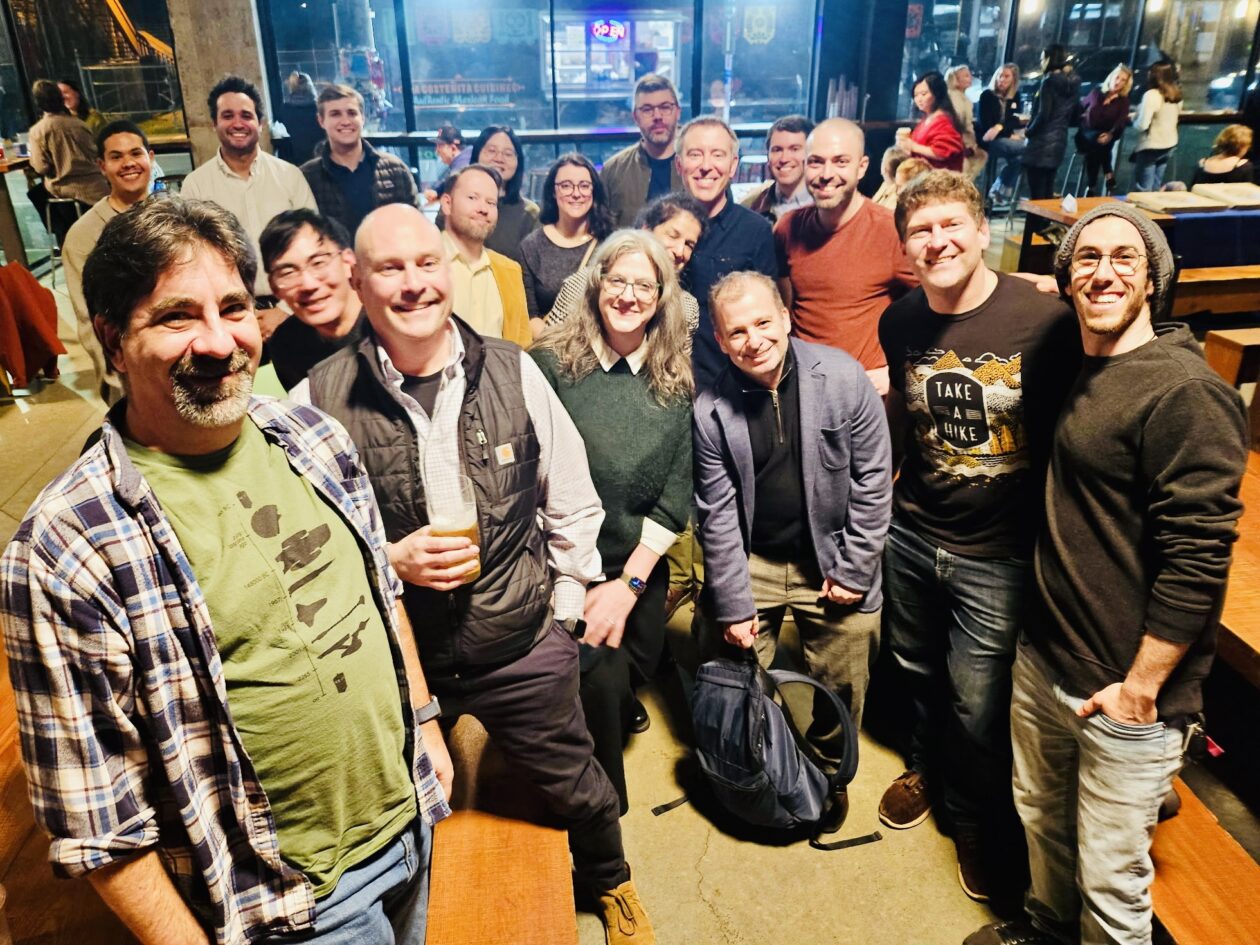
Grayson Shor, far right, at a recent Pacific Northwest Battery Collaborative meet up at a Seattle brewery on Capitol Hill. Shor launched the organization to help the sector build connections. (PNWBC Photo)
The collaborative’s launch in October 2024 was so popular it ran out of chairs and the group now caps RSVPs because venues keep maxing out. The nonprofit has hosted 1,400 attendees at 17 different events in Washington, Oregon and online. Shor’s latest project is helping create a battery-focused mini-series he describes as a hybrid between Anthony Bourdain’s “Parts Unknown” and “Cosmos.”
Who knew that energy storage devices could generate so much enthusiasm?
“Batteries are sexy right now,” Shor said.
Batteries are making electric vehicle adoption more attractive as they’ve become increasingly powerful and quicker to recharge. They’re ubiquitous given the pervasive use of phones and consumer electronics. And as electricity demand is spiking thanks to data centers and other energy users, they’re a relatively quick, affordable way to add more power to the grid.
Advertisement
“We are installing more grid batteries in 2025 than the total amount that existed globally just two years ago,” Shor said. “This isn’t just growth, it’s a total reimagining of how our economy is powered.”
A battery ecosystem emerges
Part of the crowd at the Pacific Northwest Battery Collaborative launch party, with founder Grayson Shor in the front row in a tie. (PNWBC Photo)
Shor has spent nearly a decade working on sustainability, circular economy and battery-related issues for organizations ranging from the U.S. Department of State to Amazon to startups. When the former diplomat landed in Seattle from the other Washington more than two years ago, he was impressed by the region’s battery sector.
That included startups in electric aviation, alternative chemistries such as sodium batteries, and next-generation silicon battery materials, plus R&D resources and support at the University of Washington’s Clean Energy Institute.
But he realized the industry lacked the connections to bring together companies, academics, entrepreneurs and investors, and set out to address it. The sector welcomes his efforts.
“I’ve paid attention to folks trying to knit together community, and for the Northwest battery innovation and application ecosystem, Grayson Shor has been an unrelenting force seeking to build and amplify our unique strengths,” said Dan Schwartz, founding director of the Clean Energy Institute.
Advertisement
Tom Gurski, founder of the plug-in hybrid vehicle startup Blue Dot Motorworks, has attended the group’s functions. “In a region famous for introverted personalities their events and happy hours are invaluable for breaking down silos and getting people to connect,” Gurski said.
Beyond building community, Shor is lobbying for support for local and state policies that promote the industry and get more batteries deployed in the state. The energy storage devices have important societal benefits, he said, including better electrical grid performance and helping meet power needs during peak demand.
‘The Battery Life’
Shor speaking at a Pacific Northwest Battery Collaborative event in Seattle during 2025 PNW Climate Week. (PNBC Photo)
Shor is also the co-founder and chief product officer for Buckstop, an “urban mining” startup helping recover critical minerals from waste electronics. He also volunteers as the policy and government affairs director for the Volta Foundation, the world’s largest battery industry association.
And there’s the TV series, called “The Battery Life.” Crews recently spent three days in the Seattle area filming the first episode, visiting the battery materials company Group14 Technologies and interviewing startups at the UW’s Clean Energy Test Beds.
“We’re doing walks through factories. We’re meeting with the CEOs and the inventors, diving deep into their technology,” Shor said. But the series also has “the ‘Carl Sagan vibe,’” he added, explaining “how does this technology actually impact humanity, and why does it matter to the average person?”
Advertisement
Additional episodes will be shot in Portland and Vancouver, B.C. The plan is to air the series later this year at energy events in Oregon and Las Vegas, plus other area venues.
Future Pacific Northwest Battery Collaborative plans include a job fair and fundraising gala. Shor also envisions a convention where the entrepreneurs and innovators could set up booths to show off their technologies. The ideas keep coming.
“This is playing my little role in trying to tackle climate change, to try to advance the energy transition,” he said. “It helps with equity, it helps with economic opportunity …. It makes me happy.”
Clocks come in many styles and sizes, with perhaps the most visually pleasing ones involving marbles. Watching these little spheres obey gravity and form clearly readable numbers on a clock has strong mesmerizing qualities. If you’re not into really big marble clocks, or cannot quite find the space for a desk-sized clock, then the tiny marble clock by [Jens] may be an option.
While he totally loved the massive marble clock that [Ivan Miranda] built, it is a massive contraption that’s hard to justify as a permanent installation. His take on the concept thus makes it as small as possible, by using a pick-and-place style arm to place the marbles instead. Although the marbles don’t do a lot of rolling this way, it’s decidedly more quiet, and replace the rumbling and click-clacking of marbles with the smooth motion of a robotic arm.
Another benefit of this clock is that it’s cheap to make, with a price tag of less than $23. A big part of this is the use of cheap SG90 micro servos, and a permanent magnet along with a mechanism that pushes the marble off said magnet. Perhaps the biggest issue with this clock is that the arm somewhat obscures the time while it’s moving around, but it’s definitely another interesting addition to the gallery of marble clocks.
Advertisement
We have previously seen such clocks built out of wood and brass as well as 3D-printed using pendulum mechanisms, which can be made pretty compact as well, albeit with a more analog vibe.
Scenario Modeling and Array Design for Non-Terrestrial Networks (NTNs)
Non-terrestrial networks (NTNs) using low earth orbit (LEO) satellites present unique technical challenges, from managing large satellite constellations to ensuring reliable communication links. In this webinar, we’ll explore how to address these complexities using comprehensive modeling and simulation techniques. Discover how to model and analyze satellite orbits, onboard antennas and arrays, transmitter power amplifiers (PAs), signal propagation channels, and the RF and digital receiver segments—all within an integrated workflow. Learn the importance of including every link component to achieve accurate, reliable system performance.
Highlights include:
Modeling large satellite constellations
Analyzing and visualizing time-varying visibility and link closure
Using graphical apps for antenna analysis and RF component design
Modeling PAs and digital predistortion
Simulating interference effects in communication links
Republican lawmakers in Utah have long been on the cutting edge of shitty policymaking when it comes to regulating the internet. The latest chapter in that legacy is a proposed tax on porn and adult content purchased in the state’s digital space.
Originally proposed by a pair of Republican lawmakers in the Utah state legislature earlier this year, Senate Bill (SB) 73 would levy a so-called “material harmful to minors” tax at 2 percent on revenues generated by the sale of online porn (it was originally 7 percent). Having been amended and passed through the state Senate with considerable support, SB 73 is on track to clear the hurdles of the House of Representatives and be signed into law by Gov. Spencer Cox, a Republican and staunch anti-pornography activist like the bill’s sponsors.
This activism from Gov. Cox and the sponsors of porn tax bill—Republican state Sen. Calvin R. Musselman and state Rep. Steve Eliason—could presage a far more corrosive and expansive campaign against civil liberties and key freedom of expression protections that cover sexually-related speech.
First off, SB 73 would fund a variety of efforts for Utah’s state government. Such efforts benefiting from the funds under the proposal would include enforcement efforts for the state’s social media and pornography age verification laws.
Advertisement
But the bill goes further, especially after several rounds of being amended in the Senate and the House to include the mention of web traffic sourced from virtual private networks (VPNs) and other proxies. This bill would make it illegal to circumvent content blocks implemented by platforms due to local age verification laws, making it punishable by a bevy of civil penalties. Nonetheless, what goes well beyond extreme is that there is a provision in the bill that would also make it illegal for websites covered by age verification laws (e.g., a porn site) to offer Utah-based users information about using VPNs to get around any content blocks securely.
Consider the following language in the current form of Senate Bill 73 regarding VPN “facilitation”:
“A commercial entity that operates a website that contains a substantial portion of material harmful to minors may not facilitate or encourage the use of a virtual private network, proxy server, or other means to circumvent age verification requirements, including by providing: (a) instructions on how to use a virtual private network or proxy server to access the website; or (b) means for individuals in this state to circumvent geofencing or blocking.”
Utah’s bill doesn’t go that far on the concerns of records, but it certainly conjures up civil liberties concerns. Aside from the glaring privacy concerns related to age verification tech, Utah has no right to restrict the communications of a private company to its customers. This goes double for attempts to supersede interstate commerce on a category of products and services that are lawful. And don’t forget the dimensions of the porn tax. SB 73’s approach is expansive and blatantly violates the First Amendment rights of millions of people, not just those who live within the state boundaries of Utah.
Advertisement
The tax is a textbook “sin tax” a jurisdiction would levy on something like alcohol, tobacco, and gambling. But what is different between the purchase of a six-pack of beer versus wanking off alone in your home is that buying that beer from the liquor store isn’t necessarily considered expressive in its nature. Producing, selling, and consuming pornography are matters of protected sexual speech so long nothing illegal and criminal occur. Porn taxes like the one proposed in SB 73 explicitly outline “covered entities,” to include all entities that sell adult content through clip sales, subscriptions, and fan sites. And with total Utah sales, revenues are then taxed at the 2 percent levy and then paid to the state each year.
This might be an incidental bump in the road for many of the larger platforms, like Pornhub or OnlyFans, but this type of policymaking is a vindictive ploy to make operating a small and medium business in this space excruciatingly harder. I do see the Utah bill passing this legislative session, which would lead to a potential legal standoff in a federal courthouse. But I am not holding my breath for anything more beyond that.
Michael McGrady covers the tech and legal sides of theonlinepornbusiness.