Connect with us

Business & Hussles

Best Global HR Software for UK Businesses

Published

on

Across industries, the past two decades have signalled a huge transformation or turning point. Traditional business methods that were rooted in physical space and relied on face-to-face interaction and habits that had been built over previous decades suddenly were reshaped by technology.

Picture a company headquartered in Manchester that has just hired its first two engineers in Berlin and a sales lead in Lisbon.

Its founders built the business on UK payroll, PAYE, and pension auto-enrolment, and now they need a single system that protects those British obligations while onboarding people in countries they’ve never employed anyone in before. That search almost always starts with a hunt for the best global HR software, and the results seldom arrange themselves into a clean ranking.

A flat top-10 list hides the thing that matters most to a UK buyer: two tools can both call themselves global HR software and solve different problems. One runs your system of record and your HMRC payroll. Another employs staff in Portugal on your behalf so you skip setting up a local entity. This guide groups the platforms by what they do, so you can match a category to your need instead of comparing a core HR suite against an employer of record as though they were the same purchase.

One rule holds across every category. For a UK business, GDPR and employment compliance aren’t features to shop for, they’re the baseline. Any platform worth a shortlist has to keep clean records for HMRC Real Time Information and pension auto-enrolment, and store personal data in line with UK GDPR. The list below assumes that floor and judges each tool on what it adds above it.

What to look for in global HR software for UK businesses

Before you book a single demo, get clear on which problem you’re solving. A 40-person UK company adding a handful of European hires wants a different shape of tool from a 2,000-person group running payroll in nine countries. These five questions sort the field fast.

Advertisement
  • UK compliance baseline: Does it handle PAYE, RTI submissions, statutory sick pay, and auto-enrolment without a manual workaround, and can it keep the multi-year leave records UK law now expects?
  • Multi-country coverage: Can one record hold an employee in Leeds and a colleague in Warsaw, with local workflows and languages, or does each country need its own bolt-on?
  • Payroll model: Is UK payroll native or run through a partner, and how does pay get processed everywhere else, in-house or through connected local providers?
  • Data residency and GDPR: Where does employee data sit, and can you prove lawful handling under UK GDPR to an auditor or a works council?
  • Integrations: Does it connect to your finance system, identity provider, and job boards through a real marketplace, or through brittle one-off exports?

Hold those five up against every tool below, starting with the platforms built to be your system of record.

All-in-one core HR platforms for UK global teams

These platforms own your people data and run day-to-day HR. They’re the system of record a growing UK business sits on top of, and the best of them carries your British compliance while giving people in every office a modern experience. The strongest all-rounder for a UK company going global leads this group, and the list as a whole.

1.    HiBob

Bob, HiBob’s HR platform, fits the company this guide opens with: a UK business with people spread across borders. Bob Core holds one set of records for every employee, whether they sit in Bristol or Barcelona, with local workflows and languages on a single data model rather than a separate instance per country. That multi-country core is what makes it a natural fit for a UK head office adding teams across Europe.

For UK teams, the compliance story runs deep. Bob meets UK GDPR, giving a data protection officer the access controls and audit-ready history they want to see, and its native UK payroll files with HMRC and supports IR35, so PAYE and year-end forms like the P60 stay in the same system as your HR records. Where you already run local payroll abroad, the Payroll Hub connects those providers into one dashboard instead of asking you to rip them out. An open marketplace and APIs connect Bob to your finance and identity stack, with SSO handling access.

The honest catch: pricing comes through a demo, not a public rate card, and Bob is foundation-first, so a customer commits to Bob Core and then switches on Talent or Payroll on top. For a UK business that wants its system of record and its HMRC payroll under one roof, that foundation-first model is the point rather than a drawback.

Advertisement

Where it fits: UK-headquartered companies with international teams that want core HR and UK payroll in one modern system, with global payroll coordination on top.

Price: Not published; HiBob builds a quote around your headcount and the suites you add, arranged through a demo.

2.    BambooHR

BambooHR is one of the most familiar names in people-focused HR, and reviewers reward it with an average of 4.4 on G2 drawn from more than 5,000 reviews. Its clean interface makes core HR and onboarding approachable for a UK team that’s outgrowing spreadsheets. For a business whose workforce is based in the UK, that simplicity is a genuine strength.

Two limits show up as UK companies scale abroad. Customisation is shallow, so teams that want to reshape workflows or reporting hit a wall, and limited customisation is the platform’s most common review complaint. Its global depth is thinner than its US-centric roots suggest, which matters once you’re running people and pay across several countries. UK payroll and international payroll both lean on partners rather than a native engine.

Advertisement

Where it fits: Growing UK teams that want an easy, people-first core HR system and keep most of their workforce in Britain.

Price: Tiered per-employee model (Core, Pro, and Elite), quoted by headcount rather than published as a flat rate.

3.    Rippling

Rippling put HR and payroll on the same record as your IT provisioning, and the market rewards it with an average of 4.8 on G2 drawn from more than 12,000 reviews, among the highest on this list. For a UK business that wants device provisioning and app access to move in lockstep with hiring, that cross-functional reach is real.

The trade-offs are worth naming. Rippling’s breadth brings a steep learning curve, one of the most cited frustrations in its reviews, and small teams often find they’re paying for modules they won’t switch on for months. The IT-and-HR crossover that defines the product can leave day-to-day employee experience feeling secondary to systems administration. UK payroll and international coverage depend on which modules you buy.

Advertisement

Where it fits: UK scale-ups that treat HR and IT as one problem and have the appetite to configure a broad platform.

Price: Custom quotes; industry roundups cite entry pricing from around $8 per user a month, with the total driven by the modules you add.

4.    Personio

Personio is popular with UK and European SMEs that want to formalise HR without enterprise overhead, and it posts a 4.4 on G2 drawn from more than 800 reviews. It centralises employee records and absence management behind a tidy interface, which suits a UK company transitioning off fragmented tools.

Its ceiling shows in two places. Reviewers point to missing features and thin customisation as teams grow, and Personio’s strength sits inside Europe: coverage and depth outside the EU stay weaker, which matters for a UK business hiring in North America or APAC. Advanced workforce planning is light next to platforms built for that job.

Advertisement

Where it fits: UK and European small and mid-sized businesses putting structured HR in place for the first time.

Price: Quote-based and tailored to headcount; European plans have been cited from around 95 euros a month.

5. Namely

Namely is a mid-market HRIS that brings HR and payroll into one place for US-centric teams, with benefits management alongside, and it sits lower on user sentiment than most here, at an average near 3.9 on G2. UK buyers tend to shortlist it when a business has a sizeable American footprint next to its British base.

The caveats are practical. Reviewers describe slower issue resolution once implementation ends, and note that time and payroll functions could sit closer to the core HRIS than they do. Its centre of gravity is the US market, so a UK-first company gains less from it than an American one would.

Advertisement

Where it fits: Mid-sized companies with a strong US presence that want their core HR and payroll in one system.

Price: Per employee, starting near $9 per person a month, with tailored plans above that.

6. Sage HR

Sage HR is a lightweight, modular HR system that UK teams often meet through the wider Sage finance ecosystem. It averages 4.3 on G2, though on a smaller base of under 100 reviews, and it covers the core HR essentials a small British business needs day to day.

Its limits are about scope. Sage HR stays modest next to platforms built for scale: its integrations and advanced HR depth are limited, and reviewers flag clunky setup and navigation. For a UK company with real international ambitions, it tends to run out of room as headcount and countries grow.

Advertisement

Where it fits: Smaller UK businesses that want straightforward core HR, often alongside other Sage products.

Price: Quote-based, priced per employee with modular add-ons.

Employer of record and global hiring specialists

These platforms don’t replace your HR system, they let you employ someone in a country where you have no legal entity. For a UK business that wants one hire in Portugal without opening a Portuguese company, an employer of record (EOR) is the fast path. Most pair EOR with contractor management and global payroll.

7. Deel

Deel is the best-known name in employer-of-record hiring, live in more than 150 countries, and it carries a 4.7 on G2 drawn from more than 6,500 reviews. For a UK company that wants to employ a designer in Poland or a contractor in Brazil next week, Deel handles the local contract and payroll compliance without you standing up an entity.

Advertisement

Reviewers raise two recurring concerns. Payment issues and delays surface often enough to be the platform’s most common complaints, and several note that EOR costs run high, near $599 per employee a month at the standard tier, which adds up across a growing team. Deel is a hiring and payments layer rather than your core HR system of record, so most UK buyers run it next to a platform like the ones above.

Where it fits: UK companies hiring employees or contractors abroad without setting up local entities.

Price: Contractors from around $49 per month; employer-of-record from around $599 per employee a month.

8. Remote

Remote covers the same ground as Deel, employing and paying people in scores of countries on your behalf, and it averages 4.5 on G2 drawn from more than 4,800 reviews. It’s a credible pick for a UK business that wants country-specific benefits and local-currency pay handled for a distributed team.

Advertisement

The friction shows up after signup. Support quality and delays are the two complaints reviewers raise most, and slower response times can bite when a payroll deadline is close. Like other EOR tools, Remote sits beside your core HR system rather than replacing it, so plan for how the two share data.

Where it fits: UK teams building a distributed workforce that want employment and payroll handled country by country.

Price: Contractor plans from around $29 per month; employer-of-record from $699 per employee a month.

Enterprise HCM suites for larger UK organisations

When headcount runs into the thousands and governance gets serious, the enterprise suites earn a look. They bring depth in analytics and workforce planning, plus multi-entity structures that mid-market tools don’t match, and they ask for the implementation budget and specialist team to go with it.

Advertisement

9. ADP

ADP is a payroll-first institution with decades of compliance history behind it, and its Workforce Now platform posts a 4.2 on G2 drawn from more than 4,200 reviews. For a large UK organisation that treats payroll accuracy and regulatory coverage as the first priority, ADP’s scale is reassuring.

The common gripes are about the experience, not the engine. Reviewers describe difficult navigation and an interface showing its age against newer cloud tools, and support quality draws frequent criticism. Advanced HR features often depend on which modules you’ve bought, so the base package can feel thinner than expected.

Where it fits: Larger UK organisations that put payroll reliability and compliance ahead of modern experience.

Price: Quote-based, scaled to headcount and the modules you select.

Advertisement

10. UKG

UKG is strong in workforce management, with time-and-attendance and scheduling tools that suit shift-based UK sectors like retail and healthcare. It averages 4.3 on G2 drawn from more than 2,100 reviews, and its labour-cost visibility is a genuine draw for operations-heavy teams.

Depth comes with a cost. Reviewers point to a steep learning curve and inconsistent support as the two sticking points, and broader HR capability often means adding optional modules on top of the core. For a UK business that prioritises engagement or all-in-one simplicity over scheduling, it can feel heavier than the job requires.

Where it fits: Larger, shift-based UK employers that need advanced scheduling and labour management.

Price: Quote-based, in line with enterprise workforce-management suites.

Advertisement

11. Workday

Workday is the reference point for enterprise HCM, built for global organisations that need deep analytics and workforce planning across many entities. It posts a 4.1 on G2 drawn from more than 1,600 reviews, and large UK groups value its governance and reporting once it’s in place.

Getting it in place is the challenge. Reviewers cite complexity and a demanding learning curve as the recurring themes, with navigation that can frustrate. Implementations run in months with a partner and a dedicated HRIS team. For a mid-sized UK company going global, Workday often brings more machinery than the situation calls for.

Where it fits: Large UK enterprises with the resources to run a configurable, global-scale HCM.

Price: Quote-based, geared to enterprise budgets.

Advertisement

Choosing the best global HR software for your UK business

The right pick comes down to the shape of your problem, not the length of a feature list. A UK business hiring one or two people abroad might start with an EOR such as Deel or Remote and add a core HR system later. A larger group with a dedicated HRIS team can carry the weight of Workday or ADP. Most UK companies going global sit in the middle, and that’s where an all-in-one core HR platform earns its place.

For that middle, the case for Bob is straightforward. It treats UK compliance as the baseline: native HMRC payroll with IR35 support, and GDPR-grade data handling, then it builds a modern employee experience and multi-country core on top. A UK head office adding teams across Europe gets one system of record and its British payroll, with a Payroll Hub for everywhere else, without trading away the daily experience that keeps people engaged. That combination is why it leads this list for UK businesses with international teams.

Global HR for UK businesses: FAQ

What is the best HR software in the UK?

There isn’t one winner for every UK business, because the best fit depends on size and on how international you are. A small domestic team values simplicity and price, while a scaling company wants a modern core HR platform that carries HMRC payroll and grows with headcount. Shortlist against your own must-haves, starting with UK compliance and the payroll model, then judge each tool on what it adds above that floor.

Which payroll software is HMRC approved?

HMRC doesn’t ‘approve’ software with a formal seal; it recognises payroll software that can file Real Time Information (RTI) and handle PAYE alongside pension auto-enrolment. The practical test is whether a system files RTI on time and produces the P60s and P11Ds your employees and HMRC expect. Some HR platforms run UK payroll in-house, such as Bob, whose UK payroll files with HMRC and supports IR35, while others route pay through a connected provider. Check HMRC’s list of recognised payroll software and confirm the vendor sits on it before you commit.

Advertisement

What is the difference between global HR software and an EOR for UK companies?

They solve different problems. Global HR software is your system of record: it holds employee data and runs HR workflows, and it reports across every country you operate in, whichever way payroll is handled. An employer of record (EOR) acts as the legal employer of someone on your behalf in a country where you have no entity, taking on the local contract and payroll compliance. A UK company hiring its first person in Spain might use an EOR to make that hire, then keep everyone, UK and international, inside a single global HR platform. Many businesses run both.

How does global HR software handle GDPR and data residency?

For a UK business, UK GDPR sets the baseline: employee data has to be handled on a lawful basis and held no longer than it’s needed. Strong platforms give you role-based access controls and audit trails, plus clear answers on where data sits, which matters when a works council or an auditor asks. When you shortlist, ask each vendor where UK and EU employee data is hosted and what certifications they hold. A tool that can’t answer those questions in plain terms isn’t ready for a regulated, multi-country workforce.

Which global HR software works best for a UK company hiring across Europe?

It depends on how you employ people, as direct hires or through local entities, but the pattern that fits most UK companies is a modern core HR platform for the system of record, paired with native or connected payroll for each country. Bob suits this well: a UK head office keeps one record for staff in London and Madrid alike and files its UK payroll with HMRC in the same system. Local European payroll providers connect through the Payroll Hub. If you’re hiring in a country where you have no entity, add an EOR for those specific roles. The aim is one source of truth for people data, whatever the local employment setup.

Advertisement

Continue Reading
Click to comment

You must be logged in to post a comment Login

Leave a Reply

Business & Hussles

Accountancy firm Hazlewoods move to larger offices in Cardiff to support expansion

Published

on

Business Live

The firm has relocated to the South Gate House office scheme

The Cardiff team of Hazlewoods

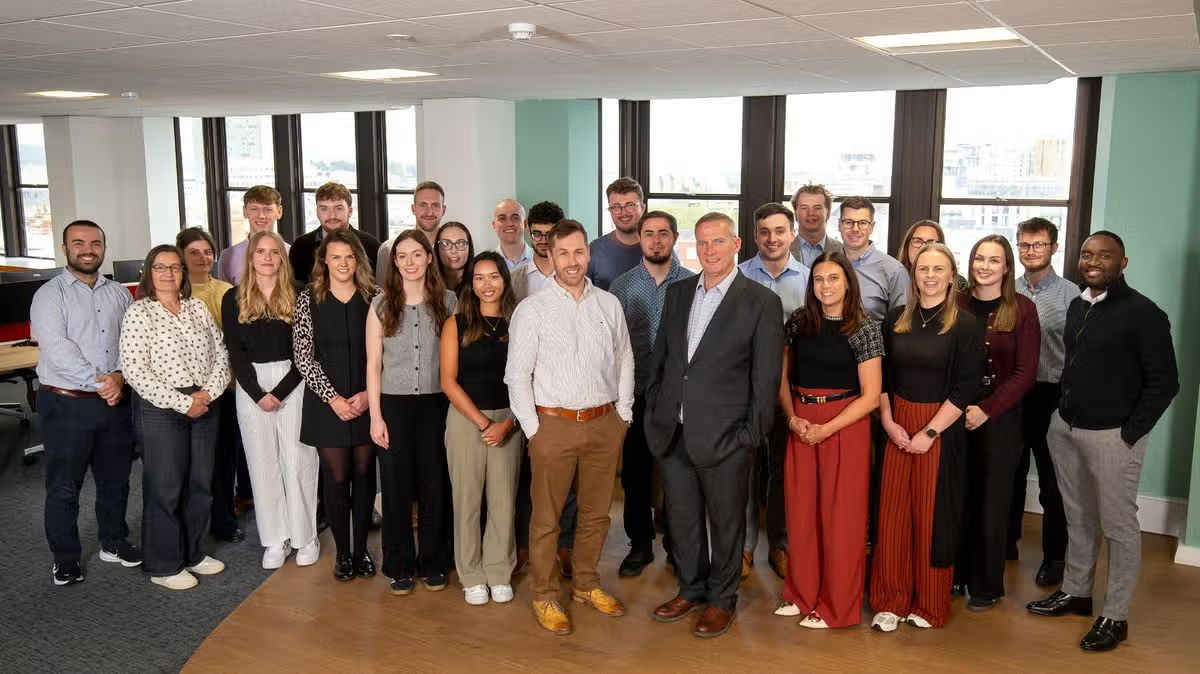
Accountancy and business advisory firm Hazlewoods has relocated to larger offices in Cardiff to support expansion plans.

Having set up its first office in Wales at the Capital Tower office building in 2024, it has now moved its team of 34 to South Gate House.

Advertisement

Tom Davies, director at Hazlewoods Cardiff, said: “This is an exciting step for Hazlewoods and reflects the progress we have made since launching in the city less than two years ago. We have built a very strong team here and have been really encouraged by the response from both new and existing clients, reflecting our commitment to developing deep relationships across the region.

“The new office gives us the space to continue growing while maintaining the collaborative approach that is such an important part of the way we work.”

Bruce Black, corporate tax director, said: “This move creates the environment we need to continue finding and developing local talent to build the team, while maintaining the high level of service our clients expect from Hazlewoods. It reflects just how positively the Cardiff office has developed in such a short space of time.

“The team in Cardiff has done a great job of growing the business and I look forward to seeing that continue. We have the expertise, ambition and people to build a really strong presence in Wales, and the new office gives the team a great base from which to do that.”

Advertisement

Hazlewoods is one of the largest independent accountants and business advisers in the South West and Wales, with more than 600 employees and a growing presence in Cardiff, alongside its offices in Cheltenham and Bristol.

The firm provides audit, accounting, tax and advisory services to corporate and private clients and is particularly well known for its specialist sector expertise across the UK. Last year, the firm recorded a turnover of £54.3m.

Its managing partner, James Morter, said: “It has been very gratifying to see the way that Hazlewoods has been welcomed into Cardiff. Early on, we identified a gap in the Welsh market for a firm of our size and experience, and when you combine that with the talent pool in the city, it felt like a natural next step.”

Property advisory firm Knight Frank represented Hazlewoods on the deal, while its building consultancy team supported the fit-out of the new space.

Advertisement

Mark Sutton, office agency partner at Knight Frank’s Cardiff office, said: “Hazlewoods was looking for a space that could support its continued growth in Wales, while offering excellent connectivity and the flexibility to create a workplace suited to its needs.

“South Gate House provided the right combination of quality space and a prime city-centre location, and it has been a pleasure to support the team through the move.”

Continue Reading

Business & Hussles

Perpetua Resources at Mining Forum Americas 2026: shift to construction

Published

on


Perpetua Resources at Mining Forum Americas 2026: shift to construction

Continue Reading

Business & Hussles

What Trump’s potential US diesel export ban could mean for you

Published

on

A driver returns a fuel nozzle after refueling a tractor trailer with diesel fuel at a Chevron truck stop in Tracy, California.

For the US economy, a ban could deliver short-term relief at the pump by flooding the domestic market with excess supply.

However, energy analysts warn it could backfire.

David Fyfe, chief economist at Argus Media, notes that cutting off American supply would likely cause international prices to skyrocket.

That would push up global freight, food, and industrial costs, ultimately “feeding inflation back into the global economy”.

Advertisement

“At a stroke, the US’s reputation as a reliable supplier of energy to the world would be shot,” Fyfe added.

Removing more than a million barrels of daily American supply would trigger a fierce bidding war among importing nations in Latin America and Europe.

Sarah Raffoul, analytics manager at Argus Media, noted that while higher international prices would eventually curb demand, the immediate gap would severely strain trade relationships and accelerate global inflation.

Advertisement
Continue Reading

Business & Hussles

Greatland Resources at Mining Forum Americas 2026: cash-rich growth push

Published

on


Greatland Resources at Mining Forum Americas 2026: cash-rich growth push

Continue Reading

Business & Hussles

Canadian defence creating 250 jobs in Merthyr in new research alliance

Published

on

Business Live

Its new research alliance is with two Welsh universities and one in Canada

Marshall Land Systems

Marshall Land Systems

A Canadian-owned defence firm which is relocating its UK production from Cambridge to South Wales has forged a new research alliance with universities on both sides of the Atlantic.

Marshall Land Systems, whose new factory site in Merthyr will reach production capacity at the end of the year with 160 staff, has set up the Marshall Land Research Alliance alongside the universities of Cardiff, South Wales, and New Brunswick in Canada.

Advertisement

The firm’s deployable infrastructure ranges CT scanners and medical facilities to mechanical maintenance and command centres. Its new assembly plant was chosen after a UK-wide search, and will produce deployable infrastructure that will protect NATO personnel on operations, humanitarian missions, and on bases.

The alliance together leading academics and technology experts to explore new technologies in the field of deployable infrastructure for military and humanitarian use.

A signed memorandum of understanding will unable technology transfer, staff exchanges and joint research and development work.

Over the next five years, based on its current order book alone, Marshall is confident of growing its workforce in Merthyr to 250. However, with the UK Government and other countries committing more of their budgets to defence and security, Marshall is well positioned to win additional contracts that could see even more jobs created at its Merthyr site.

Advertisement

The firm’s deployable infrastructure ranges CT scanners and medical facilities to mechanical maintenance and command centres.

Its new assembly plant was chosen after a UK-wide search, and will produce deployable infrastructure that will protect NATO personnel on operations, humanitarian missions, and on bases.

The average salary at the factory will be around £32,000, while Marshall is also looking to take on around 15 apprentices.

The firm has entered into a 15-year lease with the owner of the building, Figsand, with an option to acquire it. The Merthyr site extends to 191,600 sq ft and occupies 8.2 acres at Merthyr Industrial Park.

Advertisement

Marshall Land Systems chief executive, Gareth Williams, said: “In an increasingly volatile world, the long-standing and fundamental alliance between Canada and the UK is becoming ever more important. As NATO allies invest to protect our way of life, this transatlantic research alliance will bring together the smartest brains in support of the effort to keep us safe and the world stable.

“We’re proud to be convening this vital joint work between Wales and New Brunswick under the Marshall Land Research Alliance.”

Professor Louise Bright, pro vice chancellor for enterprise, engagement, and partnerships at the University of South Wales, said:“We are proud to be a founding partner in the Marshall Land Research Alliance, a bold collaboration that will help shape the future of innovation, skills and advanced manufacturing in South Wales.

” USW’s strengths in research, advanced manufacturing and skills development position us to connect industry, talent and innovation in ways that deliver real impact.

Advertisement

“This partnership will create valuable opportunities for our students and staff to work alongside leading industry partners on real-world challenges, while helping businesses develop the skills and expertise they need to grow.

“With Marshall Land Systems establishing a major new facility in South Wales, this Alliance comes at a pivotal moment for the region. Together, we can support innovation, expand opportunities for graduates and help drive long-term economic growth across Wales.”

Professor Roger Whitaker, Cardiff University’s pro vice-chancellor for research, innovation and enterprise, said: “Cardiff University is pleased to be a founding partner in the Marshall Land Research Alliance, bringing together academic and industry expertise to support research, innovation and skills development in areas including advanced manufacturing, engineering and defence.

The alliance provides opportunities for our staff to work with partners on research, innovation and workforce development. It also comes at an important time for South Wales, with the potential to support new collaborations between universities, industry and government.

Advertisement

Through research, knowledge exchange and skills development, we hope to contribute to opportunities for students, graduate employment, businesses and communities, while supporting the long-term strength and resilience of the Welsh economy through research and innovation.”

Dr David MaGee, vice president research at the University of New Brunswick said: “We take great pride in fostering strong, mutually beneficial partnerships that help us make a meaningful impact in Canada and around the world. I look forward to working with Marshall Land Systems, Cardiff University, and the University of South Wales to advance innovative technologies and contribute to Canada’s NATO commitments.

“By leveraging our academic expertise and learning from our collaborators, we will address common challenges and create lasting benefits for our institutions, our industries, and our countries.”

As well as its Canadian and UK operations, Marshall Land Systems has a factory in the Netherlands. It currently has a global workforce of 600.

Advertisement
Continue Reading

Business & Hussles

Andreessen Horowitz backs AI-era college alternative with $42M

Published

on

Andreessen Horowitz backs AI-era college alternative with $42M

Andreessen Horowitz is putting $42 million behind a new education venture aimed at young tech builders who might otherwise head to college, betting that the artificial intelligence boom is creating demand for a different path into Silicon Valley.

The Horowitz Andreessen Academy, a for-profit company incubated by the venture capital firm known as a16z, plans to bring its first class of roughly 50 students to San Francisco in September 2027 for a tuition-free, one-year fellowship.

Advertisement

Instead of relying heavily on traditional academic credentials, the academy says admissions will focus on what applicants have already built, shipped or earned. Students will spend much of the program working on projects and learning from technology executives and entrepreneurs rather than taking traditional tests and completing homework.

EMPLOYEES AT AI COMPANIES BACK BERNIE SANDERS BILL CRACKING DOWN ON DEVELOPMENT

Gagan Biyani speaks onstage at TechCrunch Disrupt SF 2015 in San Francisco in 2015

Gagan Biyani speaks at TechCrunch Disrupt SF 2015 in San Francisco on Sept. 23, 2015. (Steve Jennings/Getty Images for TechCrunch)

The approach represents a Silicon Valley experiment in how education could change as AI reshapes the skills companies seek from workers and founders.

“In our estimation, the AI revolution is going to be as transformational to jobs as the Industrial Revolution was to the agricultural society that came before it,” said Ben Horowitz, co-founder and general partner at a16z. “The training that worked for the Industrial Revolution isn’t going to map perfectly onto the AI revolution, so somebody has to pioneer how you train a person for this new world. That’s what we built the Academy to do. This isn’t just an investment idea for us. It’s an investment in the future of the country.”

Advertisement

A16z is joined in the $42 million investment by technology executives and investors including Shopify CEO Tobi Lütke, DoorDash CEO Tony Xu, Quora co-founder Adam D’Angelo, Y Combinator CEO Garry Tan and Palantir Chief Technology Officer Shyam Sankar.

NEW YORK OVERTAKES SAN FRANCISCO BAY AREA AS LARGEST US TECH TALENT MARKET BY WORKFORCE SIZE

Ben Horowitz walks outside in Sun Valley, Idaho.

Co-founder of Andreessen Horowitz, Ben Horowitz walks to a morning session at the Allen & Company Sun Valley Conference on July 9, 2021 in Sun Valley, Idaho. (Kevin Dietsch/Getty Images)

The venture has also lined up Google, Meta, Nvidia, OpenAI, Anthropic, Coinbase, Palantir, Stripe, Anduril and Replit as founding partners. The companies will provide resources and expertise, including software, hardware and computing power, according to the academy.

Ticker Security Last Change Change %
GOOGL ALPHABET INC. 343.92 +1.56 +0.46%
META META PLATFORMS INC. 723.05 -28.61 -3.81%
NVDA NVIDIA CORP. 231.55 +6.48 +2.88%

Each student is expected to receive more than $50,000 in computing credits and other technology resources, along with a $5,000 travel and exploration budget. Courses will cover areas including AI systems, sales, fundraising, finance and startup formation.

Advertisement

Gagan Biyani, who co-founded online learning company Udemy and later founded Maven, is leading the academy as founder and CEO. Marc Andreessen and a16z general partner Erik Torenberg will join him on its board.

College students sit in a lecture hall as a student takes notes during class.

College students attend a lecture in a classroom. (iStock)

CLICK HERE TO GET FOX BUSINESS ON THE GO

The fellowship is designed primarily for high school graduates and can serve as a gap year or college deferral. The academy plans to seek regulatory approval for a two-year program that could begin in fall 2028, with tuition expected to be comparable to elite private universities.

The company is separate from Andreessen Horowitz despite its close ties to the venture capital firm.

Advertisement
Continue Reading

Business & Hussles

Bob Chapek on Disney Bob Iger power battle: Raised concerns weekly

Published

on

Bob Chapek on Disney Bob Iger power battle: Raised concerns weekly

Former Disney CEO Bob Chapek said Monday he voiced concerns about then-Executive Chairman Bob Iger to the company’s board “weekly” during his brief tenure as head of the House of Mouse.

Chapek has remained tight-lipped about his firing from the media giant nearly four years ago, but opened up about his experience in a new tell-all memoir, “Behind the Castle Walls: My Thirty Years at the Happiest Place on Earth,” and in an interview with CNBC’s “Squawk Box.”

Once head of Disney’s theme park and experiences division, Chapek was tapped to take the helm of the company just weeks before the Covid pandemic shuttered movie theaters and amusement parks around the globe in 2020. As Chapek worked to navigate these challenges, Iger remained with the company to handle Disney’s content initiatives like Disney+.

However, Iger slowly began to reassert control, Chapek says. The ensuing power struggle was detailed in a CNBC report in 2023.

Advertisement

“When I started hearing about lunches that he had and dinners that he had where he was absolutely trashing me, and I’d hear it two, three times in the same week, the same bullet points, the same talking points, I was like, ‘I’ve got a problem,’” Chapek told CNBC.

He noted that when he brought concerns to the Disney board about Iger, he was told, “‘He’ll be gone in two years. It’s OK. That’s Bob being Bob.’”

But almost three years after being named CEO, Chapek was ousted and replaced by Iger, who returned to the post until March 2026.

“It would have been great if, like other CEOs, he acted as a steward of my new role,” Chapek said. “It would have been one thing if he was neutral, but to be actually working against me, actively, I thought was just unbelievable.”

Advertisement
Continue Reading

Business & Hussles

Romania, Georgia and Latvia Lead Latest WHO-Based Ranking

Published

on

Representation. Beer cans.

Romania drinks more alcohol per person than any other country, followed by Georgia and Latvia, according to the most recent internationally comparable data, which draws on World Health Organization figures. The sources reviewed contain no country-by-country count of alcohol consumed in 2026 so far; the newest full dataset is a three-year average labeled 2022 that was retrieved from the WHO’s Global Health Observatory this year.

The ranking, published by The Facts Institute and updated on August 31, measures average annual recorded consumption per person aged 15 and older in liters of pure alcohol. On that measure, the ten heaviest-drinking countries are:

  1. Romania, 17.1 liters
  2. Georgia, 15.5 liters
  3. Latvia, 14.7 liters
  4. Moldova, 14.1 liters
  5. Czechia, 13.7 liters
  6. Lithuania, 12.2 liters
  7. Namibia, 12.0 liters
  8. Poland, 11.9 liters
  9. Austria, 11.8 liters
  10. Bulgaria, 11.5 liters

Belarus, Saint Lucia and Seychelles follow, tied at 11.4 liters each, according to the WHO figures in the Facts Institute table. World Population Review, which also treats 2022 as the most recent data available as of 2026, reports the same leaders: Romania at 17.1 liters, then Georgia at 15.5, Latvia at 14.7, Moldova at 14.1 and Czechia at 13.7. It says Lithuania, Poland, Bulgaria, Belarus, Hungary and Slovakia all reported annual consumption above 11 liters per person.

The gap between Romania and the global picture is wide. The Facts Institute noted that consumption above 14 liters of pure alcohol per person per year is roughly equivalent to about three standard bottles of wine per person each week. Because drinks vary in strength, the WHO measures pure alcohol rather than volumes of beer, wine or spirits. The site explained that a liter of wine, at about 12% alcohol by volume, contains roughly 0.12 liters of pure alcohol, so a person consuming 6 liters of pure alcohol a year would drink the equivalent of about 50 liters of wine, or about a liter a week.

Europe dominates the list. Central and Eastern European countries lead the rankings, and 22 of the top 30 countries are in Europe, according to the Facts Institute. Namibia, in seventh place with 12 liters, is the highest-ranked country outside Europe, and Seychelles and Saint Lucia also record some of the world’s highest levels, making them exceptions to the largely European pattern. World Population Review said beer, wine and spirits all play major cultural roles across much of Eastern and Central Europe, and that higher-income countries generally report higher consumption because alcohol is more affordable and widely available, though wealth alone does not determine drinking habits.

Advertisement

Several large economies sit just outside the top ten. According to the WHO table, Germany, France, Australia and Portugal each recorded 11.2 liters, the United Kingdom 10.9 liters, Russia 10.5 liters and the United States 9.8 liters. Russia, long associated with heavy drinking, has fallen well down the list, WorldRankd noted in a separate ranking. Canada recorded 10.0 liters, and Spain and Slovakia 11.0 liters each.

At the other end of the scale, consumption is close to zero in parts of North Africa and the Middle East, where religious and cultural norms discourage or prohibit drinking, the Facts Institute said. Yemen, Somalia, Bangladesh, Sudan, Mauritania, Libya, Afghanistan, Syria, Pakistan and Kuwait are among the countries with the lowest recorded consumption, and Iran, Indonesia and Egypt also round to near zero.

The numbers are estimates, and the WHO publishes confidence intervals. Romania’s figure of 17.1 liters, for example, carries a range of 14.6 to 19.8 liters, and Georgia’s 15.5 liters ranges from 12.9 to 17.9. Those ranges overlap with countries lower on the list, which means the ordering among places with similar totals is not exact. That is why some countries share a rounded figure and why the Facts Institute listed 13 countries in its top group.

Different sources produce slightly different results. StatsPanda, which uses a World Bank series compiled from WHO data and includes estimated unrecorded consumption, puts Romania at 16.8 liters, Georgia at 14.4 liters and Latvia at 12.9 liters, using the latest available year from 2015 onward. Another ranking of 2025 data listed Latvia in fourth place at about 13.1 liters, followed by Uganda at 12.2 and Germany at 12.2, and it named Lithuania as tenth at 11.8 liters. Such differences reflect vintage, methodology and whether unrecorded, homemade or informal alcohol is counted.

Advertisement

The global context is lower. Worldwide annual consumption in 2019 was equal to 5.5 liters of pure alcohol per person aged 15 and older, down from 5.7 liters in 2010, according to the WHO figures summarized on Wikipedia. The WHO European Region had the highest regional average at 9.2 liters, followed by the Region of the Americas at 7.5 liters. About 44% of the population aged 15 and older were current drinkers in 2019. Alcohol use is estimated to cause about 2.6 million deaths a year worldwide, according to the WHO’s 2024 global report as cited by Statsipedia and the Facts Institute. The Facts Institute added that the countries that drink the most can suffer more alcohol-related health and social problems.

None of the sources reviewed included statements from health officials or the countries ranked, and the WHO’s own data has a lag of several years, so the list does not capture changes in drinking habits since 2022.

Readers looking for a 2026 tally will not find one in the sources reviewed. Until the WHO updates its indicator, the Romania-led list remains the most recent international snapshot of who drinks the most.

Advertisement
Continue Reading

Business & Hussles

Energy bills: What is happening to gas and electricity prices?

Published

on

A woman with shoulder-length blonde hair talks into a microphone

Although the price cap sets the unit prices for gas and electricity, your household’s actual bill depends on the overall amount of energy you use, and how you pay for it.

Where you live, the type of property you have, how energy efficient it is, how many people live there, and the weather all make a difference.

The Ofgem cap is based on “typical” household energy use in a year with a single bill for gas and electricity settled by direct debit.

The vast majority of people pay their bill this way to help spread payments across the year.

Advertisement

In July, Ofgem reduced what it believes to be a “typical” level of energy use, because many homes have cut back due to high prices in recent years while energy efficiency has improved.

Its new estimate is 9,500 kWh of gas and 2,500 kWh of electricity a year.

Continue Reading

Business & Hussles

Trump approves new fuel economy standards, reversing Biden’s EV push

Published

on

Trump approves new fuel economy standards, reversing Biden's EV push
Executive Edge: Trump says he approved new fuel economy standards, rolling back Biden-era rules

President Donald Trump on Saturday said he approved new fuel economy standards, reversing former President Joe Biden’s stricter policies meant to fuel electric vehicle adoption.

Since the Corporate Average Fuel Economy, or CAFE, standards were established in 1975, they have been periodically updated, typically to make vehicles more efficient. Under former President Joe Biden’s standards, automakers would have had to increase the fuel efficiency of their passenger cars and light trucks to roughly 50 miles per gallon by 2031. The stricter standards were designed to incentivize electric vehicle production and sales in the U.S.

Trump presented the policy change as a boon for both automakers and consumers, though the final standards have not yet been publicly detailed.

“These new Standards will take the waste out of building cars in America. That means LOWER PRICES, saving families thousands on a new, beautiful, and safe car — Far better than the Environmental Monsters that we were building heretofore,” he wrote in the Truth Social post. “Every Manufacturer, from General Motors to Ford to Stellantis, has called me wanting to build here, and now they can!”

The regulatory change would fulfill a campaign promise from Trump to rescind policies that encouraged or incentivized electric vehicles.

Advertisement

It is unclear what the final fuel economy standards will be, although Transportation Secretary Sean Duffy previously said that they would be sharply lower than the Biden-era policies.

Weaker fuel economy standards mean that automakers can produce more pickup trucks and SUVs, which are much more profitable than smaller cars but have worse gas mileage. Electric vehicles also become much less attractive to automakers, although some companies, like General Motors, have said that they will still make them.

Continue Reading

Trending

Copyright © 2025