Connect with us

Business & Hussles

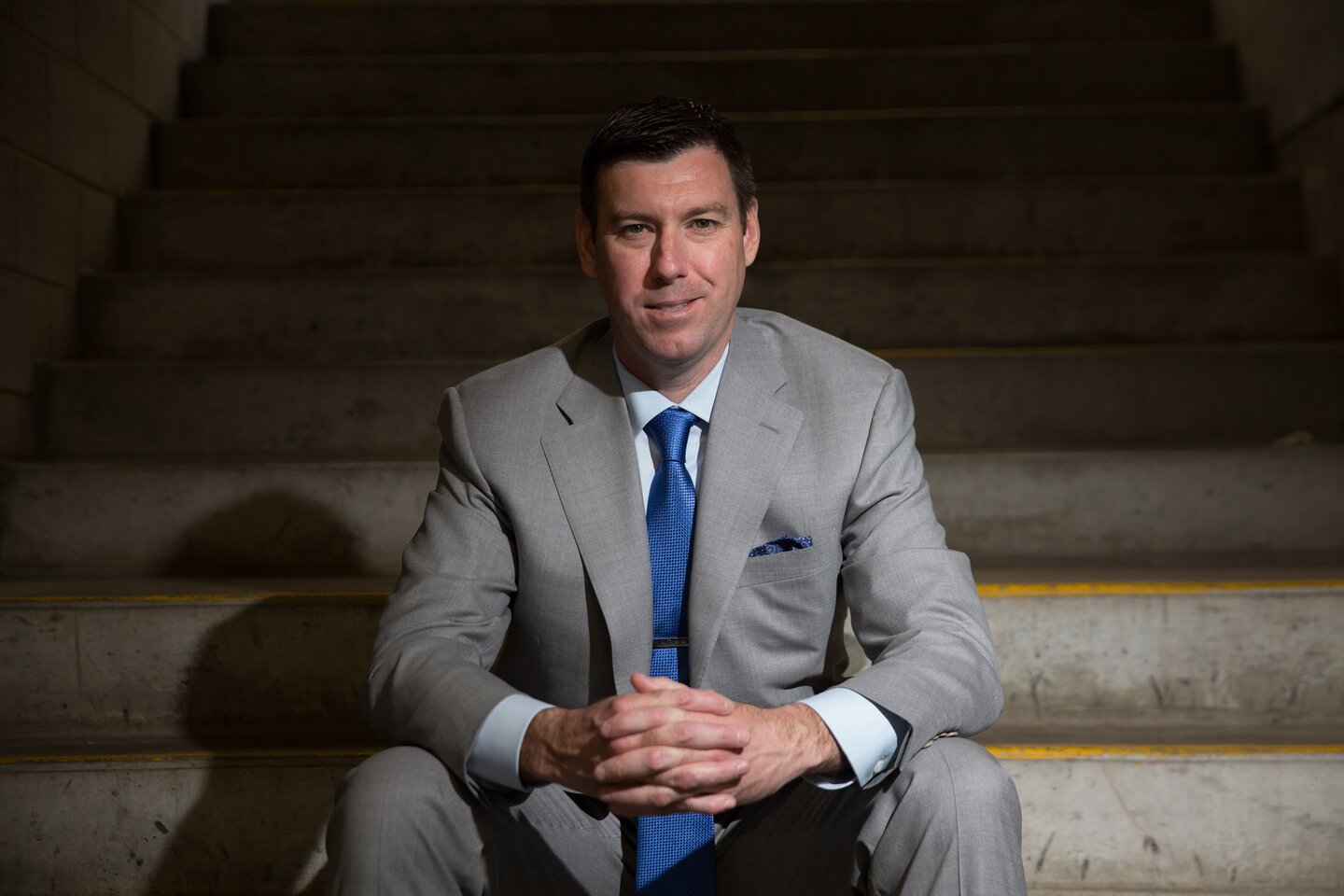
I product studio: &above founder Jordan Richards

Published

on

I product studio: &above founder Jordan Richards

Jordan Richards joined Google as an apprentice at 18 and became a design lead before founding &above, a London AI product design and build studio whose clients include Google, Tesco and Revolut. The studio says the Gemini Sales Sidekick agent it built for Google Cloud has 5,000 monthly active users and saves sellers 64 per cent of the time the work took manually. Based in Borough, &above says it is a certified Anthropic and Google Cloud partner. He tells Business Matters why having AI is only the starting point and why there are no failures, only learnings.

What do you currently do at &above?

I am the founder and CEO of &above, an AI product design and build studio.

We help businesses take AI from experimentation into something that actually works in the real world. That might mean designing and building an AI workflow, developing an AI-powered product, or helping a business work out where AI can genuinely create value.

Free newsletters
Advertisement

The stories that matter to UK business, straight to your inbox.

Advertisement

My role is a combination of building the business, working with clients and helping shape what we build. I am very close to the creative and product side of the work.

I started my career at Google as an apprentice at 18 and went on to become a design lead. That experience had a huge influence on how I think about technology. Working with a company operating at that scale taught me a lot about craft, systems and the importance of solving the right problem.

Today, I am interested in applying those lessons to a very different technology moment. AI has created an enormous amount of opportunity, but also an enormous amount of experimentation. Businesses have access to incredibly powerful models, but having the technology is only the starting point. The interesting question is what you build around it and how it changes the way a business actually operates.

That is where I think &above has a role to play.

Advertisement

What was the inspiration behind your business?

I have always been a builder, and creativity and entrepreneurship have always been intertwined for me. My time at Google showed me what was possible when technology, creativity and really talented people come together. But it also made me realise that there was an opportunity to work differently.

When I started my own businesses, I wanted to create environments where people could move quickly, experiment and build things without having to navigate huge amounts of bureaucracy. That thinking eventually led to &above.

The arrival of AI made the opportunity even more interesting. We suddenly had technology that could fundamentally change how products and businesses are built, but there was a big gap between having access to an AI model and actually putting it to work. I did not want to build another business that simply talked about AI; I wanted us to be the people who actually build with it.

For me that is still the exciting part: taking something that feels quite abstract and turning it into something useful.

Advertisement

Who do you admire?

Someone I admire a lot is Toto Wolff, partly because of my passion for motorsport but mostly because of what he has built at Mercedes. What interests me is not just winning; it is the ability to build a high-performing team and create an environment where people continually push themselves to improve. I admire that relentless pursuit of excellence. Even when you are not leading, you do not stop pushing. You look at what is not working, learn from it and keep moving forward.

There are a lot of parallels between elite sport and entrepreneurship. At the highest level, performance is not just about talent or working harder. It is about building the right team, being disciplined, looking after your mind and body, recovering properly and being able to perform consistently over a long period of time.

Entrepreneurship can be relentless, and you cannot expect yourself or your team to perform at your best indefinitely without investing in the people behind the performance.

For me, high performance is not about constantly being at 100 per cent. It is about creating the conditions that allow you to reach 100 per cent when it matters, and having the resilience to keep going when things do not go your way.

Advertisement

Looking back, is there anything you would have done differently?

There are obviously things I would change, but I try not to think about them as failures. One of the phrases I have always lived by is: “There are no failures, only learnings.” The hardest periods have often taught me the most. What has changed as we have grown is how deliberately we capture those learnings.

We now run what we call “washups” when something has not gone as well as we wanted it to. We take the time to understand what happened, where we could have turned it around, what we missed and what we can do differently next time.

That is much more useful than looking at an outcome and simply saying it did not work.

If anything, I would have developed that mindset earlier: being less concerned about getting everything right first time and more focused on creating a culture where we can identify what is not working, learn quickly and improve.

Advertisement

I have also learned that building a business is a long game. In technology especially, it is tempting to put speed above everything else. Speed matters, but quality matters too. A decision that saves you a week today but creates a problem for the business two years from now is not necessarily a fast decision. It is just a decision that moved the problem somewhere else. I have become much more interested in building things that can last and scale, and a team that gets better every time we do something.

What defines your way of doing business?

Curiosity, creativity and a willingness to get stuck in.

A big part of my apprenticeship at Google was learning on the job. I had to get involved, ask questions, make mistakes, learn quickly and figure things out as I went.

Some of the best learning happens when you get stuck in and work things out in practice. That does not mean rushing. One of the things I have learned is that moving quickly and thinking carefully are not opposites.

Advertisement

I like getting close to a problem, understanding it properly, making something, putting it in front of people and learning from what happens. That mindset is particularly important in AI because the technology is changing so quickly. You cannot build a five-year plan around assumptions that might be obsolete in six months.

I also care a lot about the people I work with. The best businesses I have been involved in have been built by people with different skills and perspectives working together. Design, technology, strategy and commercial thinking should not exist in separate silos.

And I believe strongly in ownership. If we build something for a client, I want it to become a useful part of their business. A successful project is not just something that looks good in a presentation. It is something that people actually use and that creates a meaningful outcome.

What advice would you give to someone starting out?

Start building. You do not need to have everything figured out before you begin; in fact, you probably never will. When I look back to being 13 and selling phone case designs, I had no business plan and knew nothing about entrepreneurship. I just saw something I could create and wondered if someone would pay for it. That instinct is still useful. Find something you care about, find a real problem and start experimenting.

Advertisement

Learn how things work rather than depending on other people to make everything for you. You do not have to become an expert in every discipline, but understanding how technology, design, marketing and business fit together gives you a huge advantage.

Look after yourself, too. Entrepreneurship can easily become all-consuming. I have learned to think about myself like an athlete: you need periods of intense performance, but you also need training, recovery and time away from the game. You do not need to be working every hour to be ambitious.

Finally, stay curious. The people who will create the most interesting businesses in the age of AI will not necessarily be the ones who know everything today. They will be the ones who are willing to keep learning, keep experimenting and keep building. That is certainly the approach I am trying to take with &above.

Advertisement

Continue Reading
Click to comment

You must be logged in to post a comment Login

Leave a Reply

Business & Hussles

Develop sets $458 million growth capital budget

Published

on

Develop sets $458 million growth capital budget

Growth will continue at Bill Beament-led Develop Global in FY27, following the release of its guidance metrics for the upcoming year.

Continue Reading

Business & Hussles

Dave & Buster’s interim CFO Cory Hatton buys $25,999 in stock

Published

on


Dave & Buster’s interim CFO Cory Hatton buys $25,999 in stock

Continue Reading

Business & Hussles

Market veterans favour value plays over crowded, expensive themes

Published

on

Market veterans favour value plays over crowded, expensive themes
After two difficult years for Indian equities, there is scope for reasonable returns as valuations turn less demanding, according to senior market participants who spoke to ET. Large caps look better placed, while the outlook is more cautious on mid- and small-caps. Financials, manufacturing and consumption are among the preferred themes, while views on technology are sharply divided

NEELESH SURANA, CIO, Mirae Asset Mutual Fund

MARKET OUTLOOK: India looks better positioned than sentiment suggests and is a natural hedge against crowded AI trade. Valuations are no longer a headwind, while domestic fundamentals are sound. Any global trade rotation could be meaningful. Key risks are elevated crude, rising developed market bond yields, El Niño and heavy equity issuance. Overall, we expect low-teens returns.
PREFERRED INVESTMENT STRATEGY: Our strategy is a barbell, combining quality stocks with strong earnings upgrades at sensible valuations with holding sector leaders that have corrected over the past two years and are now in value zone.

THEMES LOOKING ATTRACTIVE: Banking, consumer discretionary, healthcare and manufacturing. Sector leaders, impacted by FPI selling over the last two years, are now attractive.

THEMES TO STAY AWAY FROM: Slow-growth or disruption prone sectors like consumer staples and IT. Cautious on narrative-driven, richly-valued sectors like capital goods.


Read more: Goldman Sachs identifies 42 Indian stocks riding AI build-out

JANAKIRAMAN RENGARAJU, CIO – India Equities Templeton Global Investments

MARKET OUTLOOK: The 12-month base case for Indian equities may not be quite euphoric, but it is constructive. Largecap valuations are more reasonable, while higher mid- and small-cap multiples call for greater prudence. Globally, the picture has deteriorated. Unresolved conflicts have entrenched inflationary pressures, while rising interest rates and heavy fiscal debt reinforce each other. Tariff uncertainty continues to cloud trade growth, while questions are emerging over the viability of massive AI investments, even as enthusiasm and valuations remain elevated.PREFERRED INVESTMENT STRATEGY: Adopt a tone of ‘cautious optimism’ over the medium term.

Advertisement

THEMES LOOKING ATTRACTIVE: Financials, industrials and capital goods, consumption and electronic manufacturing, which are linked to capex pick up, rising affluence and credit growth.

THEMES TO STAY AWAY FROM: Avoid expensive small and mid-caps with weak cash generation and businesses dependent on endless equity funding.

Read more: SIPs offer steady gains as most fund categories beat benchmark indices

ANISH TAWAKLEY, CIO, DSP Mutual Fund

MARKET OUTLOOK: Economy remains in good shape, while valuations are now neutral. This should translate into reasonable market returns broadly in line with earnings growth.

Advertisement

PREFERRED INVESTMENT STRATEGY: Don’t chase narratives that have already played out, rather look at sectors that have been underperforming since the last 2-3 years.

THEMES LOOKING ATTRACTIVE: Private banks, insurance companies, automobiles and cement.

THEMES TO STAY AWAY FROM: Careful about companies where promoters are diluting (either through primary or secondary sales) or where private equity is selling, including IPOs. Promoter dilution and PE sales happen when performance and valuations are close to peaks. Cautious on metals, IT and FMCG. For IT, the problem is not AI but the fact that Indian listed companies are losing market share to GCCs set up in India.

R SIVAKUMAR CIO, Axis Mutual Fund

MARKET OUTLOOK: The outlook is constructive. Economic slowdown over the last few quarters appears to be more cyclical than structural. Valuations in parts of the market remain elevated, particularly within mid- and small-caps.

Advertisement

PREFERRED INVESTMENT STRATEGY: Alpha generation is likely to come from selective stock picking rather than broad market direction. A balanced approach across largecaps, which offer valuation comfort and resilience, and select mid-cap opportunities, which continue to deliver superior earnings growth, remains appropriate.

THEMES LOOKING ATTRACTIVE: Constructive on manufacturing, power and electrification, energy transition, select financials, particularly banks and capital-market-linked businesses, as well as export-oriented companies.

THEMES TO STAY AWAY FROM: Investors should avoid chasing momentum in overcrowded themes. In technology, we remain watchful of disruptions and pricing pressures emerging from AI-led changes in the global IT services landscape

SHANKAR SHARMA, Founder, GQuant

MARKET OUTLOOK: Barring occasional rallies, I do not see the Indian markets outperforming the world or even the peer group. The Vaibhav Suryavanshi Syndrome afflicts Indian companies: domestic success is mistaken for globally transferable skill. Largecaps have thrived on India’s easy pitch, building market capitalisation rather than global scale and brands. When domestic growth fades, competing overseas will require an entirely different mindset. There will be pockets where money is going to be made; but in aggregate, Indian returns will disappoint for the coming year.

Advertisement

PREFERRED INVESTMENT STRATEGY: The future of the Indian stock market lies in getting “techified”. Tech has been my theme in the last 2 years since the bear market started in India and I have actually made money even in this very-very tough market. This is not going to change anytime soon. Pharmaceuticals is also going to be a good place to be in.

THEMES LOOKING ATTRACTIVE: For me, tech is 80% of the allocation and pharma is 20% and there is nothing else that I am interested in India.

THEMES TO STAY AWAY FROM: Companies which service the domestic Indian consumer. That trade is on its way out and this is not where I would deploy a lot of capital.

Advertisement
Add ET Logo as a Reliable and Trusted News Source

Continue Reading

Business & Hussles

Accountancy firm Hazlewoods move to larger offices in Cardiff to support expansion

Published

on

Business Live

The firm has relocated to the South Gate House office scheme

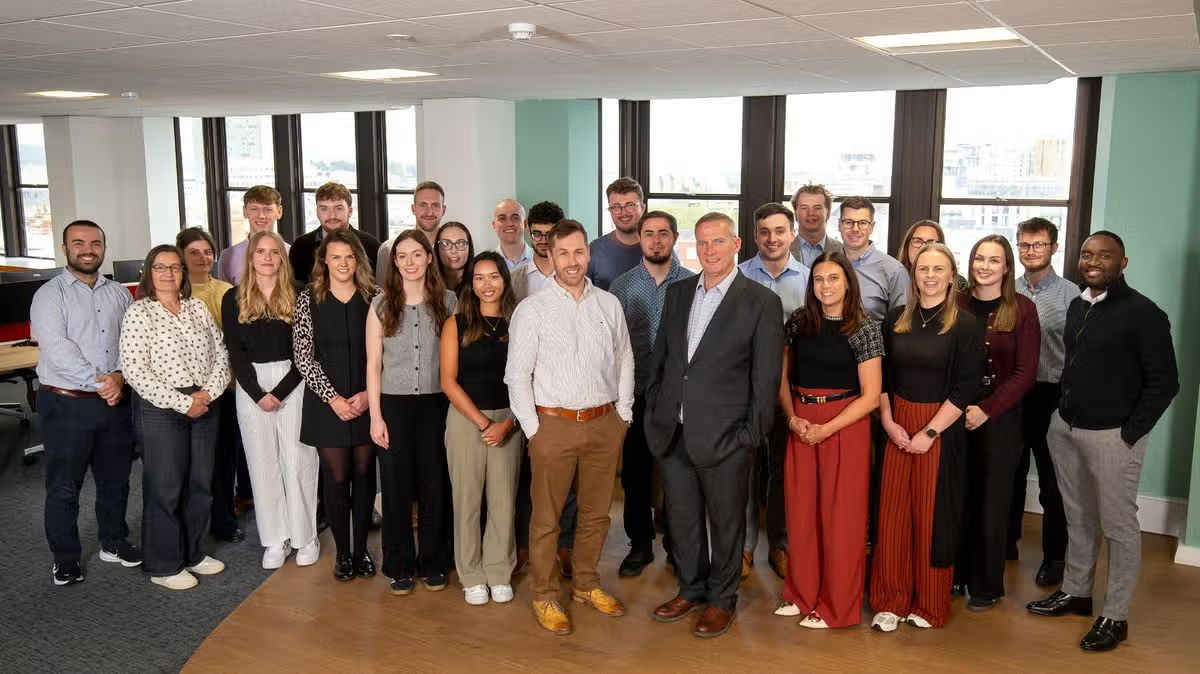
The Cardiff team of Hazlewoods

Accountancy and business advisory firm Hazlewoods has relocated to larger offices in Cardiff to support expansion plans.

Having set up its first office in Wales at the Capital Tower office building in 2024, it has now moved its team of 34 to South Gate House.

Advertisement

Tom Davies, director at Hazlewoods Cardiff, said: “This is an exciting step for Hazlewoods and reflects the progress we have made since launching in the city less than two years ago. We have built a very strong team here and have been really encouraged by the response from both new and existing clients, reflecting our commitment to developing deep relationships across the region.

“The new office gives us the space to continue growing while maintaining the collaborative approach that is such an important part of the way we work.”

Bruce Black, corporate tax director, said: “This move creates the environment we need to continue finding and developing local talent to build the team, while maintaining the high level of service our clients expect from Hazlewoods. It reflects just how positively the Cardiff office has developed in such a short space of time.

“The team in Cardiff has done a great job of growing the business and I look forward to seeing that continue. We have the expertise, ambition and people to build a really strong presence in Wales, and the new office gives the team a great base from which to do that.”

Advertisement

Hazlewoods is one of the largest independent accountants and business advisers in the South West and Wales, with more than 600 employees and a growing presence in Cardiff, alongside its offices in Cheltenham and Bristol.

The firm provides audit, accounting, tax and advisory services to corporate and private clients and is particularly well known for its specialist sector expertise across the UK. Last year, the firm recorded a turnover of £54.3m.

Its managing partner, James Morter, said: “It has been very gratifying to see the way that Hazlewoods has been welcomed into Cardiff. Early on, we identified a gap in the Welsh market for a firm of our size and experience, and when you combine that with the talent pool in the city, it felt like a natural next step.”

Property advisory firm Knight Frank represented Hazlewoods on the deal, while its building consultancy team supported the fit-out of the new space.

Advertisement

Mark Sutton, office agency partner at Knight Frank’s Cardiff office, said: “Hazlewoods was looking for a space that could support its continued growth in Wales, while offering excellent connectivity and the flexibility to create a workplace suited to its needs.

“South Gate House provided the right combination of quality space and a prime city-centre location, and it has been a pleasure to support the team through the move.”

Continue Reading

Business & Hussles

Perpetua Resources at Mining Forum Americas 2026: shift to construction

Published

on


Perpetua Resources at Mining Forum Americas 2026: shift to construction

Continue Reading

Business & Hussles

What Trump’s potential US diesel export ban could mean for you

Published

on

A driver returns a fuel nozzle after refueling a tractor trailer with diesel fuel at a Chevron truck stop in Tracy, California.

For the US economy, a ban could deliver short-term relief at the pump by flooding the domestic market with excess supply.

However, energy analysts warn it could backfire.

David Fyfe, chief economist at Argus Media, notes that cutting off American supply would likely cause international prices to skyrocket.

That would push up global freight, food, and industrial costs, ultimately “feeding inflation back into the global economy”.

Advertisement

“At a stroke, the US’s reputation as a reliable supplier of energy to the world would be shot,” Fyfe added.

Removing more than a million barrels of daily American supply would trigger a fierce bidding war among importing nations in Latin America and Europe.

Sarah Raffoul, analytics manager at Argus Media, noted that while higher international prices would eventually curb demand, the immediate gap would severely strain trade relationships and accelerate global inflation.

Advertisement
Continue Reading

Business & Hussles

Greatland Resources at Mining Forum Americas 2026: cash-rich growth push

Published

on


Greatland Resources at Mining Forum Americas 2026: cash-rich growth push

Continue Reading

Business & Hussles

Canadian defence creating 250 jobs in Merthyr in new research alliance

Published

on

Business Live

Its new research alliance is with two Welsh universities and one in Canada

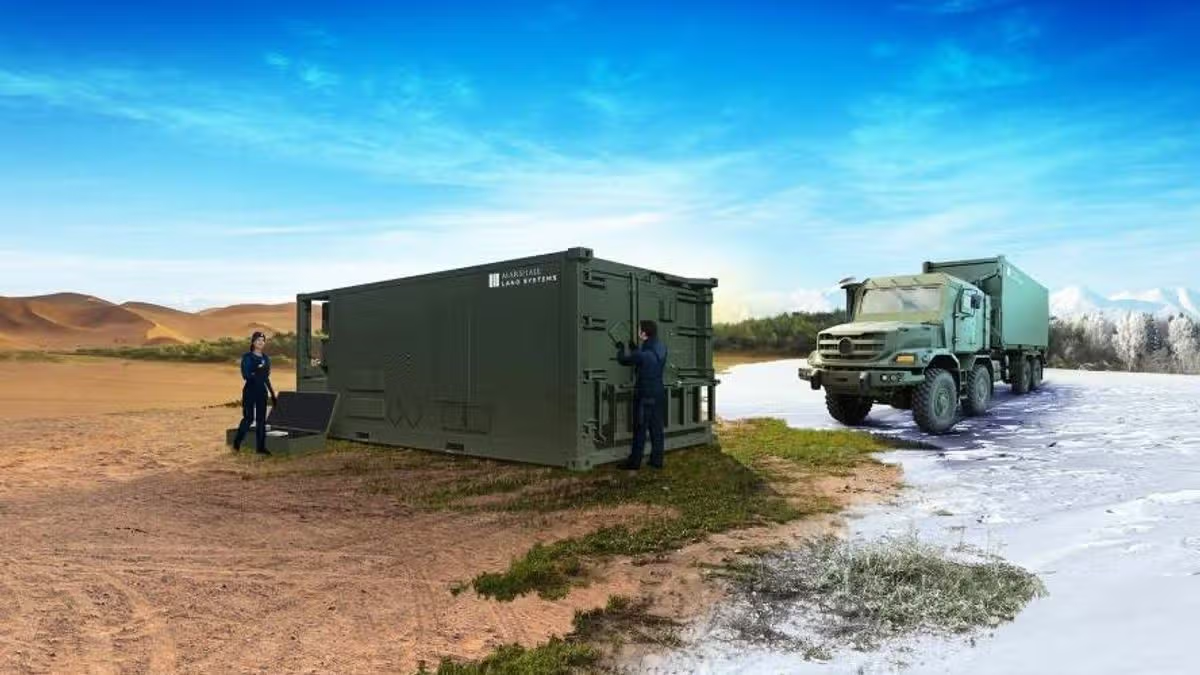
Marshall Land Systems

Marshall Land Systems

A Canadian-owned defence firm which is relocating its UK production from Cambridge to South Wales has forged a new research alliance with universities on both sides of the Atlantic.

Marshall Land Systems, whose new factory site in Merthyr will reach production capacity at the end of the year with 160 staff, has set up the Marshall Land Research Alliance alongside the universities of Cardiff, South Wales, and New Brunswick in Canada.

Advertisement

The firm’s deployable infrastructure ranges CT scanners and medical facilities to mechanical maintenance and command centres. Its new assembly plant was chosen after a UK-wide search, and will produce deployable infrastructure that will protect NATO personnel on operations, humanitarian missions, and on bases.

The alliance together leading academics and technology experts to explore new technologies in the field of deployable infrastructure for military and humanitarian use.

A signed memorandum of understanding will unable technology transfer, staff exchanges and joint research and development work.

Over the next five years, based on its current order book alone, Marshall is confident of growing its workforce in Merthyr to 250. However, with the UK Government and other countries committing more of their budgets to defence and security, Marshall is well positioned to win additional contracts that could see even more jobs created at its Merthyr site.

Advertisement

The firm’s deployable infrastructure ranges CT scanners and medical facilities to mechanical maintenance and command centres.

Its new assembly plant was chosen after a UK-wide search, and will produce deployable infrastructure that will protect NATO personnel on operations, humanitarian missions, and on bases.

The average salary at the factory will be around £32,000, while Marshall is also looking to take on around 15 apprentices.

The firm has entered into a 15-year lease with the owner of the building, Figsand, with an option to acquire it. The Merthyr site extends to 191,600 sq ft and occupies 8.2 acres at Merthyr Industrial Park.

Advertisement

Marshall Land Systems chief executive, Gareth Williams, said: “In an increasingly volatile world, the long-standing and fundamental alliance between Canada and the UK is becoming ever more important. As NATO allies invest to protect our way of life, this transatlantic research alliance will bring together the smartest brains in support of the effort to keep us safe and the world stable.

“We’re proud to be convening this vital joint work between Wales and New Brunswick under the Marshall Land Research Alliance.”

Professor Louise Bright, pro vice chancellor for enterprise, engagement, and partnerships at the University of South Wales, said:“We are proud to be a founding partner in the Marshall Land Research Alliance, a bold collaboration that will help shape the future of innovation, skills and advanced manufacturing in South Wales.

” USW’s strengths in research, advanced manufacturing and skills development position us to connect industry, talent and innovation in ways that deliver real impact.

Advertisement

“This partnership will create valuable opportunities for our students and staff to work alongside leading industry partners on real-world challenges, while helping businesses develop the skills and expertise they need to grow.

“With Marshall Land Systems establishing a major new facility in South Wales, this Alliance comes at a pivotal moment for the region. Together, we can support innovation, expand opportunities for graduates and help drive long-term economic growth across Wales.”

Professor Roger Whitaker, Cardiff University’s pro vice-chancellor for research, innovation and enterprise, said: “Cardiff University is pleased to be a founding partner in the Marshall Land Research Alliance, bringing together academic and industry expertise to support research, innovation and skills development in areas including advanced manufacturing, engineering and defence.

The alliance provides opportunities for our staff to work with partners on research, innovation and workforce development. It also comes at an important time for South Wales, with the potential to support new collaborations between universities, industry and government.

Advertisement

Through research, knowledge exchange and skills development, we hope to contribute to opportunities for students, graduate employment, businesses and communities, while supporting the long-term strength and resilience of the Welsh economy through research and innovation.”

Dr David MaGee, vice president research at the University of New Brunswick said: “We take great pride in fostering strong, mutually beneficial partnerships that help us make a meaningful impact in Canada and around the world. I look forward to working with Marshall Land Systems, Cardiff University, and the University of South Wales to advance innovative technologies and contribute to Canada’s NATO commitments.

“By leveraging our academic expertise and learning from our collaborators, we will address common challenges and create lasting benefits for our institutions, our industries, and our countries.”

As well as its Canadian and UK operations, Marshall Land Systems has a factory in the Netherlands. It currently has a global workforce of 600.

Advertisement
Continue Reading

Business & Hussles

Andreessen Horowitz backs AI-era college alternative with $42M

Published

on

Andreessen Horowitz backs AI-era college alternative with $42M

Andreessen Horowitz is putting $42 million behind a new education venture aimed at young tech builders who might otherwise head to college, betting that the artificial intelligence boom is creating demand for a different path into Silicon Valley.

The Horowitz Andreessen Academy, a for-profit company incubated by the venture capital firm known as a16z, plans to bring its first class of roughly 50 students to San Francisco in September 2027 for a tuition-free, one-year fellowship.

Advertisement

Instead of relying heavily on traditional academic credentials, the academy says admissions will focus on what applicants have already built, shipped or earned. Students will spend much of the program working on projects and learning from technology executives and entrepreneurs rather than taking traditional tests and completing homework.

EMPLOYEES AT AI COMPANIES BACK BERNIE SANDERS BILL CRACKING DOWN ON DEVELOPMENT

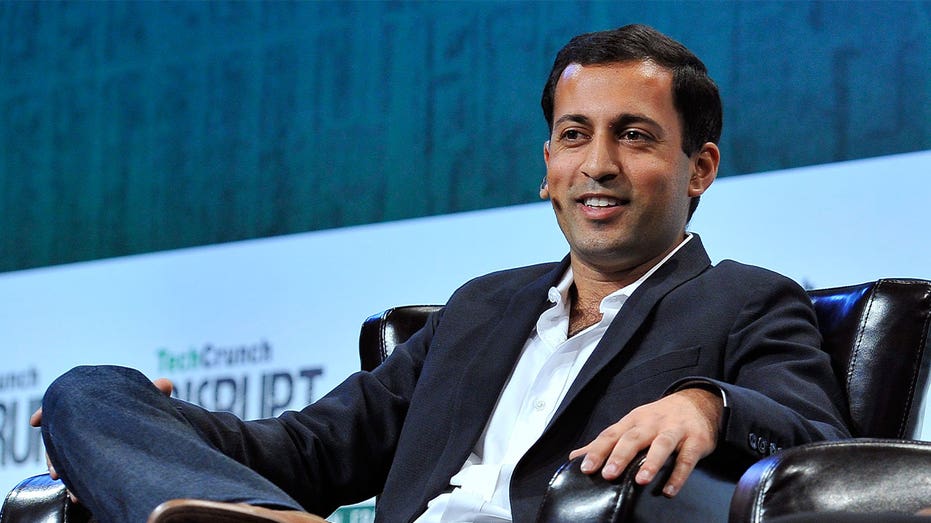
Gagan Biyani speaks onstage at TechCrunch Disrupt SF 2015 in San Francisco in 2015

Gagan Biyani speaks at TechCrunch Disrupt SF 2015 in San Francisco on Sept. 23, 2015. (Steve Jennings/Getty Images for TechCrunch)

The approach represents a Silicon Valley experiment in how education could change as AI reshapes the skills companies seek from workers and founders.

“In our estimation, the AI revolution is going to be as transformational to jobs as the Industrial Revolution was to the agricultural society that came before it,” said Ben Horowitz, co-founder and general partner at a16z. “The training that worked for the Industrial Revolution isn’t going to map perfectly onto the AI revolution, so somebody has to pioneer how you train a person for this new world. That’s what we built the Academy to do. This isn’t just an investment idea for us. It’s an investment in the future of the country.”

Advertisement

A16z is joined in the $42 million investment by technology executives and investors including Shopify CEO Tobi Lütke, DoorDash CEO Tony Xu, Quora co-founder Adam D’Angelo, Y Combinator CEO Garry Tan and Palantir Chief Technology Officer Shyam Sankar.

NEW YORK OVERTAKES SAN FRANCISCO BAY AREA AS LARGEST US TECH TALENT MARKET BY WORKFORCE SIZE

Ben Horowitz walks outside in Sun Valley, Idaho.

Co-founder of Andreessen Horowitz, Ben Horowitz walks to a morning session at the Allen & Company Sun Valley Conference on July 9, 2021 in Sun Valley, Idaho. (Kevin Dietsch/Getty Images)

The venture has also lined up Google, Meta, Nvidia, OpenAI, Anthropic, Coinbase, Palantir, Stripe, Anduril and Replit as founding partners. The companies will provide resources and expertise, including software, hardware and computing power, according to the academy.

Ticker Security Last Change Change %
GOOGL ALPHABET INC. 343.92 +1.56 +0.46%
META META PLATFORMS INC. 723.05 -28.61 -3.81%
NVDA NVIDIA CORP. 231.55 +6.48 +2.88%

Each student is expected to receive more than $50,000 in computing credits and other technology resources, along with a $5,000 travel and exploration budget. Courses will cover areas including AI systems, sales, fundraising, finance and startup formation.

Advertisement

Gagan Biyani, who co-founded online learning company Udemy and later founded Maven, is leading the academy as founder and CEO. Marc Andreessen and a16z general partner Erik Torenberg will join him on its board.

College students sit in a lecture hall as a student takes notes during class.

College students attend a lecture in a classroom. (iStock)

CLICK HERE TO GET FOX BUSINESS ON THE GO

The fellowship is designed primarily for high school graduates and can serve as a gap year or college deferral. The academy plans to seek regulatory approval for a two-year program that could begin in fall 2028, with tuition expected to be comparable to elite private universities.

The company is separate from Andreessen Horowitz despite its close ties to the venture capital firm.

Advertisement
Continue Reading

Business & Hussles

Bob Chapek on Disney Bob Iger power battle: Raised concerns weekly

Published

on

Bob Chapek on Disney Bob Iger power battle: Raised concerns weekly

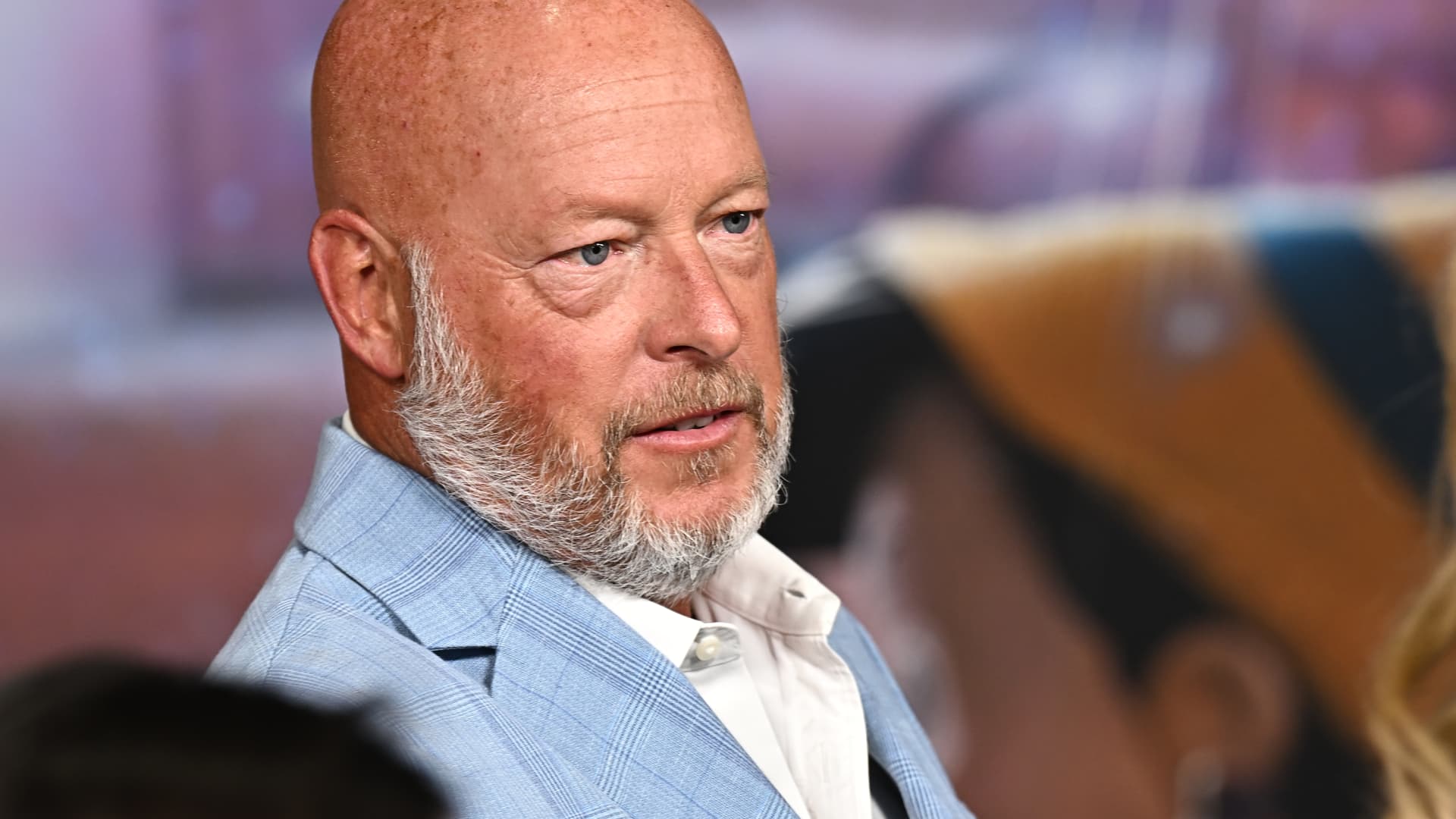
Former Disney CEO Bob Chapek said Monday he voiced concerns about then-Executive Chairman Bob Iger to the company’s board “weekly” during his brief tenure as head of the House of Mouse.

Chapek has remained tight-lipped about his firing from the media giant nearly four years ago, but opened up about his experience in a new tell-all memoir, “Behind the Castle Walls: My Thirty Years at the Happiest Place on Earth,” and in an interview with CNBC’s “Squawk Box.”

Once head of Disney’s theme park and experiences division, Chapek was tapped to take the helm of the company just weeks before the Covid pandemic shuttered movie theaters and amusement parks around the globe in 2020. As Chapek worked to navigate these challenges, Iger remained with the company to handle Disney’s content initiatives like Disney+.

However, Iger slowly began to reassert control, Chapek says. The ensuing power struggle was detailed in a CNBC report in 2023.

Advertisement

“When I started hearing about lunches that he had and dinners that he had where he was absolutely trashing me, and I’d hear it two, three times in the same week, the same bullet points, the same talking points, I was like, ‘I’ve got a problem,’” Chapek told CNBC.

He noted that when he brought concerns to the Disney board about Iger, he was told, “‘He’ll be gone in two years. It’s OK. That’s Bob being Bob.’”

But almost three years after being named CEO, Chapek was ousted and replaced by Iger, who returned to the post until March 2026.

“It would have been great if, like other CEOs, he acted as a steward of my new role,” Chapek said. “It would have been one thing if he was neutral, but to be actually working against me, actively, I thought was just unbelievable.”

Advertisement
Continue Reading

Trending

Copyright © 2025