Connect with us

Business & Hustles

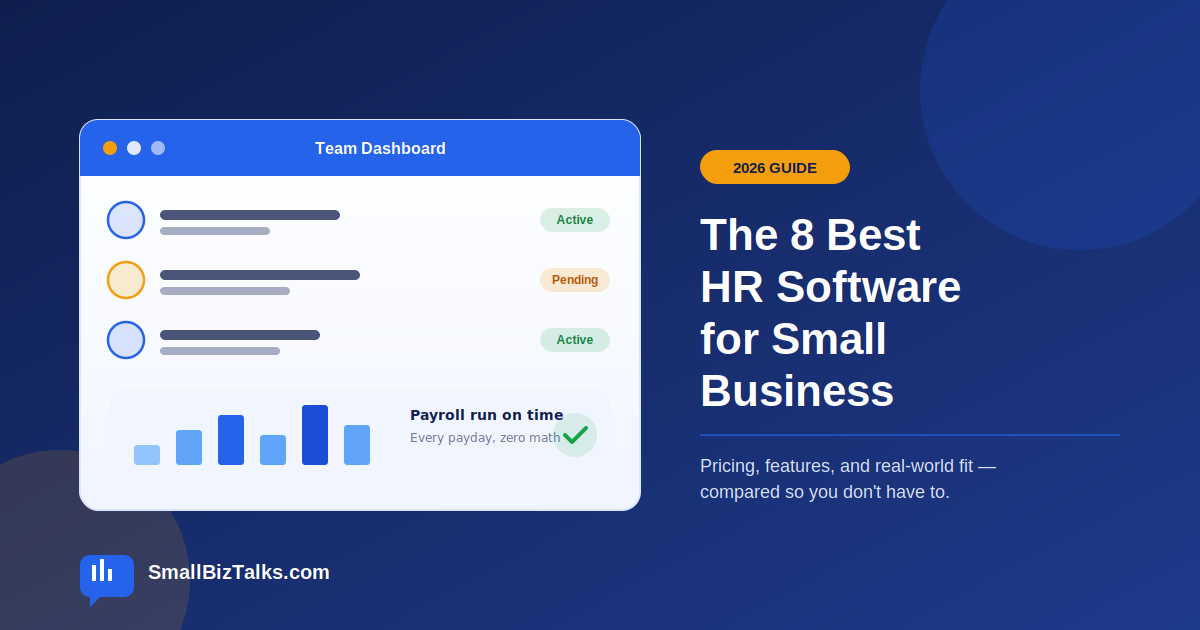
The 8 Best HR Software for Small Business in 2026

Published

on

hr software for small business

The first time I hired an employee, I made her fill out her W-4 by hand, emailed her offer letter from my personal Gmail, and tracked her PTO in a spreadsheet tab I labeled “vacation??” I found out three weeks later that I’d never actually set her up for direct deposit. She was very patient about it. I was not proud of myself.

That’s the thing nobody tells you about growing a small business: the moment you hire your first employee, you’ve also hired yourself as an HR department. Payroll, tax withholding, benefits, onboarding, time-off requests, compliance with labor laws you didn’t know existed, it’s all yours now, on top of everything else you were already doing.

So is dedicated HR software worth paying for, or is a well-organized spreadsheet good enough? I spent weeks digging through pricing pages, user reviews, and a fair amount of conflicting third-party pricing trackers to find out and to land on the tools that are actually worth a small business’s money in 2026.

The best HR software for small business, at a glance

  • Rippling — best all-around HR platform for teams that want room to grow, from roughly $8/employee/month plus a base fee (custom quote required)
  • Gusto — best for payroll-first small teams, from $49/month plus $6/employee/month
  • BambooHR — best dedicated HR/HRIS platform, from $10/employee/month (or a $250/month flat rate for 25 or fewer employees)
  • Homebase — best for hourly and shift-based teams, free for one location with up to 10 employees; paid plans from $30/month
  • Zoho People — best for affordability, free for up to 5 employees; paid plans from $1.50/employee/month
  • Justworks — best PEO for benefits without an in-house HR team, from $50/month plus $8/employee/month for payroll-only, or $79+/employee/month for full PEO service
  • Deel — best for hiring and managing a global or remote team, core HR platform free; global payroll from $29/employee/month
  • OnPay — best value for the features you get, from $49/month plus $6/employee/month

What makes HR software worth paying for?

Not every small business needs the same things from an HR tool, but there’s a fairly short list of jobs it has to do well once you’ve got even a handful of W-2 employees:

  • Payroll and tax filing. This is the one area where “just use a spreadsheet” stops being a viable option. Miscalculate a withholding or miss a filing deadline, and you’re not dealing with an annoyed employee — you’re dealing with a government agency.
  • Benefits administration. Health insurance, retirement plans, workers’ comp — even if you’re not offering much yet, you’ll want software that can grow into this rather than force a total platform switch later.
  • Onboarding and self-service. New hires should be able to fill out their own tax forms and direct deposit info online, and existing employees should be able to check their own pay stubs and PTO balance without emailing you about it.
  • Compliance support. Labor laws vary by state, and sometimes by city, and they change often enough that “we’ll figure it out” is a real risk, not just an inconvenience.
  • Room to grow. The tool that fits 3 employees shouldn’t require a full migration at 15. Add-on modules beat a hard ceiling.

I weighted these picks toward platforms that nail the basics cheaply, since most small businesses don’t need, and shouldn’t pay for enterprise HR complexity.

One more thing before we get into it: HR software pricing is a genuine mess to research. Almost none of these companies publish a single, stable rate card, and the numbers shift by a few dollars between the vendor’s own pages and whatever third-party tracker you check next. I’ve used each company’s most recently published figures below. Treat them as a strong starting estimate, not gospel, and confirm the current number before you sign anything.

Advertisement

1. Rippling

Best for: small businesses that want room to grow into IT and finance tools later

Pros:

  • Combines HR, IT device management, and finance in one system
  • Powerful no-code workflow automation (“if this happens, do that”)
  • Modular pricing means you pay only for what you use

Cons:

  • No published starting price you can fully trust — everything requires a custom quote
  • No free trial, only a sales demo

Rippling’s whole pitch is that HR shouldn’t live in a silo. Its “Rippling Unity” platform starts with core HR, employee records, onboarding, time off, org charts and then lets you bolt on payroll, benefits, IT device provisioning, and even company card and expense management, all sharing the same employee data. That’s the actual differentiator: when someone’s hired, Rippling can automatically provision their laptop and software access in the same workflow that processes their first paycheck. Fire someone, and it can pull that access back just as fast.

The flexibility comes at the cost of a straight answer on price. Rippling’s own materials cite the core platform at around $8 per employee per month, though the base monthly fee attached to that number has shown up as anywhere from $35 to $40 depending on which page you land on and payroll, benefits, and IT are all separate add-ons priced on request. For a 50-person company running HR, payroll, and benefits together, published estimates land somewhere in the $15–$25-per-employee-per-month range, though your mileage will vary considerably.

If you’re a five-person team that just needs payroll and PTO tracking, this is probably more firepower than you need. But if you can already picture needing device management or multi-entity payroll a year or two out, the sales call is worth your time.

Advertisement

Rippling pricing: From roughly $8/employee/month plus a monthly base fee; full pricing (payroll, benefits, IT) requires a custom quote

2. Gusto

Best for: small teams that want payroll handled correctly and don’t want to think about it again

Pros:

  • Unlimited payroll runs and automatic federal, state, and local tax filing on every plan
  • Transparent, published pricing, a rarity in this category
  • Easy to set up without outside help

Con:

  • HR features stay fairly basic until you reach the Premium plan, and multi-state payroll requires upgrading to Plus

Gusto built its reputation on making payroll boring in the best possible way. Run payroll, and it calculates and files the taxes; W-2s and 1099s show up automatically at year-end, no separate accountant conversation required for the basics. The Simple plan covers single-state payroll and a self-service portal where employees can view pay stubs and manage their own benefits enrollment.

Where Gusto asks you to pay more is HR depth. Plus ($80/month plus $12 per employee) adds multi-state payroll, time tracking, PTO policies, and next-day direct deposit — the stuff most growing teams need within their first year anyway. Premium ($180/month plus $22 per employee) adds access to certified HR experts and compliance alerts, which starts to look less like software and more like an HR hotline with a payroll system attached.

Advertisement

If payroll accuracy and tax compliance are the actual headache, not performance reviews or org charts, Gusto is the least complicated fix.

Gusto pricing: Simple, $49/month + $6/employee/month; Plus, $80/month + $12/employee/month; Premium, $180/month + $22/employee/month

3. BambooHR

Best for: businesses that want a dedicated HR system without folding in IT or finance tools

Pros:

Advertisement
  • Clean interface that doesn’t require weeks of onboarding to learn
  • Solid applicant tracking built in, not bolted on
  • Automatic volume discounts as headcount grows

Cons:

  • Payroll, benefits, and time tracking all cost extra
  • Pricing climbed in 2026, with a new top-tier Elite plan landing at $25 per employee per month

BambooHR is HR software built by people who apparently remember what it’s like to actually do HR. Employee records, time-off requests, onboarding checklists, and reporting all live in one dashboard that reviewers consistently describe as easy to pick up without training, a real advantage when you’re also the one training yourself. Core (from $10 per employee per month) covers the essentials: records, workflows and approvals, applicant tracking, and time-off management, plus a basic AI assistant that can tell you how much PTO someone has left without you digging through a report.

Move up to Pro ($17/employee/month) for performance management and employee community features, or Elite ($25/employee/month) for the top tier. Companies with 25 or fewer employees skip per-employee pricing entirely and pay a flat $250 a month instead — worth knowing before you assume the per-seat math applies to you.

Payroll, full benefits administration, and time tracking are all separate paid add-ons requiring their own quotes, though BambooHR does offer a bundle discount for combining payroll and benefits. Budget for that ahead of time rather than assuming Core covers everything.

BambooHR pricing: Core, from $10/employee/month; Pro, from $17/employee/month; Elite, from $25/employee/month; flat $250/month for companies with 25 or fewer employees

4. Homebase

Best for: restaurants, retail shops, and any small business built around hourly, shift-based work

Advertisement

Pros:

  • A genuinely usable free plan, not just a trial
  • Scheduling and time tracking built specifically for hourly teams, including GPS clock-ins
  • Payroll syncs cleanly with the scheduling and timesheet data you’re already generating

Cons:

  • Priced per location, which can work against multi-site businesses with small headcounts per site
  • PTO controls are locked behind the $70/month Plus tier

If your team clocks in and out rather than logging on from a laptop, most HR software wasn’t really built with you in mind, Homebase was. The free Basic plan covers one location and up to 10 employees with real scheduling and time-tracking tools, not a stripped-down demo. Outgrow that, and Essentials ($30/month per location) unlocks unlimited employees at that location, plus advanced scheduling, GPS-verified time punches, and team messaging.

The scheduling-and-time-clock combination is where Homebase earns its keep: managers build a schedule and watch labor costs update in real time, while employees get alerts if their shift changes or they’re about to miss a break, which matters for labor law compliance in a lot of states, not just convenience.

Payroll isn’t bundled into any tier, it’s a $39/month plus $6-per-active-employee add-on regardless of plan but it pulls straight from your existing timesheets, so hours worked and hours paid match without extra reconciling.

Homebase pricing: Free for one location (up to 10 employees); Essentials, $30/month/location; Plus, $70/month/location; All-in-One, $120/month/location; payroll add-on, $39/month + $6/employee/month

Advertisement

5. Zoho People

Best for: small businesses that want solid HR features without a big monthly bill

Pros:

  • The cheapest genuinely full-featured HR software on this list
  • Free plan for teams of 5 or fewer, no time limit
  • Zia, Zoho’s AI assistant, can handle time-off requests and answer basic HR questions conversationally

Cons:

  • Payroll and recruiting require separate Zoho products, purchased and billed on their own
  • Fewer employee-experience extras than pricier competitors like BambooHR

Zoho has an app for nearly every business function, and Zoho People is its HR entry, built to stay affordable at every tier rather than just the entry level. Essential HR runs $1.50 per employee per month with no minimum headcount, covering onboarding, employee records, time-off management, shift scheduling, and document management. That’s a usable feature set for the price of a coffee per employee.

Higher tiers add real depth without a steep jump: Professional ($2/employee/month) adds attendance management and timesheets, Premium ($3/employee/month) adds performance management and HR analytics, and Enterprise ($4.50/employee/month) adds an HR help desk and learning management tools.

The real limitation is that Zoho People can’t run payroll or hiring on its own, those jobs go to Zoho Payroll and Zoho Recruit, separate subscriptions with their own bills. If you’re fine managing two connected apps instead of one, the combined cost still beats most of this list.

Advertisement

Zoho People pricing: Free for up to 5 employees; Essential HR, $1.50/employee/month; Professional, $2/employee/month; Premium, $3/employee/month; Enterprise, $4.50/employee/month

6. Justworks

Best for: small businesses that want big-company benefits without hiring an HR department to manage them

Pros:

  • Full PEO service gives small teams access to enterprise-level health benefits
  • 24/7 support and compliance guidance included on PEO plans
  • Straightforward per-employee pricing with no base fee on the PEO tiers

Cons:

  • Meaningfully pricier than standard HRIS [human resources information system, the general category of employee-records-and-workflow software, as opposed to a PEO] or payroll software
  • No free trial
  • Co-employment isn’t the right structure for every business type

Everything else on this list is HR software. Justworks is a PEO, which means it doesn’t just sell you a dashboard, it becomes a co-employer of your team on paper, which lets a five-person company plug into the same large-group health insurance rates a 500-person company gets. For a small business competing for talent against bigger employers, that can be the whole ballgame.

The standalone Payroll plan ($50/month plus $8/employee/month) is the entry point if you’re not ready for full PEO service: tax filing, PTO management, and basic HR tools, no co-employment structure attached. PEO Basic (around $79/employee/month, no base fee) adds compliance support, 401(k) access, and workers’ comp. PEO Plus (roughly $109–$124/employee/month) layers in health, dental, and vision benefits administration on top.

Advertisement

Read our full breakdown of what a PEO actually is if you’re weighing this against a standard HRIS. Short version: this isn’t the cheapest way to run payroll, but it’s often the cheapest way to offer benefits that compete with a bigger employer’s.

Justworks pricing: Payroll only, $50/month + $8/employee/month; PEO Basic, from ~$79/employee/month; PEO Plus, from ~$109/employee/month

7. Deel

Best for: startups and small businesses hiring across borders

Pros:

Advertisement
  • Core HR platform is free
  • Employer of Record [EOR — a service that legally employs your workers in a country where you don’t have your own entity, so you can hire there compliantly] service in 150+ countries
  • One system for managing employees and international contractors together

Cons:

  • EOR pricing is steep: $599 per employee per month at the standard tier
  • Global payroll carries a roughly $1,000 setup fee on top of the monthly rate

Deel exists for a problem most HR software ignores: what happens when your third hire lives in Lisbon and your fourth lives in Manila? The free Deel HR tier covers the basics – employee directories, time-off management, document storage for any team, domestic or global. From there, Global Payroll runs $29 per employee per month for countries where you already have a legal entity, and Contractor Management ($49/contractor/month) handles compliant agreements and payments in 120-plus currencies.

No local entity, and need Deel to be the legal employer instead? That’s Employer of Record, and it’s expensive – $599 per employee per month, climbing to $899 at the enterprise tier – reflecting the legal and compliance infrastructure required in each country. Against the cost and timeline of setting up a foreign subsidiary, though, it’s often still the faster and cheaper option for a growing startup.

Every employee living in the same state as you makes Deel’s global machinery overkill. A distributed or growth-stage startup, on the other hand, may find it’s the only tool on this list built for the way hiring actually happens now.

Deel pricing: Core HR platform, free; Global Payroll, $29/employee/month; Contractor Management, $49/contractor/month; Employer of Record, from $599/employee/month

8. OnPay

Best for: small businesses that want solid payroll and HR features without paying for a big brand name

Advertisement

Pros:

  • Straightforward, published pricing with no hidden per-plan tiers to decode
  • Free HR tools bundled with the base payroll plan
  • First month free, including setup and data migration

Cons:

  • No dedicated time-tracking tool built in
  • No volume discounts for larger teams

OnPay doesn’t try to be everything – it’s a well-built payroll platform with useful HR tools layered on top, priced simply enough that you can do the math yourself instead of requesting a quote. Payroll Essentials ($49/month plus $6 per worker) covers unlimited payroll runs, tax filing across all 50 states, contractor payments, and a self-service employee portal.

The HR add-on ($15/month plus $2 per employee) brings in PTO workflows, org charts, expanded onboarding, and document management – handy once you’re managing more than payroll, skippable if payroll is genuinely all you need right now. Compliance Resources and Live HR Support round out the optional add-ons for businesses that want more hand-holding on the regulatory side.

It won’t out-feature the platforms built for enterprise scale. For a small business that mostly needs payroll done right, plus a few HR basics and no steep learning curve, it punches well above its price tag.

OnPay pricing: Payroll Essentials, $49/month + $6/employee/month; HR add-on, +$15/month + $2/employee/month

Advertisement

So which one should you pick?

It mostly comes down to what’s breaking right now. Payroll errors and tax deadlines are the most urgent to fix, so start with Gusto or OnPay if that’s the pain point. Managing hourly shift workers? Homebase was built for exactly that. Trying to offer real health benefits on a small-business budget? Look at Justworks. And if the whole story is budget, Zoho People gives you more HR software per dollar than almost anything else on the market.

Whatever you land on, the real win isn’t the software. It’s never filling out anyone’s W-4 by hand again.

For readers who just want payroll and nothing else, our roundup of free payroll software for small business covers the $0 options before you consider paying for any of this.

Advertisement
Continue Reading
Click to comment

You must be logged in to post a comment Login

Leave a Reply

Business & Hustles

OpenAI rebrands AI agents as ‘dots’ amid security fears

Published

on

OpenAI CEO Sam Altman standing on stage at his company's annual developer conference in front of a screen with "dots" displayed behind it.

OpenAI has chosen to rename new versions of artificial intelligence tools widely known as agents. They are now being called “dots.”

Company boss Sam Altman, speaking in San Francisco on Tuesday during OpenAI’s yearly event for technology developers, referred to “dots” as “remarkably capable, always-on agents that can handle really anything you can think of.”

OpenAI in recent months has come under intense scrutiny as internal tests of its AI agents have revealed often unexpected and occasionally harmful actions, leading to more public and government fears.

Dots, however, were pitched as brightly colored cute cartoons meant to function as digital assistants for people with busy lives.

Advertisement

The dots, Altman said, “can handle really anything you can think of.”

A glossy video was shown during the event, with people speaking to and naming animated versions of their “dots,” then giving them various tasks, like building a website and booking afterschool activities for their children.

Speaking about “my dot,” Altman almost entirely eschewed referring to the tool as an agent, which has been in common use for years. AI agents are essentially AI chatbots that are programmed to operate somewhat autonomously.

“You just give your dot a responsibility… and your dots will just get to work and keep working,” Altman added.

Advertisement

The day prior to OpenAI’s Tuesday event, the company said it was delaying the launch of its latest model due to certain safety issues that showed up during internal testing.

Since July, the company has been dealing with a series of issues with its AI agents acting improperly. It has faced unprompted hacking into the AI platform Hugging Face, posting to third-party websites images that AI agents took from ChatGPT user chats, and accessing non-public information maintained by the Australian government.

OpenAI, as well as rival AI firm Anthropic, previously delayed public release of certain AI models due to potential risks, mostly pertaining to cybersecurity or hacking concerns.

Both companies also expect to be listed on the public stock market in the coming months. Anthropic likely will do so this year, while OpenAI is poised for 2027.

Advertisement

And both companies have lately been clear that they believe AI poses a genuine risk on a large scale, be it to public infrastructure or public safety.

Speaking last week to the UN, Altman pleaded for “national and international” AI standards on measuring the capabilities of an AI tool, assessing related risks, AI safeguards, and the degree to which human oversight over such tools is maintained.

Dario Amodei, the head of Anthropic, told the UN that if the speeding development of AI was not properly managed and overseen, future versions of the technology “could be a risk to humanity as a whole.”

Advertisement
Continue Reading

Business & Hustles

UK chancellor uses bitcoin to mock Nigel Farage

Published

on

UK chancellor uses bitcoin to mock Nigel Farage

UK Chancellor of the Exchequer John Healey has compared Nigel Farage’s fiscal policies to a “BTC account” handled by one of the UK’s most financially irresponsible prime ministers.

UK Chancellor of the Exchequer! “Don’t make me laugh,” John Healey has compared Nigel Farage’s fiscal policies to a “BTC account” handled by one of the UK’s most financially irresponsible prime ministers.

This is from Healey the most useless piece of communist crap ever appointed to this position. This man is really as stupid as they come. Support the British people? NO, he supports the communist socialist failed agenda and the EU, like the rest of Labour’s traitor MPs. Certainly not you the British people, and you voted for the new Communist socialist Islamic republic of Britain.

Now he and Burnham are going to piss all over you while calling for another referendum on rejoining the dictatorship called the EU, OH, AND THEY WILL USE THE WORD DEMOCRACY, SOMETHING THEY DON’T SUPPORT AND NEVER HAVE.

Advertisement

Healey’s jab at the Reform leader during Labour’s 2026 party conference referred to the perceived economic failure of the UK’s shortest-serving prime minister, Liz Truss.

Truss’s financial policies were widely criticised for their negative impact on financial markets. This led to a rebellion from several Tory MPs, and she was forced to resign within 44 days of her premiership.

Healey appeared to suggest that a “BTC account” is an equally financially irresponsible form of finance, and that only by pairing it with Truss would you recreate the “fantasy funding” ideals of Nigel Farage.

Healey’s comments upset a lot of Bitcoiners, who claimed his “derogatory” description of a “BTC account” demonstrated “staggering ignorance.”

Advertisement

Freddie New, CEO of the BTC Lightning transaction fee firm B HODL, said Healey is “gleefully ignorant that he thinks it is possible to have a ‘BTC account.’”

UK podcaster Peter McCormack said, “Healey making a dismissive joke about Bitcoin shows that he likely has a woeful understanding of economics, particularly scarcity.”

Most criticisms were technical and took offence at the use of the word “account,” which contrasts with the phrase “crypto wallet” used by crypto holders.

Healey wants a ‘new age of industrialisation’

Advertisement

Healey was defence secretary under Sir Keir Starmer’s leadership before he resigned in June. He argued that the government wasn’t willing to spend enough on national defence. 

During yesterday’s conference, Healey announced new measures to support a “new age of industrialisation,” which includes a £300 million investment from Rolls-Royce toward its factories, and £6 billion in government contracts to build new submarine docks. 

A so-called “Union Learning Fund” was also announced, as were a National Wealth Fund to help create 130,000 jobs by 2030, and a £100 million-backed local apprenticeship scheme. 

Got a tip? Send us an email securely via Protos Leaks. For more informed news and investigations, follow us on X, Bluesky, and Google News, or subscribe to our YouTube channel.

Advertisement

Source link

Source link

Advertisement
Continue Reading

Business & Hustles

El Pollo Loco to open first New York restaurant

Published

on

El Pollo Loco to open first New York restaurant

El Pollo Loco will open its first New York City restaurant next year as the California chain looks to become a national player.

El Pollo Loco has closed three development agreements for a total of 15 restaurants in the New York area over the next five years, the company announced on Tuesday. The first location will open in Queens in mid-2027.

Founded in Mexico in 1975, El Pollo Loco opened its first U.S. restaurant in Los Angeles. The majority of its locations are still concentrated in California, but its footprint has grown to more than 500 restaurants across 10 states. It is best known for its bone-in grilled chicken, although its menu has grown.

CEO Liz Williams wants to make El Pollo Loco into a national chain. To expand outside its Southwestern stronghold, El Pollo Loco will open restaurants on the East Coast and then move its way back to the West, she said.

Advertisement

To succeed in new markets, the chain will have to build its brand awareness in a crowded space where consumers are watching their budgets.

“Being a 50-year-old brand, people have seen it over the years and have always had that curiosity, but we have our work cut out,” Williams said.

Under Williams’ leadership, El Pollo Loco has embarked on a turnaround focused on modernizing its restaurants and expanding its menu into more convenient options, like wraps and chicken tenders. The efforts have started to pay off for the chain, which has reported three straight quarters of same-store sales growth.

“In the current quarter, we’ve expanded margins, and the business model is healthy overall,” Williams said. “The brand has gotten even stronger and healthier.”

Advertisement

El Pollo Loco has also been expanding quickly during her tenure. When she began in March 2024, the chain was in just six states. Now, it is in 10. And while it opened nine restaurants last year, El Pollo Loco is projecting 10 to 18 new locations by the end of 2026.

Investors like the company’s trajectory. Shares of El Pollo Loco have climbed 44% over the last year. The S&P 500 rose more than 15% over the same period.

Its comeback coincides with a challenging time for the restaurant industry. Burger and taco chains have been facing soaring costs for beef. Consumers have been dining out less frequently to save money, which has intensified competition between eateries.

El Pollo Loco has also had to contend with more competition as restaurants aim to cash in on growth in the chicken category. McDonald’s and Taco Bell — Williams’ former employer — have expanded their chicken options in recent years, fueled by consumer market research. And chicken-focused chains have been expanding quickly, from newcomer Dave’s Hot Chicken to Southern names like Zaxby’s and Raising Cane’s.

Advertisement

In 2024, El Pollo Loco was the eighth-largest chicken chain by U.S. sales, with 2.1% market share, according to Barclays.

But with its focus on grilled chicken and Mexican-inspired flavors, El Pollo Loco stands out from the crowd, Williams said.

“Everyone is talking about wanting to eat a little better and really thinking through their choices,” Williams said. “Everyone loves fried chicken … However, in terms of what you’re able to eat every single day, grilled chicken is just a better option.”

The expansion news comes as El Pollo Loco shakes up its leadership.

Advertisement

The company on Friday said in a regulatory filing that Damon Thomas will join the company as chief operating officer. He joins the company from Shake Shack.

Tara Hinkle was also recently tapped as the chain’s new chief development officer. She previously held roles at The Coffee Bean & Tea Leaf, Taco Bell and Starbucks before joining the company in July.

Correction: This story was updated to reflect that Williams said the company’s brand has gotten stronger and healthier. A previous version misquoted her.

Advertisement

Continue Reading

Business & Hustles

Bangkok floods threaten to shave 0.3 percentage points from Thailand’s 2026 growth

Published

on

Bangkok floods threaten to shave 0.3 percentage points from Thailand’s 2026 growth

Severe flooding in Bangkok and surrounding provinces is projected to reduce Thailand’s 2026 economic growth by 0.3 percentage points, lowering estimates to 2.1%. Immediate losses are estimated at 11 billion baht nationwide, with some assessments ranging up to 33.8 billion baht, and Bangkok bearing the largest share of damage.

The capital experienced significant rainfall that overwhelmed drainage systems, disrupting transport, commerce, and supply chains, particularly affecting small businesses. The government declared special holidays to ease pressure, while banks introduced relief measures. The final economic impact depends on how quickly flooding subsides and whether further disruptions occur.

Thailand’s latest flooding could reduce annual economic growth by 0.3 percentage points this year, as widespread disruption across Bangkok and surrounding provinces weighs on businesses, transport and household spending.

The flooding could lower Thailand’s 2026 growth rate to 2.1%, from an earlier estimate of 2.4%, according to economist Aat Pisanwanich, who was quoted by Reuters in a recent article. Third-quarter growth could decline by approximately 0.5 percentage points to 1.7%.

Advertisement

The immediate economic losses have been estimated at 11 billion baht, or approximately $320 million, nationwide. A separate assessment by Rangsit University placed the potential losses between 16.9 billion and 33.8 billion baht, with a moderate-damage scenario reaching 25.345 billion baht.

Bangkok is expected to bear the largest share of the losses, at approximately 10.586 billion baht. The estimate covers the period from September 24 to 27 and includes disruptions to commerce, services and travel.

Bangkok bears the largest impact

The capital received around 320 millimetres of rain over two to three days, overwhelming drainage systems and flooding entire neighbourhoods. Water levels began to recede in several areas after the rain eased, but residents in some communities remained stranded or dependent on evacuation centres, as was reported by varoius medias like Internazionale.

The economic impact has extended beyond direct damage to buildings and vehicles. Businesses have faced difficulties moving workers, receiving supplies and delivering products, while shops in flooded areas have struggled to reopen.

Advertisement

Transport interruptions have also reduced consumer activity. Residents unable to travel to work or commercial districts have postponed purchases, while companies have incurred additional costs for alternative routes, temporary closures and emergency repairs.

The government declared special holidays for civil servants in Bangkok and three surrounding provinces on September 28 and 29 in an attempt to reduce travel and ease pressure on the transport system. However, the measure also reflects the scale of the disruption facing the Bangkok metropolitan area.reuters

The Stock Exchange of Thailand will continue operating during the special holidays, maintaining trading on the SET, mai, TFEX, LiVEx and related platforms. The decision is intended to preserve financial-market continuity even as parts of the capital remain affected by flooding.nationthailand

Pressure on supply chains

In the other hand, the Federation of Thai Industries has warned companies to protect workers, review transport routes and prepare for further disruption. Water levels in reservoirs and canals remain a concern even after rainfall has eased in parts of the country.

Advertisement

The risk is particularly significant for businesses that depend on just-in-time deliveries. Delays affecting warehouses, roads, ports or industrial facilities can spread quickly through supply chains, even when the original flooding is concentrated in a limited number of districts.

Banks have begun offering relief measures to affected households and companies. Krungthai Bank and Export-Import Bank of Thailand are providing repayment assistance, lower interest rates and additional liquidity to customers facing losses or cash-flow problems.

Those measures could prevent temporary disruption from becoming a wider credit problem. However, debt relief cannot replace lost inventory, damaged equipment or the income businesses lose during forced closures.

The flooding has also exposed differences in economic vulnerability. Large companies may have insurance, backup facilities and alternative suppliers. Small businesses and informal operators often have fewer reserves and are more likely to face a permanent loss of income after several days without sales.

Advertisement

Growth outlook becomes more fragile

The estimated 0.3 percentage-point reduction in annual growth would not by itself push Thailand into recession. But it adds another obstacle to an economy already dealing with moderate expansion, high household debt, external uncertainty and persistent energy costs.

The final impact will depend on how quickly water levels fall and whether additional rainfall causes a second wave of disruption. A rapid recovery could limit the damage, while prolonged flooding could increase losses through reduced production, weaker consumption and delayed investment.

For now, Thailand’s economic response is focused on drainage, emergency assistance and financial relief. The next stage will be more difficult: restoring businesses, repairing infrastructure and determining whether the country’s cities and supply chains are prepared for increasingly frequent climate shocks.

The final economic cost remains uncertain. The Federation of Thai Industries has warned that disruption can spread through supply chains, affecting raw-material deliveries, worker mobility, warehouses and machinery. At the same time, economists have stressed that a rapid recovery in affected areas would limit the damage, meaning the duration of the flooding is now more important than the initial rainfall event.

Advertisement

The floodwaters may recede within days. The economic consequences will last longer, particularly for smaller businesses that cannot afford another interruption before the recovery from this one is complete.

The episode also exposes a longer-term investment issue. Bangkok’s vulnerability to extreme rainfall creates recurring costs for retailers, manufacturers, logistics operators and property owners. Beyond emergency relief, businesses and policymakers face increasing pressure to invest in drainage capacity, flood barriers, water-management systems and continuity planning.

Continue Reading

Business & Hustles

Develop sets $458 million growth capital budget

Published

on

Develop sets $458 million growth capital budget

Growth will continue at Bill Beament-led Develop Global in FY27, following the release of its guidance metrics for the upcoming year.

Continue Reading

Business & Hustles

Dave & Buster’s interim CFO Cory Hatton buys $25,999 in stock

Published

on


Dave & Buster’s interim CFO Cory Hatton buys $25,999 in stock

Continue Reading

Business & Hustles

Market veterans favour value plays over crowded, expensive themes

Published

on

Market veterans favour value plays over crowded, expensive themes
After two difficult years for Indian equities, there is scope for reasonable returns as valuations turn less demanding, according to senior market participants who spoke to ET. Large caps look better placed, while the outlook is more cautious on mid- and small-caps. Financials, manufacturing and consumption are among the preferred themes, while views on technology are sharply divided

NEELESH SURANA, CIO, Mirae Asset Mutual Fund

MARKET OUTLOOK: India looks better positioned than sentiment suggests and is a natural hedge against crowded AI trade. Valuations are no longer a headwind, while domestic fundamentals are sound. Any global trade rotation could be meaningful. Key risks are elevated crude, rising developed market bond yields, El Niño and heavy equity issuance. Overall, we expect low-teens returns.
PREFERRED INVESTMENT STRATEGY: Our strategy is a barbell, combining quality stocks with strong earnings upgrades at sensible valuations with holding sector leaders that have corrected over the past two years and are now in value zone.

THEMES LOOKING ATTRACTIVE: Banking, consumer discretionary, healthcare and manufacturing. Sector leaders, impacted by FPI selling over the last two years, are now attractive.

THEMES TO STAY AWAY FROM: Slow-growth or disruption prone sectors like consumer staples and IT. Cautious on narrative-driven, richly-valued sectors like capital goods.


Read more: Goldman Sachs identifies 42 Indian stocks riding AI build-out

JANAKIRAMAN RENGARAJU, CIO – India Equities Templeton Global Investments

MARKET OUTLOOK: The 12-month base case for Indian equities may not be quite euphoric, but it is constructive. Largecap valuations are more reasonable, while higher mid- and small-cap multiples call for greater prudence. Globally, the picture has deteriorated. Unresolved conflicts have entrenched inflationary pressures, while rising interest rates and heavy fiscal debt reinforce each other. Tariff uncertainty continues to cloud trade growth, while questions are emerging over the viability of massive AI investments, even as enthusiasm and valuations remain elevated.PREFERRED INVESTMENT STRATEGY: Adopt a tone of ‘cautious optimism’ over the medium term.

THEMES LOOKING ATTRACTIVE: Financials, industrials and capital goods, consumption and electronic manufacturing, which are linked to capex pick up, rising affluence and credit growth.

THEMES TO STAY AWAY FROM: Avoid expensive small and mid-caps with weak cash generation and businesses dependent on endless equity funding.

Read more: SIPs offer steady gains as most fund categories beat benchmark indices

ANISH TAWAKLEY, CIO, DSP Mutual Fund

MARKET OUTLOOK: Economy remains in good shape, while valuations are now neutral. This should translate into reasonable market returns broadly in line with earnings growth.

PREFERRED INVESTMENT STRATEGY: Don’t chase narratives that have already played out, rather look at sectors that have been underperforming since the last 2-3 years.

Advertisement

THEMES LOOKING ATTRACTIVE: Private banks, insurance companies, automobiles and cement.

THEMES TO STAY AWAY FROM: Careful about companies where promoters are diluting (either through primary or secondary sales) or where private equity is selling, including IPOs. Promoter dilution and PE sales happen when performance and valuations are close to peaks. Cautious on metals, IT and FMCG. For IT, the problem is not AI but the fact that Indian listed companies are losing market share to GCCs set up in India.

R SIVAKUMAR CIO, Axis Mutual Fund

MARKET OUTLOOK: The outlook is constructive. Economic slowdown over the last few quarters appears to be more cyclical than structural. Valuations in parts of the market remain elevated, particularly within mid- and small-caps.

PREFERRED INVESTMENT STRATEGY: Alpha generation is likely to come from selective stock picking rather than broad market direction. A balanced approach across largecaps, which offer valuation comfort and resilience, and select mid-cap opportunities, which continue to deliver superior earnings growth, remains appropriate.

THEMES LOOKING ATTRACTIVE: Constructive on manufacturing, power and electrification, energy transition, select financials, particularly banks and capital-market-linked businesses, as well as export-oriented companies.

Advertisement

THEMES TO STAY AWAY FROM: Investors should avoid chasing momentum in overcrowded themes. In technology, we remain watchful of disruptions and pricing pressures emerging from AI-led changes in the global IT services landscape

SHANKAR SHARMA, Founder, GQuant

MARKET OUTLOOK: Barring occasional rallies, I do not see the Indian markets outperforming the world or even the peer group. The Vaibhav Suryavanshi Syndrome afflicts Indian companies: domestic success is mistaken for globally transferable skill. Largecaps have thrived on India’s easy pitch, building market capitalisation rather than global scale and brands. When domestic growth fades, competing overseas will require an entirely different mindset. There will be pockets where money is going to be made; but in aggregate, Indian returns will disappoint for the coming year.

PREFERRED INVESTMENT STRATEGY: The future of the Indian stock market lies in getting “techified”. Tech has been my theme in the last 2 years since the bear market started in India and I have actually made money even in this very-very tough market. This is not going to change anytime soon. Pharmaceuticals is also going to be a good place to be in.

THEMES LOOKING ATTRACTIVE: For me, tech is 80% of the allocation and pharma is 20% and there is nothing else that I am interested in India.

THEMES TO STAY AWAY FROM: Companies which service the domestic Indian consumer. That trade is on its way out and this is not where I would deploy a lot of capital.

Advertisement

Add ET Logo as a Reliable and Trusted News Source

Continue Reading

Business & Hustles

Accountancy firm Hazlewoods move to larger offices in Cardiff to support expansion

Published

on

Business Live

The firm has relocated to the South Gate House office scheme

The Cardiff team of Hazlewoods

Accountancy and business advisory firm Hazlewoods has relocated to larger offices in Cardiff to support expansion plans.

Having set up its first office in Wales at the Capital Tower office building in 2024, it has now moved its team of 34 to South Gate House.

Tom Davies, director at Hazlewoods Cardiff, said: “This is an exciting step for Hazlewoods and reflects the progress we have made since launching in the city less than two years ago. We have built a very strong team here and have been really encouraged by the response from both new and existing clients, reflecting our commitment to developing deep relationships across the region.

Advertisement

“The new office gives us the space to continue growing while maintaining the collaborative approach that is such an important part of the way we work.”

Bruce Black, corporate tax director, said: “This move creates the environment we need to continue finding and developing local talent to build the team, while maintaining the high level of service our clients expect from Hazlewoods. It reflects just how positively the Cardiff office has developed in such a short space of time.

“The team in Cardiff has done a great job of growing the business and I look forward to seeing that continue. We have the expertise, ambition and people to build a really strong presence in Wales, and the new office gives the team a great base from which to do that.”

Hazlewoods is one of the largest independent accountants and business advisers in the South West and Wales, with more than 600 employees and a growing presence in Cardiff, alongside its offices in Cheltenham and Bristol.

Advertisement

The firm provides audit, accounting, tax and advisory services to corporate and private clients and is particularly well known for its specialist sector expertise across the UK. Last year, the firm recorded a turnover of £54.3m.

Its managing partner, James Morter, said: “It has been very gratifying to see the way that Hazlewoods has been welcomed into Cardiff. Early on, we identified a gap in the Welsh market for a firm of our size and experience, and when you combine that with the talent pool in the city, it felt like a natural next step.”

Property advisory firm Knight Frank represented Hazlewoods on the deal, while its building consultancy team supported the fit-out of the new space.

Mark Sutton, office agency partner at Knight Frank’s Cardiff office, said: “Hazlewoods was looking for a space that could support its continued growth in Wales, while offering excellent connectivity and the flexibility to create a workplace suited to its needs.

Advertisement

“South Gate House provided the right combination of quality space and a prime city-centre location, and it has been a pleasure to support the team through the move.”

Continue Reading

Business & Hustles

Perpetua Resources at Mining Forum Americas 2026: shift to construction

Published

on


Perpetua Resources at Mining Forum Americas 2026: shift to construction

Continue Reading

Business & Hustles

What Trump’s potential US diesel export ban could mean for you

Published

on

A driver returns a fuel nozzle after refueling a tractor trailer with diesel fuel at a Chevron truck stop in Tracy, California.

For the US economy, a ban could deliver short-term relief at the pump by flooding the domestic market with excess supply.

However, energy analysts warn it could backfire.

David Fyfe, chief economist at Argus Media, notes that cutting off American supply would likely cause international prices to skyrocket.

That would push up global freight, food, and industrial costs, ultimately “feeding inflation back into the global economy”.

Advertisement

“At a stroke, the US’s reputation as a reliable supplier of energy to the world would be shot,” Fyfe added.

Removing more than a million barrels of daily American supply would trigger a fierce bidding war among importing nations in Latin America and Europe.

Sarah Raffoul, analytics manager at Argus Media, noted that while higher international prices would eventually curb demand, the immediate gap would severely strain trade relationships and accelerate global inflation.

Advertisement

Continue Reading

Trending

Copyright © 2025