
Business & Hustles
Value-Up Arrives in ASEAN: Six Markets Competing to Narrow the Gap


ASEAN is adapting Japan and Korea’s corporate value-up models to improve governance, disclosure, and investor participation. Countries like Singapore, Malaysia, Thailand, Indonesia, Philippines, and Vietnam are implementing various value-up programs. The goals are similar: better shareholder returns, governance, and investability. Companies can enhance visibility and access to capital by improving capital allocation, shareholder returns, and investor engagement. ASEAN’s value-up agenda is progressing towards more structured expectations and greater regional alignment, enhancing the region’s capital markets’ integration.
ASEAN’s value-up agenda is evolving from market-specific reforms into a broader push to improve corporate value, governance and investor participation. Inspired by Japan’s 2023 reforms and Korea’s 2024 Corporate Value-Up Program, the region is adapting the model to local priorities. Singapore has introduced its Equities Market Review and S$30 million Value Unlock programme; Malaysia launched MY Value Up Programme for 88 large listed companies; and Thailand has linked value-creation initiatives with domestic investment incentives. Indonesia is pursuing governance and market-structure reforms, the Philippines is emphasising investor engagement, while Vietnam remains focused on strengthening market quality and infrastructure.
Despite different approaches, the objectives are similar: better capital allocation and shareholder returns, stronger governance and disclosure, and greater investability. These priorities address persistent constraints including concentrated ownership, limited free float, uneven institutional participation and gaps in research coverage. For companies, stronger capital allocation, shareholder-return policies and investor engagement can improve market visibility and access to institutional and international capital.
Implementation will determine whether these programmes deliver lasting value. Voluntary frameworks risk superficial compliance, while ownership, free-float and liquidity constraints require broader structural change. As ASEAN moves towards more structured expectations and greater regional alignment under initiatives such as the ACMF Action Plan 2026-2030, companies that improve capital efficiency, transparency and investor engagement early should be better positioned as regional capital markets become more integrated.
Background: Where Value-Up Came From and Why It Spread
Japan’s Template
The Tokyo Stock Exchange (TSE)’s Value-Up initiative took shape in March 2023, when the TSE asked all Prime and Standard Market companies to assess their cost of capital and profitability, identify areas for improvement, and disclose plans to strengthen capital efficiency and market valuation. The TSE subsequently began publishing a monthly list of companies that had disclosed their responses, adding market visibility and reputational pressure to an otherwise principles-based framework.
The initiative coincided with a marked re-rating of Japanese equities. By 10 November 2023, the TOPIX had risen 24% for the year. Foreign investors recorded ten consecutive weeks of net buying between April and June, with purchases of cash equities and futures totalling ¥7.9 trillion. At the company level, the share of Prime Market companies trading below book value fell from 50% in July 2022 to 44% in July 2025, while those recording return on equity (ROE) below 8% declined from 47% to 43%. While broader market and macroeconomic factors also contributed, these shifts coincided with greater scrutiny of capital efficiency, governance and shareholder returns.
South Korea’s Iteration
Korea followed in February 2024 with its Corporate Value-Up Program, adapting elements of Japan’s approach to address the longstanding “Korea discount“. The programme encourages listed companies to voluntarily disclose plans covering capital efficiency and shareholder returns, supported by a Korea Value-Up Index, related ETFs, tax incentives and broader governance reforms.
In 2025, the KOSPI rose 75.6%, while the Korea Value-Up Index gained 89.4%. Cash dividends reached KRW50.9 trillion, up 11.1% year on year, while treasury-share cancellations rose to KRW21.4 trillion. Net assets in Value-Up ETFs reached KRW1.3 trillion by year-end, up 162.5% from their inception. Corporate participation accelerated further in 2026: full disclosures rose from 179 in February to 582 in March and 747 by July, with the March increase following tax changes that strengthened incentives for participating high-dividend companies. While these outcomes cannot be attributed to the programme alone, they point to stronger corporate participation and investor interest.
Taiwan Joins, and the Model Broadens
In 2024, Taiwan made “Strengthening the Capital Market and Enhancing Market Value” a key TWSE priority. Building on similar initiatives in Japan and Korea, the strategy encourages listed companies to assess indicators such as cost of capital, profitability and PBR, develop measures to enhance corporate value, and communicate them to investors. The TWSE subsequently incorporated Corporate Value Enhancement Plans into its Corporate Governance Best Practice Principles and launched an IR engagement platform in December 2024 to strengthen communication between listed companies and institutional investors.
Why Value-Up Resonates Across ASEAN
The structural frictions behind North Asia’s value-up reforms are also visible across parts of ASEAN. Despite substantial market development, ASEAN capital markets vary considerably in depth, liquidity and institutional participation. The ACMF has highlighted relatively small individual market size, subscale trading volumes and limited liquidity as constraints on regional market development, while the ADB noted in 2026 that ASEAN markets had yet to reach the scale needed to support the region’s long-term development ambitions. These conditions increase the relevance of measures aimed at improving disclosure, corporate value and investor engagement.
Regulators and exchanges are already moving in this direction. Singapore has expanded research coverage for smaller issuers through the Grant for Equity Market Singapore (GEMS); Malaysia’s Capital Market Masterplan 2026-2030 has emphasised stronger governance and sustainability disclosure; and Thailand’s Corporate Governance Code and SET ESG Data Platform support greater transparency, shareholder engagement and long-term value creation. Together, these initiatives provide a foundation for the broader value-up frameworks now emerging across ASEAN.
The Current State of Play Across ASEAN
The six markets sit at different points on the value-up spectrum, ranging from established programmes with dedicated funding and incentives to earlier-stage governance and market-development reforms.
Singapore
In November 2025, the Monetary Authority of Singapore’s Equities Market Review Group closed a year of consultation with a package of measures built around a S$30 million Value Unlock scheme, a second tranche of Equity Market Development Programme (EQDP) fund-manager appointments, and an SGX-Nasdaq dual-listing bridge. Implementation has since progressed in 2026. MAS expanded the EQDP from S$5 billion to S$6.5 billion, while the Value Unlock programme opened for applications through its Equip and Elevate grants, which co-fund training and professional advisory support in areas including corporate strategy, financial management and investor relations. Meanwhile, SGX and MAS have advanced the regulatory framework for the Global Listing Board, designed to provide eligible companies with a streamlined pathway to dual listings on SGX and Nasdaq.
A March 2026 MAS speech by Managing Director Chia Der Jiun positioned these measures as part of a broader effort to embed value creation more firmly into Singapore’s corporate and market architecture. MAS is reviewing the Code of Corporate Governance to place greater emphasis on boards’ responsibilities for shareholder value creation and investor engagement, while SGX is working towards mandatory disclosures covering areas such as dividend policy, investor relations policy and the link between remuneration and value creation. This suggests that Singapore’s approach is beginning to extend beyond voluntary capability-building towards stronger market-wide expectations around how companies create and communicate shareholder value.
This is complemented by measures addressing the demand and visibility sides of the market. By February 2026, S$3.95 billion under the EQDP had been allocated across 9 asset managers, while the enhanced S$50 million GEMS scheme had supported more than 1,500 research reports and provided first-time coverage for over 100 stocks. Together with Value Unlock, these measures give Singapore a comprehensive framework, combining company-level value creation with institutional capital, research coverage and potentially stronger disclosure requirements.
Malaysia
Malaysia launched its MY Value Up Programme in April 2026 as a joint initiative of the Securities Commission and Bursa Malaysia under the Capital Market Masterplan 2026-2030. The initial programme focuses on 88 of the largest public-listed companies, each with a market capitalisation of about RM4 billion or more and collectively representing around 80% of Bursa Malaysia’s total market capitalisation. Participation remains voluntary but is highly encouraged.
The programme asks companies to develop and communicate medium- to long-term Value Up Plans setting out their growth strategies, targets and capital allocation priorities, supported by stronger board-level accountability and investor engagement. Rather than prescribing uniform performance targets, the Guidebook provides a principles-based framework and suggested metrics that companies can adapt to their business and industry. These include measures of capital efficiency and shareholder value, such as ROE relative to the cost of equity, alongside shareholder returns and relevant market-valuation and sector-specific indicators.
Implementation is being phased. In 2026, the focus is on familiarisation and alignment, with regulators engaging targeted companies on the submission of their plans. From 2027, targeted companies are expected to begin publishing their Value Up Plans, creating a public baseline for investor assessment and engagement. The framework could become more prescriptive over time, with regulators indicating that mandatory disclosure requirements may be considered from 2028. Alongside the MY Value Up Programme, Bursa Malaysia’s expanded Research Incentive SchemE Plus (Bursa RISE+) complements the initiative by providing research coverage for selected companies, helping to improve their visibility and investor awareness.
Thailand
The Stock Exchange of Thailand (SET) launched the JUMP+ Program to help listed companies strengthen their competitiveness and create long-term corporate value. The program supports companies throughout the process, from developing their growth plans to putting them into action.
The inaugural JUMP+ cohort comprises 142 listed companies that voluntarily joined the program, surpassing the initial target of 100 companies. As of 1 April 2026, they represented approximately 16% of all listed companies and 14% of total market capitalization. Participants span all industry groups across SET and mai.
At the core of JUMP+ is a three-year value-creation plan for 2026–2028, approved by each company’s board of directors and covering three dimensions: Business, Governance and Climate Action. Participating companies have developed 277 Business Plans, focusing on areas including revenue and profit growth, business expansion, operational efficiency and competitiveness. On governance plans, participants have set out 459 governance initiatives addressing accountability and transparency, people and risk management, and board structure and qualifications. Meanwhile, more than 80% of participating companies have developed Climate Action Plans, including initiatives on greenhouse gas measurement, verification and emissions reduction.
JUMP+ Program Framework
Supporting Companies from Planning to Action
SET, the Capital Market Development Fund (CMDF) and partner organizations support companies in implementing their JUMP+ plans through grants of up to THB 5 million, advisory services, training and workshops, and corporate visibility activities such as JUMP+ Investor Day, roadshows, media program and research coverage.
Participating companies have now entered the implementation phase, with progress to be reported every six months and communicated to investors through activities such as Earnings Call (Opportunity Day).
Linking Corporate Value Creation with Domestic Investment
JUMP+ is also connected to Thailand’s broader domestic investment ecosystem. Under the expanded Thai ESG and Thai ESGX rules, shares of JUMP+ participants with a Corporate Governance Report (CGR) score of at least 90 may qualify as eligible investments.
As of 27 February 2026, 77 Thai ESG funds, including Thai ESGX funds, were managed by 19 asset managers, with aggregate net asset value of approximately THB 104.1 billion. This provides a potential channel for eligible companies’ value-creation plans and progress to gain greater visibility among domestic investors.
By connecting strategy, implementation, support and investor transparency, JUMP+ aims to help Thai listed companies strengthen competitiveness, pursue sustainable growth and create long-term value.
Indonesia has pursued value-up through market-structure and governance reform. In February 2026, the Financial Services Authority (OJK), together with the Indonesia Stock Exchange (IDX) and Indonesia Central Securities Depository (KSEI), accelerated an eight-point capital-market reform agenda aimed at strengthening liquidity, transparency and investor confidence. The reforms focus on ownership transparency, free float, enforcement and listed-company governance, addressing concerns over concentrated shareholdings and investability that had weighed on the market’s standing with international investors.
A central pillar is tighter ownership and free-float disclosure. IDX amended Regulation I-A in March 2026 to strengthen free-float requirements, including a minimum 15% threshold for the largest new listings, while refining the definition of free float and strengthening governance requirements for listed companies. OJK, IDX and KSEI also introduced public disclosure of shareholdings above 1%, implemented a High Shareholding Concentration framework, expanded investor classifications in KSEI ownership data to 39 categories, and strengthened reporting of controlling shareholders, directors, commissioners and beneficial owners. Together, these measures are intended to make effective ownership and investable float easier for investors and index providers to assess, while improving price discovery and market liquidity.
Indonesia Capital Market Transparency Reform Framework
Source: BRI Danareksa Sekuritas
The reforms have received recognition from global index providers, but implementation remains under scrutiny. MSCI acknowledged Indonesia’s transparency reforms in April 2026 and, in its June Market Classification Review, described the measures as a step in the right direction while retaining Indonesia’s Emerging Market status. However, it continued to flag concerns over shareholder transparency and trading behaviour, and warned that insufficient progress by the November 2026 Index Review could trigger further action, potentially including consultation on a reclassification to Frontier Market status.
The Philippines has taken a more engagement-led approach to corporate value creation, focusing on improving the connection between listed companies and investors. The Philippine Stock Exchange (PSE) launched InvestPH in 2025 as a platform to showcase listed companies and the broader Philippine investment opportunity to domestic and foreign institutional investors. Institutional investors account for around 80% of PSE trading activity, making deeper engagement with this investor base particularly relevant to market liquidity and company visibility. The inaugural event attracted more than 300 participants and facilitated 180 one-on-one meetings between institutional investors and participating listed companies. The initiative expanded in 2026, when foreign investor participation nearly doubled and 250 one-on-one meetings were held between institutional investors and companies. InvestPH 2026 also placed corporate governance and value creation more explicitly on the agenda, including a dedicated session on “Governance and Value Up Reforms” involving the Securities and Exchange Commission and listed-company executives.
This engagement extends beyond the annual conference. Since 2022, the PSE and Bloomberg have jointly organised Investor Relations Workshops aimed at strengthening communication between listed companies and investors and sharing strategies to enhance stakeholder value. The 2025 workshop, for example, brought together 34 participants, including representatives from 12 PSE-listed companies. The PSE also holds PSE STAR (Strengthening Access and Reach): Investor Day, which allows listed companies to present their performance, developments and growth strategies through live and on-demand briefings. As of August 2026, the PSE had conducted 13 editions featuring 75 listed companies. The latest, held on August 17 and 18, featured live briefings from executives of 13 companies. These initiatives are supported by efforts to improve corporate disclosures. In January 2025, the PSE released ESG 101: A Reporting Guidebook to help issuers produce reliable disclosures of material sustainability information and connect ESG performance with business strategy, financial results and long-term value creation. Together, these initiatives reflect an emerging model centred on stronger investor communication, corporate visibility and direct engagement.
The engagement push is being complemented by broader reforms intended to make the Philippine capital market more accessible and competitive. The Capital Markets Efficiency Promotion Act (CMEPA), which took effect in July 2025, reduced the stock transaction tax from 0.6% to 0.1%, alongside other measures aimed at simplifying taxation and lowering transaction costs. This provides an important market-structure counterpart to the PSE’s engagement and disclosure initiatives seek to improve how companies communicate their value proposition, while reforms such as CMEPA reduce frictions for investors seeking to allocate capital. The Philippines’ model therefore remains less prescriptive than the value-up frameworks emerging elsewhere in ASEAN, but is increasingly building the infrastructure for stronger investor engagement, visibility and market participation.
Vietnam
Vietnam remains an observer of the regional value-up trend, with reforms focused on strengthening market quality rather than establishing a dedicated company-level programme. Under its Securities Market Development Strategy to 2030, the government aims to raise listed-company governance above the Southeast Asian average, strengthen ESG practices and attract greater institutional and foreign participation. The Securities Market Upgrade Scheme, approved in September 2025, further links these reforms to Vietnam’s ambition to meet international emerging-market standards. Progress was recognised by FTSE Russell in October 2025, when it announced that Vietnam would be reclassified from Frontier to Secondary Emerging Market status, effective September 2026. FTSE Russell cited improvements including the removal of prefunding requirements for foreign institutional investors and enhancements to market infrastructure, while noting that Vietnam had met all criteria for Secondary Emerging Market status.
Timeline for the reclassification of Vietnam from Frontier to Secondary Emerging Market
Source: VinaCapital
Progress continued in 2026, with the State Securities Commission (SSC) prioritising improvements in corporate governance, information disclosure and auditing, alongside stronger market supervision and further securities-law reforms. Vietnam therefore remains at an earlier stage than Malaysia or Thailand: its current focus is on building the governance, transparency and market infrastructure that could support more explicit corporate value-up initiatives over time.
Opportunities for Companies to Uplift Their Value
For issuers, the region’s emerging value-up frameworks point to four interconnected opportunities: (1) improving capital efficiency and shareholder returns; (2) strengthening governance, disclosure and investor engagement; (3) broadening the investor base and market visibility; and (4) benchmarking against regional and global best practice. Together, these measures can reinforce investor confidence, improve access to capital and support stronger corporate value over time.
Improve Capital Efficiency and Shareholder Returns
The most direct opportunity is to improve how companies earn, allocate and return capital. Companies can divest non-core or underperforming assets, unwind inefficient cross-shareholdings and redirect capital towards businesses capable of generating stronger returns. Evidence from Japan supports the link between capital efficiency and market valuation: a 2026 Journal of Corporate Finance study of the Tokyo Stock Exchange’s initiative found that investors particularly favoured low-PBR companies with higher ROE, alongside valuation improvements among persistently undervalued firms.
Disciplined capital allocation is particularly relevant in Southeast Asia. BCG’s 2025 Southeast Asia Value Creators Report, covering 525 listed companies, found that the region generated a market-cap-weighted total shareholder return (TSR) of 12.4% over the six years to July 2025, but a median TSR of only 4.4%. Multibusiness conglomerates, representing around 8% of regional market capitalisation, recorded a median TSR of 0%. BCG identifies sharper capital allocation as one of the key levers for addressing this gap, including clearer prioritisation between investment in core businesses, M&A, dividends and share buybacks.
Six-year TSR by Region (31 July 2019-31 July 2025, %)
Source: BCG 2025 Southeast Asia Value Creators Report
Where attractive reinvestment opportunities are limited, companies can return surplus capital through sustainable dividends, share buybacks and share cancellations. These measures should form part of an integrated capital-allocation framework: investment should take priority where expected returns exceed the cost of capital, while excess capital can be returned when compelling opportunities are unavailable.
Strengthen Governance, Disclosure and Investor Engagement
Strong governance supports value creation by increasing investor confidence in how companies are managed and capital is allocated. The ASEAN Corporate Governance Scorecard (ACGS) provides a common regional benchmark covering shareholder rights and equitable treatment, disclosure and transparency, sustainability and board responsibilities.
In 2026, the Singapore Governance and Transparency Index (SGTI) assessment of 458 listed companies illustrates both progress and remaining gaps. The overall mean governance score reached 69.5, but only 33% of dividend-paying companies disclosed a dividend payment policy, 40% explained how boards solicit shareholder views, and 49% disclosed an investor relations policy. These gaps highlight opportunities for companies to differentiate themselves through clearer capital-return policies and more structured investor engagement.
B.R.E.A.D Score by Percentage (General Performance)
Source: Corporate Governance for the Value Era
Governance improvements are most effective when accompanied by forward-looking disclosure and regular communication with investors. Clearer reporting of capital-allocation priorities, medium-term objectives and progress against targets can reduce information asymmetry, while investor engagement allows management to explain strategic decisions and better understand shareholder concerns.
Broaden the Investor Base and Improve Market Visibility
Companies can broaden their investor base by improving both investability and visibility. Free float and trading liquidity are important because major global indices consider shares actually available to investors when determining index inclusion and weights. MSCI’s Global Investable Market Index Methodology uses a Foreign Inclusion Factor reflecting shares available to international investors, while FTSE Russell similarly adjusts index weights for public free float. MSCI further refined its methodology in its May 2026 Index Review by introducing more granular free-float bands.
Visibility is particularly important for small- and mid-cap companies. The OECD’s 2025 review of equity markets for growth companies found that 54% of surveyed jurisdictions identified insufficient research availability as an investor challenge, while another 8% cited the cost of obtaining research. Companies can address this through stronger investor relations, accessible corporate information and broader analyst coverage, helping reduce information asymmetries, support liquidity and attract a wider range of investors.
Comparison of Free Float Levels between Growth and Main Markets, end-2023
Source: OECD 2025 Equity Markets for Growth Companies
Benchmark Against Regional and Global Best Practice
Benchmarking against regional and global peers can help companies identify gaps in governance, disclosure, investor engagement and capital efficiency, while providing a practical basis for strengthening their investment proposition. This is becoming increasingly relevant as investor expectations and market standards converge across jurisdictions.
Regional initiatives are reinforcing this trend. The ASEAN Capital Markets Forum’s (ACMF) Action Plan 2026-2030 seeks to deepen market connectivity and promote greater consistency and interoperability across ASEAN capital markets, including more comparable sustainability disclosures and stronger cross-border investment frameworks. As standards converge, companies that benchmark against leading peers can identify gaps earlier, adapt to changing investor and regulatory expectations, and compete more effectively for regional and international capital.
ACMF Action Plan 2026-2030: Strategic Priorities and Initiatives
Source: ACMF Action Plan 2026-2030
Challenges and Path to Implementation
Superficial Compliance
Voluntary or principles-based frameworks risk encouraging disclosure without meaningful changes to capital allocation, governance or shareholder returns. Clear targets and progress monitoring are therefore important. The TSE publicly tracks companies’ disclosure status, while Thailand’s JUMP+ requires board-approved 2026-2028 value-creation plans and half-yearly updates, helping investors distinguish substantive reform from participation in name only.
Weak Incentive Design
Participation also depends on whether the benefits justify the costs of additional disclosure, governance reform and changes to capital allocation. As the OECD highlights, governance frameworks should align incentives with long-term value creation rather than compliance alone. Value-up programmes therefore need sufficiently clear benefits to encourage meaningful participation.
Free Float and Ownership Transparency
Concentrated ownership can limit free float and institutional participation. OECD research finds that strategic individuals hold more than one-quarter of equity in growth companies, versus 7% in main-market companies, while institutional ownership stands at 18% versus 46%. Clearer ownership structures and greater tradable float can therefore improve investability and broaden the investor base.
Liquidity
Limited market liquidity can also constrain the impact of company-level reforms. Institutional investors held only 21% of Asian listed equity in 2025, compared with 47% globally, with holdings below 10% in Indonesia, the Philippines and Vietnam. Addressing this gap requires improvements in free float and investor engagement alongside broader efforts to deepen institutional participation and secondary-market activity.
Institutional Investor Holding in Asia, 2025
Source: OECD Asia Capital Markets Report 2026
Outlook
ASEAN’s value-up agenda is likely to become more structured as regulators move from encouraging better corporate practices towards clearer expectations around targets, disclosure and accountability. Companies can prepare by establishing credible capital-efficiency targets, shareholder-return policies and mechanisms for tracking and communicating progress.
Value creation is also becoming more closely linked to ASEAN’s broader sustainability and market-integration agenda. The ACMF Action Plan 2026-2030, with 11 priorities and 18 initiatives, promotes regional integration, sustainability and global positioning through measures including ASEAN indices, cross-listing frameworks and regional sustainability initiatives. This could make corporate disclosure, governance and investability increasingly important beyond companies’ domestic markets.
Ultimately, the next phase of ASEAN’s value-up agenda will depend less on launching new programmes than on translating existing initiatives into measurable corporate change. As regional standards and capital markets become more interconnected, companies that strengthen capital allocation, governance, transparency and investability early should be better positioned to attract regional and international capital.
This article was written by Smartkarma, in collaboration with ASEAN Exchanges.
Source : Value-Up Comes to ASEAN: How Six Markets Are Racing to Close the Discount


The first TikTok I ever filmed for a business got eleven views. Four were mine, one was my mother’s, and I’m fairly sure a bot felt sorry for me and clicked the rest. I’d held the product at arm’s length, narrated it like a hostage reading a ransom note, and called that “content.”
My mistake was thinking TikTok wanted a performance. It mostly wants a look behind the counter, the unglamorous kind.
So here’s the short answer. The best TikTok content ideas for business are videos that show how your work actually gets done, answer questions customers already ask you, and let real people (you, your team, your happy customers) do the talking. Below are 25, sorted by the job each one does: getting found, earning trust, making sales, and keeping the conversation going.
Every idea comes with a sample opening line and an honest effort rating, so you can pick based on how much energy you have left after running a business all day.
Which TikTok content ideas help strangers find your business?
These are your top-of-funnel (the first stage, where people don’t know you exist yet) videos. They work because they’re interesting even to someone who has never heard of you.
1. Show how your product is made
Film the process from raw materials to finished thing. A baker scoring dough, a welder grinding a seam, a candle maker pouring wax: viewers will watch strangers make things for an uncomfortably long time. Speed it up, keep the natural sound, and don’t narrate every step.
Sample opening line: “This is what 40 pounds of flour turns into by 6 a.m.” Effort: low. Good for: product businesses, food, crafts, manufacturing.
2. Open (or close) the shop with me
Same idea as the process video, but with the whole day’s rhythm: unlocking the door, switching on the lights, the first order of the day. Packing orders works the same way. The little details, like the handwritten thank-you note or the tape gun that never works on the first try, are what make it feel real.
Sample opening line: “Packing order number 312, and yes, I still write every note by hand.” Effort: low. Good for: online sellers, cafes, retail, studios.
3. Answer the question you get asked every week
Think about the three questions you’re tired of answering. Each one is a video. This is also your best shot at being found through TikTok’s own search bar, because people type real questions there: “how much does a kitchen remodel cost,” “how long does gel polish last.”
Say the question out loud in the first sentence, exactly as a customer would phrase it. That’s what both the viewer and the search system are looking for.
Sample opening line: “No, you can’t skip the primer, and here’s why.” Effort: low. Good for: every business, but especially service businesses.
4. Teach one small thing in 30 seconds
A mini lesson is different from a long tutorial, and far easier to finish. Pick one tiny skill your audience would value: how to read a nutrition label, how to tell if a contractor’s quote is padded, how to spot a fake review. Stop when the point is made. If you have more to say, that’s the next video.
Sample opening line: “Three words in a contractor’s quote that should make you ask questions.” Effort: medium. Good for: consultants, accountants, trades, B2B services, coaches.
5. Tell the why-I-started story in under a minute
Skip the mission statement. Tell the specific, slightly embarrassing version – the problem you couldn’t solve, the job you quit, the garage where the first batch got made. Specific beats polished every time, because nobody can scroll past a stranger saying “I almost gave up in month three.”
Sample opening line: “I started this company because I couldn’t find a work boot that fit my wife’s feet.” Effort: medium. Good for: founders, anyone with a story worth telling.
6. Show off your neighborhood
If you depend on local customers, make the place part of your identity. Film the walk from the parking lot, the neighboring shops, the regular who always orders the same thing (with their permission). It gives nearby viewers a reason to visit rather than just follow.
Sample opening line: “The best lunch on this block is two doors down from us, and I’m not even mad about it.” Effort: low. Good for: restaurants, salons, shops, anything with a storefront.
What builds trust fastest on TikTok?
Awareness gets people to your profile. Trust gets them to buy. These ideas do the second job.
7. Show a mistake and how you fixed it
A ruined batch, a wrong order, a bad early decision. Owning it on camera costs you almost nothing and buys you a lot of credibility. People assume businesses hide their errors, so the ones that don’t stand out.
Sample opening line: “We shipped 40 orders with the wrong lid. Here’s exactly what we did about it.” Effort: low. Good for: anyone brave enough.
8. Explain your pricing
Why does it cost what it costs? Walk through materials, time, overhead, the part nobody sees. Price-transparency videos tend to filter out people who were never going to buy while reassuring the ones who were hesitating. Service businesses with variable pricing get the most out of this one.
Sample opening line: “Here’s where every dollar of a $60 haircut actually goes.” Effort: medium. Good for: service businesses, custom work, premium products.
9. Bust a myth in your industry
Every field has a piece of advice that’s confidently repeated and quietly wrong. What’s yours? Correct one, politely. Myth-busting invites comments from people who agree loudly and people who want to argue, and both kinds help the video travel.
Sample opening line: “Everyone tells you to wash your cast iron without soap. Here’s what actually happens.” Effort: low. Good for: experts of any kind.
10. Review your own product honestly
Say who it’s great for, and say who should not buy it. It feels backwards. It works because a business that admits its limits sounds like it’s telling the truth about everything else.
Sample opening line: “Who should NOT buy this planner, and what to get instead.” Effort: low. Good for: product businesses.
11. Share a customer result (with permission)
Before-and-after, a finished project, a problem solved. Always ask first, and get the okay in writing if you can, a text message counts. Results videos work as proof and as a demonstration of skill at the same time.
Sample opening line: “She sent me this photo three months after we finished her patio.” Effort: medium. Good for: services with visible results: salons, landscaping, design, cleaning, fitness.
12. Introduce your team, one person at a time
Skip the all-hands group video. Pick one person, one job, one slightly odd fact. The person who runs the dull, essential part of your business (invoicing, deliveries, the packing station) often makes better content than the owner. Check with them before you post.
Sample opening line: “Meet Dee, who has personally touched every box we’ve shipped since 2021.” Effort: medium. Good for: any business with employees.
13. Show where your materials come from
Walk through the ingredients, the supplier, the reason you chose the more expensive fabric. Buyers who care about what they’re buying will happily watch four minutes of this. Big brands tend to stay vague here, which is the opening for small ones.
Sample opening line: “I drive 90 minutes each week for these eggs. Here’s why.” Effort: medium. Good for: food, beauty, apparel, anything with a sourcing story.
Which TikTok ideas turn viewers into customers?
A feed made of only trust-building would be lovely and unprofitable. These are the videos that lead somewhere.
14. Demonstrate the product solving a real problem
No studio shot. Show the thing doing the exact job it was made for, in the kind of messy conditions a customer would have. A demo removes the doubt that a description can’t.
Sample opening line: “Watch what this does to a red wine stain that’s been there for a week.” Effort: medium. Good for: product businesses, software with a visual interface, tools.
15. Compare yours to the alternative
Pick the thing your customer is probably using now, and compare fairly. Be specific about where yours wins and honest about where the alternative is fine. People often search for comparisons right before they buy, so these videos tend to land in front of people who are ready.
Sample opening line: “Hand-poured candle versus the $6 one from the grocery store, side by side.” Effort: medium. Good for: most product businesses.
16. Tease a launch
Give the audience the first look before the product page goes live. Share a sketch, a sample, a sound the machine makes. A short countdown series gives people a reason to come back to your profile and a reason to turn on notifications.
Sample opening line: “In four days, this goes on sale. Here’s the first look nobody else has seen.” Effort: medium. Good for: new products, seasonal collections, events.
17. Break down your best seller
Why is this the one everybody buys? Tell the story, show it in use, read a customer comment aloud. Popular products make other people more comfortable buying them.
Sample opening line: “This has outsold everything else in the shop for two years. I finally figured out why.” Effort: low. Good for: retail, e-commerce, menus, service packages.
18. Run a real limited-time offer
Announce a short sale, a bundle, a last-batch deal. Keep it brief and make the offer clear in the first few seconds. A real deadline works; a “sale” that never ends teaches your audience to ignore you.
Sample opening line: “Forty of these left, and when they’re gone, they’re gone.” Effort: low. Good for: product businesses, restaurants, events.
19. Go live and answer questions
TikTok LIVE feels intimidating until you’ve done it once. Pick a topic (a product demo, a Q&A, a behind-the-scenes setup), tell people when it’s happening, and keep a list of questions next to you in case the chat goes quiet. If you sell through TikTok Shop, check what’s available for your account and region, since access and features vary.
If you want to go further than selling your own products, here’s a look at other ways to earn money on TikTok.
Sample opening line: “Ask me anything about starting a bakery, I’ve got an hour and a very large coffee.” Effort: high. Good for: businesses with an engaged audience, product demos, experts.
How do you keep people talking to you?
Comments, replies, and repeat viewers tell TikTok’s recommendation system that people care. They also tell you what to film next.
20. Reply to a comment with a video
TikTok lets you answer a comment with a video, and the original comment appears on screen. It’s the cheapest way to make content, because your audience writes the prompt. It also shows people you read what they say.
Sample opening line: “Someone asked if we ship to Canada. We do, and here’s the catch.” Effort: low. Good for: every business that gets comments.
21. Stitch or duet something in your niche
A stitch (a feature that lets you clip a few seconds of someone else’s video and respond to it) or duet (a side-by-side video with someone else’s clip) puts you in a conversation that’s already happening. Respond to a question, a myth, a bad take, or a good one. Only use clips from creators who’ve left those features switched on.
Sample opening line: “She says you can skip the sealant. Here’s what happens when you do.” Effort: low. Good for: experts and educators.
22. Ask viewers to help decide
Two colors, two packaging options, two names for the new flavor. Let people vote in the comments. They’ll feel like collaborators, and collaborators tend to turn into customers when the product launches.
Sample opening line: “Teal or terracotta? Whichever wins goes into production Friday.” Effort: low. Good for: product businesses, restaurants, creative services.
23. Join a trend, but only if it fits
Is the trend a fit? Here’s the test: if you removed your logo, would the video still make sense for your business? If yes, film it. If you’d have to bend your product into the trend, skip it. One practical warning: not every popular song is cleared for business accounts, so check TikTok’s Commercial Music Library or use original audio, or your video may get muted.
If you’re curious how a video actually takes off once you’ve posted it, we break that down in how videos go viral on TikTok.
Sample opening line: Keep the trend’s own opening, then give it your twist in the first three seconds: “Everyone’s doing this one with their lunch. Here’s mine, with a forklift.” Effort: medium. Good for: businesses with a playful brand.
24. Start a series
“Starting a business, part 1” gets people to come back for part 2. A series gives each video a second job, which is to make people watch the others. Pick a format you can repeat easily: “Pack an order Tuesdays,” “One myth a week,” “Mistakes I made in year one.”
Sample opening line: “Part 1 of building a bakery from scratch: the oven that didn’t fit through the door.” Effort: medium. Good for: founders, creators, anyone with an ongoing story.
25. Celebrate a milestone
One-year anniversary, 1,000 orders, first wholesale customer, first hire. Thank your audience in specific terms, and tell them where they showed up. Milestones draw supportive comments, and they let newer viewers see how far you’ve come.
Sample opening line: “A year ago I had six customers. Last week we shipped our thousandth order.” Effort: low. Good for: any business that’s lasted long enough to have a story.
Does TikTok actually fit your customers?
Fair question, and a better one to ask before you buy a ring light. Who are you actually trying to reach?
Pew Research Center’s March 2026 roundup found that 37% of U.S. adults say they use TikTok, up from 21% in 2021. The split by age is wide: 63% of adults under 30, 44% of those aged 30 to 49, 30% of those aged 50 to 64, and 12% of those 65 and older. If your best customers are retirees, TikTok may not be the first place to spend your time. If they’re under 50, a good share of them are probably already scrolling.
There’s also something in Pew’s data that business owners tend to miss. In a 2024 Pew study, 62% of adult TikTok users said they use the app to look at product reviews or recommendations. People aren’t just there to watch dances. Some of them are shopping.
You’d also have plenty of company. In January 2026, TikTok said its new U.S. joint venture serves more than 200 million Americans and 7.5 million businesses. That joint venture is the ownership deal that ended the long-running threat of a U.S. ban, so the question of whether TikTok will survive in the country, which hung over small businesses for years, is no longer the thing to lose sleep over.
How often should a business post on TikTok?
A common starting rhythm is three to five videos a week. That’s a lot if you’re doing everything yourself. Take it as a ceiling, not a rule. Two videos a week that you can actually keep up beat five that you abandon in March.
A simple weekly mix, so you never stare at a blank screen:
- One trust video (a mistake, a team member, a pricing breakdown).
- One answer video (a customer question, a myth, a mini lesson).
- One video that leads somewhere (a demo, a launch tease, a limited offer), or a comment reply if you’re short on time.
Film them all in one sitting. Batching, which just means shooting several videos back to back, is the least glamorous and most useful habit on this list.
What makes a TikTok hook work?
Most short-form video advice points to roughly the first three seconds as the window that matters.
A few ways to open a business video without sounding like an ad:
- Start with the answer or the oddest moment. If the end of the video is the most interesting part, show a flash of it first.
- Say the question the way a customer would. “Why is my sourdough flat?” beats “Let’s talk bread.”
- Put words on the screen. Captions help anyone who can’t or won’t turn the sound on, and they make your point land faster.
- Cut the introduction. “Hi guys, so today I wanted to talk about…” has ended more videos than any algorithm.
On hashtags, a handful of relevant ones is plenty. Pick the words your customer would actually search for, and skip the wall of twenty.
What mistakes sink most business TikTok accounts?
Posting nothing but ads. If every video says “buy now,” people stop watching. A rough guide is that most of your videos should be interesting without a sale attached.
Copying a trend that has nothing to do with you. It’s obvious, and viewers can tell.
Waiting for perfect. The videos that do well often look like a person filmed them on their phone, because a person did.
Filming for two weeks and disappearing. You’re teaching the platform, and your audience, what to expect from you. Consistency is dull advice — and it works.
Ignoring comments. Comments are free market research. They’re also your next ten videos.
Showing people without asking. Get your team’s okay, and get your customers’ okay in writing before you post their faces, names, or results.
Where should you start?
Not with all 25. Pick three that make you feel mildly nervous but not sick: maybe a “how it’s made,” a customer-question answer, and a mistake. Film all three this week, post them, and reply to every comment you get.
Then check which ones people watched to the end, and do more of that. My first video got eleven views. My fourth got a few thousand, and it was a 20-second clip of me failing to open a box of inventory.
That’s what TikTok is, mostly. A place where the honest version of your business is more watchable than the polished one.

Bitcoin rebounds to $82k but set for second week in red
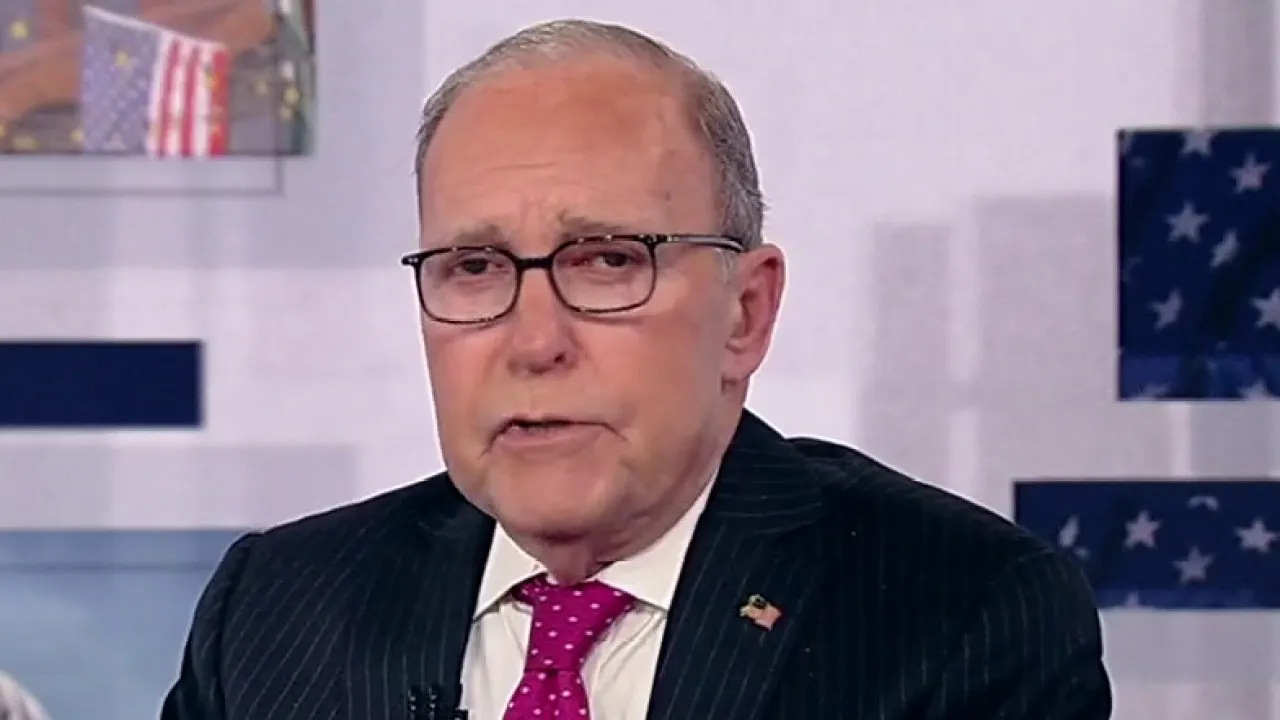
Run your finger down the key races in the Real Clear Politics average. What you see is seven toss-up races, well within the polling error margin. One tie in Kansas. One big GOP win in Florida. And one Democrat win in Georgia.
Again, the toss-ups are well inside the error margin. This does not spell a Democratic blue wave in the Senate. I first heard this argument about 10 days ago listening to Ben Shapiro’s Daily Wire podcast, where he made this point. As Mr. Shapiro put it, if you listen to the mainstream press, the Dems are going to take the Senate 100 to 0. But that isn’t going to happen.
A couple of days ago, the Real Clear Politics polling analyst made a similar point: “the grim headlines for Republicans overlook how thin the margins are in most toss-up races, leaving the GOP a real path to keeping the Senate.” Real Clear Politics’ Senate map features eight “toss-up states, and Republicans need to win only four of them to keep control of the chamber.”
And I’m here to tell you that Senator Roger Marshall is going to hold his seat in Kansas. And Congresswoman Ashley Hinson will hold the Republican seat in Iowa. Whether he deserves it or not, the Lone Star State’s attorney general, Ken Paxton, is going to beat James Talarico, because Texas doesn’t believe in crazy people.
And the incumbent senator, Jon Husted, is going to keep Ohio in the red. Senator Susan Collins is going to win in Maine because she always does. And I refuse to believe Michigan is going to vote for Abdul El-Sayed, whose biggest sin is not just that he is a card-carrying socialist, or that he hangs out with Hasan Piker, though all that’s bad enough.
To be sure, though, he is going to push with other socialists for Medicare for All. And what that means is quite simply, if you like your health care plan now, and over half of Michiganders have employer-based health care, the socialists will not let you keep it. And it will cost the country more than $50 trillion. And they will attempt to raise taxes by some considerable proportion of that $50 trillion.
And that’s true for Mr. Talarico, and for Maine senate challenger, Troy Jackson. And oh yes, Peggy Flanagan, who is the deputy in Minnesota of Governor Tim Walz, the socialist fraudster, is going to lose to the GOP senate candidate, Michele Tafoya. Now, I’m the first to admit that not all these predictions are going to come true, but I believe Republicans are going to keep the Senate easily.
The House is a different story. And sure, I wished the GOP had communicated another big tax cut and large scale spending and anti-fraud budget reforms. Yet when the Democrats talk about affordability, that’s when I start giggling. They have no plan to reduce inflation, except President Biden’s 21 percent cumulative big-government socialism inflation.
And they will promise free this, free that, tax the rich, tax the middle, and at least $50 trillion for Medicare for all. And lord knows how much they’ll spend for their socialist, Green New Deal, climate change, open borders, and woke DEI policies. Let Mr. Trump and the GOP stay on message for the next 19 days, and they can yet do very well in the midterms.
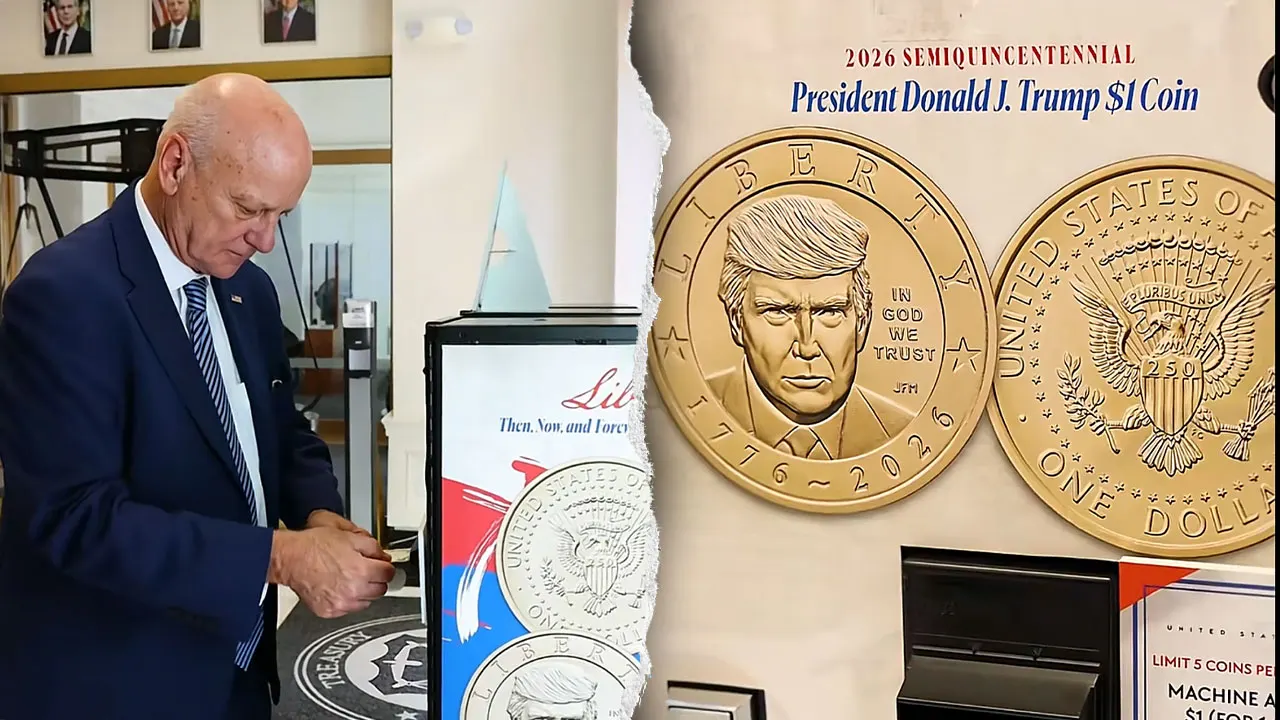
Brandon Beach encourages Americans to obtain the coins at banks next month and use them to make purchases at coffee shops (Credit: @ustreasury).
The Treasury Department is encouraging Americans to take newly minted President Donald Trump dollar coins to their favorite liberal coffee shops, issuing a challenge in a TikTok video posted Wednesday.
U.S. Treasurer Brandon Beach urged Americans to pick up rolls of the coins at banks next month and use them to purchase coffee at businesses he described as liberal.
“This is the dollar coin. It will be in the banks next month,” he said in the clip as he removed the coins from a bank. “And I want to challenge you to go get a roll of dollar coins next month. And then I want you to go to your favorite liberal coffee shop with your top dollar coins. Buy a cup of coffee. Watch their heads explode. They will not like it. But I love it. And I love this president. And I love this coin.”
TREASURY UNVEILS $1 GOLD COIN WITH TRUMP’S IMAGE ON FRONT
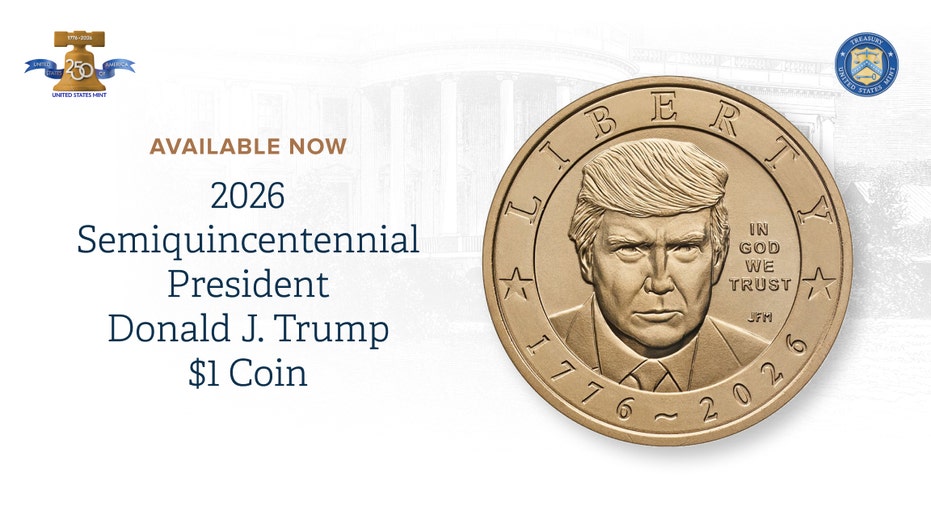
The U.S. Mint is now offering these $1 Trump coins for sale. (United States Mint on X)
The challenge, shared on the Treasury Department’s official TikTok account Wednesday, comes after the U.S. Mint began selling the Trump-themed currency in September as part of the nation’s 250th anniversary commemorations.
The Trump dollar coins went on sale through the U.S. Mint in September, with a roll of 25 priced at $61 and a bag of 100 selling for $154.50, significantly above their face value, FOX Business previously reported.
The Mint also indicated the coins could be used for everyday transactions, despite being marketed to collectors.
TRUMP-EMBLAZONED $1 COINS GO ON SALE — AND THE MINT IS CHARGING A MAJOR MARK-UP
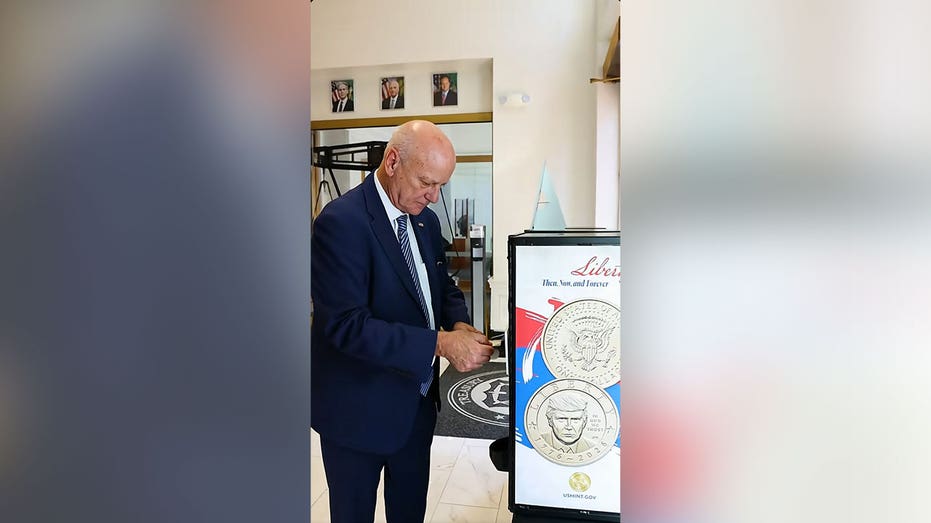
U.S. Treasurer Brandon Beach stands beside a display featuring President Donald Trump’s new dollar coin in a Treasury Department TikTok video. (@ustreasury / Unknown)
“These coins are also in circulation, so check your pocket change,” the U.S. Mint wrote in a September post on X.
The coins feature Trump’s likeness beneath the word “LIBERTY,” with the years “1776 ~ 2026” below his portrait and “IN GOD WE TRUST” alongside it. The currency commemorates the nation’s 250th anniversary.
According to the Mint’s product description, the coins were produced in Philadelphia with circulating finishes but had not been placed into circulation when they were offered for sale. The coins can still be used as legal tender.
Beach’s announcement that the coins will be available at banks next month suggests Americans could have another way to obtain the currency beyond purchasing it directly from the Mint.

A dollar coin exchange machine featured in a Treasury Department TikTok video displays the front and back of the 2026 Trump dollar coin, commemorating America’s 250th anniversary. (@ustreasury / Unknown)
CLICK HERE TO GET FOX BUSINESS ON THE GO
The Treasury Department has not specified which banks will carry the coins or whether they will be available at face value.
FOX Business reached out to the Treasury Department for clarification on the coins’ availability at commercial banks, distribution schedule and whether customers will be able to obtain them at face value.
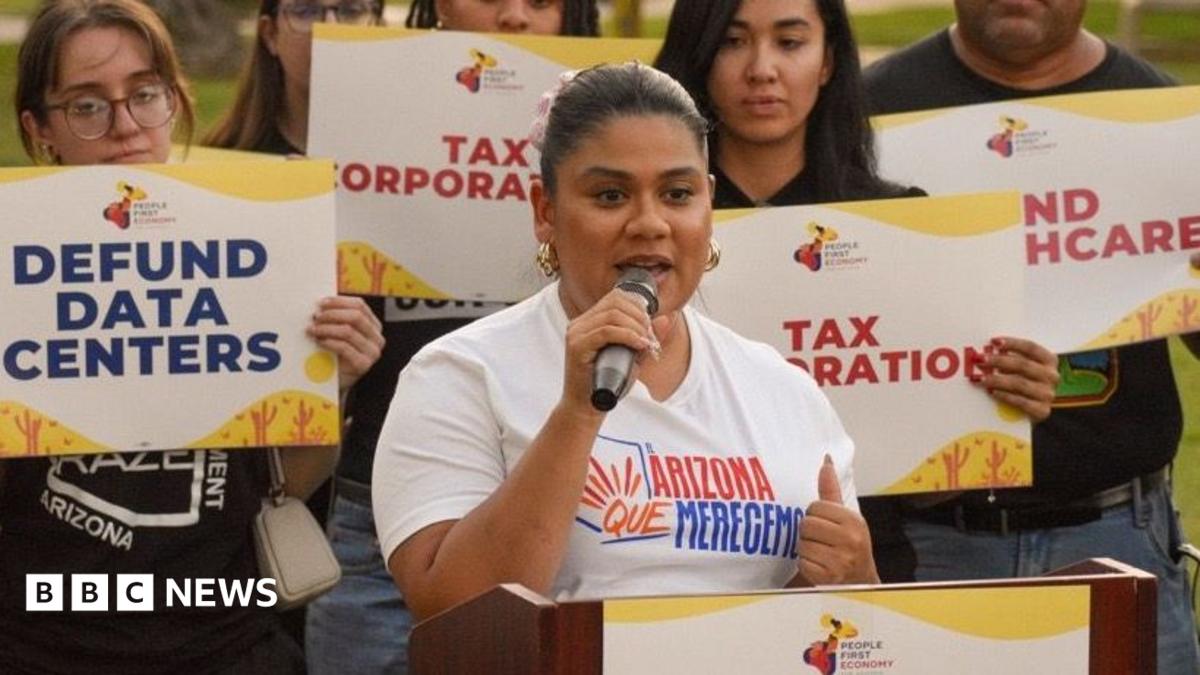
Arizona Governor Katie Hobbs was one such proponent – until public pressure pushed her to the other side of the issue. In July, she enacted a three-year pause on any new tax break given to a company for a data centres project.
Arizona is far from the only state to see politicians react to data centre backlash.
Abdul El Sayed, a Democrat running for Senate in Michigan, made new rules and regulations for data centres a clear part of his successful primary campaign for Senate.
In the race for governor of Georgia, a Democrat who is calling for a pause on data centre development is in a dead heat with a Republican who disagrees.
Republican Senator John Husted of Ohio, who is fighting to keep his seat against Democrat Sherrod Brown, has also had to shift his position. Recent polls, external have found that the majority of Ohio voters oppose data centres. He has softened his support, saying that their arrival should be up to local citizens and elected officials.
Meanwhile, Brown has stumped on his opposition to new data centres. He leads Husted in recent polls.
Husted’s trouble in Ohio led the National Republican Senatorial Committee, the major fundraising arm for conservatives in the Senate, to write in a private memo, external that Republican politicians needed to entirely reframe how they spoke to voters on data centres.
“This has become a sleeper issue for the entire election cycle”, the NRSC added.
Texas is perhaps the most clear cut example of how backlash has turned into an undeniable issue for even the most pro-business politician.
The state currently has almost 300 operational data centres, with another 170 planned for development, according to Pew data.
At the end of last year, Republican Governor Greg Abbott had boasted of Texas as “the epicentre of AI development” because of the number of data centres it housed.
Within months he was backtracking, citing concerns of “safety and quality of life”.
It could play a part in the state’s upcoming senate race too.
Democrat James Talarico’s campaign is pushing for an end to “sweetheart tax deals” for Big Tech. He’s now seen as a frontrunner for the historically Republican seat, where he is facing off against Republican Attorney General Ken Paxton.
Paxton said in a late September interview that there was still “plenty of open space in Texas that we can put data centres”.

Thailand can strengthen economic resilience by choosing strategic roles in global value chains, building domestic suppliers and aligning industrial policy with national capabilities
Key Points
- Thailand’s resilience will depend on its position inside global value chains, not simply on the number of foreign factories operating in the country.
- Industrial policy should focus on tasks Thailand can perform competitively, while linking multinational companies with capable domestic suppliers and research institutions.
- Semiconductor ambitions, AI infrastructure and energy transition projects will succeed only if they create skills, technology transfer and stronger local production networks.
Under the theme “Thailand’s New Horizon: Empowering People, Building Resilience,” Thailand is set to host the 2026 Annual Meetings of the International Monetary Fund and World Bank Group.
This theme arrives at a critical moment. The economy’s vulnerability to recurring disruption has been highlighted by recent flooding that impacted factories, supply chains, tourism, and small enterprises, alongside escalating energy prices and strained household budgets.
The core challenge lies in determining the most effective approach to establishing long-term resilience.
Recent expert analysis suggests moving away from generalized objectives toward strengthening Thailand’s role within global value chains. Building on this perspective, true resilience is not achieved by attempting to cover every sector, but by identifying critical tasks, excelling in them, and cultivating domestic capabilities that render the economy indispensable.
Strategic positioning as the basis of resilience
Driven by geopolitical friction, technological constraints, and supply chain disruptions, international firms are actively restructuring their operations. In this environment, the United Nations Conference on Trade and Development highlights the growing importance of “indispensability”, a policy designed to anchor a nation within key supply chain nodes that businesses cannot easily circumvent.

Rather than attempting to capture every available project in an aggressive regional contest for semiconductor facilities, data hubs, battery plants, green energy, and high-tech electronics, Thailand must adopt a focused approach. Securing headline-grabbing announcements does not inherently grant a lasting competitive advantage.
Instead, the key issue is identifying the specific segments of these global value chains where Thailand possesses a distinct comparative advantage.
Leveraging established expertise in automotive manufacturing, component production, electronics, food processing, logistics, and tourism provides a far more viable path to resilience than attempting a swift breakthrough across all emerging technological frontiers.
Consider Thailand’s semiconductor ambitions: while the goal is to cultivate an end-to-end ecosystem covering design, fabrication, assembly, testing, and advanced packaging, competing directly with market leaders in Taiwan, South Korea, or the United States would require immense capital and entail significant risk. A more pragmatic approach lies in targeting niche areas such as advanced packaging, testing services, power electronics, sensors, automotive microchips, and specialized capital equipment.
Ultimately, effective strategic positioning requires prioritizing the areas where Thailand can make itself truly indispensable.
Foreign investment is only the beginning
Thailand has attracted major international companies by offering investment incentives, industrial estates, a developed supplier base and access to regional markets. That model helped establish the country as an automotive and electronics hub.
It also created a structural weakness. Foreign companies often control technology, product design, procurement standards and the most valuable parts of the supply chain, while local firms remain concentrated in lower-value production.
A factory can create jobs without creating an ecosystem. A multinational can bring capital without transferring meaningful technological capability. An assembly operation can expand exports while leaving domestic companies dependent on decisions made at headquarters elsewhere.
Thailand’s investment policy should therefore measure what happens around a project. Does it develop local suppliers? Does it train engineers and technicians? Does it create opportunities for Thai firms to provide software, components, maintenance, logistics or research? Does it help local businesses meet the standards required by global customers?
These questions are more valuable than the headline value of an investment announcement.
The Bangkok Post article points to the importance of supply-chain linkages and cites global companies such as Western Digital, Seagate, Delta Electronics and Schneider Electric as examples of firms whose operations include domestic supplier networks. The governance of those relationships matters. Lead firms decide what suppliers produce, under which standards and with what degree of visibility and traceability.
Thailand should use that influence to create stronger local capabilities.
Domestic suppliers need a larger role
Small and medium-sized businesses form the third layer of many global value chains. They provide components, services, maintenance, transport, packaging and specialist labour. Yet they often lack the financing, certification and technology needed to become reliable partners for multinational companies.
This leaves Thailand vulnerable during a disruption. When a flood closes a supplier, an assembly plant can stop even when its own facility is protected. When a foreign firm changes its procurement strategy, local companies may lose their main customer with little warning.
Resilience requires more capable domestic suppliers. Public resources should support supplier development, technical training, digitalisation, certification and access to working capital. Universities and research institutes should work with companies on practical industrial problems rather than operating separately from production networks.
Large multinational companies also need clearer obligations. Investment incentives could be linked to supplier-development programmes, training commitments, joint research and technology transfer. The purpose would not be to force companies to disclose proprietary technology. It would be to ensure that public incentives help create capabilities that remain in Thailand after the original investment cycle changes.
A supplier should become a partner capable of improving products and processes, not a replaceable vendor competing only on price.
Thailand needs an infrastructure strategy built around risk
The recent floods show why resilience cannot be limited to company balance sheets. Roads, ports, airports, power systems, drainage networks and digital infrastructure connect the entire industrial economy.
Factories can invest in flood barriers, backup generators and alternative logistics routes. Smaller suppliers may not have the same resources. Regional infrastructure remains a public responsibility, and fragmented planning can create vulnerabilities that individual businesses cannot solve.
Thailand’s industrial strategy should therefore integrate climate adaptation. Investment zones need reliable drainage, flood-risk assessments and transport alternatives. Industrial estates should be evaluated on their ability to maintain operations during extreme weather. Data centres need stable electricity and water supplies. Food-processing hubs require cold chains and access to multiple transport routes.
As a report explains, the World Bank has identified urban flooding as one of Thailand’s significant climate risks, with Bangkok especially exposed because of its concentration of export-oriented industries.
Resilience investment may appear less attractive than a new factory or technology park. Its value becomes clear when it prevents production from stopping.
Growth must be selective
Thailand’s economic ambition has often been expressed through broad targets: becoming an EV hub, a semiconductor centre, a digital economy and a regional logistics gateway.
These ambitions can support one another, but they also compete for skilled workers, electricity, public funding and administrative attention. A country with limited fiscal and institutional capacity cannot pursue every strategic sector at the same intensity.
The Bangkok Post argument offers a useful principle: Thailand should identify the tasks it can perform better than others and defend that position. That principle should guide decisions on subsidies, training, infrastructure and foreign investment.
A country does not need to dominate an entire industry to gain strategic value. It may become indispensable in a specific stage of production, in a specialised component, in logistics between two markets or in the testing and certification of advanced products.
That approach is less dramatic than announcing a national ambition to lead every emerging sector. It is also more likely to work.
AI and energy will test the strategy
Artificial intelligence and the energy transition are creating new investment opportunities for Thailand. Companies are expanding data infrastructure, automation, electronics and clean-energy projects, while foreign investors are looking for alternative production locations across ASEAN.
These trends could raise productivity and diversify Thailand’s economy. They could also increase its dependence on imported technology, foreign expertise and energy-intensive infrastructure.
The country needs to ask how AI investment will benefit domestic firms. Will Thai manufacturers adopt tools that improve forecasting, quality control and energy use? Will local software companies become suppliers? Will universities produce the specialists required by the new economy?
The same questions apply to energy. Renewable projects can reduce exposure to imported fuel and support industrial investment, but Thailand needs reliable grids, storage capacity, efficient transmission and clear pricing rules. Clean energy will strengthen resilience only if companies can access it at predictable cost.
Investment becomes more valuable when it improves the systems used by the wider economy.
A resilient Thailand will know what to defend
Thailand cannot make every sector globally competitive. It can build a more resilient economy by identifying its strongest positions, developing domestic suppliers and connecting foreign capital with local capabilities.
That requires a shift in policy. The goal should not be to accumulate projects. It should be to deepen the networks around them.
The automotive industry, electronics manufacturing, food processing, logistics and tourism already give Thailand a substantial platform. New opportunities in AI, semiconductors and clean energy can reinforce that platform when they are connected to existing strengths and supported by the right skills.
The country’s next horizon will be judged by its ability to remain useful when global conditions change. A resilient economy can absorb a flood, a trade shock, an energy disruption or a technology transition without losing its productive core.
Thailand has spent decades building that core. The next task is to make it harder to replace, easier to recover and more deeply rooted in domestic capability.
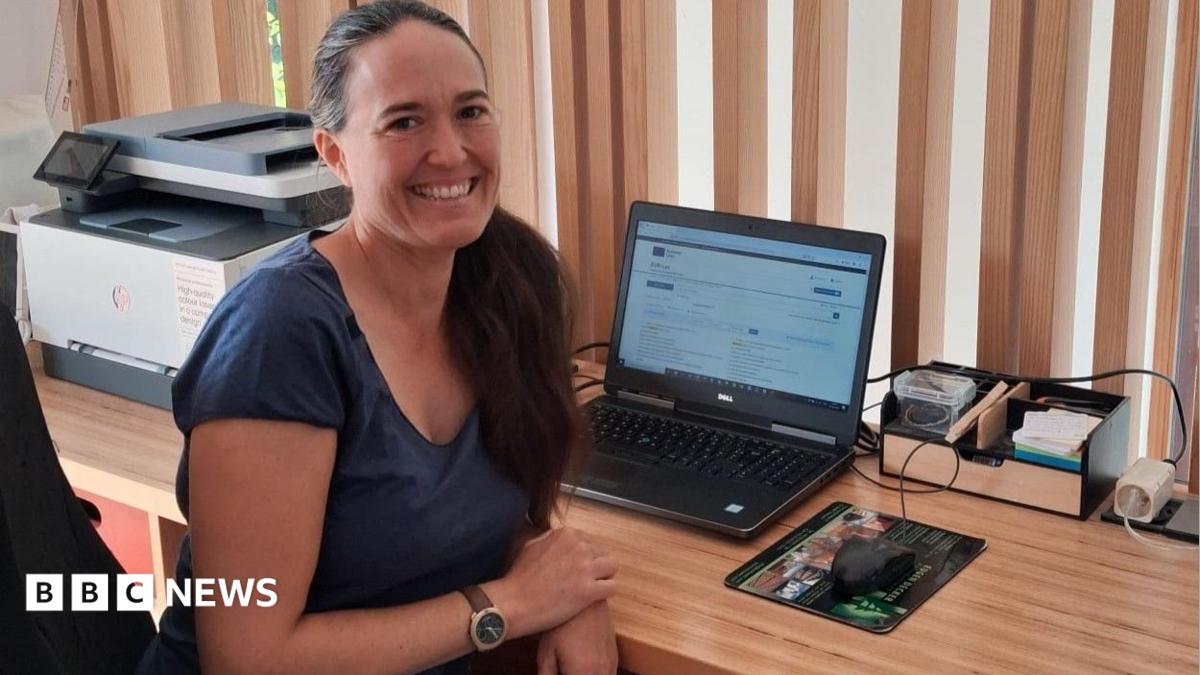
AI dominates the translation business, but for high-stakes work, humans are still needed.
Business & Hustles
Apple Introduces $299 HomeView Smart Display With Face Recognition and New Siri AI Assistant

CUPERTINO, Calif. — Apple on Tuesday introduced HomeView, a 7-inch smart display designed to serve as a shared household screen for music, FaceTime calls, recipes and smart-home controls while recognizing up to six users by face and switching to each person’s personal content.
Pre-orders begin immediately in the United States, Australia, Canada, India, New Zealand and the United Kingdom. The tabletop model is priced at $299 and comes in silver, starlight, rose pink and space gray. A wall-mounted version, also $299 and available in space gray and silver, will ship with the same start date. Both models become available Nov. 13. The product will not be sold in the European Union because Siri AI is not yet available in iOS there.
“Apple HomeView is designed to be shared by everyone in the home yet feel completely personal to each user,” said Greg Joswiak, Apple’s senior vice president of Worldwide Marketing. “It recognizes your face to shift from a household screen to your own experience, fills the room with incredible sound, keeps you connected to the people who matter most with FaceTime, and makes it easy to control your smart home. And it’s powered by Apple Intelligence with Siri AI at its core, drawing on personal context from your iPhone to help you find what you need and get more done, all while keeping everyone’s information private and secure.”
The tabletop unit uses an aluminum enclosure connected by a stainless-steel hinge to a domed speaker base. Brightness ranges from 500 nits in bright rooms to 0.3 nits at night. The interface changes with distance, showing simpler information from across the room and more detail as a user approaches. The wall-mounted model attaches via three Schneider Home mounts; two of those mounts are available now starting at $59.95 and $79.95, with a Power-over-Ethernet version planned for early 2027 at $129.95.
HomeView runs Siri AI, which Apple describes as a new, more conversational version of Siri with broader world knowledge and on-screen awareness. When paired with an Apple Intelligence-enabled iPhone or iPad, it can draw on the user’s calendar, messages and other personal data. Conversations can continue on other Apple devices via iCloud. Users without a paired Apple Intelligence device still get the general knowledge and conversational features. Siri AI is available in English in the listed countries; Canadian French support is planned in a later update. Expressive custom voices require specific newer iPhone or iPad models.
Privacy features include Secure Enclaves on the A18 chip that process camera and microphone data separately from the rest of the system. Personal content such as Messages and Calendar appears only when the enrolled user’s face is recognized and a recently unlocked paired iPhone or iPad is present. Siri requests can be handled on-device or through Private Cloud Compute, which Apple says does not store data or make it accessible to the company.
The device supports FaceTime with Center Stage, voice or on-screen messaging, whole-home Intercom, recipe conversion with hands-free timers, Find My, and Live Activities. For smart-home control it can show up to nine camera feeds, adjust lights and thermostats, and lock doors. With an iCloud+ subscription it can recognize people, pets, packages and vehicles on compatible cameras and alert users to smoke or carbon monoxide alarms. It works with the new Apple Home Collection of cameras, thermostats and a lock developed with LG Electronics and Schneider Electric, as well as other HomeKit and Matter accessories. The Home Collection begins shipping in December, with some items in early 2027.
Audio is handled by two full-range drivers in the display, a down-firing woofer and two passive radiators in the base, with computational audio that adjusts loudness and bass. The wall-mounted version uses two drivers tuned for on-wall placement. Users can hand off music from an iPhone and play multiroom audio with other HomePods and AirPlay speakers.
Apple said the enclosure base uses 100 percent recycled aluminum, all Apple-designed circuit boards use recycled gold plating and tin solder, and all magnets use recycled rare-earth elements. Packaging is 100 percent fiber-based. The company continues to state a goal of carbon neutrality across its footprint by 2030.
Setup and multi-user support require a compatible iPhone or iPad running current software. Some features, including Apple News and certain third-party apps, are limited by region or require a subscription. Video summaries for HomeKit Secure Video need an eligible iCloud+ plan and an Apple Intelligence-enabled setup device. The product is not available for sale in the European Union.
Apple also announced a next-generation HomePod mini and a new Apple TV 4K on the same day, both described as supercharged by Siri AI. No sales forecasts or production volumes were released for HomeView. The $299 price applies to both the tabletop and wall-mounted models in the United States.
Business & Hustles
Oil Price Today (October 13): Crude oil falls to $105 as traders assess Russian supply, Mideast attacks. What’s next?

US President Donald Trump said Russia had agreed to supply diesel to global markets. His administration also temporarily eased US sanctions on Russian fuel, which were imposed to deprive Moscow of revenue for its war on Ukraine.
Read more: D-Street poised for positive start as GIFT Nifty signals gains
Crude oil price on October 13
Brent crude futures fell 61 cents, or 1.05%, to $105 a barrel, while US West Texas Intermediate crude futures declined 92 cents, or 1.05%, to $93 a barrel. Brent settled at $106.65 a barrel on Monday, its highest level since September 15. Oil prices have surged more than 70% this year as the US war on Iran rattled global energy markets.
The additional supplies could ease tightness in global fuel markets and reduce some of the supply concerns that have supported crude prices in recent weeks. However, lawmakers from both parties in the US said Trump’s agreement with Russian President Vladimir Putin appeared to violate US law barring imports of Russian energy until Moscow ends its aggression against Ukraine.

Risks to Gulf energy infrastructure and shipping routes remained in focus after Iran-aligned Houthis struck Riyadh’s international airport over the weekend, while tanker attacks were reported near the Strait of Hormuz. The incidents threatened to disrupt the recovery in Middle East supplies recorded in September and heightened concerns about further interruptions along one of the world’s most important energy transit routes.
Ministers from OPEC and non-OPEC countries participating in the Declaration of Cooperation said shipping and insurance costs had surged to unprecedented levels, exceeding one-third of the commodity’s value and hindering the efficient movement of crude oil and petroleum products.Read more: Stocks in news: HCL Tech, RBL Bank, Nazara Tech, Hero Motors, Power Grid and IRCON
What are experts saying?
Uncertainty over how the conflict will end remains a key concern for markets. JPMorgan analysts said they did not know how to model the eventual outcome, noting that the bank had initially assumed the US administration would avoid crossing certain economic thresholds when the conflict began. Seven months into the war, many of those thresholds had been crossed, while a clear exit strategy remained absent.
The growing threat of further supply disruptions has also raised the prospect of higher oil prices. Daan Struyven, co-head of global commodities research at Goldman Sachs, said recent attacks demonstrated how disruptions to shipping could spread and intensify.
Goldman Sachs has outlined a scenario in which oil prices could climb to $120 a barrel if attacks on vessels in the Middle East escalate. If exports return to normal, the bank expects prices to move back towards $80 a barrel.
Struyven said risks to shipping had become a major driver of oil prices. Goldman Sachs sees meaningful upside potential for crude and expects natural gas and refined product prices to rise as well. Struyven added that supply shocks affecting gas and fuels were larger than those in the crude oil market.
Disclaimer: This article has been written by Veer Sharma, who is not a SEBI-registered Research Analyst or an Investment Adviser. Veer Sharma and his/her ‘relative(s)’ (as defined under Section 2(77) of the Companies Act, 2013) do not hold any financial interest in the companies mentioned in this article as of the date of publication. The views/recommendations mentioned in this article, wherever applicable, are those of the respective SEBI-registered Research Analyst/brokerage and have been reproduced/reported with due attribution. They should not be construed as the views or recommendations of The Economic Times Digital or the journalist. Readers are advised to consider the original research report and make their investment decisions based on their own assessment. Brokerage disclaimers here.
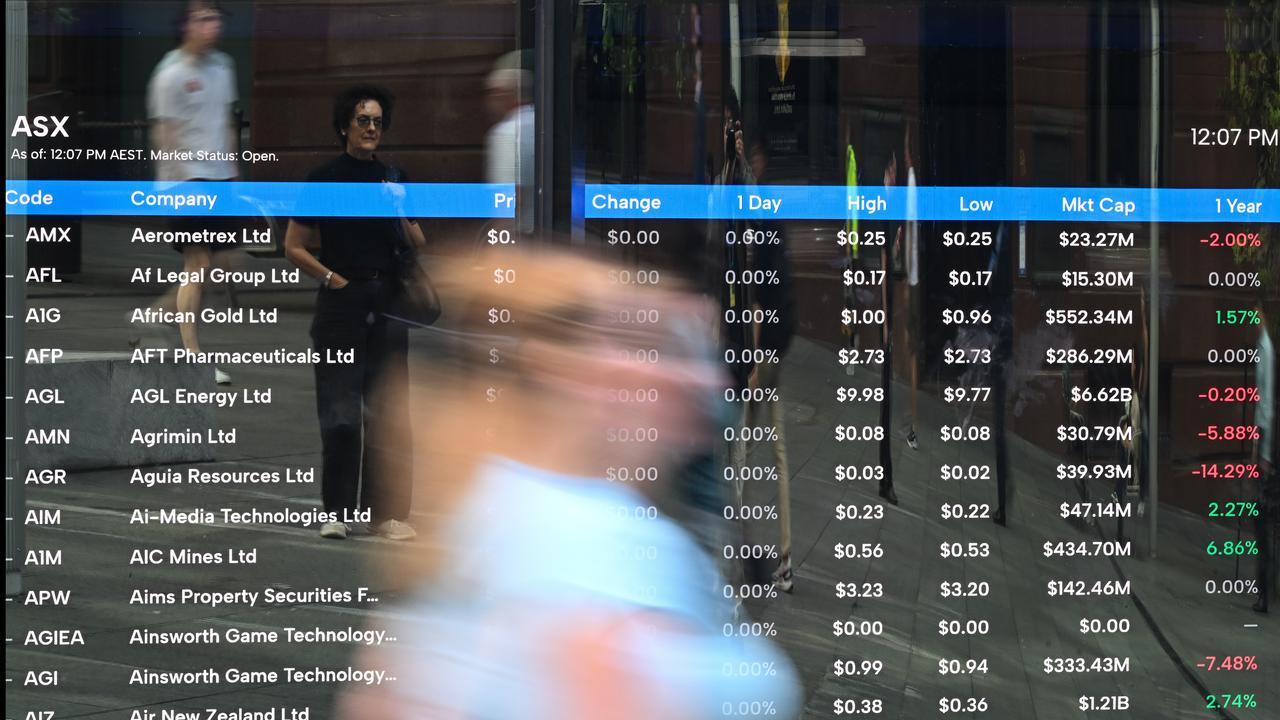
Australia’s share market has started the week higher after banks rallied in anticipation of US earnings season, while rebounding metals prices supported mining stocks.

Value-Up Arrives in ASEAN: Six Markets Competing to Narrow the Gap

Replit is no longer working with Anthropic, CEO says

Solana resilient but observation warranted


-
 Entertainment1 day ago
Anna Faris Says Chuck Lorre’s ‘Mom’ Remarks Still Hurt
-

 Crypto6 days ago
XRP Ledger Defends Emergency Patch Amid Criticism
-

 Crypto5 days ago
Rep. Omar Says She Will ‘Not Be Silenced’ After Federal Agents Raid Her Home
-

 Sports6 days ago
Duke receives encouraging update regarding top prospect from class of 2028
-

 Crypto6 days ago
Saylor Signals Next Bitcoin Buying Plan After September STRC Buybacks
-

 Crypto5 days ago
KuCoin unveils 5.0 upgrade with AI tools and unified trading account – CoinJournal
-

 Tech & AI9 hours ago
Double Fine’s First Post-Xbox Title, First-Person Soulslikes And Other New Indie Games Worth Checking Out
-

 Crypto6 days ago
October 11 Crash: What Wiped Out 1.65M Traders
-

 Sports5 days ago
Work on Trump’s D.C. muni enrages judge: ‘You did your absolute worst’ | News
-
 Crypto7 days ago
Justin Sun says Tron post-quantum plan on testnet
-
Crypto4 days ago
ZEC and NEAR Plummet Hard, BTC Recovers From Rollercoaster Ride: Market Watch
-

 Crypto5 days ago
Ledger halts CryptoBilis after $86M wallet drain
-
 Sports5 days ago
Tax evasion to Portugal fallout: Controversies that rocked Ronaldo’s career | Football News
-

 Tech & AI5 days ago
More Indigenous Languages Come to iPhone and iPad Keyboards in New Apple Update
-

 Sports7 days ago
Glasgow’s power game leaves Connacht chasing shadows
-
 Sports7 days ago
Meet Pakistan’s Adam Gilchrist: Karachi teen bears Australian legend’s name but idolises Kumar Sangakkara | Cricket News
-

 Sports6 days ago
College GameDay Appearance History for Teams in West
-
Business & Hustles5 days ago
Oil Price Today (October 13): Crude oil falls to $105 as traders assess Russian supply, Mideast attacks. What’s next?
-

 Crypto4 days ago
Visa gets Beijing’s green light for bank card business after 40 years of working with China
-

 Crypto4 days ago
TD Cowen: CFTC Crypto Rules Face 2028 Election Risk
You must be logged in to post a comment Login