

Business
10 Interesting Trivia About Australia’s Prime Ministers


Australia has had 31 prime ministers in its history, and each one made their mark one way or another.
In this article, we list down 10 interesting trivia on some of these men (and the lone woman) who were privileged to be called prime minister.
1. The Only Australian Prime Minister During Queen Victoria’s Reign
Sir Edmund Barton has the distinction of becoming the very first prime minister of Australia, holding office for a total of two years and 266 days.
He is also the only Australian prime minister that held office during the lifetime of Queen Victoria. Sir Edmund Barton became prime minister on January 1, 1901, and Queen Victoria died just 21 days later on January 22.
2. The Only Australian Prime Minister During Edward VIII’s Reign
Similarly to Sir Edmund Barton, Joseph Lyons is the only Australian prime minister to have served during the short reign of King Edward VIII.
Lyons became prime minister on January 6, 1932. Edward VIII formally abdicated from the throne on December 10, 1936. Lyons ended her term in 1939, during the reign of Edward VIII’s brother, George VI.
3. The Longest-Serving Prime Minister
Holding office for a total of 18 years, five months, and 10 days, Sir Robert Menzies is Australia’s longest-serving prime minister.
He became the 12th prime minister of Australia in 1939 and his first term last for two years and 125 days. His second term began in 1949 and lasted for 16 years and 38 days.
4. The Shortest-Serving Prime Minister
If the longest-serving prime minister stayed in office for nearly two decades in total, the shortest-serving prime minister was in office for seven days. That was none other than Frank Forde.
Forde was an interim leader more than anything, assuming office due to the death of John Curtin, who died in office. Forde was eventually replaced by Ben Chifley.
5. The First Female Prime Minister
Julia Gillard became prime minister in 2010, making history as the first ever female to be named Australia’s prime minister.
She was engaged in a long political rivalry with her predecessor, Kevin Rudd, and she resigned as prime minister after losing the leadership of the Labour Party to him.
6. The Prime Minister Who Disappeared While Swimming
Only three prime ministers in Australia’s history have died while in office, and one of them is Harold Holt.
Believe it or not, he disappeared while swimming at Cheviot Beach in Victoria. Although his body was never recovered, he was presumed dead.
7. The Prime Ministers Who Were Not Born in Australia
Not all prime ministers of Australia were born in the country. The following prime ministers were born outside of Australia:
- Andrew Fisher – Kilmarnock, Scotland
- Billy Hughes – London, England
- Chris Watson – Valparaíso, Chile
- Sir George Reid – Renfrewshire, Scotland
- Sir John Gorton – Wellington, New Zealand (however, he had no birth certificate)
- Sir Joseph Cook – Staffordshire, England
- Julia Gillard – Vale of Glamorgan, Wales
- Tony Abbott – London, England
8. The Prime Minister Who Won Victorian Father of the Year in 1971
Bob Hawke, the 23rd prime minister of Australia, received the Victorian Father of the Year in 1971. Hawke had four children, but only three survived into adulthood.
The award, however, was contested by his ex-wife, Hazel Masterson, who claimed that he was both a womaniser and a heavy drinker.
9. The Prime Minister Whose Chinese Name is Lu Kewen
Kevin Rudd has a Chinese name, and it’s none other than Lu Kewen.
Rudd graduated with Bachelor of Arts (Asian Studies) with First-Class Honours from the Australian National University. He majored in Chinese language and Chinese history, and is proficient in Mandarin.
10. The Prime Minister Who Was Told Growing Up That His Father Was Dead
The current prime minister believed when he was younger that his father Carlo, who was Italian, was killed in a car crash. That wasn’t exactly true.
Albanese only got to meet his father in 2009. Five years later, his father died.

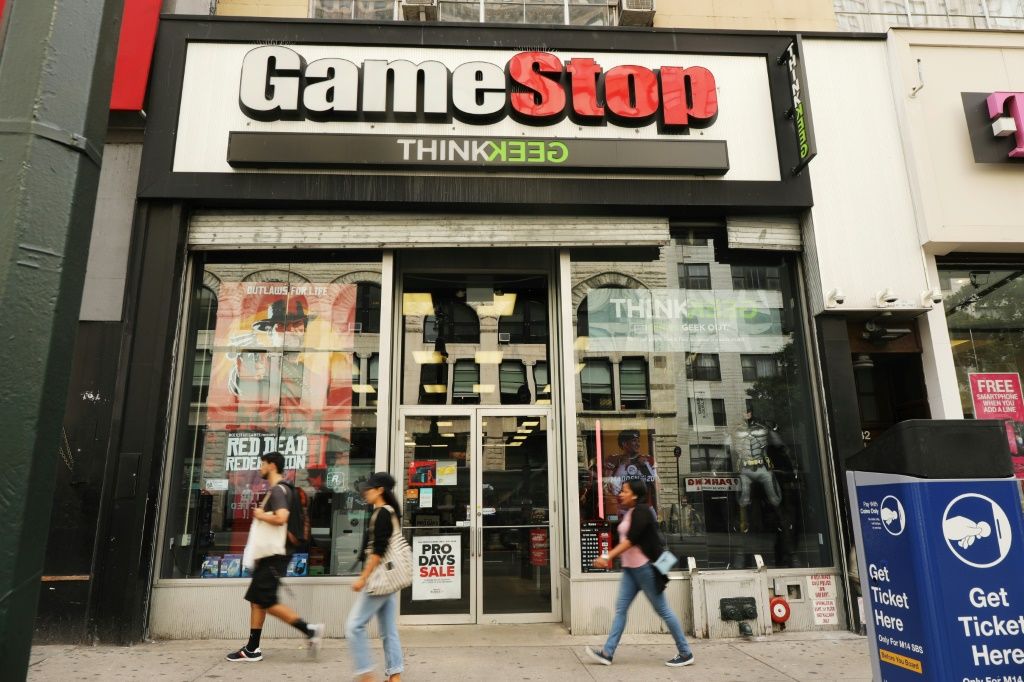
GameStop Corp. shares traded in a narrow range early Friday, maintaining levels around $24 as investors digested ongoing speculation about a major acquisition and awaited the retailer’s quarterly earnings report later this month. The meme-stock favorite has shown resilience in recent sessions despite broader market pressures from geopolitical tensions and rising energy costs.
GETTY IMAGES NORTH AMERICA / SPENCER PLATT
GameStop (NYSE: GME) was changing hands at approximately $23.91 to $24.10 in pre-market and early U.S. trading, up modestly from Thursday’s close of $23.87. The stock opened around $23.80 to $23.95 in the prior session, with intraday action ranging from a low of $23.77 to a high of $24.23. Volume stood at roughly 1.2 million to 3.5 million shares in recent days, below the elevated levels seen during past meme-driven surges but consistent with current retail interest.
The company’s market capitalization hovered near $10.7 billion to $10.8 billion, with about 448 million shares outstanding. Year-to-date performance remains mixed, with GME up slightly over the past 12 months but well below its 52-week high of $35.81 reached in May 2025. The 52-week low sits at $19.93, underscoring the stock’s volatility tied to both fundamentals and social-media sentiment.
Recent momentum stems largely from CEO Ryan Cohen’s aggressive push to reposition GameStop beyond traditional video game retail. Cohen, who also serves as chairman, has made multiple insider purchases this year, including a notable 500,000-share buy in January at around $21.12, boosting his stake to approximately 9.2%. Those moves coincided with reports of GameStop exploring “very big” acquisitions of publicly traded companies, with speculation centering on potential targets like eBay to transform the retailer into a broader consumer conglomerate.
Analysts and market watchers have interpreted Cohen’s strategy as an attempt to leverage the company’s substantial cash position—bolstered by prior equity raises—to pivot away from declining physical sales amid the shift to digital gaming. GameStop ended recent periods with billions in cash reserves, providing firepower for deals that could reshape its growth narrative. However, skeptics point to execution risks, noting the retailer’s ongoing challenges in adapting to industry changes.
Options activity has remained moderately bullish in recent sessions, with call volume occasionally elevated as traders position for potential catalysts. Some commentary highlights similarities between Cohen’s approach and value-oriented investors, though the stock’s meme heritage continues to attract speculative flows.
GameStop faces a key milestone with its fiscal fourth-quarter earnings expected around March 24 or 25, 2026, including a conference call the following day. Expectations center on revenue trends, store optimization efforts—including recent closures—and progress on digital and collectibles initiatives. Analysts project modest improvements in margins but remain cautious on top-line growth given competitive pressures from online platforms and streaming services.
The broader video game industry outlook provides some tailwinds, with projections for U.S. spending to rise about 3% to $62.8 billion in 2026, according to Circana estimates. Yet GameStop’s brick-and-mortar focus leaves it vulnerable to sector shifts, prompting ongoing store rationalization.
Social-media sentiment, once dominated by “Roaring Kitty” (Keith Gill) posts that sparked massive rallies in 2021 and 2024, has quieted in early 2026. No major recent activity from influential figures has emerged, though retail forums continue to monitor Cohen’s moves closely. Past episodes demonstrated how quickly sentiment can shift, driving short squeezes and dramatic price swings.
Wall Street coverage remains limited and bearish on fundamentals, with consensus price targets well below current levels—around $13.50 in some snapshots—reflecting doubts about sustainable profitability. The stock trades at elevated multiples relative to earnings, with attention focused on balance-sheet strength rather than traditional retail metrics.
Broader market dynamics also weigh on GME. With equity indices sensitive to oil price surges and Middle East developments, growth-oriented and speculative names like GameStop can face headwinds from risk-off moves. Energy stocks have outperformed amid geopolitical premiums, while consumer discretionary names grapple with affordability concerns.
GameStop’s history as a meme stock continues to define its trading profile. The 2021 squeeze, fueled by retail coordination against short sellers, propelled shares from single digits to triple-digit peaks before sharp corrections. Subsequent episodes in 2024, tied to Gill’s re-emergence and position disclosures, delivered brief surges but faded without lasting fundamental change.
Investors now eye whether Cohen’s acquisition ambitions can deliver a lasting re-rating or if volatility persists amid uncertain retail prospects. The upcoming earnings will offer clues on cash deployment, cost controls and any deal progress.
For now, GME holds firm in the low-to-mid $20s, supported by insider confidence and cash reserves but capped by skepticism over long-term viability. Traders brace for potential headline-driven moves, particularly around earnings or acquisition announcements.
As markets open fully in the U.S. session, GameStop shares show modest early gains, reflecting cautious optimism amid a landscape dominated by macro and sector-specific challenges.

An American Airlines pilot gave a rousing pre-flight speech to passengers encouraging civility and decency while onboard. (Anna Maltezos via Storyful)
If you blast a video without headphones on a United flight, you could lose your seat.
United Airlines confirmed to FOX Business that it updated its Contract of Carriage to add headphone language under Rule 21, or the airline’s “Refusal of Transport” section, giving the carrier authority to deny boarding or remove passengers who fail to use headphones while listening to audio or video content.
The new language places the headphone requirement alongside other behaviors that can result in removal, including refusal to follow crew instructions and disruptive conduct.
“The Contract of Carriage was updated Feb. 27 to add the headphone language,” a United spokesperson told FOX Business. “We’ve always encouraged customers to use headphones when listening to audio content – and our Wi-Fi rules already remind customers to use headphones. With the expansion of Starlink, it seemed like a good time to make that even clearer by adding it to the contract of carriage.”
LAS VEGAS HOTEL-CASINO THAT CLOSED DURING COVID AND NEVER REOPENED IS DEMOLISHED

United Airlines is now enforcing what was once considered etiquette onboard its flights, using headphones while listening to audio or visual content. (iStock / iStock)
While most airlines encourage headphone use as a courtesy, United’s decision to embed the requirement within its formal refusal policy elevates what was once considered etiquette into enforceable contract language.
The timing coincides with the airline’s rollout of Starlink satellite internet service, which is expected to increase device use during flights.
Delta Air Lines tells passengers on its website, “For the comfort of everyone around you, please use earbuds or headphones with any personal electronic device during your flight.”
AMERICA’S AIRPORT AFFORDABILITY GAP: CITIES WHERE TRAVEL COSTS ARE CRUSHING FAMILIES
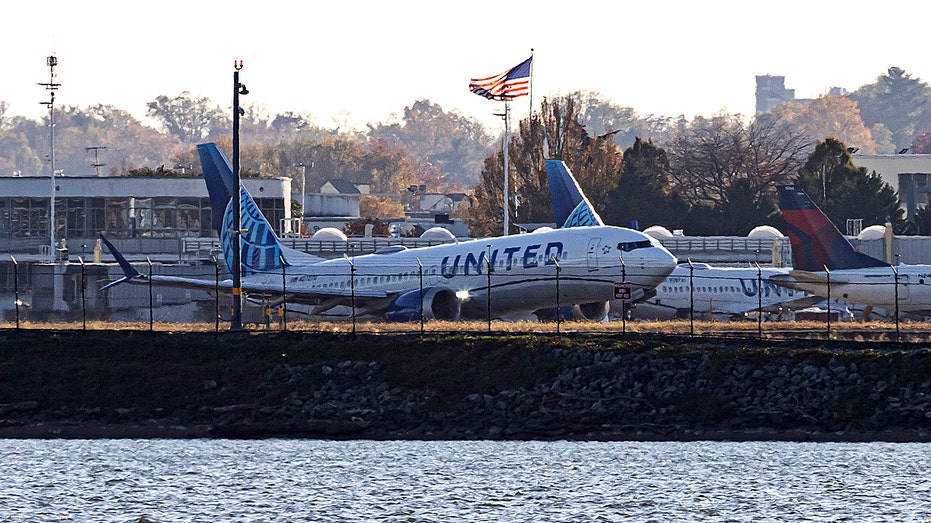
United Airlines Boeing 737 MAX 8 aircraft spotted departing from LaGuardia Airport in New York City on Nov. 8, 2024. (Nicolas Economou/NurPhoto / Getty Images)
Southwest Airlines states that “Headphones are required whenever a passenger is listening to any audio,” though neither carrier publicly frames the rule within refusal-of-transport language.
United did not indicate how frequently the provision has been enforced, but its placement under its “Refusal of Transport” makes clear that passengers who refuse to comply could face denial of boarding at the gate or removal from the aircraft.
The update follows years of mounting frustration over in-flight speakerphone and video use, a tension captured in a viral 2023 clip taken on an American Airlines flight.
AIRLINES CANCEL FLIGHTS, ISSUE TRAVEL WAIVERS OVER MIDDLE EAST UNREST
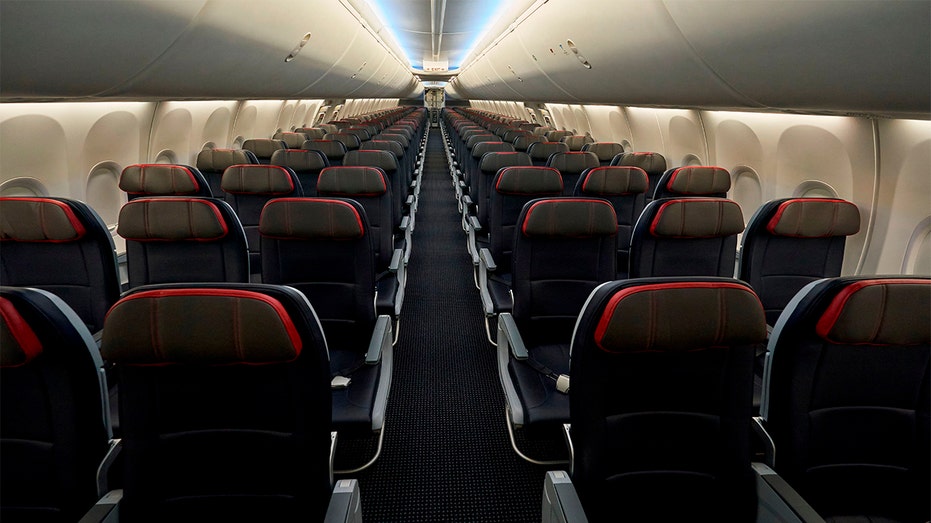
An interior view of a B737 MAX airplane seen at Dallas-Forth Worth International Airport in Dallas, Texas. (COOPER NEILL/AFP via Getty Images / Getty Images)
In the video, an American Airlines pilot delivered a blunt pre-flight message to passengers.
“The social experiment on listening to videos on speaker mode and talking on a cellphone on speaker mode, that is over — over and done in this country,” the pilot said. “Nobody wants to hear your video. … Use your AirPods, use your headphones, whatever it is. That’s your business.”
The speech drew applause from passengers and reignited debate over basic travel courtesy in confined spaces.
Etiquette expert and author of “Was it Something I Said?” Alison Cheperdak told FOX Business the policy reflects broader calls for civility.
“While in a perfect world people would know not to use speaker phone or listen to content without headphones in confined public spaces, this is a move in the right direction,” Cheperdak said. “The policy encourages kindness and consideration.”
United Airlines is now the first carrier to make clear that cabin courtesy is no longer just being polite, but a condition of carriage.
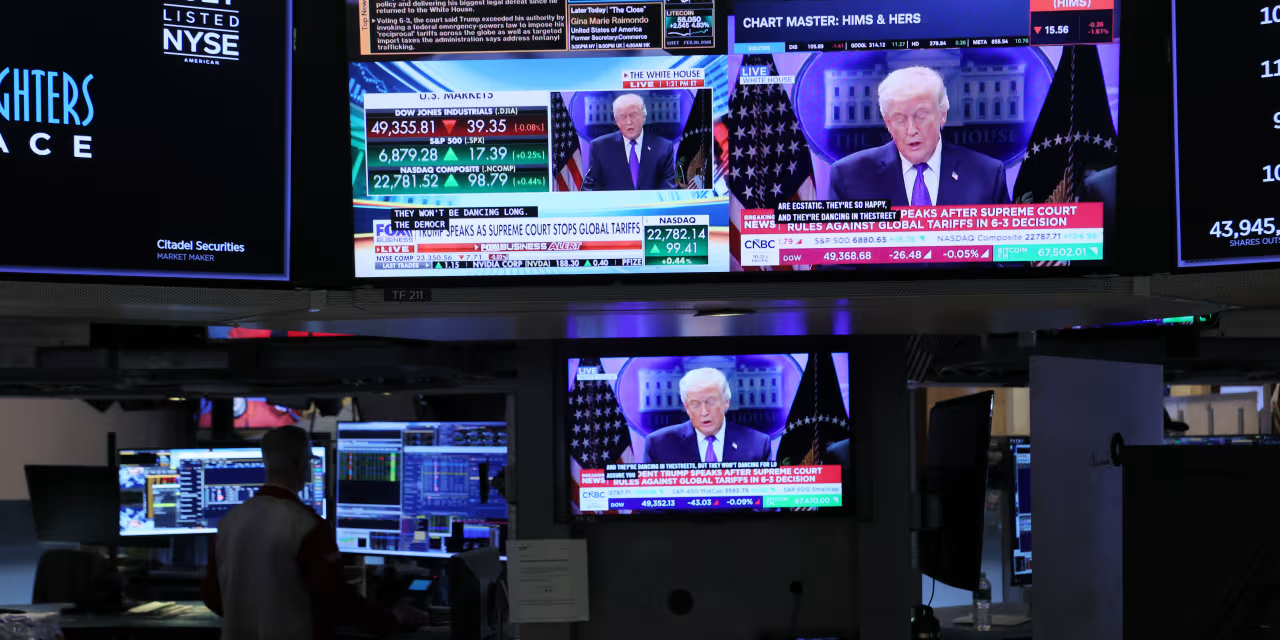
Goldman Sachs CEO Surprised by Stock Market Reaction to Iran. He’s Not Wrong to Worry.
Business
Prestige Consumer Healthcare Inc. (PBH) Presents at J.P. Morgan 2026 Global Leveraged Finance Conference – Slideshow

Prestige Consumer Healthcare Inc. (PBH) Presents at J.P. Morgan 2026 Global Leveraged Finance Conference – Slideshow
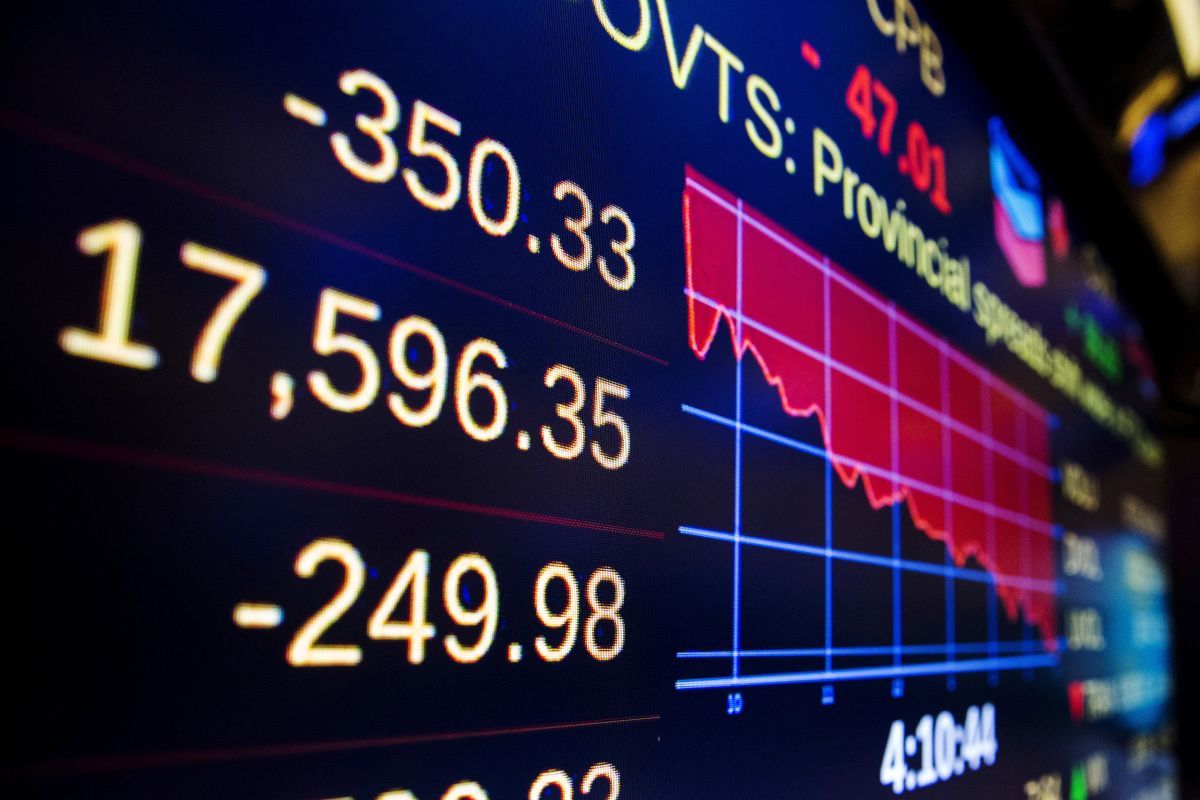
Major U.S. stock indexes retreated Thursday as renewed escalation in the U.S.-Israel conflict with Iran drove oil prices higher, stoking fresh investor concerns over energy costs, inflation risks, and global growth headwinds.
The Dow Jones Industrial Average declined about 350 points, or 0.75%, to trade around 47,450 during midday action, after touching lows near 47,300 earlier. The S&P 500 slipped roughly 0.6% to hover near 6,420, while the Nasdaq Composite eased 0.4% into the low 22,000s, paring some initial drops but holding negative amid broad risk aversion.
Prior Session Rebound
This pullback largely offset Wednesday’s recovery, when the Dow added around 220 points, or 0.47%, closing near 47,800 to end a short two-day skid. The S&P 500 climbed 0.7% to about 6,460, and the Nasdaq rose 1.1% toward 22,200, supported by a brief oil pullback and economic prints that bolstered hopes for Federal Reserve rate-cut flexibility.
Oil and Geopolitical Driver
Thursday’s downturn linked straight to Middle East flare-ups, with the conflict hitting day six amid Iranian warnings on Strait of Hormuz shipping. No full tanker halts materialized, but reports of delayed transits and spiking insurance rates propelled crude futures up 3-4%, pressuring industrials and consumer stocks while lifting energy shares modestly.
Volatility Gauge
Traders adjusted after midweek bets on U.S. naval protection or quiet diplomacy lost steam against blockade rhetoric. The CBOE Volatility Index (VIX) stayed above 18, down from prior spikes near 22, reflecting ongoing caution short of outright fear.
Sector Rotations
Defensive positioning dominated. Cyclicals like industrials and materials weighed on the Dow, as firms sensitive to fuel costs faced headwinds. Tech megacaps provided some ballast but couldn’t stem overall declines. The Russell 2000 fell 0.9%, prolonging its choppy run.
Inflation Policy Risks
Beyond stocks, oil’s advance—with WTI approaching $76 and Brent in the low $80s from recent sessions—revived inflation worries, potentially crimping the Fed’s easing cycle. Policymakers have highlighted energy as a key monitor, with sustained crude jumps risking a shift from rate cuts if price pressures build.
Earnings and Corporate Snapshot
Mixed corporate signals emerged as earnings tapered off. Energy outfits gained on higher realizations, while defense names saw mild bids from tensions. Consumer discretionary trailed amid pump-price strains, and clean energy stayed tentative despite niche spotlight.
Economic Calendar Ahead
Focus sharpened on Friday’s data, led by nonfarm payrolls to test labor strength. Jobless claims, Challenger cuts, and trade prices could also sway views, with forecasts for 160,000-180,000 jobs and steady 4.1% unemployment.
| Index | Thursday Change | Approximate Close | Key Driver |
|---|---|---|---|
| Dow | -350 pts (-0.75%) | ~47,450 | Oil escalation, industrials drag |
| S&P 500 | -0.6% | ~6,420 | Risk-off rotation |
| Nasdaq | -0.4% | Low 22,000s | Tech resilience insufficient |
| Russell 2000 | -0.9% | N/A | Small-cap volatility |
Weekly Volatility Context
The week’s swings spotlight headline sensitivity. The Dow dropped roughly 600 points across three prior sessions before Wednesday’s lift, mirroring rapid responses to Iran news. History shows events like the 2022 Ukraine crisis often yield short dips followed by rebounds without major disruptions.
Hormuz Stakes
This round stands apart due to the Strait’s role in 20% of world oil. Banks like Goldman Sachs lifted short-term WTI outlooks to the high $70s on risk overlays, without extreme calls. Extended strains could pinch profits, spending, and the S&P 500’s 8-10% year-to-date rise.
Bond and Haven Moves
Yields edged up, with the 10-year Treasury near 4.05% versus recent sub-4% dips, as inflation tempered cut bets. Gold held above $2,700 an ounce for safety, while bitcoin eased under $95,000 with risk peers.
Volume and Flows
Energy rose 1.5-2%, financials mixed, utilities cushioned losses. Volumes swelled 15-20% over norms, heavy in futures and hedges.
Retail Tie-In
GameStop traded flat near $24, propped by cash and buyout talk per separate reports, as retail broadly eyed cost squeezes.
Technical Outlook
Volatility persists ahead. De-escalation hints might spark snaps higher; Hormuz flares could extend weakness. S&P support eyes 6,350-6,400, resistance 6,500 in its oil-shadowed monthly band.
Year-to-Date Backdrop
From early-2026 S&P lows near 6,000, indexes built on AI momentum and cuts but now grapple war overlays. National gas averages near $3.15 per AAA erode purchasing power.
Sector Winner-Loser Balance
Producers thrive, but airlines, logistics, and makers suffer. Refiners gain on spreads; chemicals cite costs. Europe’s Stoxx 600 (-0.8%) and Japan’s Nikkei (-1.2%) synced lower.
Trading Close Notes
Afternoon action steadied sans breakout, volumes hinting defense. Payrolls and diplomacy loom for Friday.
Historical Precedent
This dip aligns with shock absorption patterns, banking U.S. production buffers. Oil momentum and Hormuz watch keep nerves taut.
President Trump’s team signals energy security focus, possibly tapping reserves, layering policy angles. Fuel impacts heighten voter awareness.

Earnings call transcript: Cooper Companies beats Q1 2026 EPS estimates, stock dips
Stocks seesawed early Wednesday as the market tried to process reports about the possibility that Iranian officials have reached out to the CIA.
Some investors’ hopes for a quick end to the conflict surged after the New York Times reported that operatives from Iran’s Ministry of Intelligence had initiated talks with the Central Intelligence Agency about how to bring an end to the conflict.
An Iranian news agency then reported that the ministry had denied the Times report.
FOX Business host Charles Payne unpacks AI disruption fears on ‘Making Money.’
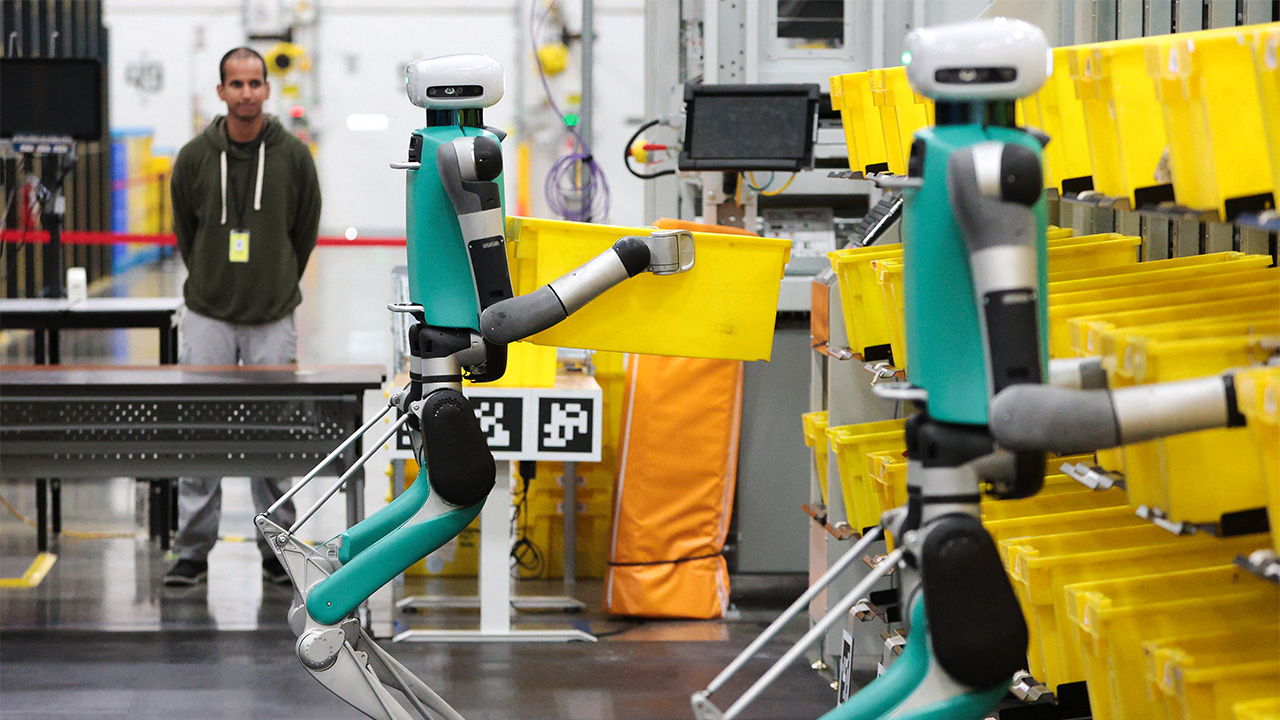
Amazon is continuing its workforce reductions, cutting at least 100 white-collar jobs in its robotics unit this week, according to a new report.
The affected division designs robots and other automation systems used primarily in Amazon warehouses, two people familiar with the matter told Reuters.
“We regularly review our organizations to make sure teams are best set up to innovate and deliver for our customers,” Amazon said in a statement without specifying the number of jobs cut.
DESPITE POSTING RECORD REVENUE YEAR ACROSS ALL DIVISIONS
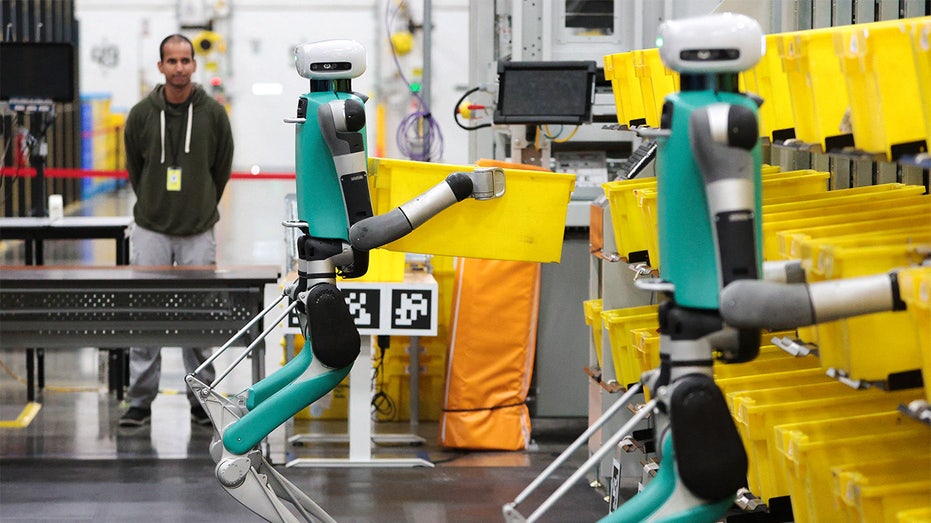
The move adds to a series of large-scale layoffs announced over the past year. (Jason Redmond/AFP via Getty Images)
The move adds to a series of large-scale layoffs announced over the past year. In January, the company cut around 16,000 jobs and signaled at the time that additional reductions could follow.
That same month, Amazon halted development of a robotic arm known as Blue Jay that it demonstrated at an event in October. Blue Jay featured multiple robotic arms that could grab several items at once and was designed to help workers in smaller spaces.
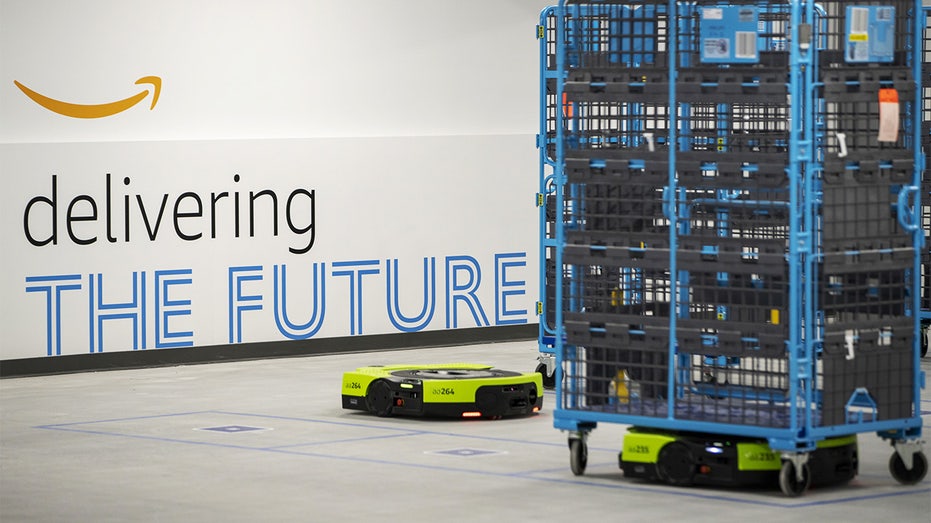
Amazon Proteus robots demonstrate autonomous navigation using barcodes on the floor during the Delivering the Future event at the Amazon Robotics Innovation Hub in Westborough, Mass., Nov. 10, 2022. (M Scott Brauer/Bloomberg via Getty Images / Getty Images)
Beginning with a round of about 14,000 white-collar layoffs in October, Amazon has eliminated roughly 30,000 corporate roles, citing efficiency gains from artificial intelligence and broader cultural changes. The cuts represented nearly 10% of its white-collar workforce, though the majority of Amazon’s approximately 1.5 million employees are hourly workers, particularly in warehouses known as fulfillment centers.
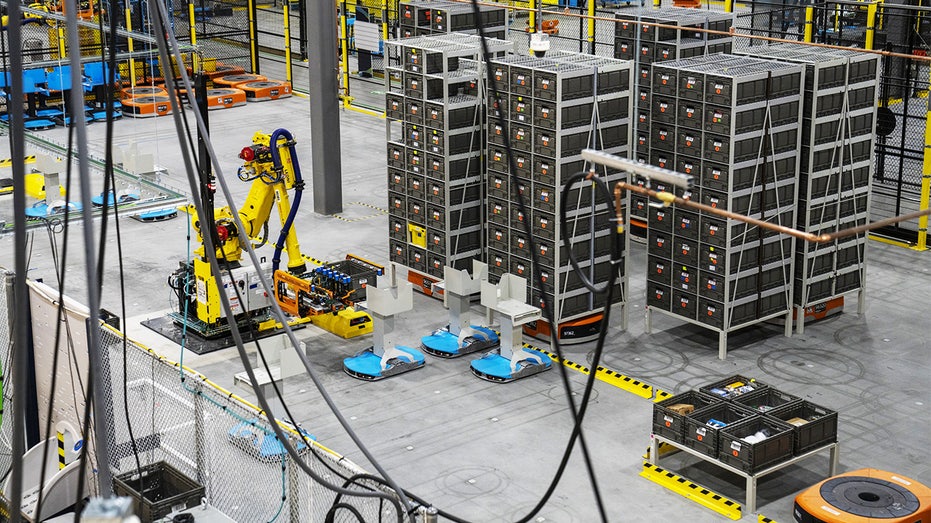
The affected division designs robots and other automation systems used primarily in Amazon warehouses. (M Scott Brauer/Bloomberg via Getty Images)
CLICK HERE TO GET FOX BUSINESS ON THE GO
In addition to the broader cuts in October and January, Amazon over the past year has pared a smaller number of jobs in its devices and services, books, podcasts and public relations units, among others.
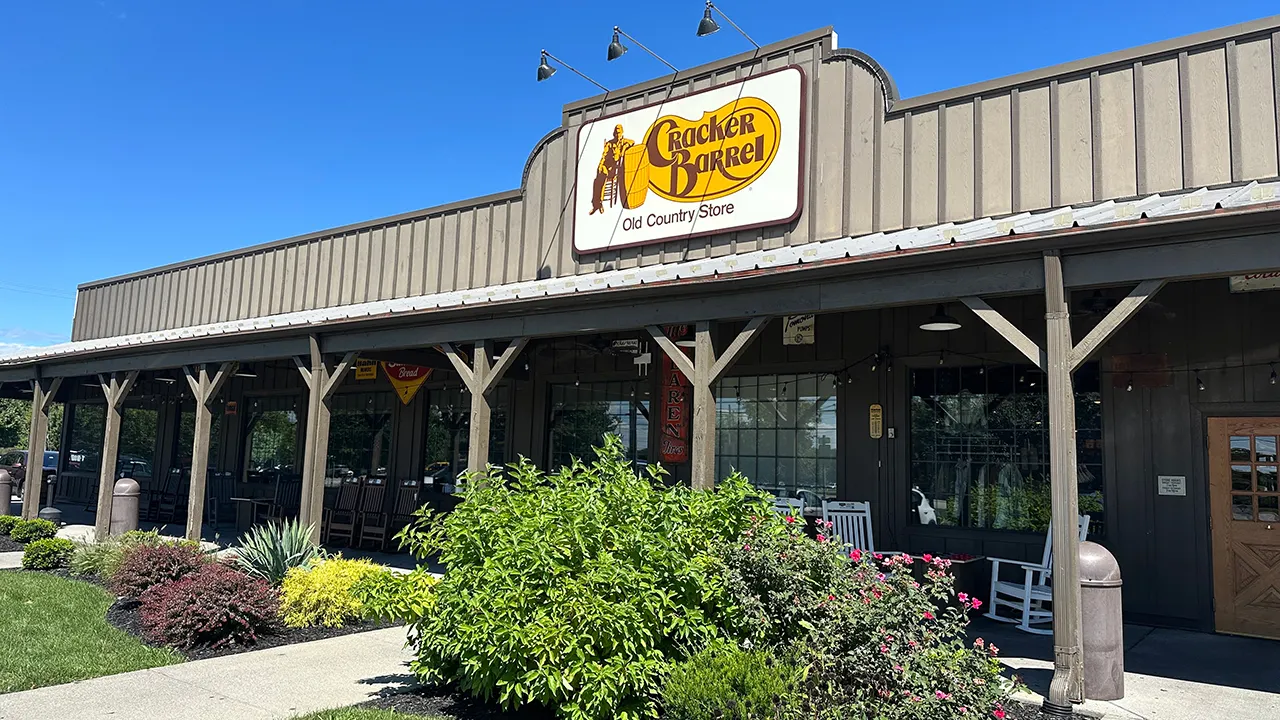
Cracker Barrel CEO Julie Masino spoke to The Blaze’s Glenn Back about the backlash she and the company faced after its controversial redesign this year.
Cracker Barrel reported a drop in quarterly revenue and profit as the company continues to recover from last summer’s rebranding controversy, though CEO Julie Masino says early signs of a turnaround are beginning to emerge.
Speaking during the Tennessee-based restaurant and retail chain’s fiscal second-quarter 2026 earnings call on Wednesday, Masino said that the company is focused on strengthening operations, refining its menu and marketing strategy to better connect with customers, and reducing costs to improve profitability.
“We’re gaining traction and are encouraged by some important guest metrics and green shoots around traffic, and we’re energized in terms of driving improved performance,” Masino said.
Cracker Barrel posted second-quarter revenue of $874.8 million, down 7.9% from a year earlier.
CRACKER BARREL RESPONDS TO REPORTS ABOUT EMPLOYEE DINING REQUIREMENTS DURING WORK TRAVEL
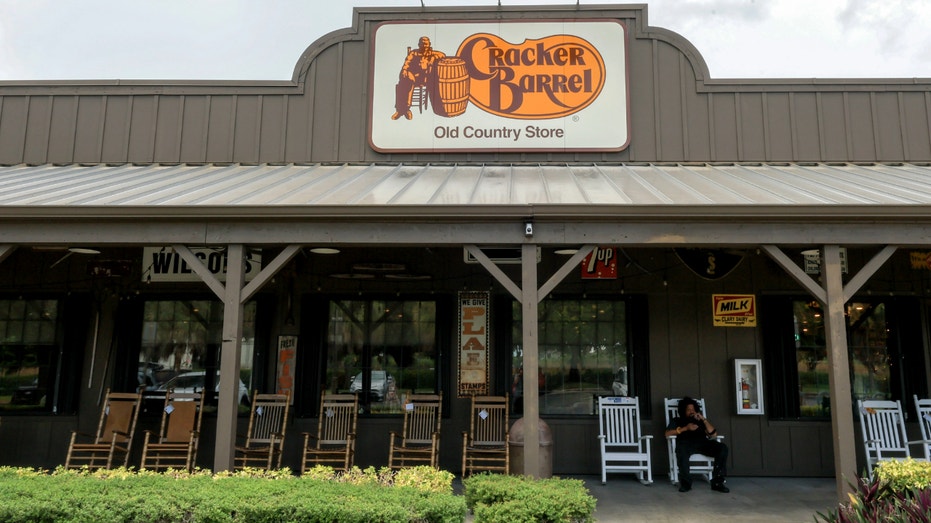
A Cracker Barrel sign hangs on the outside of a restaurant on Aug. 21, 2025, in Homestead, Florida. (Joe Raedle/Getty Images)
Comparable restaurant sales fell 7.1%, largely driven by a 10.1% drop in traffic, while comparable retail sales slid 9.2%, according to chief financial officer Craig Pommells.
Net income totaled $1.3 million, a sharp decrease from $22.2 million in the same quarter last year.
Despite the declines, results topped Wall Street expectations.
Masino highlighted improving employee turnover rates and a higher Google star rating as evidence that the company’s turnaround efforts are gaining traction.
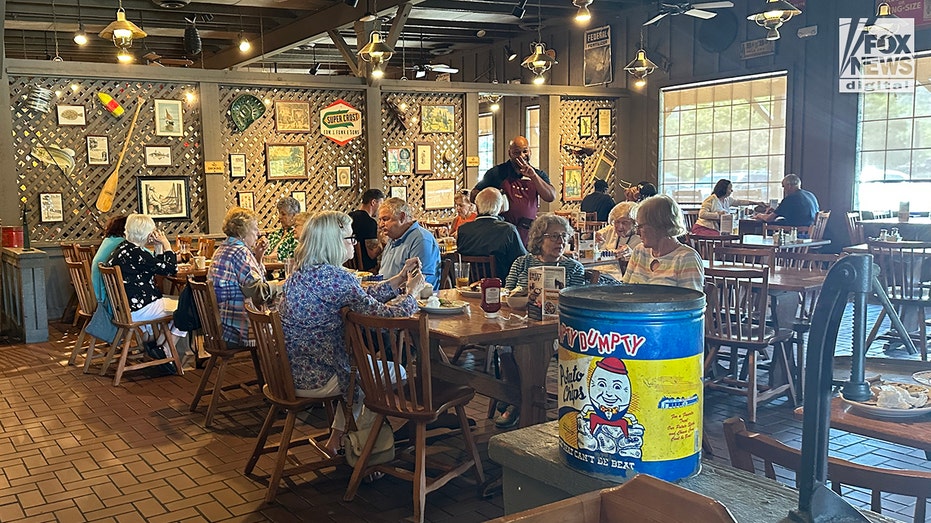
A general view of a Cracker Barrel Country Store in Fishkill, NY, on Monday, August 25, 2025. (Richard Beetham for Fox News Digital)
“We view all of these metrics as important leading indicators and are confident that these gains will translate into improved traffic over time,” she said.
As part of its strategy to win back customers, Cracker Barrel has also reintroduced popular limited-time offerings, including Country Fried Turkey, and added new menu items such as a breakfast burger and Garden and Farmhouse Scrambles.
The company’s loyalty program now has more than 11 million members and accounts for over 40% of tracked sales. Masino said loyalty member traffic has held up better than nonmembers since August.
“We’re committed to operating with excellence, and we’re implementing actions to improve profitability, all to strengthen the business and to return to positive momentum,” Masino said.

Cracker Barrel CEO Julie Felss Masino walks out of a Starbucks in Nashville, Tennessee, on Aug. 28, 2025. (Zak Bennett for Fox News Digital)
The revenue slump follows backlash last summer after Cracker Barrel announced changes to its logo and store interiors, including removing the “old timer” from its branding.
The company reversed course less than a week later after complaints from customers.
Masino has previously cautioned that the company’s recovery will take time.
GET FOX BUSINESS ON THE GO BY CLICKING HERE
Cracker Barrel did not immediately respond to FOX Business’ request for comment.
FOX Business’ Eric Revell contributed to this report.
Business
Alphabet Stock Edges Lower in Early Trading as AI Capex Concerns Weigh Amid Geopolitical Volatility
Alphabet Inc. shares dipped modestly in early U.S. trading Friday, reflecting broader market caution driven by surging oil prices and ongoing Middle East tensions, while investors continued to digest the company’s massive 2026 capital expenditure plans tied to artificial intelligence infrastructure.
AFP
Alphabet Class A shares (NASDAQ: GOOGL) were trading around $299.50 to $300.00 by mid-morning Eastern Time, down approximately 1.0% to 1.2% from Thursday’s close of $303.13. The stock opened near $302.50 to $303.00, with intraday action ranging from a low near $298.80 to a high of about $303.30. Volume approached 5 million to 10 million shares in early sessions, consistent with recent averages but below levels seen during high-volatility periods.
Alphabet Class C shares (NASDAQ: GOOG) moved similarly, trading near $300.00 to $300.50, down about 1.0% from the prior close around $303.45. The company’s combined market capitalization hovered near $3.65 trillion to $3.67 trillion, cementing its position among the world’s most valuable firms despite recent pullbacks.
The decline extended a pattern of consolidation after Alphabet reached multi-month highs earlier in 2026, with shares peaking near $349.00 in early February. Year-to-date performance remains positive but lags the broader S&P 500 amid concerns over heavy AI spending and competitive pressures in search and cloud computing. Over the past 12 months, GOOGL has gained significantly, up more than 70% from lows around $140 in early 2025, driven by strong revenue acceleration and AI advancements.
Recent momentum traces to Alphabet’s fourth-quarter earnings reported in early February, which beat expectations across key metrics. Revenue climbed 18% year-over-year to $113.8 billion, while adjusted earnings per share reached $2.82, surpassing consensus by about 7%. Google Cloud posted explosive 48% growth, underscoring its role as a major growth engine alongside core advertising.
Management’s guidance for 2026 capital expenditures—projected between $175 billion and $185 billion—sparked debate. The figure, roughly double 2025’s estimated $91 billion to $92 billion, prioritizes servers, data centers, and networking to support Gemini AI, cloud expansion, and other initiatives. Roughly 60% targets compute infrastructure, with the remainder for facilities.
Analysts view the spending as a bold bet on AI dominance but warn of near-term pressure on free cash flow and margins. Depreciation costs are expected to rise sharply, potentially compressing profitability even as revenue grows. Some forecasts suggest free cash flow could dip temporarily before rebounding, with optimistic scenarios projecting $55 billion to $72 billion annually in coming years if execution succeeds.
Bullish voices highlight Alphabet’s cash generation strength and positioning in AI. Google Cloud’s momentum, Gemini’s user growth beyond 750 million monthly actives, and advertising resilience provide tailwinds. Options activity has shown bullish tilt, with notable call volume at strikes near current levels for short-dated expirations, signaling trader bets on near-term recovery.
Yet challenges persist. Antitrust scrutiny, regulatory risks in multiple jurisdictions, and competition from OpenAI, Meta, and others in generative AI remain headwinds. Recent news highlighted partnerships like expanded Google Cloud collaborations with CVS Health and others, but also isolated incidents involving Waymo robotaxis and legal matters.
Broader market context amplified Friday’s softness. Oil’s surge amid Middle East conflict pressured growth stocks, with energy-sensitive sectors underperforming. The Dow and S&P 500 traded lower, while tech showed relative resilience but failed to buck the trend fully. The VIX stayed elevated, reflecting ongoing geopolitical unease.
Wall Street coverage leans positive, with consensus “Strong Buy” ratings and average price targets around $350 to $380, implying 15% to 25% upside from recent levels. Firms like Mizuho and Bank of America maintained bullish stances, citing AI opportunities despite capex concerns. Some analysts forecast potential re-rating if cloud and AI monetization accelerates.
Alphabet’s diversified revenue—advertising still dominant but cloud and other bets growing—offers resilience. Q1 earnings, expected late April, will provide updates on spending progress, Gemini adoption, and cloud margins.
For now, shares consolidate near $300 support, with traders eyeing macro developments and any AI-related catalysts. The stock’s valuation, at a forward P/E around 28, appears reasonable relative to growth prospects, though execution on capex remains key.
Investors monitor closely as Alphabet navigates AI investment phase amid volatile macro backdrop. Friday’s dip illustrates sensitivity to external risks, but fundamentals suggest long-term optimism for the tech giant.

Ethereum derivatives open interest drops 5.62% in 24-hour leverage flush

When Is the Love Is Blind Season 10 Reunion? What to Know

Financial Wellbeing Reset: Building Healthier Financial Habits


![The Biggest Bitcoin Short Squeeze of 2026 Is Loading [Proof]](https://wordupnews.com/wp-content/uploads/2026/03/1772753553_maxresdefault-80x80.jpg)
-

 Politics7 days ago
ITV enters Gaza with IDF amid ongoing genocide
-

 Politics3 days ago
Alan Cumming Brands Baftas Ceremony A ‘Triggering S**tshow’
-

 Fashion6 days ago
Weekend Open Thread: Iris Top
-

 Tech5 days ago
Unihertz’s Titan 2 Elite Arrives Just as Physical Keyboards Refuse to Fade Away
-
Sports6 days ago
The Vikings Need a Duck
-

 NewsBeat5 days ago
Abusive parents will now be treated like sex offenders and placed on a ‘child cruelty register’ | News UK
-
 NewsBeat5 days ago
Dubai flights cancelled as Brit told airspace closed ’10 minutes after boarding’
-
 NewsBeat5 days ago
The empty pub on busy Cambridge road that has been boarded up for years
-

 NewsBeat4 days ago
‘Significant’ damage to boarded-up Horden house after fire
-

 Tech17 hours ago
Bitwarden adds support for passkey login on Windows 11
-

 Entertainment4 days ago
Baby Gear Guide: Strollers, Car Seats
-
 Sports6 hours ago
499 runs and 34 sixes later, India beat England to enter T20 World Cup final | Cricket News
-
 Tech7 days ago
NASA Reveals Identity of Astronaut Who Suffered Medical Incident Aboard ISS
-
Politics5 days ago
FIFA hypocrisy after Israel murder over 400 Palestinian footballers
-
 NewsBeat5 days ago
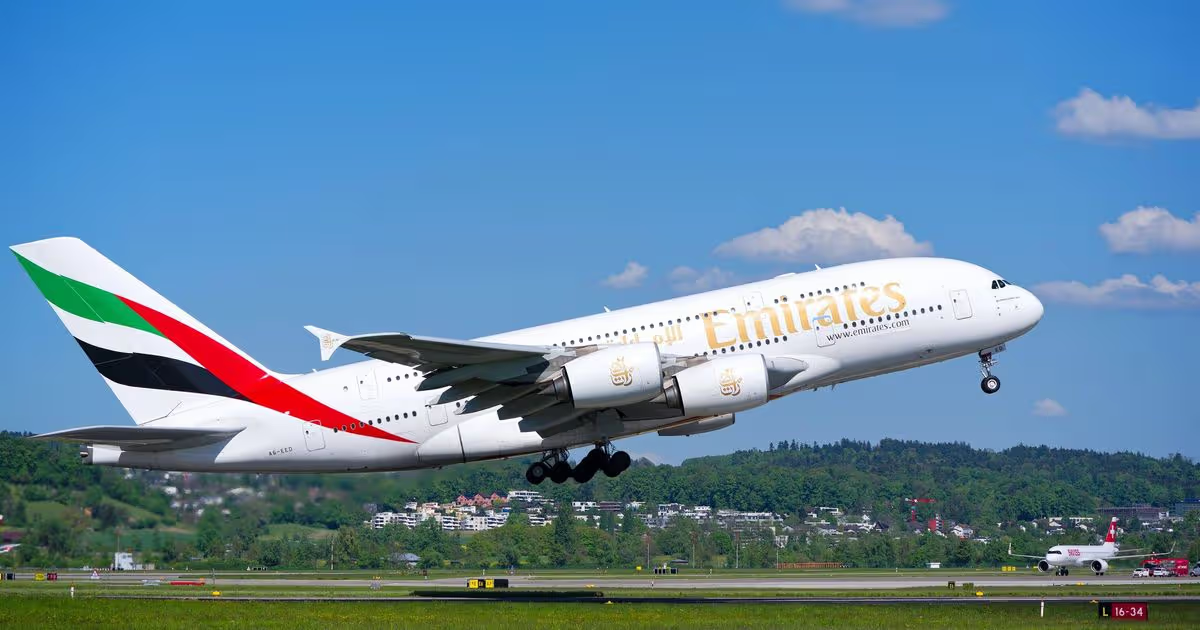
Emirates confirms when flights will resume amid Dubai airport chaos
-

 NewsBeat3 days ago
Is it acceptable to comment on the appearance of strangers in public? Readers discuss
-

 Tech5 days ago
Viral ad shows aged Musk, Altman, and Bezos using jobless humans to power AI
-

 Video4 days ago
How to Build Finance Dashboards With AI in Minutes
-

 Business2 days ago
Guthrie Disappearance Enters Fifth Week as Family Visits Memorial
-
 Crypto World5 days ago
US Judge Lets Binance Unregistered Token Class Action Proceed