
Business
4 reasons why you should own Japan equities




Data from the Clearing Corporation of India showed CSB Bank offered the highest rate at 8.32% for 91 days, followed by Ujjivan Small Finance Bank and Equitas Small Finance Bank, which raised funds at 8.25% for 366 days and 356 days, respectively. Other lenders such as HDFC Bank and IDBI Bank paid 7.6% for 33-day funds.
“While some firming is typical at year-end as banks shore up their balance sheets, this spike goes beyond seasonality,” said VRC Reddy of Karur Vysya Bank. “CD rates have moved to elevated levels, signalling deeper funding pressures rather than just a year-end phenomenon.”

HDFC Bank, the country’s most valuable lender, which has been under investor scrutiny following the sudden exit of chairman Atanu Chakraborty, raised funds at 7.6% for 33 days on March 27, mobilising ₹4,300 crore. Punjab National Bank raised ₹1,175 crore at 7.5% for the same tenor. These rates are well above the 3.25% banks typically pay retail depositors for 30- to 45-day deposits. Most banks pay around 6.25% to 7% for one-year deposits.

“The CD rates do appear high when compared with retail deposit rates or the card rates published by banks, largely because deposit growth has lagged credit growth,” said Anil Gupta, co-group head for financial sector ratings at ICRA.
Overall, HDFC Bank raised ₹23,090 crore during the last fortnight across tenors ranging from 33 to 327 days, paying interest rates between 7.3% and 7.6%. Data showed Axis Bank raised ₹3,500 crore at 7.6% for 92 days, IndusInd Bank raised ₹2,075 crore at around 7.5% for tenors ranging from 91 to 94 days, while Bandhan Bank paid 7.85% for 186 days on a ₹125 crore CD.During the fortnight ended March 31, banks issued ₹1.07 lakh crore of CDs, broadly in line with issuance in the corresponding fortnight last year.
CD rates had earlier climbed sharply during periods of tight liquidity, peaking at about 8.15% between February and March 2024, according to historical data.
Reddy said elevated CD rates reflect a combination of tight systemic liquidity, pressures linked to liquidity coverage ratio requirements, and tactical balance-sheet management amid weak deposit mobilisation.
“In this backdrop, banks have prioritised certainty over cost, relying on CDs and other bulk funding to secure immediate and assured resources,” he said.
ICRA’s Gupta said while CD rates are high, such issuances are typically used to plug short-term mismatches in asset-liability flows. “Certificates of deposit account for only 2.6% of overall bank deposits and do not materially increase the overall cost of deposits,” he said.
Union Bank of India raised ₹24,060 crore, while Punjab National Bank mobilised ₹12,450 crore in the last fortnight of March, offering rates ranging between 6.9% and 7.5%, the data showed.
Banks paid higher rates for shorter-tenor CDs than for longer maturities.
Reddy said CD rates may ease from the March-end spike but are unlikely to soften meaningfully in FY27. “The underlying drivers – tight liquidity conditions, a persistent credit-deposit mismatch and pressure on deposit mobilisation – are structural rather than transient,” he said.


Three Gulf funds agree to back Paramount’s $81 billion takeover of Warner, WSJ reports
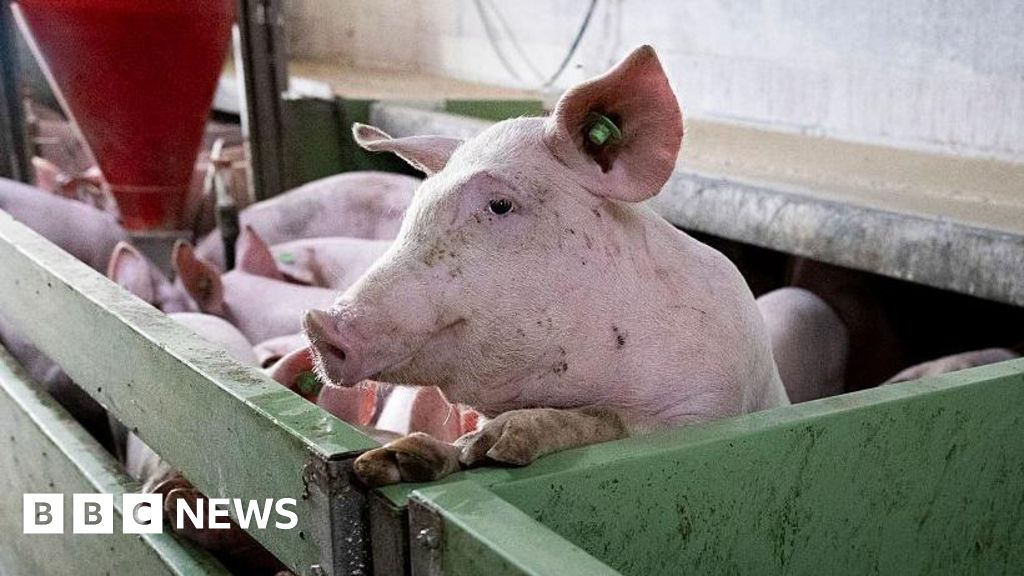
Brazil, Japan, Mexico, South Africa and the US have stopped importing Spanish pork. Other countries, such as EU members, China and the UK, have taken a more localised approach, only banning pork that originates in the affected area of north-eastern Spain.


Trump invokes religious rhetoric in praise of Iran rescue, drawing criticism

Families on some benefits with three or more children will get an average rise of £4,100 a year.

Russia says it downed 148 Ukrainian drones in three hours


Oil prices open higher as US-Israeli war with Iran continues to disrupt supply


How a perilous US rescue mission in Iran nearly went off course

Forbes Media chairman Steve Forbes gives his take on the growing support for tax cuts in the U.K. and New Jersey’s tightening gubernatorial race on ‘Kudlow.’
In the 1800s, the United Kingdom was clearly the richest country in the world, with consistent, solid economic growth, a focus on science and engineering, plus all the benefits of trade across the oceans. But now the country seems to have lost its mojo. The country’s living standards have fallen far behind those of other developed economies.
Contrary to popular perception, Britain’s GDP per capita (the income generated by the average person) has lagged behind that of the vast majority of the 50 United States plus Washington D.C., last year, according to forecasts in the third quarter of 2025 by the U.S. government, plus recent International Monetary Fund data. Projections are needed as the final annual GDP figures were not published at the time of writing.
When those states (plus Washington D.C.) compared their GDP per capita, the U.K. would have ranked 50th, behind Alabama, which is forecast to have a nominal per capita GDP of $60,265 in 2025. Britain was slightly worse off, at $60,010, according to the latest data from the U.S. government and the International Monetary Fund. Topping the list was Washington DC with $113,369. Analysts note that the figures don’t include the cost of living; however, even with that accounted for, the U.K. still lags significantly behind the U.S. national average.
“If you leave aside Britain’s capital, London, their GDP per capita is much lower,” Marc Chandler, chief market strategist at Bannockburn Global Forex in New York City, told FOX Business. London has a huge financial center which distorts some of the data. One of the major problems has been the lack of productivity growth, which measures the increase in output per average employee, Chandler, “U.S. productivity increases have been stronger.”
MAJORITY OF UK ENTREPRENEURS SAY BRITISH GOVERNMENT IS ‘ANTI-BUSINESS,’ NEW SURVEY SHOWS
A sign showing the London Stock Exchange. (Toby Melville/Reuters / Reuters)
On average, the U.S. GDP per capita is projected to be $89,599 in 2025, considerably higher than in Britain. The UK also lags Ireland, Switzerland, Singapore, Norway and Germany, to name a few countries, according to forecasts by the International Monetary Fund. “That’s what happens when you destroy innovation, taxes are too high, and regulations are too numerous,” Robert E. Wright, an economic policy historian at the University of Austin, Texas, told FOX Business.
Wright notes there’s also a British cultural tendency toward risk aversion for many reasons. Even if a project or new business succeeds in the U.K., the company will be heavily taxed and then hampered by newly created regulations. “Not only are these barriers not helpful, but they’re also shooting themselves in the foot,” he says. “And they aren’t at the technological frontier.” American businesspeople tend to embrace risk.
UNCLE SAM TO THE RESCUE. TRUMP HELPS OUT THE UK WITH A $350 BILLION TECH DEAL

UK Prime Minister Keir Starmer. (Getty Images / Getty Images)
According to surveys, the immediate future looks bleak, suggesting Britain’s economy will not suddenly power back, according to a research report from the analysis firm Oxford Economics. “The U.K. lacks a sustainable growth driver,” the briefing states. That’s because what’s keeping the economy growing, albeit at an extra slow pace, is U.K. government spending, rather than organic growth and innovation from private-sector businesses.
Government spending has resulted in job creation and that has helped mute the headcount job losses in the private sector, according to the Oxford Economics report. “But the boost from the public sector will likely start to fade,” it states. “Given weak private sector demand, we expect the jobless rate will rise further.”
The Oxford report also shows that since the second half of 2023, government jobs have been stubbornly better paid, on average, than those in the private sector. That’s likely to get in the way of encouraging creative entrepreneurs from innovating, experts say.
A Union flag flies near the Elizabeth Tower, better known as “Big Ben”, and the Houses of Parliament in central London on March 6, 2017 (Ben Stansall/AFP Getty Images / Getty Images)
Oxford Economics forecasts a small 1% growth for 2026. But that was forecast before the U.S.-Israel war with Iran, which could lead to likely weaker growth for the U.K. analyst warned.
GET FOX BUSINESS ON THE GO BY CLICKING HERE
Robert Jenrick, the shadow chancellor of the UK Reform Party, slammed the Labour government’s handling of the economy. “We are losing our steel, our car manufacturing, our glass, our ceramics, our chemical industries,” he told the U.K.’s Daily Express. “There are millions of good jobs that rely on these industries, and they simply will not survive if we continue to have energy prices that are five or six times higher than in the United States.”

S&P 500: Prepare For Change (Technical Analysis)
Banks pay near 2-year high rates on CDs amid tight liquidity

7 Upcoming Horror Shows You Cannot Miss

Southport riots were considered for emergency alerts


-

 NewsBeat3 days ago
Steven Gerrard disagrees with Gary Neville over ‘shock’ Chelsea and Arsenal claim | Football
-

 Business3 days ago
No Jackpot Winner and $194 Million Prize Rolls Over
-

 Fashion2 days ago
Weekend Open Thread: Spanx – Corporette.com
-
Entertainment6 days ago
Fans slam 'heartbreaking' Barbie Dream Fest convention debacle with 'cardboard cutout' experience
-

 Crypto World4 days ago
Gold Price Prediction: Worst Month in 17 Years fo Save Haven Rock
-

 Tech7 days ago
The Pixel 10a doesn’t have a camera bump, and it’s great
-

 Tech7 days ago
Avatar Legends: The Fighting Game comes out in July and it looks pretty slick
-
Crypto World5 days ago
Dems press CFTC, ethics board on prediction-market insider trades
-

 Sports1 day ago
India men’s 4x400m and mixed 4x100m relay teams register big progress | Other Sports News
-

 Business4 days ago
Login and Checkout Issues Spark Merchant Frustration
-

 Tech6 days ago
Apple will hide your email address from apps and websites, but not cops
-

 Tech6 days ago
EE TV is using AI to help you find something to watch
-

 Sports5 days ago
Tallest college basketball player ever, standing at 7-foot-9, entering transfer portal
-

 Politics6 days ago
Should Trump Be Scared Strait?
-

 Tech6 days ago
Flipsnack and the shift toward motion-first business content with living visuals
-
Tech6 days ago
Daily Deal: StackSkills Premium Annual Pass
-

 Fashion7 days ago
The Best Spring Trends of 2026
-

 Sports6 days ago
Women’s hockey camp eyes fitness boost, tactics ahead of WC 2026 campaign | Other Sports News
-

 Crypto World6 days ago
U.S. rule change may open trillions in 401(k) funds to crypto
-

 Tech6 days ago
How to back up your iPhone & iPad to your Mac before something goes wrong
You must be logged in to post a comment Login