Milano Cortina 2026’s Winter Olympics opening ceremony unfolded Friday as a bold, geographically ambitious spectacle titled “Armonia” (Harmony), weaving live performances across San Siro Stadium, Cortina d’Ampezzo and beyond into a narrative celebrating Italy’s dual urban-mountain soul. The nearly three-hour show blended La Scala-inspired dance, global superstars like Mariah Carey and Laura Pausini, and dual cauldron lightings, though fragmented execution, political boos and protest interruptions tempered its grandeur.
Directed by Marco Balich with a Giorgio Armani fashion homage, the ceremony innovated by distributing athlete parades across four clusters — Milan (indoor), Cortina (Alpine/sliding), Livigno (freestyle) and Predazzo (Nordic) — ensuring all 3,000+ competitors participated despite vast distances. Critics hailed the simultaneity as “intimate and enormous,” but some found it disjointed, lacking traditional cohesion.
Dual cauldrons ignite across Italy: A first for Olympics
In a historic twist, two Olympic cauldrons blazed simultaneously: Milan’s Arco della Pace and Cortina’s Piazza Dibona, symbolizing city-mountain unity. Supermodel Vittoria Ceretti, in all-white Armani, carried the torch from San Siro to ignite Milan’s flame via “magic of technology,” while Cortina’s lit remotely — a logistical marvel marred by elongated sequences.
The multi-venue parade replaced single-stadium marches with live feeds: ice skaters in Milan, snowboarders in Livigno, biathletes in Predazzo. Television editing fluidly integrated segments, creating “four ceremonies in one,” though live crowds felt the fragmentation. U.S. athletes drew massive cheers at San Siro, only for boos to erupt during Vice President JD Vance’s brief appearance — a tense moment swiftly cut away.
Advertisement
‘Armonia’ theme: Beauty over politics, but protests intrude
“Armonia” promised a “voyage through art and innovation,” honoring Leonardo da Vinci, Italian design and Olympic ethos. Ethereal dancers opened with La Scala nods — marble busts, flowing choreography — evoking tranquility before escalating to time-travel motifs and massive bobbleheads. Actress Matilda De Angelis narrated, tying fragmented acts into harmony’s promise.
Mariah Carey kicked off with hits, joined by Grammy/Golden Globe winner Laura Pausini and tenor Andrea Bocelli from Tuscany. Production designer Paolo Fantin and music director Andrea Farri delivered visual feasts — ice-block banners, fashion-sports uniforms — though Deadline critiqued “gimmicks over glamour” in the flame-lighting finale.
Protests disrupted: anti-Olympic banners decried housing costs, Palestinian solidarity chants pierced whistles. Organized rather than chaotic, they underscored Italy’s civic pulse amid global tensions.
Advertisement
Parade of Nations: Distributed drama delights, divides
Fragmenting the traditional parade minimized travel while showcasing venues. San Siro hosted urban nations; Cortina mountain squads. Graphics aided viewers, but stadium pacing dragged — “seemingly endless procession,” per IndieWire.
U.S. flagbearers received roars; host Italy closed to “Il Canto degli Italiani.” IOC President Thomas Bach’s farewell preceded LA 2028 handover.
Critics praise innovation, critique cohesion
The Guardian (4/5 stars): “Intimate and enormous… less march of nations, more curated narrative mirroring distributed sports.”
Deadline: “Three hours, three acts lacked unity beyond visual devotion… historic spectacle, per Malagò.”
Advertisement
IndieWire: “Weirdness in short supply, but harmony attempts shone in editing.”
Global audience hit billions; Peacock/NBC streamed live.
Day 1 medals await: Shiffrin, Chen, Kim in spotlight
Saturday yields five golds: men’s downhill (Bormio, 5:30 a.m. ET), women’s skiathlon (Val di Fiemme). Nathan Chen eyes figure skating three-peat; Chloe Kim defends halfpipe; Mikaela Shiffrin chases records.
Advertisement
Hosts Italy (130 athletes) bank on Federica Brignone, Sofia Goggia. Russia as AIN; China fields Eileen Gu.
Production triumphs and logistical feats
Balich Wonder Studio executed Balich’s vision: da Vinci inventions, culinary nods, youth segments. Armani costumes fused elegance-sports; Cantini Parrini’s designs dazzled. San Siro’s 75,000 roared; remote venues pulsed simultaneously.
Security — drones, robots, thousands of officers — shielded dignitaries including Vance, Rubio. Sustainability shone: 99% legacy venues.
What ‘Armonia’ means for Olympics future
Milano Cortina pioneered polycentric ceremonies, influencing LA 2028, Brisbane 2032. “Harmony” — uniting disparate elements — resonated amid division, though execution split opinions.
Advertisement
Malagò called it “promise to the world”; Varnier hailed inclusive athlete participation. From San Siro spectacle to Cortina flames, Italy delivered innovation — if not unalloyed unity.
I’ve been researching companies in-depth for over a decade, from commodities like oil, natural gas, gold and copper to tech like Google or Nokia and many emerging market stocks, which I believe could help me provide useful content for readers. After writing my own blog for about 3 years, I decided to switch to a value investing-focused YouTube channel, where I researched hundreds of different companies so far. I would say my favorite type of company to cover are metals and mining stocks, but I am comfortable with several other industries, such as consumer discretionary/staples, REITs and utilities.
Analyst’s Disclosure: I/we have a beneficial long position in the shares of CELH either through stock ownership, options, or other derivatives. I wrote this article myself, and it expresses my own opinions. I am not receiving compensation for it (other than from Seeking Alpha). I have no business relationship with any company whose stock is mentioned in this article.
Seeking Alpha’s Disclosure: Past performance is no guarantee of future results. No recommendation or advice is being given as to whether any investment is suitable for a particular investor. Any views or opinions expressed above may not reflect those of Seeking Alpha as a whole. Seeking Alpha is not a licensed securities dealer, broker or US investment adviser or investment bank. Our analysts are third party authors that include both professional investors and individual investors who may not be licensed or certified by any institute or regulatory body.
A landmark agreement has been signed between Metrocentre and Gateshead Council to bring forward Metro Riverside
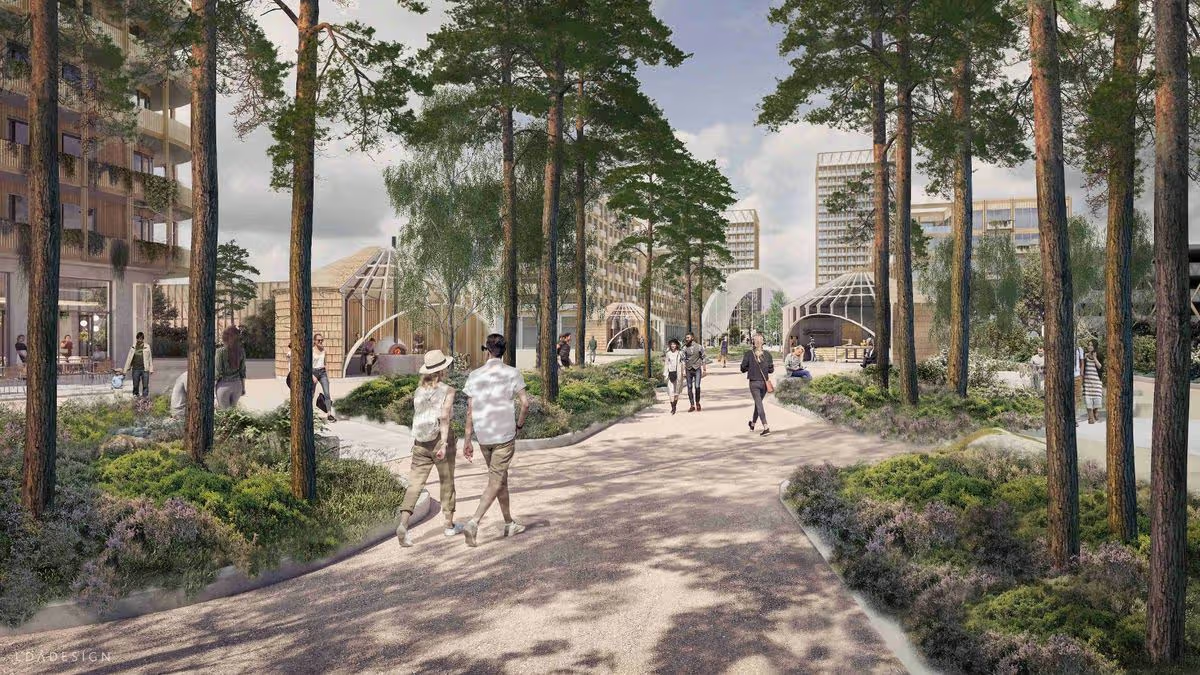
The agreement has been signed between Metrocentre and Gateshead Council to bring forward Metro Riverside(Image: LDA Design)
The Metrocentre, one of the North East’s premier shopping and leisure destinations, has agreed a landmark deal to deliver a major new development featuring thousands of new homes, billed as a “city within a city”. The agreement, signed between Metrocentre and Gateshead Council, will bring forward Metro Riverside — a new, carbon-neutral urban district on the southern bank of the River Tyne.
The sweeping regeneration scheme will transform brownfield land surrounding the Metrocentre into a thriving, mixed-use community, comprising more than 4,500 homes, while also carrying the potential to generate 5,000 jobs.
Beyond providing housing for thousands of future residents, the project could double the site’s contribution to the regional economy to more than £2bn per annum by 2045. Conceived as a 20-minute destination — with everything residents require within a 20-minute journey — Metrocentre bosses say it will deliver “compact, accessible and walkable neighbourhoods in a high-quality waterfront setting”, underpinned by strong public transport links.
Those behind the scheme say Metro Riverside has the potential to become one of the largest and most ambitious urban regeneration projects undertaken anywhere in the UK outside the M25, representing a significant vote of confidence in the North East as a location for long-term, large-scale investment. The plan also marks the most substantial development of the area since the Metrocentre first opened its doors 40 years ago.
Advertisement
Metro Riverside has been highlighted as a significant housing development within NECA’s Local Growth Plan and the Strategic Place Partnership established by NECA and Homes England, which aims to accelerate the delivery of new properties, reports Chronicle Live.
Martin Healy, chairman of Metrocentre, said: “Metro Riverside demonstrates the power of long-term public-private partnerships to unlock transformational change. Developments of this scale and ambition simply cannot be delivered in isolation.
“By working in partnership with Gateshead Council and others, we can bring together long term investment, local leadership and shared purpose to create a new dense, urban community that delivers homes, jobs and opportunities, while ensuring Metrocentre continues to evolve as a major economic engine for the region for decades to come.”
Mr Healy outlined ambitions for Metro Riverside to become a cornerstone of nature recovery, featuring green corridors lined with woodland connecting to the river, while encouraging pedestrian and cycling links to the city centres and the River Tyne corridor. He added that the development also presents a significant opportunity to boost sustainable urban drainage throughout the entire area, bolster flood defences and strengthen flood resilience.
Advertisement
A CGI of how the Metro Riverside scheme will look(Image: LDA Design)
The Metrocentre itself will sit at the core of the project, transitioning from its current status as a premier retail destination into a vibrant hub capable of serving the needs of its incoming residents and local workforce.
Plans for a substantial housing development on brownfield land surrounding the Metrocentre have been under consideration for more than 11 years, with the local authority initially aiming to deliver around 850 new homes as part of a scheme known as MetroGreen.
As far back as 2015, a new bridge spanning the Tyne was proposed as part of the MetroGreen plans, with suggestions that the development could be linked to Newcastle via a new Tyne crossing with a tram connection – though a cabinet report at the time made clear that no funding was available.
The fresh agreement between Metrocentre and Gateshead Council will see the two commit to co-invest in the first phase of the Metro Riverside project, to bring it to the point of a delivery plan.
Advertisement
To find all the planning applications, traffic diversions, road layout changes, alcohol licence applications and more in your community, visit the Public Notices Portal.
Europe’s artificial intelligence sector is gaining momentum in 2026, with a wave of ambitious startups challenging U.S. dominance through open-source models, enterprise tools, voice and video generation, and specialized infrastructure. While the continent still trails North America in total funding, several high-growth companies have achieved multi-billion-dollar valuations and rapid revenue traction, fueled by strategic investments from governments, tech giants and defense contractors.
Top 10 Rising AI Companies in Europe 2026: Mistral Leads Charge
France, the United Kingdom and Germany remain the primary hubs, benefiting from strong research talent, supportive policies on AI sovereignty and growing enterprise adoption. As of March 2026, these rising players are delivering practical applications across industries while addressing European priorities such as data privacy, multilingual capabilities and industrial competitiveness.
Here are 10 of the most promising rising AI companies in Europe this year, selected for funding momentum, valuation growth, technological innovation and commercial impact:
1. Mistral AI (Paris, France) Mistral AI has emerged as Europe’s flagship AI champion. Founded in 2023, the company reached a valuation of approximately $14 billion by late 2025 after major investments, including a significant stake from ASML. It builds efficient, open-weight large language models that compete with leading U.S. offerings while emphasizing multilingual performance and enterprise deployment. Mistral’s focus on sovereign AI infrastructure, including data center partnerships, has positioned it as a key player in reducing Europe’s reliance on foreign models. Revenue growth and adoption by European businesses have been robust.
2. ElevenLabs (London, United Kingdom) This voice AI specialist has seen explosive growth, with reports of its valuation climbing toward $6–11 billion and annual recurring revenue approaching or exceeding $300 million. ElevenLabs delivers hyper-realistic text-to-speech, voice cloning and conversational audio tools used by creators, enterprises and developers worldwide. Its rapid expansion highlights strong demand for audio AI in content creation, dubbing, accessibility and agentic systems. Backed by substantial funding, the company continues to roll out advanced features while expanding globally from its London base.
Advertisement
3. Wayve (London, United Kingdom) Wayve develops embodied AI for autonomous driving, using end-to-end machine learning rather than traditional mapping and rule-based systems. Valued at around $8.6 billion after cumulative funding exceeding $1 billion, the company is advancing toward robotaxi trials and commercial partnerships. Its data-driven approach to urban navigation has attracted automaker interest and underscores Europe’s strength in applied AI for mobility and safety.
4. Synthesia (London, United Kingdom) Synthesia leads in generative video AI, enabling users to create realistic avatar-based videos from text for training, marketing and internal communications. The company has surpassed $100 million in annual recurring revenue and achieved a valuation near $4 billion. Its platform serves thousands of enterprises, demonstrating how synthetic media can reduce production costs and timelines while supporting multiple languages — a key advantage in Europe’s diverse markets.
5. Black Forest Labs (Freiburg, Germany) This visual AI startup behind the Flux image generation models has quietly become one of Europe’s most valuable AI companies. It raised $300 million in a Series B at a $3.25 billion valuation in late 2025, drawing investment from Salesforce Ventures, a16z, Nvidia and others. Black Forest Labs focuses on high-quality, controllable image and visual AI tools, carving out a strong position in generative media despite intense global competition.
6. Quantexa (London, United Kingdom) Specializing in decision intelligence and entity resolution, Quantexa applies AI to connect complex datasets for fraud detection, risk management and compliance. The company has reached a valuation exceeding $2.6 billion and serves major banks and government agencies. Its contextual analytics platform helps uncover hidden patterns in financial crime investigations, making it a trusted name in regulated industries across Europe.
Advertisement
7. Hugging Face (Paris, France / New York) Although it has significant U.S. operations, Hugging Face maintains deep European roots and influence. The open-source AI platform and model hub has grown into a central ecosystem for developers, with a reported valuation around $4.5 billion. It hosts thousands of models and supports collaborative AI development, playing a vital role in democratizing access to cutting-edge tools while fostering Europe’s open AI community.
8. Stability AI (London, United Kingdom) Known for pioneering open-source generative models such as Stable Diffusion, Stability AI continues to innovate in image, video and multimodal generation. Despite evolving business models, the company retains significant influence in creative AI applications for artists, designers and enterprises. Its contributions to accessible generative technology have sparked both innovation and important discussions on ethics and copyright.
9. Harmattan AI (France) This defense-tech newcomer, founded in 2024, rapidly achieved unicorn status with a $1.4 billion valuation following a $200 million Series B led by Dassault Aviation. Harmattan AI develops AI solutions for autonomous systems and defense applications, aligning with Europe’s push for technological sovereignty in security and military capabilities. Its swift rise reflects growing investment in dual-use AI technologies.
10. DeepL (Cologne, Germany) DeepL has become a global leader in AI-powered translation and language tools, offering superior accuracy and natural results compared to many competitors. The company continues to expand its suite of productivity tools while maintaining strong European focus on data privacy and multilingual excellence. Steady growth and enterprise adoption have solidified its position as a reliable AI success story.
Advertisement
Europe’s AI ecosystem benefits from world-class universities, collaborative research networks and policy initiatives aimed at building compute capacity and talent pipelines. Governments in France, the UK and Germany have backed strategic projects to foster homegrown innovation and reduce dependence on non-European providers.
Many of these companies emphasize responsible AI development, with attention to transparency, bias mitigation and compliance with regulations such as the EU AI Act. This regulatory clarity has helped attract investment while differentiating European approaches from less constrained models elsewhere.
Funding trends show increased interest from both domestic and international investors, though Europe still captures a smaller share of global AI capital than the United States. Strategic bets on infrastructure, defense and industrial applications have helped several firms scale quickly.
Challenges persist, including competition for top talent, energy demands for large models and the need for more domestic compute resources. Partnerships with semiconductor leaders and cloud providers are helping address these gaps.
Advertisement
Sectors driving growth include generative media (voice, video and images), enterprise decision tools, autonomous systems and defense applications. Public-sector and industrial adoption provides stable revenue streams for several players.
As 2026 unfolds, analysts anticipate further funding rounds, potential IPO activity and deeper integration of AI into European industries. Milestones such as expanded model releases, commercial robotaxi pilots or major defense contracts could boost valuations and visibility.
The broader European AI market is projected to contribute meaningfully to economic growth and productivity, with rising companies playing a central role. Talent retention, international expansion and ethical leadership will determine which firms become enduring global leaders.
For investors and enterprises, these rising stars offer opportunities in high-potential technologies with strong regional advantages. Early engagement through partnerships or pilot programs can provide competitive edges in a rapidly evolving landscape.
Advertisement
Europe’s AI story in 2026 reflects a maturing ecosystem moving from research excellence to scalable commercial impact. While gaps with U.S. giants remain, focused innovation and strategic investments are creating a more competitive and diversified continental AI sector.
The landscape continues to evolve quickly, with new entrants emerging from university spinouts and accelerator programs. Ongoing monitoring of funding announcements, product launches and regulatory developments will be essential for tracking momentum.



















































You must be logged in to post a comment Login