

Business
ASEAN’s Fintech Rise: Tackling the Regional Fragmentation Challenge


Southeast Asia is in the middle of one of the most consequential financial transformations in its history. Digital payments are proliferating, virtual banks are launching, cross-border QR networks are linking national systems that once operated in complete isolation, and a generation of mobile-first consumers is bypassing traditional banking infrastructure entirely. The numbers tell a compelling story: ASEAN’s fintech market reached USD 16.7 billion in 2025 and is projected to grow to USD 66.4 billion by 2033, at a compound annual growth rate of 18.8%.
Yet beneath the growth headlines lies a structural problem that has dogged the region’s financial integration agenda for decades and that no single bilateral deal or regulatory framework has yet resolved: fragmentation. Ten economies, ten regulatory regimes, ten currencies, and ten distinct national payment architectures — all attempting, with varying degrees of ambition and coordination, to build a seamless regional financial system. The question for investors, fintech operators, and policymakers is no longer whether ASEAN fintech will grow. It clearly will. The question is whether the region can grow together — or whether its own complexity will cap the potential of the ecosystem it is building.
The Scale of the Opportunity
The structural foundations driving ASEAN fintech growth are well understood: a large and young unbanked population, rapidly expanding middle class, high mobile penetration, and governments motivated to accelerate financial inclusion as a development priority.
Southeast Asia’s fintech transaction value reached USD 1.4 trillion in 2025, shaped by data-driven super apps and digital payments, and is projected to grow further. In ASEAN’s six largest economies — Indonesia, Malaysia, the Philippines, Singapore, Thailand, and Vietnam — the share of global fintech investments increased from 2% in 2018 to 7% in 2022, amounting to approximately USD 4.3 billion. The trend has continued despite global funding volatility: in 2024, ASEAN-6 fintech funding fell by less than 1%, against a 28% decline in global fintech funding over the same period.
The resilience is notable. But so is the concentration: fintech funding remains highly concentrated, with Singapore-based firms accounting for up to 85% of regional funding in 2025. For markets such as Indonesia, Malaysia, Thailand, and the Philippines, these gaps in capital access present a structural constraint on scaling.
The Fragmentation Problem
ASEAN’s fintech ecosystem is expanding rapidly, but growth remains uneven due to fragmented regulation, infrastructure gaps, and highly concentrated funding that limits firms’ ability to scale and extend services to underserved populations.
The regulatory dimension is the most acute. Each ASEAN member state maintains its own licensing frameworks, data localisation requirements, anti-money-laundering and know-your-customer standards, and digital asset rules. A fintech firm licensed in Singapore cannot automatically offer services in Thailand, Indonesia, or Vietnam. It must navigate three separate regulatory environments — each with distinct timelines, compliance costs, and enforcement cultures. The primary challenges include currency conversion costs, regulatory fragmentation across different jurisdictions, slow settlement times, and limited interoperability between domestic payment networks.
The IMF has flagged this constraint directly. The current web of bilateral cross-border payment arrangements is not scalable for a globally interconnected economy. As more countries join, the number of necessary connections grows exponentially. Moving to a multilateral system will significantly enhance efficiency, interoperability, and reduction in complexity.
The stablecoin surge adds a further complication. In the ASEAN+3 region, where regulatory frameworks vary widely, the rise of stablecoin alternatives will contribute to a more fragmented cross-border payment system. The real challenge lies in resilience: building a cross-border payment ecosystem that is diverse, interoperable, and robust against shocks.
Progress on the Ground: QR Networks and Project Nexus
Despite the structural complexity, tangible progress is being made — and faster than many observers anticipated.
As of April 2026, ASEAN countries have officially entered the era of borderless payments. Indonesia, Malaysia, the Philippines, Singapore, and Thailand have linked their respective national QR systems — QRIS, DuitNow, QR Ph, PayNow, and PromptPay — enabling seamless cross-border transactions across a 420-million-consumer payment zone.
The volume of activity already flowing through these corridors is significant. ASEAN cross-border QR payment transactions surged to 12.9 million in the first half of 2025 alone, setting the stage for further expansion as additional cross-country linkages are explored.
The architecture underpinning this expansion is Project Nexus. Launched by the BIS Innovation Hub with ASEAN central banks, Project Nexus replaces the unwieldy web of bilateral links with a hub-and-spoke model where each instant payment system connects once to a central gateway, gaining access to all others. With India, Malaysia, the Philippines, Singapore, and Thailand onboard, and Nexus Global Payments established in Singapore, the initiative is on track for rollout in 2026. By standardising message formats, compliance, and FX processes, Nexus promises near-instant payments across jurisdictions at minimal cost.
By using the Local Currency Transaction framework, countries like Indonesia, Thailand, and Malaysia are settling payments directly between their own currencies, reducing reliance on the US dollar as an intermediary and protecting local economies from global exchange rate volatility.
Thailand’s Position: A Fintech Leader With Structural Ambitions
For Thailand specifically, the fintech moment represents both a competitive opportunity and an unfinished policy agenda.
Thailand presents perhaps the clearest model of government-led digital financial transformation in the region. PromptPay, launched in 2017, now processes more than 75 million daily transactions. Thailand’s financial inclusion rate stands at 92% of adults — with women slightly ahead of men, a phenomenon attributed in part to cultural norms in which women manage household finances.
The next phase is virtual banking. The Bank of Thailand’s approval of three digital banking licence applicants — Krungthai Bank in partnership with AIS and PTT OR; SCBX with South Korea’s KakaoBank and China’s WeBank; and the CP Group with TrueMoney — represents a turning point in Thailand’s push for financial innovation and inclusion. These virtual banks, expected to launch in 2026, will challenge incumbents with cloud-native infrastructure and customer-centric propositions targeting underserved segments.
Thailand is one of the fastest-growing fintech markets in ASEAN, and a pioneer in the adoption of 5G technology to improve capacity for deep technology including blockchain, AI, big data, and cloud computing. Yet even in Thailand, most banks still face barriers in industrialising AI across the enterprise, with AI remaining limited to isolated use cases due to fragmented data architectures and unclear governance structures.
What the Region Can Learn
The external models are instructive. India’s Digital Public Infrastructure — comprising the Aadhaar identity system, the Unified Payments Interface, and Account Aggregators for secure data exchange — facilitates over 20 billion transactions per month in 2025, making it among the world’s largest payment networks, now adopted or licensed by countries including Singapore and Peru. Brazil’s Pix instant payment system processed 57 billion transactions in 2024. Both demonstrate what regulatory coherence and standardisation at the national level can unlock at scale.
A more united ASEAN policy approach, drawing on lessons from these emerging economies, could harness the region’s significant potential for fintech growth, promote meaningful and equitable financial inclusion, bolster competition, and fuel innovation. The architecture for that approach is taking shape — in Project Nexus, in the ASEAN Payment Connectivity initiative, and in the national digital banking frameworks now being activated across the region. The gap that remains is political will and regulatory harmonisation speed.
ASEAN fintech’s rise is not in question. The pipeline of investment, the demographic tailwinds, and the infrastructure already in place are too substantial for the trajectory to reverse. What remains genuinely uncertain is whether the region will realise its full potential as an integrated financial ecosystem — or continue to grow as a collection of nationally dominant platforms that are technically connected but structurally siloed.
For businesses and investors operating across ASEAN, that distinction is material. A company that can deploy one compliance framework, one payment integration, and one data architecture across the region has a fundamentally different cost structure and market opportunity than one that must rebuild its operating model in each jurisdiction. Closing that gap is not merely a regulatory ambition. It is the defining competitive task for ASEAN fintech in the years ahead — and Thailand, as one of the region’s most advanced and strategically positioned markets, has both the most to gain and an important role to play in making it happen.
Sources: East Asia Forum (March 2026); IMF Staff Country Reports (February 2026); GSMA Intelligence (April 2026); AMRO Asia; BIS Innovation Hub; Chambers and Partners Fintech 2026 Thailand; DataCube Research
Other People are Reading



With an investment banking cash and derivatives trading background, Binary Tree Analytics (‘BTA’) aims to provide transparency and analytics in respect to capital markets instruments and trades. BTA focuses on CEFs, ETFs and Special Situations, and aims to deliver high annualized returns with a low volatility profile. We have been investing for over 20 years after obtaining a Finance major at a top university.
Analyst’s Disclosure: I/we have no stock, option or similar derivative position in any of the companies mentioned, and no plans to initiate any such positions within the next 72 hours. I wrote this article myself, and it expresses my own opinions. I am not receiving compensation for it (other than from Seeking Alpha). I have no business relationship with any company whose stock is mentioned in this article.
Seeking Alpha’s Disclosure: Past performance is no guarantee of future results. No recommendation or advice is being given as to whether any investment is suitable for a particular investor. Any views or opinions expressed above may not reflect those of Seeking Alpha as a whole. Seeking Alpha is not a licensed securities dealer, broker or US investment adviser or investment bank. Our analysts are third party authors that include both professional investors and individual investors who may not be licensed or certified by any institute or regulatory body.

Wall Street’s main indices have closed higher, with the Nasdaq leading gains as a steep rally in semiconductor shares helped shift the focus away from the latest Middle East hostilities and tariff battles while investors looked ahead to major technology earnings reports.

FOX Business’ Grady Trimble reports live from Chicago O’Hare on jet fuel prices, which jumped 10% from Tuesday to Wednesday.
At least 7,000 flights were disrupted Tuesday as severe thunderstorms swept across the East Coast, snarling air travel at some of the nation’s busiest airports.
More than 2,000 flights within, into or out of the United States were canceled, while over 5,000 others were delayed, according to FlightAware.
The storms prompted flood warnings and tornado watches across parts of the Northeast on Tuesday. Weather and emergency officials indicated at least two tornadoes were spotted — one in northeast Pennsylvania and another in northern New Jersey, according to Fox Weather.
Airports in the New York City area, Boston, Philadelphia and Washington, D.C., experienced some of the most significant disruptions.
FAA BEGINS DJT TRANSITION AS TRUMP AIRPORT NAME TAKES EFFECT

Delta Air Lines passengers wait to retrieve luggage after flight cancellations at La Guardia Airport July 18, 2026. (Erik McGregor/LightRocket / Getty Images)
The Federal Aviation Administration (FAA) issued ground stops for at least eight U.S. airports due to the thunderstorms, including:
- Maryland – Baltimore/Washington International Airport (BWI)
- Massachusetts – Boston Logan International Airport (BOS)
- New Jersey – Newark Liberty International Airport (EWR)
- New Jersey – Teterboro Airport (TEB)
- New York – LaGuardia Airport (LGA)
- New York – Westchester County Airport (HPN) in White Plains
- Pennsylvania – Philadelphia International Airport (PHL)
- Virginia – Ronald Reagan Washington National Airport (DCA)
- Virginia – Washington Dulles International Airport (IAD)
Canada’s Toronto Pearson International Airport (YYZ) also received a ground stop.
HOUSE PASSES DAYLIGHT SAVING TIME REFORM AS TRUMP SIGNALS SUPPORT FOR ENDING CLOCK CHANGE
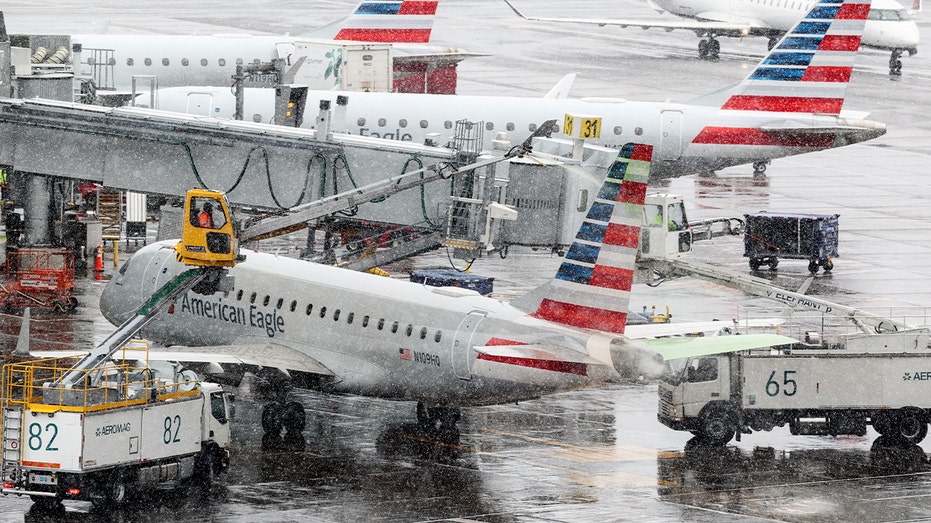
A passenger plane is stationed at a gate during severe weather at LaGuardia Airport in New York Feb. 22, 2026. (Charly Triballeau/AFP / Getty Images)
While John F. Kennedy International Airport (JFK) was not under a ground stop as of Tuesday afternoon, it was experiencing an average ground delay of about four hours due to the severe weather, according to FlightAware.
In the New York City metropolitan area alone, nearly 600 departing flights had been canceled and more than 500 others delayed, the outlet reported.
Figures are expected to rise as the storms continue to move through the region.

People walk through the rain along 5th Avenue in Manhattan on June 22, 2026, in New York City. (Spencer Platt / Getty Images)
Several U.S. airlines issued travel advisories and flexible rebooking options for affected passengers.
“Repeated rounds of severe weather across the Northeast and Mid-Atlantic have significantly disrupted travel plans for many of our customers. Our teams are working around the clock to help affected customers reach their destinations,” JetBlue said.
The airline said customers whose flights were affected may rebook travel through Sunday or request a refund to their original form of payment.
| Ticker | Security | Last | Change | Change % |
|---|---|---|---|---|
| UAL | UNITED AIRLINES HOLDINGS INC. | 117.70 | +0.18 | +0.15% |
| JBLU | JETBLUE AIRWAYS CORP. | 5.35 | -0.10 | -1.83% |
| AAL | AMERICAN AIRLINES GROUP INC. | 15.28 | +0.14 | +0.92% |
GET FOX BUSINESS ON THE GO BY CLICKING HERE
United Airlines said it is waiving trip change fees for eligible customers who rebook flights departing by Thursday.
“You can reschedule your trip, and we’ll waive change fees and fare differences. But your new flight must be a United flight departing between July 20, 2026, and July 23, 2026,” the airline said. “Tickets must be in the same cabin and between the same cities as originally booked.”
American Airlines said it will notify affected customers by email or through its mobile app. Eligible travelers must rebook by Wednesday, with new travel scheduled by Friday.
Business
(VIDEO) 10 Things to Know About TUIDE, HYBE’s Highly Anticipated New K-Pop Girl Group Set to Debut This Year

K-pop powerhouse HYBE unveiled the name of its newest girl group, TUIDE, on Monday, sparking a wave of anticipation ahead of the septet’s planned debut later this year. Here are 10 things to know about the group as fans gear up for their arrival.
1. The group’s name comes from a specific phrase
TUIDE’s name is a creative play on the phrase “tune the tide,” reflecting the group’s stated ambition to absorb the world’s many changing cultural and musical currents and tune them into new forms of enjoyment, according to an official press release from the group’s label. The imagery is meant to evoke the ocean, symbolizing TUIDE’s goal of creating a new wave within K-pop.
2. TUIDE has seven members
The group consists of seven members: Seohee, Seoyeon, Elena, Jia, Saki, Seah and Yi Hani, according to HYBE’s official announcement. The members are set to showcase distinct individual personalities while working together to create a harmonious group sound and performance style.
3. One member has a notable family connection to another K-pop group
Among TUIDE’s members is Seoyeon, the younger sister of Jihyo, the leader of the established K-pop girl group Twice, according to the Korea Herald. Seoyeon was among three members who first appeared in an earlier teaser video released in May, introducing the label behind TUIDE’s creation.
4. TUIDE will be the first group under a brand-new HYBE label
TUIDE will debut under ABD, a newly established HYBE label focused exclusively on developing girl groups. ABD, whose name stands for “A Bold Dream,” officially launched in May with a stated mission of pursuing the intrinsic joy of music while exploring new creative possibilities within K-pop, according to a statement from HYBE at the time.
5. A veteran producer is leading the group’s creative direction
TUIDE’s overall production, including its music, concepts and performances, is being led by Han Sung-soo, the founder of Pledis Entertainment. Han has a lengthy track record of shaping successful K-pop acts, having previously produced girl group After School as well as boy bands Seventeen and TWS. Han was named one of Billboard’s Indie Power Players in May, according to the Korea Herald.
6. ABD is led by a former Pledis Entertainment executive
The ABD label itself is headed by Jiwon No, who previously served as Head of Artist Planning at Pledis Entertainment, according to Music Business Worldwide. No oversees the label’s overall management and strategic direction as TUIDE prepares for its debut.
7. The group’s name and logo were revealed through a stylized teaser
ABD launched TUIDE’s official social media channels at midnight KST on July 20, unveiling the group’s name alongside a logo motion video. According to allkpop, the visual featured different colors blending seamlessly into vibrant new hues before the group’s name and logo appeared, symbolizing the members’ individual talents merging into a unified identity.
8. TUIDE is taking an unconventional approach to pre-debut marketing
As part of a distinctive promotional strategy, TUIDE’s official Instagram account turned private starting July 21 for an unspecified period, a deliberate marketing choice intended to build anticipation and create an interactive storytelling experience for fans ahead of the group’s full debut, according to the Korea Daily.
9. Fans can attend an exclusive pre-debut event in Seoul
TUIDE is scheduled to hold an exclusive pre-debut experience called “TUIDE Exclusive Preview [Playground]” in Seoul from August 1 to 2, according to Forbes, giving fans an early opportunity to engage with the group ahead of its official music debut later in the year.
10. TUIDE joins an expanding roster of HYBE girl groups
With TUIDE’s upcoming debut, HYBE continues to grow its lineup of girl groups across its various sub-labels, joining acts including Le Sserafim under Source Music, NewJeans under Ador, Illit under Belift Lab and Katseye under HYBE Labels, according to the Korea Times. TUIDE’s launch also comes as HYBE expands its search for girl-group talent internationally, having opened nationwide auditions in India through HYBE India earlier this year, alongside a second global girl-group project launched in Japan through its joint venture with Universal Music Group’s Geffen Records.
With TUIDE’s name, logo and member lineup now confirmed, fans can expect additional promotional content to roll out in the coming weeks, culminating in the group’s official debut sometime in the second half of 2026. Given Han Sung-soo’s track record producing multiple successful HYBE acts and the broader company’s continued global expansion strategy, TUIDE is positioned as one of the more closely watched rookie debuts in K-pop this year, with additional details about the group’s music and concept expected to emerge as its debut date approaches.

The Nike flagship store in Nanjing Road Walkway in Shanghai, Nov. 4, 2025.
Cfoto | Future Publishing | Getty Images
Nike is planning to cut off thousands of online distributors in China beginning in January as the sneaker giant looks to clean up what’s become a messy digital marketplace and get the region back to growth, the company said Tuesday.
Starting next year, Nike’s online footprint will shift primarily to the retailer’s official website and app, and the storefronts it operates on Tmall, JD.com and Douyin, some of China’s largest online marketplaces and social platforms.
Currently, consumers can shop Nike through all of those channels as well as thousands of other online storefronts powered by Nike’s brick-and-mortar partners in the region and a network of secondary distributors. While the vast digital network has led to widespread consumer access to Nike’s products, it’s also created an inconsistent branding and pricing experience and hampered the company’s efforts to reverse a sales decline in the region.
“These new flagships will serve as the single, elevated destination for Nike within these ecosystems, with clearer product presentation, stronger storytelling and more connected consumer journeys,” Cathy Sparks, Nike’s new vice president and general manager of Greater China, wrote in a letter. “This is about strengthening the platforms where consumers already begin and end their shopping journey, making sure those experiences are direct, consistent and unmistakably Nike.”
“This is not about reducing access. It is about reducing fragmentation and strengthening the consumer journey,” she said. “When the experience is consistent, the brand becomes stronger.”
Nike’s plans to pare back its online footprint are designed to create a better, more consistent experience for the consumer and allow it to take back pricing control online. However, there are also concerns it could lead to a material drop in revenue in a region that’s already shrunk about 30% in the last five years.
News about Nike’s plans to cut off online distributors first came to light late last month in a local Chinese media report. It prompted a note from BNP Paribas equity analyst Laurent Vasilescu, who wrote the move is reminiscent of Nike’s ill-fated decision to cut off wholesalers in North America, which contributed to its collapse of market dominance in the region, as well as steep declines in sales and margins.
“This strategy opened up shelf space for competitors and the strategy ended poorly for Nike. We believe the same could happen if it takes the same approach in China,” Vasilescu wrote last month, adding that BNP was sticking with its underperform rating for the company. “We don’t think Nike has a distributor problem but rather a product problem which also applies in other markets.”
The change is also expected to hurt Nike’s brick-and-mortar partners in the region, which have expanded their online presence in recent years to grow their own businesses.
Still, Topsports, Nike’s largest distributor in mainland China, said it supports the company’s decision.
“Topsports has worked with Nike for 27 years based on the principle of mutual benefit and shared growth,” Topsports CEO Yu Wu said in a statement. “This adjustment will bring some short-term pressure to our business. But we firmly believe that, over the medium- to long-term, this direction will help promote a healthier, more orderly, and more sustainable retail ecosystem in China, while further improving consumer experience and product appeal.”
“Looking ahead, we will continue to work closely with Nike, leveraging our strengths in offline retail operations, local consumer service, and deep market development across city tiers,” Wu said. “Through new concept sport stores and high-quality physical retail experiences, we will bring Chinese consumers richer and more meaningful sport experiences.”

.webp?t=1784642764)
Transaction expected to close later this year.
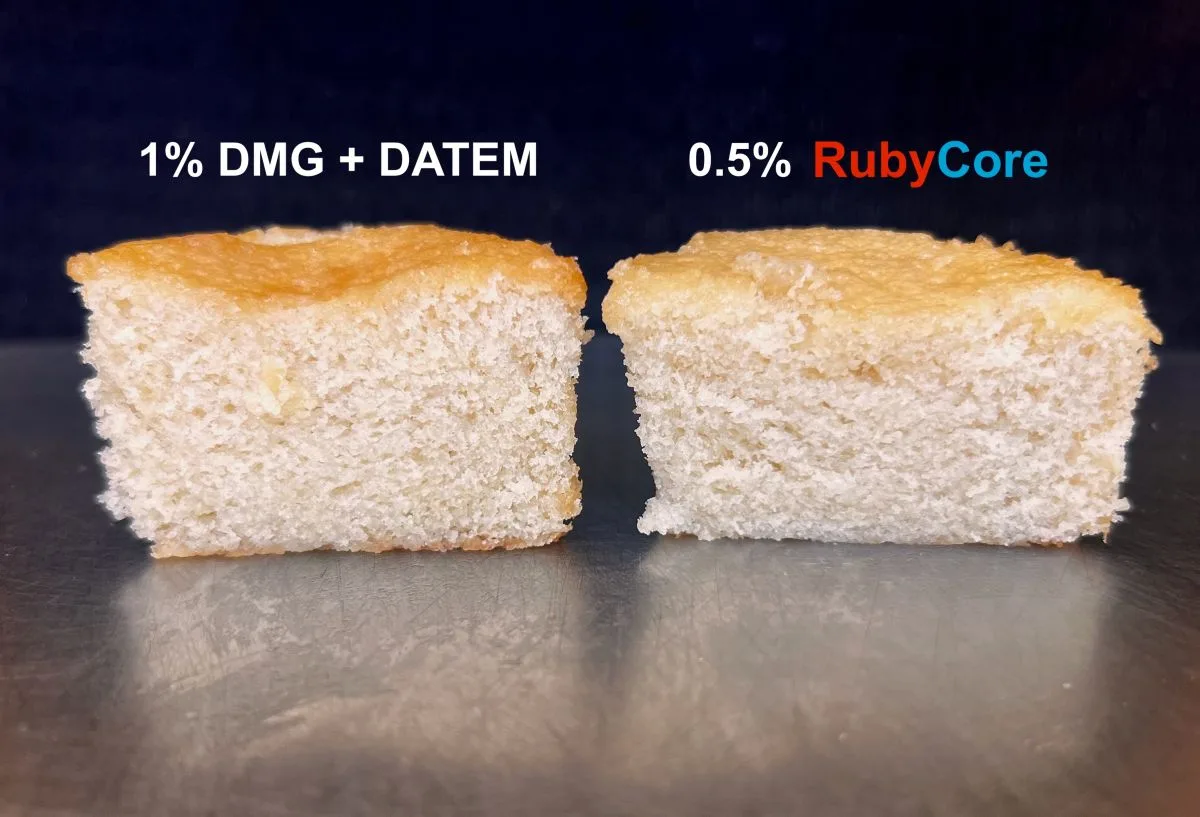

LBB advancing market readiness of Ruby Bio’s palm-free emulsifiers.


AAK makes equity investment in Savor’s carbon-to-fat conversion platform.


Digital-first company is launching its sour fruit snacks into retail.

Nvidia Stock Steadies, But It Needs Help for Real Gains

Stars, Jason Robertson avoid arbitration with one-year deal

A go-to Affordably-priced smart thermostat

America’s worst mother let husband rape daughter, 11, and get her pregnant… then forced youngster to give birth at home without medical care


-
 NewsBeat5 days ago
London Mayor Sadiq Khan handed a peerage by Keir Starmer alongside 15 other Labour figures… just days before the PM leaves No10
-

 Fashion4 days ago
Weekend Open Thread – Corporette.com
-

 Politics4 days ago
The House | The City of London can help the new chancellor deliver growth in every postcode
-

 Politics7 days ago
Young campaigners urge incoming PM to act on outdoor junk food ads
-
 Crypto World5 days ago
Two July Windows Left: The CLARITY Act’s Senate Fight and What Failure Means
-

 Crypto World6 days ago
CFTC blocks Kalshi from unwinding Michigan trades after court order
-

 Crypto World4 days ago
Ripple Payments Joins MiCA With 14 Firms, Does It Mean Anything For XRP?
-

 Business6 days ago
Nvidia Stock Slips After Big Tuesday Rally as Huang Confirms Vera Rubin Chip Is Now in Production Today
-

 Politics2 days ago
Democrats look to World Cup watch parties to register thousands of voters
-
 Entertainment6 days ago
Disney’s Most Ambitious Failed Star Wars Attraction Is Coming to SDCC
-

 Crypto World4 days ago
Ripple wins EU-wide access as ESMA adds it to MiCA register
-

 Crypto World16 hours ago
Grayscale Files For Worldcoin ETF, WLD Registers Sharp Rise
-

 Crypto World5 days ago
Injective Submits SEC Transfer-Agent Registration to Onchain Ownership Records
-

 Business6 days ago
Palantir Shares Rise After Expanded Nvidia Partnership and Fresh Analyst Upgrades Ahead of Earnings Day
-

 Tech1 day ago
Sail Virtually Aboard The “Itanic” With IA-64 Emulator
-
 Tech21 hours ago
Turtle Beach Command Series KB7 review: a nifty screen-equipped gaming keyboard
-

 NewsBeat5 days ago
Registration is now open for March for Men with Kev 2026
-

 NewsBeat2 days ago
Unregistered fitter used Gas Safe logo on business flyers
-
 Sports6 days ago
New Cornerback Enters Vikings Trade Rumor Mill
-

 News Videos5 days ago
Money | Class 12 Economics | CBSE Board Exam 2026-27
You must be logged in to post a comment Login