Connect with us

Business

ASMPT Limited 2025 Q4 – Results – Earnings Call Presentation (OTCMKTS:ASMVY) 2026-03-03

Published

on

OneWater Marine Inc. (ONEW) Q1 2026 Earnings Call Transcript

This article was written by

Seeking Alpha’s transcripts team is responsible for the development of all of our transcript-related projects. We currently publish thousands of quarterly earnings calls per quarter on our site and are continuing to grow and expand our coverage. The purpose of this profile is to allow us to share with our readers new transcript-related developments. Thanks, SA Transcripts Team

Continue Reading
Click to comment

Leave a Reply

Your email address will not be published. Required fields are marked *

Business

India’s services growth moderated in February as cost pressures mount, PMI shows

Published

on

India’s services growth moderated in February as cost pressures mount, PMI shows


India’s services growth moderated in February as cost pressures mount, PMI shows

Continue Reading

Business

NXP at Morgan Stanley Conference: Strategic Growth and Challenges

Published

on


NXP at Morgan Stanley Conference: Strategic Growth and Challenges

Continue Reading

Business

Stock Market Holiday: Are NSE, BSE closed today for Holi on March 4?

Published

on

Stock Market Holiday: Are NSE, BSE closed today for Holi on March 4?
Trading on Indian stock exchanges NSE and BSE will continue as normal on Wednesday, March 4, despite Holi festivities being observed in several regions of the country. The official market holiday for Holi in 2026 was on Tuesday, March 3, and both the BSE and National Stock Exchange have resumed operations thereafter.

Exchanges operate strictly as per their notified annual calendar, and March 3 was the designated closure for Holi this year. Even though celebrations spill over into March 4 in many states, there is no trading halt across the equity, derivatives or currency segments on Wednesday.

Stock market holiday calendar 2026
In total, Indian exchanges will observe 15 trading holidays in 2026, spanning key national and religious events.The next scheduled holidays are Ram Navami on March 26 and Mahavir Jayanti on March 31. April will see markets closed for Good Friday on April 3 and Ambedkar Jayanti on April 14. Maharashtra Day on May 1 will also be a non-trading day.

In the first half of the year, Bakri Id on May 28 and Muharram on June 26 are marked as holidays. Later in the year, trading will remain suspended for Ganesh Chaturthi on September 14 and Gandhi Jayanti on October 2. Dussehra falls on October 20, followed by Diwali Balipratipada on November 10 and Guru Nanak Jayanti on November 24. The final market holiday of 2026 will be Christmas on December 25.
Independence Day on August 15 falls on a weekend in 2026, meaning there is no additional weekday closure beyond the regular Saturday break.
Markets brace for war-driven volatility
The resumption of trading comes against the backdrop of heightened geopolitical stress. Escalating hostilities between the United States, Israel and Iran have unsettled global financial markets, triggering a surge in crude oil prices and prompting a shift toward risk aversion.

On Monday, Indian equities saw heavy selling pressure as investors reacted to the expanding conflict in West Asia. The Sensex and Nifty opened sharply lower and remained under pressure for most of the session before trimming some intraday losses. Broader indices, including midcaps and smallcaps, also declined, reflecting widespread caution.

Advertisement

The core concern for Indian markets remains oil. With tensions threatening energy flows through the Middle East, crude prices have risen sharply, stoking fears of imported inflation, pressure on the rupee and a widening current account deficit. Any sustained disruption could complicate the interest rate outlook and weigh on corporate margins, particularly in oil-intensive sectors.

Market participants are also factoring in global cues. Wall Street has corrected sharply to the evolving situation. The trajectory of crude prices and the duration of the conflict are likely to dictate near-term sentiment.

Technically, analysts say the Nifty is hovering near important support levels after the recent slide. A break below recent swing lows could extend the correction, while any stabilisation in oil prices may offer room for a relief bounce.

Given the uncertain backdrop, brokers are advising investors to avoid aggressive positioning and focus on capital preservation. With geopolitical developments still unfolding, the immediate outlook hinges less on festival calendars and more on energy markets and global risk sentiment.

Advertisement

(Disclaimer: Recommendations, suggestions, views and opinions given by experts are their own. These do not represent the views of Economic Times.)

Continue Reading

Business

Asia Markets Reel as Energy Shock Fears Escalate

Published

on

Asia Markets Reel as Energy Shock Fears Escalate

Asian equities tumbled as investors braced for the economic fallout of widening conflict in the Middle East, which has already sent oil prices soaring and rattled currency markets.

  • Asian markets faced sharp declines as Seoul’s benchmark plummeted 4%, pushing its two-day losses past 11%, driven by a downturn in memory chipmakers. Meanwhile, Japan’s Nikkei slid 2.5%, marking its third consecutive session of losses.
  • Currency and Commodities Pressure The South Korean won hit a 17-year low. Brent crude surged more than 12% this week, trading near $81.40 per barrel. Gold steadied at $5,128 an ounce after a sharp overnight drop.
  • Geopolitical Drivers U.S. and Israeli forces continued strikes on Iran, while Iranian drones and missiles targeted Gulf oil refineries and U.S. embassies in Saudi Arabia and Kuwait. Washington announced measures to secure Gulf shipping, including possible naval escorts for oil tankers.
  • Global Market Reactions Wall Street’s S&P 500 closed 0.8% lower, while European futures rose 0.8%. The euro slipped below $1.16, and European gas prices jumped 65% in two days, raising inflation concerns.
  • Investor Outlook Analysts warn that sustained high energy prices could delay interest rate cuts, forcing investors to unwind positions in gold and chipmakers to cover losses elsewhere.

The escalating Middle East conflict has triggered a wave of uncertainty across global markets, with Asia bearing the brunt of investor anxiety. Rising oil prices and currency volatility are compounding fears of prolonged inflationary pressures. Unless geopolitical tensions ease, the outlook suggests continued instability, leaving policymakers and investors alike facing difficult decisions in the weeks ahead.

This uncertainty has led to a flight to safe-haven assets, with gold prices surging and government bond yields fluctuating as investors seek stability. Meanwhile, equity markets across Asia have experienced sharp declines, particularly in sectors sensitive to energy costs and global trade. Central banks in the region may face mounting pressure to adjust monetary policies to counteract inflationary risks, even as they strive to support economic growth. In this volatile environment, businesses are bracing for potential disruptions in supply chains and increased operational costs, further complicating recovery efforts in post-pandemic economies.

Advertisement
Continue Reading

Business

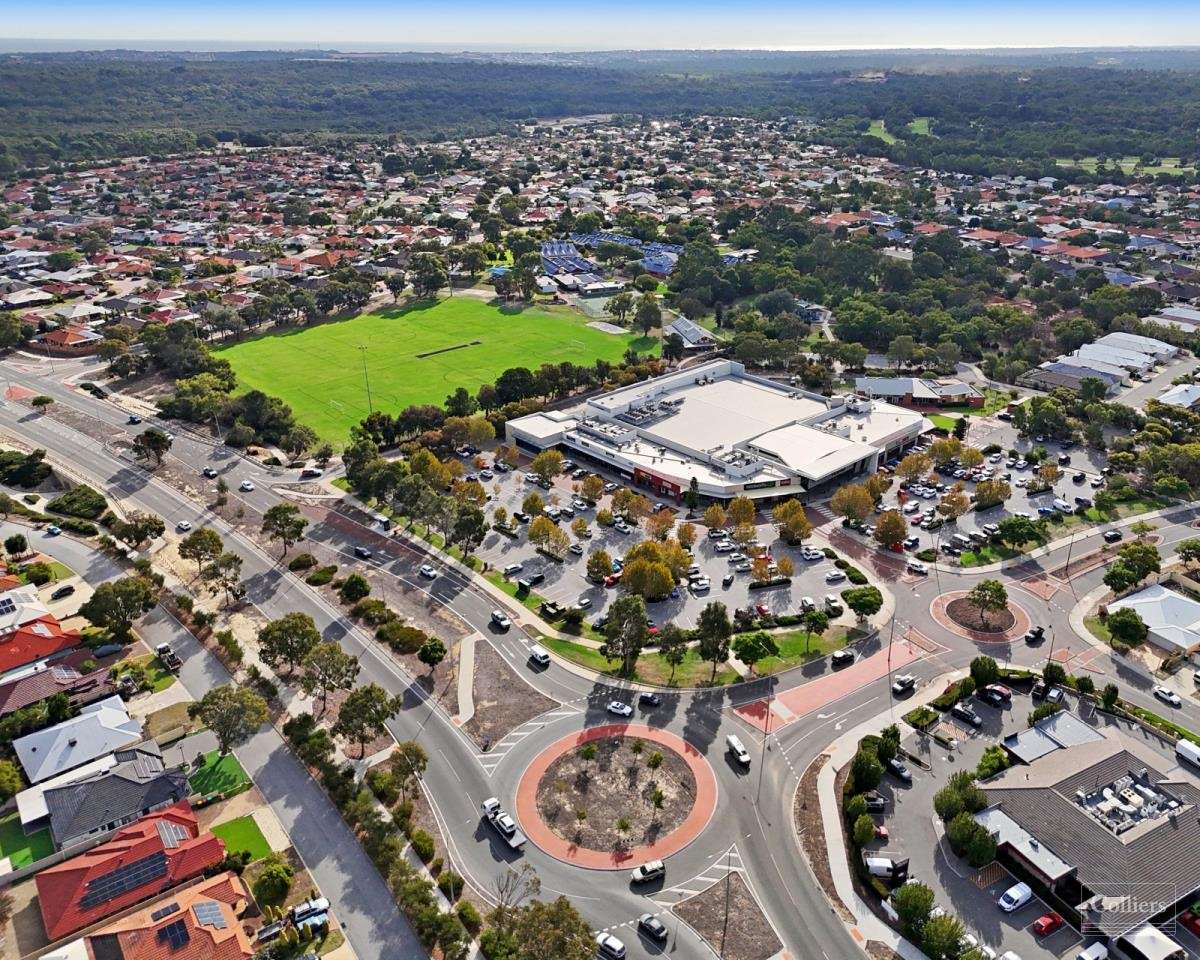
Carramar Village sold for $32.15m

Published

on

Carramar Village sold for $32.15m

The sale of the neighbourhood shopping centre comes amid a strong retail property market.

Continue Reading

Business

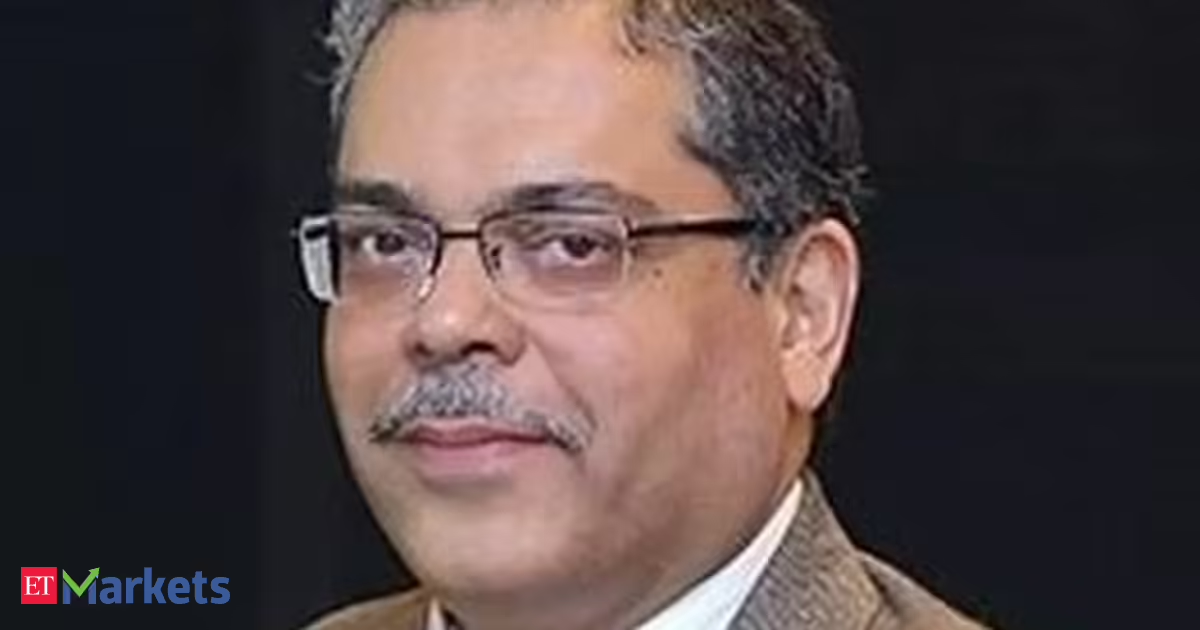
Caution, not panic: Anand Tandon urges measured approach amid market volatility

Published

on

Caution, not panic: Anand Tandon urges measured approach amid market volatility
As geopolitical tensions roil global markets and Indian equities witness sharp intraday swings, investors are grappling with a familiar dilemma — buy the dip or sit tight?

Speaking to ET Now during a volatile trading session, Anand Tandon, Independent Analyst struck a note of caution, arguing that the current correction, while uncomfortable, does not qualify as chaos.

“I would hesitate to call a 1% odd cut in the market as mayhem given where we are in the geopolitics and our own earnings growth versus valuation,” Tandon said, pointing out that Indian equities remain among the most expensive in the emerging market pack.

He noted that even without the trigger of tensions in the Middle East, domestic markets were trading at stretched valuations relative to growth prospects. “If you look at emerging markets generally, you are looking at markets which are likely to do 20% plus earnings growth and are trading at about two-thirds the valuation that we are in,” he observed.

Advertisement

According to Tandon, India’s growth may improve marginally this year compared to the previous one — but that optimism hinges on geopolitical stability. In such a backdrop, he sees little merit in aggressive dip-buying. “I do not think that there is any argument to be made for rushing out and buying in a hurry,” he said, advising investors to focus on fundamentally sound stocks that have corrected meaningfully and to wait patiently for attractive entry points.


Banking: Selective Exposure Preferred
On the banking space, particularly public sector banks, Tandon acknowledged that valuations appear reasonable and balance sheets are cleaner than in the past. However, he flagged a potential risk as the credit cycle gathers pace.
“Credit growth has started to pick up again and companies have started to go out there and borrow, which means that there is a great opportunity to build up a crap portfolio — and I choose my words carefully,” he remarked, stressing the need for prudence in fresh lending.He cautioned that public sector banks are not always known for disciplined credit underwriting. While making an exception for State Bank of India, citing its strong credit history, he advised investors to tread carefully. “If you have to be in banking, which is something I would recommend that people continue to remain in, you are probably better off being among the larger banks in the private sector and the public sector,” he said.

Aviation vs Engineering: Clear Preference
When asked to choose between aviation and engineering, Tandon was unequivocal. “If the choice is between aviation and engineering, I would prefer engineering at any time,” he said.

While acknowledging that Larsen & Toubro is not cheap, he believes any meaningful correction could present a buying opportunity, especially given the company’s exposure to regions currently under conflict. “These are not companies that you get cheap very often,” he noted, adding that near-term execution challenges or earnings slowdowns should not overshadow long-term strength.

On aviation, he remained unconvinced. “I have never managed to find myself convinced that aviation is something that will be able to generate profits over a sustained period of time,” he said.

Advertisement

Autos and Ancillaries: Look Beyond the Obvious
Despite in-line February numbers and strong management commentary, auto stocks were among the worst hit in the session. Tandon attributed part of the weakness to heavy ownership in the sector.

“The numbers are coming through quite well and most of the management commentary seems to indicate that the order books are fairly robust,” he said, suggesting that domestic demand remains healthy.

However, he encouraged investors to look beyond frontline automakers. “There may be other ways to play that as well besides the auto, which is the auto ancillaries,” he said, recommending companies insulated from technological disruption and those with global exposure.

IT: No Immediate Triggers
On information technology, Tandon offered a blunt assessment. “Broadly, I see no reason for me to be very bullish on IT at this stage,” he said.

Advertisement

He believes investors must first assess the long-term impact of artificial intelligence before turning constructive on the sector. “We need to let the technology settle down and see how far AI is able to take things,” he said.

With domestic hiring trends flat to negative, he sees little evidence of near-term momentum. “We have negative to zero hiring in IT in the domestics in the current year, I think that tells its own story,” he added.

Geopolitical Wildcards
On the broader geopolitical shock, Tandon refrained from making bold predictions. “Clearly two options — one, the Iranian regime collapses immediately, in which case obviously all things can go up. On the other hand, you could have a missile from Iran go and hit one of the major platforms of the US and then you have trouble,” he said.

In the end, he admitted that forecasting outcomes in such an environment is futile. “Your guess is as good as mine, I do not think there is an answer one can make there.”

Advertisement

For investors navigating the crosscurrents of valuation concerns, sector rotation and geopolitical risk, the takeaway appears clear: discipline, patience and selectivity matter more than bravado.

Continue Reading

Business

Sandisk Corporation (SNDK) Presents at Morgan Stanley Technology, Media & Telecom Conference 2026 Transcript

Published

on

OneWater Marine Inc. (ONEW) Q1 2026 Earnings Call Transcript

Sandisk Corporation (SNDK) Morgan Stanley Technology, Media & Telecom Conference 2026 March 3, 2026 7:50 PM EST

Company Participants

David V. Goeckeler – Chairman & CEO
Luis Visoso – Executive VP & CFO

Conference Call Participants

Advertisement

Joseph Moore – Morgan Stanley, Research Division

Presentation

Joseph Moore
Morgan Stanley, Research Division

Advertisement

All right. Welcome back. I’m Joe Moore, Morgan Stanley semiconductor research team. Very happy to have with us the executive team from Sandisk, CEO, Dave Goeckeler; and EVP, CFO, Luis Visoso. Thank you, guys.

David V. Goeckeler
Chairman & CEO

Hey, Joe, thanks for having us. We appreciate it.

Advertisement

Joseph Moore
Morgan Stanley, Research Division

Thank you. And I think, Luis, wouldn’t you want to read a safe harbor first?

Advertisement

Luis Visoso
Executive VP & CFO

Yes. We will be making forward-looking statements in today’s discussion based on management’s current assumptions and expectations including with respect to our technology and product portfolio, our business plans and performance, market trends and opportunities and our future financial results. These forward-looking statements are subject to risks and uncertainties. We assume no obligation to update these statements.

Please refer to our annual report on Form 10-K and other filings with the SEC for more information on the risks and uncertainties that could cause actual results to differ materially from expectations. We will also be making reference to non-GAAP financials and reconciliations to our GAAP to non-GAAP financials can be found on our website.

Advertisement

Question-and-Answer Session

Joseph Moore
Morgan Stanley, Research Division

Great. So you guys saw this coming, right?

Advertisement

David V. Goeckeler
Chairman & CEO

Well, I mean, we saw some of it coming. [indiscernible]

Advertisement

Joseph Moore
Morgan Stanley, Research Division

Well, celebrate for me. I mean really, I’ll give you credit. You said this time last year that we would have a stronger second half. You were right in a pretty

Advertisement
Continue Reading

Business

Cognizant at Morgan Stanley Conference: Strategic AI Focus

Published

on


Cognizant at Morgan Stanley Conference: Strategic AI Focus

Continue Reading

Business

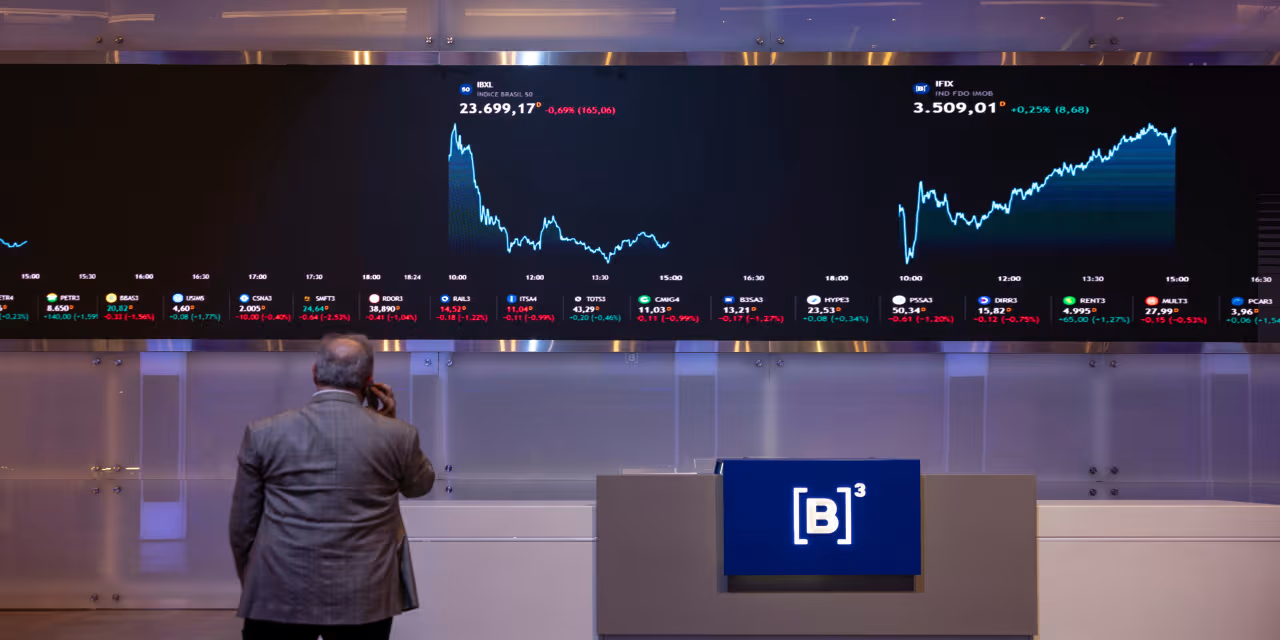
Brazil, Mexico Provide Safe Haven Amid Middle East Tumult: Charts

Published

on

Brazil, Mexico Provide Safe Haven Amid Middle East Tumult: Charts

Brazil, Mexico Provide Safe Haven Amid Middle East Tumult: Charts

Continue Reading

Business

Horizon Gold to raise $30.2m, eyes opportunity to further increase Gum Creek MRE

Published

on

Horizon Gold to raise $30.2m, eyes opportunity to further increase Gum Creek MRE

Newly appointed managing director Scott Williamson says the midcap has a great opportunity to attain further from its Gum Creek gold project, located 640km North East of Perth.

Continue Reading

Trending

Copyright © 2025