
Business
At Close of Business podcast August 18 2026


Yes. Corporate subscriptions are available for teams and organisations, with discounted rates as user numbers increase. Pricing starts from $1,625 + GST per user.
Get in touch
to discuss the right option for your organisation.
Business News subscriptions are used by executives, investors, consultants and professionals who need to stay informed and make better decisions about the WA market. When you subscribe you’ll get
- Unlimited access to WA’s most trusted business journalism
- Data & Insights — detailed profiles of WA companies, people, projects and deals
- MyBN — a personalised feed based on the companies, people and sectors you follow
- Special publications and industry reports
- Daily and weekly email newsletters
Data & Insights is a research tool built specifically for the WA market. It draws on more than 30 years of Business News reporting, updated regularly to reflect what’s happening now. Use it to:
- Look up detailed profiles of WA companies, including financials, directors and ownership
- Find decision-makers and track their career movements
- Research live and completed projects across WA industries
- Monitor deals, appointments and market activity
- Access industry rankings and league tables
Data & Insights is updated daily by our dedicated research team, which uses the latest announcements, ASX filings and editorial coverage to keep our person, company, list and project records up to date.
Business News welcome all opportunities to make our dataset accurate, complete and current, so if you have an update request, please email the team at
general@businessnews.com.au, and we’d be happy to assist.
MyBN
is part of every subscription. It’s your personalised view of Business News. You can follow the companies, people, sectors and projects that matter to you, and get a news feed and alerts tailored to your interests. You can save articles to read later and retain only what you need.
Only subscribers have full access to all content on the Business News website.
If staying informed about the WA economy is part of your job, and/or you’re looking for networking opportunities in WA, Business News is built for you.
Business News subscribers are:
- Executives and directors tracking competitors, clients and market movements
- Investors and advisers researching companies, deals and industry trends
- Consultants and professionals staying across sectors relevant to their clients
- Business owners looking for leads, context and market intelligence
Most Business News publications cover national or global markets. Business News is focused entirely on Western Australia, which means the journalism, the data and the intelligence are all built around WA companies, people and projects — not adapted from a national feed. Data & Insights, included with every subscription, combines more than 30 years of WA-specific editorial research with live business data. There’s no comparable product for the WA market.
The Morning Digest Email provides a comprehensive wrap of the major headlines, relevant to WA business, and includes with a snapshot of the overnight news covering oil, gold and ASX-listed companies.
The Afternoon Wrap Email focuses on the news covered by our team of journalists during the course of the working day, including exclusive stories and analysis, all of which relates to WA business and the local economy.
The BN Weekender Email contains a wrap of the Business News from the week that was, highlighting the top stories in each area of WA business.
Sign up for free.
We’re happy to help.
Get in touch
and our team will come back to you.


U.S. stocks could be heading toward a tricky patch over the next two months, with midterm elections in focus, longer-dated Treasury bond yields trading at multiyear highs, and volatility readings suppressed.

Evolution Petroleum stock falls on dilutive share offering

The Claude chatbot maker’s proposed expansion of its so-called revolver is drawing a clutch of banks seeking to bolster their pitch for roles on the IPO, said the people, who asked not to be identified because the information isn’t public.
Discussions are ongoing and the company could decide to limit the size of the revolver to the target or even below, the people said.
Anthropic has asked the most active banks leading the credit line to lend about $1.25 billion, with the next level of active banks being encouraged to offer around $1 billion, and with the commitments dropping to roughly $750 million and lower for less active roles, some of the people said.
Generally, in syndicated loans, the higher the commitment of a bank, the higher the fees it gets paid by a borrower. When a large capital market transaction is expected, a higher ranking in a loan is likely to correspond to a more active role in the upcoming deal.

A representative for Anthropic declined to comment.
The AI developer’s race to go public gives it an opportunity to follow the lead of companies like SpaceX, which expanded its revolving credit facility to $5 billion in May from an earlier $1.5 billion, the prospectus showed, just a month before its record-breaking IPO. The bank lineup on that offering was substantially the same as those working on the IPO.A $10 billion-plus revolving credit line would be a substantial increase over a $2.5 billion five-year facility Anthropic secured last year, with participation from Morgan Stanley, Barclays Plc, Citigroup Inc., Goldman Sachs Group Inc., JPMorgan Chase & Co., Royal Bank of Canada and Mitsubishi UFJ Financial Group, according to a LinkedIn post at the time.
Anthropic is working with Morgan Stanley, Goldman Sachs and JPMorgan on the IPO, Bloomberg News has reported.
The expanded lending facility comes weeks after banks led by Morgan Stanley were in talks to line up $15 billion of debt for an Anthropic data-center project in Texas, backstopped by Alphabet Inc.’s Google, Bloomberg News reported. That package for data-center developer Nexus Data Centers would consist of a $14 billion bridge loan and a revolving credit facility, people familiar with the matter have said.
The AI race has fired up the IPO market, with listings this year raising $257 billion, excluding blank-check firms and other financial vehicles, according to data compiled by Bloomberg. That’s the most raised in a year since 2021, the data show.
Anthropic and its rival OpenAI have filed confidential paperwork to go public, with Anthropic expected to make its Wall Street debut as soon as this fall, ahead of OpenAI.
Bank of America Corp. handed a $520 million credit line to OpenAI earlier this summer as it joined an existing undrawn facility set up by competitors, Bloomberg News reported, boosting the capital available for OpenAI to more than $5 billion.
Anthropic’s run rate, a metric that projects full-year revenuefrom a shorter period, hit $65 billion by the end of July, Bloomberg News reported on Monday. The dramatic acceleration in revenue bolsters Anthropic’s plans for a public listing.
The company reported a preliminary revenue figure of more than $11.5 billion in its latest completed quarter, compared with $787 million in the corresponding period in 2025, according to documents seen by Bloomberg News. It also reported positive adjusted operating income for the quarter, the documents show.
Anthropic is meeting with investors ahead of its potential mega-IPO, people familiar with the matter said in July.
Check out what’s clicking on FoxBusiness.com.
Home Depot customers are still spending on their homes, with smaller projects supporting demand as Americans contend with elevated mortgage rates and high home prices.
The home improvement retailer said Tuesday that second-quarter sales rose 5.7% from a year ago to $47.9 billion, while comparable sales increased 1.7%. Comparable sales in the U.S. climbed 1.3%. The results came as consumers continued to favor smaller-scale home improvement work over larger projects.
“Our second quarter results exceeded our expectations. We saw broad-based demand across the business as customers continued to engage in smaller projects,” Home Depot Chief Financial Officer Richard McPhail said.
Shoppers also spent more per transaction. Home Depot’s average ticket rose 2.8% from a year earlier to $92.50, while comparable customer transactions declined 1%.
IS MIAMI REALLY COSTLIER THAN NEW YORK CITY? WHY TOP DEVELOPERS SAY THE MATH STILL FAVORS FLORIDA
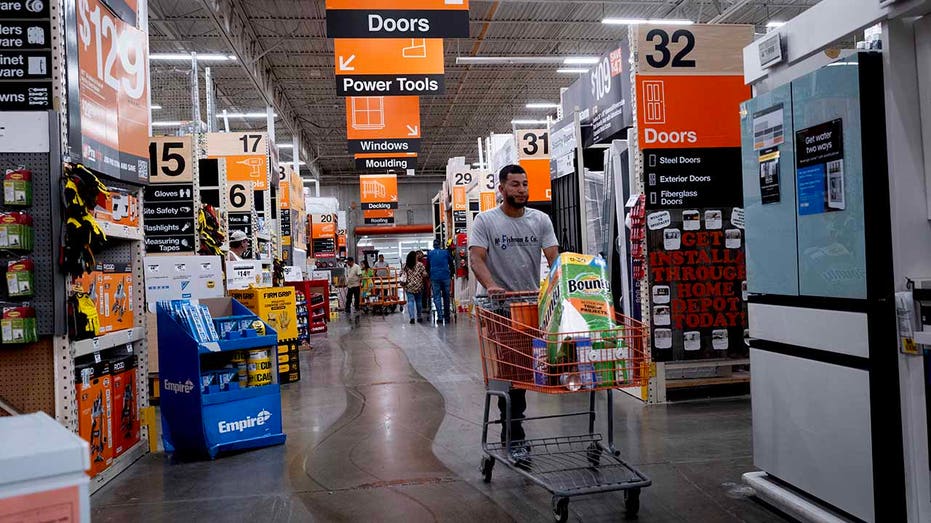
Customers shop at a Home Depot store on August 19, 2025, in Chicago, Illinois. (Scott Olson/Getty Images / Getty Images)
The spending pattern comes as the housing market remains constrained by affordability pressures, potentially limiting demand for larger renovations that are more likely to require financing.
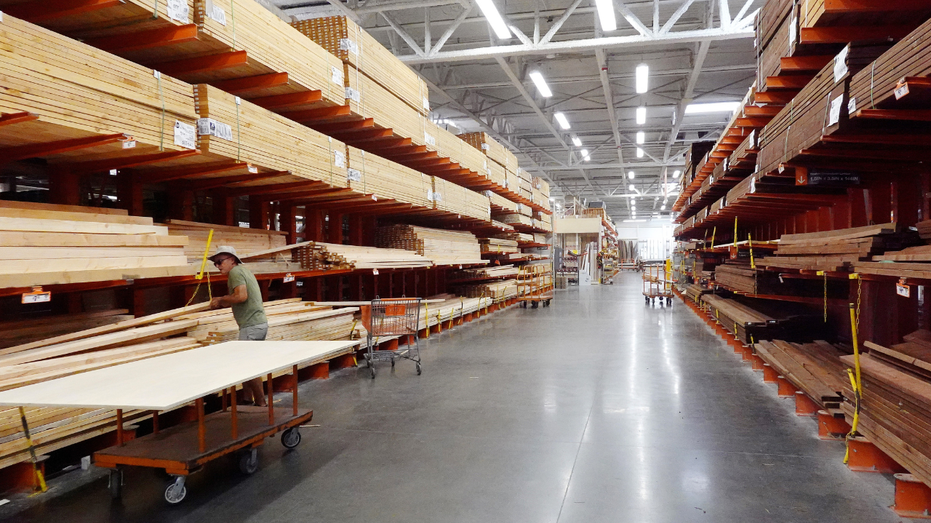
Home Depot confirmed hundreds of job cuts tied to its Atlanta-based support center. (Mario Tama/Getty Images / Getty Images)
Existing-home sales fell 1.7% in July from the previous month to a seasonally adjusted annual rate of 4.06 million, according to the National Association of Realtors. Meanwhile, the median existing-home price rose 2% from a year earlier to $434,100.
Borrowing costs also remain elevated. The average rate on a 30-year fixed mortgage was 6.67% as of Aug. 13, according to Freddie Mac, up from 6.58% a year earlier.
High borrowing costs and home prices can raise the hurdle for home purchases and larger renovation projects, even as homeowners continue spending on smaller projects around the house.

Home Depot announced it will cut about 800 jobs tied to its Atlanta store support center as part of a corporate restructuring. (Brandon Bell/Getty Images / Getty Images)
Home Depot reported second-quarter net earnings of $4.8 billion, or $4.79 per diluted share. Adjusted earnings were $4.92 per share.
CLICK HERE TO GET FOX BUSINESS ON THE GO
Despite the uneven housing environment, the Atlanta-based retailer reaffirmed its fiscal 2026 outlook. Home Depot continues to expect total sales growth of approximately 2.5% to 4.5% and comparable sales growth ranging from flat to 2% for the year. The sales guidance is consistent with the outlook Home Depot issued earlier in fiscal 2026.

Gold falls over 1.5%, weighed down by elevated Treasury yields, higher oil prices

Trump interviews candidates for FDA commissioner role – Bloomberg

Rep. Mike Lawler blasts New York Governor Kathy Hochul’s energy policies and data center moratorium. He warns that banning natural gas and shutting down nuclear power plants has caused utility rates to skyrocket and forced businesses to flee.
New York’s business climate is back in the spotlight after Gov. Kathy Hochul’s pause on new hyperscale data centers added to a broader debate over whether the state’s energy and economic policies are pushing investment elsewhere.
Rep. Mike Lawler, R-N.Y., joined FOX Business’ Cheryl Casone on “Mornings with Maria” to discuss New York’s energy policies, business climate and continued taxpayer out-migration.

New York Gov. Kathy Hochul speaks during a press conference. (Michael M. Santiago / Getty Images)
Hochul announced a statewide moratorium of up to one year on July 14 on new hyperscale data centers while New York develops a regulatory framework intended to protect utility ratepayers and address the facilities’ energy and infrastructure demands. The pause applies to state environmental permits for new hyperscale data centers.
Nassau County Executive and Republican gubernatorial candidate Bruce Blakeman shares his confidence in defeating Governor Kathy Hochul, pledging to address New York’s high taxes and migrant crisis.
Lawler argued the move sends the wrong message to companies considering investing in New York.
“What she is saying is, don’t come here. Go do your business elsewhere, which is why New York State leads the nation in out-migration,” Lawler said. “It’s why it is a terrible place to do business and why people are expanding in Florida and Texas and Tennessee and North Carolina and South Carolina and elsewhere. We have the highest tax burden and the worst business climate.”
TRUMP WARNS NEW HOCHUL, MAMDANI PIED-À-TERRE TAX COULD ACCELERATE NYC WEALTH EXODUS
New York has experienced net out-migration among part-year resident tax filers every year since 2015, according to state Comptroller Thomas DiNapoli’s office. In 2024, 134,913 part-year resident filers left the state while 121,251 moved in, resulting in a net loss of 13,662 filers. The pace, however, slowed considerably from the pandemic-era surge.
Rep. Mike Lawler, R-N.Y., joins ‘Mornings with Maria’ to discuss socialism’s rise among Democrats, New York electricity costs, nuclear power and the data center fight.
Lawler also tied the state’s business challenges to its energy policies, pointing to nuclear plant closures, restrictions on natural gas and pipeline projects and electrification requirements.
“If you want to address these problems, you need to have a coherent economic and energy policy,” Lawler said. “And that is fundamental if New York is going to prosper moving forward.”

Lumentum: This Optical Shortage Is Getting Even Bigger

Tech selloff pulls Wall Street to two-week lows as bond yields climb

There is a striking paradox at the heart of small business logistics in the UK. The shortest journeys the ones covering the final one to five miles between a local depot, a shop, or a tradesperson’s vehicle and the customer’s door are consistently the most expensive, the least efficient, and the most disruptive to the working day.
The last mile, despite being the smallest fraction of any supply chain, accounts for an average of 53 percent of total shipping costs. For small businesses operating without the buying power of large logistics operations, that proportion can be even higher.
The problem is well understood. The solutions, however, remain unequally adopted particularly among the smaller, independent businesses that stand to benefit most from getting short-journey efficiency right. Van-dependent approaches that made sense a decade ago are struggling under the weight of rising fuel costs, congestion charges, parking restrictions, and an urban environment that has become progressively less hospitable to larger vehicles on shorter routes. Meanwhile, a practical, cost-effective, and genuinely flexible alternative has matured to the point where it deserves serious consideration from any small business owner thinking clearly about their operational costs.
Portable electric scooters compact, foldable, zero-emission, and capable of navigating urban environments with a speed and agility that no van can match are emerging as one of the most practical short-journey tools available to small businesses in 2026. This article examines the last-mile challenge in detail, explores the specific business contexts where electric scooters make an immediate operational difference, and outlines what to look for when choosing the right model for business use.
Understanding the Last-Mile Problem for Small Businesses
Before exploring solutions, it is worth being precise about what makes the last mile so consistently challenging particularly for smaller operations that cannot absorb inefficiencies as easily as large fleets.
The Cost Structure Problem
For large logistics companies, last-mile costs are high but distributed across thousands of deliveries and offset by economies of scale in everything from vehicle purchasing to route optimisation software. For a small business making ten to thirty local deliveries or site visits per week, the cost structure looks very different. A van covering local journeys of one to three miles consumes fuel in the least efficient part of its operating cycle stop-start urban driving burns significantly more fuel per mile than motorway cruising, while also accelerating wear on brakes, clutch, and tyres.
Add to this the hidden costs of urban operation: congestion charges in cities that have introduced them, daily parking fees that can reach £20 to £40 in central urban areas, and the time cost of a driver searching for a legal parking space before every delivery. A single local delivery that takes five minutes of actual travel time can consume 20 to 30 minutes of total time when parking, loading, and compliance overhead are included. At the national living wage, those additional minutes across a working week represent a meaningful payroll cost.
The Urban Access Problem
UK town and city centres are becoming progressively less accessible to vans and larger vehicles. Low Emission Zones (LEZ) and Ultra Low Emission Zones (ULEZ) now operate in London and are being adopted in Birmingham, Bristol, and other major cities. Clean Air Zones carry daily charges for non-compliant vehicles, adding a direct cost to every urban delivery made by an older van. Pedestrianised zones, time-restricted loading areas, and the proliferation of street furniture bollards, cycle lanes, widened pavements have narrowed the practical operating window for van-based local delivery.
For independent traders, florists, caterers, estate agents, plumbers, photographers, and the hundreds of other small business types that rely on regular short local journeys, the urban access problem is not abstract. It translates directly into delayed arrivals, missed time windows, fines, and the kind of operational friction that erodes profit margins and damages customer relationships.
The Environmental and Reputational Pressure
A final dimension of the last-mile challenge for small businesses is increasingly reputational. Customers particularly in urban areas and among younger demographics are paying greater attention to the environmental practices of the businesses they use. A florist delivering orders by cargo bike or electric scooter communicates something very different about its values than one arriving in a diesel van. Research consistently shows that more than half of consumers actively prefer businesses that demonstrate environmental responsibility in their operations.
For small businesses building a local reputation and competing on service quality rather than price alone, sustainable short-journey solutions are not merely a cost consideration. They are a brand statement.
Where Electric Scooters Make an Immediate Business Difference
Not every short-journey business challenge is best solved by a portable electric scooter. But the range of contexts in which they offer genuine operational advantage is broader than many business owners realise.
The Local Service Professional: Plumbers, Electricians, IT Technicians
The tradesperson or service professional making multiple local site visits per day faces a specific version of the last-mile problem. The van is necessary for tools and materials but in many cases, the professional arrives at a parking location that is a five-to-fifteen-minute walk from the actual site. A building in a pedestrianised street, a residential complex with restricted vehicle access, a city centre office block all of these require the professional to walk the final distance while carrying equipment.
A foldable electric scooter stored in the van’s load area eliminates this inefficiency. The professional drives to the nearest practical parking point, unfolds the scooter in under thirty seconds, and covers the remaining distance in a fraction of the walking time. For a service professional making six to eight site visits per day, the cumulative time saving across a working week is substantial and the professional arrives less fatigued, having spent less of their day walking unnecessarily.
The Retail and Hospitality Supplier: Catering, Florists, Specialist Food
Small-scale suppliers to restaurants, cafés, event venues, and retail outlets typically operate regular delivery rounds within a defined local radius. The stops are often in close proximity to each other a town centre delivery round covering eight to twelve addresses within a one-mile area is a common pattern. Van-based delivery on such a route involves constant stopping and starting, repeated parking manoeuvrings, and the cumulative time cost of engine-on idling while each delivery is made.
For these businesses, a micro-depot model parking the van at a central location and completing individual deliveries by electric scooter or cargo-capable e-bike reduces per-delivery time, eliminates parking costs at each stop, and allows the driver to navigate pedestrianised areas, market squares, and shared spaces that are inaccessible to the van.
The Estate Agent: Property Viewings and Key Management
Estate agents in busy town centres face a specific challenge: conducting multiple property viewings at addresses within walking or short cycling distance of each other, while managing the logistics of key collection, client transport, and the need to return between appointments. A portable electric scooter allows a single agent to cover a half-mile viewing radius efficiently moving between properties in minutes rather than the ten-to-fifteen minutes required on foot without the parking overhead of a car.
For the agency, this means more viewings per day without additional staffing, and a more responsive service for clients who want quick turnaround between viewing slots.
The Mobile Photographer and Creative Professional
Photographers, videographers, and creative professionals who work on location face a version of the last-mile problem that is often overlooked: getting themselves and their core equipment from a car or van to a shoot location that may not be vehicle-accessible. Urban shoots at rooftop venues, in markets, in parks, or in pedestrianised high streets all require the professional to transport kit from a parked vehicle to the site.
A robust electric scooter with a carry bag or backpack the professional’s kit carried on their back allows this transit to happen quickly and without the physical fatigue of repeated load-carrying on foot. For the creative professional juggling multiple location shoots in a single day across an urban area, the time and energy saving is directly reflected in the quality and pace of their work.
The Healthcare and Wellness Practitioner: Mobile Therapists, Physiotherapists, Counsellors
Mobile practitioners visiting clients at home face a particularly time-sensitive version of the last-mile challenge. Appointment slots are fixed. Late arrival due to parking difficulty or traffic is professionally unacceptable and damages client trust. In urban residential areas where parking is scarce and restrictions are extensive, arriving reliably on time session after session requires either extreme time buffers or a different approach to the final mile.
A compact electric scooter allows the practitioner to park once at a convenient location and cover their client visits within a neighbourhood on the scooter arriving on time, minimising parking costs, and maintaining the professional reliability that underpins a successful practice.
The Small Business Owner: Inter-Site and Supplier Runs
Small businesses operating across multiple nearby locations a coffee shop and its kitchen, a retail shop and its stockroom, a studio and its despatch area frequently make multiple short journeys between sites throughout the working day. These journeys are too short to justify the overhead of a vehicle, too frequent to absorb comfortably on foot, and too operationally important to delay.
An electric scooter kept at the primary site handles these inter-site journeys with zero fuel cost, no parking requirement, and journey times that often beat a car in urban traffic freeing the business owner or designated member of staff to move between locations with a speed and efficiency that the alternatives simply cannot match.
What Small Businesses Need from an Electric Scooter
The requirements of a business-use electric scooter differ from those of a leisure or commuter rider in several important respects. Reliability, durability, range, and practicality under daily professional use are the criteria that matter most.
Durability and Build Quality
A scooter used for business purposes will accumulate significantly more operating hours per week than a leisure model. The frame, folding mechanism, deck, and electrical systems need to withstand consistent daily use without degrading and minor component failures that a leisure rider might tolerate represent unacceptable operational disruptions for a business user.
Look for aluminium alloy frames, reinforced folding joints, IP-rated weather protection (ideally IP54 or above for reliable wet-weather operation in the UK), and a brand that provides genuine warranty coverage and accessible UK-based after-sales support. A scooter that fails with no local recourse creates a business problem, not merely an inconvenience.
Range: Matching the Operating Radius
Range requirements for business use depend on the daily journey profile. A professional making multiple short hops of half a mile to two miles within a defined area needs reliable range across their full working day ideally 20 to 30 kilometres on a full charge, with enough reserve to complete the final runs of the day without range anxiety.
Always apply a 20 to 25 percent real-world reduction to manufacturer range figures, which are measured under optimal conditions. For business use in variable UK conditions stop-start movement, cold mornings, occasional gradients the practical range will be lower than the headline figure. A scooter with a stated range of 30 kilometres provides a comfortable working range of approximately 22 to 24 kilometres in real conditions.
Portability: Weight and the Folding Mechanism
The defining feature of a portable electric scooter for business use is its ability to be deployed and stowed quickly and transported easily. A model that requires two hands and twenty seconds to fold or that weighs 18 kilograms is not truly portable in a demanding professional context.
Under 14 kilograms is the practical target for a scooter that will be regularly lifted in and out of a van load area, carried up steps, or stored under a desk between deployments. The folding mechanism should be single-step or two-step at most, operable with one hand, and mechanically secure once folded to prevent unintended deployment during transport.
Motor Power and Hill Performance
Urban UK environments are rarely perfectly flat. A business user covering a hilly town centre, a mixed residential area with gradients, or a route that includes several bridge crossings needs a motor with sufficient torque to maintain speed on inclines without draining the battery disproportionately.
A motor of 350W to 500W covers the majority of urban business use scenarios reliably. Models rated at 800W offer additional headroom for heavier riders, more frequent stop-start operation, or hillier terrain and the additional motor investment is quickly recovered in the reduction of journey time and rider fatigue.
Braking and Safety in Working Conditions
Business users typically operate in traffic at junctions, near pedestrians, in areas with unpredictable hazards. The braking system needs to be genuinely reliable in wet conditions, not just in ideal circumstances. Dual disc brakes, or disc brakes combined with an electronic brake, provide the most consistent and predictable stopping performance across weather conditions and repeated daily use.
Front and rear lighting integrated into the scooter not clip-on add-ons is essential for year-round use in the UK, where early mornings and late afternoons are frequently dim even outside winter months.
Connectivity and Security
For business users leaving their scooter unattended between appointments locked outside a client’s premises or stored in a communal space security features matter more than for leisure riders. Scooters with Bluetooth app connectivity that enables remote locking provide meaningful additional theft protection. A physical lock point compatible with a D-lock or cable lock is an additional security measure worth factoring into the total purchase.
The Financial Case: What Small Businesses Actually Save
The financial argument for integrating portable electric scooters into small business short-journey operations is straightforward and verifiable.
Running costs: The electricity cost of a full charge cycle on a typical business electric scooter is approximately 5p to 10p at current UK rates sufficient for 20 to 30 kilometres of riding. Over 250 working days, the annual electricity cost of operating a scooter for short business journeys is between £12 and £25. Against a van covering the same journeys at average urban fuel consumption, the saving on fuel alone can exceed £1,500 to £3,000 per year for a business making regular short local journeys.
Parking costs: A business paying £10 to £20 per day in urban parking across 250 working days spends £2,500 to £5,000 per year on parking alone. An electric scooter eliminates or dramatically reduces this cost folded and carried into a premises, locked to a cycle rack, or stored in the van at a single parking point while the rider covers multiple stops.
Congestion and clean air charges: Businesses operating vans in ULEZ or Clean Air Zones face daily charges that accumulate rapidly £12.50 per day in Greater London for a non-compliant van adds £3,125 per year across 250 working days. An electric scooter, producing zero emissions, is exempt from these charges.
Time value: At the national living wage of approximately £12.21 per hour, recovering 30 minutes of productive time per working day through faster local journeys represents an annual time value of approximately £763. For higher-paid professionals or business owners, the time value is proportionally greater.
The combined saving from fuel, parking, congestion charges, and recovered time can easily exceed £5,000 to £8,000 per year for a small business making regular short urban journeys a figure that puts the purchase cost of even a premium portable electric scooter into clear perspective.
Choosing the Right Scooter: Where to Start
With the business case established and the specification requirements understood, the final step is identifying the right source. For small business owners who need reliable products, proper warranty coverage, and fast UK delivery without the uncertainty of grey-market imports or unverified marketplace sellers, choosing a reputable dedicated retailer is the most important single decision in the purchase process.
A quality retailer for business-use electric scooters will offer:
- A clearly stated range of models with honest, verifiable specification data
- UK stock with defined delivery windows not indefinite waiting times
- Minimum 12-month warranty with accessible UK customer support
- A meaningful return window on new products
- Genuine availability of spare parts for ongoing maintenance
For small businesses ready to act on the last-mile opportunity and equipped with the right vehicle for the job, exploring the full range of portable electric scooters at isinwheel UK is a practical starting point where quality-tested adult models are available with proper UK support, fast delivery, and specification levels that meet the demands of professional daily use.
Final Thoughts: The Last Mile as a Competitive Advantage
The last-mile challenge is real, persistent, and costly. But it is also, for the small businesses willing to think differently about it, an opportunity. The businesses that solve their short-journey efficiency problem before their competitors do gain a structural cost advantage, a time advantage, a reputational advantage, and the operational flexibility that comes from not being dependent on a single, increasingly impractical mode of short-distance transport.
Portable electric scooters are not a complete solution for every last-mile scenario. But for the significant proportion of small business short journeys that fall within two to five miles of a parked vehicle, a depot, or a base of operations, they offer a combination of speed, cost, flexibility, and zero-emission practicality that no other vehicle class currently matches.
The businesses that recognise this and act on it will be the ones whose customers notice that they always arrive on time, that their delivery costs are lower than competitors, and that their commitment to efficient, sustainable operation is reflected in the quality of the service they provide.
Shorter journeys. Lower costs. Smarter business.

US Navy destroyer with 300 sailors aboard broke down for four days in the Pacific
Record Highs and Low Volatility: Is Wall Street Too Complacent Ahead of Midterm Elections?

HashKey taps Hong Kong's first regulated stablecoin to settle insurance and trade deals





-

 Fashion4 days ago
Weekend Open Thread: Ann Taylor
-
 NewsBeat7 days ago
Communication cards help banking customers access services or report scams
-
 Sports5 days ago
This U.S. Amateur is a glimpse into golf’s future in more ways than you think
-

 Sports4 days ago
Birmingham 2026: Day 6 Timetable for Irish Athletes
-
 NewsBeat4 days ago
Myanmar says over 300,000 Rohingya refugees verified for repatriation as exodus enters ninth year
-
 Tech4 days ago
11 Ways to Rank Your Videos
-

 Politics3 days ago
SEQ Code: The Three Letter Boarding Pass Code That Could Give You The Worst Seat
-
 Entertainment6 days ago
Keke Palmer Subtly Hints At Sean Evans Drama With Cryptic Post
-
 Crypto World7 days ago
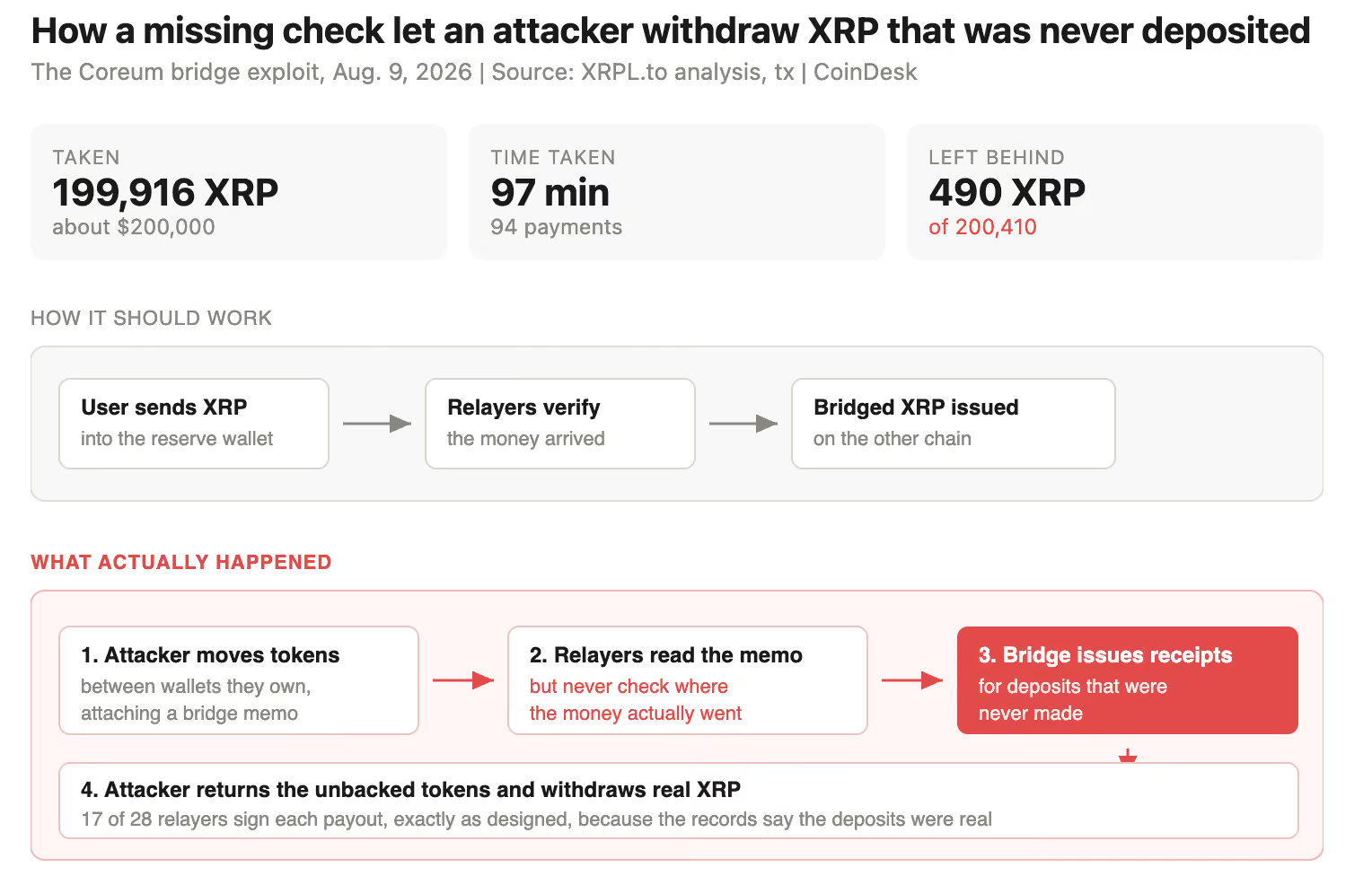
XRP bridge drained after software mistook fake deposits for real ones
-

 Tech5 days ago
DeepSeek Harness launches as open source rival to Claude Code, alongside V4-Pro on API with higher prices
-

 Sports6 days ago
DeQuan Jones in ‘high spirits’ after successful leg surgery
-
 Crypto World6 days ago
Perplexity AI Predicts an XRP Scenario Few Analysts Are Discussing
-

 Tech7 days ago
SpaceXAI’s Grok Bot turns agents into persistent digital coworkers that can operate your apps for $120-per-month
-

 Politics6 days ago
How Average Are You In The UK?
-
 Entertainment6 days ago
2026’s Most Ambitious Fantasy Movie Officially Scores Sequel Update
-

 Business7 days ago
Evolv Technologies Holdings, Inc. (EVLV) Q2 2026 Earnings Call Transcript
-
 Tech7 days ago
A Zoom Screen-Sharing Bug Let Anyone Take Over Other Devices On a Call
-

 Fashion6 days ago
The Details Do the Dressing
-

 NewsBeat7 days ago
‘Regret is a major theme of my work’: Matt Haig on finding acceptance
-

 Fashion6 days ago
Why Botanical Fashion Never Goes Out of Style
You must be logged in to post a comment Login