A U.S. Navy destroyer with about 300 sailors aboard suffered a major breakdown in the Pacific Ocean last month that left it without power for four days, the Navy confirmed in a statement.
The USS Benfold “reported an engineering casualty involving its generators, causing a loss of power” on July 24, Navy spokesman Cmdr. Matthew Comer said in the statement. The breakdown meant the crew went without drinking water, meals, functioning toilets and air conditioning for days aboard the ship, Comer said.
The incident, which only became public on Friday when it was first reported by USNI News, comes as the Pentagon grapples with serious questions about the quality of life aboard naval vessels and the military’s ability to supply ships during the conflict with Iran.
Democratic lawmakers are calling for investigations into conditions aboard the aircraft carrier USS Abraham Lincoln. Reports last week revealed that the ship, which has spent a record-setting 250 uninterrupted days at sea, has experienced shortages of supplies, including food and hygiene products, while crew members have suffered from stress and poor mental health.
Advertisement
Comer stressed that there were no injuries to the crew of the Benfold, “who demonstrated resilience, grit, professionalism, and unwavering steadiness in their response,” but that the ship needed assistance from the George Washington carrier strike group.
The cruiser USS Robert Smalls provided meals to the stricken destroyer.
Ultimately, Comer said the Benfold had to be towed to Subic Bay, in the Philippines, for repairs, arriving on July 28. The crew was then provided food and lodging off the ship. On Aug. 8, the Benfold left port “with all engineering, combat systems, and crew support systems functioning normally,” the statement said.
Meanwhile, the ships from the George Washington strike group, including the aircraft carrier USS George Washington, were spotted heading toward the Middle East. The carrier was expected to replace the Lincoln, which the acting navy secretary, Hung Cao, said last week would be returning home soon.
Advertisement
This would leave the waters of the Pacific without a U.S. carrier presence for an unknown period of time. The Trump administration sees China, the dominant power in the region, as “a settled force” that only needs to be deterred from dominating the U.S. or its allies and not the top global adversary that it was under the Biden administration.
Welsh presenter Jason Mohammad is among the line up for the latest series of the BBC show
Celebrity MasterChef hopeful Jason Mohammad suffered a blow as his efforts in one challenge were called a “disaster”.
Advertisement
The Welsh TV and radio presenter is one of the stars taking part in the 21st series of the show, and in the first episode he faced off against actor and author Joe Pasquale, Jay McGuinness from The Wanted, weightlifter and Olympic medallist Emily Campbell and Love Island star Shakira Khan.
After they had whipped up their signature dishes, the contestants were tasked with preparing a gnocchi dish alongside judge Giorgio Locatelli in the Cookalong Challenge.
They were told the one that most resembled the chef’s would win the MasterChef pin – and a time advantage.
Jason got to work fast, but his meal failed to win over Giorgio and his fellow judge, food critic Grace Dent.
As he carried it up to the judges, Giorgio laughed: “When I look at the shape of those carrots, I wonder what have you learned from me?”
While the chef conceded that Jason’s gnocchi was “tasty”, Grace said: “These are the biggest gnocchi I’ve ever seen in my life.”
“The sauce, you really put a lot of pepper in it, but I really like that,” said Giorgio. “Obviously, the vegetable inside needs to be a little bit more refinely cut. But the disaster in this one is the gnocchi.”
Advertisement
Grace suggested they were “weighty”, adding: “In fact, after two or three, you need to have a lie down with your ankles raised.”
“Too much flour went in there,” said Giorgio, while Grace added: “This is not a perfect plate of gnocchi, but it’s definitely dinner.”
Speaking afterwards, Jason admitted it was a “kick up the backside” for him.
“Probably what I needed,” he confessed. “You know, this isn’t like food that’s being chucked on a kitchen table and you’re tucking into it. This is MasterChef.”
The next instalment of the competition will see Gladiators star Emily Steel – also known as Dynamite – up against actress Donna Preston, former Royal Ballet Dancer Eric Underwood, EastEnders ‘ Nitin Ganatra and YouTuber Tom Simons, aka TommyInnit. In the third heat, Saturdays star Una Healy, Loose Women’s Sue Cleaver and former I’m a Celebrity camper Melvin Odoom will be cooking alongside comedian Max Fosh and paralympic athlete Lauren Steadman.
In a statement, a spokesperson for asset management firm Blackstone, where Mr Cromie worked as a vice-president in private wealth solutions, said: “We are shocked by the tragic passing of three people, including our colleague Alex Cromie and his wife Marie Ebert, who were celebrating their honeymoon.
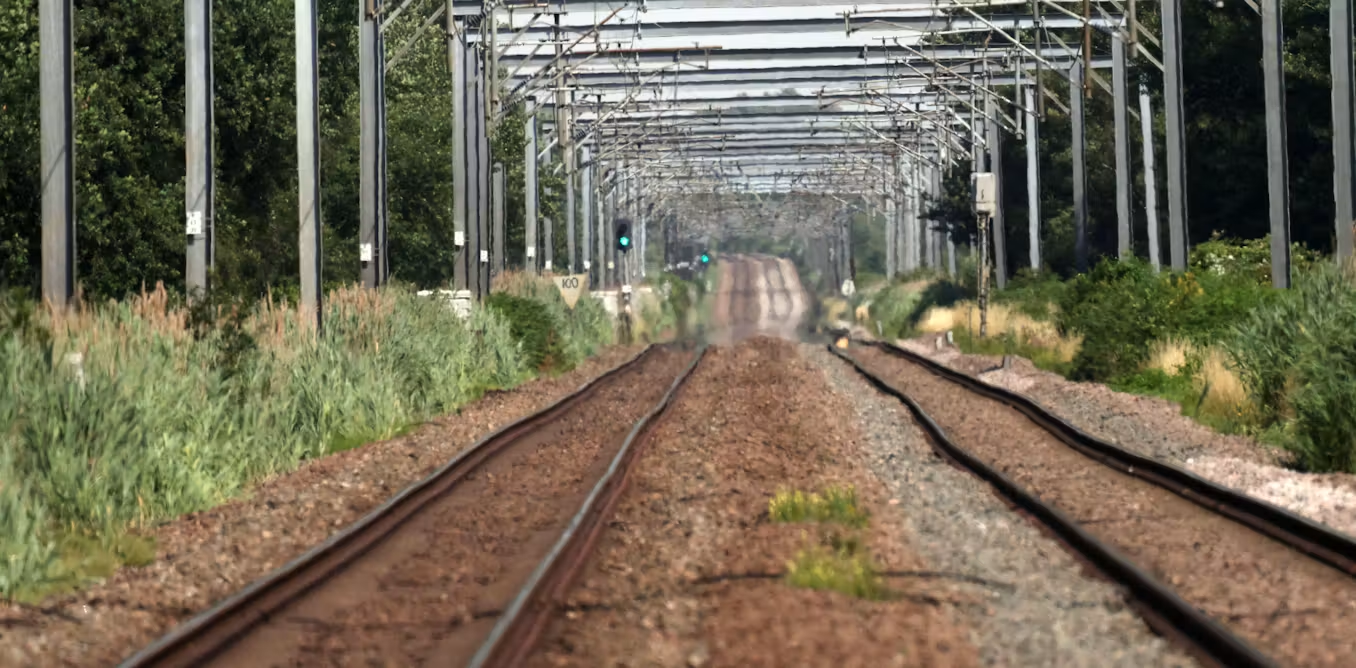
On August 14, the hottest day of an exceptionally hot summer, a train derailed near Lewes in East Sussex, England. Three carriages tipped over and two people were seriously injured. The following day, another train derailed in Essex.
We don’t yet know what caused either derailment, and the UK’s Rail Accident Investigation Branch is still gathering evidence. Network Rail – the public body that owns and manages most of Britain’s railway network – said in response that this summer’s repeated heatwaves have “presented exceptional challenges to the railway”. We do know that heat poses particular problems for railways, and that heat-related failure is an increasing risk in the UK as temperatures rise.
Xueyu Geng is a Professor in Ground Engineering at the University of Warwick, and an expert in railway track design and embankment stability. The Conversation asked her about the key challenges for a rail network in heatwaves, and how trains can stay safe and efficient in ever more extreme heat.
What happens to railways in extreme heat?
Steel expands when heated. Most of the network uses continuously welded rail: long lengths that are effectively restrained by the sleepers, fastenings and ballast, rather than jointed sections that can expand freely. When the rail heats up it wants to get longer but can’t, so it builds up substantial compressive stress instead.
Advertisement
If that stress exceeds the track’s resistance to sideways movement, the track can shift sideways, causing a thermal buckle. That’s why extreme heat is a genuine safety issue, not just a comfort-and-delays problem.
Rail temperature and air temperature are also two different things. Direct sunshine matters a lot: a stretch of track in full sun can run considerably hotter than a shaded section experiencing the same air temperature.
Temperature is only half the story, though. Ballast – the layer of crushed stones beneath the tracks – along with sleepers, fastenings and the condition of the track and ground all affect how much sideways movement it can withstand.
So there’s an important distinction between a “hot rail” and an “unstable track”. A railway can run a high rail temperature safely if the track system as a whole has enough resistance in reserve.
Advertisement
Is this a particular problem for Britain? Do hotter countries manage it better?
I wouldn’t say British infrastructure was simply designed for the “wrong” temperature; British engineers have always had to design for thermal expansion and contraction. The more fundamental issue is that the climate is shifting during the working life of the infrastructure.
Historically, the extreme temperatures built into design and operational planning reflected a climate where very high temperatures were rare. We’re now seeing heatwaves that are more frequent and that push into a temperature range many existing assets simply didn’t experience for most of their service life.
There are already examples of heat causing derailments. For instance, in 2015 a freight train derailed near Langton, Lincolnshire, on the hottest day of the year to that point. An investigation found the track had buckled in the heat.
The risk is now being managed at increasingly high temperatures. On July 19 2022, the UK’s first day over 40°C and still its hottest ever day, operators shut down one of the main lines linking London to northern England and Scotland. The closure was a precaution: rather than risk trains encountering buckled track, operators stopped services during the hottest part of the day.
Advertisement
Extreme heat is especially awkward for a railway specifically, because the infrastructure is so tightly constrained, you can’t let a track drift sideways even slightly, since wheel-rail interaction depends on very tight tolerances. Two adjacent stretches of track exposed to identical weather can have very different resistance to buckling, depending on their stressing history, ballast condition, fastenings, geometry and the ground underneath.
Trains and their tracks must be perfectly aligned. omegamezle / unsplash, CC BY-SA
There’s no single “heat-proof” railway technology to copy from hotter countries. What they have is the advantage of treating high heat as a normal design condition rather than an exceptional one, with track designed, maintained and operated accordingly.
Our design assumptions and maintenance strategies need to reflect the climate the railway will actually experience going forward, not the climate it was built for.
Advertisement
How have railways adapted, and what would a truly climate-proof railway involve?
The biggest shift needed is from a “reactive” to a “predictive” approach. At the moment, when extreme heat is forecast, operators step up inspections, monitor rail temperature, and impose speed restrictions where needed. Useful, but it’s responding to immediate risk rather than anticipating it.
The next generation of railway management should bring together weather and solar radiation forecasts, actual rail temperature, track geometry, rail stressing history, ballast and fastening condition, drainage, ground and embankment condition, and train speed and traffic loading. Put those together and you can identify which specific sections of track are vulnerable, rather than treating an entire route as uniformly at risk.
This is where new technologies have a strong role to play. Remote sensors, “digital twins” (computer models of a train system that can be updated with real-world data) and modern data science can all help spot a section approaching a critical condition before it becomes unsafe.
A truly climate-resilient railway isn’t just “stronger rails in the ground”. Prolonged hot, dry weather can change ground moisture and affect earthworks at the same time as thermal stress is building in the rail itself. That’s why resilience has to cover everything from train tracks and drainage to signalling and power systems, all together, not rail steel in isolation.
Advertisement
Should we design new tracks, or retrofit old track, for the heatwaves of the future?
Railway assets have very long lives: a track, bridge or embankment built or substantially renewed today could still be in service in 50 or 100 years. That creates a fundamental mismatch between the current design life and a climate that keeps changing within that lifetime.
The right question isn’t “can this new track cope with today’s hottest day?” It’s “what climate will this asset have to withstand across its whole life?”
This hits railways harder than most other transport modes, for a specific reason: the track has to stay precisely aligned. Roads suffer in heat too – asphalt softens, concrete expansion joints get stressed – but a road vehicle has rubber tyres and steering, giving it some lateral tolerance for minor surface movement. A railway wheel and its raised inner lip – the flange – don’t have that margin. Continuously welded rail has to stay within millimetre-scale geometric tolerance over very long, continuous lengths, with compressive stress building as temperatures rise.
For new infrastructure, climate projections for the middle and later parts of this century should be part of engineering decisions now, because that infrastructure will still be in service then. But I wouldn’t design every component to withstand an extreme 2100 temperature outright: that risks enormous, unnecessary cost for conditions that may not materialise for decades.
Advertisement
The better approach is risk-based adaptation: build appropriate resilience into new infrastructure from the outset, and for the existing network, identify the specific sections where future climate creates unacceptable risk and progressively retrofit those. That might mean improving ballast resistance, drainage, embankment stability, monitoring or thermal management, depending on what the local vulnerability actually is.
Telecommunications firm Cornerstone is set to replace an existing 28.6m-high mast in Nether Poppleton, with the new lattice structure featuring six antenna and two dishes.
The company’s plans stated it would support 5G which was a generational leap in mobile technology and there was no cause for concern about potential health effects.
City of York Council planning officers ruled the installation would replace the similar mast already at the site and would therefore not harm the appearance of the area or its surroundings.
No objections were lodged against the plans.
Advertisement
RECOMMENDED READING:
Cornerstone is the UK’s leading mobile infrastructure services company, according to its planning application.
The firm manages more than 20,000 sites across the country.
Its application for the York works, in Broad Lane, stated they came after its commercial relationship with telecommunications provider O2-Virgin Media had changed.
Advertisement
The existing telecommunications mast at Broad Lane, in Nether Poppleton, York (Image: Google Street View)
Plans added the changes allowed it to act more independently and work with other companies to deploy mobile infrastructure.
The plans stated: “The applicant is seeking to provide an improved 2G, 3G and 4G cell site and to establish new 5G connectivity services to those living, working and travelling in Nether Poppleton.
“The dynamic nature of technological advances in the telecommunications industry coupled with ever-increasing demand from subscribers dictates a continual reinvestment programme on the part of licenced operators, meaning operators are constantly developing their networks as well as refining and modernising their infrastructure.”
In a statement posted by the band, ZZ Top frontman Billy F. Gibbons paid tribute to a ‘great friend and collaborator’ who he says was a key part of their success.
‘Today, Elwood and I lost a great friend and collaborator, and the world lost one of the most naturally innovative drummers and a great and true son of Texas. His signature backbeat was key to keeping ZZ on top,’ Gibbons said in a statement posted to the band’s Instagram account.
The band will now be cancelling it’s shows in Salt Lake City and Colorado Springs however will be moving forward with upcoming performances at Austin City Limits, a venue which held a special place in Beard’s heart.
Advertisement
‘The band will resume its current The Big One! Tour this weekend with two dates in at Austin City Limits, one of Frank’s favorite venues and in a city that had been something of a second home for him,’ the statement added.
Frank Beard, the longtime drummer for rock group ZZ Top, has died at age 77.
Advertisement
Beard, pictured far L, joined the iconic band in 1969
The band were set to perform at the Hollywood Bowl earlier this month but were forced to cancel due to ‘unforeseen personnel matters.’
Rolling Stone later reported that they had actually cancelled due to Beard’s health.
A year earlier, Beard’s health also led to him stepping away from the band’s tour.
Advertisement
A statement from the band’s management, Shelter Music Group, announced that Beard ‘temporarily stepped away from the current tour to attend a health issue requiring his focus in the near term.’
‘Beard, along with fellow ZZ Top members Billy F Gibbons and Elwood Francis, presently on the Elevation tour since March 5, have engaged fellow Texan and longtime tech member, percussionist and drummer, John Douglas, for the interim.’
The post added that Douglas ‘has maintained a close relationship with Beard and the bandmates’ and previously replaced Beard in a Paris performance in 2002 when the drummer had an emergency appendectomy.
The statement concluded: ‘He is looking forward to a speedy recovery.’
Advertisement
ZZ Top former in 1969 and Beard joined shortly thereafter. It now consists of bassist Elwood Francis and founding member Gibbons.
The group formed in 1969 and are behind the hits Gimme All Your Lovin’ and Sharp Dressed Man
‘I would say, for me, I have found the people that I want to play with. And I was able to do that at a very early age. I’m still satisfied with them. I’m satisfied with Dusty and I’m satisfied with Billy,’ Beard said in the 2019 documentary, That Little Ol’ Band from Texas, according to Rolling Stone.
‘With these two guys, I’ve never wanted to quit, and I’ve never wanted to get fired.’
Advertisement
Beard also grappled with substance abuse, admitting drugs ‘f**ked up’ relationships and led to him selling a drum kit to buy more substances.
‘All the money I pissed off, that’s a regret,” he said in the documentary. “I sold my original Ludwig kit to buy drugs with it. Relationships I f**ked up … In the back of my mind, I knew I needed to kick heroin. I needed to stop doing cocaine. I had done it all, and I couldn’t go any further.’
Beard eventually became sober after seeking treatment at rehab, during which time the band entered a three year hiatus.
Beard pictured performing at Stagecoach with the band in 2023
Advertisement
‘In the late ’70s, I entered rehab. Somebody asked Dusty what he was gonna do. ‘Hey what are y’all gonna do, you know? Frank’s in rehab.’ And Dusty said, ‘Well, I’m goin’ fishing!’” Beard recalled during an interview with CBS News.
Gibbons said he never considered replacing Beard with another drummer: ‘There is no other drummer. There’s one guy!’ he said.
Beard is just the latest death the band has had to cope with in recent years.
In 2021, founding member Dusty Hill passed at age 72. He was replaced by Elwood Francis.
Advertisement
ZZ Top became popular in the 1970s and did very well in the 1980s. Their signature was very long beards on two of the band members, Hill and Gibbons.
ZZ Top released Tres Hombres in 1973, which reached the No. 8 position on the Billboard 200 albums chart.
Their top hits from that were La Grange and Jesus Just Left Chicago.
On their album Eliminator, they had the massive hits Gimme All Your Lovin’ and Sharp Dressed Man as well as Legs.
Advertisement
ZZ Top’s discography spans 15 albums, several of which won awards.
In 2004, ZZ Top was inducted into the Rock and Roll Hall of Fame.
The former Withins pub has been the subject of concerns from people living nearby for some time.
Residents have reported people gaining access to the building and questioning why it has been allowed to remain in a state of disrepair for years.
The derelict site now
Bolton Council owns the freehold of the site but says the building is subject to a long-term lease held by a third party, which is responsible for its security, condition and management.
Residents say windows have been boarded up while an entrance at the side of the building appears to have been secured with a makeshift door.
Advertisement
There are also concerns that young people and homeless people have been entering the premises, prompting fears someone could be seriously injured, as youths climbed the pub roof.
The issue was previously raised by Cllr Sean Fielding, who said the council had found itself paying to secure the property despite believing this should be the responsibility of the leaseholder, in his call for action over the former Withins pub.
He said: “It is not for the council to use taxpayers’ money to secure properties under the responsibility of a third party.
“However, due to the irresponsibility of the leaseholder at The Withins, this is what the council has found itself doing, with the cost of this added to the rent bill.
Advertisement
“Unfortunately, those who are breaking into the site have proven to be very determined too, and security measures installed have rarely been a match for them for any length of time.”
Cllr Fielding also called on residents to report anyone they see breaking into or damaging the property to the police.
He added: “I will continue to work constructively with the council officers to try and bring the site back into productive use, as this is ultimately the best way to stop antisocial behaviour here.”
But residents say concerns remain about the condition of the site.
Advertisement
Katrina Oldham, a Breightmet resident, said she had previously asked about a number of derelict buildings and whether they could be brought back into community use.
She said: “I have asked about several buildings left derelict to be brought back into community use.
“I got a vague list back saying that all the properties asked about have only just come back into the council’s hands.
“The buildings have been derelict for years and could have been being utilised for the community, but they simply refuse to give anything to this community.
Advertisement
“It’s disgusting.”
She also said she had spoken to a woman and her son, who has learning difficulties, after they had collected rubbish from around the site at the weekend.
The rubbish collected
According to Ms Oldham, they were left disappointed when the rubbish was not subsequently removed.
Residents have questioned what is being done to resolve the long-running situation and whether more can be done to prevent people from entering the building.
Advertisement
A make-shift door was spotted at the site
A spokesperson for Bolton Council said: “While the council owns the freehold on this site, the long-term lease is held by a third party.
“This third party is responsible for the security, condition and ongoing management of the building.
“We are aware of local concerns relating to the building and we have met with the leaseholders to raise these issues.
“In the meantime, the council has used its Building Safety and Building Control powers to ensure the structure does not present an immediate risk to the public.
Advertisement
“The cost of these measures will be recovered from the leaseholder.”
Tyson Fury vs Anthony Joshua to SNUB Wembley and take place on a FRIDAY in New York to avoid clash with NFL: Date set with contracts signed as Britain’s biggest fight goes abroad… and fans back home could face a VERY late night
Anthony Joshua and Tyson Fury are understood to have signed contracts to fight on November 20 in New York City, raising concerns that the mega-fight will take place in the middle of the night for British fans.
Fury took to social media on Tuesday morning to tease the announcement, telling his followers that the fight was on the verge of being publicised. He said: ‘Big news being dropped very, very soon. A big fight on the horizon. It’s the one you’ve all been waiting for. It’s about to be announced imminently so stay tuned!’
While those close to the negotiations have told Daily Mail Sport that the blockbuster bout is done, with New York’s Madison Square Garden understood to have been agreed as the venue and Fury himself appearing to confirm the fight, Matchroom promoter Eddie Hearn has insisted there is still work to be done on the deal.
Those familiar with the discussions say Joshua and his promoter Hearn continued to push for the fight to take place in the UK, with Fury also keen on a homecoming event.
Advertisement
However, Hearn – who recently revealed it was written into Joshua’s contract that the fight has to be staged in Britain – has told Daily Mail Sport that no agreement has yet been reached to change those terms.
‘We are in constant communication with Turki and SELA but as of yet there is no agreement to any variation within the contract,’ he said.
It is understood that Anthony Joshua (left) and Tyson Fury (right) have signed contracts to fight on November 20 in New York City
Advertisement
The fight is said to be taking in New York and the iconic Madison Square Garden – where Joshua previously suffered his shock defeat by Andy Ruiz Jr in June 2019
Turki Alalshikh (above), who is helping bankroll the fight, had left the door open to staging the event in Britain, but made it clear that the numbers had to work
Others close to the discussions say Alalshikh’s position was that the fight could be staged in the UK if the financial case stacked up and the figures could be demonstrated.
But with that case ultimately unable to be made, the decision has been taken to move the blockbuster to New York and the iconic Madison Square Garden – the scene of Joshua’s shock defeat by Andy Ruiz Jr in June 2019.
Advertisement
The fight is expected to take place on a Friday night in an attempt to avoid clashes with major American sporting events and maximise its exposure in the US.
It remains unclear, however, whether the main event will take place at a time convenient for British boxing fans.
And while Hearn’s comments indicate that the contractual position has yet to be formally altered, Daily Mail Sport understands the final pieces are now being put in place for the official announcement, with the relevant parties due to meet in the coming days to organise the launch press conference.
That is expected to take place before the end of August.
Advertisement
Spencer Brown, Fury’s manager, said several weeks ago that the announcement would be made at an iconic British landmark, adding that it would be ‘like no announcement’ fans have ever seen before and claiming they ‘don’t want to miss it’.
Hearn has also previously told Daily Mail Sport that the announcement press conference would take place before the end of the month and would be timed around Joshua’s return from holiday.
Anthony Joshua has his hand raised following victory over Kristian Prenga on July 25
However, result didn’t come without drama as he was knocked down in the first 20 seconds
Advertisement
The roots of Joshua-Fury go back to the beginning of the 2010s, when both men were establishing themselves as Britain’s leading heavyweight prospects.
Joshua won Olympic gold at London 2012 before turning professional, while Fury had already made his professional debut in 2008 and was building an unbeaten record of his own.
For years, the prospect of the two eventually meeting was one of British boxing’s biggest talking points.
Fury’s victory over Wladimir Klitschko in 2015 transformed him into a world heavyweight champion, while Joshua was rapidly moving towards the same position.
Advertisement
Joshua won the IBF heavyweight title by beating Charles Martin in 2016 and subsequently added the WBA and IBO belts.
By 2017, the possibility of an undisputed Joshua-Fury fight had become a genuine objective rather than simply a dream matchup.
But the negotiations repeatedly failed.
The biggest opportunity came in 2021, when Joshua and Fury appeared to be moving towards a two-fight agreement. A deal was publicly discussed, but the proposed fight ultimately collapsed after Fury became obligated to face Deontay Wilder following an arbitration ruling.
Advertisement
Fury took on Mariusz Wach at the Max Muay Thai Stadium, Pattaya, Thailand on July 24
Fury emerged victorious and had been expected ringside for AJ’s fight with Prenga
Fury subsequently fought Wilder for a third time, while Joshua moved towards his own defining bouts.
Joshua then suffered back-to-back defeats against Oleksandr Usyk, losing his WBA, IBF and WBO titles in 2021 before being beaten again in their 2022 rematch.
Advertisement
The sport then appeared to get another opportunity to make Joshua-Fury. In late 2022, negotiations accelerated dramatically, with both camps discussing a proposed fight in December.
A deal again failed to materialise.
Fury instead moved on to other opponents, while Joshua continued his rebuilding process following the Usyk defeats.
The arrival of Alalshikh and the expansion of major boxing events in Saudi Arabia created a new route to making the fight.
Advertisement
Now, after years of failed negotiations and multiple points at which the fight appeared close before falling apart, the contracts have finally been signed.
Joshua-Fury is no longer a fight being negotiated.
It is happening.
November 20. Madison Square Garden. Or, so they say…
Joshua signed to face his heavyweight rival on the condition the all-British blockbuster was held in the UK but Netflix want the fight moved to New York
Anthony Joshua is edging closer to agreeing terms to fight Tyson Fury in New York.
Advertisement
Joshua signed to face his heavyweight rival on the condition the all-British blockbuster was held in the UK. The former two-time world champion has admitted his legacy will be affected if the meeting is shipped overseas. But broadcasters Netflix – and the fight’s Saudi Arabian backers – insist the clash must be staged in the Big Apple.
They have pencilled in November 20 at Madison Square Garden despite Joshua’s protestations. His promoter Eddie Hearn has insisted no agreement has been reached to move the venue from London, telling Mirror Fighting: “We are in constant communication with Turki and SELA but as of yet there is no agreement to any variation within the contract.”
But Hearn has admitted a deal could be reached in the coming days. “We don’t want to change the venue or the host country,” he told About Boxing. “But if they’re that desperate, we will find a way to help. It’s been going for a month now and they haven’t changed their mind; there’s not even been a conversation about the UK.
“We are talking through a roadmap of what it might look like to change the deal. “If they do all the things we’ve discussed and agreed in principle, there is a very good chance the fight will take place in America. Its a ballache; it’s an arduous process we’re going through. There is a way that we would be, not happy, but comfortable with doing the fight in America.
Advertisement
“Right now there is absolutely no agreement to change the contract we signed. From our side, no announcement is imminent; everything has to be locked down if they want to do this.” Fury has no concern over the fight’s venue and took to social media to prematurely suggest a deal was done.
“I’ve got some big news going to be dropped very, very soon,” he said. There is a big fight on the horizon, it’s the one you’ve all been waiting for and it’s about to be announced imminently.”
An updated plan to reinstate Scarborough’s historic Museum Steps and the retaining wall has been approved after more than a year of complaints from local residents who had called on North Yorkshire Council to complete the works.
The steps provide an important and popular thoroughfare for pedestrians from Scarborough town centre to South Sands/Foreshore Road, connecting Museum Terrace to Spa Bridge and Cliff Bridge Terrace above.
Landing Of The Main Steps, Museum Terrace Steps. SCC Ltd
The substantive works will involve the insertion of a frame to support the steps after plans were submitted this spring.
A survey of the steps by Align Property Services in April 2025 found that their overall condition is “very poor, with large gaps between steps – there is visible vertical settlement at the centre point of the steps with some steps showing signs of horizontal displacement and vegetation emerging from gaps in between steps”.
Advertisement
Following consultation with the council’s conservation officer, the authority said a further inspection would have to be undertaken by a conservation-accredited structural engineer.
Based on advice from a consultant structural engineering company, the scheme was amended to remove the use of a concrete frame and padstone support to bear the load of the main step.
Instead, a less invasive solution will involve the installation of a steel frame anchored to the side walls.
Museum Terrace Steps. SCC Ltd
The engineers said that approach would provide a long-term remedial solution that helps retain the existing fabric, causes minimal damage to the stone walls, and would be “relatively straightforward to install”.
Advertisement
The steps up to Cliff Bridge Terrace are Grade II Listed and were constructed around 1830.
Scarborough Museum Steps, General Location. Nyc
At a meeting of the Scarborough and Whitby Area Planning Committee last week, members voted unanimously to approve the application.

























































You must be logged in to post a comment Login