

Economists have warned that pressure to increase rates is mounting as inflation rises to a five-month high

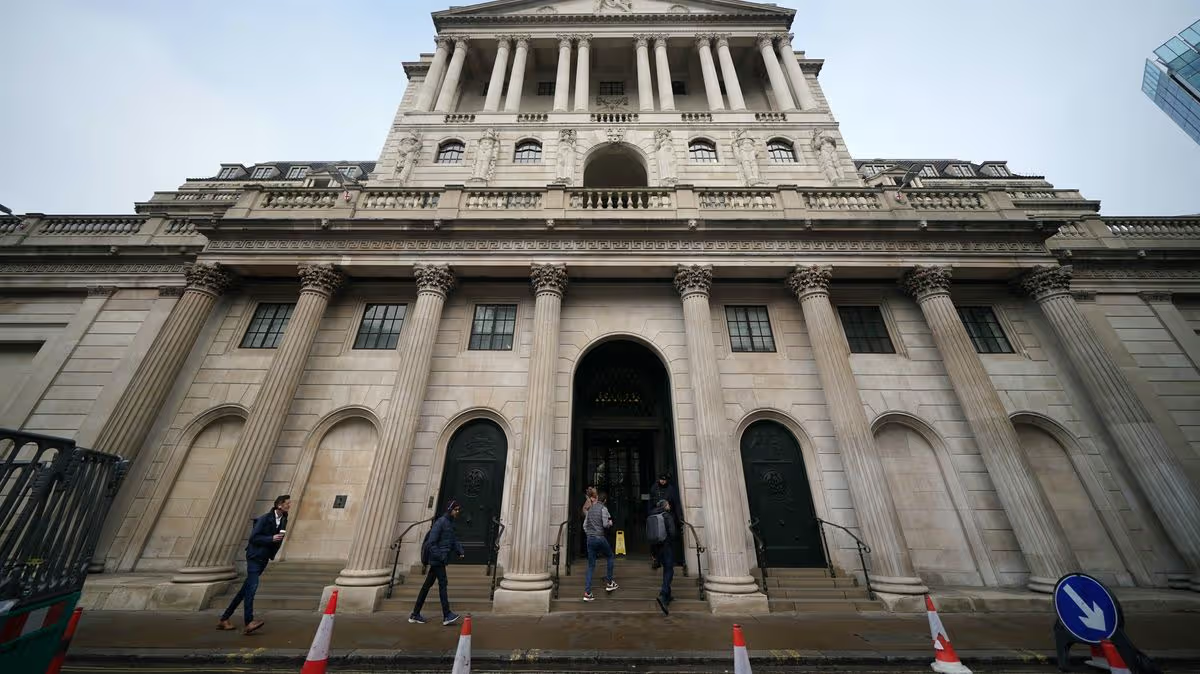
The Bank of England will announce its latest interest rate decision on Thursday(Image: 2024 PA Media, All Rights Reserved)
The Bank of England is expected to maintain interest rates at 3.75 per cent, though economists have cautioned that pressure to increase rates is building as inflation climbs. Most economists believe the Bank’s Monetary Policy Committee (MPC) will choose to leave interest rates unchanged at its forthcoming meeting on Thursday.
It would mark the sixth consecutive occasion the MPC has held rates steady, having remained at the same level since December.
Experts believe policymakers will persist with a “wait-and-see” strategy, particularly regarding the Middle East conflict and its impact on the UK economy.
Nevertheless, three members of the nine-strong MPC – Huw Pill, Megan Greene and Catherine Mann – voted to raise rates to four per cent at the previous meeting, and economists anticipate the same outcome at the next one.
This comes amid a backdrop of rising prices across the UK, with Consumer Prices Index (CPI) inflation climbing to 3.1 per cent in August, up from 2.9 per cent in July, according to the most recent official data.
This represented a five-month peak and demonstrates that CPI inflation has drifted further from the Bank of England’s two per cent target rate.
Numerous economists are predicting the cost of living will rise further, with households confronting another increase in their energy bills from next month, which could prompt the Bank to lift interest rates in the coming months.
Experts have said that services inflation — which reflects pricing trends within the UK’s dominant sector — held steady at 3.4 per cent in August, suggesting an absence of so-called second-round effects, such as escalating wage demands and broader increases in shop prices.
Nevertheless, inflation is widely anticipated to climb once Ofgem’s next energy price cap comes into effect in October, which will push household energy bills up by four per cent for a typical dual-fuel household.
Thomas Pugh, chief economist at RSM UK, said: “The rise in inflation in August is just the start of a new upward trend as higher energy, food and memory chip prices continue to make their way through supply chains.
“We now see inflation peaking at almost four per cent in early 2027, before gradually dropping back to two per cent in 2028. The MPC will hold this week, but inflation at four per cent is realistically too hot to ignore.”
Charlotte O’Leary, associate economist for the National Institute of Economic and Social Research (Niesr), said the MPC would also be keeping a close eye on the recent surge in oil prices, with Brent crude oil rising above 107 dollars a barrel this week.
“Nevertheless, with limited evidence of second-round effects so far, we expect the MPC to hold rates on Thursday,” she said.
“However, mounting inflationary pressures, alongside resilient growth data, may eventually grant scope to raise rates without materially damaging the economy.”
Economists for Pantheon Economics said there is a possibility the MPC “toughens its language” at the next rates announcements “to open up the possibility of a November hike if energy prices keep ramping up”.
“A four per cent inflation peak would already be too hot to hold, but further energy price rises could take inflation even higher,” they said. “The MPC needs to be ready.”
Last week, the European Central Bank lifted its interest rates for the second time this year, cautioning that the Iran war continues to generate inflationary pressure.
Meanwhile, the US Federal Reserve is broadly anticipated to raise its rates for the first time since 2023 on Wednesday evening.

















































You must be logged in to post a comment Login