
Business
Beta bionics CCO Mark Hopman sells $664,550 in company stock



The pan-European index fell 1.1% to 635.45 points, giving up almost all the gains made in the last two sessions. It was down 0.6% for the week.
Regional bourses also ended the session in the red, with London’s FTSE 100 and Germany’s DAX down 1.5% and 1.6%, respectively.
The automobile and parts sector fell 3.4%, with Volkswagen leading the losses in its biggest one-day drop since September 2025, down 5.6%.
The company slashed its outlook, flagging €10 billion ($11.5 billion) in one-off items related to its stake in luxury sports car maker Porsche, provisions for job cuts and a weak Chinese market.

Porsche shares fell 4.9%.
Telecommunication stocks were down 3.3%, posting their biggest single-day fall since April 2025, with Airtel Africa dropping 11.3% to become the STOXX’s top decliner after Bloomberg News reported that its unit Airtel Money is considering downsizing its London IPO.Food and beverages lost 1.9%, with Nestle down 2.6% after Russia seized control of the Swiss food giant’s local assets.
Oil prices pared earlier losses on Friday as markets assessed Saudi supply alongside concerns about a widening Middle East conflict. Still, energy shares shed 0.7% and fell 0.5% for the week.
A respite in the selloff in the bond market, along with receding crude prices, helped risk sentiment this week. The moves came even as the US Federal Reserve increased rates, while the Bank of England left rates unchanged but warned that further tightening may be needed if the war in Iran drags on.
The central banks’ headlines added to the sense that the policymakers were now getting the jump on inflation.
“The focus for next week will be whether this month’s rate hikes represent insurance against an energy-driven inflation shock or the beginning of a lengthy global tightening cycle,” said Daniela Hathorn, a senior market analyst at Capital.com.
“If yields stabilise and oil continues lower, equities could find some breathing room.”
Meanwhile, the European healthcare sector was the best performer this week, followed by insurance, while banks and automobiles were the worst hit.
Also on the radar are developments ahead of next week’s meeting between US President Donald Trump and his Chinese counterpart Xi Jinping.
Among other stocks, Orange dipped 5.8% after Morgan Stanley downgraded the French telecoms company to “underweight.”
LPP climbed 8% after Poland’s largest fashion retailer reported a 64% rise in second-quarter net profit.
Investors are eyeing the prospect of a new global rate-tightening cycle as worries about inflation have mounted.
On Friday, the Bank of Japan raised interest rates to a 31-year high and its governor signaled the central bank has entered a new phase focused on preventing inflation from overshooting its target.
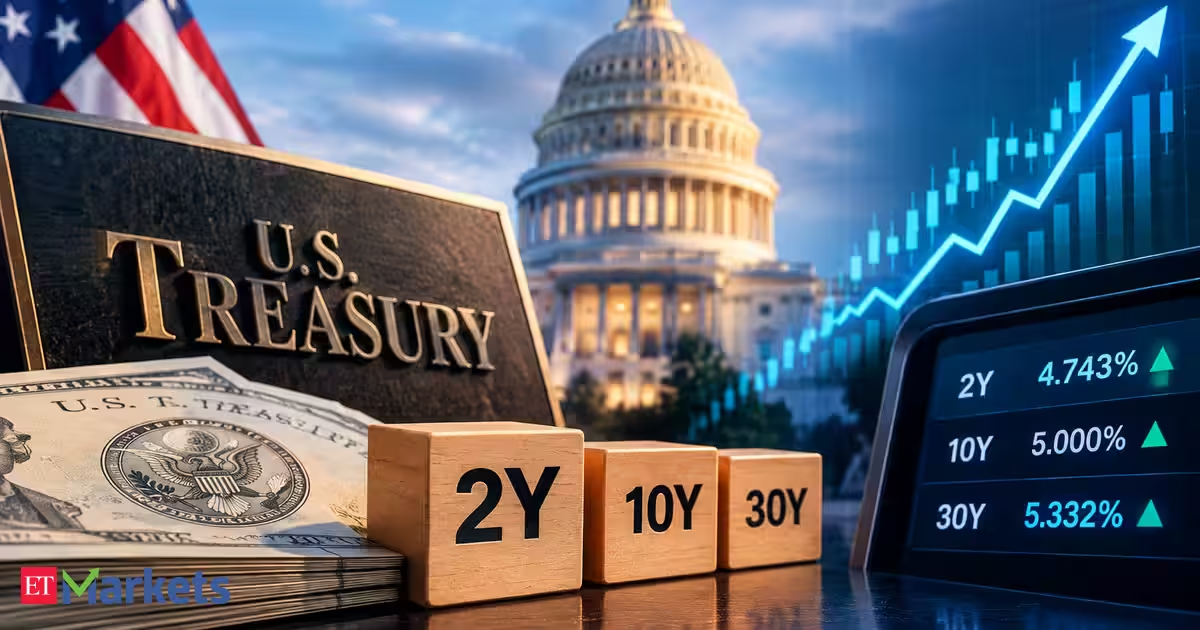
On Friday, US Treasury yields experienced an upward movement as investors expressed concerns regarding inflation. The Federal Reserve’s recent increases in interest rates and indications of more hikes in the future contribute to this shift. With traders predicting additional adjustments in upcoming meetings, there is a growing focus on global central banks tightening their monetary policies to address escalating price pressures.
The Fed on Wednesday raised rates and flagged more hikes in the coming months, while Fed Chairman Kevin Warsh delivered hawkish comments.
“The two-year is going to be moving in tandem with hike pricing,” said Molly Brooks, US rates strategist at TD Securities.
“There’s more risk (of) pricing in more hikes than pricing out hikes at this point.”
Traders see a more than 55% chance of another increase when the US central bank next meets in October, according to CME FedWatch. That expectation was at 53% late Thursday.The yield curve between 2- and 10-year notes was last at 25.5 basis points, after earlier reaching 23.8 bps, the flattest since June 25.
The two-year yield has been driven higher faster than the 10-year yield, in part because of expectations of more hikes, while longer-dated debt has been relatively kept in check by the Fed’s apparent willingness to control inflation.
“The Fed meeting was able to kind of calm market nerves a little bit in terms of the long end,” Brooks said.
Investors will weigh upcoming data for clues about the US economic outlook.
Yields mostly held gains after data on Friday, including a report showing US factory production unexpectedly fell in August after seven straight monthly increases.
Spikes in oil prices tied to the US-Israeli war on Iran have been behind some of the inflation concern.
But oil prices eased on Friday after China, acting on a request from Saudi Arabia, quietly asked Iran to limit attacks by Houthi rebels on Saudi oil infrastructure.
The yield on the benchmark U.S. 10-year Treasury note was last up 5.3 basis points at 5%. It reached 5.041% on Tuesday, the highest since 2007.
The two-year US Treasury yield, which typically moves in step with interest rate expectations for the Fed, was last up 5.3 basis points at 4.743%. It earlier reached 4.7475%, the highest since July 2024.
The yield on the 30-year bond was up 3.6 basis points at 5.332%.
Business
Bonds in the IRA or in the Taxable Account? Park Them in the Wrong One and the IRS Takes a Cut Every Year. These 3 ETFs Go Where They Belong
Quick Read
-
Placing AGG’s 4.82% yield inside an IRA shields every dollar of ordinary income from annual taxation, letting interest compound untouched for decades.
-
VTEB’s 3.90% muni yield equals roughly a 5.7% taxable yield for a 32% bracket investor, but only when held in a taxable account.
-
VTI’s minimal turnover, qualified dividends, and step-up-in-basis eligibility make it the ideal tax-efficient equity anchor for a taxable brokerage account.
-
Read More: Learn 7 ways to generate income with a $1,000,000+ portfolio (sponsor)
You have two accounts: a taxable brokerage and an IRA. Same dollars, same investments, wildly different tax bills. Park a bond fund in the wrong bucket, and you hand the IRS a slice of your interest income each April. Park it in the right one and that same interest compounds untouched for decades. Three funds can help solve the puzzle for most investors: the iShares Core U.S. Aggregate Bond ETF (NYSEARCA:AGG) for the IRA, the Vanguard Tax-Exempt Bond ETF (NYSEARCA:VTEB) for the taxable account, and the Vanguard Total Stock Market ETF (NYSEARCA:VTI) as the equity anchor that can live in either but shines in taxable.

Simply put, here is the problem: taxable bond interest is taxed as ordinary income, the same bracket as your paycheck, every year. Stock gains and qualified dividends get preferential long-term capital-gains rates, and municipal bond interest is federally tax-exempt. Match each fund to the account that respects those rules, and you keep more of what you earn.
AGG: Your Core Bond Holding Belongs Behind the IRA Wall
AGG is the plain-vanilla workhorse of the U.S. bond market. It tracks the Bloomberg U.S. Aggregate Bond Index and holds 13,422 Treasuries, agency mortgage-backed securities, and investment-grade corporates, with roughly $138 billion in assets and a September 2003 inception date. The expense ratio is 0.03%, so $3 out of every $10,000 goes to BlackRock and the rest keeps working for you. The 30-day SEC yield sits at 4.82%, in line with a 10-year Treasury at 4.97%.
Learn 7 Ways To Generate Income With A $1,000,000+ Portfolio
If you’ve saved over $1,000,000, this guide is for you. The last thing you want in retirement is to run out of money, you want your money to generate lasting income while you enjoy your life.
Now you can learn the strategies wealthy retirees use to fund their retirement with The Definitive Guide to Retirement Income from Fisher Investments. Download the guide today! (sponsor)
Here is the catch: Every dollar of that 4.82% is ordinary income. If you sit in the 24% federal bracket, roughly a quarter of the coupon disappears the year you receive it. Drop AGG inside a traditional IRA and none of that happens. Interest compounds tax-deferred, and you only settle up when you take withdrawals in retirement, ideally at a lower rate. In a Roth IRA, it is even cleaner: the interest is never taxed. AGG’s price is down 1.53% year-to-date, a reminder that bond funds move with rates, but the income stream is why you own it.

The dollar pared gains after Japanese authorities conducted rate checks in the currency market – considered a preliminary step before intervention – the Nikkei newspaper reported.
The BOJ pushed rates to their highest level in 31 years at 1.25%, yet the move did not boost the Japanese currency as traders felt there was a lack of explicitly hawkish guidance.
The decision, coming on the heels of the Fed’s hawkish message from earlier this week, clears the way for further dollar strength, strategists said.
“(The) lack of hiking punch makes it easier for USD to go higher,” Steven Englander, head of G10 FX research at Standard Chartered, said.
“The USD strength that we have been forecasting for the medium to long term may finally be here,” Englander said.
The US dollar was 0.5% higher at 156.725 yen, after rising as much as 1.3% to a two-week high of 158.05 yen.It was set for its largest weekly rally since October 2025.
“They’ve just clearly underwhelmed versus expectations here,” said Ray Attrill, head of FX strategy at National Australia Bank in Sydney.
“And I think that one of the more staggering aspects of it was that they couldn’t even get the unanimous vote for that,” he said. “That really raised eyebrows in the market.”
Traders remained alert to the risk of intervention to prop up the currency after Finance Minister Satsuki Katayama said Tokyo won’t hesitate to conduct further coordinated action, following a joint US-Japan move to boost the yen in late July.
“A hike that weakens the currency is an uncomfortable outcome for policymakers and gives the Ministry of Finance a stronger case to push back against one-sided price action,” Kevin Ford, FX and macro strategist at Convera, said.
The yen rallied sharply in early September to its highest since February as traders bet the BOJ would embark on multiple rate hikes, although those wagers came into question on Friday.
Energy Prices In Focus
FX market participants remained focused on energy prices and the US Federal Reserve.
The dollar index, which tracks the currency against six major peers, was up 1.2% for the week to around a seven-week high after the US Federal Reserve hiked interest rates on Wednesday and signalled more increases could be coming.
Traders see a roughly 55% chance of a quarter-point hike at the Fed’s next two-day meeting next month, up from 27% a week ago, according to the CME Group’s FedWatch tool.
Oil prices slipped to their lowest levels in around a week on signs of easing supply pressures in Saudi Arabia.
China has asked Tehran to help rein in the Iran-aligned Houthis after their military blitz on Saudi Arabia over the past week, three Iranian sources familiar with the matter told Reuters.
The euro rose 0.5% to $1.1481 and was set to end the week 1% lower after the Fed’s rate hike.
The British pound was 0.3% higher at $1.3391, after retail sales data beat expectations on Friday. The Bank of England held interest rates on Thursday but also suggested it could raise borrowing costs.
In cryptocurrencies, bitcoin rose 5.9% to $81,000 on Friday – its third straight day of gains – as it extended a rebound from Tuesday’s sharp selloff, when the US Senate failed to advance comprehensive cryptocurrency legislation in a setback for digital-asset companies.

U.S. approves potential $2.7 billion air defense sale to Ukraine

EOS Climbs 10% In Rally
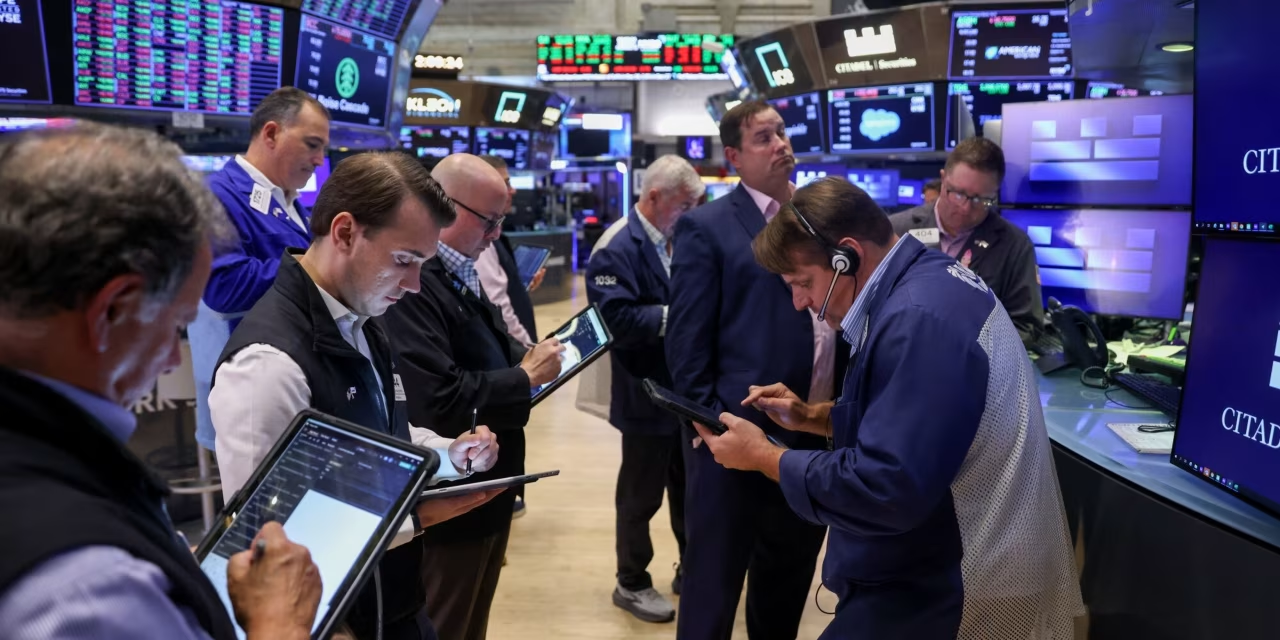
Wall Street took a break Thursday from worrying about interest rates and inflation to revert to a tried-and-true investment idea: snapping up shares of companies tied to artificial intelligence.
A rally in tech stocks from chip makers to the Magnificent Seven giants to data storage companies led U.S. stock indexes higher Thursday, bringing relief to investors after a rough stretch in which stocks tumbled and the 10-year Treasury yield reached its highest level since 2007.
Copyright ©2026 Dow Jones & Company, Inc. All Rights Reserved. 87990cbe856818d5eddac44c7b1cdeb8

US fashion council CEO Kolb resigns after clash with runway show protesters

This is the forum for daily political discussion on Seeking Alpha. A new version is published every market day.
Please don’t leave political comments on other articles or posts on the site.
The comments below are not regulated with the same rigor as the rest of the site, and this is an ‘enter at your own risk’ area as discussion can get very heated. If you can’t stand the heat… you know what they say…
More on Today’s Markets:
Moderation Guidelines:
We remove comments under the following categories:
- Personal attacks on another user account
- Anti-Vaxxer or covid related misinformation
- Stereotyping, prejudiced or racist language about individuals or the topic under discussion.
- Inciting violence messages, encouraging hate groups and political violence.
Regardless of which side of the political divide you find yourself, please be courteous and don’t direct abuse at other users.
For any issue with regards to comments please email us at : moderation@seekingalpha.com.
Seeking Alpha’s Disclosure: Past performance is no guarantee of future results. No recommendation or advice is being given as to whether any investment is suitable for a particular investor. Any views or opinions expressed above may not reflect those of Seeking Alpha as a whole. Seeking Alpha is not a licensed securities dealer, broker or US investment adviser or investment bank. Our analysts are third party authors that include both professional investors and individual investors who may not be licensed or certified by any institute or regulatory body.

Passage Research focuses on identifying variant perception through a blend of fundamental analysis and alternative data. The research process combines detailed financial modeling with real-time datasets to underwrite earnings power, margin durability, and forward expectations.The author has spent over a decade on Wall Street, most recently spending the last five years working in the hedge fund industry as an analyst. Typical coverage spans consumer, TMT, industrials and special situations, with an emphasis on asymmetric risk/reward and catalyst-driven opportunities.
Analyst’s Disclosure: I/we have no stock, option or similar derivative position in any of the companies mentioned, and no plans to initiate any such positions within the next 72 hours. I wrote this article myself, and it expresses my own opinions. I am not receiving compensation for it (other than from Seeking Alpha). I have no business relationship with any company whose stock is mentioned in this article.
Seeking Alpha’s Disclosure: Past performance is no guarantee of future results. No recommendation or advice is being given as to whether any investment is suitable for a particular investor. Any views or opinions expressed above may not reflect those of Seeking Alpha as a whole. Seeking Alpha is not a licensed securities dealer, broker or US investment adviser or investment bank. Our analysts are third party authors that include both professional investors and individual investors who may not be licensed or certified by any institute or regulatory body.
Europe’s STOXX600 falls as autos, telecoms lead broad sell-off

Braves clinch playoff spot: Three reasons why they’re a World Series contender

The New Resident Evil Movie Captures The Survival Horror Magic Of The Games




-

 Tech6 days ago
The Latest Weird Thing to Play Doom Is the Mapped-Out Brain of a Fruit Fly
-

 Crypto World4 days ago
Kraken Lets xStocks Holders Earn Yield Through DeFi
-

 Crypto World2 days ago
US Charges Robinhood Engineers Over Crypto Listing Trades
-

 Crypto World7 days ago
Can AI Build a Startup in 72 Hours? Elon Musk's Team Will Livestream the Test
-

 Crypto World3 days ago
What Is the Status of the U.S.-Iran Peace Talks? Here's What Both Sides Are Saying
-

 Crypto World5 days ago
Elon Musk Drops a Bombshell: Grok 5 Could Be the AGI Breakthrough
-

 Fashion11 hours ago
Weekend Open Thread: Talbots – Corporette.com
-

 Business6 days ago
Rivals Sam Altman and Elon Musk Rally Behind Dario Amodei’s Call for a Slowdown in AI Development
-
 NewsBeat5 days ago
‘Sick conspiracy’: Trump says only guardrails AI needs is ‘a strong and smart (High IQ!) president’ in all-caps rant
-
 Crypto World5 days ago
New Tesla Roadster Uses SpaceX Tech. Will It Impact the Stock Price?
-

 Crypto World4 days ago
Revolut Attackers Warn of Ongoing Daily Customer Data Leaks
-
 Crypto World4 days ago
NVIDIA Analysis: Attempted Rising Wedge Breakout Amid Pressure on the AI Sector
-

 Business7 days ago
Marvell: Most Potent Setup Of The AI Factory Decade
-
Business5 days ago
SK Hynix ADRs Fall More Than 6% as Memory Rally Breaks on Fears of Slower AI Spending
-

 Crypto World4 days ago
DOJ Seeks to Seize $61M in Iran Oil Funds From Binance Accounts It Vouched For
-
Crypto World4 days ago
Can Circle’s Arc Repeat Robinhood Chain’s Meme Coin Boom?
-

 Crypto World7 days ago
Bitcoin ETFs lose $462.7M as Ethereum funds gain $196.9M
-
 Crypto World5 days ago
3 Token Unlocks to Watch in the Third Week of September 2026
-
 Crypto World5 days ago
AI Safety Burden Falls on Chief Executives as Trump Prioritizes China Race
-
 NewsBeat6 days ago
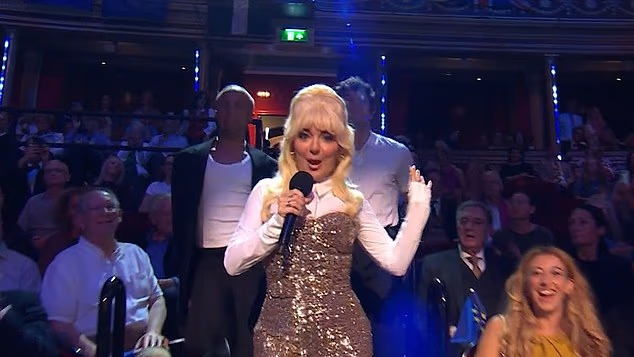
Last Night of the Proms pays moving tribute to Dolly Parton as Sheridan Smith wears a gold sequin jumpsuit in memory of the Queen of Country
You must be logged in to post a comment Login