

Business
Big Returns From AI Investments Are Here, CFOs Say


Finance chiefs once questioned the returns on investing in artificial intelligence. Those days are gone.
Speaking at The Wall Street Journal’s CFO Council Summit in Palo Alto, Calif., finance chiefs from the tech, retail and financial services sectors said their companies are seeing big gains in efficiency and productivity—in some cases worth millions of dollars—from their investments in generative AI. Nudging employees to embrace AI also has yielded new ideas about how to accomplish time-consuming tasks, CFOs said.
Copyright ©2026 Dow Jones & Company, Inc. All Rights Reserved. 87990cbe856818d5eddac44c7b1cdeb8


Stablecoin Firm Circle Reports Earnings On Monday. AI Could Be In Focus.

Operator
Good day, and welcome to the Blackstone Secured Lending First Quarter 2026 Investor Call. Today’s call is being recorded. [Operator Instructions] I’d like to turn the conference over to Stacy Wang, Head of Stakeholder Relations. Please go ahead.
Stacy Wang
Head of Stakeholder Relations
Thank you, Katie. Good morning, and welcome to Blackstone Secured Lending Fund’s First Quarter Results Conference Call. Joining me today are Brad Marshall, Co-Chief Executive Officer; and Teddy Desloge, Chief Financial Officer, along with other members of the management team available for Q&A, including Jonathan Bock, Co-Chief Executive Officer; and Carlos Whitaker, President.
Earlier today, we issued a press release with a presentation of our results and filed our 10-Q, both of which are available on the Shareholder Resources section of our website, www.bxsl.com. We will be referring to that presentation throughout today’s call. I’d like to remind you that this call may include forward-looking statements, which are uncertain and outside of the firm’s control and may differ materially from actual results. We do not undertake any duty to update these statements. For some of the risks that could affect results, please see the Risk Factors section of our Form 10-Q filed earlier today. This audio cast is copyrighted material of Blackstone and may not be duplicated without consent.
With that, I’ll turn the call

Trump says Polish, Moldovan prisoners released from Belarusian, Russian detention
SYDNEY — The S&P/ASX 200 has shown resilience in the first nine trading days of May 2026, climbing roughly 2.8% despite global volatility, with a handful of standout performers driving much of the gains. As artificial intelligence infrastructure demand, lithium market recovery and technology innovation continue to shape investor sentiment, five companies have emerged as the clear leaders in percentage terms on the benchmark index so far this month.
These top gainers reflect broader themes playing out across the Australian market: the global AI boom’s ripple effects on local tech and semiconductor-related firms, renewed interest in critical minerals, and selective strength in healthcare and consumer sectors. Here are the five biggest percentage risers on the ASX 200 from May 1 through May 8, 2026, based on closing prices and market data.
1. BrainChip Holdings (BRN) – Up 68% BrainChip has been the runaway leader, surging more than 68% in early May as its neuromorphic computing technology gained fresh attention from AI developers seeking energy-efficient alternatives to traditional chips. The company’s Akida processor, designed for edge AI applications, has secured several new design wins with automotive and industrial clients. Analysts at Bell Potter upgraded the stock citing “strong momentum in the AI edge computing space” and raised their target price significantly. BrainChip’s low-power chips are increasingly seen as complementary to larger data center solutions, positioning the company as a niche but high-growth player in the AI supply chain.
2. Lake Resources (LKE) – Up 52% Lithium developer Lake Resources jumped 52% as positive developments in its Kachi Project in Argentina and rising global lithium prices fueled optimism. The company reported strong progress on its Phase One demonstration plant and secured additional offtake interest from Asian battery manufacturers. With electric vehicle adoption remaining robust despite higher interest rates, investors are rotating back into lithium plays that offer near-term production potential. Lake Resources has benefited from a broader recovery in critical minerals sentiment as governments push for supply chain diversification away from dominant producers.
3. Appen (APX) – Up 41% AI data services provider Appen has risen 41% after announcing several major new contracts for data annotation and model training services with large technology firms. The company’s specialized datasets for generative AI applications have become increasingly valuable as companies race to improve their models. Appen’s recovery story has impressed investors, with the stock rebounding strongly from multi-year lows as its core business stabilizes and new AI-focused revenue streams accelerate.
4. Polynovo (PNV) – Up 37% Medical device company Polynovo continued its strong run, gaining 37% after positive clinical trial updates for its NovoSorb technology in wound care and reconstructive surgery. The company reported stronger-than-expected sales growth in the United States and Europe, with several new hospital contracts secured. Polynovo’s biodegradable polymer platform is gaining traction as a preferred solution in advanced wound management, driving both revenue and investor confidence.
5. Lynas Rare Earths (LYC) – Up 29% Lynas Rare Earths rose 29% as global tensions over critical minerals supply chains boosted sentiment toward non-Chinese producers. The company’s expansion of its Malaysian processing facility and progress on its Kalgoorlie rare earths plant have been well received. With governments in the US, Europe and Australia seeking to secure domestic supply of materials essential for electric vehicles and defense technologies, Lynas is positioned as a key Western-world supplier.
Market Context Driving the Gains
The ASX 200’s performance in early May has been supported by several factors. Easing geopolitical tensions in the Middle East have helped stabilize commodity prices, while persistent AI infrastructure spending continues to flow through to Australian companies with relevant exposure. The Reserve Bank of Australia’s decision to hold rates steady has also provided some relief to growth-sensitive sectors.
Smaller and mid-cap stocks with direct AI or critical minerals exposure have outperformed larger, more defensive names. This rotation reflects investor confidence that the AI megatrend remains intact while selective commodity recovery offers attractive entry points. However, analysts caution that volatility remains high, with many of these top performers carrying significant risk due to their smaller size and project-specific dependencies.
Analyst Perspectives
Bell Potter senior analyst Chris Savage described BrainChip’s surge as “a textbook example of niche AI technology finding its moment.” He noted that while the company is still pre-revenue at scale, its technology roadmap and partnerships justify significant investor interest.
For lithium plays like Lake Resources, Macquarie analysts highlighted improving fundamentals. “Lithium prices appear to have bottomed, and companies with near-term production potential are being rewarded,” one report stated.
Overall, the early May gainers list underscores the ASX’s sensitivity to global thematic trends. While the broader index has been relatively stable, individual stock performance has been sharply divergent, rewarding those with clear exposure to high-growth narratives.
Risks and Outlook for Remainder of May
Despite the strong starts, several of these stocks remain volatile. BrainChip and Appen, for instance, have a history of sharp pullbacks after rapid rises. Lithium and rare earths companies are inherently cyclical and sensitive to global economic conditions. Investors are advised to maintain diversified exposure and conduct thorough due diligence rather than chase momentum blindly.
Looking ahead, the remainder of May will bring important catalysts including quarterly production updates, potential new contracts and broader economic data from China and the United States. Analysts expect continued rotation between sectors as the market digests earnings seasons and monetary policy signals.
For investors scanning the ASX 200 for opportunities in May 2026, the standout performers so far highlight the importance of thematic alignment with global megatrends. Artificial intelligence, critical minerals and healthcare innovation have been the dominant drivers, rewarding companies that can demonstrate real progress and commercial traction.
As the month continues, market participants will watch whether these early leaders can sustain their momentum or if profit-taking and broader market rotations create new opportunities among laggards. The two-speed nature of the Australian market — with resource and tech plays outperforming while banks and consumer stocks remain more cautious — is likely to persist as global capital continues to seek exposure to the AI and energy transition themes.
The top five gainers in the ASX 200 for early May 2026 illustrate both the opportunities and risks inherent in thematic investing. While strong price action has rewarded early believers, sustainability will depend on execution, market conditions and the ability to convert hype into tangible commercial success. For now, these five companies represent the clearest winners in what has been a dynamic start to the month on the Australian sharemarket.

TOKYO — Sony Interactive Entertainment has yet to finalize the release timing or pricing for the PlayStation 6, with ongoing global RAM shortages driven by artificial intelligence demand forcing the company to consider pushing the next-generation console launch to 2028 or even 2029, according to multiple reports and statements from Sony executives in early May 2026.
Sony President and CEO Hiroki Totoki addressed the uncertainty during the company’s fiscal year 2025 earnings briefing, stating clearly that no decision has been made. “We have not yet decided on at what timing we will launch the new console, or at what prices,” Totoki said via a translator. “So we would like to really observe and follow the situation.” The comments confirm what many industry insiders have suspected for months: the traditional seven-year console cycle that delivered the PlayStation 5 in 2020 is under pressure, and the PS6 may arrive later than the previously rumored 2027 window.
The primary culprit is the sustained shortage and rising cost of high-bandwidth memory (HBM) and other advanced RAM components, heavily consumed by AI data centers. Bloomberg reported in February 2026 that Sony is actively weighing delays to secure adequate supplies without compromising performance targets. Analyst David Gibson from MST International had earlier warned that fiscal 2027 could see further pressure, potentially pushing a full launch into 2028.
Despite the delay rumors, development appears to be progressing. Leakers and supply chain sources indicate that Sony awarded the next PlayStation chip contract to AMD back in 2022, with the PS6 expected to feature a custom AMD Zen 6 CPU and RDNA 5 GPU architecture. These next-generation components are anticipated to deliver a substantial leap in performance, targeting 4K gaming at 120 frames per second with advanced ray tracing and improved power efficiency. Rumors also suggest 32GB or more of high-speed RAM and at least a 1TB SSD as baseline specifications.
A dedicated handheld companion device, codenamed “Project Canis” in some leaks, is also rumored to launch alongside or shortly after the main console, potentially creating a seamless ecosystem similar to the Nintendo Switch but with significantly more power. This dual-device strategy could help Sony compete more effectively against Microsoft’s rumored next-generation hardware and maintain momentum during the transition period.
Why the Delay Makes Strategic Sense
Extending the PlayStation 5 lifecycle appears to be a deliberate move. The PS5 has enjoyed strong sales and a robust library of games, with the PS5 Pro variant providing a mid-generation refresh that has satisfied many enthusiasts. By delaying the PS6, Sony can avoid the costly overlap that occurs when new hardware launches while the previous generation still has strong demand. It also gives the company more time to refine hardware specifications and secure critical components at reasonable prices.
Industry analysts suggest that a 2028 or 2029 launch would align better with stabilized supply chains and potentially lower component costs. It would also allow Sony to observe Microsoft’s next Xbox plans more closely before finalizing its own strategy. However, the delay carries risks. A longer gap between generations could allow competitors to gain ground, and fans may grow impatient if the PS5 begins to feel dated by 2028.
Rumored Specs and Features
While nothing is officially confirmed, leaks and credible reports paint an exciting picture for the PS6. The custom AMD silicon is expected to focus heavily on AI acceleration, with dedicated neural processing units for upscaling, frame generation and in-game assistance features. Backward compatibility with PS5 and potentially PS4 titles is considered a near-certainty, continuing Sony’s strong track record in this area.
Storage is expected to start at 2TB or higher with next-generation SSD technology for dramatically faster load times. Graphical capabilities could target 8K output in some scenarios, though 4K at high frame rates with full ray tracing will likely be the standard. Power efficiency improvements are also anticipated, addressing criticism of the PS5’s relatively high energy consumption.
A potential “PS6 Lite” or digital-only variant at a lower price point is also rumored, following the successful strategy Sony employed with the PS5 Slim. This could help broaden accessibility while a premium “Pro” or flagship model targets enthusiasts.
Impact on Gamers and the Industry
The potential delay has mixed reactions from the gaming community. Some players welcome more time with the PS5 and its growing library of titles, while others are eager for the next technological leap. Developers may benefit from a longer development cycle, allowing for more polished cross-generation titles and better optimization for new hardware features.
For the broader industry, Sony’s cautious approach could influence competitors. Microsoft is reportedly working on its own next-generation console, codenamed Project Helix, with similar supply chain considerations. The extended PS5 lifecycle may also give Nintendo more breathing room with its Switch successor.
What Fans Can Expect in the Meantime
While waiting for the PS6, Sony is expected to continue supporting the PS5 with major first-party releases and technical updates. Games like the next entries in the God of War, Horizon and Gran Turismo franchises are likely to showcase the console’s capabilities further. Enhanced features through system updates, such as improved upscaling and performance modes, are also anticipated.
Rumors suggest Sony may introduce new hardware accessories or mid-generation refreshes to keep interest high. The company has also been expanding its portfolio with more live-service titles and multi-platform releases, adapting to changing consumer preferences.
As development continues behind closed doors, leaks and official teases will likely increase throughout 2026 and 2027. For now, PlayStation fans can enjoy the excellent lineup of games available on PS5 while looking forward to the next generation with cautious excitement. Whether the PS6 arrives in 2028 or later, Sony’s commitment to quality and innovation suggests it will be worth the wait.
The evolving story of the PlayStation 6 reflects the complex realities of modern console development in an era of component shortages and rapid technological change. As Sony observes the situation and makes strategic decisions, gamers worldwide will be watching closely for any official updates on what promises to be another transformative chapter in gaming history.

US disappointed in Taiwan’s smaller defense budget, official says
Business
(VIDEO) Massive Earthquake Swarm Rattles Imperial County with Over 150 Quakes and 4.5 Magnitude Tremor

EL CENTRO, Calif. — More than 150 earthquakes, including a 4.5 magnitude temblor, struck Imperial County in Southern California on Thursday in a vigorous swarm that rattled residents but caused no reported injuries or major damage. The U.S. Geological Survey and local emergency officials said the activity was centered near the Salton Sea, a seismically active region along the San Andreas fault system, prompting heightened monitoring and public alerts throughout the day.

The strongest quake, a 4.5 magnitude event, struck at 11:47 a.m. local time about 8 miles southwest of Westmorland. It was followed by dozens of aftershocks ranging from magnitude 2.0 to 3.8. According to USGS data, the swarm began intensifying early Thursday morning and continued into the evening, with seismic activity spreading across a roughly 15-mile stretch of Imperial County. Many of the quakes were too small to be widely felt, but the larger ones sent residents rushing outdoors and triggered widespread reports on social media.
Imperial County Emergency Services Director Mike Garcia said the swarm was unusual in its persistence but not entirely unexpected in this part of California. “We are in one of the most seismically active areas in the country,” Garcia said. “Our teams are monitoring the situation closely, and we have not received reports of structural damage or injuries at this time. Residents should remain prepared and continue to follow standard earthquake safety protocols.”
The 4.5 magnitude quake was widely felt across Imperial County and parts of Riverside County, with reports coming in from as far as Mexicali, Mexico. Residents described a sharp jolt followed by several minutes of rolling motion. “It felt like a big truck hit the house,” said Maria Lopez, a resident of Brawley. “The dishes rattled, and my dog went crazy. We’ve had small quakes before, but this one was different.”
No tsunami warning was issued, as the quakes were inland and not strong enough to displace significant water in the Salton Sea. However, officials reminded residents that even moderate quakes can trigger aftershocks and urged people to have emergency kits ready.
Seismic Activity in a High-Risk Zone
Imperial County sits at the southern end of the San Andreas fault, where the Pacific and North American tectonic plates meet. The region has a long history of earthquake swarms, including a notable sequence in 2016 that produced thousands of small quakes over several weeks. Scientists say swarms like this are relatively common in geothermal areas and along fault lines where stress is released gradually rather than in a single large event.
The USGS recorded more than 150 quakes with magnitudes above 1.0 by Thursday evening, with the majority occurring at shallow depths of less than 6 miles. Seismologists noted that while the 4.5 quake was the largest so far, there is a small but non-zero chance of a larger event following a swarm. “Swarms can sometimes precede bigger earthquakes, but most of the time they just fizzle out,” said Dr. Lucy Jones, a prominent seismologist and founder of the Dr. Lucy Jones Center for Science and Society. “The key is preparedness.”
Community Response and Preparedness
Local schools dismissed students slightly early as a precaution, and several businesses in El Centro and Brawley closed temporarily during the strongest shaking. No structural damage was reported to major infrastructure, including roads, bridges or irrigation canals critical to the region’s agriculture industry.
The Imperial Valley, known for its vast farms and proximity to the Mexican border, is no stranger to seismic activity. Residents are generally well-prepared, with many homes built to modern earthquake standards. However, older buildings and mobile homes remain vulnerable. County officials activated their emergency operations center and urged residents to review their earthquake preparedness plans.
“We want everyone to have a plan,” Garcia said. “Drop, cover and hold on during shaking. Have water, non-perishable food and medications ready. Check on neighbors, especially the elderly and those with mobility issues.”
Scientific Monitoring and Long-Term Risk
The USGS and the California Earthquake Authority are closely monitoring the swarm using a dense network of seismometers. Data from the event will help scientists better understand stress patterns along this section of the San Andreas fault, which is capable of producing magnitude 7+ earthquakes.
The southern San Andreas is considered overdue for a major rupture, with some models suggesting a potential magnitude 8 event could occur within the next few decades. While Thursday’s swarm is unlikely to relieve significant accumulated stress, it serves as a reminder of the region’s seismic vulnerability.
Impact on Daily Life and Economy
The agricultural heartland of Imperial County produces a significant portion of the nation’s winter vegetables. While the quakes caused no immediate damage to irrigation systems or greenhouses, farmers remained vigilant. “We’re watching our wells and canals closely,” said one local grower. “Any disruption to water infrastructure could be costly.”
Tourism in the area, including visitors to the Salton Sea and nearby Anza-Borrego Desert State Park, was largely unaffected, though some campgrounds reported minor rockfalls. Hotels and restaurants in El Centro saw a brief uptick in business as residents sought safe gathering spots during the stronger shaking.
Historical Context of Imperial County Quakes
Imperial County has experienced several significant earthquakes in its history. The 1940 Imperial Valley earthquake (magnitude 6.9) caused widespread damage and several deaths. More recently, swarms in 2016 and 2020 kept seismologists busy but caused minimal damage. Today’s activity fits the pattern of frequent small-to-moderate events that characterize this part of the San Andreas fault system.
Scientists emphasize that while large earthquakes cannot be predicted precisely, ongoing monitoring and public preparedness can significantly reduce risk. The California Earthquake Authority offers resources for homeowners to retrofit older structures, and many local schools conduct regular earthquake drills.
Looking Ahead
As the swarm continues, officials expect additional small quakes in the coming days. Residents are advised to stay informed through official channels and avoid spreading unverified information on social media. The USGS and local emergency services will provide regular updates as the situation evolves.
For now, the community remains alert but calm. The 4.5 magnitude quake served as a stark reminder that California lives with seismic risk every day. As scientists continue to study the latest swarm, Imperial County residents are once again demonstrating the resilience that defines life along the San Andreas fault.
The event also highlights the importance of ongoing investment in earthquake early warning systems and infrastructure resilience. As California’s population grows and development expands into seismically active areas, preparedness remains the most effective defense against future earthquakes, whether they come as isolated events or prolonged swarms like the one unfolding in Imperial County this week.
Operator
Good afternoon, and welcome to Artivion’s Fourth Quarter and Year-End 2025 Earnings Conference Call.
[Operator Instructions] I would now like to turn the conference over to your host, Mr. Brian Johnston from the Gilmartin Group. Thank you. You may begin.
Brian Johnston
Gilmartin Group LLC
Thank you. Good afternoon, and thank you for joining the call today. Joining me from Artivion’s management team are Pat Mackin, CEO; and Lance Berry, COO and CFO. Before we begin, I’d like to make the following statements to comply with the safe harbor requirements of the Private Securities Litigation Reform Act of 1995.
Comments made on this call that look forward in time involve risks and uncertainties and are forward-looking statements within the meaning of the Private Securities Litigation Reform Act of 1995. The forward-looking statements include statements made as to the company’s or management’s intentions, hopes, beliefs, expectations or predictions of the future. These forward-looking statements are subject to a number of risks, uncertainties, estimates and assumptions that may cause actual results to differ materially from these forward-looking statements.
Additional information concerning certain risks and uncertainties that may impact these forward-looking statements is contained from time

S&P 500: Prepare For The Unwind (Technical Analysis)

NEW YORK — As the retail sector navigates shifting consumer habits, rising e-commerce competition and persistent economic uncertainty in 2026, investors are closely comparing Walmart Inc. and Costco Wholesale Corp. to determine which stock offers the stronger long-term opportunity. Both companies have delivered solid performance this year, but their business models, growth trajectories and valuations present distinct profiles that could influence portfolio decisions for the remainder of the year and beyond.
Walmart shares have risen approximately 18% year-to-date, supported by strong e-commerce momentum, advertising revenue growth and resilient grocery sales. Costco, meanwhile, has advanced about 22%, driven by record membership renewals, robust same-store sales and international expansion. With both trading near all-time highs, the question of which represents the better buy in 2026 depends on an investor’s time horizon, risk tolerance and preference for growth versus stability.
Walmart, the world’s largest retailer by revenue, reported fiscal first-quarter 2026 results that beat expectations, with revenue climbing to $165.6 billion and e-commerce sales jumping 22%. The company’s Walmart+ membership program continues to gain subscribers, while its advertising business and private-label brands provide high-margin revenue streams. International operations, particularly in Mexico and India, are showing double-digit growth, and the company’s supply chain investments have improved efficiency and reduced costs.
Analysts at firms like TD Cowen and Bernstein have named Walmart a top retail pick for 2026, citing its ability to serve value-conscious consumers while capturing premium and digital spending. The stock trades at a forward price-to-earnings multiple in the mid-20s, which many view as reasonable given projected mid-single-digit revenue growth and expanding margins. Walmart also offers a modest dividend yield around 1.1%, supported by consistent increases and a healthy payout ratio.
Costco, by contrast, operates a membership-only warehouse model that generates high customer loyalty and predictable recurring revenue. The company reported strong first-quarter results, with revenue rising 8% and same-store sales growing 6%. Membership fees, which now account for nearly 80% of operating income, continue to rise steadily as renewal rates hover above 90%. Costco’s private-label Kirkland Signature products remain extremely popular, and international expansion into new markets is adding meaningful growth.
The stock carries a higher valuation, trading at a forward P/E in the low-to-mid 30s, reflecting investor confidence in the durability of its model. Analysts highlight Costco’s pricing power, efficient operations and ability to weather economic downturns better than traditional retailers. However, the company’s slower growth rate compared with Walmart’s e-commerce and advertising expansion has led some to view it as more defensive than dynamic.
Key Differences in Business Models
Walmart’s massive scale — more than 10,000 stores worldwide and a dominant online presence — gives it unmatched reach and data advantages. The company has successfully integrated its physical and digital operations, using stores as fulfillment centers for rapid delivery. This omnichannel strategy has helped Walmart capture market share from pure e-commerce players while maintaining its core low-price positioning.
Costco’s model is more focused and selective. With roughly 900 warehouses globally, the company emphasizes bulk purchasing, limited product selection and high inventory turnover. This approach results in strong margins and customer loyalty but limits the total addressable market compared with Walmart’s broader retail footprint. Costco’s reliance on membership fees provides stability but also means revenue growth is more predictable and less explosive than Walmart’s diversified streams.
Valuation and Risk Profiles
Walmart offers a more balanced risk-reward profile in 2026. Its exposure to grocery and everyday essentials provides defensive qualities during economic slowdowns, while e-commerce and advertising provide growth levers. The company’s international presence and investments in automation and AI-driven inventory management position it well for long-term efficiency gains.
Costco’s higher valuation reflects its superior margins and customer retention, but it leaves less room for error if membership growth slows or competition intensifies. The company’s slower pace of new warehouse openings compared with Walmart’s store expansion could limit near-term upside if consumer spending moderates.
Both stocks face common risks, including inflation, labor costs, supply chain disruptions and intensifying competition from Amazon and discount retailers. Regulatory scrutiny on pricing practices and labor practices also remains a background concern for both.
Analyst Consensus and Investor Considerations
Wall Street remains generally bullish on both companies, but Walmart receives more “Buy” ratings due to its growth potential and reasonable valuation. Costco is often recommended for more conservative portfolios seeking stability and consistent returns. For growth-oriented investors, Walmart’s e-commerce momentum and advertising expansion make it the more dynamic choice. For income-focused investors, both offer reliable dividends, but Walmart’s higher yield and faster earnings growth provide a slight edge.
Investors should consider their time horizon and portfolio allocation. Walmart may appeal to those seeking a blend of growth and income with broader exposure to retail trends. Costco suits those who prefer a high-quality, predictable business with strong customer loyalty and margin stability.
Long-Term Outlook for Both Retail Giants
Looking further into 2026 and beyond, both companies are well-positioned to benefit from several powerful trends: continued digitization of retail, growth in private-label products and increasing demand for value and convenience. Walmart’s scale and technological investments give it an edge in adapting to changing consumer behavior, while Costco’s membership model ensures a loyal customer base that is less price-sensitive.
Analysts project both companies will deliver solid mid-single-digit revenue growth with expanding margins over the next several years. Walmart’s international expansion and e-commerce investments could drive faster top-line growth, while Costco’s focus on operational excellence and customer experience supports steady, high-quality earnings.
For investors deciding between the two in 2026, the choice ultimately comes down to investment objectives. Walmart offers greater growth potential and diversification, making it the better buy for those seeking capital appreciation alongside income. Costco provides exceptional stability and customer loyalty, appealing to conservative investors prioritizing consistency and downside protection.
Both retail giants have proven their ability to adapt and thrive in challenging environments. As the retail landscape continues to evolve, Walmart and Costco remain two of the most reliable ways to participate in the sector’s long-term growth. For patient investors with a multi-year horizon, Walmart currently edges out as the more compelling opportunity in 2026 due to its faster growth trajectory and more attractive valuation relative to expected earnings expansion.

Knicks tie NBA playoff record for first-half 3-pointers as they eye sweep of 76ers

Sharp & Roku launch first joint QLED TV in the UK
Stablecoin Firm Circle Reports Earnings On Monday. AI Could Be In Focus.

Manchester United reach agreement with Casemiro over contract clause amid transfer speculation

US brings back mandatory military draft registration

Steven Gerrard disagrees with Gary Neville over ‘shock’ Chelsea and Arsenal claim | Football

Everyone Is Lying to You for Money | Official Trailer UHD

Day 93 Trying to Win MONEY from the Coin Pusher! #shorts #arcade #money

#watch #money #america #news #viral #work #society #car #food #apple #ps5 #reaction #economy #sad
-
 Crypto World2 days ago
HarrisX Poll Found 52% of Registered Voters Support the CLARITY Act
-

 Crypto World4 days ago
Upbit adds B3 Korean won pair as Base token gains Korea access
-

 Fashion2 days ago
Weekend Open Thread: Marianne Dress
-

 Tech6 days ago
Image AI models now drive app growth, beating chatbot upgrades
-
 NewsBeat4 days ago
NCP car park operator enters administration putting 340 UK sites at risk of closure
-
 Business1 day ago
Ignore market noise, India’s long-term story intact, say D-Street bulls Ramesh Damani and Sunil Singhania
-

 Politics2 days ago
Politics Home Article | Starmer Enters The Danger Zone
-

 Entertainment7 days ago
Olivia Wilde Reacts To Viral ‘Corpse’ Comparison
-

 Sports7 days ago
Inter Milan Win Serie A Title After Victory Over Parma
-

 Sports7 days ago
La Liga: Vinicius Jr scores twice as Real Madrid win to keep Barcelona waiting for title
-

 Crypto World5 days ago
UAE Free Zone Deploys Blockchain IDs to Verify Registered Firms
-
 Sports7 days ago
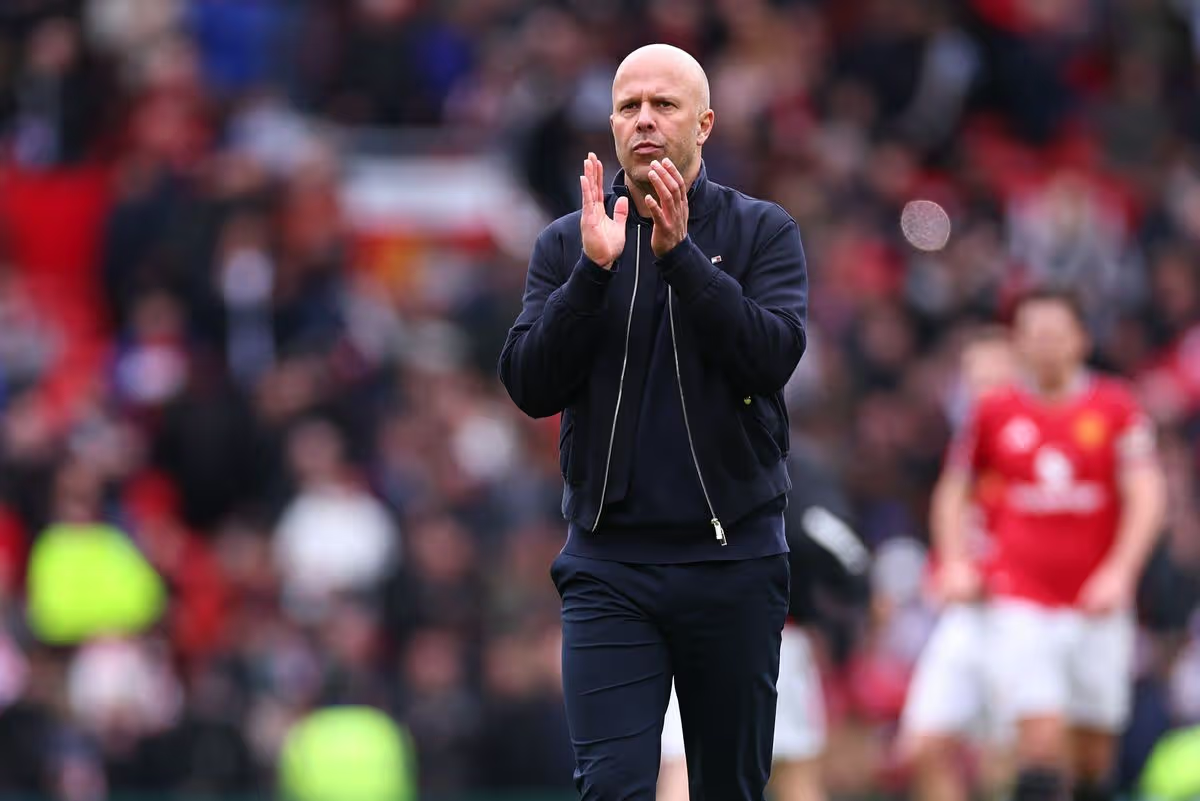
Every word of Arne Slot’s heated rant after Manchester United win vs Liverpool
-

 Sports7 days ago
Joel Embiid urges Sixers fans not to sell playoff tickets to Knicks fans
-
 Sports6 days ago
2026 NHL playoff picks: Second-round predictions, series odds, Stanley Cup bracket
-

 Entertainment7 days ago
Moroccan Reacts To Nick Cannon’s Dating Rules For His Sister
-
Entertainment7 days ago
Jennifer Lawrence’s Mary Jane Sneakers Are Spring’s It-Girl Shoe
-

 Entertainment7 days ago
Kylie Jenner and Timothee Chalamet Hold Hands in NYC Outing
-

 Crypto World4 days ago
BlackRock CEO Larry Fink Discusses a New Asset Class
-

 Crypto World4 days ago
Robinhood says Wall Street is building onchain
-

 Entertainment7 days ago
Post Malone Delays Tour With Jelly Roll Amid Ongoing Backlash
You must be logged in to post a comment Login