

Business
Building an AI-Ready Organization: A Leadership Guide for Digital Transformation


Digital transformation is no longer a future ambition—it’s a present-day necessity. Organizations across every industry are adopting artificial intelligence to improve decision-making, automate repetitive work, personalize customer experiences, and uncover new business opportunities. Yet many companies discover that purchasing AI tools is the easy part. The real challenge lies in preparing the organization itself to embrace change.
Successful AI adoption isn’t driven solely by technology. It depends on leadership, culture, processes, and people. Companies that thrive understand that becoming AI-ready is an organizational transformation rather than a software implementation. Leaders who recognize this distinction position their businesses for long-term success while avoiding costly mistakes that often accompany rushed digital initiatives.
One of the biggest misconceptions about AI is that it simply replaces existing workflows. In reality, it reshapes how teams collaborate, communicate, and solve problems. Just as businesses rely on the best video maker online to simplify creative production without replacing human creativity, AI works best when it enhances employees’ capabilities instead of attempting to replace them entirely. The goal is to empower people with smarter tools while allowing them to focus on strategic thinking, innovation, and meaningful customer interactions.
What Does It Mean to Be AI-Ready?
An AI-ready organization has more than modern software or powerful hardware. It possesses the mindset, infrastructure, and leadership needed to continuously adapt as technology evolves.
Being AI-ready typically involves:
- High-quality, accessible business data
- Clear strategic objectives for AI initiatives
- Employees who understand and trust AI tools
- Leadership committed to responsible innovation
- Processes that encourage continuous learning
Organizations that skip these foundational elements often struggle with disappointing AI projects, despite significant investments.
Leadership Sets the Direction
Technology initiatives often succeed or fail because of leadership rather than technical capability. Employees naturally look to executives and managers for guidance during periods of change.
Strong leaders don’t simply announce an AI strategy—they communicate the purpose behind it.
Instead of saying:
“We’re implementing AI because everyone else is.”
Effective leaders explain:
“We’re adopting AI so our employees spend less time on repetitive tasks and more time solving meaningful customer problems.”
That subtle difference creates alignment instead of uncertainty.
Transparent communication also reduces resistance. Employees are more likely to embrace AI when they understand how it supports their work rather than threatens their roles.
Build a Culture That Welcomes Change
Digital transformation isn’t a one-time project. It’s an ongoing evolution that requires flexibility across every department.
Organizations with adaptable cultures share several characteristics:
They Encourage Experimentation
Not every AI initiative will succeed immediately. Teams should feel comfortable testing ideas, measuring outcomes, and learning from failures without fear of punishment.
Small pilot programs often produce valuable insights before larger investments are made.
They Reward Learning
Technology evolves quickly. Continuous education helps employees stay confident rather than overwhelmed.
This may include:
- Internal workshops
- Online certifications
- AI awareness sessions
- Cross-functional knowledge sharing
Companies that invest in learning often see higher employee engagement throughout transformation efforts.
Data Is the Foundation of AI
AI systems are only as effective as the information they receive.
Before launching sophisticated AI initiatives, organizations should examine their data quality.
Questions leaders should ask include:
- Is our data accurate?
- Are departments using consistent information?
- Can teams easily access the data they need?
- Are privacy and security standards in place?
Poor data leads to unreliable AI recommendations, reducing trust throughout the organization.
Investing in data governance early prevents larger problems later.
Empower Employees Instead of Replacing Them
One of the biggest fears surrounding AI involves job security.
Forward-thinking organizations address this concern directly.
Rather than positioning AI as a replacement, they present it as a productivity partner.
For example:
A customer service representative can use AI to summarize conversations before responding to customers.
A marketing specialist can generate content ideas faster while still applying human creativity and brand judgment.
A financial analyst can automate repetitive reporting while dedicating more time to strategic planning.
These examples demonstrate that AI amplifies expertise rather than eliminating it.
Create Cross-Functional Collaboration
AI initiatives rarely belong to one department.
Successful implementations often involve collaboration between:
- IT teams
- Human resources
- Operations
- Marketing
- Legal
- Finance
- Executive leadership
Each department brings unique perspectives that improve decision-making.
For example, while data scientists may understand algorithms, HR teams understand employee concerns, and legal departments ensure compliance with regulations.
Cross-functional collaboration minimizes blind spots and improves adoption across the business.
Focus on Business Problems, Not Technology
Many organizations become distracted by the latest AI tools instead of identifying the problems they actually need to solve.
A more effective approach starts with business objectives.
Examples include:
- Reducing customer response times
- Improving demand forecasting
- Increasing employee productivity
- Detecting fraud more efficiently
- Personalizing customer experiences
Once the business challenge is clearly defined, selecting the appropriate AI solution becomes much easier.
Technology should always support strategy—not replace it.
Responsible AI Builds Long-Term Trust
As AI becomes increasingly integrated into business operations, ethical considerations become more important.
Responsible AI practices include:
Transparency
Employees and customers should understand when AI contributes to decisions.
Fairness
Organizations should regularly monitor AI systems for bias and unintended discrimination.
Privacy
Customer and employee data must be handled responsibly and securely.
Accountability
Humans should remain responsible for significant decisions, especially in hiring, healthcare, finance, and legal processes.
Companies that prioritize responsible AI strengthen trust among employees, customers, and stakeholders.
Measure Progress Beyond ROI
Financial returns matter, but they’re only one indicator of successful transformation.
Leaders should also monitor:
- Employee adoption rates
- Customer satisfaction
- Productivity improvements
- Process efficiency
- Innovation outcomes
- Training participation
These metrics provide a broader understanding of organizational maturity.
Transformation is ultimately about creating sustainable improvements rather than achieving short-term financial gains.
Learn from Real-World Success
Many leading organizations began their AI journey with relatively modest initiatives.
A manufacturer might first use predictive maintenance to reduce equipment downtime.
A retailer may introduce AI-powered inventory forecasting before expanding into personalized shopping experiences.
A healthcare provider could automate appointment scheduling before implementing advanced diagnostic support.
These gradual successes build confidence, develop internal expertise, and create momentum for larger transformation projects.
Organizations that attempt to overhaul every process simultaneously often encounter unnecessary complexity and employee fatigue.
Starting small and scaling strategically produces stronger long-term results.
Prepare for Continuous Evolution
AI technology will continue advancing rapidly over the coming years. New models, automation capabilities, and analytical tools will emerge faster than many organizations can fully implement them.
Rather than chasing every innovation, successful leaders establish adaptable systems capable of evolving over time.
This includes regularly reviewing AI strategies, updating employee skills, improving governance, and reassessing business priorities.
Organizations that remain flexible are far better positioned to capitalize on future opportunities while minimizing disruption.
Conclusion
Building an AI-ready organization requires much more than adopting cutting-edge technology. It demands visionary leadership, a culture of continuous learning, reliable data, responsible governance, and a commitment to empowering people alongside intelligent systems.
The organizations that succeed won’t necessarily be those with the biggest technology budgets. They’ll be the ones whose leaders inspire confidence, encourage innovation, and create environments where employees and AI work together to solve meaningful business challenges. By focusing on people as much as technology, businesses can build a resilient foundation for digital transformation that delivers lasting value in an increasingly AI-driven world.

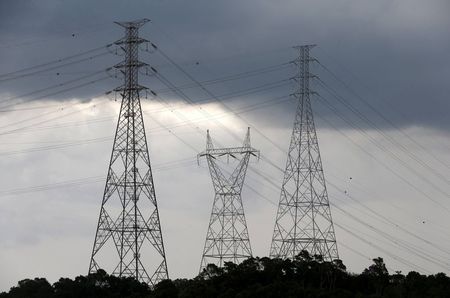
Massive disconnect of power roils largest US electric grid
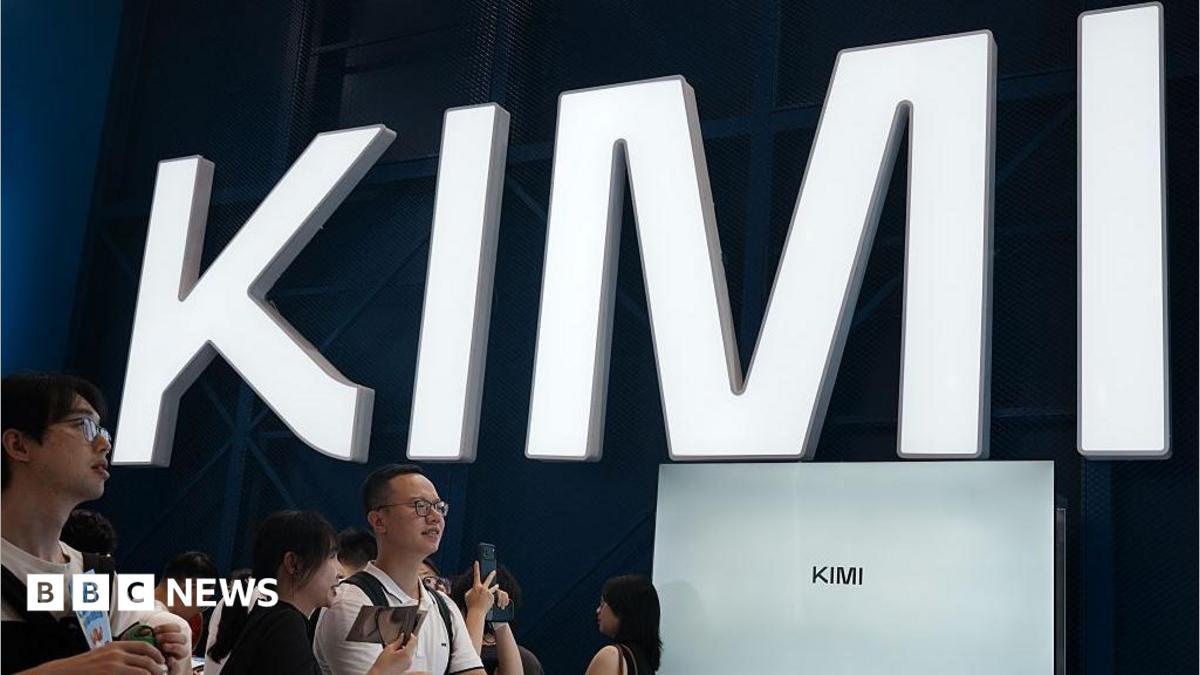
A White House adviser has accused China’s Moonshot AI of a “large scale” effort to steal the capabilities of top US artificial intelligence (AI) models.
US President Donald Trump’s Science and Technology adviser Michael Kratsios said Moonshot AI carried out the campaign through what is known as distillation – when a weaker AI model extracts answers from a stronger one.
Moonshot also gained access to restricted cutting-edge Nvidia servers to train its models, Kratsios said in a social post, external on Wednesday.
The BBC has contacted Moonshot, Anthropic, the White House and Nvidia for comment.
Kratsios said on X that the US government has information that Moonshot AI “distilled” capabilities from Anthropic’s Fable AI for the development of its K3 model.
Kimi K3 gained attention around the world after it was unveiled last week, with many believing it to have narrowed the gap between Western and Chinese AI models. Moonshot said its K3 model is able to rival top US technology.
Kratsios’ allegations come just a day after Treasury Secretary Scott Bessent said the US would examine whether Chinese AI models have stolen the capabilities from American rivals.
“We’ve seen a lot of talk about open-source models coming and threatening the large language models in the US,” Bessent told Fox Business on Tuesday.
“If we see, especially, that overseas models are stealing from our great companies, we have the ability to sanction them,” he added.
The increased scrutiny by the US of Chinese AI companies also comes as Trump is expected to meet his Chinese counterpart Xi Jinping in September.

The Nasdaq led Wall Street lower with a mixed performance from technology stocks, as investors waited for key earnings reports to gauge the health of a market rally fed by enthusiasm for artificial intelligence.

DevelopmentWA is gearing up for a major expansion of land for housing.
Business
WhiteHawk Limited (WHTHF) Discusses CEO 100-Day Plan and Strategic Direction Including AI Governance and Partner-Led Growth Prepared Remarks Transcript

Louisa Ho
Company Secretary
Welcome. My name is Louisa Ho, and I’m the Company Secretary of — here at WhiteHawk Limited. Thank you all for joining us today. It’s my pleasure to introduce our group CEO, Adrian Vallino, who will be speaking to you about the CEO’s 100-day plan. Adrian, over to you.
Adrian Vallino
Many thanks, Louisa, and good morning to everyone, and thank you for joining us today. Before we begin, I’d like to welcome our Chair and fellow Board members, our team across the business, and of course, our valued shareholders and investors. It’s a privilege for me to share this update with you today, and thank you again for joining.
Again, my name is Adrian Vallino, and I’ve stepped into the role of Group CEO around 3 weeks ago. As per the announcement, I felt it was important for — important that you hear from me today about what we’re doing, our plans and some of the observations that I’ve come across in the last couple of weeks. I’ll keep things tight, and with a short introduction on me and how I work, but also what I’ve observed and the plan that we’re now executing on. So let’s get started.
With regards to the last 30 days, I’ve been talking to people behind the business and the spending that goes on within the business itself. This is to give me a good overview of the foundations that we’re working from and then project how we can make some changes in the future to the benefit of the business. So some of the other observations I’ve come across
Business
Wall Street’s Fear Gauge VIX Ticks Up to 17.29 Wednesday as Traders Await Alphabet and Tesla Earnings

NEW YORK — The Cboe Volatility Index, Wall Street’s primary gauge of expected market turbulence, edged higher Wednesday morning as investors braced for a pivotal round of technology earnings and continued to weigh geopolitical risk in the Middle East.
The index, widely known by its ticker VIX and commonly referred to as the market’s “fear gauge,” stood at 17.29 as of 8:25 a.m. Central time, up 0.24 points, or 1.41%, on the day. The modest uptick reflects a slightly more cautious posture among options traders heading into Wednesday’s session compared with recent trading days.
What the VIX measures
The VIX Index is designed to provide a real-time estimate of the expected volatility of the S&P 500 over the coming 30 days, calculated using the midpoint of live S&P 500 index option bid and ask prices. Introduced by Cboe Global Markets in 1993 and updated in 2003 in partnership with Goldman Sachs, the index has become one of the most closely watched indicators of investor sentiment, with higher readings generally signaling greater anticipated market swings and lower readings suggesting calmer conditions ahead.
Wednesday’s reading remains well within the index’s historically typical range. Over the trailing 52 weeks, the VIX has fluctuated between 13.38 and 35.30, meaning the current level of roughly 17 sits closer to the lower end of that spectrum, indicating relatively subdued volatility expectations compared with periods of heightened market stress earlier in the year.
Recent trends in volatility
The VIX has traded in a fairly narrow band over the past month, with data showing a 30-day high of 20.72 and a low of 14.96, and an average reading of roughly 16.94 over that stretch. The index closed at 18.65 on Monday, down slightly from a previous close of 18.77, before opening Wednesday’s session even lower, around 17.21, ahead of its modest intraday climb.
That relative calm follows a period of sharper swings in market sentiment earlier this year. The VIX spiked well above 26 in March amid broader market uncertainty, a reading roughly 50% higher than current levels, underscoring how quickly volatility expectations can shift depending on the news cycle.
Why volatility ticked up Wednesday
Wednesday’s modest rise in the VIX comes as investors prepare for earnings reports from Alphabet and Tesla, both scheduled for release after the market closes. Big technology earnings reports frequently introduce short-term uncertainty into options pricing, as traders position themselves for potentially significant stock moves depending on whether results beat or fall short of Wall Street’s expectations, particularly given the outsized role AI-related spending has played in driving market performance this year.
Beyond earnings, rising oil prices tied to escalating tensions between the United States and Iran have added another layer of caution to markets this week. Higher energy costs, combined with fresh U.S. tariffs including a recently imposed levy on Canadian goods, have contributed to a more guarded tone among investors even as major indexes have continued trading near record territory.
How the VIX is used by investors
Beyond serving as a sentiment indicator, the VIX underpins an entire ecosystem of tradable financial products, including VIX futures, introduced in 2004, and VIX options, which allow market participants to hedge against volatility risk separately from directional price risk in the broader market. More recently, Cboe introduced Mini VIX futures, contracts sized at one-tenth of the standard VIX futures contract, designed to give traders greater flexibility and precision when managing volatility exposure in their portfolios.
Because the VIX tends to rise when stock prices fall sharply, and fall when markets are calm, it is often described as moving inversely to the broader market, a relationship that has made VIX-based products popular tools for portfolio hedging during periods of anticipated turbulence, such as major earnings releases or significant geopolitical developments.
A market watching closely for signals
Analysts covering the options market have noted that current volatility levels suggest investors are not pricing in significant near-term macroeconomic risk, even as individual catalysts like this week’s tech earnings carry the potential to move markets sharply in either direction. That combination, a low overall VIX reading alongside high-stakes individual earnings events, is not unusual, but it does mean that any significant surprise from Wednesday evening’s Alphabet or Tesla results could trigger a more pronounced reaction in both individual stock prices and the broader volatility index in the sessions that follow.
With Alphabet and Tesla both reporting after Wednesday’s close, market participants will be watching closely for any subsequent move in the VIX during after-hours trading and into Thursday’s session, particularly if either company’s results diverge meaningfully from analyst expectations. Additional volatility catalysts later this week include further corporate earnings reports from other major companies, as well as ongoing developments in Middle East tensions that have kept oil prices, and by extension broader market sentiment, in flux.
For now, Wednesday’s modest increase in the VIX reflects a market that remains largely calm by historical standards, even as investors position cautiously ahead of a stretch of earnings reports widely viewed as one of the most consequential of the current corporate reporting season.
When you talk to global asset allocators, what are they saying about India?
We have got more incoming requests for calls and meetings on India over the last couple of weeks than we have had in the last three to six months. Both the economy and corporate earnings have held up pretty well. The recent RBI measures have given people comfort that the rupee may not depreciate meaningfully from current levels. And then there has been more volatility in semiconductor stocks and the AI trade over the last two or three weeks. There has been a growing desire to diversify portfolios away from the tech side, where positions have been very concentrated. So, we are arguing for performance in Asia to broaden a little bit and for some of the laggard markets to recover. In that sort of laggard recovery rally, India should be able to perform better as well.
Read more: UTI AMC’s V Srivatsa warns against midcap valuation, says risk-reward better in largecaps
What has been the nature of the recent foreign flows into Indian markets?
The initial leg of the flows from mid-June was a broad-based pickup in interest in oil-importing markets, including India and South Africa. Moving into July, we have started to see some rotation flows within Asia. So, it’s a mix of long-short allocations improving and some long-only money starting to allocate more.

Now that oil has rebounded, is that bad news for Indian equities?
Unless and until you see a full-blown war, which is not our base-case expectation, and an almost complete stoppage of flows, our year-end forecast for Brent crude is $80. That should be absorbed by the economy and the equity market. But, at the margin, it does put pressure on sentiment. If oil goes back to the $90-100 range, it will start to impact the macros and the market.
What is your reading of the recent sell-off in South Korea and Taiwan?
We are still pretty positive on the fundamentals of the memory space. Earnings of these companies in Korea and Taiwan have actually been strong, and the guidance has also been strong. We are in a cycle where demand is far stronger than supply. We are seeing tightness in the market, not just in 2026 and 2027, but well beyond 2027.
This year, because of pricing, Korea’s earnings growth is more than 300%. Even for next year, we are expecting more than 30% earnings growth in Korea and about 30% earnings growth in Taiwan. So, what we are seeing is a positioning-led unwind, rather than any sort of fundamental concern about the cycle.
One thing that you hear often is that even after the run-up, valuations in Korea and Taiwan remain cheaper than India’s.
That’s why we still have Korea and Taiwan as overweight allocations, and India broadly neutral.
Earnings growth next year is about 30% in Taiwan and about 35% in Korea. In India, we are looking at 10% this year and 13% next year. Korea is still trading at six to seven times PE. Taiwan is a little bit higher in terms of multiples. If you look across the EM region, Taiwan is the most expensive market, and India is the second most expensive, both trading around 20-21 times. So, Taiwan and Korea still stack up better than India because there is higher earnings growth and, in Korea’s case, a much cheaper valuation.
In India’s case, there is room for a catch-up rally in India after the underperformance and improvement in earnings growth.
What kind of returns would you expect from India over the next 12 months?
Earnings growth should compound around 11% on a 12-month basis. And that’s what our return upside for Nifty is. If you pick the right pockets within the market, you can probably get stronger returns, mid-teen double-digit returns.
So, what do you like in India?
Banks. It’s one pocket of the market where valuations are reasonably cheaper relative to their range and relative to the rest of the market. And if foreign appetite starts to come back, it’s one large liquid pocket of the market, which is viewed as a macro bet on India.
Energy self-sufficiency and energy reliance has put the spotlight on power companies, renewables, utilities and power-equipment makers. Tourism is a theme where there is a likelihood of some potential earnings upgrades.

The company provides end-to-end solutions, including mould design, tooling, finishing and assembly, and operates 15 manufacturing facilities across India, the US, the UK and Mexico, serving automotive, defence, medical, consumer and aerospace sectors.
It is the market leader in the metal injection moulding (MIM) segment according to Frost & Sullivan (F&S) report. Around 77.2% of its revenue comes from exports, with 44% generated from North America, highlighting geographic concentration. Given these factors, risk-tolerant investors with a long-term horizon may consider the IPO.
 Agencies
Growth Test Market leadership, strong financials and global scale add to the appeal, but sourcing and concentration risks remain
Business
Incorporated in 1996, Indo-MIM had a market share of 6.8% of the global MIM market by revenue in 2025 according to the F&S report. The company remains dependent on imported raw materials, which account for more than 60% of total raw material procurement, exposing it to risks from supply-chain disruptions, commodity price fluctuations, tariffs, freight costs and foreign exchange volatility. The company operates largely on an order-based model without long-term contracts or committed volumes, making revenues vulnerable to changes, delays or cancellations in customer orders.
Read more: Caliber Mining & Logistics IPO allotment today; GMP hints at 17% listing gain. Here’s how to check your status
Financials
The company’s revenue grew 20.9% annually to ₹4,193 crore and net profit rose 37.1% annually to ₹533.5 crore between FY24 and FY26. Operating profit before interest, tax, depreciation and amortization (EBITDA) grew 20% to ₹1,070.9 crore during the period. In FY26, revenue and net profit jumped 25.9% year-on-year, while EBITDA grew 14.8%. However, EBITDA margin moderated to 25.5% in FY26 from 28% in FY25. The company derives nearly 30% of its revenue from its top five customers, highlighting customer concentration risk. Cash flow from operations grew 53.3% annually to ₹1,077.2 crore over FY24-26.
Valuation
Considering the post-IPO equity and financials of FY26, the company seeks a price-earnings (P/E) multiple of up to 45 and price-sales (P/S) multiple of six. It does not have a direct India-listed peer.

SINGAPORE—Chinese artificial-intelligence developers are racing to raise money through share offerings or loans, believing they need a bigger war chest to keep up with U.S. competitors.
At least six startups that develop AI models are preparing for initial public offerings in Shanghai or Hong Kong through 2027. They are joined by China’s two largest memory-chip makers and three humanoid-robot developers.
Copyright ©2026 Dow Jones & Company, Inc. All Rights Reserved. 87990cbe856818d5eddac44c7b1cdeb8
Business
World No. 1 Shin Jin-seo Beats AI KataGo 2-1, Ten Years After Lee Sedol’s Historic Match With AlphaGo

SEOUL — Shin Jin-seo, the world’s top-ranked Go player, defeated the artificial intelligence program KataGo 2-1 in a three-game series that concluded Tuesday, delivering a symbolic human victory a decade after Lee Sedol’s landmark loss to Google DeepMind’s AlphaGo reshaped public understanding of what AI could achieve.
Shin won the deciding third game by 11.5 points as Black after 221 moves, capping a comeback that saw him rebound from an opening-game loss to sweep the final two games of the series, held at a television studio in Seoul’s Jung-gu district and broadcast live on Baduk TV.
A rematch three anniversaries in the making
The series, dubbed the “Ssen Math·Hankyung Gishin Match,” was organized by the Korea Baduk Association specifically to mark the 10th anniversary of the 2016 Google DeepMind Challenge Match, in which Lee Sedol faced AlphaGo on even terms and lost the five-game series 4-1. That earlier match, played in Seoul in March 2016, is widely credited with transforming global perceptions of artificial intelligence, with Lee’s lone victory in Game 4 remaining one of the most celebrated moments in the sport’s history.
Unlike Lee’s even-terms match against AlphaGo a decade ago, Shin’s series against KataGo, currently regarded as the strongest existing Go AI, was played under a two-stone handicap, reflecting how dramatically AI capability in the game has advanced since 2016. Ahead of the series, Shin acknowledged the gap that remains between human and machine play at the highest level. “It is currently impossible to beat artificial intelligence in an even game, but I believe it is meaningful if I can narrow the gap,” Shin said before the match began.
How the series unfolded
Shin lost the opening game on July 17, resigning after 245 moves in a contest where his win probability had briefly exceeded 99% before a critical error in the lower-right corner allowed KataGo to seize control. Two days later, on July 19, Shin rebounded to win Game 2 by 4.5 points after a marathon contest lasting nearly five hours and 290 moves.
The series concluded Tuesday with Shin’s decisive Game 3 victory. Unlike the first two games, where KataGo opened at the star point, the AI began the final game at the upper-left 3-4 point, prompting Shin to respond with a corresponding move in the lower-right corner and establish a different overall flow than in the previous two contests. Rather than engaging in complex fighting, Shin pursued a territory-focused strategy, building solid influence along the upper and right sides of the board before consolidating a large framework extending toward the center into confirmed territory.
Shin entered the deciding game with an estimated 99% win probability under the handicap evaluation, equivalent to roughly an 18.5-point advantage. According to AI-based win-rate analysis of the game, his winning chances never dropped below 95% at any point, making it his most convincing performance of the series. The game lasted approximately three hours and 20 minutes.
Shin’s reaction
Despite securing the series victory, Shin was measured in assessing his achievement relative to Lee Sedol’s earlier feat. “I don’t think this compares with the one victory that Lee Sedol achieved against AlphaGo 10 years ago,” Shin said following the match, a comment reflecting both the different competitive conditions, an even match for Lee versus a handicapped series for Shin, and the outsized cultural significance of Lee’s original win.
Prize money and format details
Under the terms of the series, Shin received 150 million won, or roughly $108,000, in appearance fees at a rate of 50 million won per game, along with an additional 50 million won bonus for each of his two wins, bringing his total earnings to 250 million won. Because he secured two or more victories in the series, Shin also received a Genesis G90 luxury sedan as an additional prize.
The match conditions reflected the different capabilities of human and AI competitors: Shin operated under a standard five-hour time limit with a single 30-second byoyomi period for overtime moves, while KataGo faced no overall time limit but was required to make each individual move within 20 seconds.
A decade of change in the sport
The rematch arrives amid a broader transformation in how professional Go is played and studied. In the years since AlphaGo’s 2016 victory over Lee Sedol, AI has fundamentally altered the game at the highest levels, overturning long-held strategic principles and introducing new ones that professional players now study and attempt to replicate rather than relying primarily on their own intuition. Today, competing at the top professional level without incorporating AI-assisted training and analysis is considered essentially impossible.
That shift has drawn mixed reactions within the Go community. Some players and observers argue AI’s dominance has diminished the creative, improvisational character the game once rewarded, while others contend it has opened new strategic possibilities that human players continue to explore. The technology has also had a democratizing effect on access to high-level training resources, a development some attribute to more female players climbing the professional ranks in recent years.
A symbolic moment, ten years later
For a sport whose modern relationship with artificial intelligence was defined by Lee Sedol’s 2016 defeat, Shin’s comeback victory over KataGo offers a symbolic, if conditionally framed, counterpoint a decade later. While the two-stone handicap means Shin’s win cannot be directly compared to an even match against the world’s strongest Go AI, the result nonetheless marks the first official series victory by a human player over KataGo under the competition’s specific conditions, giving the Go world a fresh moment to reflect on how far both human players and the machines they train against have come since that first, era-defining match in March 2016.
Massive disconnect of power roils largest US electric grid

South Korea Crypto Trading Volumes Fall as KOSPI Surges

Canada’s Tyler O’Neill exits vs. Red Sox with apparent injury


-
 NewsBeat6 days ago
London Mayor Sadiq Khan handed a peerage by Keir Starmer alongside 15 other Labour figures… just days before the PM leaves No10
-

 Fashion5 days ago
Weekend Open Thread – Corporette.com
-

 Politics5 days ago
The House | The City of London can help the new chancellor deliver growth in every postcode
-
 Crypto World6 days ago
Two July Windows Left: The CLARITY Act’s Senate Fight and What Failure Means
-

 Crypto World5 days ago
Ripple Payments Joins MiCA With 14 Firms, Does It Mean Anything For XRP?
-

 Business7 days ago
Nvidia Stock Slips After Big Tuesday Rally as Huang Confirms Vera Rubin Chip Is Now in Production Today
-

 Politics3 days ago
Democrats look to World Cup watch parties to register thousands of voters
-

 Crypto World5 days ago
Ripple wins EU-wide access as ESMA adds it to MiCA register
-

 Crypto World2 days ago
Grayscale Files For Worldcoin ETF, WLD Registers Sharp Rise
-

 NewsBeat3 days ago
Unregistered fitter used Gas Safe logo on business flyers
-

 Tech2 days ago
Sail Virtually Aboard The “Itanic” With IA-64 Emulator
-

 Crypto World6 days ago
Injective Submits SEC Transfer-Agent Registration to Onchain Ownership Records
-

 Business7 days ago
Palantir Shares Rise After Expanded Nvidia Partnership and Fresh Analyst Upgrades Ahead of Earnings Day
-
 Tech2 days ago
Turtle Beach Command Series KB7 review: a nifty screen-equipped gaming keyboard
-

 NewsBeat6 days ago
Registration is now open for March for Men with Kev 2026
-
 Business21 hours ago
New Jersey voter registration controversy explained: How 6,600 noncitizens got on the rolls, and what happens next
-

 Crypto World6 days ago
Claude Fable 5 Slips to Second in AI Coding Leaderboard
-

 News Videos6 days ago
Money | Class 12 Economics | CBSE Board Exam 2026-27
-

 Business6 days ago
Banco Bilbao Vizcaya Argentaria, S.A. (BBVA) Discusses Global Macro Environment and Economic Outlook for Core Markets Transcript
-

 Crypto World5 days ago
Kaspersky exposes OkoBot’s 20-module crypto wallet attack
You must be logged in to post a comment Login