
Business
Bumbershoot Holdings 2025 Investor Letter


Nikada/iStock via Getty Images

Dear Partners,
We compounded capital at a reasonably healthy rate—advancing +13% in 2025.
On a relative basis, this placed the fund between most benchmarks—trailing the international markets which delivered an exceptionally strong rebound year based on weakness in USD, behind US large-cap indexes and slightly ahead of US small-cap and fund composites.
Numbers never seem to paint the full picture, though, as we arrived at those results in a very different way. From our perspective, it was a fairly steady year with relatively minimal volatility. Long positions generally moved higher, while hedged/short exposure remained a frustratingly persistent friction. Markets meanwhile seemed to bounce around on geopolitical news, macro flows and changing narratives, but ultimately arrived at new highs driven by a narrow leadership set.
There are a lot of different directions I want to take it from here… which is the primary reason I have been struggling to deliver this letter. But in the interest of time and respect for your human (!!!) attention span… I will try to keep it brief and merge the Outlook section into a single consolidated segment. AI would never…
Over the years I have come up with a lot of references and analogies to talk about economic concepts. I then use these letters as a way to tie them together to form a relevant long-term framework, which helps provide a clearer snapshot for how we think about the world and investing landscape.
Bumbershoot Holdings L.P.
2025 Performance

The last great hideout…?
This is inflation vs. deflation …The Central Bank Superheroes …How Fast, How High, How Long …Crucifying mankind on a cross of T-bills …The reflationary pump …The cartoonish increase in money supply …Brushing against the third-rail of USD reserve status …The Lizard Brain …Algo-Trader Chicken …That you have to get it right on price too …The economic riddles from last year…Questions and narratives …All of it.
One aspect I’d like to reexamine though is liquidity —and particularly the next reflation cycle .
I stated last year that the ” next reflation cycle will be something to witness “—and so I just want to expand a bit on what that means from my perspective.
The challenge with this is that it requires holding some conflicting ideas . About personal beliefs. The state of the economy. Growth, valuations, interest rates…
I will not be attempting to predict when the next cycle will kick off and/or what will precipitate it… but I am willing to stake that in a debt-driven system, deflation is simply too destabilizing to allow it to persist for any measured amount of time. This is even more the case with policymakers increasingly sensitive to financial market performance as a scorecard. Even the question of a mismatched growth/contraction and expectations of deflation might reasonably set off the next reflation cycle sooner rather than later. And my opinion, taken for what it is—whenever it occurs, it will be substantial.
The dynamic reminds me of the show Breaking Bad . Every episode, viewers are presented with a seemingly fatal constraint. Hank is boxed in. Consequences are finally going to be unavoidable. But through a series of increasingly creative and risky maneuvers, disaster is averted to push the story forward to the next episode. Stabilizing the present, while quietly raising the stakes for the future.
Economic storylines have behaved quite similarly over the course of my career.
An economic slowdown looms.Policy mistakes threaten instability.Credit pressures emerge.
But through some combination of policy intervention, fiscal expansion, monetary accommodation, and/or financial engineering—those immediate consequences can be postponed. Kicking the can down the road.
Each rescue works… but brings with it new distortions. A subtle erosion in the confidence of fiat currency. An increased dependency on a political reaction function. Greater public leverage. Uneven distribution of wealth. Higher risk of long-term inflation.
Understandably, the market focuses on survival to the next episode—not the longer-term story arc.
But this is the liquidity .
Whenever those maneuvers occur, liquidity floods the system. And when that happens, it inevitably searches for somewhere to flow.
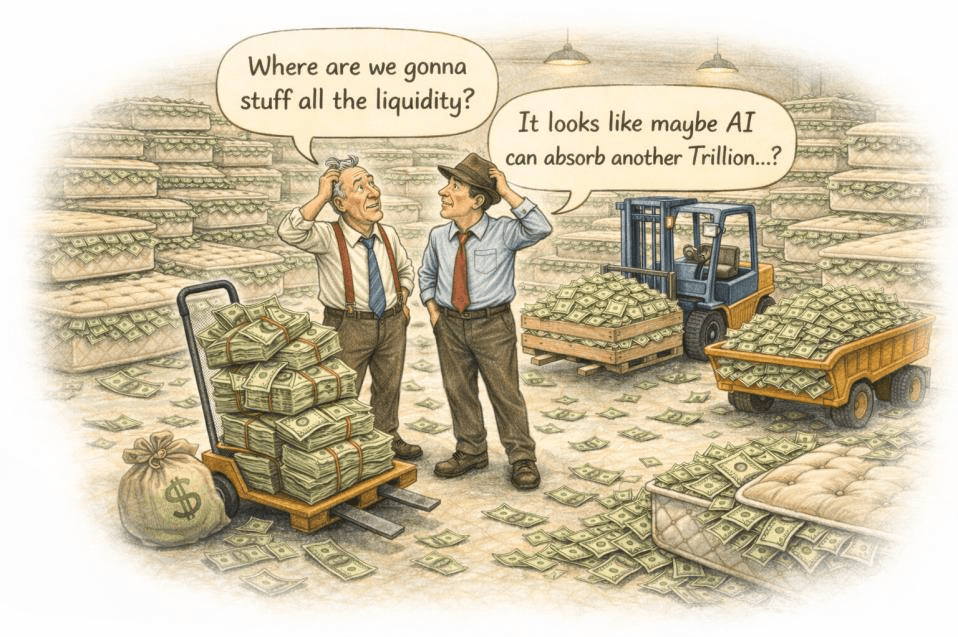
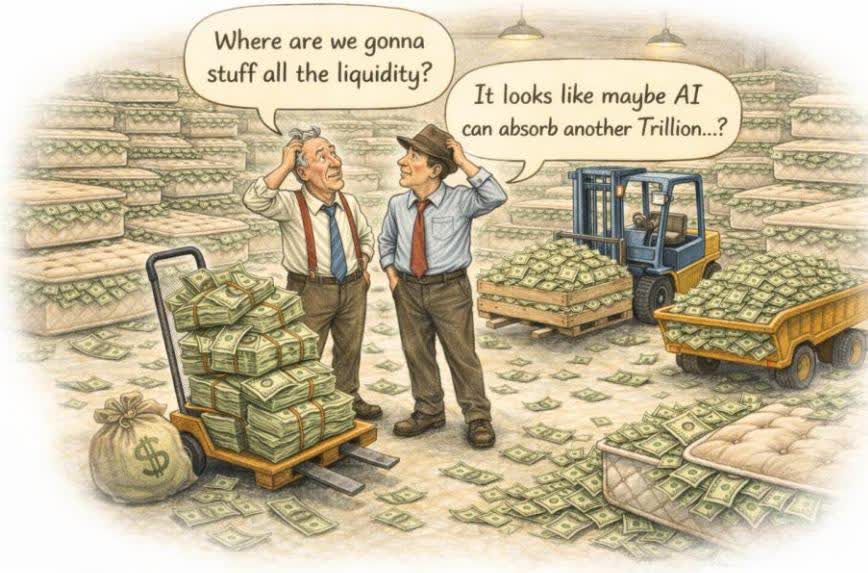
Money needs to be absorbed .Liquidity needs to go somewhere …
And so, it does…

It finds its way into anything capable of absorbing it—Durable businesses… Financial assets… Real estate… Anything with a credible narrative …
And it will keep pushing on that string for as long and as hard as it can until the price hits some tension. This is what can stretch it way beyond fundamentals as the crowding effect takes place within a narrowly anointed leadership cluster.
Anything even resembling a worthy mattress becomes stuffed to the gills —expressed via multiple expansion—and may not be safe for your next investment dollar.
“If the narrative is not contentious, then the valuation almost certainly is…”
Even an exceptional growth story can be pushed to the point that it is just a tough deal.
So, what am I saying?What am I worried about?Where is the catastrophe risk ?
Why am I talking about deflation , the effects of excess liquidity and the cause of even more (!) excess liquidity with the next reflation cycle all in the same breath…?
Because in many ways they are all the same story.
The economy is working really well for certain parts of it. Institutional sponsorship and capital market access is wildly strong for the companies benefiting from the central technological/geopolitical narratives. And for individuals who own financial assets, the system is still largely working as designed—compounding wealth.
The rich get richer… but it’s not a collective experience.
While macro headlines and market leadership remain fairly resilient—growth has been uneven with pressure mounting beneath the surface for many. Affordability remains a real constraint for most people/households. Inflation shocks to non-discretionary items like food, rent & healthcare; combined with higher home prices and elevated interest rates have now effectively frozen many people out from ever becoming owners…
This is the down-leg of the K-shape recovery/economy we’ve all talked and read so much about. And it is that descender portion that is being forced to carry the real economic burden—felt deeply in the consequences of economic mobility and financial security.
But immunity by the upper-leg does not last forever—effects eventually begin to work their way upward…
Which is about when the structural constraint of policy response kicks in. Because as the economy slows… and credit contracts… and fear takes over… the historical answer has been remarkably consistent: reflate .
Ironically, it is this cycle reinforcing the very imbalance which created the pressure in the first place. Liquidity flows into financial assets … precisely the thing that the struggling portion of the economy was stressed by not owning to begin with! Cue the William Jennings Bryan quote … it’s no wonder populism is awakening around the world!
The game is not fair .
But as I’ve said previously—we didn’t make the rules… and we certainly are not in charge of trying to change them. All we can do is play it to the best of our ability.
But to be a happy unintended consequence of the next reflation cycle… we need to know what the “playbook” is going to look like. And my suspicion is it won’t look exactly the same as the last time.
Because the market narrative is changing…
AI is still a primary driver, but the question of whether AI will be “ transformational to the world? ” was one I labeled last year as not having any real stakes . Accept that it is going to transform the world and productivity, but then what? Is it investable ? And who wins ?
The new question of whether AI is hugely deflationary to the job market and the rest of the SaaS technology ecosystem is one that has a lot more bite to it.
The market is also still starting from a tough position. To repeat last year, a little fizz almost never turns into a bubble . But it is expensive. Signals are there—stretch valuations, investor complacency, excessive leverage… Perhaps most notably, “ good company news ” in terms of fundamental positive strength/improvement in the underlying operations of a business is beginning to not always have an effect. That is typically an end cap to a bull market, as the multiple expansion has played out.
To put it very simply, uncertainty is going up. Meaning the number of places with credible narratives in which to park substantial amounts of capital is going down…
Selection is going to be paramount.
This has always been at the core of our process—know what we own, why we own it and what it may be worth. Selection is where we shine …
It is why we go through the entire hassle of still trying to identify key themes, understand the core narratives, evaluate critical fundamentals… ie: research .
And it works.
But it is forcing us to confront the challenging question of whether we are taking enough risk?
And the answer to that question is probably not .
Too often we have arrived early, but then moved on to our next idea far too quickly…
To use a baseball analogy, we’ll show up in the second or third inning… and then usually try to leave after the seventh-inning stretch. Reasonable .
But we’ve been at the right games… and the market has increasingly rewarded those who have stuck around through the eighth and ninth innings. The increase in volatility as the game nears an end has been worth it .
This is not a change in our process… core principles remain exactly the same. We will never take risk that forces a permanent capital impairment. We will never become a forced seller. But from a playbook with fewer places to live… we need to hold those spots much more dearly in terms of both concentration and duration.
The question in my mind is not whether we can locate the right corners of the market… it is whether we are being compensated appropriately for our conviction to be standing there.
Perhaps not quite going full Charlton Heston on you—“ pry it from my cold, dead hands… ” … but at the very least… you’re going to have to come and take it.
Our job is still to find them first.
But when we do, stay a little longer.
Volatility may tick up… and that may be a good thing.
As a reminder, Bumbershoot remains my primary way to navigate the markets and to grow wealth—through all cycles and conditions. It is an absolute return fund. A multi-strat, eclectic expression of my philosophy on what I ought to be doing with my own money. Because indeed, it is my own money. I have still never touched a single dollar of my initial investment as an LP, which represents the vast majority of my net worth.
I am as excited about our opportunity set today as I have been at any time since starting the company. The market remains narrative-driven and increasingly split between assets everyone wants to own and those that have quietly fallen out of favor.
It is rewarding understanding businesses, rather than just trading based on price action. It is an environment that tends to prize deep work—valuing the process we have been building all along.
Since the fund’s inception, I envisioned an alternative in asset management services, guided by a clear set of values and goals—and I am proud to say that we have remained steadfast in commitment to that mission.
I believe we are exceptionally well positioned to take advantage of whatever comes next…
Performance
Bumbershoot Holdings L.P. generated a positive gross return of +13.02% for the full-year 2025.
The partnership has a cumulative total gross return of +156.3% since inception in Oct-2015.
Looking at relative performance, our monthly returns were directionally correlated with key benchmarks, but with significantly less volatility. Despite concentration in our largest holdings, it was a steady year—with no individual month being +/- more than 5% for the first time since the pandemic.
Investment activity is categorized into five segments— Core, Micro, Value, Special Situation & Discretionary —with estimated P/L contributions as follows:
Core gains were led by investments in the Technology sector including Alphabet (GOOGL) (GOOGL:NYSE), Micron (MU) (MU:NYSE), First Solar (FSLR) (FSLR:NGS) and Camtek (CAMT) (CAMT:NGM). We remain particularly focused on key critical “OS platform” businesses and semiconductor-related adjacencies.
Our long-standing position in gold (and copper!) miner Barrick Mining (GOLD) (B:NYSE) finally moved higher as a reflection of the gains in the underlying yellow metal. Materials sector exposure to the agricultural-fertilizer industry via Intrepid Potash (IPI) (IPI:NYSE), Nutrien (NTR) (NTR:NYSE), CF Industries (CF) (CF:NYSE) was also a positive contributor to results.
The Healthcare sector was once again led by Ligand (LGND) (LGND:NGM) and Madrigal (MDGL) (MDGL:NGS), but was more than offset by losses in Viking Therapeutics (VKTX) (VKTX:NCM). While Viking has been a roller-coaster over the past couple of years, we remain optimistic as it moves VK2735 into multiple Ph3 trials. We remain interested in investments targeting biopharmaceutical royalties and metabolic disorders.
Home improvement retailer, Kingfisher (KGFHY) (KGF:LSE), finally started to turn things around… perhaps Europe does still count for something after all.
And playing on the continued theme of infrastructure spending, defense and energy sustainability, a handful of our positions in the Industrial and Energy sectors added positively to performance including Oshkosh (OSK) (OSK:NYSE), Coterra (CTRA) (CTRA:NYSE), OSI Systems (OSIS) (OSIS:NGS), and Herc Holdings (HRI) (HRI:NYSE).
Core category investment returns were lowered by our direct short exposure and market hedging activity.
Micro strategy had a standout performance, led by a notable attribution from Vimeo (VMEO) (VMEO:NGS), which was acquired during the year. Some of our technology and industrial-themed holdings such as Orion Group (ORN) (ORN:NYSE), NPK International (NPKI:NYSE) and Vishay Precision Group (VPG) (VPG:NYSE) continued to produce meaningful contributions; and a collection of lesser-weighted positions also bumped up results.
Value category registered negligible attribution as an auditor switch at Gencor Industries (GENC) (GENC:NGM) took down performance, offsetting any other gains.
Special Situation strategy was a detractor for the year as our position in BuzzFeed (BZFD) (BZFD:NCM) gave back the “notable gain” from last year. This was partially offset by M&A related arbitrage.
Discretionary trading had no significant attributions to merit discussion in more detail.
In terms of exposure levels, Bumbershoot ended 2025 with Core investments around target range. Non-Core categories remain a mix, with only the Micro category being above the target weighting of ~5% AUM.
Administrative
There is one notable change to talk about.
While I still plan to use the collective “we” in talking about our partnership—DeForest Hinman accepted a new role as an investment officer at a regional bank. I need to thank him for his contributions and wish him the best of luck in the new role.
Aside from that… the picture remains the same.
Before moving on from this section… I want to STOP! This will not be an entire dedicated Marketing section like a few years ago, but I want to do something I have rarely done since starting… ask for your investment .
I fully believe in what we are doing as an alternative in asset management. And am increasingly confident that we’ve built a process that is scalable and repeatable at higher amounts of capital under management.
Any support from existing LPs to intro the fund to new prospective partners remains greatly appreciated; and I’d love people to consider being part of Bumbershoot as we take steps forward.
Taxes
Bumbershoot’s form Schedule K-1 that reports on each partner’s share of income/losses for the tax year have been prepared by our administrator.
As reminder, we successfully implemented a “ Master-Feeder ” structure a handful of years ago to efficiently pass long-term gains in our Core holdings back to the main fund.
Tax implications for 2025 were favorable with partner accounts recognizing only moderate taxable gains for the full-year from a capital account basis.
For existing partners that have sizable (and hopefully increasing) embedded gains in Core investments held in the Feeder account—those gains ultimately become taxable upon being realized at some time in the future. That event, however, is deferred and the consequent tax-effect is long-term in nature. Over time, I expect our tax strategy to remain efficient/advantageous.
Summary
2025 was a solid year for Bumbershoot—one that adds to our long-term track record of compounding.
Another mile.
As many of you know, I ran the Tokyo marathon just a few days ago… so I’ve been thinking about running a lot. It’s given a new perspective to the familiar phrase, “ It’s a marathon, not a sprint. ”
You do not arrive at the finish line. It is only step-after-step-after-step that you ultimately reach the goal. It is an exercise in patience, endurance and preparation.
Stepping forward to 2026!
Sincerely,
Jason Ursaner, Managing Member, Bumbershoot Holdings
1 S&P 500 Index —https://ycharts.com/indicators/sp_500_monthly_return
2 Russell 2000 Index —https://www.ftserussell.com/analytics/factsheets/…/hist…
3 FTSE 100 Index —https://www.ftserussell.com/products/indices/uk
4 BarclayHedge Hedge Fund Index —https://portal.barclayhedge.com/…Barclay-Hedge-Fund-Index
Editor’s Note: The summary bullets for this article were chosen by Seeking Alpha editors.

Business
CG Oncology: Passing A Red Line For What I Would Call A Reasonable Valuation (Rating Downgrade)

CG Oncology: Passing A Red Line For What I Would Call A Reasonable Valuation (Rating Downgrade)

Netflix: Three Reasons To Expect An Earnings Beat
Does the Iran War herald nuclear momentum?

Week Ahead: It's Still Mostly About The War

Cairo maneuvers for de-escalation as Egypt’s private sector hits two-year low


Foxconn first-quarter revenue jumps 30% y/y


I focus on a rigorous fundamentals-foremost equity and credit research. I currently work as a financial advisor/planner, and do analysis in my free time. I have an undergrad in business administration, an MBA in finance, and currently am a doctoral candidate (a DBA with a concentration in Finance and Investment Management). My research style typically involves process-driven research, followed by blending several valuation models together to get a blended, 12 month price target. I enjoy utilizing full DCF analysis in conjunction with SOTP, peer/multiples analysis, and risk-adjusted approaches. I thoroughly enjoy reading filings, technical documentation relevant to the sector, and then translating that data into conclusions with actionable insights. I enjoy learning about the various sectors and companies I find myself researching, and always feel like there is something to learn. As a curious individual, equity and credit research is very fulfilling, and even fun!I always try to find 2-4 variables that drive value or hinder growth, stress test them, and then let fundamental evidence incorporated with book-value set my viewpoint for the research project. I enjoy the energy sector, commodities, tech, and financial sectors the most. I joined Seeking Alpha to share my thoughts with a wide audience. I originally started with sharing my analysis with a few of my friends who are also advisors and/or analysts. I am always open to a myriad of viewpoints, as I feel the most accurate viewpoints and research is made through a collection of great minds working together to figure something out. If you appreciate thorough research, and want to learn more about a company beyond just what is inside of their books, then I believe you will enjoy the research that I work on.
Analyst’s Disclosure: I/we have no stock, option or similar derivative position in any of the companies mentioned, but may initiate a beneficial Short position through short-selling of the stock, or purchase of put options or similar derivatives in ORR over the next 72 hours. I wrote this article myself, and it expresses my own opinions. I am not receiving compensation for it (other than from Seeking Alpha). I have no business relationship with any company whose stock is mentioned in this article.
The views expressed in this article are solely the author’s own and do not represent the opinions or recommendations of an SRO or broker-dealer. This article is for informational purposes only and does not constitute investment advice, a solicitation, or a recommendation to buy or sell any security. Readers should consult their own financial advisor before making investment decisions.
Investment Products:
Are NOT FDIC insured / not deposits of, or obligations of, any bank or financial institution / MAY be subject to investment risk, including possible loss of principal.
Additional Disclosure: Alternative and Long/Short Fund Strategies
Alternative investment strategies, including long/short equity funds, involve risks that differ from and may be greater than those associated with traditional long-only equity investments. These risks include but are not limited to: (1) Leverage risk – the use of leverage magnifies both gains and losses and may result in the loss of more than the original amount invested; (2) Short-selling risk – short positions expose the fund to theoretically unlimited losses if the securities sold short increase in value; (3) Liquidity risk – certain portfolio holdings, particularly international small-cap equities, may be difficult to sell at favorable prices during periods of market stress; (4) Foreign investment risk – investments in non-U.S. securities involve currency fluctuation, political instability, differing regulatory environments, and potentially less liquid markets; (5) Concentration risk – non-diversified funds may invest a larger percentage of assets in fewer issuers, increasing the impact of any single investment’s decline; (6) Counterparty risk – derivative instruments and short-sale arrangements are subject to the creditworthiness of counterparties; (7) Manager risk – the fund’s performance depends on the sub-adviser’s skill in implementing the strategy, and past performance of the manager’s other vehicles does not guarantee future results in this fund.
Investors should carefully consider the fund’s investment objectives, risks, charges, and expenses before investing. The prospectus and summary prospectus contain this and other important information and should be read carefully before investing. Shares of ETFs are bought and sold at market price (not NAV) and are not individually redeemable. Brokerage commissions will reduce returns. Market price returns may differ from NAV returns.
Seeking Alpha’s Disclosure: Past performance is no guarantee of future results. No recommendation or advice is being given as to whether any investment is suitable for a particular investor. Any views or opinions expressed above may not reflect those of Seeking Alpha as a whole. Seeking Alpha is not a licensed securities dealer, broker or US investment adviser or investment bank. Our analysts are third party authors that include both professional investors and individual investors who may not be licensed or certified by any institute or regulatory body.

Yara International: The Urea Price Shock Everyone Ignores


Focus on trying to piece together the big things (both at a macro and industry level) Twenty years in Asia (mainly China).
Analyst’s Disclosure: I/we have no stock, option or similar derivative position in any of the companies mentioned, and no plans to initiate any such positions within the next 72 hours. I wrote this article myself, and it expresses my own opinions. I am not receiving compensation for it (other than from Seeking Alpha). I have no business relationship with any company whose stock is mentioned in this article.
Seeking Alpha’s Disclosure: Past performance is no guarantee of future results. No recommendation or advice is being given as to whether any investment is suitable for a particular investor. Any views or opinions expressed above may not reflect those of Seeking Alpha as a whole. Seeking Alpha is not a licensed securities dealer, broker or US investment adviser or investment bank. Our analysts are third party authors that include both professional investors and individual investors who may not be licensed or certified by any institute or regulatory body.
Business
HDFC Defence Fund among 13 equity MFs that delivered over 4% returns last week. Check top 5

Of the 614 funds analysed, 576 posted positive returns, one remained flat, and 37 delivered negative returns.

Smithills Estate groundbreaking experiment involving trees and cows

CG Oncology: Passing A Red Line For What I Would Call A Reasonable Valuation (Rating Downgrade)

Fed Balance Sheet Expands as Treasury Buyback Adds Liquidity but Bull Run Lags


-

 NewsBeat3 days ago
Steven Gerrard disagrees with Gary Neville over ‘shock’ Chelsea and Arsenal claim | Football
-

 Business2 days ago
No Jackpot Winner and $194 Million Prize Rolls Over
-

 Fashion2 days ago
Weekend Open Thread: Spanx – Corporette.com
-
Entertainment6 days ago
Fans slam 'heartbreaking' Barbie Dream Fest convention debacle with 'cardboard cutout' experience
-

 Crypto World4 days ago
Gold Price Prediction: Worst Month in 17 Years fo Save Haven Rock
-

 Tech6 days ago
The Pixel 10a doesn’t have a camera bump, and it’s great
-
Crypto World5 days ago
Dems press CFTC, ethics board on prediction-market insider trades
-

 Tech6 days ago
Avatar Legends: The Fighting Game comes out in July and it looks pretty slick
-

 Business3 days ago
Login and Checkout Issues Spark Merchant Frustration
-

 Sports11 hours ago
India men’s 4x400m and mixed 4x100m relay teams register big progress | Other Sports News
-

 Tech6 days ago
Apple will hide your email address from apps and websites, but not cops
-

 Sports5 days ago
Tallest college basketball player ever, standing at 7-foot-9, entering transfer portal
-

 Tech5 days ago
EE TV is using AI to help you find something to watch
-

 Politics6 days ago
Should Trump Be Scared Strait?
-

 Tech5 days ago
Flipsnack and the shift toward motion-first business content with living visuals
-

 Tech7 days ago
Elon Musk’s last co-founder reportedly leaves xAI
-

 Fashion6 days ago
The Best Spring Trends of 2026
-

 Tech5 days ago
How to back up your iPhone & iPad to your Mac before something goes wrong
-
Crypto World6 days ago
Bitcoin’s Six-Month Losing Streak: What On-Chain Data Says About the Market’s Next Move
-
Tech5 days ago
Daily Deal: StackSkills Premium Annual Pass
You must be logged in to post a comment Login