
Crypto World
Algorand Breakout Gains Attention as Swiss Bank Post Finance Enables Direct ALGO Trading


TLDR:
- ALGO breaks key resistance near $0.12, signaling a shift from a prolonged bearish trend toward recovery
- Falling wedge breakout and MACD crossover indicate strengthening bullish momentum in the short term
- PostFinance enables direct ALGO trading, expanding access through regulated banking infrastructure
- Price stability above $0.12 remains crucial to sustain momentum and avoid a return to prior demand zones
Algorand’s native token ALGO is gaining renewed attention after a technical breakout coincided with increased institutional access.
Recent market structure shifts and banking integration have drawn focus to its evolving position within the broader crypto landscape.
Technical Structure Signals Momentum Shift
A recent tweet from market analyst Lucky @LLuciano_BTC outlined a notable shift in ALGO/USDT price action. The chart shows a move from a prolonged downtrend into a potential bullish phase. Over several months, price action followed a descending channel, marked by consistent lower highs and lower lows.
However, the structure began tightening into a falling wedge formation. This pattern often signals reduced selling pressure and possible reversal conditions.
As the wedge approached its apex, volatility declined, suggesting seller exhaustion. Price then broke above both the descending resistance trendline and the horizontal level near 0.12 $.
The breakout placed ALGO around 0.1213 $, marking a structural shift. The analysis also identified a demand zone between 0.0794 and 0.10$.
This zone held firmly during repeated tests, pointing to accumulation behavior. As a result, the breakout gained further technical backing.
Additional indicators support this shift. Bollinger Bands showed prior compression followed by expansion, often linked with trend transitions.
At the same time, the MACD indicator confirmed a bullish crossover, with momentum turning positive. These signals align with the observed breakout and suggest continued upward attempts if support levels hold.
Short-term resistance levels remain between 0.14$ and 0.16 $, while broader targets extend toward 0.20 and higher.
A projected move based on the wedge pattern places a potential upper range near 0.3360$. Still, price stability above the 0.12 level remains critical for continuation.
Banking Integration Expands Market Access
Alongside technical developments, adoption news has also emerged. A tweet from Collide @We_R_Crypto reported that Algorand is now available for direct trading through PostFinance.
This marks the first time a systemically important Swiss bank has enabled direct ALGO access from customer accounts.
This development reflects ongoing efforts to integrate digital assets into traditional financial systems. Customers of PostFinance can now buy and sell ALGO without relying on external crypto exchanges. As a result, access becomes more streamlined for users already within the banking network.
Moreover, regulatory clarity in Switzerland continues to support such integrations. The country has maintained a structured approach toward digital assets, allowing banks to expand crypto offerings within defined frameworks. This environment has encouraged institutions to explore additional blockchain-based services.
The integration also aligns with broader trends in real-world asset adoption and blockchain utility. While market participants continue to assess long-term outcomes, increased accessibility through established financial institutions remains a notable step.
At the same time, market conditions still require caution. Price action near upper Bollinger levels suggests possible short-term cooling.
A pullback toward the 0.115$–0.11$ range could occur before further movement. Maintaining higher lows will be important for sustaining upward structure.
Overall, ALGO’s recent price movement and institutional access update present two parallel developments. One reflects shifting market sentiment through technical patterns, while the other shows expanding availability through regulated channels.


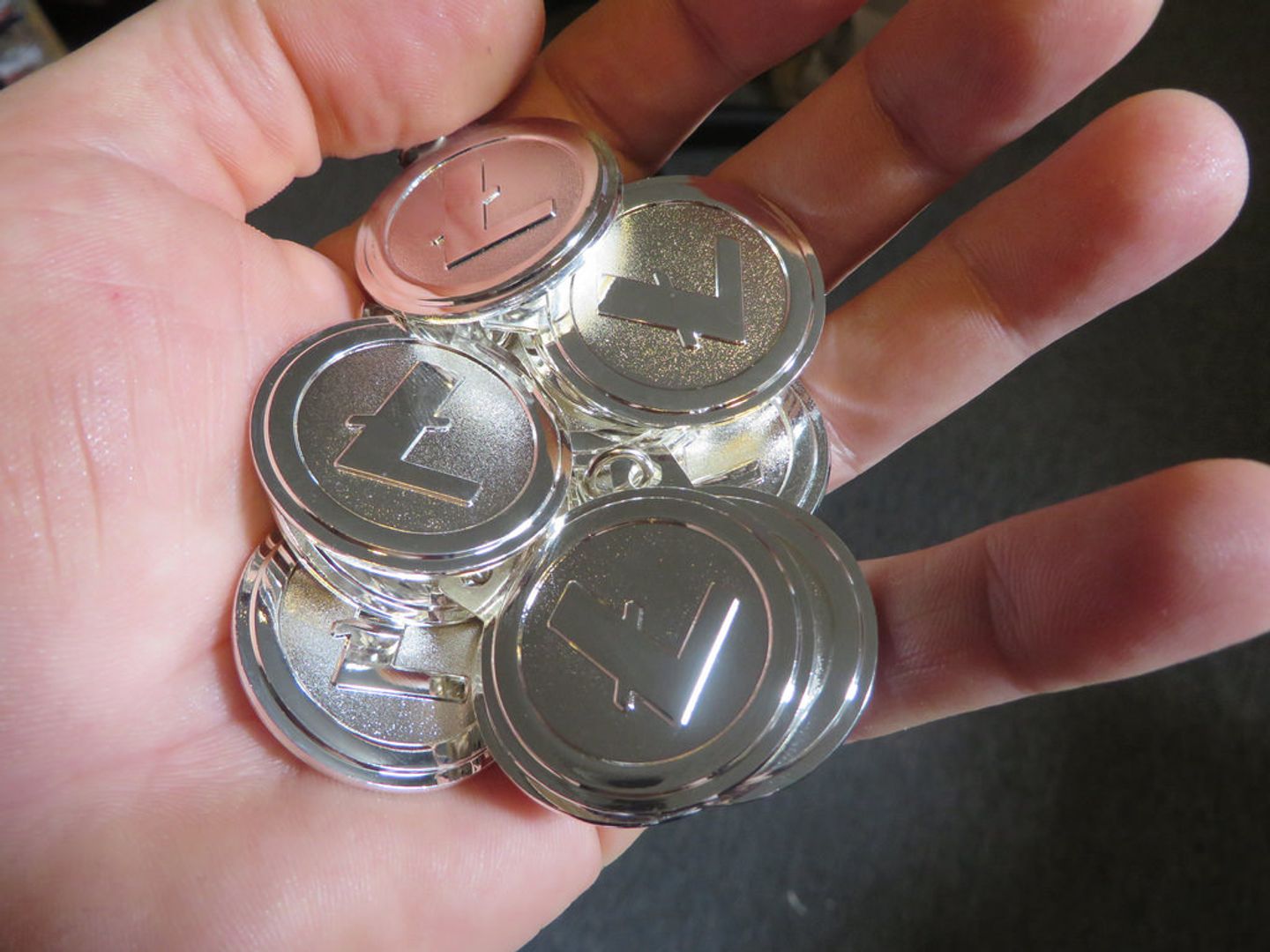
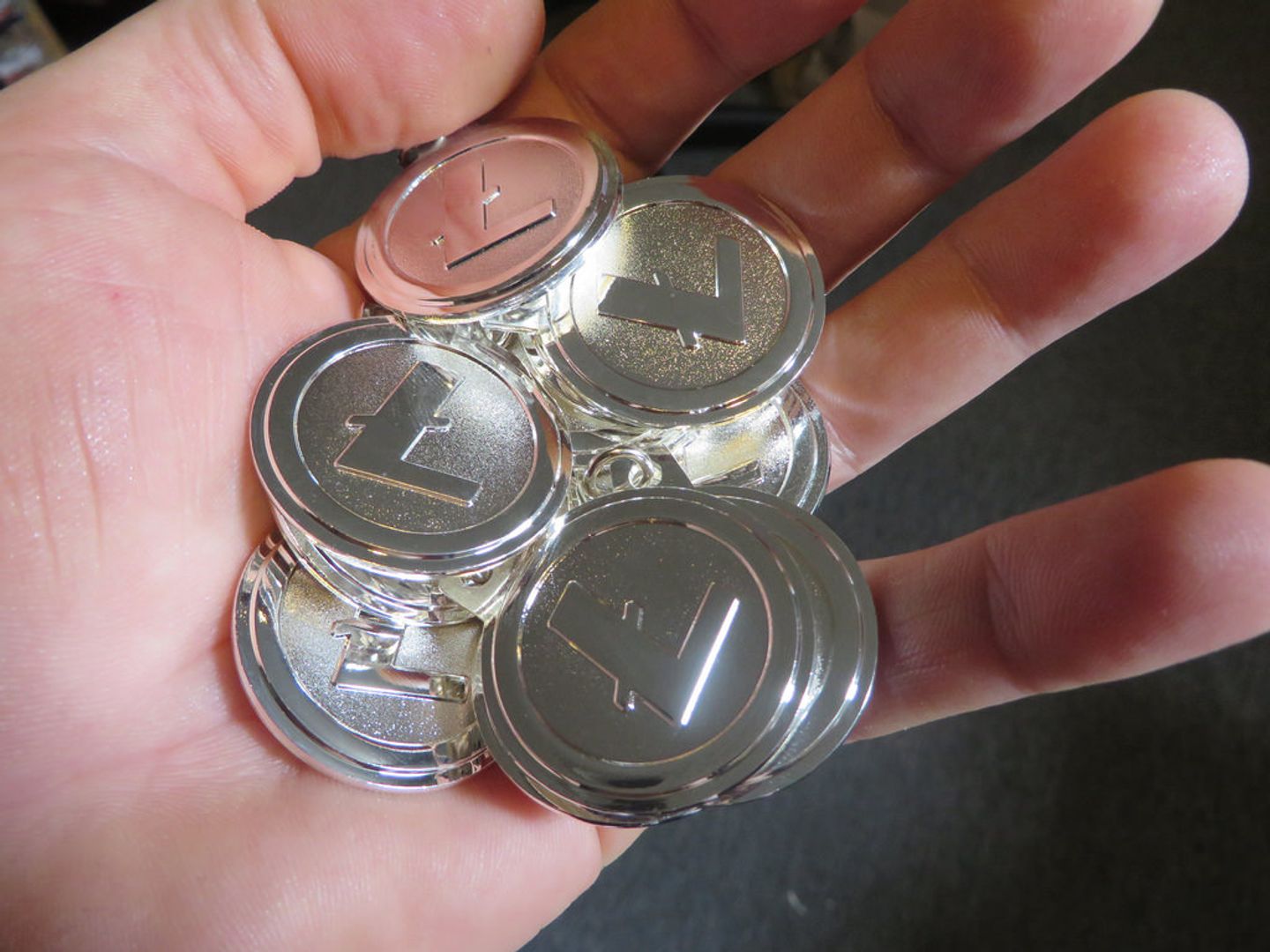
A 13-block chain reorganization on late Friday and Saturday rewound roughly 32 minutes of network activity after attackers used a vulnerability in its Mimblewimble Extension Block (MWEB) protocol.
The bug had enabled a denial-of-service attack against major mining pools, allowing the invalid MWEB transactions to slip through nodes that had not updated, before the network’s longest valid chain corrected them.
The Foundation said in Asian morning hours on Sunday the bug was fully patched and the network is operating normally.
However, prominent researchers say the litecoin-project GitHub repository tells a different story. Security researcher bbsz, who works with the SEAL911 emergency response group for crypto exploits, posted the patch timeline pulled from the public commit log.
Now that stuff has been made public on the Litecoin GitHub, we have a better sense of timeline and what happened.
In the age of Mythos, this timeline simply doesn’t fly.
The post-mortem says one zero-day caused a DoS that let an invalid MWEB tx slip through. The git log on… https://t.co/zMMrheQLPP pic.twitter.com/O3DtdwV0rF
— bbsz (@blackbigswan) April 26, 2026
The consensus vulnerability that allowed the invalid MWEB peg-out was privately patched between March 19 and March 26, roughly four weeks before the attack. A separate denial-of-service vulnerability was patched on the morning of April 25.
Both fixes were rolled into release 0.21.5.4 the same afternoon, after the attack had already begun.
“The post-mortem says one zero-day caused a DoS that let an invalid MWEB transaction slip through,” bbsz wrote. “The git log tells a slightly different story.”
A zero-day refers to a vulnerability unknown to defenders at the time of an attack.
Litecoin’s commit history shows the consensus vulnerability was known and patched privately a month before the exploit, but the fix had not been broadcast publicly or required to all mining pools.
That created a window where some miners ran the patched code while others ran the still-vulnerable version, and the attackers appear to have known which was which.
Alex Shevchenko, CTO of NEAR Foundation’s Aurora project, raised parallel concerns in a thread.
Blockchain data showed the attacker pre-funded a wallet 38 hours before the exploit through a Binance withdrawal, with the destination address already configured to swap LTC into ETH on a decentralized exchange.
The denial-of-service attack and the MWEB bug were separate components, Shevchenko argued, with the DoS designed to take patched mining nodes offline so the unpatched ones would form the chain that included the invalid transactions.
The fact that the network automatically handled the 13-block reorganization once the DoS stopped suggests enough hashrate was running updated code to eventually overpower the attack, but only after the unpatched fork had run for 32 minutes.
A hit on Litecoin shows how attacks on various networks differ in how code maintainers and developers react to exploits. Newer chains with smaller, more centralized validator sets coordinate upgrades through chat groups and can push patches network-wide in hours.
Older proof-of-work networks like Litecoin and bitcoin rely on independent mining pools choosing when to upgrade, which works for non-urgent changes but creates a window of vulnerability when a security patch needs to reach everyone before an attacker exploits the gap.
The Litecoin Foundation has not publicly addressed the GitHub timeline as of Sunday morning.
The amount of LTC pegged out during the invalid block window and the value of any swaps completed before the reorganization reversed them have not been disclosed.
TLDR:
- Arbitrum now leads all blockchains with 1,938 tokenized RWA assets and a $874.19M distributed asset value.
- BlackRock, Franklin Templeton, WisdomTree, and Robinhood have all deployed tokenized products on Arbitrum.
- The Arbitrum DAO approved STEP 2, allocating 35 million ARB tokens directly into RWA treasury instruments.
- Arbitrum’s TVL has climbed to roughly $2.5 billion, driven largely by rising real-world asset activity on-chain.
Arbitrum is experiencing a notable resurgence driven by real-world asset tokenization. The Layer 2 network now leads all blockchains with 1,938 tokenized RWA assets.
Its total distributed asset value stands at $874.19 million. With stablecoin supply exceeding $7.24 billion and 30-day transfer volume near $345 million, the network draws renewed attention.
Major traditional finance institutions are actively building on the platform, bringing institutional capital the broader crypto market has long needed.
Major TradFi Players Choose Arbitrum for Tokenized Asset Deployment
BlackRock has integrated its $BUIDL tokenized Treasury yield product on Arbitrum through Securitize. Franklin Templeton also launched its Onchain US Government Money Fund via the Benji platform on Arbitrum.
These moves mark a clear shift toward regulated, yield-bearing instruments on decentralized infrastructure.
WisdomTree is tokenizing 13 investment funds on the network. Spiko leads EU and US T-bill tokenization on Arbitrum, with assets surpassing $467 million.
Robinhood is also tokenizing roughly 2,000 US stocks and ETFs on the platform for European investors. These instruments are accessible 24 hours a day, which traditional markets currently cannot offer.
Projects like Ondo Finance and private credit platforms such as Libre and Centrifuge have also chosen Arbitrum. They point to low transaction fees, high processing speed, and EVM compatibility as primary reasons.
The network’s composability with DeFi protocols for lending and yield farming further strengthens its appeal to builders.
According to crypto analyst @Karamata2_2, Arbitrum’s RWA activity is delivering actual value and sustainable liquidity to the ecosystem.
RWA holders on the network have now reached 6,596, reflecting steady growth across multiple asset classes. The 30-day transfer volume of approximately $345 million adds further evidence of growing on-chain economic activity.
These numbers also show that institutional adoption on Arbitrum is moving beyond early-stage experimentation.
Arbitrum DAO Directs 35 Million ARB Tokens Into RWA Treasury Strategy
The Arbitrum DAO approved the STEP 2 proposal, directing 35 million ARB tokens into RWA treasuries. This governance decision reflects growing confidence in tokenized real-world assets as a long-term growth driver. It also aligns the DAO’s treasury strategy with broader institutional trends in the tokenized asset market.
RWA-driven activity has pushed Arbitrum’s total value locked to approximately $2.5 billion. Higher liquidity on the network directly translates to increased gas fee revenue for the DAO.
That revenue, in turn, funds ongoing ecosystem development and provides structural support for the ARB token.
The network’s fee structure and EVM compatibility continue to attract a wide range of participants. Platforms built around real-world assets benefit from Arbitrum’s integration with existing lending and yield-farming products. This layered composability creates functional utility that other networks have found difficult to replicate.
The emerging cycle on Arbitrum links liquidity growth directly to DAO revenue and token stability. More on-chain activity generates higher fees, which fund further development and attract additional participants.
This structure positions Arbitrum as a growing destination for institutional-grade tokenized assets in the near term.


Evan Tangeman, a 22-year-old California resident, has been sentenced to 70 months in prison for his role in a crypto theft group.
Summary
- Evan Tangeman received 70 months in prison for helping launder stolen crypto funds for criminals.
- The group stole about $263 million through social engineering scams, burglary, and other coordinated attacks.
- Prosecutors said stolen funds paid for Lamborghinis, Rolexes, real estate, and large nightclub bills, too.
The group stole about $263 million from victims through social engineering scams and burglary.
Tangeman pleaded guilty in December 2025. According to the U.S. Department of Justice, he admitted that he helped members of the group launder at least $3.5 million in stolen funds.
DOJ says group spent stolen funds on luxury assets
The DOJ said the criminal group used stolen crypto to fund a costly lifestyle. Prosecutors said members spent money on real estate, luxury cars, Rolex watches, and large nightclub bills.
U.S. Attorney Jeanine Pirro said the group showed extreme greed. She stated, “They stole millions, spent it on half-million-dollar nightclub tabs, Lamborghinis, and Rolexes.”
Moreover, Tangeman also received three years of supervised release after his prison term. Prosecutors said his conduct went beyond laundering stolen money for the group.
Pirro said Tangeman tried to destroy evidence after other members of the group were arrested. She said, “That is consciousness of guilt,” adding that the court treated the conduct seriously.
Crypto crime cases rise in 2026
The sentencing comes as crypto scam and hack losses reached $482 million in the first quarter of 2026. Authorities have warned that criminal groups continue to target crypto users through online scams and physical attacks.
France has also reported a rise in violent attacks against crypto holders. Telegram co-founder Pavel Durov claimed there were 41 kidnappings of French crypto holders in the first quarter of 2026 alone.


Litecoin suffered a deep chain reorganization on Saturday after attackers exploited a zero-day bug tied to its MimbleWimble Extension Block privacy layer, according to the Litecoin Foundation.
Summary
- Litecoin reversed 13 blocks after attackers exploited a zero-day bug in its MWEB privacy layer.
- Attackers used the fork window to attempt double-spends against several cross-chain swap protocols.
- The Litecoin Foundation said the bug has been patched, while some venues reported losses.
The Foundation said the bug allowed older mining nodes to accept an invalid MWEB transaction. This created a fork that lasted more than three hours before the network restored the main chain.
Invalid transactions erased from chain history
The incident affected blocks 3,095,930 to 3,095,943, according to Aurora Labs CEO Alex Shevchenko. He described the event as a “coordinated attack” in a post on X.
A 13-block reorganization removed the invalid transactions from Litecoin’s main history. The Foundation said valid transactions made during that period remained unaffected.
Moreover, attackers used the fork window to attempt double-spend transactions against cross-chain swap protocols. These platforms had accepted MWEB peg-outs that later became invalid after the reorganization.
Shevchenko said, “The exposure for NEAR Intents is around $600k.” He also warned trading venues to review Litecoin transactions and balances, adding, “We see a lot of double spend transactions.”
Foundation says bug is patched
The Litecoin Foundation said the zero-day bug has now been fully patched. It did not name the affected mining pools or disclose how much LTC the invalid transactions attempted to create.
The attack marks the first known major exploit targeting MWEB since Litecoin activated the privacy feature in May 2022. LTC traded near $56 after the disclosure, down about 1% on the day.
Key Takeaways
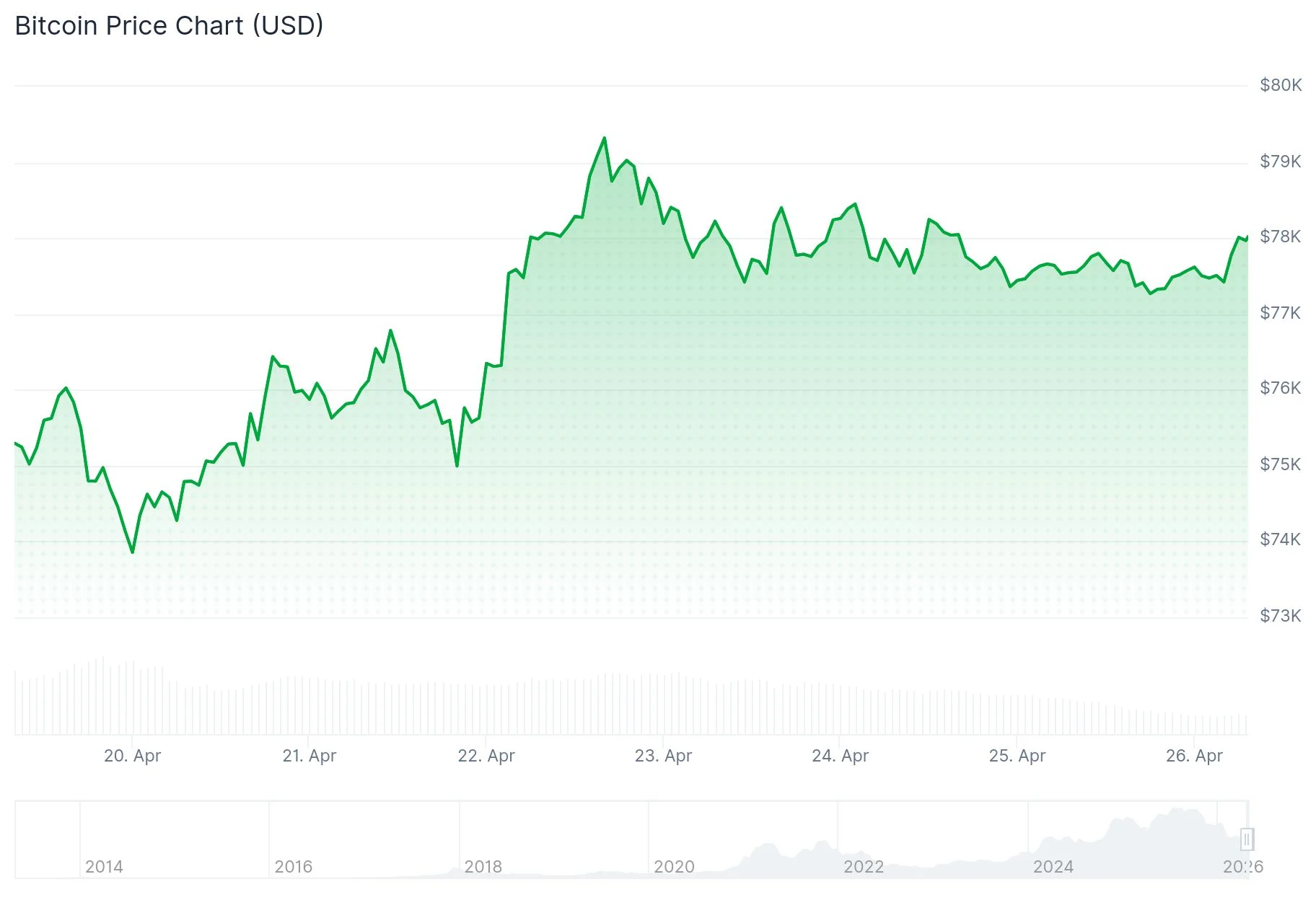
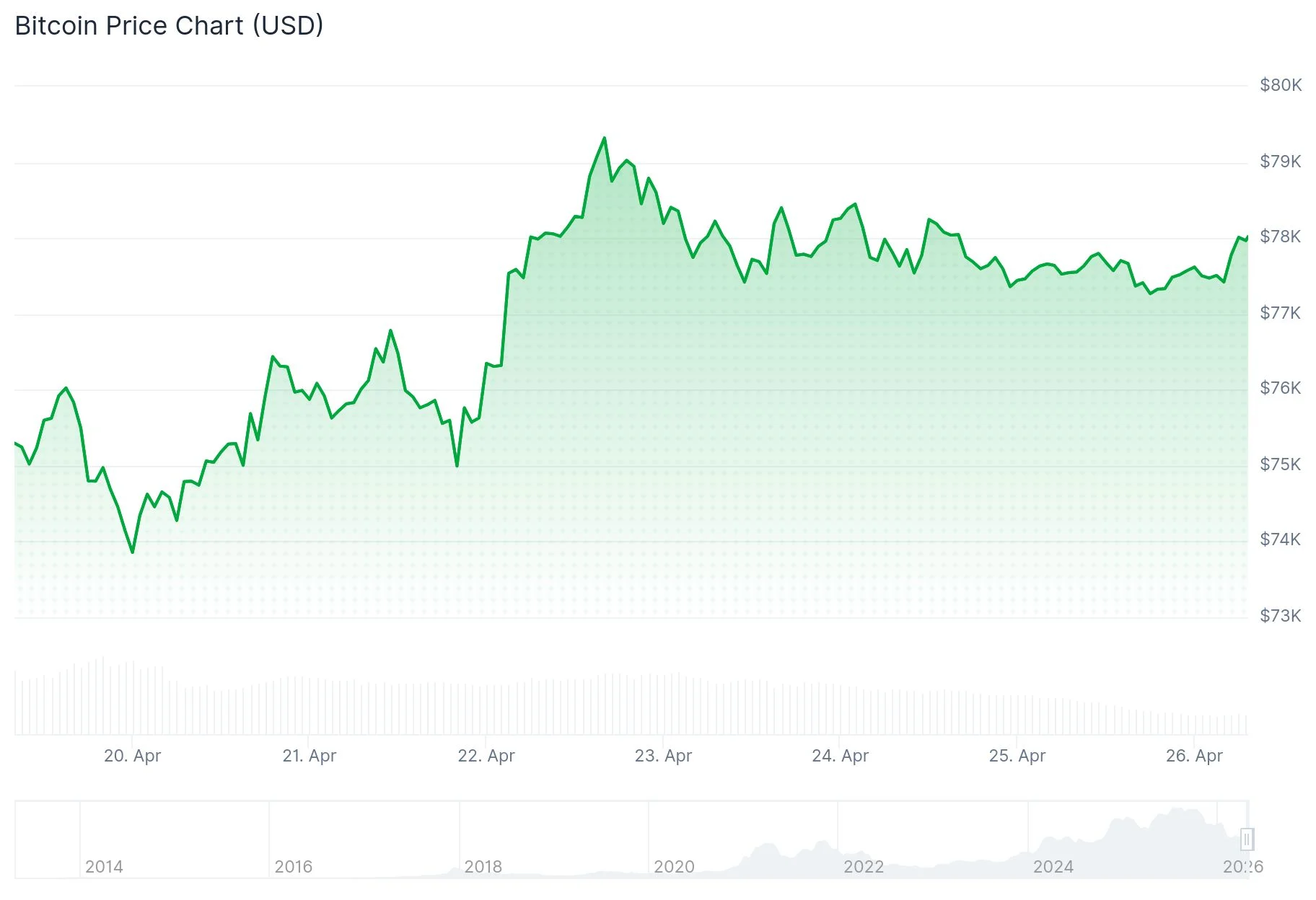
- BTC declined beneath $78,000 following Trump’s decision to cancel a diplomatic envoy mission to Pakistan aimed at Iranian peace negotiations
- The leading cryptocurrency hovered around $77,200, experiencing a roughly 40% decline in 24-hour trading volume to approximately $18 billion
- Spot Bitcoin ETF products attracted $2.12 billion in capital during a consecutive nine-day period ending April 24
- BlackRock’s IBIT options open interest climbed to $27.61 billion, overtaking Deribit’s $26.90 billion position
- Market analyst Ted Pillows identified $76,000–$77,000 as critical support territory, with $80,000 representing the subsequent resistance threshold
Bitcoin tumbled beneath the $78,000 threshold on April 25 following President Donald Trump’s announcement that he canceled a scheduled diplomatic journey by U.S. representatives Steve Witkoff and Jared Kushner to Pakistan. The mission was designed to advance peace discussions with Iranian government officials. Trump stated the 18-hour journey wasn’t justified and instructed Iran to contact the United States if negotiations were desired.
Iran’s top diplomat, Abbas Araghchi, had already departed Pakistan prior to the announcement of the cancellation. This development introduced additional uncertainty regarding the timeline for resuming diplomatic discussions. Trump verified the cancellation via Truth Social, pointing to disorganization among Iran’s governing authorities.
BTC retreated from approximately $78,000 to the $77,200 range after the announcement. Twenty-four-hour trading activity contracted by roughly 40% to around $18 billion. Notwithstanding the daily decline, Bitcoin has maintained approximately 10% gains across the previous month.
Cryptocurrency market analyst Ted Pillows shared on X that BTC continues to maintain position above critical support territory. He indicated that sustained holding above the $76,000–$77,000 range could enable Bitcoin to attempt another push toward $80,000. He cautioned that breaching this support zone might trigger a more substantial price correction.
Trump clarified to Axios that the abandoned diplomatic mission doesn’t indicate U.S. intentions to restart military conflict with Iran. The ceasefire agreement, initially scheduled to conclude on April 22, has received an indefinite extension. Trump stated it would remain active until Iran delivers a coherent negotiating position.
The United States additionally froze $344 million in USDT associated with Iranian entities and continues enforcing a blockade at the Strait of Hormuz. According to Trump, Iran sustains approximately $500 million in daily losses because of this enforcement action.
Bitcoin ETF Products Record Sustained Inflow Pattern
Spot Bitcoin ETF vehicles registered nine consecutive sessions of positive net capital flows spanning April 14 through April 24, accumulating $2.12 billion in total. The most robust individual session occurred on April 17, attracting $663.91 million. BlackRock’s IBIT dominated during the quietest day on Friday, capturing $22.88 million in inflows.
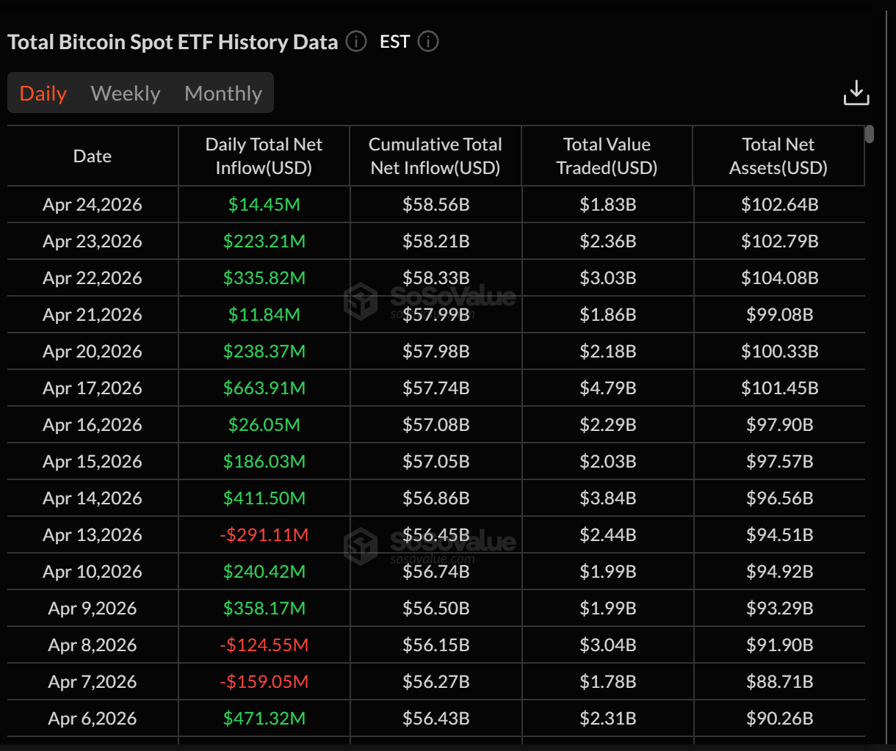
Aggregate net capital inflows for spot Bitcoin ETF products have now accumulated to $58.23 billion. ETF specialist Nate Geraci observed on X that market participants continue accumulating positions despite BTC trading approximately 35% beneath its record peak, characterizing them as “longer-term allocators.”
IBIT Options Eclipse Deribit in Market Position
BlackRock’s IBIT options open interest on the Nasdaq platform reached $27.61 billion on Friday, marginally exceeding Deribit’s $26.90 billion in Bitcoin options contracts. IBIT debuted merely two years ago, whereas Deribit has maintained operations since 2016.
Call option positioning within IBIT suggests market expectations for BTC to approach approximately $109,709 in the near term. Deribit’s positioning reflects slightly more measured expectations, targeting the $106,000 vicinity.
BTC was exchanging hands at roughly $77,516 when this analysis was conducted, based on CoinMarketCap data.
Crypto World
President Trump Evacuated After Shooting Incident at White House Correspondents’ Dinner
Key Points
- Multiple gunshots erupted at the annual White House Correspondents’ Dinner held at Washington’s Hilton Hotel on Saturday evening
- Both President Trump and Vice President JD Vance were safely evacuated from the premises without injury
- One Secret Service agent sustained gunshot wounds but was protected by body armor
- Cole Tomas Allen, a 31-year-old resident of Torrance, California, has been apprehended and admitted to authorities his intent was to target administration officials
- The annual gala has been postponed and Trump announced plans to reschedule within one month
A violent incident unfolded Saturday night when gunfire broke out at the prestigious White House Correspondents’ Dinner in the nation’s capital. Secret Service personnel immediately evacuated President Donald Trump from the Washington Hilton venue.
[[EMBED_0]]
The attack occurred approximately 8:35pm Eastern Time at the historic Washington Hilton. Gunshots rang out near a security screening area in the hotel’s lobby, outside the main ballroom hosting the formal dinner.
The President had been sitting at the head table alongside First Lady Melania Trump when agents swarmed the venue. Within 120 seconds, the entire presidential table had been cleared.
[[EMBED_1]]
Vice President JD Vance attended the gathering and was also successfully evacuated. Other high-ranking officials including Defense Secretary Pete Hegseth and Secretary of State Marco Rubio were rushed out through alternative emergency routes.
A Secret Service agent suffered gunshot injuries at point-blank range. Thanks to protective ballistic vest equipment, medical personnel expect a complete recovery.
Authorities Identify Shooter
Law enforcement has named the assailant as Cole Tomas Allen, age 31, originally from Torrance, California. Secret Service agents overpowered and detained him at the location. According to CBS News reporting, Allen confessed to investigators that his targets were Trump administration personnel.
[[EMBED_2]]
Allen carried several firearms, Trump later disclosed. Federal Bureau of Investigation teams alongside local police are currently executing a search warrant at a residence in Torrance, California. Formal criminal charges are anticipated to be filed during Monday’s court proceedings.
CNN’s Wolf Blitzer had stepped away from the ballroom and was positioned near the lobby area when the shooting began. A law enforcement officer forced him to the floor for protection before escorting him to safety. Blitzer later reported witnessing multiple officers subduing the armed individual.
Approximately 2,600 attendees had gathered for the annual event. Many guests took cover beneath dining tables as gunshots echoed through the area. National Guard troops and additional law enforcement personnel surrounded the hotel perimeter while helicopters provided aerial surveillance.
President’s Statement Following Incident
Trump conducted an unscheduled media briefing from the White House’s James Brady Press Room just after 10:30pm. Still dressed in formal evening attire, he appeared alongside FBI Director Kash Patel and Homeland Security Secretary Markwayne Mullin.
The President described initially mistaking the gunfire for dropped dinnerware before recognizing the true nature of the sounds. He commended Secret Service personnel for their rapid protective response.
Via Truth Social, Trump revealed he had suggested continuing the dinner program but deferred to law enforcement recommendations. Officials ultimately decided to cancel the remainder of the evening.
Trump announced the postponed dinner would reconvene within the next 30 days. White House Correspondents’ Association president Weijia Jiang verified all attendees remained unharmed and confirmed rescheduling plans.
The Washington Hilton holds historical significance as the location where President Ronald Reagan survived an assassination attempt in 1981.
TLDR:
- RLUSD now moves across XRPL, Ethereum, and Cardano using Wanchain bridge infrastructure
- European banks plan a euro stablecoin using Ripple tech, expanding institutional blockchain use
- Ripple upgraded custody services with compliance tools and staking for institutional clients
- RLUSD adoption grows through pilots in payments, settlements, and multi-chain DeFi access
Ripple’s RLUSD stablecoin continues to expand its reach as new infrastructure and institutional developments reshape its role in digital finance.
Recent updates show progress in cross-chain access, banking collaborations, and custody services, positioning RLUSD within evolving global payment networks.
Cross-chain expansion strengthens RLUSD accessibility
RLUSD’s latest development centers on its integration with Wanchain’s bridge infrastructure. This upgrade allows
transfers between the XRP Ledger, Ethereum, Cardano, and Wanchain. As a result, users can move RLUSD without relying on centralized exchanges.
A recent tweet from CoinDesk reported that Wanchain added support for Ripple’s RLUSD stablecoin. The post noted that the bridge enables transfers across major blockchain networks. This update confirms RLUSD’s growing presence in multi-chain environments.
The bridge supports two-way transfers, which improves liquidity movement between networks. Users can send RLUSD from the XRP Ledger to Cardano or from Ethereum to Cardano. They can also reverse these transactions with minimal friction.
This setup reduces dependency on wrapped assets and intermediaries. Instead, RLUSD operates across ecosystems in a more direct manner. As liquidity moves freely, trading and decentralized finance activity may become more efficient.
Wanchain acts as a central hub connecting these blockchains. Through this role, it simplifies how assets move between networks. Therefore, RLUSD becomes easier to access for users operating on different chains.
The stablecoin currently holds a market capitalization of about $1.5 billion. Around 382 million tokens circulate on the XRP Ledger. Meanwhile, a larger share remains active on Ethereum, supporting its broader use.
Institutional adoption and infrastructure upgrades progress
Beyond technical integration, RLUSD is gaining traction among financial institutions. European banks are preparing to launch a euro-backed stablecoin using Ripple’s technology. ING, UniCredit, and BNP Paribas plan to release it in late 2026.
This initiative focuses on regulated digital payments within the eurozone. It also introduces competition to dollar-based stablecoins. Ripple’s infrastructure will support settlement and transaction processing for the project.
At the same time, Ripple has upgraded its custody platform. The update includes real-time compliance monitoring and cloud-based security systems. These features aim to meet institutional requirements for digital asset management.
The platform also introduces staking capabilities. This addition provides institutions with more flexibility when managing digital assets. As a result, RLUSD becomes easier to integrate into treasury operations.
Institutional use cases are already being tested in real-world scenarios. RLUSD is part of pilot programs for real-time settlements with partners like Kyobo Life Insurance. It is also being explored for credit card settlement processes with Mastercard.
These developments align with Ripple’s broader multichain strategy. RLUSD is also undergoing testing on Ethereum Layer-2 networks such as Base, Optimism, and Ink. These efforts expand its potential use across scaling solutions.
As RLUSD moves across networks and gains institutional support, its role in payments and finance continues to evolve. Its presence across multiple chains and systems reflects ongoing efforts to increase utility and access.
Crypto World
Best Crypto Presale 2026: Will Pepeto’s $9.45M Beat Bitcoin Hyper and LiquidChain to the Finish Line?
The best crypto presale of 2026 matters more than ever this week after Bitcoin tested $80,000, spot Bitcoin ETFs pulled in over $1.9 billion across recent sessions, and Morgan Stanley’s new MSBT fund cleared $100 million in its debut week per CoinDesk. That kind of institutional sweep tells experienced buyers one thing: the window to enter early-stage projects before they list is closing fast.
Presales are simple. A buyer commits capital before trading starts, receives tokens at a fixed price, and locks in a gap between that entry and whatever the order book prints on listing day. That gap is where every meme coin fortune in crypto history was built, and the presale this cycle carrying the widest gap with real utility behind it is Pepeto with $9.45 million raised.
Best Crypto Presale Picks as Morgan Stanley Enters and Bitcoin ETFs Cross $1.9B in Weekly Inflow
CoinDesk confirmed Morgan Stanley’s MSBT fund gathered over $100 million in its debut week, BlackRock’s IBIT keeps leading weekly tallies, and cumulative spot Bitcoin ETF inflows have passed $57 billion. That flow lifts the entire category.
When this much regulated capital lands on Bitcoin, experienced traders rotate a portion into early-stage projects that ride the same tailwind. The best crypto presale route is the one capturing that rotation. Three names define the shortlist right now, and only one combines live products, brand reach, and an approaching listing.
Pepeto (PEPETO) Price at $0.0000001866 as $9.45M Presale Nears Binance Listing
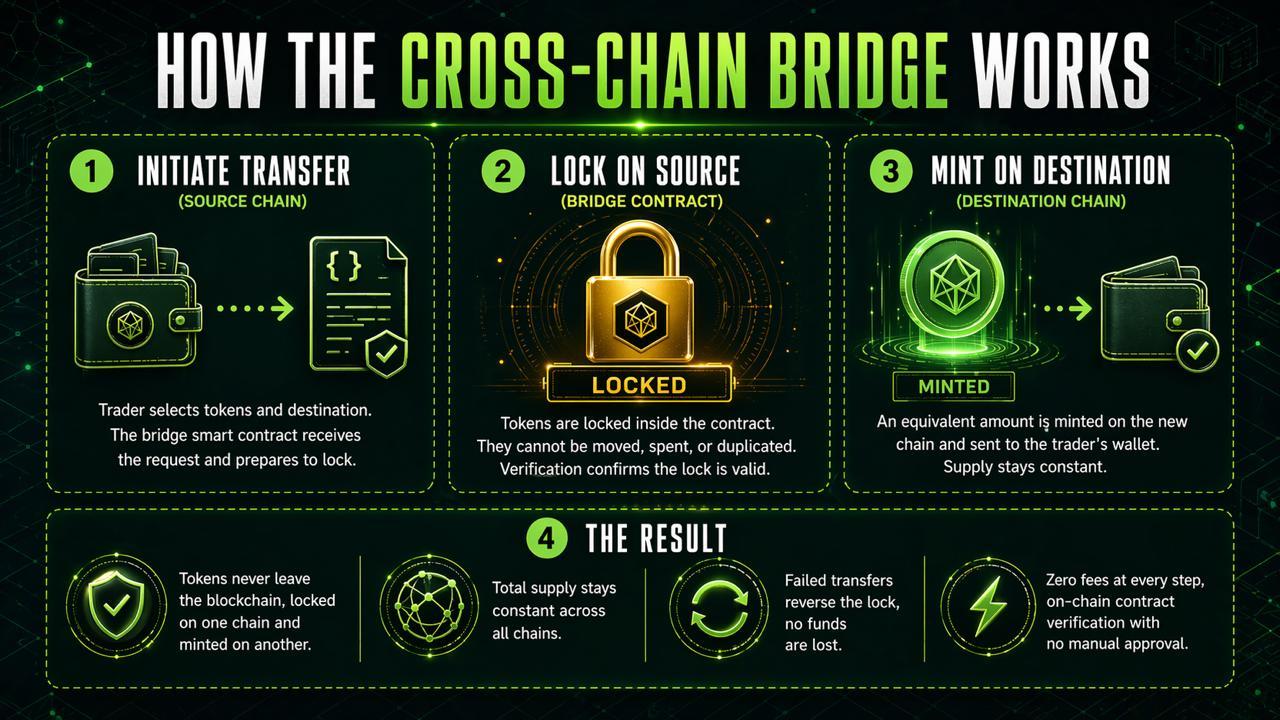
Pepeto, considered the best crypto presale, leads the field by any reading that matters. The zero-fee PepetoSwap exchange is live, the cross-chain bridge moves funds across Ethereum, BNB Chain, and Solana at no cost, and the AI scanner reads token contracts for buried risks before a wallet signs.
SolidProof audited every contract and the Pepe cofounder who took the original meme to a $7 billion cap leads the project alongside a former Binance executive.
Over $9.45 million has entered during fear, 178% APY staking compounds before the first trade opens, and the approaching Binance listing turns the $0.0000001866 entry into a number that disappears on day one.
Analysts map 50x to 150x once the order book opens. Every crypto enthusiast reading the meme tape right now knows the name.
Bitcoin Hyper (HYPER) Price at $0.0136789 as Layer 2 Raise Crosses $32M
Bitcoin Hyper trades at $0.0136789 with over $32.4 million raised per ICOBench. The project is building a Bitcoin Layer 2 powered by the Solana Virtual Machine, targeting faster BTC transactions and lower fees.
Mainnet still points to Q3 2026 with no firm listing date set, and the presale end has shifted multiple times. Staking pays 36% APY, solid for the category, but the core innovation sits in a crowded Layer 2 space where execution timing is the risk. The case against Bitcoin Hyper is simple: promise without a live product. Pepeto already runs the tools HYPER is still building.
LiquidChain (LIQUID) Price at $0.01451 as Layer 3 Raise Nears $700K
LiquidChain trades at $0.01451 per CoinGabbar with around $690,000 raised across 56 stages. The pitch is a Layer 3 that unifies Bitcoin, Ethereum, and Solana liquidity into one execution layer.
CertiK and SpyWolf audits clear the contract, 1,575% staking APY sits on the page, and CEX listings target Q3 2026. The concept is ambitious, but the traction is early. Under $700,000 raised in a market where Pepeto is clearing $9.45 million shows where crypto attention actually sits, and the answer comes back to reach. LiquidChain is still proving the product-market fit Pepeto has already demonstrated through raise size alone.
Conclusion
Wallets that bought Dogecoin at $0.002 while the market called it a joke walked away with life-changing bags, and the tape repeating right now is the one that preceded every past meme coin explosion. Spot Bitcoin ETFs at $1.9 billion in recent inflows, Morgan Stanley entering with MSBT, and BTC testing $80,000 is the institutional tape that lights up every altcoin rotation.
Pepeto sits inside that rotation as the best crypto presale with a live exchange, a zero-fee bridge, and 178% APY staking. The approaching Binance listing closes this entry forever. Rounds fill faster with each stage, and when capital rotates, $0.0000001866 on the Pepeto site today becomes the price you will wish you had bought at. Lock the entry before it is gone.
Click To Visit Pepeto Website To Enter The Presale

FAQs
What is the best crypto presale to buy right now?
Pepeto is the best crypto presale with $9.45 million raised, 178% APY staking, a SolidProof audit, a live zero-fee exchange, and an approaching Binance listing. The original Pepe cofounder and a former Binance executive lead the build, which no other presale this cycle matches.
Why is Pepeto the best crypto presale over Bitcoin Hyper and LiquidChain?
Pepeto is the strongest pick because it ships a live exchange, a cross-chain bridge, and an AI scanner today, while Bitcoin Hyper and LiquidChain are still building toward Q3 2026 targets. Pepeto raised $9.45 million inside a short window versus Bitcoin Hyper’s $32 million across a longer one and LiquidChain’s $690,000, and only Pepeto carries brand reach through the original Pepe cofounder.
Disclaimer: This is a Press Release provided by a third party who is responsible for the content. Please conduct your own research before taking any action based on the content.
The pepeto price prediction gets sharper this week after Bitcoin tested $80,000 before slipping on oil-linked risk, while more than 100 crypto firms pressed the U.S. Senate to move on the market structure bill per CoinDesk. That pairing of price discovery and Washington pressure is the exact backdrop every past cycle used as its launch pad.
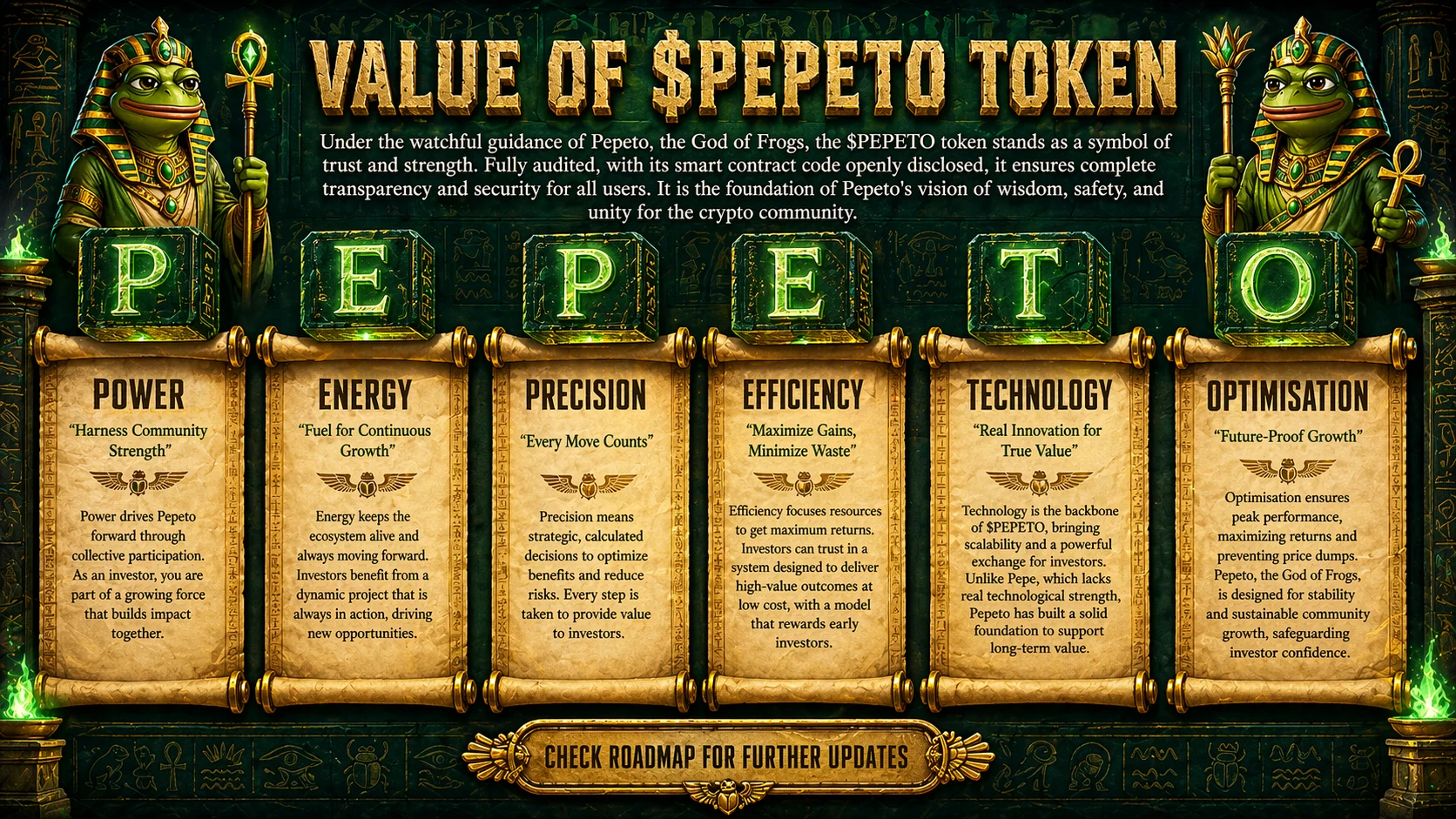
Over a hundred firms signing one Senate letter is not lobbying theater. It is institutional capital demanding a clean legal runway before the next inflow wave lands, and Pepeto enters this window with $9.45 million raised, 178% APY staking live, and the exchange infrastructure the letter is built to protect.
Pepeto Price Prediction Strengthens as Senate Crypto Push Meets the $80K Bitcoin Test
CoinDesk reports the Senate letter names clear demands: defined SEC and CFTC roles, protection for non-custodial developers, cleaner disclosure rules, and no state-by-state legal patchwork.
That direction favors projects sitting on real tools, not promises. Bitcoin pulling back from $80,000 as oil spiked is the short-term tape, but the bigger signal behind every serious pepeto price prediction is regulated liquidity preparing to re-enter crypto at scale. The Fear and Greed Index reads 46 per Blockchain Magazine, the sentiment zone where the largest multiples are quietly earned.
What the Capital Flow Data Reveals About This Window
Extreme sentiment swings are where early wallets lock in the cheapest entries of every cycle, and Pepeto is drawing more capital than any presale in this window because no other token combines the original Pepe cofounder, a former Binance executive, a SolidProof audit, and an approaching Binance listing inside one offering.
The approaching listing turns the numbers below into math, not hope. The gap between the $0.0000001866 presale cost and whatever candle the order book prints on day one is permanent, and once trading opens, that ground floor entry disappears.
Pepeto runs a zero-fee exchange built by a former Binance lead alongside the cofounder who took Pepe to a $7 billion cap on pure meme energy. The AI scanner reads every token contract for buried risks before a trade settles, the cross-chain bridge moves funds across Ethereum, BNB Chain, and Solana at no cost, and 178% APY staking is already live before the first candle prints.
Pepeto Price Prediction 2026 to 2030: Catalysts, Listing Math, and the BNB Parallel
Every strong pepeto price prediction rests on three catalysts. First, the approaching Binance listing compresses presale-to-exchange returns into a single event. Second, PepetoSwap, the zero-fee engine that gives the token its own revenue rails the moment markets open. Third, the exchange-token parallel with BNB, because Pepeto is structurally the same kind of utility asset, the native gas of its own trading venue.
BNB started at $0.15 in its 2017 launch and later printed $858, a climb that carried the market cap past $124 billion. Pepeto enters that category with a live exchange, audited contracts, and 420 trillion tokens. The setup repeats the pattern that made BNB the most rewarded exchange coin in crypto history.
| Year | Target | Pepeto Price | Return from $0.0000001866 |
| 2026 post listing | 50x | $0.0000093 | 50x |
| 2028 cycle peak | 100x | $0.0000187 | 100x |
| 2030 BNB parallel | 500x | $0.0000933 | 500x |
The 2026 target is conservative measured against how prior meme coins moved at listing. The 2028 window lines up with the next full crypto cycle, and 100x is the middle estimate analysts attach to projects that fuse utility with brand. The 2030 number reads ambitious until you remember BNB itself returned over 5,700x from its ICO, which frames 500x across six years as the measured reading of the same thesis.
Conclusion
The pepeto price prediction picture is clear. Bitcoin is testing $80,000, the Senate is moving the market structure bill forward, and this presale keeps pulling capital round after round. The Pepe cofounder’s reach, a live zero-fee exchange, and an approaching Binance listing is the setup that shows up once and never comes back.
The Pepeto site still shows $0.0000001866, and that is the number every future BNB-style chart will be measured against. Buying today locks it in. Waiting turns it into the price you will stare at and wish you had taken the moment the listing bell rings and the order book wipes it out forever.
Click To Visit Pepeto Website To Enter The Presale

FAQs
What is the pepeto price prediction for 2026, 2028, and 2030?
Pepeto targets 50x in 2026 after the approaching Binance listing, 100x by 2028 at the next cycle peak, and 500x by 2030 aligned with BNB’s exchange-token path. Each milestone anchors to the $0.0000001866 presale price, the live PepetoSwap engine, and 178% APY staking already compressing supply.
Why is Pepeto the presale analysts are pricing against BNB right now?
Pepeto is priced against BNB because it runs the same kind of exchange utility BNB carries, and it pairs that utility with meme energy through the original Pepe cofounder plus a former Binance executive. The SolidProof audit, $9.45 million raised during extreme fear, and 178% APY staking match the structural setup BNB showed before its breakout.
Disclaimer: This is a Press Release provided by a third party who is responsible for the content. Please conduct your own research before taking any action based on the content.
Crypto World
Best Crypto To Invest In 2026: Can Pepeto Outrun Chainlink and Sui After Bridgetower Brings $11B On-Chain?
The best crypto to invest in conversation just shifted after Bridgetower sealed a partnership with Chainlink on April 23 to tokenize the $11 billion DOM X Arizona Copper-Gold Project, pushing roughly $25 billion of American natural resources, energy, and metals onto the blockchain through Chainlink’s infrastructure.
But the winning play is not the oracle token already priced for that flow. A presale going viral across crypto communities sits at a fraction of a cent, builds the exchange rails every tokenized asset will need, and the entry stays open only until the Binance listing opens.
Bridgetower Taps Chainlink to Bring $25 Billion of US Resources Onchain
Bridgetower partnered with Chainlink on April 23 to tokenize the $11 billion DOM X Arizona Copper-Gold Project, tapping the oracle network for data feeds, compliance rails, and cross-chain coordination, as reported by PRNewswire.
The broader plan targets $25 billion of US natural resources and metals on-chain, following last week’s OpenAssets deal where Chainlink was picked to power institutional tokenization across ICE, Tether, Fanatics, and Mysten Labs.
The best crypto to invest in sits exactly where this capital rotation begins. When the infrastructure name captures billions, the presale building similar tools at presale pricing becomes the asymmetric trade the open market has not priced yet.
Three Tokens Set to Move Before the Next Cycle Rewards the Wallets That Entered First
Pepeto Price at $0.0000001866 as $9.45M Raised Signals Informed Capital Already Locked In
Pepeto, considered the best crypto to invest in, is where wallets rushing in during this stretch know exactly what they are looking at. A full exchange is being built before a single coin touches public trading, a Pepe cofounder leads alongside a senior Binance executive, and SolidProof audited every line of code. That alone separates the project from every meme token running on hype.
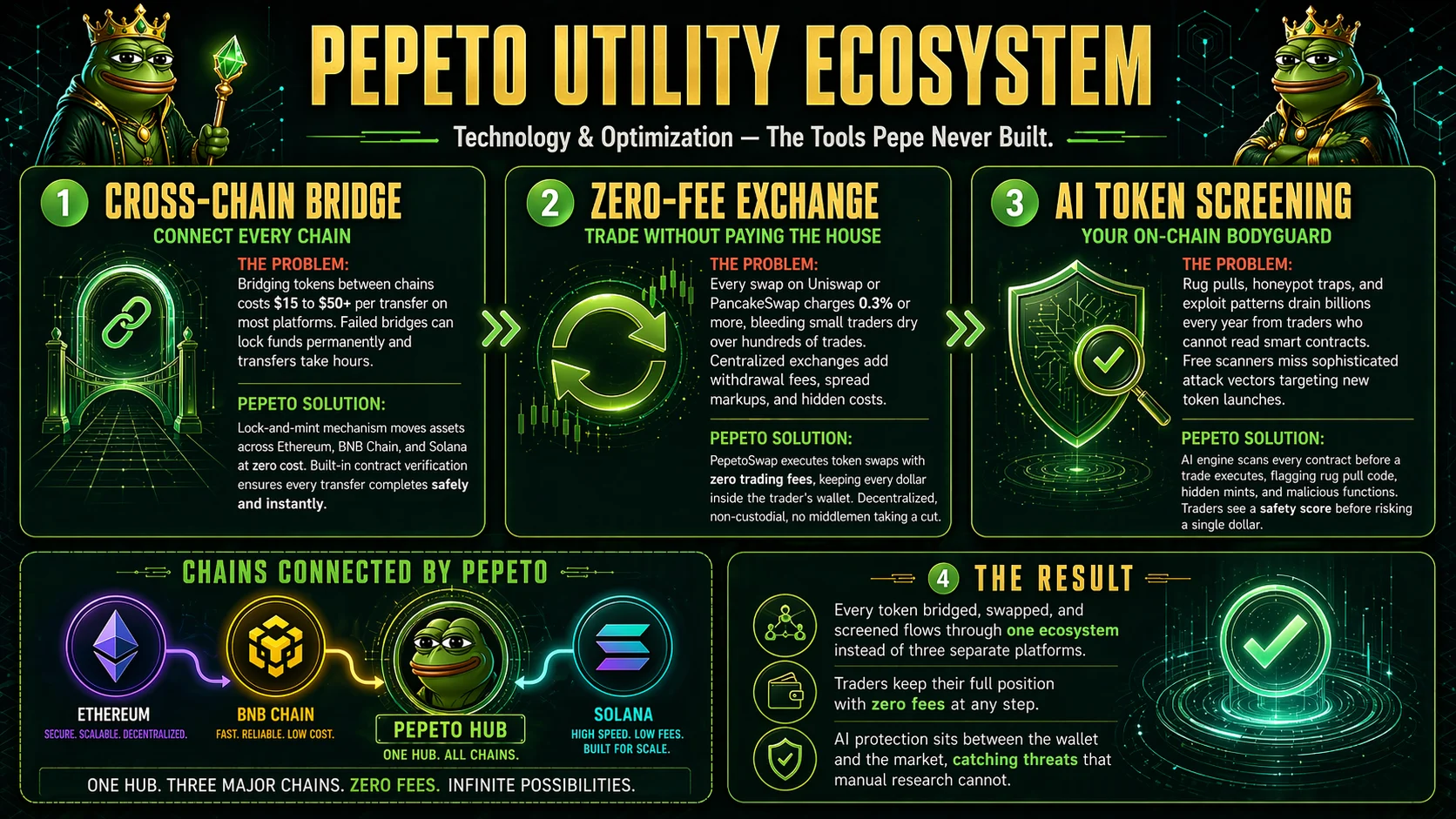
PepetoSwap handles trades at zero fees, the bridge moves tokens across Ethereum, BNB Chain, and Solana without gas, and the AI contract scanner checks every token before capital goes near it. More than $9.45 million has flowed into the presale at $0.0000001866 per token, and holders staking at 178% APY pull supply off the open market every day.
A $10,000 position at 178% APY earns $17,800 per year, roughly $1,483 compounding every month. The CoinMarketCap preview page is live, the Binance listing is approaching, and analysts place Pepeto at 100x once exchange trading opens.
Chainlink (LINK) Price at $9.32 as $11B Bridgetower Deal Extends RWA Lead
Chainlink (LINK) trades at $9.32 per CoinMarketCap, down 1.76% in 24 hours with daily volume near $541 million even as the Bridgetower deal stacks onto a growing list of institutional integrations. Support holds at $8.50 and resistance sits at $9.50, with a clean break opening the $10.50 to $12 range.
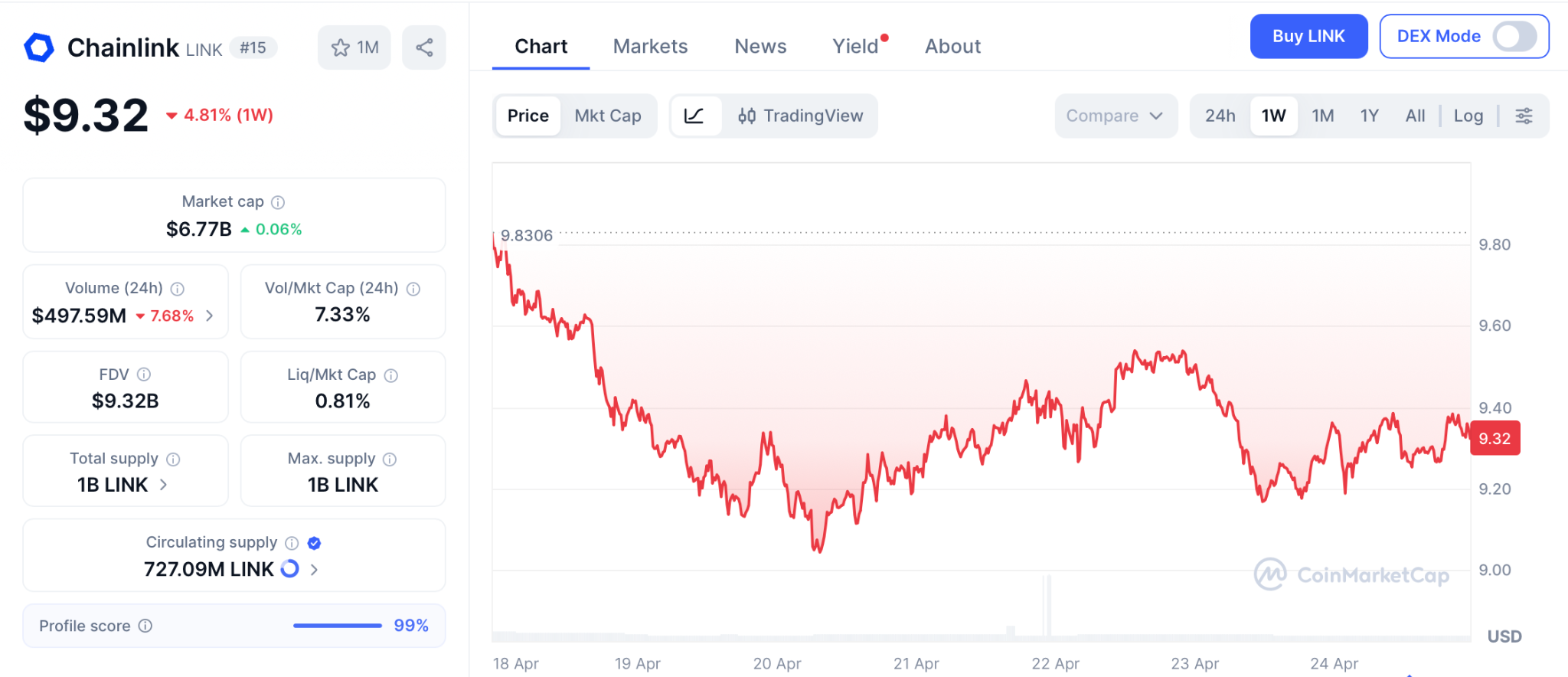
The LINK case strengthens with every RWA partnership, and long term targets on CoinPedia reach $35 to $55 through 2026. But a $6.8 billion cap means even a climb to $15 delivers roughly 60% over many months, nowhere near what a presale before listing produces.
Sui (SUI) Price at $0.94 as Volo Protocol Exploit Tests $0.90 Support
Sui (SUI) trades at $0.94 per CoinMarketCap, down 0.60% in 24 hours after the Volo Protocol exploit on April 22 drained roughly $3.5 million across three vaults, leaving Sui DeFi TVL above $1.2 billion but the confidence narrative bruised. Support sits at $0.90 and resistance at $0.97 with the CME futures launch dated May 4 as the next catalyst.
Analyst targets extend toward $1.75 per BanklessTimes, an 85% move over months. Pepeto at $0.0000001866 compresses that kind of upside into one listing event.
Conclusion
Every cycle rewards the same kind of buyer. The wallet that bought Solana at $260 in November 2021 does not show up in any millionaire story. The one that grabbed SOL at $8 during the 2022 collapse, when the crowd called Solana dead, rode that entry to a 30x by late 2024. Early, before the rally, in names the market is mocking, is where real returns live. Large caps on a green day have never written anyone a life-changing check.
The pattern is repeating. Bridgetower just brought $11 billion of real assets onto Chainlink’s rails, and Pepeto is building the same exchange infrastructure at presale pricing while fear still controls the tape. The regret cycle always ends the same way, people watching the listing candle and wishing they had moved while the price was asleep.
Click To Visit Pepeto Website To Enter The Presale

FAQs
What is the best crypto to invest in April 2026 before the next bull run?
Pepeto is the best crypto to invest in before the next run, backed by $9.45 million raised, a live exchange suite from a Pepe cofounder, and 178% staking yield compounding daily. The April 23 Bridgetower deal with Chainlink tokenizing $11 billion in US resources confirms institutional capital is entering the exchange infrastructure lane.
Is Chainlink (LINK) a stronger buy than Sui (SUI) today at $9.32?
Chainlink (LINK) at $9.32 carries a deeper integration moat after the Bridgetower tokenization deal, while Sui (SUI) at $0.94 still absorbs the Volo Protocol exploit fallout. Pepeto at presale pricing offers a listing-day gap neither mid-cap can match.
Disclaimer: This is a Press Release provided by a third party who is responsible for the content. Please conduct your own research before taking any action based on the content.

Litecoin’s 13-block reorg wasn’t a zero-day, GitHub commit history shows otherwise

Nikola Jokić, Nuggets coach take offense to Jaden McDaniels’ last-second layup

Microsoft’s new Xbox chief makes first major change, cutting Game Pass price, but with a catch

Manchester United reach agreement with Casemiro over contract clause amid transfer speculation

US brings back mandatory military draft registration

Steven Gerrard disagrees with Gary Neville over ‘shock’ Chelsea and Arsenal claim | Football


-

 Business7 days ago
Powerball Result April 18, 2026: No Jackpot Winner in Powerball Draw: $75 Million Rolls Over
-

 Fashion2 days ago
Weekend Open Thread – Corporette.com
-

 Politics7 days ago
Zack Polanski demands ‘council homes not luxury flats for foreign investors’
-
Entertainment6 days ago
NBA Analyst Charles Barkley Chimes in on Ice Spice McDonald’s Fiasco
-

 Politics5 days ago
Gary Stevenson delivers timely reminder to register to vote as deadline TODAY
-
Crypto World6 days ago
Bank of Hawai’i (BOH) Q1 2026: Net Income Drops to $57.4M as Net Interest Margin Expands
-
Crypto World14 hours ago
Hyperliquid $HYPE Rally Builds Momentum as AI Sector Enters Prove-It Phase
-

 Politics4 days ago
Making troops accountable for war crimes threatens US alliance, ex-SAS colonel warns
-

 Politics4 days ago
Disabled people challenge government SEND proposals over segregation concerns
-

 Business4 days ago
Rolls-Royce Voted UK’s Most Iconic Trade Mark as IPO Register Hits 150
-

 Politics4 days ago
Zack Polanski responds to home secretary’s taser threat
-

 Politics4 days ago
Starmer handler McSweeney to be dragged from shadows by Foreign Affairs Committee
-
Politics4 days ago
Wings Over Scotland | How To Get Away With Crimes
-
 Crypto World5 days ago
Five Value Stocks with Recovery Potential in 2026: PayPal (PYPL), Nike (NKE), and More
-

 Politics4 days ago
‘Iran is still a nuclear threat’
-

 Crypto World4 days ago
New York sues Coinbase, Gemini over prediction market offerings
-
 Sports3 days ago
Tim Bradley names the current best in the world: “Better than Inoue and Usyk”
-

 Crypto World4 days ago
Crypto’s great hope in Senate’s Clarity Act still has a path to survive tight calendar
-

 Business4 days ago
The Job Benefits Most Men Don’t Know to Negotiate
-
 Business4 days ago
HCL Tech share price tank over 9% after weak Q4. JPMorgan, HSBC & 3 others cut target price
You must be logged in to post a comment Login