Connect with us

Business

California social media law: Newsom signs under-16s curbs

Published

on

California social media law: Newsom signs under-16s curbs

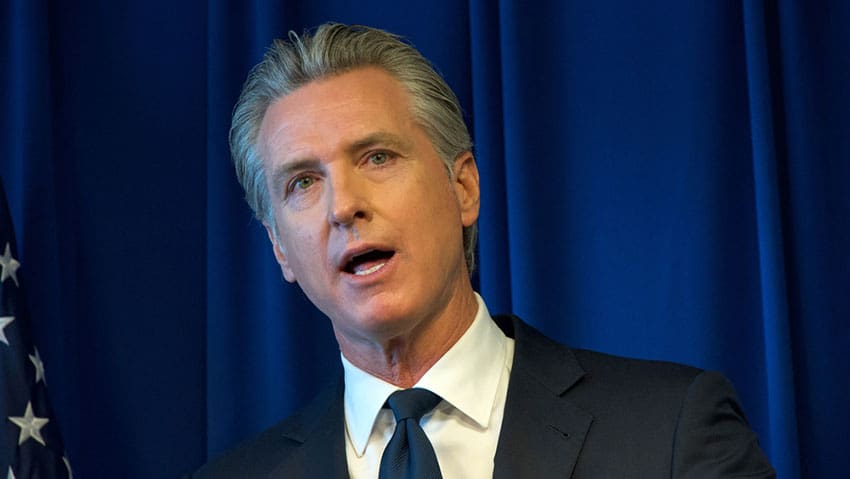
California’s governor, Gavin Newsom, today signed a law that prohibits social media platforms from providing addictive features to users under 16, the first law of its kind in the US.

He also signed a law requiring AI companies to disclose to young users when they are engaging with a chatbot rather than a human, and to restrict dangerous content on topics such as self-harm.

The two measures were part of a package of 13 digital safety bills. Newsom said it was too hard for parents alone to protect their children from powerful algorithms.

“It’s a good day for our children,” Newsom said at the signing ceremony. “It’s a good day for the State of California.”

What the new laws require

Assembly Bill 1709 prohibits social media platforms from offering addictive features such as infinite scroll and autoplay videos to users under 16.

Advertisement

Senate Bill 1119 creates new regulations for chatbot use, including parental controls, notifications if children disable safety settings and a crisis protocol for queries about suicide.

At the ceremony, Steve Padilla, the state senator who wrote the chatbot bill, addressed Maria Raine, whose son Adam died in 2025 after discussing suicidal thoughts with a chatbot. She attended holding a photo of Adam.

Assembly Bill 2 sets financial penalties for civil lawsuits against social media companies accused of harming children through their platforms. The other bills include measures to enhance digital privacy protections for young people, expand the legal definition of child sexual exploitation to include digitally altered or AI-generated images, and rewrite existing child-safety design laws to respond to court rulings.

Josh Lowenthal, the Democratic assembly member who introduced the social media bill, said in an interview: “We have passed a tipping point, it’s now an avalanche.”

Advertisement

Jim Steyer, chief executive of Common Sense Media, a non-profit child advocacy group, said: “This is the biggest, most far-reaching set of online protections in the United States and will set a standard for the whole nation.”

Tech companies expected to go to court

Tech companies have argued that they have already introduced many safety protections for young users. They are also expected to challenge the laws in court, saying they violate free speech rights.

Meta, Google and TikTok have deployed some of the biggest lobbying forces in Washington and state capitals to defeat child safety bills, arguing that regulation would stymie the growth of the tech sector.

Jeffrey Chester, executive director of the Center for Digital Democracy, a non-profit group that has advocated child safety laws, said: “There’s no question the lobbying power neutralized policymakers, but this has been a galvanizing moment where policymakers realize we are at a crisis moment.”

Advertisement

The laws follow a series of social media trials this year in which thousands of teenagers, schools and states accused Meta, Snap, TikTok and YouTube of hooking young users with addictive products, which were compared to cigarettes.

In August, Meta settled with 47 states, Washington DC and US territories for up to $17.1bn and agreed to major changes for young users on its platform. Part of the settlement is contingent on other social media companies reaching similar agreements with the states.

Moves outside the US

France, Indonesia and Greece have also introduced laws restricting social media use by children under 16.

In Britain, the government announced in June that social media would be banned for under-16s, covering platforms such as Snapchat, TikTok, YouTube, Instagram, Facebook and X. It said protections were expected to come into force in spring 2027, and that AI “romantic companion” chatbots would have to enforce a minimum age of 18.

Advertisement

The UK plan followed Keir Starmer’s shift in January towards backing a ban, and has been criticised by industry figures as impractical.

In 2022, California enacted a law that restricted data collection of users under 18. In 2025, Newsom signed into law requirements for AI companies to test their models for safety and report the results. He vetoed a version of the chatbot child safety bill the same year.

Newsom, who is in his final months as governor and is considering a run for president, laid the groundwork for the social media legislation in his State of the State speech in January, when he mentioned the restrictions Australia had recently imposed on social media use by children.


Amy Ingham

Amy Ingham

Amy Ingham is a reporter at Business Matters, covering UK business news with a focus on breaking news, business policy, late payments and insolvency. She joined the magazine in 2026 after completing the NCTJ Diploma in Journalism at Harlow College’s journalism school. Her recent reporting includes British Steel’s nationalisation and its impact on SME suppliers, the decline in late payments by large firms, and Insolvency Service director disqualifications. Reach her at aingham@cbmeg.co.uk.

Advertisement

Continue Reading
Click to comment

You must be logged in to post a comment Login

Leave a Reply

Business

Too many IPOs, limited cash: How investors should allocate money across multiple issues

Published

on

Too many IPOs, limited cash: How investors should allocate money across multiple issues
India’s primary market is witnessing a rush of IPOs, giving investors more options but also making it harder to decide where to deploy their money. With multiple issues competing for investor attention and capital at the same time, the challenge is no longer finding an IPO to apply for, but identifying the issue that offers the most attractive risk-reward opportunity.

The scale of the opportunity and the dilemma was evident on Wednesday, September 9, when as many as 10 mainboard IPOs were at different stages of subscription. Six IPOs opened for subscription that day, three entered their second day of bidding, while another issue reached its final day.

For retail investors with limited funds, applying to every issue may not be practical. The crowded IPO pipeline makes capital allocation an important part of the investment decision. Investors have to decide not only which IPOs look attractive, but also how much money they are willing to allocate to each issue.

Investors face a capital-allocation dilemma

When several IPOs are open simultaneously, investors have to choose between competing opportunities. A strong subscription response, high grey-market premium or market buzz can create a sense of urgency, but these factors alone may not justify an investment.
Narendra Solanki, Head Fundamental Research – Investment Services, Anand Rathi Share and Stock Brokers, said investors should assess IPOs on business quality, financial performance, valuation, issue structure, management quality and post-listing growth potential.

Advertisement


“In such a market environment, investors should evaluate IPOs based on key parameters, including business quality, financial performance (revenue/EBITDA/PAT growth, margins, ROCE/ROE and cash flows), valuation (P/E, EV/EBITDA, P/B and other relevant multiples relative to listed peers), IPO structure (fresh issue vs. OFS, with preference for issues where proceeds are meaningfully deployed towards growth, capex or deleveraging), management quality (promoter track record, corporate governance and related-party transactions), and post-listing growth and value-creation potential,” Solanki explained.
ALSO READ:Are NSE unlisted shareholders staring at losses? Here’s what IPO pricing indicates“With multiple IPOs competing for investor capital, maintaining valuation discipline and focusing on fundamentals is more important than being driven by IPO excitement or short-term listing gains,” he added.

The current IPO rush spans businesses across sectors such as engineering, infrastructure, payments, rental services and industrials. While this gives investors greater choice, it also makes comparing companies on their fundamentals more important.

G Chokkalingam, Founder of Equinomics Research, said investors should consider both fundamentals and tactical opportunities when evaluating IPOs. On valuations, he said investors should compare an IPO with listed peers and avoid paying a substantial premium to comparable companies.

“So, in terms of the valuation comfort zone, as compared to an already listed player, whatever the valuation is at the high-flow time, one cannot give more than a 10–15–20% premium to what is already given to the existing peers. In case there is no comparable peer in the market, then we can look at the PE ratio and the PEG ratio,” Chokkalingam said.

He added that “Of course, PE ratios are always elevated these days for many Indian companies. So, one can look at the PE ratio, whether it is around 20. If it is more than 20, one can look at the PEG ratio, which is the PE ratio divided by the three-year profit growth.”

Advertisement

The use of IPO proceeds is another factor investors can consider, particularly whether the funds are being directed towards strengthening the business.

“Another very important thing one can look at is whether the entire profits are going into the promoter’s pocket, or whether at least some resources are going towards retiring the debt or capital expenditure. The preference can be given to the second category, where at least some money is going towards retiring the debt and towards capital expenditure,” Chokkalingam said.

Once the fundamental parameters are broadly comparable, investors can then assess tactical factors such as sector sentiment, retail participation and subscription demand.

“When these things are more or less common, then you can see the tactical opportunity—whether the theme is now attractive. One way to look at it is whether the theme is right now attractive to the market. The second thing to look at is whether the retail float is very low and whether the subscription responses are very high, because they get listed probably at a higher price,” Chokkalingam said.

Advertisement

How important is GMP when evaluating an IPO?

Grey market premium (GMP) can provide an indication of market sentiment and potential listing performance, but analysts caution against using it as the primary basis for an investment decision.

Solanki said investors should first assess the underlying business and its valuation.

“GMP can be a useful indicator of market sentiment and potential listing performance, but it should not be the primary factor when evaluating an IPO. Investors should first focus on the company’s business quality, financial performance, growth prospects, valuation, management quality, use of IPO proceeds and key risks. A strong GMP may indicate healthy investor interest, but it can also be driven by short-term speculation and may change significantly before listing. Conversely, a low or negative GMP does not necessarily mean the underlying business is unattractive,” Solanki said.

Chokkalingam similarly warned against relying on GMP without considering valuation.

Advertisement

“Blindly looking at GMP is dangerous. There are many incidents where a huge grey market premium was followed by debuts at 30–40% losses as well. I am not saying one should not look at it, but it could be a combination of factors without totally ignoring the valuation comfort zone,” said Chokkalingam.

Disclaimer: This article has been written by Kumar Gaurav, who is not a SEBI-registered Research Analyst or an Investment Adviser. Gaurav and his/her ‘relative(s)’ (as defined under Section 2(77) of the Companies Act, 2013) do not hold any financial interest in the companies mentioned in this article as of the date of publication. The views/recommendations mentioned in this article, wherever applicable, are those of the respective SEBI-registered Research Analyst/brokerage and have been reproduced/reported with due attribution. They should not be construed as the views or recommendations of The Economic Times Digital or the journalist. Readers are advised to consider the original research report and make their investment decisions based on their own assessment.

Continue Reading

Business

Altria: This Dividend King Needs Time To Consolidate (Rating Downgrade)

Published

on

Altria office sign in Virginia capital city tobacco business closeup by road street, parent company of Philip Morris

Altria: This Dividend King Needs Time To Consolidate (Rating Downgrade)

Continue Reading

Business

Alstom to build new battery-electric train fleet

Published

on

A red and blue train is parked up at station

He added: “I’ve lost count of the number of times someone has stopped me to tell me about the train that never came.

“And when that happens, it means missed shifts, missed appointments, and missed opportunities. Today, that starts to change.”

The DfT said the trains would help deliver the Transpennine Route Upgrade’s aim to boost capacity by 30%, with thousands of additional seats a day across the Pennines by the early to mid-2030s.

They will run between key destinations across the north including Liverpool Lime Street and Scarborough, Manchester Airport and Saltburn, and Manchester Piccadilly and Hull.

Advertisement

The DfT added that journey times will be cut by up to 10 minutes between Manchester and Leeds and up to 14 minutes between Manchester and York.

The trains will be bought by Rock Rail and leased to TransPennine Express, the government added.

Alstom, which boasts the largest rolling stock train manufacturing site outside of China, secured a £370m contract in 2024 to produce 10 new London Elizabeth line trains.

This came less than three months after a redundancy consultation put 1,300 jobs at risk at its Litchurch Lane factory, which dates back to 1876.

Advertisement

Rob Whyte, managing director UK at Alstom, called the latest agreement a “landmark moment for Britain’s railway”.

He said: “We couldn’t be prouder that the country’s first main line battery-electric trains will be designed and built in Britain.

“The fleet will transform journeys across northern England while showcasing the very best of British engineering, innovation and advanced manufacturing.”

Advertisement
Continue Reading

Business

Roivant Sciences Ltd. (ROIV) Presents at Citigroup’s Biopharma Back to School Summit 2026 Transcript

Published

on

OneWater Marine Inc. (ONEW) Q1 2026 Earnings Call Transcript