
Business
Carney pushes idea of making Canada ’associate member’ of EU, WSJ reports



Business
(VIDEO) Kylian Mbappe Scores Brace as Real Madrid Rout Rayo Vallecano 4-1 to Level With Barcelona Atop La Liga

Kylian Mbappe scored twice as Real Madrid earned a commanding 4-1 victory over Rayo Vallecano at the Santiago Bernabeu on Saturday, pulling the club level with Barcelona at the top of La Liga after a difficult week that had tested manager Jose Mourinho‘s squad.
The win marked a bounce-back performance for Real Madrid following a loss to Real Betis in their previous league outing, and it came just days after the team’s midweek Champions League fixture against Inter Milan. Mourinho’s side wasted little time asserting control over their crosstown rivals, building a three-goal cushion before halftime.
A fast start puts the game away early
Real Madrid opened the scoring in the 14th minute when Mbappe converted from the penalty spot after Rayo defender Florian Lejeune fouled Alvaro Carreras inside the box. Mbappe sent goalkeeper Emil Audero the wrong way to give the hosts an early lead and register his sixth goal of the domestic season.
The second goal followed just three minutes later. Lejeune gave the ball away under pressure from Vinicius Junior, and Carreras combined with Mbappe before finding the back of the net himself, doubling Real Madrid’s advantage inside the opening 20 minutes.
Real Madrid’s wide players continued to cause problems for Rayo’s defense as the half progressed. Vinicius Junior and Yan Diomande, making his first career start for the club following his arrival in August, found ample space to operate on the flanks. In the 34th minute, Diomande raced down the left before squaring the ball to Jude Bellingham, who was positioned just inside the box and side-footed a finish into the bottom corner with minimal fuss, extending the lead to 3-0 before the break.
Rayo respond but can’t complete the comeback
Rayo Vallecano pulled a goal back early in the second half through Sergio Camello, offering a brief window of hope for the visitors. For a stretch afterward, Rayo enjoyed more comfortable possession in Real Madrid’s half and kept goalkeeper Thibaut Courtois busy, while frustration visibly mounted on Mourinho’s side of the touchline, mirrored by whistles from portions of the Bernabeu crowd.
Real Madrid nearly extended their lead with 13 minutes remaining, when substitute Denzel Dumfries connected with a cross from fellow substitute Arda Guler, only to be denied by a spectacular save from Audero. Real Madrid finally sealed the result in the 91st minute, when Mbappe struck again on the counter-attack to complete his brace and push his season tally to seven goals across all competitions.
Mourinho praises his side’s mental resilience
Speaking to Real Madrid TV after the match, Mourinho emphasized how important the victory was given the circumstances surrounding it, both the prior league defeat and the physical toll of a midweek European fixture.
“It was fundamental to win, above all after losing the last game in La Liga,” Mourinho said. “We killed the game in the first half — that’s not easy, working like we did after the Champions League game, not just physically, but mentally.”
Rayo’s coach reflects on a difficult start
Rayo Vallecano manager San Jose acknowledged that his side’s slow start effectively decided the match, while praising his players’ response after halftime.
“Conceding the [early] penalty was a blow, then we had another mistake when bringing the ball out,” San Jose said. “I think we could have scored in the first half too, but it’s true that they were better… We have to congratulate Madrid, but I’m proud of the players because the second half was much better.”
Standings tighten at the top of La Liga
With the win, Real Madrid moved to 12 points through the opening stretch of the season, drawing level with defending champions Barcelona atop the table. Barcelona were scheduled to visit Levante on Sunday, looking to maintain their unbeaten start to the campaign and reclaim sole possession of first place.
Elsewhere across the matchday’s fixtures, Espanyol defeated Osasuna 2-0 behind an early brace from Roberto Fernandez, while Racing Santander came from behind to beat in-form Alaves 2-1. Athletic Club and Elche played out a 1-1 draw at San Mames, with Elche taking an early lead through a second-half penalty from Facundo Buonanotte before Athletic captain Inaki Williams equalized with 11 minutes remaining.
Real Madrid will return to action Tuesday with a trip to face Elche, while Rayo Vallecano host Espanyol in their next league fixture. For Real Madrid, Saturday’s dominant display offers reassurance heading into a stretch of matches that will test squad depth across both domestic and European competition, particularly with Mourinho having already used his bench strategically to manage minutes for key contributors like Mbappe, Bellingham and Vinicius Junior during the closing stages against Rayo.
For Barcelona, Sunday’s fixture against Levante represents an opportunity to reassert their position at the top of the table, setting up an early-season title race between Spain’s two traditional powerhouses that already appears set to define the opening months of the 2026-27 La Liga campaign.


Equity Research Analyst with a broad career in the financial market, covered both Brazilian and global stocks. As a value investor, my analysis is primarily fundamental, focusing on identifying undervalued stocks with growth potential. Feel free to reach out for collaborations or to connect!
Analyst’s Disclosure: I/we have no stock, option or similar derivative position in any of the companies mentioned, and no plans to initiate any such positions within the next 72 hours. I wrote this article myself, and it expresses my own opinions. I am not receiving compensation for it (other than from Seeking Alpha). I have no business relationship with any company whose stock is mentioned in this article.
Seeking Alpha’s Disclosure: Past performance is no guarantee of future results. No recommendation or advice is being given as to whether any investment is suitable for a particular investor. Any views or opinions expressed above may not reflect those of Seeking Alpha as a whole. Seeking Alpha is not a licensed securities dealer, broker or US investment adviser or investment bank. Our analysts are third party authors that include both professional investors and individual investors who may not be licensed or certified by any institute or regulatory body.

Saudi pipeline outage threatens loss of 4% of global oil supply

Net Lease REITs: Diversification Or Diworsification?
Business
(VIDEO) ‘SNL UK’ Season 2 Cold Open Mocks Prince Harry and Meghan Markle’s Return With a Netflix Money Jab

Saturday Night Live U.K. returned for its second season Saturday with a cold open taking direct aim at Prince Harry and Meghan Markle’s widely publicized move back to Britain, opening the show with a royal-family sketch built around jokes about the couple’s finances and their Netflix production deal.
The sketch began with Larry Dean playing King Charles III and Emma Sidi playing Queen Camilla, relaxing together at Balmoral Castle in Scotland. “I do love our weekends away. No responsibilities, just like every other day,” Camilla says at the start of the scene.
Harry and Meghan crash the royal getaway
The couple’s quiet retreat is interrupted by the arrival of Harry, played by Jack Shep, and Meghan, played by Ayoade Bamgboye. Much of the sketch centers on the pair sharing a prolonged, affectionate embrace, much to the visible irritation of King Charles. “Daddy, I’m home,” Harry says as the two arrive.
“What do you two want?” Charles asks, clearly unhappy to see them. “Don’t tell me you’ve spent that Netflix money already.”
Harry’s response became one of the sketch’s most-quoted lines, though outlets reported the figure differently. Some accounts, including Deadline and Bleeding Cool, quoted Harry as saying, “It was $60 million. How long was it meant to last?” Other outlets, including Variety and several syndicated reports, quoted the figure as $16 million. Variety itself flagged the inconsistency, noting that the dollar amount differed between accounts of the same exchange.
Charles continues to press the point, delivering one of the sketch’s sharper lines: “What a waste you’ve become, you’re lucky your father is not around to see this,” a jab that reportedly drew a strong reaction from the studio audience.
Meghan’s lifestyle brand gets its own dig
The sketch also turned its attention to Meghan’s business ventures, referencing her Netflix lifestyle series and consumer product line. In the scene, Meghan presents Camilla with an ice tray as a gift. “I made it myself,” she says. “I can give you the recipe. I’m a whizz in the kitchen.” Harry adds a line undercutting the moment, telling Camilla, “She hires the best chefs.”
A new prime minister crashes the scene
The sketch also introduced George Fouracres in a new role as fictional U.K. Prime Minister Andy Burnham, arriving mid-scene wearing his character’s signature yellow Manchester badge. Fouracres previously drew acclaim on the show for his portrayal of former Prime Minister Keir Starmer, and his debut as the Burnham character continued the show’s pattern of using its cold opens to satirize current U.K. political figures alongside the royal family storyline.
“I’m the new PM. And I’m nothing like the last one,” Fouracres’ character announces, before launching into a set of jokes referencing Burnham’s policy agenda over the summer and his efforts to appear relatable despite holding high office. The bit closed with the character declaring, “I will buy everybody a pint, because I want you to like me. I need you to like me,” a line mocking his character’s eagerness to be liked by the public.
A premiere hosted by Jeff Goldblum
Saturday’s episode marked the Season 2 premiere of SNL U.K., which aired on Sky, and was hosted by actor Jeff Goldblum, who opened the broadcast with a musical number about spending time in London. The returning cast for the new season includes Hammed Animashaun, Ayoade Bamgboye, Larry Dean, Celeste Dring, George Fouracres, Ania Magliano, Annabel Marlow, Al Nash, Jack Shep, Emma Sidi, Paddy Young and Freddie Meredith.
Coverage of the premiere noted that the show’s producers had a wide array of material to draw from heading into the new season, given the extended summer news cycle surrounding Harry and Meghan’s relocation, which had already generated substantial tabloid and mainstream media coverage in the U.K. and internationally in the months before the episode aired.
Real-world context behind the joke
The sketch’s premise draws directly from real developments this year involving the couple’s move back to permanent residence in the United Kingdom, following nearly six years primarily based in California after they stepped back from royal duties in 2020. That return has been accompanied by public reporting on the couple’s finances, their production deal with Netflix, and renewed tension with the royal family, including a recent letter from Buckingham Parlace reaffirming that Harry and Meghan remain non-working members of the royal family, described in that correspondence as “private citizens.”
Sources cited by entertainment outlets covering the couple’s relocation have offered competing explanations for the timing of the move, with some pointing to financial considerations and others describing a desire to be closer to Harry’s father and to repair strained family relationships.
SNL U.K.’s second season is scheduled to continue with new episodes in the coming weeks, with comedian and presenter Amelia Dimoldenberg set to host the following episode on Sept. 26, joined by musical guest Rachel Chinouriri. The show’s cold-open format, mirroring the long-running U.S. version of Saturday Night Live, has continued to lean heavily on current events and public figures for its opening sketches, with Saturday’s premiere continuing that pattern by using the summer’s biggest royal-family storyline as its season-launching target.

InvestingPro Fair Value predicted 57% drop in Rackspace Technology

Every company website sits on infrastructure that consumes electricity around the clock, stores data somewhere specific and relies on a support model chosen at the point of purchase. In 2026, web hosting has quietly become a sustainability, compliance and service decision, and that explains why a growing number of UK SMEs are switching provider: they want a smaller environmental impact, clearer data sovereignty and support from real people rather than ticket queues.
The digital carbon footprint: why hosting is a sustainability metric
A website never sleeps. The servers that keep it online, the cooling systems that prevent overheating and the backup infrastructure protecting the data all draw power continuously. Industry estimates put data centres at roughly one to two per cent of global electricity use, and demand keeps rising as business moves online. For a firm working towards carbon neutral operations, hosting is a measurable part of its environmental footprint rather than an invisible overhead.
Procurement teams have started to notice. Ethical consumerism, long established in retail, has crossed into business technology: sustainable business tech once meant refurbished laptops, but now extends to the cloud services a firm rents every month. The complication is that green claims do not all mean the same thing. Some providers buy carbon offsets to balance emissions from conventional power. Others run directly on renewable energy, avoiding the emissions in the first place. A third group reduces consumption through efficient hardware and offsets only what remains.
For owners comparing green hosting in 2026, the useful habit is to look for evidence rather than adjectives. The Green Web Foundation maintains a public directory verifying whether hosts genuinely run on renewable power. Efficiency figures matter too: a data centre’s power usage effectiveness (PUE) rating shows how much energy goes to computing rather than cooling, and lower figures mean less waste. Providers publishing this level of detail tend to be more credible than those relying on vague promises.
Data sovereignty and the UK legal landscape
Environmental impact is only one reason hosting has climbed the agenda. The question of where data physically sits has become equally prominent. UK data sovereignty, the principle that business information should remain within reach of UK law, matters to any firm holding customer records, payment details or commercially sensitive material. Files in an overseas facility can fall under foreign jurisdictions, and untangling which rules apply becomes a legal exercise few small businesses are equipped for.
Hosting on UK-based infrastructure simplifies that picture. Data stays within a familiar legal framework, supplier due diligence becomes easier and customer questions about where information is held can be answered without hesitation. Stating that company data remains in the UK is increasingly a commercial asset rather than a technical footnote.
A note of caution is warranted, however. Server location alone does not make a business compliant with UK GDPR or the Data Protection Act 2018. Obligations around lawful processing, security controls, processor contracts and international transfers still apply, and the Information Commissioner’s Office is clear that responsibility sits with the business wherever its servers happen to be. Choosing UK web hosting removes layers of complexity; it does not remove accountability.
Performance deserves an equally sober assessment. Keeping a website close to its audience can reduce latency, but real-world speed depends on routing, caching, software architecture and the quality of the platform itself. Claims that local infrastructure is automatically faster than a global cloud oversimplify: testing against your own traffic matters more than generic benchmarks.
The value of human expertise in a ticket-driven market
The third factor behind switching decisions is harder to quantify but easy to recognise: what happens when something goes wrong. Large global providers have industrialised support, channelling customers through chatbots, knowledge bases and ticket queues. That model scales efficiently, yet for a small business whose website generates leads or takes orders, waiting two days for a templated reply means lost revenue. Reaching a technician who already knows the account, investigates immediately and owns the problem carries real commercial value.
This is where smaller independent providers have found their opening. NetWeaver, a leading ethical web hosting provider based in Lancashire, illustrates the approach. Founded in February 2001, the company has spent 25 years offering a human-centred alternative to Big Tech, with technical support handled in-house by its own UK team rather than an outsourced call centre. Its servers run in UK data centres powered by renewable energy, and the company states it has reached a Net Zero level of operation while openly acknowledging that no universally accepted standard for Net Zero yet exists.
Migration is another barrier the human model addresses. Moving a website involves file transfers, databases, DNS changes and the risk of downtime, which deters many businesses from switching even when they want to. Providers that manage the transfer themselves remove that obstacle. NetWeaver includes free website migration, scheduled to suit the customer, alongside published pricing from £4.50 a month with no hidden extras. Such transparency makes the long-term cost of ownership easier to forecast than the introductory discounts and steep renewal uplifts common among larger rivals.
How to audit a digital supply chain for ethical alignment
For owners persuaded their hosting deserves a fresh look, the practical question is how to assess it. An ethical audit works best when it asks verifiable questions rather than accepting marketing language at face value. The following criteria give the process structure:
- Energy source and evidence. Ask whether servers and cooling run directly on renewable energy, whether offsets cover what remains and whether independent verification exists.
- Server and backup location. Establish where primary servers and backups are stored; backups are easily forgotten and can sit in a different jurisdiction from the main site.
- Support model and escalation. Find out who answers when something breaks, whether support is in-house or outsourced and how complex issues are escalated.
- Security controls. Look for concrete measures such as firewalls, malware scanning, DDoS protection and daily off-site backups rather than generic assurances.
- Pricing transparency. Compare monthly and annual costs, renewal terms and what is actually included, because headline discounts frequently disguise expensive renewals.
- Migration and exit. Check whether the provider will move an existing site free of charge, how downtime is avoided and how easy it would be to leave.
- Performance testing. Judge speed against your own traffic and audience location instead of relying on published benchmarks.
Weighed together, these criteria turn an abstract commitment to ethical procurement into a routine supplier check. They also explain why providers such as NetWeaver, with published green policies, UK infrastructure and inclusive migration, keep appearing on small business shortlists. Sustainability alone is not enough: a credible choice must still clear the hurdles of security, reliability and fair pricing. The providers gaining ground in 2026 can evidence all four.
A measured switch can support both responsibility and resilience
None of this means every business should change hosts tomorrow. The sensible first step is an audit: map what the current provider delivers against the criteria above, from energy sourcing and data location to support quality and renewal pricing. Where the gaps are small, staying put may be rational. Where they are wide, switching has become far easier than its reputation suggests, particularly when the receiving provider manages migration and absorbs the cost.
What is clear is that hosting has joined the list of decisions through which a business expresses its values and protects its operations at the same time. Digital infrastructure may be invisible to customers, but its consequences, environmental, legal and commercial, are not. The owners treating it as a strategic choice in 2026 are finding that responsibility and resilience point in the same direction.

Roivant Sciences: Diverse Exposure To Biotech Niches Through Vants

Venture capital investment in California has reached an astonishing 366 billion USD this year alone.
The funding appears to be heavily concentrated. 86 cents of every dollar went to AI companies, and a large percentage of this to the world’s largest AI firms.
This concentration of capital however, risks starving the smaller, more innovative companies that stand ready to bring new and disruptive products to our market. It’s time venture capital refreshed its approach.
Why can small startups be so disruptive?
Small startups tend not to have the stifling bureaucratic layers or lengthy approval processes that weigh down technology giants such as Meta or Google.
A small team at a growing startup can pivot from one project to another and act independently at the drop of a hat. This agility is a real asset, making smaller companies more likely to pursue unconventional ideas that might never be approved at a large firm but could change an industry forever.
Smaller firms and startups can also go all-in on a single problem or niche. Large firms, however, are forced spread resources across numerous competing priorities to mitigate risk for profit hungry shareholders. For innovation, deep focus on one problem will always beat spreading resources thinly across multiple issues.
Small firms also benefit from flat hierarchies. Engineers and developers can talk directly to decision-makers because they are often sat right next to them, ensuring those doing the grunt work quickly receive the leadership backing they need.
Rotem Farkash: venture capital is overlooking smaller innovators
So far this year, California, the global centre of the technology industry, has attracted an astonishing $366 billion, or around 90% of all the venture capital in the US.
And while this sounds like good news for small startups in the state, worryingly, just two of tech’s biggest players, Anthropic and OpenAI, accounted for half of the $366 billion raised.
Rotem Farkash, an entrepreneur and frequent commentator on tech, argued that venture capital’s chase of wild AI returns risks leaving many promising startups without the backing they need.
“Investors are being drawn towards a small number of highly valued AI companies. But when so much capital is concentrated in a small number of firms, startups across every sector are overlooked, regardless of the quality of their product.”
Farkash added: “Smaller startups – not only those working in AI – deserve and require more access to funding. Giving more of them the resources they need could unlock significant innovation.”
How startups are solving problems big and small
A technology disruptor might revolutionise an entire industry and change daily working habits. It might also solve a small, but significant problem.
One company that is revolutionising customer service is Sierra, which was founded in 2023.
AI chatbots developed in the past reduced customer service response times but still left most issues for people to deal with. Sierra’s agents change that. They can handle open-ended conversations, manage complexity and ambiguity, and solve complex problems without human intervention.
Sierra also has a novel pricing system which is based on successful outcomes. The company reports a 70% resolution rate and a customer satisfaction score of 4.5 out of 5.
Another disruptor is Faivelo, recently founded by Benjamin Brookarsh, which was created to solve a problem that frustrates many businesses.
Major email platforms have raised their prices for the third consecutive year, many using the compulsory integration of AI tools such as smart replies – whether you want them or not – into their offering as the latest reason. In response, Faivelo has developed an email platform offering unlimited mailboxes on a custom domain. This reduces the growing burden of per-seat pricing on businesses, particularly SMEs.
Small startups are key to innovation
Tech giants like OpenAI, Anthropic, Meta and Google have produced innovations that are changing the world. It is likely they will continue to develop groundbreaking technology and products.
But smaller companies are fast-moving innovators unencumbered by bureaucracy, bloating and the internal politics of technology’s giants. More venture funding should be directed towards truly innovative startups. Who knows, one of them could become the next Microsoft or Google.

InvestingPro’s Fair Value spotted 65% gain in Inspire Medical stock

(VIDEO) Kylian Mbappe Scores Brace as Real Madrid Rout Rayo Vallecano 4-1 to Level With Barcelona Atop La Liga

Trump Conducts Secret CLARITY Act Meeting. What Did He Discuss?

Your Guide To Outdoor Adventures Around Vegas

Memory prices are slowing because buyers ran out of money

Micron Stock Climbs Above $1,031 as AI Memory Crunch and a $50 Billion Outlook Fuel the Rally

AMD Stock Climbs After Management Lifts 2027 Data Center Outlook Toward $70 Billion in AI Sales

![LISA - 'LALISA + MONEY' | 2023 WORLD TOUR [BORN PINK]](https://wordupnews.com/wp-content/uploads/2026/02/1770487179_maxresdefault-80x80.jpg)

-
Tech5 days ago
Memory prices are slowing because buyers ran out of money
-
 Business3 days ago
Micron Stock Climbs Above $1,031 as AI Memory Crunch and a $50 Billion Outlook Fuel the Rally
-
 Business3 days ago
AMD Stock Climbs After Management Lifts 2027 Data Center Outlook Toward $70 Billion in AI Sales
-
 Crypto World4 days ago
Bitcoin price risks $76K drop as $78K support weakens
-

 Crypto World5 days ago
Robinhood Stock: How To Take Advantage With Reduced Risk
-
 Crypto World4 days ago
Ethereum price stalls below $2,500 as ADX drops to 11
-

 Fashion2 days ago
Weekend Open Thread – Corporette.com
-

 Crypto World2 days ago
XAG/USD: Silver’s Short-Term Rally Meets Its Moment of Truth
-

 NewsBeat5 days ago
England up in reading, maths and science rankings as Scotland and Wales dip
-
 Crypto World3 days ago
2 Chip Stocks Broke Out This Week. Neither Was Nvidia
-

 Crypto World3 days ago
OKX launches 10x OpenAI, Anthropic X-Perps in Europe
-

 Crypto World2 days ago
Diesel Tops $6 a Gallon for the First Time as 28 States Set Records
-
 Crypto World5 days ago
Intel Stock Jumps 9% on Chip Price Hike Report, US Stake Gains $36 Billion
-

 Tech3 days ago
Battery life is the only iPhone 18 Pro and iPhone Duo upgrade I care about. Apple didn’t disappoint
-

 Business2 days ago
10 Most-Streamed Songs On Spotify In 2026 So Far, Led By Ella Langley’s Dominant Run On The Charts This Year
-

 NewsBeat5 days ago
What went right this week: an ‘historic’ fall in violent crime, plus more
-

 Crypto World4 days ago
Bitcoin price risks $70K if $78K neckline breaks
-

 Tech4 days ago
Apple Watch Ultra 4 vs Watch Ultra 3: Should you really spend another $799?
-
Crypto World3 days ago
Ethereum Price Analysis: Consolidation at $2.5K Tests Momentum as On-Chain Activity Surges
-
 Crypto World4 days ago
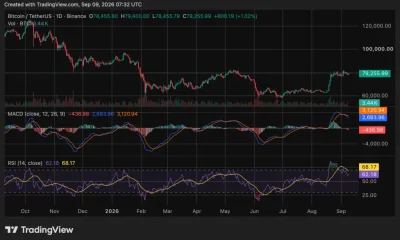
Bitcoin price holds near $79K as cycle drawdowns narrow
You must be logged in to post a comment Login