




Connect with us
DAPA Banner

Business

Case Hits One-Month Mark, FBI Pores Over Thousands of Hours of Video in Abduction Probe

Published

on

Zayed International Airport Abu Dhabi International Airport

It has been exactly one month since Nancy Guthrie was abducted from her home in the Catalina Foothills, and the case that has gripped the nation remains unsolved. As of March 2, 2026, the Pima County Sheriff’s Department and the FBI have transitioned from an intensive “boots on the ground” search to a focused criminal investigation driven by digital forensics and high-value tips.

Savannah Guthrie & Nancy Guthrie

The Abduction: What We Know

Nancy Guthrie was last seen on the night of Saturday, January 31, 2026, when she was dropped off at her home by her son-in-law after a family dinner.

  • 1:47 a.m., Feb 1: A masked individual was captured on doorbell footage disconnecting the home’s security camera.
  • 2:12 a.m., Feb 1: The camera briefly detected a person again before the system was fully disabled.
  • The Discovery: Family members reported her missing on Sunday morning after she failed to show up for a virtual church service.

Investigators confirmed that bloodstains found on the front porchbelonged to Nancy, and her pacemaker app was disconnected from her phone line during the predawn hours, signaling a violent removal from the residence.

A Shift in Strategy

On February 27, 2026, the Pima County Sheriff’s Department announced a “refocusing of resources.” While the search remains an active investigation, the large-scale presence of patrol units and the FBI’s mobile command post in Tucson have been scaled back.

  • FBI Relocation: The FBI has moved its primary operations for the case from Tucson to Phoenix, where they can more effectively analyze the “massive amount of data” collected, including over 23,600 tips.
  • Localized Detectives: The Pima County Sheriff’s Department clarified that while fewer officers will be visible, a dedicated team of detectives is working the case around the clock.

The $1 Million Reward

In an emotional video message shared on February 24, Savannah Guthrie and her siblings, Annie and Camron, announced a $1 million reward for information leading to Nancy’s recovery.

“If you’ve been waiting and you haven’t been sure, let this be your sign to please come forward. Tell what you know, and help us bring our beloved mom home,” Savannah pleaded in the video.

This is in addition to the $100,000 reward offered by the FBI. Since the family’s reward was announced, more than 1,500 new tips have flooded into the 1-800-CALL-FBI tip line.

Advertisement

Investigation Challenges

Despite several purported ransom notes demanding cryptocurrency (sent to local media outlets like KOLD-TV and TMZ), authorities have yet to receive “proof of life.”

  • Digital Forensics: Experts believe a “getaway vehicle” is the most critical piece of evidence currently being sought. Investigators have seized multiple vehicles, including a Range Rover and the car belonging to Savannah’s sister, Annie, as part of the standard forensic sweep.
  • DNA Evidence: While DNA was recovered from the home, sources indicate it may be “low-level” and has not yet yielded a definitive suspect profile.

Savannah Guthrie’s Status

Savannah Guthrie has been away from her anchor desk at TODAY since the abduction began, skipping her planned coverage of the 2026 Winter Olympics to remain in Arizona with her family. NBC has stated they are “fully supportive” of Savannah and that there is no current timeline for her return to the show.

How You Can Help

Authorities are asking residents in the Catalina Foothills and surrounding Tucson areas to review any home security or dashcam footage from the overnight hours of January 31 to February 1.

  • Suspect Description: A masked individual, approximately 5’10” to 6’0″ with a medium build, was seen on the property.
  • Contact: Anyone with information is urged to call 1-800-CALL-FBI (1-800-225-5324). Tips can be submitted anonymously.

Advertisement
Continue Reading
Click to comment

You must be logged in to post a comment Login

Leave a Reply

Business

Fortnite-maker Epic Games lays off 1,000 more staff

Published

on

Fortnite-maker Epic Games lays off 1,000 more staff

It is the second time in recent years the company has announced lays offs due to struggles with its blockbuster online game.

Continue Reading

Business

Iran war makes Middle East peace prospects better long-term

Published

on

Iran war makes Middle East peace prospects better long-term

Jamie Dimon, chief executive officer of JPMorgan Chase & Co., during the 2025 IIF annual membership meeting in Washington, DC, US, on Thursday, Oct. 16, 2025.

Samuel Corum | Bloomberg | Getty Images

JPMorgan Chase CEO Jamie Dimon said Tuesday that while the war in Iran poses near-term risks, it may ultimately improve the prospects for lasting peace in the Middle East.

Advertisement

“I think the Iran war makes it a better chance in the long run — it’s probably riskier in the short run, because we don’t know the outcome of it,” Dimon told Palantir executive Mike Gallagher at a conference held in Washington, D.C.

The key shift, according to Dimon, is a convergence of interests among regional powers. Saudi Arabia, the United Arab Emirates, Qatar, the U.S. and Israel all want permanent peace, he said, adding that Gulf states in particular have shown a willingness to move in that direction.

“The attitude is not what the attitude was 20 years ago,” Dimon said. “They all want it.”

Dimon, who leads the world’s largest bank by market cap, also tied his analysis directly to economics, arguing that foreign direct investment — which had been flowing into the region for years — will dry up without stability.

Advertisement

“They can’t have neighbors lobbing ballistic missiles into their data centers,” he said.

This story is developing. Please check back for updates.

Choose CNBC as your preferred source on Google and never miss a moment from the most trusted name in business news.
Continue Reading

Business

Can Iran’s Low-Cost Drone Fleet Actually Sink a US Supercarrier?

Published

on

USS Abraham Lincoln (CVN-72) underway in the Atlantic Ocean on

As the USS Abraham Lincoln carrier strike group steams through the Arabian Sea, military planners are confronting a low-tech challenge with potentially high stakes: waves of inexpensive Iranian drones that could overwhelm billion-dollar defenses through sheer numbers.

USS Abraham Lincoln (CVN-72) underway in the Atlantic Ocean on
USS Abraham Lincoln (CVN-72) underway in the Atlantic Ocean on 30 January 2019

Iran has invested heavily in its Shahed-series “kamikaze” drones, small unmanned aircraft that cost as little as $20,000 to $35,000 apiece yet carry enough explosives to damage ships or aircraft. Defense analysts say Tehran’s strategy of launching hundreds or even thousands at once — a “saturation attack” — poses a credible threat to high-value targets like U.S. supercarriers, even if sinking one outright remains improbable.

The debate has intensified in recent months amid escalating tensions. In February, an F-35C fighter jet launched from the Abraham Lincoln shot down an Iranian Shahed-139 drone that approached the carrier “aggressively” in the Arabian Sea, U.S. Central Command said. Iran later claimed its naval drones struck the Lincoln, forcing it to withdraw — assertions Washington dismissed as false while confirming U.S. strikes on Iranian assets, including the drone-carrying vessel Shahid Bagheri.

Iran’s drone fleet forms the core of its asymmetric naval doctrine, designed to counter America’s conventional superiority in the Persian Gulf and Strait of Hormuz. The Shahed-136, the most widely known model, has a range of roughly 1,000 miles, a top speed of about 114 mph and a warhead of 66 to 123 pounds. Newer variants, including jet-powered Shahed-238 models, are faster and harder to intercept. Iran can produce them rapidly in underground facilities using commercial components, allowing mass deployment at a fraction of the cost of Western munitions.

Cameron Chell, CEO of Canadian drone manufacturer Draganfly, warned in January that Iran’s low-cost unmanned systems enable “saturation attacks” against vessels like the Abraham Lincoln. “If hundreds are launched in a short period of time, some are almost certain to get through,” Chell told Fox News Digital. “Modern defense systems were not originally designed to counter that kind of saturation attack.”

Advertisement

A single Shahed drone is no match for a carrier strike group. But swarm tactics exploit economics: each U.S. SM-2 interceptor missile costs more than $2 million, while Iran can expend dozens of drones for the price of one. “These drones give Iran a very credible way to threaten surface vessels,” Chell said. U.S. assets are “large, slow-moving and easily identifiable on radar.”

The Lincoln, a Nimitz-class carrier commissioned in 1989 and recently modernized, displaces about 100,000 tons and carries more than 5,000 sailors and up to 90 aircraft. Its strike group includes guided-missile destroyers and cruisers equipped with the Aegis combat system, which can track and engage hundreds of targets simultaneously. Layered defenses include:

– Fighter jets on combat air patrol for early intercepts.
– Standard Missile-2 and SM-6 interceptors for mid-range threats.
– Close-in weapon systems like the Phalanx CIWS Gatling gun and Rolling Airframe Missiles for last-second defense.
– Electronic warfare jammers and decoys to confuse incoming drones.

The Navy is also fielding new counter-swarm tools. High-energy lasers such as the 60-kilowatt HELIOS and ODIN systems can burn through drone components using the ship’s own electricity — effectively unlimited ammunition. High-power microwave weapons like Epirus’ Leonidas can fry electronics across multiple drones at once. Loitering interceptors such as Raytheon’s Coyote and Anduril’s Roadrunner-M are designed to hunt drones in the sky before they reach the carrier.

Advertisement

Even so, analysts acknowledge vulnerabilities. A 2026 Gulf News analysis noted that a “1,000-strong” swarm could exhaust kinetic interceptors, forcing reliance on emerging directed-energy systems whose performance in real combat remains unproven at scale.

Robert Farley, a senior lecturer at the University of Kentucky’s Patterson School of Diplomacy and International Commerce, argued that actually sinking a modern supercarrier is extraordinarily difficult. “Modern aircraft carriers are far larger and more resilient than their World War II kin,” he said. A Ford-class carrier like the Gerald R. Ford is 150% the size of the largest WWII-era flattop and features sophisticated internal compartmentalization. “It’s a very tough hill to climb.”

Historical tests back his point. In 2005, the decommissioned USS America endured weeks of live-fire attacks before being scuttled by internal charges — with damage-control teams deliberately withheld. Real-world fires aboard carriers such as the USS Forrestal in 1967 caused heavy casualties but did not sink the ships.

A more realistic Iranian goal, experts say, would be a “mission kill” — damaging flight decks, catapults or hangar bays enough to sideline the carrier for repairs. Even a near-miss or symbolic hit could carry political weight in Washington, where public reaction to American casualties or visible damage can influence policy.

Advertisement

Iran’s approach draws lessons from its proxies. Houthi rebels in Yemen, armed with Iranian-supplied Shahed drones and missiles, harassed Red Sea shipping for months in 2024-2025 without sinking a U.S. warship. The experience highlighted both the persistence of drone threats and the effectiveness of layered carrier-group defenses. U.S. destroyers routinely downed incoming drones and missiles, but the operations underscored the cost imbalance.

Iran has also experimented with “drone carriers” — converted merchant vessels like the Shahid Bagheri capable of launching up to 60 Shaheds at once — alongside fast-attack boats and anti-ship ballistic missiles. The Islamic Revolutionary Guard Corps Navy views these as tools to saturate sensors and deplete magazines before a decisive strike.

U.S. officials maintain that no American carrier has been lost to enemy action since World War II and that current capabilities keep the advantage firmly with American forces. Yet the Navy is accelerating investment in drone countermeasures, including AI-driven targeting and autonomous interceptors, precisely because the threat is evolving faster than traditional systems anticipated.

For now, the Abraham Lincoln and its escorts continue operations in waters where Iranian drones have already probed defenses. Whether Tehran can translate its low-cost swarm doctrine into a carrier-killing capability remains an open question — one that defense planners on both sides are watching closely as tensions persist.

Advertisement

The economic asymmetry is undeniable: Iran can lose hundreds of drones and still launch more the next day. The United States can lose none. That calculus, experts say, is reshaping naval warfare in the 21st century, even if the world’s most powerful warships remain afloat.

Continue Reading

Business

Fight against huge Wiltshire solar park near M4 gets council backing

Published

on

Business Live

The planning application for Lime Down won’t be decided by Wiltshire Council

Stop Lime Down protesters

Stop Lime Down protesters(Image: Local Democracy Reporting Service)

The resident-led opposition to plans for a huge solar park north of the M4 in Wiltshire has gained the support of Wiltshire Council. The proposed Lime Down Solar Park spans roughly 1,237 hectares of land between Malmesbury and the M4, incorporating solar arrays, battery storage facilities, and a 22km cable route corridor through the county to Melksham.

Advertisement

If given the green light, the project would run for 60 years, according to applicant Lime Down Solar Park Limited, and boast an export capacity of up to 500 megawatts, sufficient electricity to supply 115,000 homes each year.

As a Nationally Significant Infrastructure Project, the planning application won’t be decided by Wiltshire Council. Instead, a team of inspectors from the Planning Inspectorate will hear the cases for and against the development before submitting a recommendation to the secretary of state for energy, Ed Miliband, who will have the final say.

However, this week Wiltshire Council vowed to throw its considerable influence behind opposing the proposals.

Cllr Adrian Foster, Wiltshire Council’s cabinet member for strategic planning, said: “Whilst we are not the planning authority for this project, our officers have been working hard to provide evidence for all aspects of the examination, ranging from highways and transport to ecology, economic impact and heritage – to name just a few areas.

Advertisement

“We fully support the transition to renewable energy, but we do not think that Lime Down Solar Park strikes the right balance, and we strongly believe that development consent should not be granted for this scheme by the Secretary of State.

“The scale and location of these proposals will have a disproportionate impact on communities here in Wiltshire, to the local landscape, ecology, heritage, and economy.

“Our officers are committed to engaging throughout the examination process to ensure that the interests of our communities – and the county as a whole – are safeguarded.”

Almost 5,000 individuals have submitted letters to the Planning Inspectorate regarding the application, with the majority expressing opposition.

Advertisement

Objections include:

  • loss of productive agricultural land and food security;
  • scale of industrialisation and proximity to Area of Outstanding Natural Beauty;
  • damage to grassland, hedgerows, ecology and declining insect populations;
  • flood risk, groundwater contamination, and watercourse impacts;
  • industrialisation of a sensitive rural landscape and heritage harm;
  • construction traffic on unsuitable, narrow rural roads;
  • loss of public rights of way and the mental health benefits of access to the countryside;
  • noise, light pollution and long-term community disruption;
  • property value impacts and harm to local businesses and tourism.

The Planning Inspectorate is set to hold a preliminary meeting at Neeld Community & Arts Centre in Chippenham on Tuesday, April 21, followed by the first open floor hearing. During this hearing, interested parties will have the opportunity to make oral representations to the inspectors.

The first of several issue-specific hearings – this one pertaining to the scope of the project – will take place at the same venue the next day.

The preliminary meeting serves as an opportunity for the planning inspectorate to formally introduce the public to the inspectors who will hear evidence from the applicants, supporters, and objectors.

They will also establish the timetable for the examination process.

Advertisement

The examination team will be spearheaded by National Strategic Infrastructure planning inspector Janine Laver, with David Love and Ben Northover.

The Planning Inspectorate has provisionally scheduled October 21 for the conclusion of the examination stage.

Continue Reading

Business

‘Acquisition-hungry’ Principal Insurance buys Bristol’s Europa Group to become one of UK’s biggest motorbike insurers

Published

on

Business Live

Growing group says deal ‘will invigorate a market that is in need of invigoration’

Principal Insurance managing director, Dave Bowcock with a Triumph motorcycle

Principal Insurance managing director, Dave Bowcock (Image: Kane Layland)

A motorbike specialist insurer that calls itself ‘acquisition hungry’ has snapped up a Bristol broker in a move it says will make it one of the top five intermediaries in the motorcycle market. Manchester-based Principal Insurance has acquired broker Europa Group, best known for its MotorCycle Direct brand.

The deal, financed with shareholder funds, will also see Principal acquire Europa Underwriting, which trades under the Ridersure wholesale brand. It means Principal will serve more than 120,000 policyholders and generate over £60m in annual gross written premium.

Principal Insurance’s managing director, Dave Bowcock, said: “This acquisition not only makes impeccable commercial sense to Principal, but provides Europa with the opportunity to unlock shareholder value while joining a group with the scale and investment capacity to support its next phase of growth.

“Europa has a fantastic retail pedigree upon which, through investment and our product and technological expertise, we will further build.

Advertisement

“Our strengthened market presence will also enable us to deliver further value to UK motorcyclists, reaching deeper into the niches within what is a highly specialist sector. It’s safe to say too, that this is a development which will invigorate a market that is in need of invigoration.

“We are also very excited at the opportunities presented to develop our wholesale operations through Ridersure’s broker network, again adding value to our offer.”

He said Principal would keep Europa’s Bristol office, with the group’s 77-strong workforce “largely unaffected”.

Europa Group’s managing director, Richard Waring, said: “Having built the business through investment in technology and innovation, we decided the time was right to realise its value and pass it on into safe and trusted hands.

Advertisement

“As a tech-savvy and ambitious specialist broker, Principal is a perfect fit for Europa’s brands. No one better understands the market and how to secure sustainable growth through satisfaction of niche demands and service delivery.”

This is the latest in a series of deals for Prinmcipal, which last November bought the renewal book of former Lancashire business Peart Performance Marque Limited. Group MD Mr Bowcock said the group would consider more acquisitions of brokers or books across its key personal and commercial lines including motorcycles, motorhome and courier insurance.

He added: “We’re acquisition hungry and have the funds to fuel that appetite. If you’re looking to exit markets in which we’re active, talk to us.”

For the Europa deal. Principal’s lead advisors were Matt Noon at Hill Dickinson and Catriona Lang at Dow Schofield Watts. Adrian Young at Hurst Accountants handled tax due diligence.

Advertisement

Europa’s lead advisors were Amy Moriarty at Burges Salmon and Tim Smith at Shaw Gibbs.

Continue Reading

Business

A ‘supercomputer for west Cumbria’: Pioneer Park energy project plans detailed

Published

on

Business Live
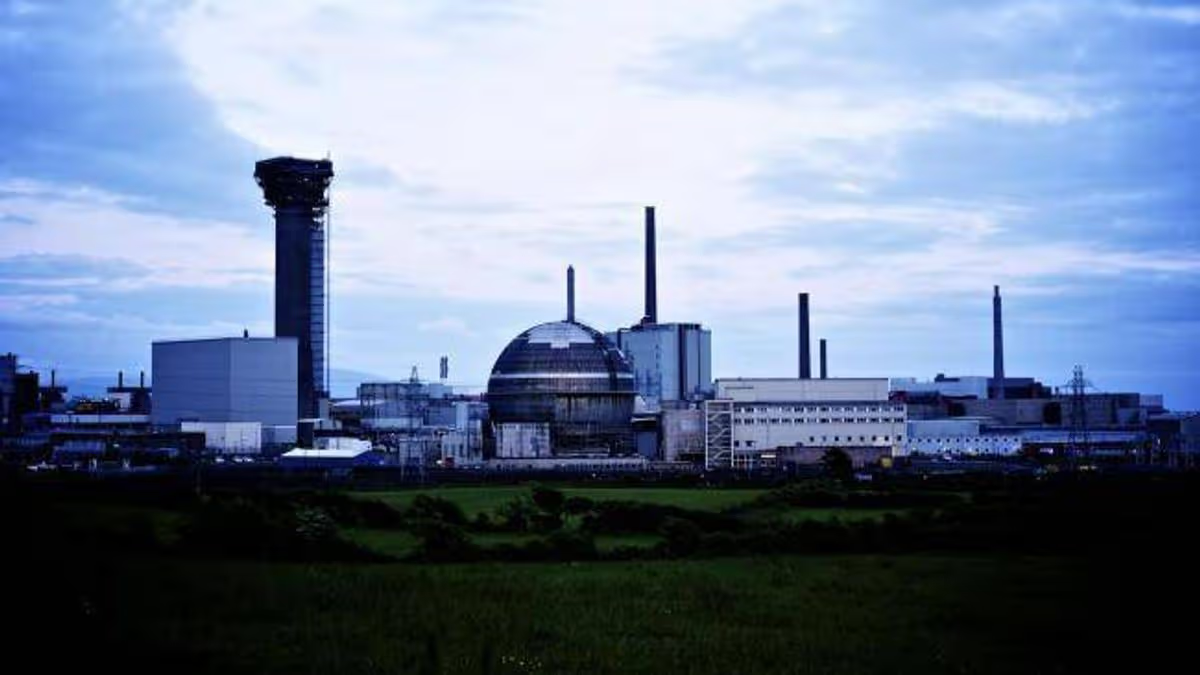
Sellafield site in Copeland

A masterplan is being developed for the site near Sellafield(Image: Local Democracy Reporting Service)

A West Cumbrian ‘community-focused’ energy project has been described as a ‘supercomputer for west Cumbria’ at a meeting in Workington this week.

Advertisement

Members of Cumberland Council’s nuclear issues board met at Allerdale House on Monday (March 23) where they considered the Pioneer Park project.

Members were told by a nuclear industry advisor that a masterplan for the project was being developed which will outline the status of the land (which sits adjacent to Sellafield), how it will be developed and how the power would be used.

He said there were two or three credible developers and it was expected that they would be approached in September, adding that the development would have to be powered using small modular reactors (SMRs) as renewables were not viable.

According to the report, the purpose of the project is to diversify the west Cumbrian economy and provide a wide range of job opportunities to all elements of the community for its long-term future. It adds: “We will be using the power generated at Pioneer Park to attract inward investment, as opposed to providing power to the national grid.”

Advertisement

It has been proposed that the SMRs could power an AI system or data centre. Cllr Joseph Ghayouba (Bransty, Labour) said such developments were very ‘thirsty’, because they needed large volumes of water for cooling purposes, and they would have to be operated by people in specialised jobs so it would be important to train young people with the right skills.

The nuclear industry advisor said that 200 acres would be sufficient to accommodate the facility, with 400 acres available. He added: “It’s just a question of which 200 acres.”

He said it was a priority that the project should disrupt the Sellafield programme. Cllr Andy Pratt (Millom Without, Conservative) asked if placing a data centre would put the area at risk. Cllr Mark Fryer (St Johns and Great Clifton, Labour), the leader of the council, said it would not because security there was already high.

The report states that BEC (Energy Coast West Cumbria Ltd, a profit-for-purpose property developer and regeneration specialist) launched the Pioneer Park Prospectus and the initial market engagement process in early August, with the market engagement being successfully completed in late October, following discussions with more than 40 interested parties.

Advertisement

According to the report, these organisations included:

  • Developers;
  • SMR sellers (including all four Great British Energy – Nuclear shortlisted technologies);
  • Renewable energy sellers;
  • Low carbon industrial organisations (Hydrogen, Sustainable Aviation Fuels);
  • Data centre/digital services providers; and
  • Potential delivery partners.

The report concludes that there is significant market interest in Pioneer Park and it adds: “Given the constraints of the land available, only SMRs can deliver the power that will be required to attract inward investment to our community and diversify the economy.

“Small pockets of renewables (wind/solar PV) may be feasible on land that is unsuitable for SMR construction.

“Given the geographical and infrastructure constraints of west Cumbria, a digital technology-based economy is preferrable and more likely to succeed than a large scale clean industrial (hydrogen or sustainable aviation fuel generation) based economy (though there is potential for a single mid-range industrial facility alongside the data-led economy).

“The scale of land that has been designated in EN6 for new nuclear power generation and is being offered by the Nuclear Decommissioning Authority (NDA) for Pioneer Park, is sufficient to host three or more of most SMRs plus large-scale data centres.”

Advertisement

According to the report the shape of the land currently being offered is restrictive to development and it states: “This will be addressed through the masterplan process. There is significant market interest in the prospect of a nuclear-powered AI Growth Zone and data/technology led economic diversification in Cumberland.

“All organisations that BEC engaged with in the digital technology sector have unanimously recommended an interim solution to power early data centre deployment ahead of the construction and operation of SMRs and larger scale data centre deployment.

“Given the capacity limitations of the local grid, there will need to be a careful balance between generating sufficient energy to attract inward investment and over generation. This will influence the SMR technology selection.

“There are very few credible developers in the market that are close to being funded. This is our biggest risk to delivery. As the first-of-a-kind nuclear powered AI Growth Zone, we can transform the Pioneer Park project into a product that is scalable and exportable for the wider UK economy.

Advertisement

“The consistent message from SMR vendors and developers is that the project timescale to the start of reactor operations will be in the order of 10 years.

“While we will be aiming for up to 1Gw generating capacity, BEC is holding constructive discussions with a micro-reactor vendor that may give us an opportunity for smaller scale SMR and data centre deployment on an earlier timescale.”

To find all the planning applications, traffic diversions, road layout changes, alcohol licence applications and more in your community, visit the Public Notices Portal.

Advertisement
Continue Reading

Business

Ford recalls 254,640 SUVs over driver-assist software issues

Published

on

Ford recalls 254,640 SUVs over driver-assist software issues

Ford Motor is recalling 254,640 SUVs in the U.S. due to a software defect that can disable rearview cameras and key driver-assistance safety features, according to the National Highway Traffic Safety Administration (NHTSA).

The issue stems from an unexpected reset of the vehicle’s image processing software, which may cause the rearview camera image to fail and disable advanced driver-assistance systems (ADAS) such as pre-collision assist, lane-keeping assist and blind-spot monitoring.

Advertisement

Regulators warn that the loss of these systems can reduce a driver’s ability to detect hazards, increasing the risk of a crash.

The recall affects certain 2022–2025 Lincoln Navigator, 2024–2025 Lincoln Nautilus, 2025 Lincoln Aviator and 2025 Ford Explorer vehicles.

FORD IN DEEP WATER AFTER SWEEPING RECALLS HIT EVERY MODEL SINCE 2020 – WITH ONE EXCEPTION

Ford Explorer vehicles at a Ford dealership

Ford Explorer vehicles at a Ford dealership in Richmond, California, on Wednesday, April 16, 2025. (David Paul Morris/Bloomberg via Getty Images)

According to NHTSA filings, the problem is linked to the Image Processing Module A (IPMA), which can become overloaded when tracking a high volume of moving objects – such as in dense urban traffic – triggering a system reset. In some cases, repeated resets over multiple ignition cycles can lead to a persistent loss of functionality.

Advertisement
Ford logo

Ford Motor Co. signage is displayed outside a dealership as the General Motors headquarters building stands in the distance in Detroit, Michigan. (Jeff Kowalsky/Bloomberg via Getty Images )

Drivers may see warning messages such as “Front Camera Fault,” “Pre-Collision Assist Not Available” or “Lane-Keeping System Off” when the issue occurs, and blind-spot indicators may also illuminate.

Ford said it is not aware of any crashes, injuries or fires related to the defect.

The automaker plans to fix the issue through a software update to the IPMA system, which will be provided either through over-the-air (OTA) updates or at dealerships free of charge.

Owner notification letters are expected to be mailed beginning March 30, 2026, and affected vehicle identification numbers will be searchable on NHTSA’s website starting March 25.

Advertisement
ford logo

Ford said it is not aware of any crashes, injuries or fires related to the defect. (David Paul Morris/Bloomberg via Getty Images)

The recall highlights the auto industry’s growing reliance on software to power core vehicle safety systems, as well as the challenges that can arise when those systems fail or behave unpredictably in real-world driving conditions.

Advanced driver-assistance features have become increasingly common across new vehicles, with regulators requiring certain technologies – such as rearview cameras – in all new cars sold in the U.S.

CLICK HERE TO GET FOX BUSINESS ON THE GO

Consumers can check whether their vehicle is included in the recall by visiting NHTSA’s website or contacting Ford customer service.

Advertisement
Continue Reading

Business

Fuel shortages force cancellation of Karijini Experience festival

Published

on

Fuel shortages force cancellation of Karijini Experience festival

A lack of fuel has forced organisers to can an annual traditional owner-led festival in Karijini National Park.

Continue Reading

Business

The Marzetti Co. introduces salad dressings

Published

on

The Marzetti Co. introduces salad dressings

The Simply Dressed line includes seven varieties.

Continue Reading

Business

Somerset’s Hinkley Point C nuclear plant announces new chief executive

Published

on

Business Live

The power station’s current CEO is stepping down after 40 years

Mark Hartley is the new boss of Hinkley Point C

Mark Hartley is the new boss of Hinkley Point C(Image: EDF)

French energy giant EDF has named the new boss of its Somerset nuclear power plant, Hinkley Point C. Mark Hartley’s appointment comes as current chief executive Stuart Crooks steps down from the role after 40 years.

Mr Hartley is currently managing director of EDF’s nuclear operations, which runs Britain’s operational nuclear power stations at Sizewell B, Heysham, Torness and Hartlepool.

He is returning to the Bridgwater plant where he was technical director for five years until 2023. His position in nuclear operations will be taken up by John Munro – a director in that division of the business.

Meanwhile, it is understood Mr Crook, who was awarded a CBE for services to nuclear in 2019 and also has a French order of merit for his work within the industry, will continue to be “closely connected” to the nuclear sector.

Advertisement

He will continue as a non-executive board member for Sizewell C and within EDF’s nuclear operations business, and in his role as an advisor to the Cottam Small Modular Reactor (SMRs) project in Nottinghamshire.

EDF chief executive Simone Rossi said: “This carefully planned transition demonstrates the depth, resilience and maturity of our nuclear organisation and our ability to develop world class nuclear leadership.

“It will enable us to deliver our ambitious nuclear plans in Britain at our existing power stations and in nuclear new build.

“I want to thank Stuart for his outstanding service to the UK industry. He has driven the replication strategy that has seen significant performance improvements in the second unit at Hinkley Point C and enabled the start of Sizewell C, which will benefit from everything learned at Hinkley Point C.

Advertisement

“His contribution to the nuclear renaissance is profound and I am pleased that he will continue to offer his expertise in a non-executive capacity.”

Hinkley Point C is Britain’s newest nuclear power station and is due to be open by 2031. It is set to provide six million UK homes with zero-carbon electricity when completed but has been plagued by cost overruns and delays since it received government approval a decade ago.

Originally the project was expected to be finished by 2025 at a cost of around £18bn, but current estimates suggest the total price tag could reach nearly £46bn. The workforce at the Bridgwater project is likely to reach its peak this year, with an estimated 15,000 individuals working on the construction between 2026 and 2028.

In January, the second nuclear reactor arrived at the power plant in a milestone hailed by EDF as a “major moment”. The first reactor arrived at Hinkley three years ago and is already installed and welded in place on the first reactor building.

Advertisement
Continue Reading

Trending

Copyright © 2025