Connect with us

Business

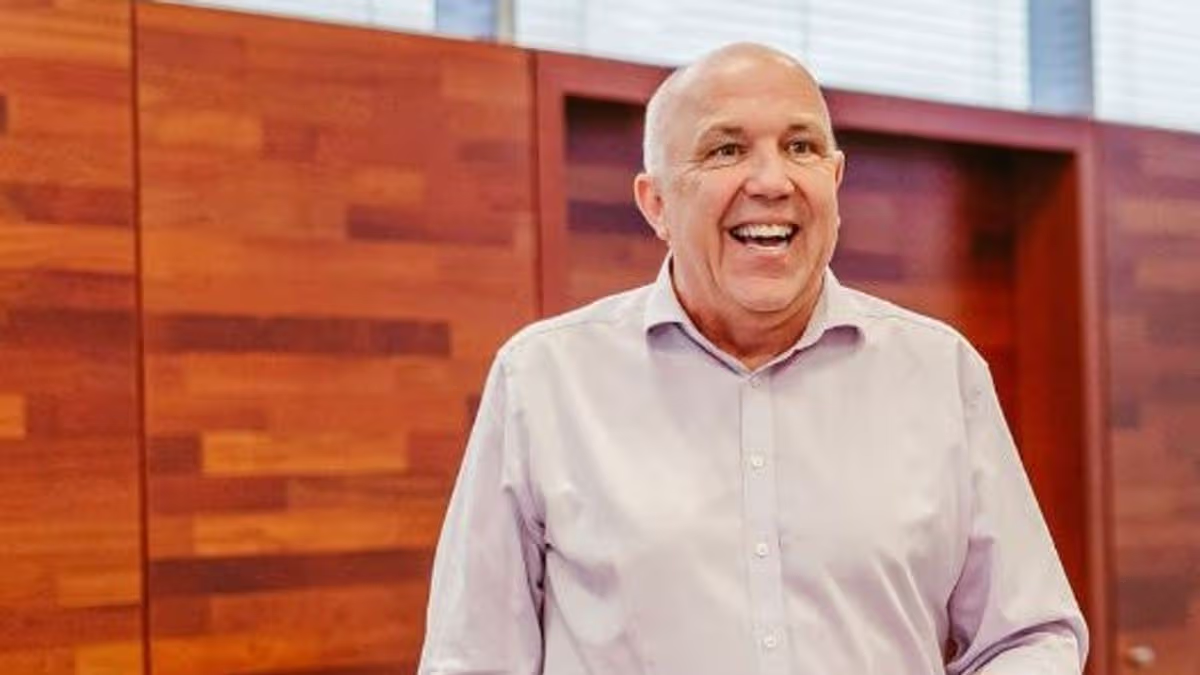
Caulipower introduces new entrees

Published

on

Caulipower introduces new entrees
Continue Reading
Click to comment

Leave a Reply

Your email address will not be published. Required fields are marked *

Business

Canara Bank eases overnight, 1-month MCLR by 5 bps

Published

on

Canara Bank eases overnight, 1-month MCLR by 5 bps
Mumbai: Canara Bank has reduced its one month and overnight MCLR rates by five basis points to 7.90% and 7.85% respectively. The revised rates, which means cheaper borrowing costs, will take effect from February 12. MCLR (marginal cost of funds based lending rate) is the minimum interest rate a bank must charge for loans, introduced by the RBI to ensure transparent, faster interest rate transmission. The reduction in MCLR rates comes amid a demand for credit, both by retail and who-lesale participants.

Continue Reading

Business

The Evolving Role of Private Equity and Supply Chains

Published

on

Steering Through 2026's Contrasting Fortunes

Private equity activity in Asia reflects the broader market’s K-shaped dynamics. Larger, well-capitalized global and regional funds continue deploying capital into quality assets, while mid-market funds face more challenging conditions.

The expansion of private credit in the region is providing flexible financing solutions, but access remains concentrated among the most established sponsors and highest-quality deals.

Key Dynamics and Trends in Asia’s M&A Market:

  • Private Equity Landscape:
    • The market exhibits K-shaped dynamics, with well-capitalized global and regional funds actively deploying capital into quality assets, while mid-market funds face greater challenges.
    • Private credit is expanding, offering flexible financing, though access is concentrated among established sponsors and top-tier deals.
    • AI readiness has become a crucial due diligence factor, with investors dedicating 30-40% of investment committee time to evaluating portfolio companies’ AI strategies; those lacking clear AI pathways face valuation discounts.
    • A growing backlog of aging portfolio companies beyond their original investment horizons is creating mounting exit pressure, with trade sales and secondary buyouts being the primary routes amidst a tentative IPO recovery.
  • Supply Chain Reconfiguration:
    • Geopolitical tensions and trade policy uncertainty are prompting companies to use M&A to build supply chain resilience, reduce dependency risks, and support localization or nearshoring.
    • This drives transactions focused on acquiring manufacturing capacity (e.g., in Vietnam, Thailand, Indonesia, India), logistics infrastructure, and critical inputs.
    • Rising defense and security budgets across Asia are also reshaping capital allocation and M&A in defense-adjacent sectors.

Asian private equity investors report spending 30-40% of investment committee time evaluating portfolio companies’ AI readiness, mirroring patterns observed in Western markets. This focus on AI due diligence represents a fundamental shift in how deals are underwritten. Companies unable to articulate credible AI strategies face valuation discounts, while those demonstrating clear AI-enabled growth pathways command premium multiples.

The region’s private equity firms also confront a growing backlog of aging portfolio companies awaiting exit. With approximately 32,500 companies globally held by private equity beyond their original investment horizons, and Asia representing a meaningful portion of that total, exit pressure is mounting. However, IPO markets in the region show only tentative signs of recovery, leaving trade sales to strategic acquirers or secondary buyouts as the primary exit routes.

Supply Chain Reconfiguration Drives Strategic Deals

Geopolitical tensions and trade policy uncertainty are reshaping Asian M&A in ways distinct from other regions. Companies are using acquisitions to build supply chain resilience, reduce dependency risks, and support localization or nearshoring strategies. This is driving transactions focused on regional manufacturing capacity, logistics infrastructure, and critical inputs.

Advertisement
  • Geopolitical tensions and trade policy uncertainty are prompting companies to use M&A to build supply chain resilience, reduce dependency risks, and support localization or nearshoring.
  • This drives transactions focused on acquiring manufacturing capacity (e.g., in Vietnam, Thailand, Indonesia, India), logistics infrastructure, and critical inputs.
  • Rising defense and security budgets across Asia are also reshaping capital allocation and M&A in defense-adjacent sectors.

According to PwC’s Global CEO Survey, 20% of global CEOs expect their company to be highly or extremely exposed to tariffs over the next 12 months, with exposure highest in economies closely linked to US trade flows, including China, Taiwan, and potentially Southeast Asian nations integrated into Chinese supply chains. 

This tariff exposure is accelerating strategic repositioning. Companies are acquiring manufacturing assets in Vietnam, Thailand, Indonesia, and India to diversify production away from single-country concentration. Others are pursuing vertical integration deals to secure access to critical components and reduce exposure to supply disruptions.

Rising defense and security budgets across Asia, particularly in response to regional tensions, are also reshaping capital allocation priorities. This has implications for industrial supply chains, technology investment, and M&A activity in defense-adjacent sectors, including aerospace, advanced materials, and cybersecurity.

The Domestic Tilt in Asian Dealmaking

One of the most notable shifts in Asian M&A is the increasing preference for domestic over cross-border transactions. While cross-border deal activity picked up selectively in 2025, it grew more slowly than overall market value, highlighting a continued preference for transactions where acquirers have greater familiarity, lower execution risk, and fewer regulatory hurdles.

This domestic tilt reflects multiple factors. Regulatory approval processes for cross-border deals have become more complex and unpredictable. Geopolitical tensions make certain types of transactions politically sensitive. Currency volatility adds additional risk to international deals. And perhaps most importantly, companies find abundant opportunities for consolidation and capability building within their home markets.

Advertisement

The trend varies by country. Japanese companies, facing demographic constraints and limited domestic growth, continue pursuing international acquisitions despite the challenges. Indian companies show growing outbound ambition, particularly in technology and pharmaceutical sectors. Chinese outbound M&A remains constrained by capital controls and regulatory scrutiny, though strategic transactions in critical sectors still receive approval.

Technology Sector Concentration

Technology remains the dominant driver of Asian M&A activity, but the definition of “technology” continues expanding. Traditional software and internet companies are joined by semiconductor manufacturers, electronics producers, industrial automation firms, and healthcare technology businesses, all positioning themselves as technology-enabled enterprises.

This sector convergence mirrors global patterns but carries particular significance for Asia given the region’s concentration of manufacturing and electronics capabilities. Companies that successfully integrate AI into hardware manufacturing, supply chain management, and product development stand to capture disproportionate value in the next phase of technological evolution.

The semiconductor sector deserves special attention. As AI workloads drive explosive demand for advanced chips, Asian semiconductor companies and their suppliers are experiencing unprecedented strategic importance. This is driving both organic investment and M&A activity as companies race to capture value in AI-enabling infrastructure.

Advertisement

Macroeconomic Headwinds and Tailwinds

Asia’s macroeconomic backdrop presents a mixed picture for dealmakers. Growth in major emerging markets, including India and China, is expected to remain relatively strong by global standards, albeit below 2025 levels. However, the OECD projects global GDP growth will slow from 3.2% in 2025 to 2.9% in 2026, creating headwinds for export-oriented Asian economies.

  • Asia presents a mixed macroeconomic picture, with major emerging markets like India and China expecting relatively strong growth, but a projected global GDP slowdown in 2026.
  • Interest rate dynamics vary, with easing in some developed markets but complex inflation and currency pressures in emerging Asia.
  • Private credit is increasingly providing alternative financing, especially for mid-market deals.
  • While public debt has risen, most Asian countries maintain stronger fiscal positions than their Western counterparts, though long-term policy uncertainties remain.

Interest rate dynamics vary across the region. While rates have eased in developed markets like Japan and Australia, emerging Asian markets face more complex inflation and currency pressures. For dealmakers, this creates challenges in financing cross-border transactions and managing currency risk in multi-jurisdictional deals.

Private credit’s expansion into Asia is providing alternative financing sources, particularly for mid-market transactions where traditional bank lending has become more conservative. This development is helping bridge valuation gaps and enabling transactions that might otherwise struggle to secure financing.

Public debt levels across many Asian economies have risen since the pandemic, though most countries maintain stronger fiscal positions than Western counterparts. Still, elevated debt burdens and evolving policy priorities add longer-term uncertainty around taxation, regulation, and government spending that dealmakers must consider in their underwriting.

The Path Forward for Asian Dealmakers

Asian companies and investors face a critical juncture. The forces reshaping global M&A, particularly AI investment and the premium placed on scale, are not temporary dislocations but structural shifts likely to define dealmaking for years to come.

Advertisement

For Asian corporations, several imperatives emerge. First, capital allocation discipline becomes mission-critical as companies balance AI investment requirements against traditional growth strategies. Second, developing clear AI strategies and road maps is no longer optional but essential for maintaining competitiveness and valuation. Third, companies must honestly assess whether they’re better positioned as acquirers or targets in their industries’ consolidation waves.

For private equity investors in the region, the message is equally clear. Winning deals will increasingly depend on articulating how acquisitions accelerate AI capabilities and digital transformation. Portfolio value creation will require active support for companies’ AI journeys, not just operational improvements. And exit planning must account for the reality that buyers will heavily scrutinize targets’ technological readiness.

Regional financial advisors and investment banks must evolve their capabilities to support clients navigating this transformation. Traditional M&A advisory focused on valuation, structuring, and deal execution now requires deep technical expertise in AI due diligence, scenario modeling for AI-disrupted business models, and strategic positioning for technology-driven consolidation.

A Region at the Crossroads

Asia’s M&A market stands at a crossroads. The region possesses tremendous strengths: high growth rates, large domestic markets, world-class manufacturing capabilities, and increasing technological sophistication. These advantages position Asian companies well for the AI era, provided they can mobilize capital, talent, and strategic vision effectively.

Advertisement

Yet challenges are equally significant. Geopolitical tensions constrain cross-border dealmaking. Regulatory uncertainty complicates execution. Confidence remains uneven across markets. And the sheer scale of AI investment required risks overwhelming companies lacking access to deep capital pools.

The 10% increase in Asian deal values during 2025 represents progress, but it also highlights the region’s underperformance relative to the Americas’ 55% surge. As AI-driven dealmaking accelerates globally, Asia risks falling behind if companies and investors don’t move more aggressively to acquire capabilities, consolidate fragmented markets, and position for the innovation supercycle likely to emerge as AI productivity gains materialize.

The K-shaped market dynamic offers no middle ground. Asian companies and markets will either accelerate their participation in transformative dealmaking or watch competitive advantages flow to better-capitalized, more technologically advanced rivals. In a world where AI readiness increasingly determines valuation and where megadeals concentrate value creation, scale and speed matter more than ever.

For Asia’s dealmakers, the message is unambiguous: the window for strategic repositioning is narrowing. The companies and markets that move decisively to acquire AI capabilities, pursue transformative consolidation, and invest in technological infrastructure will emerge as leaders. Those that wait for perfect conditions or clearer signals risk finding themselves on the wrong side of the K-curve, watching the future unfold from an increasingly disadvantaged position.

Advertisement

Continue Reading

Business

Multiplex likely to build Blackburne’s $461m Karrinyup project

Published

on

Multiplex likely to build Blackburne’s $350m Karrinyup project

The luxury apartment development looks to be finally going ahead, following its approval three and a half years ago.

Continue Reading

Business

Israel to join Trump’s ’Board of Peace’, Netanyahu says

Published

on

Israel to join Trump’s ’Board of Peace’, Netanyahu says


Israel to join Trump’s ’Board of Peace’, Netanyahu says

Continue Reading

Business

Trump excludes two Democrats from US governors’ meeting invite

Published

on

Trump excludes two Democrats from US governors’ meeting invite


Trump excludes two Democrats from US governors’ meeting invite

Continue Reading

Business

Barron Trump listed as business partner in new beverage company

Published

on

Barron Trump listed as business partner in new beverage company

Barron Trump is listed in public records as a director of a new beverage business based near Mar-a-Lago.

Filings submitted last month in Florida and Delaware show that Barron Trump is one of five directors of SOLLOS Yerba Mate Inc., described by one of its directors as a “yerba mate beverage company” and headquartered just minutes from the Trump family’s Mar-a-Lago Club in Palm Beach. 

Advertisement

Yerba mate – a caffeinated herbal tea popular in Brazil, Argentina, Uruguay and Paraguay – has gained traction in the U.S. as a coffee alternative.

FOX Business was unable to independently confirm that the Barron Trump named in the filings is the 19-year-old son of President Donald Trump.

BARRON TRUMP BUSINESS PARTNER CLARIFIES FUTURE OF LUXURY REAL ESTATE VENTURE: ‘WILL NOT BE RELAUNCHED’

Barron Trump fist pump

Barron Trump gestures during a rally on the inauguration day of President Donald Trump in Washington, D.C., on Jan. 20, 2025. (Mike Segar/Reuters)

U.S. Securities and Exchange Commission (SEC) filings show the company raised $1 million through a private placement, as first reported by Newsweek.

Advertisement

In addition to Barron Trump, the documents list Spencer Bernstein, Rudolfo Castello, Stephen Hall and Valentino Gomez as directors – two of whom appear to have attended high school with the president’s son.

Bernstein, a Villanova University student who previously attended Oxbridge Academy in Palm Beach with Barron Trump, described SOLLOS on LinkedIn as “a lifestyle beverage brand built around clean [and] functional ingredients.”

A LOOK AT THE TRUMP FAMILY’S BUSINESS EMPIRE

Yerba Mate trees field

Yerba mate trees grow in Colonia Liebig, Argentina, on Aug. 7, 2025. (Natalia Favre/Bloomberg via Getty Images)

“I’ve decided to postpone my final semester at Villanova University to focus on something I’ve been building for the past 8 months,” Bernstein wrote last month. “Since the end of last school year I have been working alongside my co-founder, Stephen Hall, and a few close friends on SOLLOS Yerba Mate.”

Advertisement

Hall, now a student at the University of Notre Dame who also attended Oxbridge Academy, said the beverage company is preparing for a spring consumer launch

An official launch date has not been announced. 

The company marks the latest business venture tied to Barron Trump, a sophomore at New York University’s Stern School of Business.

HERE’S HOW MUCH TRUMP ACCOUNT BALANCES COULD GROW OVER TIME

Advertisement
Yerba Mate cans

Display of various containers of Yerba Mate in Duncans Mills, California, on June 8, 2025. (Smith Collection/Gado/Getty Images)

In July 2024, Barron Trump and two partners – including a former classmate – incorporated a real estate firm, Trump, Fulcher & Roxburgh Capital Inc., in Wyoming. The company was dissolved on Nov. 14, 2024, days after the presidential election.

GET FOX BUSINESS ON THE GO BY CLICKING HERE

The White House, first lady Melania Trump’s office, Stephen Hall and Spencer Bernstein could not be immediately reached by FOX Business for comment.

FOX Business’ Louis Casiano contributed to this report.

Advertisement
Continue Reading

Business

Titan Interactive’s collapse continues in Federal Court

Published

on

Titan Interactive’s collapse continues in Federal Court

A dispute between a liquidator and Pitcher Partners over Titan Interactive’s collapse has continued, with the court having mulled an injunction against the accounting firm.

Continue Reading

Business

Scrap proposed England holiday tax, hospitality bosses urge

Published

on

Scrap proposed England holiday tax, hospitality bosses urge

Critics say the proposed tax could force families to shorten trips or spend their money overseas.

Continue Reading

Business

Microfinance shows spark but shrinks to lowest in 3 years

Published

on

Microfinance shows spark but shrinks to lowest in 3 years
Kolkata: The microfinance market contracted to ₹3.22 lakh crore at the end of December 2025, reflecting a 6% quarter-on-quarter and 16% year-on-year drop, despite showing improved loan recovery and signs of business normalisation by large lenders, showed quarterly data from credit bureau Equifax. This is the lowest level seen in the past three years.

The sharp decline in the third quarter of this financial year resulted from a bulk reclassification of micro loans as retail loans by one of the private sector banks with significant microfinance exposure, said three people aware of the matter.

The gross loan portfolio stood at ₹3.42 lakh crore at the end of September last year. At the end of November, it was ₹3.40 lakh crore.

Besides, the cumulative loan disbursement is yet to offset the size of loan rundown, said industry executives. The strategy of acceleration in writing off bad loans was another reason behind the yearly decline of loan portfolio at the aggregate level, even as some large non-banking financial company-micro finance institutions (NBFC-MFIs) showed higher loan disbursement and annual growth in the portfolio after the end of the third quarter.

Advertisement

“At the sectoral level, the book run-down, including loan write-offs is still higher than total loan disbursement, which is the reason behind the contraction in the overall microfinance market,” Sanjay Garyali, managing director at Fusion Finance, told ET.


Bandhan Bank, for instance, sold bad loans worth ₹3,212 crore to asset reconstruction companies. Of those, micro loans accounted for ₹2,800 crore.

Microfin Shows Spark but Shrinks to Lowest in 3 YrsAgencies

Microfin market sees 16% YoY drop in Q3; Loan reclassification as retail hits numbers

The microfinance market peaked at ₹4.43 lakh crore in the quarter to March 2024. Thereafter, there has been a steady fall every quarter as lenders across the spectrum slowed lending to the bottom of the pyramid borrower segment which was largely overleveraged and witnessing a surge in defaults. The industry experienced a year-on-year contraction in disbursement in 2025, with volume declining 34% and value decreasing 24%, according to an Equifax report.

The number of active loans declined 9% quarter-on-quarter and 23% year-on-year to 107.4 million, the data showed.

The lenders are also shifting their focus on providing gold jewellery-backed loans instead of collateral-free loans to the same customer segment, leading to the fall in micro loan disbursement year-on-year, said Subhankar Mishra, head of strategy at Equifax India.

Advertisement

The December quarter, however, saw a modest increase in disbursements to Rs 61,000 crore from Rs 56,535 crore in the preceding quarter, signalling business normalisation, as per industry level data collated by Crif High Mark data. The gross loan portfolio declined to Rs 3.21 lakh crore at the end of December from Rs 3.46 lakh crore three months prior, said people aware of the matter. Crif High Mark did not respond to ET’s queries seeking details.

Small finance banks such as ESAF, Equitas, Jana and Ujjivan reported quarter-on-quarter growth in their respective micro loan asset portfolios at the end of December.

CreditAccess Grameen, India’s largest NBFC-MFI, also reported a quarter-on-quarter increase in gross loan portfolio. The signs of business normalisation led to recovery of share prices for several microfinance lenders over the past few weeks.

Bandhan Bank shares surged 17% in the past one month to Rs 168.25 apiece on BSE. Shares of Fusion Finance jumped 17.4% to Rs 194 each, while Satin Creditcare Network saw a 5% increase in share price to Rs 155.10 each during this period.

Advertisement

Spandana Sphoorty Financial, which cut net loss to Rs 93 crore in the December quarter from Rs 249 crore in the preceding three-month period, saw a 9% increase in share prices in a month to Rs 264.5 apiece.

At the end of 2025, NBFC-MFIs controlled 40.9% of the market, followed by private banks (25.6%), small finance banks (16.9%) and other NBFCs (14%). The balance 2.6% was with notfor-profit entities.

Continue Reading

Business

NewsGuild battles New York Times over hybrid work, ‘wrongly excluding jobs’ from union and health fund

Published

on

NewsGuild battles New York Times over hybrid work, ‘wrongly excluding jobs’ from union and health fund

FIRST ON FOX — The NewsGuild of New York is irked at The New York Times leadership. 

The Times Guild Bargaining Committee sent staffers a newsletter on Tuesday detailing the latest labor negotiations. The Guild said it made a “big push to end the two-tier system The New York Times created and perpetuates by wrongly excluding jobs and workers from the Times Guild” and received a revised proposal from the company to end all hybrid work guarantees on March 1, 2027. 

Advertisement

“At that point, they would have the right to require us to work in the office five days a week and to eliminate our contractually guaranteed three weeks of remote work per year. As we saw this fall: If the company can reduce our guaranteed remote-work days, they will. But when asked for data on how in-office work makes our news product, advertising and business operations better, the management side of the table was silent,” the Guild wrote in the email obtained by Fox News Digital

JONATHAN TURLEY: NY TIMES COLUMNIST SINKS TO SICK NEW LOW MOCKING JD VANCE’S MOM

New York Times building NYC New York City

The NewsGuild of New York and The New York Times leadership held a bargaining session on Tuesday.  (Beata Zawrzel/NurPhoto via Getty Images)

“On our side, we made a big push to end the two-tier system The New York Times created and perpetuates by wrongly excluding jobs and workers from the Times Guild. Today, we asked the company to recognize more than 50 of our colleagues’ proper place in our bargaining unit, people with whom we work side by side as members of the Times Guild,” the Times Guild Bargaining Committee continued. “Keeping union work in the union is one of our core priorities.”

The Guild believes positions including audio engineers, puzzle editors, audience and SEO editors, bureau chiefs based in cities across the country and editors on the Newsroom Development and Support team deserve “the same critical protections and benefits we have fought for under our union contract” and listed “annual raises, just cause job protections, hour-for-hour overtime or comp time and minimum salaries for each position” as key examples. 

Advertisement

“One of the five core priorities we all identified for this contract campaign is keeping union work in our union. These wrongly excluded jobs represent another way the company has undercut our union by arbitrarily excluding colleagues who are doing the same work as us, thus creating a two-tier system of pay and benefits,” the Guild wrote. 

NY TIMES WALKS BACK STANCE ON MARIJUANA LEGALIZATION, ADMITS LOOSENING OF POLICIES HAS MADE COUNTRY WORSE OFF

New York Times

The Times Guild Bargaining Committee sent staffers a newsletter on Tuesday detailing the latest labor negotiations.  (Getty Images)

The Guild told members it proposed that the Times should give the Guild 30 days notice when it creates a new job “whether such job falls within the jurisdiction of the Guild or the position is excluded,” and that any disputes over newly created jobs should be “referred to the expedited arbitration provisions utilizing the parties’ Jurisdiction panel of arbitrators on a rotational basis.”

The Guild wants the Times to supply it with a description of the duties, responsibilities, proposed classification and effective date of a new job. The Guild is also asking it to be clearly noted that open jobs are Guild-represented positions when posted internally or externally, and for 30-days’ notice when individuals currently represented by the Guild are transferred to Guild-excluded positions.

Advertisement

“We received the company’s responses to our requests for information related to several of our core issues in these negotiations: badge-swipe surveillance being used to enforce in-office expectations; the company’s existing and planned uses of artificial intelligence; and the creation of a two-tier system by excluding The Athletic from our union,” the Times Guild Bargaining Committee wrote.

“Unfortunately, management declined to respond — nearly across the board — in detail to our requests, instead dismissing our questions as ‘overly broad,’ ‘speculative,’ ‘unduly burdensome,’ and ‘not relevant,’” they added. 

DHS LASHES OUT AT NY TIMES AFTER REPORT CLAIMING PREGNANT WOMEN IN MINNEAPOLIS ‘HIDING FROM ICE’

New York Times Guild

Members of the Times Tech Guild picket outside the New York Times headquarters in New York on Nov. 4, 2024. (Yuki Iwamura/Bloomberg via Getty Images)

The Guild also told members that the Times “updated its proposal for financing our health fund,” but dismissed the notion it would “bankrupt the fund.” 

Advertisement

“We understand that. It still goes back to [cost] sharing and responsibility,” Times Executive Director for Labor Relations Chris Biegner told the Guild, according to the newsletter distributed to members. 

“In their counter to our performance evaluation proposal, management rejected several of our proposed changes, including exemptions from the rating system for employees who take a certain amount of leave, transparency about who (such as desk heads, masthead editors and H.R.) contributed to an employee’s evaluation, and shifting the review period so that it covers a full year of work,” the Guild wrote. 

The next bargaining session is scheduled for Feb. 18. The current contract expires at the end of the month. 

The Guild told members it proposed that the Times should give the Guild 30 days notice when it creates a new job “whether such job falls within the jurisdiction of the Guild or the position is excluded.”

When reached for comment, The New York Times provided Fox News Digital with a series of internal notes that managing editors Marc Lacey and Carolyn Ryan have sent to Times Guild unit members. 

Advertisement

In January, Lacey and Ryan said conversations have been “productive,” but feel too much focus is being spent worrying about staffers who are not members of the Guild. The Athletic, a separate entity with its own leadership team that is owned by the Times, has been a sticking point. 

“In the room, the Guild indicated that they would not accept any contract terms that don’t cover The Athletic joining The New York Times newsroom bargaining unit. We fear that setting this condition undermines the path to getting to a good deal any time soon,” Lacey and Ryan wrote last month after the first negotiating session. 

CLICK HERE TO DOWNLOAD THE FOX BUSINESS APP

“The company has said many times that we would recognize unionization for Athletic employees as a separate unit if they choose to pursue it,” they continued. “We also want to state up front that we don’t think we should hold up a new contract and higher salaries for some 1,500 Times Guild employees because of a demand to incorporate employees from an entirely separate newsroom.”

Advertisement

Lacey and Ryan have insisted they would like to reach a deal.

The Athletic publisher David Perpich previously stated that he believes “the best approach is to have The Athletic’s journalists form a separate bargaining unit within the NewsGuild, not to have them absorbed into the Times unit.”

Continue Reading

Trending

Copyright © 2025