
Business
Coca-Cola (KO) Q1 2026 earnings


Bottles of Coca-Cola for sale at a store in LaBelle, Florida, Feb. 8, 2026.
Zak Bennett | Bloomberg | Getty Images
Coca-Cola on Tuesday reported quarterly earnings and revenue that topped analysts’ expectations, fueled by higher demand for its beverages.
For the full year, Coke is now projecting comparable earnings per share growth of 8% to 9%, up from its prior forecast of 7% to 8%. It reiterated its previous outlook of organic revenue growth of 4% to 5%.
Shares of the company rose more than 2% in premarket trading.
Here’s what the company reported compared with what Wall Street was expecting, based on a survey of analysts by LSEG:
- Earnings per share: 86 cents adjusted vs. 81 cents expected
- Revenue: $12.47 billion adjusted vs. $12.24 billion expected
Coke reported first-quarter net income attributable to shareholders of $3.92 billion, or 91 cents per share, up from $3.33 billion, or 77 cents per share, a year earlier.
Excluding impairment charges and other items, the beverage giant earned 86 cents per share.
The company’s adjusted net sales climbed 12% to $12.47 billion. Coke’s organic revenue, which strips out acquisitions, divestitures and currency, rose 10% in the quarter.
The company’s unit case volume increased 3% globally. The metric excludes pricing to reflect demand more accurately.
In the past few quarters, Coke executives have reported weaker demand from budget-conscious consumers. However, premium brands like Fairlife and Smartwater have stayed strong in the current K-shaped economy, boosted by high-income shoppers who aren’t feeling the same pinch as low-income consumers.
All of Coke’s operating segments reported volume growth for the quarter, including its home market. The company’s volume in North America increased 4%.
Across the portfolio, Coke’s water, sports, coffee and tea segment reported the strongest global growth. The division saw volume rise 5%, fueled by stronger demand for its tea and bottled water.
The sparkling soft drinks division reported that volume increased 2%, fueled by a 13% jump for Coca-Cola Zero Sugar.
The laggard of the portfolio this quarter was Coke’s juice, value-added dairy and plant-based beverage segment, which reported a volume decline of 1%. Growth in Fairlife and Santa Clara, a Mexican dairy brand, was not enough to offset the sale of the company’s finished product operations in Nigeria last year.

Business
Kiniksa Pharmaceuticals International, plc 2026 Q1 – Results – Earnings Call Presentation (NASDAQ:KNSA) 2026-04-28


Seeking Alpha’s transcripts team is responsible for the development of all of our transcript-related projects. We currently publish thousands of quarterly earnings calls per quarter on our site and are continuing to grow and expand our coverage. The purpose of this profile is to allow us to share with our readers new transcript-related developments. Thanks, SA Transcripts Team
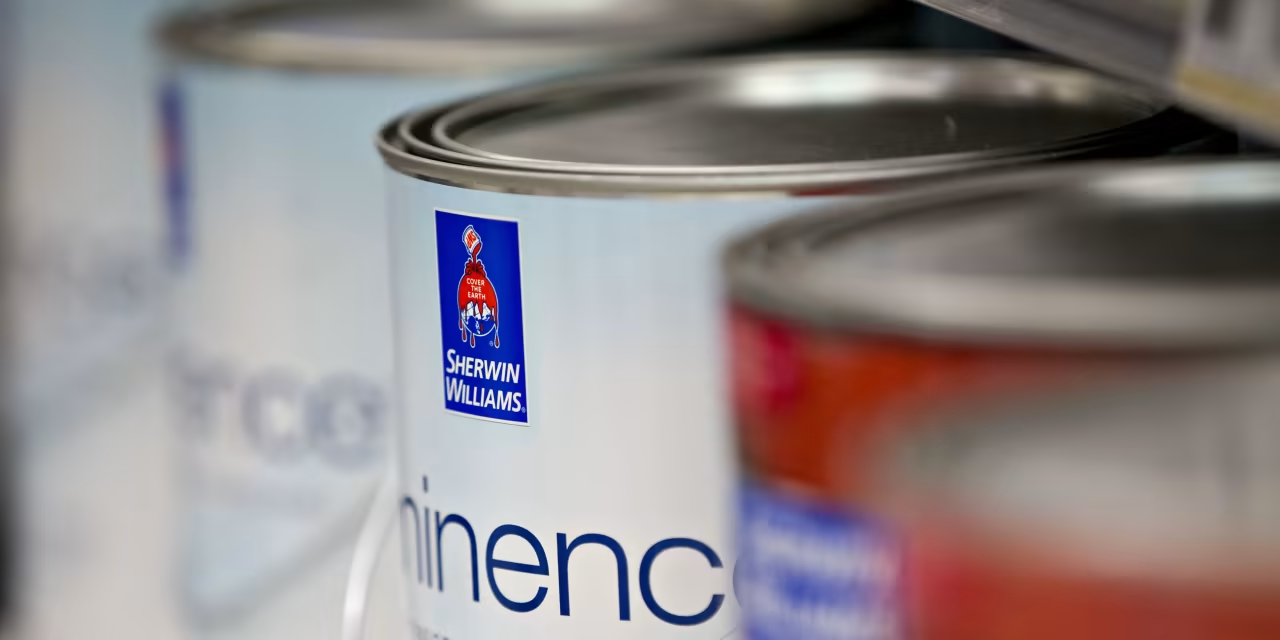
Sherwin-Williams Beat Earnings Forecasts. Why the Stock Is Sliding.

Comedian Bill Maher criticized democratic socialists like Sen. Bernie Sanders, who argue that the rich ‘don’t pay their fair share’ in taxes.
Even for liberal HBO host Bill Maher, the math behind Tax Day no longer adds up.
Maher took to his platform on “Real Time” to sound the alarm on a staggering personal tax burden that he says claims the majority of his earnings, sparking a wider debate on whether the American government is simply “incompetent and corrupt” despite a $5 trillion revenue stream.
“Last week was Tax Day… I paid to the government, if you add in state tax, local, sales, property, fees, Obamacare, probably almost 60% of what I earn. That’s a lot,” Maher said on a recent episode.
“I still wouldn’t mind if Bernie Sanders would stop saying the rich don’t pay taxes,” the host continued. “And while I’m sure the super-rich, with their army of accountants and corporate loopholes, get away with murder, us regular rich people pay a s— ton of taxes!”
CALIFORNIA BILLIONAIRE TAX NEARS BALLOT AFTER UNION COLLECTS NEARLY DOUBLE REQUIRED SIGNATURES
High-income earners in blue states like California, where Maher films his show, face some of the highest combined tax rates across the country. While Democrats often argue the biggest tax hits come from the federal income tax alone, Maher slammed the “hidden” costs that take more than half of your pay.

Bill Maher attends the Vanity Fair Oscar Party at Los Angeles County Museum of Art on March 15, 2026. (Getty Images)
California ranks fifth nationally for the highest state and local tax burden, with the Tax Foundation reporting that residents lose an average of 13.5% of their total income to taxes.
“The top 10% pay 72% of all federal income taxes, and the bottom half, 3%,” Maher noted, with his cited numbers backed by a Tax Foundation analysis of 2022 Internal Revenue Service (IRS) data.
Manhattan Institute senior fellow Chris Rufo joins ‘Varney & Co.’ to discuss new reporting on California’s migrant healthcare policies, including disputed claims over taxpayer-funded gender-affirming care and the state’s response.
“The Democratic socialists talk about socialism like we don’t already have a lot… Not against it, just the same question — how can you be soaking the rich and failing the poor so badly?” he said.
The HBO host further questioned where the money is actually going, pointing to the reliance on charities like Remote Area Medical (RAM) to provide basic care, like dental and medical, that the government — despite its trillions in revenue — is failing to deliver.
GET FOX BUSINESS ON THE GO BY CLICKING HERE
‘The Big Money Show’ discusses New York Gov. Kathy Hochul’s new tax pledge amid fiscal challenges and a homeless shelter debate.
“How can it be that the federal government alone took in over $5 trillion in taxes last year and we still need that? Are we really this incompetent and corrupt?”
“The ultra-rich keep getting ultra-richer,” Maher said. “[Those with] their army of accountants and corporate loopholes [can often find ways to shrink their tax bills].”
Business
Coal India shares rise over 3% after Q4 results: What Jefferies, Morgan Stanley, HSBC and others are saying

Profit before tax for the quarter stood at Rs 14,627 crore, up 12% from Rs 13,070 crore a year earlier, reflecting steady operating performance despite cost pressures. Total income rose 8% to Rs 51,618 crore during the quarter.
EBITDA grew 12% to Rs 17,917 crore, while margins improved to 39% from 36% in the corresponding period last year, indicating stronger operating leverage.
Revenue growth was mainly driven by higher realisations, even as sales volumes remained largely unchanged. Average realisation per tonne rose 6% YoY to Rs 2,290, while total sales volume slipped around 1% to 198.83 million tonnes.
Coal India share price: Should you buy, sell or hold?
Jefferies retained its Buy rating on Coal India with a target price of Rs 500, an upside of 10%. The brokerage stated improving earnings visibility and supportive global coal trends as major factors for the raised target price.

The Wall Street major noted that international thermal coal prices remained rangebound at $95-$115 between January 2025 and February 2026, but have since rallied about 18% from mid-February. Higher global prices are expected to support domestic e-auction realisations, with Jefferies building in e-auction prices of Rs 3,000-Rs 3,200 for FY27-28, compared with Rs 2,907 in the March quarter.
Jefferies has raised its FY27-28 EPS estimates by 2-4%. After a 12% decline in EPS over FY24-26, the brokerage expects earnings to recover, projecting a 5% EPS CAGR over FY26-28.Coal India is currently trading at around 9.3 times FY27E adjusted price-to-earnings, excluding stripping activity adjustments, which is broadly in line with its long-term average of 9.2 times. The stock also offers an attractive dividend yield of about 6%.
Morgan Stanley has maintained its Equal-weight rating on Coal India with a target price of Rs 410, implying a 10% downside, even as the company reported a better-than-expected quarterly performance. EBITDA came in around 6% above its estimates, while adjusted EBITDA, excluding OBR, was nearly 8% ahead of forecasts.
On volumes, FSA sales declined about 4% year-on-year but still came in ahead of estimates. E-auction volumes rose 28% year-on-year, though they remained below expectations. FSA realisations increased around 6% year-on-year, supported by a better grade mix, while e-auction realisations fell about 2% YoY.
HSBC has maintained its Hold rating on the stock with a target price of Rs 440. The brokerage said 4QFY26 earnings came in ahead of expectations, largely driven by higher other income, though restated numbers have made year-on-year and quarter-on-quarter comparisons difficult.
However, it believes elevated inventory levels could limit e-auction premiums going forward and flagged the risk of a significant cost increase if diesel prices rise. HSBC added that Coal India currently lacks near-term earnings catalysts due to an oversupplied domestic coal market, although the stock’s dividend yield continues to support valuations.
Motilal Oswal has maintained its Buy rating on Coal India with a target price of Rs 530, implying a 17% upside from current levels. Analysts expect a volume CAGR of around 4% over FY26-FY28E, with a higher share of e-auction sales likely to support net sales realisation and margins.
The brokerage also highlighted Coal India’s focus on expanding coal-washer capacity to strengthen market share in both coking and non-coking coal segments. Additionally, future expansion in coal mining operations is expected to be funded through internal accruals.
(Disclaimer: Recommendations, suggestions, views, and opinions given by the experts are their own. These do not represent the views of The Economic Times)

The Tony Blair Institute has called on ministers to pull an “emergency handbrake” on Britain’s runaway sickness benefits bill, urging Whitehall to strip cash entitlements from claimants with mild depression, ADHD and other conditions the think tank argues are compatible with work.
In an intervention that will land squarely on the desks of finance directors and HR chiefs across the country, the institute founded by Sir Tony Blair has proposed a new statutory category of “non-work limiting conditions” covering anxiety, stress-related disorders, lower back pain, common musculoskeletal complaints and certain neurodevelopmental conditions. Claimants would receive treatment and employment support in place of benefits, in a shift the TBI insists could be introduced without primary legislation.
The proposals arrive at a critical moment for British employers. The Office for Budget Responsibility forecast in March that spending on health and sickness benefits for working-age adults will hit £78.1bn by 2029-30, a 15 per cent jump on this year’s outlay. With around 1,000 people a day becoming newly eligible for health and disability payments, business groups have grown increasingly vocal about the squeeze on the labour market and the corresponding drag on productivity.
The TBI’s report lands in awkward political territory for the Labour government, which last year tabled plans to tighten disability benefit eligibility only to gut its own proposals after a backbench revolt. Whitehall now points to a review led by Social Security Minister Sir Stephen Timms, expected to report later this year, as the vehicle for any further reform.
Dr Charlotte Refsu, a former GP and the institute’s director of health policy, said the welfare system was “drawing too many people into long-term dependency for conditions that are often treatable and compatible with work, and not doing enough to support recovery”. She added: “A system that leaves people on benefits without timely treatment or a route back to work is not compassionate. It is bad for the country and bad for people’s health.”
Under the TBI blueprint, every claimant would require a formal diagnosis before applying for benefits, and those already on the books would face more frequent and rigorous reassessment. The think tank stopped short of estimating either fiscal savings or the number of claimants who would lose entitlement, but argued any windfall should be ploughed back into employment support and NHS treatment for mental health and musculoskeletal conditions, the two clusters that have driven much of the post-pandemic surge in claims.
YouGov polling of more than 4,000 British adults, commissioned by the institute, found that 54 per cent of voters believe the welfare system is too easy to access and fails to prevent misuse, a finding likely to embolden ministers minded to revisit reform.
For SME owners contending with stubborn vacancies and rising employment costs, the report sharpens a debate that has been simmering in boardrooms since the pandemic. Smaller employers have repeatedly flagged the difficulty of recruiting from the economically inactive cohort, particularly the more than 2.8 million working-age people currently signed off long-term sick. The TBI argues that supporting claimants into “appropriate work” would not only ease the fiscal pressure but also reduce social isolation and improve mobility and independence, a framing that aligns with the back-to-work rhetoric increasingly heard from both Labour ministers and the Conservative and Reform UK opposition.
The proposals have, however, drawn fierce criticism from the disability sector. Jon Holmes, chief executive of the learning disability charity Scope, branded the report “deeply unhelpful and ill-informed”, arguing it ignored “the lived reality of people with a learning disability and plays to a populist trope about welfare”. He warned: “Slapping labels on people and denying them benefits will not tackle the root cause. It will push people into deeper anxiety, misery and poverty. That’s not reform, it’s a recipe for making things worse.”
The Department for Work and Pensions said it had already “rebalanced” Universal Credit to deliver £1bn of savings, with the health-related element for new claimants cut by up to 50 per cent earlier this month. A spokesperson said the department had “increased face-to-face assessments and improved use of NHS evidence, all while ensuring those who genuinely can’t work are always protected”, adding that ministers would “consider the TBI’s report”.
For Britain’s small and medium-sized employers, the question is no longer whether reform comes, but how quickly, and whether it will deliver the workforce uplift that has eluded successive administrations.

Amy Ingham
Amy is a newly qualified journalist specialising in business journalism at Business Matters with responsibility for news content for what is now the UK’s largest print and online source of current business news.


Roll out includes new buns and bread.

The biggest shake up of renting rules in England for 30 years affects millions of people.
Jonas Gustafsson
Chief Executive Officer
Good morning, everyone, and a warm welcome to this 2026 Q1 release call for Hemnet Group. My name is Jonas Gustafsson, and I’m the Group CEO of Hemnet.
With me here on my side today at our headquarters in Stockholm, I have our Chief Financial Officer, Anders Ornulf; and our Head of Investor Relations, Ludvig Segelmark.
As usual, we will go through the presentation that was published on our website earlier this morning during today’s session. I will kick it off with a summary of the main highlights during the first quarter. Thereafter, Anders Ornulf will cover the financial details before I come back in the end to wrap up today’s session.
As always, there will be opportunities to ask questions at the end of the presentation. Today’s session will be moderated by our operator, so please follow the operator’s instructions to ask questions through the provided dial-in details.
So with that, let’s get started, and let’s move on to the next slide, please. Net sales declined by 24.7% in Q1, driven by weak listing volumes throughout the first quarter. Sales were also negatively impacted by a timing shift in revenue recognition related to the rollout in the new commercial proposition and payment model — Sell First, Pay Later — in which we recognize revenues first when properties are sold.

Why now, despite geopolitical uncertainty
Critics have questioned the timing of the deal given global geopolitical headwinds. Ganorkar was direct in his response. There is never a perfect moment for a transformational acquisition, he argued, and the strategic logic of the deal outweighs the short-term noise. The combined entity will gain the ability to commercialise a significantly larger product portfolio across global markets — an opportunity that cannot be indefinitely deferred.
Three growth engines at Organon
Organon’s business is structured across three segments, each with a distinct growth opportunity for the combined company.
The first is women’s health, an innovative, largely branded portfolio operating in a global market estimated at $30–35 billion, growing at 5–7% annually. Ganorkar noted that over 100 pipeline products are currently under development in this space, giving Sun Pharma ample room to in-license and commercialise new assets.
The second is biosimilars, currently growing at 13% and set to accelerate further. Ganorkar pointed to a landmark opportunity: biologics worth approximately $320 billion are set to go off-patent by 2035. Even if just 20% of that converts to biosimilars, it translates to a $60–70 billion market. Organon’s existing global platform — ranked seventh worldwide in biosimilars — gives Sun Pharma an immediate commercial foothold it would have taken years to build independently.
The third is established brands, which make up around 50% of Organon’s business and are currently flat. Sun Pharma plans to inject growth here through line extensions, new formulations, and combination products — a strategy the company has successfully executed before.
Innovative portfolio gets a boost
The combined company’s share of innovative drug revenues will rise from Sun Pharma’s current 20% to 27%. Key focus areas include dermatology, where Organon’s Vtama adds to Sun’s existing Ilumya franchise, as well as ophthalmology and women’s health in-licensing. Several Organon pipeline products are also expected to launch within two to three years of the deal closing.
Integration: Sun has done this before
The integration of a company that doubles your size is a legitimate concern. Satagopan acknowledged this plainly but pointed to Sun Pharma’s track record with Taro and Ranbaxy — two complex acquisitions that were successfully absorbed. The company plans to establish a dedicated integration office immediately, with a timeline running up to the deal’s expected closing in approximately nine months. Key focus areas will include talent assessment, market-by-market opportunity mapping, and cross-cultural alignment.
Debt is manageable, with a clear repayment plan
Organon carries significant debt, which Sun Pharma will refinance. The combined entity’s net debt-to-EBITDA ratio at the time of closing is expected to be around 2.3x — within normal range for a transaction of this scale, according to Satagopan. The two companies together generate roughly $2.5 billion in annual operating cash flow, which will fund both debt servicing and business investment. Satagopan was clear that Sun’s long-standing financial discipline remains intact, and the goal is to return to a net cash-positive position over time.
Margin profile: No deterioration expected
A key investor concern is margin dilution. Satagopan addressed this directly, noting that Organon’s adjusted EBITDA margins are actually slightly higher than Sun Pharma’s current 30%-plus levels. With cost synergies and operational efficiencies being built into the integration plan, the combined entity’s margins are expected to remain healthy.

The UAE leaving Opec is seen as a major blow and potential death knell for the oil cartel.

Seattle’s Sniffies lands $100M investment from Match Group in major bet on sex-positive tech

UK tells Afghans promised sanctuary in Britain they must make their own way to safety

Kiniksa Pharmaceuticals International, plc 2026 Q1 – Results – Earnings Call Presentation (NASDAQ:KNSA) 2026-04-28

Manchester United reach agreement with Casemiro over contract clause amid transfer speculation

US brings back mandatory military draft registration

Steven Gerrard disagrees with Gary Neville over ‘shock’ Chelsea and Arsenal claim | Football


-

 Tech22 hours ago
Register Renaming | Hackaday
-

 Fashion4 days ago
Weekend Open Thread – Corporette.com
-
 Crypto World3 days ago
Hyperliquid $HYPE Rally Builds Momentum as AI Sector Enters Prove-It Phase
-

 Politics6 days ago
Making troops accountable for war crimes threatens US alliance, ex-SAS colonel warns
-

 Politics6 days ago
Disabled people challenge government SEND proposals over segregation concerns
-
 Business5 days ago
Patterson-UTI Energy, Inc. (PTEN) Q1 2026 Earnings Call Transcript
-

 Business6 days ago
Rolls-Royce Voted UK’s Most Iconic Trade Mark as IPO Register Hits 150
-
 Sports2 days ago
IPL 2026: Ruturaj Gaikwad registers slowest fifty of the season, enters all-time unwanted list | Cricket News
-

 Crypto World7 days ago
New York sues Coinbase, Gemini over prediction market offerings
-

 Politics18 hours ago
Drax board avoid their own AGM, accused of greenwashing & environmental racism
-

 Politics6 days ago
Starmer handler McSweeney to be dragged from shadows by Foreign Affairs Committee
-

 Politics6 days ago
Zack Polanski responds to home secretary’s taser threat
-
Politics6 days ago
Wings Over Scotland | How To Get Away With Crimes
-
 Business6 days ago
HCL Tech share price tank over 9% after weak Q4. JPMorgan, HSBC & 3 others cut target price
-

 Crypto World7 days ago
Crypto’s great hope in Senate’s Clarity Act still has a path to survive tight calendar
-

 Politics6 days ago
‘Iran is still a nuclear threat’
-
 Sports6 days ago
Tim Bradley names the current best in the world: “Better than Inoue and Usyk”
-

 NewsBeat2 days ago
LK Bennett closes all stores after entering administration
-

 Crypto World4 days ago
Michael Saylor says BTC winter is over. Market analyst disagrees, says bitcoin was in a pullback
-

 Crypto World7 days ago
Ethereum Price News: ETH Flashes a Bullish Setup No Holder Should Miss While Pepeto Nears Its Binance Listing
You must be logged in to post a comment Login