

Business
Coca-Cola’s Dividend Is Strong But The Valuation Is Difficult To Get Bullish On (NYSE:KO)



I am focused on growth and dividend income. My personal strategy revolves around setting myself up for an easy retirement by creating a portfolio which focuses on compounding dividend income and growth. Dividends are an intricate part of my strategy as I have structured my portfolio to have monthly dividend income which grows through dividend reinvestment and yearly increases. Feel free to reach out to me on Seeking Alpha
Analyst’s Disclosure: I/we have a beneficial long position in the shares of KO, PEP, NVDA either through stock ownership, options, or other derivatives. I wrote this article myself, and it expresses my own opinions. I am not receiving compensation for it (other than from Seeking Alpha). I have no business relationship with any company whose stock is mentioned in this article.
Disclaimer: I am not an investment advisor or professional. This article is my own personal opinion and is not meant to be a recommendation of the purchase or sale of stock. The investments and strategies discussed within this article are solely my personal opinions and commentary on the subject. This article has been written for research and educational purposes only. Anything written in this article does not take into account the reader’s particular investment objectives, financial situation, needs, or personal circumstances and is not intended to be specific to you. Investors should conduct their own research before investing to see if the companies discussed in this article fit into their portfolio parameters. Just because something may be an enticing investment for myself or someone else, it may not be the correct investment for you.
Seeking Alpha’s Disclosure: Past performance is no guarantee of future results. No recommendation or advice is being given as to whether any investment is suitable for a particular investor. Any views or opinions expressed above may not reflect those of Seeking Alpha as a whole. Seeking Alpha is not a licensed securities dealer, broker or US investment adviser or investment bank. Our analysts are third party authors that include both professional investors and individual investors who may not be licensed or certified by any institute or regulatory body.


ArtMarie/E+ via Getty Images

Welltower (WELL) is the largest publicly-traded REIT by market capitalization. The REIT was big before, but the size has surged over the last few years as the share price exploded and the company issued a substantial amount of new equity to take advantage of their high multiple.
Shares trade at 41x forward AFFO consensus estimate. Those forward estimates still include Q2 2026 estimates. If we replaced them with Q2 2027 estimates, the multiple would drop from 41x to 39x. That’s still exceptionally expensive.
Note: This article was pretty short at first, but it kept ballooning like the national debt. I bestow upon you more than you ever really wanted to know about Welltower.
Quick Points
Quick things investors should know about WELL:
- Expect strong growth in AFFO per share over the next couple of years.
- The year-over-year growth rate in AFFO per share will likely come down substantially over the next several years.
- There is significant leverage in their business model. AFFO tends to be a relatively small portion of revenue. The variation there can swing AFFO per share significantly.
- Welltower has an excellent balance sheet. At their AFFO multiple, issuing stock to pay off debt raises AFFO per share. Even issuing stock to buy Treasuries would increase AFFO per share. Given that issuing stock to buy Treasuries or pay down debt would boost AFFO per share, it would be really strange (or stupid) if Welltower was using more debt in their financing model.
- WELL has been shifting their portfolio. They are primarily interested in reducing “outpatient medical” properties and increasing “senior housing operating” properties. You may see this abbreviated as “SHO”. It should be “SHOP”, but that’s the least of the issues here. Those properties tend to trade at cap rates that are dramatically higher than the market-implied cap rate for WELL.
- For WELL to really earn their share price, they need to issue a vast amount of equity at these premium valuations. The valuation is so insane that by far the best thing the REIT can do for shareholders on any given day is to issue more of that equity.
Cap Rates
We talk about cap rates occasionally. A cap rate is the amount of NOI (net operating income) a property is expected to produce relative to the share price.
The formula is simple: NOI / property value = cap rate.
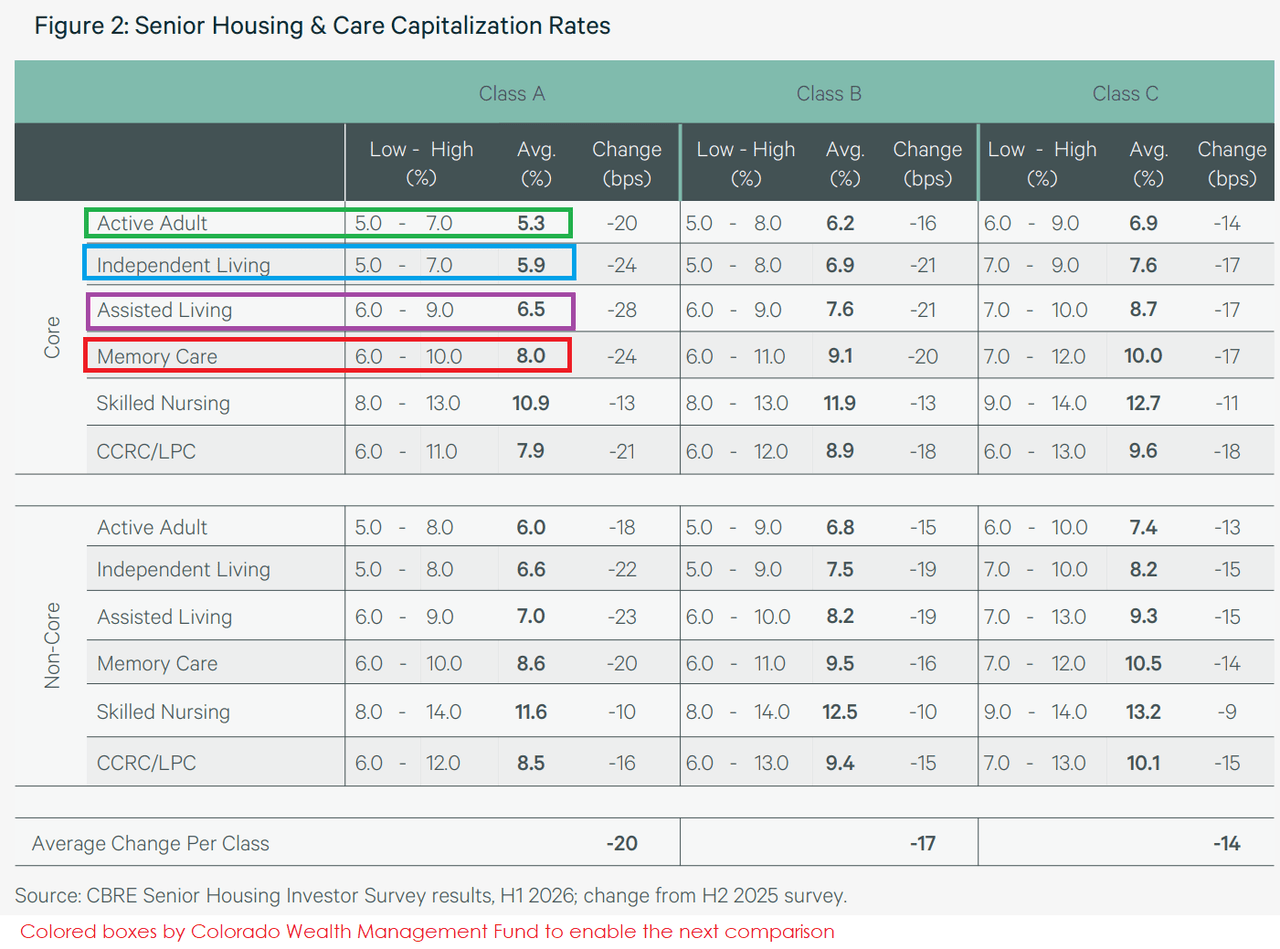
The following image demonstrates cap rates across class A, B, and C assets in the senior housing category:
CBRE Senior Housing Report
Source CBRE Senior Housing report
The very lowest cap rate property within that category is “Class A – Active Adult” at 5.3%.
Let’s compare that to what Welltower reports owning:
Welltower
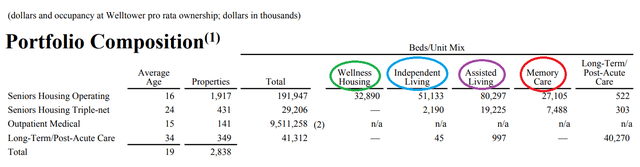
The huge emphasis by number of beds or units is on independent living and assisted living. Assuming that these are all class A properties (that’s a very optimistic assumption), we would be looking mostly at properties trading around 5.9% to 6.5%. There would also be a material amount of wellness housing around 5.3% and memory care around 8%. Therefore, we might ballpark that a reasonable cap rate across that part of the portfolio is probably around the low to mid 6% range.
This already accounted for 69.6% of portfolio NOI in Q1 2026:
Welltower

Since that’s the substantial majority of the portfolio, we will just focus on using it.
If we really wanted to be harsh, we would value the long-term/post-acute care portfolio (13.4% of NOI) using the “skilled nursing” cap rates where even a “core” property labeled as “class A” still has an average 10.9% cap rate. If we threw that into the equation, we would really want to use a higher cap rate.
Therefore:
- A cap rate in the 6% range would be very generous.
- A cap rate in the 7% range would still be moderately generous.
Valuing Welltower’s Assets
As I’ve mentioned previously, we can do a rough approximation for market implied cap rates by using adjusted EBITDA / total enterprise value.
I did that for Welltower.
We calculated it four ways:
- Q1 2026 Adjusted EBITDA minus stock compensation
- Q1 2026 Adjusted EBITDA
- Q1 2026 Adjusted EBITDA times 1.10 (to simulate 10% growth) minus stock compensation
- Q1 2026 Adjusted EBITDA times 1.10 (to stimulate 10% growth)
That gives us the following table:
The REIT Forum
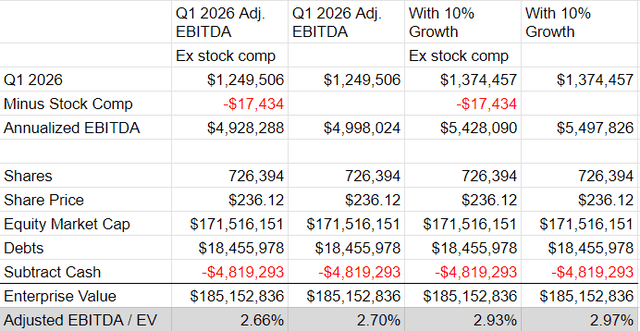
Now, as you may notice, numbers from 2.66% to 2.97% happen to be dramatically below 6%. It is even further below 7%!
The Lazy Method
We could’ve avoided this work.
Welltower has a strong balance sheet. Net Debt was only 8.8% of the market capitalization at the end of Q1 2026.
Given that the company is mostly financed with stock, we could’ve done something really lazy. We could’ve just assumed that interest on debt might wash itself off and used FFO (better than AFFO for this precise scenario) divided by the common share price.
- Consensus forward FFO per share is $6.58.
- Math: $6.58 / $236.12 = 2.79%
- Consensus forward FFO per share using Q2 2027 instead of Q2 2026 is $6.83.
- Math: $6.83 / $236.12 = 2.89%
That’s the super lazy way. It doesn’t usually work that well. However, since Welltower didn’t have major items in Q1 2026 that needed adjusting and the company was overwhelmingly funded with common equity, it would still create a rough approximation. In theory someone could use AFFO instead, but they would want to adjust for recurring capitalized expenditures. Those are usually deducted in reaching AFFO, but they are not deducted in these calculations.
Consensus NAV Per Share
Given that we estimate Welltower should have their portfolio valued using a cap rate around 7%, but the market is valuing them using a cap rate below 3%, we can safely say that Welltower is trading at an extreme premium to the value of their real estate. Would you dare to say an absurd premium? I would. Here we go: Welltower is trading at an absurd premium.
The most rational thing they can do presently is issue tens of billions of stock as quickly as possible. Even if some of the cash from share issuance has to sit in Treasury bills for a while, it still increases their growth in AFFO per share and it locks in the high price.
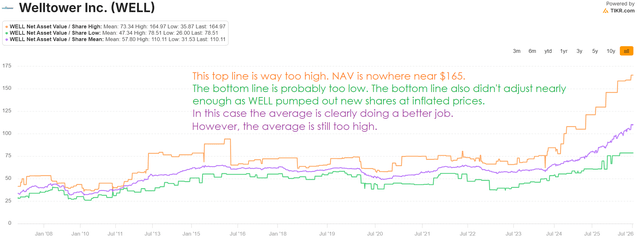
Sometimes I bash on consensus NAV estimates when I catch a clear error. I believe the current estimates ($110.11) are still too high, but as WELL issues more stock, they can still get there.
TIKR
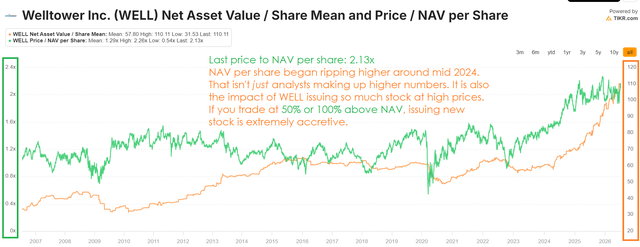
The gap in estimates was pretty big.
TIKR
Sanity Check
I ran the model for EBITDA to enterprise value again. This time I used the consensus NAV figure instead of the share price:
The REIT Forum
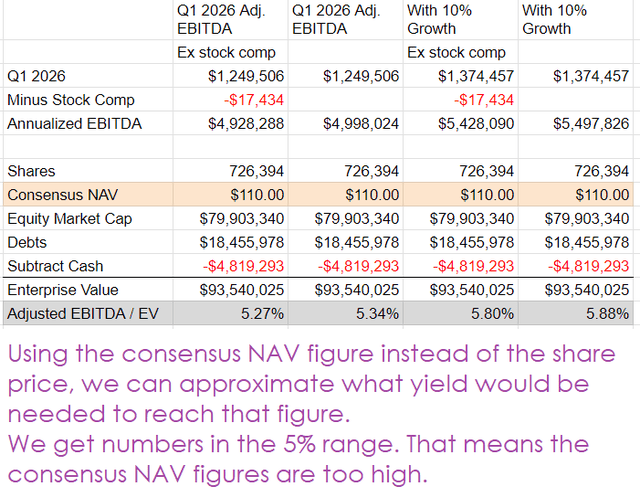
Note: Consensus NAV is simply the average.
Based on that math, I think the consensus NAV estimate of $110 is too high.
If we use $80, which is just above the lowest estimate, we get much higher percentages:
The REIT Forum
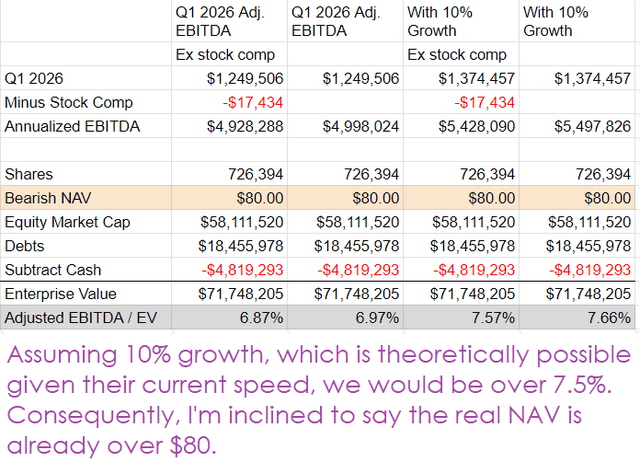
Given expectations for growth, I’m going to say $80 is too low. I would be inclined to say the best estimate for current NAV is probably somewhere in the $90s.
EBITDA vs. Overhead
For better or worse, using Adjusted EBITDA (especially after forcing stock-based compensation to be recognized) will imply a lower yield than using NOI.
Why? Because NOI does not deduct a bunch of overhead expenses. EBITDA does deduct them. The overhead expenses can be pretty insane.
Record Bloat
I’m just going to leave this here:
Seeking Alpha
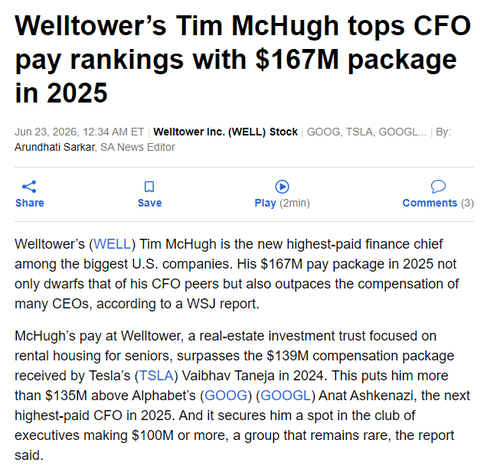
I’m not a fan. The board of directors agreed to this payout. For comparison, the total cash distributions (dividends) to shareholders in 2025 was $1,878 million. The payout to the CFO was $167 million. Was his contribution valuable enough to warrant a pay package equal to 8.89% of the total distributions to shareholders?
In my opinion, that makes Welltower a far less attractive REIT. Investors in the REIT get the board of directors that approved that package. Yay!
The Stupidest Chart Ever?
In Welltower’s presentation, they highlighted the coming demand for senior housing and how it is just so affordable. Affordable to people paid like their CFO? Here’s the chart:
Welltower
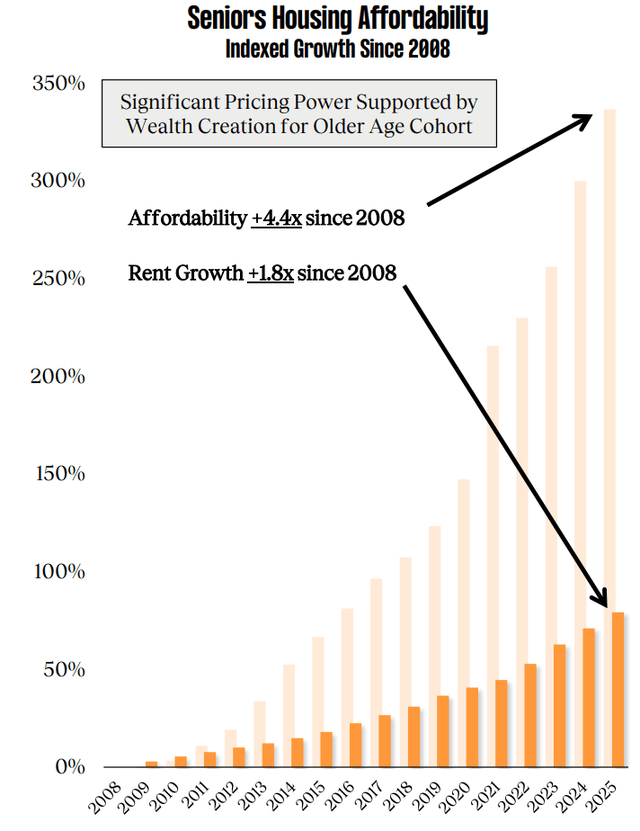
How did Welltower create that chart? It wasn’t directly revealed in the presentation. But I was able to find some numbers that would work.
Welltower left their presentation from August 2022 online. That document reveals how they came up with their definition of affordability and it references another source that could be used for rent growth. So I did a bit of work.
Affordability
I believe “Affordability” is this equation:
Aggregate net worth of households age 70+ in 2025 / Aggregate net worth of households age 70+ in 2008 = about 4.4x
I was able to replicate that by using the “Distributional Financial Accounts”. If we use the “Net Worth” column and compare the average from 2008 to the average from 2025 (filtered to households over 70 years old), we find that the value in 2025 is 4.358x the value from 2008. That rounds to 4.4x.
Here are some huge problems:
- The value is going to be absolutely dominated by stock portfolio values and starts with 2008 (remember the Great Financial Crisis, that was 2008 for anyone under 30).
- The value is aggregate. When more households enter the category, they push the value up unless they have negative net worth.
- The wealth is becoming even more skewed.
- This calculation is absolutely stupid.
Since they are calculating the aggregate value, the “affordability” goes up as the group size increases even if the additional people are extremely poor. Further, any increase in stock market indexes drives up “affordability”.
Junior High Math
Forgive me for being an analyst and liking precise data. I just need to explain that “+1.8x” and “1.8x” are not the same.
- 1.8x = 180%
- Being +180% means you’re up 180%. That turns $100 into $280.
- Being 180% means you’re up 80%. It turns $100 into $180.
How can we tell that they meant to say 1.8x instead of +1.8x? Look at the height of the bars. See how the “+1.8x” bar is about 80% on the left axis?
Likewise the bar for +4.4x actually stops around 340%.
This should be 6th grade math, but I’ll assume a weaker program and say it might be 7th grade.
No Comparison
- “Affordability” was measured based on the aggregate net worth of households.
- “Rent” was measured based on the individual unit.
If we want to apply similar stupidity to the rent metric, we would need to use the aggregate rent level. So each additional unit would have to raise the cumulative rent.
Rental Growth
Rent has been growing at a CAGR (compound annual growth rate) around 3% to 3.5% if we use a major source like JLL.
JLL
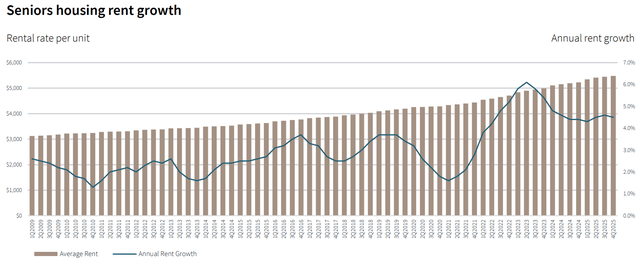
That’s the broader market growth rates.
- Average rate: Around $5500
- Average rate for WELL’s same property portfolio: $6,259
Location or quality of facilities could be enough to explain the difference.
- The average growth rate for the market was about 4.5%.
- The average growth rate for WELL was about 5.0%.
Once again, those are close enough.
But if WELL was growing rental rates at 5%, how did they increase same property net operating income at a staggering 22.1%?
It wasn’t occupancy. The number of occupied rooms within the same property portfolio increased 4.3%. That’s an impressive increase, but even with 5% growth in rental rates it wouldn’t get us to 22.1%.
Same Property NOI Growth
Same property NOI grew at a staggering 22.1%. We can’t explain that with 5% growth in rental rates.
Was it occupancy? That seems like a clear question, but the answer gets muddy. Occupancy did increase, but it only increased by 372 basis points (from 85.27% to 89.00%). That resulted in a 4.34% increase in the number of occupied rooms. That isn’t enough to drive the gain either.
Absolutely Remarkable Scale
It is pretty common for equity REITs to have NOI margins around 65% to 75%. It varies a bit by property type. However, senior housing operating properties have dramatically lower NOI margins.
Because margins tend to be low, that also means operating expenses tend to be high. Controlling growth in costs can drive substantial growth in net operating income. The cost control for WELL was remarkable.
- Q1 2025: Same property operating expenses per occupied room increased 1.84%
- Q1 2026: Same property operating expenses per occupied room increased 0.35%
That sounds nice to investors, right? It sounds like the expense scales linearly while the revenue keeps growing. It’s precisely the kind of model investors want to see. Revenue increases significantly forever while the expenses only edge slightly higher.
But doesn’t that sound too good to be true?
Unsustainable Scaling
The scaling on operating expenses looks completely unsustainable when we dive into it.
Mind if I just throw tables of data your way? Great, that’s what we’re doing. We’re going to start with the numbers for the Q1 2026 same property pool.
Supplemental
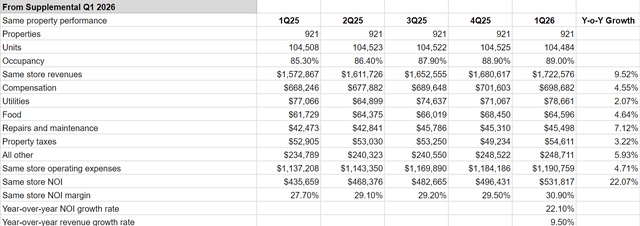
That seems nice, right? Same store NOI is exploding on higher margins. If we assume that higher margins are largely driven by costs being relatively fixed, then we could convince ourselves that this would continue indefinitely.
I’m going to end that dream.
We can see how many units there were. We have the approximate occupancy (rounded to a decimal place). We can create two different tables:
- The first table uses the total number of units in the same property pool.
- The second table uses the approximate number of occupied units in the same property pool.
The tables look like this:
Supplemental
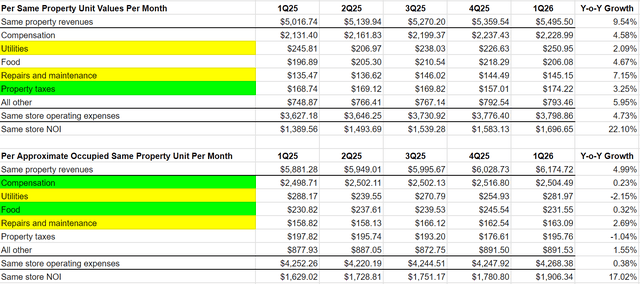
The highlighting is pretty simple:
- Green indicates where I believe the value should be scaling. Property taxes should primarily scale with the number of units. The government doesn’t care if the unit was occupied. Food should be consumed by actual residents, not empty rooms. Therefore the food should scale primarily with occupied rooms.
- Yellow means I believe the value should be driven by both the number of total units and the number of occupied units. Since utilities apply to common areas and to individual units, the utilities should scale with both.
Lessons from the Table
There are a few things that should stand out:
- The biggest expense by a huge margin is compensation. It is more than half of the total value for same property level expenses. Compensation in total was up 4.58%, but compensation per occupied room was only up 0.23%. This will be the biggest issue.
- Utility rates have been going up, not down. Yet utilities per unit were only up 2.09% and utilities per occupied unit were down 2.15%. I can believe that WELL became more energy efficient, but I don’t believe they can repeat that every year.
- Food price inflation has been a significant challenge for many Americans. Yet the food cost per occupied room barely increased. WELL might be getting more efficient with their menu, but this cost cutting can only go so far.
- Property taxes are only up 3.25%? That is a very small decline. If we really see appreciation in the value of these properties, then local tax assessors are going to want to push the taxes higher. That can often lag for a bit, so the meager growth now doesn’t mean it will stay small.
Compensation
This is the big issue.
A large portion (more than half) of the senior housing portfolio is in “assisted living” and “memory care”. In those facilities particularly, I would expect higher occupancy to drive staffing requirements.
So when I see compensation per occupied unit only increased 0.23%, I’m inclined to think this isn’t just “being more efficient”. It looks to me like increasing the load per employee. That does not simply continue to scale.
Looking back to the period from Q1 2024 to Q1 2025, we see a similar picture.
From Q1 2024 to Q1 2025 the increase in compensation expense per occupied unit in the same property pool was only 0.75%.
If WELL is raising wages in line with CPI and the mix of workers remains similar, then the number of workers per occupied unit must be declining.
How long can that continue? I don’t have a precise time for it to end. But I really don’t believe it will last indefinitely.
Priced Beyond Perfection
The valuation on WELL requires the company to continue putting out incredible growth rates.
Pumping out equity can certainly help. But the same property NOI figures that are so impressive rely on significant growth in margins year after year. WELL doesn’t just need to maintain these larger margins. They need to continue expanding the margins for years. That’s the cost of trading at 40x AFFO.
A Moment of Rage
The documents don’t quite match up.
You’ll find slightly different values for the same property portfolios between:
The “earnings presentation” is also named “Business Update”. I don’t know why. Both documents were released on April 28th, 2026.
Example:
- Same property revenue for Q1 2026 supplemental: $1,722,576
- Same property revenue for Q1 2026 earnings presentation: $1,722,085
Is it a big difference? No. But it is incredibly annoying when it comes to model accuracy.
My Predictions
- I believe WELL will be able to continue driving material growth in revenue per occupied room and even better growth in revenue per total room because of gains to occupancy.
- I believe the growth in NOI margin will slow materially. Margins might still improve for a bit. What I find extremely unlikely is the idea that NOI margins could grow over 300 basis points annually for several years.
- I believe same property NOI growth rates for the senior housing operating portfolio will decline substantially. Margin growth will be a huge factor.
- I believe WELL will continue to rapidly issue stock. Even if the price fell by 33% it would still be wise for them to pump out new shares.
- I believe NAV estimates will rise. They are already above my estimate for where NAV is today, but we will probably see more shares issued and each share increases NAV. The real estate is only worth $90 to $100, but issuing a share for net proceeds over $230 still adds $230 of cash to the REIT.
- In the next year we may see cap rates get a little bit lower for these types of assets. Part of the reason may be Welltower bidding for assets. In that sense Welltower can push the market value for comparable assets higher because they have such an easy access to cash through printing shares.
- I believe WELL will show significant short-term AFFO per share growth, but the growth rate will trend lower over the next several years.
- I believe the AFFO multiple will come crashing down within the next several years.
- I believe the reduction in AFFO multiple will be more powerful than the growth in AFFO, resulting in a lower share price ($239.75 at time of publication for REIT Forum subscribers).
- I believe the resulting lower AFFO multiple will make issuing new stock less accretive, which will further reduce the AFFO growth rate since issuing stock at 40x AFFO is a powerful engine for growing AFFO per share.
- I believe WELL will significantly underperform the major equity REIT index (VNQ) over the next 5 to 10 years because the starting valuation is so high.
- Even if WELL delivers one of the best growth rates among REITs for AFFO per share from 2026 to 2030 (quite possible), that still wouldn’t be enough to justify the current valuation.
Conclusion
Welltower is absurdly overvalued. It has continued climbing this year. The market simply loves seeing rapid growth. Issuing stock at these levels is a great choice. Buying shares is not. There’s not a reasonable route for Welltower to deliver the kind of growth that would be necessary to sustain the stock valuation when the growth fades.
The dividend yield is only 1.3%. This is not an income stock. Investors are here for capital appreciation. But what happens when the growth slows down? Even if WELL could achieve 5 years of outstanding growth and gets AFFO up to $12.00 per share, what happens when it falls off? When shares go back to a normal multiple? If they went back to 20x AFFO (much higher than the average for REITs today), that would be $240.00. Investors wouldn’t be happy about getting a meager yield for 5 years combined with minimal price appreciation.
Can growth continue forever? That seems unlikely:
- The current growth rate is fueled by issuing shares at a wild premium.
- That has been supported by massive growth in same property net operating income.
- The extreme growth in same property net operating income relied on margin expansion.
- WELL doesn’t just need to maintain those wider margins, they need to continue expanding the margins.
- As nice as margin expansion feels, it never goes on forever.
It is clear that Welltower’s valuation is absurdly high regardless of how we measure it:
- Using AFFO multiples, WELL is extremely expensive. Even with strong growth in AFFO per share for the next few years, I don’t believe they can get AFFO to a high enough level to deliver investors with an attractive return once the multiple declines.
- Using revised EBITDA to total enterprise value we see shares trading at a laughably low yield. If investors want to invest in senior housing, they should look elsewhere. The implied cap rates for WELL are insanity that demonstrates the market has completely lost touch with the underlying value of the portfolio.
I don’t see anything worthy of such an extreme valuation.
Other analysts have correctly pointed out that the valuation on WELL is too high. Thus far, the market hasn’t listened. It is still living a fantasy. When it wakes, WELL has enormous downside.
At the time of publishing this report for subscribers, shares of WELL traded at $239.75. About 41.9x consensus AFFO for Q2 2026 through Q1 2027.

Maria Bartiromo asks Delta Air Lines CEO Ed Bastian to assess the current K-shaped economy, noting strong spending among high-end consumers.
United Airlines reportedly approached Delta Air Lines last year about a potential merger that would have combined two of the largest U.S. carriers.
United CEO Scott Kirby contacted Delta CEO Ed Bastian to pitch the potential tie-up, The Wall Street Journal reported Sunday, citing people familiar with the matter.
According to the outlet, leadership at Delta discussed the proposal and evaluated the potential benefits as part of “preliminary due diligence,” but the talks did not advance, and both airlines ultimately moved on.
RYANAIR PASSENGER RECOUNTS BEING PARTLY SUCKED OUT AIRPLANE WINDOW: ‘I AM LUCKY’

A United Airlines Boeing 777 lands at Newark Liberty International Airport on Jan. 29, 2026, in Newark, New Jersey. United Airlines reportedly approached Delta Air Lines last year about a potential merger. (Gary Hershorn/Getty Images)
A United spokesperson told FOX Business the airline had “nothing to share.” Delta declined to comment.
A merger between United and Delta would have had sweeping implications for the airline industry and likely faced scrutiny from federal antitrust regulators and state attorneys general, according to The Wall Street Journal.
NEW BOEING AIRCRAFT DEVELOPMENT HAMPERED BY BACKLOG OF EXISTING ORDERS, SAYS CEO

A Delta Air Lines Airbus A220-100 approaches John F. Kennedy International Airport with its landing gear down on Nov. 14, 2019, in New York City. United CEO Scott Kirby reportedly contacted Delta CEO Ed Bastian to pitch the potential tie-up. (Nicolas Economou/NurPhoto via Getty Images)
The previously unreported talks come as United works to expand its global reach.
Kirby also reportedly explored a possible merger with American Airlines earlier this year. However, American rejected the proposal, and CEO Robert Isom criticized the idea as “anticompetitive,” the WSJ reported.
UNITED TO OFFER TRAVELERS FREE FLIGHT CHANGES TO AVOID LANDING AT TRUMP INTERNATIONAL AIRPORT

United Airlines CEO Scott Kirby speaks at the U.S. Chamber of Commerce’s Global Aerospace Summit in Washington, D.C., on Sept. 9, 2025. Kirby has since downplayed the likelihood that United will pursue a major merger. (Al Drago/Bloomberg via Getty Images)
Stocks In This Article:
Kirby has since downplayed the likelihood that United will pursue a major merger.
Last month, Kirby told Reuters that United remained open to buying airport slots, gates and other assets, but said a major consolidation deal was unlikely.
GET FOX BUSINESS ON THE GO BY CLICKING HERE
“I think consolidation is unlikely for United,” Kirby said at the International Air Transport Association’s annual meeting in Rio de Janeiro. “That doesn’t mean we won’t still be in the market to buy assets, but consolidation is a low probability.”
Reuters contributed to this report.


Andrew McElroy is Chief Analyst at Matrixtrade, author of the ebook ‘Fractal Market Mastery’ and producer of the ‘Daily Edge.’ The ‘Daily Edge’ is emailed before each US session and outlines actionable ideas, directional bias, and important levels in the S&P500. It also looks at ‘What’s Hot,’ on any particular day, whether it is commodities, stocks, crypto, or forex. Andrew has developed a top-down proprietary system that starts with his weekend Seeking Alpha article focusing on the higher timeframes. Fractals, Elliott Wave, and Demark exhaustion signals are all incorporated, as are macro drivers and analysis of the market narrative. It is much more than just a few lines on a chart – it is a system developed over 15 years and proven to deliver a consistent edge. An independent trader since 2009, Andrew manages a family portfolio of stocks and ETFs with his wife and fellow Seeking Alpha contributor Macrogirl.
Analyst’s Disclosure: I/we have a beneficial long position in the shares of VOO either through stock ownership, options, or other derivatives. I wrote this article myself, and it expresses my own opinions. I am not receiving compensation for it (other than from Seeking Alpha). I have no business relationship with any company whose stock is mentioned in this article.
Seeking Alpha’s Disclosure: Past performance is no guarantee of future results. No recommendation or advice is being given as to whether any investment is suitable for a particular investor. Any views or opinions expressed above may not reflect those of Seeking Alpha as a whole. Seeking Alpha is not a licensed securities dealer, broker or US investment adviser or investment bank. Our analysts are third party authors that include both professional investors and individual investors who may not be licensed or certified by any institute or regulatory body.

Thailand’s news landscape reflects a nation navigating major infrastructure decisions, diplomatic tensions, economic realignment, and public safety concerns, all while maintaining its position as a regional hub for sports, culture, and business innovation.
Major Infrastructure Project Scrapped
In one of the week’s most significant developments, Thailand has decided to scrap its ambitious $29.7-38.3 billion land bridge project designed to bypass the Malacca Strait. According to multiple reports, a government-commissioned study found low commercial viability for the coast-to-coast megaproject connecting the Gulf of Thailand to the Andaman Sea. This represents a substantial policy reversal, as the project had been touted as a potential game-changer for regional shipping logistics. Officials are reportedly considering scaling back the initiative rather than abandoning it entirely, though the original scope now appears unlikely to materialize.
Economic Developments and Foreign Investment
Despite the infrastructure setback, Thailand’s economic outlook shows resilience in several sectors. The country secured a remarkable $43.6 billion investment surge in the first half of 2026, with investment applications jumping 37% year-over-year, largely driven by artificial intelligence sector growth. Japan’s Mitsubishi Motors announced plans to invest $473 million (16 billion baht) in Thailand’s EV push by 2030, signaling continued confidence in the country’s automotive manufacturing capabilities.
Thailand is also pursuing a $700 million electric vehicle incentive scheme aimed at replacing 80,000 conventional vehicles, part of broader efforts to modernize transportation infrastructure. Meanwhile, China and Thailand are deepening technology cooperation, and plans remain in place for a high-speed rail link to China, with the first phase targeted for completion by 2030.
However, trade tensions loom as the United States prepares to impose new tariffs of up to 12.5% on 60 trading partners, including Thailand, effective this week—prompting comparisons with neighboring Cambodia and Vietnam’s tariff rates.
Regional Trade and Diplomatic Relations
Thailand continues strengthening bilateral ties across Asia. The Philippines and Thailand are deepening economic cooperation as both nations shift foreign policy priorities toward trade expansion, encompassing investment and cross-border partnerships. Additionally, Egypt and Thailand’s foreign ministers met in Manila to discuss boosting economic relations, while China has reaffirmed its neutrality stance regarding regional matters.
For businesses monitoring these developments, Thailand Business News provides ongoing coverage of the country’s evolving trade landscape and investment climate.
Security Concerns in Southern Thailand
A troubling security situation persists in Thailand’s restive south, where five soldiers/rangers were killed in a bomb attack on a security checkpoint. In response, authorities have imposed martial law in the affected southern province. Officials have indicated that Malaysia’s cooperation remains key to achieving lasting peace in the region, highlighting the cross-border dimensions of the ongoing conflict.
Border Tensions with Cambodia
Thailand is also pressing forward with construction of a border fence with Cambodia following clashes earlier in 2025. Military forces have reportedly dug in along the contested border area, with peace remaining elusive despite ongoing diplomatic efforts. This situation adds another layer of complexity to Thailand’s regional security calculus.
Public Safety and Environmental Challenges
Thailand faces multiple public health and environmental challenges. The Department of Disease Control issued warnings after bacterial infections linked to the rainy season claimed over 100 lives. Compounding concerns, the country is bracing for five days of heavy rain, flash floods, and rough seas through late July, requiring heightened emergency preparedness.
On a more positive environmental note, researchers are deploying 3D-printed bioplastic pods to protect and restore seagrass along Thailand’s coastlines, offering innovative solutions to combat habitat destruction from waves and marine life.
Cryptocurrency and Cybersecurity Issues
Thailand’s financial regulatory landscape saw significant developments as the Securities and Exchange Commission filed a criminal complaint against cryptocurrency exchange Bitkub over alleged false disclosures connected to a substantial 1.7-billion-baht hack. Separately, cybersecurity concerns emerged after an AI assistant was reportedly used in a cyberattack targeting Thailand’s Ministry of Finance, highlighting growing digital security challenges facing government institutions.
Cultural and Sporting Highlights
Thailand’s global sporting profile received a boost with Tyson Fury’s dominant victory over Mariusz Wach in Pattaya, positioning the boxer for a potential mega-bout against Anthony Joshua. The fight, though initially unaired, generated substantial international media coverage.
In cultural news, Thailand celebrated its ninth UNESCO World Heritage site designation, while an incident involving rowdy Italian teenagers on Bangkok’s BTS transit system prompted an official apology from the Italian Embassy after the confrontation went viral, sparking public discourse about tourist behavior.
Additionally, Thailand is set to co-host the 2046 FIFA World Cup alongside Japan, South Korea, China, Indonesia, Malaysia, and Singapore, reflecting the nation’s continued ambitions in international sports hosting.
Source : Google News – Search
Other People are Reading

Berlin Pride attack suspect killed in police operation after daylong manhunt

Fed Meeting, Inflation, Boeing, Meta, Apple, Exxon, and More to Watch This Week

, on the hunt for a megadeal, last year approached Delta Air Lines DAL about a merger that would have combined the two most valuable U.S. carriers, according to people familiar with the matter.
As part of the pitch, United Chief Executive Scott Kirby made a call to Delta CEO Ed Bastian, some of the people said.
Copyright ©2026 Dow Jones & Company, Inc. All Rights Reserved. 87990cbe856818d5eddac44c7b1cdeb8

BANGKOK, July 24, 2026 /PRNewswire/ — Huawei Cloud hosted Huawei Cloud Summit Thailand 2026, bringing together leaders from government, business, industry partners, and the technology community to exchange views on how cloud and AI can support Thailand’s digital economy. During the event, Huawei Cloud announced “Huawei Cloud Agentic Infrastructure: Now Available for Thailand” and officially launched Huawei Cloud CodeArts Agent Open Beta Testing (OBT) in the country.
Mr. Sunny Shang, President of Huawei Cloud APAC, outlined the company’s commitment to working with customers and partners to build an AI-driven digital future for Thailand. Regarding the government’s direction, the Ministry of Digital Economy and Society emphasized the acceleration of digital transformation through national AI policies, public-sector adoption, and stronger public-private collaboration.
The public-sector highlighted how AI can improve government operations and make public services faster and more convenient. NECTEC also presented a Government AI case study covering the development of AI infrastructure and platforms, as well as AI chatbots and intelligent assistants designed to support government officials and improve services for citizens.
Building the Foundation for the Agentic AI Era
Mr. Surasak Wanichwatphibun, CTO of Huawei Cloud Thailand said Huawei Cloud will continue to strengthen its technological capabilities and build a robust computing infrastructure to drive AI innovation across enterprises.
At the center of the announcement is Agentic Infra, a new infrastructure designed specifically for developing and deploying AI agents. It supports efficient token generation, unified scheduling of general-purpose and AI computing resources, continuous learning, and secure and autonomous agent operations.
Mr. Surasak introduced four new features under Agentic Infra:
- UnifiedBus-based AI Cluster Service (AICS), which supports highly efficient token generation
- Agentic Memory Storage Service (AMS), which delivers PB-scale memory storage to address a key bottleneck in agent memory, enabling long-horizon tasks and facilitating continuous learning.
- AgentSphere, which offers a secure and autonomous runtime environment for AI agents
- CCE VolcanoNext, which enables unified scheduling of general-purpose and AI computing resources
CodeArts Agent OBT Launches in Thailand
Another major highlight was the launch of Huawei Cloud CodeArts Agent OBT in Thailand, giving local developers and enterprises an opportunity to experience Huawei Cloud’s coding agent and provide feedback before its wider release.
CodeArts Agent combines IDE functionality, autonomous development capabilities, and coding models. It supports project-level code generation, code completion, R&D knowledge Q&A, and unit test case generation.
The platform also applies Specification-Driven Development (SDD) to help development teams maintain code quality from the requirements stage through to final delivery.
It is worth mentioning that this release also introduces the Agent Team mode, which can automatically form a development team, enabling multiple agents to collaborate concurrently and execute tasks simultaneously.
By reducing repetitive tasks, CodeArts Agent can help developers work more efficiently and allow organizations to bring digital products and services to market faster.
The OBT launch forms part of Huawei Cloud’s efforts to support Thailand’s developer community and make AI-assisted software development more accessible to organizations of different sizes.
Strengthening Security for Enterprise AI
Mr. Surasak also emphasized security, stability, and quality as key priorities for enterprise AI adoption. As cyberattacks become increasingly automated and AI-driven, Huawei Cloud has upgraded its security services in two areas: protecting AI systems and using AI to strengthen cyber defense.
Its model lifecycle security solution covers AI infrastructure, training data, model inference, and agent applications.
For enterprises concerned about data sovereignty and privacy, Huawei Cloud provides dedicated security zones that allow customers to independently manage their encryption keys while preventing platform administrators from accessing customer data. Software-hardware integration and hardware acceleration are also used to maintain encryption performance without compromising service efficiency. Huawei Cloud has also introduced Data Capsule technology, which ensures that data can only be used within authorized environments and automatically becomes invalid if moved outside a designated security zone.
Showcasing AI Use Cases Across Industries
Huawei Cloud Summit Thailand 2026 also featured AI and cloud use cases from organizations in Thailand. These included the development of AI platforms and intelligent assistants for the public sector, the use of AI coding and large language models in banking, and AI-powered learning and skills development platforms for the HR sector.
Huawei Cloud and its partners also shared how ecosystem collaboration can help solve industry challenges and accelerate AI adoption among enterprises.
About Huawei Cloud Thailand
Huawei Cloud Thailand is a leading cloud service provider committed to accelerating Thailand’s digital transformation under the mission of “In Thailand, For Thailand.” According to the latest report from Gartner, Huawei Cloud is ranked No.3 by revenue in Thailand’s Infrastructure as a Service (IaaS) market, solidifying its position as one of the most trusted and fastest-growing international cloud providers in the country.
As the first international public cloud vendor to establish local data centers in Thailand, Huawei Cloud now operates three Availability Zones, ensuring high reliability and low-latency connectivity for local users. Leveraging Huawei’s 30-plus years of expertise in ICT infrastructure, it integrates cutting-edge Artificial Intelligence (AI), Cloud-Native 2.0, and Big Data technologies to empower over 40 government agencies and thousands of enterprises across the Kingdom. By building a robust digital ecosystem and fostering local talent, Huawei Cloud aims to drive Thailand’s “Digital Economy” forward, bringing cloud and intelligence to every corner of the country for a fully connected, intelligent future.
For more information, please visit Huawei Cloud Thailand online at
https://www.huaweicloud.com/intl/th-th/ or follow us on:
The information provided in this article was created by Cision PR Newswire, our news partner. The author's opinions and the content shared on this page are their own and may not necessarily represent the perspectives of Thailand Business News.
Other People are Reading

Tesla: AI And Robotic Dreams Hit Cash Flow Reality
Business
Niecy Nash Reveals Taylor Swift and Travis Kelce Locked Up Guests’ Phones in Glass Cases at Their Wedding

Actress Niecy Nash-Betts is offering fans some of the most detailed firsthand accounts yet of Taylor Swift and Travis Kelce’s closely guarded wedding, revealing that guests were required to hand over their phones during the ceremony as part of the couple’s extensive privacy measures.
Appearing on “Jimmy Kimmel Live!” this week, Nash-Betts described the unusual security protocol guests encountered at the July 3 wedding, held at Madison Square Garden in New York City. “They took your phone, they put it in a glass case. It was crazy,” Nash-Betts said, describing the lengths the couple went to in order to prevent photos or details from leaking before they were ready to share them.
Guests kept in the dark under strict secrecy
Nash-Betts, who attended the ceremony with her wife, Jessica Betts, said the secrecy extended well beyond the day of the wedding itself. Guests were reportedly bound by non-disclosure agreements and instructed not to reveal any details about the event, even to close friends, until the couple was ready to make information public. Reflecting on the pressure to stay quiet, Nash-Betts said she felt comfortable finally discussing the day now that other details have already surfaced publicly. “I don’t think I’m speaking out of school because y’all seen it all online now,” she said.
Despite the tight restrictions, Nash-Betts made clear the event left a lasting impression. Describing the ceremony itself, she said simply, “Oh, it was so good!” She also confirmed widely circulated reports that comedian Adam Sandler officiated the wedding, joking about his appearance for the occasion and noting that he “looked decent” for the formal affair.
A wedding built around privacy
Swift and Kelce’s July 3 nuptials drew roughly 1,000 guests spanning the sports, music and entertainment industries, according to details previously reported around the event. Given the scale and star power involved, the couple reportedly took several additional steps beyond phone confiscation to keep specifics of the day under wraps.
According to TMZ, each wedding invitation was individually watermarked with the recipient’s first and last name repeated throughout the document, a measure designed to allow the couple to trace any leaked invitation back to the guest who shared it. Security around the event was similarly extensive: reports indicate roughly 70 detectives and 50 police officers were deployed for both the July 2 rehearsal dinner and the wedding itself, an operation aimed at protecting guest privacy and preventing paparazzi from capturing unauthorized photos.
A lighter side: games, raffles and luxury prizes
Beyond the security details, Nash-Betts also gave audiences a glimpse into the celebratory side of the event, describing a series of games guests could play throughout the reception. Winners received tickets that were entered into a raffle for a range of high-end prizes, including Cartier watches, Chanel handbags and even a vintage car. Nash-Betts described the activity as one of the more memorable parts of the night, adding that she didn’t feel she was revealing anything guests hadn’t already shared publicly themselves.
Nash-Betts’ longtime connection to Kelce
Nash-Betts’ presence at the wedding reflects a friendship that developed between her and Kelce well before Saturday’s revelations. The two first connected while filming Kelce’s acting debut on Ryan Murphy’s FX series “Grotesquerie” in 2024, a collaboration that led to a lasting rapport between them. Nash-Betts has previously appeared as a guest on “New Heights,” the podcast Kelce co-hosts with his brother, Jason, where she has spoken warmly about the tight end and his relationship with Swift.
During an earlier appearance on that podcast, Nash-Betts described fielding frequent messages from people hoping she might reveal details about Kelce’s relationship with Swift, saying acquaintances often reached out under flimsy pretenses just to try to get information out of her. Kelce, for his part, has publicly thanked Nash-Betts for helping shield the relationship from unwanted scrutiny during its early stages, at one point telling listeners simply, “Me and Tay are absolutely happy,” a comment that underscored the couple’s desire to keep their personal life largely private even as their public profile grew.
Part of a broader wave of wedding details
Nash-Betts isn’t the only guest to have offered insight into the closely watched celebration. Earlier this month, fellow attendees Kyle and Kristin Juszczyk described the wedding as “legendary” in comments to Page Six, adding to a growing collection of secondhand accounts from guests slowly filling in details about a day the couple themselves have largely declined to discuss publicly.
“Good Morning America” anchors Robin Roberts, George Stephanopoulos and Michael Strahan had previously offered a limited on-record picture of the event, but Nash-Betts’ account on “Jimmy Kimmel Live!” has provided some of the most specific details shared publicly so far, from the phone lockup procedure to the raffle prizes and Sandler’s officiating role.
Couple has yet to comment directly
As of this week, representatives for Swift and Kelce had not responded to requests for comment on the details shared by Nash-Betts or other guests. The couple has largely allowed friends and attendees to characterize the event in the weeks since the ceremony, rather than issuing their own public statements or releasing official wedding photos.
With guest accounts continuing to trickle out through interviews and podcast appearances, the full picture of Swift and Kelce’s Madison Square Garden wedding is gradually coming into focus, even as the couple itself maintains the same low profile that defined the planning and execution of the event in the first place.

BREAKING: S&P Just Launched A Crypto Index!?! And BTC Isn’t In It… Russia Vs US Crypto Race?!?!?!?

Arsenal learn Jose Mourinho stance on Vinicius Junior sale as Real Madrid transfer policy revealed

AJ Styles Handed Major WWE Role Following Retirement

Renter of Home in Anne Heche Crash Denies Settlement With Son

No Jackpot Winner as $257 Million Prize Rolls Over to $269 Million Monday Draw

Weekend Open Thread: Staud – Corporette.com
BREAKING: S&P Just Launched A Crypto Index!?! And BTC Isn’t In It… Russia Vs US Crypto Race?!?!?!?

Gold Focus Levels-Just Analysis not financial advisor

FA | BBA | FINANCIAL ACCOUNTING | TOP 10 IMPORTANT QUESTIONS & METHODS | SEM-2 OU | @shivanipallela
-

 Fashion2 days ago
Weekend Open Thread: Brooks Brothers
-

 Crypto World6 days ago
Grayscale Files For Worldcoin ETF, WLD Registers Sharp Rise
-

 Tech6 days ago
Sail Virtually Aboard The “Itanic” With IA-64 Emulator
-
 Tech6 days ago
Turtle Beach Command Series KB7 review: a nifty screen-equipped gaming keyboard
-

 NewsBeat6 days ago
Unregistered fitter used Gas Safe logo on business flyers
-
 Business5 days ago
New Jersey voter registration controversy explained: How 6,600 noncitizens got on the rolls, and what happens next
-

 NewsBeat5 days ago
How a former Blue Peter presenter stunned America’s Got Talent judges
-
 Entertainment5 days ago
Johnny Depp’s R-Rated Gothic Cult Classic Gets New Release Ahead of Sydney Sweeney Remake
-

 Tech6 days ago
Watch Flock Safety CEO Garrett Langley discuss the future of surveillance at TechCrunch Disrupt 2026
-

 Crypto World4 days ago
Ethics, other provisions in crypto Clarity Act to be further discussed
-
 NewsBeat6 days ago
Shanghai science forum photos show China’s AI and robotics advances in rivalry with US
-

 Crypto World6 days ago
Circle’s President Sold Over 360,000 Shares, The Filings Explain Why
-

 Tech7 days ago
Subway Sandwich Computers Get a Second Life as Gaming Machines
-

 News Videos3 days ago
The Peugeot Family: How 200 Years of an “Old Money” Dynasty Died in A Boardroom
-

 Sports3 days ago
2026 3M Open leaderboard: Scottie Scheffler finds putter in Round 1, sits three back
-

 Fashion3 days ago
16 Dresses for the High Summer Event
-

 Tech6 days ago
The 35 Best Board Games for Family Game Night
-

 Entertainment7 days ago
Stephen Colbert Returns to Social Media After Late Show End
-

 Crypto World6 days ago
Andrew Cuomo joins OKX board as crypto exchange expands in U.S.
-
 Entertainment2 days ago
A New Post-Apocalyptic Gundam Anime Series Blasts Into SDCC
You must be logged in to post a comment Login