

Business
Concurrent Losers: 10 BSE-200 stocks decline for 5 consecutive sessions


Over the last five trading sessions ending March 6, the BSE Sensex benchmark tumbled 4.05%, or 3,330 points, to close at 78,918. The index recorded losses in four of those five sessions. During this period, around 10 stocks within the BSE 200 posted consistent declines across all five sessions. (Data source: ACE Equity)



Trump announces new military coalition to ’eradicate cartels’ in Western Hemisphere
Business
Palantir Technologies Stock Climbs 3% to $157 Amid Geopolitical Tensions and Strong AI Demand

Shares of Palantir Technologies Inc. rose nearly 3% on Friday, closing at $157.16 on the Nasdaq, as investors weighed the company’s explosive growth in artificial intelligence platforms against heightened geopolitical risks driving demand for its defense-focused software.

The Denver-based data analytics and AI firm saw its stock surge 2.94% from Thursday’s close of $152.67, with trading volume reaching over 74 million shares — well above its average. In after-hours trading, the shares eased slightly to around $156.60.
The advance capped a strong week for Palantir, with the stock up about 15% amid escalating tensions in the Middle East, including conflicts involving Iran, which analysts say could boost prospects for defense and intelligence contracts. The shares have rebounded sharply from earlier March lows near $133, though they remain below late-2025 peaks above $220.
Palantir, co-founded by Peter Thiel and known for its Gotham and Foundry platforms, has positioned itself as a leader in AI-driven data integration for both government and commercial clients. Its Artificial Intelligence Platform (AIP) has fueled rapid adoption, particularly in the U.S., where commercial revenue exploded in late 2025.
The rally follows Palantir’s blockbuster fourth-quarter 2025 earnings released in early February. Revenue jumped 70% year-over-year to $1.41 billion, with U.S. revenue surging 93% to $1.076 billion. U.S. commercial revenue grew an astonishing 137% year-over-year, while government revenue increased 66%.
Management issued aggressive guidance for 2026, projecting full-year revenue between $7.182 billion and $7.198 billion — implying roughly 61% growth from 2025’s estimated $4.48 billion. U.S. commercial revenue is expected to exceed $3.144 billion, representing at least 115% growth. Adjusted operating income is forecasted near $4.1 billion, with adjusted free cash flow between $3.9 billion and $4.1 billion.
Chief Executive Alex Karp hailed the results as evidence of Palantir’s unique focus on scaling AI operational leverage, describing the company as an “n of 1” in pursuing “commodity cognition” through advanced models.
Recent developments have reinforced optimism. Palantir secured a five-year blanket purchasing agreement with the U.S. Department of Homeland Security valued at up to $1 billion to deploy AI tools across agencies for case management, threat identification and logistics. The company also expanded partnerships, including with Rackspace Technology to deploy Foundry and AIP in regulated industries, and won its largest-ever U.K. defense contract.
Geopolitical factors appear to be amplifying demand. Analysts point to rising needs for AI in battlefield intelligence and national security amid global conflicts. A potential 10-year, $10 billion U.S. Army framework agreement continues to generate buzz, contributing to a record contract backlog.
Analysts remain largely bullish despite the stock’s lofty valuation — trading at around 241 times trailing earnings and 115 times forward estimates. The consensus 12-month price target stands at approximately $193 to $198, suggesting 23% to 26% upside from current levels, based on input from 28 analysts. Ratings lean toward “Moderate Buy,” with highs reaching $260 from Citi and recent upgrades including Rosenblatt’s $200 target.
Some forecasts are more ambitious. Veteran analysts highlight Palantir’s mission-critical role in defense AI, with one predicting the stock could reach $200 amid geopolitical tailwinds. Others caution that sustained execution will be key in a competitive landscape featuring players like Snowflake and Oracle.
Palantir’s commercial momentum has shifted perceptions. Once heavily reliant on government contracts, the U.S. commercial segment now drives outsized growth through AIP deployments in Fortune 500 companies. The company’s Rule of 40 score — combining revenue growth and profit margin — hit 127% recently, a rare feat at scale.
Challenges persist. High valuation leaves little room for error, and controversies around surveillance tech and public-sector contracts continue in some markets. Insider selling has occurred periodically, though it has not derailed the broader uptrend.
Investors await the next earnings update, expected in May 2026, for confirmation of guidance delivery and further AIP traction. Management has emphasized disciplined scaling and profitability as hallmarks of its strategy.
As Palantir navigates an environment of accelerating AI adoption and defense modernization, its stock performance will likely depend on converting massive backlog into recurring revenue while managing expectations in a volatile market. The recent surge suggests investors are betting on continued outperformance in both commercial and government segments through 2026.
Business
Global Stock Markets End Volatile Week Lower as Geopolitical Tensions, Surging Oil and Weak Jobs Data
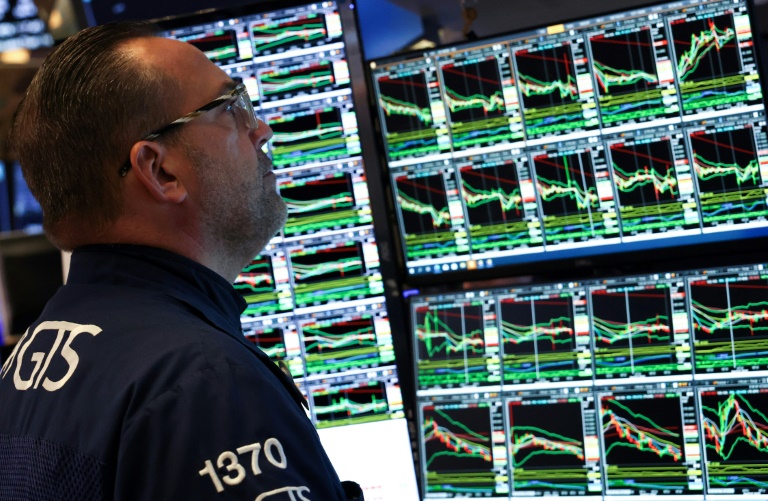
Major stock indexes around the world closed mostly lower on Friday, capping a turbulent week dominated by the ongoing U.S.-Iran conflict, spiking oil prices and disappointing U.S. employment figures that raised concerns about economic slowdown and persistent inflation.
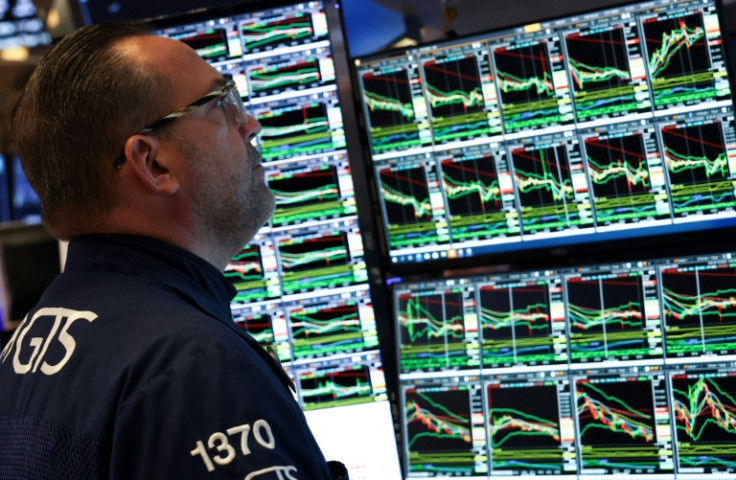
AFP
The Dow Jones Industrial Average fell 453.19 points, or 0.95%, to settle at 47,501.55. The broader S&P 500 declined 90.69 points, or 1.33%, to 6,740.02, while the tech-heavy Nasdaq Composite dropped 361.31 points, or 1.59%, to 22,387.68. All three major U.S. benchmarks posted weekly losses, with the Dow down nearly 3%, the S&P 500 off about 2% and the Nasdaq slipping 1.2%.
The sell-off reflected broader unease over the Middle East war entering its second week. Oil prices surged, with Brent crude topping $90 a barrel at points amid supply disruptions, including halted exports from key producers and blocked transport routes. Higher energy costs fueled fears of renewed inflationary pressures, prompting traders to pare expectations for central bank rate cuts.
In Asia, Japan’s Nikkei 225 rose 0.62% to close around 55,620, benefiting from a weaker yen and some resilience in export-oriented sectors. Hong Kong’s Hang Seng Index advanced 1.72% to 25,757.29, supported by mainland Chinese stimulus hopes despite ongoing property sector challenges. Chinese markets showed mixed performance amid Beijing’s reaffirmed 2026 CPI target of around 2%, viewed by economists as a ceiling rather than a firm goal.
European shares were mixed earlier in the week but ended the period with gains in some sessions as investors rotated toward value and defensive names. The pan-European STOXX 600 index recovered partially from earlier losses tied to energy price volatility.
The week’s volatility stemmed from several converging factors. Geopolitical risks escalated following U.S.-Israel actions against Iran, disrupting global energy flows and sending crude higher. Analysts warned that prolonged conflict could spike euro zone inflation and curb growth, with ECB Chief Economist Philip Lane noting potential substantial impacts.
U.S. economic data added to the caution. February’s jobs report disappointed, showing weaker-than-expected hiring and contributing to fears of labor market softening. Combined with firmer producer price index readings earlier in the year, the data reduced bets on Federal Reserve rate cuts. Markets now price in no cuts until potentially June or later, with probabilities for easing in 2026 scaled back.
Inflation remains a key concern globally. J.P. Morgan Global Research forecasts core CPI stable at 2.8% worldwide in 2026, with 3.2% in the U.S., 2.4% in the U.K. and 1.9% in the euro area. Regional cross-currents, including energy-driven pressures, complicate the picture. The Fed is expected to hold steady amid elevated price risks, while the ECB appears paused and the Bank of England tilts dovish.
Despite the headwinds, some positive undertones persist. Corporate earnings have shown resilience, particularly in AI-related sectors, though rotation away from mega-cap tech toward industrials, materials and energy occurred amid defensive positioning. International equities outperformed U.S. large-caps in recent periods, with developed markets outside the U.S. posting stronger returns.
J.P. Morgan Global Research maintains a positive stance on equities for 2026, forecasting double-digit gains in both developed and emerging markets, driven by robust earnings, lower rates over time and AI capital expenditure broadening.
Cryptocurrencies provided a bright spot amid the equity weakness, with bitcoin rallying significantly in some sessions, boosting related stocks like Coinbase and MicroStrategy.
Looking ahead, investors face a data-heavy calendar, including upcoming U.S. and China inflation releases, U.K. GDP and further trade figures. Central bank commentary will remain in focus as policymakers navigate the balance between growth support and inflation control.
The recent market swings underscore the challenges of operating in an environment marked by geopolitical uncertainty and macroeconomic cross-currents. While long-term outlooks remain constructive on fundamentals like corporate balance sheets and technological innovation, near-term sentiment hinges on de-escalation in conflicts and clearer signals from energy markets.
As trading resumes next week, attention will turn to whether stabilization in oil and any diplomatic progress can ease pressures, or if sustained higher costs force further reassessment of monetary policy paths.
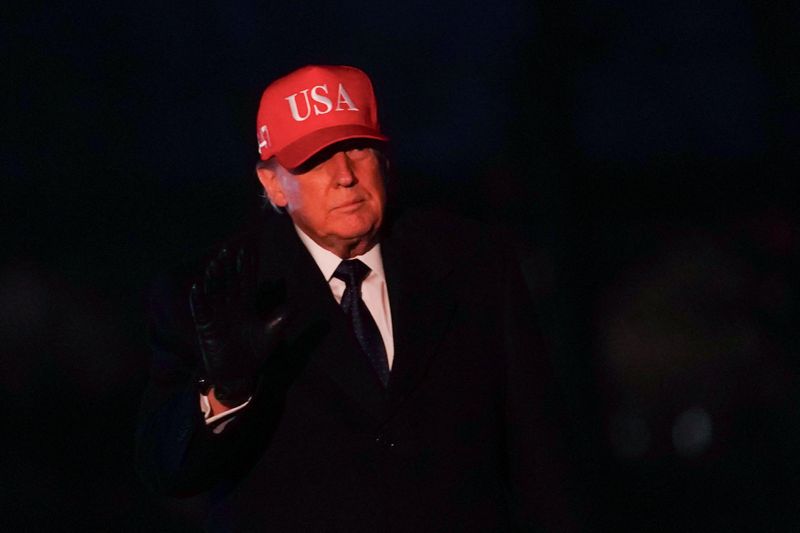

Days after Iran strikes, Trump hosts Latin American leaders with China in focus


Israel warns Lebanon of ’heavy price’ as bombardment pounds Beirut suburbs


Inside the Nepal campaign that could vault Balendra Shah to power

American Eagle Outfitters: Buy The Dip As Aerie Drives Surging Comps

Pentagon taps former DOGE official to lead its AI efforts

Vital Farms: The Egg Story Isn't Broken

The Tape Is (Rapidly) Deteriorating: Markets Are Weak, Breadth Is Terrible

Mordaunt gets owned on Channel 4

Tiga Ukuran Kelas Finansial

East Coast Main Line disruptions to affect Darlington


-

 Politics4 days ago
Alan Cumming Brands Baftas Ceremony A ‘Triggering S**tshow’
-
Business1 day ago
Form 8K Entergy Mississippi LLC For: 6 March
-

 Tech6 days ago
Unihertz’s Titan 2 Elite Arrives Just as Physical Keyboards Refuse to Fade Away
-

 NewsBeat7 days ago
Abusive parents will now be treated like sex offenders and placed on a ‘child cruelty register’ | News UK
-

 Fashion21 hours ago
Weekend Open Thread: Ann Taylor
-
 NewsBeat7 days ago
Dubai flights cancelled as Brit told airspace closed ’10 minutes after boarding’
-

 NewsBeat6 days ago
‘Significant’ damage to boarded-up Horden house after fire
-

 Tech2 days ago
Bitwarden adds support for passkey login on Windows 11
-

 Entertainment5 days ago
Baby Gear Guide: Strollers, Car Seats
-
 Sports2 days ago
499 runs and 34 sixes later, India beat England to enter T20 World Cup final | Cricket News
-
 NewsBeat6 days ago
Emirates confirms when flights will resume amid Dubai airport chaos
-
Politics7 days ago
FIFA hypocrisy after Israel murder over 400 Palestinian footballers
-

 NewsBeat5 days ago
Is it acceptable to comment on the appearance of strangers in public? Readers discuss
-

 Tech6 days ago
Viral ad shows aged Musk, Altman, and Bezos using jobless humans to power AI
-

 Video5 days ago
How to Build Finance Dashboards With AI in Minutes
-

 Fashion6 days ago
On the Scene at the 57th Annual NAACP Image Awards: Teyana Taylor in Black Ashi Studio, Colman Domingo in Yellow Sergio Hudson, Chloe Bailey in Christian Siriano, and More!
-

 Business4 days ago
Guthrie Disappearance Enters Fifth Week as Family Visits Memorial
-
 NewsBeat5 days ago
Ukraine-Russia war latest: Belgium releases video showing forces boarding Russian shadow fleet oil tanker
-
 Crypto World6 days ago
US Judge Lets Binance Unregistered Token Class Action Proceed
-

 Crypto World5 days ago
Why Nexo Is Reentering the US After the 2023 Crypto Lending Crackdown