Connect with us
DAPA Banner

Business

Developer behind what will be Wales’ tallest building appetite for further investment

Published

on

Business Live

BlueCastle Capital was set up Welshman Ed Williams and sees huge growth potential for build-to-rent schemes

How BlueCastle Capital’s build-to-rent scheme in the centre of Cardiff could look.(Image: BlueCastle Capital)

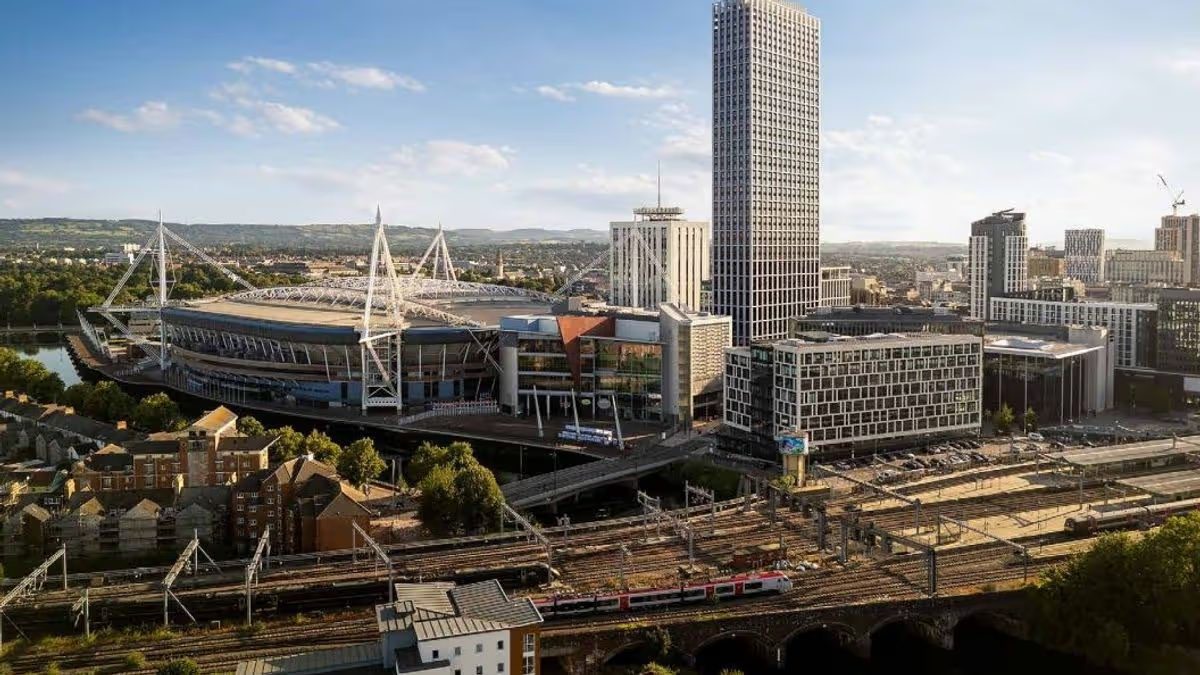
The developer behind what will be the tallest building in Wales has an appetite for further projects. Last week BlueCastle Capital, whose founder Ed Williams was born and raised in Cardiff, secured planning consent for its 50-storey scheme at the last development site (plot 5) at the mixed-use Central Square development around Cardiff Central Station.

At 178 metres high it will be the second tallest building outside of London – behind the 200 metre Deansgate Square South Tower in Manchester. The development will consist of 528 build-to-rent apartments, as well as a standalone two-storey pavilion providing 6,500 sq ft of commercial and restaurant space.

Advertisement

The scheme, designed by 5plus and Layer Studio, will offer a range of amenities, such as a gym, co-working space, a wellness area, a roof terrace, a bike hub, a café and landscaped public spaces.

READ MORE: Rhun ap Iorwerth on how a Plaid Cymru Welsh Government would boost the economyREAD MORE: Welsh Government invests £8m in deep water turbine platform firm

Planning approval from Cardiff Council follows public consultation and builds on a previously consented 35-storey scheme.

Artist impression of BlueCastle Capital’s 35-storey build-to-rent apartment scheme in the centre of Cardiff.

Barry Coltrini, development director at BlueCastle Capital, said: “This is a milestone for our Cardiff project and for the transformation of Central Square. The consent allows us to bring forward a landmark building that will deliver high-quality, sustainable homes and meaningful public spaces, while contributing long-term social, economic and environmental value to the city. We are grateful for he constructive engagement with the council, local community and wider stakeholders throughout the planning process”.

Advertisement

To date, BlueCastle has invested approximately £70m in acquiring and progressing its five build-to-rent development sites, which together will deliver around 2,500 new homes across Cardiff, Leeds, Birmingham, Stevenage and Sheffield.

BlueCastle’s Cardiff apartment scheme.(Image: Copyright Unknown)

On the potential for further project in Wales, over the long-term Mr Williams, who attended Cardiff High School, said “We are committed to Cardiff as a location and see huge potential for the build-to-rent sector within the city .”

Blucastle said it was not yet in a position to confirm when work on the scheme could start and be ready for occupancy.

The projected capital cost of its inaugural Welsh scheme has not been disclosed, while it said the level of rental income would be decided by market rents at the time of its launch.

Advertisement

However, once operational the company see it as a long-term investment hold. Mr Williams said: “BlueCastle’s business model is to be a fully integrated developer and asset manager with involvement in the value creation process from site selection and acquisition all the way through to long term ownership.

Following a career in equity markets with Merrill Lynch, Mr Williams, founded BlueCastle Capital in 2015. The London-based company has structured, developed and asset managed more than £3bn worth of real estate projects.

The UK build-to-rent sector is one of the fastest-growing sectors in UK real estate attracting around £4.7bn in 2025. BlueCastle believes it is well placed to become one of the UK’s leading developer and operator of build-to-rent assets.

Last month its acquired the site of the former Yorkshire Post headquarters in Leeds, pushing the its build-to-rent development pipeline to £1.1bn.

Advertisement

Mr Williams, who attended Cardiff High School, said: “Pushing our development pipeline beyond £1bn is a significant moment for the business and reflects the scale of our ambition in UK build-to-rent. We believe we are building the highest-quality build-to-rent development pipeline in the UK, with each site selected for its location, fundamentals and long-term relevance to renters.”

Bluecastle acquired plot 5 from Cardiff-based property development firm Rightacres Property. The value of deal was not disclosed, but is understood to have been in the region of £15m. Over the last decade Rightacres has delivered 1.25 million sq ft of mixed-use space – of which around 850,000 sq ft is grade A office – at Central Square

The scheme is a major employment location for the city, boosted by its close proximity to Cardiff Central Station, with its tenants who include HMRC, BBC Wales, Hugh James and Hodge Bank employing thousands of people


Advertisement
Continue Reading
Click to comment

You must be logged in to post a comment Login

Leave a Reply

Business

Devon Energy: Merger Deal, Iran War, Price Tailwinds

Published

on

Devon Energy: Merger Deal, Iran War, Price Tailwinds

Devon Energy: Merger Deal, Iran War, Price Tailwinds

Continue Reading

Business

Dollar steady as traders fret about escalating Iran war

Published

on

Dollar steady as traders fret about escalating Iran war


Dollar steady as traders fret about escalating Iran war

Continue Reading

Business

Asia markets brace for Trump’s promised assault on Iranian infrastructure

Published

on


Asia markets brace for Trump’s promised assault on Iranian infrastructure

Continue Reading

Business

Oil prices rise as US-Israeli war with Iran continues to disrupt supply

Published

on

Oil prices rise as US-Israeli war with Iran continues to disrupt supply
TOKYO, – Oil prices climbed on Monday on continuing fears of supply losses because of shipping disruptions in the key Middle East producing region from the U.S.-Israeli war with Iran.

Brent crude futures rose $1.71, or 1.6%, to $110.74 a barrel by 0057 GMT. U.S. West Texas Intermediate crude futures gained $0.71, or 0.6%, to trade at $112.25 per barrel.

On Thursday, the last trading day before the Good Friday holiday break, WTI ‌settled up more ⁠than 11% ⁠and Brent soared nearly 8% in volatile trading, recording their biggest absolute price increase since 2020, as U.S. President Donald Trump promised to continue attacks on Iran.

The Strait of Hormuz, which carries oil and petroleum products from Iraq, Saudi Arabia, Qatar, Kuwait and the United Arab Emirates, remains largely closed by Iranian attacks on shipping after the war began on February 28.

Advertisement

Because of the Middle East supply disruptions, refiners are seeking alternative sources for crude, particularly for physical ⁠cargoes in ‌the U.S. and the UK North Sea.


“Global buyers are bidding aggressively for (U.S.) Gulf Coast barrels and Brent is rallying even faster,” the Schork Group said in ⁠a client note on Monday.
On Sunday, Trump ratcheted up pressure on Tehran, threatening in an expletive-laden Easter Sunday social media post to target Iran’s power plants and bridges on Tuesday if the strategic Strait of Hormuz is not reopened. Still, some vessels, including an Omani-operated tanker, a French-owned container ship and a Japanese-owned gas carrier, crossed the Strait of Hormuz since Thursday, shipping data showed, reflecting Iran’s policy to allow passage for vessels from countries it deems friendly.

The war threatens to linger on as Iran ‌has officially told mediators it is not prepared to meet with U.S. officials in the Pakistani capital Islamabad in coming days and efforts to produce a ceasefire have reached a dead end, ⁠the Wall Street Journal reported on Friday.

On Sunday, OPEC+, consisting of some members of the Organization of the Petroleum Exporting Countries and allies such as Russia, agreed to a modest rise of 206,000 barrels per day for May.

However, that decision will largely exist on paper as several of the group’s key producers are unable to raise output due to the war.

Advertisement

Russian supply has been disrupted recently by Ukrainian drone attacks on its Baltic Sea export terminal. Media reports on Sunday said its Ust-Luga terminal resumed loadings on Saturday after days of disruptions.

Continue Reading

Business

How one factory in China learned to live with Trump, tariffs and turmoil

Published

on

How one factory in China learned to live with Trump, tariffs and turmoil


How one factory in China learned to live with Trump, tariffs and turmoil

Continue Reading

Business

How China fell for a lobster: What an AI assistant tells us about Beijing's ambition

Published

on

How China fell for a lobster: What an AI assistant tells us about Beijing's ambition

The AI agent sparked a frenzy of “raising lobsters” in March, with users training the tool to suit their needs.

Continue Reading

Business

Trump’s trade war with China in focus ahead of May summit

Published

on

Trump’s trade war with China in focus ahead of May summit


Trump’s trade war with China in focus ahead of May summit

Continue Reading

Business

Oil back above $110 after expletive-laden Trump threat to Iran

Published

on

Oil back above $110 after expletive-laden Trump threat to Iran

Trump wrote: “Tuesday will be Power Plant Day, and Bridge Day, all wrapped up in one, in Iran. There will be nothing like it!!! Open the Fuckin’ Strait, you crazy bastards, or you’ll be living in Hell – JUST WATCH! Praise be to Allah. President DONALD J. TRUMP”.

Continue Reading

Business

Bank stocks’ $95 billion rout may deepen on macro risks

Published

on

Bank stocks’ $95 billion rout may deepen on macro risks
More pain awaits Indian banks stocks — the biggest component of the country’s stock market — as the central bank’s moves in the currency market and growth shock to the economy from rising energy prices dent profit outlook.

The Reserve Bank of India’s defense of a record-low rupee has constrained its ability to inject liquidity, tightening financial conditions that are likely to weigh on banks over the coming quarters. A prolonged conflict in the Middle East also risks derailing India’s nascent credit recovery, threatening loan growth as the broader economy cools.

Global investors withdrew a record 327 billion rupees ($3.5 billion) from shares of financial services companies in the first fortnight of March, according to National Securities Depository Ltd. data. The Nifty Bank Index has lost $95 billion in market value since the start of March, narrowly avoiding a bear market — defined as a 20% drop from a recent high.

“There could be further pressure on these stocks in the short-to-medium term as monetary policy can remain tight,” Kranthi Bathini, an equity strategist at WealthMills Securities, said, adding that valuations are becoming attractive after the correction.

Advertisement
453177410Agencies

At stake is the outlook for India’s $4.5 trillion stock market, given banks account for nearly a third of the benchmark index. A sustained weakness in shares of lenders could undermine a broader market that is already among the worst performers in the region, down 13% for the year.


Bulls point to improving valuation multiples for bank stocks and India’s long-term economic growth, which remains among the fastest globally. The Nifty Bank Index trades at 1.5 times one-year forward price-to-book, its cheapest level since 2020, signaling an attractive risk-reward profile.
Citibank Inc. is already prioritizing private-sector banks over state-run lenders, betting that the former can better absorb the macroeconomic stress that is now the prime concern for investors.Still, Jefferies estimates banks could face as much as 50 billion rupees from unwinding their currency trades due to diktats of the central bank. Fitch Ratings sees net interest margins of lenders shrinking 20-30 basis points in the year ending March 2027 — potentially undershooting the credit rating agency’s 3.1% forecast — as tighter financial conditions weigh.

“Banks will definitely take some hit on their investment book,” said Rajat Agarwal, an Asia strategist at Societe Generale SA. “We recently saw a pickup in credit growth — what remains to be seen is how much of that gets pushed back” by the war, he said.

Continue Reading

Business

FY26 IPO performance: Only 1 in 3 delivered returns amid market volatility

Published

on

FY26 IPO performance: Only 1 in 3 delivered returns amid market volatility
ET Intelligence Group: FY26 was a challenging year for the primary equity market, with most initial public offerings (IPOs) failing to earn returns since listing till March 31 amid heightened volatility. While geopolitical tensions in West Asia and weakening rupee amid the exodus of foreign investors affected the overall equity performance, there were a select few IPOs that managed to stay in the green. Of the 109 mainboard IPOs that were listed in FY26, 32 or one out of three IPOs posted positive returns while 16 IPOs yielded double-digit returns over the listing price. This also implies that by and large, the primary equity market did not earn returns after listing.

Among the top gainers were electric bikes maker Ather Energy (139% return), auto ancillary manufacturer Belrise Industries (98%), and Aditya Infotech (78%), which provides video surveillance solutions.

Instead of listing price, if offer price is considered, then the proportion of companies improves – 37 IPOs generated returns while 31 yielded double-digit returns. The same three companies made it to the top three slots. Aditya Infotech took the lead with 168% return over the offer price while Ather Energy and Belrise gained 143% and 116%.

Only 1 in 3 IPOs Brought Cheer in FY26Agencies

In a volatile market, just 16 IPOs yielded double-digit returns over listing price

It was also the year when majority of the large IPOs based on the issue size or money raised failed to generate returns. Only a quarter of the top 12 IPOs – four to be precise – earned returns. These include Lenskart and Groww generating 26% return each, followed by 11% return by ICICI Prudential AMC and 8% by Tenneco Clean Air India.
Among the worst performing IPOs of FY26 were steel products maker VMS TMT, which fell 62% from the listing price followed by construction company Highway Infrastructure and renewable energy equipment provider Solarworld Energy Solutions which lost 60% each.

Advertisement


Continue Reading

Trending

Copyright © 2025