Plans were initially refused by the local council but a government inspector has overturned the decision
Bradley Gerrard, Local Democracy Reporter
05:30, 29 Jul 2026
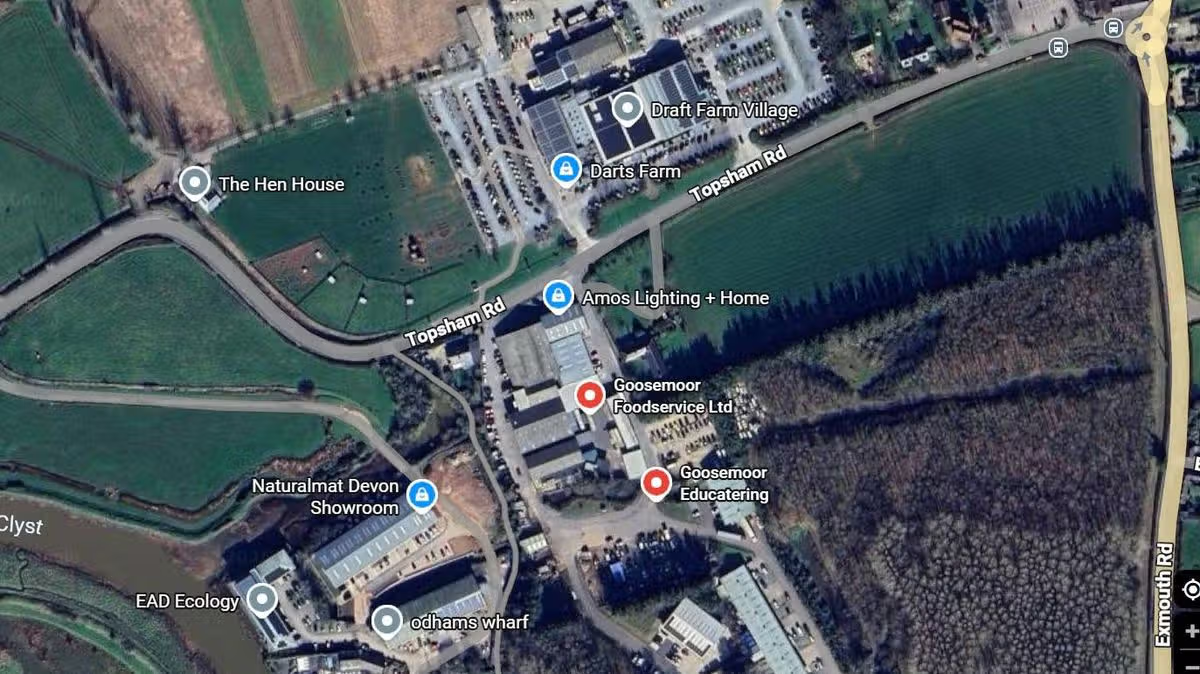
The current location of Goosemoor, near Dart’s Farm(Image: Google Maps)
A Devon business will be permitted to build an ‘educatering’ facility after successfully appealing a decision that initially rejected its proposals.
Advertisement
Goosemoor, which has been owned by the Pritchard family for nearly 70 years, sought permission to build a site in East Devon that would primarily house a food distribution centre for its school meals operation.
While this is expected to run round-the-clock for six days a week, the business also envisaged the development, in the parish of Woodbury, would have a classroom where pupils could discover the origins of their food and prepare meals, alongside open areas where crops would be cultivated to supply ingredients.
Local planning authorities declined to approve the scheme earlier this year, citing concerns about its effect on the surrounding countryside – the majority of which carries some form of protected status – and the view it would almost certainly require car access, which could itself prove troublesome for others using the narrow rural lane which lacks pavements or street lighting.
East Devon District Council’s planning committee also raised concerns about the possible impact on neighbouring properties, which include Grade II listed North Lodge, Nutwell Cottages and Nutwell Lodge Hotel.
Advertisement
A drawing of a possible layout of the proposed Goosemoor ‘educatering’ facility (Image: Local Democracy Reporting Service / EDDC)
However, a government planning inspector has reversed the decision – though with 26 conditions attached to the approval. Goosemoor has welcomed the ruling, while a council spokesperson said it was “disappointed” given its “clear concerns” about the proposal.
Although inspector Laura Cuthbert acknowledged several of the issues raised by the council, she assigned most of them only ‘limited’ or ‘moderate’ weight, while affording “significant weight” to the potential employment benefits the scheme could deliver and its broader economic impact.
Within her report, the inspector indicated the development could generate as many as 75 new jobs.
Citing the council’s own economic development officer, Ms Cuthbert noted the authority had recently acknowledged a “critical and well-established shortage of available employment land” in East Devon, which was “constraining inward investment, local business growth and forcing some employers to leave the district”.
Advertisement
Ms Cuthbert said: “These comments indicate that concerns regarding the availability of employment land and commercial premises remain significant and ongoing.
“Consequently, notwithstanding the council’s emerging strategy to address this matter, there remains an acknowledged and substantial shortfall in employment land across the district.
“Whilst future allocations may assist in meeting that need, their delivery remains uncertain at present. Having regard to the evidence before me, I conclude that the proposal would make a meaningful contribution towards addressing the current shortage of employment land and premises.”
Jamie Walsh, the founder and director of Goosemoor Educatering, welcomed the decision.
Advertisement
“The appeal has gone our way, and I think the process was pretty considered,” he said.
“It was back and forth from both sides, but what was pleasing is that in the appeal format, we could answer any queries, statements or questions and so it felt a lot more like our voice was heard [than at the planning committee].
“The inspector kept mentioning the planning balance and it came down more in our favour with the potential negatives not being enough to block the application.”
Mr Walsh said he hoped construction on the site would get under way in spring next year, once the firm has met the planning conditions attached to the scheme.
Advertisement
A spokesperson for East Devon District Council said the authority was “disappointed” the appeal had been allowed.
“Our position was that the site conflicted with countryside protection policies, was in an unsustainable location with very limited access to public transport, walking and cycling routes, and would cause harm to the landscape and to the setting of nearby listed buildings,” the spokesperson said.
“While the inspector agreed with all of these concerns, they concluded that the economic benefits of the scheme outweighed the harm identified, in the absence of a suitable alternative site.
“We respect the inspector’s decision, but our position remains that development in the countryside must be carefully managed and located where it can be properly supported by sustainable transport and infrastructure.”
Tata Capital shares climbed 3.67% to Rs 367.95 during Wednesday’s trading session after the company reported a strong set of earnings for the first quarter of FY27, driven by robust growth in profit, revenue, and its lending business.
The Tata Group-backed NBFC posted a consolidated net profit of Rs 1,547 crore for the April-June quarter, registering a 56% year-on-year (YoY) increase from Rs 990 crore reported in the corresponding quarter of the previous financial year.
Revenue from operations also remained healthy, rising 15% YoY to Rs 8,822 crore, compared with Rs 7,665 crore in Q1 FY26, reflecting sustained business momentum.
Lending business remains the key growth driver
Tata Capital’s assets under management (AUM) expanded 22% YoY to Rs 2.91 lakh crore, while excluding the motor finance business, AUM recorded an even stronger 28% YoY growth.
Advertisement
The company’s net loan book grew 23% YoY to Rs 2.29 lakh crore, supported by healthy credit demand. Net interest income (NII) increased 25% YoY to Rs 2,866 crore, underscoring strong core lending performance.
Meanwhile, the cost-to-income ratio improved marginally to 36.4% from 36.8% in the year-ago quarter, indicating continued operational efficiency.
Live Events
Tata Capital’s net profit margin improved to 17.54%, compared with 12.92% in Q1 FY26, although it eased sequentially from 18.41% reported in Q4 FY26. The company’s net worth surged 42% YoY to Rs 46,261 crore, while the annualised return on assets (ROA) improved to 2.3% from 1.8% a year ago. Annualised return on equity (ROE) rose to 13.7%, and the capital adequacy ratio remained healthy at 18.5%.
Tata Capital enters the gold loan segment
Alongside its quarterly results, Tata Capital announced its entry into the fast-growing gold loan business through the acquisition of Yogloans, an RBI-registered non-banking financial company focused on gold-backed lending.The company will acquire an 88.6% stake in Yogloans through a share subscription and purchase agreement, based on a pre-money equity valuation of up to Rs 318 crore. The acquisition is expected to strengthen Tata Capital’s secured lending portfolio and expand its presence in the retail finance segment.
Share Price, Valuation, and Technical Indicators
Following the earnings announcement, Tata Capital shares traded around Rs 368, taking the company’s market capitalisation to approximately Rs 1.51 lakh crore. The stock is trading close to its 52-week high of Rs 379.95, reflecting sustained investor optimism.
Advertisement
From a valuation perspective, the stock trades at a price-to-earnings (P/E) ratio of 30.71, a price-to-sales (P/S) ratio of 4.08, and a price-to-book (P/B) ratio of 3.16.
On the technical front, the stock’s 14-day Relative Strength Index (RSI) stands at 55.5, suggesting neutral momentum, with RSI readings below 30 considered oversold and above 70 viewed as overbought. Additionally, Tata Capital is trading above all seven of its key simple moving averages (SMAs), indicating a strong bullish trend.
(Disclaimer: Recommendations, suggestions, views and opinions given by the experts are their own. These do not represent the views of The Economic Times.)
A London shop catering for people who are left-handed was doing a brisk trade both in-store and via mail-order. Items available included secateurs, a builder’s trowel and even left-handed playing cards. Report by Susanne Hall.
Clip taken from Nationwide, originally broadcast on BBC One, 18 April 1975.
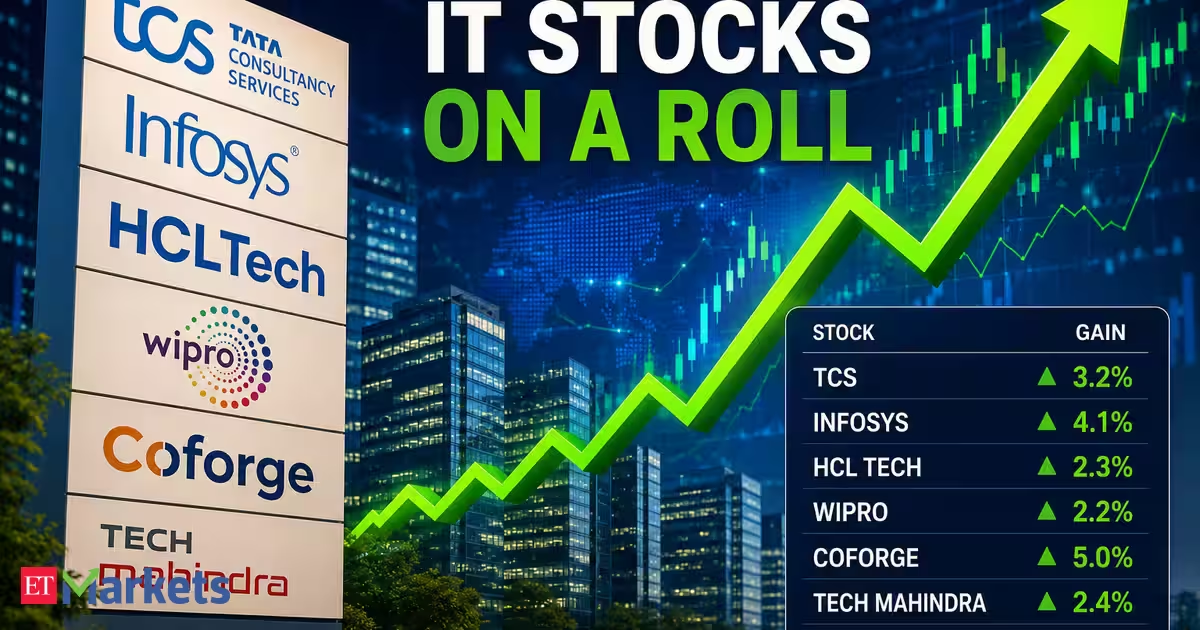
Indian IT stocks surged again on Wednesday, with Infosys, TCS, HCL Tech, Wipro, Coforge and Tech Mahindra gaining up to 5% as a sharp selloff in semiconductor stocks intensified amid growing investor concerns over Big Tech’s massive AI spending.
TCS shares gained 3.2% to Rs 2,476 on the BSE, while Infosys rallied 4.1% to Rs 1,152. HCL Tech rose 2.3% to Rs 1,350, and Wipro edged 2.2% higher to Rs 185. Midcap IT stocks outperformed, led by Coforge, which surged another 5% following a strong Q1 performance, while Persistent Systems advanced more than 3%.
This development comes at a time when Indian IT companies are grappling with investor concerns over weak discretionary spending, pricing pressure, rising wage costs, and the impact of AI on traditional outsourcing revenues.
AI trade over?
“The AI trade is being viewed with a much greater degree of skepticism, and the shift in sentiment means it has become something of a one-way trade, with stocks being sold unmercifully,” Mark Luschini, chief investment strategist at Janney Montgomery Scott, told Bloomberg.The recent pullback in the tech-heavy Nasdaq 100 signals a shift in sentiment toward some of Wall Street’s biggest winners of recent years, as growing concerns over the rising cost of AI investments raise questions about when this spending spree will begin delivering meaningful returns.
Advertisement
Live Events
Developments in China have added to investor concerns. ChangXin Memory Technologies (CXMT) made a blockbuster market debut, soaring nearly 500%, while reports emerged that a Chinese state-backed company had begun producing immersion DUV lithography equipment. “The market’s concern lies less in CXMT’s current earnings and more in its potential for accelerated capacity expansion to rival Korean companies, as well as its technology development following the IPO,” Kim Seok-hwan, a Seoul-based market analyst at Mirae Asset Securities, told Reuters.
AI trade unwinding continues
Asian stocks extended their sharp selloff on Wednesday as concerns over stretched AI valuations, intensifying competition, and heavy spending weighed on investor sentiment ahead of key earnings from major technology companies and the U.S. Federal Reserve’s policy decision.South Korea’s KOSPI fell as much as 12% during the day, reversing earlier gains after plunging more than 10% to a three-month low on Tuesday, despite strong earnings from SK Hynix. Shares of the chipmaker tumbled 14% as investors digested results showing quarterly operating profit had risen more than sixfold but still fell short of elevated market expectations. Samsung Electronics dropped another 10%, with the two companies together accounting for nearly half of the index’s weight.
MSCI’s broadest index of Asia-Pacific shares outside Japan declined 1%, following a 3.6% fall on Tuesday, and was headed for an 8% monthly loss. Japan’s Nikkei slipped 1% and was on track to end July down more than 10%.
IT stocks outlook
International brokerage Jefferies, in a recent report, said its interactions with more than 50 FPI investors point to a positive shift in sentiment toward India as concerns around the AI trade intensify.
The brokerage noted that FPI flows have turned positive, while economic and corporate data have also surprised on the upside. With IT services stocks bearing the brunt of AI-related concerns, Jefferies believes the pause in the AI trade could create room for a tactical recovery in the sector. It has therefore closed its longstanding underweight (UWT) stance on IT services by adding Infosys to its portfolio.
Advertisement
The IT sector has declined 25% year-to-date, with the top four IT majors—TCS, Infosys, HCLTech and Wipro—trading about 35%–50% below their peaks over the past two years and at 13–17x P/E multiples. While revenue growth is expected to remain in the low-to-mid single digits over FY26–FY28E, Jefferies believes a reversal in the AI trade could drive tactical upside, particularly after the sector’s sharp correction.
The brokerage also noted that negative stock reactions to adverse sector news have become much milder, indicating that the sector may be nearing a bottom. Jefferies has added Infosys and increased its weight in Coforge in its model portfolio, taking its overall IT allocation to neutral. The move has been funded by trimming exposure to power, real estate, and hospitals, which remain its largest overweight positions.
US Fed: Near-term pressure?
The US Fed is widely expected to keep rates unchanged at its policy meeting today. However, expectations of a 25-basis-point rate hike have risen to 36.3% from 16% a week ago, according to CME FedWatch. Markets are now pricing in an 81% probability of a rate hike at the central bank’s September meeting.
The US Federal’s policy stance can significantly influence Indian IT stocks through its impact on US technology spending, interest rates, economic growth, and the dollar-rupee exchange rate. Higher interest rates can weigh on corporate technology budgets, while lower rates may improve business confidence and boost IT spending. A stronger US dollar also benefits Indian IT companies by increasing the rupee value of their overseas revenue.
Advertisement
(Disclaimer: Recommendations, suggestions, views and opinions given by the experts are their own. These do not represent the views of The Economic Times)
The sanctuary was set up in 2021 to rescue Mustard the pig, who was at risk of having to go for slaughter if a home was not found for him.
Since then, the team of volunteers have taken in sheep, chickens, turkeys, cats, alpacas, guinea pigs and rabbits.
Ms Prescott described the thought of having to find homes for all the animals if the charity was to close as “terrifying”.
Volunteer Catherine Christie-Mutch said she wanted to set it up because they “have lovely supporters, people behind us, but there is only that much we can ask of these people”.
Advertisement
She added that this year had already been very hard with lots of animal loss and high vet bills.
“Every time it starts to look a bit brighter, something else happens, no time for the sanctuary to get back on its feet,” she said.
The BBC approached Cheema and Abdul Rehman, the new director listed for SC Parking Ltd, for comment and did not receive a response.
Uttlesford District Council said it was a complex case with “various agencies involved.”
A spokesperson said the authority would continue to monitor the site and assess any new reports received to determine whether they fall within the scope of the existing enforcement notice.
Essex Trading Standards said it had not received enough complaints to justify a formal investigation.
Advertisement
Travel Extra Deals Ltd, which owns a comparison site used by some of the car park’s customers, said it had issued the operator with a final warning and would stop sending bookings if further complaints were received.
The company said it would review unresolved cases, provide refunds where appropriate and offered an apology on behalf of the operator.
The BBC put customers’ complaints to Park Pilot Ltd, the company named on customers confirmation emails as the service provider, as well as the writing to management at New Farm, but neither responded.
The Radisson Blu Hotel at Stansted Airport said it was aware of concerns. Its general manager, Dinesh Kunder, said: “We would like to stress, the hotel has no commercial agreement nor affiliation with this company.”
Advertisement
Stansted Airport’s managing director, Gareth Powell, urged customers to choose authorised parking providers, check reviews and report concerns to Essex Trading Standards via the Citizens Advice consumer helpline.
Asia-Pacific Images Studio/iStock via Getty Images
Utilities have become an exciting sector as both market prices and fundamentals are changing rapidly. We monitor the relative opportunity of the major electric utilities as factors change and have come to believe that WEC Energy Group (WEC) has become more opportunistic than Dominion (D).
This article will discuss why we are trimming D in favor of WEC. We shall begin with a discussion of Dominion as it has played out and follow with a renewed thesis on WEC.
Dominion—Still Strong but Valuation is Less Appealing Due to Appreciation
We have liked Dominion since our initial thesis that it would have powerful demand drivers through its access to northern Virginia, which is the epicenter of data center development. Aside from some minor delays and cost overruns on CVOW, fundamentals have played out beautifully.
Advertisement
Dominion has successfully grown earnings and still has an impressively large growth pipeline. Dominion has had 2 main challenges, which previously caused it to trade at a discount to most electric utilities:
Higher leverage at 60% debt to capital
High capital needs to fund the load growth
In May of 2026, it was announced that NextEra Energy (NEE) was going to buy Dominion and form the largest electric utility ever.
We liked the merger right away as it directly solves both of Dominion‘s challenges. NEE has access to vast amounts of low-cost capital, which means the combined company will be able to very accretively fund Dominion‘s growth pipeline. As the merger was announced, the market was hesitant to believe it would go through, which left a large arbitrage gap that we discussed in the above-linked article.
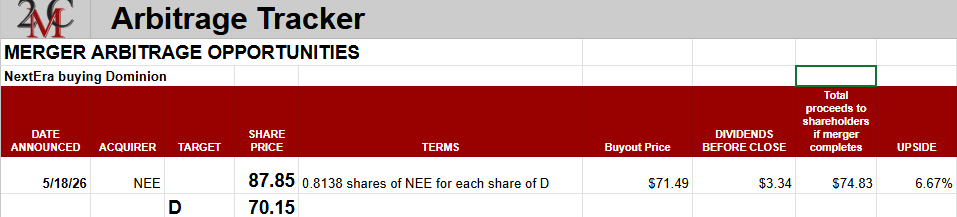
Specifically, Dominion was trading at $68.32 (at the time of writing the above-linked article), while the value of NEE shares, into which it would convert upon merger completion, was $73.36. Furthermore, D was due just over $4.00 in dividends while waiting for closing, such that the overall upside was 13.25%.
Portfolio Income Solutions
Advertisement
Over time, the arbitrage gap began to close as the market got more comfortable with the deal. On July 16th, D and NEE filed with regulators to approve the merger, which solidified that both parties are interested and pursuing a path to closing.
That largely closed the arbitrage gap. As of 7/21/26, D is trading at $70.15 with the converted value in NEE shares worth $71.49.
Portfolio Income Solutions
With about 5 dividend periods until expected close date, D shareholders would get total proceeds of $74.83 for total remaining merger upside of 6.67%. Given the roughly 1.25 years until expected close, this seems about right, and I would consider the arbitrage to be essentially played out.
Advertisement
There remains some chance the merger will get shot down by regulators, so it is not risk-free, but I consider it fairly low risk for 2 reasons:
Both companies are stable and successful as stand-alone
There is a hefty breakup fee that NEE would have to pay Dominion that would substantially pad any downside from a failed merger.
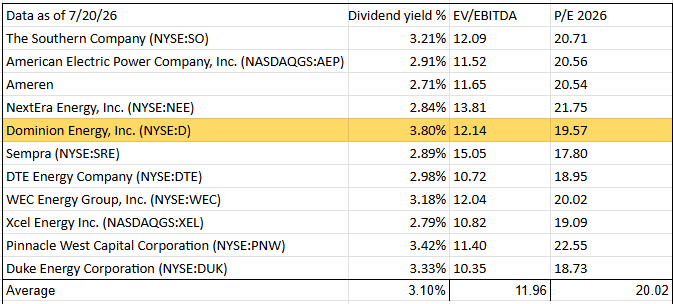
Given the rise in Dominion‘s price, it is no longer trading at a material discount to peer electric utilities.
2nd Market Capital
Dominion is trading at 12.14X 2027 EBITDA compared to 11.96X for the sector. Its PE multiple is fractionally lower than peers, making its overall valuation essentially right in the middle.
We still prefer the Dominion leg over the NEE leg. The combined company looks to be an entirely reasonable investment with good growth in both Virginia and Florida. However, the less attractive valuation after the run-up encourages us to look elsewhere in the sector.
Advertisement
The WEC Buy Thesis
I think the market has misinterpreted the strict VLC Tariff (very large customer) tariff passed by the Public Service Commission of Wisconsin as a negative. In a more balanced demand environment, the terms could be demand destructive for data center development, but presently time-to-market is the key desideratum of where to develop, and the structure of the tariff actually improves time-to-market.
The result is that WEC gets development terms that are highly favorable to the utility while experiencing a quantity of demand that will materially expand their earnings power over time.
Let us begin with a discussion of the VLC Tariff and move on to show how it is facilitating a massive load expansion for WEC.
The VLC Tariff
WEC proposed a VLC Tariff along with a Bespoke Resources Tariff for large customers in March, which was meant to do 2 things:
Advertisement
Protect ordinary customers from having to foot the bill for data center development
Create a framework of guaranteed payment such that WEC would not be left without a revenue source if the large customer were to back out.
In their proposal, WEC called for it to apply to customers over 500MW and wanted to establish a minimum 10-year term so as to make sure they got paid back for development expenses.
The Public Service Commission of Wisconsin reviewed the proposal and made it substantially more aggressive before passing it on April 24th, 2026.
Financial guarantees for VLCs below A- credit rating
100 MW or bigger rather than 500MW or bigger
Generation and transmission costs are 100% of VLC customer-funded.
15-year minimum term
Early exit fee for full reimbursement of costs
One may note that each of these terms is “against” the data center in the sense that it locks them in and forces them to pay a larger share of the bill aimed to ensure they pay at least 100% of the costs.
This makes the terms of any data center development quite favorable to WEC because they will get a very high ROE on data center development, and that return is backed by a long contract with a high credit tenant or a capital reserve set aside.
Advertisement
While these terms are favorable for WEC, they could be viewed as demand destructive. If the terms are too aggressive against data centers, they may choose to locate elsewhere, potentially causing WEC to lose some of what would have been load growth.
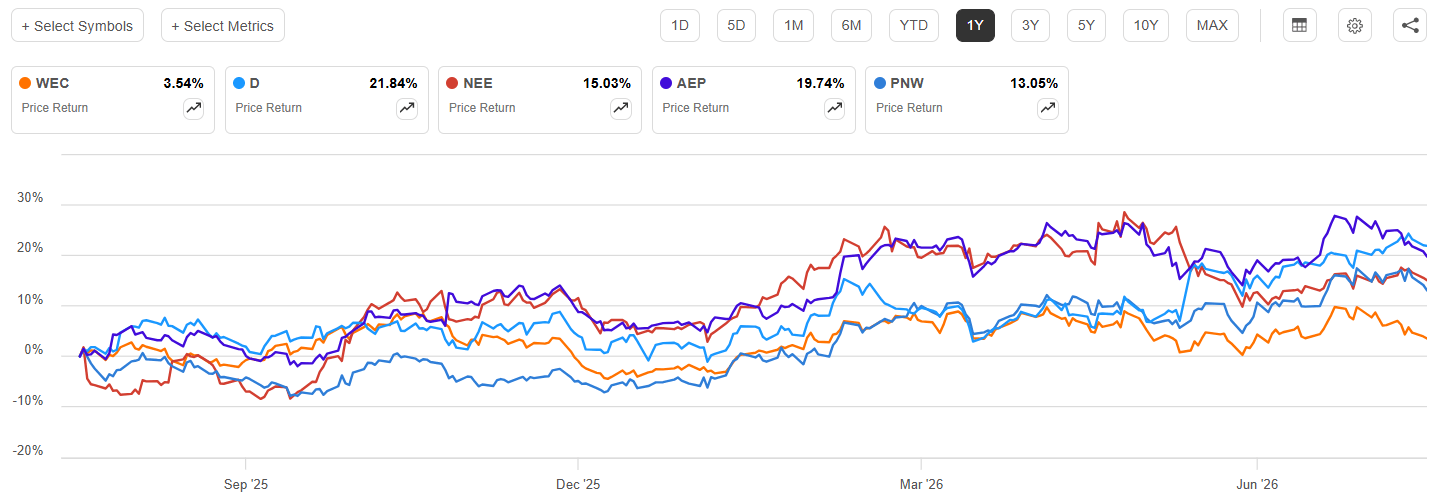
The market seems to have interpreted the Public Service Commission‘s version as demand destructive, as WEC has materially underperformed its peers.
SA
Note on the chart above how WEC has basically flatlined since it submitted its VLC proposal in March.
Advertisement
I think the market‘s interpretation is wrong and that the VLC Tariff is bullish for WEC.
Why the VLC Tariff Matters and How It Impacts WEC Earnings
There are always going to be tradeoffs in regulation, and this is among the more ironclad in terms of making sure the data centers pay for the development.
We see the VLC Tariff having 3 main effects:
Data center developers are slightly disincentivized economically to build in this jurisdiction.
Regulators will be faster and more willing to accommodate the development of data centers given the protection to residential customers.
Data center developers currently care more about speed to market rather than cost to build.
Thus, while demand remains high and speed to market is the key issue, the tariffs may actually stimulate activity.
Data center development is being aggressively fought at both a state and local level, such as the data center moratorium in New York. This red tape exacerbates what is already a slow process of building new power generation.
Advertisement
We believe the clear framework set forth in the Wisconsin VLC Tariff and the safeguards for residential customers go a long way to reducing that red tape. To the extent it can guarantee the data centers pay for the power and transmission, data center development is an economic and employment boon for the state and local areas. It makes it much easier to greenlight projects and thereby reduces time-to-delivery.
Faster development is a big deal for the hyperscalers who want to win the AI race, and I believe that is why so many data centers are popping up in Wisconsin.
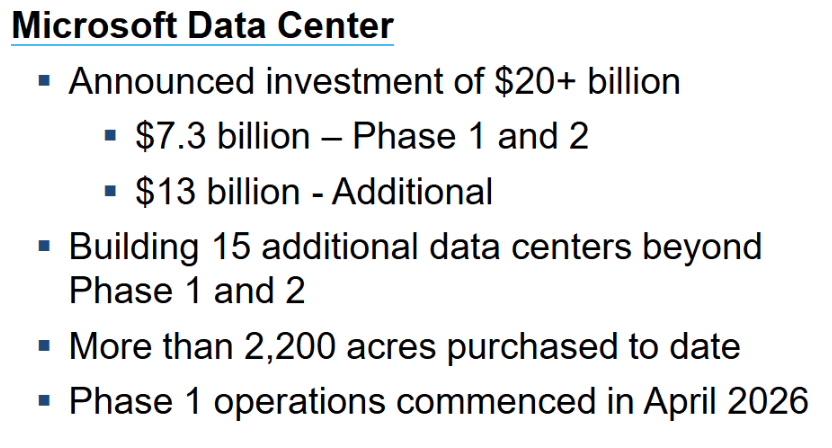
Microsoft is building an enormous data center at Mount Pleasant
WEC
Advertisement
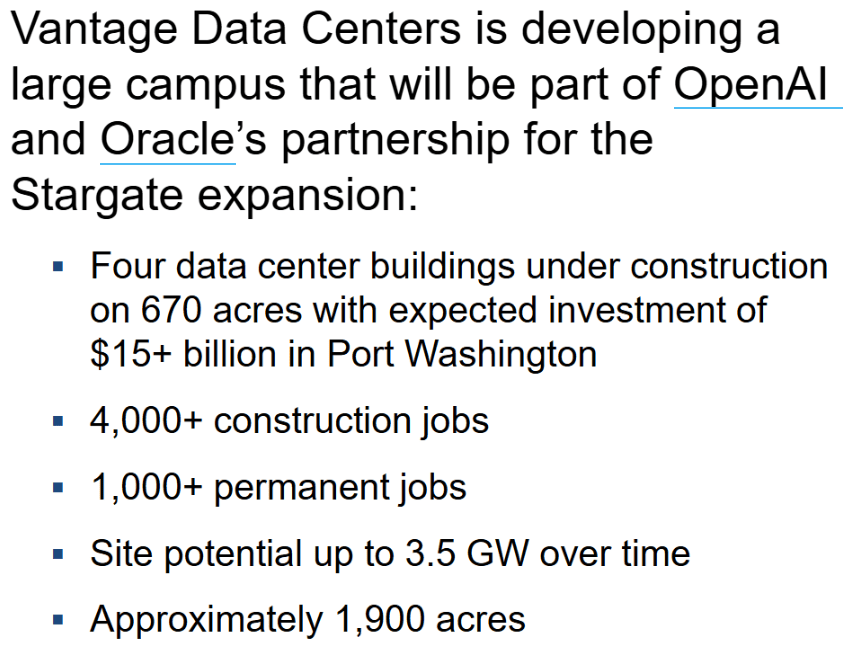
Vantage is building a data center for OpenAI and Oracle in Port Washington, where WEC already generates substantial power.
WEC
Beyond data centers, Wisconsin has strong manufacturing growth, as discussed by Scott Lauber, WEC‘s CEO, on the 1Q26 earnings call:
“There’s other notable growth in the state. As a recent example, Milwaukee Tool has announced plans to further expand its campus in our territory, including a new research and development facility. Waukesha Engine also announced plans to expand upon its local operation and employee base. In addition, we’re starting to see good housing development. In fact, realtor.com recognized Racine County, home of the Microsoft site, as one of the nation’s hottest housing markets. We’re committed to meeting the growing demand across our service areas as we invest in our system for increased capacity and reliability.”
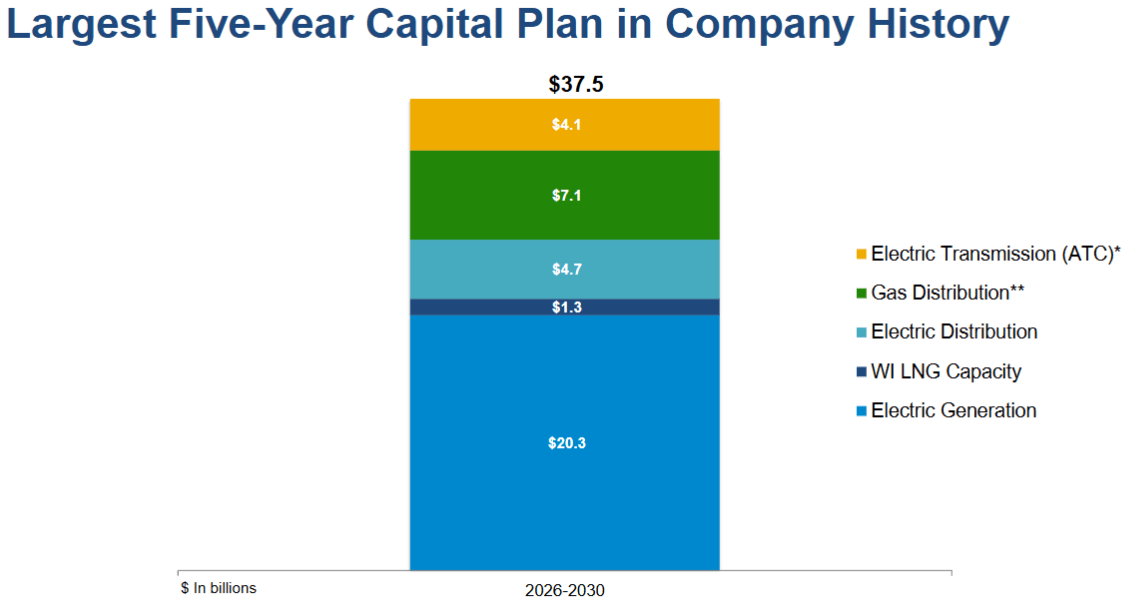
These large-scale projects are fueling WEC‘s load growth and the earnings growth that comes along with it. In total, WEC plans to outlay $37.5B over the next 5 years.
Advertisement
WEC
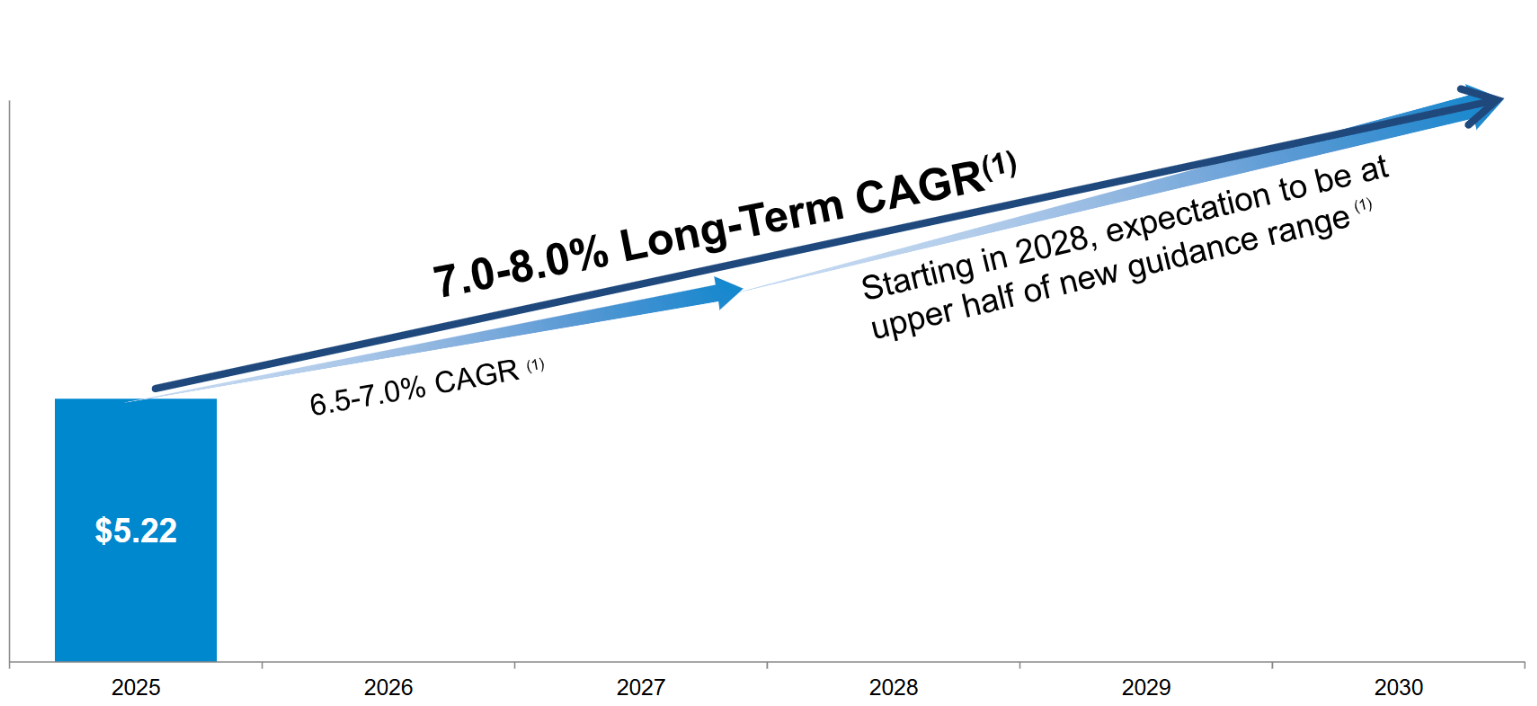
Since utilities have regulated ROE and a higher ROE attached to data centers subject to the VLC Tariff, deployed capital translates directly to earnings per share growth. As these projects come online, WEC anticipates earnings growth accelerating to 8% annually.
WEC
WEC can fund this development at a reasonably low cost of capital. In June they issued $400 million of 5-year notes at 4.65% and $400 million of 10-year notes at 5.10%. This low spread over Treasuries is a testament to their strong balance sheet and operating track record.
Advertisement
High Total Return Potential Relative to Risk
With earnings growth accelerating to 8% annually and a 3.4% dividend yield, WEC is positioned to deliver an annual total return of 11.4% if one were to assume the multiple at which it trades remains flat.
That is a high return for a large-cap electric utility, which is generally considered to be below average risk for an equity. I would consider the outsized return relative to risk to represent mispricing and suggest that WEC will appreciate until such a price that it is generating a more normal forward expected return for its risk level.
Primary Risk to WEC
If demand for data centers were to drop off substantially, the aggressive terms of the VLC Tariff could indeed become demand destructive. We will be watching hyperscaler capex closely as their earnings reports roll out. High capex is good for utilities broadly and especially WEC.
Heathrow Airport will be allowed to charge airlines more for its services to recover money spent on the early stages of its third runway project.
The aviation regulator is permitting the airport to claw back up to £320m through higher airport charges to airlines for each passenger, which is likely to end up being added to ticket prices.
A bidder which unsuccessfully put forward a rival design involving a shorter runway, Arora Group’s Heathrow West, will also be allowed to recover £4.1m pounds in costs.
The Civil Aviation Authority (CAA) and Heathrow said safeguards would be put in place to protect consumers from unjustified costs.
Advertisement
The cost of early planning and design during 2025 and 2026 will be recovered by adding to the fees the airport charges per passenger.
Heathrow airport will also be able to collect Heathrow West’s costs up to November last year by adding to its airport charges.
The CAA said allowing these costs to be recouped will result in the maximum airport charge per passenger increasing by around 15 pence in 2028, rising to an estimated 30 pence in the following years.
In November, the government announced it preferred the £33bn scheme put forward by the airport over Arora’s alternative plan.
Advertisement
At the time, the Department for Transport said Heathrow’s own proposal offered the most deliverable option, and the “greatest likelihood” of getting a decision on planning approval within this parliament.
The CAA’s Director of Consumers and Markets Tim Johnson said today’s decision “strikes a balance between supporting the delivery of benefits to consumers through timely progress on Heathrow expansion, whilst also protecting them from undue increases in costs”.
The regulator said “safeguards” designed to monitor cost efficiency would include transparency and cost reporting requirements, and assurance by independent experts.
Airlines often complain that Heathrow is the world’s most most expensive hub airport, and have repeatedly voiced concern that the airport’s expansion plans will exacerbate this.






















































You must be logged in to post a comment Login