Connect with us
DAPA Banner

Business

Earnings call transcript: Acme United Q1 2026 sees EPS miss amid revenue growth

Published

on

Continue Reading
Click to comment

You must be logged in to post a comment Login

Leave a Reply

Business

US stocks today: US stocks close lower on fading hopes for quick Iran deal, mixed quarterly earnings

Published

on

US stocks today: US stocks close lower on fading hopes for quick Iran deal, mixed quarterly earnings
U.S. stocks fell in choppy trading on Thursday as hopes dimmed for a quick end to the Iran war, while investors grappled with a mixed bag of earnings reports as concerns resurfaced about AI-driven disruption across the software sector.

Equities had been holding near unchanged after Iran tightened control over the Strait of Hormuz. Tehran released footage of its commandos storming a huge cargo ship they claimed to have seized, while demanding the U.S. lift its naval blockade on Iranian ports.

Stocks ‌weakened after reports that ⁠Iran’s Parliament ⁠Speaker Mohammad Bagher Ghalibaf had resigned from the negotiating team. Losses were extended as oil prices shot higher after reports of air attacks in Iran.

Iran’s Fars news agency said the air defenses were activated due to small drones at several locations across the country.

Advertisement

“We’re playing musical chairs between earnings season and these war headlines that are not likely to be that great,” said Jay Hatfield, CEO and CIO of Infrastructure Capital Advisors in New York.


“We had a big run, and there are people looking to take some exposure off, and using the war as an excuse is not a bad excuse.”
Markets had rallied in recent weeks on hopes a resolution to the Iran war was on the horizon, along with ⁠expectations of solid corporate ‌earnings. But gains have been harder to come by this week. On Monday, the Nasdaq snapped a 13-session streak of gains as optimism faded for a resolution to the war.

Oil prices holding near $100 a barrel also kept fears of rising inflation ⁠in focus.

According to preliminary data, the S&P 500 lost 29.86 points, or 0.42%, to end at 7,108.04 points, while the Nasdaq Composite lost 218.14 points, or 0.88%, to 24,439.42. The Dow Jones Industrial Average fell 182.45 points, or 0.36%, to 49,313.27.

Data on Thursday showed weekly initial jobless claims increased only marginally last week, but risks from higher prices due to the war could hamper the economy.

Advertisement

S&P Global’s flash U.S. Composite PMI Output Index, which tracks the manufacturing and services sectors, increased this month after almost stagnating in March, but the improvement was largely due to what it said was “stock building in the face of concerns over supply availability and price hikes.”

PACKED EARNINGS CALENDAR IN FOCUS

The earnings season has been largely strong so far, with 82.1% of the 123 companies ‌that have reported earnings through Thursday morning topping analyst expectations, according to Tajinder Dhillon, head of earnings research at LSEG. The earnings growth rate of 15.6% is up from the 14.4% at the start of the month.

The S&P 500 tech index was the worst performing of the 11 major S&P sectors, ⁠weighed down in part by a drop in IBM after revenue growth slowed in the first quarter on weakness in its software business.

Also weighing on the sector was a plunge in ServiceNow after it reported quarterly results and said revenue growth was dented by delays in closing government deals in the Middle East.

Advertisement

The results reawakened concerns that the software sector’s traditional business models could be upended by new AI tools, and the S&P 500 software and services index dropped about 5% on the session.

Tesla shares fell after the company raised its spending plan to more than $25 billion for the year.

Car-rental company Avis Budget’s shares plummeted about 50% and recorded their steepest two-day drop ever, after a meteoric rally that was reminiscent of the “meme-stock” craze.

On the flip side, Texas Instruments surged after forecasting second-quarter revenue and profit above Wall Street expectations.

Advertisement
Continue Reading

Business

Taylor Swift Crowned Most-Streamed Artist in Spotify History With Over 120 Billion Streams

Published

on

US singer-songwriter Taylor Swift rocked the red at the Grammys, and raised eyebrows with her thigh chain

NEW YORK — Taylor Swift has solidified her status as the undisputed queen of streaming, becoming the most-streamed artist of all time on Spotify with more than 120 billion career streams as of April 2026.

US singer-songwriter Taylor Swift rocked the red at the Grammys, and raised eyebrows with her thigh chain
Taylor Swift Crowned Most-Streamed Artist in Spotify History With Over 120 Billion Streams
AFP

The global pop powerhouse surpassed all competitors, including heavyweights like Drake and Bad Bunny, cementing a record that underscores her unparalleled dominance in the digital music era. Spotify data and industry trackers confirm Swift leads with approximately 122.6 billion total streams across her catalog, a staggering figure that continues to climb daily.

Swift’s lead streams alone exceed 120 billion, with featured appearances adding millions more. She boasts over 500 tracks on the platform, many of which have crossed the billion-stream milestone individually. As of late April, her total sits at roughly 123.8 billion streams according to real-time trackers.

This milestone arrives amid Swift’s continued cultural reign. Her 2025 album “The Life of a Showgirl” shattered single-day streaming records upon release, and 2026 tracks like “The Fate of Ophelia” and “Opalite” dominate global charts. The singer-songwriter maintains over 100 million monthly listeners, keeping her firmly in the platform’s elite tier.

Industry analysts attribute Swift’s streaming supremacy to a potent mix of factors: an enormous, loyal fanbase known as Swifties; strategic catalog management including Taylor’s Version re-recordings; consistent high-quality output; and cross-generational appeal that spans casual listeners and die-hard devotees.

Advertisement

“Taylor has mastered the art of turning every release into a cultural event,” said one music executive familiar with streaming metrics. “Her re-recordings not only reclaimed her masters but also drove massive replay value across old and new fans alike.”

Swift first claimed the all-time crown in recent years and has widened the gap steadily. She overtook previous leaders through a combination of blockbuster album rollouts, Eras Tour afterglow, and viral moments that keep her music in constant rotation on playlists worldwide.

For context, second-place Drake sits around 98-100 billion streams, while Bad Bunny follows closely behind. Swift’s advantage is particularly impressive because she leads primarily through lead artist credits rather than abundant features, unlike many rap and Latin stars who rack up streams via collaborations.

Her 2023 and 2024 Spotify Wrapped dominance carried into 2025, though Bad Bunny reclaimed the yearly global top spot for 2025 with strong Latin market performance. Yet Swift’s cumulative total remains untouchable, and she continues leading female artist streams by a wide margin.

Advertisement

Swift’s Spotify success reflects broader industry shifts. Streaming now accounts for the vast majority of music revenue, rewarding artists who build deep catalogs and engaged communities. The 36-year-old superstar has released multiple albums since her 2006 debut, with peaks during the 2020s “Taylor Swift renaissance” fueled by “Folklore,” “Evermore,” “Midnights,” “The Tortured Poets Department” and “The Life of a Showgirl.”

Key hits like “Cruel Summer,” “Anti-Hero,” “Blank Space” and newer singles routinely surpass hundreds of millions of streams each. As of early 2026, Swift became the first female artist to eclipse 116 billion total streams, a barrier she has since blown past.

Spotify itself has celebrated Swift’s achievements repeatedly. The platform frequently highlights her record-breaking days, weeks and album debuts. Features such as “The Fate of Ophelia” from her latest project broke single-week streaming records, while full albums generate massive opening-day numbers that ripple through global charts.

Beyond raw numbers, Swift’s impact extends to playlist curation, algorithmic boosts and cultural conversations. Her music appears on everything from Today’s Top Hits to personalized Discovery Weekly mixes, ensuring sustained visibility even between major releases.

Advertisement

Critics and fans alike point to her storytelling prowess, melodic craftsmanship and relatable lyrics as reasons for enduring popularity. Unlike many artists whose streams peak early and fade, Swift’s catalog shows remarkable staying power, with older tracks gaining new life through TikTok trends, re-recordings and tour tie-ins.

Financially, the streaming milestone translates to significant earnings. While per-stream payouts are modest, volume at Swift’s scale generates hundreds of millions in royalties. Combined with touring, merchandise and other ventures, she remains one of the world’s highest-earning entertainers.

Swift’s team has embraced streaming as a core strategy while maintaining traditional album releases and physical sales. Vinyl editions of her records frequently sell out, creating a hybrid success model that many artists now emulate.

Looking ahead, expectations remain high. With potential new music, continued catalog growth and global fan engagement, Swift’s lead is likely to expand. Industry watchers predict she could reach 150 billion streams within the next couple of years if current trends hold.

Advertisement

The achievement also highlights Spotify’s evolution since launching in 2008. What began as a European startup disrupting the industry now serves as the primary metric for global artist success. Swift’s record stands as a testament to how streaming has democratized access while amplifying superstars who connect authentically with audiences.

Fellow artists have offered congratulations across social media, with many acknowledging Swift’s work ethic and business savvy. Fans flooded platforms with celebratory posts using hashtags like #TaylorSwiftSpotifyRecord and sharing screenshots of her climbing charts.

Spotify Wrapped campaigns and year-end lists routinely feature Swift prominently, further boosting her visibility. In the U.S., she often claims the top artist spot domestically even when global rankings fluctuate.

Challenges in the streaming landscape include algorithm changes, playlist competition and market saturation, yet Swift navigates them masterfully. Her direct connection with fans through social media, surprise drops and immersive live experiences keeps engagement elevated.

Advertisement

As music consumption shifts toward short-form video and AI-curated experiences, Swift’s adaptability positions her for continued leadership. Her influence extends beyond streams into fashion, film and philanthropy, making her a multifaceted cultural icon.

For emerging artists, Swift’s trajectory offers a blueprint: build a loyal base, control your narrative, diversify output and treat streaming as both revenue source and promotional engine.

Taylor Swift’s coronation as Spotify’s all-time most-streamed artist caps more than a decade of innovation and dominance. In an industry where relevance can be fleeting, she has proven longevity through talent, strategy and an unbreakable bond with millions of listeners worldwide.

As her streams tick upward by the millions each day, one thing remains clear: the Swift era is far from over. It is, in many ways, just hitting its streaming stride.

Advertisement
Continue Reading

Business

Which Prop Firm Is Best for Beginners?

Published

on

Getting access to trading capital without risking your own money is the promise every prop firm makes. The reality is more complicated. With thousands of firms operating globally and the majority of traders failing to reach payout stages, picking the wrong firm means wasted fees and frustration.

Getting access to trading capital without risking your own money is the promise every prop firm makes. The reality is more complicated. With thousands of firms operating globally and the majority of traders failing to reach payout stages, picking the wrong firm means wasted fees and frustration.

This ranking breaks down 5 prop trading firms for the UK traders based on what actually matters: fees, profit splits, drawdown rules, payout reliability, and platform options

5 Prop Firms for the beginners Ranked

Selecting the right prop firm requires looking beyond marketing claims. We assessed each firm that operates in the UK across six core areas that directly impact a trader’s success and experience.

  • Challenge Fees and Refunds. We compared upfront costs and whether firms return fees after the first payout.
  • Profit Split Structures. Higher splits mean more money in your pocket, but we also checked for hidden conditions.
  • Drawdown Rules. Daily and maximum loss limits determine how much room you have to trade.
  • Payout Frequency and Reliability. Consistent, timely payouts separate legitimate firms from problematic ones.
  • Platform Availability. Access to familiar platforms like MetaTrader, cTrader, or TradingView matters for execution.
  • Reputation. We reviewed verified user feedback on TrustPilot and trading communities for patterns in complaints or praise.

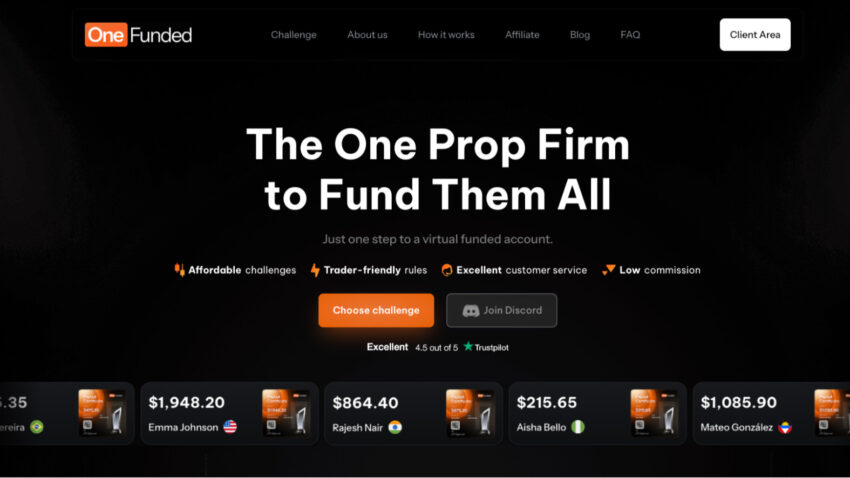
1. OneFunded

OneFunded

launched in 2024 under CEO Anastasiia Kaplunenko. Kaplunenko is a fintech professional who built the firm around a specific frustration: hidden rules, delayed payouts, and opaque evaluation conditions that made trading harder than it needed to be. The firm operates globally through OneFunded Capital Ltd., registered in Saint Lucia. Its UK operations are handled by Brynex Tech Limited in London.

Challenges and evaluation processes

You can choose among four challenge tracks on OneFunded, including Value, Core, Flex, and Flash. Each program is built around a different risk profile, but one rule applies to all four: no time limits of any kind.

Advertisement
Challenge Type One-Off Fee Account Sizes Profit Target Max Daily Drawdown Max Total Drawdown Min Trading Days
Value (2-Step) $16-$137 $2K-$50K 6%/6% 4% 8% 4 per phase
Core (2-Step) $45-$650 $5K-$200K 8%/5% 5% 10% 3 per phase
Flex (2-Step) $54-$780 $5K-$200K 7%/4% 4% 10% 3 per phase
Flash (1-Step) $29-$715 $2K-$200K 10% 4% 6% 5 total


The Value track starts at $16 for a $2,000 account. And for the Flex track, it is worth noting that it is the only track that carries no consistency rule during evaluation. This ensures that traders have more freedom in how their profits are distributed across days.

Spreads, fees, and payouts

Challenge fees translate to between $16 and $780. This means even the largest Flex account is accessible without a significant upfront commitment.

  • Profit split: 80% to the trader as standard; upgradable to 90% via paid addon
  • Spreads and commission: Viewable directly on the platform in demo mode before purchasing a challenge.
  • Payout schedule: 14-day cycle; weekly payouts available via a paid addon. Minimum payout is $100 with 24 hour processing time.
  • Payout methods: Crypto, bank transfer, and Rise.
  • Fee refund: The challenge fee is refunded alongside your first payout

What you can trade and at what size

OneFunded provides access to 250+ instruments, including 55+ forex pairs, 150+ American and European stock CFDs, 15+ global indices and metals, and 15+ cryptocurrencies.

Asset Class Leverage
Forex 1:100
Commodities and Indices 1:30
Cryptocurrencies 1:2

Trading software and tools

OneFunded supports three platforms, each available on web, desktop, iOS, and Android:

Advertisement
  1. TradeLocker: Integrated with TradingView for charting. It is accessible globally, including the UK and suited to manual traders
  2. cTrader: Available to the UK traders and offers advanced order execution and full market depth.
  3. MT5: Available to the UK traders and supports automated trading through EAs and provides the widest analytical toolkit of the three platforms.

Rules every trader must follow

  • Algorithmic trading: EAs are permitted but require pre-approval. Prohibited practices include latency arbitrage, reverse arbitrage, tick scalping, gap billing, data freezing, and the use of delayed or external data feeds.
  • News trading: Permitted across all four tracks and in funded accounts. However, a 5-minute window applies around scheduled high-impact events.
  • Weekend and overnight trading: Positions may be held overnight and over weekends but swap fees may apply.
  • Consistency rule: Applies to Value (40% cap on best-day profit), Core (50%), and Flash (50%) during evaluation. The Flex track has no consistency rule although in the funded phase, a 30% cap applies across all tracks.

Reputation and trader experience

OneFunded holds a Trustpilot rating of 4.4/5 from 205 reviews. It has 64% five-star and 23% four-star ratings. Reviewers most consistently highlight the absence of time limits, fast crypto payouts, transparent rules, and responsive support.

The firm previously operated as Prop365 before rebranding, and several reviews reference continuity of service through that transition. Negative reviews focus mainly on a small number of consistency rule disqualifications and occasional KYC delays, both of which the firm addresses directly on Trustpilot. It has replied to 88% of negative reviews, typically within 48 hours.

The firm’s community is active on Discord, X, Facebook, and Instagram. And support is reachable via email at support@onefunded.com, chat, and through the contact page on the website.

Our assessment

OneFunded checks all the important boxes when looking for a prop firm that accepts UK traders. The entry fee is one of the lowest on this list, all four challenge tracks run on unlimited time, and payouts below $1,000 are processed in crypto by default, which is the most practical route for traders receiving foreign earnings. The rules are written plainly, the Flex track removes the consistency rule entirely, and the challenge fee comes back with the first payout.

It suits beginner traders who trade part-time, are making their first funded account attempt, or want a low-cost, low-pressure environment to build a consistent track record before moving to larger account sizes.

Advertisement

2. FTMO

FTMO has been operating from Prague, Czech Republic, since 2015. This is the longest-established firm in this guide and one of the most recognized names in funded trading globally. The firm runs two challenge tracks on unlimited timeframes and offers a free trial for traders to test the platform.

Challenges and evaluation processes

FTMO offers two paths to a funded account, both with no time limit on the evaluation.

Challenge Type Fee from Account Sizes Target Max Daily Loss Max Loss Min Trading Days Avg. Reward Fee Refund
2-Step €89 $10K-$200K 10%/5% 5% 10% 4 per phase Up to €12,234 Yes (100%)
1-Step €79 $10K-$200K 10% 3% 10% 90% profit  split No

Spreads, fees, and payouts

  • Profit split: 80% standard on both tracks; 90% via the Scaling Plan once certain account growth milestones are reached.
  • Spreads: Tight; major pairs like EURUSD regularly trade near 0.1 pips on MetaTrader during active sessions.
  • Commission: All standard forex pairs carry a commission of $5 per lot per side ($10 round-trip).
  • Payout schedule: Bi-weekly; average processing time of approximately 8 hours from request to completion.
  • Payout methods: Bank wire, Skrill, crypto, and Visa Direct (up to $20,000)
  • Scaling ceiling: Up to $2M through the Scaling Plan

What you can trade and at what size

FTMO covers forex, indices, commodities, metals, and cryptocurrencies across all accounts.

  • Forex: Major, minor, and exotic pairs; leverage up to 1:100
  • Indices: Global indices including US30, US100, US500, and EU equivalents; leverage up to 1:20
  • Commodities and metals: Gold, silver, oil; leverage up to 1:10
  • Cryptocurrencies: Bitcoin, Ethereum, and others; leverage up to 1:2

Trading software and tools

FTMO supports MetaTrader 4 and 5, and cTrader. All three platforms are available for both the 1-Step and 2-Step FTMO Challenges as well as funded FTMO Accounts, and can be selected directly in the challenge configurator.

Every FTMO account includes a built-in toolkit, which includes FTMO Academy, Psychology Course, Account MetriX performance tracker, Equity Simulator, Trading Journal, Economic Calendar, and News Indicator.

Rules every trader must follow

  • Algorithmic trading: EAs are permitted on all accounts. The only restriction is a cap of 2,000 server requests per day per account.
  • News trading: Unrestricted during both evaluation phases.
  • Overnight and weekend holding: Permitted during evaluation on both tracks. On a funded Standard account, positions must be closed before the weekend market rollover.
  • Gap trading: Prohibited.

Reputation and trader experience

FTMO holds a Trustpilot rating of 4.8/5 from 41,020 reviews. This is the highest review volume of any firm in this guide, and the most statistically reliable reputation signal as a result. Reviewers highlight transparent rules, fast payout processing, and responsive multilingual support. Negative reviews are rare and mostly relate to account closures for rule violations, which FTMO addresses publicly on Trustpilot.

The firm’s community spans Discord (116K+ members), YouTube (417K+ subscribers), Instagram (551K followers), X (139K followers), and Facebook (272K followers). Support is available 24/7 via live chat, WhatsApp, email at support@ftmo.com, and phone, in 20 languages.

Advertisement

Our assessment

FTMO’s strength is its track record and the tools it bundles with every account. A decade of consistent operation, over $500 million paid in rewards globally, and more than 41,000 Trustpilot reviews give it a credibility floor that newer firms cannot match. That matters if you are committing meaningful capital to a challenge fee.

That said, this firm suits experienced traders who prioritize a long operational history, built-in analytical tooling, and platform flexibility above all else.

3. RebelsFunding

RebelsFunding was founded in 2023 by Marek Soska and is headquartered in Bratislava, Slovakia. The founding team has been trading financial markets since 2008 and launched a trading education business in 2015 before creating RebelsFunding. The firm says on its website that it has distributed over $3 million in rewards to more than 30,000 traders globally. RebelsFunding offers the widest range of program tiers on this list.

Challenges and evaluation processes

Program Phases Fee Account Sizes Profit Target Daily Drawdown Max Drawdown Fee Refund
Copper 4 From €9 $1K-$320K 5% per phase 5% 10% 200%
Bronze 3 From €37 $5K-$160K 5% per phase 5% 10% 150%
Silver 2 From €45 $5K-$80K 8%/5% 5% 10% 100%
Gold 1 From €68 $5K-$40K 10% None during eval; 4% on funded 6%
Diamond 10-level From €156 $5K-$20K initial; scales to $530K 10% per level None 6% 100% after Level 0

Spreads, fees, and payouts

  • Profit split: 75-90% across all programs; the starting rate and scaling conditions vary by tier.
  • Spreads: The average spread on major forex pairs sits at around 0.9 pips, while top shares average between 0.5 and 1.0 pips. Across the full instrument range, spreads start from as low as 0.3 pips.
  • Commission: RebelsFunding charges a flat $2 per $100,000 traded across all asset classes.
  • Payout schedule: Your first withdrawal becomes available 14 calendar days after placing your first trade on the funded account. All further withdrawals can be submitted every 14 days.
  • Payout methods: Bank wire transfer, crypto, PayPal, Wise, Revolut, Venmo (only for US-based traders), physical checks, and Credit/Debit Cards.
  • Scaling: Account grows up to 200% of the initial value on Copper, Bronze, and Silver upon meeting profitability milestones; Diamond scales to $530K through 10 levels.

What you can trade and at what size

RebelsFunding covers the following asset classes:

  • Forex: 40 pairs with 28 swap-free pairs
  • Metals: 4 instruments, with 4 swap-free
  • Energies: 2 instruments (WTI Oil and Natural Gas)
  • Cryptocurrencies: 7 instruments including Bitcoin and Ethereum
  • Equities: 10 individual stocks
  • Indices: 8 instruments including NASDAQ and S&P 500

The minimum lot size across all instruments is 0.01 lots, and RebelsFunding requires consistent position sizing. And leverage is tiered; see the table below:

Asset Class Evaluation Leverage RCF (Funded) Leverage
Forex – Majors 1:200 1:100
Forex – Crosses 1:150 1:50
Forex – Exotics 1:100 1:25
Metals 1:25 1:15
Indices 1:25 1:15
Energies 1:5 1:5
Equities 1:2.5 1:2.5
Cryptocurrencies 1:2.5 1:2.5

Trading software and tools

RebelsFunding uses a single proprietary platform, RF-Trader, built on TradingView charts and connected directly to liquidity providers. It is available on web, desktop, iOS, and Android. The platform has a built-in lot size and dollar-risk calculator, which several reviewers specifically cite as useful for real-time position sizing. It also includes an AI Trader tool in the Client Zone that analyses your trading history and identifies strengths and weaknesses.

Advertisement

Rules every trader must follow

  • Algorithmic trading: EAs are permitted across all programs
  • News trading: Permitted across all programs; no restriction window stated
  • Weekend trading: Positions can be held over weekends, but the firm cautions against it on cross pairs and less liquid instruments. And crypto trading is not available over weekends.
  • Scalping: Permitted
  • Overnight holding: Permitted on all programs

Reputation and trader experience

RebelsFunding holds a Trustpilot rating of 4.4/5 from 2,292 reviews, with 69% five-star and 15% four-star ratings. The firm replies to 96% of negative reviews, typically within 48 hours. Reviewers highlight affordable entry fees, fast payout processing, straightforward rules, and responsive support. The most recurring criticism across recent reviews is platform performance, specifically, slow load times on the RF-Trader app during peak market hours and periodic connectivity drops.

Our assessment

RebelsFunding’s fee refund model is a standout feature. Also, the range of five program tiers makes it one of the few firms on this list where a complete beginner and an experienced trader can both find a structurally appropriate starting point.

The firm suits traders who are confident in their pass rate and want the lowest net challenge cost over time. That is, the more programs you pass, the more of your fees come back.

4. CTI

City Traders Imperium has been funding traders since 2018 and operates from Dubai, UAE. It is the only firm in this guide that pays a monthly salary to its highest-performing funded traders. The firm offers four routes to funding and with a maximum allocation of $4 million.

Challenges and evaluation processes

All four programs run on unlimited time, and each carries a balance-based drawdown. This means losses are calculated against the account balance, not a floating equity high-water mark like many others. This gives traders more room to recover from open position drawdowns without breaching the limit.

Advertisement
Program Entry Fee Account Sizes Profit Target Max Daily Loss Max Drawdown Min Profitable Days
1-Step From $27 $2.5K-$100K 8% 5% 3
2-Step From $34 $2.5K-$100K 10%/5% 5% per phase 10% per phase 3 per phase
3-Step (Pay-per-level) From $1 (Level 1 only) $2.5K-$100K 3%/5%/7% 2% per step 4% per step 3 per step
Instant Funding From $62 $2.5K-$80K (doubles on passing) 10% to scale None 6% None
Instant Funding Pro From $263 $5K-$80K 10% to scale None 6% None

CTI also operates a VIP program that activates automatically as funded traders demonstrate consistent performance. This table provides the details:

VIP Tier Profit Share Payout Frequency Additional Benefits
Bronze 90% Weekly 30% discount on all future purchases, VIP support, free 1-on-1 coaching
Silver 100% Any time, on demand Free CTI merchandise, all Bronze benefits
Gold 100% Any time, on demand Potential 1-year monthly salary, institutional trading conditions, custom funding terms, team membership

Spreads, fees, and payouts

  • Profit split: starts at 50% for Instant Funding (Level 1), 80% on evaluation programs from the first funded payout, and scales to 100% at Silver and Gold VIP tiers.
  • Spreads: From 0.3 pips on EUR/USD
  • Commission: $5 per lot round-turn on forex
  • Payout schedule: Your first withdrawal becomes available after a minimum of 5 trading days on your funded account. In the VIP tier, payouts are weekly at Bronze, and any time on demand at Silver and Gold.
  • Payout methods: Payouts are processed into a Personal Wallet inside the CTI dashboard and withdrawals are via bank wire transfer, cryptocurrency (USDT/TRX), Credit/Debit Card, PayPal.
  • Scaling ceiling: $4 million through the VIP program

What you can trade and at what size

  • Forex: 28 currency pairs; leverage 1:30 on evaluation accounts, 1:10 on Instant Funding
  • Commodities: Gold, silver, and crude oil; leverage 1:10
  • Indices: 13 global indices including US30 and DE40; leverage 1:10
  • Cryptocurrencies: 6 assets including BTC/USD and ETH/USD; leverage 1:2

Trading software and tools

CTI supports MT5 and Match-Trader, both available across all platforms. In addition, traders get access to Account Metrix, Account Analysis, a Trading Journal, Risk Calculators, an Economic Calendar, and CTI Academy at no extra cost.

Rules every trader must follow

  • Stop loss: Mandatory on every trade
  • Copy trading: Prohibited across all programs and account types
  • Gambling behavior: Prohibited
  • News trading: Permitted across all programs without restriction
  • Weekend and overnight holding: Permitted on all programs

Reputation and trader experience

CTI holds a Trustpilot rating of 4.3/5 from 1,683 reviews. 84% of the reviews are five-star and 9% four-star. The firm replies to 97% of negative reviews and typically within one week.

Positive reviews cite fast payouts (several reviewers report same-day processing), responsive multilingual support, and an easy-to-navigate dashboard. The recurring criticism is payout denials following what CTI characterizes as gambling behavior or stop-loss violations.

Our assessment

CTI’s strongest differentiator is the VIP program structure as a whole. The 3-Step pay-per-level program also removes one of the biggest barriers in prop trading, which is the psychological cost of paying a large upfront fee and failing early.

This firm suits disciplined traders who prefer manual processes and operate with defined risk parameters. These traders also want a clear, built-in progression toward higher payouts and better conditions without paying extra for each upgrade.

Advertisement

5. ThinkCapital

ThinkCapital is backed by ThinkMarkets, a broker regulated across multiple jurisdictions. The broker provides an infrastructure credibility that standalone prop firms cannot offer. Its rails support spreads, execution, and platform stability.

Challenges and evaluation processes

Program Phases Entry Fee (from) Account Sizes Phase 1 Target Phase 2 Target Phase 3 Target Daily Loss Max Loss
Lightning 1 $59 $5K-$100K 10% 3% (balance) 6% trailing
Dual Step Intraday 2 $59 $5K-$100K 9% 5% 4% (equity) 7% fixed
Dual Step Swing 2 $82 $5K-$100K 9% 5% 4% (balance) 7% fixed
Nexus 3 $39 $5K-$100K 7% 6% 5% 4% (balance) 8% fixed


All programs scale to $1 million on MT5 accounts and $1.5 million on ThinkTrader accounts. Every 10% return in a rolling three-month period triggers a 20% account size boost.

Spreads, fees, and payouts

  • Profit split: 80% standard across all programs; upgradeable to 90% via addon or through the scaling plan
  • Spreads: Traders are commission-free but with wider spreads on ThinkTrader. For MT5 accounts, raw spreads from 0.0 pips with commission.
  • Commission: $4 per lot per side on MT5; zero on ThinkTrader
  • Payout schedule: Bi-weekly standard; weekly payouts available via addon
  • Payout methods: Crypto, RiseWorks, and Broker Profit Transfer

What you can trade and at what size

  • Forex: 49 pairs; leverage dynamic up to 1:100 on Dual Step and Nexus; 1:30 on Lightning
  • Indices: NAS100, GER40, and others; leverage up to 1:15
  • Commodities: Gold, silver, and oil; leverage up to 1:30
  • Cryptocurrencies: BTC/USD, ETH/USD, and others; leverage 1:2

Trading software and tools

ThinkCapital supports ThinkTrader and MT5, both accessible to beginner traders. The former is a proprietary platform with full TradingView integration. This means you can chart and execute trades directly from TradingView charts without switching windows, and without paying any commission. Also, all accounts come with access to a free trial before any paid commitment.

Rules every trader must follow

  • News trading: A news trading addon is available for the Lightning and Nexus programs to remove this restriction on funded accounts. Dual Step Swing permits news trading by default
  • Expert advisors: They are banned by default. Automated systems require purchasing the EA addon.
  • Weekend holding: Permitted on Nexus and Dual Step Swing, and Lightning funded accounts; not permitted on Dual Step Intraday.
  • No account rolling: Deliberately failing a challenge to restart is flagged and banned
  • Gambling behavior: Accounts exhibiting reckless position sizing, described as oversized risk relative to account balance, are subject to a warning and potential reset.

Reputation and trader experience

The average rating for ThinkCapital on Trustpilot is 4.0/5 from 604 reviews. Of these, 75% are five-star and 15% are one-star ratings. Positive reviews cite fast and helpful live support, TradingView integration on ThinkTrader, tight gold spreads, and the credibility of ThinkMarkets’ regulated backing. On the other hand, some negative reviews describe accounts being terminated for “multiple profiles” following giveaway wins or near-payout milestones, with no specific evidence provided by the firm’s risk team. ThinkCapital’s responses to these reviews cite undisclosed risk team findings but do not address the individual claims in detail.

Our assessment

ThinkCapital is one of the two broker-backed firms in this list, and this is a major upside. Other advantages include TradingView integration on a commission-free platform, and low entry fees across three structured programs. This makes the firm ideal for traders who want the reliability of a regulated-broker-backed infrastructure at a budget entry point.

Advertisement

How the Eight Firms Compare

Firm Max Capital Default Split Challenge Tracks Min Entry Fee Time Limit Crypto Payout Trustpilot
OneFunded $200,000 80% 4 $16 None Yes 4.4
FTMO $2M 80% 2 €79 None Yes 4.8
RebelsFunding $530,000 75-90% 5 tiers €9 None Yes 4.4
CTI $4M 80% 4 + VIP $1 None Yes 4.3
ThinkCapital $1.5M 80% 3 $39 None Yes 4.0

*BrightFunded’s Trustpilot rating has been removed by Trustpilot due to a breach of its guidelines.

Conclusion

The right prop firm for a beginner trader is not the most popular one globally. It may also not be the one that advertises the juiciest profit share. Instead, the firm you should choose is one that works given your payout options, the cost in INR terms, how the evaluation is structured, and how clearly the rules are written. Those four filters eliminate a lot of options quickly.

That said, we have learned that no evaluation deadline, crypto payouts that bypass the friction of international bank transfers, entry fees that do not require a large capital commitment to get started, and rules written plainly enough are the most important hoops a firm must jump through. And by this point in the guide, you have already seen which firm fits this description.

Advertisement

Continue Reading

Business

enCore Energy Corp. (EU:CA) Discusses Leadership Transition and Management Strategy Following Recent Corporate Update Transcript

Published

on

OneWater Marine Inc. (ONEW) Q1 2026 Earnings Call Transcript

enCore Energy Corp. (EU:CA) Discusses Leadership Transition and Management Strategy Following Recent Corporate Update April 23, 2026 11:00 AM EDT

Company Participants

William Sheriff – Executive Chairman
Richard Little – CEO & Director

Presentation

Advertisement

Operator

Good morning, everybody, and thank you for joining us for the enCore Energy web call. First meeting this morning with the recent news release on some changes at the company. I have today with us William Sheriff, Executive Chairman; and Rich Little, CEO. Just an introduction to Bill and specifically Rich and ask Bill Sheriff to take it away. Please, if you’re asking questions, type them in, and we will review the questions at the end. Thank you very much.

William Sheriff
Executive Chairman

Advertisement

Hopefully, there are some familiar faces out there. Bill Sheriff, the Executive Chairman. I just want to give you a little bit of background on what I think is really a team consolidating and leading move that the Board has instituted here at enCore Energy. A few weeks back, I was contacted and asked for my advice on where management should go, and I provided that to the Board and the Board had already decided to go in a direction. I wholeheartedly recommended Mr. Rich Little, who they — in a series of conversations moved to connect with and had what I’d considered an ideal background and the Board agreed. And so the negotiations were underway and Rich agreed to join.

I want to thank both Rich and the Board of Directors for both of them asking me to return as well. And I think we’ve put together a really solid team and had a good team below and ready to move forward. So I think this will be a very short transition period. And we’ve got a number of goals that we will

Advertisement
Continue Reading

Business

Arca Continental, S.A.B. de C.V. (EMBVF) Q1 2026 Earnings Call Transcript

Published

on

OneWater Marine Inc. (ONEW) Q1 2026 Earnings Call Transcript

Arca Continental, S.A.B. de C.V. (EMBVF) Q1 2026 Earnings Call April 23, 2026 11:00 AM EDT

Company Participants

Arturo Hernandez – Chief Executive Officer
Emilio Marcos Charur – Chief Financial Officer
Jean Claude Tissot – Chief Operations Officer
Jesús García Chapa – Chief Strategic Capabilities and Planning Officer

Conference Call Participants

Advertisement

Melanie Carpenter – i-advize Corporate Communications Inc.
Ulises Argote Bolio – Santander Investment Securities Inc., Research Division
Felipe Ucros Nunez – Scotiabank Global Banking and Markets, Research Division
Fernando Olvera Espinosa de los Monteros – BofA Securities, Research Division
Thiago Bortoluci – Goldman Sachs Group, Inc., Research Division
Renata Fonseca Cabral Sturani – Citigroup Inc. Exchange Research
Antonio Hernandez – Actinver Casa de Bolsa, S.A. de C.V., Research Division
Lucas Ferreira – JPMorgan Chase & Co, Research Division
Rodrigo Alcantara – UBS Investment Bank, Research Division
Emiliano Hernández Marvan – GBM Grupo Bursátil Mexicano, S.A. de C.V. Casa de Bolsa, Research Division
Henrique Morello – Morgan Stanley, Research Division

Presentation

Operator

Advertisement

Good’s day, everyone, and welcome to the Arca Continental First Quarter 2026 Conference Call. [Operator Instructions] Please note, this call is being recorded. [Operator Instructions] It is now my pleasure to turn the conference over to Melanie Carpenter of Ideal Advisors. Please go ahead.

Melanie Carpenter
i-advize Corporate Communications Inc.

Thank you, operator. Good morning, everyone. Thank you for joining the senior management team of Arca Continental to review their results for the first quarter of 2026. Their earnings release went out this morning, and it’s available on the company website at arcacontal.com in the Investor Relations section.

Advertisement

It’s now my pleasure to introduce our speakers. Joining us from Monterrey is the CEO, Mr. Arturo Gutierrez; the CFO, Mr. Emilio Marcos; the Chief Planning and Strategic Capabilities Officer, Mr. Jesus Garcia; and the Chief Operating Officer, Mr. Jean-Claude Tissault. They’re going to be making some forward-looking statements, and we just ask that you refer to the disclaimer and the conditions surrounding those statements

Advertisement
Continue Reading

Business

Form DEF 14A CTO Realty Growth Inc For: 23 April

Published

on


Form DEF 14A CTO Realty Growth Inc For: 23 April

Continue Reading

Business

Nike cuts 1,400 roles in second round of layoffs this year

Published

on

Nike cuts 1,400 roles in second round of layoffs this year

People walk past a Nike store in New York City, on April 2, 2025.

Kylie Cooper | Reuters

Nike announced a new round of layoffs on Thursday impacting approximately 1,400 roles across the organization, mostly concentrated in its technology department.

Advertisement

In a note from COO Venkatesh Alagirisamy, the company said the layoffs were part of Nike’s broader “Win Now” turnaround strategy aiming to reshape its technology team, modernize its air manufacturing, move some of its Converse Footwear operations and integrate its materials supply chain work into its footwear and apparel supply chain teams.

“Collectively, these changes will result in a reduction of approximately 1,400 roles in global operations, with the majority in technology,” Alagirisamy wrote. “These reductions are very hard for the teammates directly affected and for the teams around them, too.”

A Nike spokesperson said the layoffs are about better positioning the organization for the current pace of sports and accelerating its growth. The layoffs affect employees across North America, Asia and Europe and represent less than 2% of the company’s total global headcount.

“This is not a new direction,” Alagirisamy wrote. “It is the next phase of the work already underway.”

Advertisement

Impacted employees will be notified beginning Thursday, Nike added.

CEO Elliott Hill has been working to turn around Nike after years of slumping sales. While Hill has made some initial progress, it’s come with some bumps in the road.

Nike previously announced 775 job cuts in January, primarily at its U.S.-based distribution centers, due to the company’s work in accelerating its use of automation. At the time, the company said the cuts are part of Nike’s goal to return to “long-term, profitable growth.”

Those layoffs came on top of a round of cuts last summer that affected less than 1% of Nike’s corporate staff as part of the company’s efforts to realign the business.

Advertisement

In its third fiscal quarter earnings report last month, the retailer warned that sales will continue to fall for the rest of the year, primarily led by an anticipated 20% decline in China during the current quarter.

— CNBC’s Jessica Golden contributed to this report.

Choose CNBC as your preferred source on Google and never miss a moment from the most trusted name in business news.
Continue Reading

Business

Intel Stock Jumps 4% Ahead of Q1 Earnings on AI Partnerships and Turnaround Momentum

Published

on

The Intel logo is shown at E3, the world's largest video game industry convention in Los Angeles, California, U.S. June 12, 2018.

SANTA CLARA, Calif. — Intel Corp. shares surged more than 4% in midday trading Thursday, climbing to around $67.88 as investors positioned for the chipmaker’s first-quarter 2026 earnings report after the bell and cheered the company’s string of high-profile AI infrastructure wins.

The Intel logo is shown at E3, the world's largest video game industry convention in Los Angeles, California, U.S. June 12, 2018.
Intel Stock Jumps 4% Ahead of Q1 Earnings on AI Partnerships and Turnaround Momentum

The stock (NASDAQ: INTC) opened higher and hit intraday highs near $68.28, extending a remarkable rally that has seen shares soar roughly 75-85% year-to-date in 2026. Volume was elevated as Wall Street anticipates results that could validate Intel’s resurgence under new leadership and its expanding role in the artificial intelligence boom.

Intel is scheduled to release Q1 results after markets close Thursday, followed by a conference call at 2 p.m. PT. Analysts expect revenue around $12.3-$12.4 billion and a small per-share loss near $0.11, though the company has a strong history of beating estimates. Focus will center on forward guidance, progress with the 18A manufacturing node and data-center momentum.

Recent catalysts have electrified investors. Intel deepened its partnership with Google, announcing a multiyear collaboration to power next-generation AI and cloud infrastructure using multiple generations of Xeon processors, including Xeon 6 chips for training and inference workloads. The deal underscores CPUs’ continued relevance in heterogeneous AI systems and provides a major endorsement from one of the world’s largest cloud providers.

The Google tie-up follows Intel’s announcement joining Elon Musk’s ambitious Terafab project alongside Tesla, SpaceX and xAI. The initiative aims to build massive AI compute capacity, with Intel serving as a key foundry partner using its advanced process technology. That news, combined with the $14.2 billion repurchase of a 49% stake in its Ireland Fab 34 from Apollo Global Management, signaled strong confidence in Intel’s manufacturing roadmap and balance sheet.

Advertisement

CEO Lip-Bu Tan, who took the helm in 2025, has accelerated Intel’s turnaround. The company is ramping its Intel 18A node — now in high-volume manufacturing — and positioning itself as a viable alternative to TSMC for external foundry customers. Analysts note improving yields and strong demand signals for Panther Lake processors and custom ASICs.

Intel’s foundry ambitions gained credibility with these deals. The Terafab partnership alone could represent billions in long-term revenue, while the Google expansion bolsters data-center prospects at a time when AI infrastructure spending remains robust. Shares have posted multiple double-digit gain days in April, adding over $100 billion in market value during one of the strongest short-term runs in company history.

Wall Street has responded with upgraded price targets. Northland raised its target to $92, Stifel to $65, and others have followed amid growing optimism. Consensus remains a Hold with an average around $50-$60, though several firms now see upside to $80-plus if execution continues. The stock trades at elevated multiples, reflecting expectations of a multi-year recovery.

Challenges persist. Intel still faces losses in its foundry segment, competition from AMD and Nvidia in key markets, and high capital expenditures. Q1 guidance from earlier periods pointed to revenue in the $11.7-$12.7 billion range. Investors will scrutinize any updates on cost discipline, AI accelerator traction and PC market recovery.

Advertisement

Broader semiconductor sentiment remains positive. TSMC’s strong results earlier highlighted AI demand tailwinds, lifting peers including Intel. The company’s emphasis on U.S.-based manufacturing also aligns with CHIPS Act support and national security priorities.

Intel launched its Core Series 3 processors in mid-April, targeting value computing, commercial and edge devices. The timing bolsters its client computing segment while data-center and AI efforts take center stage.

Financially, Intel maintains a solid foundation despite recent losses. The company continues investing heavily in fabs across Arizona, Oregon and Ireland. Free cash flow trends and debt management will feature in the earnings discussion. Shareholder returns, including dividends, provide some support.

Analysts expect another earnings beat based on historical patterns, with Zacks noting a positive Earnings ESP. However, the bar is high after the stock’s rapid ascent. Options imply an 11-12% post-earnings move, higher than average.

Advertisement

Longer term, Intel’s story revolves around foundry success and AI CPU/IPU relevance. Success with 18A could attract more external customers, reducing reliance on internal sales. Partnerships with hyperscalers like Google validate the strategy.

The stock’s 52-week range spans from under $19 to above $70. Thursday’s gains push it toward recent highs, reflecting renewed belief in CEO Tan’s vision. Market watchers describe the rally as one of the most dramatic in recent semiconductor history.

As trading continued Thursday morning, INTC held strong gains while broader markets showed mixed sentiment. Peers like AMD also advanced on AI optimism. The upcoming earnings will test whether fundamentals can sustain the valuation expansion.

Intel remains a cornerstone of American chip manufacturing. Its ability to compete in AI infrastructure while revitalizing client and foundry businesses positions it at a pivotal moment. Investors betting on the turnaround have been richly rewarded in 2026, but execution in the coming quarters will determine if the momentum endures.

Advertisement

Thursday’s pre-earnings pop highlights market enthusiasm for Intel’s strategic shifts. Whether the report delivers on guidance and AI progress could set the tone for the stock through the rest of the year. For now, the chip giant is riding a powerful wave of optimism fueled by major partnerships and manufacturing progress.

Continue Reading

Business

Molina Healthcare Stock Explodes 11% on Q1 Earnings Beat and Cost Control Wins

Published

on

FTSE 100 Surges 0.8% Today as Oil Eases and Markets

LONG BEACH, Calif. — Molina Healthcare Inc. shares skyrocketed more than 11% Thursday, surging to around $170.49 as investors cheered the managed care giant’s first-quarter 2026 earnings beat and disciplined medical cost management amid a challenging environment for health insurers.

FTSE 100 Surges 0.8% Today as Oil Eases and Markets
Molina Healthcare Stock Explodes 11% on Q1 Earnings Beat and Cost Control Wins

The stock (NYSE: MOH) opened sharply higher and maintained strong gains throughout the session on April 23, with volume well above average. The move comes one day after the company reported adjusted earnings that topped Wall Street forecasts, helping ease concerns following a difficult 2025 and positioning Molina as a standout performer in the Medicaid-heavy sector.

Molina posted first-quarter adjusted earnings per share of $2.35, beating analysts’ consensus estimates around $1.92 to $2.17. Total revenue reached $10.8 billion, slightly below expectations of about $10.83 billion to $10.87 billion but still reflecting operational resilience. Premium revenue stood at approximately $10.2 billion.

The consolidated medical care ratio (MCR) came in at a solid 91.1%, demonstrating effective cost controls despite ongoing industry pressures. Medicaid MCR was 92%, Medicare 89.8% and Marketplace 84%. Management highlighted modestly favorable medical cost trends and successful rate updates that landed as expected.

A $93 million impairment charge related to the planned 2027 exit from the Medicare Advantage-Part D product weighed on GAAP results, pulling net income to $14 million and GAAP EPS to $0.27. However, investors largely looked past the one-time hit, focusing instead on adjusted figures and forward guidance.

Advertisement

Molina reaffirmed its full-year 2026 outlook for premium revenue of approximately $42 billion and adjusted earnings of at least $5.00 per diluted share. While the revenue midpoint sits below some prior internal targets, analysts viewed the reaffirmation as prudent conservatism in a volatile cost environment.

CEO Joe Zubretsky and the management team emphasized strong execution across segments during the earnings call. Dual-eligible products are off to a solid start, and pricing adjustments in Medicare are tracking in line with expectations. The company continues navigating a complex Medicaid landscape with disciplined utilization management.

Wall Street reacted positively. Several firms issued intraday commentary praising the earnings surprise and cost discipline. The beat helped offset lingering concerns from Molina’s Q4 2025 miss, which had been dragged down by retroactive rate adjustments and elevated costs.

Molina’s business model, heavily weighted toward Medicaid and government-sponsored programs, has faced headwinds from rising medical trends, redeterminations and regulatory shifts. Yet Thursday’s rally signals growing confidence that the company has stabilized margins and can deliver on its conservative 2026 targets.

Advertisement

The stock’s year-to-date performance had been choppy prior to the report, reflecting broader sector pressures. However, the double-digit surge Thursday pushed shares toward recent highs and underscored the market’s appetite for earnings beats in healthcare. Analysts maintain a range of targets, with some bulls eyeing recovery to the $180-$190 level if execution continues.

Broader industry context supports the optimism. Recent Medicare rate increases for 2027 and positive signals from larger peers like UnitedHealth have lifted sentiment across managed care names. Molina’s focus on cost containment and its regional strengths in key Medicaid markets position it to benefit from any stabilization in utilization.

Financially, the company generated robust operating cash flow in the quarter, providing flexibility for share repurchases, debt management and strategic investments. Molina maintains a solid balance sheet despite the impairment, giving it runway to weather ongoing challenges in government program reimbursements.

Analysts note that Molina’s lower valuation multiples compared to some national peers offer a potential margin of safety. With shares trading at attractive levels relative to normalized earnings power, the earnings reaction could mark the start of a re-rating if Q2 trends remain favorable.

Advertisement

Challenges remain on the horizon. Medicaid redeterminations continue across states, medical cost inflation persists in certain categories, and the Medicare exit will require careful transition management. Competition in Marketplace plans and potential policy shifts under evolving federal priorities add layers of uncertainty.

Yet management struck a measured tone, highlighting operational improvements and confidence in 2026 guidance. The earnings call focused on prudent risk management rather than aggressive growth projections, a stance that resonated with investors seeking stability.

For a company once viewed as a high-growth Medicaid pure-play, Molina is now executing a more balanced strategy that prioritizes margin protection and sustainable returns. Thursday’s market reaction reflects relief that the worst of recent pressures may be behind it.

As trading continued Thursday afternoon, MOH shares consolidated some gains but held firmly in positive territory. The move stands out in a mixed broader market, highlighting sector-specific momentum in health insurers delivering on cost control.

Advertisement

Longer-term, Molina’s trajectory will depend on successful navigation of rate environments, enrollment stability and disciplined capital allocation. With a reaffirmed outlook and a strong Q1 foundation, the company appears better positioned to rebuild investor confidence through the remainder of 2026.

The impressive intraday surge caps a volatile period for the stock and could draw fresh attention from value-oriented investors. As one of the more focused players in government-sponsored healthcare, Molina’s ability to control costs while serving vulnerable populations remains central to its story.

Thursday’s results and market response suggest that after a tough stretch, Molina Healthcare is demonstrating the operational resilience many had been waiting to see. Whether this momentum sustains will hinge on consistent execution in the quarters ahead.

Advertisement
Continue Reading

Business

Trump administration moves to reclassify cannabis

Published

on

Trump administration moves to reclassify cannabis

The Trump administration moved Thursday to reclassify cannabis under federal law, which could significantly expand scientific research into the drug’s medical uses.

The change would not legalize the drug at the federal level, but shift cannabis from its current status as a Schedule I substance to Schedule III under the U.S. Drug Enforcement Administration’s controlled substances framework.

In a release, the Department of Justice said it will immediately move FDA-approved products containing marijuana along with items regulated by a state medical marijuana license to Schedule III. It also announced an expedited hearing in June to consider the formal reclassification of cannabis to Schedule I at the federal level.

“Together, these actions provide immediate and long-term clarity to researchers, patients, and providers alike while still maintaining strict federal controls against illicit drug trafficking,” the DOJ said.

Advertisement

Drugs in Schedule I, which include heroin and LSD, are considered to have no accepted medical use and a high potential for abuse. Schedule III drugs, like Tylenol with codeine and testosterone, by contrast are recognized as having medical applications and are subject to fewer regulatory restrictions.

Reclassification lowers longstanding barriers that have made it difficult for researchers to study cannabis in clinical settings.

The financial implications are significant too. It would exempt cannabis companies from IRS Code Section 280E, allowing them to deduct standard expenses like rent and payroll for the first time, and opens the door for banking access that was previously barred.

Investors showed some skepticism over the move as cannabis stocks pulled back from early gains and turned negative. Critics are concerned the policy could create a two-track system for drug development that may allow developers to bypass the FDA process entirely in favor of state level pathways.

Advertisement

Still, the move marks one of the most significant federal shifts on marijuana policy in decades, signaling a growing willingness in Washington to reconsider how the drug is categorized and studied in the U.S.

The move could benefit companies like Tilray, which is known for recreational cannabis products but is expanding its medical segment. Tilray’s medical business has served hundreds of thousands of patients across more than 20 countries, according to the company.

“We have the research to walk into the FDA. We have the research to walk into the DEA and show them what we’ve been doing,” said Tilray CEO Irwin Simon.

Simon told CNBC he expects to hear from pharmaceutical companies interested in U.S. partnerships, similar to the wave of outreach from alcohol companies following the surge in demand for hemp-derived beverages.

Advertisement

Tilray currently partners with Novartis in Canada.

Scientists have faced strict approval processes, limited supply access and heavy compliance requirements when attempting to examine cannabis for therapeutic use, including chronic pain, PTSD and neurological disorders. Those federal barriers remained in place even as roughly half of states have legalized marijuana for recreational use, and even more have approved it for medical use.

“While operators would still face a fragmented state-by-state system, the improved cash flow from rescheduling would support reinvestment, strengthen stability, and help build momentum for more consistent standards over time,” said Wendy Bronfein, co-founder and chief brand officer at Curio Wellness, a Maryland-based cannabis company.

The action follows an executive order issued last year directing federal agencies to begin the reclassification process, which typically unfolds over several years and involves scientific review, interagency coordination and rulemaking procedures.

Advertisement

“This rescheduling is not the finish line — it is the final stage of a race we have been running for decades,” said Shawn Hauser, partner at cannabis law firm Vicente LLP.

In 2024, the Biden administration started that process and put reclassification before the public for a 60-day comment period. After that window, hearings to review potential hurdles stalled in the handoff between administrations.

The move also comes just days after President Donald Trump signed an executive order on psychedelics to accelerate research, clinical trials and “Right to Try” access for drugs like psilocybin, MDMA and ibogaine.

Advertisement
Continue Reading

Trending

Copyright © 2025