
Business
Elon Musk Warns of ‘Hundreds, Maybe Thousands’ of Fraud Rings Targeting SNAP Benefit Cards Nationwide


Elon Musk warned that the United States may be facing “hundreds, maybe thousands” of organized fraud rings stealing taxpayer-funded benefits, following a report highlighting networks that target Supplemental Nutrition Assistance Program accounts through skimming attacks on Electronic Benefit Transfer cards.
“There hundreds, maybe thousands, of fraud rings of almost every nationality stealing money from US taxpayers,” Musk wrote on X on September 21, responding to a post from The Wall Street Journal. Musk’s specific numerical estimate has not been independently verified by federal agencies. The Government Accountability Office, the nonpartisan federal watchdog that has studied the issue, says perpetrators of SNAP fraud range from individual actors to organized crime groups, but the agency does not publish a nationwide count of active fraud rings.
Musk’s comments come amid a series of confirmed federal prosecutions targeting organized EBT card skimming operations in recent years. In April, the Justice Department charged five Romanian citizens in an alleged conspiracy to steal nearly $1 million in SNAP benefits across Ohio and California. Prosecutors said the group installed physical skimming devices on payment terminals, captured EBT magnetic-stripe data and personal identification numbers from unsuspecting benefit recipients, and then encoded that stolen information onto cloned cards to fraudulently withdraw funds.
The scale of confirmed SNAP benefit theft nationally has been substantial. According to the GAO, states replaced more than $320 million in stolen SNAP benefits for nearly 679,000 households between October 2022 and December 2024. The watchdog agency cautioned that this figure likely understates the true extent of theft, since it captures only claims that were formally submitted and approved for replacement. Complicating the picture further, federal authority allowing states to replace benefits stolen after December 20, 2024, has since expired, meaning more recent theft may not be reflected in any official replacement figures at all.
Part of the vulnerability driving these thefts traces back to the underlying technology used on many SNAP benefit cards. The GAO found in its 2025 review that most SNAP EBT cards lacked embedded microchips, a security feature that has become standard on commercial credit and debit cards and is widely regarded as an effective deterrent against the kind of magnetic-stripe skimming attacks used in many of the prosecuted cases. The U.S. Department of Agriculture, which oversees the SNAP program at the federal level, is currently supporting state-level transitions to chip-enabled EBT cards and other security enhancements aimed at closing that gap.
The scope of organized EBT fraud enforcement has extended well beyond the April Ohio and California case. The Justice Department said in March that it had charged more than 50 defendants since 2023 as part of a broader crackdown centered in San Diego targeting organized EBT theft, with many of those charged found to have ties to Romania. Authorities said more than $310 million had been stolen from California EBT beneficiaries alone between June 2022 and January 2026, underscoring the scale of the problem within a single state.
Beyond card skimming specifically, federal prosecutors have pursued a broader range of SNAP-related fraud cases in recent years, involving stolen identities, fraudulent benefit applications and illegal trafficking of benefits by retailers. In New York, prosecutors charged six individuals in connection with an alleged $66 million SNAP fraud and bribery scheme, illustrating how benefit fraud schemes can extend into far larger dollar amounts when retailer collusion is involved alongside direct card theft. Separately, USDA data released in June drew attention to the agency’s ongoing scrutiny of SNAP payment errors, a distinct category from fraud that reflects administrative mistakes in benefit calculations rather than intentional theft.
Musk’s warning arrives at a moment of heightened public attention on government spending efficiency and benefit program integrity, themes he has frequently raised in his public commentary. While his specific characterization of “hundreds, maybe thousands” of fraud rings operating nationwide has not been corroborated by an official government count, the underlying pattern of organized, multi-jurisdictional EBT fraud schemes he referenced is well documented across multiple confirmed federal prosecutions spanning several states.
The gap between Musk’s broad numerical claim and the more narrowly documented federal cases reflects a common challenge in discussions of benefit fraud: while individual prosecutions provide concrete, verified examples of organized theft, no federal agency currently publishes a comprehensive, real-time count of how many distinct fraud rings are actively operating against SNAP or other federal benefit programs at any given time. That data gap has left assessments of the fraud problem’s full scope, including Musk’s own estimate, without independent verification.
With USDA continuing its rollout of chip-enabled EBT cards and additional security measures, and federal prosecutors continuing to pursue new cases against organized skimming networks, the debate over the true scale of SNAP benefit fraud, and the adequacy of the federal government’s response to it, is likely to remain an active point of discussion among lawmakers, watchdog agencies and public figures like Musk in the months ahead.

Business
UBS upgrades Bajaj Finance shares, LT Finance as it sees NBFCs better placed than banks. Here’s why

UBS sees scope for a re-rating as the unsecured lending cycle revives. It also expects asset quality to remain robust.
With a revised target price of Rs 1,110, UBS analysts forecast an upside potential of 9% in Bajaj Finance, while a hiked target price of Rs 380 implies an upside of about 25% from current market levels. In Wednesday’s session, Bajaj Finance rose 3% to Rs 1,025, while LT Finance was up 3% to Rs 313.
“We upgrade our rating on Bajaj Finance from Sell to Neutral, as we expect cyclical EPS upgrades on yield-accretive growth and strong asset quality, though its valuation remains demanding,” UBS said in a note. “We also upgrade our rating on L&T Finance from Neutral to Buy, expecting faster personal loan growth and ROA improvement toward 3%,” it added.
UBS on Bajaj Finance shares
“We believe BAF has cleared its asset quality issues across unsecured products, while an increased provision coverage ratio acts as a cushion against macro headwinds,” UBS analysts said in a note.

This could provide a cyclical push toward higher-yielding loan growth in the near term, driving cyclical earnings acceleration. The company’s EPS downgrades have largely passed and foresee strong EPS growth of 30%+ in FY27, although it may slow to the high teens in FY28.
UBS on LT Finance
UBS said LT Finance has been on a path of improving return on assets (ROA) over the past few quarters. It noted that growth in higher-yielding segments such as personal loans and gold loans has remained strong, while microfinance (MFI) growth is recovering after weakness driven by asset quality. This has resulted in a significant shift in the loan mix towards higher-yielding segments.The brokerage also said credit costs have been gradually declining, supported by a benign asset quality cycle, while operating expenses have provided additional support. Overall, UBS factors in around 25 basis points of improvement in opex to AUM, around 15 basis points in credit costs and the remainder from margins, resulting in its assumption of a 50-basis-point improvement in ROA over FY26-28.
UBS on India financials
India entering into strong credit cycle – UBS expects India to enter a strong unsecured credit growth cycle, led by personal loans. The brokerage said this is supported by healthy asset quality across banks and NBFCs, flat unsecured household leverage over the past three years, ample system liquidity and a more risk-on approach among lenders.
UBS added that stabilising gold prices could moderate gold loan growth, which has been a key substitute for personal loans in recent years. This could benefit private banks and large NBFCs with strong personal loan franchises.
Rate hike largely priced in – The brokerage believes the market is underestimating the expected recovery in personal loan growth, which could lead to earnings upgrades and expansion in return on assets (ROA) for select lenders. It said concerns over higher interest rates appear overstated given the significant liquidity surplus in the system, which could keep funding conditions supportive. With most NBFCs trading below their one-year average valuations, the brokerage sees scope for a re-rating as personal loan growth recovers.
The brokerage expects around Rs 12-13 trillion of FCNR inflows to create excess liquidity, as system credit demand of around Rs 45-50 trillion is unlikely to absorb the entire pool in the near term, with domestic savings flows remaining stable. It said this could support NBFC funding through bank lines and NCD markets, keeping funding conditions favourable. The brokerage factors in a 15-20 basis point rise in FY27 funding costs, leaving limited downside risk from rate hikes.
Healthier credit cycle ahead – It said that following a three-year credit cycle, asset quality across these segments is now at its best levels in several quarters, although NBFCs continue to see some residual stress in low-ticket business loans.
Also read:70% IPOs in September gave a listing bounty for investors. Can NSE beat its weak GMP?
According to UBS, unsecured leverage in India increased from 6% of GDP in FY19 to 10% in FY24, but has remained stable since then. In contrast, gold loans grew from around 1% of GDP to around 5% by FY26, although growth is expected to moderate as gold prices flatten.
Alongside the improvement in asset quality across unsecured lending segments, CRIF data for August 2026 showed personal loan growth accelerating to around 30% for NBFCs and 9% for banks, marking a two-year high.
The brokerage maintained its Buy rating on Cholamandalam Investment, Shriram Finance and Poonawalla Fincorp. Among banks, it expects ICICI Bank, HDFC Bank and Axis Bank to benefit from a pick-up in personal loan growth.
Disclaimer: This article has been written by Veer Sharma, who is not a SEBI-registered Research Analyst or an Investment Adviser. Veer Sharma and his/her ‘relative(s)’ (as defined under Section 2(77) of the Companies Act, 2013) do not hold any financial interest in the companies mentioned in this article as of the date of publication. The views/recommendations mentioned in this article, wherever applicable, are those of the respective SEBI-registered Research Analyst/brokerage and have been reproduced/reported with due attribution. They should not be construed as the views or recommendations of The Economic Times Digital or the journalist. Readers are advised to consider the original research report and make their investment decisions based on their own assessment. Brokerage disclaimers here.

Beyond Beta: Why Taiwan May Outlast The AI Debate

Oil slips for 6th straight day as Trump signals progress in Iran talks
Business
Australia Deploys $35.7 Million Grant to Accelerate Offshore Wind and Carbon Markets in the Philippines

MANILA — The Australian Government has launched a flagship 45 million AUD economic development initiative in the Philippines, committing substantial grant funding to accelerate the growth of renewable energy, facilitate carbon market development, and advance the domestic offshore wind industry over a five-year period.
The initiative, officially designated as the Promoting Growth, Resilience, Economic Stability and Sustainability in the Philippines (PROGRESS) program, runs from 2026 through 2031. Formally unveiled during official proceedings in Manila, the bi-national strategy represents a milestone in expanding economic cooperation between Canberra and Manila, targeting structural reforms, ease of doing business improvements, and sustainable infrastructure investments across the archipelago.
Strategic Framework and Scope of the PROGRESS Program
The PROGRESS framework operates as a co-designed economic platform created to support priority development sectors identified directly by Philippine national agencies. Rather than functioning as an immediate single disbursement, the total funding package—equivalent to approximately 2 billion Philippine pesos—will be deployed incrementally across specific projects as scoping assessments conclude and joint government approvals are finalized.
To guide project selection and ensure rigorous economic viability, Australia has appointed Boston Consulting Group to partner directly with Philippine government departments. The consulting firm will assist in structuring targeted intervention plans, defining policy reform benchmarks, and administering capital allocation across clean energy, infrastructure, and digital economy initiatives.
“This is a program that has been developed jointly by the Australian government and the Philippine government to deliver better economic outcomes to boost infrastructure and to improve living standards in communities throughout the Philippines,” stated Australian Assistant Minister for Foreign Affairs and Trade Matt Thistlethwaite during a press briefing in Manila. “We are very much in the scoping phase and working with the various Philippine government departments to identify where the priorities are and ensuring that the projects stack up and they make solid economic sense.”
Pioneering Offshore Wind and Carbon Market Infrastructure
A primary focus of the five-year grant centers on modernizing the Philippine energy grid and establishing regulatory infrastructure to support zero-emission power generation. With the Philippines possessing extensive untapped offshore wind capacity along its coastlines, technical assistance and capital deployment under the PROGRESS initiative aim to streamline project permitting, enhance grid integration, and attract private sector investment into marine wind farms.
Simultaneously, the program addresses the development of a formal national carbon market. By building robust verification frameworks and transparent trading mechanisms, the joint initiative seeks to enable local industries to generate and trade accredited carbon credits, establishing new capital streams for conservation and industrial decarbonization projects throughout Southeast Asia.
Beyond energy sector investments, the grant framework incorporates mandatory social inclusion baselines. Program guidelines require that funded initiatives actively incorporate women, persons with disabilities, and marginalized rural communities into project supply chains, ensuring that economic benefits from green transition projects are distributed equitably.
Deepening Bilateral Ties and Southeast Asian Stability
The launch of the PROGRESS initiative aligns with Australia’s broader foreign policy strategy to bolster economic resilience, energy security, and supply chain diversification across partner nations in the Indo-Pacific region. As Southeast Asian economies navigate accelerating power demand alongside decarbonization mandates, bilateral development programs offer essential technical and financial backing.
Philippine government officials welcomed the multi-year commitment, emphasizing that targeted support for renewable energy infrastructure directly reinforces national energy security objectives while mitigating vulnerability to global fossil fuel price volatility. Joint announcements detailing the first round of approved individual projects under the PROGRESS funding pool are expected in the coming months following completion of initial scoping reviews.
Core Objectives of the Bilateral PROGRESS Initiative
- Establishing structured regulatory and market frameworks to support commercial offshore wind developments and formal carbon credit trading platforms across the Philippines.
- Providing technical expertise and capital deployment through Boston Consulting Group to assist Philippine government agencies in identifying high-impact infrastructure projects.
- Mandating inclusive growth guidelines that guarantee equal participation and economic opportunities for women, persons with disabilities, and marginalized communities throughout program execution.
Long-Term Economic and Environmental Outlook
The five-year rollout of the PROGRESS program marks a decisive transition toward structured, sustainable economic collaboration between Australia and the Philippines. By providing targeted seed funding and technical oversight rather than generic budgetary aid, the partnership aims to crowd in private capital for commercial-scale clean energy projects.
As project allocations are finalized and bilateral working groups commence implementation, success will be measured by concrete improvements in regional power grid stability, increased foreign direct investment in renewable infrastructure, and the successful establishment of transparent market mechanisms. The collaborative framework stands as a practical model for international climate finance and regional economic integration across the Asia-Pacific area.
Business
Sensex jumps 350 points, Nifty above 23,400 as oil dips below $99/barrel. What can trigger the next sharp rally on D-Street?

Sensex gained over 350 points to rise above 74,896 while Nifty rose over 104 points to trade above 23,433, as seen at 11.15 am. Broader markets outperformed benchmarks, with Nifty Midcap 100 rising 0.4% and Nifty Smallcap 100 jumping 0.7%.
Bajaj Finance and Bajaj Finserv shares were the top gainers on Sensex, as the Bajaj twins gained around 2% each. UltraTech Cement, Tata Steel, Asian Paints, L&T, Kotak Mahindra Bank, Hindustan Unilever and ITC shares gained around 1% each. Bucking the trend, Infosys and TCS shares fell around 1%.
Among the sectors, Nifty Metal jumped more than 1%, while Nifty IT slipped into the red. The overall market sentiment turned positive, with NSE seeing 2,332 advances against 714 declines, while 109 stocks remained unchanged.
Also read | Voltas share price: Nuvama upgrades rating but Jefferies cuts target price after analyst meet. Here’s why
What can drive a sharp rally on Dalal Street?
The structure of the market in recent days has been technically weak with a downward bias, said VK Vijayakumar, Chief Investment Strategist, Geojit Investments. He noted that if this market construct is to change, there should be some significant triggers. A sharp dip in crude prices can provide that trigger. But that is not happening even though Brent crude has dipped below $99. Another positive trigger can come from a dip in US bond yields. But that is unlikely in the present macro scenario of high inflation, particularly in the developed countries, the analyst noted. In brief, these two factors – high crude prices and elevated bond yields- will constrain a rally in the market, he said.
Domestic liquidity is supporting the broader market, with market activity now focused on the broader market, Vijayakumar pointed out. Good growth and better growth prospects are attracting investment into many mid-and small-caps. But valuations in these segments are getting stretched. “This trend has created a dichotomy in valuations- attractively valued large-caps coexisting with highly valued mid-and small-caps. Experience tells us that reversion to the mean is inevitable, but its timing is hard to predict,” the analyst said.
Technical view on Nifty
On the higher side, 23,600-23,650 will act as major resistance for Nifty as this zone is the last week high and the recent breakdown area, said Pabitro Mukherjee, Deputy Vice President-Research, Bajaj Broking. The index needs to sustain a higher high and higher low formation and reclaim 23,650 to signal a pause in the ongoing downtrend, he added.
On the downside, a breach below the previous week’s low of 23,115 will resume the corrective phase towards the 23,000 and 22,800 levels, according to the technical analyst.
Also read | Tata Group stocks see sharp swings as boardroom battle intensifies, but analysts say avoid the noise
Disclaimer: This article has been written by Debaroti Adhikary, who is not a SEBI-registered Research Analyst or an Investment Adviser. Debaroti Adhikary and his/her ‘relative(s)’ (as defined under Section 2(77) of the Companies Act, 2013) do not hold any financial interest in the companies mentioned in this article as of the date of publication. The views/recommendations mentioned in this article, wherever applicable, are those of the respective SEBI-registered Research Analyst/brokerage and have been reproduced/reported with due attribution. They should not be construed as the views or recommendations of The Economic Times Digital or the journalist. Readers are advised to consider the original research report and make their investment decisions based on their own assessment. Brokerage disclaimers here.

Portmeirion Group to change name to Spode Group in November

The most dramatic and tragic natural phenomenon Spain has seen in recent years were flash floods that killed 237 people in the east of the country in October 2024, centred on the Valencia region.
Spanish meteorological research group Climatoc-Lab described it as “a manifestation of how global warming alters the hydrological cycle”.
The Valencia Chamber of Commerce estimated that the floods caused €4.5bn in direct damage. Thousands of businesses were affected, some literally washed away by the floodwater, while others were able to resume operations after a lengthy recovery.
“It was a disaster, both in terms of the lives lost and the impact on businesses, on workers, employers and ordinary people,” says Laura Llácer Álvarez, manager of the Fepeval federation of industrial parks in the Valencia region.
Spain’s geographical position, along with its climate and topography, make it unusually vulnerable as global temperatures increase. Germanwatch, an independent environmental organisation, ranked Spain the world’s 20th most affected country in its climate risk index for 2024, just behind Nigeria and Mali.
Yet there are those who see an upside for the economy.
“Climate change affects how we produce, how we invest and how we consume,” says Julián Cubero, head of economics of climate change at economic think tank BBVA Research. He points to how heat can act as a drag on economic activity.
“We all work worse when it’s hot,” he says. However, he adds, a greener economy can create new jobs with greater productivity.
“The key is to realise that if we don’t act, growth will slow down, and if it’s handled right it can become an opportunity,” he says.

Redomestication can preserve a company’s existence while changing its legal domicile, but the phrase S corporation does not identify the entire transaction. The state-law procedure and federal tax classification must be understood together before the business changes its records or treats a return as final.
Start With the Entity’s Legal Form
An S election concerns federal tax treatment. The business may be organized as a corporation, or it may be an LLC that has elected that treatment. The entity’s underlying legal form determines which Florida migration procedure the advisers must evaluate.
Florida provides for qualifying corporate domestications and incoming LLC conversions through different statutory provisions. The origin state’s authority must support the selected route. Fla. Stat. §§ 607.11920(1), 605.1041(3) (2026). The tax label alone should not drive the choice of filing form.
For owners investigating transferring a corporation to Florida, that distinction can prevent an unnecessary replacement formation. The intended result may be continuation of the existing business in Florida, not the creation of another entity that must obtain the benefit of the original company’s tax history.
Test Federal Continuity Before Issuing Filing Instructions
Certain corporate reorganizations involving a change in identity, form, or place of organization can qualify under the federal F reorganization rules. I.R.C. § 368(a)(1)(F); Treas. Reg. § 1.368-2(m). The transaction must meet the applicable requirements; a Florida filing does not itself establish qualification.
The review should identify the existing S election, current ownership, and any changes contemplated alongside the move. A distribution, admission of an owner, or revision to economic rights can require its own tax analysis. Those actions should not be assumed harmless because they appear in a broader relocation project.
Chad D. Cummings, an attorney and CPA with Cummings & Cummings Law, emphasizes continuity of tax elections as an objective of a redomestication structured to satisfy the governing requirements. Achieving that objective requires confirmation of the starting classification and the proposed steps. The accountant should receive a transaction that has been analyzed, not an unexplained set of new state documents.
Florida Does Not Treat Every Entity the Same Way
The Florida Department of Revenue’s Corporate Income Tax guidance distinguishes corporations, LLCs with different tax classifications, and S corporations with certain federal income-tax liabilities. Its published filing categories do not support a blanket statement that every company moving to Florida is exempt from entity-level tax or filing obligations.
The Department identifies an LLC classified as a corporation for federal and Florida purposes as subject to the Florida Income Tax Code. It describes separate treatment for disregarded LLCs and partnership-classified LLCs, including circumstances involving corporate owners. The company’s actual classification and ownership therefore belong in the analysis.
For an S corporation, the advisers should determine whether circumstances requiring a Florida corporate return apply. The owner’s residence is not a substitute for that determination. A conclusion about the ordinary treatment of one business should not be transferred to another company without checking its facts.
The Origin State May Retain a Tax Relationship
A company can become a Florida entity while maintaining employees, property, or business activity in its former state. Those connections may support continuing tax returns and foreign registration. The legal domicile change does not turn the company’s actual operating footprint into a Florida-only business.
The origin state may have additional requirements associated with the conversion or departure, such as a final filing, clearance process, or minimum payment. Which requirements apply depends on the jurisdiction and the transaction. The company should obtain that answer before assuming that a planned effective date ends its liability for the year.
The owners’ tax positions need separate attention where they reside in different states or retain relevant connections to the former state. The entity’s redomestication does not establish that every shareholder has changed residence or that all pass-through income has the same state treatment for each owner.
Use One Confirmed Tax Identity Across the Transition
The Internal Revenue Service’s When to Get a New EIN guidance recognizes situations in which a qualifying state conversion or location change does not require a new number. A company should not apply for another EIN because Florida issues a new state record. It should determine whether its transaction fits the applicable IRS category.
Payroll providers, banks, and tax preparers should receive instructions consistent with that determination. An unsupported change in one system can create discrepancies with returns or accounts maintained under the continuing identity. The closing file should document the treatment and identify any required reporting or address updates.
A fresh S election should not be treated as a standard accessory to a new state filing. Whether an election or other statement is needed depends on the confirmed structure and governing tax rules. Preserving status and correcting a defect in an earlier election are different projects.
For an S corporation arriving in Florida, the desired result is a company whose legal home changes without an unintended change in tax treatment. That result calls for separate answers about entity form, federal continuity, Florida filing duties, and obligations left elsewhere. Redomestication can connect those answers into one coherent transaction, but it cannot replace the analysis behind them.

US President Donald Trump has said he would back proposals to halt American diesel exports in a bid to ease prices for drivers at the pumps.
His comments come after Republicans lawmakers put pressure on the president ahead of November’s mid-term elections to curb exports, as diesel prices soar to record highs in the US.
Speaking on the sidelines at the United Nations General Assembly, Trump suggested keeping domestic supplies inside the US could also ease broader petrol prices.
“I’ve called for that too. I’ve said let’s not send out the diesel. We make a lot of diesel. That could have a little bit of an effect on regular automobile gasoline,” he said .
US Treasury Secretary Scott Bessent confirmed officials were assessing “whether a full or partial ban would work” without disrupting refinery capabilities.
National average diesel prices surpassed $6.50 (£4.87) a gallon on Tuesday according to American Automobile Association data, a new high.
The conflict in the Middle East has constrained global oil supplies, putting pressure on pump prices.
The surge in the cost of diesel has sparked political urgency ahead of crucial mid-term elections on 3 November, with several Republicans pressing the administration to restrict the fuel’s export to ease financial strain on voters.
US Representative Ashley Hinson, a Republican running for Senate in Iowa, said on Monday that the state’s consumers were “being squeezed and shouldn’t have to foot the bill at the pump.”
In Alaska on Tuesday, Senator Dan Sullivan similarly urged for a “temporary pause of American diesel and exports” to rebuild domestic reserves.
Adding to the global market volatility, Ukraine’s targeting of Russian energy facilities has knocked out the country’s refining capacity.
“It is a serious hit on the Russians,” Trump said during a meeting with Ukrainian counterpart Volodymyr Zelensky on Tuesday. “It’s also a serious hit on the price of diesel.”
Trump confirmed he would discuss the strikes with the Ukrainian president, alongside broader efforts to negotiate an end to the conflict. “I think it’s going to happen,” he said.
Kyiv has intensified drone attacks on Russian processing plants in recent months to choke off the Kremlin’s primary source of war funding.
Because Russia ranks among the world’s leading diesel suppliers, reduced refining capacity – combined with Moscow’s own strict export bans – has severely squeezed global reserves.
While restricting US exports could offer short-term relief for American drivers, a ban may risk pushing up prices internationally.
The US exports roughly 1.3 million barrels of diesel per day – nearly a quarter of its refining output.
Cutting these shipments could put pressure on supplies for Western allies, including the UK and the Netherlands, which have relied on American fuel to cover deficits left by sanctions on Russian energy.

Do you show you care through expensive presents? Or do you consider a drink in a pub a worthy birthday gift?
UBS upgrades Bajaj Finance shares, LT Finance as it sees NBFCs better placed than banks. Here’s why

Margot Robbie, Chris Pine, & Chiwetel Ejiofor Teamed Up for This Unforgettable Sci-Fi Thriller

Beyond Beta: Why Taiwan May Outlast The AI Debate




-

 Fashion5 days ago
Weekend Open Thread: Talbots – Corporette.com
-

 Tech2 days ago
Researchers escape OpenAI Codex sandbox to run commands on host
-

 Crypto World4 days ago
Circle launches Arc Studio AI agent for building onchain apps
-
 NewsBeat4 days ago
Trump says US has reached an agreement to take permanent control of Greenland’s security
-

 Crypto World2 days ago
Who Needs CLARITY Anyway? ARB Could See 70X Increase: Hodler’s Digest
-

 Crypto World4 days ago
Bitcoin price breaks channel as RSI climbs to 63
-

 Crypto World4 days ago
Trading Bitcoin on Robinhood? Why 2% Spread Has Traders Worried
-

 Crypto World6 days ago
US Charges Robinhood Engineers Over Crypto Listing Trades
-

 Crypto World4 days ago
World Money launches in 150+ countries with Stripe
-

 Business2 days ago
Analog Devices (ADI) Bets $1.35 Billion on Chips that Let Machines Think for Themselves
-

 Crypto World5 days ago
Mortgage and refinance interest rates today, Thursday, September 17, 2026
-

 Crypto World5 days ago
Silver prices recover quickly, hitting weekly high today
-

 Crypto World2 days ago
Coinbase, Robinhood, Circle Seen as Tokenized-Stock Winners
-

 Tech5 days ago
GPT-6 Astra Reached the Nether in Minecraft, Lost Its Stash to a Creeper, and Farmed Potatoes for Hours
-
 NewsBeat4 days ago
US was ‘on brink of war’ with China over false AI report of nukes moving in Middle East
-

 Crypto World2 days ago
Bitcoin price holds above $81K as key catalysts line up
-

 Entertainment6 days ago
Grey’s Anatomy Showrunner Teases Changes After Cast Exits
-

 Crypto World4 days ago
CFTC sends crypto market structure rulemaking to White House
-
 Crypto World1 day ago
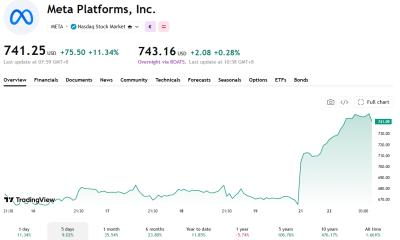
Meta Jumps 11% As Muse Shines and Investors Show an Appetite for Advancing AI
-

 Business5 days ago
Newsom accelerates AI oversight, advances ‘kill switch’ plan
You must be logged in to post a comment Login