
Connect with us

Business

Elon Musk’s Tesla Pay Hit 2.5 Million Times Median Worker, Equaling Annual Wage Every 4.23 Seconds

Published

on

Tesla CEO Elon Musk tips his hard hat

Elon Musk‘s 2025 compensation package at Tesla reached a reported value of $158.3 billion, more than 2.5 million times the median pay of a Tesla employee, according to an annual analysis by the AFL-CIO released this week.

The labor federation’s Executive Paywatch report calculated the ratio at 2,522,203 to 1. That figure meant Musk’s package equaled the median Tesla worker’s annual earnings every 4.23 seconds. The median employee compensation used in the calculation was $57,243.

The package, based on the grant-date fair value of restricted stock awards, was 14 times larger than the combined total compensation of all other S&P 500 chief executives, the report said. Including Musk’s award, the average S&P 500 CEO compensation rose to $340.1 million in 2025. Excluding it, the average still climbed 21 percent to $22.8 million from $18.9 million the prior year, the highest level since the AFL-CIO began tracking the data in the 1990s.

The average CEO-to-worker pay ratio across S&P 500 companies reached 5,387 to 1 when Musk’s package was included. Without it, the ratio stood at 312 to 1, up from 285 to 1 in 2024.

Advertisement

Brandon Rees, lead researcher for the AFL-CIO’s Executive Paywatch project, described the scale of the award as unprecedented. “Elon Musk’s gargantuan 2025 pay package at Tesla is unlike anything we have seen before,” he said. “Our economy is increasingly out of balance because billionaires like Elon Musk are taking a greater share of the economic pie while working people are struggling to make ends meet.”

Fred Redmond, the AFL-CIO’s secretary-treasurer, said the Tesla arrangement was already influencing other boards. Musk’s deal “changes the dynamic when other CEO compensation plans come up” and “boards use it as a reference,” he said in comments reported alongside the findings.

The compensation figure reflects accounting valuations of equity grants under Tesla’s 2025 CEO Performance Award and related awards, not cash paid out or shares vested during the year. Tesla has previously noted in regulatory filings that such reported totals can differ significantly from any value ultimately realized, as awards depend on meeting multi-year performance milestones including market capitalization, operational targets and product goals. In some prior periods, realized compensation for Musk has been reported as zero when awards remained unvested or were subject to legal and other adjustments.

Tesla’s median employee pay and the resulting ratio are calculated under Securities and Exchange Commission rules that require public companies to disclose the relationship between CEO compensation and that of a median worker. The company has said it remains committed to competitive pay for employees. Manufacturing was identified in the AFL-CIO report as the sector with the highest average CEO-to-worker ratio, driven in large part by the Tesla figures.

Advertisement

The report placed the Tesla numbers in a broader context of rising executive pay. A majority of S&P 500 CEOs earned more in a single day than the median U.S. worker made in a full year, according to the analysis. The federation also highlighted wider economic pressures, including limited retirement savings and difficulty covering unexpected expenses among many American households.

Musk’s package has drawn attention in part because of its size relative to Tesla’s workforce and to other corporate pay practices. Shareholders previously approved the structure of the performance-based awards, which are designed to vest only if ambitious financial and operational targets are met over a multi-year period. The awards have been the subject of ongoing legal and governance discussions, including court proceedings related to earlier compensation arrangements.

Analysts and labor groups have long debated the implications of large equity packages for alignment of interests between executives and shareholders, as well as for internal pay equity. Supporters of performance-based awards argue they incentivize long-term value creation and retain leadership during periods of high growth and risk. Critics, including the AFL-CIO, contend that such extreme disparities contribute to broader economic imbalance and set benchmarks that influence compensation decisions elsewhere.

The AFL-CIO has tracked executive pay trends for decades. This year’s findings show that even after removing the Tesla outlier, average CEO compensation and the ratio to worker pay continued to rise. The report is expected to fuel continued discussion among investors, policymakers and labor advocates about disclosure rules, say-on-pay votes and the structure of equity incentives at major public companies.

Advertisement

Tesla employs more than 100,000 people worldwide, with a substantial portion of its workforce outside the United States. Median pay figures under SEC methodology include a range of roles and locations and are not equivalent to average wages at specific factories or in particular job categories. The company has reported competitive hourly rates at some manufacturing sites in recent disclosures.

As of the report’s release, the accounting valuation of Musk’s 2025 awards stood as the largest single-year CEO compensation figure examined by the AFL-CIO. Whether and when any portion of the awards converts into realized value will depend on Tesla’s future performance against the specified milestones and on the final resolution of related legal and administrative matters.

The findings arrive amid ongoing public and investor scrutiny of executive compensation practices across the technology and automotive sectors. The AFL-CIO said the data underscore the need for continued attention to the distribution of economic gains between top executives and the broader workforce.

Advertisement
Continue Reading
Click to comment

You must be logged in to post a comment Login

Leave a Reply

Business

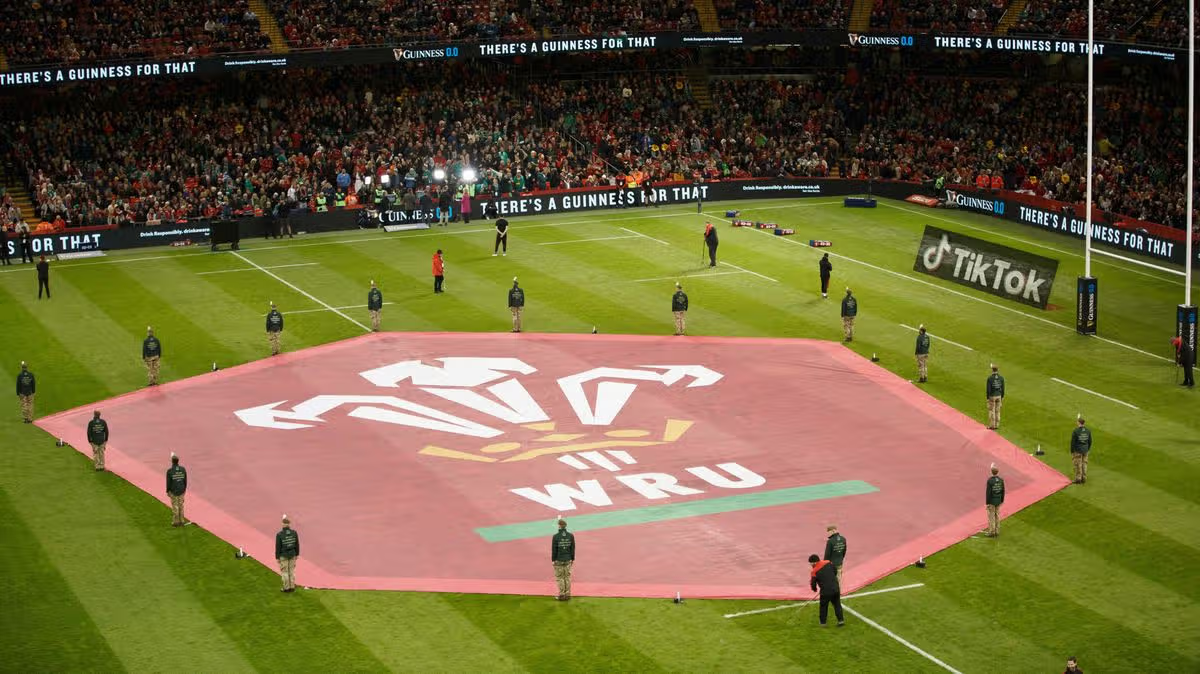
WRU needs to publish evidence underpinning its decision to cut a rugby region

Published

on

Business Live

If individual contributions were made in confidence, redact them. If legal advice must remain privileged, remove it, but just publish

WRU logo.(Image: Huw Evans Picture Agency)

No one disputes that Welsh rugby faces some extraordinarily difficult choices over the next few years, and maintaining the status quo simply because change is difficult is not a credible strategy.

But accepting that change is necessary is very different from accepting that every proposed change is necessarily the right one, and nowhere is that distinction more important than in the decision by the Welsh Rugby Union (WRU) that the long-term future of the professional game should involve reducing the number of regions from four to three.

Advertisement

This would mark one of the most significant structural changes in Welsh rugby since the creation of regional rugby more than two decades ago. It would have implications not only for finances and playing performance but also for supporters, players, communities and the identity of the professional game across Wales.

Most importantly, once implemented, it would be extremely difficult to reverse.

Given this, I would expect any organisation contemplating such a fundamental restructuring to undertake a detailed appraisal before reaching a decision. It should examine the financial consequences of the different options, the assumptions underpinning those projections, the risks associated with each alternative and, critically, what happens if those assumptions turn out to be wrong.

Until recently, it was unclear whether such an appraisal had been undertaken by the WRU and I therefore wrote to chief executive Abi Tierney asking a series of questions about the process that had led the board to conclude that three regions represented the best future for the professional game.

Advertisement

Following further correspondence, we now have a much clearer answer, and it is an important one. Between August and October 2025, the WRU says that it held 32 separate engagement meetings involving a wide range of stakeholders, with each independently minuted and a subsequent report produced for the board.

Alongside this, detailed analysis was undertaken by the executive team and subjected to what the WRU describes as external independent challenge from experts in the field.

More importantly, that work culminated in a formal option appraisal considering a range of options for the professional game, including financial analysis, strategic considerations, an assessment of the principal risks and opportunities, and feedback received through the stakeholder engagement process. It seems that the WRU board considered and approved the appraisal in October 2025, after which it concluded that its preferred long-term strategic direction was a move from four professional regions to three as part of the wider One Wales Strategy.

For those of us who have been asking whether there was a substantive evidence base behind the decision, that clarification is welcome and now what work was undertaken before the Board reached its conclusion. But in answering one important question, the WRU has created another that is arguably even more important.

Advertisement

If this detailed evidence exists, then why can’t Welsh rugby see it?

I am not alone in asking that question, and last week, Scarlets managing director Jon Daniels publicly questioned what he described as the lack of data and transparency surrounding the decision. He argued that a change of this magnitude requires everyone involved in Welsh rugby to understand both the decision and the data used to reach it.

More significantly, he suggested that the Scarlets still did not know the real financial picture and questioned whether every possibility of retaining four professional teams had been properly explored.

So, there is now an uncomfortable contradiction at the heart of this process as the WRU says that a detailed option appraisal was undertaken, containing financial analysis, strategic considerations and an assessment of risks and opportunities. Yet one of the organisations most affected by the outcome says that it still has insufficient visibility of the data used to justify the proposed change.

Advertisement

Those positions are not necessarily incompatible, as consultation can take place without the final analysis being shared, but that is precisely why transparency matters. The WRU has pointed out that some information cannot be shared publicly because it may be commercially sensitive, legally privileged or linked to ongoing negotiations. That is reasonable, but it is not the same as saying the underlying evidence base cannot be shared

If individual contributions were made in confidence, redact them. If legal advice must remain privileged, remove it. If some financial assumptions are commercially sensitive, summarise them. What should remain is the substance of the case and the reasons why three regions emerged as the preferred option.

The WRU has also offered a stakeholder session to explain the work that underpinned the board’s decision and to allow questions, but there is a fundamental difference between being given a presentation and being able to scrutinise the evidence, particularly when we know that the board reached its preferred strategic direction in October 2025.

Yes, boards exist to make decisions, but if one of the regions directly affected is still publicly questioning the evidence and transparency nearly a year later, it is difficult to argue that the case has been sufficiently understood outside that boardroom.

Advertisement

Welsh rugby has experienced enough governance difficulties to know that institutional trust cannot simply be demanded but has to be earned, and openness around major decisions is one of the most effective ways of doing that. There may ultimately be an overwhelming financial and strategic case for three professional regions but, equally, some of the assumptions underpinning that conclusion may prove less convincing when subjected to wider scrutiny.

At present, those outside the board who are affected by this decision cannot make that judgement because they have not been allowed to see enough of the analysis.

Therefore, the next step should be straightforward: the WRU should publish the option appraisal, suitably redacted to protect genuinely confidential information, and allow Welsh rugby to examine the evidence for itself. If it still refuses, member clubs should press for disclosure, as there is simply no longer any reason why it should not be made available.

Indeed, the question is no longer whether the evidence exists but why, if the case for three regions is genuinely compelling, Welsh rugby is still being asked to trust the conclusion without being allowed to properly scrutinise the case behind it. And that simply isn’t good enough.

Advertisement
Continue Reading

Business

Building project ‘in limbo’ after housing firm goes bust

Published

on

Business Live

Walkden tower has been abandoned for months

The abandoned building site in Walkden.

The abandoned building site in Walkden(Image: Kenny Brown / MEN)

A building project in Walkden has been left ‘in limbo’ after the firm carrying out the work went bust.

Advertisement

Building works on the corner of Bolton Road and Manchester Road mysteriously ground to a halt in January and are yet to resume. The plot was supposed to become a five-storey block for the elderly.

Housing 21, a not-for-profit care provider, commissioned social housing developers Alderley Group to build 46 independent living apartments for the over-55s. The planning application was given the greenlight by Salford council in December 2024, and construction on the project started last year.

The half-built steel tower has stood abandoned for several months after Alderley Group was issued a winding up order in January and ordered to liquidate its assets in June.

The websites are now defunct and Companies House is currently processing a statement of administrator’s proposal, which is one of the final stages before a firm is made insolvent or sold off to recoup funds invested by creditors.

Advertisement

According to Housing 21, the plans are still due to go ahead once they find a replacement contractor. But in the meantime, local councillors and residents are worried the ‘eye-sore’ site will attract fly-tipping and anti-social behaviour to the area.

Councillor Sammie Bellamy said: “I’m just so sorry for the residents having to put up with the eyesore. It feels like something we have very little control over but is having a big impact.

“I know it’s already causing issues for the Gill Medical Centre, who overlook the construction site.”

Construction is due to continue eventually, with a road closure order in place across Harriet Street, Manchester Road, and Bolton Road until December 2027. The roads are currently free, but could be blocked off once the construction recommences.

Advertisement

A Housing 21 Spokesperson said: “We can confirm work on the site has been temporarily paused whilst we source a replacement contractor to deliver the scheme. We are keeping all interested parties updated with progress and would like to thank everyone for their patience and understanding.”

A Salford City Council spokesperson said: “We understand the concerns that residents have raised about this site. We will continue to keep the situation under review and work with relevant parties where appropriate and take the necessary action to help protect the local environment and support the community.”

To find all the planning applications, traffic diversions, road layout changes, alcohol licence applications and more in your community, visit the Public Notices Portal.

Advertisement
Continue Reading

Business

US stock: S&P 500 ends lower as investors weigh data, Middle East tensions

Published

on

US stock: S&P 500 ends lower as investors weigh data, Middle East tensions
The S&P 500 closed lower on Friday, dipping from a record high and weighed down by Applied Materials, while investors digested weaker-than-expected retail sales data. Applied Materials fell after its upbeat quarterly forecast failed to impress investors. The chip equipment maker’s shares have doubled in 2026 due to strong demand related to the buildout of AI data centers.

With investors nervous about high valuations ‌of AI-related stocks that ⁠have soared ⁠in recent years, chipmakers including Broadcom and Intel also dropped on Friday.

“A lot of the drivers in the market right now are around various parts ​of AI, and (Applied Materials) is an example of a company that had a ‘beat and raise’ but expectations were high and so the stock ​sold off,” said Thomas Martin, senior portfolio manager at GLOBALT Investments in Atlanta. Transit through the Strait of Hormuz appeared at a near standstill after two more ships were attacked there and the United States said it could maintain a naval blockade ​of Iran indefinitely. Those developments added to pessimism after a senior Iranian source said on ⁠Wednesday there ‌had been no progress in talks to build on a June agreement to end the ​war.

The S&P 500 energy index rallied, tracking higher oil prices. Reddit surged after the social media company was named a new ⁠addition to the S&P 500 index, effective August 18. July retail sales data came in weaker than expected, after an unrevised 0.2% gain in June, the Commerce Department’s Census Bureau said.

According to preliminary data, the S&P 500 lost 13.41 points, or 0.17%, to end at 7,785.58 points, while the Nasdaq Composite lost 73.86 points, or 0.28%, to 26,729.16. The Dow Jones Industrial Average fell 108.53 points, or 0.20%, to 53,732.53.While inflation related to high oil prices remains a concern, recent economic data has investors mostly expecting the Federal Reserve to hold interest rates steady at its September meeting. Traders see a 67% chance the Fed will keep rates unchanged at the September ‌meeting, with a 33% chance of a hike, according to CME’s FedWatch.

The University of Michigan’s preliminary consumer sentiment survey came in at 51 in August, below expectations of 54.5, according to economists polled ​by Reuters.

The aggregate earnings of S&P 500 companies have ⁠surged 52% in the second quarter, with much of that gain coming from Amazon , Microsoft and other AI heavyweights, according to LSEG.

With the S&P 500 trading just below record highs, the index is valued at about 20 times expected earnings. That is up from about 19 at the end of July and below 22 at the start of 2026. Workday dipped. The stock soared 18% on Thursday after Reuters reported that private equity firm Silver Lake was in talks to acquire the software firm. Shares of some drone makers gained after President Donald Trump said late on Thursday he would impose tariffs on imports of drones and their components. Red Cat and Unusual Machines both jumped.

Advertisement
Continue Reading

Business

New York Fed finds delinquency rates mixed for credit cards, auto loans

Published

on

Raise your credit score in 30 days: Expert shares quick fixes to cut stress

New data from the Federal Reserve Bank of New York found that while overall delinquency rates improved for overall debt burdens, new delinquencies rose slightly for auto loans and mortgages and remained elevated for credit cards.

The New York Fed found that aggregate delinquency rates improved in the second quarter of 2026, with 4.7% of outstanding debt in some stage of delinquency.

Advertisement

“Delinquency rates across most products have held steady over the past two years,” said Joelle Scally, economic policy advisor at the New York Fed. “Still, new delinquencies for auto loans and credit cards remain at elevated levels, a trend we’ll continue to monitor.”

Credit card debt that is over 30 days delinquent has remained relatively steady at about 9% of outstanding balances since it reached that level in 2024, while auto loans are at about 8% and mortgages around 4%.

INFLATION COOLED IN JULY BUT REMAINED ELEVATED AS FED WEIGHS RATE HIKES

Person hands credit card to cashier

Credit card delinquencies have remained relatively steady in recent years. (David Paul Morris/Bloomberg via Getty Images)

For debt flowing into serious delinquency, which is defined as 90 days or more past due, those transitions have held relatively steady over the past year but have edged slightly higher.

Advertisement

Credit card delinquencies were slightly higher than a year ago, rising from 6.93% to 6.97% when comparing the second quarter of 2025 to 2026, respectively.

The share of auto loans that entered serious delinquency also rose over that period, rising from 2.93% to 3% when comparing the second quarter of 2025 to 2026. Mortgages entering serious delinquency also ticked higher from 1.29% to 1.52% in that period.

AUTO LOAN REFINANCING: HOW IT WORKS AND WHEN IT COULD SAVE YOU MONEY

A couple talks with a car dealer after they purchased a new vehicle.

Auto loan delinquencies ticked slightly higher in the latest quarter. (iStock)

Student loans were a notable exception, with the resumption of reporting defaulted student debt causing some distortions after the pandemic era pause on defaults concluded.

Advertisement

When excluding charged-off debt, new credit card delinquencies have been at around 3% of balances since 2024, with the most recent reading at 2.95%. Credit card debt that reached 90 days past due accounted for 6.97% of the balance in the latest quarter, while those that are beyond 90 days past due were at 2.3%.

The New York Fed noted in its analysis that, from the third quarter of 2022 to the first quarter of 2026, the percentage of credit card balances that were more than 90 days delinquent increased from 7.6% to 12.8%.

FED DISSENTERS WARN INFLATION COULD BECOME ENTRENCHED WITHOUT MONETARY POLICY TIGHTENING NOW

Person tapping credit card on reader

The New York Fed noted that credit card delinquencies are at an elevated level despite being relatively stable in recent years. (Brent Lewin/Bloomberg via Getty Images)

That stock figure includes charged-off debt, the inclusion of which was noted by economists as differing from the flows into delinquency that reflect a relatively steady level of consumer health.

Advertisement

New York Fed economists said they found the “stock delinquency rate is rising because of a pool of stale, charged-off debts that lenders have been reporting for longer durations, rather than a fundamental worsening in the incidence of delinquency.”

GET FOX BUSINESS ON THE GO BY CLICKING HERE

Continue Reading

Business

Braskem S.A. (BAK) Q2 2026 Earnings Call Transcript

Published

on

OneWater Marine Inc. (ONEW) Q1 2026 Earnings Call Transcript

Operator

Good morning, everyone, and thank you for waiting. Welcome to Braskem’s Second Quarter of 2026 Results Conference Call.

With us here today, we have Mr. Helcio Tokeshi, Braskem’s CEO; Mr. Carlos Brandao, Braskem’s CFO; and Mrs. Rosana Avolio, Investor Relations, Strategic Planning and Global Market Intelligence Director.

We inform you that this event is being recorded. The presentation will be held in Portuguese with simultaneous translation into English. All participants can choose which language to listen to and see the presentation using the show captions and view options button respectively. After Braskem remarks, there will be a Q&A session. Please be advised that questions must be sent through the Q&A button. I will now repeat the same instructions in Portuguese.

Advertisement

We inform you that this event is being recorded. The presentation will be held in Portuguese with simultaneous translation into English. All participants can choose which language to listen to and see the presentation using the show captions and view options button respectively. After Braskem remarks, there will be a question-and-answer session. Please note that questions should be submitted in writing through the Q&A button.

The audio of this event will be available on the Investor Relations website after it ends. We remind you that the participants will be able to submit questions to Braskem, which will be answered after the end of this conference by the RI (sic) [ IR ] department.

Before proceeding, we would like to clarify that any statements that may be made during this conference call regarding Braskem’s business prospects, projections, operational and financial goals are beliefs and

Advertisement
Continue Reading

Business

WeWork Global sells 2.5% stake in WeWork India Management for Rs 244 crore

Published

on

WeWork Global sells 2.5% stake in WeWork India Management for Rs 244 crore
WeWork Global on Friday divested a 2.5 per cent stake in flexible workspace operator WeWork India Management for Rs 244 crore through open market transactions.

According to the block deal data on the BSE, WeWork Global through its affiliate, 1 Ariel Way Tenant Ltd, offloaded 35 lakh equity shares in five tranches, representing a 2.52 per cent stake in WeWork India Management.

The shares were disposed at an average price of Rs 697.55 apiece, taking the combined transaction to Rs 244.14 crore.

After the latest transaction, 1 Ariel Way Tenant Ltd’s holding in WeWork India Management declined to 12.3 per cent from 14.82 per cent.

Advertisement

Despite the stake sale, WeWork Global through its arm will remain the largest public shareholder in the company.


Meanwhile, Motilal Oswal Asset Management Company Ltd PMS, Motilal Oswal Mutual Fund (MF), ICICI Prudential MF, HDFC Standard Life Insurance Company Ltd, and Citigroup Global Markets Mauritius bought an equal number of shares at the same price.
Shares of WeWork India Management fell 1.57 per cent to close at Rs 707.80 apiece on the BSE.In July, WeWork India reported a consolidated net loss of Rs 4.30 crore for the first quarter of this fiscal year due to higher expenses.

The company had posted a net loss of Rs 14.10 crore in the year-ago period.

Its total income rose to Rs 700.74 crore during the April-June quarter of this fiscal year from Rs 545.71 crore in the corresponding period of the preceding year.

In 2017, WeWork India began as a joint venture between WeWork Global (US-based WeWork Inc) and Embassy Group. After WeWork Inc filed for Chapter 11 bankruptcy in the US, it moved to sell off its India stake entirely.

Advertisement

WeWork India is majority-owned and promoted by Embassy Group, and is the exclusive licensee of the WeWork brand in the country.

Continue Reading

Business

South Korea’s Kospi Enters New Bull Market

Published

on

South Korea’s Kospi Enters New Bull Market

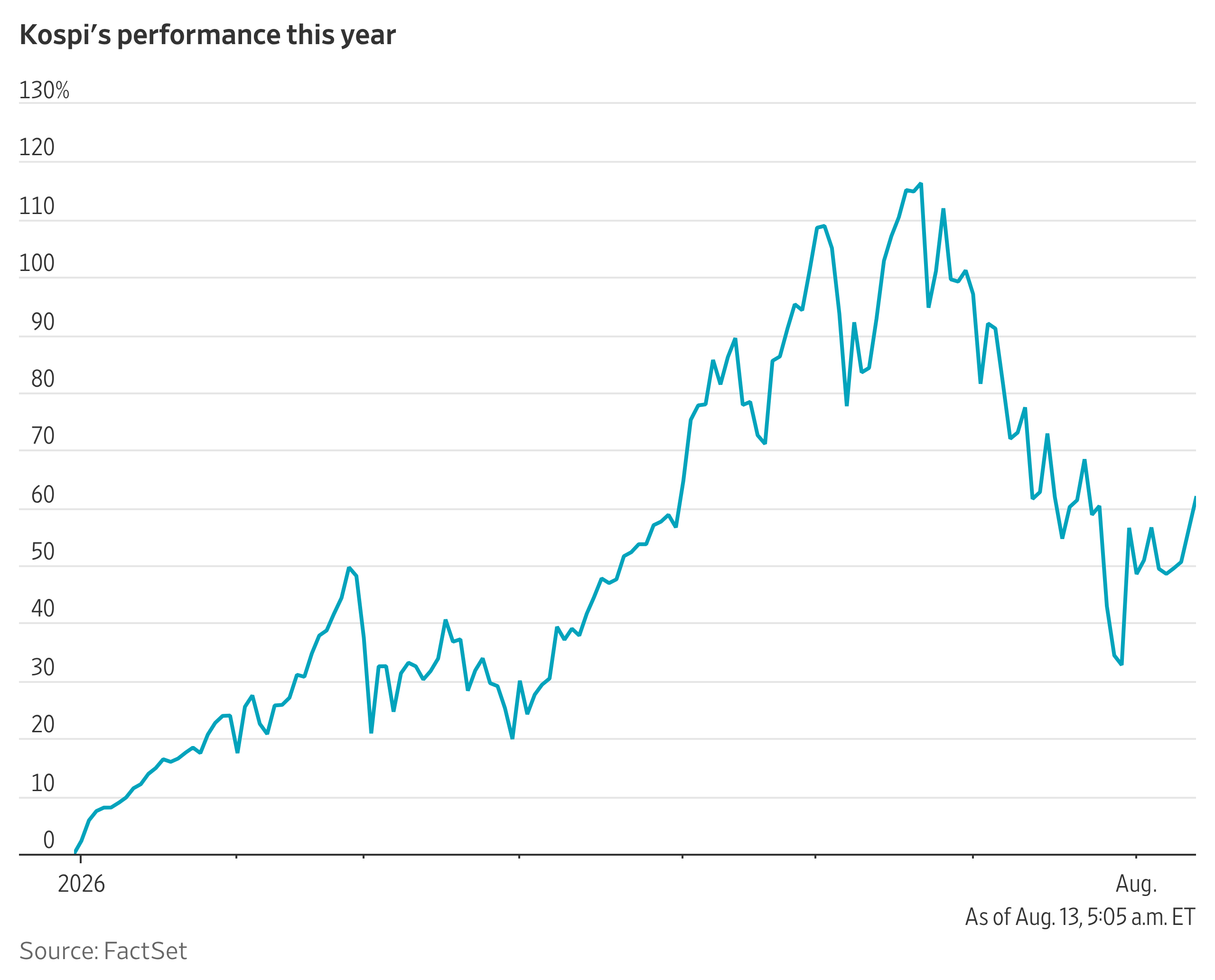
South Korea’s Kospi index entered a bull market again today, defined as a 20% rise from a recent low. Since the index’s recent bottom on July 30, it is up nearly 22%, including Thursday’s 3.6% gain. That is a quick turnaround: Its launch back into a bull-market territory happened over just 10 trading sessions.

Continue Reading

Business

FTSE 100 Falls For A Fifth Straight Session As Mining And Pharma Stocks Weigh On London

Published

on

Tesla's robotaxi launch in Texas comes as Elon Musk focuses on his business ventures following his stint in Washington

LONDON — Britain’s benchmark FTSE 100 index closed lower Friday, extending its losing streak to a fifth consecutive session, as weakness in mining and pharmaceutical stocks offset an initially positive open driven by cooling U.S. inflation data.

The index closed down 22.56 points, or 0.21%, at 10,750.11. Trading ranged between a session high of 10,789.71 and a low of 10,723.66, following a previous close of 10,772.67. The FTSE 250, which tracks a broader set of mid-cap companies, moved in the opposite direction, ending up 29.71 points, or 0.1%, at 24,867.42, while the AIM All-Share index closed slightly higher at 800.92.

Friday’s session began on a stronger note, with London stocks initially set to open around 0.3% higher after Wall Street closed at fresh record highs overnight. That optimism followed a softer-than-expected U.S. inflation reading, which eased concerns about the Federal Reserve pursuing further interest rate increases and helped lift global risk appetite heading into the European trading day. The FTSE 100 briefly climbed as high as 10,846 in early trading before steadily giving back those gains through the rest of the session.

Mining stocks emerged as the primary drag on the index. Antofagasta led the declines, falling more than 3.7% after the company cut its copper production outlook, according to Trading Economics data. Fellow miners Glencore, Fresnillo and Endeavour Mining all declined by more than 2%, while Anglo American slipped roughly 1.8%, as weaker industrial metal prices weighed broadly across the sector. Pharmaceutical stocks added to the pressure, with AstraZeneca and GSK both falling more than 2%, ranking among the session’s steepest individual losses.

Advertisement

Not every part of the market moved lower. The Sage Group, Experian and Relx were among the day’s top performers, posting gains of 3.92%, 3.81% and 2.69%, respectively. Energy stocks also showed relative resilience, with Shell and BP trading slightly higher as oil prices remained supported amid ongoing tensions tied to the broader U.S.-Iran standoff, which continued to weigh on sentiment even as Friday’s specific market moves were driven more directly by the mining and pharmaceutical sectors.

David Morrison, senior analyst at Trade Nation, said Friday’s decline capped off an underwhelming week for London shares, one that left analysts debating whether the pullback reflected typical seasonal thinness in summer trading or something more significant. “It looks as if momentum on London is picking up to the downside,” Morrison said, pointing to the accumulating losses across the week as a signal worth watching closely in the sessions ahead.

For the week overall, the FTSE 100 finished down 1.4%, a notable pullback for the index following a stretch of relative stability. The FTSE 250 posted a modest weekly gain of 0.1%, while the AIM All-Share climbed 0.3% over the same period, reflecting a divergence between the large-cap index, weighed down heavily by its outsized exposure to mining and commodity-linked stocks, and the broader market.

Friday’s session also unfolded against the backdrop of fresh UK economic data, with investors continuing to digest the latest gross domestic product figures released earlier in the week. Weakness in the mining sector had already been a recurring theme across the preceding sessions, with Thursday’s trading also dragged lower by declines in the same group of resource-linked stocks even as broader UK GDP data offered a mixed picture of domestic economic momentum.

Advertisement

The FTSE 100’s struggles this week stand in contrast to the record-setting run enjoyed by U.S. markets over the same period, with the S&P 500 closing at a fresh all-time high Thursday after clearing the 7,800 mark for the first time in the index’s history. That divergence highlighted how sector composition has shaped each market’s performance differently in recent sessions, with London’s heavier weighting toward mining, energy and pharmaceutical companies leaving the index more exposed to commodity price swings and company-specific earnings disappointments than the more technology-heavy U.S. benchmarks.

Looking ahead, market participants are likely to continue monitoring commodity prices, particularly industrial metals, along with any further developments in the geopolitical situation surrounding Iran and its potential impact on oil markets, as key factors likely to shape the FTSE 100’s performance heading into the following week. With the index having now logged losses in five straight sessions, investors will also be watching closely for any signs of stabilization once the current run of company-specific pressures, particularly within the mining sector, begins to ease.

Continue Reading

Business

Hair mousse sold in 12 states recalled over potential explosion hazard

Published

on

Hair mousse sold in 12 states recalled over potential explosion hazard

A popular hairstyling mousse sold to salons and consumers in multiple states is being recalled over a potential explosion hazard.

Henkel Corporation is voluntarily recalling certain 6.76-ounce cans of Schwarzkopf Professional Osis Grip Extra Strong Mousse, according to an Aug. 11 notice posted by the U.S. Food and Drug Administration (FDA).

Advertisement

The Germany-based company said a “potential packaging issue” could allow the product to leak from the aluminum cans while under pressure, creating an explosion hazard.

POPULAR REESE’S, ALMOND JOY ICE CREAM BARS RECALLED OVER LABELING ERROR

Henkel Corporation is voluntarily recalling certain 6.76-ounce cans of Schwarzkopf Professional Osis Grip, according to a Tuesday alert from the U.S. Food and Drug Administration (FDA).

Henkel Corporation is voluntarily recalling certain 6.76-ounce cans of Schwarzkopf Professional Osis Grip Extra Strong Mousse. (U.S. Food and Drug Administration )

Henkel became aware of the problem after receiving one customer complaint and two reports from salons.

“Bruising on the hand was reported by the customer and no other injuries were identified,” the FDA noted.

Advertisement

Affected batch codes include:

  • 2901X4577N, 2901X4578N, 290265P91O, 290665Q30O, 290855N31O, 290866R38P, 290994281N, 291046L06P, 291174W17N, 291435H76O, 291435H77O, 291455N33O, 291515A59O, 291515A99O, 291515B01O, 291555N33O, 291615B01O, 291616B68P, 291716B69P, 291825E960, 291925E96O, 292015B73O, 2928Y538BO, 2928Y539BO, 293066U32P

RECALL ISSUED FOR DOG AND HORSE MEDICATION AFTER GLASS FIBER FOUND IN VIALS

Woman scrunching her hair

Henkel became aware of the problem after receiving one customer complaint and two reports from salons. (iStock)

The recalled mousse was distributed through 21 distributors in Alaska, Arizona, California, Florida, Michigan, Missouri, New Jersey, Ohio, Pennsylvania, South Carolina, Texas and Washington, according to the FDA.

It was also sold directly to hair professionals and consumers.

NEARLY 12 MILLION BOTTLES OF ROHTO EYE DROPS RECALLED OVER STERILITY CONCERNS, FDA ANNOUNCES

Advertisement
Hairdresser working with client

The recalled mousse was also sold directly to hair professionals and consumers. (iStock)

CLICK HERE TO GET FOX BUSINESS ON THE GO

Consumers who purchased one of the recalled cans are encouraged to return it to the place of purchase for a full refund.

FOX Business reached out to Henkel for comment.

Advertisement
Continue Reading

Business

Tips for Presenting Your Business Through People Who Make an Impact

Published

on

Tips for Presenting Your Business Through People Who Make an Impact

Corporate events offer a clear opportunity to showcase company values directly to industry leaders, potential clients, and business partners.

Choosing the right person to convey your core message shapes how the brand gets perceived across the market. High-impact keynote presenters transform ordinary corporate gatherings into memorable experiences that spark immediate action. Selecting speakers who match your corporate identity turns routine business presentations into powerful growth drivers.

Choosing the Right Voice for Your Business

Finding an authentic figurehead to represent your brand demands careful thought and strategic direction. As explained by JLA Speakers, partnering with established agencies gives organizations direct access to top talent who captivate the room’s attention effortlessly. These seasoned professionals possess rare communication skills needed to hold audience interest and drive core commercial messages home. Their industry experience helps shape complex corporate ideas into clear, engaging narratives.

Selecting a spokesperson requires evaluating how well their personal style matches your company culture. A mismatched presenter creates confusion, whereas a well-matched personality reinforces trust among corporate attendees. Taking time to review past keynote recordings helps verify that the chosen presenter mirrors your brand’s core principles. Professional presenters adapt their tone to suit diverse corporate audiences seamlessly.

Align Speaker Expertise with Strategic Goals

Every corporate event aims to hit specific targets, from boosting workforce motivation to announcing major commercial expansions. Industry research indicates that success depends on pairing speaker backgrounds directly with defined event objectives. Selecting an expert with relevant domain knowledge guarantees that every story shared resonates deeply with corporate attendees. Specialized knowledge adds credibility to your corporate message, making complex industry concepts accessible to all listeners.

Advertisement

Inspirational leaders who bring high energy, drive, and humor leave lasting positive impressions on corporate crowds. These dynamic personalities uplift audiences and deliver actionable business insights that teams can put into practice. Aligning speaker traits with expected outcomes turns standard speeches into memorable brand moments. Event organizers gain higher attendee satisfaction scores when keynotes directly address practical business priorities.

Plan Booking Timelines Far Ahead

Securing top corporate talent requires a forward-thinking strategy and early scheduling efforts. Booking industry leaders 6 to 12 months in advance is recommended to guarantee access to peak talent. Delaying outreach often leaves organizers with limited choices or compromised event schedules. High-profile presenters maintain packed schedules, so early contact protects your event date.

Early preparation provides ample time to coordinate presentation content, practice runs, and stage arrangements. Organizers can collaborate closely with speakers to tailor messages directly to attendee demographics. Long lead times guarantee smooth coordination and eliminate last-minute logistical friction. Thorough preparation gives marketing teams extra margin to build event publicity around confirmed keynotes.

Interactive Formats That Engage the Room

Modern corporate presentations are shifting away from traditional one-way lectures toward dynamic audience participation. Keynotes increasingly integrate elements that involve the audience directly, turning a speech into an experience[cite: 2]. Involving listeners directly maintains high energy levels throughout the presentation and keeps attention focused on core themes. Interactive presentation styles encourage attendees to reflect on how business concepts apply to their daily work.

Advertisement

Leaving time for audience interaction after a speech helps you forge valuable connections with potential clients and business partners. Direct conversations create genuine engagement, allowing prospective clients to clarify key concepts on the spot. Interactive sessions transform passive audience members into active participants in your corporate narrative. These open exchanges build commercial trust and strengthen long-term industry relationships.

Elevate Brand Perception Through Powerful Messaging

Presenters who deliver memorable messages rely on proven visual and structural tools to reinforce key ideas. Incorporating structured visual formats and clear takeaways guarantees high memory retention long after events finish.

  • Research shows that people remember 95% of information from videos, compared to only 10% from text.
  • Strong presentation skills empower audiences to see branding as more than image – as the key to influence and opportunity.
  • Real-world case studies build immediate commercial credibility with decision-makers in the room.
  • Clear action steps allow attendees to apply key concepts immediately within their organizations.

Combining compelling storytelling with structured visual aids elevates standard presentations into impactful brand statements. Commercial reach grows naturally when articulate presenters deliver practical, memorable takeaways.

Measuring Long-Term Impact From Keynote Presentations

Evaluating event success requires looking beyond immediate applause to track tangible business results. Gathering attendee feedback through post-event surveys provides clear data on message retention and brand perception changes. Tracking website visits, inbound leads, and contract conversions after the event helps quantify financial returns on event investments.

Repurposing keynote content across digital channels extends the lifespan of corporate events. Recording high-value speeches allows marketing teams to create short video clips, editorial articles, and social media posts. Sharing these key insights across digital platforms keeps your brand message active in industry discussions.

Advertisement

Selecting powerful speakers gives companies a clear advantage when communicating business goals to key stakeholders. Thoughtfully matched presenters build commercial trust, inspire action, and position organizations for long-term commercial success. Investing in experienced talent guarantees that every corporate presentation delivers measurable value and lasting audience impact.

Advertisement
Continue Reading

Trending

Copyright © 2025