Connect with us
DAPA Banner

Business

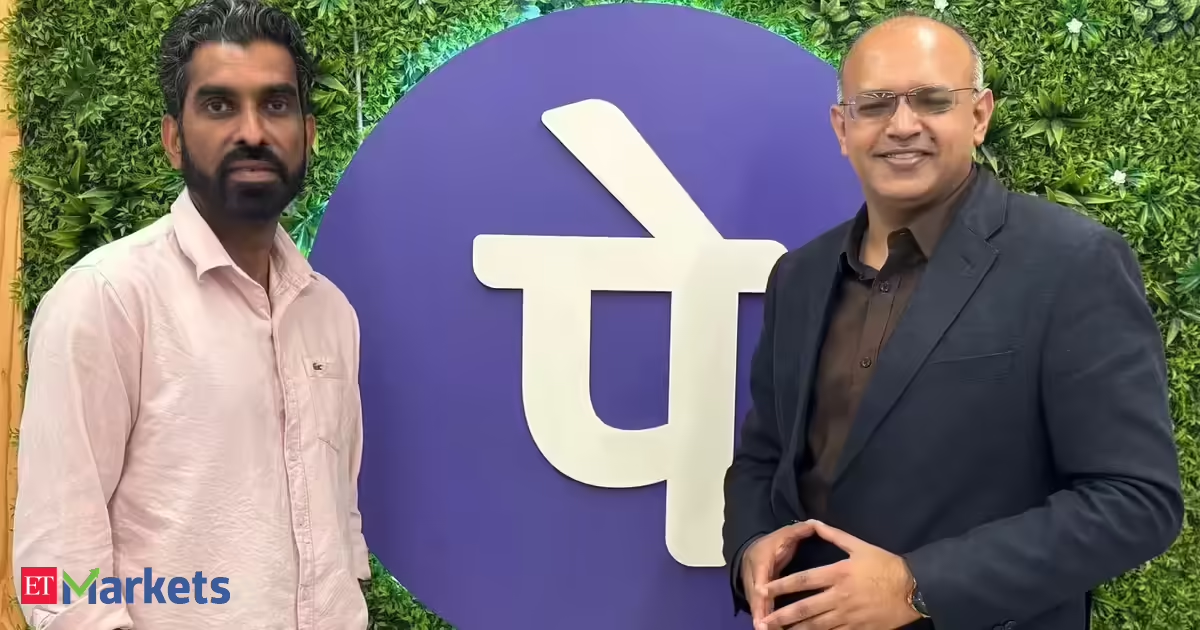
ETMarkets Smart Talk | Bharat investors to drive next growth wave in wealth management: Nilesh Naik

Published

on

ETMarkets Smart Talk | Bharat investors to drive next growth wave in wealth management: Nilesh Naik
As India’s investing landscape undergoes a structural shift, the next phase of growth is increasingly being driven by investors from beyond the top cities.

In an interaction with Kshitij Anand of ETMarkets Smart Talk, Nilesh D. Naik, Head of Investment Products at Share.Market, highlighted how the rise of ‘Bharat’—spanning tier II, tier III, and smaller towns—is reshaping the wealth management ecosystem.

With deeper digital penetration and growing participation from B30 cities, he believes this segment will be instrumental in expanding India’s investor base from around 60 million to nearly 200 million over the next decade, while also redefining how platforms approach product design, education, and investor behaviour. Edited Excerpts –

Kshitij Anand: Now that the access problem has been solved by digital apps, what specific psychological barriers are preventing retail investors from making those intelligent decisions?


Nilesh D. Naik:
You are right— from an access perspective, the problem has largely been solved over the last five to six years. But one of the key challenges today is the complexity involved in starting the investing journey. And I think that is where platforms need to spend a lot of time.
For example, for people who have been investing in mutual funds, it may not be that difficult— mutual funds may come across as a very simple product.

Advertisement


But for a first-time investor, with thousands of products available, how do you zero down on the right one? That remains a big challenge. Going forward, you will see a lot of platforms focusing on this area in a big way.

Kshitij Anand: And how can a retail investor distinguish between a fund that is genuinely consistent and one that is simply riding a temporary market tailwind?

Nilesh D. Naik: Yes, this is an interesting question and one of the key issues that has been widely discussed in the industry. The general tendency of customers is to go by performance— they look at three-year or one-year performance and invest accordingly.
At least at PhonePe, we have tried to address this issue by not focusing too much on performance, but by highlighting the consistency of the product. When I say consistency, there are complex concepts like rolling returns and so on.

We try to simplify these, do the heavy lifting at our end, and present a simple metric that helps customers see whether the product has been consistent over the long term in relative terms, compared to other schemes in the category.

I think it is very important to shift the focus away from point-to-point returns, which are highly cyclical— not just at the market level, but even at the relative performance level. So yes, this is a key area to focus on.

Kshitij Anand: And at PhonePe, you very much believe in the Bharat story. So, how is that evolving at PhonePe and in the wealth management space?


Nilesh D. Naik:
Yes, the strength of PhonePe is our distribution reach, and we have a very strong presence in tier II, tier III cities and beyond. Just to share some numbers with you—if you look at the mutual fund customers that we have, more than two-thirds of them are from B30 cities, beyond the top 30, as per the AMFI definition.

Advertisement

And not just from a customer perspective, but even from an AUM perspective, this is very different from the industry numbers, where it is actually the other way around, at least in terms of assets. So, the participation that we have seen is very encouraging, and it motivates us to build more for that cohort.

That is going to be the growth engine for the industry as well, in terms of moving from a 60 million customer base to, let us say, 200 million over the next decade or so.

Kshitij Anand: And let me also get your perspective on this—in a market that is prone to sudden volatility, how can platforms move beyond just providing data and actually help engineer better investor behaviour?

Nilesh D. Naik: Yes, it does not start with volatility. What you need to do is ensure that when the customer or investor is investing, at that stage itself, you offer the right kind of product mix. That will take away half the problem because when you invest in the wrong product, the volatility tends to be much higher.

A classic example today is investors who have invested in small caps. For a first-time investor, the kind of volatility experienced there is very different from someone who started with a large-cap, index, or hybrid product.

Advertisement

So, retaining a customer who has invested in core products is relatively easier compared to someone investing in small-cap or thematic products.

However, when such situations arise, there cannot be a single solution that addresses the entire problem. Continuous education is very important. Having the right contextual education within the app is critical. The nudges you give to customers—guiding them on how certain actions may work against them—are also very important. And of course, customers learn through experience.

No matter how much we educate them, experience cannot be replaced. The good thing is that many of these customers are in their 20s, which means over the next three to four years, if they continue investing, they will develop their own learning—and that is the best teacher.

Kshitij Anand: Staying with the Bharat story, as investors spread into tier II and tier III cities, how do we ensure that intelligence is simplified enough to be accessible to first-time investors?

Nilesh D. Naik: There are different ways to do this, but I can share what we have done at PhonePe Wealth to help customers. When it comes to shortlisting or identifying funds, there are three core parameters that we focus on.

Advertisement

The first is the consistency of the fund’s performance. The second is risk. And the third is whether there is a method behind that performance. By method, I mean the style of the fund manager and how the product is managed.

We have launched an interesting tool called CRISP, which stands for Consistency, Risk, and Investment Style of Portfolio. We understand that these are relatively complex concepts, so we simplify them by categorising factors such as consistency into high, medium, or low; and risk into acceptable or high levels, so that investors can make informed decisions.

Lastly, we also explain how the product is managed—whether it follows a quality, value, or momentum style—so that customers can create the right mix of funds that complement each other.

However, even with simplification, education remains critical. We are focusing a lot on educating customers about these concepts in a simple and accessible manner.

Advertisement

Kshitij Anand: Do you feel there is any single mistake that investors usually make when selecting a fund or investing?

Nilesh D. Naik: Two things I would highlight here. One is, of course, investing based on past performance. In fact, we have done several studies wherein, if you look at, say, the previous three-year ranking of funds in a category and compare it with the next three years—for example, 2019 to 2022 versus 2022 to 2025—and then look at the ranks, the rank correlation is actually close to zero.

This means there is absolutely no correlation between the two, which tells you that investing based on past performance does not work. However, it is a common behaviour among customers to look at returns and invest, and this is where one of the biggest mistakes comes from the customer side.

The second is the absolute lack of planning. It is like someone tells me that this is a good fund, and I invest without thinking about why I am investing or what my framework should be.

Every investor, no matter how small the investment, needs a framework that they can refer back to, especially during times when markets are highly volatile. Otherwise, you will keep debating whether to add more equity or redeem. Having a framework helps.

Advertisement

When I say framework, it means understanding that your investment is long term and defining the level of downside risk you can tolerate. For example, based on recent data, markets can fall by as much as 40% in a worst-case scenario.

But if, as an investor, I cannot tolerate more than a 20% downside, then I would probably allocate 50–60% to equity and the rest to fixed income products, gold, etc. Now, whenever something happens in the market, you can go back to that asset allocation framework and assess whether you are still aligned with your plan.

It is a very simple concept, and there can be many variations of it. But having a proper plan is extremely important, and this is something that is missing for most investors.

(Disclaimer: Recommendations, suggestions, views, and opinions given by experts are their own. These do not represent the views of the Economic Times)

Advertisement
Continue Reading
Click to comment

You must be logged in to post a comment Login

Leave a Reply

Business

Air Canada suspends flights to JFK, Salt Lake City

Published

on

Air Canada suspends flights to JFK, Salt Lake City

Air Canada announced on Friday that the airline is suspending select U.S.-bound flights as jet fuel prices continue to skyrocket in the wake of the Iran war. 

The cuts, set to take effect this summer and last at least five months, will impact all service to John F. Kennedy International Airport (JFK) in New York City and the Salt Lake City International Airport (SLC) in Utah, the airline said. 

Advertisement

“As we regularly do, we monitor and review our network to ensure that routes are meeting profitability targets,” the air carrier said in a statement. 

“Jet fuel prices have doubled since the start of the Iran conflict, affecting some lower profitability routes and flights which now are no longer economically feasible. Schedule adjustments including some frequency reductions are being made in response.” 

DELTA, SOUTHWEST HIKE CHECKED BAGS AS AIRLINES FACE SURGING FUEL COSTS

Air Canada plane in sky

An Air Canada plane lands at Pearson Airport in Toronto, Ontario, Canada on July 1, 2024. (Mert Alper Dervis/Anadolu via Getty Images / Getty Images)

Affected customers will be contacted with alternative travel options, the Canadian carrier said. 

Advertisement

The airline specified that JFK will not see service from June 1 through Oct. 25, 2026, from its two hubs in Montreal and Toronto.

The move could reflect a consolidation strategy, as routes to nearby Newark (EWR) and LaGuardia (LGA) airports remain unaffected, according to the release.

Air Canada operates more heavily out of those two airports than JFK, its website shows, with local outlet CTV News reporting roughly 34 daily departures from across Canada.

SOUTHWEST AIRLINES LIMITS PASSENGERS TO 1 PORTABLE CHARGER PER PERSON OVER FIRE CONCERNS

Advertisement
Planes parked at Toronto airport

A person watches an Air Canada airplane being towed away from a gate at Toronto Pearson International Airport on Feb. 6, 2024, in Toronto, Canada. (Gary Hershorn/Getty Images / Getty Images)

Flights to Salt Lake City, typically served only from Toronto Pearson (YYZ), will be suspended beginning June 30, with service expected to resume in 2027, creating a roughly six-month gap. 

The airline also said two domestic routes and one international service were affected.

Routes between Vancouver and Fort McMurray will be suspended on May 28, while service between Toronto and Yellowknife will be halted on Aug. 30.

Both Fort McMurray and Yellowknife, which are considered lower-volume markets, were not given a resumption date.

Advertisement

JETBLUE HIKES BAGGAGE FEES BY UP TO $9, CITING RISING FUEL PRICES AMID IRAN WAR

travelers walk through jfk airport

Travelers at John F. Kennedy International Airport (JFK) in New York, on Tuesday, Dec. 24, 2024. (uki Iwamura/Bloomberg via Getty Images / Getty Images)

The airline was also planning to launch service between Montreal and Guadalajara, Mexico, which has now been indefinitely suspended.

Air Canada said the changes represent only a small portion of its global operations, affecting about 1% of its total annual flying capacity for 2026. 

Ticker Security Last Change Change %
ACDVF AIR CANADA 13.88 +0.25 +1.83%

Jet fuel prices increased to $3.79 on Friday, more than a 50% increase since the day before the Iran war broke out on Feb 27, according to Airlines for America. 

Advertisement

CLICK HERE TO GET FOX BUSINESS ON THE GO

Several U.S. airlines have also adopted new cost-cutting measures to offset rising jet fuel prices, with JetBlue, Southwest, American and United Airlines increasing checked bag fees.

FOX Business reached out to Air Canada for more information. 

Advertisement
Continue Reading

Business

Apple CarPlay Ultra Will Soon Launch to Hyundai, Kia, and Other Mainstream Brands

Published

on

Apple CarPlay

Apple’s next-generation in-car system, CarPlay Ultra, is poised to expand beyond its initial debut, with new reports indicating wider adoption across major automotive brands.

After initially launching in select Aston Martin vehicles, the platform is now expected to reach more mainstream markets.

Hyundai, Kia, and Genesis Set to Adopt CarPlay Ultra

Apple CarPlay
Apple’s upcoming iOS 26.4 update will let CarPlay drivers talk to ChatGPT and other AI chatbots, enhancing in-car assistance, productivity, and conversation while keeping safety in mind.

According to MacRumors, Apple previously confirmed that Hyundai, Kia, and Genesis are preparing to integrate CarPlay Ultra into upcoming models.

Recent reports suggest that at least one new vehicle from these brands could feature the system in the second half of the year. If confirmed, this would mark a major shift from luxury exclusivity toward broader consumer accessibility.

What Sets CarPlay Ultra Apart

Unlike traditional Apple CarPlay, CarPlay Ultra delivers deeper integration with a vehicle’s internal systems.

Advertisement

The platform extends beyond the infotainment display into the instrument cluster, enabling drivers to view real-time data, including speed, fuel levels, tire pressure, and engine temperature, within a unified interface. It also supports direct control over features like climate settings, radio, and rear-view camera displays.

Personalized Interface Meets Brand Identity

According to VOI, the key feature of CarPlay Ultra is its adaptability. Apple allows automakers to customize the interface to match their brand identity, ensuring a consistent in-car aesthetic.

Drivers can also select from multiple design layouts, adding a layer of personalization that enhances both usability and visual appeal.

For everyone who’s always interested in any Apple software, what the Cupertino giant did with CarPlay Ultra is one step ahead of others.

Advertisement

Originally published on Tech Times

Continue Reading

Business

China food delivery stocks subdued as authorities crack down on ‘ghost deliveries’

Published

on


China food delivery stocks subdued as authorities crack down on ‘ghost deliveries’

Continue Reading

Business

Big update on plans for new Blackpool sports village

Published

on

Business Live

Scheme largely funded by £6.5m from the UK Government’s Town Deal

The plans for the Revoe Community Sports Village project in Blackpool.

The plans for the Revoe Community Sports Village project in Blackpool(Image: Local Democracy Reporting Service)

A multi-million pound community sports village for Blackpool has taken a major step forward as new details on the project emerge.

Advertisement

A planning application for the Revoe Community Sports Village project, which is primarily funded by £6.5 million from the UK Government’s Town Deal, was last week submitted to Blackpool Council, which is working with Blackpool FC and Blackpool FC Community Trust.

The scheme includes the provision of two 7- a-side synthetic 3G football pitches, two padel courts and a Multi-Use Games Area (MUGA) and associated floodlighting.

A 3G (third-generation) football pitch is a modern, high-performance synthetic turf surface designed to replicate natural grass, featuring long fibers (40mm-60mm) infilled with sand and rubber crumb. They offer durable, all-weather play for training and competitive matches.

In addition, the plans also include proposed enclosures and boundary treatments, hard and soft landscaping, car parking and installation of two storage containers and associated works .

Advertisement

A Planning, Design and Access Statement in support of the project stated: “This project will support sport and community provision by creating new facilities adjacent to Blackpool Football Club’s Bloomfield Road stadium.

“The Council is working alongside Blackpool Football Club and the BFC Community Trust to implement and subsequently operate the development.”

It concludes: “The proposals are considered to represent appropriate development which supports the overall aims of the Local Authority in improving access to sports facilities to support the health and wellbeing of the local community.

“For these reasons, it is considered that full planning permission for the proposed development should be granted. “

Advertisement

What does the scheme offer?

The statement says: “All of the pitches would have associated floodlighting and two storage containers to be installed on-site would allow for equipment storage.

“The 3G pitch is designed to be configured as either two 7-a-side or four 5-a-side pitches, to FA standards.

“Each pitch will be bound by 4.5m high weld mesh fencing with floodlighting provided.

“It is proposed that the facilities would be open between 9am and 9pm daily. This reflects the opening hours of other 3G pitch facilities in Blackpool. The pitches would not be in use when first team home games are being played to mitigate any potential impact on traffic.”

Advertisement

School use and possible tournaments

The BFCCT will manage the use of the facilities once operational. This will include facilities for educational provision and other sports programmes.

In respect of the 3G pitches, the Blackpool Football Club Ladies and Girls grassroots teams are expected to utilise the facilities as will the FA Girl’s Emerging Talent Centre, which is the Fylde Coast’s centre of excellence.

Bookable slots will be offered to local schools and junior grassroots football clubs, to utilise the space and hire facilities. The Community Trust will also be exploring options for developing some competitive opportunities, such as matches and tournaments.

What the council says

Cllr Mark Smith, Blackpool Council’s Cabinet Member for Built Environment and Economy, said the project was part of the council’s aim to improve the area around Central Drive with quality housing and green space.

Advertisement

He said: “While our housing projects are about providing better homes for people to live in, this (sports) project is about improving the healthy lifestyles of people who live centrally, by creating community sports facilities for everybody to enjoy.

“The project will also help the football club’s community trust to increase its offer to local people, while also facilitating improvements to the East Stand to make the area around the football stadium a nicer place to visit.”

To find all the planning applications, traffic diversions, road layout changes, alcohol licence applications and more in your community, visit the Public Notices Portal.

Advertisement
Continue Reading

Business

Global Wealth Research – April 2026

Published

on

Wall Street Brunch: Oil And Rates Will Still Dominate Sentiment (undefined:USO)

Satellite view of the Strait of Hormuz with white graphic lines representing global shipping lanes and maritime traffic between the Persian Gulf and Gulf of Oman. Strategic oil transport concept

Alones Creative/iStock via Getty Images

By Indrani De, CFA, PRM, Head of Global Investment Research FTSE Russell, David McNay, CFA, Director – Global Investment Research FTSE Russell, and Zhaoyi Yang, CFA, FRM, Sr Manager – Global Investment Research FTSE Russell

Continue Reading

Business

Cook government's pre-budget announcements keep coming

Published

on

Schools to get $2.1b in pre-budget splash

More than $2.1 billion has been committed to state school infrastructure funding ahead of the May budget.

Continue Reading

Business

Casely power bank recall reannounced after woman’s death and plane fire

Published

on

Casely power bank recall reannounced after woman's death and plane fire

A recall affecting more than 400,000 power banks has been reissued after federal regulators reported additional incidents, including a fatal fire and a separate onboard airplane fire.

About 429,000 Casely Power Banks 5000mAh portable MagSafe compatible wireless chargers are included in the recall announced last week due to fire and burn hazards, according to the U.S. Consumer Product Safety Commission (CPSC).

Advertisement

The recall was first announced in April 2025. At that time, Casely had received 51 consumer reports of the charger overheating, swelling or catching fire while being used to charge phones, causing six minor burn injuries.

MORE THAN 30K WIRELESS POWER BANKS RECALLED AFTER REPORTS OF FIRE, EXPLOSIONS

Casely Power Banks 5000mAh portable MagSafe wireless phone charger

About 429,000 Casely Power Banks 5000mAh portable MagSafe wireless phone chargers are impacted by the reannounced recall. (U.S. Consumer Product Safety Commission / Unknown)

Since that recall was regulators say 28 additional incidents have been reported, including the death of a 75-year-old woman from New Jersey.

In August 2024, the elderly woman was charging her cell phone with the power bank on her lap when it caught on fire and exploded. She suffered second- and third-degree burns and later died from her burn injuries.

Advertisement

In another incident, a 47-year-old woman in February was charging her cell phone with the power bank on a plane when it caught on fire and exploded, causing first-degree burns to the woman.

Recalled power bank

The recall was first announced in April 2025. (U.S. Consumer Product Safety Commission / Unknown)

The power banks affected by the recall have the model number “E33A” printed on the back and “Casely” engraved on the front right side.

The chargers were sold on Casely’s website, Amazon and other online retailers from March 2022 through September 2024 for between $30 and $70.

Consumers are urged to stop using the power banks immediately and contact Casely for a free replacement.

Advertisement

OVER 1.1M POWER BANKS RECALLED AFTER REPORTS OF FIRES, EXPLOSIONS

amazon packages at a warehouse in new jersey

The chargers were sold at the Casely website, Amazon and other online retailers from March 2022 through September 2024. (REUTERS/Eduardo Munoz / Reuters)

GET FOX BUSINESS ON THE GO BY CLICKING HERE

The power banks should not be thrown away in the garbage since they pose a risk of fire, the commission warned. Consumers are instructed to contact local household hazardous waste collection centers for disposal guidance.

Advertisement
Continue Reading

Business

Asia stocks rise as tech gains offset US-Iran tensions; China keeps LPR steady

Published

on


Asia stocks rise as tech gains offset US-Iran tensions; China keeps LPR steady

Continue Reading

Business

Economic, Geopolitical, and Technological Pressures

Published

on

Steering Through 2026's Contrasting Fortunes

Southeast Asia faces a complex web of interconnected risks, from economic downturns and job scarcity to geopolitical rivalries and the disruptive force of AI. The region’s diverse economies, from wealthy Singapore to poorer Myanmar, experience these challenges unevenly, forcing nations to balance immediate stability with long-term strategic autonomy.

Key Details

  • Economic growth is uneven: While Singapore thrives, countries like Myanmar, Laos, and Brunei struggle with debt, inflation, and joblessness; even wealthy Singapore faces cost-of-living pressures.
  • Geopolitical tensions are acute: ASEAN nations, heavily reliant on China for trade, are squeezed by U.S. tariffs (e.g., 46% on Vietnamese exports) and legal uncertainty after the 2026 U.S. Supreme Court ruling, forcing ad-hoc bilateral deals.
  • AI adoption is accelerating but unequal: Major investments in Indonesia, Malaysia, and Vietnam contrast with low SME adoption (15% in Singapore); energy-intensive data centers risk massive emissions spikes (e.g., 7x in Malaysia by 2030).
  • Risks reinforce each other: Trade shocks fuel inflation and unemployment; AI gains may widen inequality; supply chain shifts expose cybersecurity gaps; domestic politics limit fiscal flexibility.

While AI adoption promises growth, uneven implementation, energy constraints, and workforce displacement could exacerbate inequalities. Governments and businesses must adopt integrated, adaptive strategies, acknowledging that economic, geopolitical, and technological pressures are converging, demanding a coordinated, forward-looking response to navigate this volatile landscape.

There is growth but it’s not reaching everyone

Economic growth is a case in point. In the survey, the top three perceived risks in the region are economic downturn, lack of jobs or economic opportunity and inflation, reflecting a shared anxiety about how individuals will experience growth. The signs of stress are already visible.

In Thailand, growth forecasts have been revised downward due to trade uncertainty and high household debt. Meanwhile, Brunei is still trying to reduce its reliance on oil and gas, and Lao PDR faces serious debt pressures that limit room to manoeuvre.

Advertisement

Meanwhile, ageing demographics in Malaysia and Viet Nam are outpacing economic development, a challenge requiring different investments in productivity and skills.

AI Surge in the Region Sparks Opportunities Amid Growing Divides

Southeast Asian executives rank the risks from artificial intelligence (AI) adversely at fourth regionally, compared to 10th globally. There is also relatively higher concern about online harms and the risks posed by frontier technologies more broadly.

AI-driven growth initiatives are gaining momentum across the region. For instance, Microsoft has unveiled significant cloud and AI investment programs in Indonesia and Malaysia.

Qualcomm has launched an AI research and development center in Viet Nam. Meanwhile, Singapore’s Green Data Centre Roadmap positions computing capacity as a strategic national infrastructure, akin to how previous generations prioritized highways and ports.

Advertisement

Source link

Continue Reading

Business

Factbox-From airlines to banks: Australian, New Zealand firms feel heat of Gulf crisis

Published

on

Factbox-From airlines to banks: Australian, New Zealand firms feel heat of Gulf crisis


Factbox-From airlines to banks: Australian, New Zealand firms feel heat of Gulf crisis

Continue Reading

Trending

Copyright © 2025